
The opportunity in Cameroon to rebalance the WTO
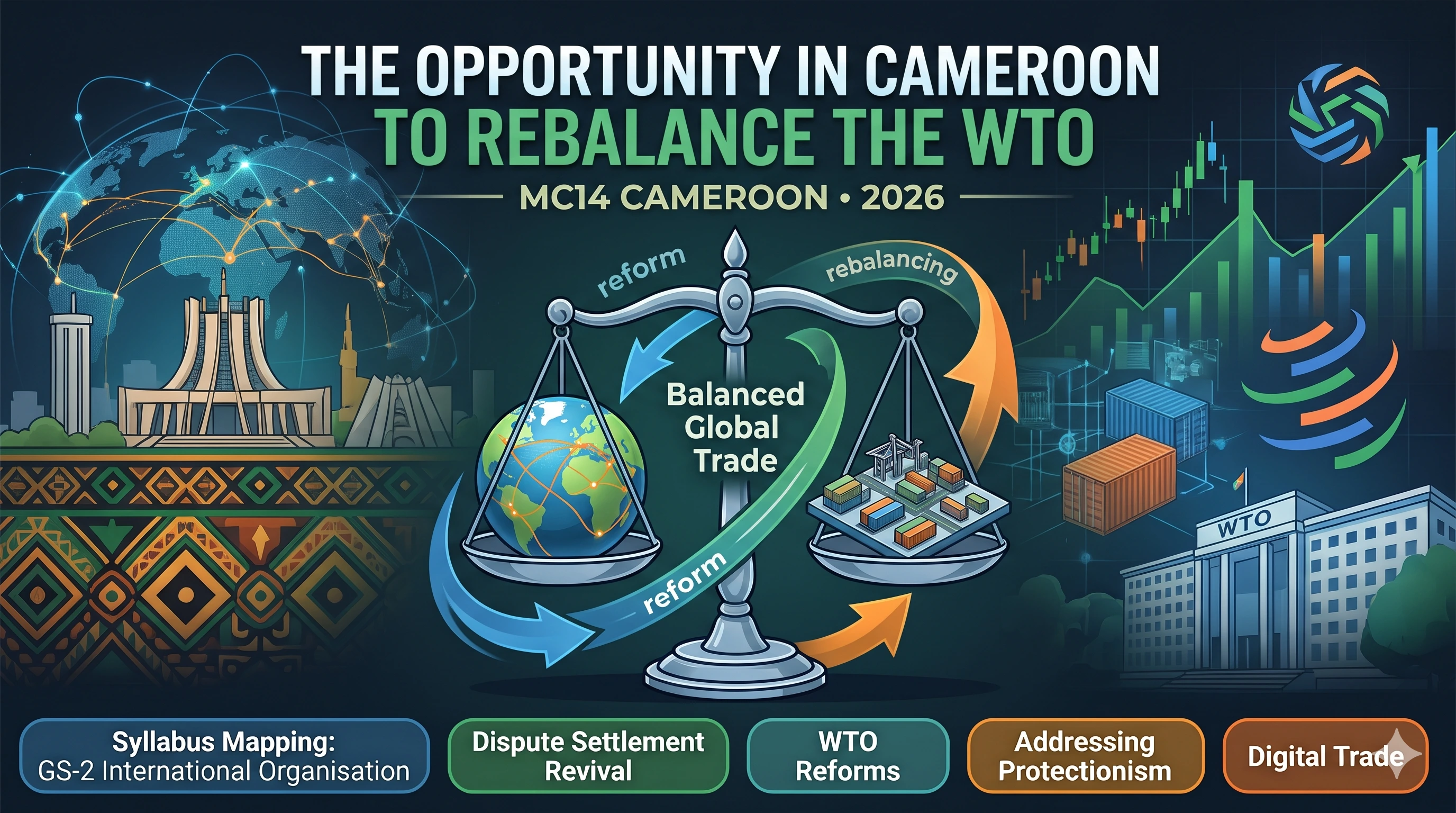
The World Trade Organization's 14th Ministerial Conference (MC14) in Cameroon (2026) occurred amidst rising trade conflicts, protectionism, and geopolitical fragmentation. This content examines the urgent need to reform the WTO, revive its dispute settlement system, and address 21st-century global trade challenges.
Introduction
Context & Background
Key Points
- •The Ministerial Conference (MC): This is the WTO’s highest decision-making body. It convenes every two years and is responsible for making decisions on all matters under any of the multilateral trade agreements, driving the organization's negotiation and reform agenda.
- •Geopolitical Strain: MC14 in Cameroon takes place against a difficult backdrop of 'wrecking-ball politics' (as noted at the Munich Security Conference). Rising protectionism and global trade conflicts severely threaten the WTO’s consensus-based framework.
- •The MFN Principle: The Most Favoured Nation (MFN) rule is the cornerstone of the WTO. It ensures that countries cannot normally discriminate between their trading partners—grant someone a special favor, and you must do the same for all other WTO members.
- •Shift to Plurilateralism: Due to the difficulty of achieving a full consensus among all 166 members, there is an increasing reliance on plurilateral agreements (deals made by a smaller subset of member nations) to push forward agendas like digital trade and investment facilitation.
World Trade Organization (WTO) at a Glance
| Feature | Details | Bookmark |
|---|---|---|
| Establishment | 1995 (Replaced GATT under the Marrakesh Agreement) | |
| Headquarters | Geneva, Switzerland | |
| Membership | 166 member countries (representing ~98% of global trade) | |
| Core Objective | Promote a rules-based, non-discriminatory global trade system | |
| Key Principle | Most Favoured Nation (MFN) - equal trade treatment to all members |
Key Focus Areas for MC14 (Cameroon 2026)
| Agenda Item | Primary Objective | Bookmark |
|---|---|---|
| WTO Reforms | Modernizing consensus rules and institutional framework to handle modern economic realities. | |
| Dispute Settlement Revival | Restoring the paralyzed Appellate Body to ensure rules can be actively enforced. | |
| Digital Trade | Establishing frameworks for e-commerce and cross-border digital transmissions. | |
| Plurilateral Agreements | Advancing deals among coalitions of willing members when full multilateral consensus fails. |
Related Entities
Impact & Significance
- •Preventing Trade Wars: A functioning WTO provides a neutral ground to de-escalate trade disputes. Without its rules, the global economy risks fracturing into competing, tariff-heavy geopolitical blocs.
- •Protecting Developing Nations: The multilateral system ensures that smaller, developing economies have a voice and are not bullied by larger economic powers in bilateral negotiations.
- •Regulatory Certainty for Business: Global supply chains rely on the predictable, non-discriminatory rules enforced by the WTO. Reforming the institution ensures continuity for international businesses.
- •Digital Trade Expansion: As the global economy digitizes, WTO agreements are critical for preventing arbitrary taxes on cross-border data flows and e-commerce.
Challenges & Criticism
- •Consensus Paralysis: Because the WTO requires unanimous agreement among its 166 members, a single country can veto global trade rules, making the institution slow and rigid.
- •Dispute Settlement Crisis: The WTO’s 'supreme court' (the Appellate Body) has been essentially non-functional for years due to the blocking of judge appointments, rendering the organization unable to enforce its own rules.
- •The Plurilateral Dilemma: To bypass gridlock, willing nations are forming 'plurilateral' agreements. Critics argue this undermines the inclusive, multilateral spirit of the WTO, leaving developing nations behind.
- •Ignoring Modern Realities: Critics argue that the WTO's original frameworks are outdated, struggling to regulate state-subsidized enterprises, climate-related trade barriers, and modern digital services.
Future Outlook
- •Institutional Overhaul: The WTO must adapt its consensus-based decision-making process, which currently allows a single member to paralyze global agreements, to remain relevant in the 21st century.
- •Restoring the Appellate Body: Reforming and unblocking the appointment of judges to the Dispute Settlement Body is essential so that the WTO can enforce its rules and resolve member conflicts.
- •Adapting to the Digital Economy: Creating permanent, binding frameworks for global e-commerce and digital services to prevent a fragmented, tariff-heavy digital landscape.
- •Integrating Plurilaterals: Developing a legal mechanism to seamlessly fold plurilateral agreements into the broader WTO framework without alienating developing nations that choose not to participate.
UPSC Relevance
- • GS-2 (International Relations): Important International institutions, agencies and fora - their structure, mandate, and functioning (Syllabus Mapping).
- • GS-3 (Economy): Effects of liberalization on the economy, changes in industrial policy and their effects on industrial growth.
- • Mains Focus: Analyzing the relevance of the WTO in an era of protectionism, the crisis in its dispute settlement mechanism, and the role of developing nations like India in WTO reforms.
- • Essay Topics: 'The future of multilateralism in a fragmented world', 'Protectionism vs. Free Trade: The modern dilemma'.
Sample Questions
Prelims
Consider the following statements regarding the World Trade Organization (WTO):
- (a)The WTO was established under the Marrakesh Agreement, replacing the General Agreement on Tariffs and Trade (GATT).
- (b)The Most Favoured Nation (MFN) principle allows WTO members to grant special trading favors to specific allies without extending them to others.
- (c)The Ministerial Conference is the highest decision-making body of the WTO and generally meets every two years.
Mains
The 14th Ministerial Conference (MC14) of the WTO highlighted the urgent need to rebalance the multilateral trading system. Discuss the structural challenges currently paralyzing the WTO and suggest necessary reforms to restore its global mandate.
Introduction: Introduce the WTO, its origin (Marrakesh Agreement, 1995), its core mandate, and the context of the recent MC14 in Cameroon, emphasizing the threat of 'wrecking-ball politics'.
Body:
• Structural Challenges: Paralysis of the Dispute Settlement Mechanism (Appellate Body crisis); Consensus-based decision making leading to gridlock; Rise of protectionist policies and unilateral tariffs by major economies.
• Emerging Issues: Inability to govern new economic domains efficiently (e.g., digital trade, e-commerce moratoriums, environmental tariffs) leading to the rise of fragmented 'plurilateral' agreements.
• Necessary Reforms: Restoring the two-tier dispute settlement system; updating trade rules to reflect 21st-century realities (services, digital economy); balancing the varying development needs of Global South nations with standard multilateral rules.
Conclusion: Conclude by emphasizing that while plurilateral agreements offer a temporary bypass, a fully functional, consensus-reformed WTO remains indispensable to protect developing countries and ensure a predictable, rules-based global economic order.