
General Awareness · SSC CGL Notes
History — SSC CGL General Awareness Notes
Free SSC CGL notes with rules, shortcuts, worked examples and practice questions for every topic. 119 topics.
Open in the interactive reader: bookmarks, progress tracking and read-aloud.
Ancient India: sources, states and ideas
Link archaeological evidence, inscriptions and texts to the claim they can actually support; then place rulers and ideas in the correct period.
Core evidence and chronology
Harappan cities are known through archaeology: planned streets, drains, baked-brick structures, seals, weights and craft remains. The script is still undeciphered, so historians do not read Harappan political history from long written narratives. Copper and bronze were used; iron is associated with later periods.
The Mauryan Empire reached its greatest extent under Ashoka. His inscriptions communicate dhamma and are major contemporary sources. Most were in Prakrit and written in Brahmi, while Kharosthi was used in the north-west; some inscriptions used Greek and Aramaic. After the Kalinga war, Ashoka publicly expressed remorse and promoted dhamma.
Buddhism and Jainism grew amid debates on conduct, suffering, rebirth and liberation. The Buddha’s first sermon is associated with Sarnath; Mahavira is regarded as the twenty-fourth Tirthankara. During the Gupta age, the Prayaga Prashasti composed by Harishena praised Samudragupta, Faxian visited India during Chandragupta II’s reign, and Aryabhata composed the Aryabhatiya.
Example 1: identify the source limit
A seal with short signs proves that the Harappans used writing, but it does not reveal a king’s biography because the script has not been deciphered. A claim about drainage can instead be checked against excavated street drains.
Example 2: combine language and region
If an Ashokan inscription is from the north-west, Kharosthi is a plausible script. The claim that every edict was in Sanskrit is false because most were in Prakrit and a few used Greek or Aramaic.
Example 3: connect person, text and reign
Harishena—Prayaga Prashasti—Samudragupta forms one chain. Faxian—Chandragupta II and Aryabhata—Aryabhatiya form two different chains; mixing their roles creates a distractor.
Common errors
Do not treat a later literary tradition as contemporary archaeological evidence. Avoid absolute words such as every and only. Keep Ashoka in the Mauryan period and Samudragupta and Chandragupta II in the Gupta period.
Revision points
Revise in three columns: evidence, fact supported and limitation. Memorise the chains Harappan archaeology, Ashoka-inscriptions-dhamma, Buddha-Sarnath, Mahavira-24th Tirthankara and Harishena-Samudragupta.
Medieval India: dynasties, administration and devotional traditions
Solve medieval-history sets by separating chronology, administrative terms and religious traditions before testing each statement.
Dynasties and administration
The principal Delhi Sultanate dynasties followed the order Mamluk or Slave, Khalji, Tughlaq, Sayyid and Lodi. An iqta was a revenue assignment whose holder performed administrative and military duties; it was not automatically hereditary private property.
Under the Mughals, a mansab fixed an officer’s rank. Zat indicated personal rank and salary status, while sawar indicated the cavalry obligation. Akbar’s revenue arrangements associated with Todar Mal used measurement, classification and assessed rates; the dahsala method used a ten-year basis. Sulh-i kul expressed universal peace and tolerance in governance.
Bhakti and Sufi traditions were diverse, but many teachers used accessible languages and stressed devotion or inward spirituality. Kabir criticised empty external ritual and sectarian divisions. Guru Nanak taught devotion to one God and rejected status based on caste. Chishti khanqahs became centres of teaching, hospitality and charity.
Example 1: order the Sultanate dynasties
Place Khalji before Tughlaq and Sayyid before Lodi. The complete chain is Mamluk → Khalji → Tughlaq → Sayyid → Lodi.
Example 2: decode a mansab
In a rank written as 2,000 zat and 1,000 sawar, 2,000 describes personal rank while 1,000 concerns the cavalry obligation. Reversing them is a common distractor.
Example 3: compare traditions carefully
Kabir’s critique of ritual, Nanak’s teaching of one God and Chishti hospitality can all be correct together. A claim that every Bhakti teacher rejected vernacular language fails because many used regional languages.
Common errors
Do not confuse iqta with mansab or jagir. Do not reverse zat and sawar. Avoid treating Bhakti or Sufism as a single uniform organisation; identify the named teacher or order.
Revision points
Use three quick chains: five Sultanate dynasties; zat-person and sawar-cavalry; Kabir-ritual critique, Nanak-one God, Chishti-khanqah.
Modern India: rebellion, nationalism and mass movements
Anchor events by date, place, leadership and issue; distinguish an immediate trigger from wider causes and association from proof.
Revolt and national movement
The uprising of 1857 began among sepoys at Meerut and moved to Delhi, where Bahadur Shah Zafar became its symbolic leader. The cartridge controversy was an immediate trigger, while annexations, military grievances, dispossession and local political-economic discontent widened the revolt. It had major regional centres but no uniform command across all India.
For chronology, fix a few anchors: Partition of Bengal in 1905, Surat split in 1907, Lucknow Pact and Home Rule activity in 1916, and the launch of the Non-Cooperation Movement in 1920. Chronology questions often replace one event with another from the same decade.
Gandhi’s early Indian satyagrahas linked method to a specific issue: Champaran in 1917 concerned indigo cultivators; the Ahmedabad dispute of 1918 involved mill workers; Kheda in 1918 concerned revenue relief after crop failure. The 1930 Dandi March challenged the salt law and opened the Civil Disobedience Movement.
Example 1: trigger versus causes in 1857
Greased cartridges help explain the immediate military outbreak, but they do not replace annexation, service grievances and local discontent. Therefore, an option calling cartridges the only cause is too absolute.
Example 2: build a four-event timeline
Arrange 1905, 1907, 1916 and 1920 first; then attach Bengal Partition, Surat split, Lucknow Pact and Non-Cooperation respectively. This prevents two events from the same phase being reversed.
Example 3: match movement and constituency
Champaran—indigo cultivators, Ahmedabad—mill workers, Kheda—revenue-paying peasants and Dandi—salt law are four separate pairs. A correct answer must preserve every pair.
Common errors
Do not call the revolt of 1857 uniform across every region. Do not confuse Non-Cooperation with Civil Disobedience. Keep Ahmedabad and Kheda in 1918 but distinguish labour wages from land revenue.
Revision points
Revise with a date-place-issue table. For every movement, ask who participated, what demand was made, which method was used and what evidence limits a broad claim.
Ancient India: SSC rapid-reference facts
Classify the source first, then connect high-frequency sites, inscriptions, rulers, texts and travellers without mixing their periods.
Source vocabulary adapted for SSC
Archaeology studies material remains; epigraphy studies inscriptions; numismatics studies coins; palaeography studies ancient writing. Prehistory lacks writing, while protohistory may have an undeciphered script. The Harappan civilisation is protohistoric because its signs survive but remain undeciphered.
Important Harappan associations include Mohenjo-daro—Great Bath, Dholavira—reservoirs and a three-part settlement, Lothal—dockyard and craft activity, and Kalibangan—an excavated ploughed field. Such pairs are archaeological interpretations; a seal or structure should be matched to the site where it was found.
High-frequency source chains include Ashoka—rock and pillar edicts—dhamma; Maski—explicit use of Ashoka’s name; Rummindei—Lumbini; and Dhauli/Jaugada—Separate Kalinga Edicts. For Buddhism, remember First Council—Rajagriha—Mahakassapa, Second—Vaishali—monastic discipline and Third—Pataliputra—Ashoka—Moggaliputta Tissa. Gupta chains include Samudragupta—Prayaga Prashasti—Harishena; Chandragupta II—Vikramaditya—Faxian; Kumaragupta I—conventional association with Nalanda; and Aryabhata—Aryabhatiya.
Example 1: distinguish disciplines
A coin question belongs to numismatics, an inscription question to epigraphy and a question about the changing shapes of Brahmi letters to palaeography. Archaeology is the broader study of material remains.
Example 2: eliminate a wrong site pair
Dholavira—reservoirs and Lothal—dockyard are valid pairs. If an option assigns the Great Bath to Kalibangan instead of Mohenjo-daro, eliminate it.
Example 3: build a Gupta source chain
The Prayaga Prashasti was composed by Harishena for Samudragupta; Faxian is associated with Chandragupta II. A distractor that exchanges the ruler linked to either source breaks the chain.
Common errors
Do not confuse a language with a script: Prakrit is a language, while Brahmi and Kharosthi are scripts. Do not assume that inscriptions or royal praises are neutral; read them with their purpose in mind.
Revision points
Revise four lists: source disciplines, Harappan site-feature pairs, Ashokan language-script pairs and Gupta ruler-source-person pairs.
Medieval India: SSC dynasty and administration map
Use dynasty sequences and term-function pairs to organise Sultanate, Mughal, Bhakti and Sufi facts into a single revision map.
High-frequency rulers and systems
The Delhi Sultanate sequence is Mamluk, Khalji, Tughlaq, Sayyid and Lodi. Iltutmish consolidated the early Sultanate and organised the iqta system; Alauddin Khalji is associated with market controls, horse-branding or dagh and descriptive rolls of soldiers; Muhammad bin Tughlaq with token currency and the attempted transfer of the capital; and Sikandar Lodi with the foundation of Agra. Din-i Ilahi belongs to Akbar, not Firoz Shah Tughlaq.
In the Sultanate, the iqta linked revenue assignment to service. In Mughal administration, mansab meant rank, zat indicated personal status and sawar the cavalry obligation; most mansabdars received jagir assignments rather than ownership of the land. Akbar’s reign is also associated with Todar Mal’s revenue arrangements and the policy of sulh-i kul.
Bhakti and Sufi traditions were diverse. Kabir criticised ritual boundaries, Guru Nanak stressed devotion to one God and social equality, and Chishti centres offered teaching and hospitality. High-frequency pairs include Nizamuddin Auliya—Chishti, Basavanna—Virashaiva/Lingayat and Chaitanya—Krishna devotion. Match each saint’s language, region and teaching individually rather than attributing one feature to every movement.
Example 1: ruler and policy
Alauddin Khalji—market controls is correct, while token currency belongs to Muhammad bin Tughlaq. Exchanging these policies creates a standard SSC distractor.
Example 2: assignment versus ownership
An iqta or jagir assigned revenue for service or salary; it did not automatically give permanent private ownership of the soil. Test questions often hide the error in the word hereditary or absolute.
Example 3: devotional traditions
Kabir, Guru Nanak and the Chishti saints can share criticism of narrow social divisions, but their institutions and teachings were not identical. Evaluate the named person or order, not a sweeping claim about all saints.
Common errors
Do not place Lodi before Sayyid, assign Muhammad bin Tughlaq’s experiments to Alauddin Khalji, or treat mansab and jagir as synonyms. Avoid absolute statements about every Bhakti or Sufi teacher.
Revision points
Memorise one five-dynasty chain, four ruler-policy pairs, the iqta and mansab distinctions, and three saint-order associations.
Modern India: SSC movement timeline and leader map
Revise modern history through date-event, centre-leader and movement-issue pairs, while separating immediate triggers from structural causes.
Revolt, nationalism and mass action
For 1857, connect Meerut with the outbreak, Delhi with Bahadur Shah Zafar and Bakht Khan, Kanpur with Nana Saheb and Tantia Tope, Lucknow with Begum Hazrat Mahal, Jhansi with Rani Lakshmibai, and Bihar with Kunwar Singh. The cartridge issue was the immediate trigger; political annexation, economic disruption and military grievances formed the wider background.
Use this national-movement spine: Indian National Congress founded in 1885; Bengal partition in 1905; Surat split in 1907; Lucknow Pact and Home Rule leagues in 1916; Rowlatt agitation and Jallianwala Bagh in 1919; Non-Cooperation in 1920; Dandi March and Civil Disobedience in 1930; Quit India in 1942. For constitutional landmarks, remember 1909—separate electorates for Muslims, 1919—dyarchy in provinces, and 1935—provincial autonomy with dyarchy proposed at the Centre; the 1935 Act did not immediately create fully responsible central government.
Gandhi’s local interventions preceded the nationwide movements: Champaran (1917) concerned indigo cultivators, Ahmedabad (1918) mill workers and Kheda (1918) revenue relief. Non-Cooperation involved surrendering honours and boycotting institutions; Civil Disobedience went further by openly breaking specified colonial laws, beginning prominently with the salt law.
Example 1: centre and leader
Begum Hazrat Mahal belongs with Lucknow and Kunwar Singh with Bihar. If the two leaders are exchanged, both pairs fail even though each name belongs to 1857.
Example 2: chronological anchors
Place 1905, 1907, 1916, 1919, 1920, 1930 and 1942 on a line before attaching events. This prevents the Lucknow Pact, Rowlatt agitation and Non-Cooperation from being reversed.
Example 3: distinguish two movements
Non-Cooperation centred on withdrawal and boycott; Civil Disobedience added deliberate violation of laws such as the salt law. The Dandi March therefore belongs to Civil Disobedience, not Non-Cooperation.
Common errors
Do not make cartridges the only cause of 1857, confuse a local leader’s centre, place Surat before Bengal partition, or attach the Salt March to the 1920 movement.
Revision points
Prepare three one-line maps: six centres of 1857, eight national-movement dates and the Champaran-Ahmedabad-Kheda issue triangle.
Stone Age (Prehistory in Detail) - The Evolution of Man
The Stone Age refers to the prehistoric period when humans primarily used stone tools . It is divided into three phases: Paleolithic (Old), Mesolithic (Middle), and Neolithic (New). This age shows the major transformation from nomadic hunting-gathering (food consumers) to agriculture and settled communities (food producers)—a shift known as the Neolithic Revolution .
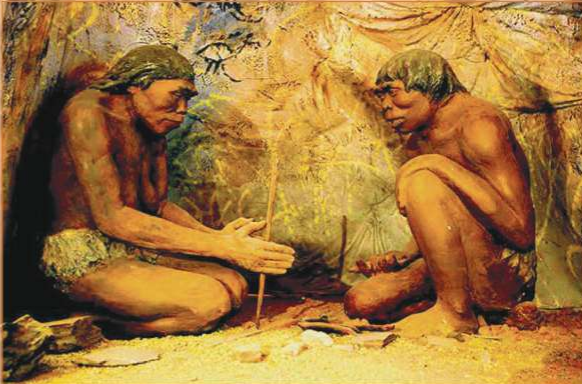
1. Paleolithic Age (Old Stone Age: The Hunter)
Time period: ~2 million BCE – 10,000 BCE (The longest phase).
Lifestyle: Strictly nomadic hunter-gatherers , dependent on nature for food, living in natural caves.
Tools: Crude, large hand axes, choppers, scrapers (made by chipping stone).
Key Discovery: Fire was discovered and used for cooking, protection, and warmth.
Major Indian sites: Soan Valley, Bhimbetka (Madhya Pradesh - famous for cave shelters).
2. Mesolithic Age (Middle Stone Age: The Transition)
Time period: ~10,000 BCE – 8,000 BCE (Transitional Phase).
Tools (Hallmark): Microliths (tiny, sharp stone blades fitted into wood or bone handles), making hunting much more efficient.
New Practices: Began domestication of animals (dogs and cattle) and produced extensive rock art .
Major Indian sites: Bagor (Rajasthan) and Adamgarh (Madhya Pradesh) provide early evidence of animal rearing.
3. Neolithic Age (New Stone Age: The Farmer)
Time period: ~8,000 BCE – 3,000 BCE (The Revolution).
Key Shift: Started Agriculture (wheat, barley, rice) and became food producers (the Neolithic Revolution ).
Settlement: Established permanent settlements with mud-brick houses.
Tools: Polished stone axes , sickles, and grinding stones (more refined and specialized).
Inventions: Pottery (for storing grain surplus and cooking) and weaving.
| Phase | Tool Quality | Key Features (Hallmark) | Economic Status |
|---|---|---|---|
| Paleolithic | Crude Stone Tools | Fire Discovery, Cave Dwelling | Nomadic Hunter-Gatherer |
| Mesolithic | Microliths (Tiny/Sharp) | Early Domestication, Rock Art | Semi-Nomadic; Transition |
| Neolithic | Polished Tools | Agriculture , Pottery, Permanent Settlements | Settled Food Producer |
Prelims tips
- Bhimbetka caves (MP) are a UNESCO World Heritage Site with the oldest rock paintings.
- Microliths are the hallmark tool of the Mesolithic age .
- Mehrgarh (Balochistan) is the earliest site showing the transition to agriculture (Neolithic).
- Burzahom (Kashmir) is unique for pit-dwellings and dog burials with humans .
Mains points
- The Stone Age is the foundation of human civilization, highlighting the transition from nomadic dependence to settled life and food production.
- The Neolithic Revolution (start of agriculture) is the most significant technological and social shift, laying the groundwork for population growth and social complexity.
- Archaeological evidence from sites like Mehrgarh demonstrates the independent origin of agriculture in the Indian subcontinent.
- The technological evolution from crude axes to microliths and polished tools demonstrates progressive human adaptation and ingenuity in response to environmental changes.
Did you know?
- Bhimbetka cave paintings are believed to be over 30,000 years old, showing continuity across Paleolithic and Mesolithic ages.
- Burzahom site in Kashmir shows dog burials along with humans, indicating early ritual practices.
- In many Neolithic communities, pottery was important for cooking and storage; its appearance varies by region and it is not a universal Neolithic invention.
- The Stone Age lasted for millions of years, illustrating the extremely slow pace of early human development.
Stone Age Tools and Settlements (The Material Evolution)
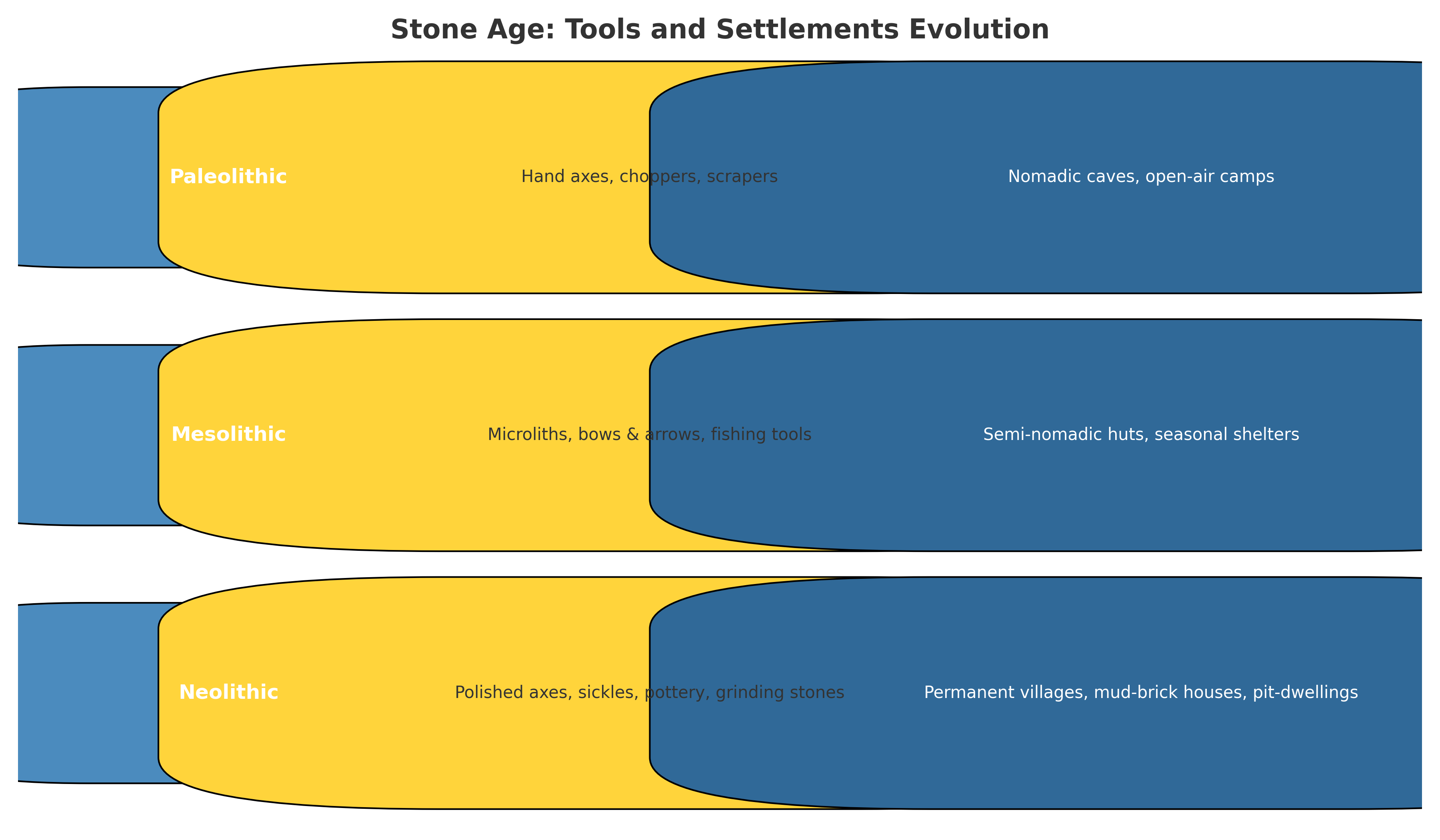
Stone Age humans showed progressive ingenuity. They developed tools made of stone, bone, and wood , which evolved from crude hand-axes (Paleolithic) to tiny, efficient microliths (Mesolithic), and finally to polished tools (Neolithic). Settlements also dramatically evolved from temporary caves and open-air sites to permanent agricultural villages .
0. Read This First (Beginner’s Map)
Timeline (rough, South Asia): Paleolithic ≈ 2.5 million–10,000 BCE → Mesolithic ≈ 10,000–6,000 BCE → Neolithic ≈ 7,000–2,500 BCE (overlaps by region) → Chalcolithic ≈ 3,000–1,000 BCE .
Easy memory hook: Big & rough (Paleo) → Small & sharp (Meso) → Polished & farming (Neo).
1. Paleolithic Tools and Settlements (The Survival Kit)
Tools: Hand-axes, cleavers, choppers, scrapers made by striking large flakes off cores (Acheulean/Soanian traditions in India).
Key Technology: Fire for protection, cooking, warmth; simple clothing from hides.
Food: Hunting, fishing, gathering wild fruits, tubers; no agriculture yet.
Settlement: Nomadic ; temporary use of caves and open-air camps near water and raw material sources.
Key Sites: Bhimbetka (Madhya Pradesh—rock shelters, art), Kurnool caves (Andhra Pradesh).
2. Mesolithic Tools and Settlements (Specialized Hunting)
Hallmark Tools: Microliths —tiny blades set into wood/bone handles to form composite tools (arrows, spears, sickles, harpoons).
Technology: Evidence of bows and arrows , better fishing gear; early domestication (dog, later cattle/goat).
Food: Hunting-gathering continues with seasonal fishing and limited plant tending.
Settlement: Semi-nomadic ; seasonal camps near rivers/forests; simple huts.
Key Sites: Bagor (Rajasthan—animal remains/domestication), Adamgarh (Madhya Pradesh).
3. Neolithic Tools and Settlements (The Agricultural Revolution)
Tools: Polished stone axes (celts) , grinding stones , pestles, querns; specialized sickles for harvesting.
Material culture: Pottery for cooking/storage and weaving are documented in many regional Neolithic communities; the wheel appears later in some regions and should not be treated as a universal Neolithic marker.
Food: Agriculture (wheat, barley; later rice by region) and animal domestication (cattle, sheep, goats).
Settlement: Permanent villages with mud-brick houses; storage pits; sometimes pit-dwellings in colder regions.
Key Sites: Mehrgarh (Balochistan—early farming/animal herding), Burzahom (Kashmir— pit-dwellings , dog burials ), Chirand (Bihar).
4. From Stone to Metal (Bridge to Chalcolithic)
Chalcolithic = Copper + Stone together; beginning of metals for tools/ornaments; sets stage for Bronze Age urbanism.
Change driver: Surplus food → craft specialization → exchange networks → proto-urban growth.
5. Megalithic–Iron Age Cultures (High-Yield South India)
What 'megalithic' means: A burial tradition marked by large stones. It is not a single ethnic group or one uniform culture, and megaliths occur in several regions and periods.
South Indian context: The Iron Age megalithic cultures of peninsular India are conventionally dated broadly to c. 1200–300 BCE, with regional variation. They followed local Neolithic phases and overlapped with early historic developments.
Material clues: Burials commonly yield iron implements, Black-and-Red Ware, beads and other grave goods. These indicate craft, agro-pastoral and hunting activities; grave goods alone do not prove a detailed belief system.
Sites to map: Brahmagiri and Maski (Karnataka), Adichanallur (Tamil Nadu), and Junapani near Nagpur (Maharashtra).
UPSC distinction: Black-and-Red Ware occurs in more than one archaeological context. Do not identify it only with one culture or use it as a stand-alone date marker.
| Phase | Hallmark Tools | Settlement Type | Key Site Feature |
|---|---|---|---|
| Paleolithic | Crude Hand axes, Choppers | Nomadic (Caves, Open-air Camps) | Fire Use |
| Mesolithic | Microliths (Tiny Blades), Bows & Arrows | Semi-nomadic (Seasonal Huts) | Early Animal Domestication |
| Neolithic | Polished Axes , Pottery, Grinding Stones | Permanent Villages (Mud-brick Houses) | Agriculture and Pit-Dwellings (Burzahom) |
Prelims tips
- Microliths are the hallmark of the Mesolithic Age, although they also occur in some Upper Palaeolithic and later contexts.
- Burzahom (Kashmir) is famous for distinctive pit-dwellings, bone tools and burials. Interpretations of the reported dog–human burial association should be stated cautiously.
- Mehrgarh is among the earliest agricultural settlements in South Asia.
- Polished tools , hallmark of finer craftsmanship, belong to the Neolithic period .
The Mesolithic Age: Key Sites and Features
The Mesolithic Age, or Middle Stone Age, served as a transitional period between the nomadic Paleolithic lifestyle and the settled agricultural Neolithic life. Its cultural hallmark is the use of Microliths (tiny stone tools) and the earliest evidence of animal domestication and extensive rock art.
Characteristics of the Mesolithic Age
Climate Change: End of the Ice Age and warming climate led to dense forests and new fauna, demanding smaller, specialized tools.
Tools: Microliths —small, sharp, geometric stone pieces (triangles, crescents) that were composite tools (spear points, arrowheads, saw blades).
Economy: Hunting and gathering persisted, but fishing became more important. Introduction of primitive animal husbandry (domestication of dog, goat, sheep, cattle).
Art: Bhimbetka and Adamgarh sites showcase rich rock paintings depicting animals, hunting scenes, and community life.
Burials: Graves were generally extended (laid out flat) or flexed (knees bent), often containing grave goods like ornaments and microliths, suggesting belief in the afterlife.
Key Indian Mesolithic Sites
Bagor (Rajasthan): One of the largest Mesolithic sites in India, providing the earliest evidence of animal domestication in the subcontinent.
Adamgarh (Madhya Pradesh): Provides early evidence of animal domestication (along with Bagor).
Langhnaj (Gujarat): Known for hunting tools, animal bones, and human skeletons.
Sarai Nahar Rai and Mahadaha (Uttar Pradesh): Known for human skeletons and clear evidence of semi-nomadic community organization.
Prelims tips
- Microliths are the exclusive tool of the Mesolithic period.
- Bagor is the most important Mesolithic site for early domestication.
- The shift from big core tools to tiny microliths is crucial.
- Mesolithic culture marked the beginning of animal domestication in India.
Mains points
- The Mesolithic Age adapted human survival techniques to the post-Ice Age environment, facilitating the eventual transition to agriculture.
- The evidence of animal domestication at Bagor and Adamgarh highlights the shift in human-animal relationship from purely hunting to co-existence.
- The extensive rock art provides invaluable insights into the social structure, rituals, and world-view of Mesolithic communities.
The Neolithic Age: Key Sites and Features
The Neolithic Age is broadly marked by food production and polished stone tools. The timing and combination of agriculture, pottery, animal husbandry, and permanent settlement differed considerably across regions.
Characteristics of the Neolithic Age
The Revolution: The beginning of agriculture (cultivation of crops like wheat, barley, rice) and large-scale animal domestication led to a food surplus.
Tools: Hallmark is the use of polished and ground stone tools (celts, grinding stones, sickles) which were more efficient for clearing forests and harvesting crops.
Settlement: Many regional Neolithic communities developed permanent or seasonally permanent villages, with varied house forms and storage practices.
Pottery: Pottery occurs in many Neolithic communities and was useful for cooking and storage. It is regionally variable; Northern Black Polished Ware belongs to a much later early-historic context, not the Neolithic.
Key Indian Neolithic Sites
Mehrgarh (Pakistan - Balochistan): Earliest evidence of agriculture (wheat, barley) and animal rearing (cattle) in the Indian subcontinent, dating back to c. 7000 BCE.
Burzahom (Kashmir): Important for its pit-dwellings, bone tools, and burials of dogs; interpretations of any dog–human burial association should be stated cautiously.
Chirand (Bihar): Known for tools made of bone and antlers (a rare use of bone tools in this period).
Koldihwa and Mahagara (Uttar Pradesh): Important Neolithic sites with reported carbonised rice remains, often dated broadly to the 7th–6th millennium BCE. Their dates and the status of early rice cultivation should be presented cautiously.
Maski and Brahmagiri (South India): Known for Megalithic burials and transition to the Iron Age.
Prelims tips
- Neolithic Revolution : Agriculture, polished tools, and pottery.
- Mehrgarh : Earliest site with evidence of wheat and barley farming.
- Koldihwa–Mahagara : Important early evidence for rice in the Belan Valley; avoid treating one site as an uncontested ‘earliest’ for South Asia.
- Burzahom : Unique for pit-dwellings and dog burial rituals.
Mains points
- The Neolithic Revolution was a global phenomenon, but sites like Mehrgarh suggest an independent and early origin of farming in the Indian subcontinent.
- The establishment of permanent settlements created the structural basis for complex social organization and the development of Protohistoric urbanism (Indus Valley Civilization).
- Regional variations, such as pit-dwellings in Burzahom and bone tools in Chirand, highlight the diverse adaptations of Neolithic communities across India.
Chalcolithic Age (Copper Age)
The Chalcolithic Age, also called the Copper Age, was the transitional phase between the Neolithic and Bronze Age. It is marked by the first use of copper along with stone tools, growth of agriculture, pottery, and village settlements.
Beginner’s Quick Map
Timeline: ~3000–1000 BCE (varies by region). Think: Neo → Chalco → Bronze .
Core idea: Stone tools continue, but copper joins in. Villages get bigger, storage improves, and pottery styles become the key cultural signatures.
Memory hook: ‘COP’ = C opper tools + O rnamented pottery + P ermanent villages.
General Features
Materials & Tools: Copper blades, chisels, pins, bangles alongside stone celts and microliths.
Agriculture: Wheat, barley, rice (by region), pulses, millets; granaries and storage bins common.
Animals: Cattle, sheep, goat, buffalo; evidence of dairying and pastoral movement around villages.
Pottery: Distinct regional styles— Black-and-Red Ware (BRW) , black-painted red wares, red-slipped wares.
Houses: Mud-brick and wattle-and-daub; some sites show fortified or planned layouts.
Burials: Extended/urn burials, grave goods (pots, beads, tools) → belief in afterlife and emerging status differences.
Textiles: Cotton cultivation and weaving evident (spindle whorls, impressions).
Social life: Village-level chiefs/elite households; craft specialization grows (potters, metal workers).
Major Chalcolithic Cultures in India
Ahar–Banas (Rajasthan): Black-and-Red Ware with white designs; copper tools; stone blades; evidence of copper smelting (Ahar, Gilund).
Malwa (MP & adjoining Maharashtra): Fortified/large settlements; wheel-made pottery with black designs on orange/red (Navdatoli, Eran, Kayatha).
Jorwe (Maharashtra Deccan): Red ware with black geometric motifs; granaries ; hierarchical village planning (Jorwe, Inamgaon, Daimabad).
Kayatha (MP): Transitional—late Neolithic traits + early copper; neat red-slipped pottery with paint (Kayatha near Ujjain).
Other Deccan groups: Savalda (rectangular houses, coarse handmade pottery). Key sites: Daimabad (copper hoard), Inamgaon (planned settlement, burials).
Why it matters (UPSC lens)
Bridges Neolithic subsistence and later urban complexity (Bronze/Iron).
Regional cultures = excellent site–pottery–feature mapping for prelims and mains.
Clear evidence of surplus , crafts , and social layering in rural India.
| Aspect | Details |
|---|---|
| Tools | Copper blades and ornaments with continued stone tools |
| Agriculture | Wheat, barley, rice (regional), pulses, millets; granaries |
| Pottery | Painted red ware, Black-and-Red Ware (BRW), red-slipped wares |
| Settlements | Mud-brick/wattle-and-daub houses; some fortified/planned villages |
| Burials | Extended and urn burials with grave goods → afterlife belief |
| Economy | Agriculture, animal husbandry, copper working, cotton weaving |
| Site/Culture | State/Region | Signature |
|---|---|---|
| Ahar, Gilund (Ahar–Banas) | Rajasthan | Black-and-Red Ware, copper smelting |
| Navdatoli, Eran (Malwa) | Madhya Pradesh | Fortified/large village, painted pottery |
| Kayatha | Madhya Pradesh | Transitional, red-slipped ware |
| Jorwe, Inamgaon, Daimabad | Maharashtra (Deccan) | Red ware with black designs, granaries, copper hoard at Daimabad |
| Savalda | Maharashtra | Rectangular houses, coarse handmade pottery |
Prelims tips
- Chalcolithic = Copper + Stone together.
- Ahar–Banas → Black-and-Red Ware with white paint.
- Jorwe → red pottery with black geometric designs; Deccan granaries.
- Malwa → large/fortified villages; wheel-made painted ware.
- Daimabad → famous copper hoard (includes a chariot).
- Cotton cultivation attested in this period (spindle whorls/impressions).
Mains points
- Chalcolithic villages demonstrate surplus agriculture , craft specialisation and incipient hierarchy without full urbanism.
- Regional diversity (Ahar, Malwa, Jorwe, Kayatha) illustrates local adaptations in pottery, planning and economy.
- Copper use remained selective ; stone technology continued—showing gradual techno-economic change.
- Burial goods reflect belief systems and stratification—useful for social reconstruction.
Did you know?
- The Daimabad hoard includes a copper chariot, animals, and figurines—showcasing remarkable metal casting skill.
- Inamgaon shows planned lanes and storage—rural planning before big cities.
- Different regions developed easily recognisable pottery identities —handy for exam mapping.
Indus Valley Civilization (IVC): Background and Origin
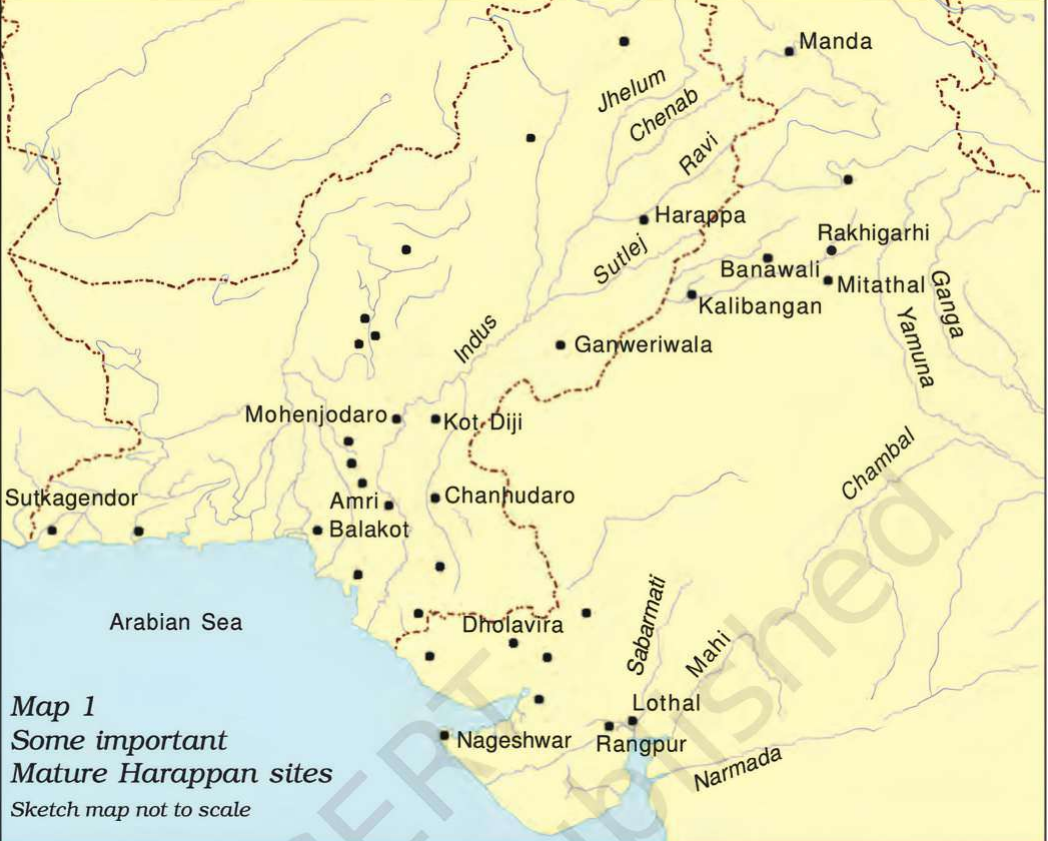
The Indus Valley Civilization (IVC) , also called the Harappan Civilization , was one of the world’s earliest urban civilizations. Its mature urban phase is generally dated to c. 2600–1900 BCE; the broader Harappan sequence begins earlier and continues later in regional forms. It is a protohistoric Bronze Age culture, known for city planning, exchange networks, and craft specialization.
Background (The Basics — for beginners)
The IVC is a Bronze Age civilization because people used bronze (copper + tin) tools; bronze is stronger than pure copper, so tools lasted longer.
It is Proto-History : they had a script on seals, but it is undeciphered , so we rely mainly on archaeology (not readable texts).
It flourished along the Indus and its tributaries across today’s Pakistan and western India (Punjab, Sindh, Gujarat, Haryana, Rajasthan).
First major sites: Harappa (1921, Daya Ram Sahni) and Mohenjo-daro (1922, R.D. Banerjee) .
Famous for urban planning , standardized weights , seals , and advanced drainage .
Origin (How it Grew — simple view)
Not sudden: it evolved from local Neolithic–Chalcolithic farming cultures (steady growth in village size, storage, craft).
Early Harappan (3300–2600 BCE): move from villages to towns; grain storage increases; more trade; potters and bead-makers specialize. Mehrgarh is an early farming precursor.
Mature Harappan (2600–1900 BCE): peak urban phase with planned cities , standard bricks , writing on seals, long-distance trade.
Late Harappan (1900–1500 BCE): de-urbanization and a return to smaller, rural settlements.
Most accepted view: largely indigenous rise built on local farming, with external trade links (e.g., Mesopotamia) helping growth.
| Phase | Time Period | Key Features |
|---|---|---|
| Early Harappan | 3300–2600 BCE | Village → town transition; storage and trade begin |
| Mature Harappan | 2600–1900 BCE | Planned cities , Bronze , seals , long-distance trade |
| Late Harappan | 1900–1500 BCE | De-urbanization , rural shift, cultural thinning |
Prelims tips
- Harappa (1921, Daya Ram Sahni ); Mohenjo-daro (1922, R.D. Banerjee ).
- Mehrgarh (7000 BCE) = key precursor .
- Mature IVC: 2600–1900 BCE .
- Bronze Age with trade to Mesopotamia .
Mains points
- Answer opening: The Harappan civilisation represents South Asia's first large-scale urbanisation, distinguished by standardisation, craft production and a wide settlement network rather than by a single excavated capital.
- Urbanism: Planned streets, drainage, weights and specialised production show coordination across many sites, but they do not by themselves prove a particular political model such as a priest-king or a modern-style central state.
- Economic base: Agricultural surplus, pastoral resources, craft specialisation and exchange with regions including Mesopotamia together sustained urban life; use sites such as Dholavira, Lothal and Chanhudaro as evidence.
- Evidence and limits: The undeciphered script limits certainty. Seals, burials and figurines permit interpretations, but a mains answer should distinguish material evidence from claims about religion, gender or government.
- Decline debate: De-urbanisation after c. 1900 BCE is best explained as a regional, multi-causal process involving ecological change, shifting river systems, changing exchange networks and settlement relocation—not a single invasion theory.
- Answer conclusion: The Harappan legacy lies in the resilience and regional diversity of its post-urban communities as much as in its mature cities.
Did you know?
- Harappans cultivated cotton early; Greeks later called it ‘ Sindon ’.
- Great Bath at Mohenjo-daro is among the earliest public water tanks.
- No huge palaces/temples: religion and power looked different from Egypt/Mesopotamia.
- Standard weights suggest tightly managed trade and administration.
Important Indus Valley Civilization Sites (The Key Excavations)
The IVC had over 1,000 sites spread across modern India, Pakistan, and Afghanistan. For UPSC, it's essential to link each major site to its unique features to understand the diversity and technological sophistication of the Harappan culture.
Major Sites and Features (Crucial for Prelims)
Harappa (Punjab, Pakistan)
First site discovered (1921) — this is why the whole culture is also called “Harappan”.
Key finds: Granaries (big storage buildings for grain) outside the citadel, Cemetery R-37 (burials showing how people were laid to rest), and many seals used for trade/identity.
Beginner tip: Think “H” for Harappa and Huge grain storage.
Mohenjo-daro (Sindh, Pakistan)
Among the largest site of the IVC (often paired with Rakhigarhi).
Key structures: the Great Bath (a large tank for ritual/public bathing), a massive Granary , and an Assembly Hall (gathering space).
Key finds: the Bronze Dancing Girl (lost-wax casting, shows metal skill) and the Bearded Priest statue (elite/ritual imagery).
Beginner tip: “M” for Mohenjo-daro and Massive Bath .
Lothal (Gujarat, India)
A major Port City (coastal) — think boats and overseas trade.
Unique find: an artificial Dockyard (rectangular basin linked to sea channels) — strong proof of maritime trade.
Also known for Rice remains (rare in IVC), bead-making workshops (agate/carnelian), and fire altars (ritual spots).
Beginner tip: “Lo-‘thal’” → like “ lo ading at the thal (dock)”.
Kalibangan (Rajasthan, India)
Name means ‘ Black Bangles ’.
Unique find: clearly marked ploughed fields (furrow marks) — direct evidence of farming technique; multiple fire altars (ritual).
Beginner tip: “Kali- bang an” → bang les + ploughed fields.
Dholavira (Gujarat, India)
Urban layout is special: divided into three parts — Citadel (upper), Middle Town, and Lower Town (most IVC towns have two parts).
Key finds: very large Water Reservoirs (advanced water harvesting) and a long Harappan inscription on a signboard (rare, shows public display of signs).
Beginner tip: “Dho-la- water ” → remember water management and three -part town.
Rakhigarhi (Haryana, India)
Currently the Largest Harappan site in India (area-wise).
Evidence: wide streets, house layouts, granaries , and burials — shows a major urban center in the Saraswati-Ghaggar belt.
Beginner tip: Rakhi -garhi → tie the “largest in India” fact to your memory like a rakhi.
Mehrgarh (Baluchistan, Pakistan)
A Pre-Harappan Neolithic–Chalcolithic site (c. 7000 BCE).
Earliest agriculture and domestication in the region; pottery, storage, and village life evolved here — seen as a cultural foundation for IVC’s later urban rise.
Beginner tip: “Mehr” (more/early) → more early farming .
| Site | Region | Unique Features |
|---|---|---|
| Harappa | Punjab (Pakistan) | Granaries , seals, Cemetery R-37 |
| Mohenjo-daro | Sindh (Pakistan) | Great Bath , Dancing Girl , Bearded Priest |
| Lothal | Gujarat (India) | Dockyard , rice remains, bead-making |
| Kalibangan | Rajasthan (India) | Ploughed fields , Fire Altars |
| Dholavira | Gujarat (India) | Water reservoirs , Three-part division |
| Rakhigarhi | Haryana (India) | Largest Harappan site in India , burials |
| Surkotada | Gujarat (India) | Horse bones , fortified settlement |
| Ropar | Punjab (India) | Burial with dog and human skeletons |
| Chanhudaro | Sindh (Pakistan) | Bead-making, No Citadel (only lower town) |
| Mehrgarh | Baluchistan (Pakistan) | Precursor to Harappan culture (Early Farming) |
Prelims tips
- Harappa – Granaries and Cemetery R-37 = storage + burial evidence.
- Mohenjo-daro – Great Bath + Dancing Girl = public works + metal art.
- Lothal – Dockyard proves sea trade; remember rice remains.
- Kalibangan – Ploughed fields and fire altars = farming + ritual.
- Dholavira – Reservoirs + three-part city = unique planning.
- Rakhigarhi – largest site in India; tie this fact like a ‘rakhi’.
Indus Valley Civilization: Civic and Political Features
The IVC (especially c. 2600–1900 BCE) was remarkable for its civic planning, drainage, and fortified settlements. Archaeology does not provide unambiguous evidence for the form of its political organisation: no clearly identified royal palace, royal tomb, or deciphered record of a king has been found, so claims of monarchy or collective governance remain interpretations.
Town Planning (The Grid System)
Streets: Cities were laid out in a neat grid pattern . Main roads ran North–South and East–West and met at right angles , making navigation easy and traffic organized.
Division: Most cities had two zones — a higher Citadel (public buildings, storage, special activities) and a larger Lower Town (residential area for people).
Construction: Houses and public buildings used standardized burnt bricks (4:2:1 ratio). This meant parts were uniform, faster to build, and easier to maintain.
Houses: Usually had rooms around a central courtyard, private wells/bath areas, and doors opening to side lanes (privacy + cleanliness).
Drainage System (Civic Sense)
Civil engineering: One of the world’s earliest covered drainage systems. Drains made of baked bricks ran along streets and were covered with stone slabs or bricks.
House connection: Many excavated houses had drains leading toward street drains; soak-pits and settling jars occur at several sites. The arrangement varied by settlement and neighbourhood.
Maintenance: Inspection holes were provided at intervals for cleaning — proof of regular municipal care.
Why it matters: Shows awareness of hygiene , flood control, and urban planning far ahead of many contemporary cultures.
Fortification
Citadel platforms were raised and fortified with strong brick walls.
Uses: Likely for defense, flood protection, and to keep important buildings (granaries, halls, baths) safe.
Takeaway for exams: Fortified citadel ≠ royal palace; it’s a public/administrative zone.
Political Structure (A Puzzle)
Absence of kingship markers: No clear palaces , royal tombs , or large temples like in Egypt/Mesopotamia.
Yet high uniformity: Standardized weights, brick proportions, town-planning conventions, and seal use indicate extensive shared norms and coordination. They do not by themselves establish a particular political model.
Interpretations: Governance by elites, councils, or other institutions has been proposed; the so-called “Priest-King” figurine is not proof of kingship.
Exam hint: Write “the political organisation is debated; archaeological standardisation indicates coordination, not a proven monarchy or democracy.”
| Feature | UPSC Significance |
|---|---|
| Street Planning | Grid Pattern , right-angle roads → planned, predictable, efficient city life |
| Drainage | Covered, baked brick drains , soak-pits, inspection holes → hygiene + maintenance |
| Fortification | Citadel platforms, walls → defense + flood control; public buildings located here |
| Political Structure | No monarchy evidence ; uniform standards → collective/merchant council style governance |
Prelims tips
- Use the phrase: “ Grid roads + covered drains + citadel = IVC standard.”
- Standard bricks (4:2:1) are a signature of Harappan construction.
- Citadel ≠ palace: think public/administrative zone .
- Write “ No clear monarchy ; likely collective governance based on uniform standards and seals.”
Indus Valley Civilization: Art, Economy and Trade
The IVC economy was robust, built on agricultural surplus , specialized crafts, and extensive trade networks . Their art was expressive, with notable achievements in terracotta , bronze casting , and sealing technology—clear signs of high technical skill.
Art and Craft (High Skill Level, Simple Words)
Terracotta Figurines (baked clay): Small clay figures of animals, toys, carts, and the Mother Goddess . Terracotta simply means clay objects fired in a kiln so they become hard.
Bronze Figurines: Made by the lost-wax casting method ( Cire Perdue ): first make a wax model → cover with clay → melt the wax → pour in molten metal. Famous example: 'Dancing Girl' of Mohenjo-daro (slim figure, confident pose, detailed bangles).
Stone Sculptures: Fewer in number but very refined; the Bearded Priest shows patterned robe and headband—suggesting elite or ritual roles.
Seals (for stamping): Over 4,000, mostly square, carved on steatite (soft stone; easy to carve, turns hard after firing). They show animal motifs (bull, elephant, unicorn ) plus short undeciphered script . The Pashupati seal (figure surrounded by animals) is the most famous.
Jewellery and Beads: Gold, silver and stones like carnelian and lapis lazuli . Cities like Lothal and Chanhudaro had specialised bead-making workshops—beads were drilled with very fine tools, showing precision.
Pottery: Mostly red/black painted designs (geometric, floral). Large storage jars and fine tableware show both utility and aesthetics.
Economy (How People Earned and Stored Wealth)
Agriculture was primary: Main crops: wheat , barley ; they were the first to cultivate cotton (later called ‘Sindon’ by Greeks). Rice remains occur at sites like Lothal and Rangpur (not everywhere).
Why surplus matters: Surplus grain (kept in granaries ) feeds non-farmers (craftspeople, traders, administrators). This is how cities and specialisations grow.
Handicrafts & Metallurgy: Advanced pottery , bead-making , and metal work in copper and bronze . Crafts were often done in dedicated areas (workshops), suggesting organised production.
Animals and Tools: Oxen pulled carts and ploughs; the humped bull icon hints at its value in farming and transport.
Trade and Commerce (How Goods Moved)
Standardized weights & measures: Weights often follow multiples of 16 (16, 32, 64...). Standardisation means fair deals across far-flung towns.
Internal trade: Bullock carts and boats moved goods along roads and rivers. Seals probably marked ownership or quality (like a brand logo + tag).
External trade: Sea and land links to Mesopotamia (Sumer), Oman , Bahrain , Iran , and Central Asia . Harappans likely exported cotton textiles, beads, carnelian, shell items; they imported metals (copper, tin), lapis lazuli , and other stones.
Archaeological clues: Harappan seals found in cities like Ur and Susa ; the dockyard at Lothal shows planned maritime trade.
Beginner Memory Aids
Art = 3 S’s: Seals (trade/admin), Sculptures (bronze & stone), Storage pottery (daily life).
Economy = 3 G’s: Grain (farming), Granaries (storage), Guild-like crafts (specialists).
Trade = 3 R’s: Roads , Rivers , Routes overseas (Lothal).
| Aspect | Key Features |
|---|---|
| Art | Dancing Girl (Bronze, lost-wax), Bearded Priest (Stone), Mother Goddess (Terracotta), Seals (steatite) |
| Economy | First to cultivate cotton ; wheat & barley; granaries ; specialised workshops |
| Trade | Standard weights (16-based); Harappan seals abroad ; Lothal dockyard = maritime links |
Prelims tips
- The 'Dancing Girl' is a bronze figurine from Mohenjo-daro made via lost-wax casting.
- Harappans were the first to grow and export cotton from South Asia.
- Lothal = bead-making hub + dockyard (maritime trade).
- Harappan weights often follow a 16-based system (16, 32, 64...).
- The Unicorn is the most frequent animal motif on seals.
Indus Valley Civilization: Religion and Beliefs
Harappan religious life can only be inferred from material remains because the script is undeciphered. Seals, figurines, burials, the Great Bath, and structures sometimes called ‘fire altars’ are important evidence, but their meanings and links with later traditions remain debated.
Key Figures and Deities
Terracotta figurines: Numerous human and animal figurines occur at Harappan sites. Calling particular female figurines a ‘Mother Goddess’ is an interpretation, not an established identification.
‘Pashupati’ seal: A famous Mohenjo-daro seal shows a horned, seated figure surrounded by animals. The ‘Proto-Shiva’ or ‘Pashupati’ label is a long-standing scholarly interpretation, not a deciphered Harappan belief.
Nature Worship
Plants and animals: Pipal motifs and animal motifs, including the frequently depicted ‘unicorn’, occur on seals. Their religious or symbolic meaning cannot be read with certainty.
Great Bath: Its watertight construction and prominent location make a ritual or communal function plausible, but its exact use is not known.
Rituals and Practices
Fire installations: Structures described as ‘fire altars’ at sites such as Kalibangan and Lothal may have had ritual functions, but this identification is debated.
Small objects and ornaments: Beads, bangles, and other personal objects are common; their use as amulets cannot be assumed without contextual evidence.
Burial Practices (Belief in Afterlife)
Harappans practiced both complete burial (laying the body out) and fractional burial (burial of bones after exposure).
Some burials contain pottery and personal objects. Such grave goods may indicate mortuary practice or status, but do not by themselves prove a specific doctrine of afterlife or ancestor worship.
| Evidence / motif | Archaeological basis | UPSC-safe interpretation |
|---|---|---|
| Horned seated figure | Mohenjo-daro seal | Often called ‘Pashupati’ or Proto-Shiva, but the identification is debated. |
| Female terracotta figurines | Figurines from several sites | May have had varied uses; ‘Mother Goddess’ is an interpretation. |
| Plant and animal motifs | Pipal and animal images on seals | Their symbolic or religious meaning is unknown. |
| Great Bath | Large watertight structure at Mohenjo-daro | A ritual or communal function is plausible, not proven. |
| Fire installations | Structures at Kalibangan and Lothal | Their identification as ritual altars is debated. |
| Burials with objects | Pottery and personal objects in some graves | Shows mortuary practice; it does not prove a specific afterlife belief. |
Prelims tips
- Pashupati Seal and Dancing Girl are from Mohenjo-daro .
- Mother Goddess figurines are mostly terracotta (not bronze/stone).
- Fire Altars are key finds at Kalibangan and Lothal .
- The Unicorn is the most commonly depicted animal on Harappan seals.
Mains points
- Harappan religious practices must be reconstructed from archaeology; the absence of clearly identified large temples does not establish the nature of belief or polity.
- For UPSC answers, distinguish archaeological evidence (seals, figurines, burials, water structures) from interpretations such as Proto-Shiva, Mother Goddess, or direct continuity with later Hindu traditions.
- Do not infer a political structure from the absence of temples or palaces alone.
Decline of the Indus Valley Civilization
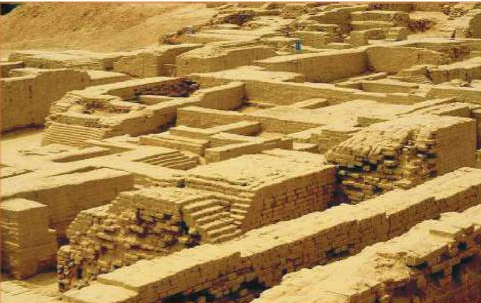
The decline of the IVC (c. 1900–1500 BCE) was a gradual process across regions—often called de-urbanization . It likely resulted from combined ecological , economic , and internal pressures, not a single invasion.
Nature and Evidence of Decline (What We Actually See)
Gradual & uneven: Big cities shrank first; people moved to smaller towns/villages.
Loss of standardisation: Weights , seal usage , and tight town planning become irregular in late layers.
Late Harappan cultures: Eg., Cemetery H (Punjab), Jhukar (Sindh), Rangpur (Gujarat) show continuity of some traditions but simpler life.
Major Causes (Easy to Remember: 3 E’s — Environment, Economy, (internal) Elasticity break)
1) Ecological & Climatic (Most accepted)
River shifts/drying: The Saraswati (Ghaggar-Hakra) system weakened; other rivers changed course → less reliable water for cities/farms.
Less rainfall: Drier climate → desertification in some zones → lower crop yields.
Flood cycles: Repeated floods (e.g., at Mohenjo-daro layers) also damaged settlements.
2) Economic & Social
Trade decline: Long-distance trade with Mesopotamia reduced after c. 1900 BCE → urban industries suffered.
Soil stress & population pressure: Overuse of land and growing cities may have lowered farm output per head.
Management limits: Without clear kingship, citywide crisis management may have been hard—standards and big projects slowed.
3) Invasion/Migration (older idea)
Earlier scholars proposed an Aryan invasion ; modern research finds no firm evidence for a sudden, large-scale military collapse. The change looks internal + environmental .
What Happened Next (Consequences)
From city to village: Crafts continued but at smaller scales; daily life became more local.
Cultural continuity: Some pottery styles, symbols, and farming practices carried into later cultures of the Gangetic plains.
Beginner Memory Aids
3 D’s: Drier climate + Damaged rivers + Declining trade.
De-urbanization = fewer big public works, more small rural settlements.
| Theory Type | Explanation |
|---|---|
| Ecological/Climatic | River shifts/drying (e.g., Saraswati ), drier climate, floods → farm/water stress ( most accepted ) |
| Economic | Trade with Mesopotamia declines; soil exhaustion; city industries weaken |
| Social/Administrative | Population/resource pressure; limited capacity to coordinate big public works |
| Invasion (older) | Large, sudden conquest not supported by current evidence |
Prelims tips
- Think De-urbanization from ~ 1900 BCE : cities shrink, villages rise.
- Saraswati (Ghaggar-Hakra) river changes are a key ecological factor.
- Invasion-only explanations are outdated ; multi-factor decline fits evidence.
- Cemetery H, Jhukar, Rangpur = important Late Harappan cultures.
Mains points
- IVC decline was a gradual, multi-factor shift, not a single catastrophic event.
- Ecology (river/climate) + Economy (trade/soil) + Administration (coordination limits) together explain the pattern.
- Transition to Late Harappan shows continuity + adaptation : smaller rural units replace mega-cities.
Did you know?
- Some Harappan pottery motifs and religious symbols survive into later Gangetic cultures—showing cultural memory.
- Large water-management at Dholavira helped the city last long even under stress—adaptation before decline.
- Late Harappan Gujarat shows rural revival , proving the farming base stayed resilient.
Early Vedic Age (Rigvedic Period) - Life in Sapta-Sindhu
The Early Vedic Age (conventionally 1500–1000 BCE) is portrayed in the Rigveda as a predominantly pastoral, kin-based society in which cattle were important. The precise workings of political assemblies and social institutions are inferred from texts and should not be labelled a modern ‘democracy’.
Geographical Location
Core area: Punjab and northwestern India , the Sapta-Sindhu (Land of Seven Rivers).
Important Rivers: Sindhu (Indus), Vitasta (Jhelum), Parushni (Ravi), Sutudri (Sutlej), and especially the praised Saraswati .
Aryans gradually moved toward the Ganga-Yamuna doab but PUNJAB remained central in this phase.
Society (Flexible and Egalitarian)
Basic units: Griha (family) → Vish (clan) → Jana (tribe). Society was tribal and patriarchal .
Women and texts: The Rigveda preserves hymns associated with women such as Ghosha and Lopamudra. It does not justify a blanket claim that women attended particular assemblies or that later practices were wholly absent; social access varied by context.
Varna: Early, flexible stage; divisions by work more than birth. Shudra reference appears once (Purusha Sukta, Mandala 10).
Wealth: Cattle (Gau) —chief measure of wealth and compensation (fines/gifts in cows).
Polity (Limited Monarchy)
Rajan: Tribe’s chief— not absolute or always hereditary.
Assemblies: Sabha, Samiti, and Vidatha are mentioned in the Rigveda. Their membership and exact functions are debated; they indicate consultation and collective activity, not a modern constitutional check on the rajan.
Key officials: Purohita (priest-adviser), Senani (war leader).
Administration: The evidence points to a comparatively less bureaucratic polity than later states. Avoid treating the absence of a standing army or a tax system as conclusively established. Gavishti is commonly glossed as a search for cows and reflects the importance of cattle conflicts.
Economy (Pastoral First)
Main occupation: Pastoralism (cattle rearing).
Agriculture: Practised (barley, wheat) but secondary to herding.
Technology: Iron unknown ; tools of copper and stone .
Trade: Barter common; cows often used as value units.
Religion (Naturalistic and Simple)
Polytheism: Deities personify natural forces.
Key deities: Indra (thunder/war; most invoked), Agni (sacrificial fire—messenger between men and gods), Varuna (cosmic order— Rita ).
Worship: Yajnas (sacrifices), hymns, prayers for worldly goods (rain, cattle, sons, victory).
Absent: No temples or idol worship in this period.
Beginner Memory Aids
Society: Jana (tribe) and kinship groups are important Rigvedic categories. Do not project the later jati system or a uniform joint-family model back onto the entire early Vedic period.
Polity = 3S: Sabha Samiti Senani (with Purohita ).
Economy = 3C: Cattle Copper Cashless (barter) .
| Aspect | Features |
|---|---|
| Geography | Punjab & Sapta-Sindhu region (Indus–Saraswati zone) |
| Society | Tribal , patriarchal, women respected , flexible varna , cattle wealth |
| Polity | Rajan with limited power; Sabha , Samiti , Vidhata active |
| Economy | Pastoralism primary; farming secondary; barter ; no iron |
| Religion | Naturalistic , polytheistic; Indra, Agni, Varuna ; yajnas ; no temples/idols |
| Literature | Rigveda (1028 hymns, 10 mandalas); oral tradition |
Prelims tips
- Rigveda mentions Sapta-Sindhu (‘land of seven rivers’).
- Women like Lopamudra composed hymns.
- Rajan was checked by Sabha , Samiti , Vidhata .
- Key deities: Indra , Agni , Varuna ( Rita ).
- Cattle were the main wealth; economy = pastoral first.
Mains points
- Rigvedic society was tribal, pastoral, and relatively egalitarian , unlike the more stratified later Vedic phase.
- Use a change-over-time frame: Explain the movement from jana-based pastoral communities to larger territorial polities, settled agriculture, iron use and sharper social hierarchy in the Later Vedic phase.
- Political power was decentralised through Sabha and Samiti , limiting the Rajan .
- Evidence: The Rigveda is a source for early Vedic society, while later Vedic texts, Painted Grey Ware contexts and archaeology must be used carefully for subsequent developments; no single source should be made to speak for the whole period.
- Women’s position was noteworthy in education, religion, and assemblies.
- Qualification: References to women such as Gargi and Maitreyi show possibilities within elite textual traditions; they do not establish equal status for all women across regions and social groups.
- Naturalistic religion rooted in yajnas formed the ritual base for later Hindu practice.
- Answer conclusion: The Vedic age should be presented as a long, internally changing phase—not as a static cultural block or a direct equivalent of modern social institutions.
Did you know?
- Rigveda is the oldest surviving Indo-European text.
- Indra is invoked around 250 times—most frequent deity.
- Gavishti literally means ‘search for cows’, showing cattle-centric wars.
- The term Bharata appears, hinting at early identity.
Tribal Assemblies and Functionaries of Early Vedic Period
Rigvedic polity was semi-democratic and participatory . The Rajan (chief) was mainly a war leader, and his authority was checked by Sabha , Samiti , and Vidhata , preventing absolute monarchy.
Assemblies (Checks on the Rajan) — Simple View
Sabha (Council of Elders)
Nature: Elders/nobles—more aristocratic .
Functions: Advised Rajan, judicial functions, discussed disputes/customs.
Samiti (People’s Assembly)
Nature: Wider body—more democratic .
Functions: Major decisions on war/peace , selection/approval of Rajan.
Vidhata (Earliest Assembly)
Nature: Oldest mentioned; men and women participated .
Functions: Social–religious–military; distribution of war booty.
Gana (Clan Assembly)
Nature: Smaller clan/group council— consultative .
Functionaries (Who did what?)
Rajan (Chief)
Role: Led in battle/rituals; called Gopati (protector of cows). No regular taxation system.
Purohita (Priest)
Role: Most important official ; chief adviser; performed yajnas for divine favour.
Senani (Commander)
Role: Led the tribal militia ( Vis ) in wars and raids.
Gramani (Village Head)
Role: Head of Grama ; collected bali (voluntary offering), maintained order.
Beginner Memory Aids
3S to check Rajan: Sabha , Samiti , Senani (with Purohita guiding rituals).
Rajan ≠ absolute king : power shared with assemblies; economy pastoral , not a tax-state.
| Assembly | Nature | Functions |
|---|---|---|
| Sabha | Council of elders/nobles | Advised Rajan; court of justice; customs/debates |
| Samiti | General people’s assembly | Elected/approved Rajan; decided war/peace |
| Vidhata | Earliest, broad-based | Religious, social, military; men & women participated |
| Gana | Clan-level council | Consultative support to higher bodies |
| Functionary | Role |
|---|---|
| Rajan | Tribal chief; limited authority; led wars/rituals |
| Purohita | Most important official ; priest-adviser; conducted yajnas |
| Senani | Commander of militia ( Vis ) |
| Gramani | Village head; collected bali ; local order |
Prelims tips
- Sabha (elite) vs Samiti (popular): both limited the Rajan .
- Vidhata is earliest; explicit women’s participation .
- No regular taxes; bali was voluntary .
- Purohita and Senani were key officials.
Mains points
- Assemblies created a decentralized check on power, unlike many contemporary absolute kingships.
- Participation of commoners ( Samiti ) and women ( Vidhata ) indicates inclusive early institutions .
- Limited taxation and reliance on bali match a pastoral economy rather than a bureaucratic state.
Did you know?
- Vidhata uniquely notes women’s presence—rare in ancient polities.
- Sabha / Samiti survive in modern names: Lok Sabha , Vidhan Sabha .
- Title Gopati (protector of cows) shows the pastoral heart of Rigvedic life.
Vedic Literature (The Written Heritage)
Vedic literature forms the earliest literary record of Indian civilization, primarily preserved through oral tradition (Shruti) . It is systematically divided into four main sections: the four Vedas (hymns), the Brahmanas (ritual explanations), the Aranyakas (forest texts), and the Upanishads (philosophical conclusion). Beginner tip: Think: Prayer → How-to → Reflection → Philosophy .
🌿 The Four Vedas (Samhitas)
The Vedas are the oldest sacred texts of India, like a library of hymns, songs, and rituals that guided early Indian religious and social life.
1. Rigveda
The oldest Veda (c. 1500–1000 BCE) with 1,028 hymns (Suktas) in 10 sections called Mandalas.
The hymns praise natural forces like Agni (fire), Indra (rain/war), Vayu (wind), and Surya (sun).
It reflects an early society that worshipped nature and valued courage, truth, and family.
2. Samaveda
A collection of Rigvedic verses set to music.
It is the basis of Indian classical music and was used by priests during rituals.
Focuses more on melody and chanting than meaning.
3. Yajurveda
Contains prose and verses (yajus) used by priests while performing rituals and sacrifices (yajnas).
It is like a ritual handbook — giving instructions on how to perform each ceremony properly.
4. Atharvaveda
The youngest Veda, dealing with everyday life, healing, and magic.
Contains spells, charms, prayers, and hymns for health, success, and protection.
Shows the beliefs of common people, not just priests.
📘 The Explanatory Texts
Brahmanas
Prose texts explaining the meaning and methods of rituals and sacrifices.
Example: Satapatha Brahmana explains the rules for fire sacrifices.
Aranyakas
Means ‘Forest Books’; written for hermits who lived in forests and meditated.
These texts connect ritual (Brahmanas) with philosophy (Upanishads) — showing the transition from outer worship to inner reflection.
Upanishads
Called Vedanta (‘end or goal of the Vedas’).
They discuss spiritual ideas like:
Atman – the soul or true self
Brahman – the universal spirit or ultimate reality
Karma – the law of cause and effect
Moksha – freedom or liberation from the cycle of rebirth
Marked a shift from rituals to philosophy, teaching that God and the soul are one.
🪔 Later Auxiliary Texts (Smriti Literature)
Vedangas (‘Limbs of the Vedas’)
These are six disciplines that help preserve and understand the Vedas:
Shiksha – pronunciation and phonetics
Chhanda – meter (poetic rhythm)
Vyakarana – grammar
Nirukta – meanings of difficult words
Kalpa – ritual rules and guidelines
Jyotisha – astronomy and astrology
Sutras
Short, concise statements summarizing complex ideas for easy learning.
The Sulba Sutras discuss geometry and measurements used for building Vedic fire altars — showing early Indian mathematical knowledge.
🧠 Beginner Tip
Shruti → means 'that which is heard' — directly revealed knowledge (includes the Vedas and Upanishads).
Smriti → means 'that which is remembered' — written or compiled later (Vedangas, Sutras, Epics, etc.).
| Category | Content Focus | Significance |
|---|---|---|
| Shruti (Revealed) | Vedas, Brahmanas, Aranyakas, Upanishads | Considered divinely revealed; foundation of Hindu theology |
| Vedas | Hymns, prayers, and basic knowledge | Rigveda is the oldest text , foundation of the entire literature |
| Brahmanas | Ritual explanations | Consolidated priestly supremacy and ritual dominance |
| Upanishads | Philosophy/Metaphysics , Atman/Brahman | Marked the shift away from ritualism to philosophy (Vedanta) |
| Smriti (Remembered) | Vedangas, Sutras (Law, Grammar, Geometry) | Auxiliary literature for practice and preservation |
Mains points
- Vedic literature divides into Shruti (revealed) and Smriti (remembered), underscoring the sanctity of Shruti.
- There is a clear arc from ritual focus (Brahmanas) to philosophical inquiry (Upanishads).
- The Vedangas/Sutras standardized language, law and early sciences—showing a complete intellectual ecosystem.
Did you know?
- The Rigveda is the oldest Indo-European text (c. 1500–1000 BCE).
- The Samaveda has about 75 original hymns; most verses are from the Rigveda but arranged for singing .
- The Sulba Sutras include clever geometry (e.g., methods to approximate √2) for altar construction.
- The Upanishads gave enduring ideas like ‘Aham Brahmasmi’ and doctrines of Karma and rebirth.
The 16 Mahajanapadas: Geographical Distribution and Types
The Mahajanapadas (600–300 BCE) were the 16 largest territorial states that existed during India's Second Urbanization . They were highly diverse, governed by either a single, powerful King (Monarchies) or an Assembly of Chiefs (Republics) . The competition among these states eventually led to the dominance of Magadha , which created the base for the Mauryan Empire.
Historical Context and Political Diversity
— The list of the 16 Mahajanapadas is compiled from the Buddhist text Anguttara Nikaya and the Jain text Bhagavati Sutra . They emerged as Janapadas expanded and consolidated power, marking the end of the tribal phase.
— Monarchies (Raja-centred): These were the most common type, ruled by a single, hereditary king who commanded a standing army and collected taxes systematically. They tended to be more powerful and expansionist. Examples include Magadha, Kosala, Kashi, and Avanti .
— Republics or Oligarchies (Gana-sanghas): These states were ruled by an assembly of clan chiefs or heads of families, rather than a single king. They were generally located in the Himalayan foothills and the eastern Gangetic plains. The Vajji (with the powerful Lichchhavi clan) and Malla were the key examples, known for their collective decision-making.
— This period is significant because it shows the simultaneous existence and rivalry between these two distinct political systems (Kingships and Republics) in ancient India.
Importance for UPSC
— The Second Urbanization was centered in these Mahajanapadas, with cities acting as administrative seats, trade hubs, and cultural centers for the entire region.
— They provided the crucial political and economic backdrop against which Buddhism and Jainism developed and spread rapidly, often receiving support from the urban population and trading communities.
— The continuous process of annexation (conquering) of the weaker states by the stronger ones was a key political dynamic, culminating in the rise of Magadha as the supreme power in North India.
| Mahajanapada | Capital | Modern Location (For Mapping) | Key Features |
|---|---|---|---|
| Anga | Champa | Bhagalpur & Munger (Bihar) | Important for sea trade; was the first state annexed by Magadha under King Bimbisara. |
| Magadha | Rajagriha (later Pataliputra) | South Bihar | The most powerful kingdom ; had crucial access to iron ore and highly fertile land; formed the base for the Mauryan Empire. |
| Vajji (Vriji) | Vaishali | North Bihar | A confederacy of republics (like the Lichchhavis); historically significant as the site of early republican governance. |
| Malla | Kusinara & Pava | Eastern Uttar Pradesh | A Republic; famous as the site where Buddha attained Mahaparinirvana (death) and Mahavira attained Nirvana (Jainism). |
| Kashi | Varanasi | Eastern Uttar Pradesh | A major religious and trade center; initially powerful, but later fell to the rivalry between Kosala and Magadha. |
| Kosala | Shravasti | Awadh region (UP) | A powerful monarchy; its ruler King Prasenajit was a contemporary and strong political rival of Magadha's Bimbisara and Ajatashatru. |
| Vatsa | Kaushambi | Allahabad/Prayagraj region (UP) | Strategically located on major land and river trade routes linking the northern plains with the Deccan region. |
| Kuru | Indraprastha (Delhi) | Delhi–Haryana | Famous from the Vedic period (Kauravas), but was politically weaker and less dominant by the 6th century BCE. |
| Panchala | Ahichhatra (North), Kampilya (South) | Western Uttar Pradesh | A significant center of Later Vedic culture; later absorbed into the larger Gangetic kingdoms. |
| Matsya | Viratnagar | Alwar (Rajasthan) | Mentioned in the Mahabharata; played a relatively minor political role in the 6th century BCE. |
| Chedi | Suktimati | Bundelkhand (Madhya Pradesh) | A smaller kingdom mentioned in the epics; politically overshadowed by Magadha and Avanti. |
| Avanti | Ujjain & Mahishmati | Western Madhya Pradesh | A major trade kingdom that controlled the lucrative Malwa plateau; a powerful rival to Magadha until its eventual annexation. |
| Gandhara | Taxila | Northwest (Punjab, Afghanistan) | Famous for its university at Taxila ; a crucial hub for foreign trade and cultural exchange with Persia and Central Asia. |
| Kamboja | Rajapura | Afghanistan & Kashmir region | Known for its superior breeds of horses and military prowess; located near the borders of the Persian Achaemenid empire. |
| Asmaka (Assaka) | Pratishthana (Paithan) | Maharashtra (Godavari valley) | The only Mahajanapada located entirely south of the Vindhyas (in the Deccan region), important for southern trade routes. |
| Surasena | Mathura | Western Uttar Pradesh | A religious center traditionally associated with the Krishna tradition ; also an important trade city due to its location. |
| Region | Mahajanapadas |
|---|---|
| Eastern India | Magadha, Anga, Vajji, Malla, Kashi, Kosala (The Core of the Ganga Valley, where power consolidated) |
| Central India | Vatsa, Chedi |
| Western India | Avanti, Surasena, Matsya |
| Northern India | Kuru, Panchala |
| North-Western India | Gandhara, Kamboja (States beyond the Indus, facing Persian influence) |
| Southern India | Asmaka (Assaka) (The only trans-Vindhyan state) |
Rise and Growth of the Magadhan Empire (6th–4th Century BCE)
Magadha emerged as the most powerful Mahajanapada primarily due to its unrivalled geographical and resource advantages (fertile land, iron), its strategically located capitals (Rajagriha, Pataliputra), and a succession of ambitious, strong rulers (Haryanka, Shishunaga, Nanda Dynasties) who utilized superior military technology and a standing army to create the first large territorial empire.
Geographical Advantages: The Natural Base
Fertile Alluvial Soil: Magadha was located in the middle Ganga plains , guaranteeing a consistent and large agricultural surplus for revenue and sustenance.
Iron Ore Resources: Control over the iron deposits in the nearby Chotanagpur plateau (South Bihar/Jharkhand) provided Magadha with an endless supply of superior weapons and tools for both war and clearing forest land.
Riverine Transport: The Ganga, Son, and Champa rivers provided a cheap and efficient network for transport, trade, and military movement, linking the capital to distant regions.
Natural Fortifications: The first capital, Rajagriha , was naturally secured by five hills. The later capital, Pataliputra , was built at the confluence of the Ganga and Son, providing an unassailable 'Water Fort' .
Political and Military Factors: The Human Element
Strong Rulers: A succession of powerful and ruthless rulers, including Bimbisara and Ajatashatru (Haryanka), Shishunaga , and the Nandas , relentlessly pursued expansion through annexation and diplomacy.
Expansion Policy: Magadha systematically annexed its neighbors (e.g., Anga) and defeated rivals (like Kosala and Vajji).
Military Innovations: Magadhan armies pioneered the use of war-elephants (which were crucial for siege warfare and shock tactics) and innovative siege engines (like Ajatashatru’s mahashilakantaka - a large stone-throwing machine).
Standing Army: The Nanda Dynasty maintained a huge, well-equipped standing army using the state's massive revenue, eliminating reliance on tribal levies.
Economic and Cultural Strength
Control over Trade: Magadha controlled key trade routes, benefiting from the taxes and duties collected, which further financed its military expansion.
Urban Hubs: Cities like Rajagriha and Pataliputra were major economic and administrative centers , streamlining state control.
Cultural Pluralism: Magadha was the epicenter of Buddhism and Jainism (Buddha and Mahavira spent significant time here). This cultural open-ness attracted scholars, traders, and monks, making it a dynamic melting pot, possibly mitigating rigid Varna opposition.
Patronage: Kings like Ajatashatru patronized the emerging religious movements, giving them social acceptance and strengthening Magadha’s influence.
| Ruler/Dynasty | Period (Approximate) | UPSC Relevance (Key Contribution) |
|---|---|---|
| Bimbisara (Haryanka) | 545–493 BCE | Annexed Anga (key resource area); used matrimonial alliances to consolidate power and expand territory. |
| Ajatashatru (Haryanka) | 493–462 BCE | Defeated Kosala & Vajji (republics); used mahashilakantaka (siege engine); patronized the First Buddhist Council . |
| Udayin (Haryanka) | 462–440 BCE | Established Pataliputra at the Ganga-Son confluence as the new, strategically superior capital. |
| Shishunaga | c. 412 BCE | Defeated Avanti (Ujjain), permanently settling the major rivalry with Western India. |
| Kalasoka (Shishunaga) | c. 394 BCE | Organized the Second Buddhist Council at Vaishali. |
| Mahapadma Nanda (Nanda) | c. 345–321 BCE | The first great empire-builder ; annexed Kalinga ; called 'Ekarat' (sole ruler); maintained an enormous standing army . |
Mains points
- Magadha's rise was a classic example of resource mobilization (iron, agriculture) driving political centralization and military expansion .
- The success of Magadha paved the way for the Mauryan Empire , demonstrating the necessity of a strong economic base and an efficient military for pan-Indian unity.
- The shift from Rajagriha to Pataliputra highlights the changing strategic and economic focus from fortified hills to riverine trade hubs.
- The Nanda Dynasty's maintenance of a large standing army and a robust tax system was the culmination of state-building efforts of the Mahajanapada era.
Did you know?
- The first capital, Rajagriha , means 'House of the King'. It was later replaced by Pataliputra , which became the capital of the Mauryan Empire.
- The term 'Magadhi' refers to the Prakrit language spoken in Magadha, which was later adopted by the Buddha for his teachings.
- The Nanda army was rumored to be so formidable that the armies of Alexander the Great hesitated to advance into the Ganges valley.
- The shifting of the capital to Pataliputra by Udayin was a decision of immense strategic foresight, centralizing control over the entire Ganga basin.
Rise and Growth of Magadha: Dynasties & Rulers
The rise of Magadha unfolded under successive dynasties—Haryanka, Shishunaga, Nanda—each contributing to territorial expansion, military strength, and urban growth, culminating in the Mauryan Empire.
🏰 Rise of Magadha Empire (c. 6th–4th Century BCE)
Magadha was the most powerful Mahajanapada, emerging as the center of political and cultural development in ancient India.
Its rise was due to fertile soil, iron mines (especially in south Bihar), strong rulers, strategic rivers (Ganga, Son), and powerful armies.
👑 Haryanka Dynasty
Bimbisara (c. 545–493 BCE)
Founder of the Haryanka dynasty and one of the earliest empire-builders of India.
Capital: Rajagriha (modern Rajgir, Bihar).
Expansion: Conquered the kingdom of Anga and made it part of Magadha.
Matrimonial Alliances: Used marriages as political tools —
Married a princess of Kosala (bringing Kashi as dowry).
Married a princess of Madra (Punjab region).
Married a Lichchhavi princess, Chellana (strengthened relations with Vaishali).
Administration: Efficient governance; appointed officials to different regions.
Religion: Contemporary of both Buddha and Mahavira; patronized Buddhism and Jainism.
Medical Diplomacy: King Bimbisara sent his personal physician Jivaka to Avanti to treat King Pradyota, who was suffering from jaundice. (Some sources mention Kashi/Varanasi, but records indicate Jivaka was dispatched to Avanti to attend Pradyota.)
Important Fact: Considered one of the first rulers to maintain a regular army and a standing diplomatic policy.
Ajatashatru (c. 493–462 BCE)
Son of Bimbisara; ascended the throne after imprisoning and killing his father.
Wars and Expansion:
Defeated Kosala and annexed Kashi.
Defeated the Vajji Confederacy (Lichchhavis of Vaishali) after a long war.
Military Innovations:
Introduced war-elephants (Rathamukta Gaja).
Used siege engines called ‘Mahashilakantaka’ (stone-throwing machine) and ‘Rathamusala’ (chariot with blades).
Capital: Strengthened Rajagriha with massive fortifications.
Religion: Contemporary of Buddha; organized the First Buddhist Council after Buddha’s death (at Rajagriha).
Important Fact: Considered one of the first rulers to use advanced war machines in Indian warfare.
Udayin (c. 462–440 BCE)
Son and successor of Ajatashatru.
Founded Pataliputra (modern Patna) at the confluence of the Ganga and Son rivers.
Significance: Made Pataliputra the new capital of Magadha, replacing Rajagriha.
Importance: The location enhanced Magadha’s strategic control over river routes and trade.
Important Fact: Pataliputra remained the imperial capital of India for centuries under later dynasties.
🏛️ Magadha under the Shishunaga Dynasty
Shishunaga (c. 412 BCE)
Founder of the Shishunaga dynasty.
Capital: Initially Rajagriha, later shifted temporarily to Vaishali.
Military Achievements: Defeated the kingdom of Avanti, ending the long rivalry between Magadha and Avanti.
Administrative Significance: Extended Magadha’s control over central India.
Important Fact: Known for integrating northern and central India politically for the first time.
Kalasoka (c. 394 BCE)
Son of Shishunaga.
Capital: Shifted back to Pataliputra.
Religious Contribution: Presided over the Second Buddhist Council at Vaishali (around 383 BCE).
Important Fact: The Buddhist Sangha split into two sects — Sthaviravadins and Mahasanghikas — during his reign.
👑 Magadha under the Nanda Dynasty
Mahapadma Nanda (c. 345–321 BCE)
Founder of the Nanda dynasty and regarded as the first empire-builder of India.
Titles: Known as ‘Ekarat’ (sole sovereign).
Expansion: Defeated Kalinga and Kosala, expanding Magadha across almost all of northern India.
Administration: Maintained a highly centralized administration.
Military Strength: Maintained the largest army of ancient India:
200,000 infantry
20,000 cavalry
3,000 elephants
2,000 chariots
Economy: Imposed heavy taxation to support the large army and bureaucracy.
Important Fact: Referred to in the Puranas as the “destroyer of all Kshatriyas.”
Nanda Successors (Until c. 321 BCE)
Continued the policies of centralization, strong military, and heavy taxation.
Downfall: Their oppressive rule made them unpopular and paved the way for Chandragupta Maurya’s rise with the guidance of Chanakya (Kautilya).
Important Fact: The last Nanda ruler, Dhana Nanda, was defeated by Chandragupta Maurya, marking the beginning of the Mauryan Empire.
| Ruler | Period | Contributions |
|---|---|---|
| Bimbisara | c. 545–493 BCE | Annexed Anga; matrimonial alliances with Kosala (Kashi), Madra, Lichchhavis; capital at Rajagriha; contemporary of Buddha & Mahavira. |
| Ajatashatru | c. 493–462 BCE | Defeated Kosala, absorbed Kashi; conquered Vajji Confederacy; used war-elephants, siege machines (‘Mahashilakantaka’, ‘Rathamusala’); strengthened Rajagriha. |
| Udayin | c. 462–440 BCE | Founded Pataliputra at Ganga-Son junction; made it new capital; improved Magadha’s strategic supremacy. |
| Ruler | Period | Contributions |
|---|---|---|
| Shishunaga | c. 412 BCE | Defeated Avanti; ended Magadha–Avanti rivalry; shifted capital temporarily to Vaishali. |
| Kalasoka | c. 394 BCE | Shifted capital back to Pataliputra; presided over Second Buddhist Council at Vaishali. |
| Ruler | Period | Contributions |
|---|---|---|
| Mahapadma Nanda | c. 345–321 BCE | Known as ‘Ekarat’ (sole sovereign); defeated Kalinga, Kosala; expanded empire across north India; maintained largest army (200,000 infantry, 20,000 cavalry, 3,000 elephants, 2,000 chariots); heavy taxation. |
| Nanda Successors | Until c. 321 BCE | Continued strong taxation and military; unpopular due to oppression, which facilitated Mauryan rise. |
| Ruler | Period | Contributions |
|---|---|---|
| Chandragupta Maurya (Maurya Dynasty) | c. 321 BCE | With Chanakya’s guidance, overthrew Nandas; founded Mauryan Empire; Pataliputra became imperial capital of first pan-Indian empire. |
Did you know?
- Bimbisara and Ajatashatru were contemporaries of Buddha and Mahavira.
- Ajatashatru used India’s earliest known war-machines in sieges.
- Udayin’s capital Pataliputra remained India’s political heart for nearly 1,000 years.
- Mahapadma Nanda is called the first historical emperor of India.
- Alexander’s invasion coincided with Nanda rule, but he never attacked Magadha due to its massive army.
Buddhism: Gautama Buddha and the Twelve Deeds (Key Events)
The life of Gautama Buddha (Siddhartha) is defined by key events marking his journey from a prince to an enlightened being. The Twelve Deeds (Dvādaśākara) summarize his mission, from the resolution to be born until his final liberation, and form the basis of Buddhist art and literature.
About Gautama Buddha (Historical Context)
Born in 563 BCE at Lumbini (Nepal) in the Kshatriya Shakya clan; father Suddhodana was the head of the Shakya republic.
He was married to Yasodhara and had a son, Rahula, reflecting his life in the Gṛhastha (householder) stage.
The vision of the Four Sights (old man, sick man, dead body, ascetic) while leaving the palace inspired his path to renunciation.
At age 29, he performed the Great Renunciation (Mahabhinishkramana) , leaving the palace to become an ascetic.
He realized that extreme self-mortification was useless and adopted the balanced ‘Middle Path’ .
He attained Enlightenment (Nirvana) under the Bodhi tree at Bodh Gaya at age 35.
He delivered his first sermon at Sarnath , known as ‘Dhammachakra Pravartana’ .
He traveled and taught for 45 years across Magadha, Kosala, and other Mahajanapadas.
He attained Mahaparinirvana (final Nirvana) at Kushinagar at age 80 (483 BCE).
The Twelve Deeds of Buddha (Dvādaśākara)
The Twelve Deeds are symbolic milestones used in art and philosophy, representing the stages of a Bodhisattva’s path:
1. Descent from Tushita Heaven – The divine resolve to be born as Buddha.
2. Entry into the Womb – Entered Queen Maya’s womb as a white elephant (the auspicious dream).
3. Birth at Lumbini – Born in Lumbini grove, took seven steps, declared his destiny.
4. Mastery in Arts – Excelled in knowledge, martial arts, and princely skills.
5. Life in Palace – Enjoyed royal luxury, sheltered from suffering.
6. Renunciation (Mahabhinishkramana) – Left palace at age 29 after seeing the Four Sights.
7. Practice of Austerities – Six years of severe penance and study.
8. Triumph over Mara – Resisted the temptations of Mara (desire, fear) just before enlightenment.
9. Enlightenment (Nirvana) – Attained complete awakening under the Bodhi tree at Bodh Gaya.
10. First Sermon (Dhammachakra Pravartana) – Preached at Sarnath, setting the Wheel of Dharma in motion.
11. Teaching Life – Traveled across India for 45 years, spreading the Dharma.
12. Mahaparinirvana – Attained final Nirvana at Kushinagar at age 80.
| Deed | Description |
|---|---|
| Descent from Tushita Heaven | Bodhisattva resolved to be reborn for humanity’s liberation. |
| Entry into Womb | Entered Queen Maya’s womb as a white elephant in a dream. |
| Birth at Lumbini | Born in Lumbini grove, took seven steps, declared destiny. |
| Mastery of Arts | Excelled in education and princely skills. |
| Life in Palace | Enjoyed royal luxuries, sheltered from suffering. |
| Renunciation (Mahabhinishkramana) | At 29, left palace after witnessing Four Sights. |
| Practice of Austerities | Six years of severe penance and meditation, followed by the Middle Path. |
| Victory over Mara | Defeated temptations of desire, fear, and ego before awakening. |
| Enlightenment (Nirvana) | Attained complete spiritual awakening under the Bodhi tree at Bodh Gaya. |
| First Sermon (Dhammachakra Pravartana) | Sarnath: set the Wheel of Dharma in motion, preaching the Four Noble Truths. |
| Teaching Life | Spread Dharma across northern India for 45 years. |
| Mahaparinirvana | Final Nirvana at Kushinagar at age 80. |
Prelims tips
- Buddha’s birth: Lumbini ; Enlightenment: Bodh Gaya ; First Sermon: Sarnath ; Death: Kushinagar (The Four Great Sites).
- Mahabhinishkramana = Great Renunciation at age 29.
- The Four Sights inspired his renunciation.
- Buddha preached for 45 years across Magadha and Kosala.
- Mahaparinirvana occurred at age 80.
Mains points
- The Life of Buddha symbolizes the rejection of luxury and the search for ultimate truth , setting the example for the entire monastic order.
- The Twelve Deeds represent stages from divine resolve to teaching humanity, forming the iconographic and narrative basis of Buddhist tradition.
- Buddha’s message emphasized ethics (Sila), meditation (Samadhi), and wisdom (Prajna) over rituals.
- The spread of Buddhism owes much to the simplicity, universality, and pragmatic nature of his teachings, making the Sangha highly accessible.
Did you know?
- Buddha was born under a Sal tree in Lumbini grove.
- Queen Maya Devi died seven days after his birth; Buddha was raised by his maternal aunt Mahaprajapati Gautami (who later became the first Buddhist nun).
- He meditated under the Bodhi tree at Bodh Gaya for 49 days before enlightenment.
- The symbol of the wheel (Dharmachakra) represents his first sermon at Sarnath.
- Buddha never claimed divinity; he called himself the ‘Tathagata’ (one who has thus gone or attained the truth) and emphasized the human potential for enlightenment.
Buddhism: Doctrines and Councils
Buddha’s teachings focus on suffering, impermanence, selflessness, and the path to liberation. Buddhist Councils preserved and codified these teachings, leading to different schools like Theravada and Mahayana.
Core Doctrines / Teachings: The Essence of Buddhism
Three Jewels (Tri-Ratna): Buddha (The enlightened one), Dhamma (The teachings), and Sangha (The monastic order). Taking refuge in these three is central to practice.
Four Noble Truths (Arya Satya): The fundamental foundation of Buddha’s philosophy, providing a complete framework for dealing with suffering:
1. Life is suffering ( Dukkha ).
2. Cause of suffering is desire/craving ( Tanha ).
3. Cessation of suffering ( Nirodha ) is possible by ending desire (Nibbana/Nirvana).
4. Path to cessation is the Eightfold Path (Magga).
Eightfold Path (Ashtangika Marga): The practical guide to achieve Nirvana, known as the Middle Path . It is divided into three categories:
- Prajna (Wisdom): Right view, right resolve.
- Sila (Ethical Conduct): Right speech, right conduct, right livelihood.
- Samadhi (Mental Discipline): Right effort, right mindfulness, right meditation.
Three Universal Truths (Ti-Lakkhana): Core concepts of reality:
- Anitya (Impermanence): Everything is constantly changing.
- Anatta (Non-self/Non-soul): There is no permanent, unchanging self or soul.
- Dukkha (Suffering): All existence is marked by suffering.
Dependent Origination (Pratityasamutpada): The law that states all phenomena arise in dependence upon other causes and conditions. It explains the cycle of birth and death (Samsara) through a chain of 12 causes (nidanas).
Karma & Rebirth: Actions (Karma) driven by intention determine the conditions of future lives. Nirvana is the state achieved when this cycle of Karma and Rebirth (Samsara) is completely ended.
Ethical Emphasis: Focused on Ahimsa (Non-violence), Karuna (Compassion), and Maitri (Loving-kindness).
Buddhist Councils: Codification and Schisms
These councils were crucial for codifying Buddhist scriptures (Tripitakas) and resolving doctrinal disputes, leading to major schisms.
1. First Council (Rajagriha, c. 483 BCE) – Held immediately after Buddha’s Mahaparinirvana at Saptaparni Cave . Patron: Ajatashatru . Presided by Mahakasyapa . Purpose: To preserve Buddha’s teachings. Result: Collection and compilation of the Vinaya Pitaka (monastic discipline) and Sutta Pitaka (Buddha's sermons/discourses).
2. Second Council (Vaishali, c. 383 BCE) – Held roughly 100 years after the First Council. Patron: Kalasoka . Issue: Disputes over monastic discipline (ten points) practiced by the Vajjian monks. Result: First major schism, leading to two groups: the conservative Sthaviravada (Elders) and the liberal Mahasanghika (Great Community).
3. Third Council (Pataliputra, c. 250 BCE) – Held during the Mauryan period. Patron: Ashoka . Presided by Moggaliputta Tissa . Purpose: To purify the Sangha from heretical views and strengthen the true faith. Result: The Abhidhamma Pitaka (philosophical analysis) was compiled. Missionaries ( Dharmamahamatras ) were sent abroad, consolidating Theravada Buddhism (a continuation of Sthaviravada).
4. Fourth Council (Kundalavana, Kashmir, 1st c. CE) – Held under the Kushan ruler. Patron: Kanishka . Presided by Vasumitra and Ashvaghosha . Result: The final major split, formalizing the division between Mahayana (Great Vehicle) and Hinayana (Lesser Vehicle). Texts were written in Sanskrit (instead of Pali/Prakrit).
| Doctrine | Meaning |
|---|---|
| Four Noble Truths | Life is suffering, desire causes it, cessation is possible, Eightfold Path is the solution. |
| Eightfold Path | Eight steps of moral and mental discipline leading to Nirvana. |
| Middle Path | Avoid extremes of luxury and asceticism. |
| Anitya | Everything is impermanent. |
| Anatta | There is no permanent soul or self. |
| Dukkha | All existence involves suffering. |
| Pratityasamutpada | Everything arises from causes and conditions. |
| Karma & Rebirth | Actions decide rebirth; Nirvana ends cycle. |
| Council | Place & Patron | Presided by | Outcome |
|---|---|---|---|
| First (c. 483 BCE) | Rajagriha; Patron: Ajatashatru | Mahakasyapa | Compilation of Vinaya & Sutta Pitaka |
| Second (c. 383 BCE) | Vaishali; Patron: Kalasoka | Yasas | Dispute on monastic rules; split into Sthaviravada & Mahasanghika |
| Third (c. 250 BCE) | Pataliputra; Patron: Ashoka | Moggaliputta Tissa | Missionaries sent abroad; Abhidhamma Pitaka compiled |
| Fourth (c. 1st CE) | Kashmir; Patron: Kanishka | Vasumitra & Ashvaghosha | Division into Mahayana & Hinayana; Sanskrit texts composed |
Prelims tips
- Three Pitakas: Vinaya, Sutta, Abhidhamma.
- First Council: Rajagriha; Fourth Council: Kashmir.
- Second Council → first schism (Sthaviravada vs Mahasanghika).
- Third Council → Ashoka sent missionaries abroad.
- Mahayana vs Hinayana division = 4th Council under Kanishka.
Mains points
- Buddhist doctrines emphasized ethics, impermanence, and self-realization instead of rituals.
- The Four Councils institutionalized Buddhism and ensured continuity of teachings.
- The Second Council led to the first schism, highlighting doctrinal diversity.
- Ashoka’s Third Council and missionary work gave Buddhism an international dimension.
- Kanishka’s Fourth Council shaped Mahayana, which spread across Asia.
Did you know?
- Buddha avoided metaphysical questions (like existence of God) and focused on practical ethics.
- The word ‘Nirvana’ literally means ‘blowing out’ of desire and ignorance.
- First Council preserved teachings orally; writing of scriptures happened much later in Sri Lanka.
- Kanishka’s Fourth Council gave rise to Mahayana Buddhism.
- Ashoka’s missionaries spread Buddhism as far as Sri Lanka, Central Asia, and Greece.
Jainism: Vardhamana Mahavira & Teachings
Mahavira, the 24th and last Tirthankara, reformed Jainism by emphasizing asceticism, non-violence, and strict discipline. His teachings centered on the Five Great Vows, Anekantavada (non-absolutism), and Syadvada (conditional logic).
Vardhamana Mahavira (540–468 BCE): The 24th Tirthankara 🦁
Mahavira, the last Tirthankara, is regarded as the final systematizer and popularizer of the Jain faith, providing the comprehensive philosophical and ascetic framework.
Birth and Lineage: Born in Kundagrama (near Vaishali, Bihar) in 540 BCE. His parents were Siddhartha (father, chief of the Jnatrika clan ) and Trishala (mother, sister of a Licchavi chief). This royal Kshatriya lineage provided Jainism with initial political and social standing.
The Great Renunciation (Diksha Kalyanaka): Following the death of his parents, Mahavira renounced his princely life, wealth, and family (wife Yashoda, daughter Priyadarshana) at the age of 30 and became a wandering ascetic ( Muni ).
Asceticism and Omniscience: He practiced rigorous penance and intense meditation for 12 years . At the age of 42 , he attained Kevalajnana (omniscience or supreme knowledge) under a Sal tree near Jrimbhikagrama (on the bank of the Rijupalika river). He was henceforth known as Jina (Conqueror).
Teaching Life and Nirvana: He spent the next 30 years spreading his teachings across Magadha, Kosala, and Mithila. He attained Moksha Kalyanaka (final liberation, or Nirvana) at Pava (Pawapuri, Bihar) in 468 BCE.
Core Teachings of Jainism: The Path to Kevalajnana
Jainism is fundamentally a doctrine of self-effort, extreme ethical rigor , and the path of the Three Jewels to burn off accumulated Karma.
Five Mahavratas (Great Vows): These form the ethical cornerstone of Jain conduct, essential for monks and practiced less strictly (Anuvratas or Lesser Vows) by laypersons:
1. Ahimsa (Non-violence): The most important vow , requiring non-injury to all living beings (plants, insects, animals, humans) through thought, word, and deed.
2. Satya (Truth): Speaking the truth, but prioritizing Ahimsa over Satya.
3. Asteya (Non-stealing): Not taking anything that has not been freely given.
4. Brahmacharya (Celibacy/Continence): Added by Mahavira for monks to ensure maximum asceticism.
5. Aparigraha (Non-possession): Renunciation of all possessions and attachments to wealth or property.
Triratna (Three Jewels): The three-pronged path that guides the soul to liberation:
- Right Faith (Samyak Darshana): Faith in the Tirthankaras and the path taught by them.
- Right Knowledge (Samyak Jnana): Correct and adequate knowledge of Jain principles (Anekantavada, Syadvada).
- Right Conduct (Samyak Charitra): Observing the Five Mahavratas to destroy Karmic bonds.
Anekantavada (Doctrine of Non-Absolutism): The metaphysical principle that reality has infinite aspects ; no single perspective or statement can express the absolute truth. This promotes intellectual tolerance .
Syadvada (Doctrine of Conditional Judgment): The logical expression of Anekantavada. It states that truth can only be expressed through seven conditional statements (Saptabhangi) , affirming that 'Maybe it is' (Syad-asti) or 'Maybe it is not' (Syad-nasti), highlighting the relativity of human knowledge.
Doctrine of Karma: Karma is viewed as a physical substance (Karmic matter) that attaches to the soul (Jiva) and binds it to the cycle of rebirth. Liberation ( Moksha ) is possible only by destroying accumulated Karma through ethical conduct and extreme asceticism (Tapas) .
Creator God Denied: Jainism denies the existence of a supreme Creator God . The universe is seen as eternal, and liberation is achieved through self-effort and perfect conduct, not divine grace.
Strict Equality and Austerity: Stressed the equality of all living beings (Jiva) , leading to strict vegetarianism and prohibition of harming even insects. Heavy emphasis on Tapas (austerity), meditation, and renunciation for salvation.
| Event | Details |
|---|---|
| Birth | 540 BCE, Kundagrama near Vaishali (Bihar) |
| Clan | Jnatrika (linked to Licchavis) |
| Marriage | Married Yashoda; daughter Priyadarshana |
| Renunciation | At age 30, left home to become ascetic |
| Kevalajnana | At age 42, Jrimbhikagrama under Sal tree |
| Teachings | 30 years in Magadha, Kosala, Mithila |
| Death/Nirvana | 468 BCE at Pava (Pawapuri, Bihar) |
| Teaching | Description |
|---|---|
| Five Mahavratas | Ahimsa, Satya, Asteya, Brahmacharya, Aparigraha |
| Triratna | Right Faith, Right Knowledge, Right Conduct |
| Anekantavada | Non-absolutism; truth has multiple aspects |
| Syadvada | Conditional judgments (seven-fold logic) |
| Karma Doctrine | Soul bound by karma; liberation through asceticism |
| No Creator God | Liberation through self-effort, not divine grace |
| Asceticism | Strict renunciation, meditation, tapas |
Prelims tips
- Mahavira’s birthplace = Kundagrama (Vaishali, Bihar).
- Language of preaching = Ardhamagadhi Prakrit.
- At age 42 → attained Kevalajnana; at age 72 → attained Nirvana at Pava (Pawapuri).
- Five vows = Ahimsa, Satya, Asteya, Brahmacharya, Aparigraha.
- Triratna = Right Faith, Right Knowledge, Right Conduct.
Mains points
- Mahavira systematized Jain teachings, making asceticism central.
- His emphasis on Ahimsa influenced Indian traditions deeply, including Gandhi.
- Jain doctrines like Anekantavada and Syadvada enriched Indian philosophy.
- Jainism rejected caste dominance and emphasized equality of beings.
- Mahavira’s teachings spread widely due to use of Prakrit and missionary monks.
Did you know?
- Mahavira was called 'Nirgrantha' (without bonds).
- He preached in Ardhamagadhi Prakrit, accessible to common people.
- Mahavira’s Nirvana at Pawapuri is commemorated as 'Diwali' in Jain tradition.
- Parshvanatha (23rd Tirthankara) taught 4 vows; Mahavira added 5th vow (celibacy).
- Jainism does not believe in a creator god but stresses on eternal souls (jiva).
Jainism: Principles & Sects
The principles of Jainism emphasize non-violence, truth, non-possession, and self-effort for liberation. Over time, Jainism split into two major sects: Digambara and Shvetambara, differing on monastic practices, scriptures, and the status of women.
Core Principles of Jainism: The Path of Rigorous Ethics 🧘
Jain philosophy is defined by its extreme emphasis on ethical conduct (Samyak Charitra) and non-attachment to achieve liberation (Moksha).
Pancha Mahavratas (Five Great Vows): The cornerstone of Jain ethics, necessary for destroying Karmic matter:
1. Ahimsa (Non-violence): The supreme principle. It requires complete non-injury to all living beings (Jiva) , including plants and insects, through thought, word, and deed. This is the foundation of Jain vegetarianism.
2. Satya (Truth): Always speaking the truth, but prioritizing the principle of Ahimsa —truth that harms others must be avoided.
3. Asteya (Non-stealing): Do not take anything that is not freely given, including property or ideas.
4. Brahmacharya (Celibacy/Chastity): Complete celibacy for monks ( Muni ); strict restraint and fidelity for householders. This fifth vow was added by Mahavira .
5. Aparigraha (Non-possession): Complete detachment from external possessions (wealth, property) and internal attachments (love, hate, jealousy).
Triratna (Three Jewels): The path to liberation ( Moksha ) which must be practiced simultaneously:
- Right Faith (Samyak Darshana): Correct conviction/belief in the Tirthankaras and the truth of the Jain doctrine.
- Right Knowledge (Samyak Jnana): Correct, comprehensive, and adequate knowledge of reality (as defined by Anekantavada).
- Right Conduct (Samyak Charitra): Strict observance of the Five Mahavratas to burn off accumulated Karma.
Anekantavada (Doctrine of Non-Absolutism): The metaphysical doctrine that states reality is complex and multi-faceted ; absolute truth cannot be known from a single perspective. This promotes intellectual pluralism .
Syadvada (Doctrine of Conditional Judgment): The logical manifestation of Anekantavada. It uses the seven-fold conditional logic (Saptabhangi Naya) (e.g., 'Syaad Asti' - maybe it is) to affirm that all knowledge is relative and conditional.
Doctrine of Karma: Karma is believed to be a subtle, physical substance (Karmic matter) that adheres to the soul (Jiva), binding it to the cycle of rebirth (Samsara). Liberation requires purification through tapas (austerity) and severe conduct to destroy the Karmic bond.
No Creator God: Jainism denies the existence of a supreme creator or controller god . The universe is eternal, and Tirthankaras are revered as perfect guides who achieved self-liberation, not as divine beings who grant grace.
Sects of Jainism: The Doctrinal Schism
The major schism occurred around the 3rd century BCE following a severe famine in Magadha, when monks led by Bhadrabahu moved South (Karnataka) while those led by Sthulabhadra remained North.
Digambara (Sky-clad):
- Monastic Practice: Monks practice complete nudity (Sky-clad, Dig-ambara), symbolizing total renunciation of worldly possessions, including clothing. They carry only a peacock feather broom and a water gourd.
- Women's Status: They hold that women ( Mallinatha ) cannot achieve Moksha in their current birth, as they cannot practice complete nudity and asceticism. They must be reborn as men.
- Scriptures: They believe the original Agamas (canonical texts) were lost . They rely on later commentaries and texts like Kasayapahuda .
- Idolatry: Worship idols of Tirthankaras that are unclothed and undecorated .
Shvetambara (White-clad):
- Monastic Practice: Monks wear simple white robes (Shveta-ambara), believing clothes do not impede the path to liberation.
- Women's Status: They believe women ( Mallinatha ) can achieve liberation (Moksha).
- Scriptures: They believe the core Agamas (45) were recovered/preserved and compiled at the Vallabhi Council (Gujarat).
- Idolatry: Worship idols that are typically clothed and decorated with ornaments.
Sub-sects (The Non-Idolaters): Both major sects later saw reform movements that rejected idol worship:
- Sthanakavasi (16th century): A Shvetambara sub-sect that rejects idol worship . They emphasize meditation, fasting, and prayer halls ( Sthanaka ) instead of temples.
- Terapanthi (18th century): A reformist sub-sect of Sthanakavasi founded by Acharya Bhikshu. Known for its highly centralized hierarchy under one Acharya (leader) and strict discipline; also non-idolatry .
| Principle | Description |
|---|---|
| Ahimsa | Non-violence towards all beings |
| Satya | Speaking truth without harm |
| Asteya | Not stealing |
| Brahmacharya | Celibacy/restraint |
| Aparigraha | Detachment from possessions |
| Triratna | Right Faith, Right Knowledge, Right Conduct |
| Anekantavada | Doctrine of non-absolutism |
| Syadvada | Seven-fold conditional logic |
| Karma | Bondage of soul through karma; liberation by austerity |
| Aspect | Digambara | Shvetambara |
|---|---|---|
| Monk Attire | Nudity (sky-clad) | White robes |
| Women’s Liberation | Not possible | Possible |
| Scriptures | Original Agamas lost; rely on commentaries | Preserved 45 Agamas |
| Idols | Nude, without ornaments | Clothed, decorated idols |
| Language | Prakrit + later Sanskrit texts | Ardhamagadhi Prakrit texts |
| View on Mallinatha | Male Tirthankara | Female Tirthankara |
Prelims tips
- Five vows (Ahimsa, Satya, Asteya, Brahmacharya, Aparigraha) are core principles.
- Triratna = Right Faith, Right Knowledge, Right Conduct.
- Anekantavada = doctrine of multiple viewpoints.
- Digambara = nudity, women cannot achieve liberation.
- Shvetambara = white robes, women can attain liberation.
Mains points
- Jainism’s principles emphasize self-discipline, non-violence, and renunciation.
- Anekantavada and Syadvada reflect Jainism’s philosophical depth.
- The split into Digambara and Shvetambara arose due to differences in monastic discipline and scriptures.
- Women’s status is a major point of divergence between the sects.
- Reformist sects like Sthanakavasi and Terapanthi show Jainism’s adaptability.
Did you know?
- Jains are among the strictest practitioners of Ahimsa; many cover their mouths to avoid harming insects.
- Syadvada’s seven-fold logic is unique to Jain philosophy.
- Mallinatha (19th Tirthankara) is a point of debate between Digambaras and Shvetambaras.
- Sthanakavasi and Terapanthi sects reject idol worship, unlike mainstream Digambara & Shvetambara.
Mauryan Empire (321–184 BCE): Introduction & Sources
The Mauryan Empire was the first large empire to rule much of the Indian subcontinent, founded by Chandragupta Maurya. It marked a turning point in Indian polity, economy, and administration, reaching its greatest documented extent under Ashoka. ‘Pan-Indian’ should not be read as control over every part of present-day India.
I. Introduction: The Foundation of India's First Empire 👑
The Mauryan Empire ( 321 BCE – 184 BCE ) marked the political and economic unification of ancient India, transitioning from small kingdoms (Mahajanapadas) to a vast, centrally administered imperial state.
Founder and Architect: The empire was founded by Chandragupta Maurya , who successfully overthrew the unpopular Nanda dynasty with the strategic guidance of his chief advisor, Chanakya (Kautilya) .
Capital: The political and administrative heart of the empire was Pataliputra (modern Patna, Bihar), strategically located at the confluence of the Ganga and Son rivers.
Territorial Extent: It expanded dramatically from its Magadhan base (Eastern India) to encompass nearly the entire Indian subcontinent , stretching from present-day Afghanistan (in the Northwest) to Karnataka (in the South), and Bengal (in the East).
Imperial Climax: The empire reached its greatest territorial and moral peak under Emperor Ashoka (Bindusara's son), especially after the Kalinga War (c. 261 BCE), which spurred him to adopt Dhamma (Buddhist ethics).
Key Features: The Mauryan period is celebrated for its highly centralized administration , detailed bureaucracy , economic prosperity fueled by agrarian surplus, and the unique experiment of spreading socio-ethical ideals (Dhamma) through state power.
Decline: The empire declined rapidly after Ashoka's death, eventually ending in 184 BCE when the last Mauryan ruler, Brihadratha , was assassinated by his Commander-in-Chief, Pushyamitra Shunga , leading to the foundation of the Shunga dynasty.
II. Sources of Mauryan History: Evidential Base 📜
The Mauryan Empire is the first period in Indian history for which a large number of diverse and concrete sources are available, enabling historical reconstruction.
A. Archaeological Sources (Direct Evidence):
Ashokan Edicts: These are the most authentic and primary source for Mauryan history, providing direct insight into Ashoka’s administration, religious policies, and territories. They are categorized as:
- Major/Minor Rock Edicts (on rocks or boulders).
- Major/Minor Pillar Edicts (on polished stone pillars).
- Cave Inscriptions (Barabar hills).
Scripts and Language: They were written predominantly in Prakrit language, using the Brahmi script (in most of India) and Kharoshthi (in the Northwest). Greek and Aramaic scripts were used in Afghanistan/Pakistan.
Monuments: The highly polished, monolithic Ashokan Pillars (e.g., the Sarnath Lion Capital , now the National Emblem of India ) and structural remains of Stupas (Sanchi, Bharhut) and Barabar caves (Bihar) demonstrate superior Mauryan craftsmanship and art.
B. Literary Sources (Narrative and Administrative):
Arthashastra (by Kautilya/Chanakya): A detailed Sanskrit treatise covering every aspect of statecraft, including administration, diplomacy, economics, warfare (sixfold policy), espionage, and the King's duties ( Dharmasastra and Arthasastra combined). It provides the theoretical blueprint for Mauryan administration.
Mudrarakshasa (by Vishakhadatta): A later Sanskrit drama (Gupta period) that vividly describes the political intrigue, the role of Chanakya, and Chandragupta's successful overthrow of the Nanda dynasty.
Jain Texts: The Parishishtaparvan by Hemachandra is crucial as it details Chandragupta Maurya's later life, including his decision to renounce the throne and become a Jain monk .
Buddhist Texts: Chronicles like Mahavamsa and Dipavamsa (from Sri Lanka) and narratives like Divyavadana and Asokavadana are the primary source for Ashoka's conversion to Buddhism and his efforts to propagate Dhamma.
C. Foreign Accounts (Eyewitness Testimony):
Indica (by Megasthenes): Megasthenes was the Greek ambassador sent by Seleucus Nikator (Alexander's successor) to the court of Chandragupta Maurya in Pataliputra. Although the original work is lost, fragments survive in later Classical accounts, providing eyewitness descriptions of the Mauryan capital, society (seven-fold division), and administration.
Other Classical Accounts: Writers like Pliny, Arrian, and Strabo supplemented Megasthenes’ work, mentioning details about Mauryan India's military strength and trade routes.
| Type | Examples | Importance |
|---|---|---|
| Archaeological | Ashokan edicts, pillars, stupas, caves | Direct evidence of administration, religion, language |
| Literary (Indian) | Arthashastra, Mudrarakshasa, Jain & Buddhist texts | Insights on polity, society, Ashoka’s policies |
| Foreign Accounts | Megasthenes’ Indica, Strabo, Pliny | Eyewitness and outsider perspective on Mauryan society |
Prelims tips
- Foundation → Chandragupta Maurya (321 BCE), guided by Chanakya.
- Capital → Pataliputra.
- Sources → Arthashastra (Kautilya), Indica (Megasthenes), Ashokan edicts.
- Sarnath Lion Capital = National Emblem.
- Barabar caves = oldest rock-cut caves in India.
Mains points
- Answer opening: The Mauryas created the first large empire to rule much of the subcontinent, while recognising that 'pan-Indian' does not mean control of every part of present-day India.
- State formation: A large army, provincial centres, revenue extraction, roads and officials enabled imperial integration; the actual balance between central command and local variation must not be reduced to a single rigid model.
- Source method: Ashokan edicts are the strongest contemporary evidence for Ashoka's public policy. Arthashastra, Buddhist-Jain traditions and Megasthenes illuminate other aspects, but differ in date, genre and purpose.
- Dhamma: Present it as an ethical-political policy of welfare, restraint and respect among sects, not simply as Buddhism imposed through the state.
- Conclusion: Mauryan statecraft, inscriptions and polished art made a lasting political and cultural vocabulary, even though the empire's administrative reach was uneven and its unity was not permanent.
Did you know?
- The Sarnath Lion Capital of Ashoka is India’s national emblem.
- Megasthenes described Chandragupta’s court and society in detail in ‘Indica’.
- Barabar caves (Bihar) given by Ashoka are the oldest surviving rock-cut caves in India.
- Chandragupta Maurya abdicated throne and became a Jain monk at Shravanabelagola.
Mauryan Empire: Political History & Expanse
The Mauryan Empire (321–184 BCE) was the first large-scale empire of India. From Chandragupta’s foundation with Chanakya’s guidance to Ashoka’s imperial zenith and later decline, it marked a turning point in Indian polity.
Political History: The Builders of the Mauryan Empire 👑
The Mauryan dynasty was defined by three successive strong rulers who achieved territorial expansion, diplomatic recognition, and moral leadership.
Chandragupta Maurya (321–297 BCE): The Unifier
Foundation: Founded the Mauryan Empire around 321 BCE, overthrowing the centralized but tyrannical Nanda dynasty , guided by his mentor, Chanakya (Kautilya) .
Western Consolidation: He defeated the Hellenistic general Seleucus Nikator (successor of Alexander) in 305 BCE. The resulting treaty was highly favorable to the Mauryans: Seleucus ceded vast territories ( Aria/Herat, Arachosia/Kandahar, Gedrosia/Baluchistan, and Paropamisadae/Kabul ), establishing the Mauryan frontier up to modern Afghanistan/Iran.
Diplomacy and Administration: The treaty was sealed with a marriage alliance and Chandragupta gifted Seleucus 500 war elephants . He established the highly centralized administrative structure detailed in the Arthashastra , with the capital at Pataliputra .
End of Reign: According to Jain tradition ( Parishishtaparvan ), he abdicated the throne late in life, became a Jain monk , and performed Sallekhana (fasting unto death) at Shravanabelagola (Karnataka), marking the influence of Jainism in the South.
Bindusara (297–273 BCE): The Expander
Succession: Son of Chandragupta Maurya. He successfully continued the policy of southern expansion into the Deccan Plateau.
Titles: Greek sources refer to him as 'Amitrochates' (Sanskrit: Amitraghata ), meaning the 'Slayer of Enemies' , indicating his continued military conquests.
Territorial Control: Controlled almost the entire subcontinent, consolidating territories from the Himalayas to Karnataka, with only the extreme South ( Cholas, Pandyas, Cheras ) and Kalinga remaining independent.
Foreign Relations: Maintained friendly diplomatic relations with Hellenistic kings, receiving ambassadors like Deimachus (from Antiochus I of Syria) at his court.
Ashoka the Great (273–232 BCE): The Moral Emperor
Initial Conquest: Initially expanded the empire aggressively. The brutal Kalinga War (261 BCE) , where over 1,00,000 people were killed and many more deported, was his last major military conquest.
Transformation (Dharmavijaya): Shocked by the immense bloodshed, Ashoka underwent a profound moral transformation. He embraced Buddhism (though remained tolerant of all faiths) and abandoned the policy of military conquest ( Bherighosa ) in favor of Dhamma (Dhamma-ghosa) .
Dhamma Policy: His unique policy emphasized social welfare, Ahimsa (non-violence), respect for elders, tolerance, and public service. He established Dharmamahamatras (officials) to spread and enforce Dhamma.
Monuments and Missions: Constructed numerous roads, rest houses, hospitals, and monumental Stupas (Sanchi) and Rock & Pillar Edicts across the empire. He sent organized Buddhist missions (including his son Mahendra and daughter Sanghamitra ) to Sri Lanka, Central Asia, and Southeast Asia .
Legacy: Ashokan pillars (especially the Sarnath Lion Capital ) are enduring symbols of Indian culture and state authority. He is considered the greatest ruler in ancient Indian history for his unique synthesis of imperial power and ethical governance.
Later Mauryas (232–184 BCE): Decline and Fragmentation
Weak Succession: Following Ashoka's long reign, a series of weak successors (e.g., Dasharatha, Samprati—a Jain patron) ruled fragmented regions. The empire split into eastern and western halves.
Causes of Decline: The empire fragmented due to internal factors (centralized administration became unwieldy, possible economic strain from maintaining the large Sangha, and large grants to Brahmins/Jains) and external pressures (invasions from Greeks/Bactrians in the Northwest).
End of Dynasty: The last Mauryan ruler, Brihadratha , was assassinated by his own Commander-in-Chief, Pushyamitra Shunga , in 184 BCE during a military parade, marking the end of the Mauryan Empire and the beginning of the Shunga dynasty in Magadha.
Expanse of the Mauryan Empire (The Largest Ancient Empire) 🗺️
At its height under Ashoka, the Mauryan Empire was the largest in ancient Indian history, comparable in scope only to the later Mughal Empire.
North-West Frontier: Extended to present-day Afghanistan, Baluchistan , and parts of Iran (territories acquired from Seleucus Nikator), controlling the crucial trade route (Silk Route access).
Eastern Regions: Included the core region of Magadha (Bihar) and was expanded to encompass Bengal and the newly conquered Odisha (Kalinga) .
Western Regions: Stretched to modern Gujarat (evidenced by the Junagadh/Girnar inscription which mentions Mauryan officials administering the Sudarshana Lake) and the Arabian Sea coast.
Southern Limit: Extended into the Deccan Plateau up to modern Karnataka (evidenced by Minor Rock Edicts in Karnataka).
Independent South: The Tamil regions (Cholas, Pandyas, Cheras, Satiyaputras) remained outside direct Mauryan provincial control but acknowledged Mauryan hegemony and maintained diplomatic relations.
| Ruler | Reign | Key Achievements |
|---|---|---|
| Chandragupta Maurya | 321–297 BCE | Founded empire, defeated Seleucus, centralized administration |
| Bindusara | 297–273 BCE | Expanded south, maintained foreign relations |
| Ashoka | 273–232 BCE | Kalinga War, adopted Buddhism, spread Dhamma, built stupas & edicts |
| Later Mauryas | 232–184 BCE | Weak rulers, decline, Brihadratha killed by Pushyamitra Shunga |
| Direction | Regions Covered |
|---|---|
| North-West | Afghanistan, Baluchistan, NW India |
| East | Bengal, Odisha (Kalinga) |
| West | Gujarat, parts of Iran |
| South | Deccan Plateau till Karnataka; Tamil states semi-independent |
| Center | Magadha (Bihar), capital Pataliputra |
Prelims tips
- Chandragupta Maurya defeated Seleucus (305 BCE).
- Bindusara = Amitrochates in Greek sources.
- Kalinga War (261 BCE) → turning point for Ashoka.
- Ashokan edicts = earliest extensive, securely dated corpus of inscriptions in India.
- Last Mauryan ruler → Brihadratha (killed by Pushyamitra Shunga).
Mains points
- Chandragupta laid the foundation of a centralized state with Chanakya’s guidance.
- Bindusara consolidated and expanded to the Deccan.
- Ashoka transformed from conqueror to propagator of Buddhism after Kalinga.
- The Mauryan Empire’s vast expanse shows the first attempt at pan-Indian political unity.
- Its decline reveals the challenge of sustaining such a vast centralized empire.
Did you know?
- Seleucus Nikator exchanged territories with Chandragupta and received 500 war elephants, which later helped in his battles in West Asia.
- Ashoka’s inscriptions are the earliest extensive, securely dated corpus of deciphered inscriptions in India; James Prinsep deciphered Brahmi in 1837.
- Sri Lankan Buddhist chronicles associate Mahinda and Sanghamitta with the transmission of Buddhism to Sri Lanka under Ashoka; this detail is not stated in Ashoka’s edicts.
- The Mauryan Empire was larger than Alexander’s empire in India.
Mauryan Empire: Edicts of Ashoka & Dhamma Policy
Ashoka’s edicts are the earliest extensive, securely dated corpus of deciphered inscriptions in India. They articulate Dhamma as an ethical and administrative policy; Major Rock Edict XIII records remorse after the Kalinga war, but avoid reducing the policy to one event or to Buddhism alone.
Edicts of Ashoka: The Primary Historical Source 📜
Ashoka’s inscriptions are the first in Indian history issued by a monarch and are crucial for understanding his reign and the spread of his ethical policy (Dhamma).
Location and Medium: Ashoka issued over 40 inscriptions across his empire, engraved on carefully polished rocks, free-standing pillars (monoliths) , and caves (e.g., Barabar caves).
Scripts and Languages: The vast majority of edicts in India were written in Prakrit language using the Brahmi script . However, in the Northwestern regions (Afghanistan/Pakistan), he used Greek, Aramaic, and Kharoshthi scripts (e.g., Kandahar bilingual inscription) to ensure local comprehension.
Classification: The edicts are systematically categorized:
- 14 Major Rock Edicts (MRE): Deal mainly with the principles of Dhamma and ethical conduct.
- 7 Pillar Edicts (PE): Often summarize the Dhamma and Ashoka's public works.
- Minor Rock Edicts (MRE): Describe Ashoka's personal conversion to Buddhism and his initial efforts.
- Minor Pillar Edicts: Address specific instructions to the Sangha.
Key Sites: Found across the subcontinent: Girnar (Gujarat), Dhauli & Jaugada (Odisha), Sarnath & Sanchi (MP), Kalsi (Uttarakhand), Kandahar (Afghanistan).
National Significance: The Sarnath Lion Capital , originally crowning an Ashokan pillar, is the National Emblem of India , symbolizing the enduring legacy of Mauryan art and ethical statecraft.
Ashoka’s Dhamma: A Code of Ethical Governance 🕊️
Dhamma was not a religious doctrine but a universal code of conduct and socio-ethical policy aimed at promoting peace and harmony in his diverse empire.
A. Contents and Core Principles of Dhamma:
Non-violence and Compassion: Strict prohibition on animal sacrifice (mentioned in MRE I); emphasis on Ahimsa (non-violence) and Karuna (compassion) towards all living beings (MRE III).
Social Ethics: Stressed respect for elders , obedience to parents, generosity ( Dana ) to Brahmanas and Shramanas, and humane treatment of servants and slaves (MRE XI).
Religious Tolerance: The policy of Toleration was central (MRE XII), advocating for respect between all sects (Buddhists, Jains, Brahmanas, Ajivikas) and advising against criticizing other faiths.
Moral Behaviour: Emphasis on virtues like truthfulness, charity, purity of thought, and self-control (MRE XIII).
Welfare Measures: Establishment of infrastructure for public welfare, including planting medicinal herbs, digging wells, building roads and rest houses, and providing medical care for both humans and animals (PE II).
Rejection of Ritualism: Avoidance of meaningless and superstitious rituals (MRE IX), emphasizing instead the ethical fruit of Dhamma.
B. Steps Taken to Propagate Dhamma:
Dhamma Mahamatras: Appointment of special officers called Dhamma Mahamatras to propagate the Dhamma, supervise welfare works, and redress wrongs within the empire (MRE V).
Dhamma Yatras: Ashoka replaced traditional royal hunting trips ( Vihara Yatras ) with Dhamma Yatras (personal tours) to preach morality directly to his subjects.
Missions Abroad: Sent organized missions ( Dharma-dutas ) to spread the ethical teachings to Sri Lanka (led by Mahendra & Sanghamitra ), Southeast Asia, and Hellenistic kingdoms (as confirmed by MRE XIII).
Public Inscriptions: Engraving the edicts on prominent public places (pillars and rocks) for easy access and longevity.
C. Interpretations and Significance:
Nature of Dhamma: Dhamma was definitively not a new religion , but an ethical policy blending Buddhist values (like Ahimsa) with universal moral principles.
Historical Debate: Some historians view it as Ashoka’s personal religious preference, while others see it as a pragmatic policy of state integration —a common moral language to unify a vast, multi-religious empire under central rule.
Uniqueness: Ashoka’s Dhamma remains a unique, unparalleled experiment in utilizing state power for ethical and social reform in ancient world history.
| Type | Description | Examples |
|---|---|---|
| Major Rock Edicts | 14 edicts; policies, welfare, tolerance | Girnar, Dhauli, Jaugada, Kalsi |
| Pillar Edicts | 7 pillars; Dhamma principles, Ashoka’s moral vision | Sarnath, Sanchi, Allahabad, Lauriya Nandangarh |
| Minor Rock Edicts | Personal beliefs, Buddhist influence | Maski, Brahmagiri, Gujarra |
| Minor Pillar Edicts | Buddhist missions, Dhamma Mahamatras | Sanchi, Sarnath |
| Principle | Meaning |
|---|---|
| Ahimsa | Non-violence towards humans and animals |
| Tolerance | Respect for all religions and sects |
| Family Ethics | Obedience to parents, care for children and servants |
| Charity | Dana (donation) and helping the needy |
| Public Welfare | Roads, wells, medical care for people & animals |
| Moral Purity | Truthfulness, avoidance of meaningless rituals |
Prelims tips
- Edicts → written in Prakrit (Brahmi), also Greek, Aramaic, Kharoshthi.
- Sarnath Lion Capital = National Emblem.
- Devanampiya Piyadassi = Ashoka.
- Kalinga War (261 BCE) → turning point in Ashoka’s life.
- Maski edict → first inscription mentioning Ashoka by name.
Mains points
- Ashoka’s edicts are a unique source to understand ancient Indian polity, religion, and ethics.
- His Dhamma was not sectarian Buddhism but a moral policy for social harmony.
- Ashoka balanced conquest with compassion after the Kalinga war.
- His efforts show the use of communication and moral persuasion as instruments of governance.
- Historians interpret Dhamma as both a religious policy and a political tool for empire integration.
Did you know?
- Ashoka’s inscriptions are the first official written records in Indian history.
- The word ‘Ashoka’ does not appear in his edicts; he calls himself ‘Devanampiya Piyadassi’ (Beloved of the Gods, of Gracious Looks).
- The Maski inscription is famous because it identifies Devanampiya Piyadassi with Ashoka; similar identification is also found at Gujarra.
- His Dhamma was not Buddhism alone, but a universal code of conduct.
Mauryan Administration: Central Administration
Mauryan administration is reconstructed from inscriptions, Megasthenes’ account, archaeological evidence, and texts such as the Arthashastra. These sources differ in date, purpose, and scope, so a single uniform bureaucratic model should not be assumed.
Mauryan Administration: Centralized Bureaucracy 🏛️
The Mauryan Empire combined imperial centres, provincial authorities, and local institutions. The Arthashastra provides a normative model of statecraft, not a direct administrative manual that can be assigned wholesale to the Mauryas.
I. Central Authority and Key Council
The King (Rajan or Swami) was the supreme head, possessing centralized authority over legislative, executive, judicial, and military functions.
The King was assisted by a Council of Ministers (Mantri Parishad) , which offered advice, but the final decision-making power always rested with the monarch.
The highest functionaries were called Tirthas (or Mahamatras ), forming the core of the central bureaucracy.
II. Important Officials in Central Administration
These officials managed the most critical departments of the vast empire:
Mahamantri (Chief Minister): Headed the Mantri Parishad and was the principal advisor to the King.
Senapati (Commander-in-Chief): Supreme head of the armed forces.
Purohita (High Priest): Performed rituals and advised the King on matters of Dharma and state ethics.
Amatya (Minister/Civil Servant): General administrative officers responsible for crucial tasks like revenue collection, maintaining records, and policy implementation. They were the executive backbone.
Yuvaraja (Crown Prince): The heir apparent, often assigned the responsibility of serving as the provincial governor (usually in the more critical provinces).
Mahamatras: High-ranking, special officers responsible for various critical state functions, including justice, revenue, and welfare.
Kautilya's Saptanga Theory of State
The Arthashastra defines the state not as territory, but as an organic entity composed of seven interdependent elements ( Saptanga ), crucial for UPSC understanding of Mauryan polity:
1. Swami (King): The head, symbolizing sovereignty and leadership.
2. Amatya (Ministers/Bureaucracy): The administrative and advisory body.
3. Janapada (Territory & People): The physical land and the population/subjects.
4. Durga (Fort/Capital): Strong capital and fortifications for defense.
5. Kosha (Treasury): The accumulated revenue, wealth, and resources—the financial backbone.
6. Danda (Army/Force): Military power to enforce rule and protect the state.
7. Mitra (Ally): Foreign policy and friendly states, essential for external security.
III. Departmental Heads and Provincial Governance
Adhyakshas (Superintendents) as per Arthashastra
The Arthashastra lists 27 Adhyakshas, showing the level of economic specialization and state control over production and trade. These are key for Prelims:
Sita Adhyaksha: Superintendent of Agriculture (Sita = furrow/land).
Panya Adhyaksha: Superintendent of Commerce and Trade (Panya = goods).
Sulka Adhyaksha: In charge of Customs and Tolls (revenue generation).
Navadhyaksha: Superintendent of Shipping and Ports .
Akaradhyaksha: Superintendent of Mines .
Pautavadhyaksha: Superintendent of Weights and Measures (ensuring fair trade).
Suradhyaksha: Superintendent of Liquor (state monopoly).
Lavanadhyaksha: Superintendent of Salt (state monopoly).
Officers Mentioned in Ashokan Edicts (Practical Administration)
Ashoka introduced unique officials to manage justice and Dhamma:
Dhamma Mahamatras: Special officers appointed by Ashoka to spread Dhamma, supervise welfare works , and ensure justice, acting as liaisons between the state and the people (MRE V).
Pradeshikas: Governors of the provinces (head of territorial administration); they toured the area and reported directly to the king every 5 years.
Rajukas: Officers at the district level ; responsible for both justice and revenue collection . Ashoka granted them increasing autonomy and judicial powers (PE IV).
Yuktas: Subordinate officers often assisting the Pradeshikas and Rajukas in record-keeping and revenue collection .
Amatyas: General administrators who were the highest-ranking civil servants, serving as counselors and executive heads at various levels.
| Limb | Function |
|---|---|
| Swami (King) | Head of the state |
| Amatya (Ministers) | Bureaucracy and advisors |
| Janapada | Territory and population |
| Durga | Fortifications and defense |
| Kosha | Treasury and resources |
| Danda | Army and coercive authority |
| Mitra | Allies and foreign policy |
| Adhyaksha | Department |
|---|---|
| Sita Adhyaksha | Agriculture |
| Panya Adhyaksha | Commerce & Trade |
| Sulka Adhyaksha | Customs & Toll |
| Nava Adhyaksha | Shipping & Ports |
| Akara Adhyaksha | Mines |
| Pautava Adhyaksha | Weights & Measures |
| Sura Adhyaksha | Liquor |
| Lavana Adhyaksha | Salt |
| Kosha Adhyaksha | Treasury |
| Samastha Adhyaksha | Markets |
Prelims tips
- Saptanga theory → 7 limbs of state from Arthashastra.
- Adhyakshas supervised every department (agriculture, trade, mines, liquor, salt, etc.).
- Dhamma Mahamatras → introduced by Ashoka.
- Rajukas → rural justice officers (mentioned in edicts).
- Pradeshikas → provincial governors.
Mains points
- The Mauryan central administration was highly centralized and bureaucratic.
- The king was supreme but assisted by ministers, priests, military, and provincial officers.
- The Arthashastra provides a detailed account of Adhyakshas (superintendents) and state organization.
- Ashoka introduced Dhamma Mahamatras, reflecting moral and welfare dimensions in administration.
- The Saptanga theory shows the holistic view of statecraft in ancient India.
Did you know?
- Megasthenes compared the Mauryan capital Pataliputra to cities like Susa and Persepolis due to its grandeur.
- The Mauryan administration had one of the earliest known departments for animal welfare.
- Ashoka appointed special officers (Dhamma Mahamatras) dedicated to moral and ethical governance.
- The Mauryan postal system (via runners) ensured communication across the vast empire.
Post-Mauryan India: Foreign Dynasties (Indo-Greeks & Shakas with Important Rulers)
Indo-Greeks (Yavanas) and Shakas (Scythians) were major foreign dynasties in post-Mauryan India. Their rulers introduced new administrative practices, coinage systems, art forms, and played key roles in Indian religion and culture.
Indo-Greeks (Yavanas) (c. 200 BCE – 100 BCE): Hellenistic Influence 🇬🇷
The Indo-Greeks, succeeding the Mauryas in the Northwest, were the first to establish lasting foreign rule in India, acting as a crucial bridge between Hellenistic (Greek) and Indian cultures.
Origin and Territory: They originated from the Greek kingdom of Bactria (Central Asia) after breaking away from the Seleucid Empire. They controlled regions spanning Punjab, Gandhara, and sometimes extended their raids up to Pataliputra (as suggested by Patanjali's Mahabhashya) .
Important Indo-Greek Rulers
1. Demetrius (200–190 BCE): Founder of Indo-Greek rule in India; often depicted wearing an elephant scalp (symbolizing his conquest of India).
2. Apollodotus I (180 BCE): Known for extending control towards Western India. He was one of the first to issue bilingual coins (Greek on one side, Prakrit in Kharoshthi/Brahmi script on the other).
3. Menander (Milinda) (165–145 BCE): The Greatest Indo-Greek ruler , famous for his justice, conquests, and patronage of Buddhism. His capital was Sagala (Sialkot) . His philosophical discussions with the monk Nagasena on Buddhist doctrine are recorded in the important Pali text, Milindapanho .
4. Antialcidas (2nd century BCE): Sent Heliodorus as an ambassador to the Shunga court at Vidisha . The Heliodorus pillar inscription (Garuda Pillar) is significant as it shows a Greek professing the Vaishnava faith (dedicated to Vasudeva).
Key Contributions
Coinage Revolution: They revolutionized Indian coinage by introducing portrait coins , featuring the first realistic and individualized depictions of Indian kings (a Greek tradition). They also pioneered the widespread use of bilingual legends , which aided in deciphering ancient scripts.
Cultural Syncretism: Their influence provided the template for the Gandhara school of art , a crucial blend of Hellenistic techniques (realistic human anatomy, drapery) and Indian religious themes (the image of the Buddha).
Political Legacy: The Indo-Greeks were the first foreign rulers to issue coins and inscriptions directly in India , providing vital evidence for the chronology and geography of the period.
Shakas (Scythians) (c. 100 BCE – 400 CE): Satrapal System and Sanskrit Patronage 🏹
The Shakas displaced the Indo-Greeks and established powerful, long-lasting kingdoms, particularly in Western and Central India, becoming partially Indianized over time.
Origin and Territory: A nomadic Central Asian tribe (Scythians) displaced by the Yuezhi, they entered India in successive waves. They ruled across NW and Western India (Punjab, Mathura, Gujarat, Malwa, Maharashtra) through five major branches.
Important Shaka Rulers
1. Maues (Moga) (1st century BCE): Considered the first Shaka king in India; ruled the Gandhara region and issued bilingual coins.
2. Azes I (c. 57 BCE): His victory over the native rulers is historically linked to the supposed establishment of the 'Vikram Samvat' era (though later associated with the Gupta king Chandragupta II).
3. Nahapana (c. 78 CE): Ruler of the Western Satraps branch, ruling key regions in Western India. Known from Nasik inscriptions ; faced major conflicts with the powerful Satavahana ruler Gautamiputra Satakarni , who temporarily defeated him and revived the Deccan power.
4. Rudradaman I (c. 130 CE): The Most famous and powerful Shaka ruler . His detailed Junagarh inscription (Kathiawar, Gujarat) is historically crucial for two reasons: it is the first long inscription in complete classical Sanskrit prose , marking a major linguistic shift, and it details the repairs of the Sudarshana lake (originally built by the Mauryas).
Key Contributions
Administrative System: Introduced and popularized the Satrap system (Kshatrapas) , a Persian-style administrative division where provinces were ruled by semi-autonomous military governors, often using the titles Maha-Kshatrapa (Great Satrap) and Kshatrapa .
Economic Expansion: Expanded Indo-Roman trade significantly by controlling key Western Indian ports like Bhrigukachcha (Broach) and Sopara , integrating Western India into the global trade network.
Cultural Patronage: Rudradaman I strongly patronized Sanskrit literature, promoting it over Prakrit in royal inscriptions. Overall, the Shakas were tolerant patrons of Buddhism, Jainism, and various Indian cults, contributing to cultural syncretism.
Conflict and Legacy: Their rule in Western India was characterized by constant rivalry with the Satavahanas (known as the Deccan vs. Western Satraps conflict). They were eventually decisively defeated by the Gupta emperor Chandragupta II (Vikramaditya) around 400 CE.
| Ruler | Contribution/Event |
|---|---|
| Demetrius | Founder of Indo-Greek rule in India (200 BCE) |
| Apollodotus I | Issued bilingual coins (Greek + Prakrit) |
| Menander (Milinda) | Converted to Buddhism; Milindapanho |
| Antialcidas | Sent Heliodorus ambassador to Vidisha; Heliodorus pillar |
| Ruler | Contribution/Event |
|---|---|
| Maues (Moga) | First Shaka king in India (1st century BCE) |
| Azes I | Started Vikram Samvat era (57 BCE) |
| Nahapana | Ruled Western India; Nasik inscription; conflict with Satavahanas |
| Rudradaman I | Junagarh inscription (first classical Sanskrit prose); repaired Sudarshana lake |
Prelims tips
- Menander → Milindapanho with Nagasena.
- Heliodorus pillar → Antialcidas’ ambassador, Vidisha, dedicated to Vasudeva.
- First Shaka ruler in India = Maues.
- Azes I → Vikram Samvat era (57 BCE).
- Rudradaman I → Junagarh inscription (Sanskrit prose).
Mains points
- Indo-Greek rulers like Menander contributed to Greco-Buddhist cultural fusion and issued bilingual coins.
- Heliodorus pillar shows Indo-Greek involvement in early Vaishnavism.
- Shaka rulers introduced Satrap system and promoted Sanskrit literature.
- Rudradaman I is significant for Sanskrit inscription and Sudarshana lake repairs.
- Both dynasties expanded Indo-Roman trade and integrated into Indian society.
Did you know?
- Heliodorus pillar in Vidisha (dedicated to Vasudeva by Greek ambassador) shows early Vaishnavism patronage by Indo-Greeks.
- Menander (Milinda) is remembered as a Dharmaraja in Buddhist tradition.
- Azes I’s Vikram Samvat era (57 BCE) is still used in parts of India.
- Rudradaman I’s Junagarh inscription is the earliest long inscription in classical Sanskrit prose.
Post-Mauryan India: Foreign Dynasties (Parthians & Kushanas)
The Parthians and Kushanas succeeded the Indo-Greeks and Shakas in northwestern India. While the Parthians ruled briefly, the Kushanas under Kanishka became one of the greatest empires of ancient India, leaving lasting contributions in art, trade, and religion.
Parthians (Pahlavas) (c. 20 BCE – 75 CE): The Transitional Force 🇮🇷
The Parthians, originally from Iran, were a short-lived ruling power in the Northwest, serving as a transitional force between the Shakas and the mighty Kushanas.
Origin and Territory: Originally Iranian. They succeeded the Shakas in controlling parts of Punjab and Afghanistan (Gandhara region).
Important Parthian Rulers
1. Gondophernes (20–46 CE): The Most important Parthian ruler . He is known from the Takht-i-Bahi and Taxila inscriptions . He holds unique significance in Christian traditions due to the legend of St. Thomas , who is believed to have visited his court.
2. Abdagases: Successor of Gondophernes, whose rule was characterized by the gradual decline of Parthian power in the face of Kushana expansion.
Contributions
Trade Promotion: They effectively controlled and promoted trade along the northwestern routes (connecting India with Iran and the Mediterranean).
Coinage: Continued the tradition of bilingual coinage (Greek on the front, Prakrit in Kharoshthi on the reverse) established by the Indo-Greeks and Shakas.
Transitional Role: Their reign was brief but played a critical role in the geopolitical landscape, preparing the region for the consolidation under the Kushanas.
Kushanas (c. 78 CE – 300 CE): Imperial Unification and Global Trade 👑
The Kushanas, of Central Asian Yuezhi origin, established the most powerful empire of the Post-Mauryan period, linking the heart of India directly to the Silk Route and facilitating massive Indo-Roman trade.
Origin and Territory: They were a branch of the nomadic Yuezhi tribe from Central Asia. Their empire was vast, stretching from Central Asia (Bactria) , across Afghanistan, to North India (up to Pataliputra and Sanchi ).
Capitals: They maintained a dual capital system: Purushapura (Peshawar) for the Central Asian territories and Mathura as the second capital for Indian territories.
Important Kushana Rulers
1. Kujula Kadphises (c. 78 CE): Founder of Kushana rule in India; successfully united the five Yuezhi tribes and initiated the Indian conquests.
2. Vima Kadphises (c. 90–100 CE): Significant for the economy. He issued gold coins for the first time in India on a large scale (modelled on Roman Denarii weight standard), facilitating the booming trade with the Roman Empire.
3. Kanishka (127–150 CE): Considered the Greatest Kushana ruler . His reign is significant for cultural and religious reasons:
- Buddhist Council: He convened the Fourth Buddhist Council at Kundalavana (Kashmir) , which formalized the split between Mahayana and Hinayana Buddhism.
- Patronage: He was a zealous patron of Mahayana Buddhism , which flourished and spread throughout Central and East Asia under his authority.
- Eras: He is often credited with starting the Shaka Era (starting in 78 CE ), an important epoch in Indian chronology.
4. Huvishka and Vasudeva I: Successors of Kanishka; Vasudeva I was the last great ruler and was known for his increasing emphasis on Shaivism (Hindu cults).
Key Contributions
Political and Economic Unification: Achieved the political unification of North India with Central Asia, controlling the entire length of the Silk Route and becoming the middlemen for trade between the Roman West and the Chinese East.
Religious Syncretism and Art: Their coins depicted a remarkable range of deities—Greek (Zeus, Helios), Iranian (Mithra, Ardoksho), and Indian (Shiva, Buddha)—illustrating exceptional religious tolerance . They fostered the development of the syncretic Gandhara (Greco-Buddhist) and Mathura (indigenous) schools of art.
Gold Coinage and Trade: The large-scale issue of high-purity gold coins facilitated and symbolized the zenith of the Indo-Roman trade , generating immense wealth for the empire.
| Ruler | Contribution/Event |
|---|---|
| Gondophernes | Takht-i-Bahi & Taxila inscriptions; St. Thomas tradition |
| Abdagases | Ruled parts of Punjab; successor of Gondophernes |
| Ruler | Contribution/Event |
|---|---|
| Kujula Kadphises | Founder of Kushana rule in India; united Yuezhi tribes |
| Vima Kadphises | Issued gold coins; expanded Indo-Roman trade |
| Kanishka | Greatest Kushana ruler; Mahayana patron; 4th Buddhist Council; Gandhara & Mathura art |
| Huvishka | Continued prosperity; coins with Indian deities |
| Vasudeva I | Last great Kushana ruler; emphasized Indian traditions |
Prelims tips
- Gondophernes → St. Thomas tradition + Takht-i-Bahi inscription.
- Kujula Kadphises → Founder of Kushana power.
- Vima Kadphises → First gold coins in India.
- Kanishka → 4th Buddhist Council, Mahayana patron.
- Gandhara & Mathura schools → Flourished under Kushanas.
Mains points
- Parthians served as a transitional power between Shakas and Kushanas, promoting trade and continuing bilingual coinage.
- Gondophernes is remembered for inscriptions and Christian traditions linked to St. Thomas.
- Kushanas politically unified north India with Central Asia, boosting Indo-Roman trade.
- Kanishka’s patronage of Mahayana Buddhism spread the religion to Central Asia and China.
- Kushanas fostered Gandhara and Mathura schools of art, showing cultural syncretism.
Did you know?
- The Kushanas were the first to issue large-scale gold coins in India, enabling long-distance trade.
- Kanishka is considered the ‘Second Ashoka’ for his patronage of Buddhism.
- The Gandhara art blended Greek realism with Buddhist spirituality.
- The Parthian king Gondophernes is linked with the Christian legend of St. Thomas coming to India.
Satavahanas (c. 1st century BCE – 3rd century CE)
The Satavahanas were the first major dynasty of the Deccan after the fall of the Mauryas and Kanvas. They acted as a cultural bridge between North and South India, promoted trade, Buddhism, and Brahmanism, and resisted foreign powers like the Shakas.
Satavahana Dynasty (c. 1st Century BCE – 3rd Century CE): Lords of the Deccan and Cultural Bridge ⚓
The Satavahanas (also referred to as Andhras in the Puranas) were the most successful native successor dynasty in the Post-Mauryan period, establishing stable rule and acting as a crucial link between North and South India.
Origin and Territory: They originally established their power in the Deccan region , primarily covering modern Maharashtra, Andhra Pradesh, and Karnataka . Their initial capital was Pratishthana (Paithan, Maharashtra) , later shifting importance to Amaravati (Andhra Pradesh), which became a major cultural hub.
Strategic Role: They effectively acted as a cultural and trade bridge , facilitating the exchange of traditions, art forms, and goods between the northern dynasties (Shungas/Kanvas) and the powerful southern kingdoms ( Cholas, Cheras, Pandyas ).
Matrilineal Traits: Satavahana rulers were often known by their matronymics (names derived from the mother, e.g., Gautamiputra , Vashishthiputra ), reflecting the high status of women in the family, though the succession to the throne remained patrilineal (male-dominated).
Important Rulers and Contributions
1. Simuka (c. 1st century BCE): Founder of the Satavahana dynasty . He launched the dynasty by overthrowing the Kanva dynasty in Magadha around 28 BCE, although he quickly retreated to the Deccan, establishing Deccan's political independence from the North.
2. Satakarni I (c. 70–60 BCE): Expanded the kingdom into the western Deccan and Malwa. To legitimize his rule and assert imperial status, he performed the Vedic rituals of Ashvamedha and Rajasuya sacrifices (showing Brahmanical affinity).
- His power is noted in the Hathigumpha inscription of the rival Kalinga ruler, Kharavela.
3. Gautamiputra Satakarni (c. 106–130 CE): The Greatest Ruler
- He single-handedly revived Satavahana power after the rule of the Western Shakas. He famously defeated the Shakas, Pahlavas, and Yavanas , earning the title ‘Shaka-Yavana-Pahlava-nisudana’ (Destroyer of Shakas, Greeks, and Pahlavas).
- He is credited with restoring the purity of the Brahmanical order (though he was tolerant of Buddhists), suggesting a policy of Varna Sankara (preventing mixing of Varnas).
- Details of his conquests and virtues are found in the Nasik Cave inscription issued by his mother, Gautami Balashri , highlighting the importance of the Queen Mother.
4. Vashishthiputra Pulumavi (c. 130–160 CE):
- Expanded the rule towards the Andhra region (east coast) and possibly built the new capital at Amaravati . He patronized the development of the beautiful Buddhist art and architecture of the Amaravati Stupa .
5. Yajna Sri Satakarni (c. 165–194 CE): Last Great Ruler
- Successfully recovered the Western coast from the Shakas, revitalizing lucrative overseas trade with the Roman Empire (the key trade partner).
- His strong maritime focus is evidenced by his issuance of coins prominently featuring ship motifs , indicating control over the Arabian Sea and Bay of Bengal trade routes.
Key Contributions and Legacy
Cultural Synthesis: They maintained the Brahmanical tradition (Vedic rituals, land grants to Brahmins) while simultaneously giving generous grants to Buddhist monks and building magnificent stupas and cave complexes (Karle, Nasik, Kanheri). This duality is crucial.
Maritime Trade Power: They were a major maritime power , controlling key Western ports ( Sopara, Bharukachchha/Broach, Kalyan ) and Eastern ports ( Masulipatnam/Ghantasala ), significantly promoting the Indo-Roman trade.
Coinage: They issued a distinctive range of coins, mainly made of lead (a unique feature due to its availability in the Deccan) and potin , often carrying symbols like the ship, elephant, horse, and chaitya (Buddhist/Jain symbol).
Language and Literature: They officially encouraged the use of the Prakrit language (King Hāla famously compiled the Prakrit poetic work, Gathasaptashati ). Their inscriptions were primarily in the Brahmi script .
| Ruler | Period | Major Contributions/Events |
|---|---|---|
| Simuka | c. 1st century BCE | Founder; overthrew Kanvas (~28 BCE) |
| Satakarni I | c. 70–60 BCE | Performed Ashvamedha; expanded to Malwa; mentioned in Hathigumpha inscription |
| Gautamiputra Satakarni | c. 106–130 CE | Greatest ruler; defeated Shakas, Pahlavas, Yavanas; Nasik inscription by his mother |
| Vashishthiputra Pulumavi | c. 130–160 CE | Expanded into Andhra; patron of Amaravati Stupa |
| Yajna Sri Satakarni | c. 165–194 CE | Last great ruler; revived Indo-Roman trade; coins with ship symbols |
Prelims tips
- Satavahana founder → Simuka.
- Gautamiputra Satakarni → defeated Shakas, Pahlavas, Yavanas; Nasik inscription.
- Vashishthiputra Pulumavi → Amaravati Stupa patron.
- Yajna Sri Satakarni → coins with ships (Indo-Roman trade).
- Pratishthana (Paithan) is often identified as a Satavahana capital; Amaravati was an important eastern regional and Buddhist centre, not simply a later proven imperial capital.
Mains points
- Satavahanas filled the political vacuum after Kanvas and connected north-south India.
- They balanced support for both Brahmanism and Buddhism.
- Their maritime trade with Rome boosted Indian economy; coins depict ships.
- Satavahana art at Amaravati and Nasik caves enriched Buddhist architecture.
- They played a key role in spreading Prakrit language and Brahmi script.
Did you know?
- Gautamiputra Satakarni’s mother Gautami Balashri inscribed his achievements at Nasik caves.
- Satavahana coins often had ships, showing their strong maritime trade with Rome.
- They issued coins in lead, copper, silver, and gold, showing economic diversity.
- Satavahanas used Prakrit language in official inscriptions, unlike Mauryas who used multiple languages.
Political History of the Gupta Empire
The Gupta Empire (320–550 CE) was established by Chandragupta I. The dynasty reached its peak under Samudragupta and Chandragupta II, saw consolidation under Kumaragupta, and faced decline during Skandagupta’s reign due to Hun invasions.
Political History: The Imperial Zenith of the Guptas 👑
The Gupta dynasty was built by a succession of competent rulers who achieved territorial dominance through strategic alliances and military might, leading to an age of unparalleled cultural flourishing.
Chandragupta I (c. 320–335 CE): The Founder
Political Foundation: He is considered the first important ruler and effective founder of the dynasty (following less prominent rulers like Sri Gupta). His reign began a formal epoch.
Strategic Alliance: He significantly raised the Gupta dynasty's prestige and power by marrying a Lichchhavi princess (Kumāradevī) . This political alliance secured the fertile and powerful Magadha region.
Imperial Title: Assumed the grand imperial title of Maharajadhiraja (King of Great Kings), formally asserting sovereignty over the smaller states in the Gangetic plains, with the capital at Pataliputra .
Samudragupta (c. 335–375 CE): The Great Conqueror
Conquests and Titles: Son of Chandragupta I and the greatest military ruler of the dynasty . Historian V.A. Smith famously called him the ‘Indian Napoleon’ due to his extensive conquests.
Primary Source: His campaigns, conquests, and virtues are meticulously recorded in the Allahabad Pillar Inscription (Prayaga Prashasti) , composed by his court poet, Harisena .
Imperial Expansion: His campaigns covered the entire subcontinent:
- Defeated and annexed nine kings of Aryavarta (North India).
- Subjugated 12 rulers of Dakshinapatha (South India) but adopted a policy of releasing and reinstating them as feudatories (Dharmavijaya) — a statesmanlike policy that earned loyalty without stretching administration.
Culture and Religion: Promoted Brahmanism (Vaishnavism) and performed the Ashvamedha sacrifice , yet remained highly tolerant towards other faiths. His coins depicting him playing the veena highlight his patronage of the arts and his personal accomplishment as a musician ( Kaviraja ).
Chandragupta II (Vikramaditya) (c. 375–415 CE): The Peak
Conquest and Titles: Son of Samudragupta and one of the greatest rulers. He achieved a major victory by defeating the Western Kshatrapas (Shakas) of Gujarat and Malwa, marking the end of foreign Shaka rule in Western India and gaining access to lucrative Western ports.
Imperial Zenith: His reign is considered the peak of the Gupta Empire's territorial, economic, and cultural power .
Cultural Patronage: Later literary tradition links his court with scholars such as Kalidasa and Amarasimha, but the exact membership and chronology of a 'Navaratna' court should not be treated as securely established. Aryabhata's work is dated to 499 CE, after Chandragupta II's reign.
Foreign Account: The Chinese Buddhist traveler Fa-Hien (Faxian) visited India during his reign (early 5th century CE), describing the empire's prosperity, peace , and efficient administration.
Titles: Assumed the title Vikramaditya (Sun of Prowess) after his victory over the Shakas.
Kumaragupta I (c. 415–455 CE): Consolidation and Learning
Stability: Maintained the vast empire inherited from his father (Chandragupta II). He also performed the Ashvamedha sacrifice to assert his supremacy.
Learning: Nalanda's early foundation is often attributed to Kumaragupta I through the identification of the donor 'Sakraditya' in later tradition and seals; the precise foundation date and identification remain uncertain. Nalanda developed over centuries into a major monastic centre of learning.
Defense: Successfully defended the empire against the initial incursions of the Pushyamitras and the Hunas (though major attacks came later).
Skandagupta (c. 455–467 CE): The Last Great Defender
The Defender: He is the last great Gupta ruler . He is celebrated for successfully repelling the large-scale invasions of the Hunas (Hephthalites) , an existential threat to the empire.
Source: His achievements and the Huna war are detailed in the Bhitari pillar inscription .
Public Works: His commitment to welfare is noted in the Junagarh inscription , which records his repair of the important Sudarshana Lake (which had previously been repaired by the Shaka ruler Rudradaman I).
Decline: Although victorious, the constant warfare severely exhausted the empire financially , marking the beginning of the irreversible decline of the mighty Gupta Empire.
| Ruler | Period | Key Achievements |
|---|---|---|
| Chandragupta I | 320–335 CE | Founder; marriage alliance with Lichchhavis; Maharajadhiraja title |
| Samudragupta | 335–375 CE | Great conqueror; Allahabad pillar inscription; Indian Napoleon; patron of arts |
| Chandragupta II (Vikramaditya) | 375–415 CE | Defeated Western Kshatrapas; peak of empire; patron of Kalidasa; Fa-Hien’s visit |
| Kumaragupta I | 415–455 CE | Performed Ashvamedha; Nalanda's early foundation is often attributed to his reign; defended empire |
| Skandagupta | 455–467 CE | Defeated Hunas; repaired Sudarshana Lake; decline of empire began |
Prelims tips
- Allahabad Pillar Inscription → Samudragupta, written by Harisena.
- Chandragupta II defeated Western Kshatrapas → end of foreign rule in western India.
- Nalanda's early foundation is often attributed to Kumaragupta I, but the exact evidence and date need caution.
- Skandagupta defeated Hunas but empire declined after him.
Mains points
- Gupta political history shows rise from regional power to imperial dominance.
- Samudragupta’s conquests made Guptas paramount in northern India.
- Chandragupta II’s reign was the cultural and political peak of the Guptas.
- Kumaragupta’s reign shows consolidation with cultural patronage (Nalanda).
- Skandagupta successfully repelled Hunas but financial strain began Gupta decline.
Did you know?
- Samudragupta issued coins showing him playing the veena — rare depiction of a king as a musician.
- Chandragupta II took the title Vikramaditya, later associated with legends and ‘Navaratnas’.
- Fa-Hien’s account praised the Gupta administration and prosperity but also noted caste restrictions.
- Skandagupta’s reign marks the first large-scale Hun invasions into India.
Administration of the Gupta Empire
The Gupta administration was a blend of strong central monarchy and decentralized feudalism. While the emperor was the supreme authority, various officials managed the empire at central, provincial, and local levels. The period saw the rise of feudatories (Samantas) and land grants, which influenced later Indian polity.
I. Central Administration and the Royal Authority 👑
The Gupta system was characterized by a powerful monarchical tradition but saw the early stages of decentralized control through land grants.
The King (Rajan): The supreme, sovereign authority, holding executive, legislative, and judicial powers. Kings adopted grand, elaborate titles like Maharajadhiraja (King of Great Kings), Parameshvara , and Paramabhattaraka .
Council of Ministers (Mantri Parishad): A high-ranking council that advised the king, but ultimate, concentrated power resided with the monarch, particularly under emperors like Samudragupta.
Rise of Feudalism: The practice of granting large tracts of tax-free land ( Brahmadeya/Agrahara ) to Brahmanas, officials, and temples (often recorded on copper plates) reduced the central government’s cash revenue and led to the rise of the Samanta (feudal) system .
II. Administrative Hierarchy: From Centre to Village 🏘️
The administration maintained a clear hierarchy, structured primarily for efficient revenue collection and imperial control over provinces.
A. Provincial (Bhukti) Administration:
The empire was divided into Bhuktis (provinces), which were administered by an imperial governor called the Uparika (often recruited from the royal family or a trusted high-ranking official).
Provinces were subdivided into Vishayas (districts), managed by the Vishayapati .
Further divisions included the Vithi (sub-districts) and the Gram (Village, the basic unit).
B. Local and Urban Administration:
Village (Gram): The basic unit, managed by the Gramadhyaksha (village headman), who was often assisted by a council of village elders ( Gramika ). These villages enjoyed a high degree of autonomy in internal matters.
Urban (Nagara) Administration: Administration in major cities (Pataliputra, Ujjain, Mathura) was organized, often involving guilds (Shrenis) and local officials, ensuring public order, managing markets, and collecting duties.
III. Key Officials and Titles in the Gupta Era 💂
Gupta titles reflect the complexity and, often, the combination of civil and military duties in high-ranking positions (e.g., Mahadandanayaka).
Kumaramatya: Highly privileged and influential high officials, often recruited from the royal family (hence 'Kumara'). They supervised general administration across the central and provincial levels.
Sandhivigrahika / Mahasandhivigrahaka: The Minister of Peace and War (Foreign Affairs). This title signifies a complex diplomatic bureaucracy necessary for managing numerous feudatories and external threats.
Mahadandanayaka: A high-ranking official who served a dual role —as a Chief of Justice and a Military Commander .
Mahapratihara: The Chief of Palace Guards , responsible for royal household security and ceremonial protocol.
Revenue Officials: The Bhogika served as a revenue officer at the local level. Ayuktas were general officials assisting in revenue collection and administration.
Military Officials: Titles included Mahasenapati (Commander-in-chief), Baladhikaranas (officers commanding military units), and Mahabaladhikrita (Officer-in-charge of army organization).
IV. Judicial System: Dharma and Punishment ⚖️
The Gupta period saw the legal system becoming more defined, guided by religious texts, with clear differentiation between civil and criminal law.
Basis of Justice: Justice was guided by Dharma-shastras (religious law codes). The King remained the supreme judicial authority.
Civil and Criminal Law: A key feature was the clear distinction between Civil Law (disputes, property) and Criminal Law (crime, offense).
Judicial Hierarchy: Royal courts at the capital served as the apex, followed by courts under the Mahadandanayaka and local bodies ( Dandapasadhikarana - judicial officer) and village headmen.
Punishments: Punishments, while severe (based on smritis), were generally less harsh than the Mauryan period , particularly in terms of capital punishment. However, the severity of the penalty often varied based on the caste and social status of the offender, reflecting the caste rigidity of the age (as noted in the accounts of Fa-Hien).
| Official | Role |
|---|---|
| Kumaramatya | High-ranking officials supervising administration |
| Sandhivigrahika | Minister of peace and war (foreign affairs, treaties) |
| Mahadandanayaka | Chief justice and military commander |
| Mahapratihara | Head of palace guards |
| Bhogika | Revenue officer at local level |
| Ayuktas | Assistants in revenue collection and administration |
| Mahasenapati | Commander-in-chief of army |
| Mahasandhivigrahaka | Chief minister for foreign affairs |
| Mahabaladhikrita | Army organization officer |
Prelims tips
- Kumaramatya → high officials in Gupta administration.
- Sandhivigrahika → minister of peace and war (foreign affairs).
- Mahadandanayaka → chief justice + military commander.
- Gupta local administration was village-based (Gramadhyaksha).
Mains points
- Gupta administration combined monarchy with feudal decentralization.
- Officials were well-defined: Kumaramatyas, Sandhivigrahika, Mahadandanayaka, Mahapratihara, etc.
- Village remained the basic unit of administration, with Gramadhyaksha and guilds playing key roles.
- Land grants to officials show the rise of feudalism in India.
- Gupta bureaucracy became the model for later Indian dynasties.
Did you know?
- Gupta inscriptions often mention the names of officials, showing a highly organized bureaucracy.
- The post of ‘Sandhivigrahika’ (minister of peace and war) is considered the origin of modern foreign ministry in India.
- Many Gupta officials were recruited from powerful families and often given land grants instead of salaries.
- Decentralization through Samantas (feudatories) began in Gupta times and became a major feature in medieval India.
Gupta Literature
The Gupta Age is considered the Golden Age of Sanskrit Literature. Scholars like Kalidasa, Amarasimha, Aryabhata, and others enriched literature in drama, poetry, lexicons, science, and religious texts.
I. General Features of Gupta Literature 📖
The Gupta period is known as the Classical Age of Sanskrit Literature and saw an unprecedented patronage for intellectual pursuits, establishing the foundations of classical Hindu and scientific thought.
Sanskrit Dominance: Sanskrit became the primary language of literature, administration, royal courts, and high culture , replacing Prakrit in official and intellectual circles.
Literary Zenith: Both Classical Sanskrit poetry (Kavya) and drama (Nataka) reached their highest forms, emphasizing ornate style, sophisticated themes, and emotional depth.
Religious Systematization: Religious texts like the Puranas were systematically compiled and expanded, making complex Hindu mythology and philosophy accessible to the common populace.
Scientific Advancement: The period produced seminal works in mathematics, astronomy, and medicine , establishing India as a global leader in scientific thought.
II. Famous Scholars and Works (The Navaratnas) 🧠
The flourishing of literature and science is best highlighted by the influential scholars of the time, often associated with the court of Chandragupta II (Vikramaditya).
Kalidasa: The Poet Laureate
- The Greatest Sanskrit poet and dramatist of all time, embodying the cultural brilliance of the Gupta age. Works include:
- Abhijnanasakuntalam (play): An internationally famous masterpiece considered the best Sanskrit drama, detailing the romance of King Dushyanta and Shakuntala.
- Meghaduta (lyric poem): The Cloud Messenger , a beautiful poem of separation and love.
- Raghuvamsha, Kumarasambhava (epic poems): Literary epics on the solar dynasty of Rama and the birth of Kartikeya, respectively.
Amarasimha: The Lexicographer
- Authored the famous lexicon ( dictionary ) known as Amarakosha , one of the earliest and most systematic Sanskrit dictionaries, providing immense insight into vocabulary and culture.
Aryabhata: The Mathematician-Astronomer
- Authored Aryabhatiya , a landmark text on place-value notation, trigonometry, the rotation of the Earth on its axis, and an approximation of Pi (π) . Formal arithmetic rules for zero are associated with Brahmagupta's seventh-century work, not Aryabhatiya.
Varahamihira: The Polymath
- Authored Brihat Samhita , a vast encyclopedia covering astronomy, meteorology, astrology , architecture, and natural sciences, demonstrating the breadth of Gupta scientific knowledge.
Visakhadatta: The Political Dramatist
- Wrote Mudrarakshasa (The Signet Ring of the Rakshasa): A famous political drama that describes the intrigue and espionage that led to the overthrow of the Nandas by Chandragupta Maurya and Chanakya (though written during the Gupta period).
Sudraka: The Social Dramatist
- Wrote Mricchakatika (The Little Clay Cart): A famous social drama depicting love, court life, social issues, and the daily lives of the common people, showcasing Gupta society's complexity.
Religious Texts: The Puranas (e.g., Vishnu Purana, Bhagavata Purana, Markandeya Purana ) were finalized and compiled, providing the definitive narrative and theological basis for modern Hinduism.
Other Sciences: Dhanvantri was a famous physician and pioneer of Ayurveda. The classic texts Sushruta-Samhita and Charaka-Samhita were widely studied in medical institutions, reflecting high medical standards.
| Scholar | Works |
|---|---|
| Kalidasa | Abhijnanasakuntalam, Meghaduta, Raghuvamsha, Kumarasambhava |
| Amarasimha | Amarakosha (lexicon) |
| Aryabhata | Aryabhatiya (mathematics, astronomy) |
| Varahamihira | Brihat Samhita, Pancha-Siddhantika |
| Visakhadatta | Mudrarakshasa (political drama) |
| Sudraka | Mricchakatika (play) |
| Puranas | Vishnu Purana, Bhagavata Purana, Markandeya Purana |
Prelims tips
- Kalidasa → Abhijnanasakuntalam, Meghaduta.
- Amarasimha → Amarakosha (lexicon).
- Aryabhata → Aryabhatiya.
- Visakhadatta → Mudrarakshasa.
- Sudraka → Mricchakatika.
Mains points
- The Gupta period is rightly called the Golden Age of Sanskrit Literature.
- Kalidasa emerged as one of the greatest poets and dramatists of India.
- Amarasimha’s Amarakosha remains a classical lexicon in Sanskrit.
- Scientific literature like Aryabhatiya and Brihat Samhita show the link between literature and science.
- Religious texts like the Puranas were systematized and popularized.
Did you know?
- Abhijnanasakuntalam by Kalidasa was translated into several languages, including English and German, influencing Western literature.
- Amarakosha by Amarasimha is still referred to by Sanskrit scholars as an important lexicon.
- Aryabhata’s Aryabhatiya is important for place-value notation, trigonometry and astronomy; do not equate it with Brahmagupta's later formal rules for zero.
- Gupta age is often called the 'Golden Age of Sanskrit Literature'.
Fa-Hien’s Visit and Inscriptions of Gupta Rulers
The Chinese pilgrim Fa-Hien visited India during Chandragupta II’s reign and described social, religious, and cultural conditions. Inscriptions like Allahabad Pillar Inscription, Mehrauli Iron Pillar, and copper plates are key sources of Gupta history.
I. Visit of Fa-Hien (Faxian): An Eyewitness Account 🚶♂️
Fa-Hien was a renowned Chinese Buddhist pilgrim who provided a crucial eyewitness account of the heartland of the Gupta Empire during its golden age.
Period and Patronage: He visited India around 405–411 CE , primarily during the successful reign of Chandragupta II (Vikramaditya) .
Purpose and Route: His main purpose was to collect authentic Buddhist texts (Vinaya Pitaka) and study Buddhist practices. He entered via Central Asia and visited major centers like Peshawar, Mathura, and the capital, Pataliputra , before exiting via the Tamralipti port .
Key Observations (Social & Political Insights): His records, compiled in ‘Fo-Kuo-Ki’ (Record of Buddhist Kingdoms), are vital for understanding the social fabric:
- Governance: Praised the prosperity and peace of the Gupta rule. Noted the mild penal laws and the absence of harsh punishments (like the death penalty), reflecting a humanitarian administration.
- Economy: Observed that people were generally wealthy and that the administration mainly relied on tributes from royal lands , with minimal interference in people's daily lives.
- Religion: Noted the existence of numerous Buddhist monasteries (though Buddhism was declining in the Gangetic valley heartland), but affirmed the dominance of Hinduism and the Brahmanical way of life.
- Society: Recorded the rigidity of the Caste system and made one of the earliest foreign references to the practice of untouchability (where Chandalas had to live outside the city and strike a piece of wood to announce their presence).
- Welfare: Noted the existence of hospitals and charitable institutions, showcasing state concern for public welfare.
II. Important Inscriptions of Gupta Rulers: Epigraphic Evidence 📜
Gupta inscriptions, mostly written in highly ornate Sanskrit Kavya style , are the primary source for constructing the political chronology and detailing imperial achievements.
Allahabad Pillar Inscription (Prayaga Prashasti):
- Significance: The most detailed and valuable source for the political history of the early Guptas.
- Author and King: Composed in both Sanskrit prose and verse by Harisena , the court poet and official of Samudragupta .
- Content: Describes Samudragupta’s vast conquests (Aryavarta and Dakshinapatha campaigns), political genius, and personal virtues.
Mehrauli Iron Pillar Inscription:
- Location/Context: Near Qutub Minar, Delhi; the inscription celebrates the military victories of a king named Chandra (widely identified as Chandragupta II ).
- Technology: Famous globally for its exceptional rust-resistant iron technology (a pure iron structure that has not rusted for over 1600 years), symbolizing Gupta scientific advancement.
Bhitari Stone Pillar Inscription:
- King/Event: Records the strenuous efforts and decisive victory of Skandagupta over the Hunas (Hephthalites), cementing his legacy as the last great Gupta defender.
Junagadh Rock Inscription:
- King/Event: Records the crucial work of Skandagupta in repairing the Sudarshana Lake after it burst due to heavy rains, highlighting his administrative responsibility.
Damodarpur Copper Plate Inscriptions:
- Content: Found in Bengal; they are key sources for understanding Gupta administrative hierarchy, taxation system, and land policies , as they meticulously record land grants made during the Gupta rule.
Eran Inscription (Madhya Pradesh):
- Social Significance: Records land grants and contains the first epigraphical reference (written evidence) to the practice of Sati (widow immolation) in India (c. 510 CE).
These inscriptions collectively form the foundation for reconstructing the political, social, and economic history of the Gupta Empire.
| Inscription | Ruler | Details |
|---|---|---|
| Allahabad Pillar Inscription | Samudragupta | Prayag Prashasti by Harisena; conquests & achievements |
| Mehrauli Iron Pillar | Chandragupta II (or Samudragupta) | Rust-free iron; inscription of king’s glory |
| Bhitari Stone Pillar | Skandagupta | Victory over Hunas |
| Damodarpur Copper Plates | Multiple rulers | Land grants; taxation policies |
| Junagadh Rock Inscription | Skandagupta | Repair of Sudarshana lake |
| Eran Inscription | Gupta rulers | Land grants; earliest mention of Sati practice |
Prelims tips
- Fa-Hien → visited during Chandragupta II, wrote Fo-Kuo-Ki.
- Allahabad Pillar Inscription (Prayag Prashasti) → Samudragupta.
- Mehrauli Iron Pillar → Chandragupta II / Samudragupta.
- Eran Inscription → earliest epigraphic mention of Sati.
Mains points
- Fa-Hien’s account provides valuable information on society, religion, and administration of Gupta India.
- Gupta inscriptions like Allahabad Pillar and Damodarpur plates are authentic sources for political and economic history.
- Mehrauli Iron Pillar shows Gupta metallurgical skills.
- Eran inscription reflects social customs like Sati.
- Together, these sources give a composite picture of Gupta rule.
Did you know?
- Fa-Hien was impressed by the mild penal laws of the Guptas — he found no capital punishment in use.
- Fa-Hien’s travelogue 'Fo-Kuo-Ki' is one of the earliest foreign accounts of Gupta India.
- The Mehrauli Iron Pillar has not rusted for over 1600 years, amazing modern scientists.
- Eran inscription provides the first epigraphical evidence of Sati practice in India.
Gupta Science and Technology: Astronomy and Mathematics
The Gupta period is especially important in the history of Indian astronomy and mathematics. Scholars such as Aryabhata and Varahamihira produced influential works on place-value notation, trigonometry, astronomy and Earth's rotation. Avoid attributing every later development concerning zero to this period or to a single scholar.
I. Aryabhata (The Scientific Pioneer) 🔭
Key Work: Aryabhatiya (written c. 499 CE).
Mathematics: Used a place-value notation and made major advances in trigonometry, including sine tables. Aryabhatiya does not set out the formal arithmetic rules for zero; these are classically associated with Brahmagupta (628 CE).
Astronomy: Stated that the Earth is round and rotates on its own axis (a concept centuries ahead of the West). Explained the cause of solar and lunar eclipses as the shadow of the Earth/Moon, rejecting mythological explanations. Calculated the length of the solar year with remarkable accuracy.
II. Varahamihira (The Great Polymath) 🌌
Key Work: Brihat Samhita (Great Compendium).
Content: A vast encyclopedia covering astronomy, geography, meteorology, architecture, and botany . He demonstrated advanced knowledge of various sciences.
Astronomy: Authored the Pancha-Siddhantika (Five Astronomical Canons), a treatise summarizing five earlier astronomical systems (including Greek/Hellenistic ones), showcasing intellectual exchange.
III. Other Scientific and Technological Feats
Metallurgy: The Mehrauli Iron Pillar (near Qutub Minar, Delhi) is a technological marvel. It is made of pure wrought iron and has not rusted for over 1600 years , demonstrating superior Gupta metallurgical skill (likely due to low sulfur content and phosphorus infusion).
Medicine: Scholars like Vagbhata compiled the Ashtanga Hridaya (a systematic text on medical practice). The Sushruta Samhita and Charaka Samhita continued to be authoritative texts, reflecting high medical standards in institutions like Nalanda .
Engineering: Continued construction of large irrigation works (e.g., Sudarshana Lake repair by Skandagupta) and the pioneering development of stone temple architecture (Deogarh, Bhitargaon).
| Scholar | Contribution |
|---|---|
| Aryabhata | Concept of Zero, Decimal System, Earth’s rotation, accurate value of Pi (π) |
| Varahamihira | Pancha-Siddhantika (astronomy), Brihat Samhita (polymathy) |
| Metallurgy | Rust-resistant Mehrauli Iron Pillar (wrought iron) |
| Medicine | Compilation of Ashtanga Hridaya (Vagbhata); continuation of Charaka and Sushruta |
Prelims tips
- Aryabhata → Aryabhatiya (499 CE), place-value notation, trigonometry and astronomy; formal rules for zero → Brahmagupta (628 CE).
- Aryabhata stated that the Earth rotates on its axis .
- Mehrauli Iron Pillar shows superior Gupta metallurgy (rust-free iron).
- Varahamihira wrote Pancha-Siddhantika (astronomy treatise).
Mains points
- The scientific achievements of the Gupta Age, particularly by Aryabhata, were foundational, preceding many similar discoveries in the West by centuries.
- The focus shifted from mythological explanations to empirical observation (e.g., in explaining eclipses).
- The Mehrauli Iron Pillar and advanced coinage demonstrate the technological excellence that underpinned the empire's economic and military strength.
- The work of Varahamihira shows the integration of various scientific traditions (Indian, Greek, Roman) through intellectual syncretism.
Pushyabhuti Dynasty (Thanesar) – Harshavardhana
The Pushyabhutis ruled from Thanesar (Haryana) and rose to prominence in the 6th–7th century CE. Their greatest ruler was Harshavardhana (606–647 CE), who united much of North India after the fall of the Guptas and became a patron of religion, culture, and literature.
I. Origin and Rise of the Pushyabhutis 🏹
The Pushyabhuti dynasty emerged in the political vacuum left by the Gupta collapse, rising from a minor position to temporarily unify North India under Harsha.
Initial Base: The Pushyabhutis were originally a minor dynasty operating as feudatories, ruling from their initial capital, Thanesar (modern Kurukshetra district, Haryana).
Early Consolidation: Early rulers like Naravardhana and Rajyavardhana established the dynasty. Prabhakaravardhana (Harsha’s father) significantly strengthened the dynasty , notably by resisting the Huna invasions .
Tragic Succession: Rajyavardhana (Harsha’s elder brother) succeeded Prabhakaravardhana but was killed through treachery by Devagupta of Malwa and Shashanka of Gauda (Bengal), leaving the throne vacant.
II. Harshavardhana (606–647 CE): The Last Great Unifier 👑
Harsha’s 41-year reign represents the last major effort to establish a centralized empire in North India before the advent of the Early Medieval period.
Accession and Vengeance: Harsha ascended the throne at the young age of 16 (in 606 CE) following his brother's death and dedicated his early reign to avenging his family and consolidating power.
Strategic Shift (Kannauj): Harsha inherited the Maukhari kingdom when his brother-in-law ( Grahavarman ) was killed and his sister ( Rajyashri ) was imprisoned. Harsha rescued his sister with the help of his key ally, Bhaskaravarman of Assam (Kamarupa) , and shifted his capital from Thanesar to Kannauj , making it the strategic political center of North India.
Territorial Extent: Expanded his authority over Punjab, UP, Bihar, Bengal, and Odisha . His southern expansion was decisively checked by Pulakeshin II (the Chalukya ruler) at the banks of the Narmada River (confirmed by the Aihole inscription ).
III. Administration, Religion, and Culture 📜
Harsha's period is defined by its synthesis of existing administrative models and its exceptional cultural patronage.
Administration: Harsha’s rule was a monarchical system that was clearly transitioning towards feudalism . He relied heavily on land grants (recorded in inscriptions and copper plates) and feudatories (Samantas) for military and administrative service.
Decentralization: Unlike the Mauryan period, local self-governing assemblies (Samiti/Gana) lost much of their political importance.
Religious Policy: Harsha used Shaiva titles and patronised Brahmanical as well as Buddhist institutions. Xuanzang presents him as an important patron of Mahayana Buddhism, but a simple personal conversion caused directly by Xuanzang is not securely established.
Public Patronage: He organized the famous five-yearly religious assemblies (Maha Moksha Parishad) at Prayag (Allahabad) and grand Buddhist assemblies at Kannauj , distributing vast amounts of charity and wealth to monks and the poor.
Education: He was a strong patron of Nalanda University , which flourished as a global center for Buddhist philosophy and learning during his reign.
IV. Literature and Decline
Royal Writer: Harsha himself was an accomplished playwright, credited with writing three major Sanskrit plays: Nagananda, Ratnavali, and Priyadarshika .
Court Poet: His court poet, Banabhatta , wrote Harshacharita, a courtly eulogy and biographical source that breaks off early in Harsha's reign, and the classical Sanskrit prose work Kadambari. Like other court literature, Harshacharita needs source criticism.
Foreign Observer: Xuanzang left a detailed account of social, political and religious conditions in seventh-century India. It is an indispensable but selective traveller's account, to be read alongside inscriptions and Indian texts.
After Harsha: Harsha died in 647 CE without a durable successor. Central authority weakened and north Indian politics became more regionalised; avoid describing this complex process as an instant, total disintegration.
| Ruler | Contributions |
|---|---|
| Prabhakaravardhana | Strengthened dynasty; resisted Hunas |
| Rajyavardhana | Killed by Devagupta of Malwa; elder brother of Harsha |
| Harshavardhana (606–647 CE) | Shifted capital to Kannauj; expanded empire; patron of Buddhism, Nalanda, literature; resisted by Pulakeshin II |
Prelims tips
- Capital shift → Thanesar → Kannauj under Harsha.
- Battle of Narmada (c. 618 CE) → Harsha defeated by Pulakeshin II.
- Banabhatta → Harshacharita (biography of Harsha).
- Xuanzang → visited Harsha’s court; account in Si-yu-ki.
- Harsha wrote → Nagananda, Ratnavali, Priyadarshika.
Mains points
- The Pushyabhutis rose from Thanesar, becoming powerful under Prabhakaravardhana and Harsha.
- Harshavardhana expanded his empire across North India but failed to conquer the Deccan due to Pulakeshin II.
- Harsha was a great patron of religion and culture, supporting Buddhism, Nalanda, and Sanskrit literature.
- He himself was a playwright, and his court was a center of learning with scholars like Banabhatta.
- Harsha’s death in 647 CE without an heir led to political fragmentation, paving way for regional kingdoms.
Did you know?
- Harsha shifted his capital from Thanesar to Kannauj, making it the political hub of North India for centuries.
- Xuanzang stayed in India for 15 years and praised Harsha’s rule as prosperous and tolerant.
- Banabhatta’s Harshacharita is one of the earliest historical biographies in Sanskrit.
- Harsha was called ‘Siladitya’ in some inscriptions and Chinese records.
Chalukyas of Badami (Vatapi)
The Chalukyas of Badami (6th–8th century CE) were a powerful Deccan dynasty with their capital at Vatapi (modern Badami, Karnataka). They created a strong empire, engaged in wars with the Pallavas and Rashtrakutas, and left behind remarkable rock-cut and structural temples.
The Chalukyas of Badami (Vatapi): Lords of the Deccan (c. 6th – 8th Century CE) ⚔️
The Badami Chalukyas were a key dynasty in the Deccan that succeeded the Vakatakas, establishing their capital at Vatapi (Badami) and engaging in defining conflicts with the Pallavas of Kanchi and Harshavardhana of Kannauj.
I. Origin and Political Base
Nomenclature: They were the first branch of the Chalukyas, claiming a mythical lineage from the ‘Chulukyas’ (linked to Brahma’s chuluka or water pot).
Capital: Their power base was Vatapi (modern Badami, Karnataka ), strategically located to control the trade and military routes across the Deccan plateau.
Founder: Pulakeshin I (c. 543–566 CE) is regarded as the founder, successfully establishing firm control over Badami.
II. Political History and Defining Conflicts
Early Expansion: Kirtivarman I expanded the kingdom into Maharashtra, Konkan, and parts of Andhra. Mangalesha succeeded him and further consolidated the kingdom, also building the early cave temples at Badami .
Pulakeshin II (609–642 CE): The Zenith
- He was the greatest ruler of the Badami Chalukyas. His reign is documented in the Aihole inscription (by Ravikirti).
- Northern Triumph: He famously and decisively defeated Harshavardhana on the banks of the Narmada River (c. 618 CE), effectively checking Harsha’s ambition to expand southwards.
- Southern Conflict: Engaged in continuous, long wars with the powerful Pallavas of Kanchi (initially defeating Mahendravarman I).
- The Fall of Vatapi: Pulakeshin II was later defeated and killed by the Pallava king Narasimhavarman I (who took the title ‘Vatapikonda’ or 'Conqueror of Vatapi') in 642 CE, leading to a temporary Pallava occupation.
Restoration and Final Rulers: Vikramaditya I restored Chalukya power after the Pallava occupation. Vikramaditya II later took revenge by defeating the Pallavas and is famous for patronizing architecture, especially the temples at Pattadakal .
Decline: Kirtivarman II was the last Badami Chalukya ruler . He was defeated by Dantidurga (a feudatory), who founded the Rashtrakuta dynasty in the mid-8th century CE.
III. Administration, Religion, and Cultural Legacy
Administration: The system was a monarchy supported by feudatories (Samantas) and officials. Administration was organized hierarchically: Rashtras (provinces) → Vishayas (districts) → Gramas (villages). Village assemblies and trade guilds were active in managing local affairs.
Land Grants: The practice of issuing tax-free land grants (Agrahara) to Brahmanas and temples was common, reinforcing the feudal structure.
Religious Tolerance: Although staunch Hindus (patrons of Shaivism and Vaishnavism), the Chalukyas maintained excellent religious tolerance , supporting Jainism and Buddhism . This tolerance is beautifully captured by the Badami cave temples (Cave 1: Shaiva; Cave 2 & 3: Vaishnava; Cave 4: Jain).
Architectural Style (Vesara): Their major contribution was in temple building, particularly at Aihole (the 'cradle of Indian temple architecture'), Badami , and Pattadakal . They perfected the Vesara style (or Chalukya style), which represents a unique hybridization or blend of the northern Nagara and southern Dravida architectural styles.
Aihole Inscription: The inscription of Pulakeshin II is one of the most important historical sources, written by his court poet, Ravikirti .
IV. Legacy and Decline
The dynasty’s greatest legacy lies in its temple architecture and its role in checking the Northern push of Harsha , thus defining the geopolitical boundaries of the early medieval period.
The family split into the Eastern Chalukyas of Vengi (a later branch) and continued the tradition.
| Ruler | Period | Contributions |
|---|---|---|
| Pulakeshin I | 543–566 CE | Founder; consolidated power at Badami |
| Kirtivarman I | 566–597 CE | Expanded kingdom into Maharashtra, Andhra |
| Mangalesha | 597–609 CE | Built Badami cave temples; strengthened rule |
| Pulakeshin II | 609–642 CE | Greatest ruler; defeated Harsha; fought Pallavas; lost Vatapi to Narasimhavarman I |
| Vikramaditya I | 655–681 CE | Restored Chalukya power after Pallava invasion |
| Vikramaditya II | 733–746 CE | Defeated Pallavas; built temples at Pattadakal |
| Kirtivarman II | 746–753 CE | Last ruler; defeated by Rashtrakuta Dantidurga |
Prelims tips
- Capital → Vatapi (Badami, Karnataka).
- Pulakeshin II → defeated Harsha (618 CE); fought Pallavas.
- Aihole inscription → Ravikirti (Pulakeshin II’s court poet).
- Vikramaditya II → built Pattadakal temples.
- Decline → Rashtrakuta Dantidurga (753 CE).
Mains points
- The Chalukyas of Badami unified much of Deccan under their rule.
- Pulakeshin II was their greatest king, known for defeating Harsha and resisting northern expansion.
- Their conflict with Pallavas defined Deccan politics for centuries.
- They were patrons of art and architecture, seen in Badami, Aihole, Pattadakal.
- Their decline opened the way for Rashtrakutas in the Deccan.
Did you know?
- Pulakeshin II’s victory over Harsha is recorded in the Aihole inscription by his court poet Ravikirti.
- Narasimhavarman Pallava’s capture of Vatapi in 642 CE is remembered as a major southern triumph.
- Pattadakal (UNESCO site) showcases fusion of Nagara (north) and Dravida (south) temple architecture.
- Badami caves include Hindu, Jain, and Buddhist shrines — rare religious tolerance in Deccan.
Pallavas of Kanchi
The Pallavas (c. 4th–9th century CE) ruled from Kanchi (modern Kanchipuram, Tamil Nadu). They were great rivals of the Chalukyas of Badami and laid the foundation of Dravidian temple architecture. Their rule marked the beginning of Tamil classical temple culture.
The Pallava Dynasty of Kanchi (c. 4th – 9th Century CE): Architects of South Indian Culture 🏛️
The Pallavas rose as a major power in the South following the decline of the Satavahanas. Their reign is considered the earliest phase of South Indian temple architecture and the peak of the Bhakti movement in the Tamil region.
I. Origin and Political Base
Origin: The Pallavas emerged in the 4th century CE . They were initially feudatories in the Andhra region but quickly expanded their control southward into Tamil Nadu .
Capital: Their ancient and pivotal capital was Kanchi (Kanchipuram) , which was not only the political center but also a major hub for Hinduism, Buddhism, and Jainism .
II. Political History and Defining Conflicts
Simhavishnu (575–600 CE): He is credited with establishing the greatness of the Pallava dynasty by expanding their power deep into the Tamil country. He initiated the long, defining conflict (Pallava-Chalukya Wars) against the Chalukyas of Badami.
Mahendravarman I (600–630 CE): The Patron of Art
- Contemporary and rival of Pulakeshin II (Chalukya). He pioneered the rock-cut cave temples (Mandapas) at places like Mahabalipuram and Mandagapattu.
- He was initially a Jain , but was converted to Shaivism by the famous Nayanar saint, Appar (Tirunavukkarasar). He lost some northern territory to Pulakeshin II.
Narasimhavarman I (Mamalla, 630–668 CE): The Conqueror
- He was the greatest Pallava ruler . He took revenge for his father's defeat by decisively defeating Pulakeshin II and capturing the Chalukya capital, Vatapi (642 CE), earning the title ‘Vatapikonda’ .
- He earned the title ‘Mamalla’ (Great Wrestler) and built the famous Pancha Rathas and other monolithic rock-cut temples at Mahabalipuram (Mamallapuram).
Narasimhavarman II (Rajasimha, 700–728 CE): The Structural Builder
- His reign marked the crucial transition from rock-cut architecture to structural stone temples .
- He built the magnificent Kailasanatha Temple at Kanchipuram (Rajasimheswaram) and the Shore Temple at Mahabalipuram .
Decline: Pallava power declined in the late 9th century CE due to continuous pressure and was ultimately absorbed by the rising Cholas (under Aditya I) and Pandyas , ending one of South India's classical ages.
III. Administration, Culture, and Architecture
Administration: The system was a monarchy supported by officials and a rising class of feudatories (Samantas) . The system heavily relied on Land Grants (Brahmadeya/Agrahara) to Brahmanas and temples.
Local Governance: Unlike the North, the South had well-developed local self-governance. Local assemblies ( Sabhas for Brahmanical villages and Nagarams for trading towns) enjoyed significant autonomy.
Bhakti Movement: The Pallava period was the most fertile ground for the Bhakti movement . The Alvars (Vaishnavite saints) and Nayanars (Shaivite saints) flourished, composing devotional hymns in Tamil, making religion deeply emotional and regional.
Architecture (Four Phases): Pallava architecture is categorized into four phases, showing the evolution of Dravida style:
- Mahendravarman Phase: Rock-cut Cave Temples .
- Mamalla Phase: Monolithic Rathas (single-stone structures, like the Pancha Rathas).
- Rajasimha Phase: Structural Temples (Kailasanatha Temple).
- Later Nandi/Aparajita Phase: Smaller structural temples.
Enduring Legacy: Pallava art and architecture provided the foundational grammar for the entire Dravida style of temple architecture , later perfected by the Cholas.
| Ruler | Period | Contributions |
|---|---|---|
| Simhavishnu | 575–600 CE | Expanded Pallava rule into Tamil country; began wars with Chalukyas |
| Mahendravarman I | 600–630 CE | Rock-cut temples at Mahabalipuram; converted from Jainism to Shaivism |
| Narasimhavarman I (Mamalla) | 630–668 CE | Defeated Pulakeshin II; captured Vatapi (642 CE); built Shore Temple, Pancha Rathas |
| Narasimhavarman II (Rajasimha) | 700–728 CE | Built Kailasanatha Temple at Kanchipuram; structural temple architecture |
| Nandivarman II | 8th century CE | Restored Pallava power; resisted Chalukya invasions |
Prelims tips
- Capital → Kanchi (Kanchipuram).
- Simhavishnu → expanded Tamil rule.
- Mahendravarman I → rock-cut temples, Shaivism.
- Narasimhavarman I → defeated Pulakeshin II; built Mahabalipuram temples.
- Narasimhavarman II → Kailasanatha Temple (Kanchi).
- Bhakti saints flourished → Alvars (Vaishnavite), Nayanars (Shaivite).
Mains points
- The Pallavas ruled South India from Kanchi and were rivals of the Chalukyas.
- They pioneered South Indian Dravidian temple architecture.
- Narasimhavarman I’s conquest of Vatapi marked Pallava-Chalukya rivalry.
- Mahabalipuram monuments reflect artistic brilliance of Pallavas.
- Their decline paved the way for Pandyas and Cholas in Tamil country.
Did you know?
- Narasimhavarman I’s victory over Pulakeshin II is remembered as the ‘Battle of Vatapi’.
- Mahabalipuram monuments (Pancha Rathas, Shore Temple) are UNESCO World Heritage sites.
- The Pallavas pioneered structural temples in South India (Kailasanatha, Kanchi).
- Bhakti saints (Alvars, Nayanars) flourished under Pallava patronage.
Sangam Age: Introduction
The Sangam Age (broadly c. 300 BCE – 300 CE) refers to early historic Tamilakam as represented by early Tamil anthologies and related texts. These sources, read with archaeology, inscriptions and foreign notices, illuminate society, economy, polity and culture in South India. The tradition of three literary Sangams at Madurai is a later literary account, not an independently verified institutional history.
I. Political Geography and Chronology 📜
The Sangam Age refers to the period in the history of Tamilakam (the ancient Tamil region) defined by the composition of the Sangam Literature . It represents the earliest well-documented phase of South Indian history.
Meaning of Sangam: The term 'Sangam' literally means an assembly or gathering (of poets). Tradition holds that three such literary academies ( Muchchangam ) were held under the royal patronage of the Pandya rulers in Madurai and Kapadapuram, but only the literature from the Third Sangam survives today.
Chronology: The most accepted period for the bulk of the existing literature is c. 300 BCE – 300 CE . This period immediately precedes the politically disruptive Kalabhra Interregnum and the rise of the Pallavas .
Geography (Tamilakam): The region covered by the Sangam kingdoms included modern Tamil Nadu, Kerala , and contiguous parts of Karnataka and Andhra Pradesh .
Major Kingdoms: The political landscape was dominated by the three powerful crowned kings ( Muvendar ): the Cholas, the Cheras, and the Pandyas , along with numerous smaller chieftains ( Velir chiefs ).
II. Sources: Reconstructing Ancient South India 🔎
The history of this era is constructed using indigenous literary works and corroborating external evidence.
Sangam Literature (The Primary Source): The literature is classified into two main groups (Anthologies):
- Ettutogai (Eight Anthologies of short poems).
- Pattuppattu (Ten Idylls or long poems).
- Tolkappiyam (the earliest extant work, primarily a treatise on Tamil grammar and poetics , providing insight into early society and culture).
Archaeological Evidence: Excavations confirm the existence of vibrant trade and urban centers, particularly at Arikamedu (near Pondicherry), Uraiyur , and Kaveripattinam (Puhar, a major Chola port). Finds include Roman coins, amphorae, and Arretine ware (fine pottery).
Foreign Accounts: The writings of Greek and Roman authors corroborate the extensive maritime trade: Periplus of the Erythraean Sea , Pliny the Elder , and Ptolemy mention major South Indian ports (Muziris, Korkai, Kaveripattinam) and the high-value exports (spices, pearls, ivory) demanded by the Roman Empire.
Inscriptions: The Ashokan Edicts (Mauryan period) provide the earliest epigraphical confirmation from the North, mentioning the Cholas, Cheras, and Pandyas as independent kingdoms existing just outside the direct Mauryan boundary.
III. Culture, Polity, and Society
Political Structure (Muvendar): The three crowned kings were hereditary monarchs. Kings used titles like Kone or Vendan . Administration was aided by a council of five assemblies (ministers, priests, envoys, spies, army chiefs), though warfare (puram) and cattle raids were common.
Economy: Driven by flourishing overseas sea trade (spices, pearls, textiles) with Rome and Southeast Asia. The local economy was agrarian, characterized by barter in rural areas and punch-marked and issued coins in port cities.
Societal Division: Society was broadly divided into: Arasar (ruling class), Vellalar (wealthy landowners/agriculturalists), Vanigar (traders), and Kadaisiyar (labourers). The Varna system was present but less rigid than in North India, with local occupational groups being more prominent.
Religion: Local deities, notably Murugan (worshipped as Skanda/Kartikeya in the North), were prominent. Worship focused on ancestors, nature spirits, and the heroic ideal (Nadukal) . Buddhism and Jainism had a significant presence, especially among the influential merchant class.
Literature Legacy: Sangam literature is unique: divided into Akam (inner life, dealing with love and family) and Puram (outer life, dealing with warfare, governance, and heroism). This literature forms the foundation of the Tamil cultural and linguistic identity and provides the most comprehensive picture of ancient South India.
Importance: It is notable for being largely secular and realistic , providing deep, nuanced insights into the society, economy, and politics of the period, demonstrating the independent literary development of the South.
| Source | Details |
|---|---|
| Literary | Sangam texts: Ettutogai, Pattuppattu, Tolkappiyam |
| Archaeological | Arikamedu, Kaveripattinam, Uraiyur excavations |
| Epigraphic | Ashokan inscriptions mentioning southern kingdoms |
| Foreign Accounts | Pliny, Ptolemy, Periplus of the Erythraean Sea |
Prelims tips
- Sangam literature → early Tamil anthologies; use them with archaeological and epigraphic evidence.
- Three Sangams at Madurai → later literary tradition, not a settled historical fact.
- Major kingdoms: Cholas, Cheras, Pandyas.
- Sources: Sangam literature + archaeology + Ashokan edicts + foreign accounts.
- Period: c. 300 BCE – 300 CE.
Mains points
- Answer opening: Sangam texts, read with Tamil-Brahmi inscriptions, archaeology and Mediterranean notices, are central evidence for early historic Tamilakam; they should not be read as literal chronicles.
- Polity: Chera, Chola and Pandya rulers coexisted with local chiefs and varied settlements. Avoid projecting the fully documented medieval Chola sabha–nattar system or modern democratic language onto Sangam polity.
- Economy: Ecological regions (tinai), agriculture, pastoralism, crafts, pearl fishing and maritime exchange shaped society. Roman finds indicate contact, but not a one-way or uniformly prosperous trade system.
- Culture and sources: Poems illuminate patronage, warfare, gender and social life, while inscriptions and excavated sites test literary claims. The tradition of three Sangams at Madurai is a later literary memory, not a settled institutional fact.
- Conclusion: Sangam material demonstrates the regional diversity and long-distance connections of early South India before the later temple-centred states.
Did you know?
- The word 'Tamil Sangam' literally means 'academy of Tamil poets'.
- Tolkappiyam, the oldest Tamil text, is both a grammar book and a guide to Sangam society.
- The Periplus describes Tamil ports like Kaveripattinam as major centers of Indo-Roman trade.
- Roman coins found at Arikamedu and Karur confirm overseas trade links.
Kingdoms of the Sangam Period
The Sangam period was dominated by three major Tamil kingdoms — the Cholas, Cheras, and Pandyas — along with smaller chieftains (Velirs). These dynasties engaged in warfare, patronized Sangam poets, and promoted overseas trade with Rome and Southeast Asia.
The Muvendar (Three Crowned Kings) of the Sangam Age 👑
The political history of the Sangam period (c. 300 BCE – 300 CE) is dominated by the rivalry and alliances between the three major dynastic houses of Tamilakam, collectively known as the Muvendar .
A. Cholas (Coromandel Coast) 🐅
Political Base: The Cholas controlled the central and northern parts of Tamilakam, along the Coromandel Coast and the Kaveri delta region (the most fertile area).
Capital and Ports: Their inland capital was Uraiyur (Tiruchirappalli), and their crucial port city, known for foreign trade, was Kaveripattinam (also called Puhar ), situated at the mouth of the Kaveri river.
Emblem: Their dynastic symbol was the Tiger emblem .
Famous King: Karikala Chola is the most renowned king in the literary tradition. He is traditionally credited with Kaveri embankments and the ancient Grand Anicut (Kallanai); the monument has been repaired and modified over time, so this attribution should be stated with caution.
Economic Focus: Highly engaged in maritime trade with the Romans, Southeast Asia, and Sri Lanka, utilizing the wealth generated from the fertile delta and sea trade.
B. Cheras (Kerala Coast) 🏹
Political Base: The Cheras controlled the Western Coast (Malabar/Kerala) and parts of western Tamil Nadu, strategically dominating the lucrative spice trade route to Rome.
Capitals: Their capitals were Vanji and Karur .
Emblem: Their dynastic symbol was the Bow and Arrow emblem .
Famous Ruler: Senguttuvan (The Red Chera) is the celebrated hero of the Sangam epic Silappadikaram . He is noted for introducing the Pattini cult (worship of the idealized wife, Kannagi) into the Tamil region.
Economic Focus: Controlled the Western Ghats spice trade , exporting massive quantities of pepper and other spices via ports like Muziris (on the Kerala coast) directly to the Roman Empire.
C. Pandyas (Southern Tip) 🐟
Political Base: The Pandyas controlled the southernmost part of Tamilakam, with their political and cultural heart located at Madurai .
Capital and Ports: Their capital was Madurai , which was the primary center for the literary academies. Their main port was Korkai , famous for its pearl fisheries .
Emblem: Their dynastic symbol was the Fish emblem .
Cultural Contribution: They were the chief patrons of the Sangam assemblies at Madurai, legitimizing the literary tradition.
Historical Mentions: They are important for being mentioned in the Ashokan inscriptions as powerful, independent southern neighbors who maintained diplomatic relations with the Mauryan court.
Economic Focus: Their economy was heavily based on the pearl trade (at Korkai) and the internal agricultural economy.
Velirs (Minor Chieftains)
The Velirs were minor chieftains and feudatories who ruled smaller, localized territories, primarily in forest and hill tracts.
They frequently allied or fought with the Muvendar, acting as important regional powers.
Their primary legacy is their role as generous patrons of Sangam poets (e.g., Pari, Adiyaman), whose works provide detailed descriptions of local life and warfare.
| Dynasty | Capital/Region | Symbol | Famous Ruler | Contributions |
|---|---|---|---|---|
| Chola | Uraiyur, Kaveripattinam | Tiger | Karikala Chola | Grand Anicut; maritime trade |
| Chera | Karur (Vanji), Kerala region | Bow | Senguttuvan Chera | Patron of Silappadikaram; spice trade |
| Pandya | Madurai, Korkai | Fish | Neduncheliyan | Sangam patronage; pearl fisheries |
| Velir | Smaller chieftains | - | - | Allies or rivals; Sangam patrons |
Prelims tips
- Chola emblem = Tiger; Pandya = Fish; Chera = Bow.
- Karikala Chola → traditionally credited with the Grand Anicut (Kallanai).
- Senguttuvan Chera → linked with Silappadikaram, Pattini cult.
- Pandya capital = Madurai, pearl fisheries at Korkai.
- Velirs = minor chieftains in Sangam literature.
Mains points
- Three crowned kings (Muvendar) — Cholas, Cheras, Pandyas — dominated Sangam politics.
- They controlled ports, overseas trade, and patronized Sangam poets.
- Symbols on coins (Tiger, Fish, Bow) confirm their political identity.
- Velir chieftains acted as feudatories and local patrons of literature.
- These kingdoms laid the foundation for later medieval Tamil states.
Did you know?
- Karikala is traditionally credited with the Grand Anicut (Kallanai) on the Kaveri; the structure has been repeatedly repaired and modified.
- Roman writers mention Pandya envoys visiting Emperor Augustus.
- The Cheras were so famous for pepper that it was called ‘Yavana Priya’ (beloved of Greeks/Romans).
- Sangam poems sometimes exaggerate rulers as heroes who never lost battles.
Sangam Literature: The Epics
The period immediately following the Sangam age saw the composition of the major Tamil Epics and didactic works (Pathinenkilkanakku). These epics—notably Silappadikaram and Manimekalai —are crucial for understanding the transition from the Sangam period to the Kalabhra interregnum, and for documenting social, religious, and commercial life.
I. The Five Great Tamil Epics (Aimperumkappiyam) 📖
While Sangam literature is primarily secular and realistic (Ettutogai, Pattuppattu), the later epics, written mostly in the post-Sangam period, are more devotional and often promote Buddhist or Jain ideals.
1. Silappadikaram (The Story of the Anklet):
- Author: Ilango Adigal (a Chera prince and Jain monk).
- Content: The story of Kannagi , who seeks justice for her husband Kovalan after he is wrongfully executed in Madurai (Pandya kingdom).
- Significance: Known for its vivid description of Sangam trade, urban life , and its Jain influence . Kannagi later became the subject of the Pattini cult (worship of the idealized wife, introduced by Senguttuvan Chera).
2. Manimekalai (The Story of the Bowl):
- Author: Sittalai Sattanar (a Buddhist poet).
- Content: It is the sequel to Silappadikaram, narrating the life of Manimekalai (Kovalan and Madhavi's daughter), who becomes a Buddhist nun.
- Significance: A powerful source for Buddhist doctrines and philosophy in South India and provides insight into the rivalry between Buddhism and Hinduism .
3. Civaka Cintamani: A Jain epic detailing the life of the prince Jivaka (Civaka), who ultimately renounces the world to become an ascetic. Jain philosophy is central.
4. Valayapathi and 5. Kundalakesi: Other major epics (less extant). Kundalakesi is a Buddhist epic that debates Jainism.
II. Didactic Literature (Pathinenkilkanakku)
This collection of 18 minor works, composed later (c. 300–600 CE), focuses primarily on ethics, morality, and code of conduct , indicating a society shifting from the heroic ideal to moral philosophy.
Tirukkural: The most famous work in this category, authored by Tiruvalluvar . It consists of 1330 couplets (Kural), covering three sections: Aram (Virtue/Dharma), Porul (Wealth/Polity), and Inbam (Love/Pleasure) . It is considered the 'Bible of Tamil Land' for its secular ethical content.
| Epic | Author | Religion | Content Focus |
|---|---|---|---|
| Silappadikaram | Ilango Adigal | Jainism | Justice, urban life, trade (Kannagi, Kovalan) |
| Manimekalai | Sittalai Sattanar | Buddhism | Buddhist philosophy, sequel to Silappadikaram |
| Civaka Cintamani | Tiruttakkathevar | Jainism | Jain ideal of renunciation (Life of Jivaka) |
| Tirukkural | Tiruvalluvar | Secular Ethics | Dharma, Artha, Kama (Virtue, Wealth, Love) |
Prelims tips
- Silappadikaram = Ilango Adigal, Jain, Kannagi.
- Manimekalai = Sittalai Sattanar, Buddhist.
- Tirukkural = Tiruvalluvar, Secular Ethics.
- Epics primarily belong to the Post-Sangam period (c. 300–600 CE).
- Kannagi worship (Pattini cult) linked to Silappadikaram.
Mains points
- Tamil epics and didactic literature mark the transition from Sangam heroism to a society focused on ethics and devotion.
- They are valuable sources for studying the influence and rivalry of Buddhism and Jainism in South India.
- The Tirukkural represents the pinnacle of Tamil ethical philosophy and is a unique secular guide to life.
- The epics showcase the continued prosperity of urban centers and maritime trade routes.
Did you know?
- The Silappadikaram and Manimekalai are known as the ‘Twin Epics’.
- The Manimekalai provides a powerful critique of the Hindu caste system from a Buddhist perspective.
- The Tirukkural is considered one of the greatest ethical works ever written.
- Ilango Adigal was the brother of the famous Chera King Senguttuvan.
The Chola Empire (850 -1200 A.D.): Rise and Supremacy
The Chola Empire was one of the greatest and longest-lasting empires in South India, famous for its powerful Navy (conquering Sri Lanka and Maldives) and its highly effective system of Local Self-Government.
I. Origin and Political Foundation
Decline & Revival : After a period of decline (around 300 AD) when they served as feudatories under the Pallavas and Pandyas, the Cholas seized their opportunity.
Founder : The medieval Chola period began when King Vijayalaya renounced Pallava authority (around 850 CE ), captured Thanjavur (Tanjore), and made it his new capital.
Territory : The core kingdom, known as Cholamandalam (or Chonad), was concentrated in the fertile Kaveri-fed delta.
Historical Mention : The Chola kingdom finds mention in early sources like the Pillars of Ashoka (3rd Century BC) and Greco-Roman accounts like the Periplus of the Erythraean Sea (1st Century AD).
II. Key Imperial Rulers and Feats
Aditya I (871 -907 AD) : Maintained matrimonial alliances with Pallavas; put an end to the Pallava kingdom by defeating Aparajita and annexed Tondaimandalam.
Parantaka I (907- 955 AD) : Known as Maduraikonda (Capturer of Madurai). Suffered a serious setback after being defeated by Rashtrakuta Krishna III at the Battle of Takkolam (949 AD). Gifted a golden roof (Vimana) for the Nataraja temple at Chidambaram.
Rajaraja I (The Great, 985-1014 AD) :
Naval Power: Established Chola naval supremacy by conquering the Maldive Islands and annexing the northern part of Sri Lanka (named Mummudi-Cholamandalam).
Administration: Known as Ulakalanada Perumal for standardizing the collection of taxes.
Rajendra I (1014-1044 AD) :
North Indian Expedition: Crossed the Ganges by defeating Pala King Mahipala I; founded the new capital city Gangaikondacholapuram to commemorate this victory.
Naval Empire: Launched a major naval expedition against Sri Vijaya (Kadaram) in the Malay peninsula, Java, and Sumatra. Assumed the title Kadaramkondan.
Kulothunga Chola I (1070-1120 AD) : Unified the Vengi kingdom with Chola. Assumed the title Sungam-tavirtta Cholan (Abolisher of Tolls), signifying trade liberalization. Sent a large embassy of 72 merchants to China.
III. Administrative, Military, and Economic Features
Administration (Local Self-Government) : The Chola system is famous for its highly developed local self-government at the village level (Ur and Sabha), one of the earliest examples of the Panchayati Raj system in India.
Navy and Trade : The development of a powerful Navy was crucial for securing India’s sea trade in the Indian Ocean (Coromandel and Malabar coasts) and for conquest (Sri Lanka, Maldives).
Warfare : Rajadhiraja I , who died fighting at the Battle of Koppam against the Western Chalukyas, earned the title Yanai-mel-thunjina Devar (the king who died on the back of an elephant).
| Ruler | Title/Achievement | Significance |
|---|---|---|
| Vijayalaya | Founder, Captured Thanjavur | Re-established Chola power in 850 AD |
| Parantaka I | Maduraikonda, Gifting Vimana (Chidambaram) | First major expansionist; faced Rashtrakuta setback at Takkolam |
| Rajaraja I | Mummudi Choladeva, Conquered Maldives/N. Sri Lanka | Established Chola naval and imperial supremacy |
| Rajendra I | Kadaramkondan, Gangaikondacholan | Annexed whole of Sri Lanka; North India & Sri Vijaya expeditions |
| Kulothunga I | Sungam-tavirtta Cholan (Abolisher of Tolls) | Unified Vengi; focused on trade and administration |
| Official/Body | Role/Designation |
|---|---|
| Ko / Perumal Adigal | Emperor (Supreme Authority) |
| Mandalam Governor | Prince or Viceroy of the Province |
| Nattar | District (Nadu) Officials; performed fiscal and judicial duties |
| Ayyavole / Manigramam | Powerful Merchant Guilds (autonomous corporate organizations) |
| Velaikkarar | Personal Troops/Bodyguards to defend the King |
| Kaikkolaperumpadai | Royal Troops / Regular Army Regiments |
| Erivariyam | Village Committee for managing Tanks and Water Distribution |
Prelims tips
- The Chola heartland was Cholamandalam in the Kaveri delta.
- The monolithic Kailashnath Temple at Ellora was built by Krishna I of the Rashtrakutas, not the Cholas.
- Rajaraja I conquered the Maldive Islands.
- Rajendra I founded Gangaikondacholapuram after defeating the Palas.
- Kulothunga I was known as Sungam-tavirtta Cholan (Abolisher of Tolls).
Mains points
- The Chola state combined royal authority with multiple local institutions—ur, sabha, nagaram and nadu. Their autonomy and social composition varied; this is more accurate than describing a uniform system of local self-government.
- Chola overseas expeditions and merchant networks reveal intensive Bay of Bengal connections. They affected routes and political relations but did not turn the Bay into an exclusive ‘Chola Lake’ or create a permanent Indian monopoly over Southeast Asian trade.
- The Rajendra I's North India campaign was primarily an expedition of military prestige, establishing the Cholas as a pan-Indian power and a counterweight to the Northern dynasties.
- Chola temples (like Brihadeeswarar) served not just as places of worship but as economic centers and landlords, demonstrating the holistic integration of religion and state economy.
Did you know?
- Rajendra I’s expedition to the Ganges was a symbolic effort to match the military prestige of North Indian rulers who had previously marched into the Deccan.
- The Uttaramerur inscriptions record procedures for selecting committees in a sabha of a Brahmadeya village. They are valuable evidence of local corporate institutions, but should not be equated directly with modern universal Panchayati Raj: participation was restricted by property, learning and social-status qualifications.
- The defeat of Sri Vijaya by Rajendra I was unusual because it was a war against a major maritime power in Southeast Asia, aimed at controlling lucrative trade routes rather than permanent land annexation.
KEY FEATURES OF CHOLA EMPIRE (850 -1200 AD)
The Chola Empire established a sophisticated model of centralized administration complemented by robust Local Self-Government. The era was the Golden Age of Tamil Culture , marked by monumental Dravidian Temple Architecture and exquisite Bronze Sculpture.
I. Chola Administration and Governance
Central Authority : The king was the supreme head (titles: Ko, Perumal Adigal ). The empire (Rashtriyam/Rajyam) consisted of eight Mandalams (provinces), each led by a Governor (generally a prince).
Administrative Units : Provinces divided into Valanadus (or Kottams), further divided into Nadus (districts) under Nattar (district officials).
Nattar Role : The Nattar performed fiscal, administrative, and judicial responsibilities. Landholders of the nadu held titles like araiyaian (leader) and kilavan (headman).
Guilds (Corporate Bodies) : Autonomous organizations known as Shrenis or Pugas, governed by the Banaju-Dharma. The Ayyavole (The Five Hundred) and Manigramam were powerful and vital merchant guilds.
Nagaram : The assembly of mercantile groups/merchants was called Nagaram, specialized for different trades (e.g., Saliya Nagaram for textiles).
II. Local Self-Government (The Panchayati Model)
Village Types :
Ur: Village assembly consisting of people from different castes.
Sabha/Mahasabha: Assembly in Agrahara (Brahmin-settled, rent-free) villages. These villages enjoyed extensive autonomy.
Committee Elections : The Uttarameruru inscription (Parantaka I) gives details of elections: educated, property-owning adult men were selected for executive committees by drawing lots or rotation.
Key Committees : Erivariyam (Tank/Water), Puravuvari-tinaikkalam (Revenue), Samavatsara Variyam (Annual), Pon Variyam (Gold/Treasury).
III. Military, Revenue, and Economy
Army/Military :
The army was well-organized (infantry, cavalry, elephants). Royal troops were Kaikkolaperumpadai.
Velaikkarar: Personal troops/body-guards who showed extreme loyalty (Marco Polo mentioned them burning themselves on the king’s pyre).
Revenue System : The Land Revenue Department was puravuvari-tinaikkalam. Extensive land surveys (Rajaraja I, Kulotunga I) classified land and fixed taxes based on fertility.
Taxes (Examples) : Nulayam (Tax on cotton thread), Tari pudavai (Tax on patterned loom), and judicial fines.
Irrigation : Cholas encouraged irrigation (e.g., digging canals like Uttamachola- vayakkal) and maintained large tanks. Vativaykkal was the traditional crisscross rainwater harnessing system in the Kaveri delta.
Economy : Primarily agrarian. Key trade centers included Kanchipuram (silk), Kudamukku (metal works), and the major port of Nagapattinam (for Southeast Asia/China trade).
IV. Society, Religion, and Culture
Social Divisions : Society was dominated by the antagonistic groups: Valangai (Right-hand, agricultural) and Idangai (Left-hand, artisan/trading). The rigid Caste System was prevalent.
Women's Status : Generally low; Sati was practiced among royal families; Devadasi system and Ganikas (prostitutes) prevailed.
Religion : Cholas were staunch Saivites (followers of Siva), but generally tolerant. Rajaraja I patronized Buddhists (built Chudamani Vihara). However, the later Chalukya-Cholas showed intolerance towards Vaishnavites like Ramanuja, who was forced into exile.
Architecture : The apex of Dravidian architecture is the Brihadeshvara Temple at Thanjavur (Rajaraja I).
Sculpture : Famous for exquisite bronzes, especially the iconic Nataraja (Shiva in Tandava dance posture).
Literature : The Golden Age of Tamil Culture. Kamban wrote Ramavatharam. Sekkilar wrote the Periya-Puranam.
The Arab Conquest of Sindh (712 AD)
The Arab conquest of Sindh (711–12 CE), led by Muhammad ibn Qasim , incorporated parts of lower Indus territory into the Umayyad world. The campaign involved political, commercial and strategic factors; its authority remained regionally limited and did not itself establish the later Delhi Sultanate.
I. Background and Causes
Early Contacts : Arab traders had penetrated the coastal towns of Sindh as early as 636 AD during the reign of Caliph Umar.
Immediate Cause : The Sindhi pirates plundered several Arab ships near the port of Dabol/Daybul (Karachi), providing the military pretext for the Umayyad Caliphate.
Systematic Conquest : The major invasion occurred in 712 AD during the reign of the Umayyad caliph al-Walid.
Underlying Motives : Driven by the desire for Indian riches and the goal of spreading Islam (religious zeal).
II. Muhammad Bin Qasim's Expedition
The General : The conquest was led by the 17-year-old Umayyad general, Muhammad Bin Qasim .
Indian Ruler : The Indus basin was ruled by the Hindu king Dahar (successor of Chach). The primary Arab source is the ChachNama.
The Battle : King Dahar was defeated and killed in the Battle of Rewar, leading to the incorporation of the lower Indus region into the Muslim empire.
Military Strategy : Qasim's force primarily consisted of 6,000 men of the gund of Syria. Shiraz was the primary base for planning the campaign.
Administration : Arabic narratives describe negotiated arrangements with local elites and differentiated taxation, including jizya in some contexts. Treat the term ‘tolerance’ carefully: these arrangements were political and fiscal, varied locally, and were not a single blueprint for all later states.
| Sector | Indian Contribution to Arab World | Arab Source/Policy |
|---|---|---|
| Mathematics & Astronomy | Brahma Siddhanta (by Brahmagupta) translated as Sindhind. | Indian decimal system provided the basis for Arabic numerals. |
| Medicine | Works of Charaka and Sushruta translated. | Indian doctors (e.g., Manka) gained prestige in Baghdad. |
| Literature | Panchatantra translated as Kalila and Dimna. | Indian music had a considerable influence on Arabic music. |
| Administration | Negotiated arrangements and differentiated taxation in a limited conquered region. | Illustrates early Arab governance in Sindh; it was not a fixed blueprint for later South Asian states. |
Prelims tips
- The Arab conquest of Sindh was completed in 712 AD under Muhammad Bin Qasim.
- The local ruler defeated was King Dahar (son of Chach).
- The administrative policy of Qasim followed the instructions of Hajjaj.
- The earliest Indo-Arab intellectual contact involved the translation of Brahmagupta's Brahma Siddhanta into Sindhind in Baghdad (771 CE).
- The Panchatantra was translated into Kalila and Dimna.
Mains points
- The Arab conquest was geographically limited, but it connected Sindh more closely with Umayyad and Abbasid political and commercial worlds. Do not read it simply as proof of an inherently ‘vulnerable’ India.
- The most profound impact was not territorial but cultural and scientific, leading to a significant transmission of Indian knowledge in mathematics, astronomy, and medicine to the Arab world, which later passed to Europe.
- Early Arab arrangements in Sindh offer a case study in negotiated rule, fiscal extraction and local elites. Later South Asian states developed their own institutions and cannot be treated as direct replicas of this precedent.
- The internal conflict among the Rajput states (Tripartite Struggle) meant North India was preoccupied and failed to organize a coordinated defense against the foreign threat.
Did you know?
- Muhammad Bin Qasim was only 17 years old when he led the massive campaign that resulted in the conquest of Sindh.
- The Chachnama, a Persian text compiled in the 13th century and presenting earlier material, is an important but late source for the Sindh conquest. Read it alongside other Arabic and archaeological evidence.
- The Arab conquest was geographically limited, as the subsequent Rajput power (Pratiharas) successfully checked their expansion beyond Sindh and Multan.
- The Indian mathematical concept of zero and the decimal system reached Europe via the Arabs due to these intellectual exchanges in Baghdad.
The Turkish Invasion in India (11th & 12th Century)
Ghaznavid and Ghurid campaigns linked north India to wider Central Asian political networks. Ghaznavid raids combined plunder, tribute and frontier control; the Ghurids built a more durable north Indian base. The Second Battle of Tarain (1192) was important, but the Delhi Sultanate emerged through further campaigns, delegation and state-building rather than from one battle alone.
I. The Ghaznavids and Mahmud of Ghazni (The Raiders)
Founder : Alptigin, founded the Ghaznavid dynasty (963 AD).
Subuktigin : Preceded Mahmud; weakened the Hindu Shahi ruler Jayapala on the frontier.
Mahmud of Ghazni (1000–1027 AD) :
Motive: Executed seventeen invasions primarily for economic plunder and religious zeal (gaining the title Idol Breaker/But Shikan).
Key Raids: Defeated Anandapala (Battle of Waihind, 1008). Famous for plundering the Somanath Temple (1025 AD).
Legacy: His conquests of Punjab and Multan established a Turkish foothold in India, though he did not aim for permanent rule.
Scholarly Patronage : Patronized the poet Firdausi (author of Shah Namah) and the historian Alberuni (author of Kitab-i-Hind, a detailed account of India).
II. The Ghoris and Muhammad Ghori (The Conquerors)
Shift in Goal : The Ghoris, under Muhammad Ghori (Muizzuddin Muhammad), were motivated by the goal of conquering India and establishing a permanent empire, unlike Mahmud.
Early Setbacks : Ghori was defeated by the Solanki ruler Mularaja II in Gujarat (1178 AD).
First Battle of Tarain (1191 AD) : Ghori clashed with Prithviraj Chauhan III near Delhi. Ghori was defeated and wounded.
Second Battle of Tarain (1192 AD) : Muhammad of Ghor defeated Prithviraj Chauhan. It enabled Ghurid expansion towards Delhi and Ajmer; consolidation in the Gangetic plain continued through subsequent campaigns under commanders such as Qutb al-Din Aibak and Bakhtiyar Khalji.
Battle of Chandawar (1194 AD) : Ghori defeated Jayachandra (Gahadavala ruler of Kannauj), securing the fertile region of the Gangetic Doab.
Consolidation : Ghori appointed his slave, Qutubuddin Aibak, as the Viceroy, who consolidated the conquests and made Delhi the capital (1193).
Eastern Conquests : Muhammad Bakhtiyar Khalji conquered parts of Bihar and Bengal and displaced Lakshmanasena from Nadia. Persian accounts report attacks on major Buddhist monastic centres; their decline also had longer political, economic and institutional causes, so avoid explaining the end of Indian Buddhism through a single event.
| Aspect | Mahmud of Ghazni (Ghaznavid) | Muhammad Ghori (Ghori) |
|---|---|---|
| Primary Goal | Economic Plunder and religious zeal (not permanent rule) | Political Conquest and establishment of empire |
| Energy Source | Somanath Temple, wealth stored in temples | Defeat of key Rajput states (Tarain, Chandawar) |
| Result in India | Established foothold in Punjab ; indirect influence | Established Muslim Rule in Delhi (via Aibak); direct empire |
| Legacy | Patron of Alberuni and Firdausi | Founder of the subsequent Delhi Sultanate |
| Ruler/General | Dynasty | Primary Goal | Key Event/Significance |
|---|---|---|---|
| Mahmud of Ghazni | Ghaznavid | Plunder | Somanath Raid (1025); Patron of Alberuni. |
| Muhammad Ghori | Ghori | Conquest/Empire | Second Battle of Tarain (1192); opened North India to Muslim rule. |
| Qutubuddin Aibak | Ghori General/Viceroy | Consolidation | Founded the Delhi Sultanate; made Delhi the capital. |
| Muhammad-bin-Baktiyar Khilji | Ghori General | Eastern Conquest | Destroyed Nalanda and Vikramasila Universities. |
Prelims tips
- Mahmud of Ghazni conducted seventeen invasions of India, mainly for wealth (Somanath, 1025 AD).
- The Second Battle of Tarain (1192 AD) between Muhammad Ghori and Prithviraj Chauhan III was the turning point for the conquest of North India.
- Alberuni wrote Kitab-i-Hind in Mahmud's court.
- Baktiyar Khilji destroyed the universities of Nalanda and Vikramasila.
- The Rajputs’ reliance on feudal armies was a key reason for their defeat.
Mains points
- The Turkish Invasions highlighted the severe vulnerability of North India due to its feudal fragmentation and the failure of Rajput clans to form a unified, centralized military command.
- The contrast in military doctrine—slow, elephant-based Rajput armies vs. fast, flexible Turkish archer cavalry—was the decisive technical reason for the Turkish victory at Tarain II.
- While Mahmud's impact was economic (plunder and wealth drain), Ghori's impact was political and institutional, laying the groundwork for the Delhi Sultanate and a new administrative structure.
- The raids against major Buddhist educational centers (Nalanda, Vikramasila) by Baktiyar Khilji caused an irreparable cultural and intellectual loss, accelerating the decline of institutionalized Buddhism in India.
Did you know?
- Mahmud of Ghazni earned the title Idol Breaker (But Shikan) for his frequent and brutal raids on Hindu temples, notably Somanath.
- Muhammad Ghori was defeated in Gujarat (1178) by Solanki Queen Naikidevi (acting as regent for young Mularaja II) before he successfully clashed with Prithviraj Chauhan.
- Ghori's general, Qutubuddin Aibak, took over the consolidation of the Indian provinces, effectively serving as the precursor to the first dynasty of the Delhi Sultanate (Slave Dynasty).
AL BIRUNI (Kitab-al-Hind) on Early Medieval India (1017–1030 AD)
Al-Biruni , a polymath from Khwarazm, compiled the seminal work Kitab-al-Hind (Tahqiq-i-Hind) during his stay in India with Mahmud of Ghazni. His study is notable for its objective and scientific analysis of 11th-century Indian society, revealing deep prejudices against foreigners and chronicling the advanced state of Indian mathematics and astronomy.
I. Methodology and Social Conditions
Author and Context : Abu Raihan Al-Biruni was attached to the court of Sultan Mahmud of Ghazna (999–1030 C.E.) and accompanied him on his campaigns.
Magnum Opus : His most important work is Kitab-al-Hind (or Tahqiq-i-Hind), a comprehensive study written not by travel, but via translations from Sanskrit classics and oral accounts from captured Brahman scholars.
Prejudices : Found contemporary Hindus filled with religious prejudices, insularity, and national pride. He noted that prejudices against foreigners (mleccha) were universal.
Caste System : Defined castes (jati/nasab) and classes (tabaqat). Noted the Antyaja (casteless, like Hadi, Doma, and Chandala), who lived outside villages and towns and were excluded from the four-fold Varna system.
Social Practices : Documented evil practices like child marriage, prohibition of widow marriage, Sati, and Jauhar.
II. Science, Religion, and Political State
Religious Philosophy : Acknowledged that Hindu philosophy viewed God as eternal, unique, and almighty, stating that liberation is common to all castes if the intention is perfect.
Astronomy : Listed five major Siddhantas (mathematical astronomy handbooks), including Surya-siddhanta and Brahma-siddhanta (by Brahmagupta). The latter was translated into Arabic as Sindhind.
Literature : Detailed the epic Mahabharata (Bharata, 100,000 slokas). Noted that Charaka’s book on medicine and the Panchatantra (known as Kalila and Dimna) were translated into Arabic.
Political Status : Observed that the country was divided into small, quarreling states, confirming the absence of nationalism among Indians.
Justice and Taxation : Noted that the King was not the owner of the land but collected a land tax of 1/6th of the produce. Criminal law was mild, and Brahmans were exempted from the death penalty and land taxes.
Geography : Defined the northern frontier by the Kularjak mountains and the western frontier by the Afghan tribes up to Makran. Also mentioned Rameshwaram and Setubandha (Rama's dike).
| Sector | Indian Contribution Noted | Arabic Name |
|---|---|---|
| Astronomy/Math | Brahma Siddhanta (Brahmagupta) | Sindhind (Formed basis of Arab astronomy) |
| Mathematics | Numeral signs (Decimal system) | Arabic Numerals |
| Medicine | Works of Charaka and Sushruta | Translated and studied |
| Literature | Panchatantra fables | Kalila and Dimna |
Prelims tips
- Al-Biruni wrote Kitab-al-Hind in Sanskrit (the language of science and philosophy at that time).
- He accompanied Mahmud of Ghazni.
- He noted the Indian system of numbers and the five Siddhantas (astronomy).
- He mentions the Siddha Matrika script as being popular in North India.
- He noted that Brahmans were exempted from the death penalty and land taxes.
- The Panchatantra was known to Arabs as Kalila and Dimna.
Mains points
- Al-Biruni’s work provided the first detailed, systematic, and objective non-Indian perspective on Indian society, history, and science of the Early Medieval Period.
- His accounts on social fragmentation, national insularity, and the mildness of criminal law offer vital sociological data for understanding India's vulnerability before the Turkish conquest.
- The transmission of Indian knowledge in astronomy and mathematics (e.g., Brahmagupta's work, Indian numerals) through his translations highlights India's global intellectual contribution during this era.
- He serves as a crucial historiographical source, confirming the political reality of feudal disunity and the absence of a unified military command in North India.
Did you know?
- Al-Biruni never learned to write Sanskrit, yet he compiled his work based on translations and oral conversations with scholars, showing his high intellectual commitment.
- He was instrumental in introducing the Indian decimal system and the concept of zero to the Islamic world, which later revolutionized European mathematics.
- The title Kitab-al-Hind translates simply to 'Book of India', reflecting his goal of creating a purely informational, non-judgmental encyclopedia.
- He accurately calculated the circumference of the Earth, demonstrating his profound knowledge of mathematics and geometry, centuries before the same was accepted in Europe.
The Vijayanagara Empire (1336 – End of 17th Century)
The Vijayanagara Empire emerged in the 14th century under the Sangama brothers Harihara and Bukka ; 1336 is the conventional foundation date. Ruled by the Sangama, Saluva, Tuluva and Aravidu dynasties, it reached a major zenith under Krishnadevaraya . The defeat at Talikota (1565) devastated Hampi, but the Aravidu dynasty continued from later capitals for decades.
I. Origin, Dynastic Change, and Foreign Accounts
Founders : Harihara and Bukka (Sangam dynasty) were originally Kakatiya feudatories who established the state amidst the Tughlaq pressure in the South.
Capital : The city of Vidyanagar (later Vijayanagar) was founded on the Tungabhadra river.
Dynastic Shift : The succession of four dynasties (Sangam, Saluva, Tuluva, Aravidu) was often driven by military necessity, as powerful generals usurped power to stabilize the realm against the Bahmani threat.
Foreign Observers : Travelers like Nicolo Conti, Abdur Razzak, Domingo Paes, and Barbosa described the empire's immense wealth, vast army, and the highly organized urban structure of Hampi.
II. Imperial Zenith: Krishna Deva Raya (Tuluva Dynasty)
Strategic Titles : He earned the title Yavana Rajya Sthapna Chirya for diplomatically restoring a Bahmani prince to the throne, thereby ensuring the Sultanates remained fragmented.
Literature (Synthesis) : His reign was the “Golden Age of Telugu Literature”, patronizing the Ashta Diggajas (including Allasani Peddana and Tenali Ramakrishna). He personally wrote the Telugu epic Amukthamalyadha and the Sanskrit play Jambavati Kalyanam.
Architecture : Finalized the Vijayanagara style (Ornate pillars, massive Kalyana Mandapas) seen in the Vittalaswami and Hazara Ramaswamy temples.
III. Structural Strength and Decline
Political Structure : The empire functioned as a centralized military state built on the Nayankara System.
Nayankara System : Amara Nayakas were military-administrative chiefs assigned revenue rights in return for military contingents and local responsibilities. Calling the system simply ‘feudal’ obscures important regional variation and the continuing claims of the royal centre.
Talikota (1565 AD) : Aliya Rama Raya’s forces were defeated by a coalition of Deccan Sultanates. Hampi was extensively looted and abandoned as the principal capital, but Vijayanagara authority survived under the Aravidus from Penukonda and later Chandragiri.
Post-Talaikota : The empire survived in a reduced form under the Aravidu dynasty for another century, maintaining control from new capitals like Penukonda and Chandragiri.
I. Sangam Dynasty (1336–1485)
Harihara I & Bukka I (Founders) :
Role: Founders of the Vijayanagara Empire in 1336 AD on the banks of the Tungabhadra River.
Origin: Originally served as feudatories of the Kakatiyas of Warangal.
Deva Raya II (The Greatest Sangama Ruler) :
Military: Recruited Muslim archers into the army to match the Bahmani cavalry's strength.
Literature: Patronized Kannada poets Kumara Vyasa and Chamarasa. Wrote the Sanskrit work Mahanataka Sudhanidhi.
Foreign Contact: Hosted the Persian chronicler Abdur Razzak.
II. Tuluva Dynasty (1505–1570)
Krishna Deva Raya (1509–1529) :
Titles: Held titles like Andhra Bhoja, Andhra Pitamah, and Yavana Rajya Sthapna Chirya (Establisher of the Yavana Kingdom, for restoring a Bahmani prince).
Cultural Zenith: His reign is the Golden Age of Telugu Literature. His court hosted the Ashta Diggajas (eight Telugu scholars), including Allasani Peddana (Father of Telugu Poetry).
Literature: Authored the Telugu epic Amukthamalyadha and the Sanskrit play Jambavati Kalyanam.
Architecture: Built the magnificent Vittalaswami Temple (Stone Chariot) and the Hazara Ramaswamy Temple at Hampi.
Foreign Contact: Contemporary of Mughal Emperor Babur and hosted Portuguese travelers Domingo Paes and Barbosa.
Aliya Rama Raya (Minister/De Facto Ruler) :
Role: The powerful minister who commanded the Vijayanagara forces in the disastrous Battle of Talaikota in 1565 AD, leading to the sacking of Hampi and the empire's permanent decline.
III. Other Notable Rulers and Figures
Saluva Narsimha : Founder of the Saluva Dynasty, instituting the first usurpation to stabilize the empire against external threats.
Veera Ballala III : The last major ruler of the Hoysala dynasty, whose territories were absorbed by Harihara I, contributing to the foundation of Vijayanagara.
Sri Ranga III : The last known ruler of the Aravidu Dynasty and the Vijayanagara Empire, ruling from Chandragiri after the fall of Hampi.
| Dynasty | Period | Founder | Key Ruler/Event |
|---|---|---|---|
| Sangam | 1336–1485 | Harihara I & Bukka I | Deva Raya II (Patron of Abdur Razzak) |
| Saluva | 1485–1505 | Saluva Narsimha | Consolidation phase; Vasco da Gama arrived (1498) |
| Tuluva | 1505–1570 | Tuluva Narasa Nayaka | Krishna Deva Raya (Imperial Zenith, Ashta Diggajas) |
| Aravidu | c.1570–17th C | Tirumala Deva Raya | Succeeded the Tuluvas after Talikota; ruled from later capitals |
| Dynasty | Ruler | Key Title/Contribution |
|---|---|---|
| Sangam | Deva Raya II | Recruited Muslim archers; patron of Abdur Razzak. |
| Tuluva | Krishna Deva Raya | Andhra Bhoja ; Golden Age of Telugu Literature; Built Vittalaswami Temple. |
| Tuluva (Minister) | Aliya Rama Raya | De facto ruler; his leadership led to defeat at Battle of Talaikota (1565). |
| Aravidu | Sri Ranga III | Last ruler of the Vijayanagara Empire. |
Prelims tips
- The Vijayanagara Empire was founded on the banks of the Tungabhadra river.
- Krishna Deva Raya (Tuluva Dynasty) was the greatest ruler, titled Andhra Bhoja.
- The Ashta Diggajas (eight scholars) adorned Krishna Deva Raya's court (Golden Age of Telugu Literature).
- The catastrophic defeat was the Battle of Talaikota in 1565 (against the Deccan Sultanates).
Mains points
- The Nayankara system linked revenue, local authority and military service. Its consequences changed across regions and periods; it cannot by itself explain Vijayanagara’s decline.
- The reign of Krishna Deva Raya represents the integration of political power with artistic and literary patronage, creating a model for imperial governance in South India.
- Talikota was a major political and urban rupture: it damaged the capital and altered Deccan power relations, while the Aravidu state and many southern polities continued. Explain the conflict through territory, revenue, forts, horses and alliance politics rather than a civilisational binary.
- The empire's longevity was based on its control of maritime trade (especially horse imports) and its ability to mobilize resources effectively from a large agricultural base.
Did you know?
- The Vittalaswami Temple at Hampi features the famous Stone Chariot and musical pillars that resonate when tapped.
- Krishna Deva Raya was famously generous, often showering temples with gold and jewels after his military victories.
- The defeat at the Battle of Talaikota was so absolute that the city of Hampi was systematically sacked and destroyed over a period of six months by the victorious Sultans.
- The Portuguese traveler Domingo Paes described Vijayanagara as being 'as large as Rome' and the best provided city in the world, attesting to its wealth before the final defeat.
Administration and Economy of Vijayanagara Empire
The Vijayanagara Empire was sustained by the military-feudal Amara Nayak System for governance and its agrarian wealth. The Ayagar System provided stable local administration, while foreign horse trade was critical for military power.
I. Central and Provincial Administration
King's Authority : The Raya (King) held absolute authority in executive, judicial, and legislative matters.
Hierarchy : Kingdom divided into Mandalams (Provinces) $ o$ Nadus (Districts) $ o$ Sthalas $ o$ Gramas (Villages).
Governors : The governor of the Mandalam was called Mandaleswara or Nayak; the Gram was headed by Gauda.
Key Officers : Important functionaries included Dalavay (Commander), Rayasam (Secretary/Accountant), Adaippam (Personal Attendant), and Kariya-karta (Executive Agents).
II. Amara Nayak System (Military Feudalism)
Nayaks : Top-grade army officers, known as Nayaks or Palaiagars (Poligars).
Amara Grant : Officers were granted land called Amaram in lieu of services, while soldiers were paid in cash.
Nayaka Duties : The Nayaka managed the Amaram, collected taxes, and used the income to maintain a powerful army, horses, elephants, and weapons of warfare. They were also commanders of forts and maintained temples/irrigation works.
Royal Army : The military consisted of cavalry, infantry, artillery, and elephants. The state employed Turkish and Portuguese experts to train soldiers.
Horse Trade : High-breed horses were procured from Arabia and Gulf countries via the Malabar port, which was critical for their cavalry warfare.
Coinage : Rulers issued gold coins called Varahas or Pagodas.
III. Local Administration: The Ayagar System
Purpose : System of village functionaries that became widely prevalent in the 15th-16th century, replacing the older Nadu/Nattar system.
Ayagars : Hereditary village servants (Headmen, Accountant/Karnam, Watchmen/Talaiyari).
Payment : They were given a portion of land as Manya (tax-free) or direct payments in kind for their services, ensuring essential services (like the waterman/niranikkar, blacksmith, potter, etc.) were always available.
Significance : This system institutionalized the allocation of income from land for specific hereditary village offices.
IV. Socio-Economic Observations
Wealth : Foreign travellers (like Nuniz and Nicolo Conti) documented Vijayanagar as one of the wealthiest kingdoms globally, praising its splendour and prosperity.
Women's Roles : Nuniz recorded that women were employed in high-status roles in the palaces, including as wrestlers, astrologers, accountants, judges, and watch women.
Social Practices : Devadasi system was prevalent. The practice of Sohagaman (Sati) was honored among the royal families.
Trade/Taxes : Barbosa noted the religious freedom enjoyed by everyone, fostering a vibrant trade environment. Nuniz referred to the excavation of canals.
| Official/Body | Role/Designation |
|---|---|
| Mandaleswara/Nayak | Governor of the Mandalam (Province) |
| Naduprabhu | Head of the Nadu (District) |
| Dalavay | Commander of the Army |
| Rayasam | Secretary/Accountant |
| Adaippam | Personal Attendant of the King |
| Kariya-karta | Executive Agent |
| Ayagars | Village Functionaries (Headman, Accountant, Watchman) |
Prelims tips
- The Amara Nayak System provided the military backbone and land grants (Amaram) to the Nayaks.
- The Ayagar System provided Manya (tax-free land) to village servants for services.
- The main gold coin was the Varaha (Pagoda).
- The city of Vijayanagara was famous for its employment of women as accountants and bodyguards (per Nuniz).
Mains points
- The Amara Nayak system linked military service and revenue assignments. Its changing relationship with the royal centre is important, but it cannot by itself be treated as the ultimate cause of Vijayanagara’s political decline.
- The detailed Ayagar System ensured the stability and self-sufficiency of the rural economy, which allowed the Vijayanagara state to survive for a century even after the central capital (Hampi) was destroyed.
- The economic focus on cavalry acquisition (horse trade) highlights the strategic imperative of warfare against the Deccan Sultanates, where mounted archery was decisive.
- The employment of women in diverse public and administrative roles indicates a degree of social liberalization in Vijayanagara society that contrasted sharply with norms in other parts of medieval India.
Did you know?
- The Nayankara System was directly responsible for the empire’s ability to field massive armies quickly, ensuring military superiority in the 15th century.
- The Rani-ki Vav is an architectural marvel designed as an inverted temple to emphasize the sanctity of water; it was added to the UNESCO list in 2014.
- The Vittalaswami Temple at Hampi features the famous Stone Chariot and musical pillars that resonate when tapped.
Decline of the Bahmani Sultanate and Successor States
The Bahmani Sultanate's decline was driven by internal noble rivalry (Deccanis vs. Afakis) and constant warfare against Vijayanagar. This led to its fragmentation into five independent Deccan Sultanates (Nizam Shahis, Adil Shahis, Qutub Shahis, Imad Shahis, Barid Shahis) after 1518 AD.
I. Causes of Decline of Bahmanis
Role of Nobility : Succession was often based on heredity, but the powerful nobles (Amirs) exercised considerable power, acting as kingmakers and causing instability.
Internal Factionalism : The fatal division between Deccanis (local, often Sunni) and Afakis (foreign, Persian/Turkic, often Shia) led to perpetual court conspiracies (e.g., the execution of Mahmud Gawan).
External Conflict : Constant, exhausting clashes with the Vijayanagar Empire over the Tungabhadra doab, Krishna-Godavari deltas (trade), and Konkan (Goa) ports.
Political Expediency : The Sultans frequently changed alliances, engaging in hostilities against other Muslim states (Malwa, Gujarat) and even briefly joining hands with Hindu chiefs (Telingana) against Vijayanagar, which proved detrimental due to frequent military engagements.
II. The Five Deccan Sultanates (Successor States)
The execution of Mahmud Gawan (1482 AD) accelerated the collapse, leading to the formation of five independent kingdoms after 1518 AD.
Adil Shahis of Bijapur : Founded by Yusuf Adil Shah. Mohammad Adil Shah built the world's second largest dome, Gol Gumbaz. Ibrahim Adil Shah II was known as Jagadguru Budshah for his religious tolerance and wrote Kitab-E-Navras (on music). Annexed by Aurangzeb.
Qutub Shahis of Golconda : Founded by Quli Qutub Shah. Mohd. Quli Qutub Shah built the city of Hyderabad and Charminar. Annexed by Aurangzeb.
Nizam Shahis of Ahmadnagar : Founded by Ahmad Bahri. Annexed by Shah Jahan.
Imad Shahis of Berar : Founded by Fatullah Khan Imad-ul-Mulk. Conquered by Nizam Shahis of Ahmadnagar.
Barid Shahis of Bidar : Founded by Ali Barid. Annexed by Adil Shahis of Bijapur.
III. Foreign Account: Niccolò de' Conti
Traveler : Niccolò de' Conti was a Venetian merchant who visited India around 1420 AD.
Source : His book is entitled De Varietate Fortunae ('On the Vicissitudes of Fortune').
Observation : He visited the Vijayanagara kingdom (Bizenegalia) during the reign of Deva Raya II. He described the capital's lofty and massive stone walls, elaborate water channels for irrigation, rich crops, and Brahmanical colleges.
| Kingdom | Founder | Key Feature | Fate |
|---|---|---|---|
| Adil Shahis (Bijapur) | Yusuf Adil Shah | Gol Gumbaz , Kitab-E-Navras (Ibrahim II) | Annexed by Aurangzeb |
| Qutub Shahis (Golconda) | Quli Qutub Shah | Built Hyderabad and Charminar | Annexed by Aurangzeb |
| Nizam Shahis (Ahmadnagar) | Ahmad Bahri | Annexed Berar | Annexed by Shah Jahan |
| Imad Shahis (Berar) | Fatullah Khan Imad-ul-Mulk | First to declare independence | Conquered by Nizam Shahis |
| Barid Shahis (Bidar) | Ali Barid | Smallest Sultanate | Conquered by Adil Shahis |
Prelims tips
- Gol Gumbaz (Bijapur) was built by Mohammad Adil Shah.
- Ibrahim Adil Shah II was known as Jagadguru Budshah for his secularism and wrote Kitab-E-Navras.
- Mohd. Quli Qutub Shah founded Hyderabad and Charminar.
- The Five Sultanates were the successors of the Bahmani Sultanate (post-1518 AD).
- Niccolò de' Conti visited Vijayanagara during the reign of Deva Raya II (Sangam Dynasty).
Mains points
- The decline of the Bahmani state was a classic example of how feudal instability (nobility as kingmakers) combined with ethnic factionalism (Deccani vs. Afaki) can destroy a powerful centralized kingdom.
- The Sultanates' continuous conflict with Vijayanagar depleted both sides' resources, ultimately facilitating their conquest by the Mughals in the 17th century.
- The cultural policies of Ibrahim Adil Shah II (secularism, music, patronage of Dakhani languages) represent a distinct and dynamic Deccani synthesis that differed sharply from North Indian orthodoxies.
Did you know?
- The Gol Gumbaz has a unique whispering gallery where even the faintest sound can be heard across the huge dome.
- Ibrahim Adil Shah II included Hindu iconography in his Kitab-E-Navras and often attended Hindu music concerts, striving for cultural harmony.
- The Five Deccan Sultanates temporarily set aside their differences to form a confederacy only once—to defeat Vijayanagara at the Battle of Talaikota (1565).
Rise of the Marathas and Shivaji (1627–1680 AD)
Shivaji, the founder of the Maratha Empire, unified the scattered Marathas into a powerful nation, transforming them into the strongest regional force capable of challenging the Mughal Empire after its decline in the 18th century. His rule was based on swaraj (self-rule) and the defense of the Hindu faith.
I. Introduction and Foundation — Understanding the Maratha Emergence
Background: The Marathas originated from the rugged hill regions of Western Maharashtra (the Sahyadri/Western Ghats). Their terrain-based lifestyle, exposure to multiple powers, and hardy peasantry created a strong martial character.
Socio-economic Base: Most Marathas were cultivators and small landholders. Continuous warfare between the Deccan Sultanates and the Mughals gave them practical military experience.
Birth and Family: Shivaji Bhonsle was born in 1627 (or 1630, as per some sources) at the Shivneri Fort near Junnar. His father, Shahji Bhonsle, served as a senior military officer (Jagirdar) under the Bijapur Sultanate, while his mother, Jijabai, was deeply religious and imbued him with a sense of divine mission and moral courage.
Education and Mentorship: His tutor, Dadoji Kondadev, trained him in administration and warfare. Shivaji was also influenced by the Bhakti movement saints like Tukaram, Eknath, and Ramdas, who taught values of equality, discipline, and moral duty — these ideas shaped his ideology of ‘Hindavi Swarajya’ (self-rule of native people).
Early Political Vision: Shivaji’s goal was not mere rebellion but the creation of a sovereign, well-governed Hindu polity independent of foreign domination — a concept that later inspired nationalist thought.
II. Conflict with the Mughals — The Making of a Warrior-King
Background to Conflict: The Mughals sought to dominate the Deccan after conquering the northern Sultanates. Shivaji’s consolidation of forts and raids on Mughal territories (like Junnar and Surat) brought him into direct conflict with Aurangzeb.
Shaista Khan’s Campaign (1660–1663): Aurangzeb sent his maternal uncle, Shaista Khan, as the Viceroy of the Deccan to suppress Shivaji. However, Shivaji’s daring night raid on Pune (1663), where he wounded Shaista Khan inside his camp, demonstrated his guerrilla mastery (Ganimi Kava) and psychological warfare.
Treaty of Purandar (1665): Mughal general Raja Jai Singh of Amber compelled Shivaji to sign this treaty. Shivaji ceded 23 forts to the Mughals but retained 12 forts and agreed to serve as a Mughal vassal. Strategically, Shivaji used the peace to regroup and strengthen internally.
Visit and Escape from Agra (1666): Invited to Aurangzeb’s court, Shivaji was insulted by being placed behind lesser nobles. Placed under house arrest, he cleverly escaped in disguise (possibly in fruit baskets) — a famous episode that boosted his legend and permanently soured Mughal–Maratha relations.
III. Coronation and Empire Building
Coronation (1674): Shivaji was crowned at Raigarh Fort with full Vedic rituals, assuming the titles ‘Chhatrapati’ (Sovereign Monarch) and ‘Haindava Dharmoddharak’ (Protector of Hindu faith). This legitimised his authority among both Brahmins and common people.
State Formation: After coronation, Shivaji reorganised administration — creating a disciplined bureaucracy (Ashta Pradhan), a standing army, and rational taxation. He aimed to prove that Hindu kingship could be both powerful and just.
IV. Military Strategy and Achievements
Guerrilla Warfare (Ganimi Kava): Shivaji perfected the art of small, mobile strikes using local terrain — ambushes, night attacks, and rapid retreats. His forces avoided pitched battles but inflicted continuous damage on larger armies.
Forts as Nerve Centres: He built or captured over 240 forts, each serving as an administrative and military base — e.g., Raigarh, Pratapgarh, Torna, and Sinhagad. These forts symbolised local self-sufficiency and secure governance.
Naval Power: Shivaji developed a coastal fleet and forts to contest Siddis, Portuguese and other maritime powers. It was important for Maratha strategy, but claims that he was the ‘first’ Indian ruler to think strategically about maritime defence are unsustainable.
V. Death and Legacy
Death: Shivaji died in 1680 at Raigarh after a short illness. His death led to a temporary succession crisis between his son Sambhaji and his younger half-brother Rajaram.
Legacy: Shivaji left behind not just a kingdom but a vision of self-rule, an administrative blueprint, and a patriotic model of leadership. He transformed a fragmented region into a disciplined state that became the foundation of the Maratha Empire under his successors.
Historical Significance: Modern historians regard him as the first Indian ruler of the early modern era to consciously promote the idea of a sovereign Indian state free from foreign domination — making him a key figure in India’s proto-national history.
| Year | Event/Conflict | Significance |
|---|---|---|
| 1627 | Birth in Shivneri Fort | Start of the Maratha Empire's lineage. |
| 1665 | Treaty of Purandar | Forced alliance with Mughals (Raja Jai Singh); ceded 23 forts. |
| 1666 | Escape from Agra | Marked Shivaji as an implacable enemy of Aurangzeb and the Mughal Empire. |
| 1674 | Coronation at Raigarh | Formally assumed the title Chhatrapati (Supreme Sovereign). |
| 1680 | Death | The empire passed to his son, Sambhaji. |
Prelims tips
- Shivaji was born at Shivneri and crowned at Raigarh.
- The Treaty of Purandar (1665) was signed between Shivaji and Raja Jai Singh of Amber.
- Shivaji assumed the titles Chhatrapati and Haindava-Dharmoddharak.
- His father, Shahji Bhonsle, was a jagirdar for the Bijapur Sultanate.
- The religious reformers of Maharashtra greatly influenced Shivaji's ideology.
Mains points
- Shivaji's rise exemplifies the successful regional resistance against the centralized imperial authority of the Mughals, fueled by an ideology of Marathi nationalism and Hindu Dharma.
- The Treaty of Purandar highlights Aurangzeb's initial strategy of attempting to integrate powerful regional rivals into the Mughal system using diplomacy (via Jai Singh) before resorting to complete conquest.
- Shivaji's use of guerrilla warfare (Ganimi Kava) revolutionized military strategy in the Deccan, leveraging terrain and mobility against the Mughal Empire's overwhelming size.
- His coronation as Chhatrapati provided necessary legitimacy and a national identity to the Maratha movement, transforming it from a mere rebellion into a recognized sovereign state.
Did you know?
- Shivaji's early revenue system focused on protecting the Rayat (peasantry), collecting revenue directly rather than relying on intermediaries.
- His famous escape from Agra was meticulously planned, leading to three months of travel in disguise before he reached safety.
- The Maratha army relied heavily on guerrilla warfare (Ganimi Kava), using the difficult terrain of the Western Ghats against the large, slower Mughal army.
Maratha Administration under Shivaji
Shivaji’s administration was a centralized, efficient system designed to support his military state (Swarajya). Its key features included the council of Ashta Pradhan (Eight Ministers) and a revolutionary revenue model that replaced the feudal Jagirdari System with cash payments and external taxation (Chauth and Sardeshmukhi).
I. Central Government and Political Divisions
Supreme Head: Shivaji himself was the supreme head of the civil government, ensuring centralized authority.
Ashta Pradhan: A council of 8 ministers appointed by the King, each in charge of a department. This council was advisory; the King's authority remained absolute.
Peshwa (Mukhya Pradhan): The Prime Minister. He oversaw general administration and finance and officiated for the king in his absence.
Territorial Division: The whole territory was divided into two:
Swarajya: The core territory directly under his rule (Maratha kingdom).
Mughalai: The surrounding territory from which he collected taxes but did not directly govern.
II. Provincial, Revenue, and Military Structure
Provincial Government: The kingdom was divided into three Prants (Provinces), each under a Governor called Mamlatdar, assisted by eight chief officers.
Provinces were further divided into Tarfs (districts), Parganas (sub-districts), and Mauzas (villages).
Revenue Administration: The system was based on direct collection to avoid corrupt intermediaries (Zamindars/Mokasadars). The land revenue in Swarajya was fixed at 2/5ths (40%) of the gross produce, payable in cash or kind.
External Taxes:
Chauth (one-fourth): A levy of 1/4th (25%) on the gross revenue of neighboring territories (Mughalai or Deccan sultanates), paid to the Marathas to avoid raids.
Sardeshmukhi: An additional 10% levy on top of the Chauth, claimed by Shivaji as the Sardeshmukh (hereditary overlord) of Maharashtra.
Military Organization: He maintained a highly organized standing army (infantry and cavalry). Officers and soldiers were paid in cash (preventing feudalism) and were strictly forbidden to live on plunder in Swarajya.
No Jagirs: Unlike the Mughal system, no jagirs (land grants) were given to military officers, ensuring the loyalty of the army remained with the central state.
III. Judicial and Police System
Judiciary: Based upon ancient Hindu Laws (Dharmashastras). Disputes in villages were settled by Panchayats; criminal cases were handled by Patils (village headmen). The final court of appeal was the Hazir Majlim.
Police Officers: Faujdar (rural area) and Kotwal (urban area).
Kamavisdar: Performance-based Brahmin elites who kept records, judged cases, and provided crucial information about local conditions to superior officials. The later British District Collector office was modeled on the lines of the Kamavisdar.
| Minister | Role/Designation |
|---|---|
| Peshwa (Mukhya Pradhan) | Prime Minister; General administration and finance. |
| Amatya (Majumdar) | Finance Minister/Accountant General. |
| Sachiv (Surunavis) | Secretary; In charge of royal correspondence. |
| Mantri (Waqia-navis) | Interior Minister; King's daily record keeper. |
| Senapati (Sarnaubat) | Commander-in-chief (Military). |
| Sumant (Dabir) | Foreign Secretary; In charge of foreign affairs. |
| Nyayadhish | Chief Justice (Judicial head). |
| Pandit Rao | Chief Priest (Managed religious affairs and charities). |
Prelims tips
- The council of ministers was called the Ashta Pradhan.
- The Peshwa was the Prime Minister and the most important minister.
- Swarajya was the core territory, while Mughalai was the land subjected to Chauth (25%) and Sardeshmukhi (10%).
- Shivaji pioneered the system of cash payment to soldiers, intentionally avoiding the Mughal Jagirdari system.
- The highest court of appeal was the Hazir Majlim.
Mains points
- Shivaji’s administration prioritized centralization and efficiency by eliminating the corrupt Jagirdari system (land grants to officials), ensuring the state's military power rested solely with the Chhatrapati.
- The Ashta Pradhan system provided a specialized, merit-based administrative structure, offering clear accountability, though its power would later be usurped by the Peshwas.
- The revenue model, based on direct collection in Swarajya and extractive taxation (Chauth/Sardeshmukhi) in Mughalai, provided financial resources necessary to sustain a large, cash-paid standing army.
- The blend of political organization (Prants) and local administration (Kamavisdar) helped transition the Maratha movement from a rebel force to a functional, sovereign power.
Did you know?
- Shivaji's revenue system was largely based on the efficient system introduced by the Deccan's revenue minister, Malik Ambar.
- The Ashta Pradhan members were appointed for the job and did not hold offices on a hereditary basis, unlike the high posts in the Mughal and Deccan Sultanate administrations.
- The Chauth collection legitimized Maratha raids, forcing neighboring powers to pay for 'protection' from the Marathas themselves.
Prominent Saints and Philosophies of the Bhakti Movement
The Bhakti Movement was led by philosophers like Sankaracharya (Advaita) and Ramanujacharya (Vishishta Advaita), and social reformers like Kabir and Guru Nanak (Nirguna stream) who used vernacular languages to promote personal devotion and social equality.
I. Founders of Major Philosophical Schools — Who they were & what they taught
Adi Shankaracharya (8th–9th C):
Doctrine: Propounded Advaita Vedanta (Non-dualism) — Brahman (ultimate reality) alone is real; the visible world is Mithyā (apparent/illusory) due to Maya. Liberation (moksha) is attained through Jnana (knowledge) — discrimination between real and unreal and the removal of ignorance (avidya).
Institutional Legacy: Established four major mathas (monastic centres) — Sringeri, Dwaraka, Puri, and Jyotir (Badrinath) — which helped propagate Vedanta across India and preserve Vedic learning.
Texts & Method: Wrote commentaries (bhashyas) on Upanishads, Bhagavad Gita and Brahma Sutras; used upamana, anumana, and adhikarana style of argumentation.
Ramanujacharya (11th–12th C):
Doctrine: Vishishtadvaita (Qualified Non-dualism) — the soul (jivatma) is distinct yet inseparable part of Brahman; God and souls are related like body and soul. Emphasized Prapatti (surrender) and devotion as a means to liberation.
Social & Religious Impact: Organized temple worship (Sri Vaishnava tradition), stressed the role of bhakti together with knowledge and ethical conduct.
Madhvacharya (13th C):
Doctrine: Dvaita (Dualism) — eternal difference between God (Vishnu) and individual souls; liberation means eternal bliss in God’s presence but not identity with God.
Institution: Founded the Brahma Sampradaya; systematized rituals and devotional practices for his followers.
Nimbarka (12th–13th C):
Doctrine: Bheda-Abheda (Difference-and-Non-difference) — a nuanced view where the soul is at once different and non-different from Brahman. Laid foundations for devotional worship combining metaphysics and bhakti.
Vallabhacharya (15th C):
Doctrine: Shuddha-Advaita (Pure Non-dualism) as interpreted in Pushti Marg — emphasis on God’s grace (pushti) and devotional service to Krishna as means to salvation.
Cultural Impact: Fostered a devotional, artistic culture around Krishna (poetry, music, temple practices).
II. Maharashtra Dharma — The Varkari and Ramdas Traditions
Jnaneshwar / Gyaneshwar (13th C):
Contribution: Wrote the Jnaneshwari (commentary on Bhagavad Gita in Marathi) and promoted direct inner experience of God; made complex Vedantic ideas accessible in the vernacular.
Namdev (13th–14th C):
Contribution: Composer of devotional abhangas (sung poetry); his hymns entered the Guru Granth Sahib, showing cross-religious appeal.
Eknath (16th C):
Role: Literary continuer and synthesizer who bridged early and later Marathi bhakti; emphasized moral living and community devotion.
Tukaram (17th C):
Contribution: Wrote powerful abhangas criticizing social hypocrisy and stressing personal devotion; his work influenced mass mobilization and a sense of social unity in Maharashtra.
Samarth Ramdas (17th C):
Role: Combined bhakti with social ethics and political exhortation (Dasabodha); spiritual guide to Shivaji, linking devotional ideals with social leadership (the so-called Dharakari strain).
III. Nirguna and Regional Saints — Voices of Universalism
Ramananda (14th–15th C):
Role: Important north-Indian preacher who used local languages; emphasized devotion beyond caste barriers and accepted disciples from various backgrounds.
Kabir (15th C):
Doctrine: A leading Nirguna (formless-God) saint; attacked ritualism, idolatry, and caste; used sharp couplets (dohas) to teach inner devotion and social equality. His verses appear in the Bijak and Sikh scripture.
Social Role: Built a bridge between Hindu and Muslim devotional vocabularies; stressed simple moral conduct and communal harmony.
Guru Nanak (15th–16th C):
Role: Founder of Sikhism — integrated Nirguna bhakti with social reform (e.g., langar, equality of sexes and castes), emphasized one God and community service.
Chaitanya Mahaprabhu (15th–16th C):
Role: Revived Krishna-centred devotion (bhakti) in Bengal through ecstatic sankirtan; stressed love (prema) and communal singing as paths to God.
Sankardeva (15th–16th C):
Role: In Assam founded Ekasarana Dharma, emphasized nama-kirtan and organised satsang institutions (satras and naam ghars) which combined devotion with social reform.
IV. Prominent Women Saints — Breaking Social Norms
Akka Mahadevi (12th C):
Contribution: Kannada vachana poet in the Virashaiva tradition; renounced social conventions and wrote intense mystical poetry celebrating union with Shiva.
Jana Bai (13th C):
Role: Marathi low-caste woman poet who wrote about female suffering and spiritual dignity — an early voice against gender and caste constraints.
Mirabai (16th C):
Contribution: Rajput princess turned Krishna devotee; produced devotional poetry celebrating personal surrender and rejecting social expectations of royal life.
Lal Ded (Lalleshwari) (14th–15th C):
Contribution: Kashmiri mystic whose vachanas (vakhs) combine bhakti and advaitic insight; influential in Kashmir’s devotional and mystical traditions.
V. Exam-oriented Summary Points
Doctrine vs Practice: Philosophers (Shankara, Ramanuja, Madhva) gave systematic metaphysics; Bhakti saints popularised religion through vernacular poetry, songs and public worship.
Social Impact: Many founders (Lingayats, Kabir, Nanak) challenged caste hierarchy and promoted social equality — useful for Mains answers on social reform and religious movements.
Sources & Texts: Jnaneshwari, Dasabodha, Ramcharitmanas, Bijak, Guru Granth Sahib, abhangas, and vachanas are primary sources to cite in answers.
Continuities: These teachers influenced later social and reform movements (Sikhism, modern reformers) and shaped regional identities through language and institutions.
| Saint | Philosophy (Vada) | Meaning |
|---|---|---|
| Sankaracharya | Advaita Vada | Pure Monism (God is the only reality) |
| Ramanujacharya | Vishishta Advaitvad | Qualified Monism (Soul is part of God, but distinct) |
| Madhvacharya | Dvaita Philosophy | Dualism (God and soul are separate realities) |
| Nimbarka | Dvait-Advaita | Dualistic Monism (Simultaneous difference and non-difference) |
| Vallabhacharya | Shuddha-Advait | Pure Monism (via Pushtimarg, the path of grace) |
| Saint | Work / Compilation | Language/Sect |
|---|---|---|
| Kabir | Bijak, Verses in Adi Granth | Hindi (Sadhukkadi), Kabirpanthi |
| Guru Nanak | Verses in Adi Granth | Punjabi, Founder of Sikhism |
| Dadu Dayal | Dadu vani, Dadu Ramahit | Hindi/Rajasthani, Dadupanthis |
| Sankardeva | Kirtana-ghosha, Gunamala | Assamese (Brajavali), Ekasarana Dharma |
Prelims tips
- The Advaita philosophy (pure monism) was propounded by Sankaracharya, who is sometimes called Pseudo-Buddha.
- Vishishta Advaitvad (Qualified Monism) was propounded by Ramanujacharya.
- Guru Nanak and Kabir were Nirguna saints whose verses are included in the Adi Granth.
- Gyaneshwar wrote Gyaneshwari (Marathi commentary on Gita).
- Ramananda was the first to use Hindi for propagating Bhakti in North India and abolished caste distinctions among his followers.
Mains points
- The philosophical conflict between Advaita (non-dualism) and Vishishta Advaita/Dvaita (qualified/dualism) provided the intellectual framework for the later evolution of Vaishnavism and Shaivism in South India.
- The Nirguna saints (Kabir, Nanak) utilized vernacular languages and monotheistic ideas (influenced by Islam) to directly challenge the socio-religious dominance of the Brahmanical class.
- The Maharashtra Dharma (Varkari tradition) provided a vital cultural and ideological foundation for the rise of Maratha nationalism under Shivaji by creating a sense of community and shared faith.
- The movement's emphasis on Bhakti over rituals led to the democratization of religion, making salvation accessible to all castes and to women, exemplified by saints like Andal and Mira Bai.
Did you know?
- Sankaracharya established the Four Mathas (Sringeri, Dwarka, Puri, Badrinath) to consolidate the Hindu philosophical tradition across India.
- Tukaram’s poetry was devoted to Vitthal, a deity often associated with the common man and pilgrimage (Varkari tradition).
- Lal Ded's mystic poetry (Vakhs) in Kashmiri is one of the earliest known literary works in the Kashmiri language.
Sufi Movement: Mysticism, Orders, and Impact
The Sufi Movement, the mystical stream of Islam, flowed into India from Persia and Arabia by the 11th century. It focused on Tauhid-i-Wajudi (unity of being) and achieving Fana (self-annihilation) through intense love of God and service to humanity. Sufis organized into Silsilahs (orders) led by a Pir.
I. Core Concepts and Organisation (Quick Recap)
Meaning: 'Sufi' from suf (wool) — denotes simplicity, asceticism and spiritual purity.
Basic Doctrine: Central idea is Tawhid (unity of God) with mystical emphasis on Tauhid-i-Wajudi (unity of being) in many strands — the seeker aims to experience closeness to God (Qurbat) through love (Ishq) and annihilation of the ego (Fana).
Goal & Practice: Spiritual goal is Fana (annihilation of the self) followed by Baqa (subsistence in God’s presence). Practices include dhikr (remembrance), sama (listening / devotional music), meditation, and service at a khanqah (Sufi hospice).
Organisation: Sufi orders (silsilahs) are chains of spiritual transmission led by a Pir/Sheikh; disciples (murids) live, learn and serve under the guide; the saint’s tomb (dargah) becomes a focal point of devotion and pilgrimage.
II. How Sufism Came to India & Its Spread
Arrival: Sufi ideas reached India with early Muslim traders and later with the movement of scholars and saints from Central Asia, Persia, and the Middle East (11th–13th centuries onwards).
Adaptation: Sufis adapted to local cultures, using vernacular languages and local musical forms to communicate mystical teachings — this made them accessible to peasants, artisans, and the urban poor.
Khanqahs & Dargahs: Functioned as centres of social welfare (food distribution, shelter) and spiritual learning, thus becoming institutions with social as well as religious roles.
III. Major Silsilahs in India — Summary & Distinctives
1. Chishti
Founder in India: Khwaja Moinuddin Chishti (Ajmer).
Features: Emphasis on love, tolerance, poverty, and service. Practiced sama and langar-style charity; avoided close ties to political power.
Notable Saints: Qutbuddin Bakhtiyar Kaki, Baba Farid, Nizamuddin Auliya.
2. Suhrawardi
Founder: Shihabuddin Suhrawardi (ideas) and Bahauddin Zakariya (propagated in India).
Features: More institutional; accepted patronage and often linked with courts; balanced mysticism with legal orthodoxy.
3. Naqshbandi
Founder: Bahauddin Naqshband (Central Asia); important in India through figures like Sheikh Ahmad Sirhindi.
Features: Silent dhikr, emphasis on Sharia conformity; had considerable political influence and reformist zeal.
4. Qadri
Features: Popular in Punjab; known for devotional flexibility; attracted liberal patrons like Dara Shikoh and Jahanara Begum.
IV. Key Saints, Shrines & Texts — Why they matter
Khwaja Moinuddin Chishti (Ajmer): His dargah became a major pan-Indian shrine attracting rulers and commoners alike.
Nizamuddin Auliya (Delhi): Famous for his open khanqah, patronage of qawwals and for shaping Delhi’s syncretic culture.
Baba Farid (Punjab): His couplets are in the Guru Granth Sahib, showing cross-religious appeal.
Literary Output: Sufi poets (e.g., Amir Khusrau) enriched Persian and vernacular literature, and devotional music (qawwali) became a vehicle of popular spirituality.
V. Social, Cultural & Political Impact
Syncretism: Sufism fostered communal interaction — shared devotional practices and shrine culture blurred rigid communal boundaries.
Upliftment & Welfare: Khanqahs performed charitable functions (food, shelter, healthcare) and provided informal dispute resolution.
Influence on Rulers: While some Sufis avoided patronage (Chishti), others engaged with courts (Suhrawardi, Naqshbandi), influencing policy and legitimising rulers — e.g., Dara Shikoh’s interest in Sufi thought; later orthodox influences shaped Aurangzeb’s policies.
Cultural Legacy: Qawwali, urs (annual shrine festivals), and devotional poetry shaped popular religiosity and regional cultures across North India.
VI. Points for UPSC — Prelims & Mains Ready
Prelims: Key names & shrines — Ajmer (Chishti), Nizamuddin (Chishti), Multan (Bahauddin Zakariya), Baba Farid (Pakpattan). Remember Qawwals, Khanqah, Dargah, Pir, Murid.
Mains: Analyse Sufism as a social force — promoted tolerance, vernacularisation of spirituality, and welfare. Also discuss tensions: Sufi syncretism vs. later orthodox reform movements and state politics.
Sample Mains line: “Sufism in medieval India not only provided a pathway to personal salvation but also became an instrument of social cohesion through its khanqahs, devotional music and shrine culture; however, its relationship with political power was ambivalent and changed across time and orders.”
| Silsilah | Founder (India) | Key Saints | State Stance |
|---|---|---|---|
| Chishti | Khwaja Moinuddin Chishti | Nizamuddin Auliya, Baba Farid | Rejected state grants; focused on masses. |
| Suhrawardi | Bahauddin Zakariya | Bahauddin Zakariya | Accepted grants and state positions. |
| Naqshbandi | Sheikh Baqi Billa | Sheikh Ahmad Sirhindi | Most orthodox; demanded strict Sharia adherence (anti-Sama). |
| Qadri | Sheikh Abdul Qadir (via Miyan Mir) | Miyan Mir, Dara Shikoh (disciple) | Liberal; influential in Punjab. |
Prelims tips
- The word Sufi is derived from 'suf' (wool).
- The core doctrine of Sufism is Tauhid-i-Wajudi (Unity of Being).
- The Chishti Silsilah was the most popular in India and rejected state patronage.
- Nizamuddin Auliya belonged to the Chishti Silsilah.
- The Naqshbandi Silsilah was the most orthodox and puritanical order (influenced Aurangzeb).
- Dara Shikoh was a disciple of the Qadri Silsilah.
Mains points
- The Sufi movement served as a vital bridge for Hindu-Muslim synthesis, utilizing vernacular languages and music (Sama) to attract mass appeal and promote tolerance.
- The conflict between the Chishti (liberal/rejecting state power) and Suhrawardi (accommodating state power) orders demonstrates the varied approaches Sufis adopted towards the political structure.
- The rise of orthodox orders like the Naqshbandi (e.g., Sheikh Ahmad Sirhindi) later drove a puritanical movement that reversed the liberal religious policies of Akbar and influenced the policies of Aurangzeb.
- The Sufi emphasis on Fana (self-annihilation) through devotion was parallel to the Bhakti emphasis on Moksha through love, establishing a common ground for spiritual dialogue.
Did you know?
- Baba Farid (Chishti saint) is considered one of the first Punjabi poets, and his verses were incorporated into the Guru Granth Sahib.
- Nizamuddin Auliya was famous for his simple lifestyle and his belief that the shortest way to God was through service to humanity.
- The Sufi Khanqahs (hospices) often functioned as community kitchens and centers for arbitration, serving people regardless of their religious background, much like the Bhakti Langar.
Introduction to the Delhi Sultanate (1206–1526 AD)
The Delhi Sultanate (1206–1526 AD) was the first long-lasting Islamic polity in northern India. Founded by former military slaves and dominated by Turkish and Afghan elites, it comprised five dynasties — Mamluk (Slave), Khalji, Tughlaq, Sayyid, and Lodi — and laid foundations for centralized medieval statecraft, Indo-Islamic culture, and administrative practices later adopted by the Mughals.
I. Chronology & Major Dynasties
Duration: c. 1206–1526 AD (establishment after Muhammad Ghori’s conquests; end with Babur’s victory at First Panipat, 1526).
Dynasties: Mamluk/Slave (1206–1290), Khalji (1290–1320), Tughlaq (1320–1414 approx), Sayyid (1414–1451), Lodi (1451–1526).
Founder: Qutb-ud-din Aibak (former slave of Muhammad Ghori) — established control from Delhi and built early Islamic monuments.
II. Political and Administrative Structure
Central Authority: Sultan was the supreme ruler with powers over law, land grants, and military command; however, real control varied with the strength of individual sultans.
Administrative Framework: Iqta system (land assignments to nobles and officers) for revenue and military maintenance; a bureaucracy of revenue officers (amil), local zamindars, and village headmen mediated control.
Military: Relied on cavalry, mounted archers, and slave soldiers (ghulams/mamluks). Military expeditions extended Sultanate influence into Deccan and Bengal at various times.
Provincial Governance: Provinces (iqta or governorships) were governed by appointed governors; frequent rebellions and decentralization occurred during weak rule (e.g., late Tughlaq period).
III. Economy and Land Revenue
Agriculture: Agrarian economy based on village production; land revenue was the main state income.
Revenue Systems: Iqta assignments used to fund troops; direct revenue assessment experiments (e.g., Alauddin Khalji’s and Muhammad bin Tughlaq’s reforms) attempted to centralise income but often faced implementation issues.
Trade & Commerce: Urban growth (Delhi, Multan, Lahore, Bengal cities) and international trade (Indo-Islamic links with Central Asia, Persia, and the Indian Ocean). Market regulations (price controls) were imposed during Alauddin Khalji’s reign.
IV. Society, Religion & Law
Religious Plurality: Predominantly Hindu population ruled by a Muslim elite. The Sultanate adopted a pragmatic approach — some rulers patronized Hindu institutions, others enforced stricter orthodoxy.
Legal Systems: Sharia for Muslims; in practice, a mixture of Islamic law for personal law and customary/administrative law for non-Muslims. Qadis (judges) and revenue officers played roles in governance.
Social Mobility: Military slavery and patronage allowed talented individuals (including non-Turks) to rise — evident in administrative and military posts.
V. Culture, Language & Literature
Language: Persian became the language of administration and high culture; local vernaculars flourished under patronage.
Literature & Learning: Persian chronicles (e.g., by Barani), Sufi literature, and translations; growth of Indo-Persian historiography and administrative writing.
Architecture: Introduction and development of Indo-Islamic architecture — Qutb Minar, Quwwat-ul-Islam Mosque, Alai Darwaza, Tughlaqabad, Siri and Firozabad remains; use of arches, domes, and new construction techniques blended with local styles.
VI. Important Rulers & Policies (select)
Qutb-ud-din Aibak: Consolidation, early monuments (Qutb complex).
Iltutmish: Consolidated the Sultanate, introduced Iltutmish’s silver tanka and the iqta system; recognized by the Abbasid Caliph.
Alauddin Khalji: Market regulations, military expansion (Deccan campaigns), revenue reforms, strong central control.
Ghiyasuddin Tughlaq & Muhammad bin Tughlaq: Administrative experiments — Muhammad bin Tughlaq’s token currency and transfer of capital to Daulatabad; ambitious but often failed reforms leading to unrest.
Firoz Shah Tughlaq: Public works (canals, rest-houses), patronage of architecture and urban projects.
Ibrahim Lodi: Last Sultan; weakened central authority led to Babur’s invasion (1526).
VII. Decline & Fall
Causes: Succession disputes, decentralization of power, fiscal stress from military campaigns and failed reforms, regional assertions (e.g., Bengal, Deccan), and growing Afghan power culminating in the Lodis’ weak rule.
Terminal Event: Defeat of Ibrahim Lodi by Babur at the First Battle of Panipat (21 April 1526), initiating the Mughal era.
VIII. Legacy & Significance
State Formation: Laid administrative and military foundations that influenced later Mughal governance (centralised revenue ideas, court culture, use of Persian).
Cultural Synthesis: Fusion of Islamic and Indian art, architecture, language and religious interactions (Sufism, shared shrine culture).
Urbanisation: Growth of new urban centres and revival of trade routes across the subcontinent.
IX. Sources & Historiography
Contemporary Sources: Persian chronicles (e.g., Minhaj-i-Siraj, Ziauddin Barani), coinage, inscriptions, architecture, traveler accounts.
Interpretations: Historians debate the Sultanate’s nature — as a foreign imposition vs. a dynamic polity that adapted to Indian conditions and produced significant socio-cultural change.
X. Prelims & Mains Tips
Prelims: Remember dynastic sequence (Mamluk, Khalji, Tughlaq, Sayyid, Lodi), key monuments (Qutb Minar, Alai Darwaza, Tughlaqabad), and major administrative terms (iqta, tanka, tughra).
Mains: For essay/GS answers, discuss state formation, administrative experiments (successes and failures), socio-religious interactions (Sufism, temple-patronage), and the Sultanate’s role as a precursor to Mughal centralisation.
Sample Mains line: “The Delhi Sultanate, though born out of martial conquest, deserves credit for initiating institutional experiments in revenue, military and urban governance; its ambiguous legacy lies in both the centralisation of power and periodic failures that exposed limits of medieval state capacity.”
Political History of the Mamluk Sultans (1206–1290 AD)
The Mamluk period established the Delhi Sultanate, founded by Qutbuddin Aibak. The true consolidation of the empire, however, was achieved by Iltutmish, who repelled rivals, gained Caliphal legitimacy, and instituted the Iqta system and the Turkan-i-Chahalgani.
I. Qutb-ud-din Aibak (r. 1206–1210 AD)
Founder: A former Turkic slave of Muhammad Ghori, Aibak became the first independent Muslim ruler in northern India and is regarded as the founder of the Delhi Sultanate (established 1206 AD).
Military & Consolidation: Secured control of the Gangetic plain after Ghori’s death, defeated local rivals (including Tajuddin Yaldauz) and kept Rajput resistance in check to establish a power base around Delhi and Lahore.
Administrative Acts: Began the process of converting military gains into a stable polity by appointing trusted nobles and establishing early iqta arrangements (land-for-service).
Architectural Legacy: Initiated major Islamic monuments — began the Quwwat-ul-Islam mosque and the Qutb Minar complex in Delhi (later continued by Iltutmish).
Nicknamed: Known as “Lakh Baksh” (giver of lakhs) for his reputed generosity.
Death & Succession: Died in 1210 AD after an accident playing chaugan (polo). His weak successor Aram Shah was soon replaced by Iltutmish, invited by the Turkish nobles of Delhi.
II. Shams-ud-din Iltutmish (r. 1211/10–1236 AD)
Consolidator of the Sultanate: Often called the real architect of the early Sultanate — consolidated territories, stabilized administration, and defended the state against external threats.
Military & Diplomacy: Defeated Tajuddin Yaldauz (Battle of Tarain c.1215 AD), secured the frontier against Turkic rivals and diplomatically navigated the Mongol threat by refusing asylum to Jalal-ud-din Mingburnu (c.1220).
Recognition: In 1229 AD he obtained formal investiture (a letter of investiture) from the Abbasid Caliph, giving religious legitimacy to his rule.
Administrative Reforms:
Turkan-i-Chahalgani: Created the 'Group of Forty' — a council of Turkish nobles which became an important political body (later, a source of factionalism).
Coinage: Standardised coinage — issued the silver tanka and copper jital, strengthening fiscal practice.
Iqta system: Institutionalised iqta grants to officers for revenue and military maintenance, consolidating control over the Doab and key regions.
Succession & Raziya: Rejected incompetent male heirs and nominated his capable daughter, Raziya (Razia Sultan), who later ruled (r. 1236–1240 AD) — an important episode for gender and polity in medieval India.
Cultural & Architectural Contributions: Patron of building activity and of Persianate court culture; completed works at the Qutb complex and promoted urban growth around Delhi.
Significance: Turned a fragile military conquest into a recognisable state with administrative structures, fiscal instruments, and a legitimised monarchy — foundations later rulers built upon.
Exam Tips (Prelims & Mains)
Prelims memory points: Aibak (1206–1210) — began Qutb Minar; Iltutmish (c.1211–1236) — silver tanka, letter of investiture (1229), Turkan-i-Chahalgani, nominated Raziya.
Mains angle: Use Iltutmish to illustrate the transition from conquest to institution-building (iqta, coinage, legitimacy). Discuss Aibak as the military founder and Iltutmish as the administrative consolidator.
Quote line: “Aibak laid the stones; Iltutmish built the house” — useful shorthand to explain founder vs consolidator roles.
| Ruler | Period | Major Achievement/Challenge | Significance |
|---|---|---|---|
| Qutbuddin Aibak | 1206–1210 AD | Founder of Delhi Sultanate; Known as Lakh Baksh. | Established independent Turkish rule in India. |
| Iltutmish | 1210–1236 AD | Defeated rivals; averted Chenghiz Khan threat; secured Caliphal legitimacy (1229). | Real founder and consolidator of the Sultanate. |
| Raziya Sultan | 1236–1240 AD | First and only female Muslim ruler of Delhi. | Challenged the feudal male authority of the Turkan-i-Chahalgani. |
| Balban | 1266–1287 AD | Eliminated Turkan-i-Chahalgani; introduced divine kingship theory. | Restored authority and order; ended Mamluk influence. |
Prelims tips
- Qutbuddin Aibak was the founder; Iltutmish was the real founder and consolidator.
- Iltutmish averted the Chenghiz Khan threat in 1220 AD.
- Iltutmish introduced the silver 'Tanka' and the copper 'Jittal'.
- Iltutmish obtained Caliphal recognition in 1229 AD.
- Aibak was known as Lakh Baksh; Iltutmish nominated his daughter, Raziya, as successor.
Mains points
- The Mamluk period was crucial for institutionalizing Turkish rule. Reforms like the Iqta System enabled the Sultanate to control the conquered territories financially and militarily without relying on native feudal lords.
- The Turkan-i-Chahalgani was a double-edged sword: it initially provided loyal administrative support but later became the primary destabilizing factor, controlling the weak successors and challenging the very authority of the Sultan.
- Iltutmish's strategic diplomatic moves—avoiding the Mongols and gaining Caliphal recognition—demonstrated a political farsightedness essential for the survival and separation of the nascent Delhi Sultanate from Central Asian politics.
- Raziya's brief reign highlights the power struggle between the monarchy (supported by the people) and the powerful, entrenched Turkish nobility (who resented a female ruler).
Did you know?
- Aibak died while playing Chaugan (an early form of Polo), symbolizing the adventurous, military nature of the Mamluk elite.
- Raziya ascended the throne with the direct support of the people of Delhi and some military leaders, marking a rare instance of popular will overriding noble dissent in medieval India.
- Iltutmish's acquisition of the Letter of Investiture from the Caliph gave his rule a legitimacy that was acknowledged far beyond India.
Raziya, Nasiruddin Mahmud, and Balban (Delhi Sultanate)
This section covers three key Mamluk Sultans: Raziya, the only female ruler of the Sultanate, whose attempt to create a non-Turkic nobility led to her downfall; Nasiruddin Mahmud, a weak ruler under the dominance of his Naib, Balban; and Balban, who strengthened the Sultanate through a stern, autocratic kingship and a policy of consolidation.
I. Raziya (Razia Sultan) (r. AD 1236–1240)
Background: Daughter of Iltutmish, Raziya was nominated by her father (an unusual move) and became one of the very few women rulers in medieval India.
Administrative Style: Assertive and capable — she appeared in public without the veil, led state affairs personally, and tried to curb the power of the Turkish nobility (Chahalgani).
Conflict with Nobility: Her attempt to create a counter-nobility by promoting non-Turkish officers (notably the Abyssinian slave Malik Jamaluddin Yaqut, appointed amir-i-akhur) enraged the Turkish amirs who saw this as an attack on their privileges.
Charges & Revolt: The nobles exploited gender prejudices — accusing her of violating feminine norms and being too close to Yaqut — to mobilise provincial revolts. The Turkish nobility (Chahalgani) rose in many provinces.
Downfall & Death: Defeated by rebel nobles, Raziya was captured and later killed in 1240 AD. Her short reign demonstrated both the possibilities and limits for a woman ruler in a male-dominated military polity.
Significance: Her reign highlights tensions between sovereign authority and a powerful military aristocracy; her failure strengthened the hand of the Chahalgani, who thereafter became king-makers.
II. Interregnum: Chahalgani Influence (AD 1240–1246)
Succession Politics: After Raziya, the Chahalgani reasserted control — they installed weak puppet sultans in quick succession (Behram Shah 1240–42, Masud Shah 1242–46) to protect their interests.
Rise of Balban: In AD 1246, to stabilise power, Ulugh Khan (later Balban) placed the young Nasiruddin (Iltutmish’s grandson) on the throne and took the real power as Naib (deputy), marking the beginning of Balban’s ascendancy.
III. Nasiruddin Mahmud (r. AD 1246–1266)
Nominal Sultan: Nasiruddin was king in name while real authority lay with his deputy Ulugh Khan (Balban).
Power Struggles: The struggle between the Sultan and the Turkish chiefs (Chahalgani) continued, reflecting deep factionalism within the elite.
Balban’s Consolidation: To secure his influence, Balban married his daughter to Nasiruddin — strengthening family ties to the throne while keeping effective power in his hands.
Death & Controversy: Nasiruddin died in AD 1265/66. Contemporary chroniclers like Ibn Battuta and Isami allege that Balban poisoned him to seize power — a contested claim but indicative of the cut-throat politics of the period.
IV. Balban (Ulugh Khan) (r. AD 1266–1287)
Background & Accession: Ulugh Khan, who had been the power behind the throne, finally assumed the sultanate in AD 1266 as Balban after removing or neutralising rival Turkish chiefs.
Security & Internal Order: Faced multiple internal and external threats — hostile Turkish chiefs, rebellious provincial governors, bold Rajput zamindars, Mewati banditry in the Doab, and the Mongol menace in the Punjab. Roadways and communications were insecure in several regions.
Stern Measures: Adopted a tough policy of law-and-order — he crushed rebellions in Mewat, Doab, Awadh and Katihar; destroyed Rajput strongholds near Badaun; and suppressed Tughril Beg’s revolt in Bengal (1279).
Military & Administrative Reforms: Reorganized the military department (Diwan-i-Arz), stationed forces across the country to deter revolts and Mongol incursions, and appointed spies in every department to keep informed of threats.
Kingship & Court Ritual: Elevated the dignity of monarchy — enforced court ceremonials (sijda, paibos), discouraged frivolity in court (no joking, no public laughter), and projected majesty to instil awe and obedience.
Centralisation & Autocracy: Sought to break the power of the Chahalgani, refused to share power even with family, and trusted a narrow circle — this restored royal authority but alienated non-Turkish groups.
Foreign Policy: Consolidation, not expansion — he secured Ajmer and Nagaur but failed to capture Ranthambore and Gwalior; maintained a ready army to check Mongol pressure but could not decisively eliminate the threat.
Administrative Legacy: Strengthened monarchy, institutionalised surveillance and central military organisation; Balban is often credited with building the idea of sacral kingship in Delhi (divine aura and regal majesty).
Downside & Aftermath: His racial exclusiveness (preference for Turks), autocratic style, and limited social base meant that after his death (AD 1287) the Sultanate again suffered factional instability and fresh disturbances.
V. Exam-focused Summaries
Prelims: Dates & names — Raziya (1236–1240), Behram Shah (1240–42), Masud Shah (1242–46), Nasiruddin Mahmud (1246–66), Balban (1266–1287). Recall key facts — Raziya’s appointment of Yaqut, Balban’s reign and death (1287), and Tughril Beg’s revolt in Bengal (1279).
Mains: Use Raziya to discuss limits of royal autonomy in military-polity; use Balban to illustrate centralising response to fragmentation, the evolution of kingship and court ceremonial, and the inherent tension between monarchy and military aristocracy.
Sample Mains line: “The reigns of Raziya and Balban reveal two sides of Sultanate politics — the vulnerability of sovereign power to aristocratic interests, and the desperate measures of centralisers to restore monarchical authority.”
| Sultan | Reign | Key Event/Policy |
|---|---|---|
| Raziya | AD 1236–40 | Only female ruler; appointed non-Turk Malik Yaqut; faced revolt by Turkish Amirs (Chahalgani). |
| Nasiruddin Mahmud | AD 1246–66 | Weak ruler; controlled by Naib Balban; suspected to be poisoned by Balban. |
| Balban | AD 1266–87 | Known as Ulugh Khan; new theory of kingship; broke power of Chahalgani; strong centralized army; consolidation policy; introduced Sijada and Paibos. |
Prelims tips
- Raziya's downfall was due to non-Turkic appointments (Yaqut as Amir-i-akhur) and the hostility of the Chahalgani.
- Balban was the Naib (deputy) to Nasiruddin Mahmud before ascending the throne.
- Balban's key policies: New theory of kingship, destruction of Chahalgani, military reorganisation (Diwan-i-arz), and court ceremonies (Sijada and Paibos).
Mains points
- Raziya's reign highlights the deep-seated resistance to female leadership and the dominance of the Turkish nobility (Chahalgani) in the early Sultanate period.
- Balban's rule was a period of strong centralization, where he suppressed regional revolts and restored the authority of the monarch against the powerful nobility.
- Balban's casteist policy of excluding non-Turks and promoting only a narrow racial group ultimately contributed to instability after his death.
Did you know?
- Raziya was the only woman to ever rule the Delhi Sultanate as a Sultan.
- Balban’s policy of consolidation (Diwan-i-arz) focused on internal stability and defense rather than military expansion.
- The Chahalgani, or 'The Forty,' was a powerful group of Turkish nobles formed by Iltutmish, whose power Balban later sought to destroy.
Alauddin Khalji: Conquest, Reforms, and the End of the Khalji Dynasty
Alauddin Khalji’s two-decade reign (AD 1296–1316) is a landmark period in the Delhi Sultanate, marked by aggressive territorial expansion across North India and into the Deccan (led by Malik Kafur), and radical administrative and economic measures. His governance revived Balban's ruthlessness, focusing on curbing the power of the nobility and Ulema, establishing a massive standing army, enforcing agrarian reforms (bringing land under Khalisa and fixing tax at half the produce), and imposing strict market regulations to ensure low prices for military maintenance.
Rise to Power and Early Governance (AD 1296)
Alauddin Khalji was Jalaluddin’s ambitious nephew and son-in-law. He served as Amir-i-Tuzuk (Master of Ceremonies) and later as Ariz-i-Mumalik (Minister of War).
He had two victorious expeditions during the reign of Jalaluddin. After the first expedition of Bhilsa (Vidisa) in AD 1292, he was given the iqta of Awadh. In AD 1294, he led the first Turkish expedition to southern India and plundered Devagiri.
In July AD 1296, he murdered his uncle and father-in-law, Jalaluddin Khalji, and crowned himself as the Sultan.
Alauddin decided to revive Balban’s policies of ruthless governance, curbing the powers of the nobles and the interference of Ulema (theological class) in state matters.
To prevent rebellions in the early years of his rule, Alauddin implemented strict regulations (according to Barani, author of Tarikh-i-Firuz Shahi):
Curbed Excess Wealth: Families enjoying free land had to pay land tax.
Spy System: The spy system was reorganized and made more effective.
Prohibition: The use of liquor and intoxicants was prohibited.
Social Control: The nobles were ordered not to have social gatherings or inter-marriages without his permission.
Territorial Conquests and Military Expansion
Alauddin established a huge permanent, standing army for conquest and defense against the Mongols.
The most important achievement was the territorial expansion of the Delhi Sultanate beyond North India.
By AD 1311, he completed the conquest of large parts of Rajputana and became the master of North India.
Campaigns in North India (Rajputana and Malwa)
Gujarat (AD 1299): Army led by Ulugh Khan and Nusarat Khan. Captured the temple of Somnath. Malik Kafur, who later became his trusted commander for South India, was captured as a slave during this campaign.
Ranthambore (AD 1301): Attacked because the ruler, Hamirdeva, sheltered rebellious Mongol soldiers. After suffering initial losses (Nusrat Khan died), Alauddin personally led the siege and the fort fell. The capture broke the power and morale of the Rajputs.
Chittor (AD 1303): Besieged another powerful state. The popular legend linking the attack to Queen Padmini is highly disputed by many scholars, as it was first mentioned much later by Jaisi in Padmavat. Chittor was renamed Khizrabad after the Sultan's son.
Malwa (AD 1305): Captured by Ain-ul-Mulk. Other states like Ujjain, Mandu, Dhar, and Chanderi were also captured.
Siwana and Jalor (AD 1311): Captured the last major Rajput strongholds.
Campaigns in Deccan and South India
The expeditions were sent under Malik Kafur, who held the office of the Naib (Deputy).
Deogir/Devagiri (AD 1306–07): Against Rai Ramachandra, who had defaulted on tribute. Ramachandra surrendered and was treated honourably, given the title Rai Rayan, and made an ally for future southern campaigns.
Warangal (Telengana) (AD 1309): Against Pratab Rudradeva. The Rai agreed to part with his treasures and pay tribute.
Dwar Samudra (Karnataka) and Ma’bar (Tamil Nadu): Malik Kafur conducted campaigns.
Ruler of Dwar Samudra, Vir Ballala III, agreed to pay tribute without resistance.
In Ma’bar (Pandya Kingdom), Kafur plundered wealthy temples like Chidambaram. Amir Khusrau recorded Kafur returned with massive booty (e.g., 512 elephants, 7000 horses).
Malik Kafur was honored with the title Naib Malik of the empire.
Agrarian Reforms of Alauddin Khalji
The aim was to bring villages into closer association with the government.
Bringing Land under Khalisa: In the Ganga-Yamuna doab region, villages were brought under Khalisa (lands not assigned as iqta to nobles). Charitable grant lands were also confiscated.
Land Revenue (Kharaj): Fixed at half of the produce, and assessed on the basis of measurement.
Taxes: Only two extra taxes were levied: a grazing tax (charai) on cattle and ghari on houses.
Payment: Land revenue was calculated in kind, but demanded in cash.
Intermediaries: The reforms aimed to reduce the influence of hereditary intermediaries like the Rai, Rana, Chaudhari, and Muqaddam.
Market Regulations of Alauddin Khalji
These measures were crucial for maintaining the huge army at lower costs by controlling inflation.
Price Control: The Sultan lowered and fixed the price of commodities of daily use.
Dedicated Markets in Delhi: Three separate markets were set up: Grain Market (Mandi), Cloth Market (Sarai Adl), and the market for horses, slaves, cattles, etc.
Enforcement Mechanism:
Shahna-i-Mandi: Superintendent appointed to ensure implementation.
Intelligence Network: Assisted by barid (intelligence officer) and munhiyans (secret spies), who provided daily independent reports.
Horse Market Control: The purchase of horses by horse dealers and brokers (dalals) was stopped to ensure the army received good horses at reasonable prices.
End of the Khalji Dynasty
Alauddin Khalji died in AD 1316.
The dynasty quickly ended due to instability:
Malik Kafur briefly sat on the throne but was deposed by Qutbuddin Mubarak Shah.
Mubarak Shah was murdered and replaced by Khusrau.
In AD 1320, Ghiyasuddin Tughlaq defeated and killed Khusrau, marking the end of the Khalji dynasty and the beginning of the Tughlaqs.
| Domain | Key Policy/Achievement |
|---|---|
| Governance | Revived Balban’s ruthless rule; curbed nobles' power; implemented spy system; prohibition of liquor. |
| Military | Established a huge permanent standing army; used Malik Kafur for large-scale Deccan campaigns. |
| Conquest | Conquered Gujarat, Ranthambore, Chittor, Malwa, Devagiri, Warangal, Dwar Samudra, and Ma'bar. |
| Agrarian | Brought Doab under Khalisa; fixed land revenue (kharaj) at half the produce based on measurement; imposed charai and ghari taxes. |
| Economic | Strict market regulations; fixed prices of commodities; established three specialized markets (Mandi, Sarai Adl); appointed Shahna-i-Mandi. |
Prelims tips
- Malik Kafur led the Deccan campaigns and was later made Naib Malik (Deputy of the Empire).
- Key agrarian reforms: Khalisa land (in Doab), 50% Kharaj, and measurement based assessment.
- Key market officials: Shahna-i-Mandi (Superintendent), Barid (Intelligence Officer), and Munhiyans (Secret Spies).
- The Khalji dynasty ended with the killing of Khusrau by Ghiyasuddin Tughlaq in 1320 AD.
Mains points
- Alauddin Khalji's governance represents a highly centralized, autocratic, and militaristic state, prioritizing the Sultan's authority over that of the nobility and religious class.
- His economic and agrarian reforms (Khalisa, 50% tax, price control) were radical measures undertaken primarily to support the massive standing army and finance imperial expansion, demonstrating a pragmatic rather than religious approach to state revenue.
- The use of market control, intelligence (Barid, Munhiyans), and social regulations reflects an attempt at total control over society to prevent internal dissent and ensure military strength.
Did you know?
- Alauddin Khalji was the first Sultan to launch extensive military expeditions into South India.
- The market control policies were so effective that some historians note the prices remained stable for the entire 20 years of his reign.
- The legendary story of Queen Padmini and the siege of Chittor is widely believed to be an addition to history by the poet Malik Muhammad Jayasi in his work Padmavat over 200 years later.
The Tughlaq Dynasty: Consolidation, Controversial Reforms, and Decline
The Tughlaq dynasty, founded by Ghiyasuddin Tughlaq in AD 1320, initially consolidated the Sultanate empire, expanding into the Deccan and East India. The reign of his son, Muhammad Tughlaq (AD 1325–1351), was marked by territorial expansion, controversial administrative and economic innovations (like the transfer of the capital to Daulatabad and the introduction of token currency), and eventual massive losses. The subsequent rule of Firuz Tughlaq saw no new territories added, and the dynasty collapsed following the invasion of Timur in AD 1398, leaving the Sultanate confined to a small area.
I. Ghiyasuddin Tughlaq (r. AD 1320–1325)
Founder: Ghazi Malik ascended the throne as Ghiyasuddin Tughlaq in AD 1320, founding the Tughlaq dynasty after defeating the last Khalji claimants.
Background: Rose in Alauddin Khalji’s service and benefited from the Khalji collapse to consolidate power quickly.
Rule: His short reign focused on stabilising the Sultanate after Khalji turbulence — restoring order and reasserting central authority across the north.
Death: Died in AD 1325 (accounts suggest death on a military expedition or under suspicious circumstances), and was succeeded by his son Muhammad Tughlaq.
II. Muhammad ibn Tughlaq (r. AD 1325–1351) — Visionary Reformer or Over-ambitious Experimenter?
Territorial Consolidation: Extended direct control over the Deccan (annexation rather than mere tribute), Orissa, parts of Bengal, and secured north-western frontiers (including Peshawar) against Mongol threats — a remarkable expansion of Sultanate influence.
Administrative Innovations:
Transfer of Capital: Attempted to shift the capital from Delhi to Deogiri (renamed Daulatabad) to better control the Deccan — entailed huge forced migrations, logistical costs, and eventual reversal; the scheme temporarily deepened north–south ties but proved unworkable.
Diwan-i-Kohi: Introduced new agricultural department for upland (rainfed) cultivation; extended credit facilities to peasants — aimed at increasing revenue and stabilising agrarian output.
Token Currency (Jittal): Introduced token/copper currency to tackle silver shortage — undermined by widespread counterfeiting and administrative weakness; policy had to be withdrawn.
Military & Foreign Policy: Led campaigns in the Deccan, West and East; some were successful (Warangal, parts of Deccan annexed) while other ventures (Qandhar, Qarachil incursions) failed, causing heavy losses.
Consequences: His ambitious reforms showed administrative imagination but poor implementation — many policies caused fiscal strain, provoked rebellions, and accelerated regional fragmentation.
III. Firuz Shah Tughlaq (r. AD 1351–1388) and the gradual decline
Succession: Muhammad Tughlaq’s rule ended in AD 1351, followed by political instability until Firuz Shah (a cousin) established relatively stable rule.
Administrative Style: Less experimental than Muhammad — emphasis on consolidation, public works, irrigation, and welfare (canals, rest houses, hospitals, and new townships).
Land & Grants: Distributed large jagirs and pensions; encouraged agricultural settlement but increased decentralisation by empowering local elites.
Limits: Firuz could not add new territories; his generous grants weakened central finances and encouraged local autonomy, contributing to long-term territorial loss.
IV. Decline & Political Fragmentation (Late 14th–15th centuries)
Timur’s Invasion (AD 1398): The sack of Delhi by Timur devastated the Sultanate’s political and economic structures, accelerating collapse.
Regional Assertions: Bengal, Orissa, Gujarat, Malwa, and large parts of the Deccan consolidated into independent polities (e.g., Bahmani, Vijayanagara) by the 15th century.
End Result: By AD 1412 the Sultanate’s direct control was limited to a small core; the stage was set for the rise of regional kingdoms and later the Mughals.
V. Significance & Assessment
Ambition vs. Capacity: Muhammad Tughlaq personifies the gulf between reformist ambition and administrative capacity in medieval India — innovative ideas often failed due to poor execution and lack of reliable bureaucracy.
Administrative Legacy: The Tughlaqs extended the reach of the Delhi polity into the Deccan and experimented with new revenue and agricultural departments — some concepts influenced later states, though many were aborted.
Structural Causes of Decline: Fiscal stress from military expansion and failed experiments, decentralising grants, provincial rebellions, and external shocks (Timur) combined to weaken central rule.
VI. Sources & Historiography
Primary Accounts: Contemporary Persian chronicles (e.g., Barani, Ibn Battuta), inscriptions, numismatic evidence and traveler narratives provide the base; chroniclers are often critical of Muhammad Tughlaq but their criticisms reflect both policy failures and political rivalries.
VII. Exam Tips (Prelims & Mains)
Prelims: Key dates and terms — Ghiyasuddin (1320–25), Muhammad Tughlaq (1325–51), Firuz Shah (1351–88); token currency (Jittal), transfer of capital (Daulatabad), Diwan-i-Kohi, Timur invasion (1398).
Mains: Use Muhammad Tughlaq as a case study for state-building experiments that failed due to weak administrative capacity; discuss Firuz Shah’s welfare measures and how short-term consolidation can lead to long-term decentralisation.
Sample Mains Line: “Muhammad Tughlaq’s reign illustrates that visionary reforms can produce unintended consequences when state capacity and local conditions are ignored — his policies expanded the Sultanate’s ambitions but also hastened its fragmentation.”
| Sultan | Reign | Key Policy/Impact |
|---|---|---|
| Ghiyasuddin Tughlaq | AD 1320–1325 | Founder (Ghazi Malik); brought initial stability. |
| Muhammad Tughlaq | AD 1325–1351 | Annexed Deccan; Transfer of Capital to Daultabad; Token Currency failure; Diwan-i-Kohi (Agri. Dept.). |
| Firuz Tughlaq | AD 1351–(Successors) | No major territorial additions; gradual decline of Sultanate control. |
| Dynasty End | AD 1398–1412 | Invasion of Timur (1398); Sultanate confined to small North Indian territory. |
Prelims tips
- Ghiyasuddin Tughlaq founded the dynasty (AD 1320).
- Muhammad Tughlaq is known for Daulatabad transfer, Token Currency (Jittal vs. Tanka), and Diwan-i-Kohi.
- The Tughlaqs annexed the Deccan, unlike the Khaljis who merely took tribute.
- The dynasty ended shortly after the invasion of Timur in AD 1398.
Mains points
- Muhammad Tughlaq's reign was characterized by innovative, yet poorly implemented, centralized policies (Capital Transfer, Token Currency) that resulted in popular discontent and economic chaos.
- The Tughlaq policy of annexation in the Deccan, unlike the Khalji's tributary approach, overstretched the Sultanate's administrative capacity and hastened the rise of independent powers like the Bahmani kingdom.
- The political collapse of the Tughlaqs, culminating in the Timur invasion, proved that the Sultanate's strength was heavily reliant on the centralized control exercised by a strong monarch, leading to widespread regional independence.
Did you know?
- Muhammad Tughlaq's decision to move the capital to Daultabad, although a failure, shows a unique attempt to govern the subcontinent from a more central location.
- The failure of the token currency was primarily due to the lack of state control over counterfeiting—a lesson in governance noted by contemporary historians like Barani.
- Following the Tughlaqs' collapse, the powerful Vijaynagar and Bahmani kingdoms emerged in the South, fundamentally altering the political landscape of the Deccan.
The Sayyid Dynasty: Timur's Legacy and the Road to the Lodis
The Sayyid Dynasty (AD 1414–1450) was founded by Khizr Khan after the invasion of Timur, and it ruled over a significantly fragmented and shrinking Delhi Sultanate. Khizr Khan, the most competent ruler, never took the title of Sultan, preferring Rayati-Ala. The dynasty's later rulers were weak, constantly struggling to control rebellious nobles and territories. The dynasty effectively ended when the last ruler, Alam Shah, voluntarily abdicated the throne, paving the way for the Lodi dynasty.
Khizr Khan (AD 1414–?)
After defeating the Delhi army in 1398, Timur appointed Khizr Khan as the ruler of Multan.
Khizr Khan defeated Sultan Daulat Khan, occupied Delhi, and founded the Sayyid Dynasty in AD 1414.
He was the most competent ruler of the dynasty.
He did not assume the title of Sultan but was comfortable with Rayati-Ala (meaning 'Exalted Standard', acknowledging Timur's authority or that of his successors).
The author of the Tarikh-i-Mubarak Shahi, Yahya Sirhindi, claims that the founder of the Sayyid dynasty was a descendant of the prophet (the source of the name 'Sayyid').
Later Sayyid Rulers (AD 1412–1450)
After Khizr Khan’s death, Mubarak Shah (AD 1412–34) and Muhammad Shah (AD 1434–45) ascended the throne one after another.
These rulers tried to control rebellious regions like Katehar, Badaun, Etawah, Patiali, Gwalior, Kampil, Nagaur, and Mewat but consistently failed due to the conspiracy of the nobles.
The Sultanate continued to shrink under the weight of these revolts.
In AD 1445, Alam Shah ascended the throne and proved to be a totally incompetent Sultan.
Alam Shah’s Wazir, Hamid Khan, invited Bahlol Lodi to take charge of the army.
Realizing that it would be difficult to continue as Sultan, Alam Shah left for Badaun, effectively abdicating the throne and clearing the way for the Lodi dynasty to take power.
| Sultan | Reign | Key Feature/Event |
|---|---|---|
| Khizr Khan | AD 1414–? | Founder; Timur’s appointee; used title Rayati-Ala, not Sultan; most competent. |
| Mubarak Shah | AD 1412–1434 | Struggled to control revolts; patronized Yahya Sirhindi. |
| Muhammad Shah | AD 1434–1445 | Continued decline and loss of territories. |
| Alam Shah | AD 1445–1450 | Incompetent; voluntarily abdicated; invited Bahlol Lodi to Delhi. |
Prelims tips
- The Sayyid dynasty was founded by Khizr Khan after the Timur invasion (1398).
- Khizr Khan was the only ruler who used the title Rayati-Ala instead of Sultan.
- The dynasty ended with the abdication of Alam Shah.
Mains points
- The Sayyid period reflects the profound political and territorial fragmentation of North India following the invasion of Timur.
- The dynasty's consistent failure to control regions like Mewat and Katehar highlights the severe weakness of the central authority and the growing power of local chieftains and rebellious nobles.
- The peaceful accession of the Lodis marked a transition from a weak Sultanate based on Turkish and purported Sayyid lineage to a more decentralized Afghan tribal polity.
Did you know?
- The Sayyid dynasty's rule is often considered a low point for the Delhi Sultanate, with its authority rarely extending beyond a 10-mile radius of the capital.
- Khizr Khan's title, Rayati-Ala, signifies that he governed as a deputy of the Timurid house rather than an independent sovereign.
- The peaceful transfer of power from Alam Shah to Bahlol Lodi is a rare instance of a dynasty ending without major conflict.
Lodi Dynasty (1451–1526 AD) and the Challenges of the Sultanate
The Lodi Dynasty was the last ruling family of the Sultanate and the first to be headed by the Afghans. Bahlol Lodi founded the dynasty by treating Afghan nobles as equals. His grandson, Ibrahim Lodi, reversed this policy, leading to internal revolts. The dynasty—and the Delhi Sultanate—collapsed in AD 1526 when Ibrahim Lodi was defeated by Babur in the First Battle of Panipat. The Sultanate's 300-year history was defined by recurring challenges: constant Mongol invasions (culminating in Timur's raid in 1398), relentless inner conflict of nobility (due to the lack of a law of succession), the emergence of independent provincial kingdoms, and continuous resistance by Indian chiefs.
LODI DYNASTY (1451–1526 AD)
The Lodis were the last ruling family of the Sultanate period and the first to be headed by the Afghans.
Bahlol Lodi (AD 1451–1489)
He laid the foundation of the Lodi dynasty and was a capable general.
Policy towards Nobles: Bahlol understood he needed the support of Afghan nobles, who wanted to be treated as equal partners rather than subjects of an absolute monarch.
To placate them, he publicly declared that he considered himself one of the Afghan peers and not the king.
He did not sit on the throne and did not insist on his nobles standing in his court. This policy ensured he faced no trouble from his powerful nobles.
Consolidation: He successfully suppressed revolts in Mewat and Doab. In AD 1476, he defeated the Sultan of Jaunpur and annexed it. He also brought Kalpi and Dholpur under Delhi's suzerainty, but failed to reoccupy Bengal, Gujarat, and the Deccan.
Sikandar Lodi (AD 1489–1517)
Sikandar Lodi succeeded Bahlol Lodi.
Policy towards Non-Muslims: He showed little tolerance towards non-Muslims and reimposed jaziya on them.
Policy towards Nobles: He believed in the superior position of the Sultan vis-a-vis the nobles, reversing his father's policy.
He compelled nobles and amirs to show formal respect to the Sultan in darbar and outside and treated them harshly.
Expansion: He re-annexed Bihar, Dholpur, Narwar, and parts of Gwalior and Nagor.
Ibrahim Lodi (AD 1517–1526)
Ibrahim Lodi ascended the throne after Sikandar Lodi's death in AD 1517.
Revolts: His reign was a period of revolts:
His own brother, Jalal Khan, rebelled and was murdered.
Bihar declared its independence.
Daulat Khan, the governor of Punjab, also rebelled.
End of the Sultanate: Daulat Khan invited Babur from Kabul to invade India. Babur defeated Sultan Ibrahim Lodi in AD 1526 in the battle at Panipat (the First Battle of Panipat).
The Delhi Sultanate, which had its birth in Tarain (AD 1192), breathed its last in Panipat (AD 1526).
CHALLENGES FACED BY THE SULTANATE
Over 300 years, the Sultanate faced four major challenges that led to its decline and final collapse:
1. Attacks by Mongols and Others
Mongol Invasions: The major threat from inception, with repeated attacks from the 13th century onward (e.g., under Qutlug Khwaja and Tarmashirin Khan).
Sultans like Balban and Alauddin Khalji confronted them with full military might.
A lot of the Sultanate's energy and resources were spent in facing these invasions, weakening it significantly.
Timur's Invasion (1398): This was a devastating plundering raid by Timur, a son of the Chief of the Chagtai branch of Turks.
Timur defeated Sultan Nasiruddin and his Wazir Mallu Iqbal, entered Delhi, and ordered a general massacre.
The invasion confirmed the Sultanate's weakness and led to the loss of control over Punjab, where Timur appointed Khizr Khan (founder of the Sayyid Dynasty).
2. Inner Conflict of Nobility
This was the main reason for the change of dynasties and deposing of rulers.
The conflict was a constant struggle between the Sultan and the nobility (Umara).
Since there was no well defined law of succession, nobles constantly fought over succession after the death of every powerful Sultan (Aibak, Balban, Alauddin Khalji, etc.), either crowning themselves or supporting a favourite heir.
3. Provincial Kingdoms
A consequence of the conflict of nobility was the declaration of independence by various provincial heads.
This led to the emergence of numerous independent Afghan and Turkish kingdoms (e.g., Bengal (Lakhnouti), Jaunpur, Malwa, Gujarat, and the Bahmani kingdom in the Deccan).
These states often warred with the Sultanate, further draining and weakening the central government.
4. Resistance by Indian Chiefs
Sultans faced constant resistance from local Indian chiefs (Rajput chiefs in Mewar, Ranthambhor, Chittor, and various kings in Warangal, Deogiri, Malwa, and Jajnagar in Orissa).
These struggles, despite successive defeats of the chiefs, continuously weakened the sultanate's hold over territories.
The Delhi Sultanate was considerably weakened after the Khalji and Tughlaq reigns and was finally ended by the invasion of Babur in AD 1526.
| Sultan | Key Policy | Outcome |
|---|---|---|
| Bahlol Lodi (1451–1489) | Equal treatment of Afghan peers; Consolidator. | Suppressed revolts; Annexed Jaunpur; Established Afghan dominance. |
| Sikandar Lodi (1489–1517) | Superior position of Sultan; Harassment of nobles; Reimposed Jaziya. | Re-annexed Bihar and Dholpur; Centralized power but alienated Afghan nobles. |
| Ibrahim Lodi (1517–1526) | Strict control over nobles; Policy led to massive revolts. | Defeated by Babur in the First Battle of Panipat (1526 AD), ending the Delhi Sultanate. |
Prelims tips
- The Lodi Dynasty was the first Afghan dynasty of the Delhi Sultanate.
- Ibrahim Lodi was defeated by Babur in the First Battle of Panipat (1526), leading to the establishment of the Mughal Empire.
- The four major challenges that weakened the Sultanate were Mongols/Timur, Conflict of Nobility, Provincial Kingdoms, and Resistance by Indian Chiefs.
Mains points
- The Lodi dynasty’s internal structure, characterized by Bahlol Lodi’s decentralized Afghan polity, was inherently unstable, leading to its collapse when Ibrahim Lodi attempted to impose a centralized monarchy.
- The decisive end of the Delhi Sultanate in 1526 was a result of the Sultanate’s accumulated weaknesses (Mongol drain, internal conflict, rise of independent states) over 300 years, making it vulnerable to the new military technology (artillery) introduced by Babur.
- The persistent conflict over succession (lack of a definite law of succession) was the most critical internal flaw that prevented the Sultanate from consolidating power permanently and led to constant dynastic changes.
Did you know?
- The Lodi Dynasty marked a change in the Sultanate's character, moving from a predominantly Turkish aristocracy to an Afghan tribal confederacy.
- Bahlol Lodi's policy of sitting with his nobles on the carpet instead of on the throne was a deliberate political move to ensure tribal loyalty, reflecting the nature of Afghan polity.
- The Delhi Sultanate existed for 334 years (1192-1526 AD), spanning five major dynasties (Slave, Khalji, Tughlaq, Sayyid, Lodi).
Key Features of the Delhi Sultanate Administration
The Delhi Sultanate was an Islamic State where the Sultan held ultimate legal, military, and political authority, acting as the representative of the Caliph. Administration was handled by numerous departments, including the Diwan-i-Wizarat (Finance, headed by the Wazir) and Diwan-i-Ariz (Military, headed by the Ariz-i-Mumalik). The entire Sultanate was organized through the Iqta System, where territories (Iqtas) were assigned to nobles (Iqtadars/Muqtis) to collect revenue and maintain troops, which also formed the basis of the provincial and local administration.
I. Central Administration — Nature & Sovereignty
Islamic State Framework: The Sultanate presented itself as an Islamic polity; the Sultan was the temporal representative of the Caliph — the Caliph’s name often appeared in the khutba and on coins to claim religious legitimacy.
Ultimate Authority: The Sultan was supreme in legal, military and political spheres and acted as Commander-in-Chief; however, effective authority depended on military strength, noble support and administrative capacity.
Succession: No fixed law of succession — all sons had rival claims. Succession was typically decided by a mixture of military backing, noble endorsement and religious/ritual legitimation (investiture).
II. Key Departments & Principal Officials
Naib — Deputy with vast powers; often the most powerful court official, sometimes the real executive in practice.
Wazir (Diwan-i-Wizarat) — Head of finance and revenue administration; supported by an Auditor-General (for expenditure control) and an Accountant-General (for income accounting).
Diwan-i-Ariz — Military department headed by the Ariz-i-Mumalik: recruited troops, organised payroll, and supervised military dispositions (the diwan ensured the army’s readiness).
Diwan-i-Risalat / Chief Sadr — Controlled religious endowments (waqf), stipends to ulama and charities; the Chief Sadr often chaired judicial appointments and acted as senior qadi.
Diwan-i-Insha — Department of correspondence and records; drafted royal orders, farmans and diplomatic letters.
Judiciary — Sharia courts for Muslims; village panchayats and customary systems for Hindus on personal/civil matters; criminal law was enforced through royal penal codes and administrative orders.
III. The Iqta System — Structure & Function
Definition: Iqta was an administrative device whereby the state assigned revenue rights over a territory to military commanders (iqtadars/muqti) in lieu of cash salaries.
Purpose: To finance the army without a large cash treasury and to ensure local military maintenance through land revenue.
Hierarchy: Iqtas (province-level) → Shiqs (districts) → Parganas (sub-districts) → Villages. Governors (muqtis/walis) supervised iqtas; shiqdars and amils handled law-and-order and revenue collection respectively.
Village Unit: The basic administrative unit — led by a muqaddam/chaudhri and recorded by the patwari (village accountant).
IV. Strengths & Weaknesses of the Iqta System
Strengths: Flexible military funding mechanism; integrated military and fiscal responsibilities locally; allowed rapid mobilisation and local defence (useful against raids and rebellions).
Weaknesses: Tendency to decentralise power — powerful iqtadars could become semi-independent; iqtas often became hereditary over time; revenue extraction incentives sometimes encouraged harsh collection and rural distress; accountability was weak without strong central oversight.
V. Administrative Practice & Social Interface
Revenue Practices: Combination of assessment (measurement-based in some periods) and in-kind/ cash collection; officials like amils and patwaris played key roles in implementing assessments.
Local Governance: Village institutions (panchayats, zamindars, village accountants) mediated between state and peasants — the Sultanate’s effective control depended on co-option of these local actors.
Corruption & Record-keeping: Variable record-keeping and weak audits at times allowed embezzlement and fiscal leakages; centralized auditing institutions attempted to check this but had mixed success.
VI. Problems that Affected State Capacity
Military Dependency: Heavy dependence on cavalry and paid soldiers increased fiscal pressure; failure to monetise agrarian surplus consistently limited cash flow.
Succession & Factionalism: Lack of institutionalised succession encouraged palace coups and undermined long-term administrative continuity.
Provincial Autonomy: Over time, weakened central oversight, coupled with powerful iqtadars and jagirdars, produced centrifugal forces that fragmented political authority.
VII. Exam-Oriented Pointers (Prelims & Mains)
Prelims: Memorise key administrative terms — Iqta, Muqti/Iqtadar, Amil, Shiqdar, Patwari, Diwan-i-Ariz, Naib, Wazir, Sadr, Diwan-i-Insha. Recall the basic hierarchy: Sultan → Naib/Wazir → Muqti (Iqta) → Shiqdar → Amil → Village (Muqaddam/Patwari).
Mains: Use the Iqta system as a case study to explain early medieval state formation — its utility for military financing and its role in creating decentralising tendencies. Discuss how administrative design (lack of succession laws, reliance on land-for-service) shaped the political trajectory of the Sultanate.
Sample Mains line: “The Iqta system turned land into a military wage-fund and enabled rapid state formation, but by vesting fiscal autonomy in military officers it also sowed the seeds of provincialism and political fragmentation.”
| Department | Head / Function |
|---|---|
| Ultimate Authority | Sultan (Commander-in-chief) |
| Overall Deputy | Naib (Most influential post) |
| Diwan-i-Wizarat (Finance) | Wazir (Headed by the Wazir) |
| Diwan-i-Ariz (Military) | Ariz-i-Mumalik |
| Diwan-i-Risalat (Religious/Judicial) | Chief Sadr / Chief Qazi |
| Diwan-i-Insha (Correspondence) | Managed official communication. |
| Unit | Head Official | Function |
|---|---|---|
| Iqta (Province) | Muqti or Wali | Maintain law and order; Collect land revenue. |
| Shiq (District) | Shiqdar | Administrative head. |
| Pargana (Sub-district) | Amil | Revenue collection. |
| Village (Basic Unit) | Chaudhri or Muqaddam | Village headman; Patwari was the accountant. |
Prelims tips
- The Naib was the most powerful official, often acting as the Sultan's deputy.
- The Iqta was an assigned territory; the Iqtadar or Muqti was its holder (governor).
- The Wazir headed the Diwan-i-Wizarat (Finance), and the Ariz-i-Mumalik headed the Diwan-i-Ariz (Military).
- At the village level, the Chaudhri/Muqaddam was the headman and the Patwari was the accountant.
Mains points
- The Sultanate's administrative structure was highly centralized in theory, revolving around the Sultan, but the Iqta system created a practical decentralized framework for revenue collection and military mobilization.
- The lack of a fixed law of succession made the Sultanate inherently vulnerable, leading to perpetual inner conflicts of nobility where military strength was the ultimate decider.
- The judicial system was a pragmatic mix, applying Sharia law to Muslims while allowing Hindus to be governed by their own personal laws and village panchayats, demonstrating an attempt at administrative flexibility in a diverse society.
Did you know?
- The Iqta system was essentially a strategic way to decentralize administration and revenue collection, allowing the Sultanate to control vast territories without having to pay a large centralized army solely in cash.
- The Chief Sadr, by holding the position of Chief Qazi, effectively merged the religious and judicial authority at the highest level of the Sultanate.
- The mention of the Caliph in the Khutba and on coins was a political gesture to legitimize the Sultan's rule in the Islamic world, even when the Caliphate was weak or defunct.
Babur and the Foundation of the Mughal Empire (1526–1530 AD)
The Mughal Empire was founded by Babur after his victory over Ibrahim Lodi in the First Battle of Panipat (1526 AD), marking the end of the Delhi Sultanate. The Mughals were proud descendants of Timur and, on their mother's side, of Genghis Khan. Babur secured his position in North India through crucial victories at Khanwa (against Rana Sanga) and Ghagra (against the Afghans). He was a noted scholar who wrote his autobiography, the Tuzuk-i-Baburi/Baburnama, in Chaghatai Turkish, offering a candid and detailed account of the subcontinent.
👑 Introduction and Lineage (UPSC Context)
Foundation: Babur defeated Ibrahim Lodi at Panipat in 1526 and then fought to secure his position. A durable, highly centralised Mughal imperial structure developed mainly under Akbar; it should not be projected back fully onto Babur’s short reign.
Lineage: Mughals were descendants of two great lineages:
Mother’s side: Genghis Khan (Mongol tribes).
Father’s side: Timur (ruler of Iran, Iraq, modern-day Turkey).
Identity & Legitimacy: They disliked being called Mughal/Mongol (due to the stigma of Genghis Khan's massacres and rivalry with the Uzbegs) but heavily utilized their Timurid ancestry (particularly Timur's capture of Delhi in 1398) to claim legitimacy over the subcontinent.
Great Mughals: The core period of strength and centralization spanned the six major rulers: Babur, Humayun, Akbar, Jahangir, Shah Jahan, and Aurangzeb (1526–1707).
⚔️ Babur (1526–1530 AD): Military and Political Consolidation
Original Name: Zahiruddin Muhammad Babur.
Motivation: He lost his ancestral lands (Farghana, Samarqand) to the Uzbegs and sought refuge in Kabul (1504). His campaigns into India were initially driven by economic necessity and the desire to re-establish the glory of the Timurid house.
Major Battles and Strategic Significance
First Battle of Panipat (1526 AD): Defeated Ibrahim Lodi. The victory was due to superior military technology and tactics, not numerical strength. Key features:
Used field artillery, matchlocks, carts and cavalry tactics effectively (master gunners: Ustad Ali and Mustafa). Firearms were not unknown in north India before 1526, so avoid claiming this was their absolute first use.
Employed the Tulughma (flanking) and Araba (carts tied with leather ropes to shield artillery) tactics learned from the Uzbegs and Ottomans.
The Battle of Khanwa (1527 AD): Fought against Rana Sanga (Mewar), who had originally invited Babur but turned against him. This was the most crucial battle:
Political Significance: Secured the Mughal position against the most formidable indigenous rival, eliminating the major challenge to Mughal rule in the Delhi-Agra region.
Religious Propaganda: Babur declared it Jihad and assumed the title of Ghazi to boost his soldiers' morale and solidify his Islamic leadership.
Battle of Chanderi (1528 AD): Defeated Medini Rai, weakening an important Rajput-led power in Malwa; it did not end Rajput political power.
Battle of Ghagra (1529 AD): Defeated the remnants of the Afghan confederacy under Mahmud Lodi. This was his last battle and the first in India fought on a river (Ghagra), utilizing riverine forces.
Literary and Religious Aspects
Religion: An orthodox Sunni, follower of Naqshbandiya Sufi Khwaja Ubaidullah Ahrar. Though orthodox, he followed Timurid tradition of patronage of the arts.
Autobiography: The most important source is his autobiography, Tuzuk-i-Baburi/Baburnama, written in Chaghatai Turkish (the Chagatai dialect of the Turkic language).
Contents: It is famed for its candid descriptions of people, climate, flora, and fauna of India, offering a highly valuable insight into the geography and sociology of the subcontinent.
Literary Contribution: Invented Mubaiyan (a new style of verse in Persian). The Baburnama was later translated into Persian by Abdul Rahim Khan-i-Khanan during Akbar’s reign.
Problems Left for Humayun (Context for Mughal Instability)
Unconsolidated Administration: Babur's four-year reign was spent fighting; he did not establish a unified civil or military administration, unlike Akbar.
Precarious Finances: Continuous warfare and gifts drained the treasury, leaving the empire financially unstable.
Afghan Threat: The most serious problem was the active and powerful Afghan resistance under Sher Khan Suri (in Bihar) and Bahadur Shah (in Gujarat), which Humayun failed to address quickly.
Nobility Issues: The Chaghatai nobles were fragmented, jealous, and frequently rebellious, posing an immediate succession challenge to Humayun.
| Battle | Year | Opponent | Strategic Outcome |
|---|---|---|---|
| First Battle of Panipat | 1526 | Ibrahim Lodi | Founding the Mughal rule; demonstrating artillery superiority. |
| Battle of Khanwa | 1527 | Rana Sanga | Eliminated the strongest indigenous rival; secured the Delhi-Agra axis; Babur assumed the title Ghazi. |
| Battle of Chanderi | 1529 | Medini Rai | Subjugation of Rajput power in Malwa. |
| Battle of Ghagra | 1529 | Mahmud Lodi (Afghans) | Final major battle; neutralized the Afghan threat in the east. |
Prelims tips
- Babur founded the Mughal Empire in 1526 AD at the First Battle of Panipat using artillery.
- The Baburnama was written in Chaghatai Turkish and translated into Persian by Abdul Rahim Khan-i-Khanan.
- Babur defeated the most significant Hindu rival (Rana Sanga) at Khanwa (1527 AD), earning the title Ghazi.
- Babur's last battle was the Battle of Ghagra (1529 AD) against the Afghans.
Mains points
- Military change: Babur’s field artillery, firearms, carts and cavalry tactics mattered at Panipat, but they worked with political alliances, command and logistics. Avoid describing 1526 as the single ‘introduction’ of gunpowder warfare to India.
- Fragile Foundation: The empire was founded on military conquest but lacked institutional depth; Babur bequeathed a highly unstable and contested realm (Afghan threat, disloyal Chaghatai nobles) to Humayun.
- Cultural Legacy: The Baburnama is not just a personal history but a critical primary source providing candid and secular observations of India's geography, society, and economy, setting a high intellectual standard for subsequent Mughal court culture.
Did you know?
- Babur's use of the Tulughma tactic (circling the enemy flank with cavalry) and the placement of artillery behind a barricade of carts (Araba) were key Ottoman/Uzbeg tactics employed effectively in Panipat.
- The Baburnama is often cited for its honest critique of India, which Babur found lacking in charm compared to his beloved Central Asia, yet he praised its vast resources and huge workforce.
- The Baburnama contains unusually detailed observations of the flora, fauna, landscape and people Babur encountered in north India; it is a major, but not the first possible, description of these subjects.
Humayun: Exile, Restoration, and the Afghan Interregnum (1530–1540 AD, 1555–1556 AD)
Humayun, the son of Babur, inherited a highly unstable empire, leading to his defeat and exile by the Afghan leader, Sher Shah Suri, after the decisive Battle of Kannauj (1540 AD). This period (1540-1555 AD) is known as the Second Afghan Empire. While in exile, he married Hamida Banu Begum (mother of Akbar) and sought refuge in Safavid Persia. He recovered the throne in 1555 AD but died shortly after in 1556. His half-sister, Gulbadan Begam, wrote his biography, the Humayun-nama.
👑 First Reign and Afghan Conflict (1530–1540 AD)
Lineage & Succession: Born to Babur and Mahim Begum. Inherited an unstable empire, facing threats from his brothers (Kamran, Askari, Hindal) and the Afghans. Humayun's generous but politically naive decision to grant vast territories to his brothers severely weakened the central authority early on.
Capital: Agra was his first capital. He built the citadel Dinpanah (Refuge of Religion) in Delhi as his second capital, an architectural project intended to assert his authority.
Early Architecture: Built Isa Khan mosque and Jamali Mosque in Delhi.
Key Battles Against Sher Khan Suri
Battle of Daurah (1532 AD): Humayun defeated the Afghans, but his critical mistake was besieging the strategic Chunar Fort (the 'gateway of eastern India') for four months and then withdrawing based on a false assurance of loyalty from Sher Khan (later Sher Shah). This was a strategic blunder, allowing Sher Khan to strengthen his position.
Battle of Chausa (1539 AD): Humayun was decisively defeated by Sher Khan due to the latter's superior military skill and the surprise attack by Afghans after the rains. Approximately 7,000 Mughal soldiers were killed. Humayun had to flee by swimming across the Ganga river to escape, losing his imperial prestige.
Battle of Kannauj (1540 AD): After Chausa, Sher Shah confronted Humayun again and defeated him completely. Sher Shah became the master of Delhi and Agra, establishing the Second Afghan Empire (Sur Dynasty, 1540–1555 AD). This defeat was a military and moral catastrophe for the Mughals.
⛵ Exile, Birth of Akbar, and Restoration (1540–1556 AD)
Exile (1540–1555 AD): Humayun fled India, becoming a 'prince without kingdom'. His flight highlights the fragility of the Mughal state at its inception.
Personal Events: While fleeing to Sind in 1540, he married Hamida Banu Begum.
Their son, Akbar, was born in 1542 in the Hindu kingdom of Amorkot (ruled by Rana Prasad), a symbol of the eventual broader indigenous support the Mughal dynasty would gain.
Refuge in Persia: Humayun sought refuge under the Safavid ruler, Shah Tahmasp, in Persia. This period exposed him deeply to Persian court culture, art, and Shi'ite thought, which profoundly influenced the trajectory of the Mughal court under Akbar.
Restoration (1555 AD): Taking advantage of the political instability and lack of a capable successor among Sher Shah’s lineage, Humayun defeated the Afghans and recovered the Mughal throne after winning the Battle of Sirhind (1555).
Death (1556 AD): His second reign lasted only six months. He died in 1556 due to a fall from the staircase of his library (Sher Mandal) in Dinpanah. Historian Lane-Poole's famous quote: 'Humayun tumbled through life, and he tumbled out of it,' sums up his erratic political career.
Tomb: His widow, Haji Begam (or Bega Begam), commissioned Humayun's Tomb in Delhi (completed 1570). It's significant for being the first tomb built in the Charbagh style in India, introducing the double dome, and is a prototype of the Taj Mahal.
Cultural Legacy: He brought back two Persian painters, Abdus Samad and Mir Sayyid Ali, whose work on the Hamza-nama project became instrumental in founding the distinctive Mughal School of miniature painting (an official imperial karkhana for painting).
| Battle | Year | Opponent | Outcome |
|---|---|---|---|
| Battle of Daurah | 1532 | Afghans (Sher Khan) | Mughal victory, but poor follow-up strategy by Humayun. |
| Battle of Chausa | 1539 | Sher Khan | Sher Khan won; Humayun fled by swimming the Ganga. |
| Battle of Kannauj | 1540 | Sher Shah | Decisive Afghan victory; Humayun exiled (1540–1555 AD). |
Prelims tips
- The Second Afghan Empire (Sur Dynasty) lasted from 1540 to 1555 AD.
- The decisive battles leading to Humayun’s exile were Chausa (1539) and Kannauj (1540), both against Sher Shah Suri.
- Akbar was born in Amorkot in 1542.
- Humayun-nama was written by his half-sister, Gulbadan Begam.
- Humayun's Tomb is the prototype for the Taj Mahal and features the Charbagh style.
Mains points
- Political Failure: Humayun's early reign was a study in political failure, characterized by indecision (Chunar Fort) and failure to understand the existential threat posed by Sher Shah Suri, allowing the Afghan leader time to consolidate power.
- Exile and Cultural Integration: The period of exile was critical for the Mughal empire's future, as Humayun's stay in Safavid Persia deepened the Persian influence on Mughal court culture, language, and the founding of Mughal painting.
- Nature of Early Mughal State: The rise and fall of Humayun demonstrated that the early Mughal state was still militarily founded and highly vulnerable to organized regional powers like the Surs, lacking the deep institutional and nobility support that Akbar later established.
Did you know?
- The Chunar Fort, which Humayun failed to hold, commanded the crucial land and river routes between Agra and the east.
- Humayun's Tomb, built by Haji Begam, is one of the first major examples of the Charbagh (four-part garden) style in India, heavily influencing later Mughal architecture like the Taj Mahal.
- The period of exile was crucial for Mughal art: the return of Abdus Samad and Mir Sayyid Ali from Persia marked the foundation of the Mughal School of Miniature Painting.
Sher Shah Suri and the Sur Dynasty (The Second Afghan Empire: 1540–1555 AD)
Sher Shah Suri (Original Name: Farid), established the Second Afghan Empire after defeating Humayun in the Battle of Kannauj (1540 AD). Although his personal reign was short (1540–1545 AD), his centralized and pragmatic administrative reforms laid the blueprint for Akbar's imperial system. Key achievements include the Ryotwari Land Revenue System (based on patta and qabooliyat), the standardization of the silver coin Rupaiya, the construction of the Grand Trunk Road (Sadak-i-Azam), and the reintroduction of military efficiency measures (Dagh and Chehra). He died in 1545 AD during the siege of Kalinjar Fort.
⚔️ Rise and Consolidation (1540–1545 AD)
The Second Afghan Empire: Lodis were the first Afghans to rule (1451-1526 AD). Sher Shah re-established Afghan rule in 1540, establishing the Sur dynasty with Sasaram as his capital.
Original Name and Title: His original name was Farid. He earned the title Sher Khan from Bahar Khan Lohani (Afghan governor of Bihar). He adopted the final title Sher Shah after the Battle of Chausa (1539 AD).
Administrative Experience: Gained rich administrative experience by managing his father Hasan Khan Sur's jagir at Sasaram (Bihar), which proved foundational for his later revenue reforms.
Military Success: Defeated Sultan Mahmud Shah of Bengal at the Battle of Surajgarh (1534 AD). Consolidated control from Sindh and Punjab to Bengal and Rajputana by 1545 AD.
Death: Died in 1545 AD while besieging the powerful Kalinjar Fort (which controlled Bundelkhand) in an accidental blast of gunpowder (due to the rebound of a shell).
Succession and Decline: His second son, Islam Shah, ruled competently until 1553, but his early death sparked a civil war among his successors, providing the crucial opportunity for Humayun to reconquer India in 1555.
Source: Tarikh-i-sher Shahi (History of Sher Shah), written by Abbas Khan Sarwani, provides detailed documentation.
📜 Administrative and Military Reforms (UPSC Focus)
a) Land Revenue Reforms (The Ryotwari System)
Objective: To increase agricultural production, maximize state revenue, and improve the conditions of the cultivators (ryots).
System: Called the Ryotwari System because he eliminated intermediaries for revenue collection and established direct contact with the cultivators.
Measurement & Classification: Cultivable land was measured uniformly. It was divided into three classes—good, middle, and bad—and the annual produce per bigha (unit of land measurement) was determined for each crop and category.
Peasant Documentation:
Patta (Title Deed): Issued to the cultivator, specifying the state demand (revenue due).
Qabooliyat (Deed of Agreement): Signed by the cultivator, indicating assent to pay the specified revenue amount. This established definite rights and liabilities.
Demand: The state demand (revenue) was typically 1/3rd of the average produce.
b) Military Reforms
Recruitment: Sher Shah directly recruited soldiers, making them loyal to the Sultan rather than to the Jagirdars.
Anti-Fraud Measures: He adopted the practices of maintaining the huliya (descriptive identification) of the soldiers and the dag (branding) of horses to prevent fraudulent practices (e.g., inflating figures or substituting poor quality horses).
Payment: Soldiers were paid in cash (Naqd), while most officers were given jagirs.
c) Civil Administration Reforms
Administrative Units: Divided the empire into 47 Sarkars (Districts), which were further divided into a number of Parganas.
Dyarchy System at Sarkar/Pargana: Introduced a dyarchy system (division of responsibility) in Sarkars and Parganas to prevent rebellions (which occurred when military and finance control were vested in the same person). He appointed two persons of equal rank—one in charge of military functions (Shiqdar-i-Shiqdaran) and the other for finance (Munsif-i-Munsifan)—to act as a check on the other.
d) Judicial Reforms
Judges: Appointed Qazi and Mir Adil to try judicial cases.
Laws: In civil cases, Hindu laws applied to Hindus and Islamic law applied to Muslims. But in criminal cases, uniform Islamic law was applied to all.
Punishment: Punishment was severe; the purpose was primarily to set an example for others rather than to reform the criminal.
e) Currency Reforms
Problem: Inherited a fragmented system of mixed currencies.
Reform: Abolished all mixed currencies and issued two new currencies: a standardized silver coin known as Rupaiya and a copper coin (Dam).
Legacy: The Rupaiya continued throughout the Mughal period and under the East India Company, becoming the basis of modern Indian currency (continuing till 1883).
f) Communication Reforms (Roads and Postal System)
Road Network: Constructed and repaired four major highways (including the Grand Trunk Road, known as Sadak-i-Azam, connecting Sonar Gaon/Bengal with the Indus River/Takshila).
Traveler Facilities: Planted trees, dug wells, and constructed Sarais (rest houses) along the roads. Separate arrangements were made for Hindus and Muslims in these Sarais.
Postal System: The Sarai was used as a Dak Chauki (Post Office). A relay system was used for posts, and a Daroga-i-Dak Chauki was in charge of the post office.
g) Taxation Reforms
Abolished numerous petty taxes collected from merchants and manufacturers, retaining only two taxes to be collected:
1. At the stage of manufacturing.
2. When goods were sold to the final consumer.
h) Educational and Welfare Measures
Education: Did not interfere with Hindu education. Established Maktabs (primary, attached to mosques) and Madrasas (higher learning) for Muslims, imparting learning of Persian & Arabic.
Welfare: Established free kitchens to feed the poor. Issued land grants to men of learning and religion (both Hindus and Muslims).
| Component | Description | Significance |
|---|---|---|
| Measurement | Land measured uniformly using the Sikandari yard. | Ensured accurate and uniform assessment. |
| Patta | The title deed issued by the state to the cultivator. | Specified state demand; guaranteed peasant rights. |
| Qabooliyat | The written agreement signed by the cultivator. | Indicated assent to pay the revenue; formalized state-peasant link. |
| Demand | Fixed at 1/3rd of the average produce (Mal). | Protected peasants from arbitrary demand by intermediaries. |
| Reform | Key Feature | Long-term Impact |
|---|---|---|
| Currency | Standardized silver coin Rupaiya. | Became the basis of modern Indian currency; survived through Mughal and British eras. |
| Roads | Built Grand Trunk Road (Sadak-i-Azam). | Improved rapid communication and facilitated trade and military movement. |
| Postal System | Used Sarais as Dak Chauki (post offices) with a relay system. | Highly efficient method for communication and control across the empire. |
Prelims tips
- The Sur Dynasty is the Second Afghan Empire (1540–1555 AD).
- Sher Shah's original name was Farid; his capital was Sasaram.
- His land system was Ryotwari (direct contact) and introduced Patta and Qabooliyat.
- He standardized the silver coin Rupaiya and built the Grand Trunk Road.
- He died at Kalinjar; the decline started after the death of his successor, Islam Shah.
Mains points
- Legacy and Blueprint: Sher Shah's brief reign was crucial as his comprehensive reforms, particularly the land revenue and currency standardization, provided the administrative and fiscal blueprint that Akbar inherited and expanded, making the Sur period an indispensable link in Mughal history.
- Administrative Centralization: He established a highly efficient, centralized administration (via the dyarchy system in Sarkars, direct recruitment, and Dagh/Chehra), demonstrating that efficient governance was possible even under an Afghan-led polity, contrasting with the chaotic Lodi rule.
- Infrastructure and Commerce: The construction of the Grand Trunk Road and the network of Sarais boosted trade, communication, and military mobility, proving that state investment in infrastructure was key to imperial consolidation.
Did you know?
- Sher Shah Suri died in an accidental blast of gunpowder at the siege of Kalinjar Fort in 1545, cutting short one of the most promising reigns in medieval India.
- His revenue officer, Raja Todar Mal, later implemented and refined these very land revenue reforms under Emperor Akbar.
- Sher Shah’s architectural style, seen in his tomb at Sasaram, is known for its fusion, utilizing the double dome technique he inherited from the Lodis and blending it with indigenous elements.
Akbar: Early Reign, Regency, and Military Consolidation (1556–1605 AD)
Akbar ascended the throne at the age of 14 in 1556 AD. His early years were dominated by the regency of Bairam Khan, who secured the Mughal future by defeating the Hindu General Hemu in the Second Battle of Panipat (1556 AD). Akbar later eliminated all Afghan threats (Bengal) and initiated aggressive territorial expansion, notably conquering Gujarat (1573), defeating Rana Pratap Singh at the Battle of Haldighati (1576), and beginning the Deccan expansion with Ahmadnagar. He demonstrated early reformist tendencies by abolishing slavery in 1562 AD.
👑 Accession and Regency (1556–1560 AD)
Accession: Born Jalaluddin Muhammad. He ascended the throne in 1556 AD at Kalanaur, Punjab, at the age of 14.
Regent: His tutor, the loyal Persian noble Bairam Khan, was appointed as the regent (titled Khan-i-Khanan).
Second Battle of Panipat (5th November 1556):
Contestants: Mughal army (led by Bairam Khan) vs. Hemu (Hindu General of Muhammad Adil Shah, who had proclaimed himself Raja Vikramaditya).
Outcome: Hemu was defeated and slain. This was a decisive victory that ended the Mughal-Afghan contest for Delhi, securing Akbar’s position permanently.
End of Regency (1560 AD): Akbar, at age 18, assumed full control. Bairam Khan was assassinated by an Afghan (Mubarak Khan) on his way to Mecca.
Abdul Rahim Khan-i-Khanan (Bairam Khan's son) was raised by Akbar and became a prominent noble and poet.
Purdah Regime (1560–1564 AD): A short period when ladies of the harem, particularly Akbar's foster mother, Maham Anaga, exercised political influence. This ended when Akbar asserted his independence (e.g., executing Maham Anaga's son, Adham Khan, for murder).
🗡️ Military Conquests and Consolidation (1561–1605 AD)
Akbar pursued a policy of aggressive expansion aimed at establishing a vast, unified empire (Subah system).
North and Central India
Malwa (1561 AD): Conquered by Adham Khan from Baz Bahadur. Malwa Queen Rupmati killed herself.
Gondwana (1564 AD): Annexed after defeating Rani Durgavati and her son Vir Narayan, highlighting Akbar's strategy of subjugating powerful regional Hindu dynasties.
Gujarat (1573 AD): Conquered from Muzaffar Shah. Crucial for gaining access to the coastal trade and maritime activities of the Arabian Sea. Akbar built Fathepur Sikri and the Buland Darwaza to commemorate this rapid victory.
Bihar and Bengal (1576 AD): Annexed after defeating Daud Khan, eliminating the final significant Afghan threat in the east.
Rajputana (Mewar Conflict)
Battle of Haldighati (1576): The Mughal army, led by Man Singh (a Rajput General), severely defeated Rana Pratap Singh of Mewar, who refused to accept Mughal suzerainty.
Outcome: Though Rana Pratap continued guerrilla warfare, this battle led most other leading Rajput rulers to accept Akbar’s suzerainty, paving the way for Akbar's renowned Rajput policy of alliance and integration.
Deccan Expansion
Khandesh (1591 AD): Annexed, securing the gateway to the Deccan.
Ahmadnagar (1595 AD): Invaded. Chand Bibi (sister of the deceased Sultan) was defeated, surrendering Berar to the Mughals. Subsequent victories marked the critical entry into Deccan politics and continuous conflict.
⚖️ Early Reforms and Death
Abolition of Slavery (1562 AD): Akbar abolished the practice of slavery and stopped the conversion of prisoners of war to Islam in 1562 AD. This was an important early step toward his policy of inclusive governance.
Death (1605 AD): Akbar died of dysentery in 1605 AD and was buried at Sikandara (Agra).
| Year | Battle/Campaign | Opponent/Region | Significance |
|---|---|---|---|
| 1556 | Second Battle of Panipat | Hemu (Afghan General) | Secured Delhi; ended Afghan threat permanently. |
| 1564 | Gondwana Campaign | Rani Durgavati | Annexation of Central India. |
| 1573 | Gujarat Campaign | Muzaffar Shah | Gained control of coastal trade; led to the building of Buland Darwaza. |
| 1576 | Battle of Haldighati | Rana Pratap Singh (Mewar) | Subjugated Mewar (though Pratap resisted); formalized Rajput policy. |
| 1595 | Ahmadnagar Campaign | Chand Bibi | Gained Berar; marked the beginning of Mughal expansion into the Deccan. |
Prelims tips
- Akbar's regent was Bairam Khan.
- The Second Battle of Panipat (1556) was fought between Bairam Khan and Hemu.
- Hemu assumed the title Raja Vikramaditya.
- The Battle of Haldighati (1576) was fought by Mughal General Man Singh against Rana Pratap Singh.
- Akbar built Fathepur Sikri and Buland Darwaza to celebrate his victory over Gujarat.
Mains points
- Second Battle of Panipat: This battle was vital as it permanently shifted the political center of gravity towards the Mughals, allowing Akbar to build an empire without the constant existential threat of the Surs/Afghans.
- Political Transition: The end of the Bairam Khan's regency and the 'Purdah Regime' (1560–1564) marked Akbar's successful assertion of personal, centralized authority over court factions and ambitious nobles.
- Foundation of Expansion: Akbar’s early conquests (Gujarat, Bengal, Deccan entry) were strategically crucial for establishing maritime trade control and securing the rice-rich eastern provinces (Bengal), financing the later, more extensive imperial projects.
Did you know?
- Akbar's rapid conquest of Gujarat (1573) was so swift that he is said to have made the journey in record time, earning him the sobriquet 'the swift-riding king.'
- Abdul Rahim Khan-i-Khanan, the son of Bairam Khan, became one of the 'Nine Jewels' (Navratnas) of Akbar's court and translated the Baburnama into Persian.
- The Buland Darwaza at Fatehpur Sikri is the highest gateway in the world, built to commemorate the Gujarat victory.
Akbar's Rajput Policy, Administration, and Cultural Achievements (1556–1605 AD)
Akbar used alliance-building, military service, calibrated accommodation and administrative integration to consolidate empire. His Rajput policy included alliances with many, not all, Rajput houses; revenue arrangements varied by region; and Sulh-i Kul was a broad ethic of peace with all. Din-i Ilahi was a small circle of disciples, not a mass religion or an imperial state religion.
🤝 Rajput Policy and Integration
Motivation: Akbar was impressed by the chivalry, faithfulness, and fighting skills of the Rajputs and recognized their necessity for imperial stability, aiming to transform them from opponents into loyal partners.
Matrimonial Alliances: The ruler of Amber, Raja Bharmal, was the first to establish friendly relations (1562). His daughter, Harkha Bai (known as Heer Kuwari/Jodha Bai, and officially as Mariam-uz-zamani), was married to Akbar.
Accommodation: Marriage alliances and high appointments helped integrate allied Rajput houses, while many local religious and social practices continued. This was political incorporation, not a modern guarantee of complete religious freedom.
High Appointments: Rajputs were given high Mansabdar ranks in the empire (e.g., Ain-i-Akbari lists 24 Rajput mansabdars).
Raja Man Singh (Amber) and Raja Birbal were his most trusted officials and part of the Navratnas (Nine Gems).
Raja Todar Mal was made the head of the revenue department.
Abolition of Discriminatory Taxes:
Abolished the Pilgrimage tax in 1563.
Abolished the Jizyah tax in 1564 (a poll tax on non-Muslims). These actions cemented the loyalty of the Hindu populace and the Rajput ruling class.
Result: Most Rajput kings recognized Akbar’s supremacy, significantly contributing to the expansion and consolidation of the Mughal empire.
🏛️ Central and Provincial Administration
Central Administration:
Emperor: Supreme head (judicial and military).
Wazir: Principal link between the ruler and the administration (Prime Minister).
Mir Bakshi: Head of the military and intelligence departments; managed the nobility and the Mansabdari system records.
Mir Saman: In charge of the royal karkhanas (workshops) and imperial household; controlled court etiquettes.
Sadr-us-sadar/Chief Qazi: Head of the judicial and ecclesiastical department; protected the laws of the Shariat.
Provincial Administration (The Subah System): The empire was divided into Subas (Provinces).
Suba: Headed by the Subedar.
Sarkar (District): Headed by the Faujdar (Law and order) and the Amalguzar/Amil (Revenue collector).
Parganas (Sub-district): Headed by the Shiqdar (Executive officer, assisted Amalguzar in revenue collection).
Village: Headed by the Muqaddam (Village headmen).
📈 Mansabdari and Revenue System
Mansabdars and Jagirdars
Mansabdar: An individual holding a mansab (position or rank) in the Mughal service. The system fixed (1) rank, (2) salary, and (3) military responsibilities.
Zat Rank: Determined the rank and salary. The higher the zat, the more prestigious the position. (e.g., 5,000 zat was the highest rank for a non-royal noble).
Sawar Rank: Determined the number of cavalrymen the mansabdar had to maintain.
Jagirs: Many mansabdars received transferable revenue assignments called jagirs in lieu of cash salary. A jagir was a right to collect assessed revenue, not ownership of land; frequent transfers limited the formation of entrenched local bases, though actual practice varied.
Revenue System (Zabt and Dahsala)
Zamindars: The general term used for all intermediaries (local headmen or powerful chieftains) who collected taxes from the peasantry.
Dahsala System: Under Akbar, revenue officials associated with Raja Todar Mal used a ten-year average of prices and yields (c.1570–80) to frame cash rates in surveyed areas. It was one method among several, not a uniform all-India system.
Based on this data, tax was fixed on each crop in cash. This was a sophisticated system of revenue assessment.
Zabt System: A revenue-assessment method implemented in surveyed areas, especially parts of the core provinces. Revenue circles had crop-specific schedules; other regions used different arrangements, so it was not a uniform all-India system.
Taccavi: Advance money in the form of a loan to the peasants in times of need, to be recovered in installments.
Dasturs: Schedules containing money revenue rates for different localities applicable year after year.
🕌 Religious and Cultural Policy
Ibadat Khana (House of Worship): Constructed in 1575 AD at Fatehpur Sikri. Initially confined to Muslims, it was later opened to debates among people of all religions (Christians, Zoroastrians, Hindus, Jains).
Key Scholars: Abu Fazl, Abdul Qadir Badayuni (Muslims); Purshottam Das (Hindu); Aquaviva and Monserrate (Christians); Hari Vijaya Suri (Jain).
Din-i-Ilahi/Tauhid-i-Ilahi: Introduced in 1582 AD as a restricted ethical and personal fellowship around Akbar; it had very few adherents and was neither a mass religion nor imposed on subjects.
Supported the view of one God and promoted Sulh-i-Kul (peace and harmony to all)—a concept of state based on religious tolerance and containing the good thoughts of all religions.
Akbar enrolled loyal nobles (murids) to support this concept (e.g., Abul Fazl, Abul Faizi, and Birbal).
Art, Architecture, and Literature
Architecture: Known for blending Indian and Persian styles, using red sandstone.
Key Structures: Agra Fort, Fatehpur Sikri (City of Victory, including Buland Darwaza, Jodha Bai's palace, and Panch Mahal—built on the plan of a Buddhist Vihara), and his own tomb at Sikandara (completed by Jahangir).
Painting: Introduced European style; established imperial karkhanas.
Famous painters: Abdal Samad, Jamshed Basawan, and Daswant (painted the Razm Namah, the Persian version of Mahabharata).
Literature: Golden age of Persian and vernacular literature.
Persian Histories: Akbarnama and Ain-i-Akbari by Abul Fazl; Kitab-ul-Tawarikh by Abdul Qadir Badauni.
Vernacular Literature: Sursagar by Sur Das (in Brij Bhasha); Ramcharitmanas by Sant Tulsidas (in Awadhi).
| Post | Role / Responsibility |
|---|---|
| Emperor | Supreme head (judicial, military, and executive powers). |
| Wazir | Principal link between the ruler and the administration. |
| Mir Bakshi | Head of military administration, intelligence, and Mansabdari records. |
| Mir Saman | In charge of the royal karkhanas and imperial household. |
| Sadr-us-sadar | Head of the judicial and ecclesiastical department; Chief Qazi. |
| Unit | Head Official(s) |
|---|---|
| Suba (Province) | Subedar |
| Sarkar (District) | Faujdar (Law & Order) and Amalguzar/Amil (Revenue) |
| Parganas (Sub-district) | Shiqdar (Executive) |
| Village | Muqaddam (Headman) |
Prelims tips
- The Second Battle of Panipat (1556) was won by Bairam Khan against Hemu.
- Akbar abolished the Pilgrimage tax (1563) and the Jizyah tax (1564).
- The Zabt/Dahsala system was introduced by Raja Todar Mal (10-year survey: 1570-1580).
- The Mansabdari system was graded by Zat (rank/salary) and Sawar (cavalry).
- The Ibadat Khana was established in 1575; Din-i-Ilahi in 1582; both promoted Sulh-i-Kul.
Mains points
- Rajput Policy: Akbar's Rajput Policy (combining military service, matrimonial alliance, and religious tolerance) was the cornerstone of the Mughal Empire's stability and Hindu-Muslim alliance, providing a continuous supply of loyal, high-ranking military and civil officers.
- Administrative Centralization: The Mansabdari and Zabt systems institutionalized the Mughal state, replacing the fluid Afghan system with a bureaucratic and revenue-efficient apparatus, providing the financial muscle for imperial expansion.
- Religious Synthesis: The evolution of Akbar’s religious policy—from abolishing Jizyah to establishing the Ibadat Khana and promulgating Sulh-i-Kul—was a pragmatic necessity for ruling a diverse subcontinent, establishing the Mughal state as a non-sectarian empire.
Did you know?
- The Panch Mahal in Fatehpur Sikri was designed on the lines of a Buddhist Vihara or temple, symbolizing Akbar's early interest in diverse religious architecture.
- The Mansabdari System evolved significantly; the distinction between Zat (personal rank/salary) and Sawar (cavalry quota) was key to preventing corruption and managing imperial finances.
- Jodha Bai is the popular name for Harkha Bai, Akbar's Hindu wife; however, the Mughal chronicles primarily refer to her by her official title, Mariam-uz-zamani.
Jahangir: Administration, Nur Jahan, and the Rise of the English (1605–1627 AD)
Jahangir (Prince Salim) succeeded Akbar in 1605 AD, assuming the title Nur-ud-din Muhammad Jahangir. His reign was marked by his pursuit of justice (symbolized by the Chain of Justice) and significant political influence exerted by his wife, Nur Jahan. Key events included the revolt and execution of Sikh Guru Arjun Dev (1606), the highly favorable Treaty with Mewar (1615), and the successful effort by Sir Thomas Roe to secure permission for an English factory at Surat. Jahangir's period saw the zenith of Mughal miniature painting and the extensive use of Pietra Durra in architecture.
👑 Accession and Political Challenges (1605–1611 AD)
Accession: Born Salim (son of Akbar and Jodha Bai/Harka Bai). He ascended the throne in 1605 AD in Agra with the title Nur-ud-din Muhammad Jahangir (Conqueror of the World).
Revolt of Prince Khusrau (1606): His eldest son, Prince Khusrau, staged a revolt. Khusrau was captured and blinded.
Sikh Guru Execution: Sikh Guru Arjun Dev was executed for providing asylum and resources to the rebellious prince. This act initiated a long period of hostility between the Mughal Empire and the Sikhs.
Administration: Jahangir generally maintained Akbar's administrative system, reinstating all Mansabdars and promoting officials based on merit.
Jahangir's Chain of Justice
Zanjir-i-Adl: Jahangir fastened a golden chain (with 60 bells) between the Shahburj of Agra fort and a stone pillar on the banks of the river Yamuna.
Purpose: People seeking justice could pull this chain to submit their complaints directly to the Emperor, symbolizing his commitment to unmediated justice.
⚖️ Reforms and Welfare (Dastur-ul-Amal)
Jahangir issued 12 Rules of Conduct (Dastur-ul-Amal) demonstrating his concern for public welfare:
Tax Abolition: Abolished the 'Tagma' and 'meerwahi' toll taxes and local Subedar taxes, reducing the financial burden on the populace.
Infrastructure: Ordered construction of mosques, sarais, and wells on roadsides, improving security and communication.
Property Law: Ensured the property of the dead would pass to legal heirs; unclaimed property went to the state treasury for public welfare.
Social and Penal Reforms: Banned the manufacture and sale of intoxicants (despite his own addiction). Disallowed the mutilation of limbs of criminals.
Peasant Protection: Ordered that land-lords would not forcibly occupy the lands of the farmers.
Welfare: Ordered the construction of government hospitals and appointed physicians (hakims).
Religious Tolerance (Partial): Banned animal slaughter on Thursday (his coronation day) and Sunday (Akbar's day/day of the sun).
📜 Key Events and Political Struggles
Marriage with Nur Jahan (1611): Married Mehrunnisa, who received the title Nur Jahan (Light of the World).
Influence: Nur Jahan, along with her family (junta—including her father Itimad-ud-Daulah and brother Asaf Khan), became the real power behind the throne until 1622. Jahangir acknowledged her influence: 'I have sold my kingdom to my beloved queen for a cup of wine and a dish of soup.'
Treaty with Mewar (1615): Signed a peace treaty with Rana Amar Singh (son of Rana Pratap).
Statesmanship: Jahangir restored all Mewar territory, including the Chittor Fort (on condition of no repairs). The Rana was granted concessions: he was not asked for matrimonial relations, and his son, Prince Karan, was sent to Mughal service instead of the Rana himself. This secured the loyalty of the Mewar house.
Revolt of Prince Khurram (1622): Prince Khurram (later Shah Jahan) revolted, fearing Nur Jahan's faction might endanger his succession. He was later pardoned.
Revolt of Mahabat Khan (1626): Mahabat Khan, an able commander, felt humiliated by Nur Jahan's treatment. He revolted and captured the emperor but later sought pardon, highlighting the power struggle between the Nur Jahan Junta and ambitious nobles.
European Visitors and Trade
William Hawkins (1608–1611 AD): Failed to obtain consent for establishing an English factory.
Sir Thomas Roe (1615–1619 AD): Sent as ambassador by King James I, he succeeded in securing permission to establish a British factory at Surat.
Trade Impact: Roe's success was pivotal, marking the formal beginning of English trading presence in Mughal India.
Death (1627 AD): Jahangir died near Lahore on his way back from Kashmir and was buried in Lahore.
🎨 Cultural Contributions
Literature: Jahangir’s autobiography, Tuzuk-i-Jahangiri, was written in Persian.
Architecture:
Pietra Durra: The use of Pietra Durra (marble inlay with semi-precious stones) became prominent (e.g., in the Tomb of Itmad-ud-Daulah, Nur Jahan's father, at Agra).
Gardens: Built the Shalimar and Nishant Gardens in Kashmir.
Painting: Jahangir's reign is considered the golden age of Mughal miniature painting, known for detailed portraits and animal studies.
Features: Used Divine Lights (Halo) behind the head of kings. Master painters included Abul Hasan (portraits/court scenes), Bishan Das (Master of Portraits), and Ustad Mansur (specialist in animal and bird painting).
| Event | Year | Significance |
|---|---|---|
| Execution of Guru Arjun Dev | 1606 | Marked the beginning of Mughal-Sikh hostility. |
| Marriage to Nur Jahan | 1611 | Began the era of the powerful Nur Jahan Junta (1611–1622). |
| Treaty with Mewar | 1615 | Secured the loyalty of the Mewar house (Rana Amar Singh) with honorable terms; achieved what Akbar could not. |
| Visit of Sir Thomas Roe | 1615–1619 | Secured permission for the British factory at Surat; formalized English trade entry into India. |
| Revolt of Mahabat Khan | 1626 | Temporarily captured the Emperor; highlighted the acute power struggle within the nobility. |
| Field | Contribution/Key Figure |
|---|---|
| Literature | Autobiography Tuzuk-i-Jahangiri (in Persian). |
| Architecture | Pioneered the use of Pietra Durra (marble inlay) in buildings (e.g., Itmad-ud-Daulah Tomb). |
| Painting | Golden Age of Mughal painting; emphasis on Portraits and Natural History. |
| Master Painters | Bishan Das (Portraits), Ustad Mansur (Animal/Bird studies), Abul Hasan. |
Prelims tips
- Jahangir was the son of Akbar and Mariam-uz-zamani (Jodha Bai).
- He executed Guru Arjun Dev (the fifth Sikh Guru).
- The Chain of Justice (Zanjir-i-Adl) was installed at Agra Fort on the banks of the Yamuna.
- The Treaty of Mewar (1615) was signed with Rana Amar Singh.
- Sir Thomas Roe secured permission for the English factory at Surat (1615).
- The Tuzuk-i-Jahangiri is his autobiography (in Persian).
- The extensive use of Pietra Durra began during his reign.
Mains points
- Political Dualism: Jahangir's reign was characterized by a dual power structure—the Emperor's formal authority coexisted with the strong informal control of the Nur Jahan Junta, creating instability and factionalism among the nobility (e.g., Mahabat Khan's revolt).
- Mughal-Rajput Policy: The Treaty of Mewar (1615) demonstrated Jahangir's statesmanship, securing the loyalty of a key Rajput house through honorable concessions rather than forced submission, validating Akbar's policy of integration.
- Cultural Legacy: The period was the golden age of Mughal painting, marked by naturalism, detailed portraiture, and technical mastery, indicating the Emperor's profound personal interest and patronage in the arts.
Did you know?
- Jahangir's fascination with natural history led him to commission artists like Ustad Mansur to create detailed, scientific-quality depictions of flora and fauna, such as the famous painting of the Siberian Crane.
- The Itmad-ud-Daulah Tomb, built by Nur Jahan for her father, is often called the 'Baby Taj' because it was the first Mughal structure built entirely of white marble and the first to use Pietra Durra extensively.
- Jahangir held Thursday (his coronation day) and Sunday (Akbar’s day) sacred, forbidding animal slaughter, demonstrating a continuation of Akbar's syncretic policies.
Shah Jahan: Golden Age, Deccan Success, and War of Succession (1627–1658 AD)
Shah Jahan (r. 1628–1658) is especially noted for imperial architecture, including the Taj Mahal and Shahjahanabad. Ahmadnagar was annexed in 1633 and Bijapur and Golconda accepted Mughal suzerainty in 1636; costly Qandahar campaigns also exposed limits of Mughal power. His illness in 1657 triggered a succession struggle that brought Aurangzeb to power.
👑 Early Reign and Administration (1627–1658 AD)
Accession: Ascended the throne in Agra in 1627 AD with the support of nobles and the army.
Mughal First Lady: After the death of his wife Mumtaz Mahal (in Burhanpur), his sister Jahanara took the position of the First Lady of the Empire. She died in 1681 AD and was buried near the shrine of Nizamuddin Auliya.
Action Against Portuguese (1632 AD): Shah Jahan arrested the Portuguese for misutilizing their trading privileges and resorting to piracy and conversion attempts on the banks of the Hooghly river.
European Visitors: His reign saw the visits of several European travelers, including the French physician Bernier, the French gem merchant Tavernier, the German adventurer Mandelslo, and the Italian writer Manucci, who left behind detailed accounts.
🗡️ Deccan and North-West Policy
Deccan Policy: Considered more successful than his predecessors' attempts.
Ahmadnagar Annexation (1633 AD): Under the leadership of Mahabat Khan, the entire Ahmadnagar Sultanate was annexed into the Mughal empire, eliminating the oldest Deccan Sultanate.
Bijapur and Golconda: Came under Mughal control by 1656, largely due to the efforts of Aurangzeb (then Viceroy of Deccan). These states accepted Mughal suzerainty and agreed to pay tribute.
Qandhar Conflict: Shah Jahan briefly occupied Qandhar in 1639 AD but lost it quickly to the Persian ruler. His repeated, large-scale campaigns to recover Qandhar (e.g., in 1649 AD) failed, leading him to finally abandon the effort. This failure was a major drain on the imperial treasury.
⚔️ The War of Succession (1657–1658 AD)
A fierce contest erupted among Shah Jahan's four sons during his last days (when he fell ill):
Dara Sikoh: The eldest and father's favorite; a scholar and a liberal (philosophically closest to Akbar). He was stationed in Delhi.
Shuja: Governor of Bengal.
Aurangzeb: Governor of the Deccan; the most skilled military commander and strategically positioned.
Murad Baksh: Governor of Gujarat and Malwa.
Outcome: Aurangzeb emerged victorious after defeating his brothers. He imprisoned Shah Jahan in the Agra Fort and crowned himself as Emperor.
Shah Jahan's Death: Shah Jahan died as a royal prisoner in January 1666, confined to the Mussaman Burj in Agra Fort, and was buried in the Taj Mahal.
🎨 Golden Age: Art and Architecture
Shah Jahan's reign is considered the Golden Age of Mughal Architecture, marked by the shift from red sandstone to white marble and excessive ornamentation.
Key Architectural Monuments
Taj Mahal (1631–1653 AD): Built for his wife, Mumtaz Mahal. Known as a 'jewel of builder’s art'.
Architects: Design by Isa Muhammad and Ustad Ahmad Lahori (awarded the title Nadir-ul-Asar). The dome was designed by Ismail Khan.
Moti Masjid (Pearl Mosque) at Agra: Made entirely of White Marble.
Sheesh Mahal and Mussaman Burj (Jasmine Palace) at Agra: Both in white marble. Shah Jahan spent his last years in captivity at Mussaman Burj.
City of Shahjahanabad (Delhi): Constructed the new capital (now Old Delhi).
Jama Masjid (Delhi): Made of Red sandstone.
Red Fort (Delhi): Contains the Rang Mahal and the Diwan-i-Am/Diwan-i-Khas.
Diwan-i-Khas: Adorned with the magnificent Takhat-i-Taus (Peacock Throne), built by Bebadal Khan. It inscribed Amir Khusro's famous couplet: “If there is a paradise on earth, it is here”.
Gardens: Shalimar Gardens (Lahore) and Talkatora Bagh (Delhi).
📚 Literature and Patronage
Official Histories:
Badshah Nama (Official chronicle) by Abdul Hamid Lahori.
Shahjahanama by Inayat Khan.
Sanskrit Literature: Jagannath Pandit (Maha Kavi Rai) authored Ras Gangadhar and Ganga Lahari.
Translation:
Dara Sikoh (a liberal patron of Hindu-Muslim synthesis) translated the Upanishads (Sirr-i-Akbar or 'the great secret') and authored Majm-ul-Bahrain (Mingling of the Oceans), which emphasized the unity of Sufism and Vedanta.
Ramayana and Prabodh Chandodaya were translated into Persian by Ibr Har Karan.
| Monument | Material/Key Feature | Architectural Significance |
|---|---|---|
| Taj Mahal | White Marble; Pietra Durra inlay | A masterpiece of Mughal architecture; prototype of perfection. |
| Moti Masjid (Agra) | Pure White Marble | Known for its pristine simplicity. |
| Red Fort (Delhi) | Red Sandstone, Marble interiors | Shifted imperial focus to Shahjahanabad (Delhi). |
| Diwan-i-Khas (Delhi) | Marble with inlays; housed the Peacock Throne. | Symbol of imperial grandeur and wealth. |
| Son | Role/Position | Key Trait |
|---|---|---|
| Dara Sikoh | Eldest; Heir Apparent (Delhi) | Liberal scholar; Father's favourite; closest to Akbar’s syncretism. |
| Aurangzeb | Governor of Deccan | Skilled commander; Politically shrewd; Orthodox. |
| Shuja | Governor of Bengal | Competitor in the east; less effective than Aurangzeb. |
| Murad Baksh | Governor of Gujarat and Malwa | Least capable; relied on Aurangzeb. |
Prelims tips
- The Golden Age of Mughal Architecture is Shah Jahan's reign.
- Key architects of the Taj Mahal were Ustad Ahmad Lahori (Design) and Ismail Khan (Dome).
- Shah Jahan annexed Ahmadnagar (1633 AD).
- The Peacock Throne (Takhat-i-Taus) was housed in the Diwan-i-Khas (Red Fort) and was built by Bebadal Khan.
- Dara Sikoh authored Majm-ul-Bahrain and translated the Upanishads (Sirr-i-Akbar).
- European visitors include Bernier, Tavernier, and Manucci.
Mains points
- Architectural Zenith: Shah Jahan's shift to white marble and excessive Pietra Durra ornamentation (culminating in the Taj Mahal) symbolizes the Mughal Empire's peak of material wealth and aesthetic sophistication.
- Political Crisis: The War of Succession was a defining crisis, highlighting the institutional weakness of the Mughal system (absence of a clear law of succession) and resulting in a severe ideological shift from Dara Sikoh’s syncretism to Aurangzeb’s orthodoxy.
- Deccan Policy: Shah Jahan's policy of annexation (Ahmadnagar) and tributary subjugation was strategically successful but significantly contributed to the over-commitment of Mughal resources that would later plague Aurangzeb.
Did you know?
- The Taj Mahal took 22 years to complete and employed approximately 20,000 workers. The inscription inside the Diwan-i-Khas at the Red Fort—'If there is a paradise on earth, it is here'—was initially written by Amir Khusro for Delhi.
- Dara Sikoh's translation of the Upanishads (Sirr-i-Akbar) into Persian was later translated into Latin and introduced Indian philosophical thought to Europe.
- Shah Jahan celebrated the Nauroj festival (Persian New Year) with great pomp and show, symbolizing the continuation of Persian influence on Mughal court culture.
Aurangzeb: Zenith of Empire and the Deccan Quagmire (1658–1707 AD)
Aurangzeb (Alamgir) ruled from 1658 to 1707, when Mughal territory reached its greatest extent. The annexation of Bijapur (1686) and Golconda (1687), prolonged Deccan warfare and expanding administrative commitments strained imperial resources. The later Jagirdari crisis and Mughal weakening grew from these fiscal-military pressures together with succession, regional and political conflicts.
👑 Reign and Northern Consolidation
Born: 3rd November, 1618 AD at Dohad (near Ujjain) as Muhi ud din Muhammad.
Titles: Alamgir (Conqueror of the world); Zinda Pir (Living saint) or Shahi Darvesh (Royal Fakir).
Reign Structure: In the first 25 years, he was in North India (Maratha power under Shivaji emerged). In the last 25 years, he was entirely in the Deccan.
Northern/Eastern Conquests:
Ahoms: Mir Jumla (Governor of Bengal) led the expedition against the Ahoms in 1662 AD.
Bengal: Shaista Khan (Governor of Bengal) captured strategic ports like Chittagong and Sondip by 1664 AD, gaining control over the Bay of Bengal trade.
🗡️ Deccan Policy (Four Phases)
Phase I (1658–1668 AD): Initial Failure
Focus: Suppressing Shivaji and recovering Bijapur territories. Jai Singh failed in his campaign against Bijapur (1665 AD), leading to the unity of Deccan states.
Gains: Secured Kalyani, Bidar, Parenda, and Sholapur (largely through bribery).
Phase II (1668–1684 AD): Maratha Alliance
Resistance: Witnessed the tripartite alliance between Shivaji, Bijapur, and Golconda, engineered by the brothers Madanna and Akhanna in Golconda.
Strategic Shift: Aurangzeb's son, Prince Akbar, revolted in 1681 AD, prompting Aurangzeb to move permanently to the South, from where he never returned to the North.
Phase III (1686–1687 AD): Zenith of Expansion
Annexation: Aurangzeb annexed the last two Deccan Sultanates: Bijapur in 1686 and Golconda in 1687.
Capital: Aurangabad (Khirki, founded by Malik Ambar) was made the capital of Mughal Deccan.
Phase IV (1687–1707 AD): The Exhaustive War
Maratha Execution: Sambhaji (son of Shivaji) was captured and executed in 1689 AD, which intensified Maratha resistance under Rajaram.
Jagirdari Crisis: The Mughal army faced fearful toll from floods, disease, and Maratha guerrillas. Many Jagirdars made secret pacts with the Marathas, agreeing to pay chauth to avoid being disturbed, severely undermining Mughal revenue authority.
Failed Peace: In 1703 AD, Aurangzeb considered releasing Shahu (Sambhaji's son) and granting him Shivaji's swarajya but canceled the plan.
End: By 1706, Aurangzeb realized the futility of the long campaign and retreated slowly to Aurangabad, where he died in 1707 AD.
| Phase | Year Range | Key Event/Outcome |
|---|---|---|
| Phase I | 1658–1668 | Failure of Bijapur campaign (1665); Deccan states unite. |
| Phase II | 1668–1684 | Prince Akbar's Revolt (1681); Aurangzeb moves permanently South; Tripartite Alliance (Maratha, Bijapur, Golconda). |
| Phase III | 1686–1687 | Annexation of Bijapur (1686) and Golconda (1687); maximum Mughal territorial expansion. |
| Phase IV | 1687–1707 | Execution of Sambhaji (1689); 20-year futile war against Maratha guerrillas; Jagirdari Crisis. |
Prelims tips
- Aurangzeb's titles were Alamgir and Zinda Pir.
- The Mughal Empire reached its maximum territorial extent under Aurangzeb.
- He annexed Bijapur (1686) and Golconda (1687).
- The Execution of Sambhaji (1689) intensified the Maratha struggle.
- His death in 1707 AD in Aurangabad is considered the start of the Later Mughal period.
Mains points
- Deccan Policy Catastrophe: Aurangzeb's rigid policy of annexing the Deccan Sultanates and executing Maratha leaders like Sambhaji inadvertently forged a unified, relentless Maratha guerrilla resistance, leading to the financial and military exhaustion of the Mughal Empire.
- Jagirdari Crisis: His prolonged Deccan involvement caused an acute scarcity of profitable jagirs, which combined with the high cost of war, precipitated the Jagirdari Crisis, eroding the loyalty of the nobility and laying the groundwork for the empire's collapse.
- Zenith and Decline: Aurangzeb's reign paradoxically marked both the territorial zenith and the institutional decline of the Mughal Empire, as the immense expansion efforts severely overstretched its administrative and fiscal capacity.
Did you know?
- Aurangzeb, known as Zinda Pir (Living Saint), earned his sobriquet due to his personal piety and austere lifestyle; he is known to have funded his personal expenses by sewing caps and copying the Quran.
- The Mughal pursuit of Prince Akbar (Aurangzeb's rebellious son) led the prince to seek refuge with Sambhaji in the Deccan, further drawing Aurangzeb into the southern entanglement.
- Aurangzeb's move to the Deccan in 1681 AD was meant to be a swift campaign, but his failure to return meant that power devolved to regional nobles in the North, accelerating the empire's political fragmentation.
Mughal Emperors' Personal Literary Contributions (Autobiographies and Works)
Three Great Mughals—Babur, Jahangir, and Aurangzeb—made significant personal contributions to literature, either through candid autobiographies or official decrees. These personal works offer invaluable primary insights into the political philosophy, imperial outlook, and cultural life of the time.
📜 Personal Works and Significance
1. Babur (Zahiruddin Muhammad) (1483–1530)
Work: Tuzuk-i-Baburi or Baburnama (Memoirs of Babur).
Language: Written in Chaghatai Turkish (his mother tongue), making it rare among imperial Mughal histories (which were typically in Persian).
Content: Highly candid, providing detailed, secular, and critical observations of the climate, geography, flora, fauna, people, and contemporary politics of India. It set the standard for Mughal autobiography and remains a primary source for early 16th-century India.
Translation: Later translated into Persian by Abdul Rahim Khan-i-Khanan during Akbar's reign, which made it accessible to later Persian-reading courts and historians.
2. Jahangir (Nur-ud-din Muhammad) (1569–1627)
Work: Tuzuk-i-Jahangiri (Memoirs of Jahangir).
Language: Written in Persian.
Content: Covers his reign through the 19th regnal year and records administrative policies (e.g., Dastur-ul-Amal), minute observations on natural history (animals, plants), and court intrigues—especially involving Nur Jahan. It combines personal reflection with official record.
Continuation: The final portions and continuations were supplemented by court historians such as Mu'tamid Khan and other chroniclers.
3. Aurangzeb (Muhi ud din Muhammad) (1618–1707)
Work: Ruq'at-i-Alamgiri (Collection of his letters and official correspondence).
Language: Primarily Persian.
Content: The letters and orders illuminate his political and religious outlook—his orthodox positions, Deccan military strategy, and the administrative stresses (including jagirdari/ revenue problems) that feature in the later Mughal decline.
Patronage: Although Aurangzeb discouraged flamboyant court chronicles later in life, he personally patronized the compilation of the Fatwa-i-Alamgiri (an extensive codification of Sunni Hanafi jurisprudence).
4. Dara Sikoh (1615–1659) — Prince and Scholar
Work: Majm-ul-Bahrain (Mingling of the Oceans) and the Persian translation of the Upanishads (Sirr-i-Akbar).
Significance: Dara's writings reflect Mughal syncretism—he argued for spiritual unity between Sufi and Vedantic traditions and represents the intellectual-cultural currents within the royal family during Shah Jahan's reign.
| Ruler/Prince | Work Title | Language | Significance |
|---|---|---|---|
| Babur | Tuzuk-i-Baburi/Baburnama | Chaghatai Turkish | Primary source on geography; candid memoirs. |
| Jahangir | Tuzuk-i-Jahangiri | Persian | Details administration, arts, and natural history. |
| Aurangzeb | Ruq'at-i-Alamgiri | Persian | Insight into his orthodox political and fiscal policy. |
| Dara Sikoh | Sirr-i-Akbar (Upanishad Translation) | Persian | Key syncretic work; stressed unity of Sufism and Vedanta. |
Prelims tips
- The Baburnama was the only one written in a non-Persian language (Chaghatai Turkish).
- Aurangzeb did not write an autobiography but compiled his letters (Ruq'at-i-Alamgiri) and sponsored the Fatwa-i-Alamgiri (law code).
- Dara Sikoh's Majm-ul-Bahrain literally means 'Mingling of the two Oceans' and reflects syncretic thought.
Mains points
- The imperial autobiographies (Baburnama and Tuzuk-i-Jahangiri) are invaluable primary sources that reflect personal intellectual curiosity, military acumen, and secular observational skills of the early Mughals—contrasting with the more formal chronicling of the Sultanate era.
- The literary works of Dara Sikoh and the compilation of the Fatwa-i-Alamgiri under Aurangzeb represent the ideological fault-lines in Mughal polity: the syncretic, eclectic tendencies versus an orthodox, juristic vision—an axis that shaped later developments.
Did you know?
- The Baburnama contains the first known description of the pineapple in India, which was introduced by the Portuguese during his time.
- Aurangzeb's private patronage of the compilation of the Fatwa-i-Alamgiri was a highly structured process, employing hundreds of scholars over several years to prepare a definitive Sunni legal text.
Portuguese in India
Vasco da Gama reached Calicut in 1498, opening a direct sea route from Europe to India. Francisco de Almeida promoted naval control, while Alfonso de Albuquerque captured Goa (1510) from Bijapur and made it the Portuguese capital in India.
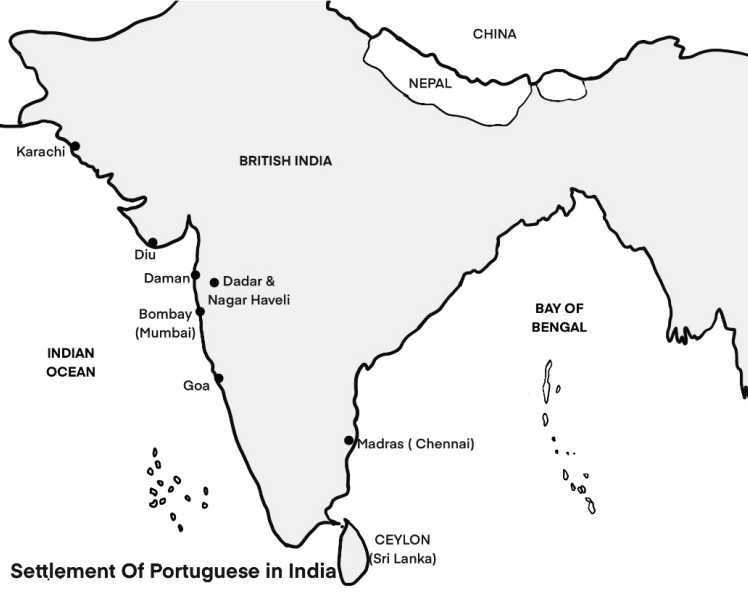
1498: Vasco da Gama's voyage was a landmark. He rounded the Cape of Good Hope and reached Calicut, where he was received by the Zamorin . His pilot's identity remains debated in historical writing; avoid treating Ahmad Ibn Majid as an undisputed identification. Portuguese entry also encountered established Arab, Indian and other Indian Ocean trading communities.
Francisco de Almeida (1505-1509): The first Portuguese viceroy in India. He emphasized naval power, commonly summarized as the 'Blue Water Policy' . The Portuguese used the cartaz pass system and fortified ports to assert control over maritime commerce. The Battle of Diu (1509) greatly strengthened Portuguese naval predominance in the western Indian Ocean, though it did not end all regional maritime competition.
Alfonso de Albuquerque (1509-1515): The second and most important governor, considered the real founder of the Portuguese empire in the East. He implemented a policy of territorial conquest.
Key Conquests: He captured Goa (1510) from the Sultan of Bijapur , which became the capital of the Portuguese empire in India. He also captured Malacca (1511) and Ormuz (1515) , securing control over maritime choke points.
Social Policy: Albuquerque encouraged Portuguese men to marry local women to build a settled Luso-Indian population. Measures against sati were introduced in Portuguese-controlled Goa, but this should not be presented as a general abolition across India.
Religious Policy: They combined trade with zealous missionary activity, often resorting to forced conversions. The Goa Inquisition (1560) was a dark chapter of religious persecution.
Decline: Portuguese dominance waned by the early 17th century due to: (a) competition from the more organized Dutch and English, (b) corruption and weak administration, (c) loss of military advantages, and (d) their intolerant religious policies which alienated local rulers and populations.
| Feature | Explanation (Keywords for Beginners) |
|---|---|
| 'Blue Water Policy' | Naval supremacy. Control the *sea*, not the *land*. (Championed by Almeida). |
| Cartaz (Pass) System | A naval trade license or pass. Ships without it were seized. (Essentially a protection racket to enforce monopoly). |
| Territorial Conquest | Capture of key ports like Goa, Diu, Daman, Cochin. (Championed by Albuquerque). |
| Missionary Activity | Strong religious focus, including forced conversions and the Goa Inquisition. |
| Area | Contributions | Notes for UPSC |
|---|---|---|
| Agriculture (Crops) | Brought new crops from the Americas: Potato, Tomato, Chillies, Pineapple, Cashew, Tobacco . | Transformed Indian cuisine and agriculture. This is a very common prelims topic. |
| Culture & Architecture | Introduced Gothic architecture in India (e.g., churches in Goa). | Cultural fusion in Goa (music, dance, cuisine). |
| Technology/Printing | Introduced the first printing press in India (at Goa in 1556). | Mainly for religious texts (Bibles, catechisms). |
| Maritime/Military | Improved shipbuilding techniques; introduction of the 'galleon' design. | Pioneered the 'Cartaz-Armada' system of naval control, later adopted by others. |
Prelims tips
- Vasco da Gama (1498) : Reached Calicut (Ruler: Zamorin).
- Francisco de Almeida : First Governor, 'Blue Water Policy', Battle of Diu (1509).
- Alfonso de Albuquerque : Real Founder, Captured Goa (1510) from Sultan of Bijapur.
- Key Crops Introduced : Potato, Chilli, Tobacco, Cashew.
Mains points
- Assess the Portuguese strategy of fortified coastal control ('Blue Water Policy') and its long-term limitations compared to the territorial ambitions of later European powers.
- Examine the socio-cultural and economic impact of the Portuguese in India, with special reference to the new crops introduced and their religious policies.
Did you know?
- Goa remained under Portuguese control from 1510 until 1961 (Operation Vijay), long after the rest of India gained independence in 1947.
- The Portuguese were the first Europeans to arrive in India (1498) and the last to leave (1961).
Dutch in India
The VOC (Dutch East India Company, 1602) was a massive corporation focused on the spice trade. Their main interest was the Spice Islands (Indonesia), not India. They were decisively defeated by the British at the Battle of Bedara (1759), ending their ambitions in India.
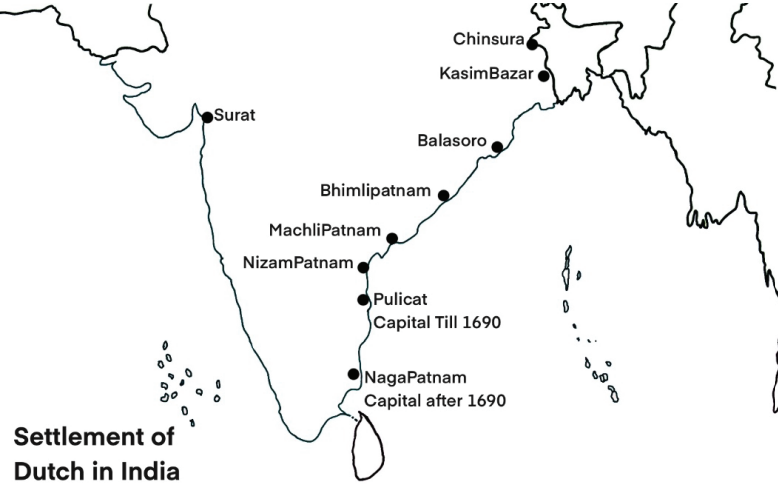
1602: VOC (Vereenigde Oostindische Compagnie) founded. This was arguably the first multinational corporation in the world. It had immense power, including the right to wage war, sign treaties, mint its own currency, and establish colonies.
Commercial Focus: The Dutch were primarily interested in the highly profitable spice trade (pepper, cloves, nutmeg) from the Spice Islands (modern Indonesia) . Their presence in India was secondary.
Intra-Asian Trade: Their strategy in India was to establish 'factories' (trading posts) to procure Indian textiles (especially from the Coromandel Coast), which they then traded for spices in Southeast Asia. This was a very efficient model of intra-Asian trade.
Key Settlements: Their main factories were at Pulicat (their first headquarters), Masulipatnam, Surat, Nagapattinam, and Chinsurah (Bengal).
Battle of Colachel (1741): A significant event where the Dutch forces were defeated by the army of Marthanda Varma , the Raja of Travancore (Kerala). This battle is a rare example of an organized Asian power defeating a European military force, and it shattered Dutch prestige in the region.
Decline (The Key Battle): The Dutch and British were rivals. Their rivalry in India culminated in the Battle of Bedara (or Biderra) in 1759 , near Chinsurah in Bengal. The British decisively defeated the Dutch, effectively destroying their military power and political ambitions in India.
Legacy: After Bedara, the Dutch were reduced to mere traders and eventually focused all their energy on the Dutch East Indies (Indonesia), which they ruled until the 20th century.
| Aspect | Note (Why it matters) |
|---|---|
| Main Interest | Spice Islands (Indonesia). India was a source for textiles to *trade* for spices. |
| Key Settlements | Pulicat (HQ), Masulipatnam, Chinsurah (Bengal). |
| Key Defeat (by Indians) | Battle of Colachel (1741) : Defeated by Marthanda Varma of Travancore. |
| Key Defeat (by British) | Battle of Bedara (1759) : Decisively beaten by the British; ended their Indian ambitions. |
| Area | Contributions | Notes |
|---|---|---|
| Culinary | Chillies, cashew, tomato, pineapple, guava | Transformed regional cuisines; vindaloo originated from Portuguese 'vinha d'alhos' |
| Cultural/Religious | Expansion of Christian (Catholic) communities, loanwords in local languages | Goan Konkani Catholic culture notable |
| Education/Printing | Missionary schools, early printing presses | Spread of Western-style education in coastal enclaves |
| Navigation/Maps | Pilots' guides & charts, cartography | Improved European knowledge of Indian Ocean routes |
Prelims tips
- VOC (1602) : Remember it as a powerful *corporation*, not just a state venture.
- Battle of Colachel (1741) : Travancore (Marthanda Varma) defeated the Dutch.
- Battle of Bedara (1759) : British defeated the Dutch. This battle is the *most important* one regarding the Dutch decline in India.
Mains points
- Discuss why the Dutch East India Company (VOC), despite its immense corporate power, failed to establish a territorial empire in India, unlike the British.
- Analyse the significance of local polities, like Travancore in the Battle of Colachel, in resisting early European expansion.
Did you know?
- The VOC (Dutch EIC) is considered the first company to issue public stock, making it a pioneer of modern corporate finance.
- After their defeat at Bedara, the Dutch and British agreed to a swap: the British gave up their claims in Indonesia in exchange for the Dutch giving up their claims in India.
British in India
The English East India Company (EIC), chartered in 1600, transformed from a trading body into a territorial power. Key events were the 1717 Farman, the Battle of Plassey (1757), and the Battle of Buxar (1764), which led to the Diwani of Bengal (1765).
1600: Formation of EIC. Queen Elizabeth I granted a Royal Charter to the 'Governor and Company of Merchants of London trading into the East Indies', giving them a monopoly on all trade with the East.
Early Footprint (The 'Factories'):
Surat (1613): After defeating the Portuguese, Captain Thomas Best secured permission from Mughal Emperor Jahangir to establish their first factory.
Diplomacy (1615): Sir Thomas Roe visited Jahangir's court as an ambassador of King James I. He secured a farman (royal order) to trade and establish factories across the Mughal empire.
The 'Presidency' Towns: The EIC established three main bases: Madras (Fort St. George, 1639), Bombay (received as dowry from Portugal in 1661 and given to EIC in 1668), and Calcutta (Fort William, established by Job Charnock in the 1690s).
The 'Magna Carta' of the Company (1717): Mughal Emperor Farrukhsiyar issued a farman in 1717. This gave the EIC valuable privileges, including duty-free trade (dastaks) in Bengal. This farman was a major source of conflict with the Nawabs of Bengal, who lost revenue.
The Shift to Power (Bengal):
Battle of Plassey (1757): A turning point. Robert Clive combined political conspiracy and alliances, including with Mir Jafar, with a short military engagement against Nawab Siraj-ud-Daula. The limited fighting and key defections were decisive; the result gave the EIC immense political influence in Bengal.
Battle of Buxar (1764): This was a *real military victory* for the EIC (led by Hector Munro) against the *combined* armies of Mir Qasim (Nawab of Bengal), Shuja-ud-Daula (Nawab of Awadh), and Shah Alam II (the Mughal Emperor) .
Diwani (1765): Following Buxar, Robert Clive concluded the Treaty of Allahabad (1765) with Shah Alam II. The Emperor granted the EIC the 'Diwani' (right to collect revenue) of Bengal, Bihar, and Orissa. It gave the Company a decisive fiscal base for territorial expansion and formalized its position as a revenue authority in eastern India.
Dual System of Government (1765-1772): After getting the Diwani, the EIC had revenue rights (Diwani) while the Nawab had administrative responsibility (Nizamat). This created a system of power without responsibility, leading to massive corruption and the disastrous Bengal Famine of 1770.
| Phase | Features & Key Events |
|---|---|
| Trading Phase (1600–1757) | Factories (Surat, Madras), Diplomacy (Roe), 1717 Farman. Focus was on commerce. |
| Political Consolidation (1757–1765) | Battle of Plassey (1757) : Political control. Battle of Buxar (1764) : Military dominance. |
| Start of 'Company Rule' (Post-1765) | Treaty of Allahabad (1765) : Acquired Diwani rights. Start of 'Dual System' in Bengal. Shift from trader to ruler. |
Prelims tips
- EIC Charter: 1600 (Queen Elizabeth I).
- First Factory: Surat (Permission from Jahangir).
- 1717 Farman : Issued by Farrukhsiyar . Called 'Magna Carta' of the EIC.
- Plassey (1757) : Conspiracy. Led to political control.
- Buxar (1764) : Military victory. Led to Diwani (1765) .
- Diwani (1765) : Right to collect revenue. Marks the start of Company Rule.
Mains points
- Trace the evolution of the English East India Company from a purely commercial body in the 17th century to the political sovereign of Bengal by 1765. Highlight the key events that facilitated this transition.
- Evaluate the long-term socio-economic effects of the acquisition of Diwani rights and the subsequent 'Dual System of Government' on Bengal.
Did you know?
- The EIC was a private company that came to rule an entire subcontinent. It had its own private army, which was larger than the official British Army at its peak.
- Bombay (Mumbai) came to the British King Charles II as a dowry when he married Catherine of Braganza from Portugal. He rented it to the EIC for just £10 of gold per year.
French in India
The French East India Company (1664), led in India by Dupleix, entered into rivalry with the British during the Carnatic Wars. Defeat at Wandiwash (1760) ended French prospects of building a comparable territorial empire in India, though French settlements survived.
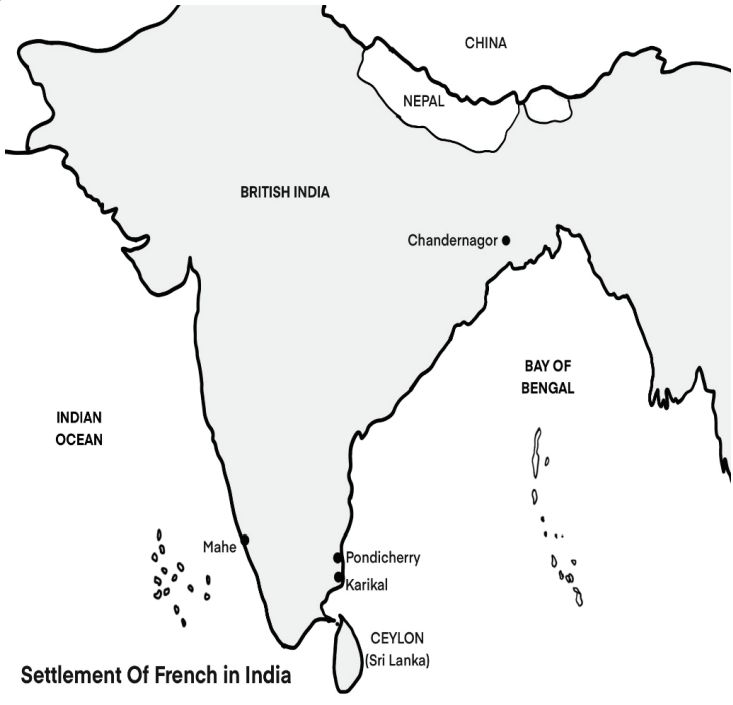
1664: French EIC founded. Unlike the British EIC (a private company), the French company (Compagnie des Indes Orientales) was a state-sponsored enterprise, heavily controlled by the government (under King Louis XIV's minister, Colbert ). This lack of autonomy made it slow and inefficient.
Key Settlements: Their first factory was at Surat (1668) . Their headquarters was established at Pondicherry (1674) . They also held Chandernagore (Bengal), Mahe, and Karaikal.
Joseph François Dupleix: The ambitious French Governor (1742–54) who changed French policy. He was not content with just trade and sought to build a French empire in India.
Dupleix's Innovation: He was the pioneer of the strategy of interfering in the succession disputes of local Indian rulers (e.g., in Hyderabad and the Carnatic). He would support one claimant with his European-trained army in exchange for money and territory. This strategy was later mastered by the British.
Anglo-French Rivalry (Carnatic Wars): The commercial rivalry between the British and French companies intensified and turned into a military conflict. These wars were essentially a proxy for the larger wars happening between Britain and France in Europe.
Third Carnatic War (1757-1763): This war, a reflection of the Seven Years' War in Europe, was the most decisive.
Battle of Wandiwash (1760): The British army, led by Sir Eyre Coote , decisively defeated the French. It was the crucial military setback that prevented the French from matching British territorial expansion in India; the British subsequently captured Pondicherry.
Treaty of Paris (1763): The war ended with this treaty. The French recovered settlements such as Pondicherry but could not build a territorial empire comparable to the British. Their remaining presence was predominantly commercial and culturally significant rather than a serious challenge to British political supremacy.
| Aspect | Note (Why it matters for UPSC) |
|---|---|
| Company Structure | State-controlled. This made it less flexible and commercially driven than the private British EIC. |
| Key Leader | Dupleix . Pioneered interfering in local politics (Subsidiary Alliance concept). |
| Decisive Battle | Battle of Wandiwash (1760) . British victory ended French political ambitions. |
| Final Treaty | Treaty of Paris (1763) . Allowed French to keep posts but *without fortification*. |
Prelims tips
- French EIC (1664) was *state-controlled* (a key weakness).
- Dupleix is the key name — associated with using local succession disputes.
- Battle of Wandiwash (1760) : Decisive British victory over French.
- Treaty of Paris (1763) : Ended the war; barred French from fortifying posts.
Mains points
- Compare and contrast the structure and strategies of the British and French East India Companies. Analyse the reasons for the French failure and British success in India.
- Assess the role of European rivalry, particularly the Carnatic Wars, in altering the political map and balance of power in 18th-century South India.
Did you know?
- Pondicherry (Puducherry) still reflects its French cultural, architectural, and linguistic legacy. French settlements were transferred to India de facto in 1954 and de jure in 1962.
- The strategies Dupleix used (like the subsidiary alliance) were failures for the French but were copied and perfected by the British (notably by Lord Wellesley) to build their own empire.
Anglo-French Rivalry & Carnatic Wars
A series of three wars (1740s-1763) in South India (the Carnatic region) between the British and the French, who supported rival local claimants. The British victory in the Third Carnatic War (Battle of Wandiwash, 1760) established their supremacy.
Context: The 'Carnatic' was the name for the Coromandel Coast region, with its capital at Arcot. The political situation was unstable due to succession disputes for the thrones of both Hyderabad and the Carnatic. Both the British (from Madras) and the French (from Pondicherry) saw this as an opportunity.
Nature of the Wars: These were proxy wars . The British and French companies would align with rival local claimants (Nawabs, Nizams), using their superior military training to influence the outcome, all while fighting each other.
First Carnatic War (1746–1748):
European Link: An extension of the War of Austrian Succession in Europe.
Key Event: The French captured Madras from the British.
Outcome: Ended with the Treaty of Aix-la-Chapelle (1748) . Madras was returned to the British, and the war was inconclusive. It mainly demonstrated the superiority of European-trained armies over local forces.
Second Carnatic War (1749–1754):
European Link: This war was *not* an extension of a European war. It was driven purely by local ambitions and the rivalry between Dupleix (French) and the British.
Key Event: Dupleix interfered in succession disputes. The British, led by Robert Clive , responded with the heroic Siege of Arcot (1751) , which turned the tide. Dupleix was recalled to France in disgrace.
Outcome: Inconclusive, but the British gained an upper hand. The French government, unhappy with Dupleix's expensive wars, recalled him.
Third Carnatic War (1757–1763):
European Link: An extension of the Seven Years' War in Europe, the main global conflict between Britain and France.
Key Event: The decisive Battle of Wandiwash (1760) . The British army under Sir Eyre Coote completely routed the French army.
Outcome: A decisive British victory. The Treaty of Paris (1763) restored Pondicherry to the French but left Britain as the predominant European political power in India. French settlements continued, chiefly as commercial enclaves.
| War | Dates | European Link | Result in India |
|---|---|---|---|
| First Carnatic War | 1746–1748 | War of Austrian Succession | Inconclusive. Ended by Treaty of Aix-la-Chapelle. Madras restored to British. |
| Second Carnatic War | 1749–1754 | None (Local disputes). | Inconclusive, but British gained influence. Dupleix recalled. |
| Third Carnatic War | 1757–1763 | Seven Years' War | Decisive British Victory . Battle of Wandiwash (1760). Treaty of Paris (1763) ended French ambitions. |
| Treaty | Year | Effect on India |
|---|---|---|
| Treaty of Aix-la-Chapelle | 1748 | Ended First Carnatic War; restored captured territories (status quo ante) |
| Convention/Treaty of Pondicherry | 1754 | Ended Second Carnatic War; created fragile local settlement pending European developments |
| Treaty of Paris | 1763 | Ended Third Carnatic War and Seven Years' War; confirmed British supremacy in India while permitting French trading posts without political interference |
Prelims tips
- Associate Carnatic Wars = British vs. French .
- 1st War Treaty: Aix-la-Chapelle .
- 2nd War: Dupleix 's local interference; Clive's Siege of Arcot .
- 3rd War: Decisive Battle was Wandiwash (1760) . Decisive Treaty was Paris (1763) .
Mains points
- Analyse how the fragmentation of Indian polity in the 18th century provided a fertile ground for the Anglo-French rivalry in the Carnatic. How did European events influence outcomes in India?
- Evaluate the long-term consequences of the Carnatic Wars. How did they pave the way for British territorial expansion and eliminate other European rivals?
Did you know?
- The Carnatic Wars were where Robert Clive first made his name as a brilliant (and lucky) military strategist with the Siege of Arcot, long before the Battle of Plassey.
- The Seven Years' War (of which the 3rd Carnatic War was a part) is often called the first *true* world war, as it was fought in Europe, North America, and Asia (India).
Land Revenue Policies
British land settlements focused on maximizing revenue and creating new proprietary classes, leading to widespread peasant oppression.
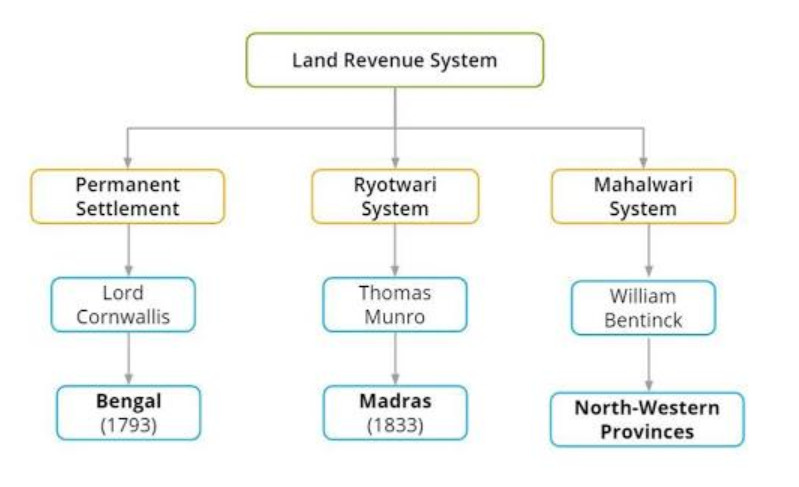
Permanent Settlement (1793) : Introduced by Lord Cornwallis in Bengal, Bihar, Orissa . Zamindars were recognized as hereditary landlords; revenue was fixed permanently. Led to absentee landlordism and peasant oppression.
Ryotwari Settlement (1820s) : Introduced by Thomas Munro in Madras, Bombay. Revenue settlement was made directly with the cultivators (ryots). Revenue was revised periodically (not fixed), often leading to high demands.
Mahalwari Settlement (1833) : Introduced by R.M. Bird in the NW Provinces & Punjab. Settlement was made with the entire village community (mahal), which was jointly responsible for paying revenue.
Taluqdari System (Awadh) : After annexation, taluqdars (landlords) were often dispossessed and then restored as landlords under the British, increasing their power and leading to oppression.
Indigo System (Bengal) : European planters forced peasants to grow indigo (a cash crop) on their best land; sparked the famous Indigo Revolt (1859–60).
Consequences : Creation of absentee landlords, massive indebtedness among peasants, decline in traditional village institutions, and periodic agrarian unrest and famines.
| System | Region | Introduced by | Features |
|---|---|---|---|
| Permanent Settlement | Bengal, Bihar, Orissa | Cornwallis (1793) | Zamindars as hereditary landlords; fixed revenue forever. |
| Ryotwari | Madras, Bombay | Thomas Munro | Direct settlement with cultivators (ryots); periodic revision. |
| Mahalwari | NW Provinces, Punjab | R.M. Bird (1833) | Village (mahal) collectively responsible; revenue demand revised. |
| Taluqdari | Awadh | Dalhousie’s policy | Taluqdars acted as powerful intermediaries; increased exploitation. |
Prelims tips
- Permanent Settlement = Cornwallis , 1793 (Bengal).
- Ryotwari = Thomas Munro (Madras/Bombay).
- Mahalwari = R.M. Bird , 1833 (NW Provinces, Punjab).
- Indigo Revolt = 1859–60 in Bengal.
Mains points
- Revenue policies prioritized Company profits over agrarian welfare, creating an exploitative structure of landlordism .
- These settlements fueled rural poverty and discontent, serving as a major underlying cause of the 1857 revolt .
Did you know?
- Under Permanent Settlement , many zamindars lost estates due to inability to pay fixed high revenue.
- The Indigo Revolt inspired Dinabandhu Mitra’s play *Nil Darpan* ( The Indigo Mirror ).
Economic Policies
British economic policies systematically de-industrialized India and transformed it into a supplier of raw materials and a market for British machine-made goods.
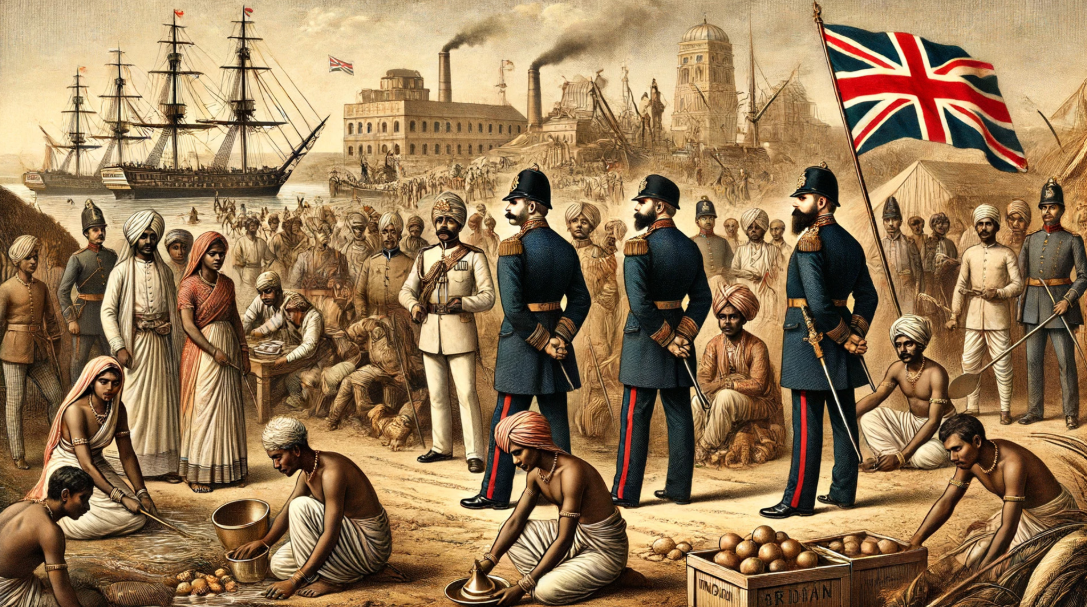
De-industrialisation : Indian handicrafts (especially textiles) collapsed due to the influx of cheap British machine-made goods and discriminatory tariffs that favoured imports over Indian exports.
Trade Pattern Reversal : India exported raw materials (cotton, indigo, silk, opium) and imported manufactured goods, reversing the favorable pre-colonial trade patterns.
Drain of Wealth Theory : Nationalists like Dadabhai Naoroji argued that India's surplus was systematically transferred to Britain through salaries, pensions, and 'Home Charges' (expenses paid in Britain), causing India's impoverishment.
Opium Trade : The Company encouraged widespread opium cultivation in Bihar and Bengal. The opium was exported to China; these profits financed crucial Company operations and indirectly contributed to the Opium Wars.
Infrastructure Development : Railways (from 1853), telegraph, roads, and ports were developed—primarily to move troops, raw materials from the interior to ports, and integrate markets favorable to Britain, not for Indian industrial growth.
Fiscal policies : High land revenue demands and tariffs were structured to extract surplus; currency and banking changes primarily favoured British merchants.
| Policy/Feature | Impact |
|---|---|
| Import of British textiles | Collapse of Indian handicrafts ; mass unemployment. |
| Export of raw materials | Shift to cash crops (cotton, indigo); food insecurity. |
| Drain of Wealth | Systematic transfer of Indian wealth abroad ( Home Charges ). |
| Opium cultivation | Profits for British; misery for peasants; led to Opium Wars. |
| Railways (1853) | Facilitated exploitation; not industrialisation or public welfare. |
Prelims tips
- First railway line : Bombay to Thane (1853).
- Drain of Wealth theory → Dadabhai Naoroji .
- Opium trade was key to British profits in China.
Mains points
- Economic policies fundamentally transformed India into a colonial economy dedicated to serving British industrial interests.
- Policies triggered rural poverty and economic discontent, providing a fertile ground for the 1857 revolt.
Did you know?
- Dadabhai Naoroji called British rule 'Un-British Rule in India'.
- Railway contracts guaranteed minimum profits for British investors, shifting all risk to the Indian treasury.
Raja Rammohan Roy and Brahmo Samaj (1828)
Raja Rammohan Roy , known as the 'Father of Indian Renaissance', founded the Brahmo Samaj in 1828 to reform Hindu society, oppose social evils, and promote monotheism and modern education.
Raja Rammohan Roy (1772–1833) - The Pioneer : He was a pioneering figure in modern Indian socio-religious reform. He campaigned against sati, criticized caste rigidity and idolatry, and advocated rational religious inquiry.
Social and Gender Reforms : He advocated women's education and property inheritance rights and argued for women's dignity using both liberal thought and interpretations of Indian texts. The later organized campaign for Hindu widow remarriage is especially associated with Ishwar Chandra Vidyasagar.
Religious Philosophy : He promoted monotheism (worship of a single, formless God) and rationalism. He founded Atmiya Sabha (1815) as a precursor to the Brahmo Samaj.
Abolition of Sati : Roy played a key, crucial role in lobbying for the abolition of sati (1829) under Lord William Bentinck’s regulation.
Brahmo Samaj (1828) : Founded by Roy, it was intended to be a society for the worship of the Eternal, Unsearchable, Immutable Being and worked for the abolition of social evils and the spread of modern scientific education.
The Brahmo Samaj Split : After Roy's death, the Samaj was led by Debendranath Tagore (who founded Tattwabodhini Sabha in 1839). The entry of Keshab Chandra Sen (1858) introduced radical reforms (like inter-caste marriage), leading to a split into Adi Brahmo Samaj (under Tagore) and Brahmo Samaj of India (under Sen).
Legislative Impact : Brahmo reformers influenced the Native Marriage Act (1872), often called the Brahmo Marriage Act. It provided a civil-marriage framework under specified conditions and reflected wider reform debates on marriage, consent and age.
| Aspect | Contribution |
|---|---|
| Social Reform | Opposed sati, child marriage; promoted widow remarriage and women’s rights |
| Religious Reform | Promoted monotheism, rationalism; opposed idol worship |
| Educational Reform | Advocated English, science, modern education; set up Hindu College with David Hare |
| Political Reform | Supported freedom of press; opposed arbitrary colonial policies |
| Institution Building | Founded Atmiya Sabha (1815), Brahmo Samaj (1828) |
Prelims tips
- Raja Rammohan Roy founded Brahmo Samaj in 1828.
- He is called the 'Father of Indian Renaissance'.
- He played a key role in the abolition of sati in 1829 under Lord William Bentinck.
- The Brahmo Samaj split involved Debendranath Tagore and Keshab Chandra Sen.
Mains points
- Raja Rammohan Roy was the pioneer in synthesizing Western rationality with Upanishadic thought, laying the ideological foundation for modern Indian reform.
- The Brahmo Samaj created an associational life and public sphere for debate, which was critical for the growth of later political nationalism.
- The splits (Tagore vs. Sen) demonstrated the internal struggle between retaining philosophical purity and embracing radical social change (e.g., inter-caste marriage).
Did you know?
- Raja Rammohan Roy travelled to England in 1830 as an envoy of Mughal Emperor Akbar II to plead his case for a pension.
- He was given the title 'Raja' by the Mughal Emperor.
- The Adi Brahmo Samaj was led by Debendranath Tagore, who was called 'Maharshi' (great sage).
Prarthana Samaj (1867)
Founded in 1867 in Bombay , the Prarthana Samaj was a reformist movement in Western India that focused on internal social reforms within Hinduism.
Foundation and Leadership : Founded by Atmaram Pandurang in 1867. It gained intellectual and organizational strength from prominent figures like Justice Mahadev Govind Ranade (known as the 'Socrates of Maharashtra'), R.G. Bhandarkar , and N.G. Chandavarkar .
Core Ideas : Heavily influenced by the Brahmo Samaj , it emphasized monotheism (worship of one God) and rejected idolatry and ritualism. However, unlike the Brahmo Samaj, it retained a loyal base within Hinduism.
Social Focus : Its work was intensely focused on practical social reforms: strong opposition to caste discrimination and untouchability, and promotion of widow remarriage, inter-caste marriage, and women’s education.
Method of Work : The Samaj worked through practical means, establishing social conferences, night schools, orphanages, and conducting welfare activities to uplift the poor and marginalized.
Legacy : M.G. Ranade transformed the Samaj into the intellectual parent body for the Indian Social Conference (1887), which worked alongside the INC for social legislation.
| Aspect | Explanation |
|---|---|
| Founder | Atmaram Pandurang ( 1867, Bombay ) |
| Supporters | M.G. Ranade , R.G. Bhandarkar |
| Religious Ideas | Monotheism ; reformist approach within Hinduism, rejected formal rituals |
| Social Reform | Opposed casteism, supported widow remarriage and women’s education |
| Legacy | Inspired the Indian Social Conference and later reformist initiatives in Western India |
Prelims tips
- Prarthana Samaj founded in 1867 in Bombay by Atmaram Pandurang .
- M.G. Ranade was the key figure responsible for its later spread and influence.
- Focused on widow remarriage, women’s education, and caste equality.
Mains points
- Examine how Prarthana Samaj built upon Brahmo Samaj’s ideas but achieved greater success in Maharashtra by retaining a loyal base within Hinduism.
- Assess its crucial role in promoting women’s education and its legacy in shaping the Indian Social Conference and future social reform networks.
Did you know?
- M.G. Ranade , a key supporter, was also known as the 'Socrates of Maharashtra'.
- The Samaj services included prayers, hymns, and readings from Hindu scriptures but strictly without idol worship.
- The society’s reform activities inspired other provincial organizations in India.
Arya Samaj
Founded in 1875 by Swami Dayanand Saraswati , Arya Samaj was a powerful socio-religious reform movement that advocated for a return to the pristine purity of the Vedas ( 'Back to the Vedas' ), while vehemently rejecting idol worship, birth-based caste system, and promoting social equality, education, and women’s empowerment.
Foundation and Period: Established in Bombay (now Mumbai) in 1875 by Swami Dayanand Saraswati . It primarily operated in North India (Punjab, UP, Rajasthan).
Core Philosophy (Revivalist): Promoted the slogan 'Back to the Vedas' , believing all religious and scientific truth was contained in the four Vedas (Rigveda, Yajurveda, Samaveda, Atharvaveda). It rejected the authority of later religious texts like the Puranas and Tantras.
Religious Reforms: Advocated for Monotheism (worship of one God) and strongly opposed Idol Worship (मूर्तिपूजा), polytheism, animal sacrifice, rituals, and pilgrimages.
Social Reforms (Reformist): Launched a strong campaign against the Caste System based on birth, untouchability , and the domination of the hereditary priesthood. It promoted meritocracy over birth status.
Women's Empowerment: Supported Widow Remarriage , opposed Child Marriage , and championed Women's Education , arguing that women had the right to read the Vedas.
The Shuddhi Movement: This significant initiative aimed to reconvert Hindus who had converted to other religions (e.g., Islam or Christianity) back into the Hindu fold, thereby aiming to strengthen Hindu identity and combat proselytization by other faiths. This aspect gives it a defensive character.
Educational Legacy: Established the network of Dayanand Anglo-Vedic (DAV) schools and colleges, starting in Lahore in 1886. The curriculum blended modern Western subjects (Anglo) with traditional Vedic studies (Vedic).
| Aspect | Explanation |
|---|---|
| Founder & Year | Swami Dayanand Saraswati ( 1875 , Bombay) |
| Key Slogan | 'Back to the Vedas' (वेदों की ओर लौटो) |
| Religious Stance | Monotheism; Rejection of Idol Worship, Puranas, and rituals |
| Social Stance | Opposed Caste by Birth, Untouchability; Supported Widow Remarriage |
| Key Initiative | Shuddhi Movement (Reconversion to Hinduism) |
| Educational Work | DAV schools and colleges (Blending modern and Vedic learning) |
Prelims tips
- Arya Samaj was founded by Swami Dayanand Saraswati in Bombay in 1875 .
- The core slogan is 'Back to the Vedas' .
- The Shuddhi Movement and DAV institutions are key Arya Samaj initiatives.
- Swami Dayanand's most important book is Satyarth Prakash .
Mains points
- Analyze the dual nature of Arya Samaj as a reformist (social evils) and revivalist (Vedas) movement, and its contribution to Hindu identity in the 19th century.
- Discuss the impact of the Arya Samaj on social justice , focusing on women's rights, the fight against casteism, and the controversial Shuddhi Movement .
- Evaluate the role of DAV institutions and the concept of 'Vedic nationalism' propagated by the Samaj in fueling the nationalist spirit.
Did you know?
- Swami Dayanand Saraswati's original name was Mool Shankar .
- He authored the book Satyarth Prakash (The Light of Truth), which is the principal text of the movement.
- The Samaj split after Dayanand's death in 1883 over educational policies (DAV Colleges vs. Gurukul Kangri system) and food habits (meat vs. vegetarianism).
Ramakrishna Mission
Founded in 1897 by Swami Vivekananda in honour of his guru Ramakrishna Paramhansa, the Mission emphasised Practical Vedanta, asserting that service to humanity is service to God. It became a major force for spiritual uplift, education, and humanitarian relief, promoting a universal and humanistic interpretation of Hinduism.
Foundation: Established by Swami Vivekananda in 1897 , a few years after his influential address at the World Parliament of Religions in Chicago (1893).
Spiritual Inspiration: Directly inspired by the teachings of Ramakrishna Paramhansa , who believed in the inherent divinity of all souls and the unity of all religions ( 'Yata Mat, Tata Path' ).
Core Principle (Practical Vedanta): The Mission translated the philosophical tenets of the Upanishads (Vedanta) into practical action. It promoted the idea that the best way to achieve 'Atmano Moksha' (self-salvation) is through 'Jagat Hitaya' (welfare of the world).
Motto: The philosophical foundation is captured by the Sanskrit motto: 'Atmano mokshartham jagat hitaya cha' (For one’s own salvation and for the welfare of the world).
Focus on Man-Making: Vivekananda stressed the need for physical, moral, and intellectual strength among the Indian youth, famously calling for 'man-making' religion and education.
Service Activities: Actively engaged in establishing schools, colleges, hospitals, and technical institutions. It pioneered organized relief work during famines, epidemics, and natural calamities in colonial India, functioning essentially as one of the earliest modern Non-Governmental Organizations (NGOs).
Global Impact: Provided a rational, universal, and humanistic image of Hinduism to the world, countering colonial narratives and initiating the global spread of Vedanta and Yoga.
| Aspect | Explanation |
|---|---|
| Founder & Year | Swami Vivekananda ( 1897 , Belur Math) |
| Core Idea | Practical Vedanta (Service to humanity = Service to God) |
| Motto | 'Atmano mokshartham jagat hitaya cha' |
| Inspiration | Ramakrishna Paramhansa (Unity of all religions) |
| Social Work | Pioneering work in education, health, and disaster relief |
| Legacy | Linked spirituality with national awakening; globalised Indian philosophy |
Prelims tips
- Ramakrishna Mission was founded in 1897 by Swami Vivekananda .
- The motto is 'Atmano mokshartham jagat hitaya cha'.
- It is associated with the concept of Practical Vedanta.
- The 1893 Chicago speech gave Vivekananda and the Mission global recognition.
- The Mission (social service) is distinct from the Math (monastic order).
Mains points
- Discuss how the Ramakrishna Mission successfully integrated spiritual idealism with practical humanitarianism through its philosophy of Practical Vedanta.
- Analyze the Mission's significant contribution to education and health in colonial India, emphasizing its non-sectarian approach to social reform.
- Evaluate the role of Swami Vivekananda and the Mission in fostering cultural pride and nationalism among Indian youth and in enhancing India's global spiritual image.
Did you know?
- Vivekananda's birth anniversary, January 12, is celebrated in India as National Youth Day.
- His speech in Chicago, starting with 'Sisters and Brothers of America', revolutionized the perception of Eastern spirituality in the West.
- The Mission's headquarters, Belur Math in West Bengal, serves as the hub for all activities globally.
Aligarh Movement
Started by Sir Syed Ahmed Khan in 1875 , the Aligarh Movement aimed at modernizing Muslim society through scientific education, rational thought, and social reform. It laid the foundation for Aligarh Muslim University (AMU).
Founder and Timeline: Sir Syed Ahmed Khan (1817–1898) was the driving force. The movement is strongly associated with the establishment of the Muhammadan Anglo-Oriental (MAO) College at Aligarh in 1875 .
Educational Institution: MAO College was deliberately modeled on British universities like Oxford and Cambridge to familiarize Muslims with Western knowledge and culture. It later achieved central university status as Aligarh Muslim University (AMU) in 1920.
Dual Education Goal: Promoted modern scientific and English education among Muslims as essential for economic upliftment and securing government employment, while simultaneously emphasizing Islamic theology and culture.
Religious Reform: Advocated for the reinterpretation of Islam (Ijtihad) in the light of reason and science. He criticized Taqlid (blind imitation) and challenged conservative religious orthodoxy.
Social Reform: Supported essential reforms like widow remarriage, female education (though cautiously), and discouragement of polygamy and the practices of Piri and Muridi.
Literary/Scientific Work: Established the Scientific Society (1864) in Ghazipur for the large-scale translation of modern English scientific and literary works into Urdu.
Political Stance: Initially opposed Muslim participation in active political movements like the Indian National Congress, believing that educational and social upliftment must be prioritized before seeking political power.
Impact: Created a new class of modern educated Muslim middle class and intelligentsia who spearheaded social and political changes in the 20th century.
| Aspect | Explanation |
|---|---|
| Founder & Year | Sir Syed Ahmed Khan (Started in 1875 ) |
| Key Institution | MAO College (1875) → AMU (1920) |
| Educational Aim | Promote modern scientific and English education |
| Religious Approach | Reconciliation of Islam with Reason and Science (Ijtihad) |
| Social Reform | Female education, widow remarriage, opposition to polygamy |
| Precursor Body | Scientific Society (1864) for translation work |
Prelims tips
- Aligarh Movement was started by Sir Syed Ahmed Khan in 1875.
- The MAO College was the center of the movement and became AMU in 1920.
- Sir Syed founded the Scientific Society (1864) for translation.
- He initially advised Muslims to focus on education over politics.
- The movement's core idea was reconciliation of Islam with science and reason.
Mains points
- Analyze the modernizing influence of the Aligarh Movement on Muslim society, focusing on its educational and rational reform agenda.
- Discuss the long-term socio-political impact of the MAO College/AMU in creating a distinct intellectual class and its complex relationship with Indian nationalism.
- Evaluate Sir Syed Ahmed Khan's role as a reformer who skillfully navigated the challenge of balancing Islamic tradition with the need for Western modernity.
Did you know?
- Sir Syed is widely recognized as the 'Architect of Modern Muslim Education' in India.
- He authored the book Asbab-e-Baghawat-e-Hind (Causes of the Indian Revolt) to explain the reasons for the 1857 revolt to the British, aiming to rebuild trust.
- The students and staff of MAO College often played the role of reformers in North Indian society.
Satya Shodhak Samaj
Founded by Jyotiba Phule in 1873 in Pune, the Satya Shodhak Samaj (Truth Seekers’ Society) worked for the upliftment of lower castes (Shudras/Ati-Shudras), women’s education, and social justice, fundamentally challenging the dominance of Brahmanical orthodoxy and priestly monopoly.
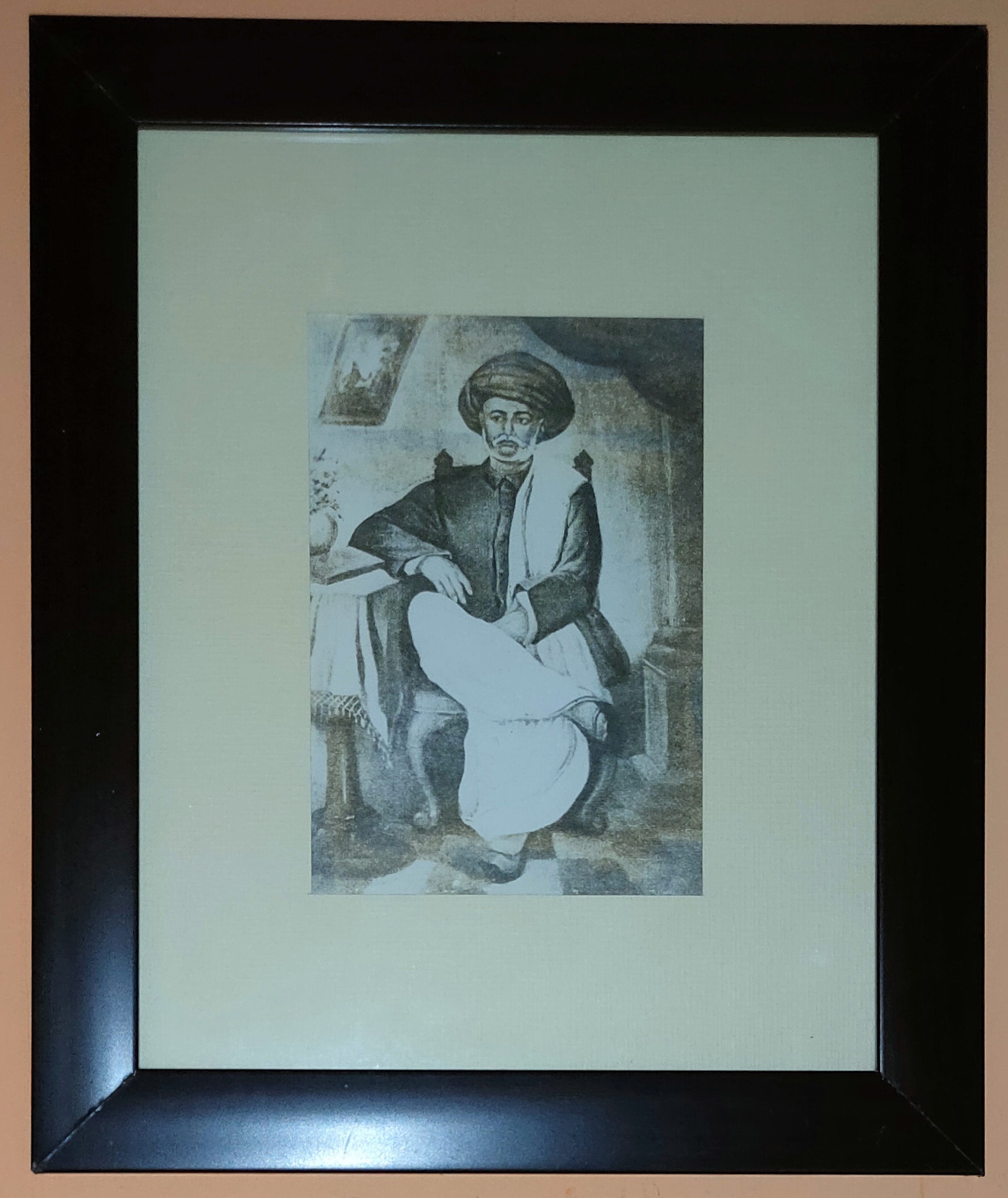
Founder and Date: Established by Jyotiba Phule (1827–1890), who belonged to the Mali (gardener) caste, in Pune, 1873.
Primary Aim: To achieve social justice and equality for the Shudras (lower castes) and Ati-Shudras (untouchables) by challenging the exploitation perpetuated under the guise of religion.
Educational Work: Phule and his wife, Savitribai Phule (India’s first female teacher), pioneered girls’ education by opening the first school for girls in Pune in 1848 and later opened schools for the untouchables.
Anti-Caste Methods: Strongly opposed the Varna system, untouchability, and the ritualistic monopoly of Brahmin priests. They conducted social and religious ceremonies (like marriages) without Brahmin priests to promote self-respect and self-dependency.
Social Reforms: Advocated for social equality, opposed child marriage, and actively supported widow remarriage. They also opened a home for destitute Brahmin widows to challenge the double standards of society.
Literary Contribution: Phule's major work, the book *Gulamgiri* (Slavery, 1873), was a seminal critique that directly compared the oppression of the lower castes in India to the American slave system, highlighting the lack of human dignity.
Movement's Base and Influence: The movement was chiefly based in Maharashtra and gained significant traction among the Maratha-Kunbis (cultivating classes). It is considered a crucial precursor to the later Dalit movement led by Dr. B.R. Ambedkar.
| Aspect | Explanation |
|---|---|
| Founder & Year | Jyotiba Phule ( 1873 , Pune) |
| Key Figures | Savitribai Phule (Pioneer of women’s education in India) |
| Core Aim | Social justice for Shudras/Ati-Shudras; Anti-Brahmanical movement |
| Religious Stance | Rejected Brahminical scriptures; Performed rituals without priests |
| Key Work | Book *Gulamgiri* (Compared caste oppression to slavery) |
| Legacy | Influenced the Dalit movement and non-Brahmin politics in Maharashtra |
Prelims tips
- Satya Shodhak Samaj was founded in 1873 in Pune by Jyotiba Phule.
- Savitribai Phule was the first female teacher of India and a key partner.
- The book *Gulamgiri* (1873) is directly linked to Phule's anti-caste work.
- The Samaj focused on social justice for Shudras and Ati-Shudras.
- It challenged caste hierarchy by conducting rituals without Brahmins .
Mains points
- Analyze the radical anti-caste philosophy of the Satya Shodhak Samaj and how it challenged the legitimacy of Brahmanical religious and social dominance from a subaltern perspective.
- Evaluate the pioneering efforts of Jyotiba and Savitribai Phule in linking education with social emancipation for the oppressed classes and women in Maharashtra.
- Discuss the long-term legacy of the movement, particularly its influence on the Dalit movement and the foundation of non-Brahmin politics in the 20th century.
Did you know?
- Phule was given the title 'Mahatma' (Great Soul) in 1888 by Vithalrao Krishnaji Vandekar for his relentless social work.
- Phule and Savitribai ran a school for untouchables and a night school for working adults.
- The Samaj used Marathi, the language of the masses, rather than Sanskrit, to communicate its ideas effectively to the lower castes.
Ishwar Chandra Vidyasagar
Ishwar Chandra Vidyasagar (1820–1891) was a leading Bengali reformer, educator, and social activist known for his relentless campaign for the Hindu Widows’ Remarriage Act (1856), pioneering women's education, and modernising Bengali prose on the basis of rational and scriptural evidence.
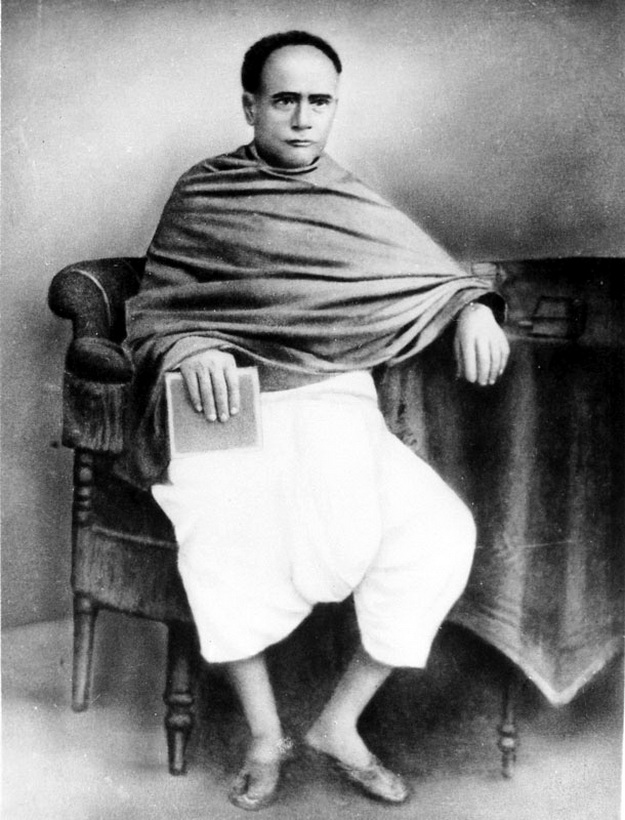
Personal Background: Born in 1820 in Bengal. He earned the title 'Vidyasagar' (Ocean of Knowledge) for his academic excellence at Sanskrit College, Calcutta.
Widow Remarriage: His most profound contribution was providing scriptural arguments (from Parashara Samhita) to prove that the remarriage of Hindu widows was legitimate. His persistent lobbying led to the enactment of the Hindu Widows’ Remarriage Act, 1856.
Educational Reform: Served as Principal of Sanskrit College, Calcutta. He boldly reformed the curriculum by introducing Western logic, philosophy, and science into the traditional Sanskrit education system.
Women’s Education: He was a strong advocate and financed the establishment of several girls’ schools in Bengal (aided by J.E.D. Bethune). He believed that education was essential for women's emancipation.
Literary Reform: He is considered the 'Father of Modern Bengali Prose'. He simplified and refined the Bengali alphabet and syntax, making the language simpler and more accessible for mass education and printing.
Other Social Reforms: He campaigned vigorously against polygamy (polygyny) and child marriage, publishing pamphlets and petitions urging the British government to take legal action.
Humanism: Known for his immense kindness and charity, he was affectionately called 'Dayar Sagar' (Ocean of Compassion).
| Contribution | Details |
|---|---|
| Major Act | Hindu Widows' Remarriage Act, 1856 (Pivotal role) |
| Educational Post | Principal of Sanskrit College; Curriculum reform |
| Literary Work | Pioneer of modern Bengali prose; simplified alphabet |
| Women’s Rights | Established numerous girls’ schools; advocated widow remarriage |
| Other Campaigns | Opposed child marriage and polygamy |
Prelims tips
- The Hindu Widows' Remarriage Act was passed in 1856 primarily due to Vidyasagar’s efforts.
- Known as 'Vidyasagar' (Ocean of Knowledge) and 'Dayar Sagar' (Ocean of Compassion).
- He was the key figure in promoting and simplifying modern Bengali prose.
- He was Principal of Sanskrit College, Calcutta, and reformed its curriculum.
Mains points
- Analyze Vidyasagar’s role as a reformer who skillfully used traditional scriptural authority to push for radical social and legislative change (Widow Remarriage Act).
- Discuss his comprehensive strategy of combining education reform (modernizing Sanskrit curriculum, simplifying prose) with women’s emancipation.
- Evaluate his contribution as a pivotal figure of the Bengal Renaissance, representing the rational-humanist strand of 19th-century reform that focused on concrete, achievable goals.
Did you know?
- Vidyasagar walked miles barefoot to study in Calcutta due to poverty, often studying under the street lights.
- He used his deep knowledge of Sanskrit scriptures to show the orthodox society that widow remarriage was permissible, effectively fighting tradition using tradition itself.
- He was such a prolific philanthropist that he often had to borrow money in his later years to maintain his charitable donations, truly earning the title 'Dayar Sagar'.
Abolition of Sati (1829) and Social Legislation
The Regulation XVII of 1829 abolished the practice of Sati (widow immolation) in the Bengal Presidency, marking the first major successful legal reform against a Hindu social evil in British India.
The Practice: Sati was a ritual where a Hindu widow voluntarily or forcefully immolated herself on her deceased husband's pyre. It was prevalent mainly among upper castes in parts of Bengal and Rajasthan.
Key Reformer: Raja Rammohan Roy led the decisive intellectual and public campaign against Sati, publishing pamphlets and petitions based on Hindu scriptures to prove the practice was not mandatory.
The Act: The Governor-General, Lord William Bentinck, was determined to abolish the practice, leading to the enactment of Regulation XVII of 1829, which declared Sati illegal and punishable as culpable homicide.
Orthodox Opposition: Orthodox elements, led by Raja Radhakant Deb (founder of the Dharma Sabha), organized petitions and challenged the law in the Privy Council in London, but the abolition was upheld.
Significance: The abolition was a watershed moment, demonstrating the combined power of liberal colonial administration and indigenous rational reform (Roy's efforts) in challenging deeply entrenched social customs. It set a precedent for later social legislation.
| Aspect | Detail |
|---|---|
| Year | 1829 |
| Act Name | Regulation XVII |
| Governor-General | Lord William Bentinck |
| Key Reformer | Raja Rammohan Roy |
| Orthodox Opposition | Dharma Sabha (Radhakant Deb) |
Prelims tips
- Sati was abolished in 1829 by Lord William Bentinck.
- The key Indian campaigner was Raja Rammohan Roy.
- The Dharma Sabha was formed to oppose the abolition.
Mains points
- Analyze the collaborative nature of the abolition, where a modernizing colonial administration worked with an indigenous rational reformer (Roy) to achieve change.
- Discuss the ideological foundations of Roy's argument, which fought tradition using tradition itself, rather than solely Western appeals.
- Evaluate the abolition as the starting point of major social legislation under the British, setting the tone for future reforms like widow remarriage.
Did you know?
- The initial ban applied only to the Bengal Presidency, but it was later extended to Madras and Bombay Presidencies.
Peasant Movements in India: Agrarian Resistance (Fighting the Landlords and Taxes)
Peasant movements in colonial India were protests against oppressive land revenue systems, moneylenders, and exploitative landlords . They gradually evolved from local agrarian revolts into struggles linked with the Nationalist Movement .
Exploitation Triangle: Peasants were victims of three main forces: the British state (high taxes), the Zamindars (illegal rent/eviction), and the Moneylenders (*Sahukars*) (seizing land for debt).
Forced Commercialization: Peasants were often compelled to grow unprofitable cash crops like Indigo under systems like the Tinkathia System (forced cultivation on 3/20th of land, especially in Champaran).
Nature of Early Resistance: Movements like the Indigo Revolt were largely non-violent, legalistic, and specifically targeted immediate exploiters (planters or moneylenders), showing a degree of tactical restraint.
Evolution (20th Century): Agrarian issues were integrated into the national struggle. Leaders like Mahatma Gandhi and Sardar Vallabhbhai Patel used Satyagraha (non-violent resistance) to achieve peasant demands (e.g., Champaran, Bardoli), marking the shift toward organized nationalism.
The Radical Phase: Post-1930s, left-wing Kisan Sabhas (Peasant Associations) led more radical movements like Tebhaga, demanding fundamental changes in land ownership.
| Movement | Region/Year | Leader(s) | UPSC Key Feature |
|---|---|---|---|
| Indigo Revolt | Bengal (1859–60) | Peasant leaders; Literary support from Dinabandhu Mitra’s ‘Nil Darpan’ | Successful non-violent protest against forced indigo cultivation. Showed power of peasant unity. |
| Deccan Riots | Maharashtra (1875) | Village peasants | An anti-moneylender revolt. Peasants attacked *sahukars* and deliberately burnt debt records (bonds), leading to the Deccan Agriculturists' Relief Act . |
| Champaran Satyagraha | Bihar (1917) | Mahatma Gandhi | First Gandhian satyagraha in India . Successfully challenged the oppressive Tinkathia system . |
| Eka Movement | Avadh (1921–22) | Madari Pasi , local leaders | Against high rents and begar (forced labor). Later became quite radical. |
| Bardoli Satyagraha | Gujarat (1928) | Sardar Vallabhbhai Patel | Successful No-Tax Movement against unfair revenue hike. Patel earned the title 'Sardar' here. |
| Tebhaga Movement | Bengal (1946–47) | Kisan Sabha, Communist leaders | Sharecroppers (Bargadars) demanded a 2/3rd share (Tebhaga) of the produce, a challenge to the traditional half-share system. |
Prelims tips
- The Indigo Revolt is chronologically the first major post-1857 peasant revolt.
- Deccan Riots are associated with the destruction of account books and the Deccan Agriculturists' Relief Act.
- Champaran is key as Gandhi's debut in Indian politics and the end of the Tinkathia System.
- Bardoli is crucial for the title of Sardar and being a model no-tax campaign.
Mains points
- Peasant movements exposed the inherent exploitative structure of colonial land policies and their intermediaries (Zamindars and Moneylenders).
- They demonstrate the shift in leadership and ideology from spontaneous local revolts to organized, national struggles post-1920.
- These movements were vital in broadening the base of the Nationalist Movement and forcing the Congress to adopt a comprehensive agrarian agenda.
- They laid the foundation for post-Independence land reforms by highlighting issues like tenancy rights and abolition of Zamindari.
Did you know?
- The play 'Nil Darpan' on the Indigo Revolt was so influential that its translator was jailed, highlighting the power of art in resistance.
- In the Deccan Riots , peasants attacked documents, not people, showing a focused form of resistance.
- The success of the Bardoli movement proved the effectiveness of Satyagraha as an economic weapon against the government.
Tribal Revolts in India: Defending the Forest and Autonomy (The Diku Challenge)
Tribal revolts were among the earliest and most militant uprisings against British rule, landlords, moneylenders, and missionaries. They were rooted in the defense of land, forests, culture, and autonomy —their entire way of life.
Main Cause: Forest Laws: British Forest Policies (to exploit timber) classified forests as state property, drastically curtailing the tribals' traditional rights to practice Jhum (Shifting Cultivation) and collect forest produce.
The Diku Invasion: The entry of Dikus (a tribal term meaning 'outsiders': moneylenders, traders, contractors) led to the destruction of the communal land ownership system (Khuntkatti) and massive land alienation.
Cultural Threat: Activities of Christian Missionaries were seen as a direct attack on tribal religious beliefs and customs, causing deep resentment.
Nature and Leadership: Revolts were often highly violent and localized. They were frequently led by messianic leaders (like Birsa Munda) who claimed divine inspiration to mobilize resistance and aimed to establish an independent ‘Raj’ (e.g., Munda Raj).
Impact: The brutality of these revolts forced the British to recognize the unique status of tribal areas, leading to protective laws like the Chotanagpur Tenancy Act (CNT Act).
| Revolt | Region/Year | Leader(s) | UPSC Key Feature |
|---|---|---|---|
| Kol Uprising | Chotanagpur, (1831–32) | Kol tribes | Against land transfer to outsiders (Sikhs/Muslims) who were revenue farmers. Known for its mass mobilization. |
| Santhal Hul | Rajmahal Hills, (1855–56) | Sidhu & Kanhu Murmu | The largest pre-1857 tribal rebellion, involving ~50,000 tribals. Fought the Dikus and British violently. |
| Khond Uprisings | Orissa, (1846–62) | Chakradhar Singh | Resistance against the suppression of the traditional tribal practice of Meriah (ritual sacrifice). |
| Munda Ulgulan (Great Tumult) | Chotanagpur, (1899–1900) | Birsa Munda | A messianic movement. Demanded restoration of the communal Khuntkatti system . Birsa was revered as 'Dharti Abba'. |
| Rampa Rebellion | Andhra (1922–24) | Alluri Sitarama Raju (later phase) | Against the restrictive Forest Act. Raju, a charismatic non-tribal leader, linked the movement to the Non-Cooperation Movement. |
Prelims tips
- Tribal revolts are tested on the Leader-Tribe-Region combination.
- The Munda revolt's key term is Ulgulan ('Great Tumult') and the land system Khuntkatti.
- Birsa Munda is often referred to as 'Dharti Abba' (Father of Earth) by his followers.
- The Rampa Revolt is important for its 20th-century timing and association with a Non-Tribal Leader (Alluri Sitarama Raju).
Mains points
- Tribal revolts were fundamentally cultural and identity movements , not just economic protests, aimed at protecting their autonomy and way of life.
- They exposed the devastating impact of British Forest Laws and the systematic land alienation caused by the Dikus.
- The use of messianic leadership indicates a high level of political consciousness, showing their will to fight for self-rule (Raj).
- Although localized, they were the first groups to challenge the state's authority over natural resources, influencing later environmental and political movements.
Did you know?
- Birsa Munda created his own faith, 'Birsait', asking tribals to reject blind faith and purify themselves, blending reform with resistance.
- The Santhal Hul was known for its initial success, creating a temporary state of panic among the British in the region.
- The CNT Act (Chotanagpur Tenancy Act), born from these revolts, is still a vital piece of legislation protecting tribal lands today.
Background of the Revolt of 1857: The Accumulation of Grievances
The Revolt of 1857 was a major anti-colonial uprising with varied regional participants and motivations. It grew from accumulated political, economic, social, religious and military grievances; nationalist writers later termed it the First War of Independence .
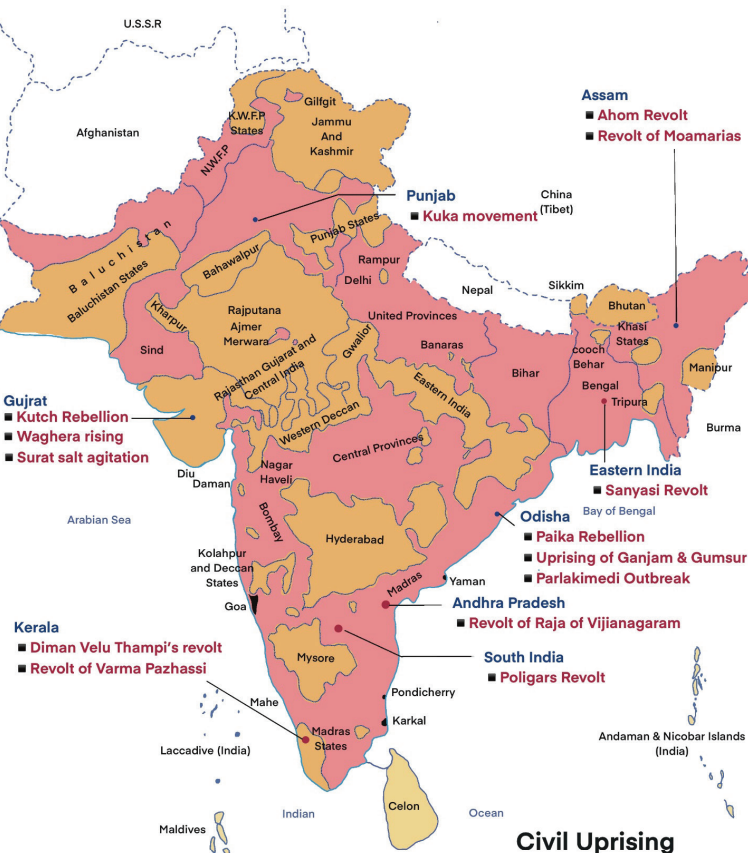
Political Causes:
- Doctrine of Lapse: Lord Dalhousie's policy annexed selected dependent states such as Satara, Jhansi, and Nagpur by refusing to recognize adopted successors for sovereignty. It was widely perceived as illegitimate.
- Subsidiary Alliance: Forced rulers to disband their own armies and accept British protection, leading to huge financial burdens and the loss of sovereignty.
- Annexation of Awadh (1856): Annexed not through Lapse but on the stated ground of 'misgovernment'. Company intervention disrupted the interests of taluqdars, court employees and soldiers, intensifying resentment in a major recruiting region of the Bengal Army.
- Humiliation of Rulers: Indian rulers were denied rights (e.g., Rani Lakshmibai denied adoption rights) or pensions (e.g., Nana Saheb denied pension).
Economic Causes:
- Exploitative Land Revenue Systems: Systems like Permanent, Ryotwari, and Mahalwari demanded excessively high revenue. Land became concentrated in the hands of moneylenders and new zamindars .
- Destruction of Handicrafts: Indian industries collapsed due to competition from cheap British machine-made goods. This resulted in the displacement of millions of artisans and craftsmen.
- Drain of Wealth: Systematic transfer of Indian resources (taxes, raw materials) to Britain, leading to India’s impoverishment (explained by Dadabhai Naoroji).
Social and Religious Causes:
- Suspicion of Social Reforms: Measures such as the abolition of Sati (1829) and the Widow Remarriage Act (1856) were welcomed by reformers but were viewed by some conservative groups as interference in religious and social practice.
- Fear of Conversion: The spread of Western education and aggressive activities of Christian missionaries created a widespread fear that the British aimed to convert the entire population to Christianity.
- Racial Discrimination: British officers maintained a superior, aloof attitude toward Indians, deepening the resentment and humiliation.
Military Causes:
- Racial Discrimination and Pay Disparity (Concrete Numbers): Indian sepoys faced severe discrimination. The monthly salary of a Sepoy was typically 7 to 9 rupees, whereas the minimum monthly salary for a European Private was three to four times higher (approx. 25-30 rupees), along with better allowances and service benefits.
- General Service Enlistment Act (1856): This Act required all new Bengal Army recruits to be ready for overseas service. For high-caste Hindu sepoys, crossing the sea was considered a violation of caste and religious taboos.
- Composition of the Army: Before 1857, the ratio of Indian to European soldiers in the Bengal Army was approximately 5:1 (around 135,000 Indian sepoys to 24,000 Europeans), yet Indians were deliberately kept out of high ranks.
Immediate Cause:
- The introduction of the new Enfield rifle cartridges. A rumour spread that the paper cartridges were greased with the fat of cow (sacred to Hindus) and pig (forbidden to Muslims). The sepoys had to bite off the paper before loading, offending both religious communities.
- The refusal of cartridges and subsequent court martial and harsh punishment of 85 sepoys at Meerut triggered the open rebellion on May 10, 1857.
| Category | Key Aspects | Examples |
|---|---|---|
| Political | Annexations, dethroning rulers, Doctrine of Lapse | Jhansi, Satara, Nagpur, Awadh (misgovernance) |
| Economic | Exploitation through revenue, decline of crafts, drain of wealth | Permanent Settlement, Collapse of Handicrafts, Naoroji’s Drain Theory |
| Social/Religious | Suspicion of reforms, missionary activities, caste fears | Widow Remarriage Act (1856), fear of conversion |
| Military | Racial Discrimination (5:1 ratio, lower pay), forced foreign posting | General Service Enlistment Act (1856), 7-9 Rs salary for Sepoy |
| Immediate | Cartridge controversy sparked revolt | Enfield rifle cartridges greased with cow and pig fat |
Prelims tips
- The Immediate cause was the Enfield rifle cartridges.
- The General Service Enlistment Act (requiring overseas service) was passed in 1856.
- The Doctrine of Lapse was associated with Lord Dalhousie.
- The annexation of Awadh took place in 1856 on the ground of misgovernance (not Doctrine of Lapse).
Mains points
- The Revolt of 1857 was the first major expression of collective Indian discontent against British rule, uniting disparate groups.
- The multi-causal nature (political, economic, social, military) created a broad coalition of rebels (from princes to peasants).
- Though triggered by the cartridge controversy, its roots lay in decades of systematic exploitation and deep resentment against the colonial system.
- Its failure revealed lack of unity, but it laid the foundation for later nationalist struggles.
Did you know?
- The annexation of Awadh displaced over 75,000 soldiers and officials who joined the rebellion, making its annexation a major military grievance.
- The ratio of Indian to European soldiers in the Bengal Army was approximately 5:1, a disparity the British drastically changed after the revolt.
- Bahadur Shah Zafar was reluctant initially but accepted leadership, giving the revolt a symbolic Mughal legitimacy.
Course of the Revolt of 1857: Key Centres and Leadership
The Revolt began dramatically at Meerut and quickly spread across North and Central India, involving sepoys, peasants, zamindars, and rulers. It was characterized by the brief restoration of traditional Indian authority under diverse local leaders, before being brutally suppressed.
Meerut (10 May 1857): The official start. 85 sepoys were court-martialed for refusing the cartridges. Their comrades mutinied, freed them, and marched to Delhi.
Delhi: Rebels proclaimed Bahadur Shah Zafar (the last Mughal Emperor) as the symbolic Emperor of Hindustan. The actual military leadership was provided by General Bakht Khan. British forces retook Delhi in September 1857; Zafar was exiled to Rangoon.
Kanpur: Led by Nana Saheb (denied pension), assisted by Tantia Tope and Azimullah Khan. The infamous Bibighar massacre (killing of British women and children) intensified the conflict. British forces recaptured Kanpur in July.
Lucknow: Led by Begum Hazrat Mahal, who declared her young son Birjis Qadr as Nawab. The Residency siege lasted 87 days. The rebellion was finally suppressed by Sir Colin Campbell.
Jhansi: Led by Rani Lakshmibai, who resisted annexation. She allied with Tantia Tope and fought bravely, dying at Gwalior in June 1858.
Bareilly (Rohilkhand): Khan Bahadur Khan (a former officer) proclaimed himself the Nawab/ruler. The region was suppressed by April 1858.
Bihar (Jagdishpur): The rebellion was led by the aging Kunwar Singh, a local Rajput zamindar whose estates were seized. He became a rallying figure in Bihar and fought till his death in April 1858.
Faizabad: Maulvi Ahmadullah Shah, a fiery orator, mobilized both Hindus and Muslims, becoming one of the most consistent rebel leaders. He was executed in 1858.
Allahabad: Led by Maulvi Liyakat Ali (a religious leader) who organized peasants and weavers. The region was suppressed quickly by Colonel Neill.
Mandasor (Central India): Led by Shahzada Firoz Shah (a Mughal prince), who attempted to raise a Mughal standard across Malwa.
Assam: Led by Kandapareshwar Singh and Maniram Dewan, who plotted to overthrow the British but were swiftly suppressed.
Mathura: Led by Devi Singh, a local leader who mobilized the populace.
Rajgarh (Bundelkhand): Led by Raja Mardansingh.
Central India: Tantia Tope (original name: Ramchandra Pandurang) was the most brilliant military leader, carrying out guerrilla warfare across Malwa, Bundelkhand, and Rajasthan until betrayed and executed in April 1859.
Suppression: The British employed brutal reprisals, including mass executions, confiscations of property, and burning of villages. By June 1858, organized resistance was largely crushed, though skirmishes continued till 1859.
| Centre | Leader(s) | British Suppressor |
|---|---|---|
| Delhi | Bahadur Shah Zafar (Symbolic), General Bakht Khan (Real Command) | John Nicholson |
| Kanpur | Nana Saheb, Tantia Tope, Azimullah Khan | Sir Colin Campbell |
| Lucknow | Begum Hazrat Mahal, Birjis Qadr | Sir Colin Campbell |
| Jhansi & Gwalior | Rani Lakshmibai, Tantia Tope | Sir Hugh Rose |
| Bareilly (Rohilkhand) | Khan Bahadur Khan | Sir Colin Campbell |
| Bihar (Jagdishpur) | Kunwar Singh | William Taylor, Major Eyre |
| Faizabad | Maulvi Ahmadullah Shah | — |
| Allahabad & Banaras | Maulvi Liyakat Ali | Colonel Neill |
| Assam | Kandapareshwar Singh, Maniram Dewan | Lieutenant Fister |
| Mandasor (M.P.) | Shahzada Firoz Shah | — |
Prelims tips
- The starting point was Meerut on 10 May 1857 .
- Tantia Tope was the most adept at guerrilla warfare, fighting till April 1859.
- Sir Colin Campbell suppressed the revolt in multiple major centers: Kanpur, Lucknow, and Bareilly.
- The leader from Assam, Maniram Dewan, was executed, marking the end of the revolt there.
Mains points
- The revolt was a series of regional uprisings linked by common anti-British sentiment, proving that resistance was widespread.
- Leadership was diverse (princes, zamindars, Maulvis, sepoys) but lacked coordination or a unified, modern military strategy.
- Despite its limited geographic and social reach, it represented the first broad attempt to overthrow British rule in a coordinated manner.
- Its legacy was crucial, providing a psychological memory of unity and sacrifice that fueled later nationalist movements.
Did you know?
- The annexation of Awadh displaced 75,000 soldiers (who joined the rebellion) and was considered the 'cherry that dropped into the mouth' of the Company.
- Rani Lakshmibai reportedly leapt from her fort on horseback with her adopted son tied to her back.
- Maulvi Ahmadullah Shah was so difficult to capture that the British announced a reward of 50,000 rupees for his head.
Consequences of the Revolt of 1857: The Great Transformation of 1858
Though the Revolt of 1857 failed militarily, it led to a fundamental restructuring of Indian governance, marking the end of the East India Company's rule and the direct assumption of power by the British Crown.
Political and Administrative Changes:
- End of Company Rule: The Government of India Act, 1858 abolished the East India Company's rule. Governance was formally transferred directly to the British Crown.
- New Posts: The post of Governor-General of India was abolished and replaced by the Viceroy (the Crown's direct representative). Lord Canning became the first Viceroy.
- New Mechanism in London: A new cabinet minister post, the Secretary of State for India, was created in the British Parliament, advised by a 15-member Indian Council, to oversee Indian administration from London.
Military Reorganization (The 'Blot on the Face' Policy):
- The army was entirely reorganized to prevent future revolts, based on the findings of the Peel Commission.
- Ratio Change (European Dominance): The ratio of European to Indian soldiers was dramatically increased. In the Bengal Army, the ratio was lowered from 5:1 (before 1857) to 2:1. In Madras and Bombay armies, it was lowered to 3:1.
- Exclusion of Indians: Indians were strictly excluded from strategic posts, particularly artillery (the military's heavy weaponry), and key positions in the armed forces.
- Divide and Rule in Army: Recruitment shifted away from the previously dominant Bengal regions (Awadh/Bihar) to the so-called 'martial races' (Sikhs, Gurkhas, Pathans) who had remained loyal, and units were deliberately mixed by caste and region to prevent unity.
Princely States Policy:
- Doctrine of Lapse abandoned: The notorious Doctrine of Lapse was officially withdrawn, guaranteeing the princely states their right to adopt successors.
- Loyal Princes Strengthened: Princes were guaranteed protection, ensuring they remained 'breakwaters in the storm'. They were now key allies of the Crown, not targets for annexation.
Socio-Economic Impact:
- Racial Divide Deepened: Hatred and mutual suspicion intensified. The British became more distant, aloof, and openly racially discriminatory toward Indians in jobs and social interaction.
- Policy of Divide and Rule: The British actively fostered communal, caste, and regional divisions (particularly between Hindus and Muslims) to systematically prevent any future united challenge to their authority.
- Religious Caution: The British government became extremely cautious about interfering in Indian religious and social customs, fearing a repeat of the 1857 backlash.
Nationalist Legacy:
- The revolt became a powerful symbol of resistance and sacrifice, laying the psychological and historical foundation for the later organized nationalist movement, often invoked by leaders like V.D. Savarkar.
| Aspect | Impact/Change |
|---|---|
| Political/Constitutional | End of Company rule ; beginning of Crown rule (via Govt. of India Act, 1858). |
| Administrative | Post of Governor-General replaced by Viceroy; Secretary of State for India created in London (new cabinet post). |
| Military | Army reorganisation (Peel Commission); European ratio increased (e.g., Bengal Army 2:1); Indians excluded from artillery. |
| Princely States | Doctrine of Lapse withdrawn; Princely states were guaranteed protection, becoming key allies of the Crown. |
| Social/Racial | Racial discrimination increased ; British adopted a policy of distance and distrust towards Indians. |
| Ideological | Systematic promotion of the Divide and Rule policy to prevent future unity. |
Prelims tips
- The Government of India Act, 1858 officially ended Company rule and started Crown’s rule.
- The First Viceroy of India was Lord Canning.
- The Doctrine of Lapse was officially withdrawn after 1857.
- The Secretary of State for India was a new position created in the British Parliament to oversee India.
- The Peel Commission was responsible for the post-1857 military reorganisation.
Mains points
- The Revolt marked a fundamental turning point—it replaced the indirect, commercial rule of the Company with the direct, authoritarian centralization of the British Crown.
- The reorganization of the army was the most immediate and impactful consequence, ensuring long-term British military dominance by drastically altering the racial composition.
- The post-1858 administration strategically reinforced the Policy of Divide and Rule, using it as a primary tool to counteract the spontaneous Hindu-Muslim unity witnessed during the Revolt.
- Though suppressed, the revolt provided the future nationalist movement with a psychological and historical inspiration—a heroic memory of fighting for collective freedom.
Did you know?
- Queen Victoria’s Proclamation (1858), often called the 'Magna Carta of the Indian people' by some contemporary observers, promised equal treatment, but this promise was quickly overshadowed by rising racism.
- The British became much more cautious about interfering in religious and social customs after 1857, learning a bitter lesson from the greased cartridges incident.
- The 1857 Revolt is still fiercely debated, with Indian historians often calling it the 'First War of Indian Independence' (V.D. Savarkar).
Foundation of the Indian National Congress (INC) (The Launch of Organized Politics)
The Indian National Congress , founded in 1885 , marked the beginning of an organized nationalist movement in India. It provided a platform for political dialogue, reform demands, and eventually the struggle for independence.
Genesis: Founded in December 1885 at Gokuldas Tejpal Sanskrit College, Bombay.
Founder: The idea was conceived by Allan Octavian Hume ( A.O. Hume ), a retired British civil servant. Hume wanted to provide educated Indians a safe channel to express their frustrations.
First Session: Presided over by W.C. Bonnerjee (Woomesh Chandra Bonnerjee) with only 72 delegates (representatives) from across India.
Early Objective (The Moderates): The initial goals were very moderate (mild): to promote unity, demand greater Indian representation in legislative councils (parliaments), and push for reforms in the Civil Service, all through constitutional means (petitions and discussions).
The 'Safety Valve' Theory (Mains Context): Some historians argue that Hume intended the INC to act as a 'safety valve'—a peaceful, constitutional outlet for educated Indians' discontent, thereby preventing a violent mass uprising. However, Indian leaders later effectively used this platform to foster genuine nationalism and challenge the colonial government.
The INC soon became the central and most powerful organization of the Indian national movement.
| Year | Place | President | Key Features |
|---|---|---|---|
| 1885 | Bombay | W.C. Bonnerjee | First session; 72 delegates; initiation of moderate constitutional demands |
| 1886 | Calcutta | Dadabhai Naoroji | Second session; attendance doubled; Naoroji explained 'Drain of Wealth' |
| 1887 | Madras | Syed Badruddin Tyabji | Became the First Muslim President; promoted unity across communities |
| 1888 | Allahabad | George Yule | Became the First English President; symbol of inclusivity |
Prelims tips
- INC founded in 1885 in Bombay; first session presided over by W.C. Bonnerjee .
- Dadabhai Naoroji (1886 session) is called the 'Grand Old Man of India'.
- Syed Badruddin Tyabji (1887) = first Muslim President.
- George Yule (1888) = first English President.
Mains points
- Foundation of INC symbolized the entry of educated Indians into organized, constitutional politics.
- It created a national political platform uniting diverse regions and communities under a common banner.
- Early moderates laid emphasis on constitutional reforms and economic critique, preparing the intellectual base.
- Though limited in scope initially, it sowed the seeds of political unity and eventually mass nationalism.
Did you know?
- The INC was initially supported by some British officials as a 'safety valve' for political discontent.
- In its early years, INC was dominated by the 'Moderates' who believed in petitions, resolutions, and dialogues with the British.
- The number of delegates rose rapidly: from 72 (1885) to over 600 by the 1890s, showcasing its rapid acceptance.
Modern Education: The Tool of Colonialism and Catalyst for Nationalism
The British introduced modern education in India to serve administrative needs, spread western knowledge, and create a loyal class, but it also produced a politically conscious middle class that spearheaded the nationalist movement.
Early Initiatives (Orientalism): Early British officials supported native learning: Calcutta Madrassa (1781) by Warren Hastings (for Muslim law) and Sanskrit College (1791) by Jonathan Duncan (for Hindu law).
Charter Act 1813: The first official step —allocated ₹1 lakh annually for education, marking the government's acceptance of responsibility, though the funds were unused until 1823 due to debate between Orientalists (supporting native learning) and Anglicists (supporting western learning).
Macaulay’s Minute (1835): The decisive turning point, settling the Orientalist-Anglicist debate in favor of the latter. Lord Macaulay advocated for:
- English medium and Western sciences.
- The 'Downward Filtration Theory': Educate a small class of elite Indians, hoping knowledge would trickle down to the masses.
- The stated goal was to create "a class of persons Indian in blood and colour, but English in taste, opinions, morals and intellect."
Wood’s Dispatch (1854): Known as the 'Magna Carta of English Education in India'. It rejected the Downward Filtration Theory and provided a comprehensive plan:
- Recommended the establishment of Universities in Calcutta, Bombay, and Madras (established 1857).
- The creation of a Department of Public Instruction (DPI) in each province.
- A system of grants-in-aid to encourage private education.
- Increased emphasis on women’s education and teacher training.
Impact (Dual Nature): Education created a powerful, English-educated Indian middle class that became the backbone of the reform movements and the nationalist movement (e.g., leaders of the INC). However, it was elitist, neglected mass, technical, and rural education, and failed to achieve the goal of creating a loyal class.
| Year | Event/Measure | Impact |
|---|---|---|
| 1781 | Calcutta Madrassa by Warren Hastings | Promoted study of Muslim law |
| 1791 | Sanskrit College at Varanasi by Jonathan Duncan | Encouraged Hindu law & philosophy studies |
| 1813 | Charter Act | First official allocation of ₹1 lakh for education. |
| 1835 | Macaulay’s Minute | Shifted policy from Oriental to English/Western medium; promoted Downward Filtration Theory. |
| 1854 | Wood’s Dispatch | 'Magna Carta' ; Recommended Universities, DPIs, and grants-in-aid (systemic planning). |
| 1857 | First Universities | Calcutta, Bombay, Madras Universities established. |
Prelims tips
- Wood’s Dispatch (1854) → Magna Carta of English Education.
- Macaulay’s Minute (1835) → English medium & Western sciences.
- The first three modern Universities were established in 1857 (Calcutta, Bombay, Madras).
Mains points
- Modern education created an English-educated Indian middle class which became the backbone of reform movements and nationalism.
- It fostered rationalism, liberalism, and modern political ideas but was elitist and failed to reach the masses, thus neglecting mass, technical, and rural education.
- It represented a dual nature: a tool of colonial control but also an instrument of Indian awakening.
Did you know?
- The first graduates from Calcutta University passed in 1858, just after the Revolt.
- Macaulay openly dismissed oriental learning as 'worthless' in comparison to Western knowledge.
- The need for English was primarily driven by the government's notification in 1844 that made English knowledge a prerequisite for government jobs.
Vernacular Press Act (1878) and Arms Act (1878)
The Vernacular Press Act (VPA) of 1878, enacted by Lord Lytton, was a highly repressive measure aimed at censoring the Indian-language press. It was passed alongside the discriminatory Arms Act.
Context (Lord Lytton’s Viceroyalty, 1876–80): Lytton's term was marked by controversy (e.g., age limit reduction for ICS exam) and the massive Delhi Durbar (1877) held during a devastating famine, which drew sharp criticism from the Indian press.
Vernacular Press Act (VPA), 1878:
- Aim (Censorship): To control and suppress the growing volume of anti-government criticism and 'seditious' material published in the vernacular (local) language newspapers.
- Key Feature (The 'Gagging Act'): The Act gave the government powers to seize the assets of any vernacular paper if it published content considered seditious, without needing a court order, making it highly arbitrary.
- Discrimination: It explicitly excluded the English-language press (which was loyal to the government), making it a discriminatory piece of legislation.
- Reaction: The Act was universally condemned by the Indian public and press. Many newspapers switched their language overnight to English to avoid the Act's provisions (e.g., Amrita Bazar Patrika).
Arms Act (1878): This Act made it a criminal offence for Indians to carry arms without a license. It was also highly discriminatory as it made an explicit exemption for Europeans and Anglo-Indians.
Significance: These acts became a rallying point for the nascent nationalist movement. They exposed the repressive, arrogant nature of the colonial government and showed Indian leaders (like Surendranath Banerjee) the immediate need for a unified political voice.
| Act | Year | Key Feature | Nature |
|---|---|---|---|
| Vernacular Press Act (VPA) | 1878 | Gave arbitrary power to seize printing press; excluded English press. | Discriminatory Censorship |
| Arms Act | 1878 | Required licenses for Indians to carry arms; exempted Europeans. | Racial Discrimination |
| ICS Age Limit | 1878 | Maximum age for ICS exam reduced to 19. | Structural anti-Indian bias |
Prelims tips
- The VPA (1878) and Arms Act (1878) were passed during the Viceroyalty of Lord Lytton.
- VPA was nicknamed the 'Gagging Act'.
- The VPA excluded the English-language press.
- The nationalist reaction to the VPA led to a strong push for political unity.
Mains points
- Lytton's repressive laws demonstrated the colonial state's willingness to use authoritarian measures to control public opinion and maintain racial superiority.
- The VPA played a vital role in the growth of nationalism by making the press a common target of repression and proving the need for a unified political voice.
- These acts confirmed the Indian intellectuals' view that all British policies, even seemingly liberal ones, were ultimately subservient to imperial control and racial interest.
Did you know?
- The VPA was eventually repealed by Lord Ripon in 1882 as part of his liberal reforms, which contributed to his popularity.
- Amrita Bazar Patrika instantly changed its language from Bengali to English (overnight) to bypass the VPA, demonstrating quick journalistic defiance.
The Partition of Bengal (1905)
Announced by Lord Curzon on 20 July 1905 and made effective on 16 October 1905 , the Partition of Bengal divided the huge province into Eastern Bengal & Assam and Western Bengal — a move presented as administrative, but widely seen as a deliberate 'divide-and-rule' step that galvanized the Swadeshi movement .
Background: The idea of reorganising Bengal and eastern districts (Chittagong, Dhaka, Mymensingh) had been under consideration since c.1903 ; Curzon pursued proposals in 1904 and toured eastern Bengal ( Feb 1904 ) to justify the scheme.
Official announcement: On 20 July 1905 Lord Curzon issued the order dividing Bengal into two units; the partition formally took effect on 16 October 1905 .
Administrative scheme: Two provinces were created — Eastern Bengal & Assam ( Dacca as capital) with about 31 million population, and Western Bengal (including the Presidency) with Calcutta as capital; the official reason cited ease of administration of a province of c.78 million.
Real (political) motive: The partition aimed to weaken Bengali political unity by splitting the Bengali-speaking population and by creating a Muslim-majority eastern province — seen as an attempt to divide Bengalis on linguistic and communal lines and to blunt the rising nationalist movement in Bengal.
Demographic engineering: In the new scheme Bengal proper (western part) would have become a Hindu-majority area while Eastern Bengal & Assam would be Muslim-majority — reducing Bengali influence in provincial politics.
Opposition inside administration: Some officials (e.g., H.J.S. Cotton , former Chief Commissioner of Assam) opposed the scheme; many Bengali political leaders and newspapers protested strongly.
Mass political reaction: The announcement triggered wide protests — hartals , public meetings, processions, fasting , bathing in the Ganga as a mark of mourning ( 16 Oct 1905 ), tying of rakhis across Bengal as a symbol of unity, and large gatherings where songs like Rabindranath Tagore’s 'Amar Sonar Bangla' were sung.
Swadeshi & Boycott link: Partition became the immediate catalyst for the Swadeshi and Boycott movement (1905 onward): public burning of foreign cloth , boycotts of British goods, establishment of swadeshi schools, industries and banks , and use of festivals for political mobilisation.
Political fallout: The partition accelerated the rise of extremist leaders ( Tilak, Aurobindo, Bipin Chandra Pal, Lajpat Rai ) and intensified demands for more vigorous political action beyond moderate petitions.
Administrative consequences & changes: To placate some interests the British created separate administrative arrangements for Assam and for Bihar & Orissa later (after annulment), and moved the imperial capital to Delhi (1911) .
Annulment (1911): At the Delhi Coronation Durbar on 12 December 1911 King George V announced the annulment of the 1905 partition; Bengal was reunited, but Bihar and Orissa were separated from Bengal and Assam became a separate province; Dacca ceased to be a provincial capital of a separate Bengal province.
Aftermath and reactions: Many Muslim leaders condemned the annulment as betrayal; Congress and nationalist opinion celebrated the reunification but the long-term damage included communal political mobilization and British use of communal representation (later reinforced by measures like separate electorates).
| Date / Year | Event | Notes |
|---|---|---|
| c.1903 | Initial proposals to reorganise Bengal discussed | Early administrative discussions began |
| January 1904 | Partition proposals officially published | Scheme circulated for comments |
| February 1904 | Curzon tours eastern Bengal | Attempt to justify scheme to public and officials |
| 20 July 1905 | Lord Curzon announces Partition | Official proclamation issued |
| 16 October 1905 | Partition comes into effect | Eastern Bengal & Assam operational with Dhaka as capital |
| 1905–1908 | Swadeshi & Boycott agitation peaks | Mass mobilisation, protests and economic action |
| 1906 | All-India Muslim League formed (Dec 1906) | Muslim political organisation partly encouraged by communal politics |
| 12 December 1911 | Partition annulled at Delhi Durbar | Bengal reunited; capital moved to Delhi ; Bihar & Orissa separated |
| Stated (Official) Reason | Real/Political Motive |
|---|---|
| Too large a province (c.78 million) — administrative difficulty | Divide Bengali political influence and weaken nationalist leadership |
| To develop and administer Assam more directly | Create a Muslim-majority province to cultivate Muslim loyalty and divide Hindus & Muslims |
| Improve provincial efficiency and governance | Gerrymander demographics — reduce Bengali-speaking majority in West Bengal |
| Group/Person | Position | Reason/Notes |
|---|---|---|
| Moderate Congress leaders (initially varied) | Opposed partition (many supported Swadeshi later) | Organized petitions, meetings and moderate protest in Bengal |
| Extremists & younger nationalists ( Tilak, Aurobindo, Bipin Chandra Pal ) | Strongly opposed, supported direct action | Pushed mass agitation, boycott and political mobilisation outside Bengal |
| Urban middle-class & students in Bengal | Opposed | Led picketing, processions and economic boycotts |
| Some Muslims (esp. certain landlords & elite in Dacca) | Supported or were neutral | Perceived administrative advantage and greater representation in the new province |
| British officials ( Curzon and associates) | Supported and implemented | Cited administrative efficiency; aimed to split nationalist leadership |
Prelims tips
- Partition announced: 20 July 1905 ; came into effect: 16 October 1905 .
- Eastern Bengal & Assam capital — Dacca (Dhaka) ; Western Bengal retained Calcutta (Kolkata) .
- Partition annulled: 12 December 1911 ( Delhi Durbar of King George V ).
- Immediate political consequence — launch and spread of the Swadeshi & Boycott movement (1905 onwards).
Mains points
- Though presented as an administrative reform, the 1905 Partition of Bengal was a politically motivated move to break Bengali unity and to cultivate communal divisions — it exemplifies the British 'divide-and-rule' strategy .
- The announcement triggered mass politics in India — the Swadeshi and Boycott movement linked political protest with economic self-reliance , education reform and cultural revival.
- The partition and its annulment had complex consequences: it briefly achieved some administrative aims but permanently altered political alignments — encouraging communal political organisation (e.g., growth of Muslim League) and strengthening extremist nationalism .
- The Partition episode demonstrates how colonial administrative decisions could produce large-scale political mobilisation and change the trajectory of the freedom movement by widening its social base (students, women, workers).
Did you know?
- On 16 October 1905 (the day partition came into force) people in Bengal observed it as a day of mourning — fasting, bathing in the Ganga and barefoot processions singing 'Bande Mataram' .
- People tied rakhis across communities in Bengal as a symbolic gesture of unity between the two halves.
- Rabindranath Tagore composed and popularised songs (including 'Amar Sonar Bangla' ) that became anthems of protest during the anti-partition movement.
The Swadeshi and Boycott Movement (1905–1911): A Foundation for Mass Nationalism
The Swadeshi and Boycott Movement emerged as a direct response to the politically motivated Partition of Bengal (1905) . It marked a watershed moment in India's freedom struggle by pioneering the concept of economic self-reliance (Swadeshi) , advocating passive resistance, and demonstrating the power of mass political mobilisation , even across regional boundaries. The movement highlighted the ideological schism between the Moderates and Extremists, but together they forged the essential blueprint for future nationalist struggles.
Launch and Catalyst: The movement was formally inaugurated at the Calcutta Town Hall on 7 August 1905 , following the passage of the Boycott Resolution . The immediate political provocation was the implementation of the Bengal Partition on 16 October 1905 , which was observed as a Day of Mourning (Arandhan) in Bengal.
Campaign under Moderates: Leaders like Surendranath Banerjea , K.K. Mitra , and Prithwishchandra Ray dominated the initial phase (1905). Their methods remained largely constitutional , utilizing petitions, public meetings, and propaganda through newspapers like *Hitabadi*, *Sanjibani*, and *Bengalee*. Their strategy was limited to pressuring the British government by building public opinion primarily in Bengal and England.
Campaign under Extremists: The later phase (1906 onwards) saw the ascendancy of the Extremist leaders: Bal Gangadhar Tilak , Lala Lajpat Rai , Bipin Chandra Pal , and Aurobindo Ghosh . They advocated a shift in method toward passive resistance , encompassing the complete boycott of not only foreign goods but also government schools, jobs, courts, legislative councils, and titles .
Extremists’ Strategy: Their goal was to transform Swadeshi into a true mass struggle with the objective of attaining Swaraj . Key methods included the public burning of foreign cloth , organizing widespread political strikes and processions, and innovatively using traditional religious festivals (like Ganapati and Shivaji Utsav) for political mobilisation.
Extent of the Movement: The movement successfully transcended Bengal's borders, spreading to Bombay (under Tilak), Punjab (under Lajpat Rai and Ajit Singh), Madras Presidency (led by V.O. Chidambaram Pillai and Subramania Siva), and Andhra (led by Hari Sarvottam Rao), proving its pan-Indian appeal.
Labour Unrest: The period marked the beginning of modern industrial protest linked to nationalist politics, evidenced by strikes among railway workers (1906) , Burn Company clerks, and cotton mill labourers. This led to the emergence of the first trade union-like movements .
Women’s Participation: For the first time, urban middle-class women actively broke traditional barriers to join processions, engage in picketing , and organize their own protest meetings.
Students’ Role: Students were highly politicized, organizing picketing and boycotting foreign goods, often facing severe government backlash, including expulsions, fines, and the loss of scholarships (e.g., the Carlyle Circular).
Reasons for Decline (by 1908): The movement fizzled out primarily due to intense government repression , the imprisonment or deportation of key leaders (e.g., Tilak in 1908), the lack of a sustained organizational structure, the damaging Surat Split (1907) which fractured the Congress, a narrow social base (peasants remained largely uninvolved), and the inherent difficulty of sustaining prolonged, high-intensity mass mobilisation.
Significance: It was the first mass movement to involve students, women, and workers; it profoundly strengthened Indian nationalism by expanding the struggle into economic, cultural, and political spheres simultaneously; and critically, it provided the conceptual and methodological framework for the later Gandhian movements.
| Aspect | Moderates’ Approach | Extremists’ Approach |
|---|---|---|
| Leadership | Surendranath Banerjea, Prithwishchandra Ray | Tilak, Lajpat Rai, Aurobindo Ghosh, Bipin Chandra Pal |
| Methods | Petitions, meetings , propaganda in newspapers | Boycott, passive resistance , strikes, processions |
| Focus | Bengal-centric agitation | Nationwide mobilisation |
| Objective | Pressurise British with public opinion | Make administration impossible; demand swaraj |
| Social base | Upper middle classes, zamindars | Educated lower middle class, students, workers |
| Region | Leaders | Special Features |
|---|---|---|
| Punjab | Lala Lajpat Rai, Ajit Singh | Peasant agitation, protests against canal colonies |
| Bombay | Bal Gangadhar Tilak | Ganapati & Shivaji festivals used for mobilisation |
| Madras Presidency | V.O. Chidambaram Pillai, Subramania Siva | Swadeshi Steam Navigation Company , Tamil newspapers |
| Andhra | Hari Sarvottam Rao | Student participation, vernacular speeches |
| Delhi | Sayyed Haider Raza | Meetings and mobilisation in north India |
Prelims tips
- Swadeshi & Boycott → formally launched in Calcutta Town Hall (7 Aug 1905) .
- Tilak used Ganapati & Shivaji festivals for mobilisation.
- V.O. Chidambaram Pillai founded Swadeshi Steam Navigation Company in Tuticorin.
- Movement fizzled out by 1908 due to repression and Surat Split (1907) .
Mains points
- The movement showcased India’s capacity for economic self-reliance (Swadeshi industries, national banks) and resistance against colonial exploitation.
- It was the first large-scale movement involving students, women, and workers , successfully widening the social base of the national struggle and laying groundwork for later mass movements.
- It clearly revealed ideological divisions within INC ( Moderates vs Extremists ), leading to the organizational fracture known as the Surat Split (1907) .
- Though it fizzled out by 1908, it left a deep impact on Indian nationalism by linking cultural, economic, and political struggles under the banner of Atma-Shakti (self-reliance).
Did you know?
- On 16 October 1905 , people tied rakhis to each other’s hands to symbolize Bengal’s unity (Hindu-Muslim unity).
- Rabindranath Tagore composed 'Amar Sonar Bangla' as a protest song, later adopted as Bangladesh’s national anthem.
- Priests refused to solemnise marriages where foreign goods were exchanged, highlighting the social application of the Boycott.
Moderates vs Extremists & Surat Split (1905–1907)
The Swadeshi and Boycott movement exposed sharp differences between Moderates and Extremists in the Congress. Moderates sought constitutional reforms and gradualism, while Extremists demanded swaraj , total boycott , and passive resistance . Their clash culminated in the Surat Split of 1907 , which weakened the nationalist movement temporarily.
Moderates’ Approach: Believed in petitions, constitutional reforms, professed loyalty to the Crown , and sought gradual participation of Indians in administration (strategy of 'political mendicancy'). Leaders: Dadabhai Naoroji , Gopal Krishna Gokhale , Surendranath Banerjea .
Extremists’ Approach: Advocated swaraj (self-rule/autonomy) as the ultimate goal, total boycott of foreign goods and institutions , passive resistance, and mass mobilisation. Leaders: Bal Gangadhar Tilak , Lala Lajpat Rai , Bipin Chandra Pal , Aurobindo Ghosh .
Social Base Differential: Moderates drew support primarily from the zamindars, upper middle classes, and urban professionals; Extremists galvanized the lower middle class, students, workers, and small traders.
View on British Rule: Moderates saw British rule as ultimately beneficial if reformed (providential mission); Extremists rejected this premise entirely, viewing British rule as fundamentally exploitative and unjust.
Ideological Inspiration: Moderates relied on English liberal thought and constitutional history; Extremists drew inspiration from Indian culture, history , and traditional symbols (e.g., Tilak's festivals) to instill pride and self-confidence (Atma-Shakti).
Clash over Methods: The core dispute was whether the Swadeshi and Boycott should be limited to Bengal and foreign goods (Moderates' view) or extended nationwide to all institutions and goods with the goal of Swaraj (Extremists' view).
The Surat Split (1907) was the climax of these ideological and tactical differences, occurring over the choice of Congress president and the resolution on Swadeshi and Boycott.
| Aspect | Moderates | Extremists |
|---|---|---|
| Social Base | Zamindars, upper middle class, professionals | Lower middle class, students, workers, traders |
| Ideological Inspiration | Western liberalism, European history | Indian culture, history, traditional symbols |
| View on British Rule | Providential mission; reforms possible | Exploitative; must be resisted |
| Methods | Petitions, memoranda, meetings | Boycott, passive resistance, strikes |
| Goal | Constitutional reforms, more Indians in governance | Swaraj (self-rule) as ultimate aim |
| Attitude towards Masses | Masses not ready for political work | Faith in masses’ ability to sacrifice |
| Approach to British Crown | Professed loyalty to the Crown | Rejected loyalty; demanded independence |
| Year & Session | Event | Outcome |
|---|---|---|
| Banaras Session, 1905 | Moderates ( Gokhale presiding) vs Extremists on boycott extension | Mild resolution passed; Extremists dissatisfied |
| Calcutta Session, 1906 | Dadabhai Naoroji presided; compromise resolutions on swadeshi, boycott, self-government | Word 'Swaraj' used for first time in INC |
| Surat Session, 1907 | Extremists wanted Tilak/Lajpat Rai as president; Moderates wanted Rashbehari Ghosh | Clash between factions → violent split in Congress |
Prelims tips
- Word 'Swaraj' first mentioned officially in INC at Calcutta Session (1906) .
- Surat Split happened in 1907 due to clash over president choice and boycott resolutions.
- Moderates led by Gokhale, Naoroji ; Extremists led by Tilak, Lajpat Rai, Bipin Chandra Pal .
Mains points
- The Surat Split was the outcome of growing ideological and tactical differences between Moderates and Extremists over the goal (Swaraj) and method (Mass Action vs Petition).
- It demonstrated that nationalism had broadened beyond petitions into mass struggle but suffered from lack of unity of leadership on future strategy.
- While the split weakened the nationalist front temporarily, it also sharpened the ideological clarity of the Extremist camp and prepared them for later mass politics.
- The lessons from this division influenced later unity attempts under Gandhi’s leadership, where balancing moderates and radicals and creating a unified front became crucial.
Did you know?
- At Surat (1907), both factions physically clashed ; chairs and shoes were thrown in the session hall.
- Dadabhai Naoroji (1906 Calcutta) was chosen as a compromise candidate between Moderates and Extremists to avert the split temporarily.
- The Surat Split weakened Congress temporarily , allowing British to suppress Extremists with impunity.
Komagata Maru Incident and the Ghadar Movement: Global Resistance and Racial Exclusion
The Komagata Maru Incident (1914) , which denied entry to 376 Indian passengers (mostly Sikhs) in Canada due to racist immigration laws, served as a critical catalyst. It galvanized the Ghadar Movement , which had already organized Indian expatriates in North America for India’s independence. These events became powerful symbols of global anti-colonial resistance and the fight against racial exclusion.
I. The Context of Racial Exclusion:
Background: Large numbers of Punjabi, predominantly Sikh, immigrants moved to Canada and the USA in the early 20th century seeking economic opportunities, where they faced severe racial prejudice and restrictive immigration laws.
Discriminatory Laws: Canada used the 'Continuous Journey Regulation' (1908), which legally blocked Asian immigrants by demanding a direct, continuous journey from their native land—a condition nearly impossible for Indians to meet, as no direct steamship service existed.
Komagata Maru Incident (1914): The Japanese ship, chartered by Gurdit Singh (a Sikh businessman from Singapore), carried 376 Indian passengers (of whom 340 were Sikh, 24 Muslim, and 12 Hindu). They were denied entry at Vancouver Harbour for two months due to the discriminatory laws.
Budge Budge Violence: After the standoff, the ship was forced back to India. Upon arrival at Budge Budge (near Calcutta), British police attempted to arrest the passengers. Violence erupted, leading to the deaths of 19 passengers and the injury and arrest of many others.
II. The Ghadar Movement’s Response:
The Ghadar Party (1913): The party was already active in San Francisco, founded by overseas Indians like Lala Hardayal , Sohan Singh Bhakna , and Kartar Singh Sarabha . It aimed for an armed revolution in India.
Ghadar Newspaper (from 1913): Published weekly in multiple languages (Punjabi, Urdu, Hindi, and English), the paper 'Ghadar' (meaning 'Revolt') fiercely spread the message of revolt among the Indian diaspora.
Catalyst for Armed Action: The Komagata Maru incident was viewed by the Ghadarites as the ultimate proof of the hypocrisy of the British Empire and the necessity of armed action. They argued that racial discrimination would only end with the end of British rule.
WWI and Ghadar Conspiracy: Ghadar leaders seized the opportunity of World War I to launch an uprising (the Indo-German Conspiracy). They called on Indians, particularly soldiers, to return home and revolt. Arms shipments were attempted with German support.
III. Suppression and Legacy:
British Suppression: British intelligence networks effectively infiltrated the Ghadar movement and foiled the conspiracy. Many Ghadar leaders were subjected to the Lahore Conspiracy Trials, leading to numerous executions and imprisonments.
Martyrdom: Young leaders like Kartar Singh Sarabha were executed in 1915 at age 19, becoming powerful martyrs for the revolutionary cause.
Legacy: Both events were seminal. The Komagata Maru incident starkly highlighted racial discrimination as a tool of imperialism, while the Ghadar Party gave the independence struggle an unprecedented global and armed dimension, fundamentally influencing the subsequent phase of revolutionary nationalism.
| Year | Event | Details |
|---|---|---|
| 1914 | Komagata Maru reaches Vancouver | Denied entry to 376 Indians (340 Sikh, 24 Muslim, 12 Hindu) due to racial laws |
| 1914 | Return to India (Budge Budge) | Violence erupted; 19 passengers killed by police |
| Impact | Symbol of racial discrimination and imperial hypocrisy | Galvanized Punjabi migrants and Ghadar revolutionaries |
| Year | Event | Details |
|---|---|---|
| 1913 | Formation of Ghadar Party | Founded in San Francisco by Indian immigrants (mostly Sikh) |
| 1913 | Launch of Ghadar Newspaper | Published in Punjabi, Urdu, Hindi, and English; called for revolt |
| 1915 | Indo-German Conspiracy | Attempted arms shipment to India for uprising during WWI |
| 1915 | Executions | Kartar Singh Sarabha executed at age 19 |
| Legacy | Provided global and armed dimension to the freedom struggle | Inspired future revolutionaries like Bhagat Singh |
Prelims tips
- Komagata Maru Incident → 1914 , Vancouver, ship with 376 Indians denied entry.
- Budge Budge violence killed 19 passengers on return to India.
- Ghadar Party founded 1913 in San Francisco ; published 'Ghadar' newspaper.
- Kartar Singh Sarabha → executed in 1915 at age 19.
Mains points
- Racial Nexus of Imperialism: Komagata Maru highlighted the link between racial discrimination in the Dominions (Canada) and colonial rule in India, exposing the hypocrisy of the British Empire.
- Globalisation of Struggle: The Ghadar Party provided the first successful model of a transnational organization that mobilized the diaspora , financing and attempting to execute an armed uprising against the British from abroad.
- Symbolic Retaliation: Both events, especially the Budge Budge tragedy, served as powerful rallying points, injecting revolutionary fervor and acting as a critical catalyst for direct action by Ghadarites during WWI.
- Legacy: Komagata Maru and Ghadar left an enduring legacy of sacrifice, resistance, and international solidarity, profoundly influencing figures like Bhagat Singh and the subsequent revolutionary phase in Punjab.
Did you know?
- The Komagata Maru ship was originally a Japanese ship chartered by Gurdit Singh , a Sikh businessman.
- The Ghadar newspaper was printed on cheap paper but circulated globally, from Canada to India.
- Kartar Singh Sarabha was so young that even the British judge noted his bravery at execution.
Home Rule Movement (1916–1918): Revival and Expansion
The Home Rule Movement , launched separately by Bal Gangadhar Tilak and Annie Besant in 1916 , demanded self-government for India within the British Empire. Inspired by Irish Home Rule , it marked a vital revival of nationalist politics after the decline of the Swadeshi Movement and successfully created organizational unity between the Moderates and Extremists.
I. Objectives, Inspiration, and Strategy:
Objective: To achieve Self-government (Home Rule) for India within the British Empire (Dominion Status), focusing on control over internal administration.
Inspiration: The movement was directly modeled on the Irish Home Rule League.
Tilak’s League (April 1916, Poona): Active in Maharashtra, Karnataka, Central Provinces, and Berar . Focused on mass mobilization , linking with peasants, and using the vernacular press. Slogan: 'Home Rule is my birthright, and I shall have it.'
Besant’s League (September 1916, Adyar): Covered the rest of India (Madras, UP, Bombay). Leveraged Theosophical Society networks , focusing on educated classes and using petitions and pamphlets.
Methods: Continuous agitation through extensive public meetings, pamphlets, newspapers, tours, and campaigns for political awareness, utilizing the Indian language press.
II. Impact on Nationalist Unity (Lucknow Milestones):
Congress Reunion (Lucknow, 1916): The Home Rule momentum facilitated the reunion of Extremists (Tilak) and Moderates in the Congress, healing the Surat Split of 1907 .
Hindu-Muslim Unity (Lucknow Pact, 1916): Led to the historic pact between Congress and the All-India Muslim League (facilitated by Tilak and Jinnah), presenting joint constitutional demands to the British.
Controversial Concession: The Congress formally accepted separate electorates for Muslims for the first time, a structural concession that later validated the communal principle in Indian politics.
III. Decline and Enduring Legacy:
British Response: Initially repressive; Annie Besant was interned (June 1917) , which ironically amplified the movement’s popularity.
Montagu’s Declaration (August 1917): The sustained pressure forced Britain to promise the 'gradual development of self-governing institutions.'
Decline (By 1918): Weakened due to Besant’s acceptance of the Montagu Declaration (moderation), Tilak's absence (to fight the Valentine Chirol libel case in England), and the subsequent emergence of Gandhi’s leadership and mass Satyagraha.
Prepared the Ground: The movement created a nationwide organizational structure and a generation of trained, politically conscious youth (students, women, lower middle class), preparing the masses for Gandhi's mass movements of the 1920s.
Shift to Masses: Successfully utilized linguistic provinces and vernacular language for political mobilization, anticipating the later regional strategies of the Congress.
| Aspect | Tilak’s League | Besant’s League |
|---|---|---|
| Founded | April 1916 (Poona) | September 1916 (Adyar, Madras) |
| Regions | Maharashtra, Karnataka, CP & Berar | Madras, Bombay, United Provinces, rest of India |
| Focus | Mass mobilisation, peasants, popular appeal | Educated classes, petitions, propaganda |
| Method | Tours, meetings, vernacular press | Pamphlets, petitions, journals |
| Leadership Style | Assertive, linked with extremists | Moderate, linked with Congress liberals |
Prelims tips
- Home Rule Movement launched 1916 by Tilak (Poona) and Annie Besant (Madras) .
- Inspired by Irish Home Rule Movement .
- Annie Besant was interned in June 1917 ; release increased popularity.
- Montagu’s Declaration (1917) → response to Home Rule agitation.
Mains points
- Revival and Organisational Unity: The Home Rule Movement revived nationalist activity after the Swadeshi decline and created unity by bridging moderates and extremists (Lucknow Session).
- Global and Domestic Pressure: It exerted continuous pressure on the British, leading directly to the Montagu’s Declaration (1917) , the first official British commitment to responsible government .
- Mass Base Preparation: It successfully spread political education to new social groups including students, women, and the lower middle class , thereby preparing a mass base for Gandhi’s mass movements from 1919 onwards.
- Political Strategy: The movement facilitated the Lucknow Pact, showcasing strategic Hindu-Muslim cooperation, although it simultaneously entrenched the structural weakness of separate electorates.
Did you know?
- Tilak popularised the slogan: 'Home Rule is my birthright and I shall have it'.
- Besant used Theosophical networks to spread the movement’s message across India.
- The Lucknow Session (1916) of Congress witnessed unity between moderates, extremists, and Muslim League for the first time since Surat Split.
Lucknow Pact (1916): A Milestone of Unity
The Lucknow Pact of 1916 was a historic agreement forged during the high point of the Home Rule Movement between the Indian National Congress and the All-India Muslim League. It successfully achieved temporary Hindu-Muslim unity and presented joint constitutional demands to the British, marking a strategic consolidation of the nationalist struggle.
I. The Context of Unification:
Congress Reunion: The Lucknow Session (December 1916) was marked by the successful reunion of the two Congress factions, the Extremists (led by Tilak) and the Moderates, effectively healing the Surat Split of 1907.
Congress-League Unity: For the first time, the All-India Muslim League also held its session at the same venue. Influential leaders like Tilak, Annie Besant, and Mohammad Ali Jinnah (then the 'Ambassador of Hindu-Muslim Unity') played crucial roles in brokering the agreement.
Joint Goal: Both parties agreed on a common minimum program of constitutional reforms to demand from the British government, centering on the demand for eventual self-government/Dominion Status.
II. Key Provisions and Structural Flaws:
Expansion and Control: Both parties jointly demanded that the Legislative Councils be expanded and contain an elected Indian majority to ensure greater Indian participation in governance.
The Controversial Concession: The Congress formally accepted separate electorates for Muslims for the first time since 1909. This political necessity secured the Muslim League's support but is widely criticized for validating the communal principle and laying the foundations for the eventual communal divide.
Impact: The pact created a powerful illusion of Hindu-Muslim unity at the national level, significantly strengthening the nationalist voice and increasing political pressure on the British government.
| Provision | Details |
|---|---|
| Expansion of Councils | Legislative councils to be larger with elected majority |
| Separate Electorates | Congress accepted separate electorates for Muslims |
| Self-Government | Joint demand for eventual dominion status/self-rule |
| Unity | Hindu-Muslim cooperation in political demands |
Prelims tips
- Lucknow Pact → 1916 (Congress + Muslim League).
- Congress accepted separate electorates for Muslims for the first time.
- Extremists and moderates reunited at Lucknow Session (1916).
- Key leaders: Tilak, Annie Besant, Jinnah.
Mains points
- Structural Weakness: Acceptance of separate electorates was the major flaw, sowing the seeds of future communal divide by validating the principle of communal representation in the political structure.
- Strategic Success: The Pact served as a major strategic success during WWI by achieving unprecedented nationalist unification (Moderates + Extremists + League), greatly intensifying pressure on the British.
- Political Consolidation: It marked the first formal Congress-Muslim League cooperation, allowing the national movement to present a united front and a clear set of demands to the colonial power.
- Milestone: Despite its flaws, it was a major political milestone that galvanized the national movement during WWI and helped push the British towards the Montagu Declaration (1917).
Did you know?
- At Lucknow in 1916, Tilak and Jinnah shared the same political stage, symbolizing Hindu-Muslim unity.
- The pact was hailed by Annie Besant as a 'wonderful beginning of a new era of national cooperation'.
- The Lucknow Pact marked Jinnah as an 'ambassador of Hindu-Muslim unity', a title he later lost.
Montagu’s Declaration (1917) and Montagu-Chelmsford Reforms (1919): Limited Constitutionalism
The period 1917–1919 marked a strategic, though limited, shift in British policy. The Montagu’s Declaration (August 1917) was the first official promise of self-governance, which was formalized by the Government of India Act, 1919 (Montagu-Chelmsford Reforms). These were designed primarily to pacify nationalist opinion and divide the Indian political class while retaining absolute British control.
I. Strategic Context and Montagu's Declaration (1917):
Political Pressure: The Declaration was a direct response to combined nationalist pressure: the continuous agitation of the Home Rule Movement, the strategic nationalist unity achieved through the Lucknow Pact (1916), and the need to reward India for its massive military and financial sacrifices during WWI.
The Policy: Announced on August 20, 1917, by Edwin Montagu, the Secretary of State, it declared the goal of the British government as the 'progressive realisation of responsible government in India' as an integral part of the British Empire. This marked the first official promise of responsible government by the British Parliament.
II. The Government of India Act, 1919 (Montford Reforms):
Provincial Dyarchy (Dual Rule): This was the Act's most distinct feature, introducing dual rule in the provinces:
- Reserved Subjects: Crucial areas like Law and Order, Police, Finance, and Irrigation remained under the control of the Governor and his Executive Council (British officials).
- Transferred Subjects: Less critical areas like Education, Public Health, and Local Self-Government were placed under the control of Indian Ministers responsible to the Provincial Legislature.
Flaws of Dyarchy: The system was inherently flawed, as Indian Ministers responsible for 'Transferred' subjects had no control over finance (which was 'Reserved'), making their departments effectively powerless.
Central Administration: The Central Executive remained entirely responsible to the British Parliament, not the Indian Legislature.
Bicameralism at Centre: Introduced bicameralism at the Centre for the first time: the Central Legislative Assembly and the Council of States.
Institutionalizing Communalism: The provision of separate electorates was dangerously extended from Muslims to include Sikhs, Anglo-Indians, Indian Christians, and Europeans, a deliberate political maneuver to fragment the nationalist ranks.
Governor-General’s Powers: The Governor-General retained overriding veto power over all legislation and expenditure, ensuring ultimate imperial supremacy.
III. Nationalist Response and Legacy:
Political Disillusionment: The reforms were widely rejected as grossly inadequate and 'disappointing and deceitful.' Tilak famously dubbed dyarchy 'a new charter of slavery,' highlighting the continued dominance of the British executive.
Constitutional Milestone: Despite their political shortcomings and the perpetuation of the communal divide, the Montford Reforms were a constitutional milestone because they:
- Introduced the principle of elections and partial responsibility in the provinces.
- Provided the institutional framework for the Government of India Act, 1935, which advanced the concept of self-governance further.
| Feature | Details | Strategic Intent |
|---|---|---|
| Provincial Dyarchy | Subjects divided into Reserved (British control) and Transferred (Indian ministers) | To give an illusion of responsibility while retaining control over key powers (Finance, Police). |
| Central Legislature | Introduced bicameralism: Assembly + Council of States | To retain Official Majority and check Indian influence. |
| Separate Electorates | Extended to Sikhs, Christians, Anglo-Indians | To institutionalize communal divisions and fragment the nationalist movement. |
| Governor-General Powers | Retained veto and overriding control | To ensure ultimate imperial supremacy over the entire administration. |
Prelims tips
- Montagu’s Declaration → 20 August 1917 (First official promise of responsible government).
- Government of India Act, 1919 → Introduced dyarchy in provinces and bicameralism at the centre.
- Separate Electorates were extended in 1919 to Sikhs, Christians, and Anglo-Indians.
- Tilak famously called dyarchy 'a new charter of slavery'.
Mains points
- Strategic Compromise: The reforms were a strategic compromise: rewarding loyalty (WWI) and addressing pressure (Home Rule) while carefully limiting power transfer to maintain imperial control.
- Flawed Devolution: The introduction of dyarchy was a flawed experiment that exposed the British intent. By reserving Finance and Police, the British ensured that the Indian Ministers lacked any real capacity to implement positive change.
- Deepening Divide: The dangerous extension of separate electorates was a deliberate institutional strategy to fragment the political landscape along communal lines, mitigating the unity achieved by the Lucknow Pact.
- Constitutional Precedent: Despite failure, the Act set a constitutional precedent by formally introducing the language of 'responsible government', which nationalists thereafter used as the minimum benchmark for future demands.
Did you know?
- Edwin Montagu was the first British Secretary of State for India to visit India personally (1917) during the consultation process for the reforms.
- The reforms led to the first Indian woman legislator, Begum Jahanara Shahnawaz, being nominated/elected under the expanded councils.
- The 1919 Act provided for a review commission (later the Simon Commission ) after ten years to assess the working of the reforms.
Emergence of Gandhi in Indian Politics (1915–1920): From Local Action to National Leadership
Gandhi returned from South Africa in 1915 , bringing with him the unique methodology of satyagraha and non-violence . Through successful local peasant and worker movements (Champaran, Ahmedabad, Kheda) and his leadership in the Rowlatt Satyagraha , he skillfully transformed the nationalist struggle into a mass movement . By 1920, he emerged as the undisputed national leader , strategically unifying diverse classes, regions, and communities (including the Khilafat issue).
I. South Africa and Initial Integration (1915-1916):
South Africa Experience: Gandhi spent two decades (1893–1914) developing and testing satyagraha (Truth-Force) against racial discrimination and oppressive laws, shaping it into a formidable political tool.
Return and Mentorship: He returned to India in January 1915 . As advised by his political guru, Gopal Krishna Gokhale, he spent the initial period touring widely to understand the 'real India'—its economic hardship and social composition—before committing to political action.
Sabarmati Ashram (1917): Gandhi established his ashram near Ahmedabad, which became a hub for experiments in non-violence, simplicity, and a foundation for the Constructive Programme.
II. Testing Satyagraha: The Local Movements (1917-1918):
Champaran Satyagraha (1917): Gandhi’s first satyagraha in India was against the tinkathia system (forced indigo cultivation on 3/20th of land) in Bihar. He organized peasants and secured the official abolition of the oppressive system.
Ahmedabad Mill Strike (1918): Supported textile workers demanding better wages against Indian mill owners. Gandhi successfully used the hunger strike as a political tool for the first time in India, compelling owners to concede a 35% wage increase.
Kheda Satyagraha (1918): Led peasants in Gujarat demanding tax remission due to crop failure (famine). He, along with Sardar Patel and Indulal Yajnik, organized a no-tax campaign, forcing the government to concede partial relief.
Significance of Local Triumphs: These movements cemented Gandhi’s reputation as a leader of peasants and workers, demonstrating the practicality and ethical strength of satyagraha as a technique for mass struggle.
III. National Emergence and Consolidation (1919-1920):
Rowlatt Satyagraha (1919): The Rowlatt Act (allowed detention without trial) led to Gandhi’s first all-India struggle. He called for nationwide hartals (strikes) and non-violent protests, despite the movement turning violent in some regions.
Jallianwala Bagh (April 1919): General Dyer’s firing on an unarmed crowd in Amritsar shocked the nation. This tragedy propelled Gandhi into the moral leadership of Indian politics and convinced him that cooperation with the 'satanic' British government was impossible.
Khilafat Movement (1919–20): Gandhi strategically supported the Indian Muslims who were protesting the dismemberment of the Ottoman Caliphate. By merging the Khilafat issue with Non-Cooperation, he forged an unprecedented level of Hindu-Muslim unity.
Transformation of Congress: By 1920, Gandhi transformed the nationalist struggle from a middle-class, constitutional movement into a mass movement involving peasants, workers, women, and students, fundamentally changing the social base of the Congress.
Constructive Programme: Gandhi emphasized spinning khadi, the removal of untouchability, promotion of Hindu-Muslim unity, and rural uplift as integral components of the freedom struggle, linking social reform with political freedom.
| Year | Event | Region | Outcome |
|---|---|---|---|
| 1915 | Return from South Africa | India | Began tours to understand India; Gokhale's advice |
| 1917 | Champaran Satyagraha | Bihar | Abolition of tinkathia system |
| 1918 | Ahmedabad Mill Strike | Gujarat | Workers gained 35% wage increase; Gandhi used hunger strike |
| 1918 | Kheda Satyagraha | Gujarat | Partial revenue remission for peasants (No-Tax campaign) |
| 1919 | Rowlatt Satyagraha | All India | First all-India agitation; General Dyer's repression |
| 1919 | Jallianwala Bagh Massacre | Punjab | National outrage; Gandhi gained moral leadership |
| 1920 | Khilafat-Non-Cooperation | All India | Start of Gandhian mass movement phase; Hindu-Muslim Unity |
Prelims tips
- Champaran Satyagraha (1917) → Gandhi’s first satyagraha in India.
- Ahmedabad Mill Strike (1918) → Gandhi used hunger strike successfully.
- Kheda Satyagraha (1918) → Involved Sardar Patel; achieved revenue remission.
- Rowlatt Satyagraha (1919) → First all-India agitation under Gandhi.
- Khilafat merged with Non-Cooperation (1920) → Gandhi as national leader.
Mains points
- Evolution of Satyagraha: Gandhi introduced satyagraha and non-violence as practical, ethical, and scalable tools of mass struggle in India, moving politics beyond petitions and violence.
- Wider Social Base: His local movements successfully connected the Congress leadership with the peasants, workers, and middle classes, fundamentally widening the nationalist base into a pan-Indian mass movement.
- Moral and Political Ascent: The Rowlatt Satyagraha and the subsequent Jallianwala Bagh massacre elevated him as the undisputed moral and political leader of India, replacing the Moderate and Extremist methods.
- Strategic Unification: By 1920, Gandhi achieved a strategic masterstroke by unifying the Congress, the Khilafat movement, and the masses into a single, cohesive movement (Non-Cooperation), marking the definitive beginning of the Gandhian era.
Did you know?
- Champaran peasants called Gandhi 'Bapu' for the first time.
- During the Ahmedabad Mill Strike, Gandhi initially advised workers to sell off their jewelry, but he later resorted to a fast.
- Gandhi experimented with diet, spinning khadi, and simple living at Sabarmati Ashram as part of his philosophical preparation for political life.
Rowlatt Act (1919): The 'Black Act' and Catalyst for Mass Politics
The Rowlatt Act , passed in March 1919 against universal Indian opposition, strategically extended the government’s wartime repressive powers into peacetime. This arbitrary law, dubbed the 'Black Act' , exposed British betrayal of self-governance promises, leading directly to Gandhi’s first all-India Satyagraha and tragically culminating in the Jallianwala Bagh Massacre.
I. Background and Draconian Provisions:
Context and Betrayal: The Act was formally the Anarchical and Revolutionary Crimes Act of 1919. It was based on the recommendations of the Sedition Committee chaired by Justice S.A.T. Rowlatt . It was passed immediately after WWI and the promise of the Montagu Declaration, confirming the nationalist view that British policy was rooted in repression, not reform.
Provisions (Denial of Justice): The Act allowed the British government to imprison any person suspected of sedition or terrorism without trial for up to two years. Its most infamous feature was the complete denial of fundamental legal rights, summed up by the phrase: 'no vakil, no appeal, no daleel' (no lawyer, no appeal, no argument).
Official Goal: Ostensibly, the goal was to curb revolutionary activities during and after WWI; in reality, it aimed to stifle any political dissent arising from the Home Rule Movement or wartime hardship.
II. Gandhi’s Response and Mass Mobilisation:
The 'Black Act': Nationalists universally condemned the law as the 'Black Act' for its draconian suppression of civil liberties and press freedom. Even Moderates like Madan Mohan Malaviya and Annie Besant opposed it strongly.
First All-India Satyagraha: Gandhi denounced the Act as the final proof of the 'satanic' nature of the British system. He launched the Rowlatt Satyagraha , calling for a nationwide hartal (strike) on April 6, 1919 . This marked his first political action on a truly all-India scale, using non-violent civil disobedience as a political tool.
Spread of Agitation: The strike was successful, turning into widespread strikes, processions, and protests in major urban centers like Delhi, Punjab, Gujarat, and Bengal. The movement successfully involved a new social base, including the urban lower middle class and artisans.
III. Consequences and Legacy:
Unrest and Repression: The British responded with harsh repression and mass arrests. The arrest of local leaders in Punjab, Dr. Saifuddin Kitchlew and Dr. Satyapal , triggered spontaneous and sometimes violent protests.
Link to Jallianwala Bagh: The agitation against the Act culminated tragically in the Jallianwala Bagh Massacre (April 13, 1919), where General Dyer ordered the firing on an unarmed crowd. The severity of the massacre (and the mild punishment given to Dyer by the Hunter Committee) permanently destroyed any Indian faith in the British sense of justice.
Turning Point: The events following the Rowlatt Act—the brutality and the lack of official remorse—marked the end of the era of constitutional petitions and cooperation. It was the direct ideological foundation for the launch of the Non-Cooperation Movement (1920), establishing the framework for the first truly mass Gandhian movement.
Legacy: The anti-Rowlatt Satyagraha was key to establishing Gandhi as the undisputed national leader and testing the methodology of Satyagraha on a vast scale across diverse regions.
| Feature | Details |
|---|---|
| Detention | Arrest without warrant; detention up to 2 years without trial ('no appeal, no daleel') |
| Trials | Political cases tried without jury |
| Press & Liberties | Severe restrictions on newspapers and suppression of civil rights |
| Public Perception | Called 'Black Act' due to suppression of civil rights and denial of justice |
Prelims tips
- Rowlatt Act (1919) → Based on Rowlatt Committee report (1918).
- Allowed detention without trial; famously called 'Black Act'.
- First all-India satyagraha launched by Gandhi against it.
- Directly linked to Jallianwala Bagh massacre.
Mains points
- Betrayal and Failure: The Rowlatt Act was a profound error of judgment by the British, passed immediately after WWI, effectively nullifying the political goodwill and the promise of the Montagu Declaration.
- Catalyst for Mass Politics: Gandhi’s anti-Rowlatt Satyagraha successfully mobilized the masses across regions, marking the beginning of mass Gandhian politics and moving the national movement beyond elite circles.
- Moral Condemnation: The subsequent Jallianwala Bagh Massacre served as the ultimate moral condemnation of the British Raj, permanently damaging the faith of all Indians, including moderates, in the colonial system’s sense of justice.
- Ideological Shift: The tragedy directly led to Gandhi's critical shift from a policy of cooperation to non-cooperation, establishing the framework and ideological necessity for the launch of the Non-Cooperation Movement (1920).
Did you know?
- The Act was officially called the 'Anarchical and Revolutionary Crimes Act of 1919'.
- Even Moderates like Madan Mohan Malaviya and Annie Besant opposed it strongly.
- Gandhi’s hartal against the Act on April 6, 1919, was one of the first truly nationwide protests in India.
Jallianwala Bagh Massacre (1919) and Its Outcome: The End of Cooperation
On 13 April 1919, in the backdrop of the Rowlatt Satyagraha, thousands of unarmed men, women, and children had gathered at Jallianwala Bagh, Amritsar , to protest peacefully. General Reginald Dyer ordered troops to fire without warning on the trapped crowd, killing hundreds. This massacre destroyed the last vestiges of Indian faith in British rule and became the definitive turning point in the freedom struggle.
I. The Incident and Its Immediate Context:
Context (Rowlatt Satyagraha): The massacre occurred during the unrest triggered by the Rowlatt Act (1919). The immediate catalyst was the spontaneous protest in Amritsar against the arrest of two local leaders, Dr. Saifuddin Kitchlew and Dr. Satyapal . Public meetings had been banned under the threat of martial law.
The Atrocity: On Baisakhi day, a large, peaceful crowd—unaware of the ban—had gathered in the enclosed Jallianwala Bagh. General Dyer blocked the single, narrow exit and ordered 40 to 150 troops to fire directly into the crowd. Firing continued until ammunition was exhausted.
Casualties: The official British Hunter Commission cited 379 deaths , but the Congress Committee estimated over 1,000 deaths and many more wounded, trapped inside the walled garden.
Dyer's Intent: Dyer later admitted his objective was not merely to disperse the crowd but to produce a "sufficient moral effect" on the entire populace of Punjab, making the attack an act of deliberate state terror.
II. Moral and Political Condemnation:
The Hunter Commission (1919): The British government appointed the Hunter Commission to investigate the incident. While the report mildly condemned Dyer’s actions, it failed to impose any serious punishment. Dyer was merely relieved of command and retired, strengthening the Indian belief in British partiality.
The Moral Condemnation: The incident was the ultimate moral indictment of the British Raj. It shattered the notion of British justice and loyalty among even the most moderate Indians.
Symbolic Protests: Rabindranath Tagore renounced his knighthood in protest, stating that the time had come for "titles to lose all their relevance." Sir Sankaran Nair resigned from the Viceroy’s Executive Council .
III. Impact on the National Movement (Turning Point):
End of Co-operation: The massacre convinced Mahatma Gandhi that cooperation with the "satanic" British government was impossible, marking the definitive end of the era of constitutional petitioning and cooperation that had defined Congress politics for decades.
Radicalization of Politics: The widespread national outrage and anger radicalized the national movement, providing the emotional and ideological basis for the Non-Cooperation Movement (NCM) in 1920.
Unification in Resistance: The tragedy united all sections of Indian society—Hindus, Muslims, Sikhs, peasants, and the educated elite—in shared anger and resistance against the common oppressor.
International Legacy: The global criticism of British actions severely damaged the moral legitimacy of the British Empire, transforming India's freedom struggle into a globally recognized anti-colonial cause.
| Outcome | Details |
|---|---|
| End of Faith | The massacre permanently destroyed the belief in British justice among Moderates and all Indians. |
| Political Shift | Radicalized Indian politics; pushed Congress toward mass non-cooperation (NCM). |
| Leadership Ascent | Elevated Gandhi as the undisputed moral authority and primary political leader. |
| International Criticism | Weakened the moral legitimacy of the British Empire worldwide. |
Prelims tips
- Jallianwala Bagh Massacre → 13 April 1919, Amritsar, Punjab.
- General Dyer ordered firing on unarmed civilians.
- Hunter Commission investigated but gave no real punishment.
- Rabindranath Tagore renounced knighthood in protest.
Mains points
- Moral Crisis: The massacre was the ultimate moral condemnation of the British Raj, destroying faith in British justice among moderates and setting the stage for the end of cooperation.
- Radicalization: It provided the emotional and ideological foundation for the next phase, propelling the Congress towards mass non-cooperation and radicalizing Indian politics.
- Symbolic Unity: The brutality symbolized the cruelty of colonial rule, successfully unifying diverse sections of society in shared anger and resistance.
- Global Impact: International criticism of the atrocity weakened the moral legitimacy of the British empire, strengthening the global case for Indian independence.
Did you know?
- The garden had only one narrow exit, which was blocked by troops, trapping people inside.
- The massacre occurred on Baisakhi , a major harvest festival in Punjab.
- Udham Singh later avenged the massacre by assassinating Michael O’Dwyer (Punjab’s Lt. Governor during 1919) in London (1940).
Chauri Chaura Incident and Withdrawal of NCM (1922)
The Chauri Chaura incident on February 5, 1922, in Gorakhpur (UP), saw a mob of Congress and Khilafat protestors clash with police, resulting in the burning of a police station and the death of 22 policemen. This single act of violence caused Mahatma Gandhi to immediately withdraw the Non-Cooperation Movement (NCM), believing the country was not yet ready for the core principle of Ahimsa (non-violence).
The Incident (Feb 5, 1922): A large group of peaceful NCM and Khilafat protestors clashed with police who had fired at them. The mob attacked the police station at Chauri Chaura (Gorakhpur, UP), locking the police inside and setting the building on fire, killing 22 policemen.
Gandhi's Decision: Gandhi viewed the violence as a personal failure and a violation of the Ahimsa principle, which was the core tenet of Satyagraha. He feared that continued violence would be met with even harsher government repression and could degenerate into anarchy.
Withdrawal (February 1922): Despite opposition from nearly all top Congress leaders (including Jawaharlal Nehru, Subhas Chandra Bose, and C.R. Das), Gandhi announced the immediate suspension of the Non-Cooperation Movement.
Consequences: The sudden withdrawal disappointed and confused many nationalists. Leaders criticized Gandhi's decision to halt a national movement based on a localized incident, but the decision underscored Gandhi's uncompromising commitment to non-violence.
Legacy: The Chauri Chaura incident proved that the success of Gandhian mass movements was entirely predicated on the principle of strict non-violence, even in the face of provocation. It highlighted the fragility of the mass base's commitment to Ahimsa.
| Date/Year | Place | Key Event | Consequence |
|---|---|---|---|
| Feb 5, 1922 | Gorakhpur (UP) | Mob burned police station; 22 policemen killed | Immediate withdrawal of NCM by Gandhi |
Prelims tips
- Chauri Chaura occurred in 1922 in Gorakhpur (UP).
- The incident led to the withdrawal of the Non-Cooperation Movement.
- Gandhi made the withdrawal decision in Bardoli.
Mains points
- Principle over Politics: The withdrawal highlighted Gandhi’s uncompromising commitment to non-violence (Ahimsa), proving that for him, the means were as important as the end (Swaraj).
- Political Impact: The sudden halt led to a split in the Congress (forming the Swaraj Party), but it protected the movement from further potential violence and harsh state repression.
- Assessment of Mass Readiness: The incident forced Gandhi to accept that the masses were still lacking the necessary discipline and understanding of non-violence required for a sustained Satyagraha.
Did you know?
- Gandhi announced the withdrawal of the NCM at the Bardoli session of the Congress Working Committee.
- C.R. Das and Motilal Nehru formed the Swaraj Party soon after the withdrawal, as they disagreed with Gandhi's decision.
Non-Cooperation Movement (1920–1922): Course and Impact
The Non-Cooperation Movement (NCM) , formally adopted at the Nagpur Session (Dec 1920), was the first mass, nationwide struggle under Gandhi’s leadership. It was strategically merged with the Khilafat issue to achieve unprecedented Hindu-Muslim unity. Though abruptly withdrawn in February 1922 following the Chauri Chaura incident, it fundamentally transformed the nature of Indian nationalism.
I. Programme and Implementation:
Adoption: The NCM was formally adopted at the Nagpur Session of Congress (December 1920), aligning with Khilafat leaders and adopting a non-violent method for achieving Swaraj .
Boycott & Surrender: The program included the surrender of titles (like 'Sir' and 'Kaiser-i-Hind') and the boycott of schools, colleges, law courts, and foreign cloth. Lawyers like C.R. Das, Motilal Nehru, and Rajendra Prasad gave up practice.
Constructive Work: Emphasis was placed on establishing National Educational Institutions (e.g., Jamia Millia Islamia), promoting Khadi and Swadeshi industries, and campaigning for Hindu-Muslim unity and the removal of untouchability.
Economic Dimension: Organized bonfires of foreign cloth took place, which successfully provided the masses an active role in the movement and hit British imports hard.
II. Mass Participation and Spread:
Unprecedented Unity: The merger with the Khilafat issue cemented Hindu-Muslim unity at the grassroots level, particularly with the active participation of the Ali brothers.
Wider Social Base: The movement spread rapidly beyond urban elites to include peasants in Awadh (under Baba Ramchandra), workers in Assam tea plantations, and local/tribal agitations like the Eka movement (UP).
Women’s Role: Women participated for the first time in large numbers, picketing liquor shops and foreign cloth stores, injecting huge moral force.
Organisational Restructuring: The Nagpur Session also led to the reorganization of the Congress on a provincial linguistic basis, increasing its grassroots reach and making it a true mass party.
III. Withdrawal and Legacy:
Chauri Chaura Incident (February 1922): In Gorakhpur district (UP), protestors clashed violently with police, leading to the death of 22 policemen. Gandhi, distressed by the violence and convinced that the masses were not yet ready for non-violence, suspended the movement immediately.
Government Repression: The British countered the movement with arrests of leaders (including Gandhi later in 1922), police violence, and strict censorship.
Legacy: Despite its abrupt end, the NCM created unprecedented political awakening, spread nationalist ideas to the villages, made Gandhi the supreme leader of Indian politics, and laid the groundwork for future mass struggles (Civil Disobedience, Quit India).
| Year | Event | Details |
|---|---|---|
| 1920 | Nagpur Congress Session | Non-Cooperation formally adopted ; Gandhi emerged as leader |
| 1920–21 | Boycott Campaign | Boycott of schools, courts, titles, and foreign cloth . |
| 1921 | Mass Participation | Peasants (Awadh), workers, students, and women joined movement. |
| 1921 | Hindu-Muslim Unity | Merger with Khilafat cause strengthened the base. |
| 1922 | Chauri Chaura Incident | Violence led Gandhi to abruptly withdraw the movement. |
Prelims tips
- Nagpur Session (1920) → Congress adopted Non-Cooperation.
- Lawyers like C.R. Das and Motilal Nehru gave up practice.
- Chauri Chaura Incident (1922) → Gandhi suspended the movement.
- First mass nationwide struggle under Gandhi’s leadership.
Mains points
- Mass Base: The NCM was revolutionary as it successfully spread nationalism to villages and common people, fundamentally changing the character of the freedom struggle from elite to mass-based.
- Ahimsa and Satyagraha: It marked the first large-scale, nationwide application of non-violent methods under Gandhi’s leadership, establishing the ethical and strategic efficacy of Satyagraha.
- Withdrawal and Ideology: The abrupt withdrawal highlighted Gandhi’s uncompromising commitment to non-violence (Ahimsa) as an absolute principle, even over political expediency, a defining feature of his leadership.
- Organisational Foundation: Despite its abrupt end, it created vast political awakening and mass mobilization, leaving behind a trained corps of volunteers and a reorganized Congress, thus laying the groundwork for future struggles.
Did you know?
- Jamia Millia Islamia (1920) was established in response to the Non-Cooperation and Khilafat movements.
- Women from middle-class families, like Basanti Devi (wife of C.R. Das), actively picketed shops.
- The Congress party membership swelled to over 2 million during this movement.
Congress-Khilafat Swarajya Party (1923): Obstructionist Politics
The Congress-Khilafat Swarajya Party , formed in 1923 by C.R. Das and Motilal Nehru , represented the Pro-Changer faction that sought to end the NCM's legislative boycott. Its strategic objective was 'Council entry to wreck the councils'—using legislative bodies as platforms for nationalist propaganda and deliberately practicing obstructionist politics against the British colonial administration.
I. Genesis, Formation, and Political Alignment:
Genesis: The party arose from the political vacuum and strategic crisis faced by the Congress after the abrupt suspension of the NCM (1922) and Gandhi’s imprisonment. Leaders felt the continued boycott of legislatures was leading to political stagnation.
Formation (1923): Founded on 1 January 1923.
- Leaders: C.R. Das (President), Motilal Nehru (Secretary), and N.C. Kelkar.
- Name Significance: The inclusion of 'Khilafat' underscored the party's intent to maintain the Hindu-Muslim unity forged during the NCM era, securing support from Khilafat leaders like the Ali Brothers.
Strategic Objective: The clear motto was to "wreck the reforms from within" by creating deadlock and using the council floor as a platform for nationalist propaganda (a new form of non-cooperation against the Government of India Act, 1919).
II. Role in Councils and Achievements:
Electoral Success (1923): The Swarajists achieved notable success, securing 42 seats in the Central Legislative Assembly and clear majorities in some provincial councils (e.g., Central Provinces).
Obstructive Function: Inside the councils, they acted as a strong opposition by rejecting budgets, blocking unjust laws, and exposing the hollowness of the 1919 Montford Reforms by forcing the Governor-General to certify bills.
Keeping Politics Alive: Their most significant achievement was preventing the political vacuum from causing stagnation in the nationalist movement during Gandhi's absence and maintaining a continuous, visible political challenge to the British.
Unity: Their existence allowed for the continuation of Hindu-Muslim cooperation on a political platform, bridging the NCM and future struggles.
III. Limitations and Decline:
Official Majority Hurdle: The Swarajists achieved obstruction, not destruction. They could not prevent the government from ultimately passing laws due to the permanent Official Majority and the Governor-General's veto power (certification power).
Internal Fissures: The party faced internal dissent between 'Responsivists' (who wanted to accept office) and 'Non-responsivists' (who stuck to pure obstruction).
Decline: The death of C.R. Das in 1925 was an irrecoverable blow. By the late 1920s, the focus shifted back to mass action (e.g., Simon Commission boycott), rendering the council entry strategy obsolete.
Outcome: The party was formally dissolved by 1930, having fulfilled its strategic role of keeping the political pressure alive.
| Aspect | Details | Strategic Intent for Mains |
|---|---|---|
| Founded | 1923 by C.R. Das, Motilal Nehru | To fill the political vacuum left by the withdrawn NCM. |
| Strategy | Council entry to wreck councils from within | To use the councils as a platform for nationalist propaganda and obstruct colonial governance. |
| Name Significance | Congress-Khilafat | Demonstrated intent to maintain Hindu-Muslim unity and the NCM alliance. |
| Achievement | Won 42 seats in 1923 ; acted as strong opposition | Prevented political stagnation; exposed hollowness of Montford Reforms. |
| Limitation | Official majority and Governor's veto | Prevented the party from achieving real legislative change; led to internal fissures. |
Prelims tips
- Swarajya Party founded in 1923 by C.R. Das and Motilal Nehru.
- Also called Congress-Khilafat Swarajya Party.
- Main slogan → 'Enter the councils to wreck the councils'.
- Acted as opposition in legislative councils under Government of India Act, 1919.
Mains points
- Strategic Necessity: The Swaraj Party filled the political vacuum left by the NCM, ensuring the nationalist challenge remained visible in the constitutional arena during a period of mass inaction.
- Constitutional Critique: Swarajists were successful as critics. They exposed the hollowness and anti-democratic nature of the Montford Reforms from within, demonstrating that the only purpose of the reforms was to maintain British power.
- Preservation of Unity: The Congress-Khilafat alliance in the party helped maintain the crucial Hindu-Muslim cooperation established during the NCM, even as the movement itself declined.
- Limitations: Their ultimate failure to *destroy* the councils and their subsequent internal fragmentation (Responsivists vs. Non-Responsivists) confirmed Gandhi’s belief that mass action outside the councils remained the only path to genuine Swaraj.
Did you know?
- C.R. Das was known as 'Deshbandhu' and was the first President of the Swarajya Party.
- The Swarajists’ obstructionist tactics forced the British to often dissolve councils before their term ended.
- The debate between Swarajists and No-Changers was the first major internal crisis faced by Congress after Gandhi took control.
Revolutionary Activity during the 1920s (Punjab–United Provinces–Bihar)
The revival of revolutionary activity in the Punjab, United Provinces (UP), and Bihar during the 1920s marked a significant ideological and tactical evolution. Driven by disillusionment with Gandhian non-violence and inspired by Socialist and Russian revolutionary ideas, groups like the HRA and later HSRA shifted their focus from individual assassinations to establishing a Socialist Republic through propaganda by deed.
I. Ideological and Organizational Evolution:
Crisis of Non-Violence: The abrupt withdrawal of the Non-Cooperation Movement (1922) following Chauri Chaura convinced many educated youth that Gandhian non-violence was ineffective against British repression, pushing them toward organized militancy.
HRA (Republicanism, 1924): The initial organization, the Hindustan Republican Association (HRA), was founded in Kanpur (UP) by older revolutionaries like Sachindranath Sanyal and Jogesh Chandra Chatterjee, alongside Ram Prasad Bismil and Chandrashekhar Azad. Its objective was a Federal Republic of India.
HSRA (Socialist Republicanism, 1928): After the setback of the Kakori Conspiracy, the organization was revamped in 1928 at Feroz Shah Kotla, Delhi, into the Hindustan Socialist Republican Association (HSRA) by Bhagat Singh, Sukhdev, and Chandrashekhar Azad.
Ideological Shift: The HSRA explicitly incorporated Socialist and Marxist ideas, shifting the revolutionary goal from merely overthrowing British rule to establishing a socialist restructuring of Indian society (anti-exploitation).
II. Key Actions and Political Objectives:
Kakori Conspiracy (1925): HRA members (including Bismil, Ashfaqullah Khan) looted a government train near Kakori (UP) to acquire funds for arms. This action, though financially necessary, was strategically aimed at demonstrating the capacity for armed action.
Saunders’ Assassination (1928): The HSRA assassinated British police officer J.P. Saunders in Lahore. This was framed as a direct retaliation for the death of Lala Lajpat Rai during the Simon Commission boycott, marking a shift toward politically motivated vengeance.
Assembly Bomb Incident (1929): Bhagat Singh and B.K. Dutt threw non-lethal bombs in the Central Legislative Assembly in Delhi. The goal was not to kill ( "to make the deaf hear" ) but to use the resulting court trials as a platform for nationalist and socialist propaganda against repressive laws (Trade Disputes Bill).
Naujawan Bharat Sabha (1926): Founded by Bhagat Singh as a parallel, open youth organization to cultivate secularism and socialist consciousness among students and workers, linking intellectual ideology with revolutionary action.
III. Legacy and Impact:
Shift in Methodology: The HSRA successfully evolved revolutionary methods, moving from individual assassinations (First Phase/HRA) to using acts of violence primarily for propaganda and political communication to the masses.
Ideological Depth: The emphasis on Socialism demonstrated a recognition that the struggle needed an underlying socio-economic vision (anti-exploitation) beyond just political independence.
Martyrdom and Inspiration: The executions of the Kakori martyrs and later Bhagat Singh, Sukhdev, and Rajguru cemented their status as national symbols of courage and sacrifice, keeping radical nationalism alive.
Strategic Collaboration: Bihar played a crucial logistical role, providing shelter, safe houses, and funding links to the Bengal network, enabling the HSRA to operate across North India.
| Year | Event/Organization | Region | Leaders |
|---|---|---|---|
| 1924 | Formation of HRA | United Provinces | Sachindranath Sanyal, Ram Prasad Bismil |
| 1925 | Kakori Conspiracy | UP–Bihar | Bismil, Ashfaqullah Khan, Rajendra Lahiri |
| 1926 | Naujawan Bharat Sabha | Punjab | Bhagat Singh |
| 1928 | HSRA founded | Delhi (Punjab–UP) | Bhagat Singh, Azad, Sukhdev, Rajguru |
| 1928 | Saunders’ Assassination | Punjab (Lahore) | Bhagat Singh, Azad, Rajguru |
| 1929 | Assembly Bomb Incident | Delhi | Bhagat Singh, B.K. Dutt |
Prelims tips
- Hindustan Republican Association (HRA) founded in 1924.
- HRA became HSRA (Socialist) in 1928.
- Kakori Conspiracy (1925) involved Ram Prasad Bismil and Ashfaqullah Khan.
- Bhagat Singh founded Naujawan Bharat Sabha in 1926.
Mains points
- Ideological Evolution: The shift from HRA's republicanism to HSRA's Socialism broadened the revolutionary vision from political freedom to socio-economic equality (anti-exploitation).
- Propaganda by Deed: HSRA used targeted acts (Assembly Bomb) primarily for propaganda and political communication to the masses, turning court trials into revolutionary platforms.
- Strategic Disillusionment: Revolutionary activity in the 1920s was a direct reflection of disillusionment with Gandhian methods (post-1922) and the failure of constitutional politics (Swarajists).
- Legacy of Sacrifice: The martyrdom of leaders like Bhagat Singh cemented their status as national symbols and ensured that radical nationalism, characterized by secularism and socialist thought, remained a powerful force.
Did you know?
- The Kakori case created the first nationwide sensation about revolutionary activities in UP–Bihar.
- Bhagat Singh read Marx, Lenin , and international revolutionary literature in Lahore Jail.
- The Assembly Bomb was intentionally low-powered , designed only to produce noise, not casualties.
Simon Commission Report (1927–1930): The Boycott and Political Radicalization
The Simon Commission, appointed in 1927 , was intensely boycotted by most Indian political parties because of the complete exclusion of Indian members. The 1930 Report was strategically conservative, failing to grant Dominion Status. The protests against the Commission catalyzed the radicalization of Indian politics and led directly to the Congress’s demand for Purna Swaraj.
I. The Boycott (1927–1928): An Assertion of Dignity:
Background and Timing: The Commission was appointed two years early (1927) to review the Government of India Act, 1919, but comprised entirely of 7 British MPs, chaired by Sir John Simon.
Reason for Boycott: The exclusion of Indians was seen as an outright insult and a denial of India's right to frame its own constitution, prompting a joint boycott by the Congress and the Muslim League (Jinnah faction).
Mass Protest: The slogan 'Simon Go Back' became the nationwide rallying cry upon the Commission's arrival in 1928. Police repression of protests in Lahore led to the fatal injury of Lala Lajpat Rai.
Radical Impact: Lala Lajpat Rai’s death spurred the HSRA to take revenge (Saunders’ assassination), contributing to the radicalization of the youth movement.
II. Simon Commission Report (1930): Strategic Conservatism:
Rejection of National Demand: The Report rejected the demand for Dominion Status and offered no concrete plan for self-government at the Centre, which was to remain under British control.
Provincial Autonomy: Recommended the abolition of Dyarchy and the introduction of Provincial Autonomy (responsible government) but ensured Governors retained vast special powers (veto, emergency).
Federal Structure: Suggested setting up a Federal Assembly with representation from provinces and princely states (a means to dilute nationalist influence).
Communal Division: Strongly supported the continuation and extension of separate communal electorates for minorities (Muslims, Sikhs, Christians) to institutionalize fragmentation.
III. Divergent Indian Reactions and Long-Term Impact:
Congress Rejection: The Congress outright rejected the report, denouncing it as reactionary.
Muslim League Division: The Commission caused a split in the Muslim League: the Jinnah faction criticized it for inadequate Muslim safeguards, while the Shafi faction welcomed it as it upheld separate electorates.
Radicalization and Purna Swaraj: The national disillusionment fueled the adoption of the resolution for Purna Swaraj (Complete Independence) by the Congress in the 1929 Lahore Session, replacing the earlier demand for Dominion Status.
Constitutional Legacy: Despite its political rejection, the Simon Commission Report formed the primary basis for the discussions in the Round Table Conferences (1930–32) and provided source material for the Government of India Act, 1935.
| Aspect | Recommendation | Critical Evaluation |
|---|---|---|
| Provincial Dyarchy | Abolish dyarchy; grant provincial autonomy | Governors retained special powers (veto) to undermine Indian ministers. |
| Central Government | No self-government; central control to remain British | A direct rejection of the Dominion Status demand. |
| Federal Assembly | Proposed with provinces and princely states | Designed to dilute nationalist strength by including loyal Princes. |
| Communal Representation | Continue and expand separate electorates | A political strategy to institutionalize division among Indians. |
| Group/Section | View | Strategic Context |
|---|---|---|
| Congress | Rejected ; demanded Purna Swaraj | Asserted India's right to frame its own constitution. |
| Muslim League (Jinnah) | Criticized for not protecting Muslim rights enough | Attempted to use the boycott to press for more safeguards. |
| Muslim League (Shafi) | Welcomed due to continuation of separate electorates | Supported the institutionalization of communal representation. |
| Princes | Interested in federation but cautious | Interested in maintaining their autonomy within a federal setup. |
Prelims tips
- Simon Commission appointed in 1927; no Indian member.
- 'Simon Go Back' slogan raised during protests.
- Report (1930) recommended provincial autonomy but retained communal electorates.
- Lala Lajpat Rai died following the police crackdown on protests in 1928.
Mains points
- Structural Insult: The exclusion of Indians was a structural insult, asserting colonial dominance and denying India’s right to self-determination.
- Political Catalyst: The protests and the death of Lala Lajpat Rai radicalized Indian politics, forcing the national goal to shift from Dominion Status to Purna Swaraj (1929).
- Strategic Conservatism: The report itself was strategically conservative, offering limited provincial power while retaining central imperial control and institutionalizing fragmentation through extended separate electorates.
- Foundation for 1935 Act: Despite being rejected, the report provided the core material and ideas (federation, provincial autonomy) that were ultimately incorporated into the Government of India Act, 1935.
Did you know?
- The Simon Commission protests spurred the formation of the Nehru Report (1928), as Indian leaders took up the challenge to draft their own constitution.
- The fatal attack on Lala Lajpat Rai in Lahore inspired Bhagat Singh to kill Saunders in revenge.
Gandhi’s 11 Demands and the Salt March (1930): The Salt Satyagraha
The Civil Disobedience Movement (CDM) formally began with Gandhi’s 11 demands (January 1930) and the historic Salt March (March–April 1930) . The demands strategically synthesized economic grievances into a unified political appeal. When Viceroy Lord Irwin ignored them , Gandhi launched the Salt Satyagraha, making the salt tax the central symbol of colonial exploitation and national defiance.
I. Gandhi’s 11 Demands (January 1930): The Strategic Compromise:
The Appeal: Gandhi wrote to Viceroy Lord Irwin (31 January 1930) with the 11 demands, giving an ultimatum of March 2, 1930.
Key Economic Demands: Include abolish salt tax and government salt monopoly (Point 6), Reduce land revenue by 50%; Protect Indian textile industry, and change rupee-sterling exchange ratio.
Key Political/Administrative Demands: Reduce expenditure on army and civil services, Release all political prisoners, and introduce currency and exchange reforms in favor of Indians.
Strategic Significance: The demands were designed to appeal to peasants, workers, and nationalist businessmen alike, creating a multi-class unity and providing a clear moral basis for the impending movement.
Failure of Negotiations: Lord Irwin’s failure to respond provided Gandhi with the necessary moral justification to launch mass Civil Disobedience.
II. The Salt March (March–April 1930): Symbolism and Action:
Choosing Salt: Gandhi deliberately chose the salt tax as the central symbol of protest because it was a universal necessity affecting the rich and the poor alike, highlighting the immorality of colonial taxation.
The March: The Satyagraha commenced on March 12, 1930 , when Gandhi started the march from Sabarmati Ashram (Ahmedabad) with 78 trusted followers. They walked about 240 miles in 24 days to reach Dandi on the Gujarat coast.
Defiance: On April 6, 1930 , Gandhi symbolically broke the salt law by making salt from sea water, formally launching the CDM.
Impact: The march was a non-violent moral spectacle that captured worldwide attention. It instantly sparked mass civil disobedience across India: defiance of salt laws, boycotts of foreign goods, refusal to pay taxes, and defiance of forest laws in tribal areas.
| No. | Demand | Target Group |
|---|---|---|
| 1 | Reduce expenditure on army and civil services. | Taxpayers/Middle Class |
| 2 | Lower rupee-sterling exchange ratio. | Indian Industry/Businessmen |
| 3 | Protect Indian textile industry from foreign competition. | Indian Industry/Businessmen |
| 4 | Levy customs duty on foreign cloth. | Indian Industry/Businessmen |
| 5 | Reduce land revenue by 50% and abolish zamindari system. | Peasants |
| 6 | Abolish salt tax and government salt monopoly. | General Public/Poor (Universal Appeal) |
| 7 | Reform currency and exchange system in favor of Indians. | Businessmen/Nationalist Economists |
| 8 | Release all political prisoners. | Political Class/Activists |
| 9 | Accept postal, telegraph and railway reforms. | General Public/Administration |
| 10 | Introduce prohibition of liquor. | Social Reformers/Women |
| 11 | Abolish the CID (Criminal Investigation Department) or control its methods. | Civil Liberties Activists/Political Class |
| Aspect | Details |
|---|---|
| Start | 12 March 1930, Sabarmati Ashram |
| End | 6 April 1930, Dandi (Law broken) |
| Distance/Duration | 240 miles in 24 days |
| Followers | 78 trusted satyagrahis initially |
| Symbolism | Salt: A universal necessity that revealed the immorality of colonial taxation. |
Prelims tips
- Civil Disobedience Movement launched in 1930 after Gandhi’s 11 demands were rejected.
- Salt chosen as symbol because it affected all classes.
- March: 12 March–6 April 1930, Sabarmati to Dandi .
- Gandhi broke the salt law at Dandi on April 6, 1930 .
Mains points
- Strategic Masterstroke: The Salt Satyagraha was a strategic masterstroke because the 11 Demands offered a point of unity for peasants, workers, and businessmen under one political umbrella.
- Symbolism of Salt: The choice of salt was brilliant because it was a basic necessity affecting every stratum of society, making the violation of the law a simple, non-violent act of moral and national defiance that resonated globally.
- Conversion to Mass Action: The March effectively converted the abstract declaration of Purna Swaraj (Lahore 1929) into a concrete program of mass action, thereby providing the practical mechanism for achieving independence.
- Moral Authority: The march was a moral spectacle that severely tested the loyalty of the British bureaucracy, forcing them to directly confront the moral implications of upholding an unjust law against peaceful defiance.
Did you know?
- The march gained worldwide attention, with *The New York Times* giving front-page coverage.
- At each village, Gandhi addressed crowds, spreading awareness of swaraj and civil disobedience.
- The salt made at Dandi was auctioned publicly to defy British law.
Communal Award (1932) and Poona Pact (1932): The Crisis of Separation
The Communal Award (August 1932) by British PM Ramsay MacDonald granted separate electorates to minorities, including the Depressed Classes. Gandhi opposed this, fearing the structural fragmentation of Hindu society, and began a fast unto death in Yerwada Jail. This moral pressure led to the Poona Pact (September 1932) between Ambedkar and Gandhi , which replaced separate electorates with reserved seats in joint electorates.
I. The Communal Award (August 1932): British Strategy:
Announcement: Announced by British PM Ramsay MacDonald in August 1932.
Key Provision: Extended separate electorates to Muslims, Sikhs, Christians, and crucially, to the Depressed Classes (Scheduled Castes).
British Intent (Divide and Rule): The Award was seen by Congress as a strategic move to structurally fragment the Hindu community and undermine the nationalist movement by creating a permanent political division.
Ambedkar’s Position: Dr. B.R. Ambedkar supported the Award, viewing separate electorates as the most effective means to ensure genuine political voice for the oppressed community.
II. Gandhi’s Fast and the Poona Pact:
Gandhi’s Fast (September 1932): Gandhi, then in Yerwada Jail (Pune), opposed the separate electorate for Dalits, arguing it would permanently divide Hindu society. On September 20, 1932, he began a fast unto death.
Poona Pact (24 September 1932): Signed between Dr. B.R. Ambedkar and Hindu leaders (on behalf of Gandhi/Congress).
Key Term (Electorate): Separate electorates for Depressed Classes were replaced by reserved seats in joint electorates.
Key Term (Seats): The number of reserved seats for Depressed Classes in provincial legislatures was significantly increased from 71 (in Award) to 148.
Other Assurances: The Pact guaranteed adequate representation in public services and special educational grants for Depressed Classes.
III. Legacy and Analytical Significance:
Affirmative Action: The Poona Pact laid the practical and moral foundation for India's future reservation policies by ensuring a significantly larger number of seats for the Depressed Classes.
Moral Authority: Gandhi’s fast reinforced his moral authority as the defender of both national unity and the rights of the oppressed (Harijans).
Ambedkar's Pragmatism: Ambedkar showed pragmatism by agreeing to the Pact under intense public pressure, securing the significant gain of more than double the reserved seats while sacrificing separate representation.
Communal Politics: The episode confirmed that minority representation would remain the most contentious issue in India's constitutional future, accelerating identity-based political mobilization.
| Aspect | Communal Award (1932) | Poona Pact (1932) | Strategic Outcome |
|---|---|---|---|
| Electorate Type | Separate Electorates | Reserved Seats in Joint Electorates | Preserved Hindu electoral unity (Gandhi's goal). |
| Seats in Provincial Legislatures | 71 | 148 (More than double) | Secured greater representation for Depressed Classes (Ambedkar's gain). |
| Role of Gandhi | Opposed Award; fasted unto death | Signed Pact with Ambedkar | Demonstrated moral power overriding constitutional fiat. |
| Affirmative Action | No explicit guarantee | Adequate representation in public services assured | Institutionalized the basis for future reservation policies. |
Prelims tips
- Communal Award (1932) → announced by Ramsay MacDonald ; gave separate electorates to Depressed Classes.
- Gandhi opposed it and began a fast unto death in Yerwada Jail.
- Poona Pact (24 September 1932) signed between Gandhi & Ambedkar ; replaced separate electorates with reserved seats.
- Reserved seats for Depressed Classes increased from 71 to 148.
Mains points
- Communal Strategy Exposed: The Award was a clear execution of the 'divide and rule' policy aimed at the structural fragmentation of Hindu society (through Dalits), undermining the national movement.
- Moral Authority and Ahimsa: Gandhi’s fast highlighted his moral authority and political stake in the issue, using the extreme method of *Ahimsa* to overturn a constitutional fiat.
- Ambedkar’s Achievement: The Poona Pact was a political victory for Ambedkar, securing more than double the seats for the Depressed Classes, thus ensuring stronger political representation.
- Affirmative Action Foundation: The Pact served as the fundamental constitutional and moral foundation for future reservation policies in independent India.
Did you know?
- Gandhi’s fast generated immense national pressure; telegrams and appeals poured into Yerwada Jail.
- Ambedkar initially resisted but agreed under severe social and political pressure, stating he had to save Gandhi’s life.
- The Pact was a landmark in modern Indian history, demonstrating the power of moral protest over legal decree.
Government of India Act, 1935: Limited Federation and Disguised Control
The Government of India Act, 1935 , was the longest and most comprehensive Act passed by the British Parliament for India. It introduced Provincial Autonomy and proposed an All-India Federation, but nationalists criticized it as a strategy to offer responsibility without transferring real power, retaining central authority firmly under the British.
I. Key Structural Features:
All-India Federation: Proposed a Federation of provinces and princely states. This provision did not materialize as Princes did not voluntarily join.
Provincial Autonomy: Dyarchy at the provincial level was abolished, and provinces were given autonomy with responsible governments (ministries responsible to legislatures). However, Governors retained special powers and discretionary authority.
Dyarchy at the Centre: Dyarchy was introduced at the central level—subjects divided into Reserved (Defense, Foreign Affairs under Viceroy) and Transferred (others).
Federal Legislature: Provided for a bicameral legislature (Council of States & Federal Assembly).
Federal Court and RBI: Led to the establishment of the Federal Court in Delhi (1937) and the Reserve Bank of India (RBI) in 1935.
Separate Electorates: Extended to Depressed Classes, women, and labor, institutionalizing communal and sectoral divisions.
Other Changes: Burma separated from India; Sindh separated from Bombay; Orissa separated from Bihar. Provincial legislatures enlarged; the franchise was expanded to 10% of the population.
II. Critical Evaluation (Nationalist View):
Autonomy vs. Control: Provincial autonomy was limited; Governors retained veto power and could overrule ministries, ensuring imperial control.
Central Domination: The Centre remained dominated by the Viceroy and British officials, as key subjects were Reserved.
Federation Failure: The failure of the federation provision meant that the Act’s primary constitutional promise was never implemented.
Communal Divide: The extension of separate electorates deepened communal and social divisions.
Limited Franchise: Despite expansion, the 10% franchise still excluded the majority of the population.
Verdict: Nationalists saw the Act as a strategy to delay real self-government and consolidate the 'divide and rule' policy.
| Feature | Provision | Strategic Significance |
|---|---|---|
| Provincial Autonomy | Dyarchy abolished; responsible government introduced | Allowed Indian ministers to form governments; Governors retained veto power. |
| Central Dyarchy | Introduced at the Centre: Reserved (Defense, Foreign Affairs) vs. Transferred subjects | Ensured Viceroy’s absolute control over critical central powers. |
| Federal Proposal | Proposed All-India Federation (Provinces + Princes) | Never implemented; intended to dilute nationalist influence. |
| Institutional Foundation | Established Federal Court (1937) and RBI (1935) | Laid the permanent foundation for modern governance institutions in India. |
| Communal Division | Separate electorates extended to Depressed Classes, women, labor | A strategy to institutionalize communal divisions and fragment the nationalist movement. |
Prelims tips
- Government of India Act, 1935 → longest act passed by British Parliament for India.
- Introduced Provincial Autonomy and Dyarchy at the Centre.
- Established Federal Court (1937) and Reserve Bank of India (RBI) (1935).
- Burma separated from India under this Act.
Mains points
- Strategic Compromise: The Act marked the most comprehensive attempt at constitutional reforms before independence, offering responsibility to Indians while strategically retaining control over central defense and finance.
- Flawed Federalism: The failure of the All-India Federation (due to Princes' reluctance) and the implementation of Dyarchy at the Centre proved the British unwillingness to transfer real power at the national level.
- Divide and Rule: The extension of separate electorates deepened communalism, institutionalizing fragmentation along religious and sectoral lines.
- Institutional Legacy: It laid crucial institutional and structural foundations (RBI, Federal Court, provincial governance) that were later heavily incorporated into the Constitution of Independent India.
Did you know?
- It was the longest act ever passed by the British Parliament until then (321 sections, 10 schedules).
- The Congress rejected the Act but decided to contest the provincial elections in 1937.
- The Reserve Bank of India started operations on 1 April 1935 under this Act.
Cripps Mission (1942): Proposals, Response, and Failure
The Cripps Mission, led by Sir Stafford Cripps, arrived in March 1942 as Britain’s final, urgent attempt to secure Indian cooperation in World War II (WWII). It promised Dominion Status and a new Constituent Assembly after the war, but failed spectacularly due to the British refusal of immediate power and the controversial provincial secession clause.
I. Main Proposals and Strategic Intent:
Background: Japan’s entry into WWII (1941) and fall of Rangoon (1942) created extreme British urgency. Cripps was sent to negotiate with Indian leaders.
Political Status: Promise of Dominion Status to India *after* WWII.
Constitutional Body: A Constituent Assembly to frame the new Constitution, elected partly by provincial assemblies and partly nominated by princes.
Partition Clause: A controversial clause allowing any province the right to not join the Indian Union and form a separate Constitution (First explicit British acknowledgment of potential partition).
Wartime Control: Defence would remain entirely under British control during the war.
Immediate Concession: Indians to be immediately included in the Viceroy’s Executive Council (seen as token).
II. Nationalist Response and Dual Rejection:
## Congress:
– Rejected proposals as inadequate; demanded immediate transfer of real power.
– Gandhi: Called it 'a post-dated cheque on a crashing bank' (worthless post-war promise).
– Opposed the provincial secession clause (feared partition).
## Muslim League:
– Opposed as it did not guarantee Pakistan (explicit territorial division).
– Demanded explicit recognition of 'Two-Nation Theory' before constitutional framing.
## Hindu Mahasabha:
– Opposed the idea of provinces opting out; feared the disintegration of India.
III. Reasons for Failure and Legacy:
No Real Power Transfer: The most critical failure was the British Government's unwillingness to concede real authority immediately, especially keeping Defence under their control.
Irreconcilable Demands: Cripps failed to reconcile the INC’s demand for unity/immediate freedom with the League’s demand for guaranteed partition.
Legacy: The failure convinced Gandhi that further negotiations were useless and confirmed the need for a final, non-constitutional confrontation. It thus directly set the stage for the Quit India Movement (August 1942).
| Proposal | Response | Analytical Significance |
|---|---|---|
| Dominion Status after WWII | INC rejected; wanted immediate independence | Confirmed INC's goal was Purna Swaraj (since 1929). |
| Right of Provinces to Secede | INC opposed; Muslim League opposed (no guarantee) | First explicit British reference to partition; alienated both major parties. |
| Defence under British control | Rejected by Congress | Showed Britain's unwillingness to trust Indians with real power during the crisis. |
| Immediate Inclusion in Executive Council | Seen as token concession | Did not grant effective cabinet status or end Viceroy's power. |
Prelims tips
- Cripps Mission sent in March 1942 under Sir Stafford Cripps.
- Promised Dominion Status and a Constituent Assembly after WWII.
- Allowed provinces to opt out of Union → implied partition.
- Rejected by both Congress (no immediate independence) and Muslim League (no Pakistan guarantee).
Mains points
- Constitutional Impasse: The Mission's failure marked the final breakdown of constitutional negotiations, confirming the British unwillingness to transfer real power during the war.
- Ideological Conflict: The rejection highlighted the irreconcilable differences between the INC's demand for Purna Swaraj/Unity and the League's demand for Guaranteed Partition.
- Partition's Seeds: The clause allowing provincial secession was a strategic British move that officially planted the seeds of partition in the constitutional arena, which Congress vehemently opposed.
- Catalyst for Revolt: The Mission's failure convinced Gandhi that the British were weak and negotiations were futile, leading to the decision to launch the Quit India Movement (1942).
Did you know?
- Cripps was considered a friend of India and came with liberal intentions, but his hands were tied by Winston Churchill’s conservative government.
- Gandhi famously dismissed the proposals as another 'post-dated cheque'.
- Failure of the mission directly triggered Quit India Movement in August 1942.
Quit India Movement (1942)
The Quit India Movement (QIM) was launched by the Congress under Mahatma Gandhi in August 1942 after the failure of the Cripps Mission. It was the final, most decisive mass struggle demanding immediate British withdrawal from India, with Gandhi’s powerful slogan: 'Do or Die' .
I. Genesis and Ideological Shift
Failure of Cripps Mission (1942): Its rejection by both Congress and Muslim League confirmed that further constitutional negotiation was futile.
Japanese Threat: Japanese victories in Southeast Asia raised fears of invasion of India, making the British presence unacceptable.
Wartime Discontent: Growing anger over economic hardships (high inflation , food shortages ), military setbacks, and repressive policies.
The Final Call: The All India Congress Committee (AICC) ratified the resolution at Bombay (Gowalia Tank Maidan) on 8 August 1942 .
Gandhi’s Call: Gandhi gave the powerful, radical slogan: 'Do or Die' (Karo Ya Maro), accepting the necessity of a final, aggressive confrontation.
II. Course and Decentralized Action
Operation Zero Hour: Within 24 hours , the British launched Operation Zero Hour , arresting Gandhi and almost the entire top Congress Working Committee (CWC) . This left the movement spontaneous and highly decentralized .
Instructions to Masses: Gandhi instructed students to leave colleges; peasants to refuse land revenue ; government servants to openly declare allegiance to Congress ; and soldiers not to fire on Indians.
Forms of Protest: Characterized by attacks on symbols of colonial authority —blowing up railway lines, stations, and telegraph wires —to paralyze the civil administration.
Parallel Governments: Establishment of 'Prati Sarkars' (Parallel Governments) in localized areas (e.g., Satara in Maharashtra, Tamluk in Bengal, and Ballia in UP ).
Underground Activity: Leaders like Aruna Asaf Ali, Jayaprakash Narayan, and Ram Manohar Lohia organized resistance secretly; Usha Mehta famously ran the Congress Radio underground.
III. Suppression and Legacy
British Repression: The British responded with immediate and brutal force (using the Army and Air Force), resulting in mass casualties and over 100,000 arrests .
Final Assertion: QIM was the most potent assertion of the Indian people's political will, marking the end of negotiations during the war and confirming that independence was inevitable .
Legacy of Decentralization: The decentralized nature of the movement, despite its failure to achieve immediate independence, ensured that the nationalist spirit penetrated every corner of the country and survived the arrest of the entire leadership.
| Aspect | Details |
|---|---|
| Launch | 8 August 1942 , Bombay session of AICC |
| Leader | Mahatma Gandhi ('Do or Die') |
| Nature | Decentralized and spontaneous mass movement, often violent |
| Immediate Cause | Failure of Cripps Mission and Japanese threat |
| British Response | Operation Zero Hour (Arrest of leaders) and brutal repression |
Prelims tips
- Quit India Movement launched on 8 August 1942 at Bombay.
- Gandhi’s slogan: 'Do or Die' .
- Movement followed the failure of Cripps Mission (1942) .
- The arrest of leaders was called Operation Zero Hour .
- Parallel Governments were set up in Satara (Maharashtra) and Tamluk (Bengal) .
Mains points
- Ideological Shift: Gandhi's call of 'Do or Die' sanctioned a militant, aggressive, but non-violent approach, accepting the risk of mass violence due to spontaneity and leaderlessness.
- Decentralized Resistance: The movement succeeded because it was decentralized ; with leaders jailed, the masses attacked symbols of colonial authority (railways, police stations), paralyzing the administration.
- Parallel Governments: The establishment of parallel governments (e.g., Satara, Tamluk, Ballia) in localized areas showed the mass resolve for self-rule and became training grounds for future local leadership.
- Final Assertion: QIM was the most potent assertion of the Indian people's political will, leaving the British in no doubt that independence was inevitable and could not be delayed further.
Did you know?
- The Quit India resolution was passed at the Gowalia Tank Maidan in Bombay, now known as 'August Kranti Maidan' .
- Usha Mehta was a key figure in running the Congress Radio underground.
- The movement was the last major mass revolt before India gained independence.
Indian National Army (INA) / Azad Hind Fauj (1942–45)
The Indian National Army (INA) , revived and led by Netaji Subhas Chandra Bose , represented the most organized form of armed resistance to British colonialism during World War II. Though militarily defeated, the subsequent INA Trials (1945) and the mass agitation they triggered fatally shook the confidence of the British Raj in its own armed forces, accelerating independence.
I. Ideology and Formation
Initial Genesis: Originated in 1942 under Mohan Singh , comprising Indian POWs captured in Malaya and Singapore.
Bose's Revival (1943): Subhas Chandra Bose arrived from Germany and took over the leadership in Singapore , transforming it into the Azad Hind Fauj .
Provisional Government: Bose proclaimed the 'Provisional Government of Azad Hind' in October 1943 , recognized by the Axis powers (Japan, Germany, Italy), symbolizing a claim to Indian sovereignty on foreign soil.
Unique Features: Included the 'Rani Jhansi Regiment' —the first all-women combat unit in modern India, led by Captain Lakshmi Sahgal .
II. Military Campaign and Trials (The Turning Point)
Action: The INA fought alongside Japanese forces in the Burma front (1943–44). The INA advanced into Indian territory during the Imphal–Kohima campaign and hoisted the tricolour flag at Moirang (Manipur) in April 1944 .
The Trials (Red Fort Trials): British prosecuted INA officers for treason, murder, and torture at the Red Fort in Delhi ( Nov 1945 onwards). The initial trial was strategically held in public and involved officers of all major faiths: Shah Nawaz Khan (Muslim), P.K. Sehgal (Hindu), and Gurbaksh Singh Dhillon (Sikh) .
National Unity and Defense: The trials sparked a massive, emotional public agitation unprecedented since the Quit India Movement. The defense team was a display of national solidarity, including Jawaharlal Nehru, Bhulabhai Desai, Tej Bahadur Sapru, and Asaf Ali . The British were forced to commute the sentences (though cashiering the officers), confirming their inability to ignore public opinion or rely on their uniformed forces.
Final Catalyst: The trials directly inspired the Royal Indian Navy (RIN) Mutiny in Bombay (1946) and subsequent police strikes, accelerating the process of decolonization.
III. Legacy for UPSC Mains
Erosion of British Authority: The agitation proved that the military could no longer be relied upon to suppress nationalism. The decision to transfer power was decisively influenced by the loss of control over its internal security structure.
Militarized Nationalism: The INA presented a powerful, militarized vision of nationalism and provided an alternative, aggressive path to independence, contrasting sharply with Gandhian non-violence.
Mass Mobilization: The trials became a powerful unifying force , bringing the feeling of imminent independence to the common masses and creating a final wave of nationalist sentiment necessary to push for the transfer of power in 1947.
Symbolism: Netaji Subhas Bose’s charisma made INA a powerful nationalist symbol, immortalized in slogans like 'Delhi Chalo' and 'Jai Hind' .
| Aspect | Details | Mains Relevance |
|---|---|---|
| Formation | 1942 (Mohan Singh); revived by Subhas Bose (1943). | Demonstrated militant opportunism to leverage WWII. |
| Provisional Govt | Azad Hind declared in Singapore (Oct 1943). | Symbolized a claim to Indian sovereignty on foreign soil. |
| Unique Feature | Rani Jhansi Regiment (first all-women combat unit). | Set a precedent for women's direct role in armed forces. |
| INA Trials | Red Fort trials of Shah Nawaz, Sehgal, Dhillon (1945–46). | Exposed British weakness and eroded loyalty of the Indian Army. |
| Impact | Mass protests, unity across communal lines. | Final catalyst for decolonization; British realized military rule was impossible. |
Prelims tips
- INA revived by Subhas Bose in 1943.
- Azad Hind Government established in Singapore (Oct 1943).
- Rani Jhansi Regiment was the first all-women combat unit in modern India.
- INA hoisted the tricolor at Moirang (Manipur) in April 1944.
- INA Trials at Red Fort (1945–46) united Indians across communal and political lines.
Mains points
- Erosion of Loyalty: The INA trials and post-war mutinies severely eroded the loyalty of the armed forces—the last pillar of the British Raj—making continuation of colonial rule impossible.
- Militarized Nationalism: The INA presented a powerful, militarized vision of nationalism and provided an alternative, aggressive path to independence, contrasting sharply with Gandhian non-violence.
- Mass Mobilization: The agitation around the trials became a powerful mobilizing force, uniting Indians across political and communal divides (Congress, League, Liberals) in defense of the soldiers.
- Accelerated Decolonization: The demonstrated fragility of British control over its military and the resultant political crisis accelerated the process of decolonization and hastened the Transfer of Power.
Did you know?
- Netaji Subhas Bose traveled from Germany to Japan in a German and later Japanese submarine—one of the most daring wartime journeys.
- The INA’s slogan 'Jai Hind' later became India’s national salutation.
- The INA trials forced the British Commander-in-Chief, Claude Auchinleck, to commute the sentences due to overwhelming public pressure.
Mountbatten Plan (3 June 1947) and Indian Independence Act (1947)
The Mountbatten Plan of June 3, 1947 , was the final blueprint that legalized the partition of British India into two dominions — India and Pakistan . It was implemented through the Indian Independence Act of 18 July 1947 , marking the legal end of colonial rule and the start of a massive human tragedy.
Background to the Plan
After the failure of the Cabinet Mission Plan and escalating communal violence after Direct Action Day (1946) , many key leaders came to see partition as the least damaging available option; others continued to oppose it.
Attlee’s Statement (20 Feb 1947) declared the intent to transfer power by June 1948 .
Lord Mountbatten arrived as the last Viceroy in March 1947 with a mandate to work out a final settlement, quickly deciding on partition and advancing the timeline to avoid further bloodshed.
Provisions of Mountbatten Plan (3 June 1947)
Division : British India to be partitioned into two fully sovereign and independent Dominions : India and Pakistan .
Provincial Division : The Legislative Assemblies of Bengal and Punjab were to meet in two parts (Muslim-majority districts and the rest) to decide, by a majority vote, on the division of the province .
Boundary Commissions : Boundary Commissions were set up under Sir Cyril Radcliffe (the Radcliffe Line ) to demarcate the final borders for Punjab and Bengal.
Referenda : NWFP (North-West Frontier Province) and the Sylhet district of Assam were to hold a referendum (both chose Pakistan).
Sindh & Baluchistan : The Sindh Assembly and the Baluchistan Assembly were given the right to decide their future (both opted for Pakistan).
Princely States : The British lapsed their paramountcy ; the States were free to accede to either dominion (India or Pakistan), but were not given the option of independence .
Constituent Assemblies : The Constituent Assemblies of both dominions were empowered to frame their own constitutions.
Transfer Date : Transfer of power was drastically advanced from June 1948 to 15 August 1947 , overriding the Cabinet Mission timeline.
Indian Independence Act (18 July 1947)
Legal Implementation : Passed by the British Parliament to give legal effect to the Mountbatten Plan.
Dominions : Declared the establishment of two independent Dominions, India and Pakistan , from 15 August 1947 .
Suzeainty Ended : Abolished the British Crown’s suzerainty (paramountcy) over the Princely States, confirming their freedom to accede.
Governance : The Constituent Assemblies of both Dominions were empowered to act as the legislatures (passing ordinary laws) until new constitutions could be framed and enforced.
Governor-General : The position of the Governor-General was retained, to be appointed separately for India and Pakistan by the King, but acting on the advice of the respective Dominion's Cabinet.
End of British Authority : The Act abolished the office of the Secretary of State for India and terminated the authority of the British Parliament to legislate for the new Dominions.
Reactions and Consequences
Congress : Accepted partition reluctantly, primarily as the only means to achieve swift independence and prevent further civil war/bloodshed .
Muslim League : Celebrated the realization of the Pakistan demand .
Mahatma Gandhi : Deeply saddened but reluctantly accepted for peace.
Consequence : The hurried partition and the Radcliffe Line accompanied one of the largest mass migrations in modern history, involving roughly 10–15 million people. Estimates of deaths vary widely, from several hundred thousand to over a million, amid devastating communal violence.
Significance : The Plan left crucial unresolved issues such as Kashmir, minority safety , and the refugee crisis , which plagued the subcontinent for decades.
| Aspect | Details |
|---|---|
| Partition | India and Pakistan to be created as dominions. |
| Boundary | Punjab and Bengal divided by Radcliffe Commission. |
| NWFP Referendum | Chose Pakistan. |
| Princely States | To join India or Pakistan, no option of independence. |
| Transfer of Power | Advanced to 15 Aug 1947. |
| Independence Act | Passed on 18 July 1947; ended British suzerainty. |
Prelims tips
- Mountbatten Plan announced on 3 June 1947 .
- Partition : India and Pakistan as dominions.
- Radcliffe Commission → boundary of Punjab and Bengal.
- Indian Independence Act passed on 18 July 1947 .
- Independence on 15 August 1947 .
Mains points
- Mountbatten Plan was the final blueprint for partition and independence, accepted by Congress as the only way to avert civil war .
- It advanced the timeline , leading to hasty and chaotic transfer of power and a failure to manage the resultant refugee crisis .
- The Indian Independence Act legally ended 200 years of British rule , creating India and Pakistan as Dominions .
- While it ended colonialism, it also triggered mass displacement, unprecedented violence , and left behind a legacy of long-term conflicts (e.g., Kashmir) .
Did you know?
- Lord Mountbatten advanced the date of independence to 15 August 1947 , coinciding with the second anniversary of Japan’s surrender in WWII.
- Sir Cyril Radcliffe , who drew the boundary, had never been to India before and had only 5 weeks to complete the task.
- Gandhi refused to participate in independence celebrations, mourning partition violence instead.