
Ethics, Integrity & Aptitude · UPSC Notes
Aptitude and Foundational Values — UPSC Ethics Notes
Free, exam-focused notes for UPSC Prelims and Mains, with Prelims tips and Mains points for every topic. 2 topics.
Open in the interactive reader: bookmarks, progress tracking and read-aloud.
Foundational Values for Civil Services: Integrity, Impartiality, Objectivity and Dedication
Aptitude is the potential to acquire skills; for civil services it must be combined with foundational values—integrity, impartiality and non-partisanship, objectivity, dedication to public service, empathy, tolerance and compassion towards the weaker sections. These values distinguish a competent officer from an ethical one.
1. Aptitude vs Attitude vs Values
Aptitude: Capacity to learn and perform (analytical ability, decision-making).
Attitude: Evaluative disposition towards people and issues.
Values: Enduring beliefs about what is important and right.
An officer needs all three: ability, the right disposition and a moral compass.
2. Foundational Values
Integrity: Honesty and consistency in all dealings.
Impartiality: Treating all citizens equally without favour or prejudice of caste, religion, gender or wealth.
Non-partisanship: Serving the government of the day loyally without political affiliation; giving the same frank advice to any party in power.
Objectivity: Decisions based on facts, evidence and merit, not emotion or bias.
Dedication to public service: Commitment beyond the call of duty, especially in crises.
Empathy, tolerance and compassion towards the weaker sections (covered in detail in the next topic).
3. Impartiality vs Non-partisanship
Impartiality concerns fairness to citizens; non-partisanship concerns neutrality between political parties.
4. Threats to These Values
Political interference and arbitrary transfers, caste and community pressures, corruption, confirmation bias, the desire for career advancement.
5. Strengthening Values
Merit-based and transparent postings, ethics training (Mission Karmayogi), codes of ethics, performance appraisal that rewards integrity, role models, and reflective practice.
6. Nolan Principles (UK, 1995)
Selflessness, integrity, objectivity, accountability, openness, honesty, leadership—widely cited in GS IV answers.
| Value | In practice |
|---|---|
| Integrity | Declaring assets, refusing gifts with strings attached |
| Impartiality | Same treatment for influential and ordinary applicants |
| Non-partisanship | Frank, evidence-based advice to any elected government |
| Objectivity | Decisions based on data and documented reasons |
| Dedication | Working through disasters and emergencies |
Prelims tips
- The GS IV syllabus lists: integrity, impartiality and non-partisanship, objectivity, dedication to public service, empathy, tolerance and compassion towards the weaker sections.
- Nolan Committee's seven principles of public life (1995).
- Impartiality relates to citizens; non-partisanship relates to political parties.
- Aptitude is potential ability; attitude is disposition.
- Mission Karmayogi focuses on role-based capacity building.
Mains points
- Competence without values can be dangerous; values without competence are ineffective—civil services need both.
- Non-partisanship sustains the 'steel frame' across changing governments.
- Objectivity requires awareness of one's own biases and reliance on evidence.
- Institutional design (stable tenure, transparent postings) protects foundational values in practice.
Did you know?
- Sardar Patel urged civil servants to give fearless advice, saying they should not be afraid to express their views.
- The 2nd ARC's 4th Report is titled 'Ethics in Governance' (2007).
- Many training academies use simulations and case studies to build ethical aptitude.
Emotional Intelligence, Empathy and Compassion in Administration
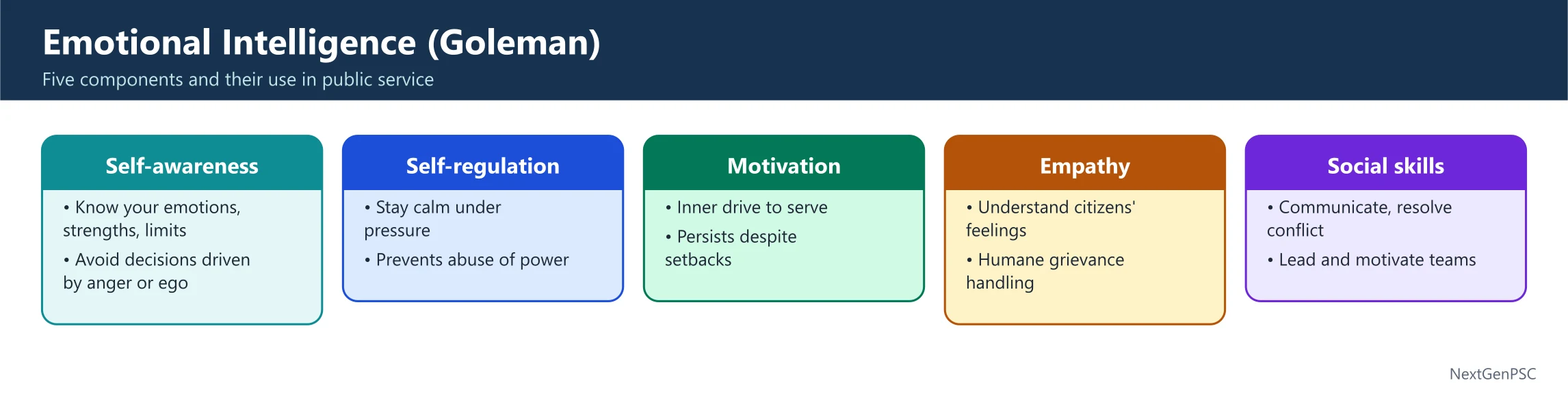
Emotional intelligence (EI)—popularised by Daniel Goleman—is the ability to recognise, understand and manage one's own emotions and those of others. Its components are self-awareness, self-regulation, motivation, empathy and social skills. In administration, EI helps officers handle stress, resolve conflicts, lead teams and treat citizens—especially the vulnerable—with empathy and compassion.
1. Components (Goleman)
Self-awareness: Knowing one's emotions, strengths and weaknesses.
Self-regulation: Controlling impulses, staying calm under pressure.
Motivation: Inner drive beyond money or status.
Empathy: Understanding others' feelings and perspectives.
Social skills: Communication, conflict management, teamwork, leadership.
2. Applications in Administration
Crisis management: Calm decision-making during riots, disasters, pandemics.
Conflict resolution: Mediating between communities, unions and management.
Leadership: Motivating subordinates, building trust and morale.
Citizen interface: Patient listening at grievance hearings; dignity for victims.
Self-care: Preventing burnout and frustration-driven misconduct.
3. Empathy, Sympathy and Compassion
Sympathy: Feeling sorry for someone.
Empathy: Understanding and sharing their feelings ('walking in their shoes').
Compassion: Empathy plus the desire and action to relieve suffering.
Tolerance: Respecting differences in beliefs and lifestyles.
4. Towards the Weaker Sections
Sensitive handling of Scheduled Castes and Tribes, women, children, persons with disabilities, the elderly and the poor; proactive outreach rather than waiting for complaints.
Caution: Compassion must not override fairness or law—it should guide how rules are applied, not justify favouritism.
5. Can EI Be Developed?
Yes—through reflection, feedback, mindfulness, role-playing, mentoring and exposure (village visits in training).
| Quality | Meaning | Administrative example |
|---|---|---|
| Sympathy | Feeling pity | Expressing sorrow to a flood victim |
| Empathy | Understanding their perspective | Seeing why the victim cannot fill forms |
| Compassion | Acting to relieve suffering | Setting up camps to process relief on the spot |
Prelims tips
- Daniel Goleman popularised EI with his book 'Emotional Intelligence' (1995).
- Five components: self-awareness, self-regulation, motivation, empathy, social skills.
- The term EI was introduced academically by Peter Salovey and John Mayer (1990).
- Compassion = empathy + action.
- Tolerance is respect for differences, not mere indifference.
Mains points
- EI is as important as IQ for civil servants who deal with people, conflict and crisis daily.
- Self-regulation prevents abuse of power and impulsive decisions.
- Empathy improves policy design by understanding the lived experience of beneficiaries.
- Compassion must be institutionalised—through humane procedures, grievance redress and outreach—not left to individual goodwill.
Did you know?
- Goleman argued that EI matters more than IQ for leadership success.
- 'Ahimsa' in Gandhian thought includes active compassion, not just non-violence.
- Many civil-service academies include stress management and mindfulness in training.
Ethics, Integrity & Aptitude: All chapters
- Ethics and Human Interface
- Attitude
- Aptitude and Foundational Values
- Moral Thinkers
- Ethics in Public Administration
- Probity in Governance
- Case Studies