
Ethics, Integrity & Aptitude · UPSC Notes
Case Studies — UPSC Ethics Notes
Free, exam-focused notes for UPSC Prelims and Mains, with Prelims tips and Mains points for every topic. 2 topics.
Open in the interactive reader: bookmarks, progress tracking and read-aloud.
How to Solve GS IV Case Studies: A Step-by-Step Method
Case studies carry about half the marks of GS IV (Section B). They test whether you can apply ethical values to realistic situations under constraints. A good answer identifies stakeholders and ethical issues, evaluates options with their merits and demerits, chooses a legal, practical and compassionate course of action, and suggests long-term systemic reforms.
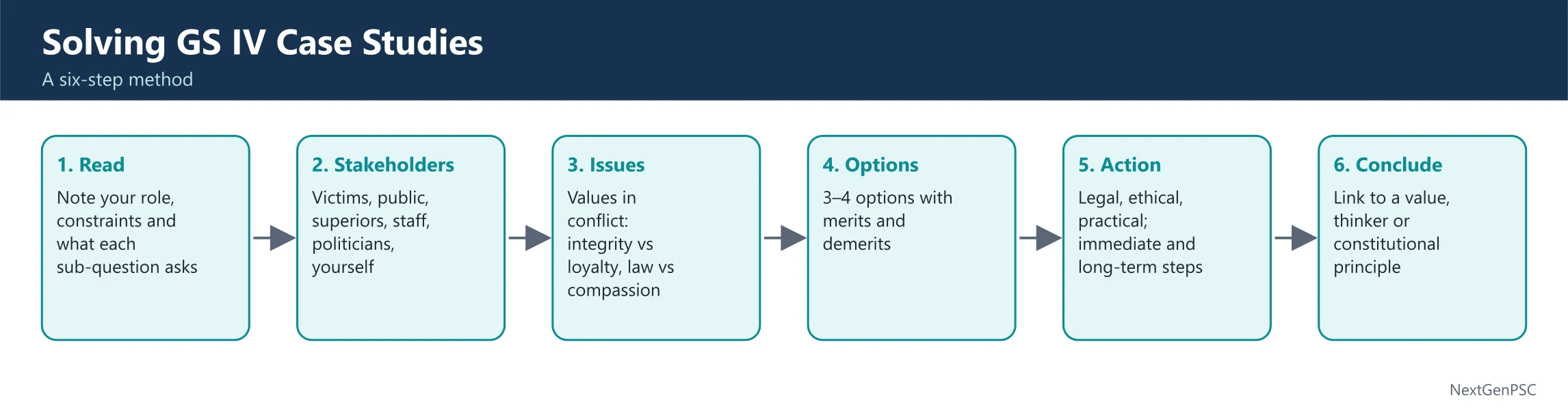
1. Read the Case Carefully
Note your role (District Collector, SP, engineer, NGO head), constraints (time, law, resources) and exactly what each sub-question asks.
2. Identify Stakeholders
Victims, public, superiors, subordinates, politicians, companies, media, yourself (career and conscience).
3. Identify Ethical Issues and Values in Conflict
e.g. integrity vs loyalty, rule of law vs compassion, efficiency vs equity, transparency vs confidentiality.
4. List Options with Merits and Demerits
Usually 3–4 options, from doing nothing or blindly following orders to extreme confrontation, and a balanced middle path.
5. Choose and Justify the Course of Action
Must be legal, ethical, practical and protect the vulnerable.
Separate immediate actions (save lives, stop wrongdoing, record facts) from long-term measures (systemic reform, training, policy change).
Use institutional channels: written records, informing superiors, inquiry committees, RTI, grievance mechanisms.
6. Common Mistakes
Resigning or going to the media as the first step; taking illegal shortcuts for 'good' ends; ignoring a stakeholder; moralising without concrete steps; exceeding the word limit.
7. Value Words to Use (Appropriately)
Integrity, impartiality, accountability, empathy, compassion, rule of law, public interest, transparency, courage of conviction, constitutional morality.
8. Presentation
Short headings (Stakeholders / Issues / Options / Course of action), bullet points, a brief conclusion linking to a thinker or value.
| Section | What to write |
|---|---|
| Introduction | One or two lines on the core dilemma |
| Stakeholders | List with their interests |
| Ethical issues | Values in conflict |
| Options | 3–4 options with merits and demerits |
| Course of action | Immediate and long-term steps, with justification |
| Conclusion | Link to a value, thinker or constitutional principle |
Prelims tips
- GS IV is a 250-mark paper; Section B consists of case studies.
- Always separate immediate and long-term actions.
- Record dissent in writing when given oral illegal instructions.
- Avoid resignation as a first response—use institutional remedies first.
- Mention specific laws and mechanisms (RTI, POSH Act, DM Act) where relevant.
Mains points
- Examiners reward practicality: the best course of action is lawful, humane and implementable within the given role.
- Balance is key—neither blind obedience nor reckless confrontation.
- Long-term systemic suggestions show administrative maturity beyond firefighting.
- Concise, structured answers score better than lengthy moral essays.
Did you know?
- Section B of GS IV typically has six case studies.
- Many case studies are inspired by real incidents like disasters, mining disputes and workplace harassment.
- Practising with a fixed template saves time in the exam hall.
Common Case-Study Themes: Conflict of Interest, Workplace Harassment, Public Health and Disaster Relief
Certain themes recur in GS IV case studies: conflict of interest (relatives or friends seeking favours), workplace sexual harassment (POSH Act, 2013), public health dilemmas (scarce resources, vaccine hesitancy, private hospital overcharging), disaster relief under political pressure, and professional integrity (pressure to falsify reports or certify substandard work). Knowing the relevant laws and a standard approach for each saves time.
1. Conflict of Interest
Situation: A relative bids for a tender you supervise; a friend seeks out-of-turn service.
Approach: Disclose the interest, recuse from the decision, follow rules strictly, record everything; be polite but firm with family.
2. Workplace Sexual Harassment
Law: Sexual Harassment of Women at Workplace (Prevention, Prohibition and Redressal) Act, 2013 (POSH), based on the Vishaka guidelines (1997).
Approach: Take the complaint seriously, ensure the Internal Committee functions, protect the complainant from retaliation, maintain confidentiality, ensure due process for the accused, and build a safe workplace culture.
3. Public Health Dilemmas
Situations: Limited ICU beds or vaccines; outbreaks; hesitant communities; private hospitals overcharging; food adulteration.
Approach: Transparent, need-based allocation criteria (medical priority, vulnerability), communication with communities through trusted local leaders, enforcement under the Epidemic Diseases Act and clinical establishment rules, protection of health workers.
4. Disaster Relief and Political Pressure
Situation: Pressure to divert relief to a particular area or group, or to delay evacuation for political events.
Approach: Follow need-based norms (SDRF guidelines), document allocation criteria, involve local bodies and NGOs, prioritise life-saving actions, and resist illegal pressure through written orders.
5. Professional Integrity
Situation: Superior asks an engineer to certify a substandard bridge, or a doctor to issue a false certificate.
Approach: Refuse to falsify, put objections in writing, escalate to higher authority or vigilance, keep evidence, use whistle-blower protection if needed; public safety comes first.
| Theme | Relevant law/mechanism |
|---|---|
| Workplace harassment | POSH Act, 2013; Internal Committee |
| Corruption and favours | Prevention of Corruption Act; Conduct Rules |
| Disaster relief | DM Act, 2005; SDRF norms |
| Public health | Epidemic Diseases Act, 1897; Clinical Establishments Act, 2010 |
| Whistle-blowing | Whistle Blowers Protection Act, 2014 |
Prelims tips
- POSH Act (2013) requires an Internal Committee in workplaces with 10 or more employees.
- Vishaka guidelines were laid down by the Supreme Court in 1997.
- Epidemic Diseases Act dates from 1897 and was amended in 2020 to protect health workers.
- Recusal is the standard response to a conflict of interest.
- SDRF is the primary fund for immediate disaster relief in states.
Mains points
- Recurring themes allow you to prepare standard 'value + law + action' frameworks in advance.
- Protecting complainants and whistle-blowers is as important as punishing wrongdoers.
- Need-based, documented criteria are the best defence against political pressure in resource allocation.
- Public safety and human life override convenience, hierarchy and career interests.
Did you know?
- The Vishaka case arose from the gang rape of Bhanwari Devi, a social worker in Rajasthan, in 1992.
- The Epidemic Diseases Act was first enacted to fight bubonic plague in Bombay in 1897.
- Many states publish relief norms online so citizens can check their entitlements.