
Ethics, Integrity & Aptitude · UPSC Notes
Attitude — UPSC Ethics Notes
Free, exam-focused notes for UPSC Prelims and Mains, with Prelims tips and Mains points for every topic. 2 topics.
Open in the interactive reader: bookmarks, progress tracking and read-aloud.
Attitude: Content, Structure, Function and Relation with Behaviour
An attitude is a learned, relatively stable evaluation of a person, object, idea or event. Its ABC structure—Affective (feelings), Behavioural (tendency to act) and Cognitive (beliefs)—shapes how we act, though behaviour does not always follow attitude. Political attitudes (liberal, conservative, radical) and attitudes of public servants towards the weaker sections strongly affect governance.
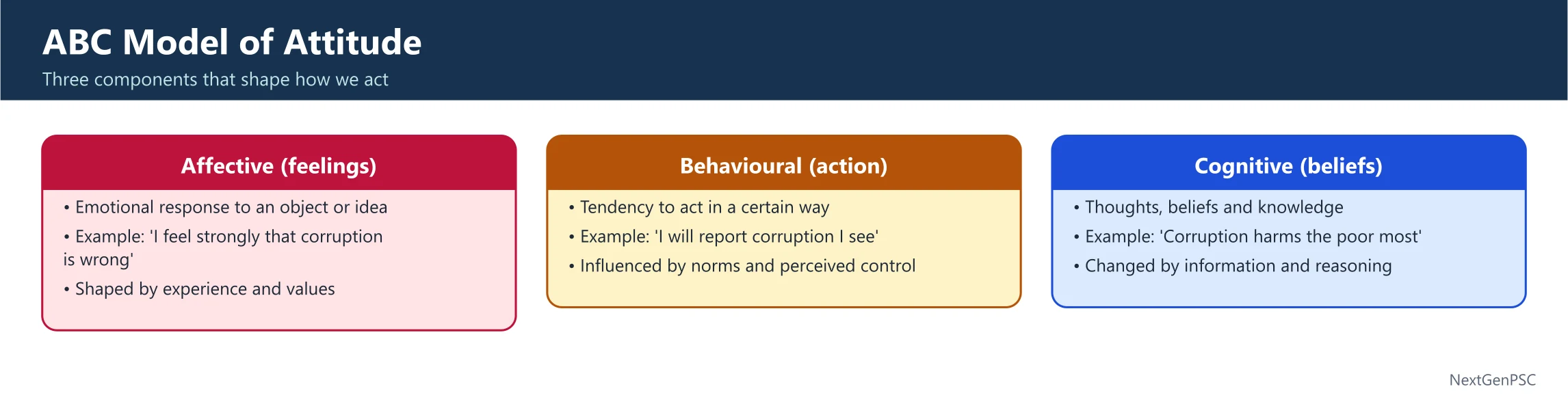
1. Structure (ABC Model)
Affective: Emotions—'I dislike corruption'.
Behavioural: Action tendency—'I will report corruption'.
Cognitive: Beliefs—'Corruption harms the poor'.
2. Features and Functions
Features: Learned, relatively enduring, can be explicit (conscious) or implicit (unconscious bias), vary in strength.
Functions (Katz): Utilitarian (gain rewards), knowledge (make sense of the world), ego-defensive (protect self-image), value-expressive (express identity).
3. Formation
Family and socialisation, education, personal experience, media, peer groups, culture; classical and operant conditioning; observational learning.
4. Attitude and Behaviour
Attitude predicts behaviour better when it is strong, specific, based on direct experience and when social pressure is low.
Cognitive dissonance (Festinger): Discomfort when attitudes and behaviour conflict, leading people to change one of them.
Theory of planned behaviour: Attitude + social norms + perceived control → intention → behaviour.
Example: People may value cleanliness but still litter if bins are absent—behaviour also depends on the environment ('nudges', as in Swachh Bharat).
5. Political Attitudes
Spectrum: radical, liberal, moderate, conservative, reactionary.
Shaped by ideology, identity, economic interest and media.
Relevance: Political attitudes affect voting, tolerance and civic participation; polarisation weakens democratic deliberation.
6. Attitudes Needed in Public Servants
Empathy towards the weaker sections, non-partisanship, openness to change, respect for diversity, service orientation, and tolerance for dissent.
| Component | Meaning | Example (gender equality) |
|---|---|---|
| Affective | Feelings | I feel strongly about women's dignity |
| Behavioural | Action tendency | I will promote women in my team |
| Cognitive | Beliefs and knowledge | Women's participation raises growth |
Prelims tips
- ABC = Affective, Behavioural, Cognitive components of attitude.
- Cognitive dissonance theory was proposed by Leon Festinger (1957).
- Daniel Katz described four functions of attitudes.
- Implicit attitudes operate unconsciously and can cause hidden bias.
- Theory of planned behaviour was developed by Icek Ajzen.
Mains points
- Public servants' attitudes towards the poor, women and minorities determine whether policies reach them.
- Behavioural insights ('nudges') show that changing the environment can change behaviour even when attitudes lag.
- Implicit biases must be addressed through training, diverse teams and transparent procedures.
- Political neutrality of civil servants protects trust across changing governments.
Did you know?
- Richard Thaler won the 2017 Nobel in Economics for work on nudges and behavioural economics.
- NITI Aayog set up a Behavioural Insights Unit to apply nudges to public policy.
- Festinger developed cognitive dissonance after studying a group that predicted the end of the world.
Moral Influence and Persuasion
Persuasion is the process of changing attitudes or behaviour through communication rather than force. Moral influence is the ability to inspire others to act ethically through example and credibility. Public servants use both—to change social behaviour (sanitation, vaccination, girl education) and to lead teams—while avoiding manipulation.
1. Elements of Persuasion
Source: Credibility, expertise, trustworthiness and likeability of the communicator.
Message: Clear, relevant, evidence-based, two-sided when the audience is informed; emotional appeal in moderation.
Audience: Their existing attitudes, education, culture and needs.
Channel: Face-to-face, community leaders, media, social media.
2. Models
Elaboration Likelihood Model (Petty and Cacioppo): Central route (argument quality, lasting change) vs peripheral route (cues like celebrity, short-lived change).
Aristotle's rhetoric: Ethos (credibility), pathos (emotion), logos (logic).
Cialdini's principles: Reciprocity, commitment, social proof, authority, liking, scarcity.
3. Persuasion in Governance
Swachh Bharat (community-led total sanitation, swachhagrahis), Pulse Polio (religious leaders and celebrities), Beti Bachao Beti Padhao, COVID-19 vaccination drives, 'Give It Up' LPG subsidy campaign.
Using local influencers, SHGs and panchayats builds trust.
4. Moral Influence
Comes from integrity, consistency and personal example—Gandhi's leadership and officers who lead from the front.
Leaders influence organisational culture: what they tolerate becomes the norm.
5. Persuasion vs Manipulation
Ethical persuasion respects autonomy, uses truth and serves the public interest; manipulation uses deception, fear or exploitation of weaknesses (propaganda, dark patterns, misinformation).
6. Way Forward
Combine information, incentives and nudges; listen to communities' concerns; build credibility through delivery.
| Aspect | Ethical persuasion | Manipulation |
|---|---|---|
| Means | Truth, reason, example | Deception, fear, exploitation |
| Respect for autonomy | Yes | No |
| Purpose | Public interest | Narrow interest |
| Effect | Lasting change, trust | Short-term compliance, distrust |
Prelims tips
- Elaboration Likelihood Model: central vs peripheral routes of persuasion.
- Aristotle's modes of persuasion: ethos, pathos, logos.
- Cialdini listed six principles of influence (later adding unity).
- 'Give It Up' campaign (2015) asked better-off households to surrender LPG subsidy.
- Swachhagrahis are community volunteers promoting sanitation behaviour change.
Mains points
- Lasting social change comes through persuasion and participation, not coercion alone.
- Credibility of the messenger is critical—local leaders, ASHAs and teachers persuade better than distant officials.
- Moral influence of leaders sets the ethical tone of an organisation.
- Persuasion must stay ethical; misinformation and manipulation erode public trust.
Did you know?
- India was declared polio-free in 2014 after massive campaigns that persuaded hesitant communities.
- Gandhi's Salt March persuaded millions by a simple symbolic act.
- Community-Led Total Sanitation uses 'triggering' sessions where villagers map open defecation themselves.