
Ethics, Integrity & Aptitude · UPSC Notes
Ethics and Human Interface — UPSC Ethics Notes
Free, exam-focused notes for UPSC Prelims and Mains, with Prelims tips and Mains points for every topic. 5 topics.
Open in the interactive reader: bookmarks, progress tracking and read-aloud.
Ethics: Essence, Determinants and Consequences
Ethics is the systematic study of what is right and wrong, good and bad in human conduct. GS IV asks for its essence, determinants and consequences in human actions. Ethics differs from law (externally enforced) and morality (personal or social code), and is shaped by family, society, religion, education, law and conscience.
1. Essence of Ethics
Normative: Tells us how we ought to act, not just how we do act.
Universal and contextual: Core values (truth, non-violence, fairness) are widely shared, but their application depends on context.
Branches: Meta-ethics (meaning of 'good'), normative ethics (theories of right action), applied ethics (bioethics, business ethics, public administration ethics).
2. Major Normative Theories
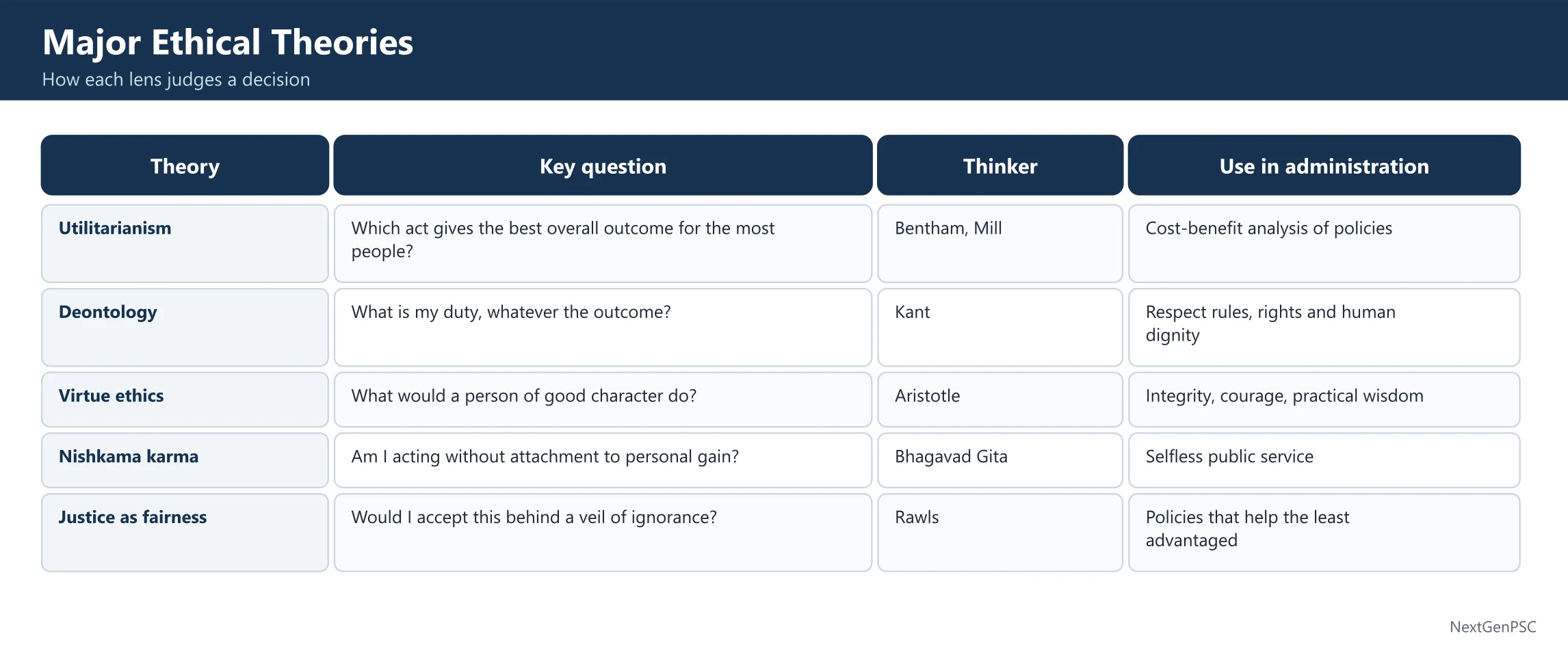
Consequentialism / utilitarianism (Bentham, Mill): An act is right if it produces the greatest good for the greatest number.
Deontology (Kant): Duty and rules matter regardless of consequences; treat people as ends, never merely as means.
Virtue ethics (Aristotle, Indian tradition): Focus on character—honesty, courage, temperance, justice.
Indian traditions: Dharma, nishkama karma (Gita), ahimsa (Jainism, Buddhism, Gandhi).
3. Determinants of Ethics
Family (first school of values), society and culture (norms, customs), religion, education, law and constitution, peer groups and media, personal conscience and experience.
Situational factors: Organisational culture, incentives and pressure can push good people into unethical acts (e.g. the Milgram and Stanford prison experiments).
4. Consequences of Ethics in Human Actions
Individual: Inner peace, self-respect, credibility.
Organisational: Trust, legitimacy, efficiency; unethical conduct leads to scandals and loss of public confidence.
Society: Ethics sustains social capital, rule of law and cooperation.
5. Ethics, Morality and Law
Law is the minimum ethics a society enforces; ethics goes beyond law (e.g. helping an accident victim is not always legally required but is ethically expected). Some laws may be unethical (apartheid), which justifies civil disobedience.
| Theory | Key question | Thinker |
|---|---|---|
| Utilitarianism | Which act produces the best overall outcome? | Bentham, Mill |
| Deontology | What is my duty, whatever the outcome? | Kant |
| Virtue ethics | What would a person of good character do? | Aristotle |
| Nishkama karma | Am I acting without attachment to results? | Bhagavad Gita |
Prelims tips
- Utilitarianism: 'greatest good of the greatest number' (Bentham).
- Kant's categorical imperative: act only on maxims you could will as universal laws.
- Virtue ethics focuses on character rather than rules or outcomes.
- Law is externally enforced; ethics is internally accepted.
- Milgram's experiment showed obedience to authority overriding conscience.
Mains points
- In answers, define ethics precisely, then show how it differs from law and morality with an example from public life.
- Use more than one ethical lens (consequences, duty, virtue) to evaluate a situation—examiners reward multi-dimensional analysis.
- Situational pressures explain why ethical people fail; institutions must design systems (transparency, rotation, whistle-blower protection) that support ethical behaviour.
- Indian thought (dharma, ahimsa, seva) provides valuable examples for GS IV answers alongside Western theories.
Did you know?
- The word 'ethics' comes from the Greek 'ethos', meaning character or custom.
- The Ethics paper (GS IV) was introduced in the UPSC Mains from 2013.
- Ashoka's edicts are among the earliest state-issued codes of ethical conduct (dhamma).
Private and Public Ethics; Role of Family and Society in Inculcating Values
Private ethics governs personal relationships (honesty with family, loyalty to friends), while public ethics governs the conduct of those who hold public trust (impartiality, accountability, use of public resources). Values are first learnt in the family, then shaped by schools, society and institutions. A public servant's private conduct also affects public trust.
1. Private vs Public Ethics
Private ethics: Personal virtues—honesty, kindness, loyalty, responsibility to family.
Public ethics: Duties attached to office—impartiality, non-partisanship, integrity, transparency, accountability, responsiveness.
Conflict: Loyalty to family may clash with impartiality in office (nepotism); personal religious beliefs may clash with the duty to treat all equally.
Overlap: A person who lies at home is less trusted in office; private vices (corruption to fund lifestyle) spill into public life.
2. Ethics in Public and Private Relationships
Public relationships: Citizen–state, officer–subordinate, officer–politician—based on rules, fairness and accountability.
Private relationships: Family, friends—based on affection and trust.
Principles: Avoid conflict of interest, declare personal interests, recuse when relatives are involved, do not use office for private gain.
3. Role of Family in Inculcating Values
Children learn by observing parents (role modelling), through stories, rituals and discipline.
Values learnt: honesty, respect for elders, sharing, empathy, work ethic.
Challenges: Nuclear families, working parents, screen time, consumerism, and gender-biased socialisation.
4. Role of Society and Educational Institutions
Schools: Value education, co-curricular activities, teachers as role models; NEP 2020 emphasises ethical and constitutional values.
Society: Community norms, religion, media, civil society and peer groups.
Institutions: Workplaces reinforce or erode values through incentives and culture.
Constitutional values: Justice, liberty, equality, fraternity, fundamental duties (Article 51A).
5. Way Forward
Consistency between what is taught and what is practised; community service; role models in public life; ethics training in civil services.
| Aspect | Private ethics | Public ethics |
|---|---|---|
| Sphere | Family, friends | Office, citizens |
| Basis | Affection, personal virtue | Rules, public trust |
| Key values | Loyalty, kindness | Impartiality, accountability |
| Risk | Hypocrisy | Nepotism, misuse of power |
Prelims tips
- Fundamental Duties are in Article 51A (added by the 42nd Amendment).
- Nepotism is a conflict between private loyalty and public duty.
- Recusal means withdrawing from a decision where one has a personal interest.
- NEP 2020 emphasises ethical and constitutional values in education.
- Family is called the 'primary agent of socialisation'.
Mains points
- Public office is a trust; private loyalties must yield to impartiality when they conflict.
- Private integrity and public integrity are linked—character is not compartmentalised.
- Families and schools must model, not just preach, values; inconsistency breeds cynicism.
- Gender-sensitive socialisation in families is key to equality and respect in society.
- Institutions can strengthen values through ethical leadership and fair incentives.
Did you know?
- Gandhi said his mother's religious devotion and fasting deeply shaped his values.
- Lal Bahadur Shastri resigned as Railway Minister in 1956 taking moral responsibility for a train accident.
- The Nolan Committee (UK, 1995) set out the 'Seven Principles of Public Life'.
Integrity, Courage of Conviction and Conscience
Integrity means consistency between values, words and actions—being honest even when no one is watching. Courage of conviction is the willingness to act on one's beliefs despite pressure or risk. Conscience is the inner moral voice; when it conflicts with law or orders, a public servant must weigh legality, morality and consequences.
1. Integrity
Meaning: From Latin 'integer'—whole, undivided; wholeness of character.
Dimensions: Intellectual integrity (honest reasoning), moral integrity (acting on values), professional integrity (competence and honesty at work), financial integrity.
In public service: Not using office for private gain, declaring assets, refusing gifts that create obligations, giving honest advice.
Examples: E. Sreedharan (Delhi Metro), T.N. Seshan (electoral reforms).
2. Courage of Conviction
Standing by what is right despite political pressure, transfers or threats.
Examples: Whistle-blowers like Satyendra Dubey (NHAI, 2003) and Manjunath Shanmugam (2005), who paid with their lives; officers who resist illegal orders.
Requires: Moral clarity, emotional strength, institutional protection (Whistle Blowers Protection Act, 2014).
Caution: Conviction must be based on facts and law, not ego or stubbornness.
3. Conscience
Meaning: Inner sense of right and wrong; Gandhi called it the 'inner voice'.
Formation: Upbringing, education, reflection, experience.
Crisis of conscience: When personal values conflict with orders or law.
4. Conscience vs Law
Obey law generally: Law reflects democratic consensus; individual conscience can be mistaken.
Exceptions: Grossly unjust laws or orders (illegal detention, violence on peaceful protesters)—civil servants must refuse illegal orders, record dissent in writing, and use institutional channels.
Civil disobedience: Gandhi, Martin Luther King—open, non-violent, accepting punishment.
Nuremberg principle: 'Following orders' is no defence for crimes against humanity.
5. Way Forward
Protect honest officers (fixed tenure, whistle-blower protection), reward integrity, and train officers in ethical reasoning.
| Value | Meaning | Example |
|---|---|---|
| Honesty | Telling the truth | Reporting accurate data |
| Integrity | Consistency of values and action | Refusing a bribe when unobserved |
| Courage of conviction | Acting on values despite risk | Exposing a scam despite threats |
Prelims tips
- Whistle Blowers Protection Act was passed in 2014.
- Satyendra Dubey exposed corruption in the Golden Quadrilateral project.
- Gandhi referred to conscience as the 'inner voice'.
- Nuremberg trials rejected 'superior orders' as a defence.
- 'Integrity' derives from the Latin 'integer' (whole).
Mains points
- Integrity is the foundation of public trust; one corrupt act can undo years of credibility.
- Courage of conviction needs institutional support—otherwise honest officers are isolated and punished.
- Conscience should be informed by law and facts; dissent must be expressed through legitimate channels.
- Refusing manifestly illegal orders is a duty, not insubordination.
- Case-study answers should show how integrity translates into concrete steps (recording dissent, reporting, transparency).
Did you know?
- T.N. Seshan, as Chief Election Commissioner (1990–96), enforced the Model Code of Conduct strictly and transformed elections.
- E. Sreedharan is known as the 'Metro Man' for completing projects on time and within budget.
- Satyendra Dubey Memorial Award is given by IIT Kanpur alumni for integrity in public life.
Ethical Dilemmas and the Ethics of Care
An ethical dilemma arises when two or more moral duties conflict and choosing one means compromising another—for example, loyalty to a superior vs honesty to the public, or rules vs compassion. Structured reasoning helps resolve them. The ethics of care (Carol Gilligan, Nel Noddings) adds that moral decisions should consider relationships, vulnerability and responsibility, not just abstract rules.
1. Types of Dilemmas in Public Life
Personal vs professional: Family pressure vs impartial duty.
Rules vs compassion: Strict eligibility criteria vs a needy applicant who narrowly fails them.
Loyalty vs whistle-blowing: Superior's wrongdoing vs organisational loyalty.
Efficiency vs equity: Fast project completion vs fair rehabilitation of displaced people.
Transparency vs confidentiality: RTI requests vs national security or privacy.
2. A Framework to Resolve Dilemmas
Step 1: Identify facts and stakeholders.
Step 2: Identify the values in conflict.
Step 3: Check law, rules and codes of conduct.
Step 4: List options with their consequences for each stakeholder.
Step 5: Apply tests—legality, public interest, Gandhi's talisman (impact on the poorest), the newspaper test (would I be comfortable if this were published?).
Step 6: Choose, act, document reasons, and review.
3. Ethics of Care
Emerged from feminist ethics (Carol Gilligan's 'In a Different Voice', 1982) as a critique of purely rule-based, 'justice' reasoning.
Emphasises empathy, attentiveness, responsibility and responsiveness to those who depend on us.
In public service: Sensitive handling of victims, the elderly, disabled, children; disaster relief; health care.
Balance: Care should complement, not replace, fairness and rule of law.
4. Common Mistakes in Answers
Choosing an extreme option without exploring alternatives; ignoring the law; forgetting short-term and long-term actions; not considering the most vulnerable.
| Test | Question to ask |
|---|---|
| Legality | Is it lawful and within rules? |
| Public interest | Does it serve the larger public good? |
| Gandhi's talisman | How will it affect the poorest and weakest? |
| Newspaper test | Would I be comfortable if this were on the front page? |
| Reversibility | Would I accept this decision if I were on the other side? |
Prelims tips
- An ethical dilemma involves a conflict between two moral duties, not between right and obviously wrong.
- Carol Gilligan wrote 'In a Different Voice' (1982), a foundation of the ethics of care.
- Gandhi's talisman: recall the face of the poorest person and ask if your step will help them.
- A crisis of conscience is an internal conflict between personal values and external demands.
- Recording reasons in writing is key to accountability in dilemmas.
Mains points
- Dilemmas rarely have perfect answers; the best answer minimises harm, respects law and protects the vulnerable.
- A structured approach (stakeholders, values, options, tests) makes answers credible and balanced.
- The ethics of care humanises administration, especially for victims and marginalised groups.
- Compassion must operate within legal limits—discretion should be transparent and documented.
- Institutional mechanisms (ethics committees, clear guidelines) reduce the burden of dilemmas on individual officers.
Did you know?
- The 'trolley problem' is a famous thought experiment contrasting utilitarian and deontological intuitions.
- Gandhi's talisman was written in 1947 as a guide for decision-makers.
- Many UPSC GS IV case studies are drawn from real administrative situations in districts.
Media Ethics, Corporate Governance and Ethics in International Relations
Ethics applies beyond government. Media ethics demands truthfulness, fairness and respect for privacy amid paid news and fake news. Corporate governance ensures companies are run transparently and accountably for shareholders and society (CSR under the Companies Act, 2013). Ethics in international relations asks how states should balance national interest with justice, human rights and global responsibilities such as climate action and humanitarian aid.
1. Media Ethics
Principles: Truth and accuracy, independence, fairness and impartiality, humanity (minimising harm), accountability.
Issues: Paid news, sensationalism, media trials, fake news and deepfakes, invasion of privacy, conflict of interest due to corporate ownership.
Regulation: Press Council of India (for print), self-regulatory bodies for TV (News Broadcasting and Digital Standards Authority), IT Rules, 2021 for digital media.
Way forward: Fact-checking, independent ombudsmen, media literacy among citizens.
2. Corporate Governance
Meaning: System of rules and practices by which a company is directed and controlled.
Principles: Transparency, accountability, fairness to all shareholders, responsibility to stakeholders.
Indian framework: Companies Act, 2013 (independent directors, women director requirement, audit committees), SEBI's Listing Obligations, CSR (Section 135)—eligible companies spend 2% of average net profits on social causes.
Committees: Kumar Mangalam Birla (1999), Narayana Murthy (2003), Uday Kotak (2017).
Failures: Satyam scam (2009), IL&FS crisis (2018)—show the cost of weak oversight.
ESG: Environmental, social and governance reporting (BRSR for top listed firms).
3. Ethics in International Relations
Realism vs idealism: Realists prioritise national interest and power; idealists stress morality, law and cooperation.
Ethical issues: Humanitarian intervention and the Responsibility to Protect; refugees; arms trade; climate justice (CBDR); vaccine equity; sanctions that hurt civilians.
India's approach: Vasudhaiva Kutumbakam, Panchsheel, non-intervention, humanitarian assistance (Vaccine Maitri, disaster relief), voice of the Global South.
| Field | Core value | Key concern |
|---|---|---|
| Media | Truth and fairness | Fake news, paid news, privacy |
| Corporate | Transparency and accountability | Fraud, shareholder rights, CSR |
| International relations | Justice and humanity | Interventions, refugees, climate justice |
Prelims tips
- CSR is mandated under Section 135 of the Companies Act, 2013.
- Press Council of India regulates print media, not TV.
- Satyam scam (2009) was a major corporate governance failure.
- Uday Kotak Committee (2017) dealt with corporate governance reforms.
- Responsibility to Protect (R2P) was endorsed at the 2005 UN World Summit.
Mains points
- A free but responsible media is the fourth pillar of democracy; self-regulation must be credible to avoid state control.
- Good corporate governance protects investors and the public; ethics must go beyond compliance to stakeholder responsibility.
- CSR can complement public welfare but should not become reputation management alone.
- In international relations, ethics and national interest can align—humanitarian aid builds soft power and trust.
- India's civilisational values offer an ethical framework for a just global order.
Did you know?
- India was the first country to make CSR spending mandatory by law.
- The phrase 'Vasudhaiva Kutumbakam' comes from the Maha Upanishad.
- Under Vaccine Maitri (2021), India supplied COVID-19 vaccines to many developing countries.