
International Relations · UPSC Notes
India and Other Regions, Diaspora and the Global Commons — UPSC International Relations Notes
Free, exam-focused notes for UPSC Prelims and Mains, with Prelims tips and Mains points for every topic. 6 topics.
Open in the interactive reader: bookmarks, progress tracking and read-aloud.
India–Africa Relations: Development Partnership and the Global South
India's ties with Africa rest on shared anti-colonial struggle (Gandhi's years in South Africa), the Non-Aligned Movement, a large Indian-origin diaspora and a demand-driven development partnership of lines of credit, training and capacity building, guided by the Kampala Principles (2018). India is among Africa's largest trading partners and championed the African Union's permanent membership of the G20 (2023). The India–Africa Forum Summit (IAFS) process is the main framework; its fourth summit, planned for New Delhi in May 2026, was put off.
1. Historical Foundations
Ancient Indian Ocean trade linked Gujarat and Malabar with the East African coast; Indian labour and traders migrated during colonial rule.
Gandhi's satyagraha in South Africa (1893–1914); India's early UN campaign against apartheid (1946) and support to liberation movements in Namibia, Zimbabwe and South Africa.
2. Institutional Framework
IAFS-I (New Delhi, 2008), IAFS-II (Addis Ababa, 2011), IAFS-III (New Delhi, 2015)—the third was the first to invite all 54 African countries and announced USD 10 billion in concessional credit and 50,000 scholarships.
IAFS-IV was scheduled for New Delhi on 28–31 May 2026, but a joint AU–India release (21 May 2026) described those dates as the 'initially scheduled' ones, and it was not held then.
Kampala Principles (2018): Ten guiding principles announced by PM Modi in Uganda's Parliament—development partnership driven by African priorities, local capacity, market access, and a free and open Indian Ocean.
3. Development Partnership
Lines of credit through EXIM Bank for power, water, railways and agriculture; ITEC training; the Duty-Free Tariff Preference scheme (2008) for least developed countries.
Digital links: Pan-African e-Network (2009) and its successor e-VidyaBharati and e-ArogyaBharati (2019) for tele-education and tele-medicine; India Stack and UPI-type solutions offered as digital public infrastructure.
Health: affordable generic medicines; vaccines under Vaccine Maitri; IIT Madras campus in Zanzibar (Tanzania), India's first IIT abroad (2023).
4. Trade, Energy and Resources
India imports crude oil (Nigeria, Angola), gold, coal, phosphates, cashew and pulses; exports petroleum products, medicines, vehicles and machinery. Indian firms invest in telecom, mining and agriculture.
Critical minerals (cobalt, lithium, copper) in countries such as Zambia, DR Congo and Namibia are a growing focus; Namibia also sent cheetahs to Kuno (2022).
5. Maritime and Security Cooperation
SAGAR (2015), widened to MAHASAGAR in Mauritius (March 2025); the airstrip and jetty at Agalega (Mauritius, 2024); coastal radar chains; hydrographic surveys; anti-piracy patrols in the Gulf of Aden since 2008.
AIKEYME (Africa–India Key Maritime Engagement, April 2025), co-hosted with Tanzania; India–Africa Defence Dialogue (since 2020); Indian peacekeepers serve in African UN missions (South Sudan, DR Congo).
6. India vs China in Africa
China's trade and lending dwarf India's; it builds large infrastructure via the BRI and FOCAC. India stresses capacity building, local employment and avoiding debt traps, but suffers from slow project delivery.
Irritants: attacks on African students in India, slow LoC disbursement, and the gap since the last summit (2015).
Practice
UPSC-style: 'India's development partnership with Africa is a counter-model to China's.' Critically examine.
| Summit | Venue and year | Note |
|---|---|---|
| IAFS-I | New Delhi, 2008 | Banjul formula: AU-selected countries |
| IAFS-II | Addis Ababa, 2011 | Hosted at AU headquarters |
| IAFS-III | New Delhi, 2015 | All 54 countries invited |
| IAFS-IV | New Delhi (planned May 2026) | Not held on the planned dates |
Prelims tips
- Kampala Principles: ten guiding principles for India–Africa engagement, announced in 2018.
- The African Union became a permanent member of the G20 at the New Delhi summit (September 2023).
- IAFS-III (2015) was the first summit with all 54 African countries.
- India's first IIT campus abroad: IIT Madras, Zanzibar (Tanzania).
- AIKEYME (2025): first Africa–India Key Maritime Engagement exercise, co-hosted with Tanzania.
- MAHASAGAR, announced in Mauritius in 2025, widened the SAGAR vision.
Mains points
- Africa matters for India's energy and mineral security, markets for its goods and services, maritime security in the western Indian Ocean, and votes for its global ambitions such as UNSC reform.
- India's model—capacity building, training and demand-driven projects—builds goodwill, but slow delivery and limited finance weaken it against China's speed and scale.
- The AU's G20 entry under India's presidency strengthened India's claim to speak for the Global South; follow-through (debt relief, climate finance) will test that leadership.
- The long gap in summit-level meetings reduces visibility; regular summits and an Africa-focused finance mechanism are needed.
- Way forward: triangular cooperation with Japan, the EU and the UAE; digital public infrastructure; agriculture and food security; skills and student exchanges.
Did you know?
- Gandhi was thrown off a train at Pietermaritzburg, South Africa, in 1893—an event that shaped satyagraha.
- Nelson Mandela received the Bharat Ratna in 1990.
- The Siddi community of Gujarat and Karnataka traces its roots to East Africa.
India–Central Asia Relations: Extended Neighbourhood and Connectivity
The five Central Asian republics—Kazakhstan, Kyrgyzstan, Tajikistan, Turkmenistan and Uzbekistan—are India's extended neighbourhood, linked by history (Silk Route, Mughals) and important for energy (uranium, gas), security (Afghanistan, terrorism) and connectivity. Without direct land access (Pakistan blocks transit), India relies on Chabahar, the INSTC and the Ashgabat Agreement. The Connect Central Asia policy (2012), the India–Central Asia Dialogue and the first India–Central Asia Summit (2022) structure the ties, along with the SCO.
1. Historical and Cultural Links
The Silk Route carried Buddhism, trade and ideas; the Kushan empire spanned both regions; Babur, founder of the Mughal dynasty, came from the Fergana Valley (Uzbekistan).
Soviet-era ties: Indian films and culture were popular; the Tashkent Declaration (1966) ended the 1965 India–Pakistan war.
2. Policy Frameworks
Connect Central Asia (2012): political, economic, security, connectivity and cultural engagement; PM Modi visited all five republics in 2015.
India–Central Asia Dialogue (foreign ministers, first in Samarkand, 2019; the fourth in New Delhi, June 2025). India announced a USD 1 billion line of credit for the region (2020).
First India–Central Asia Summit (virtual, January 2022) agreed to hold summits every two years, set up a secretariat in New Delhi and a Joint Working Group on Chabahar. The second summit has not yet been held; India renewed its invitation in June 2025.
Four of the five (all except neutral Turkmenistan) are members of the SCO alongside India, which joined in 2017.
3. Energy and Economy
Kazakhstan is a major supplier of uranium to India and its largest trading partner in the region; Uzbekistan also signed a uranium supply deal.
TAPI gas pipeline (Turkmenistan–Afghanistan–Pakistan–India) has been delayed for years by security and financing problems.
Trade remains small relative to potential; Indian medical students in Kyrgyzstan and Uzbekistan, pharmaceuticals, IT and tourism are growing links.
4. Connectivity
Chabahar port (Iran): India operates the Shahid Beheshti terminal; it offers access to Afghanistan and Central Asia bypassing Pakistan, but US sanctions on Iran create uncertainty.
INSTC (2000, India–Iran–Russia): a 7,200 km multimodal route from Mumbai to Russia via Iran and the Caspian region; India joined the Ashgabat Agreement (transport corridor via Iran and Turkmenistan) in 2018.
5. Security and Challenges
Shared concerns: terrorism, radicalisation and drug trafficking from Afghanistan; India–Central Asia NSA meetings on Afghanistan.
Challenges: no direct land route; Russia's traditional influence and China's dominant trade and BRI investments; Iran sanctions; low trade.
Practice
UPSC-style: 'Connectivity is the key constraint in India's Central Asia policy.' Discuss with reference to Chabahar and the INSTC.
| Country | Capital | Key link with India |
|---|---|---|
| Kazakhstan | Astana | Uranium, largest regional trade partner |
| Uzbekistan | Tashkent | Most populous; Tashkent Declaration, Babur |
| Turkmenistan | Ashgabat | Gas, TAPI, Ashgabat Agreement |
| Tajikistan | Dushanbe | Borders Afghanistan; defence cooperation |
| Kyrgyzstan | Bishkek | Medical education; exercise Khanjar |
Prelims tips
- Connect Central Asia policy: 2012.
- First India–Central Asia Summit: virtual, January 2022.
- Turkmenistan is the only Central Asian republic that is not an SCO member.
- India joined the Ashgabat Agreement in 2018; INSTC was agreed in 2000 by India, Iran and Russia.
- Kazakhstan is a key supplier of uranium to India.
- Exercises: Kazind (Kazakhstan), Dustlik (Uzbekistan), Khanjar (Kyrgyzstan).
Mains points
- Central Asia matters for India's energy security, for countering terrorism from Afghanistan, and for balancing China's growing economic presence in a region that welcomes 'multi-vector' partners.
- Geography is India's biggest handicap: Pakistan's denial of transit forces India to depend on Iran-based routes vulnerable to sanctions and West Asian instability.
- India's soft power (films, education, yoga, IT) and development partnership can build goodwill, but trade and investment must grow for influence to last.
- The regular summit mechanism agreed in 2022 has not been sustained; institutional follow-through is needed to match China's and Russia's regular summitry.
- Way forward: operationalise Chabahar and INSTC, digital and payment links, critical minerals and rare earths, and air connectivity.
Did you know?
- Prime Minister Lal Bahadur Shastri died in Tashkent in January 1966, a day after signing the Tashkent Declaration.
- Al-Biruni, author of 'Kitab-ul-Hind', was born in Khwarezm in present-day Uzbekistan.
- Raj Kapoor's films made him a household name across the Soviet Central Asian republics.
India–Latin America and the Caribbean: The New Frontier
Latin America and the Caribbean (LAC), once peripheral to Indian diplomacy, now matter for energy (crude oil), critical minerals (the 'lithium triangle' of Argentina, Bolivia and Chile), food security (soybean oil, pulses), markets for Indian pharmaceuticals, vehicles and IT, and Global South coalitions. Brazil is India's partner in BRICS, IBSA, BASIC and the G4. The Caribbean has a large indentured-labour diaspora. PM Modi's July 2025 tour (Trinidad and Tobago, Argentina, Brazil) signalled higher priority.
1. Historical Context
Indentured labourers (girmitiyas) were taken to Trinidad and Tobago, Guyana, Suriname and Jamaica from 1838; their descendants are now a large share of the population and have produced heads of government.
Distance, language and limited air and shipping links kept ties thin during the Cold War, though both regions shared NAM and Third World positions.
2. Brazil: The Anchor Partner
Strategic Partnership (2006); cooperation in BRICS, IBSA (India–Brazil–South Africa, 2003), BASIC (climate), G4 (UNSC reform) and the G20, where Brazil's 2024 presidency followed India's.
Ethanol and biofuels (Global Biofuels Alliance, 2023), agriculture, defence (Embraer aircraft), space and pharmaceuticals. PM Modi attended the BRICS summit in Rio and made a state visit to Brasília in July 2025.
3. Trade and Resources
India imports crude oil (Brazil, Guyana, Mexico, Colombia; earlier Venezuela), gold, copper, soybean oil and sunflower oil; exports medicines, motorcycles and cars, textiles, chemicals and IT services.
Critical minerals: KABIL signed a lithium exploration agreement in Argentina's Catamarca province (2024); Chile and Bolivia hold large lithium reserves; Chile and Peru are major copper producers.
Trade agreements: India–Mercosur PTA (in force 2009) with plans to expand it; India–Chile PTA with a CEPA under negotiation; FTA talks with Peru.
4. The Caribbean and Regional Bodies
India–CARICOM summits (the second in Georgetown, Guyana, November 2024) focus on climate resilience, health, digital public infrastructure and capacity building; dialogue with SICA (Central America) and CELAC.
Small island states are vulnerable to hurricanes and sea-level rise; India supports them through the ISA, CDRI and grants; Vaccine Maitri reached many Caribbean countries.
5. Challenges
Distance and high logistics costs; few direct flights; limited Indian diplomatic presence; China's far larger trade, loans and infrastructure footprint; political volatility and sanctions (Venezuela).
Practice
UPSC-style: 'Latin America is India's most under-tapped economic partner.' Discuss with reference to critical minerals and energy.
| Country | Main interest for India |
|---|---|
| Brazil | BRICS/IBSA/G4 partner; biofuels; crude oil; soybean oil |
| Argentina | Lithium (KABIL in Catamarca); edible oils |
| Chile | Copper and lithium; PTA moving to CEPA |
| Mexico | Large trade partner; crude oil; automobiles market |
| Guyana, Trinidad and Tobago, Suriname | Indian-origin diaspora; energy |
Prelims tips
- IBSA (India, Brazil, South Africa) was formed by the Brasília Declaration in 2003.
- The 'lithium triangle' comprises Argentina, Bolivia and Chile.
- India–Mercosur Preferential Trade Agreement came into force in 2009.
- Mercosur members include Brazil, Argentina, Uruguay, Paraguay and Bolivia.
- The second India–CARICOM summit was held in Georgetown, Guyana (2024).
Mains points
- LAC can diversify India's crude oil and critical-mineral sources away from volatile West Asia and China-dominated supply chains.
- Brazil and India share interests in reforming global governance; coordination in BRICS and the G20 strengthens Global South bargaining on climate finance and trade.
- The Caribbean diaspora offers soft-power capital, but most of it is several generations removed and needs renewed cultural and OCI-based engagement.
- China's head start in loans and infrastructure means India must play to its strengths—pharmaceuticals, IT, digital public infrastructure and capacity building.
- Way forward: expand the Mercosur PTA, conclude CEPAs with Chile and Peru, direct shipping and air links, and more missions in the region.
Did you know?
- Indian Arrival Day is a public holiday in Trinidad and Tobago (30 May), marking the arrival of the first indentured workers in 1845.
- Rabindranath Tagore stayed in Argentina in 1924 as the guest of writer Victoria Ocampo.
- Brazilian Gir and Kankrej cattle descend from Indian breeds taken there in the 19th and 20th centuries.
India–Canada Relations: Rupture and Reset
India and Canada share Commonwealth ties, democracy and one of the largest Indian-origin communities abroad, and are complementary economies (Canadian pulses, potash, uranium and pension-fund investment; Indian talent and students). Ties collapsed after Canada's September 2023 allegation of Indian involvement in the killing of Hardeep Singh Nijjar, which India rejected, leading to mutual expulsions of diplomats (2023–24). Under PM Mark Carney (2025) the two have reset: high commissioners returned (August 2025), CEPA negotiations were launched (November 2025) and Carney visited India (February–March 2026).
1. Background
Canada helped build India's CIRUS research reactor (1950s) but cut nuclear cooperation after the 1974 test, which India's critics said used plutonium from CIRUS; ties stayed cool for decades.
The Kanishka bombing (Air India Flight 182, 23 June 1985) by Khalistani terrorists based in Canada killed 329 people—the deadliest terror attack in Canadian history—and remains a symbol of India's concerns.
Revival after 2010: Nuclear Cooperation Agreement (2010); uranium supply contract with Cameco (2015); Strategic Partnership (2015).
2. The 2023–24 Crisis
In September 2023 PM Justin Trudeau told Parliament there were 'credible allegations' linking Indian agents to the June 2023 killing of Nijjar, a designated terrorist in India. India called the claims 'absurd and motivated' and asked for evidence.
India temporarily suspended visa services and asked Canada to reduce its diplomatic strength (October 2023); in October 2024 each side expelled six diplomats, including the high commissioners.
India's core concern: Canada's tolerance of Khalistani extremism—'referendums', threats to diplomats and glorification of terrorists—under the cover of free speech and vote-bank politics.
3. The Reset (2025–26)
PM Modi attended the G7 summit at Kananaskis (June 2025) on Carney's invitation; both agreed on calibrated steps, and high commissioners returned in August 2025.
In November 2025 the leaders agreed to launch negotiations on a Comprehensive Economic Partnership Agreement (CEPA) covering goods, services, investment, agriculture, digital trade and mobility.
Carney's official visit (27 February–2 March 2026) was the first bilateral visit to India by a Canadian PM since 2018. In October 2026 it was announced that PM Modi would visit Canada on 11–12 December 2026.
Drivers of the reset: US tariff pressures pushing both to diversify trade, Canada's need for new markets for energy and agriculture, and India's interest in uranium, critical minerals and investment.
4. Economic and People-to-People Ties
Canadian pension funds are among the largest foreign investors in Indian infrastructure; India imports pulses (lentils), potash, newsprint and uranium.
Indians have been among the largest groups of international students and new permanent residents in Canada, though Canada's caps on study permits (from 2024) have cut numbers.
Practice
UPSC-style: 'Diaspora politics can both build and break bilateral relations.' Discuss with reference to India–Canada relations.
| Date | Event |
|---|---|
| June 1985 | Kanishka (Air India 182) bombing |
| September 2023 | Trudeau's allegation on Nijjar killing |
| October 2024 | Six diplomats expelled by each side |
| June 2025 | Modi at G7 Kananaskis; reset begins |
| August 2025 | High commissioners return |
| November 2025 | CEPA negotiations agreed |
| Feb–Mar 2026 | PM Carney visits India |
Prelims tips
- Kanishka bombing (Air India Flight 182): 23 June 1985; 329 killed.
- CIRUS reactor was built with Canadian help; Canada halted nuclear cooperation after 1974.
- India–Canada Nuclear Cooperation Agreement: 2010.
- High commissioners were restored in August 2025 after the 2024 expulsions.
- Canada is a major supplier of pulses and potash to India.
Mains points
- The crisis showed how domestic electoral politics and diaspora extremism can override economic logic in foreign policy.
- For India, sovereignty and counter-terrorism are non-negotiable; for Canada, rule of law and free speech are; a durable relationship needs security cooperation that respects both.
- Changing geo-economics—US tariffs and supply-chain shifts—has created strong incentives for a pragmatic reset.
- The episode also affected India's ties with Five Eyes partners, showing the reputational stakes of allegations of transnational repression.
- Way forward: institutional security dialogue, conclusion of CEPA, energy and critical-minerals partnership, and student mobility with safeguards against fraud.
Did you know?
- The Komagata Maru (1914), carrying mainly Sikh passengers, was turned away from Vancouver; Canada formally apologised in 2016.
- Punjabi is one of the most spoken languages in Canada after English and French.
- Canada's Hockey Night broadcasts have had a Punjabi-language edition since 2008.
Indian Diaspora: Role, Schemes and Issues
With about 3.7 crore overseas Indians (NRIs and PIOs, MEA estimate, January 2026), India has the world's largest diaspora. It is India's largest source of remittances—a record USD 135.46 billion in 2024–25 (RBI)—and a bridge for investment, technology, soft power and lobbying. Policy has moved from distance (Nehru era) to active engagement through OCI, Pravasi Bharatiya Divas, welfare funds and large-scale evacuation operations, while issues such as Gulf labour conditions, visa curbs and extremism abroad remain.
1. Categories and Waves
NRI (Non-Resident Indian): an Indian citizen living abroad; PIO (Person of Indian Origin): a foreign citizen of Indian origin; the PIO card was merged into OCI (Overseas Citizen of India) in 2015.
OCI (from 2005, Section 7A of the Citizenship Act): lifelong visa and parity with NRIs in many economic matters, but no voting rights, no constitutional posts and no agricultural land purchase. It is not dual citizenship.
Waves: indentured labour (1834–1917) to Mauritius, Fiji, the Caribbean and Africa; post-war migration to the UK; professionals to the US, Canada and Australia (from the 1960s); workers to the Gulf (oil boom from the 1970s).
2. Significance
Remittances: India has been the world's top recipient; inflows of USD 135.46 billion in 2024–25 formed over 10% of gross current-account receipts, cushioning the trade deficit.
Soft power and lobbying: Indian-Americans helped build support for the 2008 nuclear deal; diaspora leaders in politics, business and technology shape views of India.
Knowledge and investment: 'brain gain' through returning entrepreneurs, venture capital, and NRI deposits; diaspora networks support India's IT and start-up growth.
3. Institutions and Schemes
L.M. Singhvi High Level Committee (2001) led to Pravasi Bharatiya Divas (9 January, marking Gandhi's return from South Africa in 1915), held since 2003 and biennially since 2015; the 18th PBD was held in Bhubaneswar (January 2025).
Welfare: Indian Community Welfare Fund (2009) for distressed workers; MADAD portal for consular grievances; e-Migrate for regulated recruitment; Pravasi Bharatiya Bima Yojana (insurance for ECR workers); Know India Programme and scholarships for diaspora youth.
Evacuations: Vande Bharat Mission (COVID-19, 2020), Operation Ganga (Ukraine, 2022), Kaveri (Sudan, 2023), Ajay (Israel, 2023) and Sindhu (Iran and Israel, 2025).
Law: the Emigration Act, 1983 regulates recruitment and sets Emigration Check Required (ECR) rules for less-educated workers going to specified (mostly Gulf) countries; NRIs can register as overseas electors (since 2011) but must vote in person.
4. Issues
Gulf workers: the kafala sponsorship system, wage theft, passport confiscation, poor housing, deaths of workers; some Gulf states have reformed kafala.
Visa and immigration curbs: US H-1B restrictions (a USD 100,000 fee on new H-1B petitions from September 2025), caps on student permits in Canada, Australia and the UK.
Other: fraudulent recruiters and human trafficking (including into cyber-scam centres in Southeast Asia and illegal routes to the US), brain drain, and extremist politics in sections of the diaspora (Khalistan).
Practice
UPSC-style: 'The Indian diaspora is a strategic asset, but also a responsibility.' Discuss with reference to remittances, soft power and evacuation diplomacy.
| Category | Citizenship | Voting in India |
|---|---|---|
| NRI | Indian | Yes, as overseas elector (in person) |
| PIO | Foreign (Indian origin) | No |
| OCI cardholder | Foreign, registered under Section 7A | No |
Prelims tips
- Pravasi Bharatiya Divas: 9 January (Gandhi's return from South Africa in 1915); biennial since 2015.
- The PIO card scheme was merged with OCI in 2015.
- OCI cardholders cannot vote, hold constitutional posts or buy agricultural land.
- Remittances hit a record USD 135.46 billion in 2024–25 (RBI).
- The Emigration Act, 1983 governs overseas recruitment and ECR rules.
- Indian Community Welfare Fund was set up in 2009 to help Indians in distress abroad.
Mains points
- Remittances are a stable, counter-cyclical source of foreign exchange that supports household consumption in Kerala, Uttar Pradesh, Bihar and other states.
- The diaspora's influence in host countries can advance India's interests, but India must avoid being seen as interfering in host-country politics.
- The state's duty to protect citizens abroad, shown in evacuations, has become a measure of India's capacity as a responsible power.
- Migration governance needs updating: a modern emigration law, regulation of recruitment agents, skilling for global demand and mobility agreements with ageing economies.
- Way forward: turn brain drain into brain circulation through diaspora investment platforms, research fellowships and easier return pathways.
Did you know?
- The first Pravasi Bharatiya Divas was held in New Delhi in 2003.
- Mauritius celebrates Aapravasi Diwas on 2 November; the Aapravasi Ghat in Port Louis, where indentured labourers landed, is a UNESCO World Heritage Site.
- Several heads of government of Mauritius, Guyana, Trinidad and Tobago, Suriname and Fiji have been of Indian origin.
Maritime and Polar Diplomacy: UNCLOS, the Arctic and Antarctica
The UN Convention on the Law of the Sea (UNCLOS, 1982)—the 'constitution of the oceans'—defines maritime zones, navigation rights and seabed mining; the BBNJ (High Seas) Agreement entered into force in January 2026. India, with a 7,500+ km coastline and over 2 million sq km EEZ, relies on UNCLOS for its maritime interests. In the polar regions, India is an Arctic Council observer (2013) with an Arctic Policy (2022) and the Himadri station, and a consultative party to the Antarctic Treaty (1983) with the Maitri and Bharati stations and the Indian Antarctic Act, 2022.
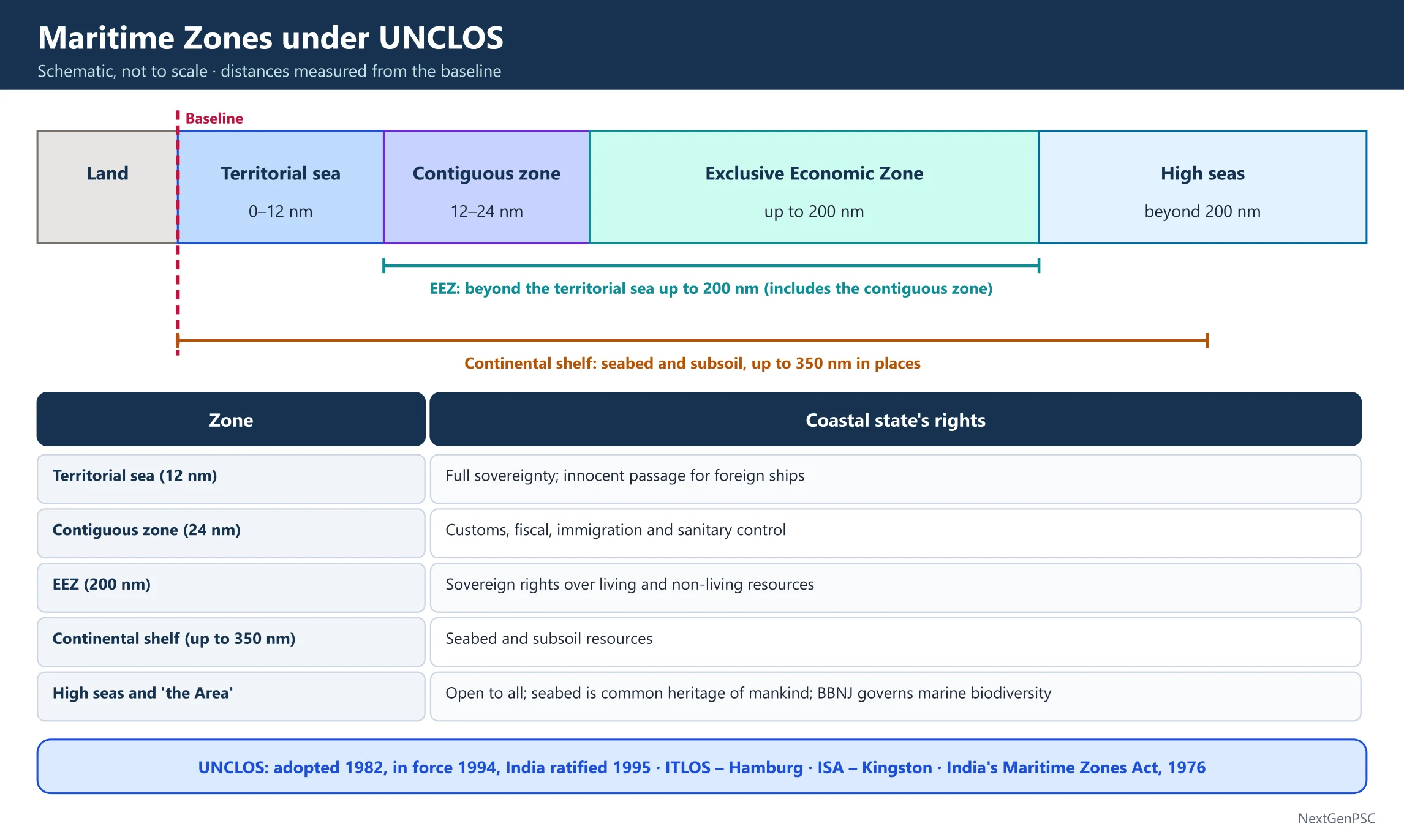
1. UNCLOS: Maritime Zones
Adopted 1982, in force 1994; India ratified in 1995. Bodies: ITLOS (Hamburg), the International Seabed Authority (Kingston, Jamaica) and the Commission on the Limits of the Continental Shelf.
Zones from baselines: territorial sea 12 nautical miles (full sovereignty, with innocent passage); contiguous zone 24 nm (customs, immigration, sanitation); EEZ 200 nm (sovereign rights over resources); continental shelf up to 350 nm; beyond lies the high seas and 'the Area' (seabed, common heritage of mankind).
India's Maritime Zones Act, 1976 mirrors these zones; India holds that other states need its consent for military exercises in its EEZ.
India accepted the 2014 arbitral award on the India–Bangladesh maritime boundary, and supports a rules-based order in the South China Sea, citing the 2016 arbitral award in the Philippines' case.
2. Seabed and High Seas
India was the first country to be registered as a 'pioneer investor' (1987) and holds ISA contracts for polymetallic nodules in the Central Indian Ocean Basin and polymetallic sulphides on the Indian Ocean ridge; the Deep Ocean Mission (2021) includes the crewed submersible Matsya-6000 (Samudrayaan).
The BBNJ Agreement (adopted 2023) on marine biodiversity beyond national jurisdiction—marine protected areas on the high seas, sharing benefits from marine genetic resources, environmental impact assessments—entered into force on 17 January 2026. India signed in 2024 and has begun domestic steps towards ratification.
3. India and the Arctic
India signed the Svalbard Treaty (1920) as part of the British Empire; its research station Himadri (2008) is at Ny-Ålesund, Svalbard (Norway); the IndARC underwater observatory was deployed in Kongsfjorden in 2014.
Arctic Council (1996, Ottawa Declaration): eight Arctic states and indigenous Permanent Participants; India became an observer in 2013.
India's Arctic Policy (March 2022), 'India and the Arctic: building a partnership for sustainable development', rests on six pillars: science and research; climate and environmental protection; economic and human development; transportation and connectivity; governance and international cooperation; and national capacity building.
Why it matters: Arctic warming affects the Indian monsoon and sea levels; melting ice opens the Northern Sea Route and access to hydrocarbons and minerals, raising great-power competition (Russia, China's 'near-Arctic state' claim).
4. India and Antarctica
Antarctic Treaty (1959, in force 1961): Antarctica for peaceful purposes and science only, territorial claims frozen; the Madrid Protocol (1991) bans mineral mining. India joined and gained consultative status in 1983.
Stations: Dakshin Gangotri (1983, now a supply base), Maitri (1989, Schirmacher Oasis) and Bharati (2012, Larsemann Hills); expeditions since 1981–82 are run by the National Centre for Polar and Ocean Research (NCPOR), Goa.
Indian Antarctic Act, 2022: applies Indian law to Indian expeditions and activities in Antarctica; requires permits; bans mining, nuclear explosions and waste disposal; sets up the Committee on Antarctic Governance and Environmental Protection and an Antarctic Fund; designates courts to try offences.
India hosted the 46th Antarctic Treaty Consultative Meeting in Kochi (May 2024).
Practice
UPSC-style: 'Though geographically distant, the polar regions are vital to India's national interest.' Discuss with reference to India's Arctic Policy and the Indian Antarctic Act, 2022.
| Zone | Extent from baseline | Coastal state's rights |
|---|---|---|
| Territorial sea | 12 nm | Full sovereignty; innocent passage for others |
| Contiguous zone | 24 nm | Customs, fiscal, immigration, sanitary control |
| Exclusive Economic Zone | 200 nm | Sovereign rights over living and non-living resources |
| Continental shelf | Up to 350 nm | Seabed and subsoil resources |
| High seas | Beyond the EEZ | Open to all; BBNJ governs biodiversity |
Prelims tips
- UNCLOS: adopted 1982, in force 1994; India ratified in 1995. ISA is in Kingston, ITLOS in Hamburg.
- BBNJ (High Seas) Agreement entered into force on 17 January 2026.
- Himadri (2008): India's Arctic station at Ny-Ålesund, Svalbard; India is an Arctic Council observer since 2013.
- India's Arctic Policy (2022) has six pillars.
- Antarctic stations: Dakshin Gangotri (1983), Maitri (1989), Bharati (2012).
- Indian Antarctic Act, 2022 created the Committee on Antarctic Governance and Environmental Protection.
Mains points
- UNCLOS underpins freedom of navigation through chokepoints vital to India's trade and energy, so India has a stake in upholding it against unilateral claims such as China's in the South China Sea.
- Seabed minerals and the BBNJ regime will shape access to future resources; India must balance its deep-sea mining ambitions with conservation commitments.
- Arctic change links directly to India's monsoon, Himalayan glaciers ('third pole') and coastal security, making polar science a national-interest issue.
- The Antarctic Act gives India legal credibility as a consultative party and supports its voice against future resource scrambles.
- Way forward: polar research vessel and new stations, ratification of BBNJ, scientific partnerships with Nordic states and Russia, and a coherent ocean governance strategy linked to the Blue Economy.
Did you know?
- India's first Antarctic expedition (1981–82) was led by Dr S.Z. Qasim.
- India's Himalayan research station Himansh (2016) in Spiti studies the 'third pole'.
- Dakshin Gangotri, India's first Antarctic station, was built on an ice shelf and was later buried in ice.
International Relations: All chapters
- India and Its Neighbourhood
- India and Major Powers
- Indo-Pacific and Global Institutions
- Foundations of India's Foreign Policy
- Regional and Multilateral Groupings
- International Institutions and Global Regimes
- India and Other Regions, Diaspora and the Global Commons