
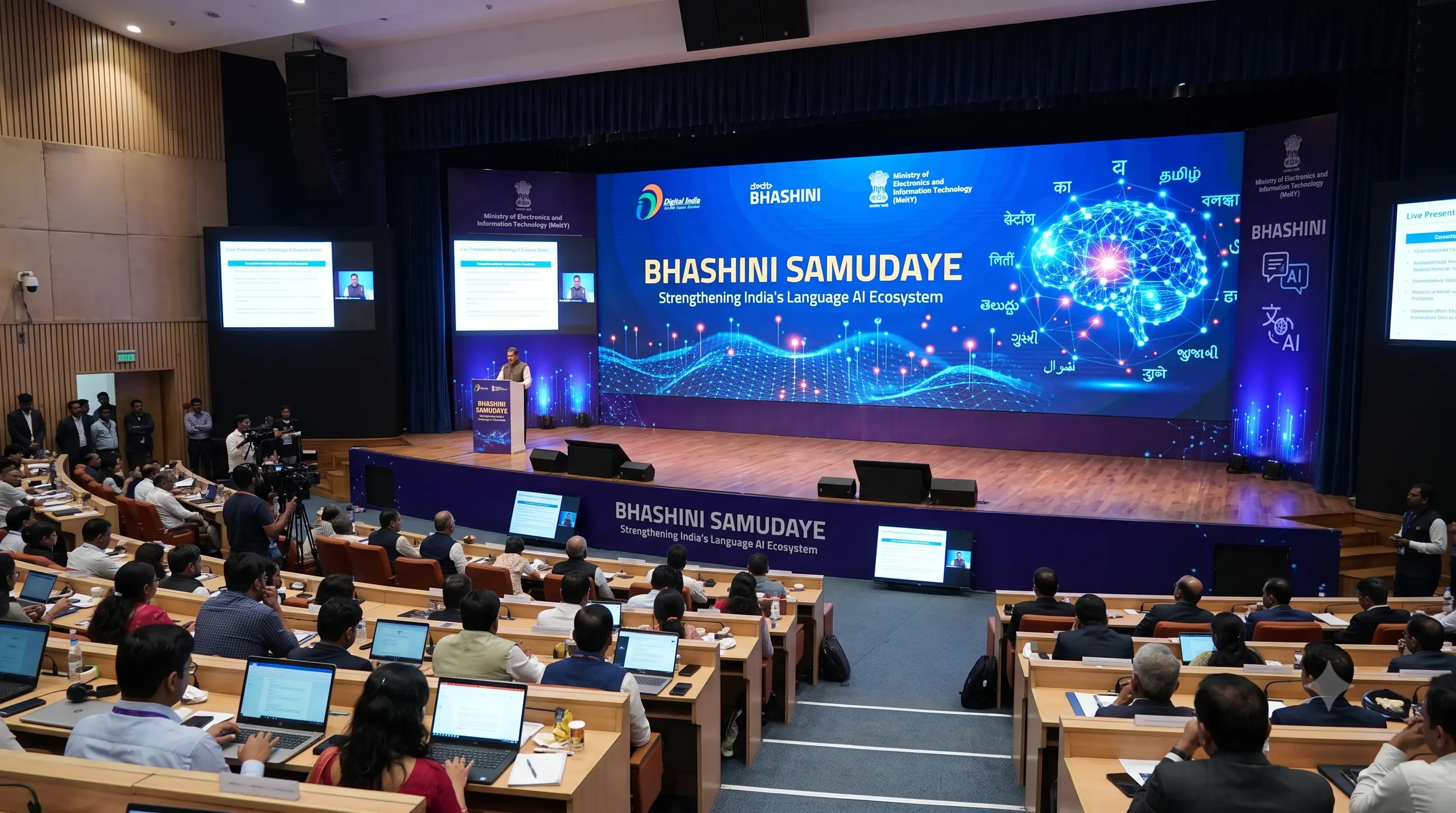
BHASHINI Samudaye: Strengthening India's Language AI Ecosystem
Organised in New Delhi by MeitY, BHASHINI Samudaye is a collaborative ecosystem initiative aimed at co-developing and scaling Indian-language Artificial Intelligence solutions to bridge the digital divide.
Introduction
Context & Background
Key Points
- •Institutional Framework: The initiative is spearheaded by the Digital India BHASHINI Division (DIBD) under MeitY and serves as a vital component of the broader Mission BHASHINI.
- •Ecosystem-Driven Governance: It shifts away from siloed development by bringing together diverse stakeholders—including academia, NGOs, and tech startups—to democratize language AI.
- •Interoperable Infrastructure: Provides developers with critical tools, including robust APIs for real-time translation, text-to-speech (TTS), and speech-to-text (STT) across India's linguistic landscape.
- •BhashaDaan Integration: Leverages crowdsourcing where citizens voluntarily contribute their voices and text to build massive, open-source Indian language datasets.
- •Live Use-Case Showcases: Practical applications of these models are actively deployed and demonstrated in sectors like governance, justice delivery, education, and public service.
Key Features of BHASHINI Samudaye
| Feature | Description | Objective | Bookmark |
|---|---|---|---|
| Ecosystem-Driven AI Governance | Involves researchers, State governments, NGOs, and startups in a participatory model. | To promote shared ownership and collaborative development. | |
| BHASHINI Platform & APIs | Provides interoperable APIs for translation, speech-to-text, and text-to-speech. | To enable real-time, accessible multilingual digital services. | |
| BhashaDaan Initiative | A citizen-participation drive to contribute text, speech, and translation data. | To create open, representative Indian-language AI datasets. | |
| Ethical Data Framework | Consent-based, standardized data collection prioritizing linguistic diversity. | To ensure social equity and inclusive AI development. |
Mission BHASHINI vs. BHASHINI Samudaye
| Framework | Core Focus | Previous/Alternate Name | Bookmark |
|---|---|---|---|
| Mission BHASHINI | A public digital platform focused on using AI for real-time translation across Indian languages. | National Language Translation Mission (NLTM) | |
| BHASHINI Samudaye | A collaborative ecosystem sub-initiative meant to deploy, govern, and scale the AI tools developed. | N/A (New Initiative) |
Related Entities
Impact & Significance
- •Bridging the Digital Divide: It ensures that non-English speakers, particularly in rural India, can access the internet, digital services, and government schemes natively.
- •Empowering Local Startups: By providing open-source datasets and APIs, it drastically lowers the entry barrier for Indian startups to build localized digital applications.
- •Transforming Justice and Education: Enables the real-time translation of Supreme Court judgments, legal documents, and educational content into regional languages, strengthening fundamental civic rights.
- •Ethical Data Sourcing: Ensures that AI data collection is inclusive and represents marginalized linguistic groups accurately, preventing the biases typically associated with western-centric AI models.
Challenges & Criticism
- •Data Scarcity for Minor Languages: While data for languages like Hindi and Tamil is abundant, generating high-quality training datasets for tribal and less-spoken languages remains a massive technical challenge.
- •Dialectal Variations: Indian languages have profound variations in dialects (e.g., Bhojpuri vs. Maithili under the broader Hindi umbrella), which can confuse AI models relying on standardized text.
- •Technological Literacy: Providing a platform in a native language does not automatically solve the foundational issue of digital illiteracy among the targeted demographics.
- •Data Privacy Concerns: Although BhashaDaan is consent-based, the large-scale collection of voice and text data inevitably raises potential concerns regarding privacy and secure data storage.
Future Outlook
- •Scaling Tribal Languages: Beyond the 22 Scheduled Languages, the framework will increasingly focus on digitizing and preserving endangered and tribal dialects.
- •Integration with Digital Public Infrastructure (DPI): Seamless coupling of language AI tools with existing DPIs like UPI, ONDC, and India Stack to ensure native-language e-commerce and digital payments.
- •Global Export of Language AI Models: Establishing a global precedent for countries with high linguistic diversity, allowing India to export its inclusive AI governance frameworks to the Global South.
- •Enhancing Multimodal AI: Moving beyond text and speech to integrate localized visual and contextual understanding in native Indian languages.
UPSC Relevance
- • GS-2 (Governance): E-governance applications, successes, limitations, and potential; government policies and interventions for inclusive development.
- • GS-3 (Science and Technology): Indigenization of technology; IT and Computers (Artificial Intelligence for social good).
- • Essay Topics: 'Artificial Intelligence: Bridging or Widening the Digital Divide?', 'Linguistic Pluralism in the Digital Age'.
- • Mains Focus: Analyzing the role of AI-driven Digital Public Infrastructure (DPI) in delivering transparent and inclusive governance to marginalized communities.
Sample Questions
Prelims
With reference to 'Mission BHASHINI', consider the following statements and identify the correct option:
1. It is a scheme exclusively aimed at translating ancient Indian scriptures into English using AI.
2. It is a public digital platform utilizing AI for real-time translation across multiple Indian languages.
3. It falls under the administrative control of the Ministry of Culture.
4. It focuses solely on the 22 Scheduled Languages and excludes all tribal dialects.
Answer: Option 2
Explanation: Option 2 is correct. Mission BHASHINI uses AI for real-time translation. Option 1 is incorrect (it targets widespread digital content and governance services). Option 3 is incorrect (it is led by MeitY). Option 4 is incorrect (it explicitly includes tribal languages alongside the 22 Scheduled Languages).
Mains
“Language is often cited as a major barrier to digital inclusion in India.” Discuss how initiatives like Mission BHASHINI and BHASHINI Samudaye aim to leverage Artificial Intelligence to overcome this barrier and transform e-governance.
Introduction: Define the digital language divide in India. Introduce Mission BHASHINI (formerly NLTM) and the recent BHASHINI Samudaye as MeitY's core interventions using Natural Language Processing (NLP).
Body:
• The Linguistic Barrier: Limited English proficiency restricts digital access for millions. Traditional e-governance faced challenges in translating protocols, legal documents, and digital services into regional dialects efficiently.
• Role of BHASHINI Samudaye: Fostering an ecosystem involving startups and academia; utilizing the BhashaDaan initiative for open datasets; building interoperable APIs (speech-to-text, machine translation) for 22 scheduled and tribal languages.
• Impact on E-Governance: Facilitates native-language public grievance redressal, real-time justice delivery systems, accessible agricultural advisories for farmers, and inclusive digital education.
Conclusion: Conclude that transitioning from a generic 'Digital India' to a 'Multilingual Digital India' is essential for true social equity, establishing India as a global leader in inclusive technological advancement.