
A Case Against the SHANTI Act
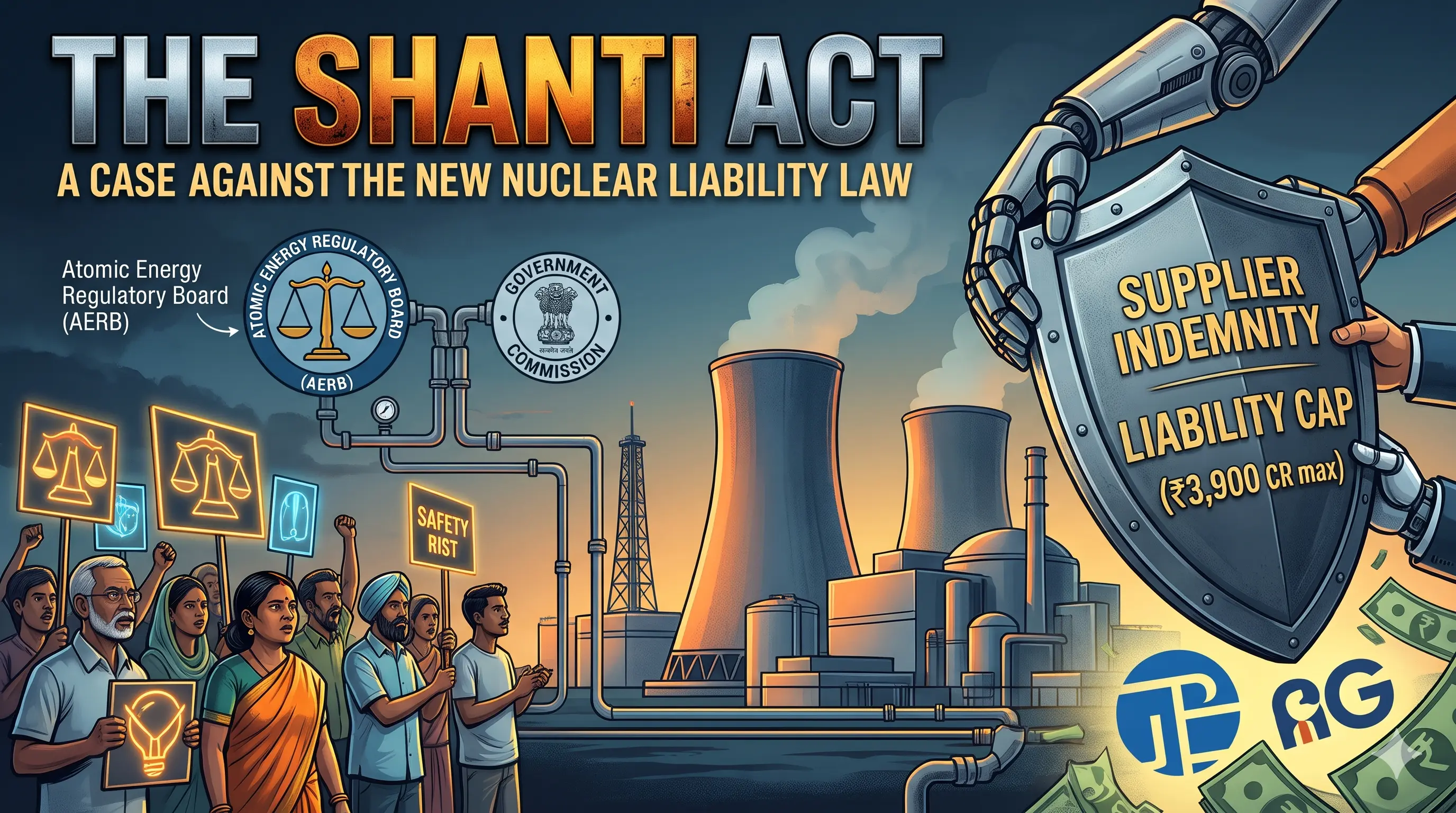
The SHANTI Act, passed in the Winter Session of Parliament, aims to boost private sector participation and foreign investment in India's nuclear sector by capping liability and indemnifying suppliers. However, it raises significant concerns regarding safety, regulatory independence, and adequate compensation for victims in case of a nuclear disaster.
Introduction
Context & Background
Key Points
- •Private Sector participation: The SHANTI Act allows private entities to operate nuclear power plants, ending the earlier monopoly of the Union government under the Atomic Energy Act framework.
- •Indemnification of Suppliers: The Act removes the operator’s “right of recourse” against suppliers in case of defective equipment. Liability for nuclear accidents is channelled exclusively to the plant operator, protecting equipment suppliers from civil or criminal claims.
- •Capping of Operator and Total Liability: The operator’s liability is capped between ₹100 crore and ₹3,000 crore depending on plant size. The total liability, including the Centre’s share, is capped at 300 million SDR (around ₹3,900 crore), limiting compensation in case of large-scale accidents.
- •Omission of Clause 46 of CLNDA: The earlier Civil Liability for Nuclear Damage Act (CLNDA) allowed victims to seek remedies under other laws, including criminal law. The SHANTI Act omits this provision.
- •Regulatory Framework for AERB: The Act provides statutory status to the Atomic Energy Regulatory Board (AERB), but its members will be selected by a committee constituted by the Atomic Energy Commission.
International Nuclear Liability Frameworks
| Framework / Model | Key Feature | Mechanism | Bookmark |
|---|---|---|---|
| Paris & Vienna Conventions | Channelling of Liability | Exclusively channels liability to the operator to ensure clarity and insurability; requires mandatory financial security up to a prescribed cap. | |
| State Supplementation Mechanism | Additional Compensation | Governments provide additional compensation beyond operator limits to ensure adequate victim relief. | |
| U.S. Price-Anderson Act | Pooled Insurance Model | Establishes an industry-wide pooled fund, enabling compensation running into billions of dollars. |
Related Entities
Impact & Significance
- •Attracting Foreign Investment: By aligning liability norms with global supplier-friendly standards, the Act is expected to attract multinational firms, especially from the U.S. and Europe, breaking years of stagnation in foreign nuclear projects.
- •Energy Security Ambitions: The Act supports India’s long-term goal of expanding nuclear capacity under its three-stage programme, moving the country closer to reducing its dependence on imported fossil fuels and meeting climate goals.
- •Private Sector Integration: Ending the state monopoly allows private capital, efficiency, and technological innovation to enter the nuclear operations space.
Challenges & Criticism
- •Moral Hazard Due to Liability Caps: Capping liability may reduce incentives for operators to invest in maximum safety standards, as their financial risk has a definitive, relatively low ceiling.
- •Supplier Indemnity: Major historical accidents like Chernobyl and Three Mile Island involved design or system flaws. Shielding suppliers from accountability despite these global precedents may severely undermine the safety culture.
- •Grossly Inadequate Compensation: Studies estimate the Fukushima disaster's economic damage at tens of lakh crore rupees. India’s total cap of ~₹3,900 crore would cover only a fraction of potential losses, leaving victims destitute.
- •Loss of Legal Recourse: The omission of Clause 46 of the CLNDA strips victims of the ability to seek remedies under other laws, including criminal law, shielding negligent corporations.
- •Compromised Regulatory Independence: While the AERB gets statutory status, its members will be selected by a committee under the Atomic Energy Commission, raising conflict-of-interest concerns regarding its autonomy to enforce strict safety norms.
- •Financial Risks and Viability: Nuclear power currently contributes only ~3% to India's electricity. With global precedents of massive cost overruns in projects (like AP1000 reactors), Indian taxpayers could be burdened with high capital risks.
Future Outlook
- •Strengthening Regulatory Independence: The AERB must be made fully autonomous, with transparent appointments and parliamentary oversight to ensure credible safety enforcement.
- •Revisiting Liability Caps: India could consider periodic revision of liability caps indexed to inflation and plant capacity, ensuring realistic compensation.
- •Mandatory Insurance and Risk Pooling: Operators should maintain robust insurance coverage and participate in international compensation frameworks for additional security.
- •Ensuring Supplier Accountability: Even if indemnified from civil liability, suppliers should be accountable under strict contractual and criminal provisions for proven negligence or defective design.
- •Public Transparency and Safety Audits: Regular safety audits, public disclosure of risk assessments, and independent review mechanisms can build confidence in nuclear expansion.
- •Diversified Energy Strategy: Nuclear energy should complement, not replace, renewables and storage solutions. A balanced mix reduces overdependence on any single technology.
UPSC Relevance
- • GS-3 (Science and Technology): Developments and their applications and effects in everyday life; Indigenization of technology and developing new technology (Nuclear Energy).
- • GS-3 (Infrastructure): Energy security, transition away from fossil fuels, and associated risks.
- • GS-2 (Governance): Statutory, regulatory and various quasi-judicial bodies (Autonomy of AERB).
- • Mains Focus: Analyzing the trade-off between attracting FDI in the nuclear sector versus ensuring public safety and adequate liability.
Sample Questions
Prelims
With reference to the SHANTI Act recently passed in Parliament, consider the following statements: 1. It allows private entities to operate nuclear power plants in India. 2. It holds equipment suppliers criminally liable in case of a nuclear accident caused by defective design. 3. It grants statutory status to the Atomic Energy Regulatory Board (AERB). Which of the statements given above is/are correct?
- (a)1 and 2 only
- (b)2 and 3 only
- (c)1 and 3 only
- (d)1, 2 and 3
Mains
Critically examine the provisions of the SHANTI Act in the context of India's nuclear energy security and liability framework. How does it balance the need for foreign investment with the imperatives of safety and accountability?
Introduction: Introduce the SHANTI Act, its context of passing in Parliament, and its primary objective: ending the state monopoly to boost private participation and FDI in the nuclear sector by altering the liability framework.
Body:
• Significance/Pros: Attracting foreign investment by aligning with global supplier-friendly standards (Paris/Vienna conventions); supporting India's 3-stage nuclear program; reducing dependence on fossil fuels.
• Key Concerns: Moral hazard due to capped liability (₹3,900 crore maximum); indemnification of suppliers removing accountability for defective designs; omission of Clause 46 of CLNDA restricting legal recourse; lack of complete autonomy for the AERB.
• Way Forward: Strengthening AERB's independence via parliamentary oversight; indexing liability caps to inflation; mandatory risk pooling similar to the US Price-Anderson model; ensuring strict contractual accountability for suppliers.
Conclusion: Conclude that while modernizing the nuclear sector is crucial for India's energy security and climate goals, it must not come at the cost of public safety. A robust, autonomous regulatory framework is essential to balance commercial incentives with citizen protection.