
Strategy for Artificial Intelligence in Healthcare for India (SAHI): Regulating AI in Healthcare
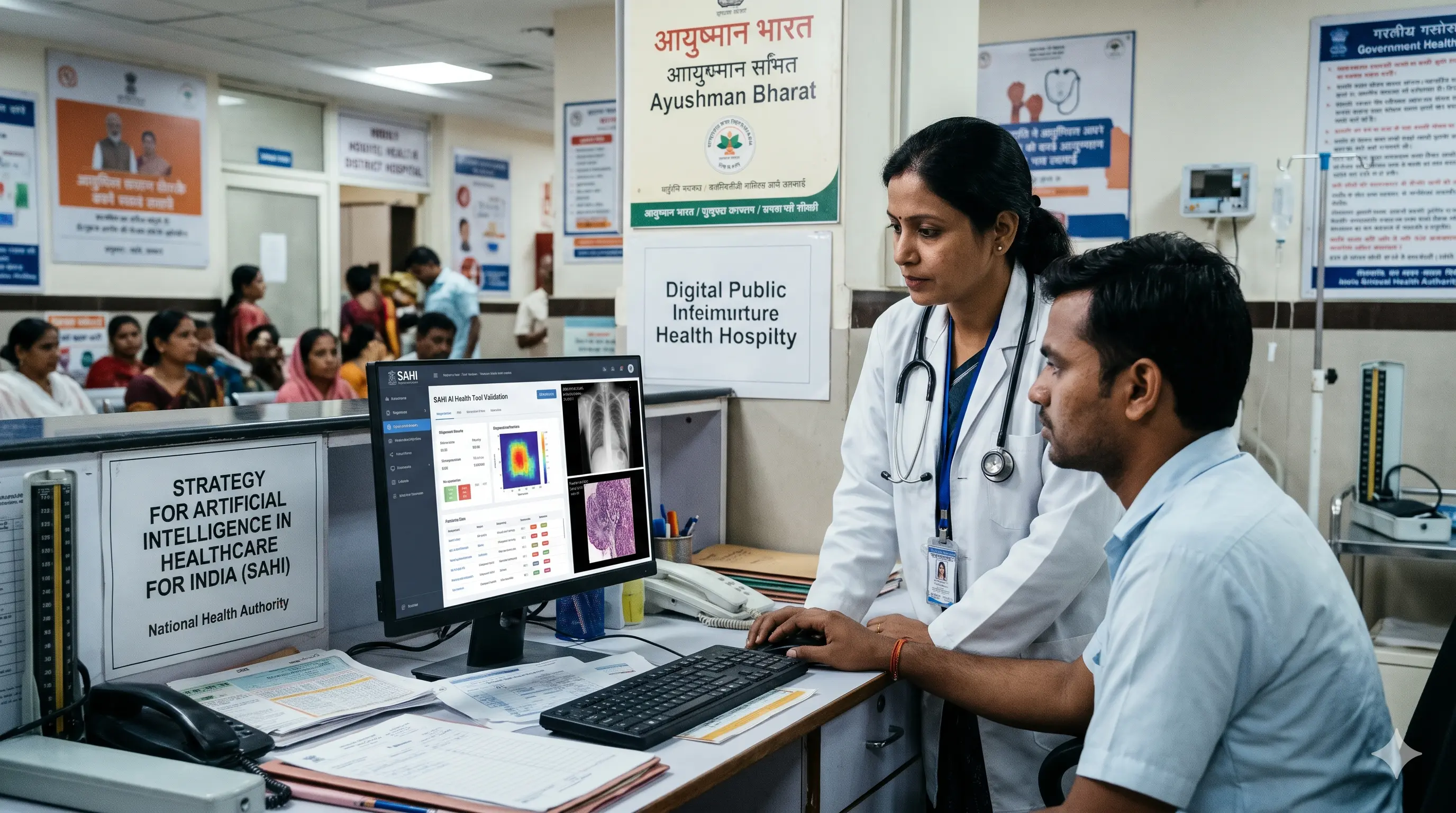
India has unveiled the Strategy for Artificial Intelligence in Healthcare for India (SAHI) along with the BODH validation platform. Developed jointly by the Union Health Ministry and the National Health Authority (NHA) on the ABDM digital public infrastructure, the framework sets comprehensive clinical, ethical, and procurement standards for deploying safe and equitable AI in medical ecosystems.
Introduction
Context & Background
Key Points
- •Strategy for Artificial Intelligence in Healthcare for India (SAHI): Built by the Union Health Ministry and NHA, setting technical, ethical, and clinical benchmarks for deploying medical AI.
- •ABDM & Privacy-by-Design: Follows Ayushman Bharat Digital Mission principles using a federated data model—where health records remain at hospitals/labs rather than a central honeypot—paired with an explicit, revocable patient consent architecture.
- •BODH Platform: The Benchmarking Open Data Platform for Health AI provides curated, secure public-academic datasets to test, compare, and validate algorithms in real-world scenarios before public rollout.
- •Procurement via Outcome-Based Models: Establishes clear qualification standards for public healthcare procurement, encouraging payment models linked to verified patient health outcomes rather than just upfront software licensing costs.
- •Mitigating Algorithmic Bias: Mandates testing across diverse demographics—spanning rural populations, multiple genders, and socio-economically marginalized groups—to eliminate diagnostic skew.
- •Model Drift & Continuous Auditing: Enforces mandatory periodic re-certification and post-market tracking to identify performance degradation (model drift) over time as patient trends evolve.
Key Pillars of the SAHI AI Governance Framework
| Pillar / Stage | Focus Area | Core Mechanism | Bookmark |
|---|---|---|---|
| Data Collection & Curation | High-quality and diverse datasets | Ethically sourced, bias-free data representative of rural, gender, and marginalized demographics. | |
| Validation & Testing | Pre-deployment safety assurance | Rigorous benchmarking via BODH (Benchmarking Open Data Platform for Health AI). | |
| Privacy Architecture | Patient autonomy & data security | ABDM-aligned consent management, federated data storage, and strict API controls. | |
| Procurement & Finance | Public health adoption | Standardized evaluation metrics and outcome-based purchasing linked to clinical efficacy. | |
| Lifecycle Oversight | Long-term efficacy & drift control | Continuous post-market surveillance, periodic re-certification, and safe decommissioning protocols. |
Global Approaches to Health AI Governance
| Country / Organization | Regulatory Model / Initiative | Key Governance Feature | Bookmark |
|---|---|---|---|
| European Union (EU) | EU AI Act | Categorizes health AI as high-risk; mandates human oversight and pre-market compliance. | |
| United States | US FDA AI Framework | Pre-determined change control plans and continuous performance tracking. | |
| United Kingdom | NHS AI Lab Model | Sandbox testing environments, structured procurement, and real-world evidence generation. | |
| Singapore | Model AI Governance Framework | Risk-based classification, explainability, and multi-sector regulatory coordination. | |
| WHO | WHO Ethical Guidance for AI in Health | Principles of transparency, accountability, inclusivity, and fundamental human rights. |
Related Entities
Impact & Significance
- •Democratizing Diagnostics: AI-driven triage and radiology support can bridge specialist deficits across underserved rural and tier-2/3 regions.
- •Template for the Global South: Demonstrates how developing economies can deploy digital public infrastructure (DPI) to govern advanced artificial intelligence ethically without prohibitive licensing costs.
- •Preventing Premature Deployment: Mandatory pre-testing via BODH shields patients from experimental or clinically unverified proprietary tools.
- •Encouraging Domestic MedTech Innovation: Clear evaluation and procurement pathways allow Indian startups and academic researchers to validate and scale solutions for national programs.
Challenges & Criticism
- •Data Privacy & Cybersecurity Risks: Expanding digital interfaces increases vulnerabilities to ransomware and health data breaches, which can compromise personal privacy.
- •Model Drift & Maintenance: Clinical algorithms trained on specific initial distributions often degrade in accuracy when exposed to shifting real-world pathogen strains or demographic variations.
- •Over-Reliance vs. Clinical Autonomy: A risk that clinicians might over-rely on automated recommendations, diluting human judgment and critical medical instinct.
- •Digital & Infrastructure Divide: Rural health centers (Sub-Centres and PHCs) frequently lack high-speed connectivity, modern computing hardware, and trained staff required to leverage AI systems.
- •Ethical & Legal Liability: In the event of an erroneous diagnosis or treatment recommendation made by an autonomous or semi-autonomous tool, liability lines between developers, hospitals, and doctors remain legally ambiguous.
Future Outlook
- •Dedicated AI-Health Regulatory Cell: Setting up an institutional regulatory cell under the Health Ministry to manage continuous compliance, safety advisories, and adverse incident reporting.
- •Scaling Federated Learning: Advancing algorithmic training where models travel to decentralized institutional servers to learn on local data without centralizing raw personal records.
- •Dynamic Dataset Enrichment: Continuously expanding BODH's repositories to account for rare diseases, regional genetic profiles, and atypical presentations.
- •Comprehensive Liability Legislation: Developing clear statutory guidelines delineating the legal liability of medical practitioners versus software developers in AI-assisted errors.
UPSC Relevance
- • GS-3 (Science & Technology): Awareness in the fields of IT, Computers, Robotics, and Artificial Intelligence; indigenization of technology.
- • GS-2 (Governance & Social Justice): Issues relating to the development and management of the Health sector; delivery of public services through Digital Public Infrastructure (DPI).
- • Essay Topics: 'Artificial Intelligence in Public Health: Panacea or Peril?', 'Bridging India\'s Urban-Rural Healthcare Divide Through Technology'.
Sample Questions
Prelims
With reference to the Strategy for Artificial Intelligence in Healthcare for India (SAHI) and BODH platform, consider the following statements: 1. SAHI is built upon the digital public infrastructure provided by the Ayushman Bharat Digital Mission (ABDM). 2. Under the framework's federated data model, all citizen medical health records are pooled into a single centralized national repository to train AI algorithms. 3. BODH serves as a benchmarking platform to validate and evaluate health AI models before deployment. Which of the statements given above are correct?
- (a)1 and 2 only
- (b)2 and 3 only
- (c)1 and 3 only
- (d)1, 2, and 3
Mains
Examine the significance of the 'Strategy for Artificial Intelligence in Healthcare for India' (SAHI) in addressing ethical and systemic challenges in digital medicine. How can India ensure equity and accountability in deploying health AI across its diverse demographic landscape?
Introduction: Introduce the SAHI framework and BODH platform released by the Health Ministry and NHA, highlighting India's proactive step toward governing AI in healthcare using digital public infrastructure (ABDM).
Body:
• Core Significance & Gap Addressed: Fills the regulatory vacuum around adaptive algorithms; sets clear clinical evaluation standards; establishes privacy-by-design through federated data and revocable consent.
• Key Challenges to Address: Mitigating demographic bias across gender/rural datasets; preventing clinical deskilling; managing model drift; bridging digital infrastructure divides across tier-2/tier-3 public health centres.
• Measures for Equity & Accountability: Regularizing BODH audits; creating unambiguous legal frameworks for diagnostic liability; incentivizing low-bandwidth edge-AI; funding continuous post-market surveillance.
Conclusion: Conclude by highlighting that ethical governance, robust digital infrastructure, and human-in-the-loop clinical supervision can transform India's health AI strategy into a scalable benchmark for the Global South.