
Lessons from India's C-DOT Saga for Indigenous Technology Development
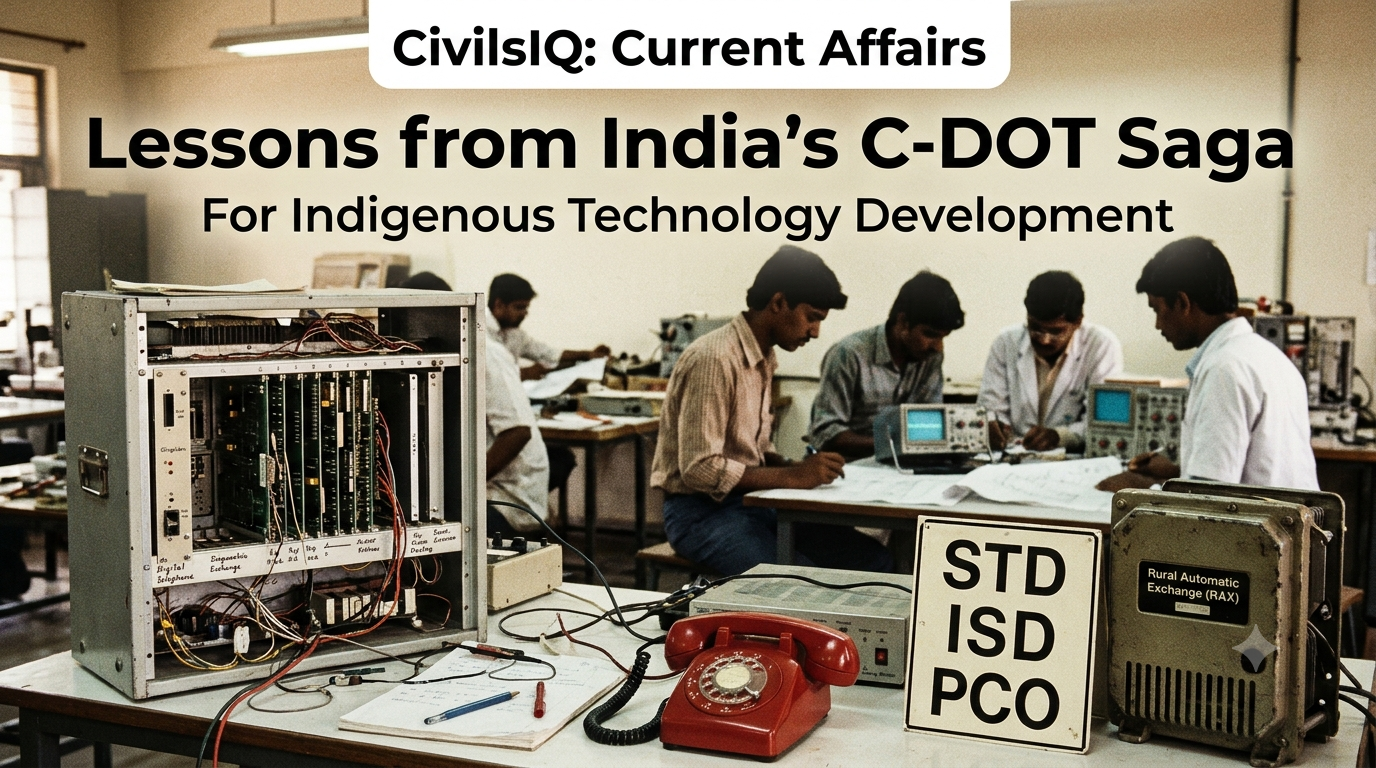
The Centre for Development of Telematics (C-DOT) revolutionised India's rural telecom infrastructure in the 1980s through indigenous digital switching systems. However, political targeting and bureaucratic interference triggered a mass exit of scientists, offering critical lessons on institutional autonomy and policy continuity for India's modern technology missions.
Introduction
Context & Background
Key Points
- •Indigenous Telecom Breakthrough: Established in August 1984 as an autonomous telecom R&D centre, C-DOT successfully designed software-based digital switching systems specifically engineered for harsh Indian conditions—high temperatures, dust, and heavy call volumes.
- •Bridging the Rural Telecom Deficit: In the 1980s, only about 3% of Indian villages had telephone access. C-DOT's Rural Automatic Exchanges (RAX) brought reliable connectivity to remote areas and laid the foundation for India's broader telecom revolution.
- •Startup-Like R&D Culture: Unlike traditional government laboratories, C-DOT operated with young engineers, flat project teams, performance incentives, and a mission-oriented approach.
- •Bureaucratic & Political Disruption: Following the change in political leadership after the Rajiv Gandhi government, C-DOT and its founder Sam Pitroda faced political targeting, resistance from the Department of Telecommunications (DoT), and formal ministry inquiries.
- •Dismissals and Brain Drain: Committee reviews led to the removal of senior scientists who voiced dissenting views, triggering a mass exodus of skilled engineers to multinational corporations and overseas opportunities.
- •Strategic Takeaway: Technology development inherently requires experimentation and risk-taking; judging mission-mode R&D through rigid administrative rules undermines national technological sovereignty.
Key Achievements of C-DOT
- Innovation / Action:
- Developed software-based digital exchanges suited for Indian heat, dust, and heavy call volumes.
- Impact on India:
- Replaced outdated imported analogue exchanges.
- Innovation / Action:
- Deployed compact switches tailored for remote villages.
- Impact on India:
- Addressed the 1980s rural telecom deficit where only ~3% of villages had phone access.
- Innovation / Action:
- Built a local network of component vendors, engineers, and manufacturers.
- Impact on India:
- Broke India's heavy import dependence on multinational telecom firms.
- Innovation / Action:
- Integrated C-DOT exchanges with Subscriber Trunk Dialling (STD) networks.
- Impact on India:
- Expanded long-distance communication and laid the base for India's telecom revolution.
Root Causes of the C-DOT Institutional Crisis
- Manifestation:
- Fall of the Rajiv Gandhi government led to political targeting of C-DOT and Sam Pitroda.
- Consequence:
- Loss of high-level backing and policy continuity.
- Manifestation:
- Friction between C-DOT's autonomous, startup-like culture and traditional DoT bureaucracy.
- Consequence:
- Resistance to operational independence and unconventional workflows.
- Manifestation:
- Ministry-ordered inquiries judged experimental R&D against rigid bureaucratic rules.
- Consequence:
- Internal distrust, dismissal of dissenting senior scientists, and mass brain drain.
- Manifestation:
- Indigenous telecom success threatened foreign multinational suppliers.
- Consequence:
- Heightened lobbying and commercial pushback against domestic tech.
Related Entities
Impact & Significance
- •Breaking Import Dependence: C-DOT proved India could build complex telecom hardware and software domestically, reducing reliance on multinational suppliers and nurturing local component manufacturers.
- •Foundation of the Telecom Revolution: Combining C-DOT exchanges with Subscriber Trunk Dialling (STD) networks democratised long-distance communication across towns and villages.
- •Blueprint for Mission-Mode R&D: Demonstrated that young, empowered teams working in a flat, startup-like environment can outperform rigid hierarchical labs.
- •Cautionary Precedent for Deep-Tech: Highlights how institutional instability can erase years of R&D momentum and drive top scientific talent abroad.
Challenges & Criticism
- •Bureaucratic Resistance: Traditional telecom administrators and sections of the DoT resisted C-DOT's operational autonomy and unconventional management style.
- •Political Targeting: Following the fall of the Rajiv Gandhi government, C-DOT and Sam Pitroda became targets of political scrutiny due to their close association with the previous administration's technology missions.
- •Misunderstanding of Innovation: Ministry-ordered inquiries evaluated high-risk, experimental R&D through rigid bureaucratic norms, creating internal distrust.
- •Mass Brain Drain: The removal of dissenting senior officials and prolonged institutional uncertainty triggered a mass exodus of engineers to multinational telecom firms and overseas jobs.
Future Outlook
- •Ensure Institutional Autonomy: Mission-oriented R&D organisations must be granted operational independence, shielding them from day-to-day bureaucratic interference.
- •Maintain Policy Continuity: Strategic technology programmes need bipartisan, long-term institutional backing that survives changes in political regimes.
- •Protect Innovation Ecosystems: Scientists, engineers, and research teams must be insulated from political targeting and administrative disruptions.
- •Promote Indigenous Product Development: Policy should prioritise end-to-end product innovation and commercialisation rather than stopping at academic research or relying on imports.
- •Strengthen Talent Retention: Stable institutional environments, clear career paths, and performance incentives are essential to prevent brain drain to foreign multinationals.
UPSC Relevance
- • GS-3 (Science & Technology): Indigenization of technology and developing new technology; achievements of Indians in science and technology.
- • GS-2 (Governance): Institutional autonomy, bureaucratic reforms, and policy continuity in public-funded R&D bodies.
- • Essay Topics: 'Technological sovereignty requires institutional autonomy', 'Why India's R&D ecosystem needs a startup mindset'.
Sample Questions
Prelims
Consider the following statements regarding the Centre for Development of Telematics (C-DOT):
- (a)C-DOT was established as an autonomous telecom R&D organisation under the Government of India.
- (b)Its Rural Automatic Exchanges (RAX) were specifically designed to operate in Indian conditions such as high temperature and dust.
- (c)C-DOT operates as a private sector joint venture outside the purview of the Department of Telecommunications (DoT).
Mains
“The rise and disruption of C-DOT offer enduring lessons for India’s quest for technological self-reliance.” Analyse the achievements of C-DOT, the factors behind its institutional crisis, and the policy safeguards required for indigenous technology missions today.
Introduction: Briefly introduce C-DOT (established 1984) as a landmark indigenous telecom mission that demonstrated India's engineering potential while exposing the vulnerabilities of public R&D to political and bureaucratic interference.
Body:
• Achievements of C-DOT: Developed indigenous software-based digital switches suited for Indian conditions; bridged the rural telecom gap (only ~3% villages connected in the 1980s) via RAX; integrated with STD networks; built a domestic vendor ecosystem; pioneered a startup-like R&D culture.
• Reasons Behind the Crisis: Political transition and targeting after the fall of the Rajiv Gandhi government; bureaucratic resistance from DoT against C-DOT's autonomy; rigid administrative inquiries into experimental R&D; dismissal of dissenting scientists leading to brain drain; external commercial pressures from multinational suppliers.
• Way Forward for Technology Policy: Guarantee operational autonomy for mission-mode R&D; ensure bipartisan policy continuity; insulate scientists from political/administrative disruptions; focus on indigenous product commercialisation; strengthen talent retention through stable incentives.
Conclusion: Conclude that achieving Atmanirbhar Bharat in critical technologies—from 6G and AI to semiconductors—depends as much on protecting institutional autonomy and talent as on funding research.