
Labour Market Impacts of Artificial Intelligence
A recent research report by Anthropic, analysing AI usage data alongside U.S. Bureau of Labor Statistics data, introduces 'observed exposure' to measure AI's real-world impact on jobs. While AI adoption remains below its theoretical potential and hasn't caused mass unemployment yet, early signs point to slower job growth and reduced entry-level hiring in white-collar sectors.
Introduction
Context & Background
Key Points
- •Concept of 'Observed Exposure': A new framework introduced by Anthropic that measures real-world interaction between AI systems and workplace tasks. It combines three elements: theoretical AI capability, actual usage data from AI platforms, and the nature of usage (giving greater weight to full automation over mere assistance).
- •Capability vs. Actual Usage Gap: Real-world AI adoption lags far behind its theoretical potential. For instance, in Computer and Mathematical occupations, AI can theoretically assist in 94% of tasks, but actual current usage covers only about 33%.
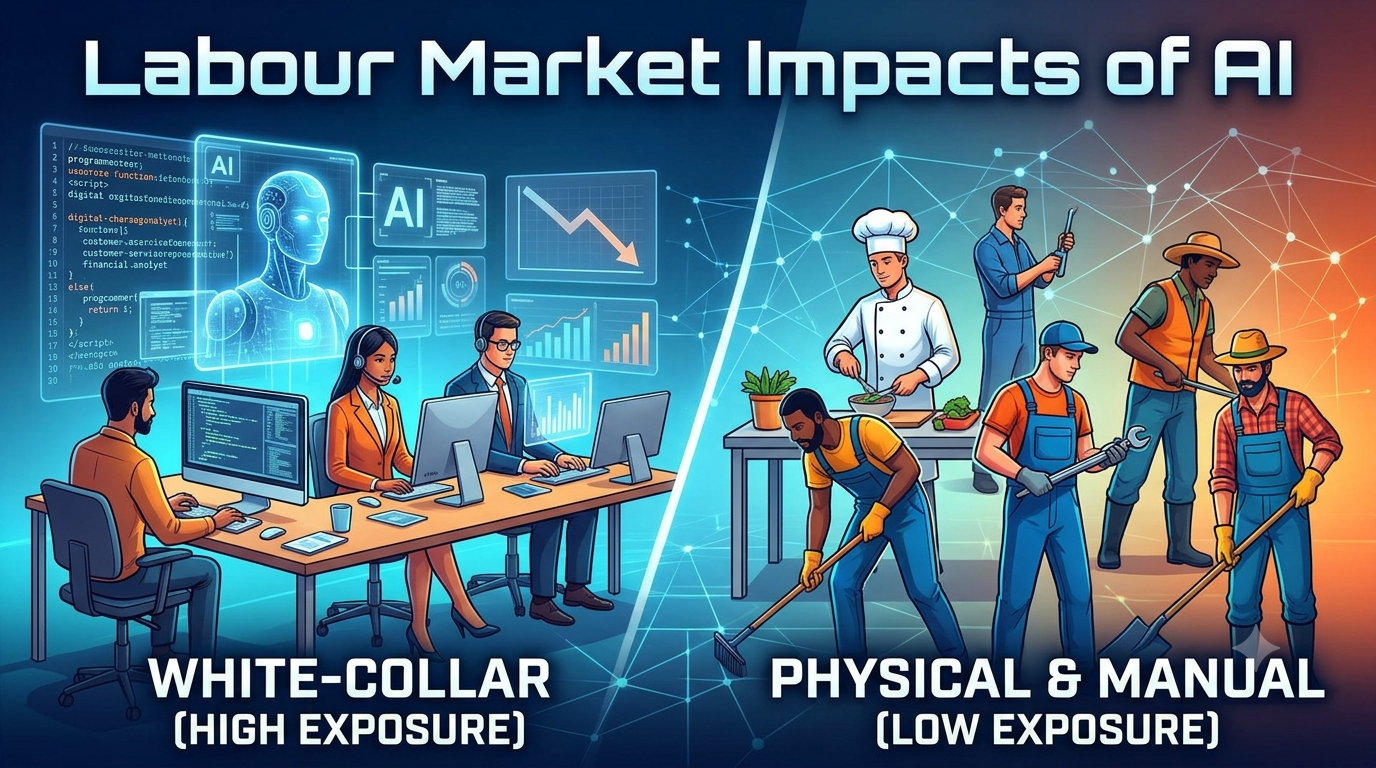
- •Most Exposed Occupations: White-collar roles involving routine cognitive work face the highest exposure. Computer Programmers see around 75% task coverage, alongside Customer Service Representatives, Data Entry Workers, and Financial Analysts.
- •Least Exposed Occupations: Roughly 30% of the workforce has zero measurable exposure to AI automation—primarily roles requiring physical labour and interpersonal skills, such as cooks, mechanics, lifeguards, bartenders, and dishwashers.
- •Demographic Profile of Exposed Workers: Unlike previous waves of automation that hit manual labour, AI primarily affects workers who are more educated, higher paid, more likely to be female, and in white-collar professions. Workers with graduate degrees make up 17.4% of the most exposed group, compared to just 4.5% among unexposed workers.
- •No Mass Unemployment Yet, But Slower Hiring for Youth: Since 2022, there has been no systematic spike in unemployment in AI-exposed jobs. However, hiring for young workers (aged 22–25) into highly exposed occupations has dropped by 14%, suggesting companies may be automating entry-level tasks.
Occupational Exposure to Artificial Intelligence
- Key Occupations:
- Computer Programmers (~75% task coverage), Customer Service Reps, Data Entry Workers, Financial Analysts
- Nature of Tasks:
- Coding, automated support, structured data entry, summarisation, and report generation.
- Key Occupations:
- Cooks, Mechanics, Lifeguards, Bartenders, Dishwashers, Agricultural Workers
- Nature of Tasks:
- Physical manipulation, skilled mechanical repair, and interpersonal interaction.
- Key Occupations:
- Courtroom Legal Representatives, Tree Pruners
- Nature of Tasks:
- Human judgment, regulatory responsibility, and complex physical tasks.
Possible Future Labour Market Scenarios
- Mechanism:
- AI enhances worker productivity while humans retain decision-making roles.
- Current Outlook:
- Dominant trend in the short term.
- Mechanism:
- Core job tasks evolve significantly, but overall employment remains stable.
- Current Outlook:
- Dominant trend in the short term.
- Mechanism:
- Automation replaces workers performing routine cognitive tasks.
- Current Outlook:
- Emerging risk for routine white-collar roles.
- Mechanism:
- Technological innovation generates entirely new industries and job categories.
- Current Outlook:
- Historical precedent (e.g., Internet Revolution).
Related Entities
Impact & Significance
- •Slower Projected Job Growth: Occupations with higher AI exposure are projected to grow more slowly—every 10-percentage-point increase in AI exposure correlates with a 0.6-percentage-point reduction in projected job growth.
- •Pressure on Entry-Level Hiring: The 14% decline in job entry rates for workers aged 22–25 in highly exposed sectors indicates that firms may be using AI to automate junior tasks and boost existing staff productivity instead of hiring freshers.
- •Shift in Automation Demographics: Because highly exposed roles skew towards higher-paid, college-educated, and female white-collar workers, AI could reshape traditional middle- and upper-income career ladders.
- •Short-Term Productivity Gains: With unemployment remaining broadly stable across exposed and non-exposed roles, the immediate macroeconomic effect appears to be job augmentation and transformation rather than mass layoffs.
Challenges & Criticism
- •Barriers to Full Adoption: The wide gap between theoretical capability and real-world usage persists due to evolving AI tools, regulatory and legal constraints, the need for human verification, and organisational inertia.
- •Limits of Automation: AI remains unable to handle tasks requiring fine physical manipulation (e.g., pruning trees, mechanical repair), nuanced human judgment, or legal accountability (e.g., courtroom representation).
- •Statistical Uncertainty: Researchers caution that early signals—such as the 14% hiring dip among young workers—are still statistically weak and require longer-term monitoring before drawing definitive conclusions.
- •Risk of Eroding the Talent Pipeline: If companies consistently automate entry-level tasks to cut junior hiring, industries may struggle in the future to develop experienced mid- and senior-level professionals.
Future Outlook
- •Workforce Reskilling: Governments must invest heavily in digital skills and AI literacy to help existing workers transition alongside evolving workplace tools.
- •Education Reform: Academic curricula need to pivot towards creative, analytical, and interpersonal skills that are less vulnerable to automation.
- •Continuous Labour Market Monitoring: Adopting real-time measurement frameworks like 'observed exposure' will help policymakers detect early signs of structural disruption before mass displacement occurs.
- •Supporting Young Workers: Because entry-level opportunities are showing early signs of contraction in AI-intensive sectors, targeted internships, apprenticeships, and career transition support for young graduates will be essential.
UPSC Relevance
- • GS-3 (Science & Technology): Developments in Artificial Intelligence and their real-world applications and socio-economic impacts.
- • GS-3 (Indian Economy): Issues relating to employment, growth, and the future of white-collar/IT services in the age of automation.
- • Essay Topics: 'Artificial Intelligence: Augmentation or Displacement?', 'Preparing the youth for the future of work'.
- • Mains Focus: Analysing the shift from manual automation to white-collar cognitive automation, and designing policy interventions for youth employment and education reform.
Sample Questions
Prelims
Consider the following statements regarding the labour market impacts of Artificial Intelligence:
- (a)The 'observed exposure' framework gives greater weight to AI augmentation (assistance) than to full task automation.
- (b)Workers in AI-exposed occupations are statistically more likely to hold graduate degrees and work in white-collar professions compared to unexposed workers.
- (c)Rapid AI adoption since 2022 has led to a sharp, systematic rise in overall unemployment across highly exposed occupations.
Mains
“Artificial Intelligence is currently augmenting rather than replacing human labour, yet early signals point to structural shifts in entry-level white-collar hiring.” Discuss in the context of the 'observed exposure' framework and suggest policy measures to mitigate labour market disruptions.
Introduction: Define 'observed exposure' based on the recent Anthropic–BLS study and state the central thesis: AI's real-world labour impact currently lags its theoretical potential, primarily affecting white-collar knowledge work.
Body:
• Understanding Observed Exposure: Explain how it bridges theoretical AI capability and actual workplace usage (e.g., 94% theoretical vs. 33% actual in Computer/Math roles) and weights automation over assistance.
• Emerging Labour Market Trends: Highlight the demographic shift (white-collar, higher-educated, higher-paid workers affected), slower projected job growth (0.6 percentage point drop per 10-point exposure rise), and the 14% decline in entry-level hiring for ages 22–25 despite stable overall unemployment.
• Policy Way Forward: Focus on workforce reskilling and AI literacy, reforming education towards creative/interpersonal skills, continuous labour monitoring, and targeted support for young entrants.
Conclusion: Conclude by noting that while augmentation and job transformation dominate the short term—much like the Internet Revolution—proactive policy intervention is vital to ensure that entry-level talent is not locked out of the AI-driven economy.
Static topics behind this news
Read the background in these notes: Prelims and Mains questions are built on it.