
Indo-Persian Civilizational Links: A Millennia-Old Bond of Statecraft, Art, and Language
The enduring civilizational bond between India and Iran spans millennia of exchange across administration, literature, art, and architecture. From ancient Achaemenian expeditions and Mauryan statecraft to Mughal miniature paintings and GI-tagged Kashmiri silk carpets, this article explores the deep historical foundations and contemporary cultural resonance of Indo-Persian ties.
Introduction
Context & Background
Key Points
- •Foundations of Contact (The Achaemenian Bridge): Formal political ties began with the Achaemenian Empire. Cyrus (558–530 B.C.) was the first conqueror to lead an expedition into India, capturing the Gandhara region. Later, Darius I (522–486 B.C.) annexed the Indus Valley, Punjab, and Sindh in 518 B.C., organizing them into the 20th satrapy (province) of the Persian Empire.
- •Administration and Statecraft: The Achaemenian administrative structure directly influenced Chandragupta Maurya while building the First Indian Empire. Centuries later, Persian functioned as the official language of Indian law, governance, and diplomacy throughout the Mughal period and into the British East India Company era, until the administrative reforms of 1832–37.
- •Scriptural and Linguistic Synthesis: The Indian Rigveda and the Iranian Zoroastrian Avesta share remarkable linguistic and mythological parallels. Under Akbar (1582), Persian became the official court language, enriching modern Indian languages with thousands of everyday loanwords such as Kagaz (paper), Vakil (lawyer), Tehsil (administrative unit), and Mohalla (neighborhood).
- •Art, Architecture, and Scripts:
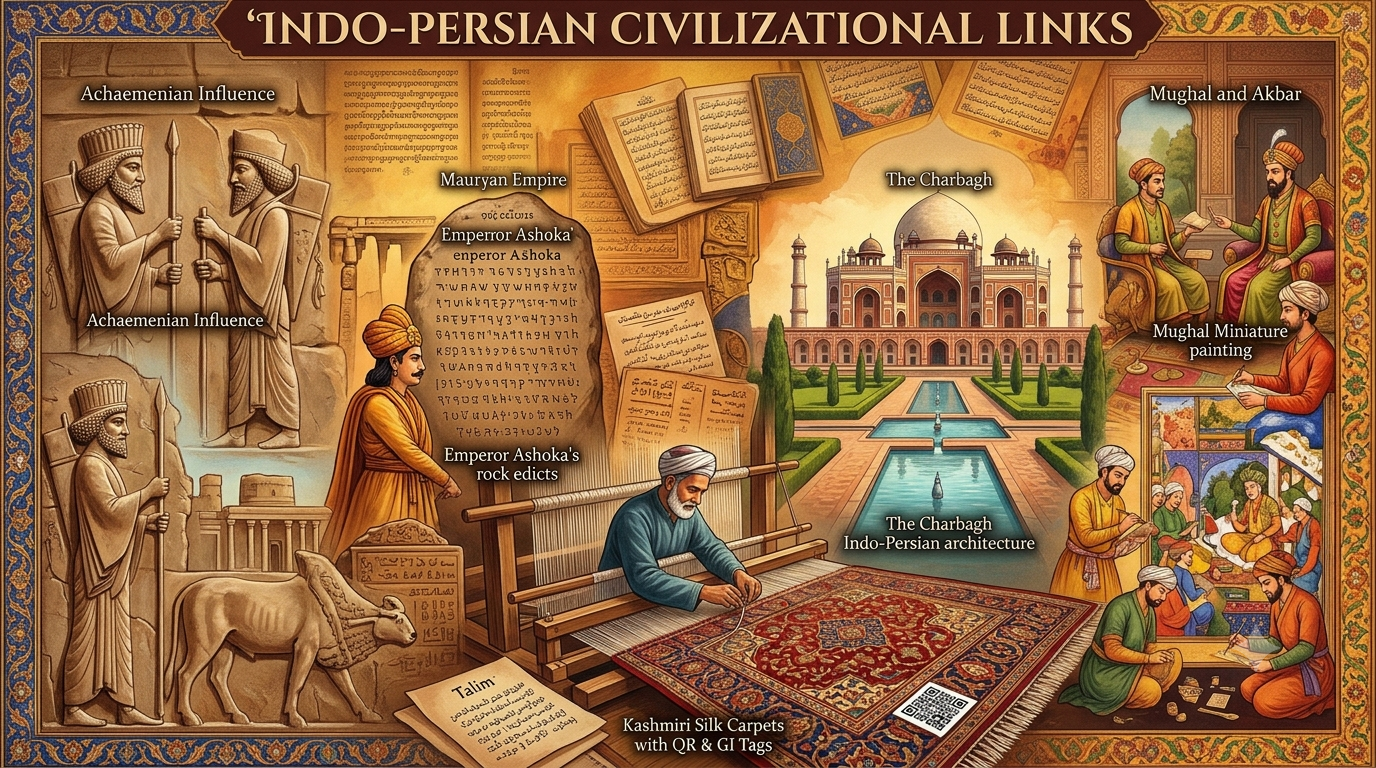
1. Mauryan Edicts: Emperor Ashoka's practice of issuing rock edicts and the use of the Kharoshti script (derived from Aramaic/Iranian writing) reflect direct Persian influence.
2. Miniature Painting: Humayun brought Persian masters Mir Sayyid Ali and Abdu Samad to India, blending Persian techniques with Indian themes to create the Mughal school of painting.
3. The Charbagh: The symmetrical Persian garden layout with water channels shaped iconic Indian monuments like Humayun's Tomb and the Taj Mahal. - •Kashmiri Hand-Knotted Silk Carpets: Crafted from mulberry silk on silk or cotton, these carpets use the Talim—a unique coded script that weavers read to translate intricate patterns onto the loom. Each carpet carries a distinct 'design signature' named after its Iranian city of origin. Recognized as 'woven maps' of Iran, they received a QR-code-based GI Tag in 2022, making them the first in India to offer 'source-to-consumer' authenticity tracking.
Key Historical Milestones in Indo-Persian Contact
- Empire:
- Achaemenian Empire
- Key Contribution / Influence:
- First Persian conqueror to lead an expedition into India; captured the Gandhara region.
- Empire:
- Achaemenian Empire
- Key Contribution / Influence:
- Annexed the Indus Valley, Punjab, and Sindh in 518 B.C., making them the 20th satrapy (province) of the Persian Empire.
- Empire:
- Mauryan Empire
- Key Contribution / Influence:
- Adopted Achaemenian administrative models, rock edict traditions, and the Kharoshti script.
- Empire:
- Mughal Empire
- Key Contribution / Influence:
- Brought Persian master painters (Mir Sayyid Ali, Abdu Samad) and declared Persian the official court language in 1582.
Civilizational Influence Across Key Domains
- Notable Indo-Persian Legacy:
- Achaemenian satrapy model; Persian as the official language of law and diplomacy until British reforms of 1832–37.
- Notable Indo-Persian Legacy:
- Linguistic and mythological parallels between the Rigveda and the Zoroastrian Avesta; everyday loanwords like Kagaz, Vakil, Tehsil, and Mohalla.
- Notable Indo-Persian Legacy:
- Mughal miniature painting, Ashokan rock edicts, Kharoshti script, and Charbagh garden layouts (Humayun's Tomb, Taj Mahal).
- Notable Indo-Persian Legacy:
- Kashmiri Hand-Knotted Silk Carpets using the coded Talim script and Iranian city design signatures (QR-code GI tagged in 2022).
Related Entities
Impact & Significance
- •Administrative Continuity: Persian bureaucratic frameworks and legal terminology shaped Indian governance from the Mauryan era right up to the 19th-century British East India Company reforms.
- •Linguistic Enrichment: Thousands of Persian loanwords became permanently embedded in Indian vernaculars, legal systems, and everyday speech.
- •Architectural & Artistic Identity: The fusion of Persian symmetry (Charbagh) and painting techniques with Indian craftsmanship produced some of India's most celebrated UNESCO World Heritage monuments and art schools.
- •Livelihoods & Heritage Economy: Traditional Indo-Persian crafts like Kashmiri silk carpets sustain thousands of rural artisans and command high value in global export markets.
Challenges & Criticism
- •Counterfeiting in Heritage Crafts: Authentic Kashmiri hand-knotted carpets face stiff competition from cheaper machine-made imitations, making technological interventions like QR-code GI tagging essential.
- •Declining Classical Language Literacy: With the fading use of Persian in formal education, fewer scholars are able to read original medieval Indian manuscripts, court records, and historical inscriptions.
- •Geopolitical Headwinds: While civilizational ties remain strong, translating cultural goodwill into modern economic and trade partnerships is often complicated by international sanctions and West Asian regional tensions.
Future Outlook
- •Cultural Diplomacy & Soft Power: Leveraging shared heritage—such as joint exhibitions of Mughal-Persian art, manuscript digitization, and academic exchanges on Vedic-Avestan studies—to strengthen bilateral goodwill.
- •Boosting Artisan Exports via Tech: Expanding the QR-code-based GI certification model pioneered by Kashmiri hand-knotted carpets to other Indo-Persian heritage crafts to protect authentic artisans from machine-made counterfeits.
- •Strategic Connectivity: Translating historical civilizational goodwill into modern geopolitical and economic corridors, such as the Chabahar Port and the International North-South Transport Corridor (INSTC).
UPSC Relevance
- • GS-1 (Art & Culture / Ancient & Medieval History): Achaemenian influence on Mauryan art/edicts, Mughal miniature painting, Charbagh architecture, and GI-tagged traditional crafts.
- • GS-2 (International Relations): India-Iran bilateral relations, cultural diplomacy, and soft power.
- • Prelims Focus: Cyrus and Darius I (20th satrapy), Kharoshti script, Mir Sayyid Ali & Abdu Samad, Talim script, and QR-code GI tagging of Kashmiri carpets.
Sample Questions
Prelims
Consider the following statements regarding Indo-Persian historical and cultural links:
- (a)Darius I annexed the Indus Valley, Punjab, and Sindh in 518 B.C., making them the 20th satrapy of the Persian Empire.
- (b)The Kharoshti script used in Ashoka's edicts was derived from ancient Greek writing.
- (c)Kashmiri Hand-Knotted Carpets use a coded script called 'Talim' and feature QR-code-based GI tagging for authenticity.
Mains
“The civilizational links between India and Persia have deeply shaped India's administrative traditions, language, and artistic heritage.” Discuss with suitable historical and contemporary examples.
Introduction: Introduce the millennia-old Indo-Persian bond as a continuous exchange of ideas, governance, and aesthetics spanning from the Achaemenian era to modern craft traditions.
Body:
• Ancient Foundations & Statecraft: Cite Achaemenian expeditions (Cyrus in Gandhara, Darius I annexing the Indus Valley as the 20th satrapy); influence on Chandragupta Maurya's administration, Ashokan rock edicts, and the Kharoshti script.
• Language & Literature: Highlight Vedic-Avestan scriptural parallels; Akbar's adoption of Persian as court language (1582); its role in law/diplomacy until 1832–37; and enduring loanwords (Kagaz, Vakil, Tehsil, Mohalla).
• Art, Architecture & Living Crafts: Detail Mughal miniatures (Mir Sayyid Ali, Abdu Samad), Charbagh gardens (Humayun's Tomb, Taj Mahal), and Kashmiri Hand-Knotted Carpets (Talim script, Iranian city design signatures, 2022 QR-code GI tag).
Conclusion: Conclude by noting that this deep-rooted cultural synthesis serves as a resilient foundation for contemporary India-Iran soft power and strategic cooperation.
Static topics behind this news
Read the background in these notes: Prelims and Mains questions are built on it.