
Keeladi Phase XI and Seven Other Excavation Sites Cleared in Tamil Nadu
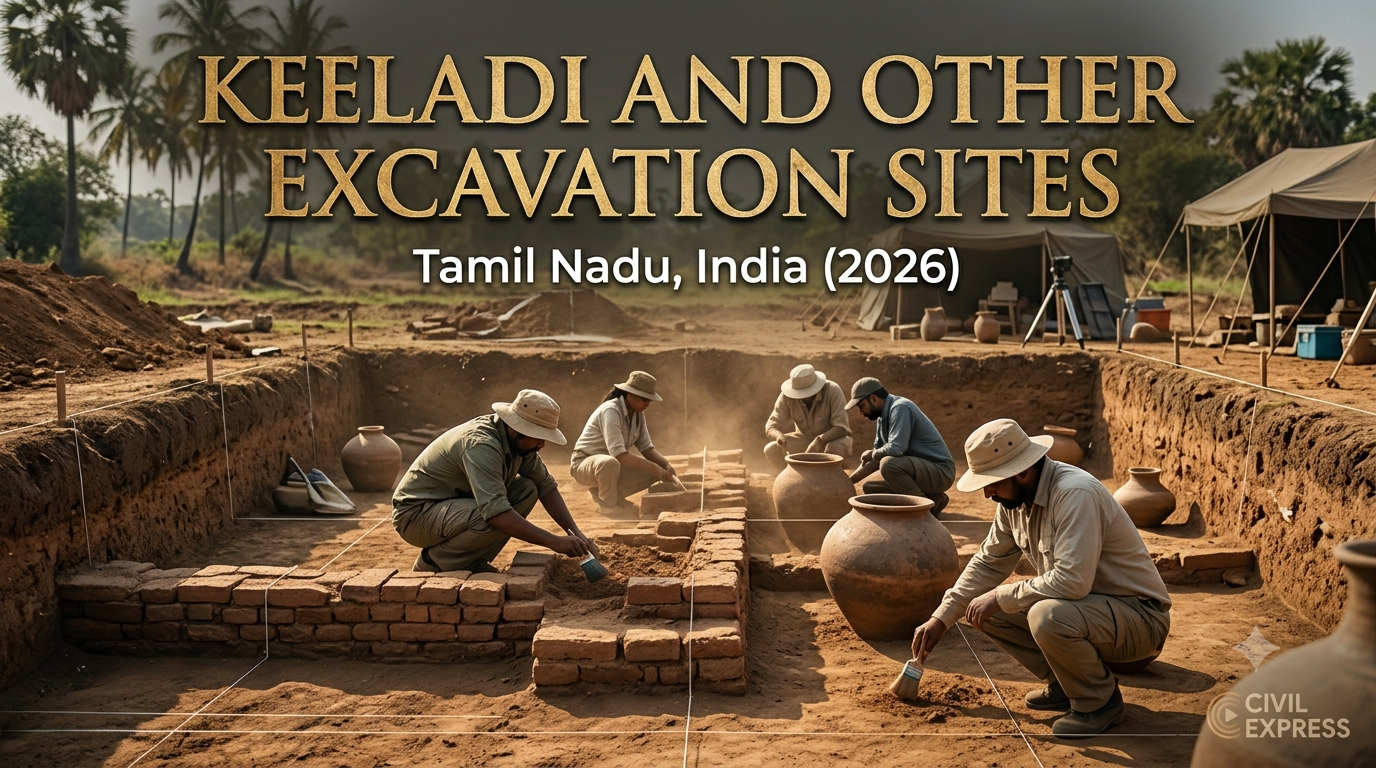
In March 2026, the Archaeological Survey of India (ASI) granted permission to the Tamil Nadu State Department of Archaeology (TNSDA) to conduct excavations at eight historical sites, including the milestone 11th phase of Keeladi. These digs aim to deepen our understanding of Sangam-era urbanization, Iron Age metallurgy, and ancient maritime trade networks.
Introduction
Context & Background
Key Points
- •ASI Clearance & Legal Framework: In March 2026, the Archaeological Survey of India (ASI) approved the Tamil Nadu State Department of Archaeology (TNSDA) to begin excavations at eight sites under the Ancient Monuments and Archaeological Sites and Remains Act, 1958 and its 1959 Rules.
- •Keeladi – Phase XI (Vaigai Valley Civilization): Located in Sivaganga district, Keeladi provides evidence of a secular, urban settlement along the Vaigai River. Carbon dating pushes the Sangam Era back to the 6th century BCE, making it contemporary with the Second Urbanization in the Gangetic plains.
- •Literacy and Industrial Craft: Earlier phases at Keeladi uncovered numerous potsherds with Tamil-Brahmi inscriptions indicating widespread literacy among common people, alongside advanced dyeing units, glass bead production, and structured brick architecture.
- •Maritime & Global Trade Links: Sites like Pattinamarudhur (near ancient Korkai), Vellalore (linked to Roman trade and Chera history), and Nagapattinam (Chola-era port and Buddhist hub) highlight ancient Tamil Nadu's deep integration into Indian Ocean and Mediterranean trade networks.
- •Iron Age to Medieval Continuity: Together, Manikollai (Iron Age to Early Historic transition), Adichanur (Megalithic studies), Telunganur–Mangadu (early iron-smelting and hero stones), and Karivalamvanthanallur (later Pandyan/medieval) span millennia of continuous cultural evolution.
Eight Approved Excavation Sites in Tamil Nadu (2026)
- Historical & Archaeological Significance:
- Evidence of a secular, urban civilization along the Vaigai River (c. 6th century BCE); Phase XI builds on carbon dating that pushes the Sangam Era to be coeval with Gangetic urbanization, with Tamil-Brahmi inscriptions, dyeing units, glass beads, and brick structures.
- Historical & Archaeological Significance:
- Located near the ancient port of Korkai; associated with Pandyan maritime trade.
- Historical & Archaeological Significance:
- Linked to the later Pandyan period and medieval developments.
- Historical & Archaeological Significance:
- Important for understanding the transition from the Iron Age to the Early Historic period.
- Historical & Archaeological Significance:
- Near the Gingee region; significant for Megalithic cultural studies.
- Historical & Archaeological Significance:
- Connected with Roman trade routes and Chera history.
- Historical & Archaeological Significance:
- Evidence of early iron-smelting and hero stones.
- Historical & Archaeological Significance:
- Medieval Buddhist centre and Chola-era maritime hub.
Related Entities
Impact & Significance
- •Redefining Sangam Chronology: Pushing the Sangam Age to the 6th century BCE challenges earlier assumptions that South Indian urbanization lagged centuries behind North India.
- •Holistic Regional History: Covering eight districts allows historians to connect inland industrial centres, Iron Age smelting hubs, and coastal ports into a single economic map.
- •Cultural & Buddhist Heritage: Work at Nagapattinam reinforces the history of maritime Buddhism and cosmopolitanism during the Chola period.
Challenges & Criticism
- •Clearance Delays & Monsoon Window: Delays in securing central approvals can compress the short dry-season excavation window before monsoon rains halt fieldwork.
- •Stratigraphic & Dating Debates: Archaeologists continue to debate the exact stratigraphic context of some early Tamil-Brahmi potsherds, making rigorous documentation in Phase XI essential.
- •Centre-State Friction: Archaeological clearances and the publication of pending excavation reports have occasionally become points of political contention between the State and the Centre.
Future Outlook
- •Scientific Dating & Multidisciplinary Research: Continued use of Accelerator Mass Spectrometry (AMS) carbon dating and metallurgical analysis will help establish firmer chronologies for the Iron Age and Sangam period.
- •Mapping Maritime Heritage: Excavations at coastal and trade-linked sites like Pattinamarudhur, Vellalore, and Nagapattinam will clarify how the Chera, Chola, and Pandya polities connected with Roman and Southeast Asian markets.
- •Timely Publication of Reports: Completing and publishing comprehensive, peer-reviewed excavation reports for earlier Keeladi phases alongside Phase XI will strengthen academic consensus.
UPSC Relevance
- • GS-1 (Art & Culture / Ancient History): Sangam Age, Second Urbanization, Tamil-Brahmi script, Megalithic culture, and Indo-Roman maritime trade.
- • Prelims Focus: Matching archaeological sites with districts, rivers (Vaigai), dynasties (Chera, Chola, Pandya), and key findings.
- • GS-2 (Governance / Federalism): Centre-State coordination in archaeological clearances under the AMASR Act, 1958.
Sample Questions
Prelims
Consider the following statements regarding the archaeological sites approved for excavation in Tamil Nadu in 2026:
- (a)Keeladi is an urban settlement located along the Vaigai River in Sivaganga district.
- (b)Vellalore in Coimbatore is associated with Roman trade routes and Chera history.
- (c)Nagapattinam served as both a medieval Buddhist centre and a Chola-era maritime hub.
Mains
How do recent archaeological excavations in Tamil Nadu, particularly at Keeladi and surrounding sites, reshape our understanding of early historic urbanization and trade in South India?
Introduction: Mention the ASI's March 2026 approval for TNSDA to excavate eight sites, including Keeladi Phase XI, and its significance for reconstructing South Indian antiquity.
Body:
• Urbanization & Chronology: Keeladi's brick structures, dyeing units, and 6th century BCE dating show that urban life in the Vaigai valley developed alongside Gangetic urbanization.
• Literacy & Society: Tamil-Brahmi inscriptions on pottery point to widespread secular literacy, while sites like Adichanur and Telunganur–Mangadu illuminate Megalithic and Iron Age metallurgy.
• Trade Networks: Vellalore (Roman trade/Chera), Pattinamarudhur (near Korkai/Pandya), and Nagapattinam (Chola maritime/Buddhist hub) demonstrate sustained international commercial and cultural links.
Conclusion: Conclude by noting that integrating material evidence from these eight sites with Sangam literature offers a more balanced, pan-Indian perspective of ancient Indian history.
Static topics behind this news
Read the background in these notes: Prelims and Mains questions are built on it.
Related current affairs
- Burhanpur: The Gateway to Southern India and Its Mughal Heritage29 Nov 2026
- Balirajgarh Excavation: Unearthing Mithila's Early Urban Civilization29 Nov 2026
- Lakkundi Treasure: Unearthing Vijayanagara-Era Gold and Karnataka's Medieval Heritage29 Nov 2026
- Indo-Persian Civilizational Links: A Millennia-Old Bond of Statecraft, Art, and Language29 Nov 2026