
Balirajgarh Excavation: Unearthing Mithila's Early Urban Civilization
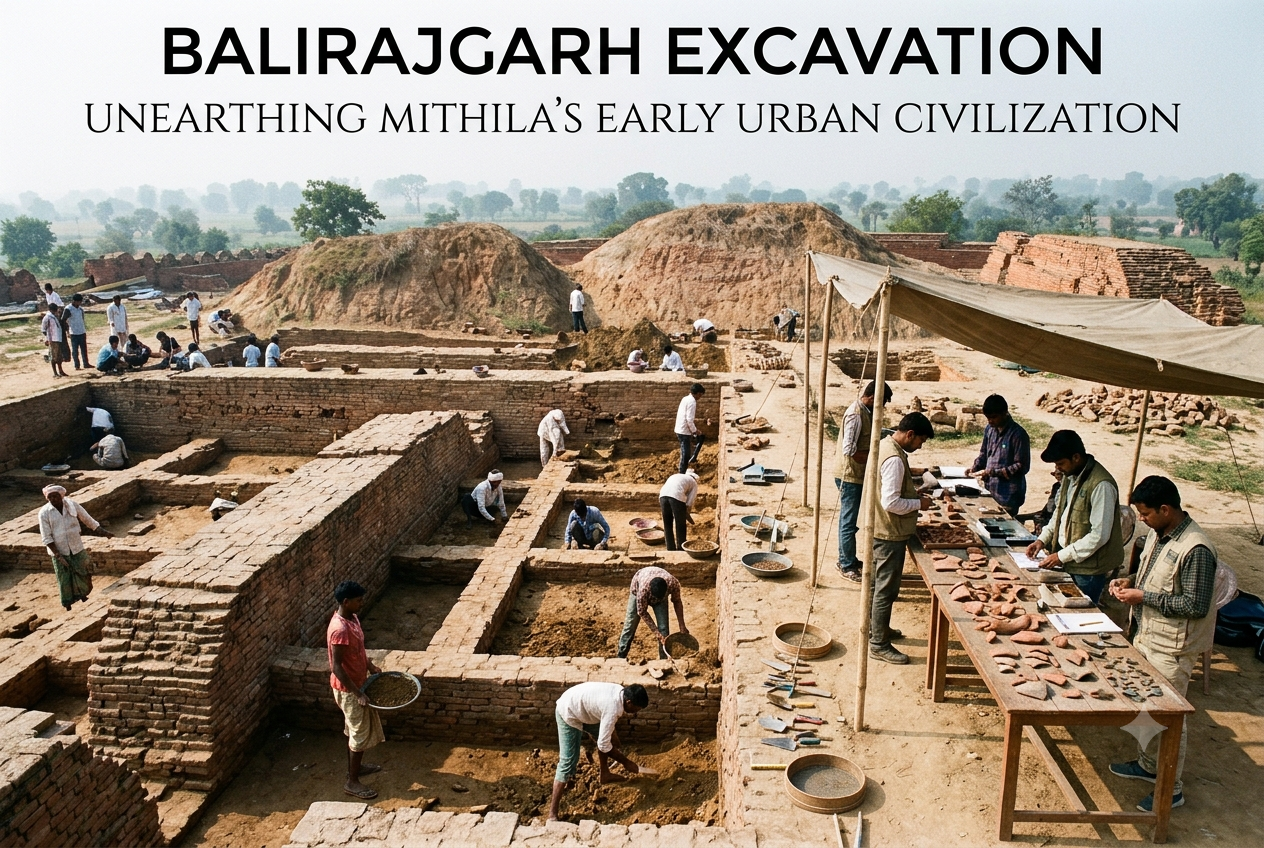
The Archaeological Survey of India (ASI) has granted fresh approval for excavation at Balirajgarh in Madhubani, Bihar. This centrally protected site, known locally as 'Raja Bali Ka Garh', holds a five-fold cultural sequence spanning from the Early Historic to the Early Medieval periods, offering vital insights into the urban evolution of the Mithila region.
Introduction
Context & Background
Key Points
- •Fresh ASI Approval: The Archaeological Survey of India (ASI) has approved a new phase of excavation at Balirajgarh to uncover deeper stratigraphic layers and better understand the early urban layout of ancient Mithila.
- •Geographical & Cultural Location: Situated in the Madhubani district of Bihar (roughly 260 km north of Patna), the fortified mound is locally revered as 'Raja Bali Ka Garh'.
- •Historical Identification: The site was first identified in 1884 by George Abraham Grierson, who was serving as the Sub-Divisional Magistrate of Madhubani and is renowned for leading the Linguistic Survey of India.
- •Protected Heritage Status: Balirajgarh is a centrally protected monument under the ASI, officially listed in records as the 'Remains of Ancient Fort of Garh'.
- •Continuous Habitation: Previous excavations have confirmed a remarkable five-fold cultural sequence, demonstrating uninterrupted human settlement from the Northern Black Polished Ware (NBPW) phase (700–200 BCE) through the Sunga, Kushan, Gupta, and Pala periods.
Five-Fold Cultural Sequence at Balirajgarh
- Key Features / Findings:
- Northern Black Polished Ware (NBPW) phase indicating early urbanization and trade activity.
- Key Features / Findings:
- Presence of structural remains along with characteristic terracotta figurines and objects.
- Key Features / Findings:
- Expansion of settlement with development of urban features and material culture.
- Key Features / Findings:
- Evidence of brick structures, advanced architecture, and rich cultural artifacts.
- Key Features / Findings:
- Early medieval phase marked by distinct pottery types and structural remains.
Balirajgarh: Quick Facts
- Details:
- Madhubani district, Bihar (approx. 260 km north of Patna)
- Details:
- Raja Bali Ka Garh
- Details:
- George Abraham Grierson (1884), then Madhubani Sub-Divisional Magistrate
- Details:
- Centrally protected site ('Remains of Ancient Fort of Garh') under ASI
Related Entities
Impact & Significance
- •Understanding Regional Urbanization: Sheds light on how early urban centres developed, traded, and fortified themselves in the Mithila plains.
- •Continuity of Material Culture: The five-fold sequence allows historians to study uninterrupted changes in pottery, terracotta art, and brick architecture over more than a thousand years.
- •Cultural Identity: Reinforces the historical depth of the Mithila region, connecting local folklore ('Raja Bali Ka Garh') with scientific archaeological evidence.
Challenges & Criticism
- •Encroachment & Land Pressure: Like many centrally protected mounds in densely populated regions of Bihar, safeguarding the site perimeter from agricultural or residential encroachment remains a persistent challenge.
- •Weathering & Flood Vulnerability: North Bihar's seasonal floods and high water table can damage subterranean brick structures and make deep trench excavation technically difficult.
- •Funding & Post-Excavation Conservation: Ensuring that newly unearthed structures are properly conserved, documented, and protected from exposure after excavation seasons conclude.
Future Outlook
- •Deeper Stratigraphic Clarity: Fresh excavations using modern dating techniques can help pinpoint the exact origins of the fortification and its earliest pre-NBPW or early NBPW occupation levels.
- •Heritage Tourism in Mithila: Proper conservation, site museums, and integration into Bihar's cultural tourism circuit can boost local livelihoods in Madhubani alongside its famous Mithila (Madhubani) painting heritage.
- •Regional Archaeological Mapping: Linking findings from Balirajgarh with other Gangetic plain sites (such as Vaishali and Pataliputra) will build a more complete picture of the Second Urbanization in eastern India.
UPSC Relevance
- • GS-1 (Art & Culture / Ancient History): Second Urbanization in the Gangetic plains, NBPW culture, and dynastic transitions (Sunga, Kushan, Gupta, Pala).
- • Prelims Focus: Location of Balirajgarh, its association with George Abraham Grierson, and chronological sequencing of Indian historical periods.
- • State PCS (BPSC): High-priority topic for Bihar-specific history, culture, and heritage conservation.
Sample Questions
Prelims
Consider the following statements regarding Balirajgarh:
- (a)It is a centrally protected archaeological site located in the Madhubani district of Bihar.
- (b)The site was first identified in 1884 by George Abraham Grierson.
- (c)Previous excavations have revealed a five-fold cultural sequence beginning with the Northern Black Polished Ware (NBPW) phase.
Mains
Discuss the archaeological significance of Balirajgarh in tracing the urban evolution of the Mithila region from the Early Historic to the Early Medieval period.
Introduction: Introduce Balirajgarh ('Raja Bali Ka Garh') in the context of the ASI's fresh excavation approval to explore Mithila's early urban civilization.
Body:
• Historical Context & Identity: Mention its location in Madhubani (Bihar), identification by George Abraham Grierson (1884), and status as a centrally protected ASI site.
• Five-Fold Cultural Sequence: Detail the continuous habitation—NBPW phase (early trade/urbanization), Sunga (terracotta & structures), Kushan (urban expansion), Gupta (brick architecture), and Pala (early medieval pottery and structures).
• Broader Significance: Explain how it connects Mithila to the wider Second Urbanization of the Gangetic valley and highlights the need for conservation and heritage tourism.
Conclusion: Conclude by noting that fresh ASI excavations at Balirajgarh will not only enrich our understanding of regional urban history in eastern India but also help preserve Mithila's ancient heritage for future generations.
Related current affairs
- Burhanpur: The Gateway to Southern India and Its Mughal Heritage29 Nov 2026
- Keeladi Phase XI and Seven Other Excavation Sites Cleared in Tamil Nadu29 Nov 2026
- Lakkundi Treasure: Unearthing Vijayanagara-Era Gold and Karnataka's Medieval Heritage29 Nov 2026
- Indo-Persian Civilizational Links: A Millennia-Old Bond of Statecraft, Art, and Language29 Nov 2026