
Burhanpur: The Gateway to Southern India and Its Mughal Heritage
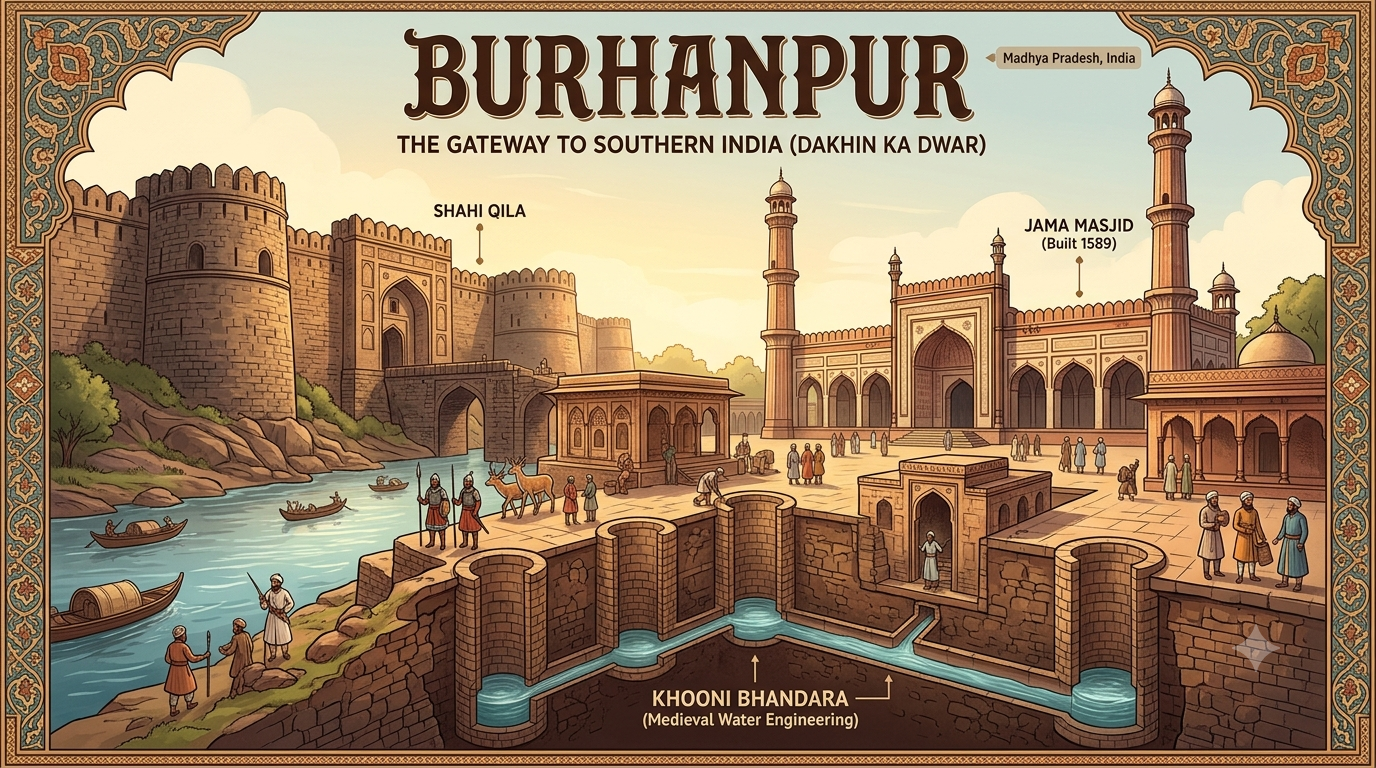
Historically known as the 'Dakhin ka Dwar' (Gateway to Southern India), Burhanpur in Madhya Pradesh is a historic city on the banks of the Tapti River where Faruqi and Mughal architecture, medieval water engineering like the Khooni Bhandara, and the poignant origins of the Taj Mahal converge.
Introduction
Context & Background
Key Points
- •Foundation and Naming: Founded in 1400 AD (some records cite 1388 AD) by Malik Nasir Khan, Sultan of the Faruqi dynasty of the Khandesh Sultanate. It was named after the renowned medieval Sufi saint, Sheikh Burhan-ud-din Gharib.
- •Strategic Geography: Situated on the banks of the Tapti River in present-day Madhya Pradesh, Burhanpur served as a vital military and commercial corridor connecting North India to the Deccan, earning it the title 'Dakhin ka Dwar' (Gateway to Southern India).
- •Mughal Annexation: In 1601, Emperor Akbar annexed the Khandesh Sultanate, elevating Burhanpur to the capital of the Mughal province of Khandesh and a primary staging ground for southern military campaigns.
- •Shahi Qila and The Hammam: Originally built by the Faruqi rulers and later expanded by Shah Jahan, the Royal Fort served as the residence for Mughal princes. It houses the famous Hammam (royal bathhouse) built specifically for Mumtaz Mahal, featuring intricate Mughal paintings and a sophisticated heating system.
- •Syncretic Heritage of Jama Masjid (1589): Constructed during the reign of Ali Khan, the mosque is notable for its elegant arches and the unusual inclusion of Sanskrit inscriptions alongside Arabic, highlighting the region's cultural and linguistic synthesis.
- •Khooni Bhandara (Kundi Bhandara): Built in 1615, this underground water management system uses a network of storage structures (Kundis) and natural gravity to channel fresh mineral water to the city and Mughal garrisons. Remarkably, it remains functional even today.
- •The Taj Mahal Connection: In 1631, Mumtaz Mahal passed away at Burhanpur's Shahi Qila while giving birth to her fourteenth child. She was initially buried for six months at the Aahukhana (Deer Park). Local legends suggest Shah Jahan originally planned a black marble mausoleum on the banks of the Tapti before deciding on Agra.
Key Historical Monuments and Engineering Marvels of Burhanpur
- Patron / Period:
- Faruqi Dynasty / Enhanced by Shah Jahan
- Distinctive Feature:
- Residence for Mughal princes; houses the royal Hammam built for Mumtaz Mahal.
- Patron / Period:
- Ali Khan (1589)
- Distinctive Feature:
- Features elegant arches and rare Sanskrit inscriptions alongside Arabic.
- Patron / Period:
- Mughal Era (1615)
- Distinctive Feature:
- Gravity-fed underground water management system supplying fresh mineral water; still functional.
- Patron / Period:
- Mughal Era
- Distinctive Feature:
- Site of Mumtaz Mahal's initial six-month interment after her death in 1631.
Historical Timeline of Burhanpur
- Key Event:
- City founded by Malik Nasir Khan of the Faruqi dynasty (Khandesh Sultanate).
- Key Event:
- Construction of the Jama Masjid during the reign of Ali Khan.
- Key Event:
- Emperor Akbar annexed the Khandesh Sultanate; Burhanpur became the Mughal provincial capital.
- Key Event:
- Construction of the Khooni Bhandara underground water supply system.
- Key Event:
- Death of Mumtaz Mahal at Shahi Qila; initially buried at Aahukhana before relocation to Agra.
Related Entities
Impact & Significance
- •Cultural Syncretism: The coexistence of Sanskrit and Arabic inscriptions in the 1589 Jama Masjid demonstrates the inclusive, pluralistic traditions of medieval regional sultanates.
- •Sustainable Water Engineering: The 400-year-old Khooni Bhandara proves the long-term viability of gravity-based, zero-energy underground water distribution systems.
- •Mughal Historical Legacy: As the place where Mumtaz Mahal died and was first interred, Burhanpur holds a foundational chapter in the history of the Taj Mahal.
Challenges & Criticism
- •Preservation & Neglect: Despite its rich Faruqi and Mughal heritage, many monuments in Burhanpur receive far less conservation funding and tourist footfall compared to Agra or Delhi.
- •Urbanization Pressure: Modern urban expansion and groundwater extraction pose potential threats to the delicate underground channels and aquifers feeding the historic Khooni Bhandara.
- •Documentation Gaps: Several historical details—such as the exact founding year (1388 AD vs. 1400 AD) and legends of a planned black marble mausoleum—rely on fragmented records and local folklore.
Future Outlook
- •Heritage Tourism Promotion: Positioning Burhanpur as a key heritage circuit destination in Madhya Pradesh by highlighting its connection to the Taj Mahal and Mughal history.
- •Conservation of Traditional Water Systems: Studying and preserving the Khooni Bhandara as a model of sustainable, gravity-based urban water harvesting and management.
- •Archaeological Preservation: Restoring lesser-known Faruqi and Mughal-era structures like the Shahi Qila and Aahukhana to protect them from urban encroachment and weathering.
UPSC Relevance
- • GS-1 (Art & Culture / Medieval History): Regional sultanates (Khandesh), Mughal expansion into the Deccan, Indo-Islamic architectural synthesis, and traditional water harvesting systems.
- • Prelims Focus: Matching historical sites with dynasties/features (e.g., Khooni Bhandara, Jama Masjid with Sanskrit inscriptions, Shahi Qila, Aahukhana).
- • Mains Focus: Relevance of traditional Indian water management systems in addressing modern urban water crises; cultural syncretism in medieval India.
Sample Questions
Prelims
Consider the following statements regarding the historic city of Burhanpur: 1. It was founded by Malik Nasir Khan of the Faruqi dynasty on the banks of the Narmada River. 2. The Jama Masjid of Burhanpur is unique for containing Sanskrit inscriptions alongside Arabic. 3. The Khooni Bhandara is a 17th-century gravity-fed underground water management system located in the city. How many of the statements given above are correct?
- (a)Only one
- (b)Only two
- (c)All three
- (d)None
Mains
Burhanpur stands as a testament to medieval India's cultural synthesis and engineering ingenuity. Discuss with reference to its architectural heritage and traditional water management system.
Introduction: Introduce Burhanpur as the historic 'Gateway to Southern India' in Madhya Pradesh, highlighting its dual legacy under the Faruqi and Mughal rulers.
Body:
• Strategic & Political Significance: Role as 'Dakhin ka Dwar' on the Tapti River; transition from the Faruqi dynasty (Khandesh Sultanate) to a key Mughal provincial capital under Akbar (1601).
• Architectural & Cultural Synthesis: Shahi Qila and Mumtaz Mahal's Hammam showcasing Mughal aesthetics; Jama Masjid (1589) featuring both Sanskrit and Arabic inscriptions reflecting regional syncretism.
• Engineering Ingenuity: Khooni Bhandara (1615) as a sustainable, gravity-fed underground water supply system using Kundis that remains functional over four centuries later.
Conclusion: Conclude by emphasizing that preserving sites like Burhanpur not only safeguards India's pluralistic heritage but also offers practical lessons in sustainable urban water engineering.
Static topics behind this news
Read the background in these notes: Prelims and Mains questions are built on it.
Related current affairs
- Balirajgarh Excavation: Unearthing Mithila's Early Urban Civilization29 Nov 2026
- Keeladi Phase XI and Seven Other Excavation Sites Cleared in Tamil Nadu29 Nov 2026
- Lakkundi Treasure: Unearthing Vijayanagara-Era Gold and Karnataka's Medieval Heritage29 Nov 2026
- Indo-Persian Civilizational Links: A Millennia-Old Bond of Statecraft, Art, and Language29 Nov 2026