
The National Flag of India: Historical Evolution and Legal Framework
Recent legal complaints against public figures for the alleged improper use of the National Flag, alongside a February 2026 government mandate on the National Song, have reignited debates around India's national symbols. This article traces the historical evolution of the Tiranga and examines the constitutional and statutory framework governing its display and protection.
Introduction
Context & Background
Key Points
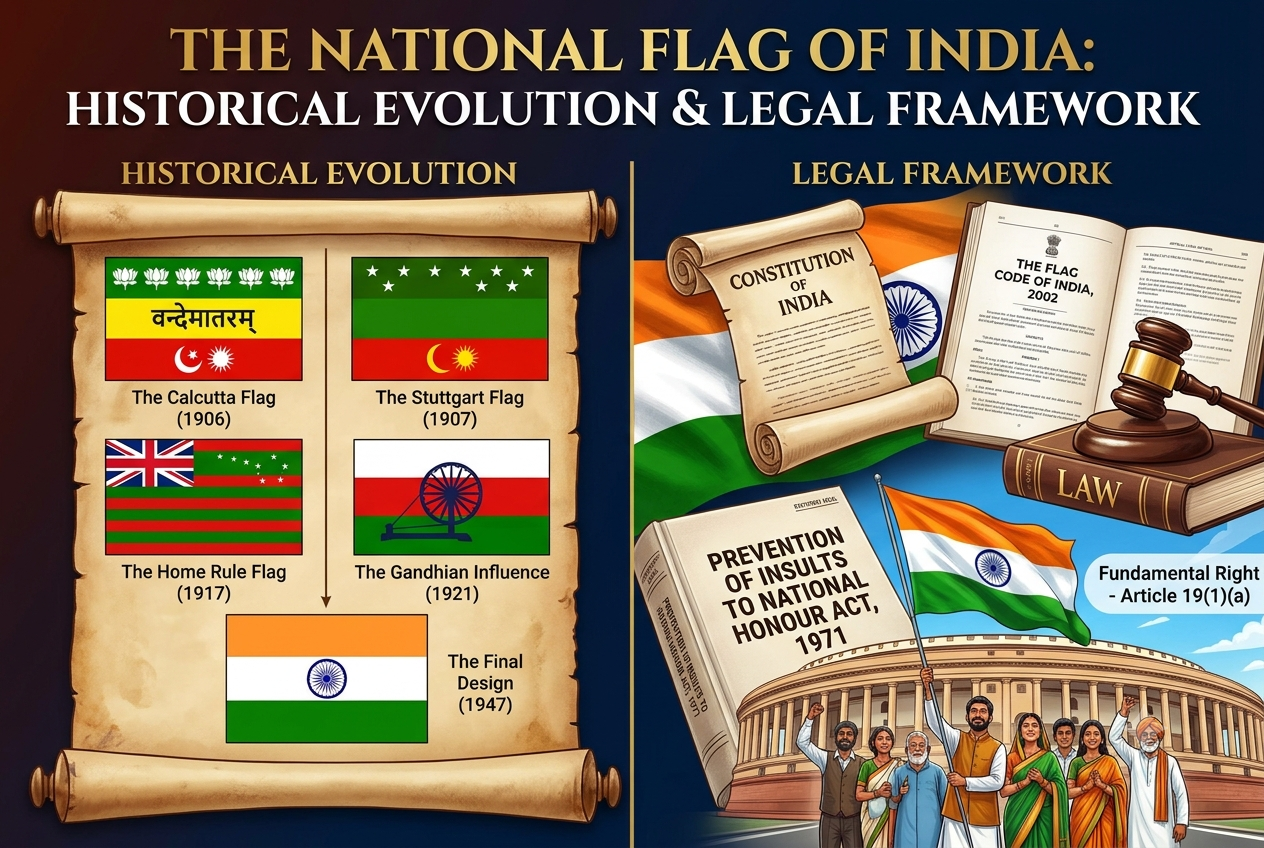
- •Design and Symbolism: Designed by Pingali Venkayya, the National Flag features three horizontal stripes: Saffron (courage), White (truth and peace), and Green (fertility and faith). At the center sits the Ashoka Chakra with 24 spokes, symbolizing the 'Wheel of the Law' (Dharma Chakra).
- •Pre-Independence Milestones: The flag evolved through several stages of the freedom struggle—from the Calcutta Flag (1906) and Bhikaji Cama's Stuttgart Flag (1907) to the Home Rule Flag (1917) and the 1921 Gandhian design featuring the Charkha—before the Constituent Assembly adopted the final design in 1947.
- •Flying the Flag as a Fundamental Right: In the landmark Union of India v. Naveen Jindal (2004) judgment, the Supreme Court held that flying the National Flag with respect and dignity is a Fundamental Right under Article 19(1)(a) (Freedom of Speech and Expression).
- •Flag Code of India, 2002 & 2022 Amendments: The Flag Code lays down detailed protocols for displaying the Tiranga. The 2022 amendments modernized these rules by allowing the flag to be flown day and night if displayed in the open, and by permitting machine-made and polyester flags.
- •Punitive Safeguards (1971 Act): The Prevention of Insults to National Honour Act, 1971 strictly prohibits desecrating the flag—including burning, trampling, or using it as a 'drapery' or costume, a provision directly cited in recent legal complaints against public figures.
Historical Evolution of the Indian National Flag
- Year:
- 1906
- Key Figure(s):
- Sachindra Prasad Bose
- Distinctive Features & Significance:
- Three horizontal stripes (green, yellow, red) with eight half-open lotuses; inspired by the French Revolution's tricolour.
- Year:
- 1907
- Key Figure(s):
- Bhikaji Cama
- Distinctive Features & Significance:
- First Indian flag to be unfurled on foreign soil.
- Year:
- 1917
- Key Figure(s):
- Annie Besant & Lokmanya Tilak
- Distinctive Features & Significance:
- Five red and four green horizontal stripes, featuring the Union Jack in the corner and the Saptarishi constellation.
- Year:
- 1921
- Key Figure(s):
- Pingali Venkayya (at Mahatma Gandhi's behest)
- Distinctive Features & Significance:
- Incorporated the Charkha (spinning wheel) to symbolize self-reliance.
- Year:
- 1947
- Key Figure(s):
- Adopted by the Constituent Assembly
- Distinctive Features & Significance:
- Saffron, White, and Green horizontal bands with the Charkha replaced by the 24-spoke Ashoka Chakra (Dharma Chakra).
Key Legal Frameworks Governing the National Flag
- Purpose & Scope:
- Establishes flying the National Flag with respect and dignity as a Fundamental Right.
- Key Nuance / Limitation:
- Subject to reasonable restrictions and respectful conduct.
- Purpose & Scope:
- Consolidates executive instructions and rules on the display, material, and timing of hoisting the flag.
- Key Nuance / Limitation:
- Primarily a set of executive guidelines rather than a standalone punitive statute.
- Purpose & Scope:
- Criminalizes desecration of the National Flag, including burning, trampling, or using it as drapery/costume.
- Key Nuance / Limitation:
- Frequent legal ambiguity and debates over intent versus inadvertent misuse.
Related Entities
Impact & Significance
- •Democratic Participation: Recognizing flag-hoisting as a Fundamental Right and relaxing material/timing norms in 2022 has made the National Flag more accessible to ordinary citizens.
- •Preservation of Heritage: Understanding the evolution from the 1906 Calcutta Flag to the 1947 Tiranga connects contemporary citizens to the pluralistic ideals of the independence movement.
- •Legal Precedent: Ongoing complaints against public figures test the boundaries between artistic or celebratory expression and statutory violations under the 1971 Act.
Challenges & Criticism
- •Awareness Gap: Many citizens and even public figures remain unaware of specific prohibitions under the 1971 Act, such as the ban on using the flag as drapery or part of a costume.
- •Risk of Frivolous Litigation: Broad interpretations of 'improper use' can sometimes lead to politically motivated legal complaints rather than addressing genuine desecration.
- •Environmental Concerns: While the 2022 amendment allowing polyester flags increased affordability and access, improper disposal of non-biodegradable flags after national holidays poses both ecological and dignity-related challenges.
Future Outlook
- •Public Awareness Campaigns: Greater civic education on the Flag Code of India—especially around proper disposal, wearing rules, and digital representations—to prevent unintentional violations.
- •Clearer Legal Guidelines: Harmonizing rules across all national symbols (Flag, Anthem, and Song) so citizens and public figures have unambiguous standards of compliance.
- •Balancing Liberty and Reverence: Ensuring that enforcement of the 1971 Act targets deliberate disrespect while protecting genuine patriotic expression under Article 19(1)(a).
UPSC Relevance
- • GS-1 (Modern Indian History): Evolution of national symbols during the Swadeshi, Home Rule, and Gandhian phases of the freedom struggle.
- • GS-2 (Polity & Constitution): Fundamental Rights (Article 19(1)(a)), Fundamental Duties (Article 51A(a)), and landmark Supreme Court judgments (Naveen Jindal case).
- • Prelims Focus: Chronology of pre-independence flags, provisions of the Flag Code of India (2002 & 2022 amendments), and the Prevention of Insults to National Honour Act, 1971.
Sample Questions
Prelims
Consider the following statements regarding the National Flag of India:
- (a)The Stuttgart Flag of 1907 was designed by Pingali Venkayya at Mahatma Gandhi's behest.
- (b)In Union of India v. Naveen Jindal (2004), the Supreme Court held that flying the National Flag with dignity is a Fundamental Right under Article 19(1)(a).
- (c)Under the 2022 amendments to the Flag Code of India, only hand-spun khadi flags are permitted to be flown in the open.
Mains
Trace the historical evolution of the Indian National Flag and discuss how India's legal framework balances the Fundamental Right to fly the flag with the statutory duty to prevent its disrespect.
Introduction: Briefly reference the recent legal controversies over the improper use of the National Flag and the February 2026 mandate on national symbols to set the contemporary context.
Body:
• Historical Evolution: Trace the journey from the Calcutta Flag (1906) and Stuttgart Flag (1907) to the Home Rule Flag (1917), Pingali Venkayya's 1921 Charkha flag, and the Constituent Assembly's final 1947 design with the Ashoka Chakra.
• Right to Fly the Flag: Highlight the Supreme Court's ruling in Union of India v. Naveen Jindal (2004) under Article 19(1)(a) and the liberalization brought by the 2022 amendments to the Flag Code of India, 2002 (day-and-night display, polyester/machine-made flags).
• Preventing Disrespect: Explain the punitive provisions of the Prevention of Insults to National Honour Act, 1971 (ban on burning, trampling, or using the flag as drapery/costume) and the need to distinguish deliberate insult from inadvertent error.
Conclusion: Conclude that national symbols unite a diverse republic; upholding their dignity requires both clear legal enforcement and widespread civic awareness rather than punitive overreach.
Static topics behind this news
Read the background in these notes: Prelims and Mains questions are built on it.
- Polity · Fundamental RightsArticle 19 – Protection of Certain Rights Regarding Freedom of Speech, etc.Shared: Article 19, Reasonable Restrictions, Expression
- Polity · Fundamental RightsFreedoms under Article 19(1)(b)–(g)Shared: Article 19, Democratic Participation, Reasonable Restrictions
- Polity · Fundamental RightsArticle 19 – Freedom-wise Breakdown & Landmark JudgmentsShared: Article 19, Free Speech, Reasonable Restrictions
- Economy · Financial MarketElectoral Bonds and Concept of Bond YieldShared: Article 19
- Science & Tech · Information TechnologyCryptocurrency: The Digital Evolution of MoneyShared: Article 19
Related current affairs
- From UGC to VBSA: Rethinking Higher Education Regulation in India7 Nov 2026
- Invisible Citizens? Racism and exclusion of Northeastern communities in India7 Nov 2026
- Demand for Distinct Enumeration of DNT Communities in the 2027 Census7 Nov 2026
- The Transgender Persons (Protection of Rights) Amendment Bill, 2026: Balancing Rights and Regulation7 Nov 2026
- Regulating Social Media for Children: Policy Challenges and Global Lessons7 Nov 2026