
Medieval Indian History · UPSC Notes
Mughal Empire — UPSC Medieval History Notes
Free, exam-focused notes for UPSC Prelims and Mains, with Prelims tips and Mains points for every topic. 14 topics.
Open in the interactive reader: bookmarks, progress tracking and read-aloud.
Babur and the Foundation of the Mughal Empire (1526–1530 AD)
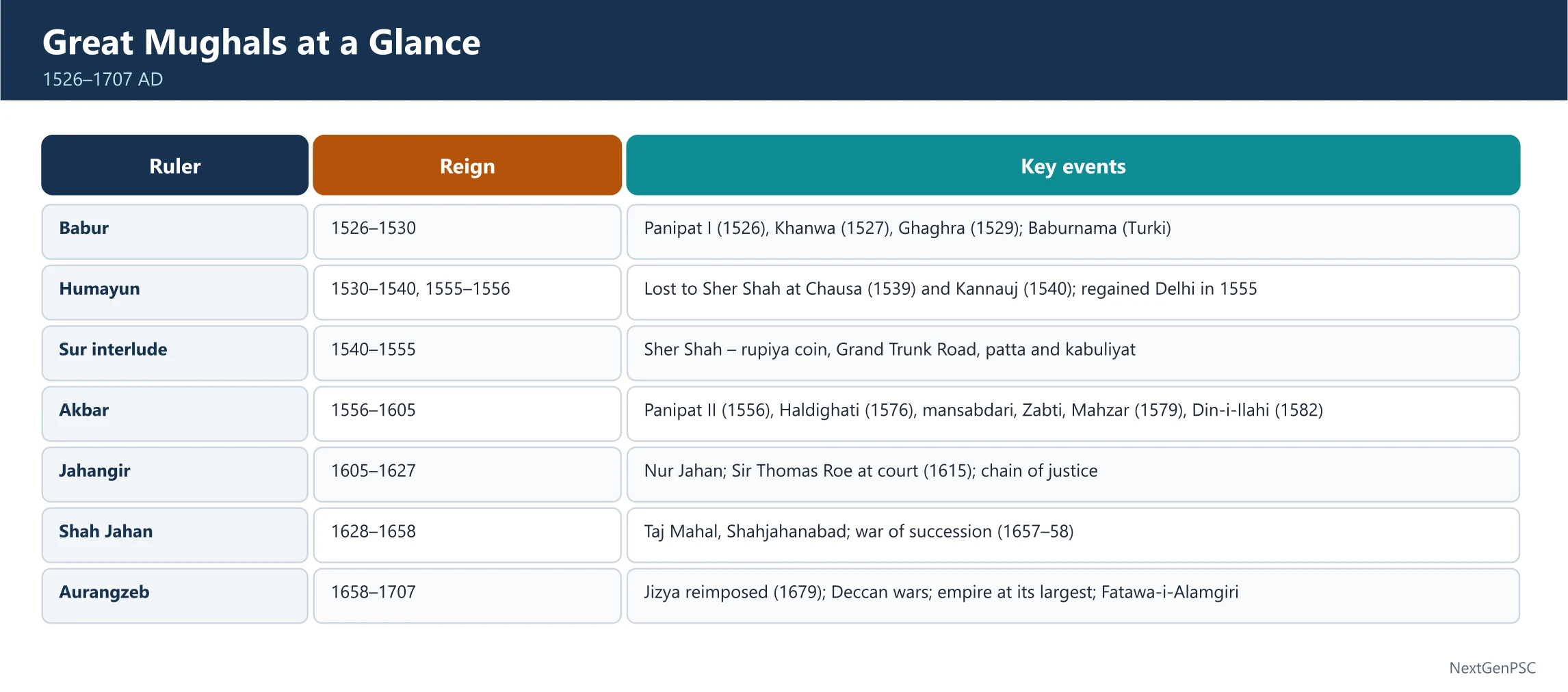
The Mughal Empire was founded by Babur after his victory over Ibrahim Lodi in the First Battle of Panipat (1526 AD), marking the end of the Delhi Sultanate. The Mughals were proud descendants of Timur and, on their mother's side, of Genghis Khan. Babur secured his position in North India through crucial victories at Khanwa (against Rana Sanga) and Ghagra (against the Afghans). He was a noted scholar who wrote his autobiography, the Tuzuk-i-Baburi/Baburnama, in Chaghatai Turkish, offering a candid and detailed account of the subcontinent.
👑 Introduction and Lineage (UPSC Context)
Foundation: Babur defeated Ibrahim Lodi at Panipat in 1526 and then fought to secure his position. A durable, highly centralised Mughal imperial structure developed mainly under Akbar; it should not be projected back fully onto Babur’s short reign.
Lineage: Mughals were descendants of two great lineages:
Mother’s side: Genghis Khan (Mongol tribes).
Father’s side: Timur (ruler of Iran, Iraq, modern-day Turkey).
Identity & Legitimacy: They disliked being called Mughal/Mongol (due to the stigma of Genghis Khan's massacres and rivalry with the Uzbegs) but heavily utilized their Timurid ancestry (particularly Timur's capture of Delhi in 1398) to claim legitimacy over the subcontinent.
Great Mughals: The core period of strength and centralization spanned the six major rulers: Babur, Humayun, Akbar, Jahangir, Shah Jahan, and Aurangzeb (1526–1707).
⚔️ Babur (1526–1530 AD): Military and Political Consolidation
Original Name: Zahiruddin Muhammad Babur.
Motivation: He lost his ancestral lands (Farghana, Samarqand) to the Uzbegs and sought refuge in Kabul (1504). His campaigns into India were initially driven by economic necessity and the desire to re-establish the glory of the Timurid house.
Major Battles and Strategic Significance
First Battle of Panipat (1526 AD): Defeated Ibrahim Lodi. The victory was due to superior military technology and tactics, not numerical strength. Key features:
Used field artillery, matchlocks, carts and cavalry tactics effectively (master gunners: Ustad Ali and Mustafa). Firearms were not unknown in north India before 1526, so avoid claiming this was their absolute first use.
Employed the Tulughma (flanking) and Araba (carts tied with leather ropes to shield artillery) tactics learned from the Uzbegs and Ottomans.
The Battle of Khanwa (1527 AD): Fought against Rana Sanga (Mewar), who had originally invited Babur but turned against him. This was the most crucial battle:
Political Significance: Secured the Mughal position against the most formidable indigenous rival, eliminating the major challenge to Mughal rule in the Delhi-Agra region.
Religious Propaganda: Babur declared it Jihad and assumed the title of Ghazi to boost his soldiers' morale and solidify his Islamic leadership.
Battle of Chanderi (1528 AD): Defeated Medini Rai, weakening an important Rajput-led power in Malwa; it did not end Rajput political power.
Battle of Ghagra (1529 AD): Defeated the remnants of the Afghan confederacy under Mahmud Lodi. This was his last battle and the first in India fought on a river (Ghagra), utilizing riverine forces.
Literary and Religious Aspects
Religion: An orthodox Sunni, follower of Naqshbandiya Sufi Khwaja Ubaidullah Ahrar. Though orthodox, he followed Timurid tradition of patronage of the arts.
Autobiography: The most important source is his autobiography, Tuzuk-i-Baburi/Baburnama, written in Chaghatai Turkish (the Chagatai dialect of the Turkic language).
Contents: It is famed for its candid descriptions of people, climate, flora, and fauna of India, offering a highly valuable insight into the geography and sociology of the subcontinent.
Literary Contribution: Invented Mubaiyan (a new style of verse in Persian). The Baburnama was later translated into Persian by Abdul Rahim Khan-i-Khanan during Akbar’s reign.
Problems Left for Humayun (Context for Mughal Instability)
Unconsolidated Administration: Babur's four-year reign was spent fighting; he did not establish a unified civil or military administration, unlike Akbar.
Precarious Finances: Continuous warfare and gifts drained the treasury, leaving the empire financially unstable.
Afghan Threat: The most serious problem was the active and powerful Afghan resistance under Sher Khan Suri (in Bihar) and Bahadur Shah (in Gujarat), which Humayun failed to address quickly.
Nobility Issues: The Chaghatai nobles were fragmented, jealous, and frequently rebellious, posing an immediate succession challenge to Humayun.
| Battle | Year | Opponent | Strategic Outcome |
|---|---|---|---|
| First Battle of Panipat | 1526 | Ibrahim Lodi | Founding the Mughal rule; demonstrating artillery superiority. |
| Battle of Khanwa | 1527 | Rana Sanga | Eliminated the strongest indigenous rival; secured the Delhi-Agra axis; Babur assumed the title Ghazi. |
| Battle of Chanderi | 1529 | Medini Rai | Subjugation of Rajput power in Malwa. |
| Battle of Ghagra | 1529 | Mahmud Lodi (Afghans) | Final major battle; neutralized the Afghan threat in the east. |
Prelims tips
- Babur founded the Mughal Empire in 1526 AD at the First Battle of Panipat using artillery.
- The Baburnama was written in Chaghatai Turkish and translated into Persian by Abdul Rahim Khan-i-Khanan.
- Babur defeated the most significant Hindu rival (Rana Sanga) at Khanwa (1527 AD), earning the title Ghazi.
- Babur's last battle was the Battle of Ghagra (1529 AD) against the Afghans.
Mains points
- Military change: Babur’s field artillery, firearms, carts and cavalry tactics mattered at Panipat, but they worked with political alliances, command and logistics. Avoid describing 1526 as the single ‘introduction’ of gunpowder warfare to India.
- Fragile Foundation: The empire was founded on military conquest but lacked institutional depth; Babur bequeathed a highly unstable and contested realm (Afghan threat, disloyal Chaghatai nobles) to Humayun.
- Cultural Legacy: The Baburnama is not just a personal history but a critical primary source providing candid and secular observations of India's geography, society, and economy, setting a high intellectual standard for subsequent Mughal court culture.
Did you know?
- Babur's use of the Tulughma tactic (circling the enemy flank with cavalry) and the placement of artillery behind a barricade of carts (Araba) were key Ottoman/Uzbeg tactics employed effectively in Panipat.
- The Baburnama is often cited for its honest critique of India, which Babur found lacking in charm compared to his beloved Central Asia, yet he praised its vast resources and huge workforce.
- The Baburnama contains unusually detailed observations of the flora, fauna, landscape and people Babur encountered in north India; it is a major, but not the first possible, description of these subjects.
Humayun: Exile, Restoration, and the Afghan Interregnum (1530–1540 AD, 1555–1556 AD)
Humayun, the son of Babur, inherited a highly unstable empire, leading to his defeat and exile by the Afghan leader, Sher Shah Suri, after the decisive Battle of Kannauj (1540 AD). This period (1540-1555 AD) is known as the Second Afghan Empire. While in exile, he married Hamida Banu Begum (mother of Akbar) and sought refuge in Safavid Persia. He recovered the throne in 1555 AD but died shortly after in 1556. His half-sister, Gulbadan Begam, wrote his biography, the Humayun-nama.
👑 First Reign and Afghan Conflict (1530–1540 AD)
Lineage & Succession: Born to Babur and Mahim Begum. Inherited an unstable empire, facing threats from his brothers (Kamran, Askari, Hindal) and the Afghans. Humayun's generous but politically naive decision to grant vast territories to his brothers severely weakened the central authority early on.
Capital: Agra was his first capital. He built the citadel Dinpanah (Refuge of Religion) in Delhi as his second capital, an architectural project intended to assert his authority.
Early Architecture: Built Isa Khan mosque and Jamali Mosque in Delhi.
Key Battles Against Sher Khan Suri
Battle of Daurah (1532 AD): Humayun defeated the Afghans, but his critical mistake was besieging the strategic Chunar Fort (the 'gateway of eastern India') for four months and then withdrawing based on a false assurance of loyalty from Sher Khan (later Sher Shah). This was a strategic blunder, allowing Sher Khan to strengthen his position.
Battle of Chausa (1539 AD): Humayun was decisively defeated by Sher Khan due to the latter's superior military skill and the surprise attack by Afghans after the rains. Approximately 7,000 Mughal soldiers were killed. Humayun had to flee by swimming across the Ganga river to escape, losing his imperial prestige.
Battle of Kannauj (1540 AD): After Chausa, Sher Shah confronted Humayun again and defeated him completely. Sher Shah became the master of Delhi and Agra, establishing the Second Afghan Empire (Sur Dynasty, 1540–1555 AD). This defeat was a military and moral catastrophe for the Mughals.
⛵ Exile, Birth of Akbar, and Restoration (1540–1556 AD)
Exile (1540–1555 AD): Humayun fled India, becoming a 'prince without kingdom'. His flight highlights the fragility of the Mughal state at its inception.
Personal Events: While fleeing to Sind in 1540, he married Hamida Banu Begum.
Their son, Akbar, was born in 1542 in the Hindu kingdom of Amorkot (ruled by Rana Prasad), a symbol of the eventual broader indigenous support the Mughal dynasty would gain.
Refuge in Persia: Humayun sought refuge under the Safavid ruler, Shah Tahmasp, in Persia. This period exposed him deeply to Persian court culture, art, and Shi'ite thought, which profoundly influenced the trajectory of the Mughal court under Akbar.
Restoration (1555 AD): Taking advantage of the political instability and lack of a capable successor among Sher Shah’s lineage, Humayun defeated the Afghans and recovered the Mughal throne after winning the Battle of Sirhind (1555).
Death (1556 AD): His second reign lasted only six months. He died in 1556 due to a fall from the staircase of his library (Sher Mandal) in Dinpanah. Historian Lane-Poole's famous quote: 'Humayun tumbled through life, and he tumbled out of it,' sums up his erratic political career.
Tomb: His widow, Haji Begam (or Bega Begam), commissioned Humayun's Tomb in Delhi (completed 1570). It's significant for being the first tomb built in the Charbagh style in India, introducing the double dome, and is a prototype of the Taj Mahal.
Cultural Legacy: He brought back two Persian painters, Abdus Samad and Mir Sayyid Ali, whose work on the Hamza-nama project became instrumental in founding the distinctive Mughal School of miniature painting (an official imperial karkhana for painting).
| Battle | Year | Opponent | Outcome |
|---|---|---|---|
| Battle of Daurah | 1532 | Afghans (Sher Khan) | Mughal victory, but poor follow-up strategy by Humayun. |
| Battle of Chausa | 1539 | Sher Khan | Sher Khan won; Humayun fled by swimming the Ganga. |
| Battle of Kannauj | 1540 | Sher Shah | Decisive Afghan victory; Humayun exiled (1540–1555 AD). |
Prelims tips
- The Second Afghan Empire (Sur Dynasty) lasted from 1540 to 1555 AD.
- The decisive battles leading to Humayun’s exile were Chausa (1539) and Kannauj (1540), both against Sher Shah Suri.
- Akbar was born in Amorkot in 1542.
- Humayun-nama was written by his half-sister, Gulbadan Begam.
- Humayun's Tomb is the prototype for the Taj Mahal and features the Charbagh style.
Mains points
- Political Failure: Humayun's early reign was a study in political failure, characterized by indecision (Chunar Fort) and failure to understand the existential threat posed by Sher Shah Suri, allowing the Afghan leader time to consolidate power.
- Exile and Cultural Integration: The period of exile was critical for the Mughal empire's future, as Humayun's stay in Safavid Persia deepened the Persian influence on Mughal court culture, language, and the founding of Mughal painting.
- Nature of Early Mughal State: The rise and fall of Humayun demonstrated that the early Mughal state was still militarily founded and highly vulnerable to organized regional powers like the Surs, lacking the deep institutional and nobility support that Akbar later established.
Did you know?
- The Chunar Fort, which Humayun failed to hold, commanded the crucial land and river routes between Agra and the east.
- Humayun's Tomb, built by Haji Begam, is one of the first major examples of the Charbagh (four-part garden) style in India, heavily influencing later Mughal architecture like the Taj Mahal.
- The period of exile was crucial for Mughal art: the return of Abdus Samad and Mir Sayyid Ali from Persia marked the foundation of the Mughal School of Miniature Painting.
Sher Shah Suri and the Sur Dynasty (The Second Afghan Empire: 1540–1555 AD)
Sher Shah Suri (Original Name: Farid), established the Second Afghan Empire after defeating Humayun in the Battle of Kannauj (1540 AD). Although his personal reign was short (1540–1545 AD), his centralized and pragmatic administrative reforms laid the blueprint for Akbar's imperial system. Key achievements include the Ryotwari Land Revenue System (based on patta and qabooliyat), the standardization of the silver coin Rupaiya, the construction of the Grand Trunk Road (Sadak-i-Azam), and the reintroduction of military efficiency measures (Dagh and Chehra). He died in 1545 AD during the siege of Kalinjar Fort.
⚔️ Rise and Consolidation (1540–1545 AD)
The Second Afghan Empire: Lodis were the first Afghans to rule (1451-1526 AD). Sher Shah re-established Afghan rule in 1540, establishing the Sur dynasty with Sasaram as his capital.
Original Name and Title: His original name was Farid. He earned the title Sher Khan from Bahar Khan Lohani (Afghan governor of Bihar). He adopted the final title Sher Shah after the Battle of Chausa (1539 AD).
Administrative Experience: Gained rich administrative experience by managing his father Hasan Khan Sur's jagir at Sasaram (Bihar), which proved foundational for his later revenue reforms.
Military Success: Defeated Sultan Mahmud Shah of Bengal at the Battle of Surajgarh (1534 AD). Consolidated control from Sindh and Punjab to Bengal and Rajputana by 1545 AD.
Death: Died in 1545 AD while besieging the powerful Kalinjar Fort (which controlled Bundelkhand) in an accidental blast of gunpowder (due to the rebound of a shell).
Succession and Decline: His second son, Islam Shah, ruled competently until 1553, but his early death sparked a civil war among his successors, providing the crucial opportunity for Humayun to reconquer India in 1555.
Source: Tarikh-i-sher Shahi (History of Sher Shah), written by Abbas Khan Sarwani, provides detailed documentation.
📜 Administrative and Military Reforms (UPSC Focus)
a) Land Revenue Reforms (The Ryotwari System)
Objective: To increase agricultural production, maximize state revenue, and improve the conditions of the cultivators (ryots).
System: Called the Ryotwari System because he eliminated intermediaries for revenue collection and established direct contact with the cultivators.
Measurement & Classification: Cultivable land was measured uniformly. It was divided into three classes—good, middle, and bad—and the annual produce per bigha (unit of land measurement) was determined for each crop and category.
Peasant Documentation:
Patta (Title Deed): Issued to the cultivator, specifying the state demand (revenue due).
Qabooliyat (Deed of Agreement): Signed by the cultivator, indicating assent to pay the specified revenue amount. This established definite rights and liabilities.
Demand: The state demand (revenue) was typically 1/3rd of the average produce.
b) Military Reforms
Recruitment: Sher Shah directly recruited soldiers, making them loyal to the Sultan rather than to the Jagirdars.
Anti-Fraud Measures: He adopted the practices of maintaining the huliya (descriptive identification) of the soldiers and the dag (branding) of horses to prevent fraudulent practices (e.g., inflating figures or substituting poor quality horses).
Payment: Soldiers were paid in cash (Naqd), while most officers were given jagirs.
c) Civil Administration Reforms
Administrative Units: Divided the empire into 47 Sarkars (Districts), which were further divided into a number of Parganas.
Dyarchy System at Sarkar/Pargana: Introduced a dyarchy system (division of responsibility) in Sarkars and Parganas to prevent rebellions (which occurred when military and finance control were vested in the same person). He appointed two persons of equal rank—one in charge of military functions (Shiqdar-i-Shiqdaran) and the other for finance (Munsif-i-Munsifan)—to act as a check on the other.
d) Judicial Reforms
Judges: Appointed Qazi and Mir Adil to try judicial cases.
Laws: In civil cases, Hindu laws applied to Hindus and Islamic law applied to Muslims. But in criminal cases, uniform Islamic law was applied to all.
Punishment: Punishment was severe; the purpose was primarily to set an example for others rather than to reform the criminal.
e) Currency Reforms
Problem: Inherited a fragmented system of mixed currencies.
Reform: Abolished all mixed currencies and issued two new currencies: a standardized silver coin known as Rupaiya and a copper coin (Dam).
Legacy: The Rupaiya continued throughout the Mughal period and under the East India Company, becoming the basis of modern Indian currency (continuing till 1883).
f) Communication Reforms (Roads and Postal System)
Road Network: Constructed and repaired four major highways (including the Grand Trunk Road, known as Sadak-i-Azam, connecting Sonar Gaon/Bengal with the Indus River/Takshila).
Traveler Facilities: Planted trees, dug wells, and constructed Sarais (rest houses) along the roads. Separate arrangements were made for Hindus and Muslims in these Sarais.
Postal System: The Sarai was used as a Dak Chauki (Post Office). A relay system was used for posts, and a Daroga-i-Dak Chauki was in charge of the post office.
g) Taxation Reforms
Abolished numerous petty taxes collected from merchants and manufacturers, retaining only two taxes to be collected:
1. At the stage of manufacturing.
2. When goods were sold to the final consumer.
h) Educational and Welfare Measures
Education: Did not interfere with Hindu education. Established Maktabs (primary, attached to mosques) and Madrasas (higher learning) for Muslims, imparting learning of Persian & Arabic.
Welfare: Established free kitchens to feed the poor. Issued land grants to men of learning and religion (both Hindus and Muslims).
| Component | Description | Significance |
|---|---|---|
| Measurement | Land measured uniformly using the Sikandari yard. | Ensured accurate and uniform assessment. |
| Patta | The title deed issued by the state to the cultivator. | Specified state demand; guaranteed peasant rights. |
| Qabooliyat | The written agreement signed by the cultivator. | Indicated assent to pay the revenue; formalized state-peasant link. |
| Demand | Fixed at 1/3rd of the average produce (Mal). | Protected peasants from arbitrary demand by intermediaries. |
| Reform | Key Feature | Long-term Impact |
|---|---|---|
| Currency | Standardized silver coin Rupaiya. | Became the basis of modern Indian currency; survived through Mughal and British eras. |
| Roads | Built Grand Trunk Road (Sadak-i-Azam). | Improved rapid communication and facilitated trade and military movement. |
| Postal System | Used Sarais as Dak Chauki (post offices) with a relay system. | Highly efficient method for communication and control across the empire. |
Prelims tips
- The Sur Dynasty is the Second Afghan Empire (1540–1555 AD).
- Sher Shah's original name was Farid; his capital was Sasaram.
- His land system was Ryotwari (direct contact) and introduced Patta and Qabooliyat.
- He standardized the silver coin Rupaiya and built the Grand Trunk Road.
- He died at Kalinjar; the decline started after the death of his successor, Islam Shah.
Mains points
- Legacy and Blueprint: Sher Shah's brief reign was crucial as his comprehensive reforms, particularly the land revenue and currency standardization, provided the administrative and fiscal blueprint that Akbar inherited and expanded, making the Sur period an indispensable link in Mughal history.
- Administrative Centralization: He established a highly efficient, centralized administration (via the dyarchy system in Sarkars, direct recruitment, and Dagh/Chehra), demonstrating that efficient governance was possible even under an Afghan-led polity, contrasting with the chaotic Lodi rule.
- Infrastructure and Commerce: The construction of the Grand Trunk Road and the network of Sarais boosted trade, communication, and military mobility, proving that state investment in infrastructure was key to imperial consolidation.
Did you know?
- Sher Shah Suri died in an accidental blast of gunpowder at the siege of Kalinjar Fort in 1545, cutting short one of the most promising reigns in medieval India.
- His revenue officer, Raja Todar Mal, later implemented and refined these very land revenue reforms under Emperor Akbar.
- Sher Shah’s architectural style, seen in his tomb at Sasaram, is known for its fusion, utilizing the double dome technique he inherited from the Lodis and blending it with indigenous elements.
Akbar: Early Reign, Regency, and Military Consolidation (1556–1605 AD)
Akbar ascended the throne at the age of 14 in 1556 AD. His early years were dominated by the regency of Bairam Khan, who secured the Mughal future by defeating the Hindu General Hemu in the Second Battle of Panipat (1556 AD). Akbar later eliminated all Afghan threats (Bengal) and initiated aggressive territorial expansion, notably conquering Gujarat (1573), defeating Rana Pratap Singh at the Battle of Haldighati (1576), and beginning the Deccan expansion with Ahmadnagar. He demonstrated early reformist tendencies by abolishing slavery in 1562 AD.
👑 Accession and Regency (1556–1560 AD)
Accession: Born Jalaluddin Muhammad. He ascended the throne in 1556 AD at Kalanaur, Punjab, at the age of 14.
Regent: His tutor, the loyal Persian noble Bairam Khan, was appointed as the regent (titled Khan-i-Khanan).
Second Battle of Panipat (5th November 1556):
Contestants: Mughal army (led by Bairam Khan) vs. Hemu (Hindu General of Muhammad Adil Shah, who had proclaimed himself Raja Vikramaditya).
Outcome: Hemu was defeated and slain. This was a decisive victory that ended the Mughal-Afghan contest for Delhi, securing Akbar’s position permanently.
End of Regency (1560 AD): Akbar, at age 18, assumed full control. Bairam Khan was assassinated by an Afghan (Mubarak Khan) on his way to Mecca.
Abdul Rahim Khan-i-Khanan (Bairam Khan's son) was raised by Akbar and became a prominent noble and poet.
Purdah Regime (1560–1564 AD): A short period when ladies of the harem, particularly Akbar's foster mother, Maham Anaga, exercised political influence. This ended when Akbar asserted his independence (e.g., executing Maham Anaga's son, Adham Khan, for murder).
🗡️ Military Conquests and Consolidation (1561–1605 AD)
Akbar pursued a policy of aggressive expansion aimed at establishing a vast, unified empire (Subah system).
North and Central India
Malwa (1561 AD): Conquered by Adham Khan from Baz Bahadur. Malwa Queen Rupmati killed herself.
Gondwana (1564 AD): Annexed after defeating Rani Durgavati and her son Vir Narayan, highlighting Akbar's strategy of subjugating powerful regional Hindu dynasties.
Gujarat (1573 AD): Conquered from Muzaffar Shah. Crucial for gaining access to the coastal trade and maritime activities of the Arabian Sea. Akbar built Fathepur Sikri and the Buland Darwaza to commemorate this rapid victory.
Bihar and Bengal (1576 AD): Annexed after defeating Daud Khan, eliminating the final significant Afghan threat in the east.
Rajputana (Mewar Conflict)
Battle of Haldighati (1576): The Mughal army, led by Man Singh (a Rajput General), severely defeated Rana Pratap Singh of Mewar, who refused to accept Mughal suzerainty.
Outcome: Though Rana Pratap continued guerrilla warfare, this battle led most other leading Rajput rulers to accept Akbar’s suzerainty, paving the way for Akbar's renowned Rajput policy of alliance and integration.
Deccan Expansion
Khandesh (1591 AD): Annexed, securing the gateway to the Deccan.
Ahmadnagar (1595 AD): Invaded. Chand Bibi (sister of the deceased Sultan) was defeated, surrendering Berar to the Mughals. Subsequent victories marked the critical entry into Deccan politics and continuous conflict.
⚖️ Early Reforms and Death
Abolition of Slavery (1562 AD): Akbar abolished the practice of slavery and stopped the conversion of prisoners of war to Islam in 1562 AD. This was an important early step toward his policy of inclusive governance.
Death (1605 AD): Akbar died of dysentery in 1605 AD and was buried at Sikandara (Agra).
| Year | Battle/Campaign | Opponent/Region | Significance |
|---|---|---|---|
| 1556 | Second Battle of Panipat | Hemu (Afghan General) | Secured Delhi; ended Afghan threat permanently. |
| 1564 | Gondwana Campaign | Rani Durgavati | Annexation of Central India. |
| 1573 | Gujarat Campaign | Muzaffar Shah | Gained control of coastal trade; led to the building of Buland Darwaza. |
| 1576 | Battle of Haldighati | Rana Pratap Singh (Mewar) | Subjugated Mewar (though Pratap resisted); formalized Rajput policy. |
| 1595 | Ahmadnagar Campaign | Chand Bibi | Gained Berar; marked the beginning of Mughal expansion into the Deccan. |
Prelims tips
- Akbar's regent was Bairam Khan.
- The Second Battle of Panipat (1556) was fought between Bairam Khan and Hemu.
- Hemu assumed the title Raja Vikramaditya.
- The Battle of Haldighati (1576) was fought by Mughal General Man Singh against Rana Pratap Singh.
- Akbar built Fathepur Sikri and Buland Darwaza to celebrate his victory over Gujarat.
Mains points
- Second Battle of Panipat: This battle was vital as it permanently shifted the political center of gravity towards the Mughals, allowing Akbar to build an empire without the constant existential threat of the Surs/Afghans.
- Political Transition: The end of the Bairam Khan's regency and the 'Purdah Regime' (1560–1564) marked Akbar's successful assertion of personal, centralized authority over court factions and ambitious nobles.
- Foundation of Expansion: Akbar’s early conquests (Gujarat, Bengal, Deccan entry) were strategically crucial for establishing maritime trade control and securing the rice-rich eastern provinces (Bengal), financing the later, more extensive imperial projects.
Did you know?
- Akbar's rapid conquest of Gujarat (1573) was so swift that he is said to have made the journey in record time, earning him the sobriquet 'the swift-riding king.'
- Abdul Rahim Khan-i-Khanan, the son of Bairam Khan, became one of the 'Nine Jewels' (Navratnas) of Akbar's court and translated the Baburnama into Persian.
- The Buland Darwaza at Fatehpur Sikri is the highest gateway in the world, built to commemorate the Gujarat victory.
Akbar's Rajput Policy, Administration, and Cultural Achievements (1556–1605 AD)
Akbar used alliance-building, military service, calibrated accommodation and administrative integration to consolidate empire. His Rajput policy included alliances with many, not all, Rajput houses; revenue arrangements varied by region; and Sulh-i Kul was a broad ethic of peace with all. Din-i Ilahi was a small circle of disciples, not a mass religion or an imperial state religion.
🤝 Rajput Policy and Integration
Motivation: Akbar was impressed by the chivalry, faithfulness, and fighting skills of the Rajputs and recognized their necessity for imperial stability, aiming to transform them from opponents into loyal partners.
Matrimonial Alliances: The ruler of Amber, Raja Bharmal, was the first to establish friendly relations (1562). His daughter, Harkha Bai (known as Heer Kuwari/Jodha Bai, and officially as Mariam-uz-zamani), was married to Akbar.
Accommodation: Marriage alliances and high appointments helped integrate allied Rajput houses, while many local religious and social practices continued. This was political incorporation, not a modern guarantee of complete religious freedom.
High Appointments: Rajputs were given high Mansabdar ranks in the empire (e.g., Ain-i-Akbari lists 24 Rajput mansabdars).
Raja Man Singh (Amber) and Raja Birbal were his most trusted officials and part of the Navratnas (Nine Gems).
Raja Todar Mal was made the head of the revenue department.
Abolition of Discriminatory Taxes:
Abolished the Pilgrimage tax in 1563.
Abolished the Jizyah tax in 1564 (a poll tax on non-Muslims). These actions cemented the loyalty of the Hindu populace and the Rajput ruling class.
Result: Most Rajput kings recognized Akbar’s supremacy, significantly contributing to the expansion and consolidation of the Mughal empire.
🏛️ Central and Provincial Administration
Central Administration:
Emperor: Supreme head (judicial and military).
Wazir: Principal link between the ruler and the administration (Prime Minister).
Mir Bakshi: Head of the military and intelligence departments; managed the nobility and the Mansabdari system records.
Mir Saman: In charge of the royal karkhanas (workshops) and imperial household; controlled court etiquettes.
Sadr-us-sadar/Chief Qazi: Head of the judicial and ecclesiastical department; protected the laws of the Shariat.
Provincial Administration (The Subah System): The empire was divided into Subas (Provinces).
Suba: Headed by the Subedar.
Sarkar (District): Headed by the Faujdar (Law and order) and the Amalguzar/Amil (Revenue collector).
Parganas (Sub-district): Headed by the Shiqdar (Executive officer, assisted Amalguzar in revenue collection).
Village: Headed by the Muqaddam (Village headmen).
📈 Mansabdari and Revenue System
Mansabdars and Jagirdars
Mansabdar: An individual holding a mansab (position or rank) in the Mughal service. The system fixed (1) rank, (2) salary, and (3) military responsibilities.
Zat Rank: Determined the rank and salary. The higher the zat, the more prestigious the position. (e.g., 5,000 zat was the highest rank for a non-royal noble).
Sawar Rank: Determined the number of cavalrymen the mansabdar had to maintain.
Jagirs: Many mansabdars received transferable revenue assignments called jagirs in lieu of cash salary. A jagir was a right to collect assessed revenue, not ownership of land; frequent transfers limited the formation of entrenched local bases, though actual practice varied.
Revenue System (Zabt and Dahsala)
Zamindars: The general term used for all intermediaries (local headmen or powerful chieftains) who collected taxes from the peasantry.
Dahsala System: Under Akbar, revenue officials associated with Raja Todar Mal used a ten-year average of prices and yields (c.1570–80) to frame cash rates in surveyed areas. It was one method among several, not a uniform all-India system.
Based on this data, tax was fixed on each crop in cash. This was a sophisticated system of revenue assessment.
Zabt System: A revenue-assessment method implemented in surveyed areas, especially parts of the core provinces. Revenue circles had crop-specific schedules; other regions used different arrangements, so it was not a uniform all-India system.
Taccavi: Advance money in the form of a loan to the peasants in times of need, to be recovered in installments.
Dasturs: Schedules containing money revenue rates for different localities applicable year after year.
🕌 Religious and Cultural Policy
Ibadat Khana (House of Worship): Constructed in 1575 AD at Fatehpur Sikri. Initially confined to Muslims, it was later opened to debates among people of all religions (Christians, Zoroastrians, Hindus, Jains).
Key Scholars: Abu Fazl, Abdul Qadir Badayuni (Muslims); Purshottam Das (Hindu); Aquaviva and Monserrate (Christians); Hari Vijaya Suri (Jain).
Din-i-Ilahi/Tauhid-i-Ilahi: Introduced in 1582 AD as a restricted ethical and personal fellowship around Akbar; it had very few adherents and was neither a mass religion nor imposed on subjects.
Supported the view of one God and promoted Sulh-i-Kul (peace and harmony to all)—a concept of state based on religious tolerance and containing the good thoughts of all religions.
Akbar enrolled loyal nobles (murids) to support this concept (e.g., Abul Fazl, Abul Faizi, and Birbal).
Art, Architecture, and Literature
Architecture: Known for blending Indian and Persian styles, using red sandstone.
Key Structures: Agra Fort, Fatehpur Sikri (City of Victory, including Buland Darwaza, Jodha Bai's palace, and Panch Mahal—built on the plan of a Buddhist Vihara), and his own tomb at Sikandara (completed by Jahangir).
Painting: Introduced European style; established imperial karkhanas.
Famous painters: Abdal Samad, Jamshed Basawan, and Daswant (painted the Razm Namah, the Persian version of Mahabharata).
Literature: Golden age of Persian and vernacular literature.
Persian Histories: Akbarnama and Ain-i-Akbari by Abul Fazl; Kitab-ul-Tawarikh by Abdul Qadir Badauni.
Vernacular Literature: Sursagar by Sur Das (in Brij Bhasha); Ramcharitmanas by Sant Tulsidas (in Awadhi).
| Post | Role / Responsibility |
|---|---|
| Emperor | Supreme head (judicial, military, and executive powers). |
| Wazir | Principal link between the ruler and the administration. |
| Mir Bakshi | Head of military administration, intelligence, and Mansabdari records. |
| Mir Saman | In charge of the royal karkhanas and imperial household. |
| Sadr-us-sadar | Head of the judicial and ecclesiastical department; Chief Qazi. |
| Unit | Head Official(s) |
|---|---|
| Suba (Province) | Subedar |
| Sarkar (District) | Faujdar (Law & Order) and Amalguzar/Amil (Revenue) |
| Parganas (Sub-district) | Shiqdar (Executive) |
| Village | Muqaddam (Headman) |
Prelims tips
- The Second Battle of Panipat (1556) was won by Bairam Khan against Hemu.
- Akbar abolished the Pilgrimage tax (1563) and the Jizyah tax (1564).
- The Zabt/Dahsala system was introduced by Raja Todar Mal (10-year survey: 1570-1580).
- The Mansabdari system was graded by Zat (rank/salary) and Sawar (cavalry).
- The Ibadat Khana was established in 1575; Din-i-Ilahi in 1582; both promoted Sulh-i-Kul.
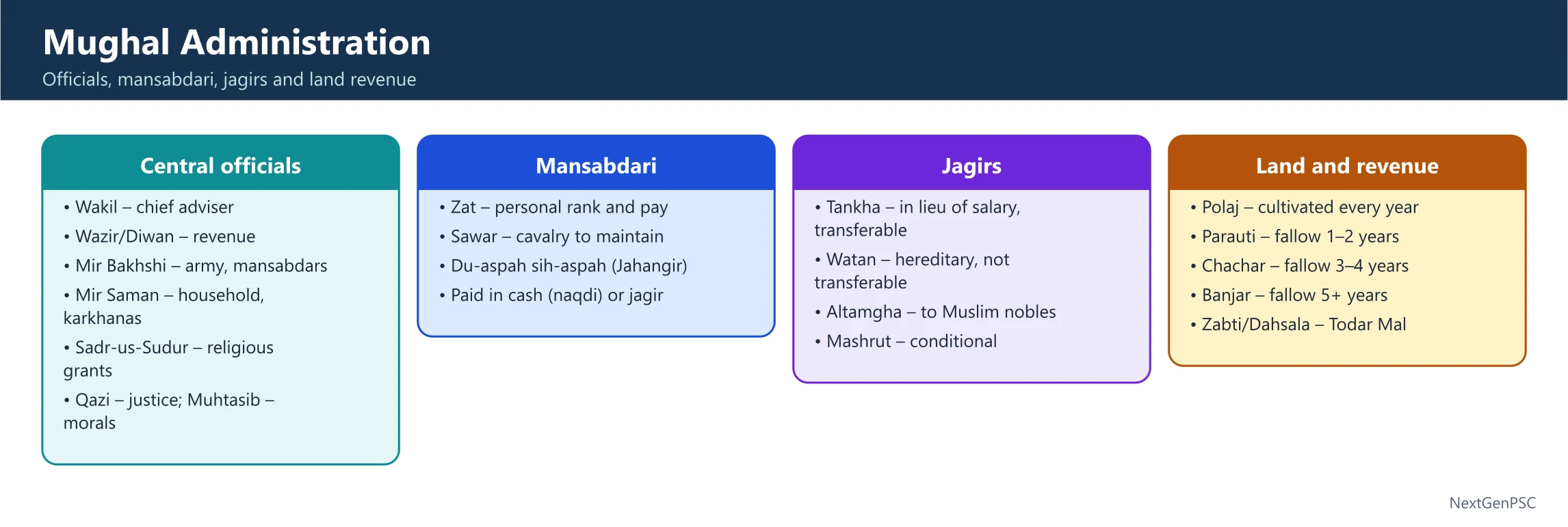
- Central officials: Wakil (chief adviser, reduced under Akbar), Wazir/Diwan-i-Kul (revenue and finance), Mir Bakhshi (military, mansabdars' pay, intelligence), Mir Saman (royal household and karkhanas), Sadr-us-Sudur (religious grants, charity, education), Qazi-ul-Quzat (justice), Muhtasib (public morals).
- Mansabdari: every mansab had a zat rank (personal status and pay) and a sawar rank (cavalry to be maintained); Jahangir added du-aspah sih-aspah, letting chosen nobles keep extra cavalry.
- Jagirs: Tankha (in place of salary, transferable), Watan (hereditary home lands of zamindars/Rajput chiefs, not transferable), Altamgha (granted to Muslim nobles in their family towns, Jahangir), Mashrut (conditional).
- Land classes (Ain-i-Akbari): Polaj (cultivated every year), Parauti (fallow 1–2 years), Chachar (fallow 3–4 years), Banjar (fallow 5 years or more). Revenue: Zabti/Dahsala of Raja Todar Mal (average of 10 years), plus Batai/Ghalla-bakhshi (crop sharing), Kankut (estimate) and Nasaq.
- Peasants: Khud-kasht (resident cultivators owning land), Pahi-kasht (non-resident cultivators from other villages), Muzarian (tenants). Mahzar (1579) made Akbar the final arbiter in religious disputes among the ulema.
Mains points
- Rajput Policy: Akbar's Rajput Policy (combining military service, matrimonial alliance, and religious tolerance) was the cornerstone of the Mughal Empire's stability and Hindu-Muslim alliance, providing a continuous supply of loyal, high-ranking military and civil officers.
- Administrative Centralization: The Mansabdari and Zabt systems institutionalized the Mughal state, replacing the fluid Afghan system with a bureaucratic and revenue-efficient apparatus, providing the financial muscle for imperial expansion.
- Religious Synthesis: The evolution of Akbar’s religious policy—from abolishing Jizyah to establishing the Ibadat Khana and promulgating Sulh-i-Kul—was a pragmatic necessity for ruling a diverse subcontinent, establishing the Mughal state as a non-sectarian empire.
Did you know?
- The Panch Mahal in Fatehpur Sikri was designed on the lines of a Buddhist Vihara or temple, symbolizing Akbar's early interest in diverse religious architecture.
- The Mansabdari System evolved significantly; the distinction between Zat (personal rank/salary) and Sawar (cavalry quota) was key to preventing corruption and managing imperial finances.
- Jodha Bai is the popular name for Harkha Bai, Akbar's Hindu wife; however, the Mughal chronicles primarily refer to her by her official title, Mariam-uz-zamani.
Akbar's Navratnas (Nine Gems)
Akbar’s court included influential administrators, military commanders, artists, scholars and religious figures. The familiar list of Navratnas (‘nine gems’) is a later popular tradition rather than a formally attested official institution; study the individual figures and their documented contributions instead.
📚 Historians and Poets
1. Abu Fazl:
Works: Wrote the comprehensive official history, the Akbarnama (including the Ain-i-Akbari—a gazetteer and statistical abstract of the empire). The Ain-i-Akbari is Volume 3 of the Akbarnama and is invaluable for studying Mughal administration, revenue, and society.
Role: Chief court chronicler, ideologue of Sulh-i-Kul, and close friend/advisor to Akbar. He gave political philosophy to Akbar's universal sovereignty.
Death: Murdered by Bir Singh Bundela on the orders of Prince Salim (Jahangir), who was then in rebellion against Akbar. This act was a major blow to Akbar's liberal circle.
2. Faizi:
Role: Brother of Abul Fazl and the Poet Laureate (Malik-ush-Shuara) of Akbar's court. He strongly supported Akbar's religious policies.
Contribution: Directed the Maktab Khana (Translation Bureau). Translated many Sanskrit works into Persian, including the mathematical treatise Lilavati and the Mahabharata.
3. Fakir Aziao Din:
Role: Chief advisor to Akbar and a Sufi mystic (one of the few religious scholars in the Navratnas), known for his spiritual counsel and involvement in the Ibadat Khana debates.
🎶 Artists and Advisors
4. Tansen:
Original Name: Ramtanu Pandey (Hailed from Gwalior).
Conversion: Converted to Islam by the Sufi Saint Muhammad Ghaus of Gwalior.
Legacy: Master of the Hindustani classical music style (Dhrupad). Credited with creating new Ragas and believed to possess magical musical powers (e.g., singing Raag Deepak brought fire, and Megh Malhar brought rain).
5. Raja Birbal: (Original name: Mahesh Das)
Role: Courtier and advisor, known for his wit, sharp intelligence, and philosophy. Akbar gave him the title of Raja Birbal.
Death: Died fighting against the Yusuf Shahis on the North-West Frontier (1586 AD), a major setback for Akbar and a personal loss.
🛡️ Administrators and Military Leaders
6. Raja Todar Mal:
Role: Finance Minister (Diwan-i-Ashraf title given in 1582 AD). He was responsible for the entire land revenue and finance of the empire.
Contribution: Architect of the Zabt/Dahsala land revenue system, inheriting his expertise from his earlier service under Sher Shah Suri. He was instrumental in standardizing the fiscal policy.
7. Raja Man Singh:
Role: High-ranking Rajput Mansabdar (Grandson of Akbar's father-in-law, Raja Bharmal). Held the rank of 7000 Zat, the highest attainable by any noble not belonging to the royal family.
Contribution: Led the Mughal army in the Battle of Haldighati (1576) against Rana Pratap; served as a highly effective Subedar (governor) of Kabul and Bihar, exemplifying the success of the Rajput policy.
8. Abdul Rahim Khan-i-Khanan:
Role: Son of Akbar's former regent, Bairam Khan, and a highly respected Persian and Hindi poet (known for his devotional dohas). He was a high-ranking Mansabdar.
Contribution: Translated Baburnama (originally in Turkish) into Persian (known as the Turki to Farsi translation).
9. Mirza Aziz Koka:
Title: Also known as Khan-i-Azam / Kotaltash.
Role: Foster brother (Koka) of Akbar and a powerful noble; served as Subedar of Gujarat. Though loyal, he sometimes disagreed with Akbar's policies, reflecting internal court tension.
| Name | Field | Key Contribution |
|---|---|---|
| Abul Fazl | History/Ideology | Wrote Akbarnama and Ain-i-Akbari; ideologue of Sulh-i-Kul. |
| Faizi | Poetry/Literature | Poet Laureate; translated Lilavati and Mahabharata into Persian. |
| Tansen | Music | Master musician; invented Ragas; Sang Raag Deepak and Megh Malhar. |
| Raja Todar Mal | Finance/Revenue | Architect of the Zabt/Dahsala land revenue system. |
| Raja Man Singh | Military/Administration | High-ranking Mansabdar; General in the Battle of Haldighati. |
| Raja Birbal | Counsel/Wit | Trusted advisor; famous for his wisdom and wit. |
| Abdul Rahim Khan-i-Khanan | Literature/Translation | Son of Bairam Khan; translated Baburnama into Persian. |
| Fakir Aziao Din | Counsel/Mysticism | Chief advisor; Sufi mystic. |
| Mirza Aziz Koka | Administration/Military | Foster brother (Khan-i-Azam); Subedar of Gujarat. |
Prelims tips
- Raja Todar Mal worked under both Sher Shah Suri and Akbar (as Finance Minister).
- Tansen was associated with Ramachandra of Gwalior before joining Akbar.
- Abu Fazl wrote Akbarnama; Faizi translated Lilavati and Mahabharata.
- Abdul Rahim Khan-i-Khanan translated Baburnama into Persian.
- Mirza Aziz Koka was Akbar's foster brother (Khan-i-Azam/Kotaltash).
Mains points
- The Navratnas symbolized Akbar's administrative pragmatism, emphasizing meritocracy and cultural synthesis over sectarian identity, which was crucial for the stability and grandeur of the empire.
- The integration of individuals like Todar Mal (economic expertise) and Man Singh (military expertise) into the highest ranks demonstrates how Akbar utilized their non-Mughal expertise to create the sophisticated Mughal administrative system.
- The literary contributions, particularly Abul Fazl’s historical work and Faizi’s translations, highlight the state's deliberate policy of cultural assimilation and Persianization of knowledge.
Did you know?
- The concept of Navratnas was inspired by the court of the legendary King Vikramaditya in Ujjain.
- The killing of Abu Fazl by Bir Singh Bundela at the behest of Prince Salim (Jahangir) highlights the deep political rivalry and intolerance toward Akbar's liberal ideology (Sulh-i-Kul) within his own family.
- Faizi's translation of Lilavati was crucial in introducing advanced Indian mathematics (by Bhaskara II) to the Persian-speaking world.
Jahangir: Administration, Nur Jahan, and the Rise of the English (1605–1627 AD)
Jahangir (Prince Salim) succeeded Akbar in 1605 AD, assuming the title Nur-ud-din Muhammad Jahangir. His reign was marked by his pursuit of justice (symbolized by the Chain of Justice) and significant political influence exerted by his wife, Nur Jahan. Key events included the revolt and execution of Sikh Guru Arjun Dev (1606), the highly favorable Treaty with Mewar (1615), and the successful effort by Sir Thomas Roe to secure permission for an English factory at Surat. Jahangir's period saw the zenith of Mughal miniature painting and the extensive use of Pietra Durra in architecture.
👑 Accession and Political Challenges (1605–1611 AD)
Accession: Born Salim (son of Akbar and Jodha Bai/Harka Bai). He ascended the throne in 1605 AD in Agra with the title Nur-ud-din Muhammad Jahangir (Conqueror of the World).
Revolt of Prince Khusrau (1606): His eldest son, Prince Khusrau, staged a revolt. Khusrau was captured and blinded.
Sikh Guru Execution: Sikh Guru Arjun Dev was executed for providing asylum and resources to the rebellious prince. This act initiated a long period of hostility between the Mughal Empire and the Sikhs.
Administration: Jahangir generally maintained Akbar's administrative system, reinstating all Mansabdars and promoting officials based on merit.
Jahangir's Chain of Justice
Zanjir-i-Adl: Jahangir fastened a golden chain (with 60 bells) between the Shahburj of Agra fort and a stone pillar on the banks of the river Yamuna.
Purpose: People seeking justice could pull this chain to submit their complaints directly to the Emperor, symbolizing his commitment to unmediated justice.
⚖️ Reforms and Welfare (Dastur-ul-Amal)
Jahangir issued 12 Rules of Conduct (Dastur-ul-Amal) demonstrating his concern for public welfare:
Tax Abolition: Abolished the 'Tagma' and 'meerwahi' toll taxes and local Subedar taxes, reducing the financial burden on the populace.
Infrastructure: Ordered construction of mosques, sarais, and wells on roadsides, improving security and communication.
Property Law: Ensured the property of the dead would pass to legal heirs; unclaimed property went to the state treasury for public welfare.
Social and Penal Reforms: Banned the manufacture and sale of intoxicants (despite his own addiction). Disallowed the mutilation of limbs of criminals.
Peasant Protection: Ordered that land-lords would not forcibly occupy the lands of the farmers.
Welfare: Ordered the construction of government hospitals and appointed physicians (hakims).
Religious Tolerance (Partial): Banned animal slaughter on Thursday (his coronation day) and Sunday (Akbar's day/day of the sun).
📜 Key Events and Political Struggles
Marriage with Nur Jahan (1611): Married Mehrunnisa, who received the title Nur Jahan (Light of the World).
Influence: Nur Jahan, along with her family (junta—including her father Itimad-ud-Daulah and brother Asaf Khan), became the real power behind the throne until 1622. Jahangir acknowledged her influence: 'I have sold my kingdom to my beloved queen for a cup of wine and a dish of soup.'
Treaty with Mewar (1615): Signed a peace treaty with Rana Amar Singh (son of Rana Pratap).
Statesmanship: Jahangir restored all Mewar territory, including the Chittor Fort (on condition of no repairs). The Rana was granted concessions: he was not asked for matrimonial relations, and his son, Prince Karan, was sent to Mughal service instead of the Rana himself. This secured the loyalty of the Mewar house.
Revolt of Prince Khurram (1622): Prince Khurram (later Shah Jahan) revolted, fearing Nur Jahan's faction might endanger his succession. He was later pardoned.
Revolt of Mahabat Khan (1626): Mahabat Khan, an able commander, felt humiliated by Nur Jahan's treatment. He revolted and captured the emperor but later sought pardon, highlighting the power struggle between the Nur Jahan Junta and ambitious nobles.
European Visitors and Trade
William Hawkins (1608–1611 AD): Failed to obtain consent for establishing an English factory.
Sir Thomas Roe (1615–1619 AD): Sent as ambassador by King James I, he succeeded in securing permission to establish a British factory at Surat.
Trade Impact: Roe's success was pivotal, marking the formal beginning of English trading presence in Mughal India.
Death (1627 AD): Jahangir died near Lahore on his way back from Kashmir and was buried in Lahore.
🎨 Cultural Contributions
Literature: Jahangir’s autobiography, Tuzuk-i-Jahangiri, was written in Persian.
Architecture:
Pietra Durra: The use of Pietra Durra (marble inlay with semi-precious stones) became prominent (e.g., in the Tomb of Itmad-ud-Daulah, Nur Jahan's father, at Agra).
Gardens: Built the Shalimar and Nishant Gardens in Kashmir.
Painting: Jahangir's reign is considered the golden age of Mughal miniature painting, known for detailed portraits and animal studies.
Features: Used Divine Lights (Halo) behind the head of kings. Master painters included Abul Hasan (portraits/court scenes), Bishan Das (Master of Portraits), and Ustad Mansur (specialist in animal and bird painting).
| Event | Year | Significance |
|---|---|---|
| Execution of Guru Arjun Dev | 1606 | Marked the beginning of Mughal-Sikh hostility. |
| Marriage to Nur Jahan | 1611 | Began the era of the powerful Nur Jahan Junta (1611–1622). |
| Treaty with Mewar | 1615 | Secured the loyalty of the Mewar house (Rana Amar Singh) with honorable terms; achieved what Akbar could not. |
| Visit of Sir Thomas Roe | 1615–1619 | Secured permission for the British factory at Surat; formalized English trade entry into India. |
| Revolt of Mahabat Khan | 1626 | Temporarily captured the Emperor; highlighted the acute power struggle within the nobility. |
| Field | Contribution/Key Figure |
|---|---|
| Literature | Autobiography Tuzuk-i-Jahangiri (in Persian). |
| Architecture | Pioneered the use of Pietra Durra (marble inlay) in buildings (e.g., Itmad-ud-Daulah Tomb). |
| Painting | Golden Age of Mughal painting; emphasis on Portraits and Natural History. |
| Master Painters | Bishan Das (Portraits), Ustad Mansur (Animal/Bird studies), Abul Hasan. |
Prelims tips
- Jahangir was the son of Akbar and Mariam-uz-zamani (Jodha Bai).
- He executed Guru Arjun Dev (the fifth Sikh Guru).
- The Chain of Justice (Zanjir-i-Adl) was installed at Agra Fort on the banks of the Yamuna.
- The Treaty of Mewar (1615) was signed with Rana Amar Singh.
- Sir Thomas Roe secured permission for the English factory at Surat (1615).
- The Tuzuk-i-Jahangiri is his autobiography (in Persian).
- The extensive use of Pietra Durra began during his reign.
Mains points
- Political Dualism: Jahangir's reign was characterized by a dual power structure—the Emperor's formal authority coexisted with the strong informal control of the Nur Jahan Junta, creating instability and factionalism among the nobility (e.g., Mahabat Khan's revolt).
- Mughal-Rajput Policy: The Treaty of Mewar (1615) demonstrated Jahangir's statesmanship, securing the loyalty of a key Rajput house through honorable concessions rather than forced submission, validating Akbar's policy of integration.
- Cultural Legacy: The period was the golden age of Mughal painting, marked by naturalism, detailed portraiture, and technical mastery, indicating the Emperor's profound personal interest and patronage in the arts.
Did you know?
- Jahangir's fascination with natural history led him to commission artists like Ustad Mansur to create detailed, scientific-quality depictions of flora and fauna, such as the famous painting of the Siberian Crane.
- The Itmad-ud-Daulah Tomb, built by Nur Jahan for her father, is often called the 'Baby Taj' because it was the first Mughal structure built entirely of white marble and the first to use Pietra Durra extensively.
- Jahangir held Thursday (his coronation day) and Sunday (Akbar’s day) sacred, forbidding animal slaughter, demonstrating a continuation of Akbar's syncretic policies.
Shah Jahan: Golden Age, Deccan Success, and War of Succession (1627–1658 AD)
Shah Jahan (r. 1628–1658) is especially noted for imperial architecture, including the Taj Mahal and Shahjahanabad. Ahmadnagar was annexed in 1633 and Bijapur and Golconda accepted Mughal suzerainty in 1636; costly Qandahar campaigns also exposed limits of Mughal power. His illness in 1657 triggered a succession struggle that brought Aurangzeb to power.
👑 Early Reign and Administration (1627–1658 AD)
Accession: Ascended the throne in Agra in 1627 AD with the support of nobles and the army.
Mughal First Lady: After the death of his wife Mumtaz Mahal (in Burhanpur), his sister Jahanara took the position of the First Lady of the Empire. She died in 1681 AD and was buried near the shrine of Nizamuddin Auliya.
Action Against Portuguese (1632 AD): Shah Jahan arrested the Portuguese for misutilizing their trading privileges and resorting to piracy and conversion attempts on the banks of the Hooghly river.
European Visitors: His reign saw the visits of several European travelers, including the French physician Bernier, the French gem merchant Tavernier, the German adventurer Mandelslo, and the Italian writer Manucci, who left behind detailed accounts.
🗡️ Deccan and North-West Policy
Deccan Policy: Considered more successful than his predecessors' attempts.
Ahmadnagar Annexation (1633 AD): Under the leadership of Mahabat Khan, the entire Ahmadnagar Sultanate was annexed into the Mughal empire, eliminating the oldest Deccan Sultanate.
Bijapur and Golconda: Came under Mughal control by 1656, largely due to the efforts of Aurangzeb (then Viceroy of Deccan). These states accepted Mughal suzerainty and agreed to pay tribute.
Qandhar Conflict: Shah Jahan briefly occupied Qandhar in 1639 AD but lost it quickly to the Persian ruler. His repeated, large-scale campaigns to recover Qandhar (e.g., in 1649 AD) failed, leading him to finally abandon the effort. This failure was a major drain on the imperial treasury.
⚔️ The War of Succession (1657–1658 AD)
A fierce contest erupted among Shah Jahan's four sons during his last days (when he fell ill):
Dara Sikoh: The eldest and father's favorite; a scholar and a liberal (philosophically closest to Akbar). He was stationed in Delhi.
Shuja: Governor of Bengal.
Aurangzeb: Governor of the Deccan; the most skilled military commander and strategically positioned.
Murad Baksh: Governor of Gujarat and Malwa.
Outcome: Aurangzeb emerged victorious after defeating his brothers. He imprisoned Shah Jahan in the Agra Fort and crowned himself as Emperor.
Shah Jahan's Death: Shah Jahan died as a royal prisoner in January 1666, confined to the Mussaman Burj in Agra Fort, and was buried in the Taj Mahal.
🎨 Golden Age: Art and Architecture
Shah Jahan's reign is considered the Golden Age of Mughal Architecture, marked by the shift from red sandstone to white marble and excessive ornamentation.
Key Architectural Monuments
Taj Mahal (1631–1653 AD): Built for his wife, Mumtaz Mahal. Known as a 'jewel of builder’s art'.
Architects: Design by Isa Muhammad and Ustad Ahmad Lahori (awarded the title Nadir-ul-Asar). The dome was designed by Ismail Khan.
Moti Masjid (Pearl Mosque) at Agra: Made entirely of White Marble.
Sheesh Mahal and Mussaman Burj (Jasmine Palace) at Agra: Both in white marble. Shah Jahan spent his last years in captivity at Mussaman Burj.
City of Shahjahanabad (Delhi): Constructed the new capital (now Old Delhi).
Jama Masjid (Delhi): Made of Red sandstone.
Red Fort (Delhi): Contains the Rang Mahal and the Diwan-i-Am/Diwan-i-Khas.
Diwan-i-Khas: Adorned with the magnificent Takhat-i-Taus (Peacock Throne), built by Bebadal Khan. It inscribed Amir Khusro's famous couplet: “If there is a paradise on earth, it is here”.
Gardens: Shalimar Gardens (Lahore) and Talkatora Bagh (Delhi).
📚 Literature and Patronage
Official Histories:
Badshah Nama (Official chronicle) by Abdul Hamid Lahori.
Shahjahanama by Inayat Khan.
Sanskrit Literature: Jagannath Pandit (Maha Kavi Rai) authored Ras Gangadhar and Ganga Lahari.
Translation:
Dara Sikoh (a liberal patron of Hindu-Muslim synthesis) translated the Upanishads (Sirr-i-Akbar or 'the great secret') and authored Majm-ul-Bahrain (Mingling of the Oceans), which emphasized the unity of Sufism and Vedanta.
Ramayana and Prabodh Chandodaya were translated into Persian by Ibr Har Karan.
| Monument | Material/Key Feature | Architectural Significance |
|---|---|---|
| Taj Mahal | White Marble; Pietra Durra inlay | A masterpiece of Mughal architecture; prototype of perfection. |
| Moti Masjid (Agra) | Pure White Marble | Known for its pristine simplicity. |
| Red Fort (Delhi) | Red Sandstone, Marble interiors | Shifted imperial focus to Shahjahanabad (Delhi). |
| Diwan-i-Khas (Delhi) | Marble with inlays; housed the Peacock Throne. | Symbol of imperial grandeur and wealth. |
| Son | Role/Position | Key Trait |
|---|---|---|
| Dara Sikoh | Eldest; Heir Apparent (Delhi) | Liberal scholar; Father's favourite; closest to Akbar’s syncretism. |
| Aurangzeb | Governor of Deccan | Skilled commander; Politically shrewd; Orthodox. |
| Shuja | Governor of Bengal | Competitor in the east; less effective than Aurangzeb. |
| Murad Baksh | Governor of Gujarat and Malwa | Least capable; relied on Aurangzeb. |
Prelims tips
- The Golden Age of Mughal Architecture is Shah Jahan's reign.
- Key architects of the Taj Mahal were Ustad Ahmad Lahori (Design) and Ismail Khan (Dome).
- Shah Jahan annexed Ahmadnagar (1633 AD).
- The Peacock Throne (Takhat-i-Taus) was housed in the Diwan-i-Khas (Red Fort) and was built by Bebadal Khan.
- Dara Sikoh authored Majm-ul-Bahrain and translated the Upanishads (Sirr-i-Akbar).
- European visitors include Bernier, Tavernier, and Manucci.
Mains points
- Architectural Zenith: Shah Jahan's shift to white marble and excessive Pietra Durra ornamentation (culminating in the Taj Mahal) symbolizes the Mughal Empire's peak of material wealth and aesthetic sophistication.
- Political Crisis: The War of Succession was a defining crisis, highlighting the institutional weakness of the Mughal system (absence of a clear law of succession) and resulting in a severe ideological shift from Dara Sikoh’s syncretism to Aurangzeb’s orthodoxy.
- Deccan Policy: Shah Jahan's policy of annexation (Ahmadnagar) and tributary subjugation was strategically successful but significantly contributed to the over-commitment of Mughal resources that would later plague Aurangzeb.
Did you know?
- The Taj Mahal took 22 years to complete and employed approximately 20,000 workers. The inscription inside the Diwan-i-Khas at the Red Fort—'If there is a paradise on earth, it is here'—was initially written by Amir Khusro for Delhi.
- Dara Sikoh's translation of the Upanishads (Sirr-i-Akbar) into Persian was later translated into Latin and introduced Indian philosophical thought to Europe.
- Shah Jahan celebrated the Nauroj festival (Persian New Year) with great pomp and show, symbolizing the continuation of Persian influence on Mughal court culture.
Aurangzeb: Zenith of Empire and the Deccan Quagmire (1658–1707 AD)
Aurangzeb (Alamgir) ruled from 1658 to 1707, when Mughal territory reached its greatest extent. The annexation of Bijapur (1686) and Golconda (1687), prolonged Deccan warfare and expanding administrative commitments strained imperial resources. The later Jagirdari crisis and Mughal weakening grew from these fiscal-military pressures together with succession, regional and political conflicts.
👑 Reign and Northern Consolidation
Born: 3rd November, 1618 AD at Dohad (near Ujjain) as Muhi ud din Muhammad.
Titles: Alamgir (Conqueror of the world); Zinda Pir (Living saint) or Shahi Darvesh (Royal Fakir).
Reign Structure: In the first 25 years, he was in North India (Maratha power under Shivaji emerged). In the last 25 years, he was entirely in the Deccan.
Northern/Eastern Conquests:
Ahoms: Mir Jumla (Governor of Bengal) led the expedition against the Ahoms in 1662 AD.
Bengal: Shaista Khan (Governor of Bengal) captured strategic ports like Chittagong and Sondip by 1664 AD, gaining control over the Bay of Bengal trade.
🗡️ Deccan Policy (Four Phases)
Phase I (1658–1668 AD): Initial Failure
Focus: Suppressing Shivaji and recovering Bijapur territories. Jai Singh failed in his campaign against Bijapur (1665 AD), leading to the unity of Deccan states.
Gains: Secured Kalyani, Bidar, Parenda, and Sholapur (largely through bribery).
Phase II (1668–1684 AD): Maratha Alliance
Resistance: Witnessed the tripartite alliance between Shivaji, Bijapur, and Golconda, engineered by the brothers Madanna and Akhanna in Golconda.
Strategic Shift: Aurangzeb's son, Prince Akbar, revolted in 1681 AD, prompting Aurangzeb to move permanently to the South, from where he never returned to the North.
Phase III (1686–1687 AD): Zenith of Expansion
Annexation: Aurangzeb annexed the last two Deccan Sultanates: Bijapur in 1686 and Golconda in 1687.
Capital: Aurangabad (Khirki, founded by Malik Ambar) was made the capital of Mughal Deccan.
Phase IV (1687–1707 AD): The Exhaustive War
Maratha Execution: Sambhaji (son of Shivaji) was captured and executed in 1689 AD, which intensified Maratha resistance under Rajaram.
Jagirdari Crisis: The Mughal army faced fearful toll from floods, disease, and Maratha guerrillas. Many Jagirdars made secret pacts with the Marathas, agreeing to pay chauth to avoid being disturbed, severely undermining Mughal revenue authority.
Failed Peace: In 1703 AD, Aurangzeb considered releasing Shahu (Sambhaji's son) and granting him Shivaji's swarajya but canceled the plan.
End: By 1706, Aurangzeb realized the futility of the long campaign and retreated slowly to Aurangabad, where he died in 1707 AD.
| Phase | Year Range | Key Event/Outcome |
|---|---|---|
| Phase I | 1658–1668 | Failure of Bijapur campaign (1665); Deccan states unite. |
| Phase II | 1668–1684 | Prince Akbar's Revolt (1681); Aurangzeb moves permanently South; Tripartite Alliance (Maratha, Bijapur, Golconda). |
| Phase III | 1686–1687 | Annexation of Bijapur (1686) and Golconda (1687); maximum Mughal territorial expansion. |
| Phase IV | 1687–1707 | Execution of Sambhaji (1689); 20-year futile war against Maratha guerrillas; Jagirdari Crisis. |
Prelims tips
- Aurangzeb's titles were Alamgir and Zinda Pir.
- The Mughal Empire reached its maximum territorial extent under Aurangzeb.
- He annexed Bijapur (1686) and Golconda (1687).
- The Execution of Sambhaji (1689) intensified the Maratha struggle.
- His death in 1707 AD in Aurangabad is considered the start of the Later Mughal period.
Mains points
- Deccan Policy Catastrophe: Aurangzeb's rigid policy of annexing the Deccan Sultanates and executing Maratha leaders like Sambhaji inadvertently forged a unified, relentless Maratha guerrilla resistance, leading to the financial and military exhaustion of the Mughal Empire.
- Jagirdari Crisis: His prolonged Deccan involvement caused an acute scarcity of profitable jagirs, which combined with the high cost of war, precipitated the Jagirdari Crisis, eroding the loyalty of the nobility and laying the groundwork for the empire's collapse.
- Zenith and Decline: Aurangzeb's reign paradoxically marked both the territorial zenith and the institutional decline of the Mughal Empire, as the immense expansion efforts severely overstretched its administrative and fiscal capacity.
Did you know?
- Aurangzeb, known as Zinda Pir (Living Saint), earned his sobriquet due to his personal piety and austere lifestyle; he is known to have funded his personal expenses by sewing caps and copying the Quran.
- The Mughal pursuit of Prince Akbar (Aurangzeb's rebellious son) led the prince to seek refuge with Sambhaji in the Deccan, further drawing Aurangzeb into the southern entanglement.
- Aurangzeb's move to the Deccan in 1681 AD was meant to be a swift campaign, but his failure to return meant that power devolved to regional nobles in the North, accelerating the empire's political fragmentation.
Aurangzeb's Religious Policy, Rebellions, and Legacy (1658–1707 AD)
Aurangzeb’s reign included measures associated with Sunni legal orthodoxy, notably the reimposition of jizya in 1679, alongside pragmatic state practices and continued employment of many non-Muslim officials. Jat, Satnami, Bundela, Sikh, Rajput and Maratha conflicts had distinct local political, fiscal and military causes; they should not be explained only through religious policy.
🕌 Religious and Administrative Policy
Legal orientation: Aurangzeb emphasised aspects of Sunni law and public morality, but the formula that he sought to convert the entire empire from Dar-ul-Harb to Dar-ul-Islam is an oversimplification. Administrative necessity continued to require diverse officials and local arrangements.
Taxation Reforms: Discontinued the practice of levying abwab (non-Sharia taxes levied over and above the original rent), aiming to follow only Sharia-sanctioned taxes.
Reversal of Akbar's Policies: Went against the policy of religious tolerance:
Jizyah: Re-imposed the Jizyah (non-Muslim tax) in 1679 AD, which was later suspended in 1705.
Destruction of Temples: Allegedly demolished prominent Hindu temples, including the Keshav Rai temple at Mathura and the Vishwanath temple at Banaras, building mosques at these sites.
Court Abolitions: Abolished the celebration of Nauroz (Persian New Year) and Muharram. Discontinued the practice of inscribing Kalma on coins.
Imperial Customs: Stopped the practice of tuladaan (weighing the emperor on his birthday), jharokadarshan (public view from the balcony), and the celebration of Dasarah.
Censorship: Appointed Muhtasibs (censors of public morals) to enforce Quranic law and Shariah, and prohibit activities like drinking and cultivation of Bhang.
Justice and Law: Patronized Fatwa-i-Alamgiri (a compendium of Muslim law). Issued Zawabit (secular decrees) that supplemented Sharia, compiled as Zawabit-i-Alamgiri.
Music: Banished singing from his court, but not playing of musical instruments. He himself was an accomplished Veena player. Paradoxically, during his reign, large numbers of books on classical Indian music were written in Persian.
⚔️ Rebellions and Conflict (Non-Maratha)
Afghan Revolt (1667 AD): Frequent revolts in the North-West, a constant drain on Mughal resources.
Jat Revolt (Mathura): Led by Gokla (1669), Rajaram (1685), and Churaman (1691). Jats were defeated by Mughal forces in the Battle of Tilpat.
Satnami Revolt (Punjab, 1672-1673 AD): A brief but fierce rebellion by a religious sect, known for its simple, anti-authority stance.
Sikh Revolt and Martyrdom (1675 AD): Guru Tegh Bahadur (the 9th Sikh Guru) was executed by Aurangzeb on 11th November, 1675 AD, for refusing to convert to Islam. This martyrdom led to the formal militarization of the Sikh community under Guru Gobind Singh.
Bundela Revolt (1672 AD): Led by Raja Chatrasaal in Bundelkhand.
Rajput Revolt (Marwar and Mewar)
The revolt began after the death of Raja Jaswant Singh of Marwar (1678 AD), when Aurangzeb attempted to interfere in the succession by giving the tika of Jodhpur to a Mughal nominee.
Marwar Resistance: The struggle continued under the leadership of Durga Das (called the Ulysses of the Rathors by Colonel Tod) to restore Prince Ajit Singh.
Mewar Involvement: Rana Raj Singh of Mewar sided with Ajit Singh and Rani Hadi, forcing Aurangzeb to personally attack Mewar (1679 AD). The Rajputs then adopted guerrilla warfare.
📚 Literature and End of Reign
Historical Works (Patronized): Despite his austerity, he patronized scholars who produced important histories:
Mutakhab-ul-Lubab by Khafi Khan.
Alamgir Namah by Mirza Muhammad Kazim.
Masir-i-Alamgiri by Muhammad Saqi.
Fatuhat-i-Alamgiri by Iswar Das.
European Trade: Gave the French permission to build a factory in Surat (1667 AD).
Death (1707 AD): Died at the age of 88 in Ahmednagar in February 1707, while still engaged in the exhaustive Deccan campaign. His death marks the formal beginning of the Later Mughal period.
| Revolt | Year | Leader(s)/Region | Significance |
|---|---|---|---|
| Jat Revolt | 1669 onwards | Gokla, Rajaram (Mathura) | Localized peasant/zamindar uprising near the capital region. |
| Satnami Revolt | 1672–1673 | Religious sect (Punjab) | The Mughal army struggled to suppress the highly motivated sect. |
| Sikh Revolt | 1675 | Guru Tegh Bahadur | Execution led to the militarization of the Sikh community. |
| Rajput Revolt | 1678 onwards | Durga Das (Marwar) & Rana Raj Singh (Mewar) | Caused prolonged war in Rajputana, draining resources. |
Prelims tips
- Aurangzeb re-imposed the Jizyah tax in 1679.
- He was an accomplished Veena player.
- The Muhtasibs were appointed as censors of public morals to enforce Sharia.
- Guru Tegh Bahadur (9th Guru) was executed in 1675 AD.
- Durga Das led the Rajput struggle in Marwar to restore Ajit Singh.
Mains points
- Policy and statecraft: Reimposition of jizya and selected court regulations signalled a stronger Sunni legal orientation, but Aurangzeb’s regime still depended on a socially diverse nobility and local political bargains. Avoid a simple Akbar-versus-Aurangzeb binary.
- Rebellions: Jat, Satnami, Sikh, Rajput and Maratha conflicts had distinct immediate causes—land, revenue, succession, local authority and warfare as well as religion. A high-quality Mains answer differentiates them rather than giving one cause for all.
- Cultural Paradox: The simultaneous prohibition of public music and personal mastery of the Veena, alongside the massive production of music books in Persian, reveals a cultural paradox where private royal patronage clashed with public orthodox morality.
Did you know?
- Aurangzeb, despite banishing music from the court, was an accomplished Veena player himself.
- The place where Guru Tegh Bahadur was executed is now Gurudwara Sisganj in Delhi, a sacred site for Sikhs.
- Colonel Tod, the chronicler of Rajput history, famously called the Marwar leader Durga Das the Ulysses (the cunning hero of Greek mythology) of the Rathors for his clever guerrilla tactics against the Mughals.
The Decline of the Mughal Empire and an Overview of Mughal Rule
After Aurangzeb’s death (1707), Mughal authority weakened unevenly through succession struggles, fiscal-military pressures, jagir shortages, regional state formation and external invasions. Nadir Shah’s invasion (1739) and later Afghan incursions were severe shocks. This was a long transformation of imperial power, not an immediate collapse caused by one ruler or policy.
📉 Determinants of Downfall (After Aurangzeb)
Orthodox Policies: Aurangzeb's policies (e.g., re-imposition of Jizyah) alienated large sections of the population, particularly the Rajputs, Jats, and Sikhs, destabilizing the political structure built by Akbar.
Deccan Expansion: The costly and ultimately futile 25-year war in the Deccan severely drained the imperial treasury, military resources, and manpower, precipitating the Jagirdari Crisis and the collapse of the central administration's authority. This led to a crisis of Iqtas and Khalisa land management.
Weak Successors (Later Mughals): Aurangzeb's death in 1707 AD was followed by a series of weak successors, leading to the emergence of independent principalities (e.g., Bengal, Awadh, Hyderabad) that ceased remitting taxes to Delhi.
External Incursions: Repeated incursions from the North-West (e.g., Nadir Shah's invasion in 1739) and Ahmad Shah Abdali's raids exposed the military and financial bankruptcy of the empire, resulting in the loss of the Peacock Throne and Koh-i-Noor diamond.
Exposed Weakness: Baji Rao I’s raid on Delhi (1737) and Nadir Shah's invasion (1739) were pivotal, publicly exposing the hollowness of the Mughal empire to the European trading companies, marking the beginning of their political interference.
🛡️ Mughal Army and Society
Mughal Army
Principal Arm: The Mansabdars (officers) and their cavalry were the core. The quality declined due to the Jagirdari Crisis.
Ahadis: Individual, gentlemen troopers maintained directly by the Emperor. They received much higher salaries, mustered up to 5 horses, and worked as musketeers (baraq-andaz) and bowmen. They were an elite force, distinct from the Mansabdari contingents.
Royal Guards: Maintained a corps of royal bodyguards (walashahis) and armed palace guards (cavalrymen who served on foot in the palace).
Footmen (Piyadgan): Consisted of matchlockbearers (banduqchi) and received minimal salaries (3 to 7 rupees/month).
Mughal Society
Middle Class: Included small Mansabdars, petty shopkeepers, musicians, artists, and professionals like hakims. This class drove urban commerce.
Salaried Class: Received grants called madad-i-mash (aid for living), a tax-free grant usually given to religious scholars (Ulema) or charitable institutions, from the ruler and local authorities.
Women's Rights: Hindu women had only limited rights of inheritance. Muslim brides were entitled to receive mehr (mandatory payment by the groom) at the time of marriage. The Purdah system was prevalent, particularly among the aristocracy.
Dress: Poor men wore langota and women wore a sari.
📈 Mughal Economy and Trade
Nature: A forest-based agricultural economy. Crops were cultivated during Rabi and Kharif seasons.
New Crops (17th Century): Tobacco and Maize were introduced in the 17th century. Chilli and Groundnut came later. Pineapple was introduced in the 16th century, and the Portuguese brought grafted varieties of mango.
Commercial Crops: Indigo was the main commercial crop. Sericulture (silk production) underwent spectacular growth in Bengal (chief exporting center).
Exports: Europeans imported Spices, Indigo, Bengal Silk, Muslin, Calico, and Chintz.
Major Trading Centers:
Bengal: Chief exporter of rice, sugar, muslin, and silk.
Coromandel Coast: Reputed for its textile production (Calico/Chintz).
Lahore: Center for handicraft production (Kashmiri Shawls and carpets).
Gujarat: Exported silk (patola) to North India; served as a nodal point for Malabar pepper and Bengal goods.
Trading Communities: Muslims of Malabar, Chettiars of Coromandal, Marwaris of Rajasthan, and Bohra Muslims of Gujarat.
Nagarseth: The community leader of merchants who mediated with local officials.
Finance and Transportation:
Hundi: Letters of credit that facilitated the movement of goods (a sophisticated indigenous credit system).
Shroffs/Sarrafs: Specialized in money changing, dealing with hundis, and acted as private banks (keeping money in deposit from nobles).
Banjaras: Specialized in carrying bulk goods (nomadic traders).
Rahdari: Road cess/tax, which was declared illegal by emperors but continued to be collected locally, becoming a local source of corruption.
🎨 Art and Architecture Overview
Style: Marked by a striking revival of Islamic architecture, fusing Persian, Indian, and Turkish styles to create the Indo-Islamic style.
Key Features: Use of red sandstone and white marble, pronounced bulbous domes, slender turrets, broad gateways, Charbagh style of gardens, and rich ornamentation with calligraphy, arabesque, and geometric patterns. The use of Chatris (pavilions) and bulbous domes became hugely popular.
Mughal Paintings
Nature: Evolved from Persian miniature painting with Hindu, Buddhist, and Jain influences. Done as small miniatures (illustrations or solitary works).
Themes: Portraits (Jahangir), royal life, battles, and illustrated translations of the Mahabharata and Ramayana.
Synthesis: Patronage of both Persian and Indian painters led to a distinct synthesis.
Reflection of Reality (Socio-Political):
Political Power: Painting activity was a visible sign of dynastic power (halo/glow from God: Farri-i-Izidi).
Court Life: Showed the imperial court but typically the near absence of females from open courts, confirming their limited public roles.
Justice: Symbols like the lion and the lamb peacefully coexisting signified a realm of harmony and justice (Adl).
Secularism: Illustrated translations of Hindu texts reflected the state's secularism (up to Shah Jahan's era).
| Official | Department/Role | Significance |
|---|---|---|
| Wazir/Diwan | Head of Finance/Revenue | Chief link between Emperor and administration. |
| Mir Bakshi | Head of Military/Intelligence | Managed the Mansabdari system and recruitment. |
| Mir Saman | In charge of Royal Household/Karkhanas | Controlled state production and supply of goods. |
| Sadr-us-sadar | Head of Religious Affairs/Grants | Managed charitable grants (Madad-i-mash). |
Prelims tips
- The Mughal decline started after Aurangzeb's death (1707).
- The Ahadis were individual Mughal troopers with high pay, directly managed by the Emperor.
- The Rabi and Kharif seasons were key for Mughal agriculture; Indigo was the main commercial crop.
- Hundi was a letter of credit; Shroffs/Sarrafs acted as private bankers and money changers.
- Mughal Architecture fused Indian, Persian, and Turkish styles; Charbagh style was prominent.
Mains points
- Causes of Decline: The Mughal Empire's downfall was a combination of systemic institutional failure (Jagirdari Crisis, lack of clear succession) and Aurangzeb's flawed policies (Deccan Wars, religious rigidity), which fractured the imperial center's political legitimacy and fiscal health.
- Economic Strength: Despite political turmoil, the Mughal economy was robust and highly monetized, supported by sophisticated financial tools (Hundi, Shroffs) and major export sectors (Bengal Silk, Coromandel Textiles), highlighting the disconnect between the stable economic base and the fragile political superstructure.
- Cultural Synthesis: Mughal architecture and painting are seminal examples of cultural assimilation, creating a distinct Indian aesthetic (Miniature School) while projecting an image of universal sovereignty (Farri-i-Izidi) and justice (Lion and Lamb motif).
Did you know?
- The Portuguese introduced several new crops to India during the Mughal era, including Tobacco, Maize, and Pineapple.
- The movement of goods through Hundis (letters of credit) and the function of Shroffs highlight the highly monetized and sophisticated Mughal financial market.
- Akbar popularized cooling water using saltpetre, a method of refrigeration before mechanical cooling was invented.
- Mughal paintings often used the halo/glow behind the emperor's head to visually represent the divine source of kingship, promoting the Farri-i-Izidi (Divine Light) concept.
Foreign Accounts: Sir Thomas Roe and Jean Baptiste Tavernier (17th Century)
The 17th-century accounts of Sir Thomas Roe (English Ambassador, 1615–1619 AD) and Jean Baptiste Tavernier (French gem merchant, 1638–1668 AD) are vital sources for Mughal history. Roe provided a candid critique of the Mughal court, highlighting Oriental despotism, the lack of written law, and the pervasive intrigues under Jahangir. Tavernier's six voyages documented the immense wealth of the empire, the quality of its coinage, the brilliance of its diamond mines, and provided early descriptions of Shivaji (whom he called the 'Chief of Bandits') and the splendour of Golconda and the Taj Mahal.
🇬🇧 Sir Thomas Roe (1615–1619 AD): Court and Administration
Period: Stayed at the Mughal court of Emperor Jahangir from 1615 to 1619 AD, arriving as the ambassador of King James I of England.
Source: His "Journal of the Mission to the Mogul Empire" and letters are invaluable for 17th-century Indian history.
Observations on Mughal Governance and Court
Intrigues and Despotism: Roe observed constant intrigues, self-interest, and treachery among the nobles and courtmen. His descriptions highlighted elements of "Oriental despotism, Oriental splendour, cruelty, [and] sensuality."
Law and Authority: He famously noted that the Mughal Empire had "no written Law." The King ruled by his own word, and Provincial Governors ruled by that authority, emphasizing the autocratic and personal nature of Mughal rule.
Justice and Punishment: Noted that punishments for even petty crimes were harsh.
Nur Jahan's Influence: Described Empress Nur Jahan's heavy interference and influence over court affairs, confirming the existence of the 'Nur Jahan Junta'.
Portuguese Presence: Observed that the Portuguese were simultaneously despised as well as tolerated by the Emperor.
🇫🇷 Jean Baptiste Tavernier (1638–1668 AD): Commerce and Wealth
Role: A French gem merchant and traveler who made six voyages to Persia and India, primarily during the reign of Shah Jahan (and early Aurangzeb).
Source: His detailed book, “Les Six Voyages de Jean-Baptiste Tavernier” (Six Voyages, 1676), written at the behest of Louis XIV.
Focus on Economy and Infrastructure
Diamond Industry: Tavernier is the most important source for the Indian diamond mines and the gem trade. He is famous for discovering and purchasing the Blue Diamond (which he later sold to Louis XIV).
Coinage: Recognized the Mughal system as a "Brilliant coinage system that is being run with great care," validating the high quality and standardization of Mughal currency (Rupiya).
Transportation: Noted the use of oxes, camels, caravans, palanquins, and horses as carriers. Mentioned that the Mughals controlled only one port at that time.
Houses: Observed the contrast between Mughal splendour and common housing, noting that houses of private persons were often simply built of reeds and cow-dung.
Trade Ports: Called Masulipatnam (in the Bay of Bengal) the best port in the Bay of Bengal, though inland travel was difficult.
Observations on Deccan and Society
Golconda: Found Golconda rich in agricultural products (corn, rice, cattle) and noted the extensive use of tanks and dams for irrigation. Praised the Musi river bridge as scarcely less beautiful than the Pont Neuf in Paris.
Bijapur/Maratha: Observed that robbery and piracy were rampant in the Bijapur region. Identified Shivaji as the “Chief of Bandits” but noted that his army was well paid and well maintained due to his liberality.
Architectural Splendour: Gave rich and visual descriptions of gems and precious stones owned by the Mughal emperor, and praised the splendour of the Taj Mahal and royal palaces.
| Traveler | Period/Patron | Key Observation | Political Focus |
|---|---|---|---|
| Sir Thomas Roe | 1615–1619 AD (Jahangir/King James I) | Mughal rule has no written law; pervasive court intrigues; Nur Jahan's power. | Exposed the fragility and despotism of the Jahangir court. |
| Jean B. Tavernier | 1638–1668 AD (Shah Jahan/Louis XIV) | Immense wealth (diamonds, gems); excellent coinage system; Shivaji as 'Chief of Bandits'. | Documented the economic base and the contrast between imperial splendour and poverty. |
Prelims tips
- Sir Thomas Roe (Ambassador of James I) secured the factory permission at Surat from Jahangir.
- Roe's account highlighted the Mughal rule's lack of written law and Oriental despotism.
- Jean Baptiste Tavernier was a French gem merchant who wrote about diamond mines.
- Tavernier praised the Mughal coinage system and called Masulipatnam the best port in the Bay of Bengal.
- Tavernier referred to Shivaji as the 'Chief of Bandits'.
Mains points
- Source Material: Roe's and Tavernier's accounts provide a crucial European perspective on 17th-century India, offering insights into the Mughal court's political fragility (Roe) and its underlying economic power and financial sophistication (Tavernier).
- Nature of the Mughal State: Roe's observation of rule by the king's word (no written law) reinforces the historical assessment of Mughal governance as a highly centralized, personal despotism, dependent entirely on the Emperor's will and capacity.
- Economic Contrast: Tavernier documented the stark contrast between the immense imperial wealth (gems, Taj Mahal) and the poor living conditions of the common populace (reed houses), revealing the highly extractive nature of the Mughal agrarian economy.
- Rise of New Powers: Tavernier's documentation of Shivaji's well-paid army, despite calling him a 'bandit,' signals the rising efficiency and challenge of indigenous powers to the declining Mughal authority in the Deccan.
Did you know?
- Sir Thomas Roe was successful in securing permission for the British factory at Surat from Jahangir, a pivotal moment in English involvement in India.
- Tavernier's observation that the Mughals controlled only one port highlights the political power of local kings in holding strategic coastal access points.
- The Blue Diamond that Tavernier sold eventually became the Hope Diamond.
François Bernier's Account: Critique of Mughal India (1656–1668 AD)
François Bernier, a French physician who served Dara Shukoh, offered a highly critical account of Mughal India for a European audience. His claims about ‘Oriental despotism,’ universal crown ownership of land and the absence of a middle class reflect his own comparisons and political assumptions; use them alongside Mughal records and other travellers rather than as neutral fact.
🔬 Bernier's Perspective and Method
Role: French physician who served Prince Dara Shukoh and later traveled extensively across the country.
Work: “Histoire de la dernière révolution des États du Grand Mogol” (History of the Recent Revolution of the States of the Grand Mogul).
Perspective: Bernier possessed a scientific temper but his observations were filtered through a framework that contrasted India with Europe (where private property and monarchy were seen as ideal). He dedicated his work to Louis XIV to subtly warn him against absolute monarchy.
Social Conditions and Stratification
Social Gap: Bernier described a wide gap between the poorest of the poor and the richest of the rich. He famously stated, “There is no middle state in India.” (This view is contradicted by other accounts showing the prosperity of merchant classes).
Ruling Class: Society consisted of undifferentiated masses and a very rich and powerful ruling class (Nobles and Mansabdars).
👑 Critique and Theory of Oriental Despotism
The Royal Beggar: Bernier critically described the Mughal Emperor as the king of “beggars and barbarians.”
Land Ownership (Oriental Despotism): He attributed all of India's problems (ruined cities, contaminated air, decline in agriculture) to the Crown's ownership of land and the absence of private property.
Bernier's Argument: He argued that since all land was owned by the state, landholders had no incentive to invest in improvements, leading to the decay of the empire.
Counterpoint (UPSC Note): Mughal official documents, including Abul Fazl's accounts, assert that the Emperor collected only remuneration for protection, not rent as the sole owner, though the very high land revenue often blurred this line.
Political Theory: Bernier's description heavily influenced European philosophers like Montesquieu, who developed the idea of Oriental Despotism: the belief that Asian rulers enjoyed absolute authority, owned all lands, and consequently, all people (except the king and nobles) struggled for survival.
📈 Commerce, Cities, and Women
Commerce and Decline: Bernier argued that manufacturing was declining because artisans had no incentive to improve the quality of their manufactures since all profits were appropriated by the state/nobles.
Economic Paradox: Despite this decline, he acknowledged that vast quantities of the world’s precious metals flowed into India because manufactures were exported in exchange for gold and silver.
Mughal Cities: Described Mughal cities as “camp towns,” suggesting their existence and survival were entirely dependent upon imperial patronage (the movement of the court).
Merchant Communities: Acknowledged the existence of a prosperous merchant community engaged in long-distance trade.
Merchants were organized into caste-cum-occupational groups, led by the Mahajans in Western India, whose chief was the Sheth.
In urban centers like Ahmedabad, the Nagarsheth collectively represented the Mahajans.
Condition of Women: Noted the prevalence of Sati (some were cheerful, others were forced). However, he noted that women of poorer classes contributed equally in the farms, fields, and in taking care of cattle, demonstrating their significant role in the agrarian economy.
| Feature | Bernier's Claim | Historical Critique/Reality |
|---|---|---|
| Land Ownership | The Crown was the sole owner of all land; no private property. | Mughal documents suggest remuneration for protection, not rent; local zamindars held proprietary rights. |
| Social Structure | No middle class; only the rich ruling elite and the impoverished masses. | Existence of a large, prosperous merchant and banking community (Shroffs, Nagarsheth). |
| Economy | Manufacturing was declining due to state appropriation of profits. | Acknowledged massive influx of gold/silver via exports (textiles, spices); Bengal silk production boomed. |
Prelims tips
- François Bernier was a French physician; he served Dara Shukoh.
- His seminal work is “Histoire de la dernière révolution des États du Grand Mogol”.
- He developed the idea of Oriental Despotism (no private property, no middle class).
- He described Mughal cities as “camp towns” and noted the prosperity of the merchant community (Nagarsheth, Mahajans).
Mains points
- Oriental Despotism: Bernier's account is highly subjective and biased by European standards, but it successfully provided the framework for the Oriental Despotism concept, which characterized the Mughal state as exploitative, lacking true political institutions beyond the Emperor's will, and the root of India's supposed economic stagnation (a view historically challenged).
- The Middle Class Debate: His assertion of "no middle state" simplifies the highly differentiated Mughal social structure, intentionally overlooking the vitality and wealth of the Shroffs, Seths, and Nagarsheths who dominated international and inland commerce.
- Economic Analysis: The paradox of 'declining manufacture' concurrent with the 'influx of gold' in his account highlights the conflict between his philosophical belief (lack of private property leads to ruin) and the undeniable commercial prosperity of the Mughal ports and interior trade.
Did you know?
- Bernier was a contemporary of Manucci and Tavernier, but his account is uniquely famous for its critical comparison with Europe, earning him the reputation as the most 'philosophical' of the travelers.
- He was present in India during the War of Succession (1657–1658) and served the defeated Prince Dara Shikoh, which likely colored his negative perception of Aurangzeb's ultimate victory and the subsequent imperial government.
- His work directly inspired the Enlightenment thinkers in France, shaping the European intellectual understanding (and often misconception) of Asian governments.
Mughal Emperors' Personal Literary Contributions (Autobiographies and Works)
Three Great Mughals—Babur, Jahangir, and Aurangzeb—made significant personal contributions to literature, either through candid autobiographies or official decrees. These personal works offer invaluable primary insights into the political philosophy, imperial outlook, and cultural life of the time.
📜 Personal Works and Significance
1. Babur (Zahiruddin Muhammad) (1483–1530)
Work: Tuzuk-i-Baburi or Baburnama (Memoirs of Babur).
Language: Written in Chaghatai Turkish (his mother tongue), making it rare among imperial Mughal histories (which were typically in Persian).
Content: Highly candid, providing detailed, secular, and critical observations of the climate, geography, flora, fauna, people, and contemporary politics of India. It set the standard for Mughal autobiography and remains a primary source for early 16th-century India.
Translation: Later translated into Persian by Abdul Rahim Khan-i-Khanan during Akbar's reign, which made it accessible to later Persian-reading courts and historians.
2. Jahangir (Nur-ud-din Muhammad) (1569–1627)
Work: Tuzuk-i-Jahangiri (Memoirs of Jahangir).
Language: Written in Persian.
Content: Covers his reign through the 19th regnal year and records administrative policies (e.g., Dastur-ul-Amal), minute observations on natural history (animals, plants), and court intrigues—especially involving Nur Jahan. It combines personal reflection with official record.
Continuation: The final portions and continuations were supplemented by court historians such as Mu'tamid Khan and other chroniclers.
3. Aurangzeb (Muhi ud din Muhammad) (1618–1707)
Work: Ruq'at-i-Alamgiri (Collection of his letters and official correspondence).
Language: Primarily Persian.
Content: The letters and orders illuminate his political and religious outlook—his orthodox positions, Deccan military strategy, and the administrative stresses (including jagirdari/ revenue problems) that feature in the later Mughal decline.
Patronage: Although Aurangzeb discouraged flamboyant court chronicles later in life, he personally patronized the compilation of the Fatwa-i-Alamgiri (an extensive codification of Sunni Hanafi jurisprudence).
4. Dara Sikoh (1615–1659) — Prince and Scholar
Work: Majm-ul-Bahrain (Mingling of the Oceans) and the Persian translation of the Upanishads (Sirr-i-Akbar).
Significance: Dara's writings reflect Mughal syncretism—he argued for spiritual unity between Sufi and Vedantic traditions and represents the intellectual-cultural currents within the royal family during Shah Jahan's reign.
| Ruler/Prince | Work Title | Language | Significance |
|---|---|---|---|
| Babur | Tuzuk-i-Baburi/Baburnama | Chaghatai Turkish | Primary source on geography; candid memoirs. |
| Jahangir | Tuzuk-i-Jahangiri | Persian | Details administration, arts, and natural history. |
| Aurangzeb | Ruq'at-i-Alamgiri | Persian | Insight into his orthodox political and fiscal policy. |
| Dara Sikoh | Sirr-i-Akbar (Upanishad Translation) | Persian | Key syncretic work; stressed unity of Sufism and Vedanta. |
Prelims tips
- The Baburnama was the only one written in a non-Persian language (Chaghatai Turkish).
- Aurangzeb did not write an autobiography but compiled his letters (Ruq'at-i-Alamgiri) and sponsored the Fatwa-i-Alamgiri (law code).
- Dara Sikoh's Majm-ul-Bahrain literally means 'Mingling of the two Oceans' and reflects syncretic thought.
- Court literature and painting: Gulbadan Begum wrote Humayun-nama; Akbar's atelier produced the Razmnama (Persian Mahabharata) and illustrated the Tutinama (Tales of a Parrot); Mir Sayyid Ali and Abd al-Samad led Humayun's and Akbar's painting workshop.
Mains points
- The imperial autobiographies (Baburnama and Tuzuk-i-Jahangiri) are invaluable primary sources that reflect personal intellectual curiosity, military acumen, and secular observational skills of the early Mughals—contrasting with the more formal chronicling of the Sultanate era.
- The literary works of Dara Sikoh and the compilation of the Fatwa-i-Alamgiri under Aurangzeb represent the ideological fault-lines in Mughal polity: the syncretic, eclectic tendencies versus an orthodox, juristic vision—an axis that shaped later developments.
Did you know?
- The Baburnama contains the first known description of the pineapple in India, which was introduced by the Portuguese during his time.
- Aurangzeb's private patronage of the compilation of the Fatwa-i-Alamgiri was a highly structured process, employing hundreds of scholars over several years to prepare a definitive Sunni legal text.