
Medieval Indian History · UPSC Notes
The Maratha Empire and other Regional States — UPSC Medieval History Notes
Free, exam-focused notes for UPSC Prelims and Mains, with Prelims tips and Mains points for every topic. 20 topics.
Open in the interactive reader: bookmarks, progress tracking and read-aloud.
Rise of the Marathas and Shivaji (1627–1680 AD)
Shivaji, the founder of the Maratha Empire, unified the scattered Marathas into a powerful nation, transforming them into the strongest regional force capable of challenging the Mughal Empire after its decline in the 18th century. His rule was based on swaraj (self-rule) and the defense of the Hindu faith.
I. Introduction and Foundation — Understanding the Maratha Emergence
Background: The Marathas originated from the rugged hill regions of Western Maharashtra (the Sahyadri/Western Ghats). Their terrain-based lifestyle, exposure to multiple powers, and hardy peasantry created a strong martial character.
Socio-economic Base: Most Marathas were cultivators and small landholders. Continuous warfare between the Deccan Sultanates and the Mughals gave them practical military experience.
Birth and Family: Shivaji Bhonsle was born in 1627 (or 1630, as per some sources) at the Shivneri Fort near Junnar. His father, Shahji Bhonsle, served as a senior military officer (Jagirdar) under the Bijapur Sultanate, while his mother, Jijabai, was deeply religious and imbued him with a sense of divine mission and moral courage.
Education and Mentorship: His tutor, Dadoji Kondadev, trained him in administration and warfare. Shivaji was also influenced by the Bhakti movement saints like Tukaram, Eknath, and Ramdas, who taught values of equality, discipline, and moral duty — these ideas shaped his ideology of ‘Hindavi Swarajya’ (self-rule of native people).
Early Political Vision: Shivaji’s goal was not mere rebellion but the creation of a sovereign, well-governed Hindu polity independent of foreign domination — a concept that later inspired nationalist thought.
II. Conflict with the Mughals — The Making of a Warrior-King
Background to Conflict: The Mughals sought to dominate the Deccan after conquering the northern Sultanates. Shivaji’s consolidation of forts and raids on Mughal territories (like Junnar and Surat) brought him into direct conflict with Aurangzeb.
Shaista Khan’s Campaign (1660–1663): Aurangzeb sent his maternal uncle, Shaista Khan, as the Viceroy of the Deccan to suppress Shivaji. However, Shivaji’s daring night raid on Pune (1663), where he wounded Shaista Khan inside his camp, demonstrated his guerrilla mastery (Ganimi Kava) and psychological warfare.
Treaty of Purandar (1665): Mughal general Raja Jai Singh of Amber compelled Shivaji to sign this treaty. Shivaji ceded 23 forts to the Mughals but retained 12 forts and agreed to serve as a Mughal vassal. Strategically, Shivaji used the peace to regroup and strengthen internally.
Visit and Escape from Agra (1666): Invited to Aurangzeb’s court, Shivaji was insulted by being placed behind lesser nobles. Placed under house arrest, he cleverly escaped in disguise (possibly in fruit baskets) — a famous episode that boosted his legend and permanently soured Mughal–Maratha relations.
III. Coronation and Empire Building
Coronation (1674): Shivaji was crowned at Raigarh Fort with full Vedic rituals, assuming the titles ‘Chhatrapati’ (Sovereign Monarch) and ‘Haindava Dharmoddharak’ (Protector of Hindu faith). This legitimised his authority among both Brahmins and common people.
State Formation: After coronation, Shivaji reorganised administration — creating a disciplined bureaucracy (Ashta Pradhan), a standing army, and rational taxation. He aimed to prove that Hindu kingship could be both powerful and just.
IV. Military Strategy and Achievements
Guerrilla Warfare (Ganimi Kava): Shivaji perfected the art of small, mobile strikes using local terrain — ambushes, night attacks, and rapid retreats. His forces avoided pitched battles but inflicted continuous damage on larger armies.
Forts as Nerve Centres: He built or captured over 240 forts, each serving as an administrative and military base — e.g., Raigarh, Pratapgarh, Torna, and Sinhagad. These forts symbolised local self-sufficiency and secure governance.
Naval Power: Shivaji developed a coastal fleet and forts to contest Siddis, Portuguese and other maritime powers. It was important for Maratha strategy, but claims that he was the ‘first’ Indian ruler to think strategically about maritime defence are unsustainable.
V. Death and Legacy
Death: Shivaji died in 1680 at Raigarh after a short illness. His death led to a temporary succession crisis between his son Sambhaji and his younger half-brother Rajaram.
Legacy: Shivaji left behind not just a kingdom but a vision of self-rule, an administrative blueprint, and a patriotic model of leadership. He transformed a fragmented region into a disciplined state that became the foundation of the Maratha Empire under his successors.
Historical Significance: Modern historians regard him as the first Indian ruler of the early modern era to consciously promote the idea of a sovereign Indian state free from foreign domination — making him a key figure in India’s proto-national history.
| Year | Event/Conflict | Significance |
|---|---|---|
| 1627 | Birth in Shivneri Fort | Start of the Maratha Empire's lineage. |
| 1665 | Treaty of Purandar | Forced alliance with Mughals (Raja Jai Singh); ceded 23 forts. |
| 1666 | Escape from Agra | Marked Shivaji as an implacable enemy of Aurangzeb and the Mughal Empire. |
| 1674 | Coronation at Raigarh | Formally assumed the title Chhatrapati (Supreme Sovereign). |
| 1680 | Death | The empire passed to his son, Sambhaji. |
Prelims tips
- Shivaji was born at Shivneri and crowned at Raigarh.
- The Treaty of Purandar (1665) was signed between Shivaji and Raja Jai Singh of Amber.
- Shivaji assumed the titles Chhatrapati and Haindava-Dharmoddharak.
- His father, Shahji Bhonsle, was a jagirdar for the Bijapur Sultanate.
- The religious reformers of Maharashtra greatly influenced Shivaji's ideology.
Mains points
- Shivaji's rise exemplifies the successful regional resistance against the centralized imperial authority of the Mughals, fueled by an ideology of Marathi nationalism and Hindu Dharma.
- The Treaty of Purandar highlights Aurangzeb's initial strategy of attempting to integrate powerful regional rivals into the Mughal system using diplomacy (via Jai Singh) before resorting to complete conquest.
- Shivaji's use of guerrilla warfare (Ganimi Kava) revolutionized military strategy in the Deccan, leveraging terrain and mobility against the Mughal Empire's overwhelming size.
- His coronation as Chhatrapati provided necessary legitimacy and a national identity to the Maratha movement, transforming it from a mere rebellion into a recognized sovereign state.
Did you know?
- Shivaji's early revenue system focused on protecting the Rayat (peasantry), collecting revenue directly rather than relying on intermediaries.
- His famous escape from Agra was meticulously planned, leading to three months of travel in disguise before he reached safety.
- The Maratha army relied heavily on guerrilla warfare (Ganimi Kava), using the difficult terrain of the Western Ghats against the large, slower Mughal army.
Maratha Administration under Shivaji
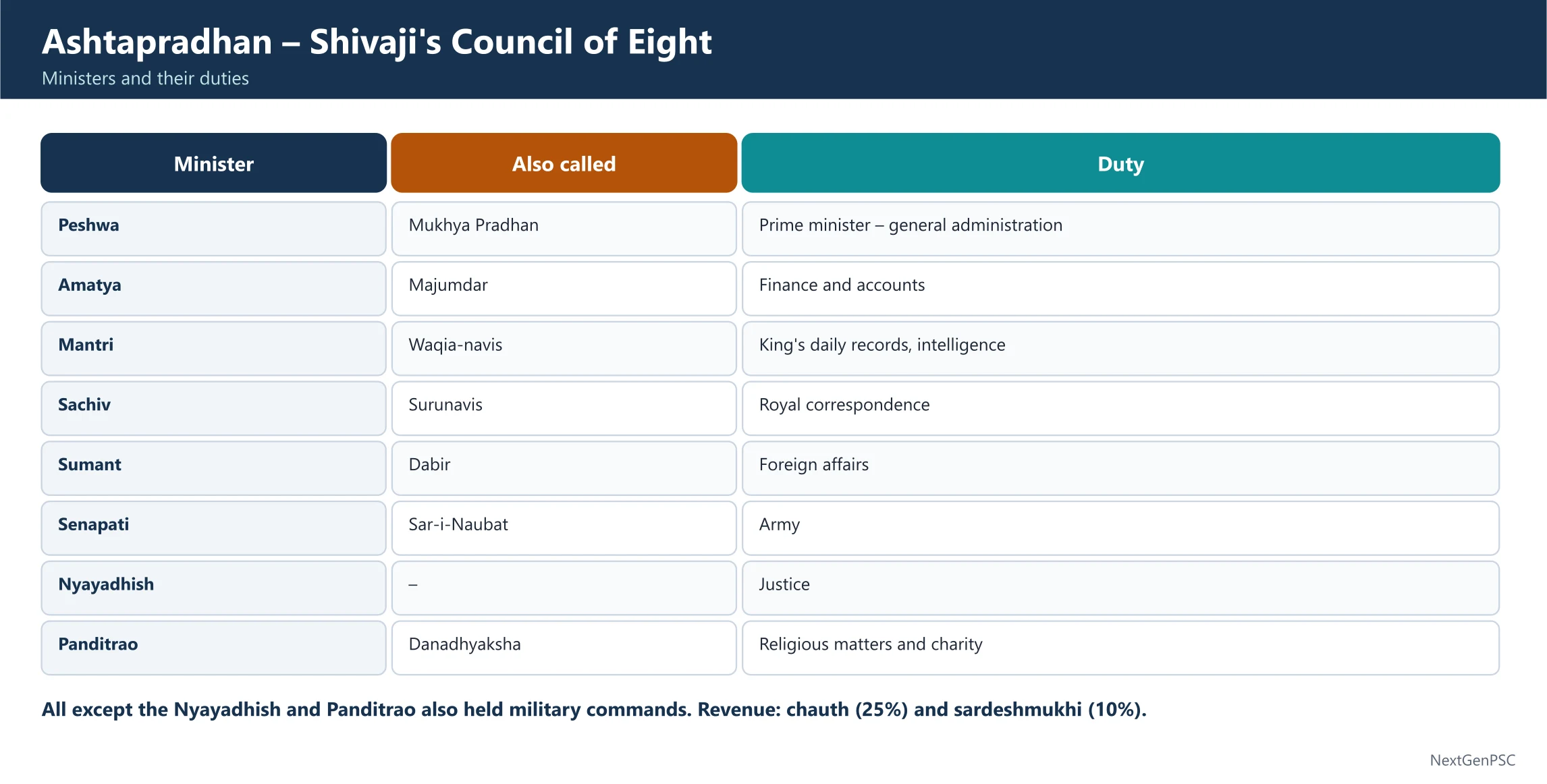
Shivaji’s administration was a centralized, efficient system designed to support his military state (Swarajya). Its key features included the council of Ashta Pradhan (Eight Ministers) and a revolutionary revenue model that replaced the feudal Jagirdari System with cash payments and external taxation (Chauth and Sardeshmukhi).
I. Central Government and Political Divisions
Supreme Head: Shivaji himself was the supreme head of the civil government, ensuring centralized authority.
Ashta Pradhan: A council of 8 ministers appointed by the King, each in charge of a department. This council was advisory; the King's authority remained absolute.
Peshwa (Mukhya Pradhan): The Prime Minister. He oversaw general administration and finance and officiated for the king in his absence.
Territorial Division: The whole territory was divided into two:
Swarajya: The core territory directly under his rule (Maratha kingdom).
Mughalai: The surrounding territory from which he collected taxes but did not directly govern.
II. Provincial, Revenue, and Military Structure
Provincial Government: The kingdom was divided into three Prants (Provinces), each under a Governor called Mamlatdar, assisted by eight chief officers.
Provinces were further divided into Tarfs (districts), Parganas (sub-districts), and Mauzas (villages).
Revenue Administration: The system was based on direct collection to avoid corrupt intermediaries (Zamindars/Mokasadars). The land revenue in Swarajya was fixed at 2/5ths (40%) of the gross produce, payable in cash or kind.
External Taxes:
Chauth (one-fourth): A levy of 1/4th (25%) on the gross revenue of neighboring territories (Mughalai or Deccan sultanates), paid to the Marathas to avoid raids.
Sardeshmukhi: An additional 10% levy on top of the Chauth, claimed by Shivaji as the Sardeshmukh (hereditary overlord) of Maharashtra.
Military Organization: He maintained a highly organized standing army (infantry and cavalry). Officers and soldiers were paid in cash (preventing feudalism) and were strictly forbidden to live on plunder in Swarajya.
No Jagirs: Unlike the Mughal system, no jagirs (land grants) were given to military officers, ensuring the loyalty of the army remained with the central state.
III. Judicial and Police System
Judiciary: Based upon ancient Hindu Laws (Dharmashastras). Disputes in villages were settled by Panchayats; criminal cases were handled by Patils (village headmen). The final court of appeal was the Hazir Majlim.
Police Officers: Faujdar (rural area) and Kotwal (urban area).
Kamavisdar: Performance-based Brahmin elites who kept records, judged cases, and provided crucial information about local conditions to superior officials. The later British District Collector office was modeled on the lines of the Kamavisdar.
| Minister | Role/Designation |
|---|---|
| Peshwa (Mukhya Pradhan) | Prime Minister; General administration and finance. |
| Amatya (Majumdar) | Finance Minister/Accountant General. |
| Sachiv (Surunavis) | Secretary; In charge of royal correspondence. |
| Mantri (Waqia-navis) | Interior Minister; King's daily record keeper. |
| Senapati (Sarnaubat) | Commander-in-chief (Military). |
| Sumant (Dabir) | Foreign Secretary; In charge of foreign affairs. |
| Nyayadhish | Chief Justice (Judicial head). |
| Pandit Rao | Chief Priest (Managed religious affairs and charities). |
Prelims tips
- The council of ministers was called the Ashta Pradhan.
- The Peshwa was the Prime Minister and the most important minister.
- Swarajya was the core territory, while Mughalai was the land subjected to Chauth (25%) and Sardeshmukhi (10%).
- Shivaji pioneered the system of cash payment to soldiers, intentionally avoiding the Mughal Jagirdari system.
- The highest court of appeal was the Hazir Majlim.
- Army: Bargirs were cavalrymen equipped and paid by the state; Silahdars brought their own horses and arms. The Ashtapradhan included the Peshwa, Amatya, Mantri, Sachiv, Sumant, Senapati (Sar-i-Naubat), Nyayadhish and Panditrao; revenue from chauth (one-fourth) and sardeshmukhi (one-tenth). Kanhoji Angre later led the Maratha navy.
Mains points
- Shivaji’s administration prioritized centralization and efficiency by eliminating the corrupt Jagirdari system (land grants to officials), ensuring the state's military power rested solely with the Chhatrapati.
- The Ashta Pradhan system provided a specialized, merit-based administrative structure, offering clear accountability, though its power would later be usurped by the Peshwas.
- The revenue model, based on direct collection in Swarajya and extractive taxation (Chauth/Sardeshmukhi) in Mughalai, provided financial resources necessary to sustain a large, cash-paid standing army.
- The blend of political organization (Prants) and local administration (Kamavisdar) helped transition the Maratha movement from a rebel force to a functional, sovereign power.
Did you know?
- Shivaji's revenue system was largely based on the efficient system introduced by the Deccan's revenue minister, Malik Ambar.
- The Ashta Pradhan members were appointed for the job and did not hold offices on a hereditary basis, unlike the high posts in the Mughal and Deccan Sultanate administrations.
- The Chauth collection legitimized Maratha raids, forcing neighboring powers to pay for 'protection' from the Marathas themselves.
Successors of Shivaji and the Rise of the Peshwas
The period after Shivaji’s death was marked by internal succession wars and the Mughal strategy of division. The reign of Shahu (1707–1749 AD) was the pivotal turning point, leading to the transfer of all executive power from the Chhatrapati (King at Satara) to the Peshwa (Prime Minister at Poona).
I. Succession and Mughal Conflict
Sambhaji (1681–1689):
Background: Shivaji's elder son, who faced internal opposition but intensified the war against the Mughals by sheltering Aurangzeb’s rebellious son, Prince Akbar.
Downfall: Defeated and executed by the Mughals at the Battle of Sangameshwar (1689) along with his counselor, Kavi Kalash, leading to the captivity of his son, Shahu.
Rajaram (1689–1707):
Role: Shivaji’s younger son; ruled as the titular head (or sovereign-in-exile) on behalf of the captive Shahu, directing Maratha guerrilla warfare from Jinji and Satara.
Successor: Succeeded by his minor son, Shivaji II, with his highly capable wife, Tara Bai, acting as regent, who continued the war.
II. The Rise of the Peshwas (Post-1707 AD)
Shahu’s Release: Released by the Mughals in 1707 (after Aurangzeb's death). This was a deliberate strategy to divide the Marathas (Shahu vs. Tara Bai).
Battle of Khed (1707): Shahu, aided by Balaji Vishwanath, defeated Tara Bai’s forces, cementing his claim to the throne at Satara.
Treaty of Warna (1731): Formally settled the rivalry between the Satara (Shahu) and Kolhapur (Sambhaji II) branches, recognizing Shahu’s overlordship.
Power Transfer: Shahu’s reign witnessed the rise of the Peshwa (Prime Minister) power. Shahu retired to Satara, and the Peshwa (starting with Balaji Vishwanath in 1713) began ruling the empire from Poona (Pune).
Assertion of Sovereignty: Shahu formally declared Swaraj in 1719 after securing the necessary recognition and alliances in Delhi.
III. Later Chhatrapatis (The Symbolic End)
Rajaram II (1749–1777): Adopted son of Shahu; remained a titular Chhatrapati whose power was completely overshadowed by the Peshwa's centralized administration.
Pratap Singh (1808–1839): The Chhatrapati whom the British deposed in 1839 on charges of plotting against them.
Shaji II (1839–1848): The last Chhatrapati. His death without a successor led the British to annex Satara under the Doctrine of Lapse (1848), ending the royal line's political role.
| Ruler | Period | Major Conflict/Event | Political Status |
|---|---|---|---|
| Sambhaji | 1681–1689 | Battle of Sangameshwar (Execution) | Chhatrapati, actively resisted Mughals. |
| Rajaram | 1689–1707 | Guerrilla war from Jinji/Satara | Titular Chhatrapati (led resistance). |
| Shahu | 1707–1749 | Battle of Khed (Victory over Tara Bai) | Chhatrapati; Power transferred to Peshwa. |
| Pratap Singh | 1808–1839 | Deposed by British (1839) | End of Chhatrapati's political relevance. |
Prelims tips
- Sambhaji was executed after being defeated at the Battle of Sangameshwar (1689).
- Mughals released Shahu in 1707 to incite Maratha Civil War (Shahu vs. Tara Bai).
- The Treaty of Warna (1731) settled the succession dispute between the Satara and Kolhapur branches.
- The rise of the Peshwa (starting with Balaji Vishwanath) marked the transfer of power from the Chhatrapati to the Prime Minister.
- Satara was the seat of the Chhatrapati; Poona (Pune) became the seat of the Peshwa.
- After Rajaram (d. 1700) his widow Tarabai led the resistance against Aurangzeb for her son Shivaji II; Shahu, released by the Mughals in 1707, defeated her at Khed and appointed Balaji Vishwanath as Peshwa (1713).
Mains points
- The period showcases the fatal impact of Aurangzeb's Deccan policy, whose actions (like executing Sambhaji and later releasing Shahu) inadvertently created the political vacuum that led to the Maratha Empire's greatest expansion under the Peshwas.
- The transition of power from the Chhatrapati (religious/symbolic head) to the Peshwa (administrative/military head) centralized the executive structure in Poona, enabling the transformation of the Maratha state into a pan-Indian power.
- Tara Bai’s resistance demonstrated the resilience of the Maratha movement and contributed significantly to the ultimate depletion of Mughal resources in the Deccan.
- The Treaty of Purandar exemplifies the Mughal strategy of using diplomacy and local Rajput allies (Jai Singh) to counter regional Hindu resistance before using direct military force.
Did you know?
- The Treaty of Purandar (1665) was considered a diplomatic masterpiece by Raja Jai Singh, as it temporarily brought Shivaji under Mughal obedience.
- Tara Bai was a formidable military strategist who kept the Mughal Empire engaged in war for several years after Rajaram's death, preventing the complete Mughal subjugation of the Deccan.
- The Treaty of Warna (1731) was signed on the Warna River, formalizing the separate states of Satara and Kolhapur.
The Rise of the Peshwas (1713–1740 AD)
The release of Shahu (Shivaji’s grandson) from Mughal captivity in 1707 catalyzed the transfer of power from the royal Chhatrapati to the Peshwas (Prime Ministers). This shift, institutionalized by Balaji Vishwanath and militarized by his son, Baji Rao I, transformed the Maratha state into the dominant Maratha Confederacy.
I. Background: Civil War and the Rise of the Peshwas
After Aurangzeb’s Death (1707): The Mughal Empire weakened, and the balance of power in the Deccan shifted. The release of Shahu, grandson of Shivaji, from Mughal captivity created a political turning point.
Civil War (1707–1713): Shahu’s claim to the Maratha throne was challenged by his aunt Tara Bai, who ruled from Kolhapur on behalf of her minor son, Shivaji II. This division split the Marathas into two rival camps — Satara (Shahu) and Kolhapur (Tara Bai).
Emergence of a New Leadership: Amid this internal crisis, a capable Brahmin administrator named Balaji Vishwanath Bhatt rose to prominence. Through diplomacy and tact, he unified the Maratha chiefs under Shahu and reorganised governance — laying the foundations for the Peshwa system.
II. Balaji Vishwanath (Peshwa: 1713–1720)
Appointment: In 1713, Shahu appointed Balaji Vishwanath as his Peshwa (Prime Minister). His administrative skill, revenue reforms, and alliances with key Maratha sardars helped stabilise Shahu’s rule.
Institutional Change: He transformed the Peshwa office from a royal secretaryship into the real seat of executive authority. The Chhatrapati (king) became largely ceremonial, while the Peshwa directed both policy and diplomacy.
Alliance with the Mughals (1719): Balaji Vishwanath supported the Sayyid Brothers (‘Kingmakers’ in Delhi) in their coup against Mughal Emperor Farrukh Siyar. In return, the Mughals formally recognised the Maratha right to collect Chauth (one-fourth tax) and Sardeshmukhi (an additional 10%) from the Deccan — legitimising Maratha revenue rights within the imperial system.
Significance: This was a turning point — the Marathas moved from being regional rebels to acknowledged power-brokers in imperial politics.
Death: Balaji Vishwanath died in 1720 and was succeeded by his son, Baji Rao I.
III. Baji Rao I (Peshwa: 1720–1740)
Character and Legacy: Considered the greatest Peshwa, Baji Rao I was a bold military strategist, often called the “greatest exponent of guerrilla warfare after Shivaji.” He embodied Maratha vitality, expansionism, and military mobility.
Vision — ‘Hindustan Chalo’ Policy: He believed the Marathas should replace the decaying Mughal authority in North India. His famous slogan ‘Let us expand the Swarajya beyond the Deccan’ guided his northern campaigns.
Military Successes: Through swift cavalry raids and clever diplomacy, he extended Maratha influence into Malwa, Gujarat, and Bundelkhand. These regions became the revenue backbone of the empire.
Maratha Confederacy Formation: To manage such vast territories, Baji Rao allowed key military families to govern semi-autonomously, forming the Maratha Confederacy:
Gaekwads of Baroda — Gujarat region.
Bhonsles of Nagpur — Central India and Berar.
Holkars of Indore — Malwa region.
Sindhias (Scindias) of Gwalior — North-Central India.
Peshwas of Poona — the central administration.
Impact: This decentralised system expanded Maratha reach but also sowed seeds of future rivalry among these families, which later weakened Maratha unity against the British.
Death and Succession: Baji Rao died in 1740 (during a campaign near Indore) and was succeeded by his son Balaji Baji Rao (Nana Saheb), under whom the Maratha Empire reached its zenith but also faced the disaster of Panipat (1761).
| Peshwa | Term | Key Contribution | Legacy |
|---|---|---|---|
| Balaji Vishwanath | 1713–1720 | Institutionalized Peshwa power; Secured Chauth/Sardeshmukhi rights from Mughals (1719). | Made Peshwa the de facto ruler. |
| Baji Rao I | 1720–1740 | Aggressive Northward Expansion; Fought numerous campaigns against Mughals. | Established Maratha Confederacy (Holkar, Sindhia, Gaekwad, Bhonsle). |
Prelims tips
- Balaji Vishwanath was the first in the line of powerful hereditary Peshwas.
- Baji Rao I was the greatest exponent of guerrilla warfare after Shivaji.
- The Treaty of 1719 (with the Sayyid Brothers) gave Marathas the formal right to collect Chauth and Sardeshmukhi from the Deccan.
- The Maratha families of Sindhia (Gwalior), Holkar (Indore), and Gaekwad (Baroda) came into prominence under Baji Rao I.
Mains points
- The institutional shift from the Chhatrapati to the Peshwa was crucial, converting the religiously-sanctioned authority of Shivaji’s line into a centralized, professional, bureaucratic state based in Poona.
- Baji Rao I's policy of Northward Expansion (Hindustan Chalo) was driven by the necessity of moving the conflict away from the saturated Deccan and funding the military through extraction (Chauth) from wealthy Mughal territories.
- The formation of the Maratha Confederacy solved the problem of administering vast conquered territories but created the later problem of internal feuds among the Maratha houses, which contributed to the Maratha defeat at Panipat.
Did you know?
- The Peshwa post became hereditary after Balaji Vishwanath, transforming the administrative office into the ruling family of the Maratha Empire.
- Baji Rao I was famed for his speed; he often covered vast distances on horseback, surprising his Mughal opponents before they could mobilize.
- The Maratha Confederacy was designed to manage the vast territories conquered by Baji Rao I, effectively giving these loyal military families autonomous control over their regions while owing allegiance to the Peshwa.
The Zenith and Crisis of the Peshwa Era (1740–1772 AD)
The Peshwa Empire reached its largest territorial extent under Balaji Baji Rao, but its power was tragically shattered in the Third Battle of Panipat (1761) against Ahmad Shah Abdali. The subsequent successful recovery was led by Madhav Rao, whose early death caused a power vacuum leading to the Anglo-Maratha Wars.
I. Balaji Baji Rao (Nana Saheb) (Peshwa: 1740–1761)
Formal Power Shift: Following Chhatrapati Shahu’s death in 1749, Shahu’s will formally transferred all state management to the Peshwa. This made the Peshwa the de facto ruler (actual power) at Poona (Pune), reducing the Chhatrapati to a symbolic head at Satara.
Territorial Apex: Consolidated control over Malwa, Gujarat, and Bundelkhand. Forced the Nizam of Hyderabad to cede vast territories (Battle of Udgir, 1760). Ceded Orissa from the Bengal Nawab (1751).
North India Dominance: Marathas effectively became the power behind the Mughal throne (1752), controlling Imperial politics and extending their influence up to Punjab, which brought them into direct conflict with the Afghan ruler Ahmad Shah Abdali.
Death: Died in June 1761 upon hearing the news of the catastrophic defeat at Panipat.
II. Third Battle of Panipat (14 January 1761)
Conflict: Fought between the Marathas and the forces of Ahmad Shah Abdali, who allied with Najib-ud-daulah (Rohilkhand) and Shuja-ud-daulah (Avadh).
Maratha Command: The army was led by the Peshwa’s cousin, Sadashiv Rao Bhau, with the Peshwa's minor son, Vishwas Rao, in nominal command.
Result: The Marathas suffered a devastating defeat (The Hindustani Holocaust). Vishwas Rao and Sadashiv Rao Bhau perished. This loss crippled the military, political, and financial structure of the Maratha Confederacy.
III. Madhav Rao (Peshwa: 1761–1772)
The Resurrection: Inherited a severely weakened state at age 17. His short reign is considered the period of Maratha recovery.
Successes: Successfully defeated the Nizam and compelled Haider Ali of Mysore to pay tribute.
Restored Dominance: Aggressively reasserted control over Northern India, subjugating the Rohillas, Rajputs, and Jat chiefs, thereby restoring the prestige lost at Panipat.
Fatal Event: Died prematurely in 1772. His death created a power vacuum and led directly to the internal disputes among the Maratha houses (the Bara Bhai Conspiracy), which the British East India Company exploited in the First Anglo-Maratha War.
| Peshwa | Period | Key Contribution | Consequence |
|---|---|---|---|
| Balaji Vishwanath | 1713–1720 | Institutionalized Peshwa power; Secured Chauth/Sardeshmukhi rights. | Transferred power from Chhatrapati to Peshwa. |
| Baji Rao I | 1720–1740 | Aggressive Northward Expansion; Established Maratha Confederacy. | Transformed Marathas into a pan-Indian power. |
| Balaji Baji Rao (Nana Saheb) | 1740–1761 | Formal transfer of all state management; largest territorial extent. | Third Battle of Panipat (1761); catastrophic loss. |
| Madhav Rao | 1761–1772 | Maratha Resurrection; restored North India control post-Panipat. | Early death created a fatal power vacuum for the Maratha state. |
Prelims tips
- Balaji Baji Rao formally became the de facto ruler after Shahu’s death in 1749.
- The Third Battle of Panipat (1761) was fought between the Marathas (Sadashiv Rao Bhau) and Ahmad Shah Abdali.
- The major casualty for the Marathas at Panipat was Vishwas Rao (Peshwa's son) and Sadashiv Rao Bhau.
- Madhav Rao is credited with the Maratha Resurrection and recovering prestige lost at Panipat.
- The Maratha Empire was governed from Poona during this entire period.
- Sangola Agreement (1750): after Shahu's death (1749) the Peshwa Balaji Bajirao became the real head of the Maratha state, with the Chhatrapati a figurehead. Ahilyabai Holkar (Indore, capital Maheshwar) rebuilt the Kashi Vishwanath temple (1780).
Mains points
- The Third Battle of Panipat exposed the fatal flaw of the Maratha Confederacy: the lack of political cohesion among the Maratha houses (Holkar, Sindhia, Gaekwad), who often failed to cooperate effectively with the central Peshwa command.
- The conflict, though a tactical defeat, ensured the decline of Mughal authority and indirectly benefited the British East India Company, which faced a weakened primary rival in the late 18th century.
- The era highlights the dual policy of the Marathas: aggressive militarism for expansion and the subsequent administrative failure to integrate and manage the vast conquered territories (Mughalai, Bengal, South India).
- Madhav Rao’s period of resurrection demonstrates the inherent administrative and military strength of the Maratha system, which allowed for rapid recovery despite the massive loss of leadership.
Did you know?
- The Third Battle of Panipat was so devastating that a code message was sent back to the Peshwa describing the loss of two pearls, twenty-two gold mohurs, and the rest silver and copper coins—meaning Sadashiv Rao and Vishwas Rao died, and the entire army was destroyed.
- Balaji Baji Rao died not directly in battle but from the profound shock and grief of the Panipat catastrophe.
- Madhav Rao's death was a bigger political gift to the British than any battlefield victory, as it immediately fractured the Maratha central command and opened the door for intervention.
Successors of Shivaji and the Decline of Maratha Power
The period after 1772 was marked by a crisis of succession, leading to the First Anglo-Maratha War (1775–82). The internal feuds among the great Maratha sardars (Sindhia, Holkar) allowed the British to implement their 'Divide and Rule' policy, ultimately leading to the extinction of the Peshwas' house after the Third Anglo-Maratha War (1819).
I. Sawai Madhav Rao (Peshwa: 1774–1795) — Context & Succession
Background: The Peshwa was the hereditary prime minister at the Maratha court in Pune — originally serving under the Chhatrapati but increasingly the real centre of power by the 18th century. Sawai Madhav Rao’s period is important for understanding how the Peshwa office came to dominate Maratha politics.
Succession Crisis explained: On the death of Peshwa Madhav Rao I, there was a dispute about the rightful heir. A posthumous son, Sawai Madhav Rao, was recognised by the Maratha chiefs (the Bara Bhai council). His rival, Raghunath Rao, attempted to seize power — creating a dangerous internal division.
Why this mattered: Regional chiefs used succession disputes to advance their own interests and external powers (especially the British) exploited these divisions to intervene politically and militarily.
II. Raghunath Rao, British Intervention and the First Anglo-Maratha War (1775–1782)
Raghunath Rao’s appeal: Failing to secure support, Raghunath Rao sought the assistance of the British East India Company to place him on the Peshwa throne. This invitation gave the British a formal pretext to intervene in Maratha politics.
Course of the war: The First Anglo-Maratha War involved several encounters; the Marathas (led by leaders like Mahadji Shinde and Nana Fadnavis) successfully resisted the British in many theatres.
Treaty of Salbai (1782): The war ended with this treaty which recognised Sawai Madhav Rao and restored a fragile peace. It also gave the British some concessions but kept them mostly outside Maratha internal politics for about two decades — a diplomatic check rather than full control.
III. Political Fragmentation and the Rise of Regional Maratha Chiefs (late 18th – early 19th century)
Feudal fragmentation: Powerful Maratha sardars — the Scindias (Sindhias) of Gwalior, Holkars of Indore, Bhonsles of Nagpur and Gaekwads of Baroda — carved out semi-independent states. They maintained their own armies and pursued regional agendas.
Effect on Pune: The Peshwa at Pune became increasingly dependent on alliances and balancing acts among these chiefs; central coordination weakened and unity broke down.
British strategy: The British applied a combination of diplomacy, subsidiary treaties and selective military action to exploit these rivalries rather than fight the Marathas as a united polity.
IV. Baji Rao II (Peshwa: 1796–1818) — Weakness and Choices
Ascension: Baji Rao II, son of Raghunath Rao, became Peshwa at a time when the confederacy was fragmented and British ambitions were rising.
Weak rule: He lacked strong personal authority and was reliant on British military support once he sought protection—an act that undermined his independence and angered other chiefs.
Key decision — Treaty of Bassein (1802): After being defeated and threatened by rival Maratha chiefs, Baji Rao II signed the Treaty of Bassein with the British (31 Dec 1802). Under this Subsidiary Alliance he accepted a British force and agreed to give territory/payment for its maintenance and to accept British control of his external affairs. This treaty is a crucial turning point — it effectively made the Peshwa a British client and catalysed the Second Anglo-Maratha War.
V. The Second Anglo-Maratha War (1803–1805) — Consequences
What happened: The Treaty of Bassein angered other Maratha chiefs (notably Scindia and Bhonsle), who formed armed resistance. The British fought and won several decisive battles (e.g., Assaye, Argaon), defeating the major chiefs separately.
Consequences: The war curtailed the power of Scindia and Bhonsle, enlarged British political influence and reduced Maratha autonomy through new subsidiary arrangements and territorial gains for the Company.
VI. The Third Anglo-Maratha War (1817–1818) and the End of the Peshwa House
Why final defeat: By 1817 the Maratha confederacy was internally divided, several chiefs had taken subsidiary ties with the British, and the Peshwa could not muster a united front. The British used military pressure and political manoeuvre to dismantle remaining resistance.
Result: The British defeated the Peshwa and his allies; Baji Rao II surrendered (1818), was pensioned and exiled to Bithoor (near Kanpur). The Peshwa household lost political power and the British established paramountcy over former Maratha territories.
VII. Why the Peshwa rule collapsed — simple analysis
Structural cause: The Maratha system depended on a confederacy of powerful, semi-independent chiefs. That system lacked institutional mechanisms to transform wartime cooperation into sustained central authority.
Immediate causes: Succession disputes (e.g., Raghunath Rao vs Sawai Madhav Rao), the Peshwa’s dependence on British support (Treaty of Bassein), and military defeats that removed the chiefs’ ability or will to coordinate resistance.
British advantage: Superior discipline, logistics, use of modernised artillery, and clever diplomacy (treaties that split allies) allowed the Company to defeat the Marathas piecemeal.
VIII. UPSC-Useful Points & Answering Tips
Prelims facts: Know dates — First Anglo-Maratha War (1775–1782) and Treaty of Salbai; Treaty of Bassein (31 Dec 1802); Second Anglo-Maratha War (1803–1805); Third Anglo-Maratha War (1817–1818) leading to Baji Rao II’s surrender (1818).
Mains themes: Use the Peshwa story to discuss decline of centralised power (Mughals), rise of regional confederacies, limits of confederate polities, British diplomatic-military strategies (Subsidiary Alliance), and the political consolidation of Company rule.
Answer structure suggestion: (1) Short intro (context), (2) Sources of Maratha power and nature of the confederacy, (3) Key crises — succession, Treaty of Bassein, wars, (4) Consequences — end of Peshwa rule and British paramountcy, (5) Short conclusion linking to larger themes (e.g., colonial consolidation).
IX. Quick Revision Bullets
Chauth = 25% levy; Sardeshmukhi = additional 10% claimed by Marathas (revenue/tribute forms).
Treaty of Salbai (1782) ended First War — gave temporary peace.
Treaty of Bassein (1802) made Baji Rao II a British client — trigger for Second War.
Battle of Assaye (23 Sept 1803) — major British victory in the Second War (Wellesley).
Final surrender of the Peshwa (1818) ended Peshwa political supremacy and helped establish British paramountcy.
| Peshwa | Period | Key Event | Consequence |
|---|---|---|---|
| Sawai Madhav Rao | 1774–1795 | Treaty of Salbai (1782) | Recognized as rightful Peshwa after First Anglo-Maratha War. |
| Baji Rao II | 1796–1818 | Treaty of Bassein (1802); Defeat in Third Anglo-Maratha War (1818) | Deposed and exiled; House of Peshwas extinguished. |
Prelims tips
- The First Anglo-Maratha War was triggered by Raghunatha Rao (Raghoba) seeking British help.
- The war ended with the Treaty of Salbai (1782), which acknowledged Sawai Madhav Rao.
- The Second Anglo-Maratha War (1803–1805) forced many Maratha chiefs to sign the Subsidiary Alliance.
- Baji Rao II was the last Peshwa; he was exiled to Bithoor.
Mains points
- The succession crisis following Madhav Rao's death fatally exposed the Maratha Confederacy's weakness: the lack of a strong, legitimate central authority after the Chhatrapati's power declined.
- The Treaty of Salbai demonstrated the Marathas' diplomatic strength under leaders like Nana Fadnavis, delaying full British domination for two decades.
- The internal conflicts among the Maratha sardars (Sindhia vs. Holkar) provided the pretext and opportunity for the British to introduce the Subsidiary Alliance, dismantling the Confederacy from within.
- The extinction of the Peshwa house and the annexation of Satara marked the successful final phase of British conquest, transforming the East India Company from a trading power to the paramount power in India.
Did you know?
- The Treaty of Salbai (1782) kept the British out of Maratha affairs for twenty years, allowing the Maratha state a crucial period of peace before the final confrontations.
- The Bara Bhai (Twelve Brothers) council was an informal regency of powerful Maratha nobles (including Nana Fadnavis and Mahadji Sindhia) who worked together to protect the young Peshwa Sawai Madhav Rao from Raghunatha Rao and the British.
- Baji Rao II's desperate flight to the British and subsequent signing of the Treaty of Bassein (1802) was viewed by the other Maratha chiefs (especially the Holkars) as a betrayal, directly leading to the Second Anglo-Maratha War.
Decline of the Maratha Kingdom and the Anglo-Maratha Wars
The decline of the Maratha power (the dominant force after the Mughals) was rapid, caused by internal political fragmentation among the Peshwas and the great sardars (Sindhia, Holkar). The Anglo-Maratha Wars (1775–1819) exploited this disunity, leading to the extinction of the Peshwas' rule and the establishment of British paramountcy.
I. Maratha Supremacy and Internal Faultlines — simple explanation
Rise after Aurangzeb: After Aurangzeb’s death (1707) the Mughal Empire weakened. The Marathas, originally a regional power in western India under the Bhonsle and later under the Peshwas, expanded to become the most powerful regional force in the 18th century — controlling large parts of central, western and peninsular India.
Revenue and Power: Chauth & Sardeshmukhi: Marathas collected two major kinds of tribute from other states — Chauth (one-fourth of revenue as protection money) and Sardeshmukhi (an extra 10% claimed by the Maratha chief as overlord). These levies were a major source of their wealth and influence.
Shift of authority: Political power gradually moved away from the hereditary Chhatrapati (the nominal king) to the Peshwa (prime minister) who became the de-facto head of the Maratha Confederacy. This informal federal structure gave autonomy to powerful chiefs (Scindia/Sindhia, Holkar, Gaekwad, Bhonsle), which helped expansion but made central coordination weak.
Fatal flaw: The Confederacy’s success was undermined by factional rivalries (for example, Scindia vs Holkar), competing ambitions of chiefs, and a lack of a single, legitimate central authority — an advantage the British would later exploit.
II. First Anglo-Maratha War (1775–1782) — cause & result
Trigger: Internal Maratha politics — a succession struggle in Pune (Raghunath Rao’s attempt to seize power) led him to seek British help.
Course: The British intervened but suffered reverses (e.g., Wadgaon). The Maratha leader Mahadji Shinde and statesman Nana Fadnavis negotiated effectively.
Outcome: Ended by the Treaty of Salbai (1782), which restored a balance — the British kept some gains while recognising the Maratha influence under Sawai Madhav Rao. The treaty produced a twenty-year truce and kept the British largely out of Maratha internal politics for two decades.
III. Between the Wars — rising tensions
Changing alliances: The Maratha chiefs pursued their own regional policies; European powers (British and French) tried to gain influence by backing different factions.
Significance: The peace after Salbai was uneasy — unresolved rivalries continued and British strategic aims (secure trade, prevent French influence) remained unchanged.
IV. Treaty of Bassein and the Second Anglo-Maratha War (1803–1805)
Treaty of Bassein (31 Dec 1802): After being defeated by rivals, Peshwa Baji Rao II sought British support and signed the Treaty of Bassein, accepting a British subsidiary force and conditions which curtailed his independence (he agreed to cede territory for upkeep of troops, accept British control of foreign affairs, and exclude other Europeans from his service). This was seen as a betrayal by other Maratha chiefs.
Second War (1803–1805): The treaty provoked direct conflict with the major Maratha chiefs (Scindia, Bhonsle, Holkar). Key battles: Assaye (23 Sept 1803)) — Arthur Wellesley defeated combined Maratha forces — and others like Laswari and Argaon. The British gained important territorial and political concessions, reducing Maratha autonomy.
V. Third Anglo-Maratha War (1817–1818) — final collapse
Cause: By 1817 Maratha power was fragmented; British pressure, broken alliances, and the problem of uncontrolled plunderers (the Pindaris) provided pretexts for a final campaign. Lord Hastings and the Governor-General used these factors to eliminate remaining Maratha resistance.
Course & Result: The Maratha chiefs fought separately, not as a united front. The British defeated major Maratha armies and forced the surrender of the Peshwa. Baji Rao II surrendered in 1818, was pensioned and exiled to Bithur (near Kanpur); the Peshwa’s political power was extinguished and most Maratha states accepted British paramountcy. The war marks the effective end of Maratha sovereignty and the consolidation of British rule.
VI. End of Peshwa Rule and British Paramountcy
Aftermath: Baji Rao II was deposed and pensioned; the Maratha territories were reorganised under British control — many regions were annexed or converted into subsidiary states under British suzerainty.
Longer significance: The subjugation of the Marathas removed the major native military obstacle to British expansion, enabling the Company to consolidate political control over most of peninsular and northern India by the 1820s.
VII. UPSC-useful points & writing tips
Prelims facts: Chauth & Sardeshmukhi definitions; Treaty of Salbai (1782) ended the First War; Treaty of Bassein (1802) triggered the Second War; Third Anglo-Maratha War (1817–1818) ended Maratha sovereignty with Baji Rao II’s surrender in 1818.
Mains themes: Use the Maratha story to illustrate (a) the decline of the Mughal centre and rise of regional powers, (b) the strengths and structural weaknesses of confederacies vs centralised states, (c) how British diplomacy (treaties, subsidiary alliances) and military power exploited internal divisions, and (d) the transition to British paramountcy.
How to structure a 15–20 mark answer: 1) Intro (brief context), 2) Growth & sources of Maratha power (Chauth, military), 3) Internal weaknesses & factionalism, 4) Anglo-Maratha wars (causes & outcomes), 5) Conclusion (long-term consequences for Indian polity).
VIII. Quick revision bullets
Marathas collected Chauth (25%) and Sardeshmukhi (10%), and shifted real power to the Peshwa.
Treaty of Salbai (1782) ended First War and gave a 20-year uneasy peace.
Treaty of Bassein (1802) made Baji Rao II a British client — major trigger of the Second War.
Battle of Assaye (23 Sept 1803) was a key British victory in the Second War (Wellesley).
Third War (1817–1818) ended Maratha sovereignty; Baji Rao II surrendered in 1818 and was pensioned at Bithur.
| War | Period | Key Trigger | Maratha Status Aftermath |
|---|---|---|---|
| First War | 1775–1782 | Raghunath Rao seeks British help (Succession Crisis). | Treaty of Salbai (1782): Maintained status quo, recognized Sawai Madhav Rao. |
| Second War | 1803–1805 | Peshwa signs Subsidiary Alliance (Treaty of Bassein, 1802). | Major chiefs defeated separately; Confederacy dissolved; British paramountcy initiated. |
| Third War | 1816–1819 | Lord Hastings uses Pindari threat as pretext. | House of Peshwas extinguished (Baji Rao II exiled); Maratha independence ends. |
Prelims tips
- The First Anglo-Maratha War was resolved by the Treaty of Salbai (1782).
- The Treaty of Bassein (1802), signed by Baji Rao II, was the immediate cause of the Second Anglo-Maratha War.
- Lord Hastings used the Pindari threat as the pretext for the Third Anglo-Maratha War.
- Baji Rao II was the last Peshwa; his exile marked the end of the Peshwa rule.
- Treaty of Surat (1775) between Raghunath Rao and the British triggered the First Anglo-Maratha War, ended by the Treaty of Salbai (1782); the Treaty of Bassein (1802) with Bajirao II led to the Second War; the Third War (1817–18) ended the Peshwaship.
Mains points
- The decline was fundamentally caused by political fragmentation (feudal structure and Peshwa-Sardar rivalry) rather than military weakness, allowing the British to use Subsidiary Alliances to dismantle the Confederacy from within.
- The Treaty of Bassein (1802) was a critical legal turning point, transforming the Peshwa into a British pawn and justifying the subsequent conquest of the Maratha domains.
- The Third War confirmed the failure of Maratha diplomacy and military coordination, as the refusal of the sardars to form a unified front led to their final defeat by a centralized enemy.
- The Maratha's inability to modernize their military doctrine (relying on old cavalry tactics) against the professional British infantry and artillery was a decisive technological and strategic failure.
Did you know?
- The Treaty of Salbai gave the Marathas twenty years of peace, which they unfortunately used to fight internal wars instead of modernizing their army.
- The Pindaris were a multi-caste, irregular force of plunderers often associated with the Maratha armies but operating independently, whose existence the British successfully used to justify war.
- The Bara Bhai (Twelve Brothers) council successfully ran the Maratha state against the British during the First Anglo-Maratha War despite internal threats, demonstrating strong bureaucratic and diplomatic skill.
Causes of the Downfall of the Marathas
The downfall of the Maratha Empire was due to a fatal combination of internal political fragmentation (Confederacy feuds, loss of central authority), a flawed feudal military system (Jagirdari, reliance on Samantas), and a lack of economic foresight against the superior, centralized, and modern forces of the British.
I. Political and Structural Weakness
Flawed Confederacy: The empire was not a well-knit unit but a confederacy of five Maratha chiefs (Peshwa, Sindhia, Holkar, Bhonsle, Gaekwad) who, after the death of Peshwa Madhav Rao I, pursued self-interested policies and frequently fought against each other, leading to political disunity.
Jagirdari System: The revival and expansion of the Jagirdari system (allowing commanders to keep conquered territory as jagir) prevented the central Peshwa government from centralizing military and economic resources. This destroyed the 'one entity' status of the empire.
Lack of National Consciousness: The Rajputs lacked political wisdom and aimed only to control the Mughal emperor for narrow objectives, failing to achieve the political unity of India necessary to meet the challenge of a foreign foe.
Social Division: The spirit of Maratha nationality created by Shivaji was lost. The caste system reasserted itself, with Maratha chiefs often challenging the Brahmin Peshwas simply due to caste differences, further dividing society.
II. Military and Technological Inferiority
Flawed Military Organization: Rajputs failed to maintain a permanent, professional army, relying on the untrained militias supplied by feudal lords (Samantas) only when war broke out.
Lack of Mobility: The Marathas relied heavily on slow infantry and war elephants. The Turks and the English, conversely, relied on highly mobile, well-equipped cavalry and superior artillery (mobility was the keynote of Turkish military organizations).
Flawed Adoption of European Methods: The Marathas adopted European means of warfare (artillery and disciplined infantry) but failed to perfect them. Their factories for manufacturing arms produced material of poor quality, and their soldiers, though trained by the French, were often unreliable in crises.
Defensive Strategy: Rajputs habitually fought defensive wars, hoping to contain the enemy, rather than waging decisive offensive campaigns to neutralize the threat in its own territory.
III. Economic and Leadership Failures
Neglect of Economic Affairs: The Marathas failed to develop their economic resources or implement a sound system of internal administration. They never took the responsibility of improving the economic or moral conditions of their subjects.
Extractive Economy: Their primary income source remained Chauth, Sardeshmukhi, and plunder, which was irregular and insufficient, resulting in a failure to achieve economic stability.
Lack of Loyalty: Due to the plunder-based economy, they failed to secure the loyalty of their subjects, who often remained neutral or even supported the British.
Incapable Leadership: After the death of capable leaders like Madhav Rao I and Nana Fadnavis, the Marathas were led by weak and indecisive Peshwas (like Baji Rao II), contrasting sharply with the continuous supply of strong English leaders (Wellesley, Hastings, etc.).
| Aspect | Rajput/Maratha Forces | Turkish/English Forces |
|---|---|---|
| Organization | Decentralized (reliant on feudal lords/Samantas) | Centralized, professional standing armies |
| Military Doctrine | Defensive; focused on elephants and close-range combat | Offensive; focused on highly mobile cavalry (Turks) or disciplined infantry/artillery (English) |
| Technology | Traditional weapons; flawed adoption of European artillery | Superior long-range archery (Turks); modern artillery/muskets (English) |
| Economic Base | Irregular income from Chauth and plunder | Stable, centralized revenue base and military treasury |
| Leadership | Incapable later Peshwas (Baji Rao II); leadership vacuum | Strong, continuous supply of capable military and civil leaders (Wellesley, Elphinstone) |
Prelims tips
- The Maratha Confederacy was fatally weakened by the rivalry between the Peshwa (Poona) and the Sindhia/Holkar clans.
- The Jagirdari system was seen as a major flaw because it undermined the central authority of the Peshwa.
- The Third Anglo-Maratha War (1816–1819) ended the Peshwa's house and Maratha independence.
- Maratha income was based on Chauth (25%) and Sardeshmukhi (10%) collected from external territories.
Mains points
- The collapse was fundamentally structural: feudal decentralization prevented the formation of a unified Central Military Command, allowing the British to use Subsidiary Alliances to dismantle the Confederacy from within.
- The economic philosophy of the Marathas (reliance on plunder) failed to sustain a large empire, contrasting with the stable revenue base and financial planning of the British.
- The inability of the Maratha leadership to transition from Guerrilla tactics to modern pitched-battle doctrine was a decisive failure against the professionalized armies of the English.
- The social rigidities (casteism) and failure to secure the loyalty of conquered subjects undermined the national spirit required for prolonged resistance.
The Sultanate of Gujarat (1407–1572 AD)
The Gujarat Sultanate (Muzaffarid dynasty) was a highly prosperous independent state known for its seaports and handicrafts. It reached its zenith under Mahmud Begarha, who conquered two strategic forts (Girnar and Champaner) and resisted early Portuguese expansion.
I. Foundation and Political Context
After the decline of the Delhi Sultanate in the late 14th century, regional governors (like Zafar Khan) began asserting independence. Gujarat, due to its rich resources and coastal trade, was one of the earliest to do so.
Founder: Zafar Khan (appointed as governor by Firoz Shah Tughlaq) declared independence after Timur’s invasion of Delhi and took the title Muzaffar Shah (1407 AD). This marked the beginning of the Muzaffarid dynasty.
The new Sultanate controlled key trade centers like Khambhat (Cambay), linking India to the Persian Gulf, Red Sea, and East Africa — a crucial factor in its wealth.
II. Ahmad Shah (1411–1441): The Real Founder
Ahmad Shah, Muzaffar Shah’s grandson, consolidated power and built a stable administrative system. He founded Ahmedabad (1413 AD) on the banks of the Sabarmati River and made it the capital.
Built important monuments like the Jama Masjid, Teen Darwaza, and laid out planned city areas, reflecting urban sophistication.
Religious and Administrative Policy: Though he imposed Jaziya (tax on non-Muslims), he pragmatically included Hindu nobles and officials in high offices, ensuring stability in a mixed society.
Known for his strict sense of justice, even punishing his own relatives when they violated law — earning him respect across communities.
Conflict with Malwa: Constant rivalry with the neighboring Malwa Sultanate for regional dominance drained resources of both states.
III. Zenith under Mahmud Begarha (1459–1511 AD)
‘Begarha’ Title: Earned after capturing two major forts or ‘Garhs’ — Girnar (Junagarh) and Champaner, vital for controlling trade routes and defense.
Developed Mustafabad (near Girnar) and Muhammadabad (near Champaner) as secondary capitals, symbolizing Gujarat’s prosperity and military strength.
Economic Power: Gujarat became the hub of Indian Ocean trade, exporting textiles, indigo, spices, and precious stones to Arabia and Africa.
Conflict with the Portuguese (1507 AD): The arrival of the Portuguese challenged Gujarat’s monopoly over sea trade. Mahmud Begarha attempted to expel them but later permitted them to set up a trading post at Diu — an early example of India’s encounter with European colonial powers.
Culture and Society: Patronized literature and art; Sanskrit poet Udayaraja served in his court, showing cultural inclusivity. His reign saw a fusion of Islamic architecture with Gujarati motifs, evident in mosques of Ahmedabad and Champaner.
Legend and Personality: Chroniclers like Duarte Barbosa exaggerated tales of his enormous appetite and alleged that his body contained poison — illustrating the mystique around powerful Indian rulers.
IV. Decline and Mughal Annexation
Successors of Begarha were weak and unable to resist growing Mughal expansion.
In 1572 AD, Emperor Akbar annexed Gujarat into the Mughal Empire, recognizing its immense strategic value as the gateway to Arabian Sea trade.
Under the Mughals, Gujarat remained an economic powerhouse with cities like Surat becoming the center of imperial maritime commerce.
| Ruler | Period | Key Contribution | Fate |
|---|---|---|---|
| Muzaffar Shah | 1407–1411 | Founded the independent Sultanate. | Succeeded by grandson. |
| Ahmad Shah | 1411–1441 | Founded Ahmedabad; Consolidated the state; known for strict justice. | Rivalry with Malwa. |
| Mahmud Begarha | 1459–1511 | Captured Girnar and Champaner (Begarha title); Resisted Portuguese. | Apex of power; later successors were weak. |
| Final Ruler | Successors of Begarha | N/A | Annexed by Akbar in 1572 AD. |
Prelims tips
- Ahmad Shah founded the city of Ahmedabad in 1413 AD.
- Mahmud Begarha was named for capturing two forts: Girnar and Champaner.
- The Rani-ki Vav (UNESCO site) was built in Gujarat by the earlier Solanki (Chalukya) dynasty.
- Gujarat Sultanate was annexed by Akbar in 1572 AD.
- Mahmud Begarha granted the Portuguese a site for a factory in Diu.
Mains points
- The Gujarat Sultanate's strategic location (maritime access and fertile land) made it the most powerful western successor state to the Delhi Sultanate, establishing a strong Deccani-Rajput political synthesis.
- Mahmud Begarha's career highlights the complex geopolitical challenge posed by the arrival of the Portuguese on the western coast, forcing Indian land powers to engage in maritime diplomacy and warfare.
- The Sultanate's administrative policy, under Ahmad Shah, represents a pragmatic approach to governance, balancing Islamic orthodoxy (Jaziya) with the necessity of incorporating Hindu elites into the central administration.
Did you know?
- The Teen Darwaza (Three Gates) in Ahmedabad, built by Ahmad Shah, served as a gateway to the Royal Square and was meant to symbolize the entry into a magnificent city.
- The rivalry between Gujarat and Malwa was so intense that they often fought each other instead of uniting against the powerful Delhi Sultanate, reflecting fatal regional political fragmentation.
- The legend of Mahmud Begarha's poisonous nature (noted by Duarto Barbosa) shows how foreign travelers often exaggerated the exoticism and power of Indian rulers.
The Sultanate of Malwa (1401–1562 AD)
The Malwa Sultanate, situated on the Central Highland plateau, was crucial for controlling the Gujarat-North India trade route. It reached its peak under Mahmud Khalji but was constantly weakened by the bitter rivalry with Gujarat, leading to its final annexation by the Mughals in 1562 AD.
I. Foundation and Political Context
Background: The decline of the Delhi Sultanate in the late 14th century led to the rise of several regional kingdoms in India. Malwa, located in the fertile plateau between the Narmada and Tapti rivers, was one such successor state.
Strategic Location: Malwa occupied the central position in India — controlling the trade routes between Gujarat ports and North India, making it economically and militarily significant.
Founder: Dilawar Khan Ghori, the governor of Malwa under Firoz Shah Tughlaq, declared independence around 1401 AD after Timur’s invasion of Delhi (1398 AD). He ruled from Dhar, but later shifted his capital to the defensible hill fort of Mandu, which became one of India’s most beautiful cities.
Mandu, surrounded by natural defenses and water bodies, was developed with gardens, palaces, and mosques — earning the title ‘City of Joy’.
Rivalries: The main political rival was the Gujarat Sultanate to the west. Their constant warfare weakened both powers and allowed the Mughals to expand later.
II. Rise and Consolidation: Hushang Shah (1406–1435 AD)
Son of Dilawar Khan: Hushang Shah was an able ruler who strengthened the foundation of the new state.
Religious Policy: Known for his tolerance and inclusivity, he patronized Jain merchants and scholars, recognizing their role in trade and finance. His treasurer Nardeva Soni, a Jain, held high office — showing pragmatic governance.
Urban Development: Founded Hoshangabad on the Narmada River.
Architecture and Legacy: Initiated the construction of the Hoshang Shah’s Tomb in Mandu, which became one of the earliest marble mausoleums in India and later inspired the design of the Taj Mahal.
III. Zenith under Mahmud Khalji (1436–1469 AD)
New Dynasty: Mahmud Khalji, a powerful noble, usurped the throne and established the Khalji dynasty of Malwa.
Military Expansion: He waged continuous wars against neighboring powers — Gujarat, Mewar, Bahmani, and Gondwana — attempting to extend his control across Central India.
Conflict with Mewar: His campaigns against Rana Kumbha of Mewar are legendary; although he claimed victory, historical sources like Kumbhalgarh inscriptions show that Rana Kumbha defeated him.
Architecture and Art: Built the seven-storeyed Victory Tower (Victory Pillar) at Mandu to commemorate his military success. Mandu flourished as a center of Indo-Islamic art and culture during his reign.
Administration: Maintained an efficient administration and continued patronage of trade and artisans, which contributed to Mandu’s prosperity.
IV. Cultural Glory: Ghiyas-ud-din Shah (1469–1500 AD)
Peaceful Rule: Focused more on art, architecture, and courtly life than warfare.
Architectural Patronage: Constructed the splendid Jahaz Mahal (Ship Palace) — built between two artificial lakes, giving the illusion of a floating palace. It served as a residence for royal women.
Social Life: The Malwa court under him became a symbol of luxury, refinement, and syncretic culture. Persian and local influences blended in architecture, music, and poetry.
V. Later Rulers and Decline
Baz Bahadur (1555–1561 AD): The last independent ruler of Malwa, known for his love for Rani Roopmati, a Hindu singer and poetess. Their tragic romance became a symbol of loyalty and loss in Indian folklore.
Foreign Policy: Baz Bahadur tried to maintain independence but faced invasions from both Gujarat and the rising Mughal power.
Military Weakness: Internal instability and luxury-loving rulers led to administrative decline.
VI. Decline and Mughal Annexation
In 1531 AD, Bahadur Shah of Gujarat invaded Malwa and temporarily captured Mandu, showing the state’s weakening condition.
Finally, in 1562 AD, Mughal Emperor Akbar’s general Abdullah Khan defeated Baz Bahadur, and Malwa was annexed into the Mughal Empire.
Under the Mughals, Malwa became part of the Subah (province) system, remaining a key administrative and cultural center of Central India.
| Ruler | Period | Key Contribution | End |
|---|---|---|---|
| Dilawar Khan | 1401–1406 | Founded the independent state; shifted capital to Mandu. | Start of Muzaffarid rule. |
| Ahmad Shah | 1411–1441 | Known for strict justice and rivalry with Gujarat. | Consolidator of the state. |
| Hushang Shah | 1406–1435 | Patronized Jain merchants; founded Hoshangabad. | Exemplified religious tolerance for economic benefit. |
| Mahmud Khalji | 1436–1469 | Built seven-storeyed column (Mandu); apex of military power. | Constant warfare with Mewar and Gujarat. |
| Baz Bahadur | 1555–1561 | Famous for romance with Roopmati. | Defeated and annexed by Akbar (1562). |
Prelims tips
- Malwa’s capital was shifted from Dhar to Mandu.
- Mahmud Begarha (of Gujarat) was the main rival, not a Malwa ruler.
- Hushang Shah patronized the Jain merchant Nardeva Soni.
- The Jahaz Mahal in Mandu was built by Ghiyas-ud-din.
- The Sultanate was annexed by the Mughal Emperor Akbar in 1562 AD.
Mains points
- The Malwa Sultanate's strategic location made it a geopolitical pawn; its constant rivalry with Gujarat highlights the failure of regional political coordination against the emerging Mughal threat.
- The careers of Hushang Shah and Mahmud Khalji exemplify the pragmatic syncretism of medieval regional states, balancing orthodox Islamic policies with the necessity of patronizing the Jain mercantile community (for economic stability).
- The architecture of Mandu (Jahaz Mahal, victory column) showcases a distinct Mughal-precursor Indo-Islamic style of the region, marking a unique cultural contribution before its annexation.
Did you know?
- The Jahaz Mahal in Mandu (built by Ghiyas-ud-din) is famous for its unique architecture, designed to resemble a ship floating between two artificial lakes, maximizing cooling and luxury.
- The rivalry between Gujarat and Malwa was a classic case of regional fragmentation where two powerful states fought each other to exhaustion instead of recognizing the common threat from the North (Mughals).
- The final annexation of Malwa by Akbar began with the defeat of Baz Bahadur due to his neglect of military duties, reportedly distracted by his love for Queen Roopmati.
The Sultanate of Jaunpur and the Sharqi Dynasty (1394–1505 AD)
The Sharqi Dynasty was founded in 1394 AD by Malik Sarwar (titled Sultanu-Sharq) in Jaunpur (Eastern UP) following the collapse of the Tughlaq dynasty. The Sultanate reached its cultural peak under Ibrahim Shah Sharqi, known for developing the unique Sharqi style of architecture and contributing to Hindustani classical music.
I. Foundation and Early Rulers — Background made simple
Geography: Jaunpur lies on the banks of the Gomati River in eastern Uttar Pradesh — an agriculturally rich and strategically important region connecting the Gangetic heartland with eastern and central India.
Founder: Malik Sarwar (also called Malik-us-Sharq) was originally a governor under the Delhi Sultanate. After Timur’s invasion of Delhi (1398) and the resultant political chaos, he stepped out as an independent ruler and was given the title Sultanu-Sharq (Lord of the East) in 1394. This marks the start of the Sharqi dynasty.
Why independence happened: When central power in Delhi broke down, strong provincial governors with local support — like Malik Sarwar — converted administrative control into sovereign rule. This was a common pattern across India after the late 14th century.
Mubarak Shah Sharqi: One of the early rulers who asserted political sovereignty by striking coins in his own name — a clear symbol of independent authority in medieval polity.
II. Political Growth and Territorial Extent
Expansion: At its height Jaunpur controlled territory from parts of western Uttar Pradesh to areas reaching Bihar and even influence towards Nepal — roughly from Aligarh in the west to Darbhanga in the east.
Administration: The Sharqi rulers used the existing Islamic administrative framework (iqta/land grants, court ranks, military retainers) but adapted it to local conditions — recruiting Hindu and Muslim elites, using local revenue systems, and patronizing trade and agriculture.
Military: The state relied on cavalry and local infantry; continuous campaigns against neighbors (notably the Lodi rulers of Delhi and regional Rajput powers) shaped its military priorities.
III. The Zenith — Ibrahim Shah Sharqi (1402–1440)
Scholar-King: Ibrahim Shah combined rulership with scholarship — he was learned in Islamic law, theology, music, and the arts, and made Jaunpur a centre for learning.
Learning & Law: Under his patronage legal works (fatwas) and scholarly commentaries like Hashiah-i-Hindi were composed — scholars from many parts came to Jaunpur’s madrasas.
Architecture: Developed a distinct Sharqi style — prominent, lofty gateways (mehraabs), large open courtyards and a relative absence of tall minarets. Key monuments completed: Atala Masjid (1408 AD) and Jhanjhiri Masjid (1430 AD).
Urban planning: Ibrahim encouraged artisans, merchants, and religious scholars to settle in Jaunpur, promoting craft production and urban prosperity.
IV. Culture — Music, Language and Society
Music: Jaunpur contributed to the early development of North Indian classical music. Later rulers, especially Hussain Shah, were famed as patrons and practitioners (Hussain was called 'Gandharva' in praise of his musical talent).
Religious life: The Sharqi courts displayed pluralist tendencies — Islamic institutions (madrasas, mosques) coexisted with Sufi shrines and local Hindu social structures. This created a cosmopolitan court culture.
Language and Literature: Persian remained the court language; local dialects and devotional literature continued to flourish among the populace.
V. Key Monuments — What to remember
Atala Masjid (1408): A grand congregational mosque — notable for its massive arched entrance and harmonious proportions.
Jhanjhiri Masjid (1430): Another important mosque with distinctive Sharqi features.
Lal Darwaza: Built during the period of Mahmud Shah — part of urban fortifications and civic structures.
Jama Masjid (Badi Masjid) (1470): Built under Hussain Shah — a large congregational mosque reflecting the artistic peak of the Sharqi style.
VI. Decline — Why Jaunpur fell
Continuous Warfare: Repeated wars with the Lodi rulers of Delhi (Bahlol and later Sikandar Lodi) drained resources and destabilised the state.
Failure to Control Delhi: Jaunpur’s attempt to exert influence over northern politics failed; inability to capture and hold Delhi limited its strategic reach.
Internal Weaknesses: Succession disputes and court intrigues reduced effective central control in the later period.
Annexation: By around 1505 AD, Sikandar Lodi) annexed Jaunpur, ending the Sharqi dynasty and incorporating the region into the expanding Lodi state — a precursor to later Mughal consolidation.
VII. UPSC-Relevance (how to use this in answers)
Prelims facts: Founder — Malik Sarwar (c.1394); capital — Jaunpur on Gomati; famous monuments — Atala Masjid, Jama Masjid (Badi); annexed by Sikandar Lodi ~1505 AD.
Mains themes: Use Jaunpur to illustrate (a) rise of regional states after Delhi’s decline, (b) cultural syncretism (courtly patronage of music and scholarship), (c) architectural regional styles (Sharqi style), and (d) limits of regional powers facing persistent inter-state warfare.
Answer structure tip: For a 20-mark essay on regional kingdoms, place Jaunpur under the sub-heading of 'Northern regional polities' — emphasise its administrative adaptations, cultural contributions, and military limitations.
VIII. Quick Revision Points (bullet memory aids)
Malik Sarwar — Founder, title Sultanu-Sharq (1394).
Ibrahim Shah — Scholar-king, Atala Masjid, Sharqi style.
Hussain Shah — Musician-king (Gandharva), built Badi Masjid.
Key reason for fall — Conflict with Lodis; annexed c.1505 by Sikandar Lodi.
| Ruler | Period | Key Contribution | Cultural/Architectural Focus |
|---|---|---|---|
| Malik Sarwar | 1394–1399 | Founder; Title: Sultanu-Sharq. | Established the Dynasty. |
| Ibrahim Shah Sharqi | 1402–1440 | Zenith of power; Great patron of architecture and law. | Developed Sharqi Style (Atala/Jhanjhiri Masjid). |
| Mahmud Shah | 1440–1457 | Fought against Bahlol Lodi. | Built the Lal Darwaza Masjid. |
| Hussain Shah Sharqi | 1458–1505 | Fought the final war against Lodis. | Known as Gandharva; Contributed to Khayal music; Built Jama Masjid. |
Prelims tips
- The Jaunpur Sultanate was founded by Malik Sarwar (Sultanu-Sharq).
- The Sharqi architectural style is unique for its lofty gates and the absence of minarets.
- The Atala Masjid was built during the reign of Ibrahim Shah Sharqi.
- Hussain Shah Sharqi was famous for his contribution to Khayal music (Gandharva).
- The dynasty was finally annexed by Sikandar Lodhi (Lodi Dynasty).
Mains points
- The Sharqi Sultanate exemplifies a regional state that arose from the collapse of the Tughlaq empire, demonstrating successful political fragmentation in the East.
- The Sharqi style of architecture (Atala Masjid) represents a key moment of Indo-Islamic syncretism, incorporating Hindu motifs and regional elements while dispensing with central imperial styles (like minarets).
- The prolonged conflict with the Lodi dynasty (The Lodi-Sharqi struggle) was a major factor in the political instability of 15th-century North India, delaying the effective consolidation of the Delhi Sultanate.
- The patronage of Khayal music by Hussain Shah Sharqi highlights the critical role of regional courts in evolving Hindustani classical traditions.
Did you know?
- The Sharqi style of architecture emerged because the builders did not borrow heavily from Delhi but relied on local expertise, leading to its distinctive features.
- Jaunpur was often referred to as the 'Shiraz of the East' due to the high level of cultural, literary, and architectural patronage under Ibrahim Shah Sharqi.
- Malik Muhammad Jaisi, the author of the famous Awadhi work Padmavat, lived at Jaunpur during this era, indicating the court's wide literary patronage beyond just Persian and Sanskrit.
The Rise of Mewar (15th–16th Century AD)
The Kingdom of Mewar emerged as the central Rajput power, challenging the Sultanates of Gujarat and Malwa. Under Rana Kumbha and Rana Sanga, Mewar reached its peak, with Sanga leading the last major Indian resistance against Babur in the Battle of Khanwa (1527 AD).
I. Rana Kumbha (1433–1468 CE) — The Builder-King of Mewar
Background: Rana Kumbha (Kumbhakarna Singh) of the Sisodia dynasty ruled Mewar from 1433 to 1468 CE. He succeeded his father Rana Mokal Singh and became one of the most powerful Rajput rulers of medieval India.
Titles and Personality: A patron of learning and the arts, he called himself ‘Sangeet Shiromani’ (Crest-jewel of Music). He was both a warrior and a scholar — symbolising the ideal Rajput ruler.
Political Context: During his reign, the Mewar kingdom reached its territorial and cultural zenith. He fought to protect Rajput independence against the Sultanates of Malwa (Mahmud Khalji) and Gujarat (Ahmad Shah I and successors).
Military Achievements:
He inflicted several defeats on Mahmud Khalji of Malwa. One of their fiercest battles was near Mandalgarh and Chittor.
Despite continuous invasions, he successfully defended Mewar and maintained its sovereignty — a rare achievement during the Sultanate period.
Architectural Legacy:
Built the towering Kirti Stambha (Tower of Fame) at Chittorgarh to commemorate his victory over Mahmud Khalji. Its Sanskrit inscriptions were composed by Mahesh and Atri, court scholars.
Constructed Kumbhalgarh Fort (a UNESCO World Heritage Site today) — one of India’s largest fort complexes, noted for its 36 km-long wall, second only to the Great Wall of China.
Strengthened and rebuilt several other forts including Achalgarh and Mandalgarh, turning Mewar into a fortified powerhouse.
Cultural Achievements:
Patronised Sanskrit, Persian, and local vernacular scholars.
Authored and sponsored works like ‘Sangeet Raja’ and ‘Sangeet Mimansa’, blending aesthetics with royal philosophy.
End of Reign: Tragically assassinated by his own son Uday Singh (Uda) in 1468 CE, marking one of the darker episodes in Rajput dynastic politics.
II. Rana Sanga (Sangram Singh) (1508–1528 CE) — The Last Great Rajput Challenger
Succession and Background: Grandson of Rana Kumbha, Rana Sanga revived the military power of Mewar after decades of internal instability. He ruled from Chittorgarh and became the symbol of Rajput valor.
Political Ambition: His goal was to unite the Rajput states and challenge both the declining Lodis in Delhi and the Sultanates of Malwa and Gujarat. Under him, Rajput influence stretched from Ajmer and Ranthambore to Malwa and parts of Gujarat.
Military Achievements:
Defeated Mahmud Khalji II of Malwa and annexed major territories including Chanderi.
Defeated Ibrahim Lodhi of Delhi in the Battle of Khatoli (1518 CE) and again at Dholpur, proving Rajput resurgence.
Alliance and Conflict with Babur:
Initially, Rana Sanga expected Babur (who had invaded in 1526 CE) to overthrow the Lodis and then withdraw, but Babur decided to establish his own empire.
This brought Sanga and Babur into direct conflict — Sanga organised a Rajput Confederacy including rulers of Marwar, Amber, and Gwalior to oppose the Mughals.
Battle of Khanwa (1527 CE):
One of the most decisive battles in Indian history, fought near Agra.
Outcome: Sanga’s huge cavalry force was defeated by Babur’s smaller but well-disciplined army using gunpowder artillery and the Tulughma (flanking) tactics.
Aftermath: The defeat broke the backbone of the Rajput Confederacy, ensuring the establishment of Mughal supremacy in North India.
Death and Legacy:
Rana Sanga was reportedly poisoned by his own nobles while planning another campaign against Babur.
Despite defeat, he remains celebrated as the last great Hindu ruler who seriously challenged the Mughals.
His heroism and sacrifices became legendary in Rajput folklore and inspired later resistance movements, including those of Maharana Pratap.
| Ruler | Period | Major Conflict | Architectural/Literary Feat |
|---|---|---|---|
| Rana Kumbha | 1433–1468 | Conflict with Mahmud Khalji (Malwa) | Built Kirti Stambha (Chittor); Wrote Sangeet Raj. |
| Rana Sanga | 1508–1528 | Battle of Khanwa (1527) against Babur. | Last major organized resistance against the Mughals. |
Prelims tips
- Rana Kumbha was also known as Kumbhakarna Singh and was a musician, authoring Sangeet Raj.
- The Kirti Stambha (Victory Tower) at Chittor was built by Rana Kumbha after defeating Mahmud Khalji.
- Rana Sanga (Sangram Singh) was defeated by Babur at the Battle of Khanwa (1527).
- The Battle of Khatoli (1518) was fought between Rana Sanga and Ibrahim Lodhi.
Mains points
- The careers of Rana Kumbha and Rana Sanga highlight the fatal flaw of the Rajput polity: the inability to forge permanent unity, as resources were continuously drained fighting regional rivals (Malwa/Gujarat/Marwar) rather than unifying against the larger Turkish/Mughal threat.
- The Battle of Khanwa (1527) was more consequential than Panipat (1526) in establishing the Mughal Empire, as it broke the organized military power of the indigenous Rajput confederacy under Sanga.
- The Kirti Stambha and Sangeet Raj underscore the synthesis of military power and cultural patronage that characterized the successful Rajput states.
- Sanga's decision to invite Babur, driven by internal rivalry (Lodhi), exemplifies the political shortsightedness that doomed North Indian resistance in the 16th century.
Did you know?
- The Kirti Stambha is an impressive nine-story tower dedicated to Vishnu, showcasing the influence of Vaishnavism in Mewar's political identity.
- Rana Sanga was a veteran warrior who reportedly had lost an eye, an arm, and a leg, and had eighty scars on his body before the Battle of Khanwa.
- The Battle of Khanwa was highly significant because Babur declared it a Jihad (holy war) to motivate his demoralized troops, promising to abolish the Tamgha tax (a commercial tax) in return for victory.
Regional State: The Sultanate of Bengal (14th–16th Century AD)
The Bengal Sultanate emerged as a highly autonomous and culturally vibrant regional state. It was founded by Haji Ilyas Khan (1342 AD) and gained wealth through maritime trade (Chittagaong) and agricultural prosperity. The Sultanate was notable for its religious tolerance (Alauddin Hussain Shah) and the development of the Bengali language.
I. Foundation and Early Rulers — The Rise of an Independent Bengal
Background: Bengal had been a distant province under the Delhi Sultanate since the time of Bakhtiyar Khalji (early 13th century). However, its geographical isolation, humid climate, and long distance from Delhi made direct control impractical. Over time, the region developed its own powerful local elites and trade networks.
Reason for Autonomy: The eastern frontier’s difficult terrain and growing wealth made it ripe for independence when Delhi’s central authority weakened in the 14th century.
Founder — Shams-ud-din Ilyas Shah (1342–1358 CE): Originally a local governor, he united Bengal (which had been divided into Lakhnauti, Satgaon, and Sonargaon) under his rule in 1342 CE, taking the regal title Shams-ud-din Ilyas Shah. This marked the foundation of the Ilyas Shahi dynasty, Bengal’s first stable native Muslim dynasty.
Expansion and Conflict: Ilyas Shah led campaigns into Orissa, Tirhut (North Bihar), and Assam, compelling these regions to pay tribute. His success demonstrated Bengal’s new strength and autonomy from Delhi.
Capitals: He established Pandua (Firozabad) as the capital; later, Gaur (Lakhnauti) became a thriving administrative and cultural centre, known for its Indo-Islamic architecture.
II. Consolidation and Cultural Zenith
Ghiyasuddin Azam Shah (1390–1410 CE):
Justice and Governance: Remembered for his reputation as a just and impartial ruler. His rule stabilized Bengal after internal conflicts.
Foreign Relations: Maintained diplomatic and commercial relations with the Ming dynasty of China. Sent embassies and Buddhist monks, highlighting Bengal’s maritime trade through the Chittagong port.
Patronage of Literature: Encouraged Persian scholars and local poets — notably Krittibas Ojha, who translated the Ramayana into Bengali under his reign, signalling the rise of Bengali literary culture.
Alauddin Hussain Shah (1493–1519 CE):
Administration and Syncretism: Considered the greatest ruler of the Bengal Sultanate. He appointed Hindus to high administrative posts, promoted Vaishnava saints like Chaitanya, and ensured religious harmony — making his rule an example of composite Indo-Islamic governance.
Territorial Strength: Extended Bengal’s influence into Assam, Tripura, and Orissa, showing both political expansion and cultural outreach.
Conflict with the Delhi Sultanate: Clashed with Sikandar Lodhi but settled diplomatically, maintaining Bengal’s autonomy.
Economy and Urban Culture: Bengal’s location in the deltaic plains made it one of the richest agricultural regions in Asia. Trade in rice, silk, muslin, and sugar flourished with ports like Chittagong and Satgaon, connecting Bengal to the Indian Ocean world.
III. Decline and Integration with the Mughal Empire
Decline of the Ilyas Shahi Line: Internal revolts and the rise of the Abyssinian (Habshi) nobles weakened Bengal. The Hussain Shahi dynasty (1493–1538) briefly restored stability but could not withstand northern invasions.
Sher Shah Suri’s Invasion (1538 CE): Defeated the last Hussain Shahi ruler, Ghiyasuddin Mahmud Shah, marking the first major external annexation of Bengal.
Mughal Conquest (1574–1586 CE): Emperor Akbar’s generals (Munim Khan and later Man Singh) finally integrated Bengal into the Mughal Empire. It became a key Suba (province) with its capital later at Dhaka (during Jahangir’s reign).
IV. Legacy and Historical Significance
Language and Culture: Under the Bengal Sultanate, Persian was the official administrative language, but Bengali emerged as a dynamic regional language, blending Persian, Sanskrit, and local idioms — the foundation of modern Bengali culture.
Art and Architecture: Brick-and-terracotta mosques like the Adina Mosque (Pandua) and Lotan Mosque (Gaur) exemplify the unique Bengal style — with curved cornices, lotus motifs, and glazed tiles adapted to the humid deltaic climate.
Agrarian Transformation: The Mughal integration brought stable governance, leading to massive rice cultivation and peasant settlements in the deltaic plains — turning Bengal into one of the most densely populated and prosperous regions of South Asia.
Overall Significance: The Bengal Sultanate stands as an early example of regional autonomy, maritime diplomacy, and cultural synthesis, laying the groundwork for Bengal’s later economic and cultural prominence under the Mughals.
| Ruler | Period | Major Contribution | Fate |
|---|---|---|---|
| Haji Ilyas Khan | 1342 AD | Founder of Ilyas Shah Dynasty; united Bengal; raided Orissa. | Start of independent rule. |
| Ghiyasuddin Azam Shah | Late 14th C | Cordial relations with China; promoted Persian literature and justice. | Zenith of power and culture. |
| Alauddin Hussain Shah | 1493–1519 | Appointed Hindus to high posts; respected Chaitanya. | Known for syncretic, efficient administration. |
| Annexation | 1586 AD | Mughal conquest by Akbar. | Bengal became a stable Mughal province (suba). |
Prelims tips
- The Ilyas Shah dynasty was the first independent Sultanate in Bengal.
- Ghiyasuddin Azam Shah maintained cordial relations with China.
- Alauddin Hussain Shah was known for his policy of Hindu inclusion and respect for Chaitanya.
- Bengal was annexed by Sher Shah Suri before its final conquest by Akbar (1586).
- The primary port for trade with Southeast Asia was Chittagaong.
Mains points
- The Bengal Sultanate's longevity and prosperity were built on its maritime trade (Chittagaong) and rich agrarian economy, which allowed it to maintain independence despite the weak central control from Delhi.
- The rule of Alauddin Hussain Shah exemplified the Indo-Islamic cultural synthesis of the region, marked by the appointment of Hindus to high office and patronage that boosted the development of the Bengali language and literature.
- The region's geographical and logistical difficulties (distance, climate) ironically saved it from earlier annexation, allowing regional administrative and cultural patterns to fully mature before the stable Mughal conquest.
Did you know?
- Jaunpur was often referred to as the 'Shiraz of the East' due to the high level of cultural, literary, and architectural patronage under Ibrahim Shah Sharqi.
- The immense rice cultivation in southeastern Bengal after the Mughal conquest led to the region being called the 'Granary of the East'.
- Alauddin Hussain Shah is credited with encouraging the translation of Sanskrit literature, including the Ramayana and the Bhagavata Purana, into Bengali.
Kashmir: From Sultanate to Mughal Province
Kashmir's history saw the decline of Shaivism, followed by the rise of Muslim rule in the 14th century. The period of greatest stability and cultural synthesis was under Zainul Abidin (1420–1470 AD), known as the 'Akbar of Kashmir', who abolished Jaziya, patronized Hindu arts, and pioneered economic reforms.
I. Rise of Islam and Persecution
Initial Phase: By the 11th century, Kashmir was a closed kingdom primarily following Shaivism. Arab traveler Alberuni noted that access was restricted even to Hindus from outside.
Political Shift: Following devastating Mongol invasions (1320s), Shamsuddin Shah deposed the Shaiva ruler (1339 AD) and established Muslim rule.
Sufi Synthesis: The Rishis (Sufi saints) propagated a unique religion combining features of Hinduism and Islam.
Persecution: Sultan Sikandar Shah (1389–1413) issued harsh orders, forcing Hindus and Brahmanas to embrace Islam or leave the kingdom, allegedly influenced by his converted minister, Suha Bhatt.
II. Zenith: Zainul Abidin (1420–1470 AD)
Titles: Known as the 'Akbar of Kashmir' and locally as Bud Shah (The Great King).
Religious Tolerance: He recalled the Hindus who had left, abolished Jaziya, and prohibited cow slaughter. He repaired and constructed many Hindu temples.
Economic Reforms:
Agriculture: Constructed dams and canals (chief achievement: Zaina Lanka, an artificial island in Wular Lake). Provided loans and relief during famine.
Trade & Currency: Introduced currency reforms and market control (fixed prices). Subsidized scarce imports (like salt from Ladakh) to stabilize markets.
Handicrafts: Sent people to Samarqand for training in paper making and book binding. Introduced carpet and shawl making (making Kashmir famous till today).
Cultural Patronage: A scholar of Persian, Sanskrit, Tibetan, and Arab languages. He patronized the translation of the Mahabharata and Kalhana’s Rajatarangini into Persian.
III. Mughal Annexation
After Abidin’s death, weak rulers caused instability. Mirza Haider (Babur’s relative) occupied Kashmir, followed by its final conquest by Akbar in 1586 AD.
| Aspect | Sikandar Shah (Persecution) | Zainul Abidin (Tolerance) |
|---|---|---|
| Jaziya | Imposed/Continued | Abolished |
| Hindu Population | Forced conversion or exile | Recalled refugees; gave high state posts. |
| Temples | Destroyed/Neglected | Repaired old temples; constructed new ones. |
| Economic Policy | N/A | Introduced currency reform; subsidized salt imports; developed handicrafts. |
Prelims tips
- Zainul Abidin is known as the 'Akbar of Kashmir' and the Bud Shah.
- He abolished Jaziya and prohibited cow slaughter.
- His chief engineering achievement was the Zaina Lanka (artificial island in Wular Lake).
- He introduced carpet making and paper making by sending craftsmen for training to Samarqand.
- The Rajatarangini (Kalhana) was translated into Persian under his patronage.
Mains points
- The reign of Zainul Abidin demonstrates an ideal example of enlightened kingship and Indo-Islamic cultural synthesis, successfully reversing religious persecution for the benefit of state stability and economic prosperity.
- His economic policy (currency reforms, market control, subsidized imports) was driven by a need for self-sufficiency and public welfare, a model distinct from the purely expansionist policies of contemporary rulers.
- The Sikandar Shah period highlights the dangers of state-sponsored religious intolerance, which caused immense demographic and economic damage (exile of skilled Brahmanas) to the region.
- The Rishi movement exemplifies the unique regional syncretism that developed in Kashmir, merging local Shaiva practices with Central Asian Sufism.
Did you know?
- The Zaina Lanka on Wular Lake was built using the rubble from the old, ruined temples that Sikandar Shah had destroyed, turning materials of destruction into a symbol of new rule.
- The Rishis were one of the few Sufi orders that were vegetarian, reflecting the deep influence of local Hindu (Shaiva) and Buddhist ascetic traditions.
- Abidin maintained such excellent trade relations with Ladakh for salt that the subsidy made the imported commodity affordable for the common people.
Bhakti Movement: Devotion and Social Reform (7th–17th C)
The Bhakti Movement, originating in South India, emphasized achieving salvation through personal devotion (Bhakti) to the Divine, rejecting elaborate rituals and the strict caste hierarchy. This movement developed into two key streams: Saguna (worship with form) and Nirguna (worship of the formless God).
I. Historical Context and Causes
Religious Background: By the 7th century, Hinduism had become highly ritualistic and dominated by Brahmanical orthodoxy, excluding the lower castes and women from direct spiritual participation.
Reaction Against Ritualism: Bhakti saints opposed meaningless sacrifices, Sanskrit rituals, and rigid caste boundaries that alienated common people.
Influence of Buddhism and Jainism: Earlier traditions had already challenged Brahmanical domination by preaching non-violence, equality, and moral living — Bhakti reformers continued this legacy.
Impact of Islam and Sufism: The arrival of Islam and the Sufi emphasis on love and one God encouraged the development of monotheistic ideas in Hindu traditions.
Social Need: Political fragmentation and regional conflicts (after the Gupta period) created a spiritual vacuum. Bhakti offered emotional unity and hope to the oppressed and marginalized classes.
II. Core Philosophy of Bhakti
Bhakti as Love and Surrender: Bhakti means total surrender (śaranāgati) to the will of God — a personal relationship of love rather than fear.
Rejection of Mediators: Salvation could be attained without priests, rituals, or Sanskrit learning; personal devotion was sufficient.
Equality of All: God could be approached by anyone — irrespective of caste, gender, or social status. This gave rise to social inclusiveness.
Use of Local Languages: Bhakti saints spread their teachings in vernacular languages like Tamil, Kannada, Marathi, Hindi, Bengali, and Gujarati, democratizing religion.
III. Early Bhakti Movement (7th–12th Century, South India)
Centres: Originated in the Tamil country under Pallavas and Pandyas.
Nayanars – Devotees of Shiva: They composed hymns called Tevaram; propagated personal devotion and opposed caste hierarchy.
- Prominent Saints: Appar (Tirunavukkarasar), Sundarar, Manikkavachakar, and Karaikkal Ammaiyar (a woman saint).
Alvars – Devotees of Vishnu: They composed Divya Prabandham in Tamil, emphasizing love for Vishnu as the supreme deity.
- Prominent Saints: Nammalvar, Periyalvar, Kulsekhara, Andal (female saint).
Impact: These saints created a bridge between Sanskritic Hinduism and popular folk faiths, laying the foundation for later pan-Indian Bhakti traditions.
IV. Later Bhakti Movement (12th–17th Century, North India)
This phase emerged in a context of Turko-Afghan and Mughal rule, when social inequalities and religious divisions deepened.
The movement took two major ideological forms — Saguna (with form) and Nirguna (formless).
A. Saguna Bhakti (With Attributes)
Worship of God with form and qualities — such as Rama, Krishna, or Devi.
Stressed loving devotion (Prem Bhakti) through singing, poetry, and community worship.
Upheld basic social order but emphasized moral devotion for all.
Important Saints: Ramananda, Chaitanya Mahaprabhu, Tulsidas (Ramcharitmanas), Surdas, Mirabai.
Contribution: Revived faith in epics (Ramayana, Mahabharata), inspired popular literature and performing arts (like Bhajans, Kirtans).
B. Nirguna Bhakti (Without Attributes)
Believed in one formless, omnipresent God (Nirakar Brahman).
Strongly rejected idol worship, priesthood, caste, and religious formalism.
Promoted unity of humanity — many teachings parallel to Sufi philosophy.
Important Saints: Kabir, Guru Nanak, Dadu Dayal, Raidas, Namdev.
Contribution: Paved the way for inter-faith harmony and the rise of Sikhism under Guru Nanak.
V. Social and Cultural Impact
Social Equality: Uplifted lower castes and women by giving them equal access to spiritual life.
Language and Literature: Boosted vernacular literature — Hindi (Kabir, Tulsidas), Marathi (Namdev, Tukaram), Bengali (Chaitanya), Gujarati (Narsinh Mehta).
Hindu-Muslim Unity: The Nirguna stream blended Hindu and Islamic ideas, sowing seeds of composite culture (Ganga-Jamuni Tehzeeb).
Political Influence: Provided moral resistance against oppression and foreign domination by focusing on inner spiritual strength.
Gender Role: Women saints like Mirabai and Andal broke patriarchal barriers and expressed divine love in personal, poetic ways.
VI. Legacy
Formed the foundation of Indian spirituality, influencing later movements like Sikhism, Sufism in India, and even modern reformers like Ramakrishna, Vivekananda, and Mahatma Gandhi.
Created a sense of emotional and cultural unity among Indians beyond caste and region.
Promoted a vision of religious tolerance and ethical living that remains relevant even today.
| Aspect | Saguna (Tulsidas, Chaitanya) | Nirguna (Kabir, Nanak) |
|---|---|---|
| Worship Form | Specific Avatars (Rama, Krishna), anthropomorphic. | Abstract, Formless God (Monotheism). |
| Path to Salvation | Premashrayi (Path of Love/Devotion). | Gyanshrayi (Path of Knowledge/Spiritual Realization). |
| Social Stance | Upheld Brahmanical authority and caste hierarchy. | Radically attacked caste system and rejected Brahman authority. |
| Influence | Primarily Hindu scriptural tradition. | Strongly influenced by Islamic monotheism and Sufi teachings. |
Prelims tips
- The Bhakti movement originated in Tamil Nadu (7th–12th C) led by Nayanars (Shiva) and Alvars (Vishnu).
- The female saints were Andal (Alvar) and Karaikkal Ammaiyar (Nayanar).
- Kabir and Guru Nanak are key figures of the Nirguna stream.
- Tulsidas (Ramcharitmanas) and Surdas are key figures of the Saguna stream.
- The later Bhakti movement was influenced by Islamic monotheism and Sufi teachings.
Mains points
- The Bhakti movement acted as a vital social reform tool, challenging the caste hierarchy and rigid rituals by stressing the equality of all devotees before God.
- The movement was pivotal in developing regional vernacular languages (like Marathi, Hindi, Bengali, Tamil, Kannada) as the medium for religious expression, making sophisticated theology accessible to the masses.
- The Nirguna stream directly facilitated Hindu-Muslim cultural synthesis, promoting ideas of universal brotherhood influenced by Sufism.
- The Saguna stream provided emotional stability to the masses during a period of political turmoil and consolidated regional identity through the glorification of local deities and epics.
Bhakti and Sufi Movements
The medieval period saw the rise of the Bhakti and Sufi movements, which democratized faith by emphasizing personal devotion over rigid rituals. The Bhakti stream split into Saguna (worship with form) and Nirguna (worship of the formless God), significantly influencing social reform and Hindu-Muslim cultural synthesis.
I. Regional Bhakti Movements: Diverse Paths, Common Spirit
The Bhakti Movement evolved differently across India, adapting to regional languages, local deities, and social conditions. Yet, the underlying theme remained the same — love for God and equality among humans.
Pandharpur Movement (Maharashtra Dharma):
Focus: Centered around the worship of Vitthal (Vithoba) of Pandharpur — a compassionate form of Vishnu loved by farmers, artisans, and lower castes.
Divisions:
- Varakaris: Emphasized pilgrimage to Pandharpur and devotional singing (abhangas) to express equality and humility before God.
- Dharakaris: Followers of Samarth Ramdas, who connected Bhakti with social service and political courage, inspiring the Maratha nationalist spirit (influencing Shivaji).
Saints and Works:
- Gyaneshwar (Jnanadeva): Author of Jnaneshwari, a Marathi commentary on the Bhagavad Gita; promoted inner realization over ritualism.
- Namdev, Eknath, and Tukaram: Advocated the idea that God resides in every heart, irrespective of caste; their abhangas became moral guides for society.
Impact: Unified Maharashtra culturally; gave rise to a people’s religion accessible to all classes and genders.
Vir Shaiva Movement (Lingayats of Karnataka):
Leaders: Founded by Basava (Basavanna) in the 12th century, supported by Channabasava and the poetess Akka Mahadevi.
Philosophy: A radical Shaivite reform movement rejecting idol worship, Brahmanical authority, and caste oppression. Advocated the concept of Kayaka (work as worship) and Dasoha (sharing of wealth).
Social Reform: Encouraged widow remarriage, women’s participation in spiritual life, and communal equality. Followers called Lingayats wore the Ishtalinga (symbol of Shiva) on their body.
Impact: Became a powerful socio-religious reform movement in Karnataka; continues as a major community with progressive ideals.
II. Non-Sectarian and Vaishnavite Streams (North India)
Nirguna / Non-Sectarian Bhakti:
Leaders: Ramananda, Kabir, and Guru Nanak (14th–15th centuries). They transcended sectarian boundaries and preached a universal faith.
Core Beliefs:
- God is formless (Nirakar) and can be realized through love and meditation.
- Rejected idolatry, priestly dominance, and caste discrimination.
- Emphasized the unity of all religions — ‘Ishwar and Allah are one’.
Social Message: Their teachings appealed to both Hindus and Muslims, promoting religious harmony and human equality.
Impact: Laid the foundation for Sikhism (through Guru Nanak) and enriched the Hindavi or Hindi vernacular literature with spiritual poetry.
Saguna / Vaishnavite Bhakti (North India):
Ram Cult:
- Tulsidas (16th C): Composed Ramcharitmanas in Awadhi, making the ideals of Rama (Maryada Purushottam) accessible to common people. His version of the Ramayana became a moral code of conduct.
Krishna Cult:
- Vallabhacharya founded the Pushti Marg (Path of Grace) emphasizing divine love and surrender.
- Surdas: Blind poet, author of Sursagar, glorified Krishna’s childhood as symbols of divine love.
- Mirabai: Rajput princess turned mystic; her bhajans express complete surrender (śaranāgati) to Krishna, breaking patriarchal norms.
Impact: Made Bhakti emotional and artistic — through poetry, music, and dance — contributing to the rise of classical Indian devotional art forms.
Bengal Vaishnavism:
Leader: Chaitanya Mahaprabhu (15th–16th C), who spread Krishna Bhakti through Kirtan (group singing and ecstatic dance).
Philosophy: Stressed the concept of Achintya Bheda Abheda (inconceivable oneness and difference between God and soul).
Influences: Drew from the Bhagavata Purana, Nathpanthi Yogic practices, and Tantric devotionalism.
Impact: Turned Bhakti into a mass movement in Bengal, uniting people across castes through emotional devotion.
III. Nath Panthis, Siddhas, and Yogis: The Path of Discipline and Realization
Origins: Emerged as ascetic reformers combining elements of Buddhist Vajrayana, Shaivite Yoga, and folk mysticism.
Philosophy: Focused on self-purification through control of mind and body; believed salvation could be achieved by realizing the divine within (Atma = Brahman).
Practices: Advocated Yoga, Pranayama (breathing control), and meditation to attain spiritual enlightenment.
Leaders: Gorakhnath (disciple of Matsyendranath) systematized Hatha Yoga; his followers were known as Yogis or Kanphatas (split-ear ascetics).
Impact: Though not strictly Bhakti in form, they influenced Bhakti saints by stressing inner realization and simplicity of living. Their ideas bridged Tantric, Bhakti, and Sufi traditions, enriching India’s composite spiritual heritage.
| Movement | Region | Founder/Saints | Ideology/Focus |
|---|---|---|---|
| Alvars/Nayanars | Tamil Nadu (7th–12th C) | Poet Saints | Early devotionalism (Vishnu/Shiva); used Tamil. |
| Vir Saiva/Lingayat | Karnataka | Basava | Radical social reform; anti-caste, anti-idolatry. |
| Varkari/Pandharpur | Maharashtra | Gyaneshwar, Tukaram | Devotion to Vitthal; social inclusion. |
| Nirguna (Non-Sectarian) | North India | Kabir, Guru Nanak | Universal Monotheism; rejection of rituals and Priesthood. |
| Saguna (Ram/Krishna) | North India | Tulsidas, Surdas, Chaitanya | Worship of avatars; popularized faith in vernaculars. |
Prelims tips
- The Vir Saiva Movement (Lingayats) was founded by Basava in Karnataka.
- The Pandharpur Movement focuses on the deity Vitthal (Vithoba).
- Tulsidas wrote the Ramcharitmanas in Awadhi; Surdas wrote the Sursagar in Brajbhasha.
- Nirguna saints like Kabir rejected the caste system and idol worship.
- The female saints were Andal (Alvar) and Karaikkal Ammaiyar (Nayanar).
Mains points
- The Bhakti movement acted as a profound social equalizer, challenging the Brahmanical monopoly on religious knowledge by adopting vernacular languages and promoting religious inclusion.
- The Nirguna stream (Kabir, Nanak) facilitated significant Hindu-Muslim cultural synthesis, promoting universal brotherhood against the rigidities of both orthodox Islam and Hinduism.
- The Vir Saiva Movement (Basava) was unique in its radical anti-caste stance and its challenge to the economic power structure associated with temples and Brahmanical ritualism in Karnataka.
- The movement provided emotional stability and cultural unity to the masses during a period marked by political turmoil and external invasions.
Did you know?
- Gyaneshwar wrote the Dnyaneshwari (commentary on the Bhagavad Gita) in Marathi, making the complex philosophical text accessible to the common Marathi-speaking populace.
- The Lingayats (Vir Saivas) were so radical that they insisted on cremation of their dead rather than traditional Hindu burial, and they practiced social dining among castes.
- Chaitanya Prabhu is said to be the first Bhakti saint to popularize the ecstatic practice of Kirtan (public singing and dancing) as a form of worship, often losing himself in devotion.
Prominent Saints and Philosophies of the Bhakti Movement
The Bhakti Movement was led by philosophers like Sankaracharya (Advaita) and Ramanujacharya (Vishishta Advaita), and social reformers like Kabir and Guru Nanak (Nirguna stream) who used vernacular languages to promote personal devotion and social equality.
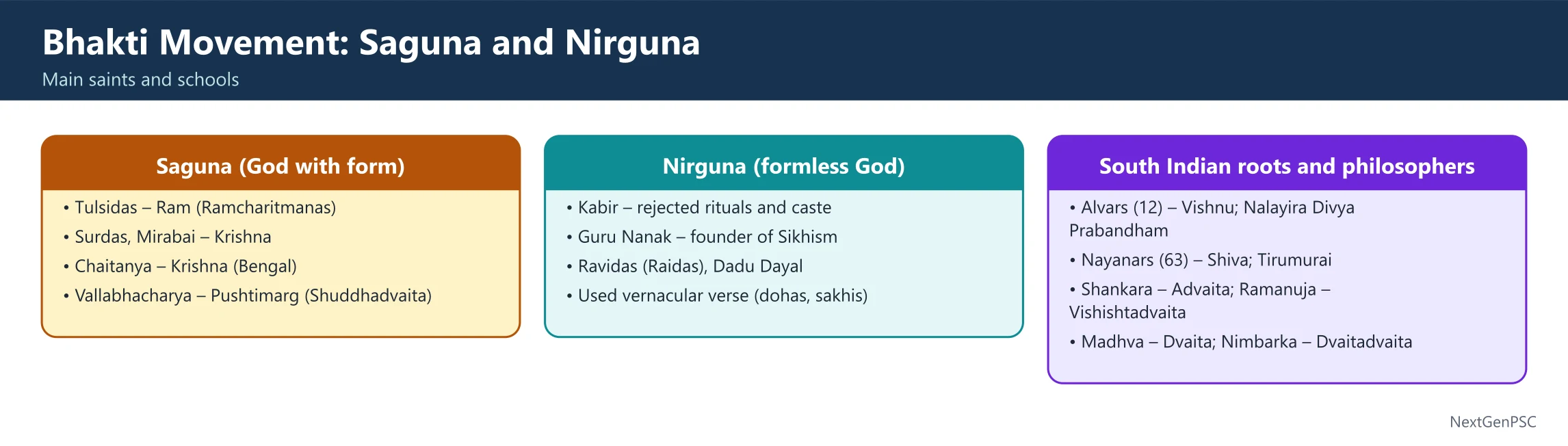
I. Founders of Major Philosophical Schools — Who they were & what they taught
Adi Shankaracharya (8th–9th C):
Doctrine: Propounded Advaita Vedanta (Non-dualism) — Brahman (ultimate reality) alone is real; the visible world is Mithyā (apparent/illusory) due to Maya. Liberation (moksha) is attained through Jnana (knowledge) — discrimination between real and unreal and the removal of ignorance (avidya).
Institutional Legacy: Established four major mathas (monastic centres) — Sringeri, Dwaraka, Puri, and Jyotir (Badrinath) — which helped propagate Vedanta across India and preserve Vedic learning.
Texts & Method: Wrote commentaries (bhashyas) on Upanishads, Bhagavad Gita and Brahma Sutras; used upamana, anumana, and adhikarana style of argumentation.
Ramanujacharya (11th–12th C):
Doctrine: Vishishtadvaita (Qualified Non-dualism) — the soul (jivatma) is distinct yet inseparable part of Brahman; God and souls are related like body and soul. Emphasized Prapatti (surrender) and devotion as a means to liberation.
Social & Religious Impact: Organized temple worship (Sri Vaishnava tradition), stressed the role of bhakti together with knowledge and ethical conduct.
Madhvacharya (13th C):
Doctrine: Dvaita (Dualism) — eternal difference between God (Vishnu) and individual souls; liberation means eternal bliss in God’s presence but not identity with God.
Institution: Founded the Brahma Sampradaya; systematized rituals and devotional practices for his followers.
Nimbarka (12th–13th C):
Doctrine: Bheda-Abheda (Difference-and-Non-difference) — a nuanced view where the soul is at once different and non-different from Brahman. Laid foundations for devotional worship combining metaphysics and bhakti.
Vallabhacharya (15th C):
Doctrine: Shuddha-Advaita (Pure Non-dualism) as interpreted in Pushti Marg — emphasis on God’s grace (pushti) and devotional service to Krishna as means to salvation.
Cultural Impact: Fostered a devotional, artistic culture around Krishna (poetry, music, temple practices).
II. Maharashtra Dharma — The Varkari and Ramdas Traditions
Jnaneshwar / Gyaneshwar (13th C):
Contribution: Wrote the Jnaneshwari (commentary on Bhagavad Gita in Marathi) and promoted direct inner experience of God; made complex Vedantic ideas accessible in the vernacular.
Namdev (13th–14th C):
Contribution: Composer of devotional abhangas (sung poetry); his hymns entered the Guru Granth Sahib, showing cross-religious appeal.
Eknath (16th C):
Role: Literary continuer and synthesizer who bridged early and later Marathi bhakti; emphasized moral living and community devotion.
Tukaram (17th C):
Contribution: Wrote powerful abhangas criticizing social hypocrisy and stressing personal devotion; his work influenced mass mobilization and a sense of social unity in Maharashtra.
Samarth Ramdas (17th C):
Role: Combined bhakti with social ethics and political exhortation (Dasabodha); spiritual guide to Shivaji, linking devotional ideals with social leadership (the so-called Dharakari strain).
III. Nirguna and Regional Saints — Voices of Universalism
Ramananda (14th–15th C):
Role: Important north-Indian preacher who used local languages; emphasized devotion beyond caste barriers and accepted disciples from various backgrounds.
Kabir (15th C):
Doctrine: A leading Nirguna (formless-God) saint; attacked ritualism, idolatry, and caste; used sharp couplets (dohas) to teach inner devotion and social equality. His verses appear in the Bijak and Sikh scripture.
Social Role: Built a bridge between Hindu and Muslim devotional vocabularies; stressed simple moral conduct and communal harmony.
Guru Nanak (15th–16th C):
Role: Founder of Sikhism — integrated Nirguna bhakti with social reform (e.g., langar, equality of sexes and castes), emphasized one God and community service.
Chaitanya Mahaprabhu (15th–16th C):
Role: Revived Krishna-centred devotion (bhakti) in Bengal through ecstatic sankirtan; stressed love (prema) and communal singing as paths to God.
Sankardeva (15th–16th C):
Role: In Assam founded Ekasarana Dharma, emphasized nama-kirtan and organised satsang institutions (satras and naam ghars) which combined devotion with social reform.
IV. Prominent Women Saints — Breaking Social Norms
Akka Mahadevi (12th C):
Contribution: Kannada vachana poet in the Virashaiva tradition; renounced social conventions and wrote intense mystical poetry celebrating union with Shiva.
Jana Bai (13th C):
Role: Marathi low-caste woman poet who wrote about female suffering and spiritual dignity — an early voice against gender and caste constraints.
Mirabai (16th C):
Contribution: Rajput princess turned Krishna devotee; produced devotional poetry celebrating personal surrender and rejecting social expectations of royal life.
Lal Ded (Lalleshwari) (14th–15th C):
Contribution: Kashmiri mystic whose vachanas (vakhs) combine bhakti and advaitic insight; influential in Kashmir’s devotional and mystical traditions.
V. Exam-oriented Summary Points
Doctrine vs Practice: Philosophers (Shankara, Ramanuja, Madhva) gave systematic metaphysics; Bhakti saints popularised religion through vernacular poetry, songs and public worship.
Social Impact: Many founders (Lingayats, Kabir, Nanak) challenged caste hierarchy and promoted social equality — useful for Mains answers on social reform and religious movements.
Sources & Texts: Jnaneshwari, Dasabodha, Ramcharitmanas, Bijak, Guru Granth Sahib, abhangas, and vachanas are primary sources to cite in answers.
Continuities: These teachers influenced later social and reform movements (Sikhism, modern reformers) and shaped regional identities through language and institutions.
| Saint | Philosophy (Vada) | Meaning |
|---|---|---|
| Sankaracharya | Advaita Vada | Pure Monism (God is the only reality) |
| Ramanujacharya | Vishishta Advaitvad | Qualified Monism (Soul is part of God, but distinct) |
| Madhvacharya | Dvaita Philosophy | Dualism (God and soul are separate realities) |
| Nimbarka | Dvait-Advaita | Dualistic Monism (Simultaneous difference and non-difference) |
| Vallabhacharya | Shuddha-Advait | Pure Monism (via Pushtimarg, the path of grace) |
| Saint | Work / Compilation | Language/Sect |
|---|---|---|
| Kabir | Bijak, Verses in Adi Granth | Hindi (Sadhukkadi), Kabirpanthi |
| Guru Nanak | Verses in Adi Granth | Punjabi, Founder of Sikhism |
| Dadu Dayal | Dadu vani, Dadu Ramahit | Hindi/Rajasthani, Dadupanthis |
| Sankardeva | Kirtana-ghosha, Gunamala | Assamese (Brajavali), Ekasarana Dharma |
Prelims tips
- The Advaita philosophy (pure monism) was propounded by Sankaracharya, who is sometimes called Pseudo-Buddha.
- Vishishta Advaitvad (Qualified Monism) was propounded by Ramanujacharya.
- Guru Nanak and Kabir were Nirguna saints whose verses are included in the Adi Granth.
- Gyaneshwar wrote Gyaneshwari (Marathi commentary on Gita).
- Ramananda was the first to use Hindi for propagating Bhakti in North India and abolished caste distinctions among his followers.
Mains points
- The philosophical conflict between Advaita (non-dualism) and Vishishta Advaita/Dvaita (qualified/dualism) provided the intellectual framework for the later evolution of Vaishnavism and Shaivism in South India.
- The Nirguna saints (Kabir, Nanak) utilized vernacular languages and monotheistic ideas (influenced by Islam) to directly challenge the socio-religious dominance of the Brahmanical class.
- The Maharashtra Dharma (Varkari tradition) provided a vital cultural and ideological foundation for the rise of Maratha nationalism under Shivaji by creating a sense of community and shared faith.
- The movement's emphasis on Bhakti over rituals led to the democratization of religion, making salvation accessible to all castes and to women, exemplified by saints like Andal and Mira Bai.
Did you know?
- Sankaracharya established the Four Mathas (Sringeri, Dwarka, Puri, Badrinath) to consolidate the Hindu philosophical tradition across India.
- Tukaram’s poetry was devoted to Vitthal, a deity often associated with the common man and pilgrimage (Varkari tradition).
- Lal Ded's mystic poetry (Vakhs) in Kashmiri is one of the earliest known literary works in the Kashmiri language.
Sufi Movement: Mysticism, Orders, and Impact
The Sufi Movement, the mystical stream of Islam, flowed into India from Persia and Arabia by the 11th century. It focused on Tauhid-i-Wajudi (unity of being) and achieving Fana (self-annihilation) through intense love of God and service to humanity. Sufis organized into Silsilahs (orders) led by a Pir.
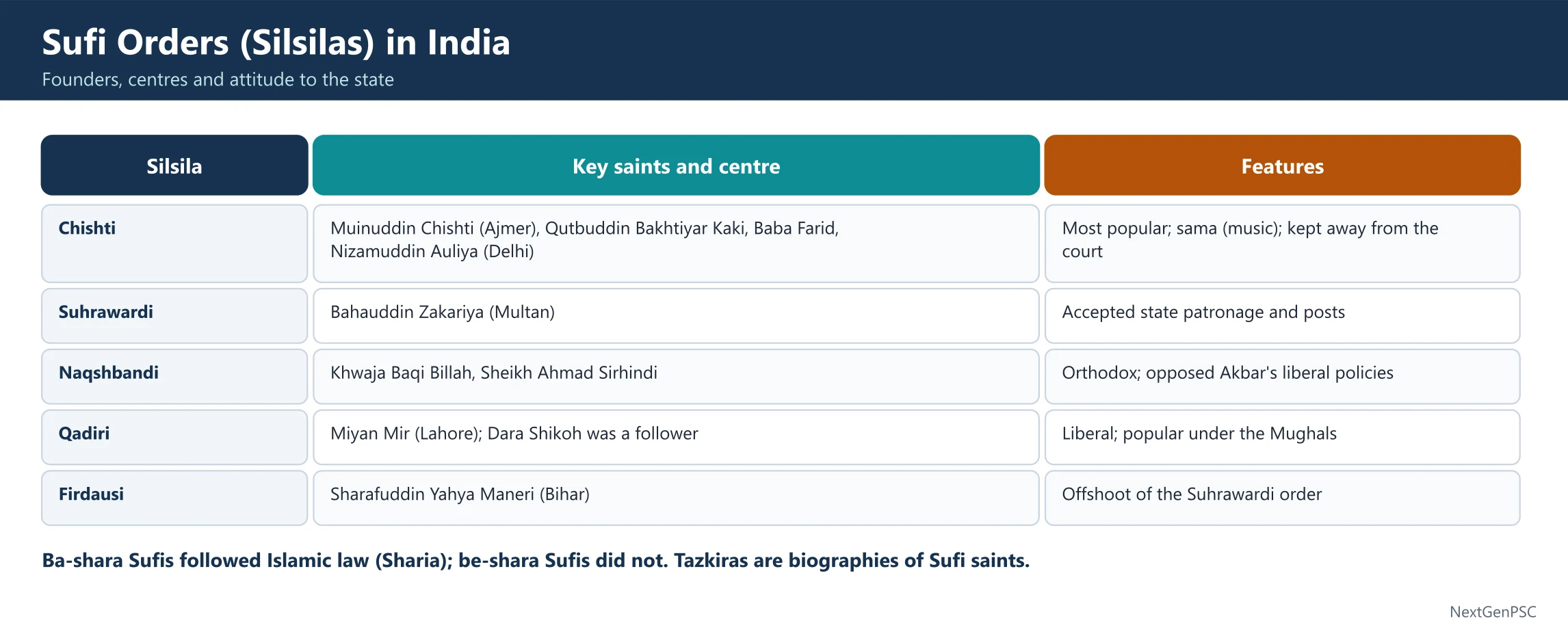
I. Core Concepts and Organisation (Quick Recap)
Meaning: 'Sufi' from suf (wool) — denotes simplicity, asceticism and spiritual purity.
Basic Doctrine: Central idea is Tawhid (unity of God) with mystical emphasis on Tauhid-i-Wajudi (unity of being) in many strands — the seeker aims to experience closeness to God (Qurbat) through love (Ishq) and annihilation of the ego (Fana).
Goal & Practice: Spiritual goal is Fana (annihilation of the self) followed by Baqa (subsistence in God’s presence). Practices include dhikr (remembrance), sama (listening / devotional music), meditation, and service at a khanqah (Sufi hospice).
Organisation: Sufi orders (silsilahs) are chains of spiritual transmission led by a Pir/Sheikh; disciples (murids) live, learn and serve under the guide; the saint’s tomb (dargah) becomes a focal point of devotion and pilgrimage.
II. How Sufism Came to India & Its Spread
Arrival: Sufi ideas reached India with early Muslim traders and later with the movement of scholars and saints from Central Asia, Persia, and the Middle East (11th–13th centuries onwards).
Adaptation: Sufis adapted to local cultures, using vernacular languages and local musical forms to communicate mystical teachings — this made them accessible to peasants, artisans, and the urban poor.
Khanqahs & Dargahs: Functioned as centres of social welfare (food distribution, shelter) and spiritual learning, thus becoming institutions with social as well as religious roles.
III. Major Silsilahs in India — Summary & Distinctives
1. Chishti
Founder in India: Khwaja Moinuddin Chishti (Ajmer).
Features: Emphasis on love, tolerance, poverty, and service. Practiced sama and langar-style charity; avoided close ties to political power.
Notable Saints: Qutbuddin Bakhtiyar Kaki, Baba Farid, Nizamuddin Auliya.
2. Suhrawardi
Founder: Shihabuddin Suhrawardi (ideas) and Bahauddin Zakariya (propagated in India).
Features: More institutional; accepted patronage and often linked with courts; balanced mysticism with legal orthodoxy.
3. Naqshbandi
Founder: Bahauddin Naqshband (Central Asia); important in India through figures like Sheikh Ahmad Sirhindi.
Features: Silent dhikr, emphasis on Sharia conformity; had considerable political influence and reformist zeal.
4. Qadri
Features: Popular in Punjab; known for devotional flexibility; attracted liberal patrons like Dara Shikoh and Jahanara Begum.
IV. Key Saints, Shrines & Texts — Why they matter
Khwaja Moinuddin Chishti (Ajmer): His dargah became a major pan-Indian shrine attracting rulers and commoners alike.
Nizamuddin Auliya (Delhi): Famous for his open khanqah, patronage of qawwals and for shaping Delhi’s syncretic culture.
Baba Farid (Punjab): His couplets are in the Guru Granth Sahib, showing cross-religious appeal.
Literary Output: Sufi poets (e.g., Amir Khusrau) enriched Persian and vernacular literature, and devotional music (qawwali) became a vehicle of popular spirituality.
V. Social, Cultural & Political Impact
Syncretism: Sufism fostered communal interaction — shared devotional practices and shrine culture blurred rigid communal boundaries.
Upliftment & Welfare: Khanqahs performed charitable functions (food, shelter, healthcare) and provided informal dispute resolution.
Influence on Rulers: While some Sufis avoided patronage (Chishti), others engaged with courts (Suhrawardi, Naqshbandi), influencing policy and legitimising rulers — e.g., Dara Shikoh’s interest in Sufi thought; later orthodox influences shaped Aurangzeb’s policies.
Cultural Legacy: Qawwali, urs (annual shrine festivals), and devotional poetry shaped popular religiosity and regional cultures across North India.
VI. Points for UPSC — Prelims & Mains Ready
Prelims: Key names & shrines — Ajmer (Chishti), Nizamuddin (Chishti), Multan (Bahauddin Zakariya), Baba Farid (Pakpattan). Remember Qawwals, Khanqah, Dargah, Pir, Murid.
Mains: Analyse Sufism as a social force — promoted tolerance, vernacularisation of spirituality, and welfare. Also discuss tensions: Sufi syncretism vs. later orthodox reform movements and state politics.
Sample Mains line: “Sufism in medieval India not only provided a pathway to personal salvation but also became an instrument of social cohesion through its khanqahs, devotional music and shrine culture; however, its relationship with political power was ambivalent and changed across time and orders.”
| Silsilah | Founder (India) | Key Saints | State Stance |
|---|---|---|---|
| Chishti | Khwaja Moinuddin Chishti | Nizamuddin Auliya, Baba Farid | Rejected state grants; focused on masses. |
| Suhrawardi | Bahauddin Zakariya | Bahauddin Zakariya | Accepted grants and state positions. |
| Naqshbandi | Sheikh Baqi Billa | Sheikh Ahmad Sirhindi | Most orthodox; demanded strict Sharia adherence (anti-Sama). |
| Qadri | Sheikh Abdul Qadir (via Miyan Mir) | Miyan Mir, Dara Shikoh (disciple) | Liberal; influential in Punjab. |
Prelims tips
- The word Sufi is derived from 'suf' (wool).
- The core doctrine of Sufism is Tauhid-i-Wajudi (Unity of Being).
- The Chishti Silsilah was the most popular in India and rejected state patronage.
- Nizamuddin Auliya belonged to the Chishti Silsilah.
- The Naqshbandi Silsilah was the most orthodox and puritanical order (influenced Aurangzeb).
- Dara Shikoh was a disciple of the Qadri Silsilah.
Mains points
- The Sufi movement served as a vital bridge for Hindu-Muslim synthesis, utilizing vernacular languages and music (Sama) to attract mass appeal and promote tolerance.
- The conflict between the Chishti (liberal/rejecting state power) and Suhrawardi (accommodating state power) orders demonstrates the varied approaches Sufis adopted towards the political structure.
- The rise of orthodox orders like the Naqshbandi (e.g., Sheikh Ahmad Sirhindi) later drove a puritanical movement that reversed the liberal religious policies of Akbar and influenced the policies of Aurangzeb.
- The Sufi emphasis on Fana (self-annihilation) through devotion was parallel to the Bhakti emphasis on Moksha through love, establishing a common ground for spiritual dialogue.
Did you know?
- Baba Farid (Chishti saint) is considered one of the first Punjabi poets, and his verses were incorporated into the Guru Granth Sahib.
- Nizamuddin Auliya was famous for his simple lifestyle and his belief that the shortest way to God was through service to humanity.
- The Sufi Khanqahs (hospices) often functioned as community kitchens and centers for arbitration, serving people regardless of their religious background, much like the Bhakti Langar.
The Rise of Sikh Power: Misls and Ranjit Singh
The Sikhs organized themselves into twelve powerful, sovereign territorial units called Misls after the decline of the Mughals. This confederacy was unified by Maharaja Ranjit Singh (1780–1839 AD) into the powerful Sikh Empire, making it the last major indigenous power to challenge British expansion.
I. The Rise of the Misls (18th Century)
Context: Following the persecution of the Sikh Gurus and the subsequent collapse of centralized Mughal authority after Aurangzeb's death, the Sikh community transitioned from a religious group to a military and political power.
Misl Organization: The word Misl means 'equal' or 'alike'. These were sovereign territorial segments (chiefdoms) and military brotherhoods that ruled over various parts of Punjab. Each Misl was headed by a Misladar or Sardar.
Dal Khalsa: The Misls were loosely united under the Dal Khalsa (Khalsa Army), which served as the central military and political organization. Their combined authority was known as Sarbat Khalsa, which met biannually at Amritsar to pass resolutions (Gurumatta).
Sukerchakia Misl: Ranjit Singh was born into the Sukerchakia Misl, which was active in the Gujranwala region. He gradually consolidated power, leveraging his military and diplomatic skill.
II. Maharaja Ranjit Singh (1780–1839 AD): The Sher-e-Punjab
Unification: Ranjit Singh successfully eliminated the competing Misls and unified Punjab under a centralized administration. He captured Lahore (1799) and made it his capital, followed by the capture of Amritsar (1805).
Treaty of Amritsar (1809): Signed with the British East India Company, this treaty recognized the Sutlej River as the boundary between Ranjit Singh's territories and the Company's sphere of influence. This stabilized the eastern border and allowed him to focus on western expansion.
Conquests: Expanded the empire westward, conquering Kashmir, Peshawar, Multan, and Derajat, creating a large, secure border along the northwest frontier.
Modern Army: His greatest achievement was the creation of a modern, disciplined army (the Fauj-i-Khas) based on European lines. He employed European generals (like Ventura and Allard) to train his infantry and artillery, making it one of the most formidable forces in Asia.
III. Administration and Culture
Administration: Ran a highly centralized and efficient administration, characterized by secular policies, fair taxation, and a strong revenue system.
Religious Policy: Was famously secular and tolerant. He protected Hindu and Muslim subjects equally, never forcing religious conversion. He rebuilt the Harmandir Sahib (Golden Temple) in marble and gold.
Death and Decline: His death in 1839 AD created a power vacuum, leading to rapid succession disputes and internal feuding among his successors and the court (Khalsa Army vs. Durbar). The decline was swift.
IV. Anglo-Sikh Wars and Annexation
First Anglo-Sikh War (1845–46): Fought due to border tensions and the Khalsa Army's distrust of the British. Ended with the Treaty of Lahore (1846), placing a British resident in Lahore.
Second Anglo-Sikh War (1848–49): Fought during the time of Lord Dalhousie. Ended with the decisive British victory and the annexation of Punjab (1849). The Sikh Empire was dissolved, marking the final stage of British conquest of India.
Legacy: The Sikh Empire was the last sovereign state annexed by the British, delaying the full consolidation of British rule until the mid-19th century.
Khadga Dal: Ranjit Singh's army was organized into two wings — the Khadga Dal (regular infantry and cavalry) and the Dharamarth (irregular and jagirdari forces).
| Year | Event | Significance |
|---|---|---|
| 1799 | Capture of Lahore | Made capital; consolidated power in central Punjab. |
| 1809 | Treaty of Amritsar | Set Sutlej River as the boundary with the British. |
| 1819 | Conquest of Kashmir | Extended the empire to the north; gained control of shawl trade. |
| 1839 | Death of Ranjit Singh | Marked the beginning of the empire's rapid decline. |
Prelims tips
- The Misls were Sikh military brotherhoods that governed territories after the Mughal decline.
- The Dal Khalsa was the central political and military organization of the Sikh Misls.
- Maharaja Ranjit Singh belonged to the Sukerchakia Misl.
- The Treaty of Amritsar (1809) fixed the Sutlej River as the border between the British and the Sikh Empire.
- Ranjit Singh's modern army was called the Fauj-i-Khas.
- Banda Singh Bahadur, after Guru Gobind Singh, led a Sikh uprising, captured Sirhind (1710), struck coins and abolished zamindari in areas he controlled; he was executed by the Mughals in 1716.
Mains points
- The rise of the Misls demonstrates a successful transition from a religious-militant movement to a decentralized regional political system following the vacuum left by the Mughal decline.
- Maharaja Ranjit Singh's reign exemplifies the final stage of Indian regional state formation in the 18th century, characterized by centralized military modernization (Fauj-i-Khas) and secular administration.
- The Anglo-Sikh Wars highlight the failure of the Sikh Empire to maintain political unity after the strong central leadership (Ranjit Singh) was removed, allowing the British to exploit internal feuds.
- The Sikh Empire's longevity was a testament to the effectiveness of the Treaty of Amritsar (1809), which successfully deterred direct British intervention for two decades.
Did you know?
- Ranjit Singh's army was known for its non-religious composition; generals and soldiers were often European, Hindu, or Muslim, recruited based on merit, reflecting his secular administration.
- He was the only major Indian ruler who died in 1839 without his kingdom having signed a Subsidiary Alliance with the British.
- Ranjit Singh wore the famous Koh-i-Noor diamond on his arm in public.
Regional Kingdoms of Awadh and Travancore (18th Century)
The 18th century saw the emergence of successor states like Awadh (North India) and indigenous states like Travancore (South India). While Awadh was annexed through a Subsidiary Alliance, Travancore developed as an independent regional power, notably under Marthanda Varma, who modernized the state and its military.
I. Regional Kingdom: Awadh (Oudh)
Type: A major successor state that emerged from the break-up of the Mughal Empire.
Founder: Saadat Ali Khan (also known as Burhan-ul-Mulk) founded the autonomous state of Awadh in 1722 AD.
Capital: Initially Faizabad, later shifted to Lucknow by Asaf-ud-daula.
Administration: Awadh developed a distinctive composite culture where Shia Nawabs and local Hindu and Muslim elites (Zamindars) cooperated for revenue and stability.
Key Event - Battle of Buxar (1764): Nawab Shuja-ud-daula allied with Mir Qasim (Bengal) and the Mughal Emperor against the British. The defeat was disastrous, leading to the Treaty of Allahabad (1765) and bringing Awadh under British influence.
Decline/Annexation: Awadh became one of the first major states to enter the Subsidiary Alliance system and was later annexed by Lord Dalhousie (1856) on grounds of 'misgovernance', despite the Nawab's cooperation.
II. Indigenous State: Travancore
Type: An indigenous kingdom of the Malabar coast (Kerala), which rose to prominence amidst the decline of the Zamorin of Calicut.
Zenith Ruler: Marthanda Varma (1729–1758 AD) is considered the founder of modern Travancore. He consolidated the state by defeating local chiefs and expanding territory.
Military Modernization: Varma's most famous victory was the Battle of Colachel (1741), where he decisively defeated the Dutch East India Company. This was the only recorded instance where an Indian state defeated a European naval power in a major battle, ending Dutch ambition in India.
Administration/Culture: Varma modernized his army along European lines (under the Dutch general Eustachius De Lannoy), developed the port of Colachel, and shifted the capital to Thiruvananthapuram (Trivandrum). The state was known for its patronage of arts (Kathakali) and literature.
Religious Policy: The royal family dedicated the state to the deity Padmanabha (Vishnu) and ruled as 'Padmanabha Dasa' (Servant of the Deity), symbolizing a unique blend of spiritual and temporal authority.
Subsidiary Alliance: Travancore later entered a Subsidiary Alliance with the British (1795) but retained much of its internal autonomy until India's independence.
| State | Type | Key Ruler | Military Significance |
|---|---|---|---|
| Awadh | Successor State (Mughal) | Saadat Ali Khan (Founder) | Defeat in the Battle of Buxar (1764) led to British influence. |
| Travancore | Indigenous/Independent | Marthanda Varma (Modernizer) | Decisively defeated the Dutch at the Battle of Colachel (1741). |
Prelims tips
- The founder of the autonomous state of Awadh was Saadat Ali Khan.
- Lucknow became the capital of Awadh under Asaf-ud-daula.
- The annexation of Awadh (1856) was carried out by Lord Dalhousie.
- Marthanda Varma was the modernizer and greatest ruler of Travancore.
- The Battle of Colachel (1741) was a decisive victory for Travancore against the Dutch.
Mains points
- The comparison between Awadh and Travancore illustrates two distinct models of 18th-century state formation: Awadh, the wealthy Mughal successor state that succumbed early to British political pressure, and Travancore, the resilient indigenous state that modernized its military (Battle of Colachel) to successfully resist European power.
- The annexation of Awadh on the pretext of 'misgovernance' highlights the ruthless and arbitrary nature of British expansionism under Lord Dalhousie, designed to acquire territory based on strategic and commercial interests.
- Travancore's victory at the Battle of Colachel demonstrates that successful resistance to European powers in the 18th century was possible for Indian states that adopted military modernization and possessed strong, centralized leadership.
Did you know?
- Awadh's later decline was ironically characterized by a refined, composite culture, the Lucknavi *Tehzeeb*, known for its poetry, music, and elaborate court etiquette.
- Marthanda Varma employed the captured Dutch commander Eustachius De Lannoy to modernize and train his army, demonstrating a pragmatic approach to military technology.
- Travancore's dedication of its kingdom to Lord Padmanabha is called Trippadidanam.
Medieval Indian History: All chapters
- Early Medieval Period
- Vijayanagar and Bahmani Kingdom
- The Maratha Empire and other Regional States
- The Delhi Sultanate
- Mughal Empire