
Medieval Indian History · UPSC Notes
The Delhi Sultanate — UPSC Medieval History Notes
Free, exam-focused notes for UPSC Prelims and Mains, with Prelims tips and Mains points for every topic. 16 topics.
Open in the interactive reader: bookmarks, progress tracking and read-aloud.
Ghorian Invasions and the Foundation of the Sultanate
Ghurid expansion, especially after the Second Battle of Tarain (1192), created the conditions for a Delhi-centred polity. The Delhi Sultanate was consolidated after 1206 by Qutb al-Din Aibak and his successors through warfare, revenue assignments, alliances and urban administration; it was not the automatic outcome of one battle.
I. Muhammad Ghori's Objectives and Invasions
Objective: Unlike the Ghaznavids (like Mahmud of Ghazni), whose primary goal was plunder, Muhammad Ghori aimed to establish a permanent military base and political empire in India.
First Battle of Tarain (1191 AD): Ghori was defeated by the Chauhan ruler Prithviraj III. The story that Prithviraj magnanimously spared Ghori comes from later literary traditions and should not be used as established historical fact.
Second Battle of Tarain (1192 AD): Ghori defeated Prithviraj Chauhan. Mounted warfare and tactics were important, but explain the outcome through military organisation, leadership, resources and regional politics rather than claims of inherent cultural or military superiority. Conquest and consolidation in the Gangetic plain continued after 1192.
Battle of Chandawar (1194 AD): Ghori defeated Jayachandra (Gahadavala ruler of Kannauj), securing control over the fertile Doab region, which was crucial for the Sultanate's revenue base.
Consequences of Victory: Ghori secured the heartland of North India (Delhi and the Doab). He appointed his trusted military general and slave, Qutbuddin Aibak, as the Viceroy to manage and consolidate the conquests.
II. Succession and Foundation of the Sultanate
Ghori's Death (1206 AD): Ghori died in 1206 AD. Since he had no male heir, his territories were divided among his trusted military slaves and officers (Mamluks), who controlled key regions (Yaldauz in Ghazni, Qubacha in Multan, Aibak in Delhi/Lahore).
Qutbuddin Aibak's Accession (1206 AD): Aibak asserted his independence from Ghazni and declared himself the Sultan in 1206 AD, establishing the Mamluk (Slave) Dynasty and thus the Delhi Sultanate. He focused on consolidating the scattered territories left by Ghori.
Significance: The Ghorian invasions transformed the nature of warfare in India, introducing the fast, highly mobile Central Asian cavalry and the use of the Iqta system for military-fiscal maintenance, which became foundational for the Sultanate.
| Battle | Year (AD) | Indian Ruler | Significance |
|---|---|---|---|
| First Battle of Tarain | 1191 | Prithviraj Chauhan III (Chauhan) | Ghori decisively defeated; shows early Rajput military strength. |
| Second Battle of Tarain | 1192 | Prithviraj Chauhan III | Decisive Ghori victory; established Turkish rule in the Gangetic plain (pivotal event). |
| Battle of Chandawar | 1194 | Jayachandra (Gahadavala) | Ghori secured the Doab/Kannauj heartland (revenue base). |
| Aibak's Accession | 1206 | N/A | Qutbuddin Aibak declared Sultan; founding of the Delhi Sultanate. |
Prelims tips
- Muhammad Ghori’s defeat of Prithviraj Chauhan in the Second Battle of Tarain (1192) was the turning point.
- The Battle of Chandawar (1194) defeated the Gahadavala ruler Jayachandra.
- The Delhi Sultanate was established in 1206 AD by Qutbuddin Aibak (a Mamluk of Ghori).
- Ghori's invasions differed from Ghaznavid invasions because they aimed at political conquest.
Mains points
- The Ghorian invasions, unlike transient raids, established a territorial base (Delhi/Doab) and a political system (Mamluk rule) that led directly to the Sultanate, marking a fundamental transformation of North Indian polity.
- The Battles of Tarain and Chandawar exemplify the technological and strategic superiority of the centralized, mobile Turkish cavalry over the segmented, elephant/infantry-based Rajput forces.
- The rise of Qutbuddin Aibak from slavery to sovereignty reflects the unique socio-political mobility inherent in the Mamluk system, where merit and loyalty could override birthright.
Did you know?
- Prithviraj Chauhan's reluctance to immediately annihilate Ghori's army after the First Battle of Tarain is often cited as a fatal strategic mistake, influenced by the chivalric codes of the time.
- Muhammad Ghori viewed his Mamluk (slave) commanders, like Aibak and Iltutmish, as his heirs, famously saying that they would inherit his legacy, which proved true.
Introduction to the Delhi Sultanate (1206–1526 AD)
The Delhi Sultanate (1206–1526 AD) was the first long-lasting Islamic polity in northern India. Founded by former military slaves and dominated by Turkish and Afghan elites, it comprised five dynasties — Mamluk (Slave), Khalji, Tughlaq, Sayyid, and Lodi — and laid foundations for centralized medieval statecraft, Indo-Islamic culture, and administrative practices later adopted by the Mughals.
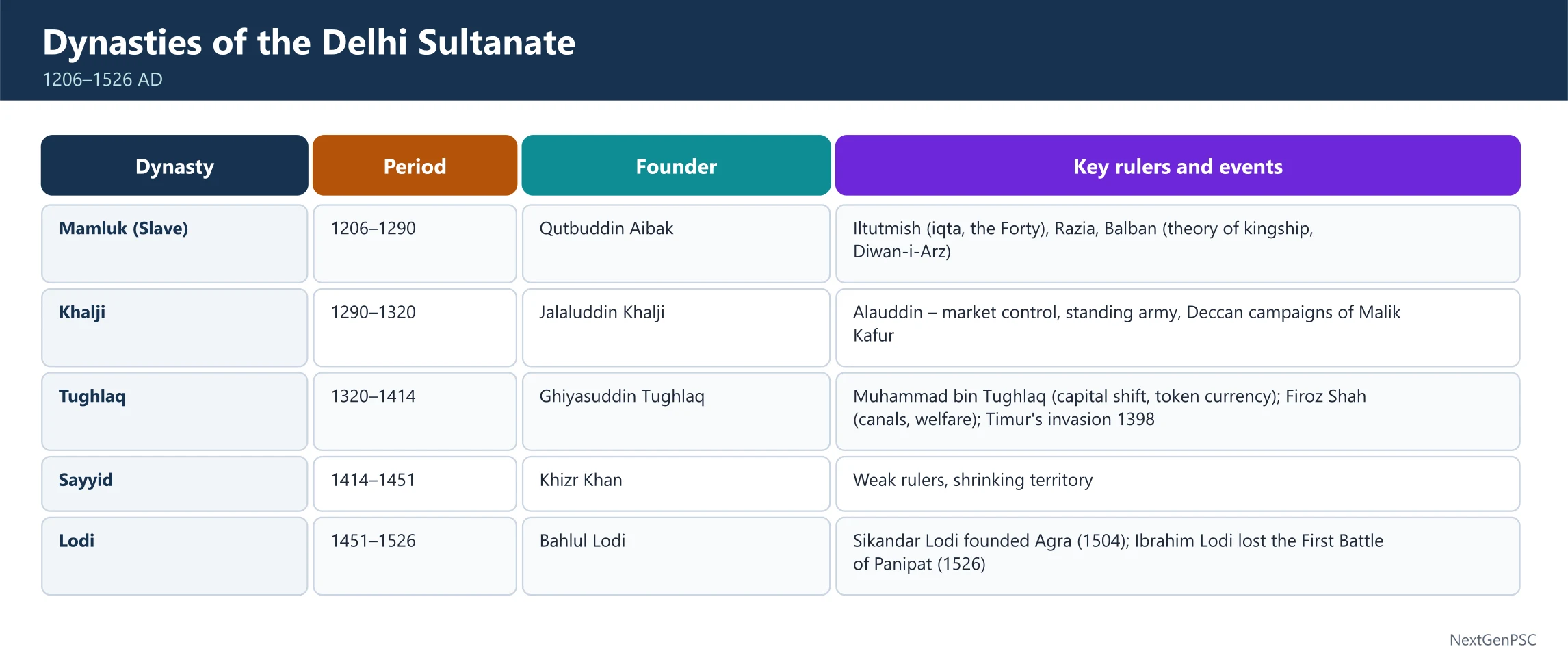
I. Chronology & Major Dynasties
Duration: c. 1206–1526 AD (establishment after Muhammad Ghori’s conquests; end with Babur’s victory at First Panipat, 1526).
Dynasties: Mamluk/Slave (1206–1290), Khalji (1290–1320), Tughlaq (1320–1414 approx), Sayyid (1414–1451), Lodi (1451–1526).
Founder: Qutb-ud-din Aibak (former slave of Muhammad Ghori) — established control from Delhi and built early Islamic monuments.
II. Political and Administrative Structure
Central Authority: Sultan was the supreme ruler with powers over law, land grants, and military command; however, real control varied with the strength of individual sultans.
Administrative Framework: Iqta system (land assignments to nobles and officers) for revenue and military maintenance; a bureaucracy of revenue officers (amil), local zamindars, and village headmen mediated control.
Military: Relied on cavalry, mounted archers, and slave soldiers (ghulams/mamluks). Military expeditions extended Sultanate influence into Deccan and Bengal at various times.
Provincial Governance: Provinces (iqta or governorships) were governed by appointed governors; frequent rebellions and decentralization occurred during weak rule (e.g., late Tughlaq period).
III. Economy and Land Revenue
Agriculture: Agrarian economy based on village production; land revenue was the main state income.
Revenue Systems: Iqta assignments used to fund troops; direct revenue assessment experiments (e.g., Alauddin Khalji’s and Muhammad bin Tughlaq’s reforms) attempted to centralise income but often faced implementation issues.
Trade & Commerce: Urban growth (Delhi, Multan, Lahore, Bengal cities) and international trade (Indo-Islamic links with Central Asia, Persia, and the Indian Ocean). Market regulations (price controls) were imposed during Alauddin Khalji’s reign.
IV. Society, Religion & Law
Religious Plurality: Predominantly Hindu population ruled by a Muslim elite. The Sultanate adopted a pragmatic approach — some rulers patronized Hindu institutions, others enforced stricter orthodoxy.
Legal Systems: Sharia for Muslims; in practice, a mixture of Islamic law for personal law and customary/administrative law for non-Muslims. Qadis (judges) and revenue officers played roles in governance.
Social Mobility: Military slavery and patronage allowed talented individuals (including non-Turks) to rise — evident in administrative and military posts.
V. Culture, Language & Literature
Language: Persian became the language of administration and high culture; local vernaculars flourished under patronage.
Literature & Learning: Persian chronicles (e.g., by Barani), Sufi literature, and translations; growth of Indo-Persian historiography and administrative writing.
Architecture: Introduction and development of Indo-Islamic architecture — Qutb Minar, Quwwat-ul-Islam Mosque, Alai Darwaza, Tughlaqabad, Siri and Firozabad remains; use of arches, domes, and new construction techniques blended with local styles.
VI. Important Rulers & Policies (select)
Qutb-ud-din Aibak: Consolidation, early monuments (Qutb complex).
Iltutmish: Consolidated the Sultanate, introduced Iltutmish’s silver tanka and the iqta system; recognized by the Abbasid Caliph.
Alauddin Khalji: Market regulations, military expansion (Deccan campaigns), revenue reforms, strong central control.
Ghiyasuddin Tughlaq & Muhammad bin Tughlaq: Administrative experiments — Muhammad bin Tughlaq’s token currency and transfer of capital to Daulatabad; ambitious but often failed reforms leading to unrest.
Firoz Shah Tughlaq: Public works (canals, rest-houses), patronage of architecture and urban projects.
Ibrahim Lodi: Last Sultan; weakened central authority led to Babur’s invasion (1526).
VII. Decline & Fall
Causes: Succession disputes, decentralization of power, fiscal stress from military campaigns and failed reforms, regional assertions (e.g., Bengal, Deccan), and growing Afghan power culminating in the Lodis’ weak rule.
Terminal Event: Defeat of Ibrahim Lodi by Babur at the First Battle of Panipat (21 April 1526), initiating the Mughal era.
VIII. Legacy & Significance
State Formation: Laid administrative and military foundations that influenced later Mughal governance (centralised revenue ideas, court culture, use of Persian).
Cultural Synthesis: Fusion of Islamic and Indian art, architecture, language and religious interactions (Sufism, shared shrine culture).
Urbanisation: Growth of new urban centres and revival of trade routes across the subcontinent.
IX. Sources & Historiography
Contemporary Sources: Persian chronicles (e.g., Minhaj-i-Siraj, Ziauddin Barani), coinage, inscriptions, architecture, traveler accounts.
Interpretations: Historians debate the Sultanate’s nature — as a foreign imposition vs. a dynamic polity that adapted to Indian conditions and produced significant socio-cultural change.
X. Prelims & Mains Tips
Prelims: Remember dynastic sequence (Mamluk, Khalji, Tughlaq, Sayyid, Lodi), key monuments (Qutb Minar, Alai Darwaza, Tughlaqabad), and major administrative terms (iqta, tanka, tughra).
Mains: For essay/GS answers, discuss state formation, administrative experiments (successes and failures), socio-religious interactions (Sufism, temple-patronage), and the Sultanate’s role as a precursor to Mughal centralisation.
Sample Mains line: “The Delhi Sultanate, though born out of martial conquest, deserves credit for initiating institutional experiments in revenue, military and urban governance; its ambiguous legacy lies in both the centralisation of power and periodic failures that exposed limits of medieval state capacity.”
Political History of the Mamluk Sultans (1206–1290 AD)
The Mamluk period established the Delhi Sultanate, founded by Qutbuddin Aibak. The true consolidation of the empire, however, was achieved by Iltutmish, who repelled rivals, gained Caliphal legitimacy, and instituted the Iqta system and the Turkan-i-Chahalgani.
I. Qutb-ud-din Aibak (r. 1206–1210 AD)
Founder: A former Turkic slave of Muhammad Ghori, Aibak became the first independent Muslim ruler in northern India and is regarded as the founder of the Delhi Sultanate (established 1206 AD).
Military & Consolidation: Secured control of the Gangetic plain after Ghori’s death, defeated local rivals (including Tajuddin Yaldauz) and kept Rajput resistance in check to establish a power base around Delhi and Lahore.
Administrative Acts: Began the process of converting military gains into a stable polity by appointing trusted nobles and establishing early iqta arrangements (land-for-service).
Architectural Legacy: Initiated major Islamic monuments — began the Quwwat-ul-Islam mosque and the Qutb Minar complex in Delhi (later continued by Iltutmish).
Nicknamed: Known as “Lakh Baksh” (giver of lakhs) for his reputed generosity.
Death & Succession: Died in 1210 AD after an accident playing chaugan (polo). His weak successor Aram Shah was soon replaced by Iltutmish, invited by the Turkish nobles of Delhi.
II. Shams-ud-din Iltutmish (r. 1211/10–1236 AD)
Consolidator of the Sultanate: Often called the real architect of the early Sultanate — consolidated territories, stabilized administration, and defended the state against external threats.
Military & Diplomacy: Defeated Tajuddin Yaldauz (Battle of Tarain c.1215 AD), secured the frontier against Turkic rivals and diplomatically navigated the Mongol threat by refusing asylum to Jalal-ud-din Mingburnu (c.1220).
Recognition: In 1229 AD he obtained formal investiture (a letter of investiture) from the Abbasid Caliph, giving religious legitimacy to his rule.
Administrative Reforms:
Turkan-i-Chahalgani: Created the 'Group of Forty' — a council of Turkish nobles which became an important political body (later, a source of factionalism).
Coinage: Standardised coinage — issued the silver tanka and copper jital, strengthening fiscal practice.
Iqta system: Institutionalised iqta grants to officers for revenue and military maintenance, consolidating control over the Doab and key regions.
Succession & Raziya: Rejected incompetent male heirs and nominated his capable daughter, Raziya (Razia Sultan), who later ruled (r. 1236–1240 AD) — an important episode for gender and polity in medieval India.
Cultural & Architectural Contributions: Patron of building activity and of Persianate court culture; completed works at the Qutb complex and promoted urban growth around Delhi.
Significance: Turned a fragile military conquest into a recognisable state with administrative structures, fiscal instruments, and a legitimised monarchy — foundations later rulers built upon.
Exam Tips (Prelims & Mains)
Prelims memory points: Aibak (1206–1210) — began Qutb Minar; Iltutmish (c.1211–1236) — silver tanka, letter of investiture (1229), Turkan-i-Chahalgani, nominated Raziya.
Mains angle: Use Iltutmish to illustrate the transition from conquest to institution-building (iqta, coinage, legitimacy). Discuss Aibak as the military founder and Iltutmish as the administrative consolidator.
Quote line: “Aibak laid the stones; Iltutmish built the house” — useful shorthand to explain founder vs consolidator roles.
| Ruler | Period | Major Achievement/Challenge | Significance |
|---|---|---|---|
| Qutbuddin Aibak | 1206–1210 AD | Founder of Delhi Sultanate; Known as Lakh Baksh. | Established independent Turkish rule in India. |
| Iltutmish | 1210–1236 AD | Defeated rivals; averted Chenghiz Khan threat; secured Caliphal legitimacy (1229). | Real founder and consolidator of the Sultanate. |
| Raziya Sultan | 1236–1240 AD | First and only female Muslim ruler of Delhi. | Challenged the feudal male authority of the Turkan-i-Chahalgani. |
| Balban | 1266–1287 AD | Eliminated Turkan-i-Chahalgani; introduced divine kingship theory. | Restored authority and order; ended Mamluk influence. |
Prelims tips
- Qutbuddin Aibak was the founder; Iltutmish was the real founder and consolidator.
- Iltutmish averted the Chenghiz Khan threat in 1220 AD.
- Iltutmish introduced the silver 'Tanka' and the copper 'Jittal'.
- Iltutmish obtained Caliphal recognition in 1229 AD.
- Aibak was known as Lakh Baksh; Iltutmish nominated his daughter, Raziya, as successor.
Mains points
- The Mamluk period was crucial for institutionalizing Turkish rule. Reforms like the Iqta System enabled the Sultanate to control the conquered territories financially and militarily without relying on native feudal lords.
- The Turkan-i-Chahalgani was a double-edged sword: it initially provided loyal administrative support but later became the primary destabilizing factor, controlling the weak successors and challenging the very authority of the Sultan.
- Iltutmish's strategic diplomatic moves—avoiding the Mongols and gaining Caliphal recognition—demonstrated a political farsightedness essential for the survival and separation of the nascent Delhi Sultanate from Central Asian politics.
- Raziya's brief reign highlights the power struggle between the monarchy (supported by the people) and the powerful, entrenched Turkish nobility (who resented a female ruler).
Did you know?
- Aibak died while playing Chaugan (an early form of Polo), symbolizing the adventurous, military nature of the Mamluk elite.
- Raziya ascended the throne with the direct support of the people of Delhi and some military leaders, marking a rare instance of popular will overriding noble dissent in medieval India.
- Iltutmish's acquisition of the Letter of Investiture from the Caliph gave his rule a legitimacy that was acknowledged far beyond India.
Raziya, Nasiruddin Mahmud, and Balban (Delhi Sultanate)
This section covers three key Mamluk Sultans: Raziya, the only female ruler of the Sultanate, whose attempt to create a non-Turkic nobility led to her downfall; Nasiruddin Mahmud, a weak ruler under the dominance of his Naib, Balban; and Balban, who strengthened the Sultanate through a stern, autocratic kingship and a policy of consolidation.
I. Raziya (Razia Sultan) (r. AD 1236–1240)
Background: Daughter of Iltutmish, Raziya was nominated by her father (an unusual move) and became one of the very few women rulers in medieval India.
Administrative Style: Assertive and capable — she appeared in public without the veil, led state affairs personally, and tried to curb the power of the Turkish nobility (Chahalgani).
Conflict with Nobility: Her attempt to create a counter-nobility by promoting non-Turkish officers (notably the Abyssinian slave Malik Jamaluddin Yaqut, appointed amir-i-akhur) enraged the Turkish amirs who saw this as an attack on their privileges.
Charges & Revolt: The nobles exploited gender prejudices — accusing her of violating feminine norms and being too close to Yaqut — to mobilise provincial revolts. The Turkish nobility (Chahalgani) rose in many provinces.
Downfall & Death: Defeated by rebel nobles, Raziya was captured and later killed in 1240 AD. Her short reign demonstrated both the possibilities and limits for a woman ruler in a male-dominated military polity.
Significance: Her reign highlights tensions between sovereign authority and a powerful military aristocracy; her failure strengthened the hand of the Chahalgani, who thereafter became king-makers.
II. Interregnum: Chahalgani Influence (AD 1240–1246)
Succession Politics: After Raziya, the Chahalgani reasserted control — they installed weak puppet sultans in quick succession (Behram Shah 1240–42, Masud Shah 1242–46) to protect their interests.
Rise of Balban: In AD 1246, to stabilise power, Ulugh Khan (later Balban) placed the young Nasiruddin (Iltutmish’s grandson) on the throne and took the real power as Naib (deputy), marking the beginning of Balban’s ascendancy.
III. Nasiruddin Mahmud (r. AD 1246–1266)
Nominal Sultan: Nasiruddin was king in name while real authority lay with his deputy Ulugh Khan (Balban).
Power Struggles: The struggle between the Sultan and the Turkish chiefs (Chahalgani) continued, reflecting deep factionalism within the elite.
Balban’s Consolidation: To secure his influence, Balban married his daughter to Nasiruddin — strengthening family ties to the throne while keeping effective power in his hands.
Death & Controversy: Nasiruddin died in AD 1265/66. Contemporary chroniclers like Ibn Battuta and Isami allege that Balban poisoned him to seize power — a contested claim but indicative of the cut-throat politics of the period.
IV. Balban (Ulugh Khan) (r. AD 1266–1287)
Background & Accession: Ulugh Khan, who had been the power behind the throne, finally assumed the sultanate in AD 1266 as Balban after removing or neutralising rival Turkish chiefs.
Security & Internal Order: Faced multiple internal and external threats — hostile Turkish chiefs, rebellious provincial governors, bold Rajput zamindars, Mewati banditry in the Doab, and the Mongol menace in the Punjab. Roadways and communications were insecure in several regions.
Stern Measures: Adopted a tough policy of law-and-order — he crushed rebellions in Mewat, Doab, Awadh and Katihar; destroyed Rajput strongholds near Badaun; and suppressed Tughril Beg’s revolt in Bengal (1279).
Military & Administrative Reforms: Reorganized the military department (Diwan-i-Arz), stationed forces across the country to deter revolts and Mongol incursions, and appointed spies in every department to keep informed of threats.
Kingship & Court Ritual: Elevated the dignity of monarchy — enforced court ceremonials (sijda, paibos), discouraged frivolity in court (no joking, no public laughter), and projected majesty to instil awe and obedience.
Centralisation & Autocracy: Sought to break the power of the Chahalgani, refused to share power even with family, and trusted a narrow circle — this restored royal authority but alienated non-Turkish groups.
Foreign Policy: Consolidation, not expansion — he secured Ajmer and Nagaur but failed to capture Ranthambore and Gwalior; maintained a ready army to check Mongol pressure but could not decisively eliminate the threat.
Administrative Legacy: Strengthened monarchy, institutionalised surveillance and central military organisation; Balban is often credited with building the idea of sacral kingship in Delhi (divine aura and regal majesty).
Downside & Aftermath: His racial exclusiveness (preference for Turks), autocratic style, and limited social base meant that after his death (AD 1287) the Sultanate again suffered factional instability and fresh disturbances.
V. Exam-focused Summaries
Prelims: Dates & names — Raziya (1236–1240), Behram Shah (1240–42), Masud Shah (1242–46), Nasiruddin Mahmud (1246–66), Balban (1266–1287). Recall key facts — Raziya’s appointment of Yaqut, Balban’s reign and death (1287), and Tughril Beg’s revolt in Bengal (1279).
Mains: Use Raziya to discuss limits of royal autonomy in military-polity; use Balban to illustrate centralising response to fragmentation, the evolution of kingship and court ceremonial, and the inherent tension between monarchy and military aristocracy.
Sample Mains line: “The reigns of Raziya and Balban reveal two sides of Sultanate politics — the vulnerability of sovereign power to aristocratic interests, and the desperate measures of centralisers to restore monarchical authority.”
| Sultan | Reign | Key Event/Policy |
|---|---|---|
| Raziya | AD 1236–40 | Only female ruler; appointed non-Turk Malik Yaqut; faced revolt by Turkish Amirs (Chahalgani). |
| Nasiruddin Mahmud | AD 1246–66 | Weak ruler; controlled by Naib Balban; suspected to be poisoned by Balban. |
| Balban | AD 1266–87 | Known as Ulugh Khan; new theory of kingship; broke power of Chahalgani; strong centralized army; consolidation policy; introduced Sijada and Paibos. |
Prelims tips
- Raziya's downfall was due to non-Turkic appointments (Yaqut as Amir-i-akhur) and the hostility of the Chahalgani.
- Balban was the Naib (deputy) to Nasiruddin Mahmud before ascending the throne.
- Balban's key policies: New theory of kingship, destruction of Chahalgani, military reorganisation (Diwan-i-arz), and court ceremonies (Sijada and Paibos).
Mains points
- Raziya's reign highlights the deep-seated resistance to female leadership and the dominance of the Turkish nobility (Chahalgani) in the early Sultanate period.
- Balban's rule was a period of strong centralization, where he suppressed regional revolts and restored the authority of the monarch against the powerful nobility.
- Balban's casteist policy of excluding non-Turks and promoting only a narrow racial group ultimately contributed to instability after his death.
Did you know?
- Raziya was the only woman to ever rule the Delhi Sultanate as a Sultan.
- Balban’s policy of consolidation (Diwan-i-arz) focused on internal stability and defense rather than military expansion.
- The Chahalgani, or 'The Forty,' was a powerful group of Turkish nobles formed by Iltutmish, whose power Balban later sought to destroy.
The Rise of the Khalji Dynasty (Jalaluddin Khalji)
The Khalji Dynasty began with a 'dynastic revolution' in AD 1290, when Jalaluddin Khalji murdered the last descendant of Balban and seized the throne. This event ended the Mamluk (Slave) Dynasty's monopoly on power and introduced a new ruling class. Jalaluddin, the founder, was notable for his policy of tolerance and the view that the state in India could not be truly Islamic, as it relied on the support of its Hindu majority.
The Khalji Dynastic Revolution (AD 1290)
After the death of Balban, the nobles raised his grandson Kaiquabad to the throne, who was soon replaced by his son, Kaimurs.
Firoz (later Jalaluddin Khalji) had been the warden of the marches in north-west during Balban's reign and had successfully fought the Mongols. He was called to Delhi as Ariz-i-Mumalik (Minister of War).
In AD 1290, Firoz took a bold step by murdering Kaimurs and seizing the throne.
A group of Khalji nobles led by Firoz established the Khalji dynasty (1290–1320 AD).
This event is called the 'dynastic revolution' of AD 1290 by some scholars, as it brought an end to the so-called Slave Dynasty (Mamluk Dynasty) and ended the monopoly of the earlier nobility on high offices.
Firoz ascended the throne under the title of Jalaluddin Khalji.
Jalaluddin Khalji (AD 1290–1296)
Jalaluddin Khalji laid the foundation of the Khalji dynasty, ascending the throne at the age of 70 years.
Though he retained the earlier nobility in his administration, the rise of the Khaljis ended the monopoly of the nobility of slaves to high offices.
Jalaluddin ruled for a short span of six years.
He was the first ruler of the Delhi Sultanate to clearly put forward the view that the state should be based on the willing support of the governed.
He argued that since the large majority of the people in India were Hindus, the state in India could not be a truly Islamic state.
He tried to win the goodwill of the nobility by a policy of tolerance and clemency, attempting to mitigate some of the harsh aspects of Balban’s rule.
He avoided harsh punishments even for those who revolted against him, often forgiving and even rewarding them to win their support.
His lenient policy led many people, including his supporters, to consider him a weak sultan.
Jalaluddin’s policy of tolerance was later reversed by Alauddin Khalji, who awarded drastic punishments to all those who dared to oppose him.
| Parameter | Details |
|---|---|
| Founder of Dynasty | Jalaluddin Khalji (Firoz) |
| Year of Accession | AD 1290 |
| End of Old Dynasty | Mamluk/Slave Dynasty (Murder of Kaimurs) |
| Key Policy | Tolerance and Clemenency; Avoided harsh punishments |
| Theory of State | State based on willing support of the governed; could not be a truly Islamic state due to Hindu majority. |
Prelims tips
- Khalji Dynasty began in AD 1290 (the 'dynastic revolution').
- Jalaluddin Khalji was the first Sultan to openly state that the state couldn't be purely Islamic.
- The position Ariz-i-Mumalik means 'Minister of War' (a position held by Firoz before becoming Sultan).
Mains points
- The Khalji 'dynastic revolution' of 1290 broke the racial and aristocratic monopoly of the Turkish Mamluk elite on state power.
- Jalaluddin Khalji’s policy of clemency was viewed as a weakness by the Turkish nobility but represented a philosophical shift toward governance by popular support.
- His theoretical stance on the state's relationship with its Hindu majority was a significant departure from previous, more orthodox Sultanate policies.
Did you know?
- The 'dynastic revolution' of 1290 marked a crucial point where the Sultanate's power passed from the initial Turkish slave nobility to a new class of nobles, opening the door for greater meritocracy (though briefly).
- Jalaluddin Khalji was 70 years old when he became Sultan, making him one of the oldest rulers to ascend the throne of Delhi.
- His view that the state could not be truly Islamic was a remarkably progressive and pragmatic political thought for the time.
Alauddin Khalji: Conquest, Reforms, and the End of the Khalji Dynasty
Alauddin Khalji’s two-decade reign (AD 1296–1316) is a landmark period in the Delhi Sultanate, marked by aggressive territorial expansion across North India and into the Deccan (led by Malik Kafur), and radical administrative and economic measures. His governance revived Balban's ruthlessness, focusing on curbing the power of the nobility and Ulema, establishing a massive standing army, enforcing agrarian reforms (bringing land under Khalisa and fixing tax at half the produce), and imposing strict market regulations to ensure low prices for military maintenance.
Rise to Power and Early Governance (AD 1296)
Alauddin Khalji was Jalaluddin’s ambitious nephew and son-in-law. He served as Amir-i-Tuzuk (Master of Ceremonies) and later as Ariz-i-Mumalik (Minister of War).
He had two victorious expeditions during the reign of Jalaluddin. After the first expedition of Bhilsa (Vidisa) in AD 1292, he was given the iqta of Awadh. In AD 1294, he led the first Turkish expedition to southern India and plundered Devagiri.
In July AD 1296, he murdered his uncle and father-in-law, Jalaluddin Khalji, and crowned himself as the Sultan.
Alauddin decided to revive Balban’s policies of ruthless governance, curbing the powers of the nobles and the interference of Ulema (theological class) in state matters.
To prevent rebellions in the early years of his rule, Alauddin implemented strict regulations (according to Barani, author of Tarikh-i-Firuz Shahi):
Curbed Excess Wealth: Families enjoying free land had to pay land tax.
Spy System: The spy system was reorganized and made more effective.
Prohibition: The use of liquor and intoxicants was prohibited.
Social Control: The nobles were ordered not to have social gatherings or inter-marriages without his permission.
Territorial Conquests and Military Expansion
Alauddin established a huge permanent, standing army for conquest and defense against the Mongols.
The most important achievement was the territorial expansion of the Delhi Sultanate beyond North India.
By AD 1311, he completed the conquest of large parts of Rajputana and became the master of North India.
Campaigns in North India (Rajputana and Malwa)
Gujarat (AD 1299): Army led by Ulugh Khan and Nusarat Khan. Captured the temple of Somnath. Malik Kafur, who later became his trusted commander for South India, was captured as a slave during this campaign.
Ranthambore (AD 1301): Attacked because the ruler, Hamirdeva, sheltered rebellious Mongol soldiers. After suffering initial losses (Nusrat Khan died), Alauddin personally led the siege and the fort fell. The capture broke the power and morale of the Rajputs.
Chittor (AD 1303): Besieged another powerful state. The popular legend linking the attack to Queen Padmini is highly disputed by many scholars, as it was first mentioned much later by Jaisi in Padmavat. Chittor was renamed Khizrabad after the Sultan's son.
Malwa (AD 1305): Captured by Ain-ul-Mulk. Other states like Ujjain, Mandu, Dhar, and Chanderi were also captured.
Siwana and Jalor (AD 1311): Captured the last major Rajput strongholds.
Campaigns in Deccan and South India
The expeditions were sent under Malik Kafur, who held the office of the Naib (Deputy).
Deogir/Devagiri (AD 1306–07): Against Rai Ramachandra, who had defaulted on tribute. Ramachandra surrendered and was treated honourably, given the title Rai Rayan, and made an ally for future southern campaigns.
Warangal (Telengana) (AD 1309): Against Pratab Rudradeva. The Rai agreed to part with his treasures and pay tribute.
Dwar Samudra (Karnataka) and Ma’bar (Tamil Nadu): Malik Kafur conducted campaigns.
Ruler of Dwar Samudra, Vir Ballala III, agreed to pay tribute without resistance.
In Ma’bar (Pandya Kingdom), Kafur plundered wealthy temples like Chidambaram. Amir Khusrau recorded Kafur returned with massive booty (e.g., 512 elephants, 7000 horses).
Malik Kafur was honored with the title Naib Malik of the empire.
Agrarian Reforms of Alauddin Khalji
The aim was to bring villages into closer association with the government.
Bringing Land under Khalisa: In the Ganga-Yamuna doab region, villages were brought under Khalisa (lands not assigned as iqta to nobles). Charitable grant lands were also confiscated.
Land Revenue (Kharaj): Fixed at half of the produce, and assessed on the basis of measurement.
Taxes: Only two extra taxes were levied: a grazing tax (charai) on cattle and ghari on houses.
Payment: Land revenue was calculated in kind, but demanded in cash.
Intermediaries: The reforms aimed to reduce the influence of hereditary intermediaries like the Rai, Rana, Chaudhari, and Muqaddam.
Market Regulations of Alauddin Khalji
These measures were crucial for maintaining the huge army at lower costs by controlling inflation.
Price Control: The Sultan lowered and fixed the price of commodities of daily use.
Dedicated Markets in Delhi: Three separate markets were set up: Grain Market (Mandi), Cloth Market (Sarai Adl), and the market for horses, slaves, cattles, etc.
Enforcement Mechanism:
Shahna-i-Mandi: Superintendent appointed to ensure implementation.
Intelligence Network: Assisted by barid (intelligence officer) and munhiyans (secret spies), who provided daily independent reports.
Horse Market Control: The purchase of horses by horse dealers and brokers (dalals) was stopped to ensure the army received good horses at reasonable prices.
End of the Khalji Dynasty
Alauddin Khalji died in AD 1316.
The dynasty quickly ended due to instability:
Malik Kafur briefly sat on the throne but was deposed by Qutbuddin Mubarak Shah.
Mubarak Shah was murdered and replaced by Khusrau.
In AD 1320, Ghiyasuddin Tughlaq defeated and killed Khusrau, marking the end of the Khalji dynasty and the beginning of the Tughlaqs.
| Domain | Key Policy/Achievement |
|---|---|
| Governance | Revived Balban’s ruthless rule; curbed nobles' power; implemented spy system; prohibition of liquor. |
| Military | Established a huge permanent standing army; used Malik Kafur for large-scale Deccan campaigns. |
| Conquest | Conquered Gujarat, Ranthambore, Chittor, Malwa, Devagiri, Warangal, Dwar Samudra, and Ma'bar. |
| Agrarian | Brought Doab under Khalisa; fixed land revenue (kharaj) at half the produce based on measurement; imposed charai and ghari taxes. |
| Economic | Strict market regulations; fixed prices of commodities; established three specialized markets (Mandi, Sarai Adl); appointed Shahna-i-Mandi. |
Prelims tips
- Malik Kafur led the Deccan campaigns and was later made Naib Malik (Deputy of the Empire).
- Key agrarian reforms: Khalisa land (in Doab), 50% Kharaj, and measurement based assessment.
- Key market officials: Shahna-i-Mandi (Superintendent), Barid (Intelligence Officer), and Munhiyans (Secret Spies).
- The Khalji dynasty ended with the killing of Khusrau by Ghiyasuddin Tughlaq in 1320 AD.
Mains points
- Alauddin Khalji's governance represents a highly centralized, autocratic, and militaristic state, prioritizing the Sultan's authority over that of the nobility and religious class.
- His economic and agrarian reforms (Khalisa, 50% tax, price control) were radical measures undertaken primarily to support the massive standing army and finance imperial expansion, demonstrating a pragmatic rather than religious approach to state revenue.
- The use of market control, intelligence (Barid, Munhiyans), and social regulations reflects an attempt at total control over society to prevent internal dissent and ensure military strength.
Did you know?
- Alauddin Khalji was the first Sultan to launch extensive military expeditions into South India.
- The market control policies were so effective that some historians note the prices remained stable for the entire 20 years of his reign.
- The legendary story of Queen Padmini and the siege of Chittor is widely believed to be an addition to history by the poet Malik Muhammad Jayasi in his work Padmavat over 200 years later.
The Tughlaq Dynasty: Consolidation, Controversial Reforms, and Decline
The Tughlaq dynasty, founded by Ghiyasuddin Tughlaq in AD 1320, initially consolidated the Sultanate empire, expanding into the Deccan and East India. The reign of his son, Muhammad Tughlaq (AD 1325–1351), was marked by territorial expansion, controversial administrative and economic innovations (like the transfer of the capital to Daulatabad and the introduction of token currency), and eventual massive losses. The subsequent rule of Firuz Tughlaq saw no new territories added, and the dynasty collapsed following the invasion of Timur in AD 1398, leaving the Sultanate confined to a small area.
I. Ghiyasuddin Tughlaq (r. AD 1320–1325)
Founder: Ghazi Malik ascended the throne as Ghiyasuddin Tughlaq in AD 1320, founding the Tughlaq dynasty after defeating the last Khalji claimants.
Background: Rose in Alauddin Khalji’s service and benefited from the Khalji collapse to consolidate power quickly.
Rule: His short reign focused on stabilising the Sultanate after Khalji turbulence — restoring order and reasserting central authority across the north.
Death: Died in AD 1325 (accounts suggest death on a military expedition or under suspicious circumstances), and was succeeded by his son Muhammad Tughlaq.
II. Muhammad ibn Tughlaq (r. AD 1325–1351) — Visionary Reformer or Over-ambitious Experimenter?
Territorial Consolidation: Extended direct control over the Deccan (annexation rather than mere tribute), Orissa, parts of Bengal, and secured north-western frontiers (including Peshawar) against Mongol threats — a remarkable expansion of Sultanate influence.
Administrative Innovations:
Transfer of Capital: Attempted to shift the capital from Delhi to Deogiri (renamed Daulatabad) to better control the Deccan — entailed huge forced migrations, logistical costs, and eventual reversal; the scheme temporarily deepened north–south ties but proved unworkable.
Diwan-i-Kohi: Introduced new agricultural department for upland (rainfed) cultivation; extended credit facilities to peasants — aimed at increasing revenue and stabilising agrarian output.
Token Currency (Jittal): Introduced token/copper currency to tackle silver shortage — undermined by widespread counterfeiting and administrative weakness; policy had to be withdrawn.
Military & Foreign Policy: Led campaigns in the Deccan, West and East; some were successful (Warangal, parts of Deccan annexed) while other ventures (Qandhar, Qarachil incursions) failed, causing heavy losses.
Consequences: His ambitious reforms showed administrative imagination but poor implementation — many policies caused fiscal strain, provoked rebellions, and accelerated regional fragmentation.
III. Firuz Shah Tughlaq (r. AD 1351–1388) and the gradual decline
Succession: Muhammad Tughlaq’s rule ended in AD 1351, followed by political instability until Firuz Shah (a cousin) established relatively stable rule.
Administrative Style: Less experimental than Muhammad — emphasis on consolidation, public works, irrigation, and welfare (canals, rest houses, hospitals, and new townships).
Land & Grants: Distributed large jagirs and pensions; encouraged agricultural settlement but increased decentralisation by empowering local elites.
Limits: Firuz could not add new territories; his generous grants weakened central finances and encouraged local autonomy, contributing to long-term territorial loss.
IV. Decline & Political Fragmentation (Late 14th–15th centuries)
Timur’s Invasion (AD 1398): The sack of Delhi by Timur devastated the Sultanate’s political and economic structures, accelerating collapse.
Regional Assertions: Bengal, Orissa, Gujarat, Malwa, and large parts of the Deccan consolidated into independent polities (e.g., Bahmani, Vijayanagara) by the 15th century.
End Result: By AD 1412 the Sultanate’s direct control was limited to a small core; the stage was set for the rise of regional kingdoms and later the Mughals.
V. Significance & Assessment
Ambition vs. Capacity: Muhammad Tughlaq personifies the gulf between reformist ambition and administrative capacity in medieval India — innovative ideas often failed due to poor execution and lack of reliable bureaucracy.
Administrative Legacy: The Tughlaqs extended the reach of the Delhi polity into the Deccan and experimented with new revenue and agricultural departments — some concepts influenced later states, though many were aborted.
Structural Causes of Decline: Fiscal stress from military expansion and failed experiments, decentralising grants, provincial rebellions, and external shocks (Timur) combined to weaken central rule.
VI. Sources & Historiography
Primary Accounts: Contemporary Persian chronicles (e.g., Barani, Ibn Battuta), inscriptions, numismatic evidence and traveler narratives provide the base; chroniclers are often critical of Muhammad Tughlaq but their criticisms reflect both policy failures and political rivalries.
VII. Exam Tips (Prelims & Mains)
Prelims: Key dates and terms — Ghiyasuddin (1320–25), Muhammad Tughlaq (1325–51), Firuz Shah (1351–88); token currency (Jittal), transfer of capital (Daulatabad), Diwan-i-Kohi, Timur invasion (1398).
Mains: Use Muhammad Tughlaq as a case study for state-building experiments that failed due to weak administrative capacity; discuss Firuz Shah’s welfare measures and how short-term consolidation can lead to long-term decentralisation.
Sample Mains Line: “Muhammad Tughlaq’s reign illustrates that visionary reforms can produce unintended consequences when state capacity and local conditions are ignored — his policies expanded the Sultanate’s ambitions but also hastened its fragmentation.”
| Sultan | Reign | Key Policy/Impact |
|---|---|---|
| Ghiyasuddin Tughlaq | AD 1320–1325 | Founder (Ghazi Malik); brought initial stability. |
| Muhammad Tughlaq | AD 1325–1351 | Annexed Deccan; Transfer of Capital to Daultabad; Token Currency failure; Diwan-i-Kohi (Agri. Dept.). |
| Firuz Tughlaq | AD 1351–(Successors) | No major territorial additions; gradual decline of Sultanate control. |
| Dynasty End | AD 1398–1412 | Invasion of Timur (1398); Sultanate confined to small North Indian territory. |
Prelims tips
- Ghiyasuddin Tughlaq founded the dynasty (AD 1320).
- Muhammad Tughlaq is known for Daulatabad transfer, Token Currency (Jittal vs. Tanka), and Diwan-i-Kohi.
- The Tughlaqs annexed the Deccan, unlike the Khaljis who merely took tribute.
- The dynasty ended shortly after the invasion of Timur in AD 1398.
- Firoz Shah Tughlaq (1351–1388): set up Dar-ul-Shifa (hospital), Diwan-i-Khairat and an employment bureau; brought Ashokan pillars from Topra and Meerut to Delhi; dug canals (Ulughkhani, Rajiwah); wrote Futuhat-i-Firoz Shahi.
Mains points
- Muhammad Tughlaq's reign was characterized by innovative, yet poorly implemented, centralized policies (Capital Transfer, Token Currency) that resulted in popular discontent and economic chaos.
- The Tughlaq policy of annexation in the Deccan, unlike the Khalji's tributary approach, overstretched the Sultanate's administrative capacity and hastened the rise of independent powers like the Bahmani kingdom.
- The political collapse of the Tughlaqs, culminating in the Timur invasion, proved that the Sultanate's strength was heavily reliant on the centralized control exercised by a strong monarch, leading to widespread regional independence.
Did you know?
- Muhammad Tughlaq's decision to move the capital to Daultabad, although a failure, shows a unique attempt to govern the subcontinent from a more central location.
- The failure of the token currency was primarily due to the lack of state control over counterfeiting—a lesson in governance noted by contemporary historians like Barani.
- Following the Tughlaqs' collapse, the powerful Vijaynagar and Bahmani kingdoms emerged in the South, fundamentally altering the political landscape of the Deccan.
The Sayyid Dynasty: Timur's Legacy and the Road to the Lodis
The Sayyid Dynasty (AD 1414–1450) was founded by Khizr Khan after the invasion of Timur, and it ruled over a significantly fragmented and shrinking Delhi Sultanate. Khizr Khan, the most competent ruler, never took the title of Sultan, preferring Rayati-Ala. The dynasty's later rulers were weak, constantly struggling to control rebellious nobles and territories. The dynasty effectively ended when the last ruler, Alam Shah, voluntarily abdicated the throne, paving the way for the Lodi dynasty.
Khizr Khan (AD 1414–?)
After defeating the Delhi army in 1398, Timur appointed Khizr Khan as the ruler of Multan.
Khizr Khan defeated Sultan Daulat Khan, occupied Delhi, and founded the Sayyid Dynasty in AD 1414.
He was the most competent ruler of the dynasty.
He did not assume the title of Sultan but was comfortable with Rayati-Ala (meaning 'Exalted Standard', acknowledging Timur's authority or that of his successors).
The author of the Tarikh-i-Mubarak Shahi, Yahya Sirhindi, claims that the founder of the Sayyid dynasty was a descendant of the prophet (the source of the name 'Sayyid').
Later Sayyid Rulers (AD 1412–1450)
After Khizr Khan’s death, Mubarak Shah (AD 1412–34) and Muhammad Shah (AD 1434–45) ascended the throne one after another.
These rulers tried to control rebellious regions like Katehar, Badaun, Etawah, Patiali, Gwalior, Kampil, Nagaur, and Mewat but consistently failed due to the conspiracy of the nobles.
The Sultanate continued to shrink under the weight of these revolts.
In AD 1445, Alam Shah ascended the throne and proved to be a totally incompetent Sultan.
Alam Shah’s Wazir, Hamid Khan, invited Bahlol Lodi to take charge of the army.
Realizing that it would be difficult to continue as Sultan, Alam Shah left for Badaun, effectively abdicating the throne and clearing the way for the Lodi dynasty to take power.
| Sultan | Reign | Key Feature/Event |
|---|---|---|
| Khizr Khan | AD 1414–? | Founder; Timur’s appointee; used title Rayati-Ala, not Sultan; most competent. |
| Mubarak Shah | AD 1412–1434 | Struggled to control revolts; patronized Yahya Sirhindi. |
| Muhammad Shah | AD 1434–1445 | Continued decline and loss of territories. |
| Alam Shah | AD 1445–1450 | Incompetent; voluntarily abdicated; invited Bahlol Lodi to Delhi. |
Prelims tips
- The Sayyid dynasty was founded by Khizr Khan after the Timur invasion (1398).
- Khizr Khan was the only ruler who used the title Rayati-Ala instead of Sultan.
- The dynasty ended with the abdication of Alam Shah.
Mains points
- The Sayyid period reflects the profound political and territorial fragmentation of North India following the invasion of Timur.
- The dynasty's consistent failure to control regions like Mewat and Katehar highlights the severe weakness of the central authority and the growing power of local chieftains and rebellious nobles.
- The peaceful accession of the Lodis marked a transition from a weak Sultanate based on Turkish and purported Sayyid lineage to a more decentralized Afghan tribal polity.
Did you know?
- The Sayyid dynasty's rule is often considered a low point for the Delhi Sultanate, with its authority rarely extending beyond a 10-mile radius of the capital.
- Khizr Khan's title, Rayati-Ala, signifies that he governed as a deputy of the Timurid house rather than an independent sovereign.
- The peaceful transfer of power from Alam Shah to Bahlol Lodi is a rare instance of a dynasty ending without major conflict.
Lodi Dynasty (1451–1526 AD) and the Challenges of the Sultanate
The Lodi Dynasty was the last ruling family of the Sultanate and the first to be headed by the Afghans. Bahlol Lodi founded the dynasty by treating Afghan nobles as equals. His grandson, Ibrahim Lodi, reversed this policy, leading to internal revolts. The dynasty—and the Delhi Sultanate—collapsed in AD 1526 when Ibrahim Lodi was defeated by Babur in the First Battle of Panipat. The Sultanate's 300-year history was defined by recurring challenges: constant Mongol invasions (culminating in Timur's raid in 1398), relentless inner conflict of nobility (due to the lack of a law of succession), the emergence of independent provincial kingdoms, and continuous resistance by Indian chiefs.
LODI DYNASTY (1451–1526 AD)
The Lodis were the last ruling family of the Sultanate period and the first to be headed by the Afghans.
Bahlol Lodi (AD 1451–1489)
He laid the foundation of the Lodi dynasty and was a capable general.
Policy towards Nobles: Bahlol understood he needed the support of Afghan nobles, who wanted to be treated as equal partners rather than subjects of an absolute monarch.
To placate them, he publicly declared that he considered himself one of the Afghan peers and not the king.
He did not sit on the throne and did not insist on his nobles standing in his court. This policy ensured he faced no trouble from his powerful nobles.
Consolidation: He successfully suppressed revolts in Mewat and Doab. In AD 1476, he defeated the Sultan of Jaunpur and annexed it. He also brought Kalpi and Dholpur under Delhi's suzerainty, but failed to reoccupy Bengal, Gujarat, and the Deccan.
Sikandar Lodi (AD 1489–1517)
Sikandar Lodi succeeded Bahlol Lodi.
Policy towards Non-Muslims: He showed little tolerance towards non-Muslims and reimposed jaziya on them.
Policy towards Nobles: He believed in the superior position of the Sultan vis-a-vis the nobles, reversing his father's policy.
He compelled nobles and amirs to show formal respect to the Sultan in darbar and outside and treated them harshly.
Expansion: He re-annexed Bihar, Dholpur, Narwar, and parts of Gwalior and Nagor.
Ibrahim Lodi (AD 1517–1526)
Ibrahim Lodi ascended the throne after Sikandar Lodi's death in AD 1517.
Revolts: His reign was a period of revolts:
His own brother, Jalal Khan, rebelled and was murdered.
Bihar declared its independence.
Daulat Khan, the governor of Punjab, also rebelled.
End of the Sultanate: Daulat Khan invited Babur from Kabul to invade India. Babur defeated Sultan Ibrahim Lodi in AD 1526 in the battle at Panipat (the First Battle of Panipat).
The Delhi Sultanate, which had its birth in Tarain (AD 1192), breathed its last in Panipat (AD 1526).
CHALLENGES FACED BY THE SULTANATE
Over 300 years, the Sultanate faced four major challenges that led to its decline and final collapse:
1. Attacks by Mongols and Others
Mongol Invasions: The major threat from inception, with repeated attacks from the 13th century onward (e.g., under Qutlug Khwaja and Tarmashirin Khan).
Sultans like Balban and Alauddin Khalji confronted them with full military might.
A lot of the Sultanate's energy and resources were spent in facing these invasions, weakening it significantly.
Timur's Invasion (1398): This was a devastating plundering raid by Timur, a son of the Chief of the Chagtai branch of Turks.
Timur defeated Sultan Nasiruddin and his Wazir Mallu Iqbal, entered Delhi, and ordered a general massacre.
The invasion confirmed the Sultanate's weakness and led to the loss of control over Punjab, where Timur appointed Khizr Khan (founder of the Sayyid Dynasty).
2. Inner Conflict of Nobility
This was the main reason for the change of dynasties and deposing of rulers.
The conflict was a constant struggle between the Sultan and the nobility (Umara).
Since there was no well defined law of succession, nobles constantly fought over succession after the death of every powerful Sultan (Aibak, Balban, Alauddin Khalji, etc.), either crowning themselves or supporting a favourite heir.
3. Provincial Kingdoms
A consequence of the conflict of nobility was the declaration of independence by various provincial heads.
This led to the emergence of numerous independent Afghan and Turkish kingdoms (e.g., Bengal (Lakhnouti), Jaunpur, Malwa, Gujarat, and the Bahmani kingdom in the Deccan).
These states often warred with the Sultanate, further draining and weakening the central government.
4. Resistance by Indian Chiefs
Sultans faced constant resistance from local Indian chiefs (Rajput chiefs in Mewar, Ranthambhor, Chittor, and various kings in Warangal, Deogiri, Malwa, and Jajnagar in Orissa).
These struggles, despite successive defeats of the chiefs, continuously weakened the sultanate's hold over territories.
The Delhi Sultanate was considerably weakened after the Khalji and Tughlaq reigns and was finally ended by the invasion of Babur in AD 1526.
| Sultan | Key Policy | Outcome |
|---|---|---|
| Bahlol Lodi (1451–1489) | Equal treatment of Afghan peers; Consolidator. | Suppressed revolts; Annexed Jaunpur; Established Afghan dominance. |
| Sikandar Lodi (1489–1517) | Superior position of Sultan; Harassment of nobles; Reimposed Jaziya. | Re-annexed Bihar and Dholpur; Centralized power but alienated Afghan nobles. |
| Ibrahim Lodi (1517–1526) | Strict control over nobles; Policy led to massive revolts. | Defeated by Babur in the First Battle of Panipat (1526 AD), ending the Delhi Sultanate. |
Prelims tips
- The Lodi Dynasty was the first Afghan dynasty of the Delhi Sultanate.
- Ibrahim Lodi was defeated by Babur in the First Battle of Panipat (1526), leading to the establishment of the Mughal Empire.
- The four major challenges that weakened the Sultanate were Mongols/Timur, Conflict of Nobility, Provincial Kingdoms, and Resistance by Indian Chiefs.
Mains points
- The Lodi dynasty’s internal structure, characterized by Bahlol Lodi’s decentralized Afghan polity, was inherently unstable, leading to its collapse when Ibrahim Lodi attempted to impose a centralized monarchy.
- The decisive end of the Delhi Sultanate in 1526 was a result of the Sultanate’s accumulated weaknesses (Mongol drain, internal conflict, rise of independent states) over 300 years, making it vulnerable to the new military technology (artillery) introduced by Babur.
- The persistent conflict over succession (lack of a definite law of succession) was the most critical internal flaw that prevented the Sultanate from consolidating power permanently and led to constant dynastic changes.
Did you know?
- The Lodi Dynasty marked a change in the Sultanate's character, moving from a predominantly Turkish aristocracy to an Afghan tribal confederacy.
- Bahlol Lodi's policy of sitting with his nobles on the carpet instead of on the throne was a deliberate political move to ensure tribal loyalty, reflecting the nature of Afghan polity.
- The Delhi Sultanate existed for 334 years (1192-1526 AD), spanning five major dynasties (Slave, Khalji, Tughlaq, Sayyid, Lodi).
Key Features of the Delhi Sultanate Administration
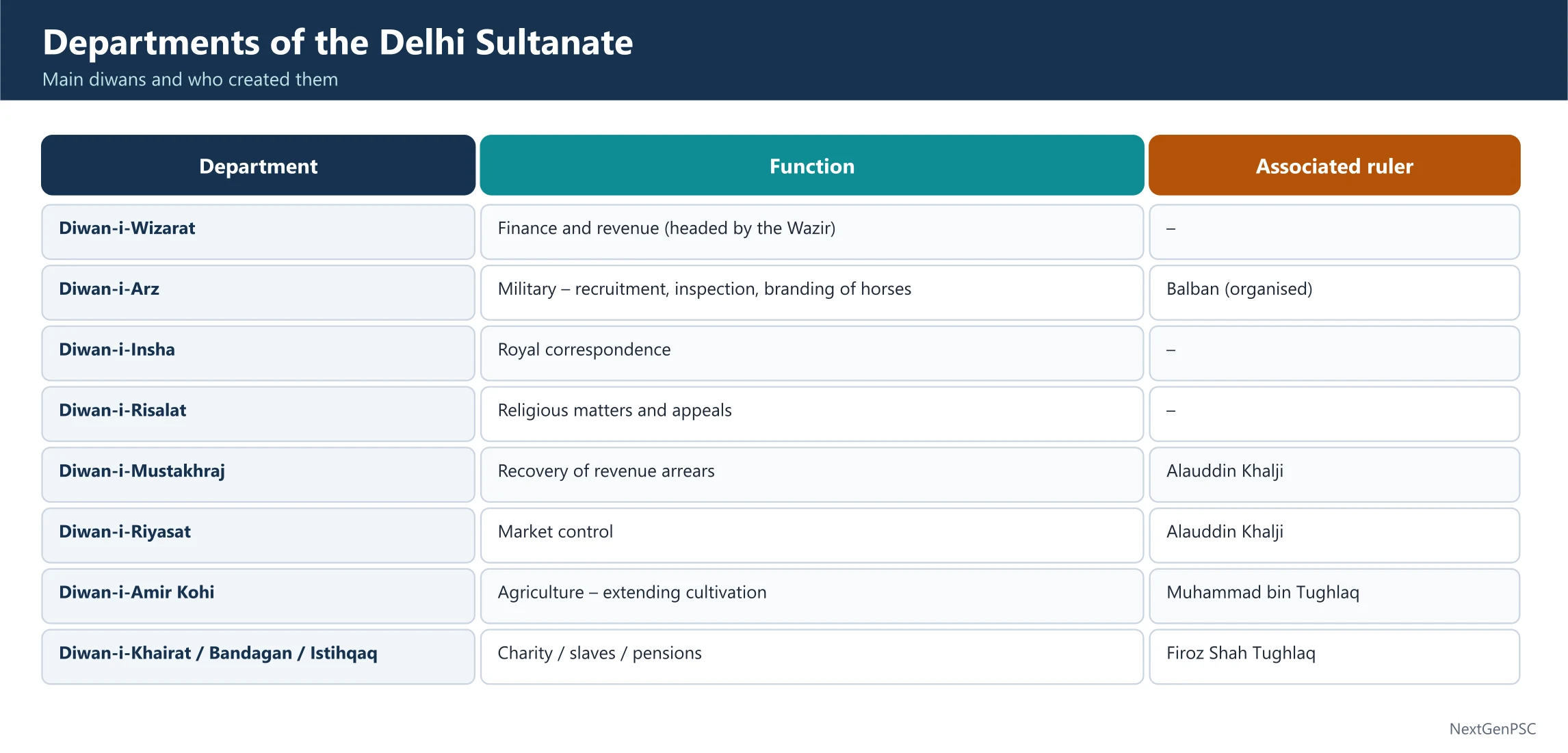
The Delhi Sultanate was an Islamic State where the Sultan held ultimate legal, military, and political authority, acting as the representative of the Caliph. Administration was handled by numerous departments, including the Diwan-i-Wizarat (Finance, headed by the Wazir) and Diwan-i-Ariz (Military, headed by the Ariz-i-Mumalik). The entire Sultanate was organized through the Iqta System, where territories (Iqtas) were assigned to nobles (Iqtadars/Muqtis) to collect revenue and maintain troops, which also formed the basis of the provincial and local administration.
I. Central Administration — Nature & Sovereignty
Islamic State Framework: The Sultanate presented itself as an Islamic polity; the Sultan was the temporal representative of the Caliph — the Caliph’s name often appeared in the khutba and on coins to claim religious legitimacy.
Ultimate Authority: The Sultan was supreme in legal, military and political spheres and acted as Commander-in-Chief; however, effective authority depended on military strength, noble support and administrative capacity.
Succession: No fixed law of succession — all sons had rival claims. Succession was typically decided by a mixture of military backing, noble endorsement and religious/ritual legitimation (investiture).
II. Key Departments & Principal Officials
Naib — Deputy with vast powers; often the most powerful court official, sometimes the real executive in practice.
Wazir (Diwan-i-Wizarat) — Head of finance and revenue administration; supported by an Auditor-General (for expenditure control) and an Accountant-General (for income accounting).
Diwan-i-Ariz — Military department headed by the Ariz-i-Mumalik: recruited troops, organised payroll, and supervised military dispositions (the diwan ensured the army’s readiness).
Diwan-i-Risalat / Chief Sadr — Controlled religious endowments (waqf), stipends to ulama and charities; the Chief Sadr often chaired judicial appointments and acted as senior qadi.
Diwan-i-Insha — Department of correspondence and records; drafted royal orders, farmans and diplomatic letters.
Judiciary — Sharia courts for Muslims; village panchayats and customary systems for Hindus on personal/civil matters; criminal law was enforced through royal penal codes and administrative orders.
III. The Iqta System — Structure & Function
Definition: Iqta was an administrative device whereby the state assigned revenue rights over a territory to military commanders (iqtadars/muqti) in lieu of cash salaries.
Purpose: To finance the army without a large cash treasury and to ensure local military maintenance through land revenue.
Hierarchy: Iqtas (province-level) → Shiqs (districts) → Parganas (sub-districts) → Villages. Governors (muqtis/walis) supervised iqtas; shiqdars and amils handled law-and-order and revenue collection respectively.
Village Unit: The basic administrative unit — led by a muqaddam/chaudhri and recorded by the patwari (village accountant).
IV. Strengths & Weaknesses of the Iqta System
Strengths: Flexible military funding mechanism; integrated military and fiscal responsibilities locally; allowed rapid mobilisation and local defence (useful against raids and rebellions).
Weaknesses: Tendency to decentralise power — powerful iqtadars could become semi-independent; iqtas often became hereditary over time; revenue extraction incentives sometimes encouraged harsh collection and rural distress; accountability was weak without strong central oversight.
V. Administrative Practice & Social Interface
Revenue Practices: Combination of assessment (measurement-based in some periods) and in-kind/ cash collection; officials like amils and patwaris played key roles in implementing assessments.
Local Governance: Village institutions (panchayats, zamindars, village accountants) mediated between state and peasants — the Sultanate’s effective control depended on co-option of these local actors.
Corruption & Record-keeping: Variable record-keeping and weak audits at times allowed embezzlement and fiscal leakages; centralized auditing institutions attempted to check this but had mixed success.
VI. Problems that Affected State Capacity
Military Dependency: Heavy dependence on cavalry and paid soldiers increased fiscal pressure; failure to monetise agrarian surplus consistently limited cash flow.
Succession & Factionalism: Lack of institutionalised succession encouraged palace coups and undermined long-term administrative continuity.
Provincial Autonomy: Over time, weakened central oversight, coupled with powerful iqtadars and jagirdars, produced centrifugal forces that fragmented political authority.
VII. Exam-Oriented Pointers (Prelims & Mains)
Prelims: Memorise key administrative terms — Iqta, Muqti/Iqtadar, Amil, Shiqdar, Patwari, Diwan-i-Ariz, Naib, Wazir, Sadr, Diwan-i-Insha. Recall the basic hierarchy: Sultan → Naib/Wazir → Muqti (Iqta) → Shiqdar → Amil → Village (Muqaddam/Patwari).
Mains: Use the Iqta system as a case study to explain early medieval state formation — its utility for military financing and its role in creating decentralising tendencies. Discuss how administrative design (lack of succession laws, reliance on land-for-service) shaped the political trajectory of the Sultanate.
Sample Mains line: “The Iqta system turned land into a military wage-fund and enabled rapid state formation, but by vesting fiscal autonomy in military officers it also sowed the seeds of provincialism and political fragmentation.”
| Department | Head / Function |
|---|---|
| Ultimate Authority | Sultan (Commander-in-chief) |
| Overall Deputy | Naib (Most influential post) |
| Diwan-i-Wizarat (Finance) | Wazir (Headed by the Wazir) |
| Diwan-i-Ariz (Military) | Ariz-i-Mumalik |
| Diwan-i-Risalat (Religious/Judicial) | Chief Sadr / Chief Qazi |
| Diwan-i-Insha (Correspondence) | Managed official communication. |
| Unit | Head Official | Function |
|---|---|---|
| Iqta (Province) | Muqti or Wali | Maintain law and order; Collect land revenue. |
| Shiq (District) | Shiqdar | Administrative head. |
| Pargana (Sub-district) | Amil | Revenue collection. |
| Village (Basic Unit) | Chaudhri or Muqaddam | Village headman; Patwari was the accountant. |
Prelims tips
- The Naib was the most powerful official, often acting as the Sultan's deputy.
- The Iqta was an assigned territory; the Iqtadar or Muqti was its holder (governor).
- The Wazir headed the Diwan-i-Wizarat (Finance), and the Ariz-i-Mumalik headed the Diwan-i-Ariz (Military).
- At the village level, the Chaudhri/Muqaddam was the headman and the Patwari was the accountant.
- Departments (Diwans): Diwan-i-Wizarat (finance), Diwan-i-Arz (military – organised under Balban), Diwan-i-Insha (royal correspondence), Diwan-i-Risalat (religious matters and appeals), Diwan-i-Mustakhraj (arrears – Alauddin), Diwan-i-Riyasat (market control – Alauddin), Diwan-i-Amir Kohi (agriculture – Muhammad bin Tughlaq), Diwan-i-Khairat (charity, marriage aid), Diwan-i-Bandagan (slaves) and Diwan-i-Istihqaq (pensions) – the last three under Firoz Shah Tughlaq.
- Iqta system: revenue assignments to military officers (muqtis/iqtadars); Iltutmish organised it and formed the Turkan-i-Chahalgani ('the Forty'), later crushed by Balban.
Mains points
- The Sultanate's administrative structure was highly centralized in theory, revolving around the Sultan, but the Iqta system created a practical decentralized framework for revenue collection and military mobilization.
- The lack of a fixed law of succession made the Sultanate inherently vulnerable, leading to perpetual inner conflicts of nobility where military strength was the ultimate decider.
- The judicial system was a pragmatic mix, applying Sharia law to Muslims while allowing Hindus to be governed by their own personal laws and village panchayats, demonstrating an attempt at administrative flexibility in a diverse society.
Did you know?
- The Iqta system was essentially a strategic way to decentralize administration and revenue collection, allowing the Sultanate to control vast territories without having to pay a large centralized army solely in cash.
- The Chief Sadr, by holding the position of Chief Qazi, effectively merged the religious and judicial authority at the highest level of the Sultanate.
- The mention of the Caliph in the Khutba and on coins was a political gesture to legitimize the Sultan's rule in the Islamic world, even when the Caliphate was weak or defunct.
Key Features of the Delhi Sultanate: Economy, Society, and Culture
The Sultanate period saw changing iqta arrangements, expanding towns, craft production and long-distance commerce. Persian, regional literary languages, diverse devotional traditions and new architectural forms developed through interaction with older local practices. Social hierarchy, gender relations, taxation and slavery varied by region, community and ruler; no single feature describes the whole 13th–16th-century period.
💰 Economy
Land Classification and Revenue
Under the Delhi Sultanate, land was categorised into three classes:
1. Iqta land – the lands which were allotted to the officials as iqtas instead of payment for their services.
2. Khalisa land – it was directly under the control of the Sultan and the revenue generated was utilised for maintaining the royal court and royal household.
3. Inam land – it was allotted to religious institutions or religious leaders.
The farmers paid 1/3rd of their produce as land revenue and sometimes even half of the produce.
Trade, Industry, and Urbanisation
A number of cities and towns had grown during this period which led to rapid urbanisation. Delhi was the largest city in the east.
Overseas trade was dominated by Khurasanis (Afghan Muslims) and Multanis (mostly Hindus).
Inland trade was under the control of Gujarati, Marwari and Muslim Bohra merchants.
The silk and the cotton textile industry thrived. The introduction of sericulture on a large scale made India less reliant on other countries for the import of raw silk.
The use of paper was widespread from the 14th and 15th centuries, leading to the growth of the paper industry.
Other crafts like carpet weaving, leather making and metal crafts also flourished.
Royal karkhanas produced expensive articles made of gold and silver.
Coinage and Technology
The system of coinage boomed: Several types of tankas (silver) were issued by Iltutmish, divided into jitals (copper). Gold coins or dinars became popular after Alauddin Khalji's South Indian conquests.
The Turks popularised a number of crafts and techniques like the use of iron stirrup, use of armour, improvement of Rahat (Persian wheel), the spinning wheel and an improved loom, and use of superior mortar for the arch and dome.
👥 Social System
Hindu Society: The structure of the Hindu society hardly changed. The Brahmins continued to enjoy the highest place. Severe restrictions were placed on mingling with the chandalas.
Gender and seclusion: Practices of female seclusion varied by class, region and community and changed over time. Do not attribute purdah to one group ‘bringing’ it to India; evidence shows multiple, evolving elite practices.
Sati: The practice of sati was widely prevalent. Ibn Batuta mentions that permission from the Sultan had to be taken for its performance.
Muslim Society: Remained divided into ethnic and racial groups. The Afghans, Iranians, Turks and Indian Muslims developed as exclusive groups and rarely married each other. Converts were also discriminated against.
Jaziya Tax: Hindu subjects were given the status of zimmis (protected people) and paid the tax called jaziya.
Firoz Tughlaq made jaziya a separate tax and levied it on Brahmins also, who were earlier exempted.
Slavery: Slavery thrived, with established slave markets. Firoz Shah Tughlaq had about 1,80,000 slaves.
🏛️ Art and Architecture
The architecture is a synthesis of Indian and Islamic styles, known as the Indo-Islamic or Saracenic style.
Key Features: Use of the true arch and the dome, the construction of the minar, and decoration using calligraphy and geometric patterns (avoiding human/animal figures).
Mamluk Period: Qutb Minar (started by Aibak, completed by Iltutmish), Quwwat-ul-Islam Mosque, and Adhai Din Ka Jhonpra.
Khalji Period: Alai Darwaza (first true arch gateway), city of Siri, and Hauz Khas (Alauddin Khalji).
Tughlaq Period: Noted for simplicity and massiveness; use of sloping (battered) walls (e.g., Tughlaqabad Fort). Firoz Shah Tughlaq established cities like Firozabad.
Lodi Period: Introduced the double dome system (e.g., Sikandar Lodi's Tomb), providing height and structural stability.
✍️ Culture, Literature, and Religion
Persian Language: The official court language. Persian literature flourished, especially court chronicles (e.g., Tarikh-i-Firoz Shahi by Barani).
Amir Khusrau: A major Persian poet and court intellectual (Tuti-i-Hind or ‘Parrot of India’). Popular tradition credits him with several musical innovations, but the invention of the sitar, tabla or khayal cannot be stated as securely established fact.
Bhakti traditions: Saints such as Kabir and Guru Nanak criticised particular ritual and caste practices and enriched vernacular literature. Their teachings and the social practices of their followers were diverse; avoid treating all Bhakti traditions as identical.
Sufism: Organised through silsilahs (orders), Sufi traditions stressed ethical discipline, remembrance of God and spiritual guidance. The Chishti and Suhrawardi orders were influential, but their relations with rulers, ulama and local society differed; do not assume uniform opposition to orthodoxy.
Music: The Hindustani classical tradition developed. Turks introduced instruments like the Rabab and Sarangi. The Qawwali form of devotional music originated.
| Feature | Bhakti Movement | Sufism |
|---|---|---|
| Core Idea | Attainment of God through intense devotion (Bhakti). Rejected rituals, caste, and idol worship. | Attainment of God through intense love and personal experience (Tasawwuf). Stressed service and spiritual music (Sama). |
| Saints/Proponents | Ramananda, Kabir, Guru Nanak, Chaitanya. | Organized into Silsilahs (orders). Key orders: Chishti and Suhrawardi. |
| Impact | Challenged caste distinctions; fostered social equality; led to the growth of vernacular literature. | Softened the rigid orthodox approach; promoted tolerance and humanitarian work. |
| Term | Function/Meaning | Significance |
|---|---|---|
| Naib | Deputy of the Sultan; most influential post. | Held nearly all powers, especially during weak rulers. |
| Wazir | Head of Diwan-i-Wizarat (Finance). | Managed revenue, expenditure, and overall financial administration. |
| Iqta | Territory assigned to a noble/officer. | System of decentralized land revenue collection and army maintenance. |
| Khalisa Land | Land revenue goes directly to the Sultan's treasury. | Crucial source of revenue for the royal household and central army. |
| Jaziya | Tax levied on non-Muslim subjects (Zimmis). | Symbol of the religious distinction in the state's revenue system. |
| Innovation Introduced / Popularized | Purpose / Significance |
|---|---|
| True Arch and Dome | Enabled the construction of large, stable, and aesthetically pleasing monumental buildings (e.g., Alai Darwaza). |
| Rahat (Persian Wheel) | Improved irrigation technology for lifting water from deeper levels, aiding agriculture. |
| Spinning Wheel | Mechanization of textile production, greatly increasing the speed and efficiency of cotton yarn production. |
| Sericulture | Large-scale cultivation of silkworms, boosting the indigenous silk industry and reducing reliance on imports. |
Prelims tips
- Economic division: Iqta (officials), Khalisa (Sultan), Inam (religious).
- Firoz Tughlaq was the first Sultan to levy Jaziya on Brahmins.
- Indo-Islamic architecture is characterized by the use of the true arch and dome.
- Amir Khusrau is associated with Sitar, Tabla, and Khayal music.
- Bhakti and Sufism were major forces promoting social and religious harmony.
Mains points
- The Delhi Sultanate successfully integrated new technologies (Persian wheel, spinning wheel, true arch) and administrative systems (Iqta, formalized currency) that underpinned its longevity and agricultural efficiency.
- The synthesis of cultural traditions led to the formation of the distinctive Indo-Islamic architectural style and the birth of the Hindustani classical music tradition.
- Despite the state's Islamic character, the flourishing of the Bhakti and Sufi movements demonstrates the resilience of indigenous spiritual traditions and the pragmatic necessity of religious tolerance in a diverse subcontinent.
- Socially, the Sultanate reinforced stratification through institutionalized taxes (Jaziya) and the proliferation of slavery, while ethnic divisions persisted within the Muslim ruling class.
Did you know?
- Iltutmish issued the standard silver coin (Tanka) and copper coin (Jital), establishing the monetary system of the Sultanate.
- The Purdah system, brought by the Turks, became a symbol of higher social status among Hindu and Muslim women in North India.
- Amir Khusrau is often credited with bridging the gap between Indian and Persian music, influencing the development of the Hindustani classical tradition.
- The Tughlaq architecture, particularly under Ghiyasuddin, used the sloping or 'battered' walls to give the buildings a look of strength and massiveness.
Art, Culture, and Literature of the Delhi Sultanate
The Sultanate period produced varied Indo-Islamic architectural forms, with the wider use of arches, domes, vaulting, calligraphy and local building skills. Amir Khusrau was a major Persian poet and court intellectual, though popular attributions that he invented the sitar, tabla or qawwali must be treated cautiously. Persian flourished alongside many regional literary languages.
🏛️ Art and Architecture
The architecture developed during this period was a blend of Indian and Islamic styles (Indo-Islamic or Saracenic style).
Turkish/Islamic Introductions: Domes, arches, lofty towers, minarets, and Islamic script were introduced.
The dome is the prominent feature of mosques, in contrast to the shikhara of Hindu temples.
Mamluk/Early Sultanate:
Qutb Minar: A 73m victory/minaret tower begun by Qutb al-Din Aibak and substantially completed by Iltutmish. Its exact original function is debated; it should not be described as a memorial to Qutb al-Din Bakhtiyar Kaki.
Alai Darwaza: An entrance to the Qutb Minar complex built by Alauddin Khalji.
Tughlaq Period:
The palace complex of Tughlaqabad was built during the reign of Ghiyasuddin Tughlaq.
Rulers, starting with Muhammad Bin Tughlaq, built tombs on an elevated platform (e.g., Tomb of Ghiyasuddin Tughlaq).
Muhammad Bin Tughlaq built Jahanpanah, one of the cities of Delhi.
Firoz Shah Tughlaq built Hauz Khas (a pleasure resort) and the Feroz Shah Kotla fort.
Lodi Period: The Lodhi Gardens in Delhi exemplify Lodi architecture, known for the introduction of the double dome.
Architectural Styles: The three well-developed architecture styles were:
1. Delhi or Imperial Style (Central Sultanate works)
2. Provincial Style (Works in independent kingdoms like Jaunpur, Bengal)
3. Hindu architectural style (Indigenous styles that continued or influenced the Saracenic style)
🎶 Music
New Instruments: The sarangi and the rabab were introduced during this period.
Amir Khusrau: A key figure in music:
Introduced new ragas like ghora and sanam.
Credited with fusing the Iranian and Indian musical systems to create Qawwali.
Also invented the musical instrument the Sitar.
Patronage:
Ragadarpan, an Indian classical work, was translated into Persian during the rule of Firoz Shah Tughlaq.
Pir Bhodan, a Sufi saint, was regarded as the greatest musician of his age.
Raja Man Singh of Gwalior was a great patron who encouraged the composition of the great work on music called Man Kautuhal.
✍️ Literature
The Delhi Sultans primarily promoted Persian literature (the language of the court), focusing on poetry, theology, and history writing.
Historians: The most renowned historians include Minhaj-us-Siraj, Zia-ud-din Barani, Hasan Nizami, and Shams Siraj.
Minhaj-us-Siraj authored Tabaqat-i-Nasari (history up to c. 1260 CE).
Zia-ud-din Barani wrote Tarikh-i-Firoz (history of the Tughlaq dynasty).
Amir Khusrau: Regarded as the greatest Persian poet of his age, known for writing over 4 lac couplets.
He created a new style of Persian poetry called Sabaq-i-Hind (Indian style).
His important works include Khazain-ul-Futuh, Tughlaqnama, and Tarikh-i-Alai.
He was given the title 'Parrot of India'.
Translations and Indigenous Works:
Zia Nakshabi was the first to translate Sanskrit stories into the Persian language (e.g., Tutu Nama or the Book of the Parrot).
Kalhana's Rajatarangani (history of Kashmir) belonged to the era of Kashmiri ruler Zain-ul-Abideen.
Chand Bardai, a Hindi poet, was the author of Prithviraj Rasau.
Regional rulers like Nusrat Shah (Bengal) patronised the translation of the Mahabharata and Ramayana into Bengali.
Arabic Works (Al-Beruni): Al-Beruni (patronized by Mahmud of Ghazni) authored the most important Arabic work, Kitab-ul-Hind (or Tarikh-ul-Hind), mentioning the socio-economic conditions of India. He also translated Sanskrit works into Arabic.
| Feature | Bhakti Movement | Sufism |
|---|---|---|
| Core Idea | Attainment of God through intense devotion (Bhakti). Rejected rituals, caste, and idol worship. | Attainment of God through intense love and personal experience (Tasawwuf). Stressed service and spiritual music (Sama). |
| Saints/Proponents | Ramananda, Kabir, Guru Nanak, Chaitanya. | Organized into Silsilahs (orders). Key orders: Chishti and Suhrawardi. |
| Impact | Challenged caste distinctions; fostered social equality; led to the growth of vernacular literature. | Softened the rigid orthodox approach; promoted tolerance and humanitarian work. |
| Dynasty / Style | Key Feature | Example Monuments |
|---|---|---|
| Mamluk / Early Sultanate | Indo-Islamic Synthesis; use of corbelled arches and minarets. | Qutb Minar, Alai Darwaza, Quwwat-ul-Islam Mosque. |
| Tughlaq | Massiveness and simplicity; use of sloping (battered) walls. | Tughlaqabad Fort, Tomb of Ghiyasuddin Tughlaq, Firoz Shah Kotla. |
| Lodi | Double dome system; tombs set in gardens. | Lodhi Gardens, Tomb of Sikandar Lodi. |
| Figure | Domain / Work | Contribution |
|---|---|---|
| Amir Khusrau | Persian Poetry, Music | Created Qawwali and Sabaq-i-Hind; invented Sitar and Tabla; title: 'Parrot of India'. |
| Zia-ud-din Barani | History | Wrote Tarikh-i-Firoz (History of Tughlaqs). |
| Minhaj-us-Siraj | History | Authored Tabaqat-i-Nasari (General history up to 1260 CE). |
| Al-Beruni | Arabic/Sanskrit Scholar | Wrote Kitab-ul-Hind on India's socio-economic conditions (patronized by Mahmud of Ghazni). |
| Chand Bardai | Hindi Literature | Authored Prithviraj Rasau (One of the earliest works in Hindi). |
Prelims tips
- Qutb Minar was completed by Iltutmish; Alai Darwaza was built by Alauddin Khalji.
- The Lodi period is known for the introduction of the double dome architecture.
- Amir Khusrau is associated with Sitar, Tabla, and Qawwali; his literary style was Sabaq-i-Hind.
- Barani wrote Tarikh-i-Firoz Shahi; Al-Beruni wrote Kitab-ul-Hind.
Mains points
- The Sultanate's architectural style (Indo-Islamic) represents a successful fusion of indigenous decorative traditions with Islamic structural principles (true arch and dome).
- The flourishing of Persian history writing (Barani, Khusrau) provides vital primary documentation of the political structure and social life of the time.
- The synthesis in music, largely driven by Amir Khusrau, demonstrates a profound cultural integration between Indian and Iranian traditions.
- The Lodi architecture, characterized by the double dome, laid the foundation for the monumental style of the subsequent Mughal Empire.
Did you know?
- Iltutmish issued the standard silver coin (Tanka) and copper coin (Jital), establishing the monetary system of the Sultanate.
- The Purdah system, brought by the Turks, became a symbol of higher social status among Hindu and Muslim women in North India.
- Amir Khusrau is often credited with bridging the gap between Indian and Persian music, influencing the development of the Hindustani classical tradition.
- The Tughlaq architecture, particularly under Ghiyasuddin, used the sloping or 'battered' walls to give the buildings a look of strength and massiveness.
Reasons for the Weakening of the Delhi Sultanate
The Delhi Sultanate did not decline through one uniform process. From the 14th century, changing provincial power, succession conflicts, fiscal and military pressures, rebellions and external shocks—especially Timur’s raid of 1398—reduced Delhi’s reach. The Lodi state remained significant until Babur defeated Ibrahim Lodi at Panipat in 1526.
Causes of Decline
The weakening of the Sultanate Empire started from the Tughlaq dynasty itself, taking place due to several overlapping reasons:
1. Unsuccessful Campaigns and External Shocks
External attacks, such as the invasion of Timur in 1398, severely weakened the central authority and led to widespread desolation.
Consequence: Regions that were once annexed and controlled by the Sultans, such as Gujarat, Malwa, Punjab, and Rajasthan, demanded autonomy and no longer remained under Delhi's control.
2. Frequent Internal Power Struggle
The absence of a clear law of succession led to continuous power struggles and revolts within the royal family and among the nobility.
Succession was rarely peaceful; deceit and treachery were common where brothers and descendants attempted to capture power by killing or using other treacherous means. This was a common phenomenon in every dynasty.
3. Problem of Maintaining Large Standing Army
The necessity of maintaining a large army placed a huge financial burden on the state (e.g., salary and payment issues).
This often led to two unsustainable measures: levying more taxes on the people or resorting to conquering neighboring territories for wealth, which further drained the Sultanate's own resources.
4. Failure to Control Mercenaries
The Sultanate failed to control the free-floating mercenaries who were hired for money. These soldiers sold their services to whoever paid more.
Impact: The easy availability of these mercenaries led to more rebellions, as smaller kings and local chieftains used these hired soldiers to rebel against the Sultan.
5. Persistent Internal Rebellions and Final Collapse
Internal rebellions accelerated the decline, notably during the last dynasty.
At the time of the last Delhi Sultan, Ibrahim Lodhi (1517–1526), revolts by his own brother, Jalal Khan, and others elsewhere led to massive dissatisfaction.
This internal weakness led the governor of Punjab, Daulat Khan Lodi, to invite the foreign conqueror Babur.
Babur defeated Ibrahim Lodi in the First Battle of Panipat in 1526, establishing the Mughal rule in India and ending the Delhi Sultanate.
| Category | Key Factor | Consequence |
|---|---|---|
| External Attack | Timur's Invasion (1398) | Regional autonomy for Gujarat, Malwa, and Punjab; loss of Delhi's prestige. |
| Political Instability | Lack of definite law of succession and internal power struggle. | Frequent change of dynasties; constant revolts; deceit and treachery among royals. |
| Economic Strain | Burden of maintaining a large standing army. | Increased taxation; drainage of state wealth; financial instability. |
| Military Weakness | Dependence on and failure to control mercenaries. | Mercenaries fueled internal rebellions by selling their services to local chiefs. |
| Final Blow | Internal revolts under Ibrahim Lodi. | Invitation to Babur; Defeat in First Battle of Panipat (1526). |
Prelims tips
- The decline of the Sultanate is traced back to the Tughlaq dynasty.
- The Sultanate era officially ended with the First Battle of Panipat (1526 AD), where Ibrahim Lodi was defeated by Babur.
- Timur's Invasion (1398 AD) was a critical external shock that accelerated the fragmentation of the Sultanate.
Mains points
- The Sultanate suffered from a chronic structural defect (absence of a clear law of succession) that generated persistent internal conflicts, preventing long-term stability.
- Financial overextension, resulting from the need to maintain a massive army for defense against Mongols and internal suppression, drained the state's resources, making it vulnerable to both internal revolts and external attacks.
- The final collapse under Ibrahim Lodi was a direct consequence of his failure to manage the Afghan tribal system, leading key nobles to betray him and invite the Mughal invasion.
Did you know?
- The Mongol invasions, though repelled by strong Sultans like Alauddin Khalji, continuously bled the Sultanate's treasury and military reserves for over a century.
- The collapse of the central authority led to the rise of regional powers like the Sharqi Sultanate of Jaunpur, which once even threatened to capture Delhi itself.
- The conflict between Ibrahim Lodi and his rebellious nobles (like Daulat Khan Lodi) was primarily about Lodi's attempt to impose an absolute centralized monarchy on the decentralized Afghan tribal system established by his grandfather, Bahlol Lodi.
Marco Polo's Account (AD 1292–1294): Observations on South India
Marco Polo, a Venetian merchant, recorded his observations of South India during his return journey from China. His accounts, found in 'The Travels of Marco Polo', provide a rare glimpse into the Pandyan Kingdom (Coromandel Coast) and the Kakatiya Dynasty. He noted the local people's unique hygienic habits (bathing twice daily, right-hand eating), their strong superstitions, and the high value placed on dark skin. Polo also praised Queen Rudrama Devi of Warangal for her justice and highlighted Gujarat's merchants as the 'most truthful in the world'.
🌍 Marco Polo's Journey and Context
Period of Stay: 1292–1294 AD, during his return to Venice from China along the Silk Road.
Record: His travels are recorded in 'The Travels of Marco Polo' (or 'Book of the Marvels of the World', c. 1300).
Location Visited: He primarily stayed on the Coromandel Coast, in the kingdom of the Tamil Pandyas (near modern-day Tanjore) under King Maravarman Kulasekara.
Other Key Stops: Malabar Coast, Warangal (Kakatiya Kingdom of Queen Rudrama Devi), Gujarat, and the tomb of St. Thomas the Apostle (near Chennai).
🧍 Pandyan Kingdom: Culture and Habits
Hygienic Habits
Eating: People sat on the ground, ate and drank only with their right hands, reserving the left hand for 'filthy duties'.
Drinking: Everyone had their own vessel; they would not drink from another's, nor would they touch the vessel to their lips, instead pouring the drink directly into the mouth.
Bath: Everyone, male and female, took baths twice, every day; those who did not bathe were looked down upon.
Social and Other Habits
Betel Nut: They had a habit of chewing tambur leaves (Paan), mixed with camphor, quicklime, and fragrant spices.
Sleeping: They slept on the ground stark naked.
Superstition: People were very superstitious and keenly differentiated between good and bad omens.
Skin Tone: Dark skin was highly esteemed. They anointed children once a week with sesame oil to make them grow much darker.
Trust Issues: People did not trust those who drank wine/liquor or who traveled to the seas, regarding seafarers as reckless and desperate men.
Violence & Sati: The killing of animals, birds, and even insects was socially prohibited, yet Marco also records the practice of Sati.
Nobles' Sleeping Custom: Nobles and the rich used light canework beds that were drawn up by cords to the ceiling at night for protection from insects, vermin, and for better airflow.
🧘 Religious Practice and Environment
Religion: The practice of idol worship was prevalent, with both male and female deities worshipped.
Tolerance: There was a general acceptance for people from other religions.
Idols: Idols of gods were made black, whereas idols of devils were made white.
Cults: Polo mentions a cult of men called Yogis who lived longer on frugal diets, and the austere lives of Jains who lived without clothes.
Ox Worship: The worship of the Ox was prevalent.
Flora & Fauna: He characterized the flora and fauna as being unlike anything he had seen in Italy. He noted animals like lions, leopards, peacocks, and various parrots, and observed that some monkeys had anthropomorphic appearances.
🌾 Agriculture and Other Kingdoms
Main Crops: Rice was the main crop. He also mentioned pepper and indigo crops, incense, and a date wine drink.
Warangal (Kakatiya Kingdom): He visited the kingdom of Queen Rudrama Devi (modern Telangana), noting it was a huge producer of diamonds and buckram cotton of the finest texture.
He praised Queen Rudrama Devi as a lady of much discretion who administered her realm with justice and equity.
Gujarat: He noted the merchants of Gujarat as being the best and the most truthful in the world.
Port of Kayal: He spoke highly of this port, noting it was frequently visited by Arabian and Persian ships laden with horses and other goods. He praised the king for his good administration and generous treatment of foreign merchants.
| Category | Observation |
|---|---|
| Hygienic/Social Custom | Bathing twice daily; eating only with the right hand; sleeping naked on the ground; chewing Paan. |
| Religious Practice | Prevalence of Idol Worship and Ox Worship; general tolerance for other religions; mention of Yogis and naked Jains. |
| Economic/Trade | Port of Kayal was a hub for horses; Warangal was a producer of diamonds and fine buckram cotton. |
| Noteworthy Judgment | Gujarat merchants are the most truthful in the world; Queen Rudrama Devi ruled with justice; Dark skin is highly esteemed. |
Prelims tips
- Marco Polo was a Venetian traveler; his account is 'The Travels of Marco Polo'.
- He visited the Pandyan Kingdom (Coromandel Coast) and the Kakatiya Kingdom (Warangal) under Queen Rudrama Devi.
- He noted the high quality of buckram cotton and the production of diamonds in Warangal.
Mains points
- Marco Polo's account is a valuable source for the economic vitality of South India (trade in horses, diamonds, fine cotton) during the late 13th century, coinciding with the height of the Pandyan and Kakatiya powers.
- His observations reveal the blend of austerity (Jainism, Yogis) and social customs (Sati, strict hygiene, superstition) prevalent in medieval South Indian society.
- The praise for Queen Rudrama Devi highlights the tradition of capable female rulers and the existence of administrative justice in certain regional kingdoms, contrasting with the often chaotic contemporary North Indian political scene.
Did you know?
- Marco Polo's descriptions of the Pandyan kingdom are considered among the most detailed Western accounts of a South Indian kingdom during the medieval period.
- His mention of the value placed on dark skin in the Coromandel region is a unique cultural observation noted by a foreign traveler.
- The Port of Kayal (near present-day Tuticorin) was a major trade hub in the Pandyan kingdom, underscoring the maritime importance of South India at the time.
Ibn Battuta's Account: India under Muhammad Bin Tughlaq (AD 1333–1347)
The Moroccan traveler, Ibn Battuta, served as the Qazi of Delhi for seven years under Sultan Muhammad Bin Tughlaq. His extensive travel account, the 'Rihla', offers a unique, insider's view of Tughlaq's administration. He brilliantly described the sophisticated postal system (Ulaq and Dawa), the bustling economy (Calicut and Quilon rivaling Alexandria, high demand for Indian textiles), and the social conditions (widespread slavery, practice of Sati). Battuta's account is a primary source for the Sultan's court, justice system (Diwan-i-Siydsat), and the grandeur of Delhi city.
📜 Background and Context
Traveler: Abu Abdullah Muhammad ibn Battutah, born in Tangier, Morocco.
Period in India: 1333–1347 AD, during the reign of Muhammad Bin Tughlaq.
Court Appointment: Appointed as Qazi (judge) of Delhi by Sultan Muhammad bin Tughlaq, who was impressed by his scholarship.
Account: His travelogue, Rihla (meaning 'Journey'), is formally titled ‘A Gift to Those Who Contemplate the Wonders of Cities and the Marvels of Travelling’.
Perspective: His observations are unique because, unlike other travelers, he held an official position, giving him access to the inner workings of the Sultanate administration.
📬 Postal System — Efficiency and Innovation
Ibn Battuta described an elaborate and efficient postal system that connected the Sultanate from Delhi to distant provinces.
Horse Courier (Ulaq): Mounted messengers stationed every four miles.
Foot Courier (Dawa): Three relay runners per mile, stationed at every mile (kuruh).
Each runner carried a rod with copper bells, signaling the next runner for handover — an early relay system for rapid communication.
The system transported letters, valuable goods (like fruits from Khurasan), and even criminals for trial.
This indicates a highly centralised bureaucracy and administrative efficiency under Muhammad bin Tughlaq.
⚖️ Justice and Administration
Ibn Battuta served as Qazi of Delhi for seven years, assisted by interpreters since Persian was the court language.
Muhammad bin Tughlaq personally heard petitions and complaints every Monday and Thursday, showing an interest in justice, though often tempered by cruelty.
A separate court, the Diwan-i-Siyasat, handled criminal and political cases — infamous for its harsh punishments.
The Amir-i-Dad supervised secular justice in the Sultan’s absence, ensuring Qazis’ verdicts were implemented.
Punishments: Severe corporal and capital punishments were imposed irrespective of rank or religion, reflecting the Sultan’s strict control.
🏙️ Delhi City, Trade, and Society
Delhi — The Imperial Metropolis
Ibn Battuta praised Delhi as a vast, populous, and prosperous city — “one of the greatest in the East.”
He noted its crowded streets, colourful bazaars, and stone-built city walls with 28 gates (Darwazas).
Every bazaar had a mosque, temple, and public performance areas for musicians, acrobats, and dancers.
The urban prosperity reflected Delhi’s ability to extract surplus from rural areas and its cosmopolitan nature as a commercial hub.
Trade and Agriculture
Ibn Battuta found India’s ports (especially on the Malabar Coast) flourishing — comparing Calicut and Quilon to Alexandria in wealth and trade volume.
These ports traded with China, Arabia, and Persia, exporting textiles, spices (pepper), and precious stones.
Textiles: Indian cotton, silk, brocade, and muslin were prized globally, dominating Indian exports.
Agriculture: The land was fertile, producing two to three crops a year — rice, sugarcane, wheat, pulses, and oilseeds.
He admired the irrigation systems and the richness of India’s agricultural base.
Social Observations
Ibn Battuta noted the rigid caste system and observed practices like Sati (widow burning), for which official permission from the Sultan was required.
Slavery: Slavery was widespread; female slaves were sold at cheap prices and employed in domestic services.
He described lavish royal feasts — chapattis, roast meats, samosas (sambusak), halwa, and almond pudding.
He noted the prominence of Habshis (Abyssinians), who held high administrative and military positions in Gujarat and Bengal.
🌍 Significance of Ibn Battuta’s Account
Ibn Battuta’s Rihla provides an invaluable firsthand account of the Delhi Sultanate’s administration, economy, and society.
His writings reveal both the sophistication and the despotism of Muhammad bin Tughlaq’s rule.
It offers cross-cultural insight into India’s global trade connections, urban vibrancy, and social complexities in the 14th century.
🧭 Exam Summary
Prelims: Rihla, postal system (Ulaq & Dawa), Diwan-i-Siyasat, Amir-i-Dad, Muhammad bin Tughlaq’s administrative experiments.
Mains: Ibn Battuta as a historical source — depicts Indo-Islamic urban life, administrative complexity, and global connections of Delhi Sultanate.
Key Line: “Through Ibn Battuta’s eyes, the Delhi Sultanate appears both as an empire of order and of paradox — centralised efficiency governed by despotic unpredictability.”
| Area | Details |
|---|---|
| Administration/Justice | Appointed Qazi of Delhi; Sultan held court every Monday and Thursday; Existence of Diwan-i-Siydsat; Brutal punishments. |
| Communication | Sophisticated postal system: Ulaq (horse courier, every 4 miles) and Dawa (foot courier, every mile), used for letters, luxury goods, and criminals. |
| Economy/Trade | Calicut and Quilon rivaled Alexandria; high demand for Indian textiles (muslin, silk); fertile land allowed 2-3 crops annually. |
| Social/Cultural | Widespread slavery and practice of Sati; Habshis (Abyssinian slaves) held influential posts; cities were rich due to village surplus. |
Prelims tips
- Ibn Battuta was a traveler from Morocco and served as the Qazi of Delhi under Muhammad Bin Tughlaq.
- His account is called the Rihla.
- He described the two postal systems: Ulaq (horse) and Dawa (foot).
- He praised the ports of Calicut and Quilon and the demand for Indian textiles.
- Ibn Battuta, a Moroccan traveller, recorded his travels in the Rihla (Kitab-ul-Rehla); Muhammad bin Tughlaq made him qazi of Delhi and sent him as envoy to China (1342).
Mains points
- Ibn Battuta’s Rihla is an invaluable primary source for understanding the centralized authority and justice system of Muhammad Bin Tughlaq's reign, including the functioning of the Diwan-i-Siydsat.
- His observations on the highly efficient Dawa postal system and the thriving maritime trade (Calicut/Quilon) reveal the sophisticated state of infrastructure and commerce that underpinned the Delhi Sultanate's power.
- The account highlights the complexities of medieval Indian society, showcasing not only the prevalence of slavery and Sati but also the rise of Habshi slaves to influential positions, reflecting ethnic diversity and mobility within the system.
Did you know?
- Ibn Battuta was given two assistants as Qazi because he did not speak Persian, the court language, highlighting the cosmopolitan nature of Delhi's administration under Muhammad Bin Tughlaq.
- His description of the Dawa postal system shows that information and goods could travel across the vast Sultanate faster than the average speed in contemporary Europe.
- The Rihla, though dictated to another scholar, Ibn Juzzay, is the only surviving record of Battuta's astonishing journeys across the Old World.
Muhammad bin Tughlaq’s Patronage of Scholars and Administration
Sultan Muhammad Bin Tughlaq (AD 1325–1351) was a learned polymath who generously patronized scholars of Islamic theology, philosophy, and history, attracting global figures like the Moroccan traveler Ibn Battuta (whom he appointed as the Qazi of Delhi). His court represented the cultural zenith of the Tughlaq period, even amidst administrative turmoil.
I. Patronage of Foreign and Indigenous Scholars
Ibn Battuta: The most famous foreign visitor and scholar, Ibn Battuta (from Morocco), arrived in Delhi in 1333 AD and was so impressed by the Sultan's scholarship that he was immediately appointed as the Qazi of Delhi (Judge). He spent seven years in Tughlaq’s service before being sent as an ambassador to China.
Barani: The great chronicler Ziauddin Barani was a court historian during Muhammad Tughlaq's reign and wrote extensively about his policies, often criticizing the Sultan's 'visionary' experiments that failed on implementation.
Persian Learning: Tughlaq’s court was a major center for Persian learning. He patronized the writing of philosophical, legal, and historical works and encouraged the compilation of official court records.
Secular Knowledge: The Sultan's personal interests extended beyond orthodox Islamic scholarship to include philosophy, mathematics, and logic, which often brought him into conflict with the conservative Ulema (theological class).
II. Administration and Appointments
Secular Appointments: Muhammad Tughlaq was known for basing his appointments on merit rather than noble birth or religious lineage. He appointed people from humble backgrounds, including non-Turks and non-Muslims, to high administrative posts—a policy that angered the entrenched Turkish and Mamluk nobility.
Legal Authority: Despite his learning, the Sultan often applied justice with extreme harshness, personally hearing petitions and administering severe punishments. The contradiction between his intellectual depth and administrative brutality remains a subject of historical debate.
Impact: His liberal policy regarding appointments significantly weakened the old Turkish aristocracy but, combined with his controversial reforms (like the Token Currency), ultimately fueled rebellions among the disaffected elite.
Prelims tips
- Muhammad Tughlaq appointed the foreign traveler Ibn Battuta as the Qazi of Delhi.
- The Sultan was known for his personal interest in philosophy and logic.
- He appointed individuals based on merit rather than noble birth, a policy that alienated the old Turkish nobility.
Mains points
- Muhammad Tughlaq's patronage of scholars and non-Turkic administrators highlights a philosophical shift towards meritocracy, though this policy destabilized the Mamluk-era power structure.
- The contradictory nature of his rule—intellectual and learned yet arbitrary and severe in punishment—reflects the complex challenges faced by a centralizing monarch in reconciling Islamic principles with the political needs of an expansive, multi-religious empire.
Did you know?
- Ibn Battuta served as the Qazi of Delhi for seven years but was later imprisoned by Tughlaq for a period due to suspicion, highlighting the Sultan's unpredictable nature.
- Barani’s criticism of the Sultan’s reforms is believed to be colored by his resentment over Tughlaq’s policy of rewarding low-born individuals.