
Medieval Indian History · UPSC Notes
Vijayanagar and Bahmani Kingdom — UPSC Medieval History Notes
Free, exam-focused notes for UPSC Prelims and Mains, with Prelims tips and Mains points for every topic. 9 topics.
Open in the interactive reader: bookmarks, progress tracking and read-aloud.
The Vijayanagara-Bahmani Conflict: Causes and Core Regions
The 14th-century rise of the Vijayanagara Empire and the Bahmani Sultanate created a major Deccan rivalry. Their contests centred on revenue-rich and strategic zones—the Tungabhadra Doab , the Krishna-Godavari Delta and the Konkan coast—alongside control of forts, ports and horse-trade routes. Religious identity did not prevent diplomacy, recruitment or alliances across courts.
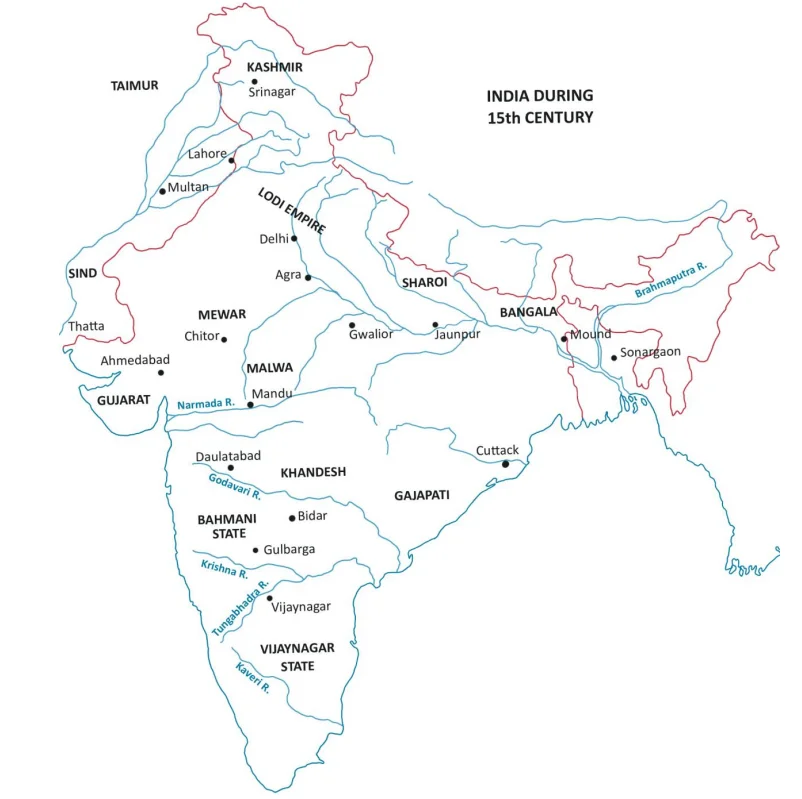
I. Introduction: The Deccan Deadlock
Context : The 14th century saw the emergence of two powerful, antagonistic kingdoms in South India: the Vijayanagara Empire (south of the Tungabhadra) and the Bahmani Sultanate (north of the Krishna).
Clash of Interests : The rivalry was not merely religious, but primarily economic and strategic, focused on controlling three highly valuable, contested regions.
Result : The frequent wars were generally inconclusive, maintaining a volatile military and political status quo, with temporary advantages shifting between the two empires.
II. Core Contested Regions (The Triad of Conflict)
1. The Tungabhadra Doab
Location : The fertile, 30,000 square-mile region situated between the Krishna and Tungabhadra rivers.
Strategic Value : It was historically the bone of contention in South India (earlier fought over by the Western Chalukyas/Cholas and the Yadavas/Hoysalas) due to its vast agricultural wealth and economic resources.
2. The Krishna-Godavari Delta
Location : The expansive and highly fertile river basin and coastal delta region in the east.
Strategic Value : The numerous ports in this region provided control over the foreign trade of the eastern Deccan, making its mastery vital for external revenue.
3. Marathwada and the Konkan Coast
Location : The struggle was for access to and control of the narrow, fertile Konkan coastal strip (between the Western Ghats and the Arabian Sea), particularly the port of Goa .
Strategic Value : Goa was the primary outlet for trade and the crucial inlet for importing high-quality horses from Iran and Iraq, essential for maintaining the powerful cavalry of both empires.
| Region | Geographical Feature | Primary Economic Value |
|---|---|---|
| Tungabhadra Doab | Fertile land between Krishna and Tungabhadra rivers. | Agricultural wealth and resources. |
| Krishna-Godavari Delta | Coastal delta region (Bay of Bengal). | Control over Eastern foreign trade and agriculture. |
| Konkan Coast (Goa) | Narrow strip between Western Ghats and Arabian Sea. | Access to horse imports (from Iran/Iraq) and Western maritime trade. |
Prelims tips
- The Tungabhadra Doab was the most frequent zone of conflict.
- The struggle for the Konkan Coast was mainly driven by the need to control the import of war horses.
- The Bahmani Sultanate was located north of the Krishna river, and Vijayanagara was located south of the Tungabhadra.
- The conflict replaced the earlier rivalry between the Yadavas/Hoysalas.
Mains points
- The Vijayanagara-Bahmani rivalry demonstrates how economic factors (fertile land and horse trade) supersede religious identity as the primary motivation for inter-state warfare in medieval India.
- The conflict contributed to the militarization of the Deccan and the continuous innovation in warfare (especially cavalry based on imported horses), shaping the region's political landscape for two centuries.
- Control over the Konkan maritime trade via Goa was a major strategic necessity, highlighting the dependence of land-based empires on foreign supply chains for military superiority.
- The inconclusive nature of the struggle underscores the balance of power maintained between the two kingdoms, preventing either from achieving complete hegemony over South India until the 16th century.
Did you know?
- The port of Goa changed hands multiple times during the 15th century, with the Portuguese eventually seizing it from the Bijapur Sultanate (a successor state of Bahmani).
- The wealth derived from the Krishna-Godavari delta (ports and rice) was so critical that the rulers often used religious titles or built grand structures to legitimize their conquest of the area.
- The Tungabhadra Doab contains the ruins of the Vijayanagara capital, Hampi, making it the economic and political heart of the southern empire.
The Vijayanagara Empire (1336 – End of 17th Century)
The Vijayanagara Empire emerged in the 14th century under the Sangama brothers Harihara and Bukka ; 1336 is the conventional foundation date. Ruled by the Sangama, Saluva, Tuluva and Aravidu dynasties, it reached a major zenith under Krishnadevaraya . The defeat at Talikota (1565) devastated Hampi, but the Aravidu dynasty continued from later capitals for decades.
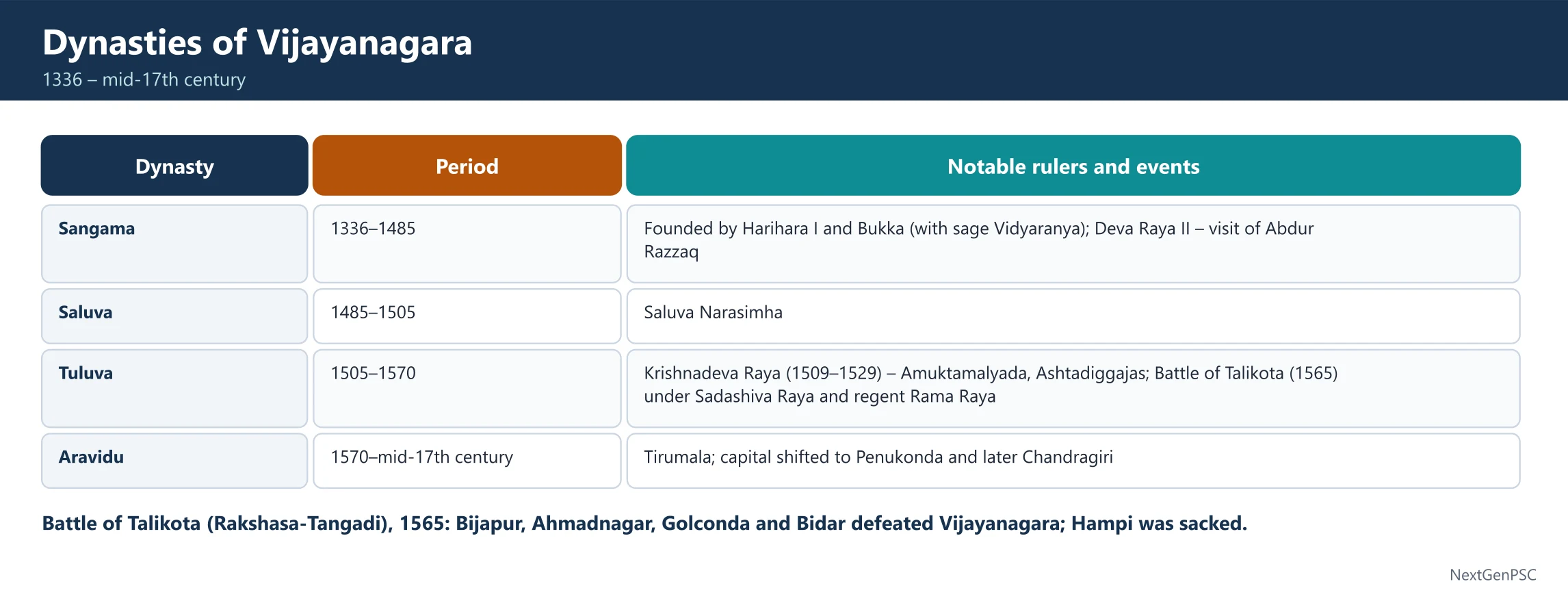
I. Origin, Dynastic Change, and Foreign Accounts
Founders : Harihara and Bukka (Sangam dynasty) were originally Kakatiya feudatories who established the state amidst the Tughlaq pressure in the South.
Capital : The city of Vidyanagar (later Vijayanagar) was founded on the Tungabhadra river.
Dynastic Shift : The succession of four dynasties (Sangam, Saluva, Tuluva, Aravidu) was often driven by military necessity, as powerful generals usurped power to stabilize the realm against the Bahmani threat.
Foreign Observers : Travelers like Nicolo Conti, Abdur Razzak, Domingo Paes, and Barbosa described the empire's immense wealth, vast army, and the highly organized urban structure of Hampi.
II. Imperial Zenith: Krishna Deva Raya (Tuluva Dynasty)
Strategic Titles : He earned the title Yavana Rajya Sthapna Chirya for diplomatically restoring a Bahmani prince to the throne, thereby ensuring the Sultanates remained fragmented.
Literature (Synthesis) : His reign was the “Golden Age of Telugu Literature”, patronizing the Ashta Diggajas (including Allasani Peddana and Tenali Ramakrishna). He personally wrote the Telugu epic Amukthamalyadha and the Sanskrit play Jambavati Kalyanam.
Architecture : Finalized the Vijayanagara style (Ornate pillars, massive Kalyana Mandapas) seen in the Vittalaswami and Hazara Ramaswamy temples.
III. Structural Strength and Decline
Political Structure : The empire functioned as a centralized military state built on the Nayankara System.
Nayankara System : Amara Nayakas were military-administrative chiefs assigned revenue rights in return for military contingents and local responsibilities. Calling the system simply ‘feudal’ obscures important regional variation and the continuing claims of the royal centre.
Talikota (1565 AD) : Aliya Rama Raya’s forces were defeated by a coalition of Deccan Sultanates. Hampi was extensively looted and abandoned as the principal capital, but Vijayanagara authority survived under the Aravidus from Penukonda and later Chandragiri.
Post-Talaikota : The empire survived in a reduced form under the Aravidu dynasty for another century, maintaining control from new capitals like Penukonda and Chandragiri.
I. Sangam Dynasty (1336–1485)
Harihara I & Bukka I (Founders) :
Role: Founders of the Vijayanagara Empire in 1336 AD on the banks of the Tungabhadra River.
Origin: Originally served as feudatories of the Kakatiyas of Warangal.
Deva Raya II (The Greatest Sangama Ruler) :
Military: Recruited Muslim archers into the army to match the Bahmani cavalry's strength.
Literature: Patronized Kannada poets Kumara Vyasa and Chamarasa. Wrote the Sanskrit work Mahanataka Sudhanidhi.
Foreign Contact: Hosted the Persian chronicler Abdur Razzak.
II. Tuluva Dynasty (1505–1570)
Krishna Deva Raya (1509–1529) :
Titles: Held titles like Andhra Bhoja, Andhra Pitamah, and Yavana Rajya Sthapna Chirya (Establisher of the Yavana Kingdom, for restoring a Bahmani prince).
Cultural Zenith: His reign is the Golden Age of Telugu Literature. His court hosted the Ashta Diggajas (eight Telugu scholars), including Allasani Peddana (Father of Telugu Poetry).
Literature: Authored the Telugu epic Amukthamalyadha and the Sanskrit play Jambavati Kalyanam.
Architecture: Built the magnificent Vittalaswami Temple (Stone Chariot) and the Hazara Ramaswamy Temple at Hampi.
Foreign Contact: Contemporary of Mughal Emperor Babur and hosted Portuguese travelers Domingo Paes and Barbosa.
Aliya Rama Raya (Minister/De Facto Ruler) :
Role: The powerful minister who commanded the Vijayanagara forces in the disastrous Battle of Talaikota in 1565 AD, leading to the sacking of Hampi and the empire's permanent decline.
III. Other Notable Rulers and Figures
Saluva Narsimha : Founder of the Saluva Dynasty, instituting the first usurpation to stabilize the empire against external threats.
Veera Ballala III : The last major ruler of the Hoysala dynasty, whose territories were absorbed by Harihara I, contributing to the foundation of Vijayanagara.
Sri Ranga III : The last known ruler of the Aravidu Dynasty and the Vijayanagara Empire, ruling from Chandragiri after the fall of Hampi.
| Dynasty | Period | Founder | Key Ruler/Event |
|---|---|---|---|
| Sangam | 1336–1485 | Harihara I & Bukka I | Deva Raya II (Patron of Abdur Razzak) |
| Saluva | 1485–1505 | Saluva Narsimha | Consolidation phase; Vasco da Gama arrived (1498) |
| Tuluva | 1505–1570 | Tuluva Narasa Nayaka | Krishna Deva Raya (Imperial Zenith, Ashta Diggajas) |
| Aravidu | c.1570–17th C | Tirumala Deva Raya | Succeeded the Tuluvas after Talikota; ruled from later capitals |
| Dynasty | Ruler | Key Title/Contribution |
|---|---|---|
| Sangam | Deva Raya II | Recruited Muslim archers; patron of Abdur Razzak. |
| Tuluva | Krishna Deva Raya | Andhra Bhoja ; Golden Age of Telugu Literature; Built Vittalaswami Temple. |
| Tuluva (Minister) | Aliya Rama Raya | De facto ruler; his leadership led to defeat at Battle of Talaikota (1565). |
| Aravidu | Sri Ranga III | Last ruler of the Vijayanagara Empire. |
Prelims tips
- The Vijayanagara Empire was founded on the banks of the Tungabhadra river.
- Krishna Deva Raya (Tuluva Dynasty) was the greatest ruler, titled Andhra Bhoja.
- The Ashta Diggajas (eight scholars) adorned Krishna Deva Raya's court (Golden Age of Telugu Literature).
- The catastrophic defeat was the Battle of Talaikota in 1565 (against the Deccan Sultanates).
- Literature: Krishnadeva Raya wrote Amuktamalyada (Telugu) and Jambavati Kalyanam (Sanskrit); his court had the Ashtadiggajas (eight Telugu poets) including Allasani Peddana ('Andhra Kavita Pitamaha', Manucharitram) and Tenali Ramakrishna; Gangadevi wrote Madhura Vijayam on her husband Kumara Kampana's conquest of Madurai.
Mains points
- The Nayankara system linked revenue, local authority and military service. Its consequences changed across regions and periods; it cannot by itself explain Vijayanagara’s decline.
- The reign of Krishna Deva Raya represents the integration of political power with artistic and literary patronage, creating a model for imperial governance in South India.
- Talikota was a major political and urban rupture: it damaged the capital and altered Deccan power relations, while the Aravidu state and many southern polities continued. Explain the conflict through territory, revenue, forts, horses and alliance politics rather than a civilisational binary.
- The empire's longevity was based on its control of maritime trade (especially horse imports) and its ability to mobilize resources effectively from a large agricultural base.
Did you know?
- The Vittalaswami Temple at Hampi features the famous Stone Chariot and musical pillars that resonate when tapped.
- Krishna Deva Raya was famously generous, often showering temples with gold and jewels after his military victories.
- The defeat at the Battle of Talaikota was so absolute that the city of Hampi was systematically sacked and destroyed over a period of six months by the victorious Sultans.
- The Portuguese traveler Domingo Paes described Vijayanagara as being 'as large as Rome' and the best provided city in the world, attesting to its wealth before the final defeat.
Administration and Economy of Vijayanagara Empire
The Vijayanagara Empire was sustained by the military-feudal Amara Nayak System for governance and its agrarian wealth. The Ayagar System provided stable local administration, while foreign horse trade was critical for military power.
I. Central and Provincial Administration
King's Authority : The Raya (King) held absolute authority in executive, judicial, and legislative matters.
Hierarchy : Kingdom divided into Mandalams (Provinces) $ o$ Nadus (Districts) $ o$ Sthalas $ o$ Gramas (Villages).
Governors : The governor of the Mandalam was called Mandaleswara or Nayak; the Gram was headed by Gauda.
Key Officers : Important functionaries included Dalavay (Commander), Rayasam (Secretary/Accountant), Adaippam (Personal Attendant), and Kariya-karta (Executive Agents).
II. Amara Nayak System (Military Feudalism)
Nayaks : Top-grade army officers, known as Nayaks or Palaiagars (Poligars).
Amara Grant : Officers were granted land called Amaram in lieu of services, while soldiers were paid in cash.
Nayaka Duties : The Nayaka managed the Amaram, collected taxes, and used the income to maintain a powerful army, horses, elephants, and weapons of warfare. They were also commanders of forts and maintained temples/irrigation works.
Royal Army : The military consisted of cavalry, infantry, artillery, and elephants. The state employed Turkish and Portuguese experts to train soldiers.
Horse Trade : High-breed horses were procured from Arabia and Gulf countries via the Malabar port, which was critical for their cavalry warfare.
Coinage : Rulers issued gold coins called Varahas or Pagodas.
III. Local Administration: The Ayagar System
Purpose : System of village functionaries that became widely prevalent in the 15th-16th century, replacing the older Nadu/Nattar system.
Ayagars : Hereditary village servants (Headmen, Accountant/Karnam, Watchmen/Talaiyari).
Payment : They were given a portion of land as Manya (tax-free) or direct payments in kind for their services, ensuring essential services (like the waterman/niranikkar, blacksmith, potter, etc.) were always available.
Significance : This system institutionalized the allocation of income from land for specific hereditary village offices.
IV. Socio-Economic Observations
Wealth : Foreign travellers (like Nuniz and Nicolo Conti) documented Vijayanagar as one of the wealthiest kingdoms globally, praising its splendour and prosperity.
Women's Roles : Nuniz recorded that women were employed in high-status roles in the palaces, including as wrestlers, astrologers, accountants, judges, and watch women.
Social Practices : Devadasi system was prevalent. The practice of Sohagaman (Sati) was honored among the royal families.
Trade/Taxes : Barbosa noted the religious freedom enjoyed by everyone, fostering a vibrant trade environment. Nuniz referred to the excavation of canals.
| Official/Body | Role/Designation |
|---|---|
| Mandaleswara/Nayak | Governor of the Mandalam (Province) |
| Naduprabhu | Head of the Nadu (District) |
| Dalavay | Commander of the Army |
| Rayasam | Secretary/Accountant |
| Adaippam | Personal Attendant of the King |
| Kariya-karta | Executive Agent |
| Ayagars | Village Functionaries (Headman, Accountant, Watchman) |
Prelims tips
- The Amara Nayak System provided the military backbone and land grants (Amaram) to the Nayaks.
- The Ayagar System provided Manya (tax-free land) to village servants for services.
- The main gold coin was the Varaha (Pagoda).
- The city of Vijayanagara was famous for its employment of women as accountants and bodyguards (per Nuniz).
- Amara-nayaka system: military chiefs (nayakas) got territories (amaram) to collect revenue and maintain troops for the king; Ayagars were the hereditary village functionaries (traditionally twelve), paid with a share of land or produce.
Mains points
- The Amara Nayak system linked military service and revenue assignments. Its changing relationship with the royal centre is important, but it cannot by itself be treated as the ultimate cause of Vijayanagara’s political decline.
- The detailed Ayagar System ensured the stability and self-sufficiency of the rural economy, which allowed the Vijayanagara state to survive for a century even after the central capital (Hampi) was destroyed.
- The economic focus on cavalry acquisition (horse trade) highlights the strategic imperative of warfare against the Deccan Sultanates, where mounted archery was decisive.
- The employment of women in diverse public and administrative roles indicates a degree of social liberalization in Vijayanagara society that contrasted sharply with norms in other parts of medieval India.
Did you know?
- The Nayankara System was directly responsible for the empire’s ability to field massive armies quickly, ensuring military superiority in the 15th century.
- The Rani-ki Vav is an architectural marvel designed as an inverted temple to emphasize the sanctity of water; it was added to the UNESCO list in 2014.
- The Vittalaswami Temple at Hampi features the famous Stone Chariot and musical pillars that resonate when tapped.
Foreign Trade and Internal Economy of Vijayanagara
Foreign trade was vital for the empire's military supply, centered on the critical import of high-quality war horses. The internal economy was supported by lucrative diamond mining, specialized markets (pettai/santais), and the dominance of Muslim merchants in overseas trade.
I. Critical Foreign Trade and Military Imports
Trade Control : Traveler Barbosa noted that Indian overseas trade was completely controlled by Muslim merchants, who received special treatment from the rulers due to their economic power.
Crucial Import (Horses) : The most critical import was high-quality war horses brought from Arabia, Syria, and Turkey to the west-coast ports (e.g., Goa, Malabar). This was essential for maintaining the superior cavalry needed against the Bahmani Sultanates, as good horses were not bred in India.
Strategic Ports : Goa and Malabar were the centers of this trade, supplying horses to Vijayanagar as well as the Deccani Sultanates.
Other Imports : Included ivory, pearls (from Persian Gulf/Ceylon), spices, precious stones (from Pegu), and luxury fabrics like velvet (Mecca) and silk (China).
Exports and Mining Industry
Major Exports : White rice, sugarcane, and iron were the major exports.
Diamond Industry : Diamonds were a key export, mined principally on the Krishna river and in Kurnool and Anantapur. Traveler Nuniz stated these mines were the richest in the world.
Related Industry : The mining activity led to the development of a great industry for cutting and polishing precious stones (diamonds, rubies, sapphires) in Vijayanagar and Malabar.
II. Internal Trade and Urban Life
Road Network : Contemporary foreign accounts highlight excellent roads and roadside facilities for travelers, supporting internal commerce.
Transport : Carts and pack-animals were used for grain and long-distance transport. Riverine shipping utilized the backwater-system on the west coast.
Trade Centers : The growth of pettai (markets) and santais (periodic fairs) indicated the spread of 'urbanism'.
Trade Fairs : Fairs were held along main roads leading to big temples, conducted by trade associations under the supervision of a leader called the Pattam swami.
Urban Segregation : Markets for agricultural and non-agricultural products were often separate in accordance with the left and right-hand caste affiliations.
Central Control : Unlike autonomous villages, urban affairs were controlled by local Governors appointed by the central administration, showing centralized control over commerce.
Temple Commerce : Temples were major urban commercial centers, involved in the trade of consecrated food and the sale of ritual functions.
| Feature | Nature/Product | Strategic/Economic Value |
|---|---|---|
| Crucial Import | High-quality Horses | Essential for cavalry superiority against Bahmani Sultanates. |
| Key Ports | Goa, Malabar, Bhatkal | Inlets for horse trade and general maritime commerce. |
| Major Export | Diamonds, Iron, White Rice | Source of external revenue and global luxury trade. |
| Internal Trade Hubs | Pettai (Markets), Santais (Fairs) | Indicates spread of urbanism and commerce. |
| Currency | Varahas (Pagodas) , Gold Coins | Signifies a stable, centralized monetary system. |
| Labor | Muslim Merchants | Dominated and controlled overseas carrying trade. |
Prelims tips
- The most critical import for Vijayanagara's military was horses.
- The primary gold coin of the empire was the Varaha or Pagoda.
- The richest diamond mines were located near the Krishna river (Kurnool/Anantapur), as stated by Nuniz.
- Barbosa noted the religious freedom that helped foster trade.
- The Saffir-Simpson Hurricane Wind Scale is used primarily in the North Atlantic and East Pacific.
Mains points
- Vijayanagara’s economy was a study in contrasts: high dependence on maritime trade for military supplies (horses) balanced by agrarian wealth derived from the fertile river deltas.
- The dominance of Muslim merchants in foreign trade highlights the pragmatic, non-religious approach of the Hindu rulers toward economic necessity and securing critical military imports.
- The prosperity of the empire fueled the development of specialized urban centers and luxury goods industries (jewel polishing), although the core revenue structure remained feudal and agrarian.
- The caste-based segregation in urban markets (left/right-hand factions) demonstrates the pervasive influence of social hierarchy even within commercial life.
Did you know?
- The left and right-hand caste affiliations (Valangai and Idangai) were unique to South India and sometimes led to violent disputes over ritual and commercial privileges, even within market areas.
- The Portuguese involvement grew so influential that they became the primary suppliers and controllers of the strategic horse trade in the western ports.
- Nuniz's detailed accounts include observations on the extensive irrigation canals dug from the Tungabhadra river to supply water to the dry capital city of Hampi.
Society and Administration in the Vijayanagara Empire and Bahmani Sultanate
The society of the Vijayanagara macro-region was unique, marked by the immense secular power of Brahmins (temple managers) and the dual division of lower groups into Valangai (Right-Hand) and Idangai (Left-Hand) castes. The Bahmani Sultanate emerged as the chief rival, reaching its zenith under Minister Mahmud Gawan before fragmenting into Five Deccan Sultanates.
I. Vijayanagara Society: Unique Structure
Secular Functions of Brahmins : Brahmans held prestige from sacred priestly functions and secular authority derived from controlling land and managing temples (as Devadanas were land grants to temples). This gave them ritual and economic control over other castes.
Dual Division (Valangai/Idangai) :
Right-Hand (Valangai): Primarily involved in Agricultural production and local trade in agricultural goods. (Often associated with Vaishnavas).
Left-Hand (Idangai): Engaged in mobile artisan production (craftsmen) and extensive trade in non-agricultural products. (Often associated with Shaivites).
Significance: This division profoundly influenced socio-economic competition and market structure.
Territorial Segmentation : Society was segmented based on natural subregion and associated occupational patterns. They preferred cross-cousin and maternal uncle-niece marriages.
Peasantry Status : The peasant was the basis of the social order. Leading peasants (Satkams) were regarded as Sat-Sudras, claiming ritual purity and respectable secular rank.
II. Bahmani Sultanate (1347–1527 AD)
Founder and Capital : Founded by Alauddin Hasan Bahman Shah (Original name: Hasan Gangu) in 1347 AD. Capital: Gulbarga (named Ahsanabad), later shifted to Bidar (by Ahmad Shah Wali).
Administration : Divided into four Tarafs (provinces). Mohammed Shah I appointed a formal Council of 8 Ministers (including Vakil-us-Saltana and Amir-i-Jumla).
Firoz Shah (1397–1422) : A polyglot (Telugu, Kannada, Marathi, Persian, Arabic, Turkish). Encouraged astronomy and built an observatory. Inducted many Hindus into the administration.
III. Zenith and Collapse (Mahmud Gawan)
Mahmud Gawan (Minister) : Served as minister and guardian, under whom the Bahmani kingdom reached its height of power. He held the title Malik-ul-Tujjar.
Military Innovation : Introduced the use of gunpowder in wars against Vijayanagar (e.g., in Belgaum) and invited Persian chemists for training.
Cultural Contribution : Built a famous college at Bidar in Persian style.
Collapse : Gawan was executed in 1482 due to court conspiracy. The Sultanate rapidly disintegrated into Five Deccan Sultanates after 1518 (Ahmadnagar, Bijapur, Golconda, Berar, and Bidar).
| Official | Role/Designation |
|---|---|
| Vakil-us-Saltana | Lieutenant of the Kingdom (Deputy) |
| Waziri-Kull | Supervisor of all Ministers |
| Amir-i-Jumla | Finance Minister |
| Wazir-i-Ashraf | Minister of Foreign Affairs |
| Nazir | Assistant Minister of Finance |
| Kotwal | Officer to look after Law and Order |
| Maha Senapati | Commander-in-Chief |
Prelims tips
- Bahmani Sultanate was founded by Hasan Gangu (Bahman Shah) in 1347 AD.
- The capital was shifted from Gulbarga to Bidar by Ahmad Shah Wali.
- The monolithic Kailashnath Temple at Ellora was built by Krishna I of the Rashtrakutas.
- Mahmud Gawan was a minister who introduced gunpowder to the Bahmani military.
- The Sultanate broke up into Five Deccan Sultanates after 1518.
Mains points
- The Bahmani Sultanate served as a necessary counterweight to the powerful Vijayanagara Empire, driving the militarization and continuous technological innovation (gunpowder) in the Deccan.
- The secular power of Brahmins in Vijayanagara (through temple lands) and the conflict between Valangai/Idangai factions highlight the unique, complex socio-economic stratification of the South Indian macro-region.
- The execution of Mahmud Gawan exemplifies the fatal flaw of the Bahmani state—the intense rivalry and conspiracy between Deccani (native) and Afaki (foreign Persian/Arab) nobles, leading directly to fragmentation.
- Firoz Shah's policies of Hindu inclusion and Mahmud Gawan's Persian influence demonstrate the dynamic cultural synthesis that occurred in the Bahmani court.
Did you know?
- The Turquoise Throne became the symbol of the Bahmani kingdom after it was acquired from Warangal by Mohammed Shah I.
- Taj-ud-din Firoz Shah was so devoted to learning that he encouraged sailors to bring not just horses but also rare books and scholars from other countries.
- The Five Deccan Sultanates eventually united temporarily to fight against the Vijayanagara Empire in the decisive Battle of Talaikota (1565).
Decline of the Bahmani Sultanate and Successor States
The Bahmani Sultanate's decline was driven by internal noble rivalry (Deccanis vs. Afakis) and constant warfare against Vijayanagar. This led to its fragmentation into five independent Deccan Sultanates (Nizam Shahis, Adil Shahis, Qutub Shahis, Imad Shahis, Barid Shahis) after 1518 AD.
I. Causes of Decline of Bahmanis
Role of Nobility : Succession was often based on heredity, but the powerful nobles (Amirs) exercised considerable power, acting as kingmakers and causing instability.
Internal Factionalism : The fatal division between Deccanis (local, often Sunni) and Afakis (foreign, Persian/Turkic, often Shia) led to perpetual court conspiracies (e.g., the execution of Mahmud Gawan).
External Conflict : Constant, exhausting clashes with the Vijayanagar Empire over the Tungabhadra doab, Krishna-Godavari deltas (trade), and Konkan (Goa) ports.
Political Expediency : The Sultans frequently changed alliances, engaging in hostilities against other Muslim states (Malwa, Gujarat) and even briefly joining hands with Hindu chiefs (Telingana) against Vijayanagar, which proved detrimental due to frequent military engagements.
II. The Five Deccan Sultanates (Successor States)
The execution of Mahmud Gawan (1482 AD) accelerated the collapse, leading to the formation of five independent kingdoms after 1518 AD.
Adil Shahis of Bijapur : Founded by Yusuf Adil Shah. Mohammad Adil Shah built the world's second largest dome, Gol Gumbaz. Ibrahim Adil Shah II was known as Jagadguru Budshah for his religious tolerance and wrote Kitab-E-Navras (on music). Annexed by Aurangzeb.
Qutub Shahis of Golconda : Founded by Quli Qutub Shah. Mohd. Quli Qutub Shah built the city of Hyderabad and Charminar. Annexed by Aurangzeb.
Nizam Shahis of Ahmadnagar : Founded by Ahmad Bahri. Annexed by Shah Jahan.
Imad Shahis of Berar : Founded by Fatullah Khan Imad-ul-Mulk. Conquered by Nizam Shahis of Ahmadnagar.
Barid Shahis of Bidar : Founded by Ali Barid. Annexed by Adil Shahis of Bijapur.
III. Foreign Account: Niccolò de' Conti
Traveler : Niccolò de' Conti was a Venetian merchant who visited India around 1420 AD.
Source : His book is entitled De Varietate Fortunae ('On the Vicissitudes of Fortune').
Observation : He visited the Vijayanagara kingdom (Bizenegalia) during the reign of Deva Raya II. He described the capital's lofty and massive stone walls, elaborate water channels for irrigation, rich crops, and Brahmanical colleges.
| Kingdom | Founder | Key Feature | Fate |
|---|---|---|---|
| Adil Shahis (Bijapur) | Yusuf Adil Shah | Gol Gumbaz , Kitab-E-Navras (Ibrahim II) | Annexed by Aurangzeb |
| Qutub Shahis (Golconda) | Quli Qutub Shah | Built Hyderabad and Charminar | Annexed by Aurangzeb |
| Nizam Shahis (Ahmadnagar) | Ahmad Bahri | Annexed Berar | Annexed by Shah Jahan |
| Imad Shahis (Berar) | Fatullah Khan Imad-ul-Mulk | First to declare independence | Conquered by Nizam Shahis |
| Barid Shahis (Bidar) | Ali Barid | Smallest Sultanate | Conquered by Adil Shahis |
Prelims tips
- Gol Gumbaz (Bijapur) was built by Mohammad Adil Shah.
- Ibrahim Adil Shah II was known as Jagadguru Budshah for his secularism and wrote Kitab-E-Navras.
- Mohd. Quli Qutub Shah founded Hyderabad and Charminar.
- The Five Sultanates were the successors of the Bahmani Sultanate (post-1518 AD).
- Niccolò de' Conti visited Vijayanagara during the reign of Deva Raya II (Sangam Dynasty).
- Bahmani politics: rivalry between the Afaqis (newcomers from Iran, Iraq and Central Asia) and the Dakhnis (old settlers); the Afaqi wazir Mahmud Gawan (built the Bidar madrasa) was executed in 1481. Ibrahim Adil Shah II of Bijapur wrote Kitab-i-Nauras; Firishta was a historian at the Bijapur court.
Mains points
- The decline of the Bahmani state was a classic example of how feudal instability (nobility as kingmakers) combined with ethnic factionalism (Deccani vs. Afaki) can destroy a powerful centralized kingdom.
- The Sultanates' continuous conflict with Vijayanagar depleted both sides' resources, ultimately facilitating their conquest by the Mughals in the 17th century.
- The cultural policies of Ibrahim Adil Shah II (secularism, music, patronage of Dakhani languages) represent a distinct and dynamic Deccani synthesis that differed sharply from North Indian orthodoxies.
Did you know?
- The Gol Gumbaz has a unique whispering gallery where even the faintest sound can be heard across the huge dome.
- Ibrahim Adil Shah II included Hindu iconography in his Kitab-E-Navras and often attended Hindu music concerts, striving for cultural harmony.
- The Five Deccan Sultanates temporarily set aside their differences to form a confederacy only once—to defeat Vijayanagara at the Battle of Talaikota (1565).
Foreign Accounts on Vijayanagara Society and Economy
The 15th and 16th centuries accounts by travelers like Niccolò de' Conti and Domingo Paes confirm Vijayanagara's immense wealth, its advanced irrigation systems, and the high degree of social mobility for women employed in the royal court.
I. Niccolò de' Conti (Circa 1420 AD)
Traveler : A Venetian merchant who visited during the reign of Deva Raya I (Sangam Dynasty).
Linguistics : Coined the phrase 'Italian of the East' for the Telugu language due to its words ending with vowels.
Customs : Documented the prevalence of polygamy among nobles and the frequent practice of Sati (widow immolation), which was considered an honour.
Technology : Noted the established use of cannons in wars, indicating early adoption of artillery in the Deccan.
Trade/Slavery : Observed the prevalence of slavery, where slaves would be seized by creditors to settle debt. Noted that only Cambay used paper; the rest wrote on leaves of trees.
II. Domingo Paes (Circa 1520 AD)
Traveler : A Portuguese traveler who visited the court of Krishna Deva Raya (Tuluva Dynasty) and witnessed the Battle of Raichur (1520).
King and Polity : Confirmed Raya as an absolute sovereign, praised his strict daily discipline and military leadership (commanding armies in person).
Urban Prosperity : Famously claimed Vijayanagara was the 'best-provided city in the world', noting the abundance and cheapness of goods, comparing its size to Rome.
Irrigation : Detailed the complex network of canals, dams, and lakes that supported intensive agriculture, often built with the aid of Portuguese engineers.
III. Fernão Nunes (Circa 1535 AD)
Social Mobility : Nunes (whose memoirs often accompany Paes') documented the extensive employment of women in diverse and high-status public roles: wrestlers, astrologers, accountants, judges, and bodyguards in the royal palaces, highlighting unusual social liberalization.
Markets : Noted the immense quantity of diamonds, rubies, and pearls traded in the bustling city markets.
| Traveler | Period | Key Observation |
|---|---|---|
| Niccolò de' Conti (Italian) | c. 1420 AD (Sangam Dynasty) | Coined ' Italian of the East ' (Telugu); noted cannons in warfare. |
| Domingo Paes (Portuguese) | c. 1520 AD (Tuluva Dynasty) | Described city size comparable to Rome; witnessed Battle of Raichur. |
| Fernão Nunes (Portuguese) | c. 1535 AD (Tuluva Dynasty) | Noted extensive employment of women as accountants and wrestlers. |
| Abdur Razzak (Persian) | c. 1442 AD (Sangam Dynasty) | Described King Deva Raya II's vast empire and the wealth of the court. |
Prelims tips
- Niccolò de' Conti coined the phrase 'Italian of the East' for Telugu.
- Domingo Paes and Barbosa visited during Krishna Deva Raya's reign.
- The use of cannons in the Deccan was noted by Conti.
- Nuniz documented the wide employment of women in high administrative and military roles.
- The Battle of Raichur (1520) was witnessed and recorded by Paes.
- Travellers: Nicolo de Conti (Italian, Deva Raya I, about 1420); Abdur Razzaq (Persian envoy, Deva Raya II, 1443); Athanasius Nikitin (Russian, visited the Bahmani kingdom, 1469–72); Domingo Paes (Portuguese, Krishnadeva Raya); Fernao Nuniz (Portuguese, Achyuta Raya); Duarte Barbosa (Portuguese).
Mains points
- Foreign accounts are invaluable for confirming the wealth, administrative sophistication, and military focus of the Vijayanagara state, contrasting sharply with the fragmented North Indian kingdoms.
- The observations highlight the strategic importance of maritime trade (horses, jewels) and its intersection with state policy, necessitating diplomatic and economic engagement with foreign powers (Portuguese, Arabs).
- Travelers' notes on social mobility for women and advanced irrigation systems provide evidence of the complex, resilient, and distinct cultural model that Vijayanagara presented in the medieval world.
- The mention of cannons confirms the rapid military technological transfer occurring in the Deccan due to the continuous conflict with the Bahmani successor states.
Did you know?
- Conti's observation that writing was done on tree leaves outside Cambay reflects the long-standing South Indian tradition of using palm-leaf manuscripts (Olais).
- The Portuguese involvement was highly strategic: they wanted to control the port of Goa to monopolize the war horse trade, a fact central to the Vijayanagara economy.
- The extensive employment of women as bodyguards and wrestlers, as noted by Nuniz, indicates a unique form of social liberalization within the strict confines of the royal household.
Vijayanagara Art and Architecture
The Vijayanagara period architecture, often called the Provincial Dravidian style, is marked by its emphasis on secular structures (palaces, public baths, irrigation works, market complexes) and the highly ornate Kalyana Mandapa (wedding hall) within large temple complexes. It reflects a deliberate fusion of Chalukya, Hoysala, Pandya and Chola traditions adapted to granite and the socio-political needs of a militarized, urbanized state.
I. Key Features of the Vijayanagara Style
Hybrid Style: Vijayanagara architecture synthesizes motifs from Hoysala ornamentation (intricate reliefs), Chola layout (agamic plans) and Pandya/Chalukya sculptural vocabulary, but is distinctive for large-scale use of granite and monumental civic structures.
Pillared Mandapas: The Kalyana Mandapa (ceremonial marriage or congregation hall) is a hallmark — deep, pillared halls with horizontal beams, often added to older temple complexes. Pillars commonly bear yali (mythical beast) figures, erotic friezes, processional scenes and hunting panels.
Gopurams and Vimanas: While the inner sanctum towers (Vimanas) remained compact, the gateway towers (Gopurams) — especially in later Vijayanagara-influenced South India — grew taller and more ornate, acting as visual markers for temple precincts.
Secular Structures: The cityscape included fortified royal enclosures, administrative halls, bazaars, stepped tanks (pushkarni), public baths and military architecture — notable examples being the Lotus Mahal and the Elephant Stables in Hampi that illustrate both local and foreign influences.
II. Construction Techniques and Materials
Granite Work: Use of hard granite required specific sculptural techniques — large-scale carving, assembly of monolithic blocks and finely articulated reliefs. This made structures durable and able to survive episodes of conflict and collapse.
Assembly & Polychromy: Although much original painting and wooden superstructure is lost, traces indicate temples and palaces were originally polychromatic and used timber and metal fittings alongside stone.
III. Notable Examples (Hampi - UNESCO World Heritage Site)
Vittalaswami Temple: Associated with the rule of Krishna Deva Raya (early 16th century). The complex is famed for the Stone Chariot (a shrine sculpted to resemble a chariot) and the musical pillars — lathe-polished stone columns that emit distinct tones when tapped.
Hazara Ramaswamy Temple: A richly carved small temple with hundreds of narrative panels depicting episodes from the Ramayana, offering insight into courtly culture and iconographic programs.
Virupaksha Temple: The principal temple of Hampi, with continuous religious use from pre-Vijayanagara times; its expansive complex and nine-tiered eastern gopuram underline the political-religious centrality of the site.
Monolithic Sculptures: Large single-piece sculptures such as the monolithic Narasimha illustrate technical skill and royal patronage; sculptural programs include life-size figures of royalty, dancers and battle scenes.
IV. Socio-economic and Cultural Significance
Temples as Economic Hubs: Major temple complexes functioned as landowners, banks, employers and craft-centres. Donations, endowments and agricultural revenues sustained temple workshops and urban economies.
Patronage: Royal and elite patronage (Krishna Deva Raya, Virupaksha Raya, and provincial governors) drove large building campaigns. Temple architecture also reflected competition among local elites for prestige.
Cultural Exchange: Structural hybrids like the Lotus Mahal show pragmatic borrowing from Islamic forms (arches, domes) and local aesthetics, reflecting diplomatic, trade and military contact with Deccan Sultanates.
| Feature | Significance | Example/Location |
|---|---|---|
| Kalyana Mandapa | Ornate pillared halls used for ceremonial events and congregations; show patronal display. | Vittalaswami Temple, Hampi |
| Yali Pillars | Columns carved with mythical rearing beasts and complex iconography. | Temple complexes across Hampi |
| Stone Chariot | Miniature stone shrine carved to resemble a chariot — symbolic royal patronage. | Vittalaswami Temple (Iconic) |
| Lotus Mahal | Secular palace structure exhibiting arches and vaults consistent with Indo-Islamic influence. | Royal Enclosure, Hampi |
Prelims tips
- The dominant material of Vijayanagara temples was Granite — enabling large monolithic works.
- The Kalyana Mandapa is a characteristic addition in Vijayanagara temple complexes.
- The Stone Chariot is an iconic sculpture at the Vittalaswami Temple in Hampi.
- The Lotus Mahal displays Indo-Islamic architectural borrowings within a secular context.
- The monolithic Narasimha demonstrates the emperors' penchant for colossal sculptural commissions.
- Monuments: Vittala temple (stone chariot, musical pillars), Hazara Rama temple, Mahanavami Dibba (royal platform for the Mahanavami festival) at Hampi; Lepakshi (Andhra Pradesh) – Veerabhadra temple with Vijayanagara murals; tall gateways called rayagopurams and large pillared mandapas.
Mains points
- Vijayanagara architecture synthesizes regional traditions and develops a distinct identity through features like the Kalyana Mandapa and Yali Pillars, marking a shift from earlier Chola/Hoysala idioms.
- The inclusion of extensive secular architecture (palaces, public utilities) underlines the empire’s urbanized, militarized polity and temples’ dual religious-economic role.
- Hybrid structures such as the Lotus Mahal reveal pragmatic cultural exchange with neighboring Sultanates, showing accommodation and adaptation in times of conflict and commerce.
- Monumental temple complexes functioned as economic engines — centers of craft production, land revenue management and patronage — integrating religion with statecraft and economy.
Did you know?
- The musical pillars of the Vittalaswami Temple were precisely lathe-polished so that they produce distinct musical notes when struck carefully.
- The Elephant Stables show vaulting techniques and planning that have parallels with Islamic architectural practice, indicating cross-cultural exchange.
- Granite’s durability helped many Vijayanagara structures survive sacking and partial destruction, offering archaeologists a rich corpus for study.
Social Structure and Practices in the Bahmani Sultanate
The Bahmani society exhibited a sharply divided elite — the native Deccanis and the foreign-born Afakis (Pardesis) — whose rivalry defined political life. The state also relied extensively on Hindu officials for revenue administration and local governance, and gave rise to a distinct Dakhani culture that blended Persianate courtly practices with local Deccan languages, art and literature.
I. Factionalism: Deccanis vs Afakis
Deccanis (Oldcomers): Indigenous or long-settled Muslim elites, often of mixed Indian origin. They controlled provincial appointments and enjoyed local patronage networks that tied them to agrarian and urban elites.
Afakis/Pardesis (Newcomers): Migrant elites from Persia, Central Asia and the broader Islamic world. Afakis often brought administrative techniques, military skills and bureaucratic experience — prominent among them was Mahmud Gawan who rose from a foreign origin to become a powerful wazir.
Political Consequence: Persistent mistrust and rivalry between these factions produced palace intrigues, assassinations, and policy paralysis. This internal fragmentation weakened centralized authority and contributed to the eventual disintegration of the Bahmani polity into successor Deccan Sultanates (late 15th—early 16th century).
II. Administration, Religion and Social Policy
Hindu Officials: Brahmin accountants, village headmen and local revenue officers were often retained to collect land revenue and supervise agrarian affairs. Their involvement ensured continuity in agrarian management and local legitimacy.
Religious Tolerance & Dhimmi System: Non-Muslim subjects (primarily Hindus) were usually allowed to practice their religion, retain personal laws and serve in military and administrative roles — sometimes under a Dhimmi-like arrangement.
Cultural Patronage: Rulers like Firoz Shah patronized learning, astronomy and literature; later Bijapur rulers (Ibrahim Adil Shah II) furthered syncretic cultural trends, promoting Dakhani poetry and musical forms.
III. Language, Art and Urbanism
Language: Persian remained the court and administrative lingua franca, while Dakhani (an early form of Urdu incorporating Marathi, Telugu and Persian elements) developed as a regional literary and spoken idiom.
Architecture: Bahmani and successor Deccan Sultanate architecture combined Persianate elements (arches, domes) with local materials and horizontal planning; notable monuments include the Jama Masjid at Gulbarga and the Madrasa of Mahmud Gawan at Bidar.
Urban Centers: Gulbarga, Bidar and later Hyderabad emerged as hubs of trade, craft production, and intellectual exchange — attracting merchants and scholars from the Islamic world and integrating Deccan economies into wider Eurasian networks.
| Faction | Origin/Composition | Key Political Role |
|---|---|---|
| Deccanis | Native or long-settled Muslims (often Indian origin or culturally acculturated). | Controlled most provincial governorships (*Tarafdari*) and local networks; opposed centralized Afaki influence. |
| Afakis/Pardesis | Foreign migrants (Persians, Turks, Central Asian) who brought bureaucratic and military expertise. | Held high offices (wazir, military commands); key role in fiscal-military organization (e.g., Mahmud Gawan). |
| Hindu Officials | Local administrators, accountants and village elites (Brahmins, Deshmukhs). | Managed land revenue, local dispute resolution and administrative continuity. |
Prelims tips
- The rivalry between Deccanis and Afakis was a structural reason behind the Bahmani Sultanate's fragmentation.
- Mahmud Gawan — a notable Afaki — served as a powerful and reforming wazir before his execution in 1481–82.
- Firoz Shah is known for cosmopolitan patronage and inclusion of Hindu functionaries in administration.
- Dakhani Urdu began forming during the Bahmani era as a syncretic regional language.
- Bahmani architecture blends Persian motifs with local Deccan planning and materials (Gulbarga, Bidar).
Mains points
- The Bahmani polity demonstrates how elite factionalism (ethnicized into Deccani vs Afaki) can undermine state capacity — court politics often eclipsed coherent frontier and fiscal policies.
- Inclusion of Hindu officials reveals a pragmatic approach to governance: leveraging indigenous administrative expertise ensured fiscal continuity despite dynastic and factional changes.
- Dakhani culture (language, literature, architecture) is evidence of localized Islamicate synthesis that shaped the Deccan’s distinct identity separate from Indo-Gangetic norms.
- The architectural and urban legacy of Gulbarga and Bidar testifies to a hybrid material culture — useful for understanding the diffusion of technologies, patronage patterns and cross-cultural interaction in late medieval India.
Did you know?
- The execution of Mahmud Gawan (1481–82) was engineered by jealous Deccani nobles — his death weakened centralized reformist tendencies and accelerated the state’s collapse.
- Bidar’s water management and garden tombs reflect sophisticated engineering introduced by Afaki officers and architects.
- The temporary anti-Vijayanagara coalition of Deccan sultanates (Battle of Talaikota, 1565) was short-lived in its political unity due to deep-seated factionalism among elites.
Medieval Indian History: All chapters
- Early Medieval Period
- Vijayanagar and Bahmani Kingdom
- The Maratha Empire and other Regional States
- The Delhi Sultanate
- Mughal Empire