
Medieval Indian History · UPSC Notes
Early Medieval Period — UPSC Medieval History Notes
Free, exam-focused notes for UPSC Prelims and Mains, with Prelims tips and Mains points for every topic. 13 topics.
Open in the interactive reader: bookmarks, progress tracking and read-aloud.
Early Medieval Period (750 - 1200 AD)
The period 750-1200 AD saw powerful regional states, changing patterns of land grants and the Tripartite Struggle for Kannauj among the Gurjara-Pratiharas , Palas , and Rashtrakutas . Political power was dispersed, but the period also produced major centres of trade, learning, temple building and regional literature; it should not be reduced to a simple prelude to later conquests.
I. Phases and Core Conflict
Age of Three Empires (750–1000 AD) :
This phase saw three major powers rise: Gurjara Pratiharas (North), Palas (East), and Rashtrakutas (Deccan).
The Rashtrakutas connected Deccan politics with north Indian and peninsular networks; their inscriptions, patronage and trade links make them important for studying these interactions.
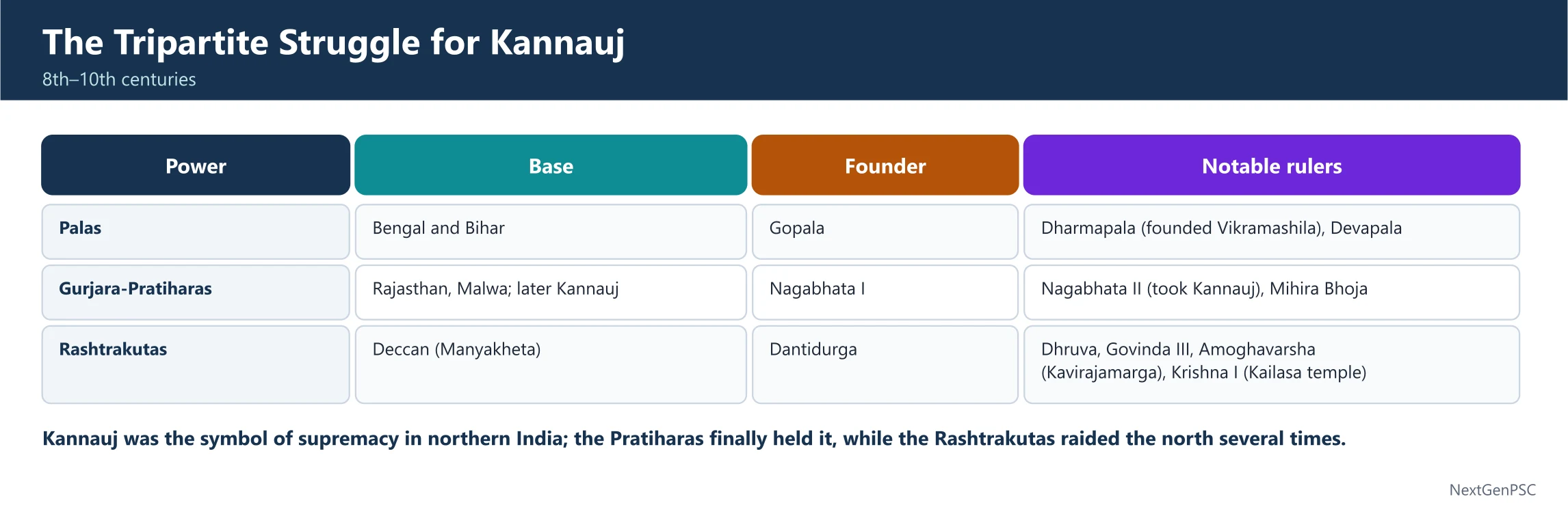
Tripartite Struggle : This was a constant, 200-year conflict among the three empires for control of Kannauj (the former capital of Harsha, which symbolized imperial sovereignty).
Outcome : Control shifted repeatedly. Nagabhata II captured Kannauj, and the Gurjara-Pratiharas made it an important political centre under later rulers, but no dynasty maintained uncontested control throughout the struggle.
Age of Conflict (1000–1200 AD) : The three major empires declined, leading to the rise of numerous smaller kingdoms, notably the Rajputs, setting the stage for subsequent raids.
Note on South India : During this era, the powerful Chola Empire (Later Cholas) dominated the South.
II. Key Dynasties and Contributions
1. Gurjara Pratiharas (North India)
Origin/Founder : The origins of the Gurjara-Pratiharas are debated. Harichandra is associated with an early Mandavyapura branch, while Nagabhata I founded the imperial line centred in western/north India—use the context of the question.
Major Role : Nagabhatta I successfully checked the Arab invasion in the 8th century.
Rulers : Mihirbhoja I was praised by Arab traveler Sulaiman for maintaining law and order. The court of Mahendrapala I included the famous Sanskrit playwright Rajasekhara.
2. Palas of Bengal (Eastern India)
Founder : Gopala , who was elected by the people to end political chaos (recorded in the Khalimpur copper plate).
Religion : They were the last major dynasty to patronize Buddhism, especially the Mahayana and Tantric schools.
Education : Dharmapala founded Vikramshila University and the Somapuri Monastery. He revived Nalanda University.
3. Rashtrakutas of Deccan
Founder : Dantidurga (overthrew the Chalukyas). Capital: Manyakheta (Malkhed).
Architecture : Krishna I built the magnificent monolithic Kailashnath Temple at Ellora, carved out of a single rock.
Literature : Amoghvarsha I (the ' Ashoka of the South ') wrote Kavirajamarga, the earliest work on poetics in the Kannada language.
Cultural Role : They acted as a cultural bridge between North and South India.
| Empire | Key Region | Founder | Major Feature |
|---|---|---|---|
| Gurjara Pratiharas | North India (Kannauj) | Harichandra | Defeated Arabs; Rajasekhara's patron |
| Palas | Eastern India (Bengal/Bihar) | Gopala | Patrons of Buddhism; founded Vikramshila/Nalanda |
| Rashtrakutas | Deccan (Manyakheta) | Dantidurga | Built Monolithic Kailashnath Temple; Bridge between North/South |
Prelims tips
- The Tripartite Struggle was fought for control over Kannauj .
- Krishna I (Rashtrakuta) built the monolithic Kailashnath Temple at Ellora.
- Dharmapala (Pala) founded Vikramshila and revived Nalanda.
- The term ' Ashoka of the South ' is sometimes applied to Amoghvarsha I (Rashtrakuta).
- The Pala dynasty began with the election of Gopala.
- Vikramashila Mahavihara was founded by the Pala king Dharmapala; its famous teacher Atisha Dipankara went to Tibet to revive Buddhism there.
Mains points
- The Early Medieval period saw regionalisation of political power, land grants, agrarian expansion and new intermediaries. ‘Indian feudalism’ is a useful but debated analytical label, not an unquestioned description of every region.
- The Tripartite Struggle reveals the political and symbolic value of Kannauj, while the Palas, Pratiharas and Rashtrakutas also sustained trade, learning and cultural production. Avoid treating political plurality as simple ‘failure’ or as an inevitable cause of later conquest.
- The Rashtrakutas were unique in maintaining political, cultural, and economic links across the Vindhyas, effectively integrating the Northern and Southern political spheres.
- The patronage of Buddhism by the Palas and the construction of monolithic temples by the Rashtrakutas showcase the diverse religious and architectural evolution of the era.
Did you know?
- The monolithic Kailashnath Temple built by the Rashtrakutas is not assembled; it was carved out of one single rock by digging from the top down, a massive engineering feat.
- The Pala dynasty was started by Gopala, who was not a hereditary ruler but was elected by an assembly of nobles to end the political anarchy in Bengal.
- The Gurjara Pratihara ruler Mihirbhoja I was known for his cavalry, and Arab accounts mention his army having the best horses in India.
- The Rashtrakuta capital, Manyakheta, was known as one of the four great capitals of the world during the 10th century, alongside Baghdad, Constantinople, and Kanchipuram.
Architecture, Literature, and Socio-Economic Life of the Three Empires
The three empires of the Early Medieval Period— Gurjara Pratiharas , Palas , and Rashtrakutas —left lasting legacies in architecture, particularly rock-cut temples and educational centers, while the period witnessed the growth of feudalism and a decline in coinage.
I. Gurjara Pratiharas (North India)
Architecture :
o Khajuraho Style: The Pratiharas significantly influenced the North Indian temple style seen later at Khajuraho (built by their feudatories, the Chandela dynasty).
o Teli ka Mandir: Built by Mihira Bhoja within the Gwalior Fort, this unique Hindu temple represents the Pratihara's own distinct architectural tradition (Gopagiri style).
Literature :
o Rajasekhara: The most famous Sanskrit poet in the court of Mahendrapala I and Mahipala I.
o Key Works: Authored Kavya Mimansa (a manual for poets) and the play Karpuramanjari (written in Sauraseni Prakrit).
Military : Maintained the finest cavalry among the three, relying on the horse trade with Central Asia and Arabia.
II. Palas (Eastern India)
Architecture & Education :
o Great Viharas: Palas built vast monasteries (Viharas) and temples, notably Vikramashila and Somapuri.
o International Hub: Noted Buddhist scholars, including Santarakshita and Dipankara (Atisa), who traveled to Tibet, ensuring that Nalanda and Vikramshila remained crucial global centers for Buddhist studies.
Literature :
o Language: Laid the foundation for the proto-Bengali language.
o Charyapada: Developed the first Bengali literature, a collection of mystic Buddhist poems from the Tantric tradition. The authors were called Mahasiddhas.
III. Rashtrakutas (Deccan)
Architecture :
o Ellora: Krishna I built the magnificent monolithic rock-cut Kailashnath Temple at Ellora (9th century). This temple is unique for being carved entirely out of a single large rock .
Literature:
o Patronage: Patronized Sanskrit as well as regional languages like Prakrit and Apabhramsha.
o Swayambhu: The great Apabhramsha poet Swayambhu lived at the Rashtrakuta court.
o Revenue Officials: Local revenue officers included Nad-gavundas or Desa-gramakutas (in Deccan) and Deshmukhas (in Maharashtra).
IV. Socio-Economic and Military Features
Feudalism : The political system shifted towards feudalism, marked by kings granting land to Samantas (local chiefs/big zamindars), who gained significant power.
Economic Trends : This period witnessed a general decline of towns and a noticeable absence of Gold and Silver coins in circulation, suggesting a shift towards localized economic self-sufficiency.
Trade & Taboos : New Dharmashastras placed restrictions on travel across the salt seas (Samudra Yatra), though Tamralipti (Bengal) remained a key port for trade with Java and Sumatra.
Military Organization : All three kingdoms maintained a Royal army (infantry, cavalry, elephants). The Palas maintained the largest number of elephants; the Pratiharas maintained the finest cavalry; and Rashtrakutas and Pratiharas were heavily involved in the horse trade with Central Asia and Arabia.
| Empire | Key Region | Founder | Major Feature |
|---|---|---|---|
| Gurjara Pratiharas | North India (Kannauj) | Harichandra | Defeated Arabs; Rajasekhara's patron |
| Palas | Eastern India (Bengal/Bihar) | Gopala | Patrons of Buddhism; founded Vikramshila/Nalanda |
| Rashtrakutas | Deccan (Manyakheta) | Dantidurga | Built Monolithic Kailashnath Temple; Bridge between North/South |
Prelims tips
- The Tripartite Struggle was fought for control over Kannauj .
- Krishna I (Rashtrakuta) built the monolithic Kailashnath Temple at Ellora.
- Dharmapala (Pala) founded Vikramshila and revived Nalanda.
- The term ' Ashoka of the South ' is sometimes applied to Amoghvarsha I (Rashtrakuta).
- The Pala dynasty began with the election of Gopala.
- The rock-cut Kailasa (Kailasanatha) temple at Ellora was built by the Rashtrakuta king Krishna I (8th century); the Rashtrakuta king Amoghavarsha (Nripatunga) wrote Kavirajamarga, an early Kannada work on poetics.
Mains points
- The Early Medieval period saw regionalisation of political power, land grants, agrarian expansion and new intermediaries. ‘Indian feudalism’ is a useful but debated analytical label, not an unquestioned description of every region.
- The Tripartite Struggle for Kannauj demonstrated the failure to establish a stable, unified North Indian empire, leaving the region vulnerable to subsequent invasions from the Northwest.
- The Rashtrakutas were unique in maintaining political, cultural, and economic links across the Vindhyas, effectively integrating the Northern and Southern political spheres.
- The patronage of Buddhism by the Palas and the construction of monolithic temples by the Rashtrakutas showcase the diverse religious and architectural evolution of the era.
Did you know?
- The monolithic Kailashnath Temple built by the Rashtrakutas is not assembled; it was carved out of one single rock by digging from the top down, a massive engineering feat.
- The Pala dynasty was started by Gopala, who was not a hereditary ruler but was elected by an assembly of nobles to end the political anarchy in Bengal.
- The Gurjara Pratihara ruler Mihirbhoja I was known for his cavalry, and Arab accounts mention his army having the best horses in India.
- The Rashtrakuta capital, Manyakheta, was known as one of the four great capitals of the world during the 10th century, alongside Baghdad, Constantinople, and Kanchipuram.
Regional Kingdoms of the Later Early Medieval Period (1000–1200 AD)
The later phase of the Early Medieval period saw the rise of successor dynasties like the Senas (Bengal), the Western Chalukyas (Deccan), and the Ganga dynasty (Odisha), alongside regional powers like the Karkotas of Kashmir, marking the political fragmentation and feudalization of India.
1. Senas of Bengal (c. 1097–1225 CE)
Identity: A Hindu Brahmin-Kshatriya dynasty that replaced the Palas in Bengal and brought a period of Sanskritic revival and orthodox Hindu practices in eastern India.
Founder: Samanta Sena (Title: Brahmakshatriya).
Key Rulers:
Vijaya Sena: Described as Maharajadhiraja in the Barrackpore Copper Plate Inscription; consolidated the dynasty’s control over Bengal.
Ballala Sena: Known for the revival of orthodox Hindu customs; author of Adbhutsagara and Danasagara.
Lakshmana Sena: The last effective ruler, whose reign ended with Bakhtiyar Khalji’s invasion, marking the final end of Sena rule.
Court Poets: His court included Jayadeva (author of Gita Govinda), Dhoyi, and Umapati.
Significance: Symbolized the transition from the Buddhist-Pala era to a Hindu-Sanskritic polity and enriched Bengal’s literary culture.
2. Kalachuris (Chedis of Tripuri) — Central India (c. 9th–13th centuries CE)
Location: Ruled from Tripuri (near modern Jabalpur), between the Godavari and Narmada rivers.
Founder: Kokkala I (r. c.845–885 CE), who established the Kalachuri power.
Later Rulers: The line continued under several branches; Vijaysimha (r. c.1177–1211 CE) was the last major ruler.
Significance: Played an important role in central Indian politics, temple-building, and interactions with the Chalukyas, Rashtrakutas, and Gahadavalas.
3. Eastern Gangas of Kalinga (Odisha) — Ganga Dynasty (c. 11th–15th centuries CE)
Region: Ruled over Kalinga (modern Odisha and parts of northern Andhra Pradesh).
Founder: Anantavarman Chodaganga (r. c.1077–1150 CE), who took the title Trikalingadhipati and consolidated Kalinga’s power.
Architecture:
Credited with initiating the construction of the famous Jagannath Temple at Puri — a landmark in Odishan temple architecture.
Narasimhadeva I (r. c.1238–1264 CE) built the grand Sun Temple at Konark, symbolizing the artistic zenith of the dynasty.
Legacy: Patronized temple art, maritime trade across the Bay of Bengal, and religious syncretism in eastern India.
4. Western Chalukyas of Kalyani (Karnataka) — c. 10th–12th centuries CE
Founder: Tailapa II (r. c.957–997 CE), who overthrew the Rashtrakutas and restored Chalukya rule with Kalyani (Basavakalyan) as capital.
Greatest Ruler: Vikramaditya VI (r. c.1076–1126 CE), who assumed the title Tribhuvanamalla and presided over a golden age of Deccan culture.
Literature: His court poet Bilhana composed Vikramankadeva Charita; Kannada and Sanskrit literature flourished.
Architecture: Built temples like Mallikarjuna Temple and Mahadeva Temple, showing the later phase of Chalukyan architecture that influenced the Hoysalas.
Importance: Served as a political and cultural bridge between the Rashtrakutas and the Hoysalas.
5. Kingdoms of Kashmir (As per Kalhana’s Rajatarangini)
Source: The Rajatarangini of Kalhana (12th century CE) provides a rare continuous history of Kashmir’s rulers and polity.
Karkota Dynasty (7th–9th c. CE): Founded by Durlabhavardhana. Lalitaditya Muktapida (8th c.) expanded power and built the magnificent Martand Sun Temple.
Utpala Dynasty (9th c. CE): Established by Avantivarman, remembered for flood control, irrigation, and the founding of Avantipura city.
Lohara Dynasty (10th–12th c. CE): Included strong rulers like Queen Didda, one of the rare female sovereigns of medieval India.
Hindu Shahis: A related dynasty ruling parts of Kabul and Gandhara, showing the frontier continuity of northwestern Indian polities.
Legacy: The Kashmir tradition represents a blend of political continuity, temple culture, and literary development in the northwestern Himalayas.
| Dynasty | Region | Key Ruler | Contribution/Work |
|---|---|---|---|
| Senas | Bengal | Lakshamana Sena | Patronized Jayadeva (Geet Govind); defeated by Bakhtiyar Khalji. |
| Chedis/Kalachuris | Tripuri (MP) | Kokkala I | Ruled central India between Narmada and Godavari. |
| Western Gangas | Odisha | Narsimhadeva I | Built Sun Temple at Konark; Anantavarman built Jagannath Temple. |
| Western Chalukyas | Kalyani (Karnataka) | Vikramaditya VI | Patronized Bilhana (Vikramankadeva Charita). |
| Karkota Dynasty | Kashmir | Lalitaditya Muktapida | Built Martand Temple; documented in Rajatarangini. |
Prelims tips
- Lakshamana Sena 's court featured Jayadeva (author of Geet Govind).
- The Jagannath Temple (Puri) and Sun Temple (Konark) belong to the Western Ganga Dynasty.
- Vikramaditya VI (Western Chalukya) was praised by Bilhana in Vikramankadeva Charita.
- The history of Kashmir is primarily known from Kalhana’s Rajatarangini.
- The Martand Temple in Kashmir was built during the Karkota Dynasty.
Mains points
- The later regional kingdoms (Senas, Gangas, Chalukyas) continued the architectural and literary traditions of their predecessors (Palas, Rashtrakutas) while accelerating the process of feudal decentralization.
- The Western Ganga dynasty's legacy in Odisha is central to the development of the Kalinga School of Architecture (Puri, Konark), demonstrating the strong link between patronage and regional cultural identity.
- Kalhana’s Rajatarangini provides a unique and reliable historiographical source for the Early Medieval period, offering insights into political and social life not available for most other contemporary kingdoms.
- The invasion of Bakhtiyar Khalji into Bengal highlights the political vulnerability created by the fragmentation of power in the North/East and the decline of the earlier great empires.
Did you know?
- The Sun Temple at Konark, built by Narsimhadeva I, was designed as a colossal chariot with twelve pairs of intricately carved wheels.
- The Sena dynasty ruler Ballala Sena is famous for establishing the tradition of Kulinism in Bengal, a complex system of matrimonial and social hierarchy.
- Queen Didda of the Lohara dynasty was a physically disabled but politically ruthless ruler who managed the Kashmir kingdom single-handedly for decades.
- Bakhtiyar Khalji’s invasion of Bengal during Lakshmana Sena's reign was famously swift; some accounts claim Khalji only had a small cavalry force, yet the Sena capital was easily captured.
The Age of Conflict (1000–1200 AD) and the Rise of the Rajputs
The period 1000–1200 AD marked the Age of Conflict and the collapse of the Gurjara-Pratihara Empire, leading to the rapid rise of numerous Rajput states (like the Chauhans, Chandellas, and Paramaras) across North India. This political fragmentation left the region vulnerable to aggressive Turkish invasions from the northwest.
I. Age of Conflict and Fragmentation
Political Shift : The break-up of the Gurjara-Pratihara empire created a political vacuum and a new phase of struggle for dominance in North India.
Consequence : The constant internal fighting among emerging regional powers meant little attention was paid to the aggressive expansionist Turkish states (like the Ghaznavids and Ghurids) on India's northwestern border.
End Result : This vulnerability led directly to the incursion of the Turks into northern India, culminating in the establishment of the Delhi Sultanate towards the end of this period.
II. Rise of the Rajputs
Origin of Term : The term Rajput originates from the Sanskrit word Rajputra, meaning 'son of a king' or 'of royal lineage'.
Nature : The Rajput clan was formed from diverse elements but became politically and socially homogenous through constant intermarriage and adopting common customs.
Characteristic Features : The core values of the Rajput clans were 'attachment to land, family and honour'.
III. The Rajput States
1. Chauhans/Chahamanas
Region : Ruled Rajasthan and adjoining regions, initially as feudatories of the Pratiharas.
Founder : Simharaja, who declared independence (944 AD).
Capital : Shakambhari (modern Sambhar), later shifted to Ajmer (Ajayameru, founded by Ajayaraja II).
Key Rulers :
Vigraharaja IV/Visaldev: Wrote the play Harikeli Nataka. Constructed the structure later known as the Adhai Din Ka Jhopra.
Prithviraj III (Rai Pithora): Most famous Chauhan ruler.
- First Battle of Tarain (1191 AD): Defeated Mohammad Ghori.
- Second Battle of Tarain (1192 AD): Defeated and killed by Mohammad Ghori (a major turning point).
Decline : Qutub-ud-din Aibak conquered Ajmer. Alauddin Khilji later captured Ranthambore (1301 AD), ending their major stronghold.
2. Chandellas of Bundelkhand
Region/Capital : Ruled Bundelkhand (Central India). Capital: Khajuraho.
Founder : Nannuka (initially feudatories of Gurjara-Pratiharas).
Architecture : The Nagara style of temple architecture reached its peak at Khajuraho under the Chandellas (e.g., Lakshmana Temple, Vishvanatha Temple, Kandariya Mahadeva Temple).
Key Rulers :
Jayashakti: The region was named 'Jejakabhukti' after him.
Vidyadhara: Famous for resisting Mahmud of Ghazni and murdering the Pratihara ruler Rajyapala.
3. Paramaras of Malwa
Region/Capital : Ruled Malwa. Capital: Dhara (later shifted to Mandu).
Founder : Upendra (feudatories of Rashtrakutas).
Ruler Bhoja (1010–1055 AD) : A great scholar and patron. He built a Sarasvati temple in Dhara, founded the city of Bhojpur, and built the Bhojeshwar temple.
Decline : Killed by the army of Ala-ud-din Khilji in 1305 AD.
4. Chalukyas of Gujarat (Solanki Rajputs)
Region/Capital : Ruled Gujarat and Kathiawar. Capital: Anahilapataka (Pattan).
Key Rulers :
Bhima I: Mahmud of Ghazni plundered the Somnath Temple during his reign. His queen built the Rani-ki Vav (UNESCO World Heritage Site). Minister Vimalsha built the Vimal Vasahi temple (Dilwara Temple).
Bhima II: Successfully resisted the invasion of Mohammad Ghori at the Battle of Kayadara.
Decline : They were replaced by their feudatories, the Vaghela dynasty, before Gujarat fell to Ala-ud-din Khilji.
5. Tomaras of Delhi
Region/Capital : Ruled the Haryana territory. Capital: Dellika (Delhi).
Key Rulers : Anangapala Tomara established Delhi and the citadel of Lal Kot.
Legacy : A 13th century Palam Baoli inscription mentions Tomaras enjoyed the land of Hariyanaka before the Chauhans and Delhi Sultans.
6. Gahadavalas of Kannauj
Founder : Chandradeva. Second Capital: Banaras.
Decline : Jaichandra ’s rivalry with Prithviraj Chauhan weakened them. He was defeated and drowned in the Ganga by Mohammad of Ghori in the Battle of Chanawar (1194 AD). Survivors founded the Rathore clan in Rajasthan (Marwar/Jodhpur).
| Dynasty | Region | Capital | Key Ruler/Event |
|---|---|---|---|
| Chauhans (Chahamanas) | Rajasthan | Ajmer | Prithviraj III (Battles of Tarain, 1191/1192) |
| Chandellas | Bundelkhand | Khajuraho | Vidyadhara (Built Kandariya Mahadeva Temple) |
| Paramaras | Malwa | Dhara/Mandu | Bhoja (Scholar-King, founded Bhojpur, Sarasvati Temple) |
| Chalukyas (Solankis) | Gujarat/Kathiawar | Anahilapataka (Pattan) | Bhima I (Somnath plundered); Rani-ki Vav (UNESCO) |
| Gahadavalas | Kannauj | Kannauj/Banaras | Jaichandra (Defeated by Ghori in Battle of Chanawar, 1194) |
| Tomaras | Haryana/Delhi | Dellika (Delhi) | Anangapala Tomara (Founder of Lal Kot) |
Prelims tips
- Prithviraj Chauhan (III) was defeated in the Second Battle of Tarain (1192) by Mohammad Ghori.
- The Kandariya Mahadeva Temple (Khajuraho) was built by the Chandella ruler Vidyadhara.
- The Rani-ki Vav (Gujarat) was built by Queen Udaymati during the reign of Bhima I (Solanki/Chalukya).
- Bhoja (Paramara) was a polymath who founded Bhojpur and was patronized by Padmagupta.
- The Palam Baoli inscription mentions the chronological rule of the Tomaras, Chauhans, and Shakas over Delhi.
- Agnikula legend (Prithviraj Raso): the Pratiharas, Paramaras, Chauhans and Chalukyas (Solankis) arose from a sacrificial fire at Mount Abu. The Paramara king Bhoja wrote the architecture treatise Samarangana Sutradhara.
Mains points
- The period 1000–1200 AD should be analysed through regional rivalry, resource mobilisation, fort networks and changing military techniques—not through stereotypes of a uniform ‘feudal’ or ‘Rajput’ polity.
- The Battles of Tarain (1191–92) were important in Ghurid expansion, but the Delhi Sultanate was built through later campaigns and institutions. Avoid framing the events as a civilisational shift from ‘Hindu’ to ‘Muslim’ military dominance.
- Despite political instability, the Rajput states left a rich legacy of Nagara style temple architecture (Khajuraho) and pioneered significant water management structures (Rani-ki Vav, Suraj Kund), showcasing cultural resilience.
- The rise of the Rajputs reinforced a decentralized, land-grant-based (feudal) military structure that relied heavily on local chiefs (Samantas), which proved ineffective against a unified, centralized invading force.
Did you know?
- The structure later converted into the Adhai Din Ka Jhopra mosque in Ajmer was originally a Sanskrit college built by the Chauhan ruler Vigraharaja IV.
- The Rani-ki Vav is an architectural marvel designed as an inverted temple to emphasize the sanctity of water; it was added to the UNESCO list in 2014.
- Later popular narratives portray Jaichandra as an ally of the Turks against Prithviraj, but this claim is not securely supported by contemporary evidence. Treat it as legend, not an explanation for Ghurid success.
- The Rajput clans maintained a fierce attachment to Kshatriya dharma and honour, which often led to internal feuds and prevented them from forming a united front against the Turkish invaders.
CAUSES OF DECLINE OF RAJPUTS
The expansion of the Ghurid-Turkish forces in north India resulted from a changing political and military balance, not from one inherent ‘Rajput’ weakness. Competition among regional states, access to mobile cavalry and military resources, leadership, logistics, and the contingent outcomes of campaigns all mattered.
I. Political and Social Reasons
Regional Competition : North India contained several competing powers, including the Chauhans, Gahadavalas, Chandelas and Paramaras. Alliances and rivalries constrained coordinated responses, but these states also possessed substantial military and fiscal resources.
Lack of Vision : They lacked political foresight, prioritizing personal freedom, pride, and clan honour over the political unity necessary to defend North India from external, aggressive states.
Absence of Uniformity : There was no written law for the land, and states were ruled based on disparate local customs and traditions, hindering pan-Indian political integration.
Caste Consciousness : A rigid caste system restricted warfare primarily to the Kshatriya class, preventing mass mobilization. The Turks, conversely, utilized united, mixed-caste armies, strengthening their ranks.
II. Military and Strategic Reasons
Military Context : Ghurid forces used fast cavalry, mounted archery, intelligence and repeated campaigning effectively. This does not mean Indian armies had no trained troops or cavalry; outcomes varied with commanders, resources, terrain and coalition politics.
Military mobility : Ghurid forces used mounted archery and mobile cavalry effectively and drew on Central Asian horse networks. Indian armies also deployed cavalry; differences in command, resources, logistics and tactics—not an absolute absence of mobility—shaped outcomes.
Defensive Strategies : Rajputs habitually fought defensive wars, attempting only to stop the enemy or protect cities, rather than waging decisive offensive campaigns to neutralize the threat in its own territory.
Lack of New Arms : They relied on close-range weapons like the spear and sword. The Turkish invaders were skilled archers who used efficient, disciplined cavalry to attack effectively from a long range.
Weak Espionage System : Rajput spy networks were primarily focused on neighboring Rajput dynasties, leaving them completely unaware of the large-scale movements and strategies of foreign invaders.
III. Economic and Ethical Reasons
Depletion of Treasury : Rajput rulers spent heavily on personal luxuries and lavish courts, frequently emptying the royal treasuries, forcing financial submission when external attacks demanded vast resources.
Attraction of Wealth : The vast wealth (gold/jewels) stored in religious buildings and not allowed to circulate in the market was a primary motivation for the foreign invaders (e.g., Mahmud of Ghazni), funding their expansionist wars.
Obsession with Ethics : Rajputs rigidly observed morality and ethics on the battlefield, avoiding attacks on sleeping enemies, unarmed civilians, or at night. The Turks did not share these values, using every opportunity for conquest.
Fatal Error : Prithviraj Chauhan's decision to release Mohammad Ghori after the First Battle of Tarain (1191 AD) due to an ethical code is cited as a major mistake, ensuring Ghori's return and subsequent victory.
| Aspect | Rajput Forces | Turkish Invaders |
|---|---|---|
| Organization | Decentralized (reliant on feudal lords/Samantas) | Centralized, professional standing armies |
| Mobility | Low (dependent on infantry and elephants) | High (elite, disciplined cavalry) |
| Primary Weapon | Spear and sword (short-range) | Bow and Arrow (long-range archery) |
| Strategy | Defensive and fixed formations | Offensive, fluid, and flanking maneuvers |
| Ethics | Strictly observed morality (e.g., releasing captured enemies) | Pragmatic; sought victory by any means |
Prelims tips
- The Second Battle of Tarain (1192 AD) is considered the pivotal military event that ensured the Turkish conquest of North India.
- The Rajput military was primarily weakened by reliance on Samantas (feudal lords) for troops.
- Reservoir-Induced Seismicity (RIS) is a common anthropogenic cause (e.g., Koyna, 1967).
- Mihirbhoja I (Pratihara) was noted for maintaining the finest cavalry in India, according to Arab accounts.
- The monolithic Kailashnath Temple at Ellora was built by Krishna I of the Rashtrakutas.
Mains points
- For Mains, avoid monocausal explanations: the Ghurid breakthrough combined regional rivalries with military mobility, strategic leadership, resource flows and the instability created by repeated campaigns.
- The contrast in military technology and doctrine—slow Rajput elephants/infantry vs. fast Turkish archer-cavalry—was decisive in pitched battles like Tarain.
- The Rajputs’ inability to transcend clan politics (e.g., Jaichandra’s betrayal) and rigid Kshatriya ethics proved to be their greatest political and strategic vulnerability against a pragmatic invader.
- The scarcity of coinage and luxury spending contributed to the economic weakness, making the wealth stored in temples an irresistible target for Ghaznavid and Ghurid raiders.
The Chola Empire (850 -1200 A.D.): Rise and Supremacy
The Chola Empire was one of the greatest and longest-lasting empires in South India, famous for its powerful Navy (conquering Sri Lanka and Maldives) and its highly effective system of Local Self-Government.
I. Origin and Political Foundation
Decline & Revival : After a period of decline (around 300 AD) when they served as feudatories under the Pallavas and Pandyas, the Cholas seized their opportunity.
Founder : The medieval Chola period began when King Vijayalaya renounced Pallava authority (around 850 CE ), captured Thanjavur (Tanjore), and made it his new capital.
Territory : The core kingdom, known as Cholamandalam (or Chonad), was concentrated in the fertile Kaveri-fed delta.
Historical Mention : The Chola kingdom finds mention in early sources like the Pillars of Ashoka (3rd Century BC) and Greco-Roman accounts like the Periplus of the Erythraean Sea (1st Century AD).
II. Key Imperial Rulers and Feats
Aditya I (871 -907 AD) : Maintained matrimonial alliances with Pallavas; put an end to the Pallava kingdom by defeating Aparajita and annexed Tondaimandalam.
Parantaka I (907- 955 AD) : Known as Maduraikonda (Capturer of Madurai). Suffered a serious setback after being defeated by Rashtrakuta Krishna III at the Battle of Takkolam (949 AD). Gifted a golden roof (Vimana) for the Nataraja temple at Chidambaram.
Rajaraja I (The Great, 985-1014 AD) :
Naval Power: Established Chola naval supremacy by conquering the Maldive Islands and annexing the northern part of Sri Lanka (named Mummudi-Cholamandalam).
Administration: Known as Ulakalanada Perumal for standardizing the collection of taxes.
Rajendra I (1014-1044 AD) :
North Indian Expedition: Crossed the Ganges by defeating Pala King Mahipala I; founded the new capital city Gangaikondacholapuram to commemorate this victory.
Naval Empire: Launched a major naval expedition against Sri Vijaya (Kadaram) in the Malay peninsula, Java, and Sumatra. Assumed the title Kadaramkondan.
Kulothunga Chola I (1070-1120 AD) : Unified the Vengi kingdom with Chola. Assumed the title Sungam-tavirtta Cholan (Abolisher of Tolls), signifying trade liberalization. Sent a large embassy of 72 merchants to China.
III. Administrative, Military, and Economic Features
Administration (Local Self-Government) : The Chola system is famous for its highly developed local self-government at the village level (Ur and Sabha), one of the earliest examples of the Panchayati Raj system in India.
Navy and Trade : The development of a powerful Navy was crucial for securing India’s sea trade in the Indian Ocean (Coromandel and Malabar coasts) and for conquest (Sri Lanka, Maldives).
Warfare : Rajadhiraja I , who died fighting at the Battle of Koppam against the Western Chalukyas, earned the title Yanai-mel-thunjina Devar (the king who died on the back of an elephant).
| Ruler | Title/Achievement | Significance |
|---|---|---|
| Vijayalaya | Founder, Captured Thanjavur | Re-established Chola power in 850 AD |
| Parantaka I | Maduraikonda, Gifting Vimana (Chidambaram) | First major expansionist; faced Rashtrakuta setback at Takkolam |
| Rajaraja I | Mummudi Choladeva, Conquered Maldives/N. Sri Lanka | Established Chola naval and imperial supremacy |
| Rajendra I | Kadaramkondan, Gangaikondacholan | Annexed whole of Sri Lanka; North India & Sri Vijaya expeditions |
| Kulothunga I | Sungam-tavirtta Cholan (Abolisher of Tolls) | Unified Vengi; focused on trade and administration |
| Official/Body | Role/Designation |
|---|---|
| Ko / Perumal Adigal | Emperor (Supreme Authority) |
| Mandalam Governor | Prince or Viceroy of the Province |
| Nattar | District (Nadu) Officials; performed fiscal and judicial duties |
| Ayyavole / Manigramam | Powerful Merchant Guilds (autonomous corporate organizations) |
| Velaikkarar | Personal Troops/Bodyguards to defend the King |
| Kaikkolaperumpadai | Royal Troops / Regular Army Regiments |
| Erivariyam | Village Committee for managing Tanks and Water Distribution |
Prelims tips
- The Chola heartland was Cholamandalam in the Kaveri delta.
- The monolithic Kailashnath Temple at Ellora was built by Krishna I of the Rashtrakutas, not the Cholas.
- Rajaraja I conquered the Maldive Islands.
- Rajendra I founded Gangaikondacholapuram after defeating the Palas.
- Kulothunga I was known as Sungam-tavirtta Cholan (Abolisher of Tolls).
Mains points
- The Chola state combined royal authority with multiple local institutions—ur, sabha, nagaram and nadu. Their autonomy and social composition varied; this is more accurate than describing a uniform system of local self-government.
- Chola overseas expeditions and merchant networks reveal intensive Bay of Bengal connections. They affected routes and political relations but did not turn the Bay into an exclusive ‘Chola Lake’ or create a permanent Indian monopoly over Southeast Asian trade.
- The Rajendra I's North India campaign was primarily an expedition of military prestige, establishing the Cholas as a pan-Indian power and a counterweight to the Northern dynasties.
- Chola temples (like Brihadeeswarar) served not just as places of worship but as economic centers and landlords, demonstrating the holistic integration of religion and state economy.
Did you know?
- Rajendra I’s expedition to the Ganges was a symbolic effort to match the military prestige of North Indian rulers who had previously marched into the Deccan.
- The Uttaramerur inscriptions record procedures for selecting committees in a sabha of a Brahmadeya village. They are valuable evidence of local corporate institutions, but should not be equated directly with modern universal Panchayati Raj: participation was restricted by property, learning and social-status qualifications.
- The defeat of Sri Vijaya by Rajendra I was unusual because it was a war against a major maritime power in Southeast Asia, aimed at controlling lucrative trade routes rather than permanent land annexation.
KEY FEATURES OF CHOLA EMPIRE (850 -1200 AD)
The Chola Empire established a sophisticated model of centralized administration complemented by robust Local Self-Government. The era was the Golden Age of Tamil Culture , marked by monumental Dravidian Temple Architecture and exquisite Bronze Sculpture.
I. Chola Administration and Governance
Central Authority : The king was the supreme head (titles: Ko, Perumal Adigal ). The empire (Rashtriyam/Rajyam) consisted of eight Mandalams (provinces), each led by a Governor (generally a prince).
Administrative Units : Provinces divided into Valanadus (or Kottams), further divided into Nadus (districts) under Nattar (district officials).
Nattar Role : The Nattar performed fiscal, administrative, and judicial responsibilities. Landholders of the nadu held titles like araiyaian (leader) and kilavan (headman).
Guilds (Corporate Bodies) : Autonomous organizations known as Shrenis or Pugas, governed by the Banaju-Dharma. The Ayyavole (The Five Hundred) and Manigramam were powerful and vital merchant guilds.
Nagaram : The assembly of mercantile groups/merchants was called Nagaram, specialized for different trades (e.g., Saliya Nagaram for textiles).
II. Local Self-Government (The Panchayati Model)
Village Types :
Ur: Village assembly consisting of people from different castes.
Sabha/Mahasabha: Assembly in Agrahara (Brahmin-settled, rent-free) villages. These villages enjoyed extensive autonomy.
Committee Elections : The Uttarameruru inscription (Parantaka I) gives details of elections: educated, property-owning adult men were selected for executive committees by drawing lots or rotation.
Key Committees : Erivariyam (Tank/Water), Puravuvari-tinaikkalam (Revenue), Samavatsara Variyam (Annual), Pon Variyam (Gold/Treasury).
III. Military, Revenue, and Economy
Army/Military :
The army was well-organized (infantry, cavalry, elephants). Royal troops were Kaikkolaperumpadai.
Velaikkarar: Personal troops/body-guards who showed extreme loyalty (Marco Polo mentioned them burning themselves on the king’s pyre).
Revenue System : The Land Revenue Department was puravuvari-tinaikkalam. Extensive land surveys (Rajaraja I, Kulotunga I) classified land and fixed taxes based on fertility.
Taxes (Examples) : Nulayam (Tax on cotton thread), Tari pudavai (Tax on patterned loom), and judicial fines.
Irrigation : Cholas encouraged irrigation (e.g., digging canals like Uttamachola- vayakkal) and maintained large tanks. Vativaykkal was the traditional crisscross rainwater harnessing system in the Kaveri delta.
Economy : Primarily agrarian. Key trade centers included Kanchipuram (silk), Kudamukku (metal works), and the major port of Nagapattinam (for Southeast Asia/China trade).
IV. Society, Religion, and Culture
Social Divisions : Society was dominated by the antagonistic groups: Valangai (Right-hand, agricultural) and Idangai (Left-hand, artisan/trading). The rigid Caste System was prevalent.
Women's Status : Generally low; Sati was practiced among royal families; Devadasi system and Ganikas (prostitutes) prevailed.
Religion : Cholas were staunch Saivites (followers of Siva), but generally tolerant. Rajaraja I patronized Buddhists (built Chudamani Vihara). However, the later Chalukya-Cholas showed intolerance towards Vaishnavites like Ramanuja, who was forced into exile.
Architecture : The apex of Dravidian architecture is the Brihadeshvara Temple at Thanjavur (Rajaraja I).
Sculpture : Famous for exquisite bronzes, especially the iconic Nataraja (Shiva in Tandava dance posture).
Literature : The Golden Age of Tamil Culture. Kamban wrote Ramavatharam. Sekkilar wrote the Periya-Puranam.
The Collapse of the Chola Empire (13th Century AD) and the Rise of Hoysalas
The Chola Empire collapsed by the mid-13th century due to feudal decentralization and continuous pressure from the Pandyas and the rising Hoysalas. The final blow came when the Pandyan ruler, Jatavarman Sundara Pandyan I, sacked the capital in 1264 AD .
I. The Collapse of the Chola Empire
Internal Weakness : By the end of the 12th century, local chiefs (Samantas), having been granted land by the Chola kings, grew in prominence, leading to the weakening of central imperial control.
External Pressure : The empire faced frequent and successful invasions from the resurgent Pandyas in the south and the rising power of the Hoysalas in the west.
Final Defeat : In 1264 AD, the Pandyan ruler, Jatavarman Sundara Pandyan I, sacked the Chola’s capital at Gangaikonda Cholapuram. With Kanchipuram already lost, the remaining Chola territories passed entirely into the hands of the Pandyan king.
Result : The once mighty Chola empire was reduced to the status of a dependent on the far stronger Hoysalas before eventually disappearing.
II. Rise of the Hoysalas of Dwarasamudra
Origin : The Hoysalas began as feudatories of the Western Chalukyas of Kalyana in the Karnataka region.
Founder : Sala is cited as the founder, but Vishnuvardhana (Bittideva) is considered the greatest and real founder of this dynasty (1108–1152 AD).
Capital : Dwarasamudra (modern Halebid) in Karnataka.
Key Rulers :
Vishnuvardhana (Bittideva): Completely routed Cholas from the crucial region of Gangavadi in the Battle of Talakadu. He earned the title Talkadugonda (Conqueror of Talkad).
- Architecture: Built the magnificent Chennakesava Temple at Belur and the Kirtinarayana Temple at Talakadu to commemorate his victory.
Veera Ballalla III (1291–1343 AD) : The last ruler of the dynasty. He founded a new capital at Hospet (Hosapattana) on the banks of the Tungabhadra river.
Architecture : Famous for the intricate, star-shaped Hoysala style of architecture (a variant of the Chalukyan style). Other examples include Kesava Temple at Somnathpur and Hoysaleswara Temple at Halebid.
Succession : Veera Ballala III was succeeded by Harihara I, who later founded the Sangama dynasty of the Vijayanagara Empire.
| Dynasty | Region | Founder/Greatest Ruler | Contribution |
|---|---|---|---|
| Pandyas | Extreme South (Madurai) | Jatavarman Sundara Pandyan I | Sacked Chola capital; hastened Chola collapse. |
| Hoysalas | Dwarasamudra (Karnataka) | Vishnuvardhana (Real Founder) | Defeated Cholas at Talakadu; built Chennakesava Temple. |
| Yadavas | Devagiri (Maharashtra) | Bhillama V | Expanded power in the Deccan; later fell to Khilji. |
| Kakatiyas | Warangal (Andhra/Telangana) | Beta I | Known for administrative reforms and resistance to Delhi Sultanate. |
Prelims tips
- The Chola Empire was defeated by the Pandyas in 1264 AD (Jatavarman Sundara Pandyan I).
- The Hoysalas were feudatories of the Western Chalukyas.
- Vishnuvardhana (Hoysala) was the real founder and took the title Talkadugonda.
- The Chennakesava Temple at Belur and Hoysaleswara Temple at Halebid are famous examples of Hoysala architecture.
- The last Hoysala king, Veera Ballalla III , was succeeded by Harihara I, the founder of the Vijayanagara Empire.
Mains points
- The collapse of the Cholas was a classic example of feudal decay, where the decentralization of military and revenue authority to local chiefs ultimately destroyed the center.
- The Hoysalas' rise demonstrates the transfer of imperial power within the feudal structure (from feudatory to sovereign) and their crucial role in developing a distinct regional architectural style (Hoysala style).
- The succession of Hoysala power by the Vijayanagara Empire shows a continuous regional political evolution, where successor states learned from the failures of earlier empires to create a more resilient structure against northern incursions.
- The aggressive rivalry between the Hoysalas and Cholas in the south mirrored the Tripartite Struggle in the north, highlighting the competitive political climate of the entire Early Medieval period.
Did you know?
- The Hoysala capital, Dwarasamudra, means 'Entrance to the Sea' or 'Ocean Gate' in Sanskrit, reflecting its historical significance as a wealthy commercial center, though far inland.
- The Hoysala temples are often described as 'sculpture in stone', famous for their soapstone material and unique star-shaped base designs.
- The Hoysala founder, Vishnuvardhana, originally followed Jainism and was known as Bittideva before converting to Vaishnavism under the influence of the philosopher Ramanuja.
- The final fall of the Hoysalas under Veera Ballalla III occurred during the early campaigns of the Delhi Sultanate (Muhammad bin Tughlaq), marking the end of the major independent South Indian powers preceding Vijayanagara.
The Arab Conquest of Sindh (712 AD)
The Arab conquest of Sindh (711–12 CE), led by Muhammad ibn Qasim , incorporated parts of lower Indus territory into the Umayyad world. The campaign involved political, commercial and strategic factors; its authority remained regionally limited and did not itself establish the later Delhi Sultanate.
I. Background and Causes
Early Contacts : Arab traders had penetrated the coastal towns of Sindh as early as 636 AD during the reign of Caliph Umar.
Immediate Cause : The Sindhi pirates plundered several Arab ships near the port of Dabol/Daybul (Karachi), providing the military pretext for the Umayyad Caliphate.
Systematic Conquest : The major invasion occurred in 712 AD during the reign of the Umayyad caliph al-Walid.
Underlying Motives : Driven by the desire for Indian riches and the goal of spreading Islam (religious zeal).
II. Muhammad Bin Qasim's Expedition
The General : The conquest was led by the 17-year-old Umayyad general, Muhammad Bin Qasim .
Indian Ruler : The Indus basin was ruled by the Hindu king Dahar (successor of Chach). The primary Arab source is the ChachNama.
The Battle : King Dahar was defeated and killed in the Battle of Rewar, leading to the incorporation of the lower Indus region into the Muslim empire.
Military Strategy : Qasim's force primarily consisted of 6,000 men of the gund of Syria. Shiraz was the primary base for planning the campaign.
Administration : Arabic narratives describe negotiated arrangements with local elites and differentiated taxation, including jizya in some contexts. Treat the term ‘tolerance’ carefully: these arrangements were political and fiscal, varied locally, and were not a single blueprint for all later states.
| Sector | Indian Contribution to Arab World | Arab Source/Policy |
|---|---|---|
| Mathematics & Astronomy | Brahma Siddhanta (by Brahmagupta) translated as Sindhind. | Indian decimal system provided the basis for Arabic numerals. |
| Medicine | Works of Charaka and Sushruta translated. | Indian doctors (e.g., Manka) gained prestige in Baghdad. |
| Literature | Panchatantra translated as Kalila and Dimna. | Indian music had a considerable influence on Arabic music. |
| Administration | Negotiated arrangements and differentiated taxation in a limited conquered region. | Illustrates early Arab governance in Sindh; it was not a fixed blueprint for later South Asian states. |
Prelims tips
- The Arab conquest of Sindh was completed in 712 AD under Muhammad Bin Qasim.
- The local ruler defeated was King Dahar (son of Chach).
- The administrative policy of Qasim followed the instructions of Hajjaj.
- The earliest Indo-Arab intellectual contact involved the translation of Brahmagupta's Brahma Siddhanta into Sindhind in Baghdad (771 CE).
- The Panchatantra was translated into Kalila and Dimna.
Mains points
- The Arab conquest was geographically limited, but it connected Sindh more closely with Umayyad and Abbasid political and commercial worlds. Do not read it simply as proof of an inherently ‘vulnerable’ India.
- The most profound impact was not territorial but cultural and scientific, leading to a significant transmission of Indian knowledge in mathematics, astronomy, and medicine to the Arab world, which later passed to Europe.
- Early Arab arrangements in Sindh offer a case study in negotiated rule, fiscal extraction and local elites. Later South Asian states developed their own institutions and cannot be treated as direct replicas of this precedent.
- The internal conflict among the Rajput states (Tripartite Struggle) meant North India was preoccupied and failed to organize a coordinated defense against the foreign threat.
Did you know?
- Muhammad Bin Qasim was only 17 years old when he led the massive campaign that resulted in the conquest of Sindh.
- The Chachnama, a Persian text compiled in the 13th century and presenting earlier material, is an important but late source for the Sindh conquest. Read it alongside other Arabic and archaeological evidence.
- The Arab conquest was geographically limited, as the subsequent Rajput power (Pratiharas) successfully checked their expansion beyond Sindh and Multan.
- The Indian mathematical concept of zero and the decimal system reached Europe via the Arabs due to these intellectual exchanges in Baghdad.
The Turkish Invasion in India (11th & 12th Century)
Ghaznavid and Ghurid campaigns linked north India to wider Central Asian political networks. Ghaznavid raids combined plunder, tribute and frontier control; the Ghurids built a more durable north Indian base. The Second Battle of Tarain (1192) was important, but the Delhi Sultanate emerged through further campaigns, delegation and state-building rather than from one battle alone.
I. The Ghaznavids and Mahmud of Ghazni (The Raiders)
Founder : Alptigin, founded the Ghaznavid dynasty (963 AD).
Subuktigin : Preceded Mahmud; weakened the Hindu Shahi ruler Jayapala on the frontier.
Mahmud of Ghazni (1000–1027 AD) :
Motive: Executed seventeen invasions primarily for economic plunder and religious zeal (gaining the title Idol Breaker/But Shikan).
Key Raids: Defeated Anandapala (Battle of Waihind, 1008). Famous for plundering the Somanath Temple (1025 AD).
Legacy: His conquests of Punjab and Multan established a Turkish foothold in India, though he did not aim for permanent rule.
Scholarly Patronage : Patronized the poet Firdausi (author of Shah Namah) and the historian Alberuni (author of Kitab-i-Hind, a detailed account of India).
II. The Ghoris and Muhammad Ghori (The Conquerors)
Shift in Goal : The Ghoris, under Muhammad Ghori (Muizzuddin Muhammad), were motivated by the goal of conquering India and establishing a permanent empire, unlike Mahmud.
Early Setbacks : Ghori was defeated by the Solanki ruler Mularaja II in Gujarat (1178 AD).
First Battle of Tarain (1191 AD) : Ghori clashed with Prithviraj Chauhan III near Delhi. Ghori was defeated and wounded.
Second Battle of Tarain (1192 AD) : Muhammad of Ghor defeated Prithviraj Chauhan. It enabled Ghurid expansion towards Delhi and Ajmer; consolidation in the Gangetic plain continued through subsequent campaigns under commanders such as Qutb al-Din Aibak and Bakhtiyar Khalji.
Battle of Chandawar (1194 AD) : Ghori defeated Jayachandra (Gahadavala ruler of Kannauj), securing the fertile region of the Gangetic Doab.
Consolidation : Ghori appointed his slave, Qutubuddin Aibak, as the Viceroy, who consolidated the conquests and made Delhi the capital (1193).
Eastern Conquests : Muhammad Bakhtiyar Khalji conquered parts of Bihar and Bengal and displaced Lakshmanasena from Nadia. Persian accounts report attacks on major Buddhist monastic centres; their decline also had longer political, economic and institutional causes, so avoid explaining the end of Indian Buddhism through a single event.
| Aspect | Mahmud of Ghazni (Ghaznavid) | Muhammad Ghori (Ghori) |
|---|---|---|
| Primary Goal | Economic Plunder and religious zeal (not permanent rule) | Political Conquest and establishment of empire |
| Energy Source | Somanath Temple, wealth stored in temples | Defeat of key Rajput states (Tarain, Chandawar) |
| Result in India | Established foothold in Punjab ; indirect influence | Established Muslim Rule in Delhi (via Aibak); direct empire |
| Legacy | Patron of Alberuni and Firdausi | Founder of the subsequent Delhi Sultanate |
| Ruler/General | Dynasty | Primary Goal | Key Event/Significance |
|---|---|---|---|
| Mahmud of Ghazni | Ghaznavid | Plunder | Somanath Raid (1025); Patron of Alberuni. |
| Muhammad Ghori | Ghori | Conquest/Empire | Second Battle of Tarain (1192); opened North India to Muslim rule. |
| Qutubuddin Aibak | Ghori General/Viceroy | Consolidation | Founded the Delhi Sultanate; made Delhi the capital. |
| Muhammad-bin-Baktiyar Khilji | Ghori General | Eastern Conquest | Destroyed Nalanda and Vikramasila Universities. |
Prelims tips
- Mahmud of Ghazni conducted seventeen invasions of India, mainly for wealth (Somanath, 1025 AD).
- The Second Battle of Tarain (1192 AD) between Muhammad Ghori and Prithviraj Chauhan III was the turning point for the conquest of North India.
- Alberuni wrote Kitab-i-Hind in Mahmud's court.
- Baktiyar Khilji destroyed the universities of Nalanda and Vikramasila.
- The Rajputs’ reliance on feudal armies was a key reason for their defeat.
Mains points
- The Turkish Invasions highlighted the severe vulnerability of North India due to its feudal fragmentation and the failure of Rajput clans to form a unified, centralized military command.
- The contrast in military doctrine—slow, elephant-based Rajput armies vs. fast, flexible Turkish archer cavalry—was the decisive technical reason for the Turkish victory at Tarain II.
- While Mahmud's impact was economic (plunder and wealth drain), Ghori's impact was political and institutional, laying the groundwork for the Delhi Sultanate and a new administrative structure.
- The raids against major Buddhist educational centers (Nalanda, Vikramasila) by Baktiyar Khilji caused an irreparable cultural and intellectual loss, accelerating the decline of institutionalized Buddhism in India.
Did you know?
- Mahmud of Ghazni earned the title Idol Breaker (But Shikan) for his frequent and brutal raids on Hindu temples, notably Somanath.
- Muhammad Ghori was defeated in Gujarat (1178) by Solanki Queen Naikidevi (acting as regent for young Mularaja II) before he successfully clashed with Prithviraj Chauhan.
- Ghori's general, Qutubuddin Aibak, took over the consolidation of the Indian provinces, effectively serving as the precursor to the first dynasty of the Delhi Sultanate (Slave Dynasty).
Foreign Accounts: Al-Masudi on Early Medieval India (Circa 953 AD)
The Arab historian Al-Masudi provided one of the most objective foreign accounts of 10th-century India. His work, Muruj al-Dhahab , details the geography, strong feudal political structure (Hereditary posts, powerful Balhara kings), and noted the religious tolerance and high prestige of Indian wisdom.
I. General Information and Significance
Origin/Title : Born in Baghdad. Referred to by some historians as the “Herodotus of Arab”.
Key Works : His major surviving work is Muruj al-Dhahab ("The Meadows of Gold and Mines of Gems").
Contribution : He was the first Arab scholar to successfully combine history and scientific geography in a large-scale work. He rated Indian rulers among the top five rulers of the world, noting that 'wisdom comes from India'.
II. Geographical and Environmental Observations
Extent of India : Observed India (Arz al-Hind) as a vast country, bordering Khurasan and Sind, extending to Tibet. He considered the kingdom of Zábaj (Java/Indonesia) as part of India.
Monsoon Term : Al-Masudi is credited with coining the term Monsoon (seasonal wind) and provided a good account of these periodic winds in the Bay of Bengal (Herkend).
Winds as Energy : Noted the use of windmills in the desert of Sajistan (Rajasthan), highlighting the utility of winds as an energy source on the western frontier.
Comparative Geography : Compared the geography of India with Italy, calling Rome the equivalent of 'Benares' on the River Tiber.
Khambhat : Visited the town of Khambhat (Kambayah) in Gujarat, noting its rich environment situated on a wide estuary.
III. Political and Social Conditions
Political Structure : Observed that royalty, wazirs, qazis, and high officers were all hereditary (inherited their positions), reflecting a rigid, feudal organizational setup.
Royal Conduct : Noted that kings rarely made public appearances, believing they would lose dignity if the public gazed at them frequently. Also observed the custom that a king proved to have drunk wine had to abandon the crown.
Powerful Dynasty : Praised the Balhara king of Malkhed (a corruption of Vallabha-raja, a Rashtrakuta title) for being a powerful ruler who was always at war with the rulers of Kannauj. He noted that Islam flourished in the Balhara's kingdom.
Religious Tolerance : Observed a high degree of general tolerance among people of different religions and explicitly stated that Hindu rulers protected all minority communities, including the followers of Islam.
Abstinence : Noticed that Indians abstained from liquors (al-Sharab) not primarily for religious reasons, but from the fear of losing their reason and mental power.
Kashmir : Described Kashmir as an unapproachable territory with 60,000–70,000 towns and villages, surrounded by high mountains.
| Domain | Key Finding | Significance |
|---|---|---|
| Politics | High posts (Wazirs, Qazis) were hereditary . | Reflects the feudal and decentralized nature of the state. |
| Geography | Coined the term Monsoon . | First major Arab account linking seasonal winds to Indian climate. |
| Dynasty | Praised the Balhara (Rashtrakuta) King. | Confirmed Rashtrakutas as the dominant power fighting the Pratiharas (Kannauj). |
| Culture | Hindu kings maintained religious tolerance for Islam and minorities. | Contradicts the later narratives of widespread religious conflict. |
| Military | Observed windmills in Rajasthan (Sajistan). | Noted the non-military use of winds as an early energy source. |
| Ethics | Indians abstained from liquor for fear of clouding their reason. | Highlights the importance of mental acuity in the Indian ethical system. |
Prelims tips
- Al-Masudi (10th C AD) is called the 'Herodotus of Arab'.
- He coined the term Monsoon.
- His work, Muruj al-Dhahab, mentions the Balhara king (Rashtrakuta) and his conflict with Kannauj.
- He provided early evidence of windmills (in Rajasthan/Sajistan) used as an energy source in India.
- The hereditary nature of high offices was a key observation.
Mains points
- Al-Masudi's accounts are crucial for studying the Early Medieval Feudal State, confirming the powerful role of hereditary officials and the decentralization of power.
- His records highlight the cultural tolerance and intellectual prestige enjoyed by India in the 10th-century Arab world, contradicting later narratives.
- The description of the Rashtrakuta-Kannauj rivalry (Balhara vs. Kannauj) provides contemporary evidence of the Tripartite Struggle for imperial supremacy.
- His geographical observations (Monsoon, Khambhat) are invaluable primary sources for economic and climatic history.
AL BIRUNI (Kitab-al-Hind) on Early Medieval India (1017–1030 AD)
Al-Biruni , a polymath from Khwarazm, compiled the seminal work Kitab-al-Hind (Tahqiq-i-Hind) during his stay in India with Mahmud of Ghazni. His study is notable for its objective and scientific analysis of 11th-century Indian society, revealing deep prejudices against foreigners and chronicling the advanced state of Indian mathematics and astronomy.
I. Methodology and Social Conditions
Author and Context : Abu Raihan Al-Biruni was attached to the court of Sultan Mahmud of Ghazna (999–1030 C.E.) and accompanied him on his campaigns.
Magnum Opus : His most important work is Kitab-al-Hind (or Tahqiq-i-Hind), a comprehensive study written not by travel, but via translations from Sanskrit classics and oral accounts from captured Brahman scholars.
Prejudices : Found contemporary Hindus filled with religious prejudices, insularity, and national pride. He noted that prejudices against foreigners (mleccha) were universal.
Caste System : Defined castes (jati/nasab) and classes (tabaqat). Noted the Antyaja (casteless, like Hadi, Doma, and Chandala), who lived outside villages and towns and were excluded from the four-fold Varna system.
Social Practices : Documented evil practices like child marriage, prohibition of widow marriage, Sati, and Jauhar.
II. Science, Religion, and Political State
Religious Philosophy : Acknowledged that Hindu philosophy viewed God as eternal, unique, and almighty, stating that liberation is common to all castes if the intention is perfect.
Astronomy : Listed five major Siddhantas (mathematical astronomy handbooks), including Surya-siddhanta and Brahma-siddhanta (by Brahmagupta). The latter was translated into Arabic as Sindhind.
Literature : Detailed the epic Mahabharata (Bharata, 100,000 slokas). Noted that Charaka’s book on medicine and the Panchatantra (known as Kalila and Dimna) were translated into Arabic.
Political Status : Observed that the country was divided into small, quarreling states, confirming the absence of nationalism among Indians.
Justice and Taxation : Noted that the King was not the owner of the land but collected a land tax of 1/6th of the produce. Criminal law was mild, and Brahmans were exempted from the death penalty and land taxes.
Geography : Defined the northern frontier by the Kularjak mountains and the western frontier by the Afghan tribes up to Makran. Also mentioned Rameshwaram and Setubandha (Rama's dike).
| Sector | Indian Contribution Noted | Arabic Name |
|---|---|---|
| Astronomy/Math | Brahma Siddhanta (Brahmagupta) | Sindhind (Formed basis of Arab astronomy) |
| Mathematics | Numeral signs (Decimal system) | Arabic Numerals |
| Medicine | Works of Charaka and Sushruta | Translated and studied |
| Literature | Panchatantra fables | Kalila and Dimna |
Prelims tips
- Al-Biruni wrote Kitab-al-Hind in Sanskrit (the language of science and philosophy at that time).
- He accompanied Mahmud of Ghazni.
- He noted the Indian system of numbers and the five Siddhantas (astronomy).
- He mentions the Siddha Matrika script as being popular in North India.
- He noted that Brahmans were exempted from the death penalty and land taxes.
- The Panchatantra was known to Arabs as Kalila and Dimna.
Mains points
- Al-Biruni’s work provided the first detailed, systematic, and objective non-Indian perspective on Indian society, history, and science of the Early Medieval Period.
- His accounts on social fragmentation, national insularity, and the mildness of criminal law offer vital sociological data for understanding India's vulnerability before the Turkish conquest.
- The transmission of Indian knowledge in astronomy and mathematics (e.g., Brahmagupta's work, Indian numerals) through his translations highlights India's global intellectual contribution during this era.
- He serves as a crucial historiographical source, confirming the political reality of feudal disunity and the absence of a unified military command in North India.
Did you know?
- Al-Biruni never learned to write Sanskrit, yet he compiled his work based on translations and oral conversations with scholars, showing his high intellectual commitment.
- He was instrumental in introducing the Indian decimal system and the concept of zero to the Islamic world, which later revolutionized European mathematics.
- The title Kitab-al-Hind translates simply to 'Book of India', reflecting his goal of creating a purely informational, non-judgmental encyclopedia.
- He accurately calculated the circumference of the Earth, demonstrating his profound knowledge of mathematics and geometry, centuries before the same was accepted in Europe.
Religious Movements (8th - 12th Century AD)
The Early Medieval period saw influential Tamil devotional traditions and major Vedantic schools. The Alvars and Nayanars, Adi Shankara, Ramanuja and Madhva must be studied as distinct traditions with different texts, institutions and social reach; ‘Bhakti’ was not a single uniform movement.
I. Rise of Bhakti and Saints
Alvars and Nayanars: Tamil Vaishnava Alvars and Shaiva Nayanars composed devotional hymns, later collected as the Divya Prabandham and Tevaram. Their traditions expanded personal devotion and Tamil sacred literature, while their relations with ritual, caste and temples differed across communities and periods.
South Indian Origin: Emerging during the Pallava and Chola periods (7th–12th centuries), the movement used local languages instead of Sanskrit, making religion accessible to common people — especially lower castes and women.
Religious Syncretism: Despite being strong Shaivites, the Cholas allowed coexistence of Vaishnavism, Jainism, and Buddhism. The presence of Buddhist structures like the Chudamani Vihara at Nagapattinam reflects this broad religious tolerance.
II. Key Philosophical Schools (Vedanta)
1. Adi Shankara (Advaita Vedanta)
Period/Place: 8th Century AD (Kerala/Kanchi).
Philosophy: Advaita (Non-dualism). Shankara argued that Brahman is the only reality and the world is Maya (illusion). The individual soul (Jivatman) is identical to the Supreme Soul (Paramatman).
Contribution: He revived Hinduism at a time when Buddhism and Jainism were influential. His logic-based commentaries on the Upanishads, Gita, and Brahma Sutras strengthened philosophical Hinduism. He established four Mathas—Sringeri, Dwaraka, Puri, Badrinath—to maintain religious unity across India.
2. Ramanuja (Vishishtadvaita)
Period/Place: 11th–12th Century AD (Tamil Nadu). Patronized by Hoysala ruler Vishnuvardhana.
Philosophy: Vishishtadvaita (Qualified Monism). Ramanuja argued that the world is real and the soul is a part of Brahman, but not identical. He promoted personal devotion (Bhakti) and Prapatti (complete surrender) as the path to salvation.
Significance: Ramanuja placed bhakti and prapatti at the centre of salvation and helped consolidate the Sri Vaishnava tradition. Claims of direct, uniform influence on every later North Indian saint should be made cautiously; Bhakti traditions developed through several regional lineages.
3. Madhvacharya (Dvaita)
Period/Place: 13th Century AD (Karnataka).
Philosophy: Dvaita (Dualism). He asserted an eternal and complete distinction between God (Vishnu) and the individual soul. His philosophy influenced later Vaishnavite traditions in Karnataka and beyond.
III. Jainism and Buddhism
Jainism: Thrived under Rashtrakutas. King Amoghavarsha I and ministers like Chamundaraya patronized Jainism. The enormous Gomateshwara (Bahubali) statue at Sravanabelagola, carved in the 10th century, remains one of India's best-known monolithic sculptures.
Buddhism: Flourished under the Pala dynasty (Eastern India). They built major universities such as Nalanda, Vikramashila, and Odantapuri. The decline accelerated after Bakhtiyar Khilji destroyed Nalanda and Vikramashila in the 13th century, weakening institutional Buddhism in India.
| Philosopher | Period/Dynasty | Philosophy (Vedanta School) | Key Idea |
|---|---|---|---|
| Adi Shankara | 8th C (Nagas/Pallavas) | Advaita (Non-dualism) | Jivatman = Paramatman (Soul is God) |
| Ramanuja | 11th-12th C (Chola/Hoysala) | Vishishtadvaita (Qualified Monism) | Salvation through Bhakti and Prapatti (Submission) |
| Madhvacharya | 13th C (Post-Chola) | Dvaita (Dualism) | God and soul are eternally separate |
Prelims tips
- The Bhakti Movement originated in South India with Alvars and Nayanars.
- Adi Shankara established four major Mathas.
- Ramanuja's philosophy is Vishishtadvaita.
- The Gomateshwara statue at Sravanabelagola was built by Ganga minister Chamundaraya.
- Later Chalukya-Chola rulers briefly persecuted Ramanuja, forcing him to migrate to Karnataka.
Mains points
- Bhakti traditions broadened the use of vernacular devotional languages and created new devotional communities. They could question ritual hierarchy, but did not uniformly abolish caste or produce social equality; assess each tradition, text and social setting separately.
- The rise of Vedanta Schools created a strong philosophical foundation that shaped Indian religious identity for centuries.
- Decline of Buddhist institutions and rise of Shaiva-Vaishnava thought represent a major cultural shift of early medieval India.
- Interactions between philosophers like Ramanuja and rulers like Vishnuvardhana highlight the political impact of religious ideas.
Did you know?
- Adi Shankara's travels from Kerala to Kashmir within a short life span (32 years) are considered extraordinary.
- Ramanuja allowed lower-caste devotees entry into temples, marking an early attempt toward social equality.
- Manikkavasagar’s Tiruvachakam is revered as 'the book that melts the heart' due to its intense devotional emotion.