
Lakkundi Treasure: Unearthing Vijayanagara-Era Gold and Karnataka's Medieval Heritage
A significant cache of 500–600-year-old gold ornaments, believed to belong to the Vijayanagara Empire, was recently discovered during a house excavation in Lakkundi, Gadag district, Karnataka. This article examines the archaeological details of the find, the rich history of Lakkundi as a medieval minting and architectural hub, and the legal framework governing treasure troves in India.
Introduction
Context & Background
Key Points
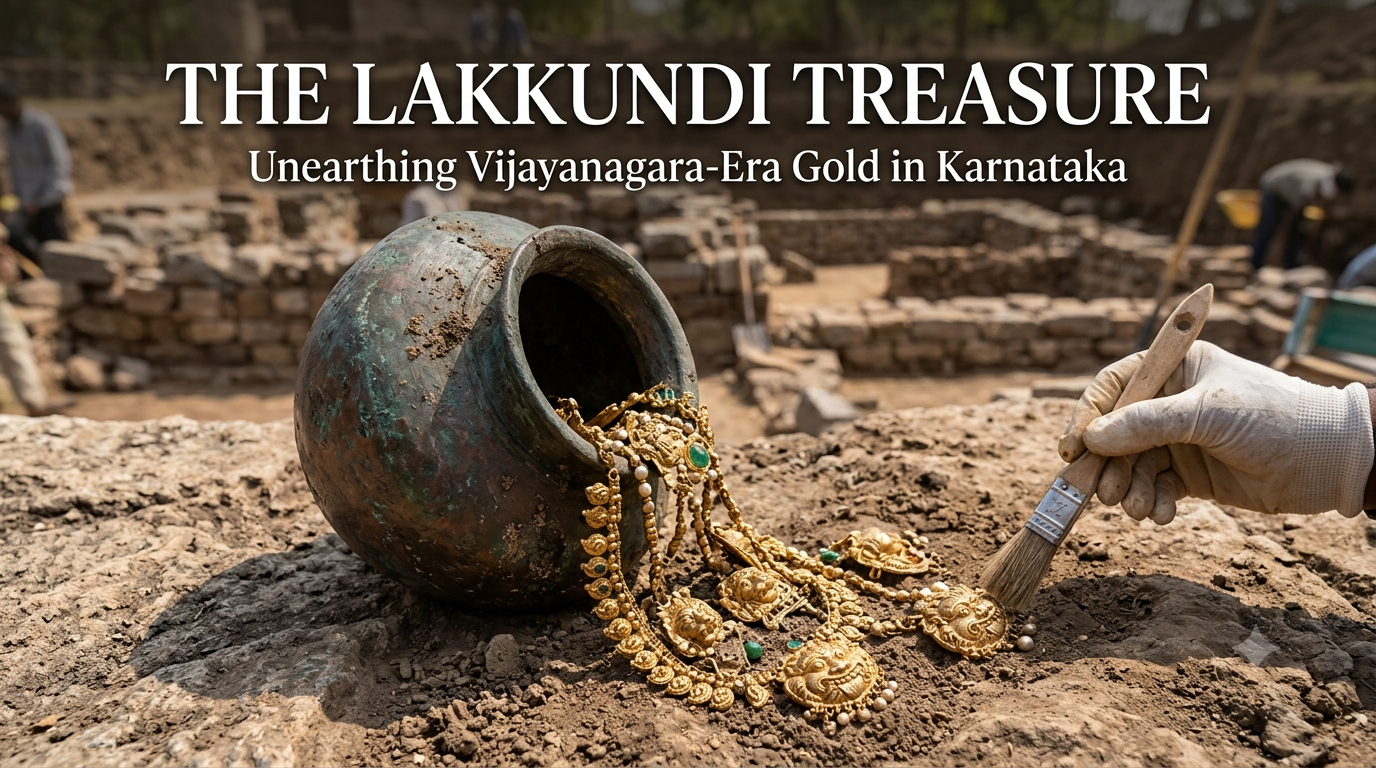
- •The Discovery: Roughly 466 grams of gold ornaments studded with pearls, emeralds, and blue sapphires were unearthed during a house foundation excavation in Lakkundi (Gadag district, Karnataka). Stored inside a traditional copper pot (charige or tambige), the artefacts are dated to the 14th–16th century Vijayanagara era.
- •Sacred Iconography: Archaeologists believe the ornaments were ritual offerings to a female deity. They feature two distinct Vijayanagara-era motifs:
1. Lion Faces: A traditional emblem of power and protection in temple art and sacred jewellery.
2. Kirtimukha (Face of Glory): A swallow-like ornamental mask commonly placed at the crown of temple arches and sacred ornaments to ward off evil. - •Historical Prominence (Lokkigundi): Known in ancient inscriptions as Lokkigundi, Lakkundi was a major urban and strategic centre under the Kalyani Chalukyas (Western Chalukyas), Rashtrakutas, Kalachuris, Hoysalas, and later the Vijayanagara Empire.
- •Medieval Minting Hub: During the 12th century under the Kalyani Chalukyas, Lakkundi functioned as a premier central mint. Inscriptions dating to 1185 AD record the minting of specialized medieval gold coins here, including Lokki-gadyana, Lokkiya-pon, and Pon-gadanya.
- •The Legend of 101: Local folklore and historical epigraphs describe Lakkundi as a grand city boasting 101 temples and 101 step-wells (Kalyanis). Many of these heritage structures remain buried beneath modern residential settlements and are gradually being unearthed.
- •Transitional Architecture: Lakkundi's monuments mark a crucial transitional phase bridging early Chalukyan architecture and the more intricate Hoysala style. The shift from sandstone to fine-textured chloritic schist (steatite/soapstone)—pioneered at the Brahma Jinalaya—enabled the deeply carved detailing seen in the Kasivisvesvara Temple.
Lakkundi Treasure: Key Archaeological Details
- Description:
- 500–600 years old (14th–16th Century CE)
- Description:
- Approx. 466 grams of gold inlaid with pearls, emeralds, and blue sapphires
- Description:
- Traditional copper vessel known as a 'charige' or 'tambige'
- Description:
- Sacred offerings made to a female deity, not for public or everyday use
- Description:
- Lion Faces (power/protection) and Kirtimukha (ornamental mask to ward off evil)
Prominent Architectural Landmarks of Lakkundi
- Patronage/Type:
- Built by patroness Attimabbe (Danachintamani)
- Key Architectural Feature:
- Earliest regional example using fine-textured chloritic schist (soapstone) instead of sandstone.
- Patronage/Type:
- Kalyani Chalukya era
- Key Architectural Feature:
- Renowned for ornate carvings and a twin-shrine (Dvikuta) architectural layout.
- Patronage/Type:
- Medieval Step-well (Kalyani)
- Key Architectural Feature:
- Artistic man-made water tank featuring a distinctive tiered structure.
Related Entities
Impact & Significance
- •Reconstructing Vijayanagara Craftsmanship: The ornaments provide tangible evidence of 14th–16th century goldsmithing, stone-setting techniques, and temple-offering traditions.
- •Highlighting Deccan Architectural Evolution: Renewed focus on Lakkundi draws scholarly attention to the crucial stylistic bridge between Western Chalukyan and Hoysala temple architecture.
- •Setting a Civic Precedent: The voluntary reporting of the find to district authorities sets a strong ethical benchmark for public cooperation in safeguarding national antiquities.
- •Boosting Regional Heritage Identity: Reinforces North Karnataka's historical stature as a centre of medieval commerce, numismatics, and religious patronage.
Challenges & Criticism
- •Encroachment & Living Heritage Conflict: With modern residential houses standing directly over ancient temples and step-wells, carrying out large-scale scientific excavations without displacing residents is complex.
- •Risk of Unreported Finds & Smuggling: Accidental discoveries in heritage-rich zones often face the threat of illegal melting or black-market sale if finders are unaware of or distrustful of legal compensation mechanisms.
- •Outdated Legal Framework: The colonial-era Indian Treasure Trove Act, 1878 (with its archaic ₹10 threshold) requires modernization to offer clearer, faster rewards and stronger protection for antiquities.
- •Conservation Gaps: Many of Lakkundi's step-wells (Kalyanis) and smaller shrines suffer from weathering, neglect, and lack of dedicated conservation funding.
Future Outlook
- •Systematic Excavations: Expanding controlled archaeological digs around demarcated temple zones in Lakkundi to recover buried inscriptions, sculptures, and step-wells without damaging existing residential areas.
- •Heritage Conservation & Museum Display: Scientific preservation and public exhibition of the ornaments to educate citizens about Vijayanagara-era metallurgy, gemology, and temple traditions.
- •Promoting Legal Awareness: Using the voluntary handover of the Lakkundi treasure as a model to spread awareness about the Indian Treasure Trove Act, 1878, and incentivize ethical reporting of accidental finds.
- •Cultural Tourism Circuit: Integrating Lakkundi's temples and Kalyanis (like Musukina Bavi) more prominently into Karnataka's North-Central heritage tourism trail alongside Hampi, Badami, and Pattadakal.
UPSC Relevance
- • GS-1 (Art & Culture): Temple architecture of South India (Chalukya to Hoysala transition), material shift to chloritic schist, and Vijayanagara-era iconography.
- • Prelims Focus: Ancient names of cities (Lokkigundi), medieval numismatics (Lokki-gadyana, Lokkiya-pon), architectural terms (Dvikuta, Kalyani, Kirtimukha), and Attimabbe.
- • GS-2 (Governance & Heritage): Role of the Archaeological Survey of India (ASI) and legal frameworks like the Indian Treasure Trove Act, 1878.
Sample Questions
Prelims
Consider the following statements regarding the historic town of Lakkundi:
- (a)In ancient inscriptions, Lakkundi was referred to as Lokkigundi and served as a major minting centre during the Kalyani Chalukya period.
- (b)The Brahma Jinalaya at Lakkundi is notable for being constructed entirely out of red sandstone.
- (c)'Lokki-gadyana' and 'Lokkiya-pon' were medieval gold coins minted at Lakkundi.
Mains
Lakkundi represents a vital transitional phase in Deccan temple architecture and medieval South Indian economy. Discuss its historical significance in light of recent archaeological discoveries.
Introduction: Briefly introduce the recent discovery of 500–600-year-old Vijayanagara-era gold ornaments in Lakkundi (Gadag, Karnataka) and establish its ancient identity as Lokkigundi.
Body:
• Architectural Transition: Explain the shift from early Chalukyan sandstone structures to fine-textured chloritic schist (soapstone) at Brahma Jinalaya, paving the way for ornate Hoysala artistry. Cite the Dvikuta layout of Kasivisvesvara Temple and tiered Kalyanis like Musukina Bavi.
• Economic & Political Hub: Highlight Lakkundi's (Lokkigundi) strategic importance across multiple dynasties (Kalyani Chalukyas, Hoysalas, Vijayanagara) and its 12th-century role as a central royal mint producing Lokki-gadyana and Lokkiya-pon.
• Cultural & Contemporary Relevance: Connect the recent Vijayanagara-era gold treasure (Kirtimukha and Lion Face motifs) to temple patronage, and note the need for balancing modern urban habitation with heritage conservation.
Conclusion: Conclude that systematic excavation, community participation, and heritage-sensitive planning are essential to protect living archaeological sites like Lakkundi.
Static topics behind this news
Read the background in these notes: Prelims and Mains questions are built on it.
- Ethics · Ethics and Human InterfacePrivate and Public Ethics; Role of Family and Society in Inculcating ValuesShared: Article 51A
- Art & Culture · Heritage, Institutions and CinemaHeritage Conservation in India: Laws, Threats and the Way ForwardShared: Article 51A, Treasures, Heritage
- Polity · Directive Principles of State Policy (DPSP)Important Judgments and Committees on Fundamental DutiesShared: Article 51A
- Polity · Directive Principles of State Policy (DPSP)Fundamental Duties (Article 51A)Shared: Article 51A, Emblem, Civic
- Ethics · Ethics and Human InterfaceEthics in Politics, Patriotism and National CharacterShared: Article 51A