
Light Water Reactors (LWRs): India's Strategic Shift in Nuclear Energy
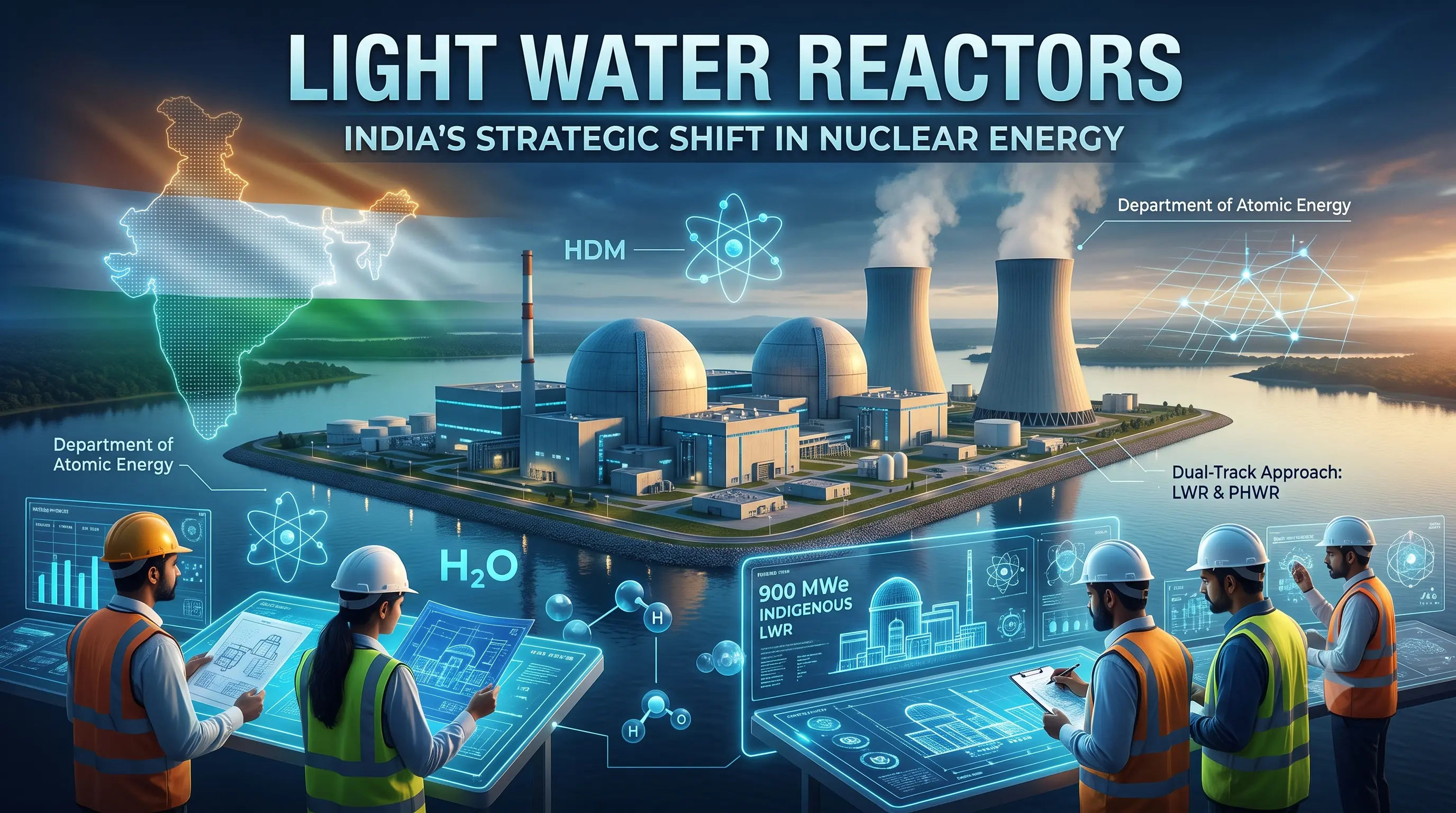
The Department of Atomic Energy (DAE) is accelerating the development of a 900 MWe indigenous Light Water Reactor (LWR). This article examines the differences between LWRs and Pressurised Heavy Water Reactors (PHWRs), the reasons driving India's push for LWR technology, and the strategic implications of adopting a dual-track nuclear approach.
Introduction
Context & Background
Key Points
- •Global Dominance: LWRs account for over 85% of global civil nuclear reactor capacity, making them the standard technology in international markets and reactor trade.
- •Design and Cost Advantages: LWRs use normal (light) water as both coolant and moderator. Their simpler engineering overlaps with conventional thermal power technologies, and they benefit from economies of scale, resulting in lower construction costs and higher thermal efficiency.
- •Export Imperative: Developing an Indian LWR would strengthen India's bargaining power with foreign vendors and support its ambitions to export nuclear technology.
- •Heavy Water Dual-Use: Heavy water (D2O) is an excellent neutron moderator that allows PHWRs to use natural uranium. Because it can also produce plutonium suitable for nuclear weapons if misused, it is classified as a strategic nuclear material monitored under frameworks like the IAEA.
- •Dual-Track Nuclear Strategy: By continuing its PHWR programme while fast-tracking LWRs, India is diversifying its reactor portfolio. This enhances its standing as a credible supplier for emerging economies seeking scalable clean energy solutions.
Difference Between LWRs and PHWRs
| Aspect | LWRs | PHWRs | Bookmark |
|---|---|---|---|
| Moderator | Light water (H2O) | Heavy water (D2O) | |
| Coolant | Light water | Heavy water | |
| Fuel | Enriched uranium | Natural uranium | |
| Enrichment Requirement | Required | Not required | |
| Global Presence | Dominant worldwide | Limited outside a few countries | |
| Construction Cost | Generally lower due to scale | Higher due to heavy water use | |
| Fuel Flexibility | Limited | High (thorium, LEU blends possible) |
Related Entities
Impact & Significance
- •Geopolitical Bargaining: An indigenous LWR bolsters India's negotiating leverage with foreign nuclear technology vendors, ensuring better terms and less dependency.
- •Market Competitiveness: Aligning with the globally dominant LWR technology opens doors for India in the international reactor trade and supply chains.
- •Long-Term Sustainability: Balancing the nuclear portfolio guarantees resilient power generation critical for India's net-zero carbon commitments.
Challenges & Criticism
- •Risk to Indigenous Capacity: An excessive shift towards imported or LWR-centric projects could potentially undermine the decades-old domestic manufacturing ecosystem built around PHWRs.
- •Fuel Security Concerns: Unlike PHWRs, LWRs strictly require enriched uranium, which India historically has had constrained access to, necessitating robust international supply agreements.
- •Cost Implications: Imported LWR components often come with higher capital costs, which could lead to increased electricity tariffs until domestic economies of scale are fully realized.
Future Outlook
- •Energy Diplomacy: Nuclear capabilities will increasingly function as a tool of energy diplomacy. India can complement its outreach through infrastructure development and digital public goods to strengthen strategic partnerships.
- •Clean Energy Transition: The dual-track approach supports India's climate goals by expanding low-carbon, base-load power generation, thereby reducing dependence on fossil fuels.
- •Small Modular Reactors (SMRs): Alongside large LWRs and PHWRs, exploring SMRs will offer flexible, affordable clean energy alternatives suitable for global export.
UPSC Relevance
- • GS-3 (Science & Technology): Awareness in the fields of IT, Space, Computers, robotics, nano-technology, bio-technology and issues relating to intellectual property rights (Nuclear Technology).
- • GS-3 (Infrastructure): Energy security, clean energy transition, and electricity tariff impacts.
- • GS-2 (International Relations): Energy diplomacy, global supply chain integration, and IAEA safeguards.
Sample Questions
Prelims
Consider the following statements regarding nuclear reactor technologies and materials:
1. Both LWRs and PHWRs require enriched uranium to sustain a nuclear chain reaction.
2. Heavy water is classified as a strategic nuclear material because its use can enable the production of weapons-grade plutonium.
3. LWRs constitute less than half of the total global civil nuclear reactor capacity.
Answer: Option 2
Explanation: Statement 1 is incorrect; PHWRs operate on natural uranium. Statement 2 is correct; heavy water has dual-use potential and is safeguarded by the IAEA. Statement 3 is incorrect; LWRs account for over 85% of global civil nuclear capacity.
Mains
Differentiate between Light Water Reactors (LWRs) and Pressurised Heavy Water Reactors (PHWRs). Examine the strategic rationale behind India's focus on developing an indigenous 900 MWe LWR while maintaining its PHWR capabilities.
Introduction: Define both reactor types briefly. Mention the DAE's initiative to develop an indigenous 900 MWe LWR as the context for India's strategic shift.
Body:
• Differences: Highlight the contrast in moderator/coolant (Light vs. Heavy water), fuel requirements (Enriched vs. Natural uranium), cost, and fuel flexibility.
• Rationale for LWRs: Global dominance (>85% capacity), cost advantages, higher thermal efficiency, and strengthening export/bargaining power.
• Dual-Track Significance: Maintaining PHWRs secures fuel flexibility (thorium capabilities) and protects domestic manufacturing, while LWRs enable global integration, energy diplomacy, and rapid base-load capacity expansion for climate goals.
Conclusion: Conclude by emphasizing that the dual-track approach harmonizes India's indigenous technological strengths with international market realities, fostering robust energy security.