
Rethinking Battery Strategy in India: The Case for Sodium-Ion Technology
Heavy reliance on lithium-ion batteries presents severe challenges for India's energy security, critical mineral imports, and environmental sustainability. This article explores how sodium-ion batteries provide an abundant, safe, and cost-effective alternative, detailing their operating mechanisms, comparative advantages, current technological limitations, and strategic policy pathways for domestic adoption.
Introduction
Context & Background
Key Points
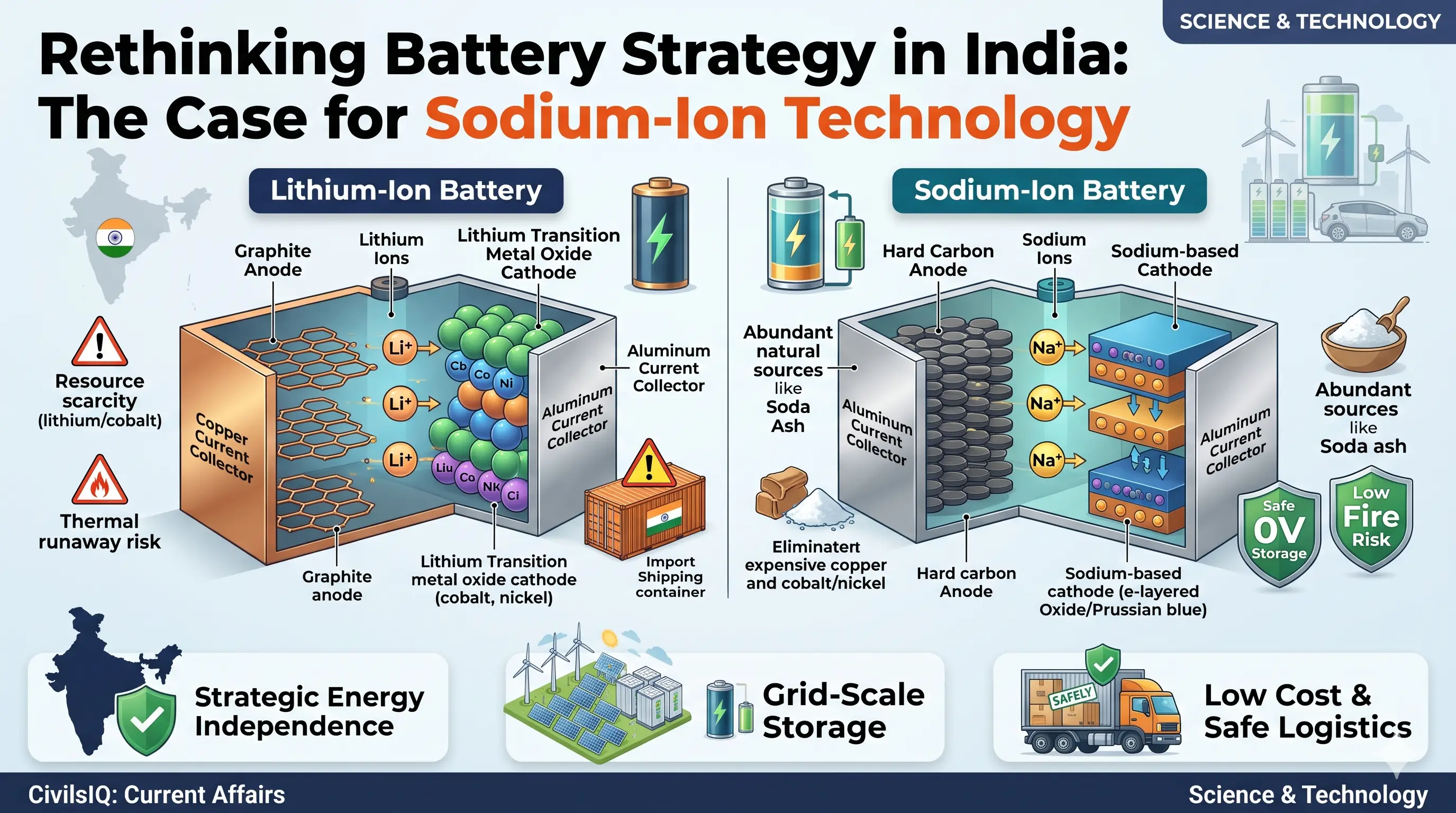
- •What are Sodium-Ion Batteries (SIBs)?: SIBs are rechargeable energy storage devices that function analogously to lithium-ion batteries by using sodium ions (Na+) rather than lithium ions (Li+) to store and shuttle electrical charge between electrodes.
- •Electrode & Material Composition: In place of scarce critical minerals, SIBs employ sodium salts, aluminium current collectors on both sides, and cathode chemistries such as layered oxides, polyanionic compounds, and Prussian blue analogues.
- •Working Principle: During discharge, sodium ions deintercalate from the anode (negative terminal) and move through the electrolyte to intercalate into the cathode (positive terminal), driving electric current; the reverse flow occurs during charging.
- •The Copper vs. Aluminium Advantage: Lithium-ion cells require copper collectors on the anode because lithium alloys with aluminium at low voltages. Sodium does not alloy with aluminium, allowing the complete substitution of costly, heavy copper with cheaper, lighter aluminium foil.
- •Zero-Volt Storage Capability: Because copper dissolution is absent, SIBs can be completely discharged and shipped at zero volts (0V) safely, eliminating thermal-hazard transport restrictions and reducing logistics overheads.
- •Advances in Lithium Precedents: While Li-ion pack costs dropped from over $1,100/kWh in the early 2010s to ~$108/kWh by 2025 across LFP and NMC formats, resource bottlenecks make SIB parallelization urgent.
Lithium-Ion vs. Sodium-Ion Batteries: Problem-Solving Matrix
| Basis of Difference | Issues with Lithium-Ion Batteries | How Sodium-Ion Batteries Address These Issues | Bookmark |
|---|---|---|---|
| Raw Material Availability | Dependence on scarce, unevenly distributed minerals like lithium, cobalt, and nickel. | Uses abundant sodium readily sourced globally from soda ash and rock salts. | |
| Import Dependence (India) | Heavy reliance on imported lithium and processed battery components. | Domestic and global availability of sodium drastically lowers import dependence and supply vulnerabilities. | |
| Supply Chain Security | Heightened vulnerability to geopolitical tensions and extreme price volatility of critical minerals. | Decentralized, stable supply ecosystem with low geopolitical friction. | |
| Safety | High susceptibility to thermal runaway, fire hazards, and explosion risks. | Intrinsically safer chemistry with reduced heat generation and lower fire risks. | |
| Transportation & Storage | Classified as 'dangerous goods'; cannot drop below critical state of charge; transported at ≤30% charge. | Can be safely stored and transported at zero volts without degradation or risk. | |
| Cost of Materials | Requires costly minerals (cobalt, nickel) and uses copper anode current collectors. | Eliminates cobalt/nickel; replaces expensive copper collectors with cheaper aluminium on both electrodes. | |
| Environmental Impact | Water-intensive and ecologically destructive mining processes for lithium and cobalt. | Sodium extraction requires less water and has significantly lower ecological footprints. |
Key Technical Differences Between Li-Ion and Na-Ion
| Technical Aspect | Lithium-Ion Batteries (LIBs) | Sodium-Ion Batteries (SIBs) | Bookmark |
|---|---|---|---|
| Current Collector Materials | Copper anode collector; risks dissolution and short circuits at low voltage. | Aluminium current collectors on both cathode and anode; no alloying risks. | |
| Discharge Mechanism | Li+ ions migrate from anode to cathode across organic electrolyte during discharge. | Na+ ions migrate from anode to cathode using layered oxides/Prussian blue analogues. | |
| Volumetric / Gravimetric Energy Density | High energy density; ideal for long-range EVs and lightweight electronics. | Lower density due to larger, heavier sodium ions; best suited for stationary storage. |
Related Entities
Impact & Significance
- •Mineral Sovereignty: Decouples India's battery roadmap from geostrategically concentrated lithium, cobalt, and graphite processing chains.
- •Cost Reduction in Mass Mobility: Inexpensive sodium salts and aluminium collectors reduce manufacturing capital overheads for price-sensitive commercial segments.
- •Grid Reliability: Offers an economical, highly safe battery chemistry for stationary renewable energy storage where weight constraints are minimal.
- •Safer Logistics: Eliminates catastrophic thermal runaway hazards and allows standard zero-volt freight, cutting hazardous storage overheads.
Challenges & Criticism
- •Lower Energy Density: Larger atomic radius and higher mass of sodium ions result in lower energy densities, rendering SIBs unviable for long-range electric vehicles and lightweight consumer gadgets.
- •Stringent Manufacturing Demands: Extreme moisture sensitivity of sodium-ion cells mandates deep vacuum drying protocols, inflating cell-assembly energy consumption and plant operational expenditures.
- •Shorter Cycling Lifespans: Many early sodium-ion formulations exhibit faster capacity fade compared to established Lithium Iron Phosphate (LFP) platforms.
- •Nascent Industrial Ecosystem: SIBs lack the decades of supply chain optimization, standardized component ecosystems, and third-party certifications enjoyed by Li-ion technologies.
Future Outlook
- •Parallel Battery Strategy: India must develop sodium-ion alongside existing lithium-ion infrastructure rather than treating it as an absolute replacement, hedging raw material supply risks.
- •Incentive & Policy Alignment: Expand the scope of the Production Linked Incentive (PLI) scheme for Advanced Chemistry Cells (ACC) to explicitly reward sodium-ion gigafactory setups.
- •Chemistry-Flexible Gigafactories: Direct battery manufacturing lines to adopt modular equipment architectures capable of toggling between LIB (like LFP) and SIB production with minimal re-tooling.
- •Targeted Initial Applications: Deploy early-generation SIBs in sectors where weight penalties are secondary—such as grid-scale battery energy storage systems (BESS), telecom towers, and low-speed two/three-wheelers.
- •Targeted R&D & Domestic Standards: Fund academic and industry pilot facilities to stabilize capacity fade while the Bureau of Indian Standards (BIS) formulates safety and performance certification protocols.
UPSC Relevance
- • GS-3 (Science and Technology): Applications of S&T in everyday life, indigenization of technology, and developing new technology in clean energy.
- • GS-3 (Energy Security & Environment): Renewable energy integration, critical mineral supply chain resilience, and environmental life-cycle footprints.
- • Prelims Focus: Comparative properties of sodium vs. lithium (intercalation, collector metals, zero-voltage transit).
- • Mains Focus: Strategic necessity of diversifying battery chemistries under National Electric Mobility and Decarbonization goals.
Sample Questions
Prelims
With reference to Sodium-Ion Batteries (SIBs) and Lithium-Ion Batteries (LIBs), consider the following statements: 1. Sodium-ion batteries utilize aluminium current collectors on both the anode and cathode. 2. Unlike lithium-ion batteries, sodium-ion batteries can be safely discharged to zero volts for long-distance transport. 3. Sodium-ion batteries have a higher volumetric energy density than Nickel Manganese Cobalt (NMC) lithium-ion batteries. Which of the statements given above are correct?
- (a)1 and 2 only
- (b)2 and 3 only
- (c)1 and 3 only
- (d)1, 2, and 3
Mains
“Evaluating battery chemistry solely on energy density ignores geopolitical and supply chain vulnerabilities.” Critically examine the viability of Sodium-Ion batteries as an alternative to Lithium-ion technology for India’s clean energy transition.
Introduction: Define the context of critical mineral concentration in lithium-ion supply chains and introduce Sodium-Ion Batteries (SIBs) as an economically viable, mineral-secure alternative.
Body:
• Strategic Advantages of SIBs: Resource abundance (soda ash), avoidance of expensive cobalt/nickel, cheaper aluminium collectors, safe 0V storage, and lower fire hazards.
• Technical Limitations: Lower gravimetric/volumetric energy density, moisture sensitivity requiring deep vacuum manufacturing, capacity degradation, and absent industrial supply chain.
• India's Strategic Roadmap: Parallel deployment roadmap, inclusion in ACC PLI incentives, chemistry-agnostic gigafactories, and prioritized adoption in stationary grid storage and 2W/3W segments.
Conclusion: Conclude by highlighting that a pluralistic battery ecosystem is indispensable for achieving energy sovereignty and net-zero targets.