
How did the Space Sector Fare in the Budget 2026-27?
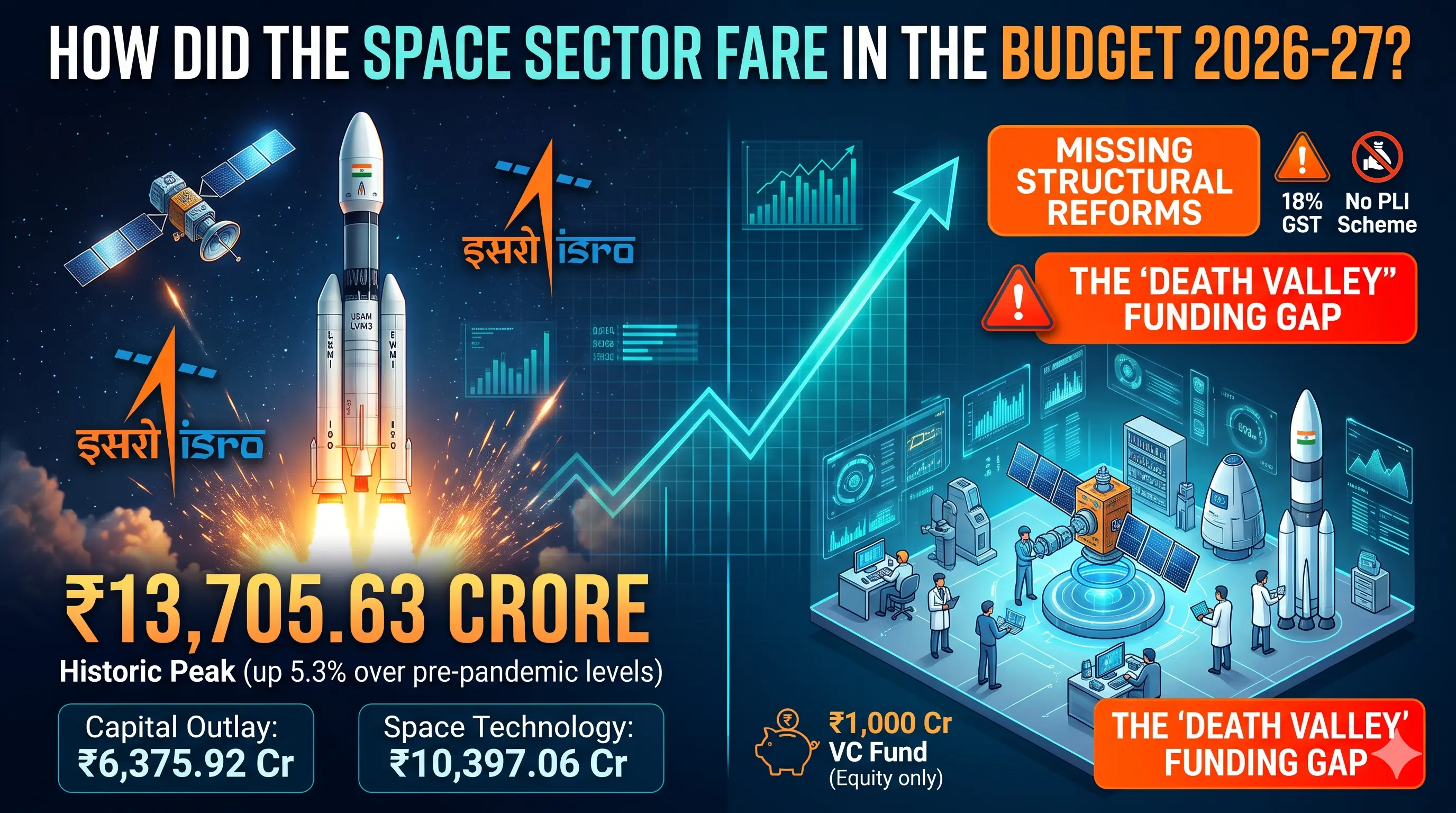
India's space budget for FY 2026-27 has reached a historic high of ₹13,705.63 crore, crossing pre-COVID levels. While capital expenditure on infrastructure and strategic missions like Gaganyaan has increased, structural financial reforms such as PLI schemes, GST rationalization, and critical infrastructure status for the private sector remain unaddressed.
Introduction
Context & Background
Key Points
- •Budgetary Rebound: The space budget has grown 182% since 2012–13. After stagnating around ₹13,000 crore during the pandemic, the 2026-27 allocation has finally crossed the pre-COVID peak.
- •Focus on Capital Expenditure: There is a clear shift toward capital outlay to build essential hard infrastructure like propulsion facilities, satellites, and mission-critical systems.
- •Sustained Strategic Funding: Major national projects, including Gaganyaan (human spaceflight) and the Next Generation Launch Vehicle (NGLV), continue to receive robust backing.
- •The 'Death Valley' Problem: Private startups face a critical funding gap between early R&D and commercial revenue generation. The budget lacks direct grants or R&D tax credits to absorb this early-stage risk.
- •Limits of the VC Fund: While the ₹1,000-crore Space Venture Capital Fund is a positive step, it provides equity-only support and cannot replace broader fiscal incentives or policy reforms.
Space Budget 2026-27: Key Allocations
| Category | Amount Allocated | Significance | Bookmark |
|---|---|---|---|
| Total Space Sector Allocation | ₹13,705.63 crore | Exceeds pre-pandemic peak by 5.3%. | |
| Space Technology | ₹10,397.06 crore | Core chunk; funds launch vehicles, satellites, and ISRO centers. | |
| Revenue Expenditure | ₹7,329.71 crore | Operational and administrative expenses. | |
| Capital Outlay | ₹6,375.92 crore | Emphasis on building hard infrastructure (launch pads, propulsion). |
Missing Structural Reforms and Their Impact
| Missing Reform | Impact on Private Sector | Bookmark |
|---|---|---|
| No PLI Scheme | Indian space hardware remains costly compared to subsidized global competitors. | |
| Unresolved GST Framework | Creates a hidden 18% tax burden as inputs are taxed but final services are exempt, blocking Input Tax Credits. | |
| Denial of Critical Infra Status | Private startups borrow at 10-12% interest, lacking access to cheap institutional capital. | |
| Equity-only VC Fund | The ₹1000-crore fund doesn't provide grants or tax holidays to bridge the 'Death Valley' of early R&D. |
Related Entities
Impact & Significance
- •Loss of Global Competitiveness: Without GST rationalization, Indian space hardware becomes significantly more expensive than imports from nations with refund-friendly tax systems.
- •Stifled Innovation: The lack of R&D credits makes private firms hesitant to invest in high-risk deep-tech (like reusable launch vehicles), reducing them to component suppliers rather than IP creators.
- •High Cost of Capital: Because space is not considered 'Critical Infrastructure', startups borrow at punitive rates of 10–12%, crippling large-scale physical expansion.
- •Risk of Brain Drain: Severe funding gaps and a lack of non-equity support could force top Indian aerospace talent to migrate to foreign ecosystems with more supportive financial conditions.
Challenges & Criticism
- •Lack of Manufacturing Incentives: The government has failed to introduce a Production Linked Incentive (PLI) scheme for space-grade components, ignoring heavy global competition.
- •Unresolved Tax Architecture: The refusal to implement a zero-rated GST regime leaves startups paying taxes on raw materials that they cannot claim refunds for.
- •Inadequate Risk Absorption: There is no dedicated, industry-facing Space Development Fund to handle the 'Death Valley' of deep-tech scaling; the new VC fund relies entirely on equity.
Future Outlook
- •Shift from Operator to Facilitator: The government must transition to a market facilitator, letting private firms handle manufacturing and routine launches while ISRO focuses on frontier missions.
- •Introduce Space PLI & Zero-Rated GST: Implement a Production Linked Incentive (PLI) scheme for space components and bring space manufacturing under a zero-rated GST framework to allow full input tax refunds.
- •Grant 'Critical Infrastructure' Status: Classifying ground stations, telemetry networks, and launch pads as critical infrastructure will unlock low-cost, long-term institutional loans for startups.
- •Strengthen IN-SPACe: Provide IN-SPACe with independent programme funding to expand its capabilities beyond administrative allocations.
- •Promote Independent IP Creation: Move beyond making private firms mere subcontractors for ISRO by rewarding original designs and offering non-equity fiscal support like viability gap funding.
UPSC Relevance
- • GS-3 (Space Technology & Economy): Indigenization of technology, developing new technology, and government budgeting.
- • Mains Focus: Analyzing the hurdles of private sector participation in deep tech and the necessity of tax rationalization/PLI schemes.
- • Essay Topics: 'India's journey from a Space Power to a Global Space Market Leader'.
Sample Questions
Prelims
Consider the following statements regarding the Space Sector in India's recent budget and policy framework. Which of the statements given above is/are correct?
- (a)Private space startups can avail full Input Tax Credit on imported raw materials since final space services are fully taxed under GST.
- (b)Space infrastructure such as telemetry networks and launch pads are currently classified as 'Critical Infrastructure' in India.
- (c)The allocation for the space sector in the Union Budget 2026-27 has surpassed its pre-pandemic peak.
- (d)The ₹1,000-crore Space Venture Capital Fund exclusively provides direct non-repayable grants to startups.
Mains
“While India’s space budget has reached historic highs, the absence of structural financial reforms continues to limit the potential of the private space sector.” Analyze the constraints faced by private space startups in India and suggest a way forward.
Introduction: Highlight the 2026-27 Space Budget (₹13,705.63 cr) crossing the pre-COVID peak, driven by capital expenditure. Mention that privatization was liberalized but financial enablement is lagging.
Body:
• Current Constraints: High GST input tax burdens without refunds; absence of manufacturing incentives like PLI; denial of 'Critical Infrastructure' status leading to high borrowing costs (10-12%); the 'Death Valley' gap where early R&D lacks risk absorption.
• Limitations of Current Policy: The ₹1,000-crore Space VC fund is equity-only and does not address base costs. Startups risk remaining mere component suppliers to ISRO rather than independent IP creators.
• Way Forward: Shift government role to facilitator; classify launch pads as critical infrastructure; implement a zero-rated GST regime; offer tax holidays and R&D credits.
Conclusion: Conclude that achieving the target of 10% of the global space market by 2030 requires moving beyond just funding ISRO missions, to actively building a globally competitive, financially viable private ecosystem.