
Modern Indian History · UPSC Notes
British Administration in India — UPSC Modern History Notes
Free, exam-focused notes for UPSC Prelims and Mains, with Prelims tips and Mains points for every topic. 9 topics.
Open in the interactive reader: bookmarks, progress tracking and read-aloud.
Background of British Administration in India
British administration in India gradually evolved from trading company rule to a centralized colonial state, shaped by wars, treaties, and parliamentary control from Britain.
1600: East India Company formed in England to trade with the East.
1757: Battle of Plassey marked the beginning of British political control in India.
1764: Battle of Buxar consolidated British power over Bengal, Bihar, and Orissa.
1765: Treaty of Allahabad granted Diwani rights (revenue collection) in Bengal → Company became territorial power.
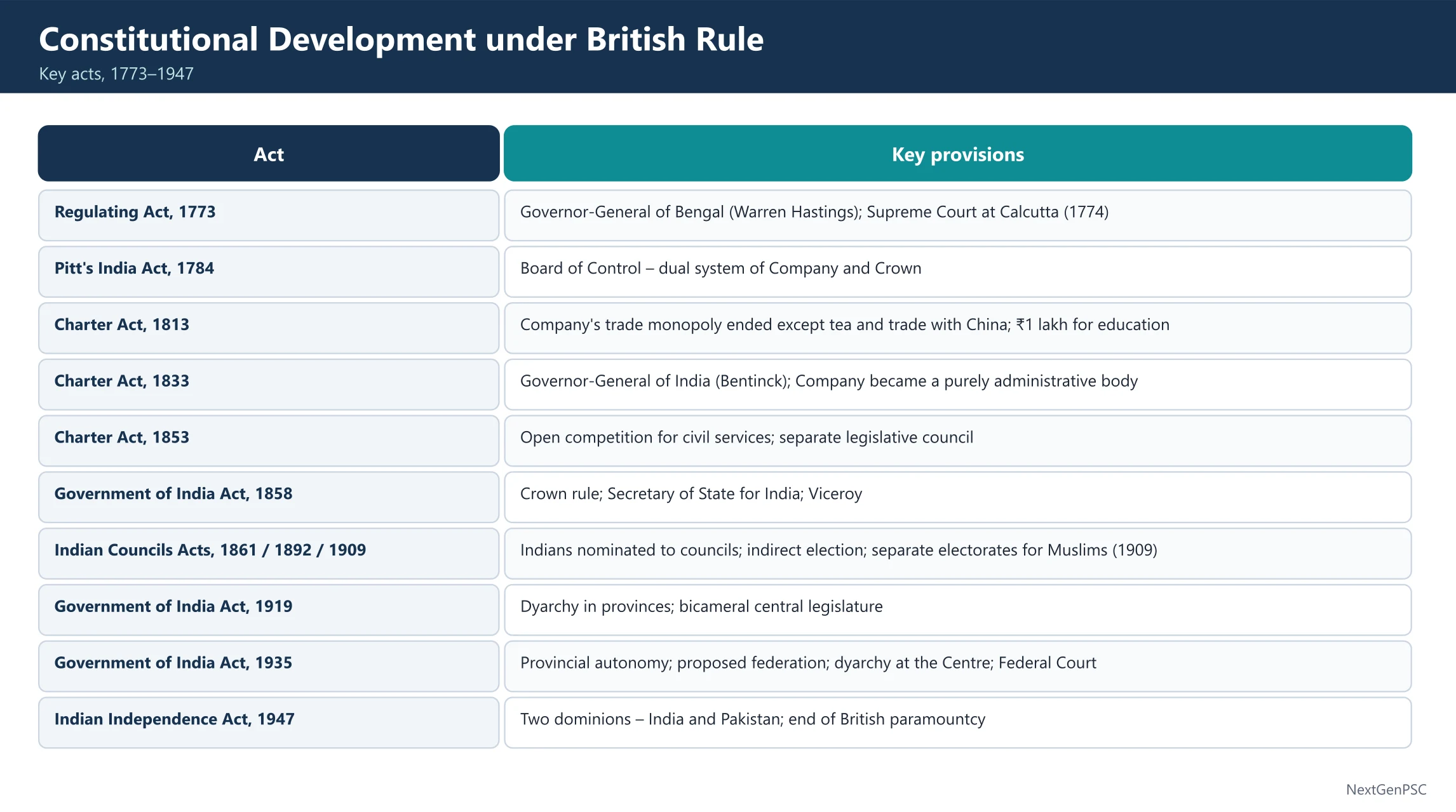
1773: Regulating Act brought the Company under Parliamentary supervision; Governor-General of Bengal created.
1784: Pitt’s India Act established dual control of Company and Parliament.
1793–1853: Charter Acts restructured administration, extended parliamentary oversight, and curtailed Company’s trade monopoly.
1833: Governor-General of India created ( Lord William Bentinck first holder).
1853: Civil Services opened through competitive exams; foundation of modern bureaucracy.
1857: Revolt exposed weaknesses of Company rule, leading to direct Crown rule under Government of India Act (1858).
Prelims tips
- Battle of Plassey (1757) → start of political control.
- Battle of Buxar (1764) → consolidated Company power.
- 1773 Regulating Act → first step of Parliamentary control.
- 1833 Charter Act → first Governor-General of India.
- 1858 Act → end of Company rule, Crown rule begins.
Mains points
- British administration in India transitioned from commercial to political control after 1757.
- Parliamentary Acts (1773–1853) steadily increased Crown oversight over Company rule.
- Administrative institutions (civil services, judiciary, army) laid the foundation for modern governance.
- 1857 Revolt revealed exploitative and weak structures, leading to direct Crown rule in 1858.
Did you know?
- After 1765, the East India Company became the 'Diwan' of Bengal — a trader turned ruler.
- Governor-General Warren Hastings (1773) was the real architect of early British administration in India.
Civil Services: Administrative Backbone of the Raj
Civil Services were the professional, hierarchical bureaucracy created to implement colonial policy. The slow and contested process of 'Indianisation' was a major political issue that exposed structural discrimination.
Origin & Professionalization: Staff evolved from the Company's commercial 'factors' (traders). Lord Cornwallis (1786–93) professionalized the service, prohibiting corruption like private trade and gifts, and ensuring fixed pay, earning him the title 'Father of Civil Service in India' .
The Two Divisions (Cornwallis): Cornwallis created a discriminatory structure:
- Covenanted Civil Service (CCS): The superior, highly paid branch (e.g., District Collector posts), initially reserved only for the British. Officers had to sign a covenant (legal agreement) with the Company.
- Uncovenanted Civil Service: The subordinate, low-paid branch, which was open to Indians but held no real decision-making power.
Recruitment Shift (Charter Act 1853): This Act ended the system of patronage (jobs given through recommendation by Directors) and introduced an open competitive examination for the Covenanted Service. The first exam was held in 1856 in London.
Structural Barrier to Indians (The Exam): This 'open' exam was heavily rigged: it was held only in London, conducted in English, and based on a Western Classical syllabus (Latin/Greek). Furthermore, the maximum age limit was often arbitrarily lowered by the British (e.g., from 23 to 19 by Lord Lytton in 1878) to deliberately restrict Indian participation.
Slow Indianisation (Statistical Reality): Despite the hurdles:
- The first Indian to qualify was Satyendranath Tagore (elder brother of Rabindranath Tagore) in 1863.
- By 1892, Indians held less than 3% of the senior ICS posts.
- The demand for simultaneous exams (holding exams in India and London) became a central goal of the early nationalist movement (Indian National Congress).
Key Commissions & Acts:
- Indian Civil Service Act 1861: Formalized the service structure and allowed limited Indian entry, often in minor posts.
- Statutory Civil Service (Lord Lytton, 1879): An unsuccessful attempt to introduce a quota for local recruitment (one-sixth of the CCS posts to be filled by natives selected by local governments), which failed due to nepotism and was later abandoned.
- Aitchison Committee (1886): Recommended reclassifying services into three clear grades: Imperial, Provincial, and Subordinate, creating separate entry points for locals.
- Lee Commission (1923–24): A major landmark. Recommended a goal of 50:50 parity (equal number of Europeans and Indians) in the senior services within 15 years, and advocated for the immediate establishment of a Public Service Commission (PSC) in India.
Functions & Legacy: The ICS formed the core of District Administration (Collector/Magistrate), responsible for revenue, law & order, and policy. This cadre structure and rule-based administration became the efficient but often elitist template for the modern Indian Administrative Service (IAS).
| Year | Event / Act | Significance |
|---|---|---|
| 1772–93 | Cornwallis Reforms | Professionalised service; created Covenanted/Uncovenanted division; barred private trade; 'Father of Civil Service in India'. |
| 1853 | Charter Act | Statutory provision for open competitive examination for covenanted service (exam location initially London). |
| 1863 | First Indian ICS Officer | Satyendranath Tagore qualified (proved possibility, but exposed structural bias). |
| 1861 | Indian Civil Service Act | Formalized service rules and structure; allowed limited Indian entry. |
| 1878 | Age Limit Reduction | Lord Lytton deliberately reduced the maximum age for the ICS exam from 21 to 19, severely limiting Indian chances. |
| 1879 | Statutory Civil Service | Unsuccessful attempt by Lord Lytton to introduce a small quota for local recruitment (later abandoned). |
| 1886 | Aitchison Committee | Classified services into Imperial, Provincial and Subordinate categories; created separate entry points for locals. |
| 1923–24 | Lee Commission | Recommended 50:50 parity goal over 15 years; advocated immediate PSC establishment. |
| 1935 | Government of India Act (1935) | Provided for the establishment of a Federal Public Service Commission and Provincial PSCs; increased service protections. |
| Committee/Commission | Year | Key Recommendations / Outcome |
|---|---|---|
| Committee headed by Lord Macaulay | 1835 | Macaulay's Minute influenced English education and indirectly the civil service by supplying English-educated clerks and lawyers; promoted English curriculum used in recruitment. |
| Aitchison Committee | 1886 | Reclassified services into Imperial, Provincial and Subordinate categories; clarified recruitment channels and career paths. |
| Islington Commission | 1912 | Proposed two entry channels (England & India), recommended reserving posts for Indians (quantum debated), suggested more training in India. |
| Lee Commission | 1923–24 | Recommended 50:50 parity goal over 15 years; advocated immediate PSC establishment; sectoral recruitment changes. |
Prelims tips
- Father of Civil Services in India → Lord Cornwallis .
- ICS competitive exam introduced by Charter Act 1853 (first exam held 1856 in London).
- The first Indian to qualify for the ICS was Satyendranath Tagore in 1863.
- The simultaneous exam demand and the age limit reduction (1878) were key issues raised by the early nationalist movement (Surendranath Banerjee, Indian Association).
- The Lee Commission (1923-24) recommended the 50:50 parity goal and the establishment of the Public Service Commission (PSC).
- Company servants were trained at Haileybury (East India College, 1806); the Charter Act of 1853 introduced open competition; the Aitchison Commission (1886) recommended Imperial, Provincial and Subordinate services; the Lee Commission (1924) set up a Public Service Commission (1926).
Mains points
- Civil Services were the backbone of colonial administration—efficient in revenue and law-and-order but institutionally designed to ensure European dominance and serve imperial objectives (not social welfare).
- The demand for Indianisation became a key rallying cry of the early nationalist movement, exposing the structural hypocrisy of British 'open' competition and mobilizing the educated middle class.
- The colonial administrative model (cadre system, rule-based procedures, district collector system) was maintained after independence, leaving an ambivalent legacy combining institutional strength with elitist exclusion.
Did you know?
- The age limit reduction in 1878 by Lord Lytton was a direct challenge to Indian aspirations and led to the first major all-India campaign by the Indian Association led by Surendranath Banerjee.
- The service was sometimes called the 'heaven-born service' by the British due to its high pay and exclusive control over India.
- Despite all commissions, by 1947, Indians still constituted less than 50% of the senior ICS cadre, proving the deep structural resistance to sharing power.
Police: The Repressive Arm of the State
The British created a structured police system through the 1791 Cornwallis reforms and the 1861 Police Act, designed explicitly to protect colonial rule and revenue collection rather than public rights.
Pre-British Context: Policing was highly decentralized. Order was maintained by local authorities like Zamindars, town police (Kotwals), and village watchmen (Chowkidars).
Cornwallis Reforms (1791): Lord Cornwallis established the basis of the modern police system:
- Organized regular police units, making the Thana (police station) the basic unit of policing.
- Placed the Thana under an Indian officer called the Daroga (Superintendent of Police).
- Introduced the Superintendent of Police (SP) as the district head.
Bentinck's Adjustment (1828–35): Lord William Bentinck briefly abolished the SP office, placing the police under the Collector (the revenue head), reinforcing the link between policing and revenue extraction. The SP post was later restored.
Indian Police Act of 1861: Passed immediately after the 1857 Revolt to formalize a hierarchical, centralized structure:
- At the apex was the Inspector General (IG) for the province.
- The Superintendent of Police (SP) controlled policing at the district level.
- Village watchmen (Chowkidars) remained at the lowest level, often poorly paid by the villagers.
Post-1857 Focus: The police became primarily a tool for political surveillance, intelligence gathering, and the suppression of dissent against the rising tide of nationalism.
Police Commission (1902–03): Recommended the creation of specialized intelligence wings: the Criminal Investigation Department (CID) at the provincial level and the Central Intelligence Bureau (CIB) at the central level.
Critique (Mains Focus): The colonial police were notorious for corruption, arbitrary arrests, and torture during interrogations. They had poor accountability and their function was rooted in maintaining imperial order, not public welfare.
| Year | Event/Measure | Impact |
|---|---|---|
| 1791 | Cornwallis organised regular police and thana system | Established modern policing structure under Darogas (Indian officer). |
| 1861 | Indian Police Act | Created structured centralized hierarchy (SP, IG, DIG, chowkidars) post-1857. |
| 1902–03 | Police Commission | Recommended CID & CIB for centralized intelligence and political surveillance. |
| Post-1857 | Political policing focus | Suppression of dissent, surveillance of nationalists. |
Prelims tips
- The Indian Police Act was implemented in 1861 (after the Revolt of 1857).
- Cornwallis (1791) started the modern thana system under darogas.
- CID and CIB were recommended by the 1902 Police Commission.
Mains points
- The colonial police prioritized regime security over public service, making it a tool of repression rather than protection, especially during the nationalist movement.
- The 1861 Police Act institutionalized a centralized, hierarchical police system that was highly efficient in enforcing colonial law and order, and still shapes modern Indian policing.
- The police became an essential arm of colonial surveillance, helping suppress nationalism and revolts, and were deeply distrusted by the native population.
Did you know?
- Village chowkidars were paid by villagers through levies (taxes), not by the government, highlighting the local burden of colonial policing.
- Early police often doubled as tax collectors during famines and revolts, merging law enforcement with revenue extraction.
Army: The True Pillar of the British Raj
The British Indian Army was the main pillar of colonial rule — used for conquest, suppression of revolts, and imperial wars abroad, but its recruitment and discriminatory policies directly sowed the seeds of discontent, culminating in 1857.
Pre-1857 Organisation: The Company relied on three presidential armies (Bengal, Bombay, Madras). The Bengal Army was the largest and primarily recruited high-caste Hindus from Awadh and Bihar.
Cause of Discontent (The General Service Act): The General Services Enlistment Act (1856) mandated that all new recruits must serve abroad if required. This directly clashed with the caste and religious taboos of high-caste Hindu sepoys, who feared losing caste if they crossed the sea.
Racial Discrimination (Numerical & Pay): Discrimination was profound:
- The European to Indian ratio in the Bengal Army was approximately 1:5 before 1857.
- Indian sepoys earned very low salaries (7 to 9 rupees monthly), while European privates earned three to four times more.
- Indians were systematically denied higher command ranks.
Post-1857 Reforms (Peel Commission): The Revolt led to major reorganization based on the Peel Commission's findings:
- Ratio Change: The European:Indian ratio was raised significantly to 1:2 in Bengal and 1:3 in Bombay/Madras, ensuring British numerical superiority.
- 'Martial Races' Policy: Recruitment shifted to communities deemed 'martial' and loyal during the revolt, such as Sikhs, Gurkhas, and Punjabi Muslims, implementing the Divide and Rule policy within the army.
- Arms Restriction: Artillery (heavy weapons) was placed almost exclusively under European control to prevent Indian mutiny from gaining firepower.
Functions Abroad: The Army was essential for imperial expansion, fighting in Sudan, China (Boxer Rebellion), Persia, and South Africa—all at the considerable financial expense of India (Drain of Wealth).
| Year/Period | Event/Measure | Impact |
|---|---|---|
| Pre-1857 | General Services Enlistment Act (1856) | Mandated overseas service, directly violating sepoys' religious and caste beliefs, contributing to 1857. |
| Post-1857 | Peel Commission Reforms | Implemented the 1:2 ratio (European:Indian in Bengal) and shifted recruitment to 'martial races'. |
| Post-1857 | Arms Restriction | Artillery (heavy weapons) was restricted exclusively to European troops. |
| Late 19th C. | Deployment Abroad | Used Indian soldiers for Imperial Wars globally, funded by the Indian treasury (Drain). |
Prelims tips
- The General Services Enlistment Act (1856) was a direct cause of sepoy discontent before 1857.
- The Peel Commission was responsible for the post-1857 army reorganisation.
- Post-1857, recruitment was favored among Sikhs, Gurkhas, and Punjabi Muslims (the 'martial races' policy).
- Artillery remained almost entirely under European control.
Mains points
- The army was the most crucial pillar of British imperial control, responsible for internal security and external conquest.
- The Peel Commission reforms institutionalized racial and communal division within the military to prevent future unity, a key element of the Divide and Rule policy.
- The use of the Indian Army for imperial wars abroad (funded by India) contributed significantly to the Drain of Wealth and resentment among Indian political leaders.
Did you know?
- Before 1857, sepoys were sometimes allowed leave to attend village festivals and agricultural duties, a practice curtailed post-1857.
- Indian regiments fought not only in India but also in distant imperial conflicts like the Boxer Rebellion (China, 1900) and wars in South Africa.
Judiciary: Codification, Courts, and Colonial Bias
The British introduced a structured judiciary in India with codified laws, graded courts, and the principle of rule of law , but it remained costly, inaccessible, and inherently biased towards colonial interests.
Early Foundations: The first judicial grants were via Royal Charters (1662, 1726). The Mayor’s Courts were established in Presidency towns (Bombay, Calcutta, Madras) to deal mainly with European affairs.
Warren Hastings' Plan (1772): Established the initial court structure: a District Civil Court (Diwani Adalat) for civil cases and a District Criminal Court (Faujdari Adalat) for criminal cases. He applied native personal laws (Hindu law for Hindus, Muslim law for Muslims).
Regulating Act (1773): This landmark Act established the Supreme Court at Calcutta (Fort William) as the first formal superior court, primarily with jurisdiction over British subjects and Company employees.
Cornwallis Reforms (1786–93): Lord Cornwallis formalized the structure:
- Separation of Powers: He separated the Revenue Collection function from the Administration of Justice, making the judge independent of the revenue collector.
- Graded Courts: Created a clear hierarchy of courts (Munsiff, Registrar, Provincial Courts of Appeal, and Circuit Courts for criminal cases).
- Rule of Law: Introduced the principle that all people, including government servants, were answerable to the courts, though this was often selectively applied, favoring Europeans.
Codification (Macaulay): The First Law Commission (1833) , chaired by Lord Macaulay , was responsible for creating uniform law codes across India. This resulted in the Indian Penal Code (IPC, 1860), the Criminal Procedure Code (CrPC, 1861), and the Civil Procedure Code (CPC, 1859).
Post-1857 Unification: The High Courts Act (1861) empowered the Crown to establish High Courts in Presidency towns, merging the older Supreme Courts and the Sadar Adalats (old Company Courts of Appeal).
Later Development: The Government of India Act 1935 established the Federal Court (in Delhi), laying the constitutional groundwork for independent India's Supreme Court (1950).
Critique (Mains Focus): The system was criticized for being expensive (requiring lawyers), slow, and complex. The inherent racial bias (Europeans often received lighter sentences, known as the 'White Man's Justice') and limited Indian participation made justice elusive for the common person.
| Year | Event/Measure | Impact |
|---|---|---|
| 1772 | Hastings’ Judicial Plan | Created district Diwani & Faujdari courts; applied native personal law. |
| 1773 | Regulating Act → Supreme Court at Calcutta | First formal superior court in India for British subjects. |
| 1793 | Cornwallis Code | Separation of revenue & justice; introduced graded courts and Rule of Law. |
| 1833–60 | Law Commission (Macaulay) | Codified IPC (1860), CPC, CrPC, providing legal uniformity across India. |
| 1861 | High Courts Act | Unified Supreme Courts and Sadar Adalats, establishing modern High Courts. |
| 1935 | Federal Court established | Foundation for post-independence Supreme Court. |
Prelims tips
- Regulating Act (1773) → Supreme Court at Calcutta (Fort William).
- Cornwallis Code (1793) → separation of revenue and justice.
- Macaulay’s Law Commission → authored the IPC (1860), CrPC, CPC.
- High Courts Act (1861) merged Supreme Courts and Sadar Adalats.
Mains points
- The British judiciary institutionalised rule of law and codified laws , creating legal uniformity and predictability across India, which was beneficial for modern society.
- Yet, it remained fundamentally elitist and inaccessible to the masses, often serving as an instrument to uphold colonial land policies and suppress dissent.
- The system evolved into both an instrument of control and a lasting institutional legacy for modern India’s legal structure.
Did you know?
- Macaulay’s codification introduced English legal ideas but carefully retained Hindu and Muslim personal laws (e.g., marriage, inheritance) to avoid social backlash.
- The controversy over the Ilbert Bill (1883) highlighted the deep racial bias, as Europeans violently opposed Indian judges being given the power to try Europeans.
Modern Education: The Tool of Colonialism and Catalyst for Nationalism
The British introduced modern education in India to serve administrative needs, spread western knowledge, and create a loyal class, but it also produced a politically conscious middle class that spearheaded the nationalist movement.
Early Initiatives (Orientalism): Early British officials supported native learning: Calcutta Madrassa (1781) by Warren Hastings (for Muslim law) and Sanskrit College (1791) by Jonathan Duncan (for Hindu law).
Charter Act 1813: The first official step —allocated ₹1 lakh annually for education, marking the government's acceptance of responsibility, though the funds were unused until 1823 due to debate between Orientalists (supporting native learning) and Anglicists (supporting western learning).
Macaulay’s Minute (1835): The decisive turning point, settling the Orientalist-Anglicist debate in favor of the latter. Lord Macaulay advocated for:
- English medium and Western sciences.
- The 'Downward Filtration Theory': Educate a small class of elite Indians, hoping knowledge would trickle down to the masses.
- The stated goal was to create "a class of persons Indian in blood and colour, but English in taste, opinions, morals and intellect."
Wood’s Dispatch (1854): Known as the 'Magna Carta of English Education in India'. It rejected the Downward Filtration Theory and provided a comprehensive plan:
- Recommended the establishment of Universities in Calcutta, Bombay, and Madras (established 1857).
- The creation of a Department of Public Instruction (DPI) in each province.
- A system of grants-in-aid to encourage private education.
- Increased emphasis on women’s education and teacher training.
Impact (Dual Nature): Education created a powerful, English-educated Indian middle class that became the backbone of the reform movements and the nationalist movement (e.g., leaders of the INC). However, it was elitist, neglected mass, technical, and rural education, and failed to achieve the goal of creating a loyal class.
| Year | Event/Measure | Impact |
|---|---|---|
| 1781 | Calcutta Madrassa by Warren Hastings | Promoted study of Muslim law |
| 1791 | Sanskrit College at Varanasi by Jonathan Duncan | Encouraged Hindu law & philosophy studies |
| 1813 | Charter Act | First official allocation of ₹1 lakh for education. |
| 1835 | Macaulay’s Minute | Shifted policy from Oriental to English/Western medium; promoted Downward Filtration Theory. |
| 1854 | Wood’s Dispatch | 'Magna Carta' ; Recommended Universities, DPIs, and grants-in-aid (systemic planning). |
| 1857 | First Universities | Calcutta, Bombay, Madras Universities established. |
Prelims tips
- Wood’s Dispatch (1854) → Magna Carta of English Education.
- Macaulay’s Minute (1835) → English medium & Western sciences.
- The first three modern Universities were established in 1857 (Calcutta, Bombay, Madras).
- Education commissions: Hunter (1882, primary and secondary), Raleigh (1902) → Indian Universities Act (1904), Sadler (1917, Calcutta University; 12-year school course), Hartog (1929), Wardha scheme of basic education (1937), Sargent Plan (1944).
Mains points
- Modern education created an English-educated Indian middle class which became the backbone of reform movements and nationalism.
- It fostered rationalism, liberalism, and modern political ideas but was elitist and failed to reach the masses, thus neglecting mass, technical, and rural education.
- It represented a dual nature: a tool of colonial control but also an instrument of Indian awakening.
Did you know?
- The first graduates from Calcutta University passed in 1858, just after the Revolt.
- Macaulay openly dismissed oriental learning as 'worthless' in comparison to Western knowledge.
- The need for English was primarily driven by the government's notification in 1844 that made English knowledge a prerequisite for government jobs.
Transport & Communication: Linking India for Imperial Control
The British developed transport and communication networks primarily to serve colonial interests — enabling troop movement, revenue collection, and integration of Indian markets with Britain, though these changes had long-term developmental impacts on India.
Railways (Lord Dalhousie): The network was introduced in 1853 (Bombay–Thane). It was expanded rapidly to link major ports (Calcutta, Bombay, Madras) with raw material producing regions (e.g., cotton from Deccan) and strategic military centres. The primary goal was economic exploitation and military control.
Telegraph (Lord Dalhousie): Introduced mid-19th century. The first major line linked Calcutta–Agra–Bombay–Madras (by 1854). The telegraph played a crucial role during the 1857 revolt by allowing the British to coordinate their suppression efforts quickly, proving its strategic value.
Postal System (Lord Dalhousie): Reformed with the introduction of the standardized half-anna postage stamp (1854), making communication affordable and uniform across the vast subcontinent. This was vital for administration.
Roads and Canals: Grand Trunk Road was modernized for military and commercial use. Canals (like the Ganges Canal, 1854) aided irrigation but were also designed to facilitate troop movement.
Impact (Dual Nature):
- Colonial Goal: Accelerated the commercialization of agriculture (forcing cash crops) and deepened India’s economic dependency on Britain by facilitating raw material export. The railways often worsened the impact of famines by facilitating the export of grain.
- Nationalist Effect: Unintentionally facilitated the rise of nationalism by physically and mentally integrating India, allowing political ideas and nationalist leaders to travel and mobilize support nationwide, thereby fostering a pan-Indian consciousness.
| Year | Development | Impact |
|---|---|---|
| 1853 | First railway line (Bombay–Thane) | Linked port with interior; start of Indian railways. |
| 1854 | Telegraph | First major line linked Calcutta–Agra–Bombay–Madras; vital for 1857 coordination . |
| 1854–1855 | Dalhousie’s Postal Reforms | Standardized half-anna postage; made communication uniform and accessible. |
| 19th century | Railway network 25,000 km+ | Integrated markets; enabled troop movement and raw material export. |
Prelims tips
- First railway line → Bombay to Thane (1853).
- Dalhousie credited with modern postal and telegraph reforms.
- The telegraph's strategic value was proved during the 1857 Revolt.
Mains points
- Transport & communication served colonial needs but created enduring infrastructure that shaped India’s economic and political integration.
- Railways accelerated commercialization of agriculture but also deepened India’s economic dependency on Britain.
- The network unintentionally fostered a pan-Indian consciousness by facilitating nationalist mobilization, proving the dual nature of colonial development.
Did you know?
- The first train in India carried about 400 passengers in 14 coaches.
- The half-anna postage stamp made postal communication affordable to common Indians.
- Telegraph wires were often targeted during the 1857 Revolt by rebels to disrupt British communication.
Local Self-Government: Decentralization and Ripon’s Resolution
The British introduced Local Self-Government not as a form of democracy but to achieve administrative efficiency and financial decentralization, transferring the burden of local services to local, non-official representatives.
Financial Decentralization (Lord Mayo, 1870): The first major step toward decentralization was taken by Lord Mayo with his Resolution of 1870. The aim was to relieve the central treasury of the increasing cost of administrative services (health, education) by shifting financial responsibility to the provinces.
Need for Local Bodies: As the provinces could not meet all these new responsibilities, there was a need to create organized local bodies (like Municipal Committees and District Boards) below the provincial level to manage local affairs.
Lord Ripon’s Resolution (1882) — The 'Magna Carta': Lord Ripon advanced this policy with his 1882 Resolution on Local Self-Government, which is considered the 'Magna Carta' of local self-government in India.
- Objective: Ripon aimed to provide political and popular education to Indians by involving them in local administration.
- Structure: Recommended establishing local boards with a majority of non-official elected members.
- Chairman: Proposed that the chairman of these bodies should be non-official (Indian), though in practice, the district collector often retained control.
Significance: While the measure was ultimately limited (the electorate was small, and control was retained by British officials), Ripon's resolution introduced the elective principle to Indians at the lowest level of administration, fostering a sense of civic responsibility.
| Year | Vicery | Event | Key Feature |
|---|---|---|---|
| 1870 | Lord Mayo | Financial Decentralization Resolution | Transferred control of certain funds (e.g., education, medical) from Centre to Provinces. |
| 1882 | Lord Ripon | Local Self-Government Resolution | 'Magna Carta'; promoted non-official majority and election principle in local boards. |
| 1907 | Lord Minto | Hobhouse Commission (Royal Commission on Decentralization) | Examined the necessity of further decentralization and enhancing local powers. |
Prelims tips
- Lord Ripon’s Resolution of 1882 is the 'Magna Carta' of Local Self-Government in India.
- Lord Mayo (1870) started the policy of Financial Decentralization.
- Ripon’s measure was intended to provide political education.
Mains points
- The policy of Local Self-Government, though born of financial necessity (Mayo), was expanded by Ripon as an attempt to introduce liberal political education.
- It failed to achieve true autonomy due to official control (Collector as head) and limited franchise, but it provided the earliest training ground for Indian political leadership.
- The reform showed the inherent contradiction in colonial policy: the need for efficiency versus the fear of granting real political power.
Did you know?
- Lord Ripon was one of the few Viceroys genuinely popular with Indians, partly due to this resolution and the Ilbert Bill.
- Ripon resigned and left India due to the fierce opposition of the European community to his liberal policies.
Vernacular Press Act (1878) and Arms Act (1878)
The Vernacular Press Act (VPA) of 1878, enacted by Lord Lytton, was a highly repressive measure aimed at censoring the Indian-language press. It was passed alongside the discriminatory Arms Act.
Context (Lord Lytton’s Viceroyalty, 1876–80): Lytton's term was marked by controversy (e.g., age limit reduction for ICS exam) and the massive Delhi Durbar (1877) held during a devastating famine, which drew sharp criticism from the Indian press.
Vernacular Press Act (VPA), 1878:
- Aim (Censorship): To control and suppress the growing volume of anti-government criticism and 'seditious' material published in the vernacular (local) language newspapers.
- Key Feature (The 'Gagging Act'): The Act gave the government powers to seize the assets of any vernacular paper if it published content considered seditious, without needing a court order, making it highly arbitrary.
- Discrimination: It explicitly excluded the English-language press (which was loyal to the government), making it a discriminatory piece of legislation.
- Reaction: The Act was universally condemned by the Indian public and press. Many newspapers switched their language overnight to English to avoid the Act's provisions (e.g., Amrita Bazar Patrika).
Arms Act (1878): This Act made it a criminal offence for Indians to carry arms without a license. It was also highly discriminatory as it made an explicit exemption for Europeans and Anglo-Indians.
Significance: These acts became a rallying point for the nascent nationalist movement. They exposed the repressive, arrogant nature of the colonial government and showed Indian leaders (like Surendranath Banerjee) the immediate need for a unified political voice.
| Act | Year | Key Feature | Nature |
|---|---|---|---|
| Vernacular Press Act (VPA) | 1878 | Gave arbitrary power to seize printing press; excluded English press. | Discriminatory Censorship |
| Arms Act | 1878 | Required licenses for Indians to carry arms; exempted Europeans. | Racial Discrimination |
| ICS Age Limit | 1878 | Maximum age for ICS exam reduced to 19. | Structural anti-Indian bias |
Prelims tips
- The VPA (1878) and Arms Act (1878) were passed during the Viceroyalty of Lord Lytton.
- VPA was nicknamed the 'Gagging Act'.
- The VPA excluded the English-language press.
- The nationalist reaction to the VPA led to a strong push for political unity.
Mains points
- Lytton's repressive laws demonstrated the colonial state's willingness to use authoritarian measures to control public opinion and maintain racial superiority.
- The VPA played a vital role in the growth of nationalism by making the press a common target of repression and proving the need for a unified political voice.
- These acts confirmed the Indian intellectuals' view that all British policies, even seemingly liberal ones, were ultimately subservient to imperial control and racial interest.
Did you know?
- The VPA was eventually repealed by Lord Ripon in 1882 as part of his liberal reforms, which contributed to his popularity.
- Amrita Bazar Patrika instantly changed its language from Bengali to English (overnight) to bypass the VPA, demonstrating quick journalistic defiance.
Modern Indian History: All chapters
- Advent of Europeans in India
- Decline of the Mughal Empire
- Emergence of Regional States
- Expansion and Consolidation of British Power
- British Government & Economic Policies (1757–1857)
- Social Reform Movements
- People’s Resistance before 1857
- The Revolt of 1857
- Growth of Nationalism and Moderate Phase of Congress
- British Administration in India
- Era of Militant Nationalism (1905–1909)
- First Phase of Revolutionary Activities (1907–1917)
- India’s Response to First World War and Home Rule Movement
- Emergence of Gandhi
- Non-Cooperation Movement and Khilafat Movement
- Emergence of Swarajists, Socialist Ideas, Revolutionary Activities
- Struggle for Swaraj (1928–1935)
- Period from 1935 to 1942
- Period from 1942 to 1947
- World History (Mains GS I)
- Post-Independence India