
Modern Indian History · UPSC Notes
Expansion and Consolidation of British Power — UPSC Modern History Notes
Free, exam-focused notes for UPSC Prelims and Mains, with Prelims tips and Mains points for every topic. 23 topics.
Open in the interactive reader: bookmarks, progress tracking and read-aloud.
Background: Conditions for British Expansion
The decline of Mughal authority , the rise of regional states , and European rivalry created the political, economic, and military conditions for British expansion .
Political Vacuum (Post-1707) : The Mughal Empire disintegrated after Aurangzeb’s death (1707) . This decline weakened central control and created a political vacuum , which regional powers and the EIC sought to fill.
Regional States Disunity : Powerful regional states like Bengal, Awadh, and Hyderabad emerged, but their mutual distrust and constant internal conflicts led to political disunity and instability , which the British exploited effectively.
Anglo-French Rivalry : The decisive Anglo-French rivalry in the Carnatic Wars (1740–1763) for commercial and political supremacy ultimately decided the fate of the European power that would rule India.
British Military and Financial Edge : The British advantage lay in their superior naval power , more disciplined and modern army, and crucial financial backing from their powerful domestic economy and large-scale revenue collection from Bengal post-1757.
Company’s Transition : The East India Company (EIC) successfully transitioned from being a mere trading body to a political and territorial power after the mid-18th century.
Economic Motives : The core drive was economic: securing raw materials (cotton, indigo, silk) at cheaper rates and establishing a captive market for finished British industrial goods.
| Factor | Explanation |
|---|---|
| Decline of Mughals | Central authority collapsed after Aurangzeb (1707); led to a power vacuum |
| Regional States | Strong but fatally divided; provided opportunities for alliances and subversion |
| European Rivalry | French vs British; British won Carnatic Wars (1740–1763) and secured control |
| Military & Naval Strength | Disciplined army, superior naval power (control over supply lines) |
| Economic Motivation | Access to Bengal's revenue and India's raw materials |
| Indian Disunity | Betrayals and rivalries among Indian rulers enabled British victories (e.g., Mir Jafar) |
Prelims tips
- The Carnatic Wars established British supremacy in South India.
- French influence was confined to trading posts after the Treaty of Paris (1763).
Mains points
- British expansion was driven by a sophisticated mix of military strategy, diplomacy, and economic exploitation (e.g., control of the Bengal revenue).
- Indian disunity and the success against the French rival were key enabling conditions for the EIC.
Did you know?
- The English East India Company was originally chartered by Queen Elizabeth I in 1600.
- The French East India Company was backed directly by the state, unlike the English EIC, which had more financial flexibility.
Battle of Plassey (1757)
The first major political victory of the British under Robert Clive against Nawab Siraj-ud-Daulah ; marked the beginning of political control.
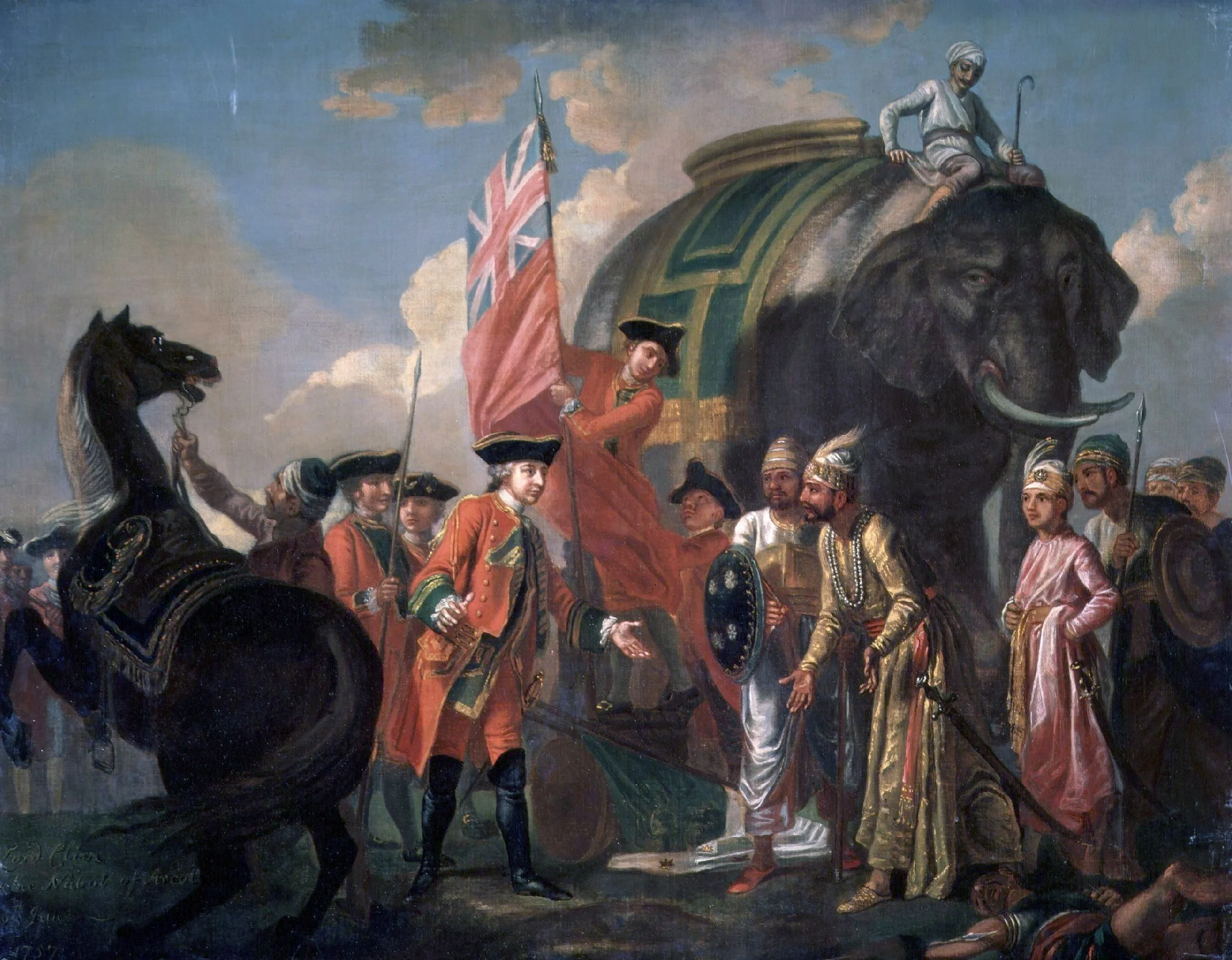
Causes of Conflict : Siraj-ud-Daulah opposed the misuse of the Mughal Farman (1717) privileges by Company officials and the unauthorized fortification of Calcutta by the British.
Immediate Pretext : The Black Hole tragedy (1756), in which many English prisoners died in captivity, provided the immediate pretext for British military retaliation.
The Battle (23 June 1757) : Robert Clive defeated Siraj at Plassey. The victory was secured not by military might alone, but by the betrayal of the Nawab's Commander-in-Chief, Mir Jafar, who remained inactive on the battlefield.
Consequences : The British gained enormous plunder and decisive control over the Bengal revenues (though formal rights came later). Mir Jafar was installed as a puppet Nawab.
Significance : Plassey transitioned the EIC from a mere trading power to the chief political contender and revenue collector in Bengal, the richest province in India.
| Aspect | Detail |
|---|---|
| Cause | Nawab opposed misuse of privileges (Dastaks) and fortification |
| British Leader | Robert Clive |
| Betrayal | Mir Jafar sided with British; key factor in the victory |
| Outcome | British control over Bengal; foundation of British rule in India |
Prelims tips
- Plassey (1757) → foundation of British rule.
- Mir Jafar = puppet Nawab installed by Company.
Mains points
- Plassey marks the political transition of the Company and the beginning of the Drain of Wealth from India.
- Exposed the fragility of the Indian state system due to factionalism and betrayal among nobles.
Did you know?
- The battle lasted only a few hours. Political conspiracy and key defections were crucial to the Company's victory, alongside its military organization and Siraj-ud-Daula's tactical disadvantages.
- Clive returned to England enormously wealthy after Plassey, leading to later scrutiny over his methods.
Battle of Buxar (1764)
Buxar was a decisive military victory where the British defeated the combined Indian forces; established administrative supremacy in North India.
Indian Alliance : The British faced the combined forces of deposed Nawab Mir Qasim (Bengal), Nawab Shuja-ud-Daula (Awadh), and the Mughal Emperor Shah Alam II .
Immediate Cause : Mir Qasim tried to reform the revenue system and eliminate the trade privileges (Dastaks) misused by the British, leading to armed conflict.
The Battle (22 October 1764) : Fought at Buxar ; the British forces were led by Hector Munro. Unlike Plassey, this was a genuine military conflict where British superiority in discipline and tactics was proven.
Outcome and Treaty : The British won a crushing victory. The ensuing Treaty of Allahabad (1765) granted the EIC the Diwani rights (right to collect revenue) of Bengal, Bihar, and Orissa .
Administrative Effect : Led to the Dual Government in Bengal (1765–1772), where the Company held the Diwani (revenue/money) and the Nawab retained the Nizamat (administrative/justice) functions. This system led to misrule and exploitation.
| Aspect | Plassey (1757) | Buxar (1764) |
|---|---|---|
| Result Type | Victory by Conspiracy/Treachery | Victory by Military Superiority |
| Key Indian Opposition | Nawab of Bengal (Solo) | Combined forces of Bengal, Awadh, and Mughal Emperor |
| Long-Term Impact | Gave political control | Gave administrative (Diwani) control over a vast territory |
Prelims tips
- Buxar (1764) → decisive military victory (unlike Plassey’s conspiracy).
- Treaty of Allahabad (1765) → EIC acquired Diwani rights (revenue collection).
Mains points
- Buxar ensured Company supremacy in North India and proved the EIC’s superior military tactics over the largest Indian coalitions.
- Set the stage for administrative control and the disastrous Dual Government via the Diwani rights.
Did you know?
- Buxar was arguably more decisive than Plassey because it defeated the forces of the Mughal Emperor (Shah Alam II), granting the EIC legitimacy across North India.
Policies of Expansion: Indirect Control and Annexation
The Subsidiary Alliance and the Doctrine of Lapse were important instruments of indirect control and annexation, used alongside wars, treaties and administrative intervention to establish British paramountcy.
Subsidiary Alliance (Lord Wellesley, 1798) : This policy required Indian rulers to accept a permanent British contingent within their territory and pay for its maintenance (subsidy). Rulers lost freedom in foreign affairs and accepted a British Resident at their court. Hyderabad was the first major Indian state to accept the alliance in 1798.
Doctrine of Lapse (Lord Dalhousie, 1848–56) : This controversial policy enabled the Company to annex certain dependent states when a ruler died without a natural heir recognized by the Company. It refused to recognize adopted successors for sovereignty in cases where adoption was otherwise accepted in Indian practice. States such as Satara, Jhansi, and Nagpur were annexed under it.
Annexation by Misgovernment : Awadh was annexed in 1856 on the stated ground of 'misgovernment' (misrule) by Nawab Wajid Ali Shah, despite having an heir. It was not annexed under the Doctrine of Lapse; the action fuelled resentment that contributed to the 1857 Revolt.
Overall Impact : These policies vastly expanded British territory but simultaneously created deep, widespread resentment among the ruling class, nobility, and the common people.
| Policy | Introduced by | Example States Annexed |
|---|---|---|
| Subsidiary Alliance | Lord Wellesley | Hyderabad (First), Awadh, Mysore |
| Doctrine of Lapse | Lord Dalhousie | Jhansi , Nagpur , Satara (First) |
| Misgovernment Doctrine | Lord Dalhousie | Awadh (1856) |
Prelims tips
- Subsidiary Alliance = Wellesley .
- Doctrine of Lapse = Dalhousie .
- Awadh annexed in 1856 ( misgovernment ).
Mains points
- Policies allowed expansion without costly wars but were perceived as unjust and undermined traditional Indian customs (adoption).
- Created resentment across all classes (rulers, nobles, sepoys), contributing to the Revolt of 1857.
Did you know?
- The Doctrine of Lapse deeply angered Rani Lakshmibai of Jhansi .
- The application of these policies was a direct, immediate cause of the 1857 revolt.
Anglo-Mysore Wars (1767–1799)
Four wars fought against Hyder Ali and Tipu Sultan of Mysore; they were the fiercest resistance faced by the British in the South.
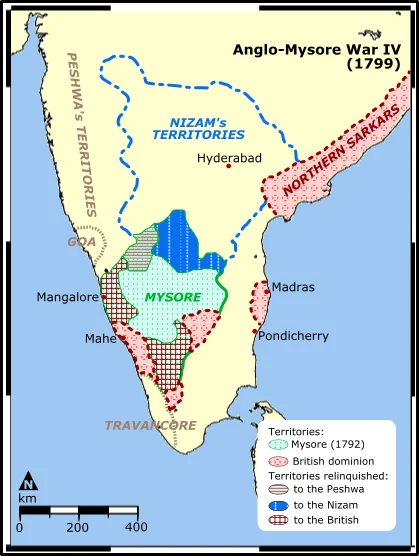
Mysore’s Rise : Mysore rose as a powerful southern state under Hyder Ali (1761), who adopted European techniques to build a strong army and allied with the French.
Tipu Sultan’s Modernisation : Tipu Sultan (1782–1799), known as the 'Tiger of Mysore', continued resistance, modernizing administration, trade, and famously utilizing iron-cased rockets (precursors to modern rocketry).
British Diplomacy : British success relied heavily on diplomacy, forming crucial alliances with the Marathas and the Nizam of Hyderabad to isolate Mysore.
Fourth War & End : The Fourth Anglo-Mysore War (1799) ended with the Siege of Seringapatam and Tipu’s death. Mysore was reduced in size and placed under the Wodeyar dynasty as a British subsidiary ally.
| War | Years | Key Outcome |
|---|---|---|
| First | 1767–1769 | Treaty of Madras (Hyder Ali dictated terms) |
| Second | 1780–1784 | Treaty of Mangalore (Status Quo; Hyder Ali died in 1782) |
| Third | 1790–1792 | Treaty of Seringapatam (Tipu ceded half territory, paid indemnity) |
| Fourth | 1799 | Tipu killed ; Mysore annexed/subsidized |
Prelims tips
- Hyder Ali = de facto ruler of Mysore (1761).
- Tipu Sultan = ' Tiger of Mysore '; introduced sericulture (silk).
- Tipu died in Fourth War (1799).
- After the Fourth War (1799) the Wodeyars were restored under Krishnaraja Wodeyar III; the British took direct control in 1831 and returned Mysore to the Wodeyars by the Rendition of 1881.
Mains points
- Mysore Wars demonstrated the strength of modernized Indian armies but also showed the power of British diplomacy (alliance strategy).
- Tipu’s death (1799) marked the end of effective resistance to the British in South India.
Did you know?
- Tipu used iron-cased rockets in war; considered precursors to modern rockets.
- His alliances with the French and the Ottoman Empire demonstrated his diplomatic vision.
Anglo-Maratha Wars (1775–1818)
Three wars against the Maratha Confederacy ; their defeat established British paramountcy over the rest of India by 1818.
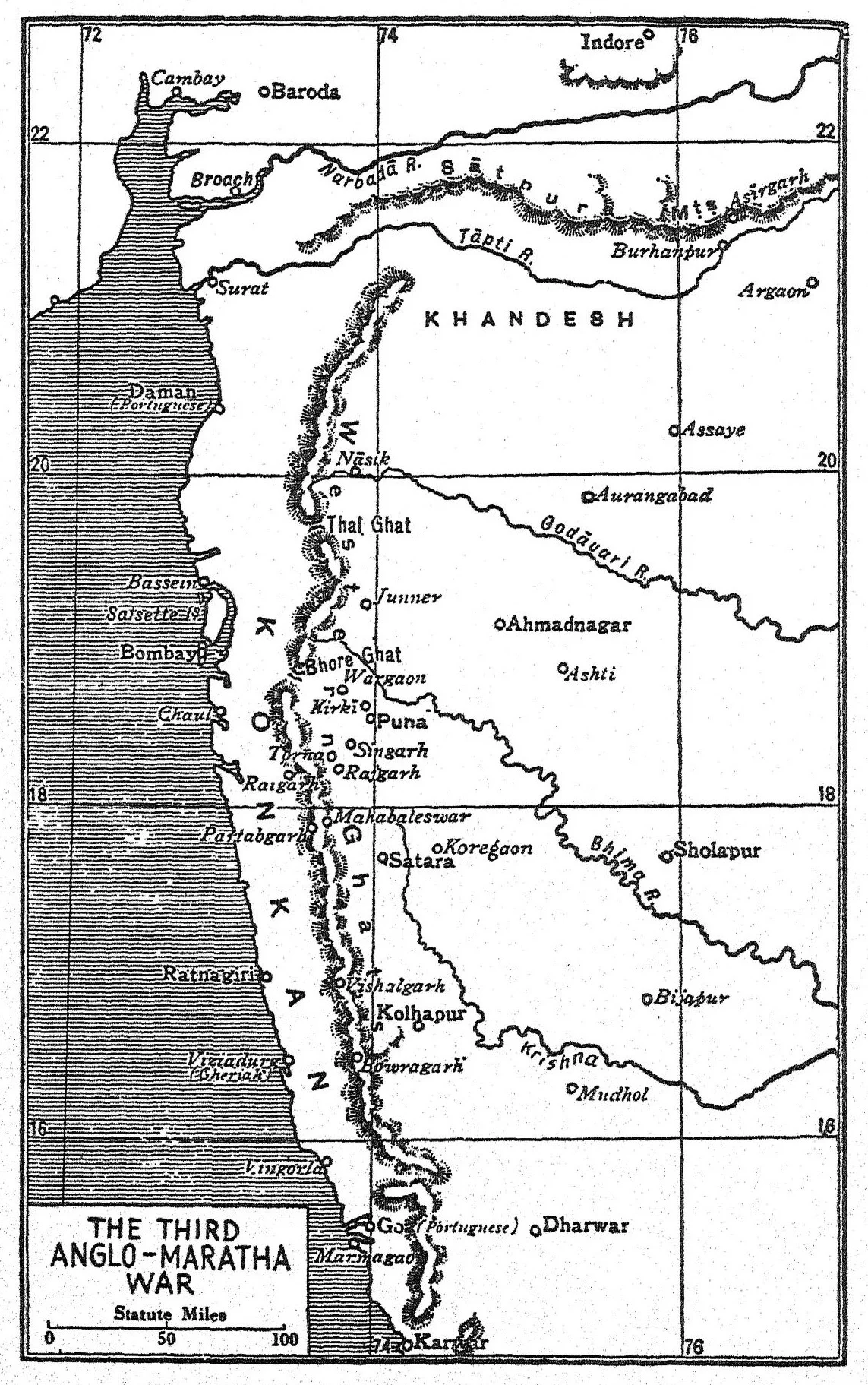
Initial Power : The Marathas emerged as the strongest Indian power after the Mughal decline, but were weakened by internal rivalry after Panipat (1761).
First War (1775–1782) : Caused by a succession dispute (British supported Raghunath Rao). Ended with the Treaty of Salbai (1782), which maintained the status quo for 20 years, a rare strategic pause for the British.
Second War (1803–1805) : British exploited the severe divisions among the main Maratha chiefs (Scindias, Holkars, Bhonsles). British victory gave them control of Delhi .
Third War (1817–1818) : Final confrontation; the Peshwa was defeated and deposed. The Peshwa was abolished, his territories annexed, and the other Maratha houses were confined to princely states under the Subsidiary Alliance.
Causes of Defeat : The failure of the Marathas lay in their inability to act as a confederacy, with each house pursuing separate interests and the British offering superior diplomacy and unified command.
| War | Years | Key Treaties/Events |
|---|---|---|
| First | 1775–1782 | Treaty of Salbai (1782) : Status quo restored. |
| Second | 1803–1805 | British captured Delhi. |
| Third | 1817–1818 | Peshwa abolished; Treaty of Poona (1817): Maratha power ended. |
Prelims tips
- Treaty of Salbai (1782) ended First War → status quo maintained.
- Third War (1817–1818) → end of Maratha power; Peshwa abolished.
- Treaties: First War (1775–82) – Surat (1775), Purandar (1776), Salbai (1782); Second War (1803–05) – Bassein (1802, Bajirao II accepts subsidiary alliance), Deogaon (Bhonsle) and Surji-Arjungaon (Sindhia); Third War (1817–18) – Mandsaur (1818, Holkar); the Peshwa was pensioned off to Bithur.
Mains points
- British victory due to unity, superior diplomacy, and effective exploitation of Maratha rivalries (divide and conquer).
- Wars established the Company’s supremacy over the entire Indian subcontinent by 1818.
Did you know?
- Arthur Wellesley (later Duke of Wellington, victor of Waterloo) fought in the Second War.
- The last Peshwa, Baji Rao II, was pensioned off to Bithoor near Kanpur.
Conquest of Sindh (1843)
Sindh was annexed in 1843 by Charles Napier; motivated by strategic necessity during the Anglo-Afghan Wars.
Rulers & Interest : Sindh was ruled by the Talpur Amirs . British interest grew due to fear of Russian invasion (The Great Game) and the strategic need to control the Indus River route for military supply.
The Annexation : Governor-General Lord Ellenborough ordered the annexation. General Charles Napier defeated the Amirs decisively at the Battle of Miani (1843) and the Battle of Dubbo (1843).
Significance : The annexation was seen as an unjust violation of earlier treaties (e.g., 1832). It secured British control westward and provided a vital base during the First Anglo-Afghan War.
| Event | Year | Outcome |
|---|---|---|
| Battle of Miani | 1843 | Charles Napier defeated Talpur Amirs |
| Annexation | 1843 | Sindh integrated into Bombay Presidency |
Prelims tips
- Sindh annexed in 1843 under Lord Ellenborough.
- General Charles Napier won the Battle of Miani (1843) .
Mains points
- Conquest of Sindh was a classic example of strategic imperialism (security against Russia) overriding moral obligation (treaty violations).
Did you know?
- After the conquest, Charles Napier famously sent the cryptic message: ' Peccavi ' (Latin for 'I have sinned,' sounding like 'I have Sindh').
Conquest of Punjab (1845–1849)
The Sikh Empire , built by Ranjit Singh , was the last major kingdom to be annexed after two Anglo-Sikh Wars.
Ranjit Singh’s Rule : Maharaja Ranjit Singh (1799–1839) built a powerful Sikh Empire and modernized the Khalsa army with European officers and drills. The British refrained from attacking during his lifetime.
Succession Crisis : After his death, the Punjab fell into anarchy due to weak successors and fierce court intrigues (instability of the central Durbar).
First Anglo-Sikh War (1845–46) : Ended by the Treaty of Lahore (1846), which forced the Sikhs to cede territory (Jullundur Doab), pay heavy indemnity, and accept a British Resident.
Second Anglo-Sikh War (1848–49) : Fueled by Sikh resistance to British demands. Ended with the British victory at the Battle of Gujrat (1849).
Final Annexation : Lord Dalhousie formally annexed Punjab in 1849, completing the British conquest of India up to the natural northwest frontier.
| War | Years | Key Outcomes |
|---|---|---|
| First | 1845–46 | Treaty of Lahore (1846) : Heavy indemnity; Resident accepted. |
| Second | 1848–49 | Battle of Gujrat (1849); Punjab annexed. |
Prelims tips
- Maharaja Ranjit Singh modernised Sikh army with European help.
- Punjab formally annexed in 1849 under Lord Dalhousie.
- Anglo-Sikh Wars: First (1845–46) – battles of Mudki, Ferozeshah, Aliwal and Sobraon; Treaty of Lahore and Treaty of Amritsar (1846), by which Kashmir was sold to Gulab Singh; Second (1848–49) – Mulraj's revolt, Chillianwala and Gujrat; Dalhousie annexed Punjab in 1849.
Mains points
- Ranjit Singh created a strong centralised state, but the lack of a stable succession plan enabled British penetration.
- Annexation of Punjab was the final step in establishing British paramountcy across the subcontinent.
Did you know?
- The famous Koh-i-Noor diamond was taken from Punjab after annexation (later given to Queen Victoria).
Overview of Dalhousie’s Annexations (1848–1856)
Lord Dalhousie (Governor-General, 1848–1856 ) aggressively expanded British India using the Doctrine of Lapse and 'misgovernment'.
Doctrine of Lapse : A policy under which the Company annexed selected dependent states when it refused to recognize an adopted successor for sovereignty. Satara (1848) was the first major state annexed; Jhansi (1853) and Nagpur (1854) followed.
Annexation of Awadh (1856) : Annexed on grounds of 'misgovernment' (misrule), not the Lapse. The deposition of Nawab Wajid Ali Shah alienated the sepoys (who were largely from Awadh) and the local taluqdars (landlords).
Legacy : These annexations caused deep socio-economic disruption and political resentment among all classes of Indians, directly fueling the Revolt of 1857.
| State | Year | Grounds |
|---|---|---|
| Satara | 1848 | Doctrine of Lapse (First major annexation) |
| Jhansi | 1853 | Doctrine of Lapse (Rani Lakshmibai denied adoption) |
| Nagpur | 1854 | Doctrine of Lapse |
| Awadh | 1856 | Misgovernment (not Lapse; key cause of 1857) |
Prelims tips
- Doctrine of Lapse introduced by Lord Dalhousie.
- First annexation under Lapse = Satara (1848).
- Awadh (1856) annexed on misgovernment, not lapse.
Annexation of Satara (1848)
Satara was the first state annexed under Lord Dalhousie’s Doctrine of Lapse in 1848, setting a crucial precedent for later territorial expansion.
Historical Context : Satara was a significant former Maratha principality and the nominal seat of the descendants of Chhatrapati Shivaji.
The Lapse Applied : The last ruler, Raja Shahaji (also known as Pratapsinh's successor), died in 1848 without a natural male heir.
Dalhousie's Action : Lord Dalhousie, then Governor-General, aggressively rejected the traditional Hindu right of adoption by the ruler, applying the controversial Doctrine of Lapse to the state.
Significance : The annexation was carried out despite widespread dissent and set a crucial precedent for the subsequent seizure of states like Jhansi and Nagpur, consolidating British power in the Deccan.
Prelims tips
- Satara = first annexation under Doctrine of Lapse ( 1848 ).
Annexation of Jhansi (1853)
Jhansi was annexed in 1853 when Lord Dalhousie rejected Rani Lakshmibai’s adopted heir, making it a key trigger for the Revolt of 1857.
Succession Crisis : The Ruler of Jhansi , Gangadhar Rao Newalkar , died in 1853 without a natural male heir. Just before his death, he adopted a child, Damodar Rao, in the presence of a British official.
Dalhousie's Rejection : Lord Dalhousie , the Governor-General, aggressively rejected the adoption claim, arguing that the Doctrine of Lapse applied to princely states that were subordinates created by the British, thus annexing Jhansi .
Rani's Stance : Rani Lakshmibai vehemently protested the annexation, famously stating, 'I shall not surrender my Jhansi.' She challenged the British refusal to recognize the adopted son, which was a clear violation of Hindu traditional law.
Revolt Trigger : The arbitrary annexation and the humiliation inflicted upon the Rani became a central grievance and a powerful rallying point for the Revolt of 1857 in Central India.
Prelims tips
- Jhansi annexed in 1853 under Lord Dalhousie .
- The annexation directly caused Rani Lakshmibai’s resistance in 1857.
Did you know?
- Rani Lakshmibai became an enduring symbol of resistance and national honour in the 1857 revolt.
Annexation of Nagpur (1854)
Nagpur , a strategically vital and rich cotton-producing region, was annexed under the Doctrine of Lapse in 1854 after the death of its ruler.
Geographical and Economic Importance : Nagpur was the seat of the Bhonsle Maratha dynasty and held immense strategic value in Central India. Crucially, it was a fertile and rich cotton-producing region (UPSC significance: providing a vital raw material for British textile mills).
The Succession Event : The ruler of Nagpur, Raghoji III, died without a natural male heir in 1854, leaving no recognized successor.
The Annexation : Lord Dalhousie, the Governor-General, immediately rejected the right of the state to adopt an heir, applying the controversial Doctrine of Lapse to annex Nagpur.
Consequences : The annexation led to the dissolution of the Bhonsle dynasty and gave the British direct control over large swathes of Central India, solidifying their dominance over the Deccan Plateau and expanding their economic resource base.
Prelims tips
- Nagpur annexed in 1854 under Doctrine of Lapse . (The ruler was Raghoji III).
Annexation of Awadh (1856)
Awadh was annexed in 1856 by Lord Dalhousie on highly controversial grounds of 'misgovernment' (misrule), not the Doctrine of Lapse.
The Ruler : The Nawab at the time of annexation was Wajid Ali Shah, renowned as a major patron of art and culture (especially Kathak and Urdu theatre). He was seen as a popular, though weak, ruler by his subjects.
The Pretext (Misgovernment) : The annexation was carried out not under the Doctrine of Lapse (as the Nawab had heirs), but on the alleged charge of chronic 'misgovernment' (misrule). This step was highly condemned as the Awadh Nawabs had been loyal British allies since the Battle of Buxar (1764).
Political Integration : Following the annexation, Awadh was merged into the North-Western Provinces (later known as the United Provinces) of British India, thus ending its identity as a separate princely state.
Socio-Economic Disruption : The British immediately dispossessed most of the taluqdars (hereditary landlords) of their estates. Furthermore, the disbandment of the Nawab's army created deep discontent among the sepoys (most of whom were recruited from Awadh's rural areas).
Major Cause of 1857 : The annexation of a loyal ally, combined with the dispossession of the elite and the resentment of the sepoys and peasants, created widespread resentment and became a major, central cause of the Revolt of 1857.
Prelims tips
- Awadh annexed in 1856 ( misgovernment , not lapse).
- Ruler: Nawab Wajid Ali Shah.
Did you know?
- Wajid Ali Shah was exiled to Calcutta where he continued to promote Kathak and Urdu poetry.
Anglo-Bhutanese Relations
Relations between British India and Bhutan were marked by border disputes, raids, and culminated in the Anglo–Bhutanese War (1864–65).
Political Structure : Bhutan was a Himalayan kingdom ruled by the Deb Raja (spiritual and temporal head) and Penlops (powerful regional governors, notably the Penlops of Tongsa and Paro).
British Interest and Conflict Zones : British interest grew after the annexation of Assam (1826), bringing them into direct contact with the strategically and agriculturally valuable Dooars region (low-lying land at the foot of the Himalayas).
Cause of Friction : Frequent Bhutanese raids (Dooar-related disputes) into Assam and Bengal frontiers caused severe friction, as the British sought to secure their newly acquired revenue sources and borders.
Diplomatic Breakdown : British envoys (notably Ashley Eden) were often treated with disrespect (seen as affronts to British prestige), worsening relations and providing a pretext for intervention.
War and Outcome : Tensions escalated into the Anglo–Bhutanese War (1864–65). Though the Bhutanese fought fiercely, they lacked modern weaponry. The conflict ended with the Treaty of Sinchula (1865).
| Event | Details |
|---|---|
| Cause | Bhutanese raids into Assam and Bengal; failure of negotiations to secure the Dooars region |
| British Campaign | Invaded Bhutanese territory (Dooars) in 1864 ; swift military action |
| Treaty of Sinchula (1865) | Bhutan ceded Dooars (parts of Assam and Bengal Duars) to the British in perpetuity; received an annual subsidy in return |
Prelims tips
- Anglo–Bhutanese War fought in 1864–65.
- Treaty of Sinchula (1865) → Bhutan ceded Dooars; received annual subsidy.
- Main cause: Bhutanese raids into Assam & Bengal frontiers.
Mains points
- British frontier policy aimed at securing Assam and Bengal borders and their revenue sources from Himalayan kingdoms.
- Bhutan’s loss of the agriculturally important Dooars reduced its economic strength but, crucially, preserved its sovereignty.
- The policy established a precedent for later Anglo–Tibetan and Anglo–Nepalese interactions.
Did you know?
- Despite defeat and territorial loss, Bhutan retained its independence (unlike many Indian neighbours).
- The annual subsidy given by the British was a rare case of the British paying a Himalayan kingdom to maintain a peaceful buffer zone.
Anglo-Nepalese Relations
The Anglo–Nepalese (Gurkha) War (1814–1816) ended with the Treaty of Sugauli, significantly reducing Nepal’s territory but crucially preserving its sovereignty.
Unification and Expansion : Nepal was unified under the aggressive Gorkhas in the mid- 18th century by Prithvi Narayan Shah. The Gorkhas then expanded aggressively westwards into Kumaon, Garhwal , and south into the productive Terai region.
Causes of Conflict : Conflicts arose with the East India Company (EIC) due to recurrent border disputes (especially in the Terai region) and the Nepalese expansion into territories claimed or desired by the British.
The War (1814–1816) : The Anglo–Nepalese (Gurkha) War was a difficult and costly war for the British. The Nepalese army fought bravely, utilizing excellent guerrilla tactics and knowledge of the hilly terrain, but ultimately could not match the EIC’s superior arms and sustained logistical power.
Treaty of Sugauli (1816) : The war concluded with the signing of the Treaty of Sugauli (1816). This treaty was highly significant for the EIC as it pushed the British frontier further north, securing the northern border of British India.
Consequences : Nepal ceded valuable territories including Kumaon, Garhwal, and Sikkim, and accepted a British Resident at Kathmandu. Despite the territorial loss, Nepal retained its external sovereignty and was not annexed (unlike many Indian states).
| Aspect | Details |
|---|---|
| War Period | 1814–1816 |
| Causes | Border disputes ; Gorkha expansion into Kumaon, Garhwal, Terai |
| British Campaign | Led by General Ochterlony; faced heavy resistance |
| Outcome | Nepal defeated ; Treaty of Sugauli (1816) signed |
| Treaty of Sugauli | Nepal ceded Kumaon, Garhwal, Sikkim; accepted British Resident at Kathmandu; crucially kept sovereignty |
Prelims tips
- Anglo–Nepalese War fought ( 1814–16 ) under Lord Hastings.
- Treaty of Sugauli (1816) → Nepal ceded Kumaon, Garhwal, Sikkim.
- Nepal accepted British Resident in Kathmandu.
Mains points
- The Treaty of Sugauli set Nepal’s modern boundaries and marked the beginning of close but unequal relations with British India.
- The British recruitment of Gorkhas became a lasting feature of military relations, providing the EIC with highly effective soldiers while relieving pressure on the northern frontier.
Did you know?
- Despite defeat, Nepal retained sovereignty unlike many Indian states, becoming an important buffer zone.
- The Gorkhas’ bravery impressed the British; they were later recruited into the British Indian Army (Gurkha regiments), a relationship that continues to this day.
Anglo-Burmese Relations & Wars
Three Anglo–Burmese Wars (1824–1886) resulted in the complete annexation of Burma (Myanmar) into British India , securing the Eastern Frontier .
Expansionist Threat : Burma (Myanmar) was a rising regional power under the Konbaung dynasty in the 18th–19th centuries. Its aggressive expansion westward into the territories of Assam, Manipur, and Arakan directly threatened the British Northeast frontier .
Causes of Conflict : Relations were primarily marked by escalating territorial disputes (especially over the border regions) and British commercial ambitions toward Southeast Asia and China.
First War (1824–1826) : Fought when the Burmese expanded near Calcutta. Ended by the Treaty of Yandabo (1826), which forced Burma to cede significant territories including Assam, Manipur, Arakan, and Tenasserim, and pay a heavy indemnity.
Second War (1852) : This war was driven largely by Lord Dalhousie’s expansionist policy, using trade disputes and the harassment of British merchants at Rangoon as a pretext. Resulted in the easy annexation of Lower Burma (Pegu), securing British trade access via the port of Rangoon.
Third War (1885–1886) : Triggered by the fear of increasing French influence on King Thibaw’s court and allegations of misrule. Ended with the annexation of Upper Burma, completing the subjugation. Burma became a province of British India (1886) .
| War | Years | Causes | Outcome |
|---|---|---|---|
| First Anglo–Burmese War | 1824–1826 | Burma expanded into Assam & Manipur; conflict with Company | Treaty of Yandabo (1826) : Burma ceded Assam, Manipur, Arakan; paid indemnity |
| Second Anglo–Burmese War | 1852 | Trade disputes ; British merchants harassed at Rangoon; Dalhousie's expansion | Lower Burma (Pegu) annexed ; Rangoon under British control |
| Third Anglo–Burmese War | 1885–1886 | British accused King Thibaw of misrule and aligning with French | Annexation of Upper Burma ; Burma became part of British India (1886) |
Prelims tips
- First War (1824–26) ended with Treaty of Yandabo .
- Second War (1852) → annexation of Lower Burma (under Dalhousie).
- Third War (1885–86) → annexation of Upper Burma ; Burma became part of British India .
Mains points
- Burma’s annexation shows British strategic concern over Northeast India (securing the border) and Southeast Asia (commercial expansion).
- The wars reveal British use of 'misrule' and 'trade disputes' as pretexts for expansion (especially the Second and Third Wars).
- Integration of Burma expanded India’s eastern frontier and provided access to new trade routes .
Did you know?
- The First Anglo–Burmese War was the costliest for the Company; expenses nearly bankrupted it.
- King Thibaw , the last Burmese monarch, was exiled to Ratnagiri (Maharashtra, India).
- Burma remained a province of British India until 1937, when it was separated.
Anglo-Tibetan Relations
Anglo–Tibetan relations were shaped by trade disputes, Tibet’s ties with China, and the British desire to check Russian influence (The Great Game). The 1903–04 Younghusband Expedition forced Tibet to sign a treaty with the British.
Political Status (Suzerainty) : Tibet historically maintained close ties with China, which claimed suzerainty (a relationship where one state controls the foreign policy of another, but the latter retains internal autonomy).
The Great Game : British interest in Tibet grew sharply in the 19th century as part of the geopolitical rivalry known as the 'Great Game' against Russia’s expansion in Central Asia. The British feared Russian influence spreading to the Himalayas.
Causes of Conflict : Tibet obstructed British attempts to establish trade relations and repeatedly refused to recognize earlier treaties signed between China and Britain concerning Tibet.
The Younghusband Expedition : Lord Curzon (Viceroy) , highly concerned about the Russian threat, ordered a military mission under Colonel Francis Younghusband in 1903. The aim was to open Tibet to British influence.
The Invasion and Treaty : The expedition faced resistance but forced its entry into the capital, Lhasa, in 1904. This military action led directly to the signing of the Treaty of Lhasa (1904).
Treaty of Lhasa (1904) Terms : Tibet agreed to open trade marts at Gyantse, Yatung, and Gartok; to pay a heavy indemnity; and, crucially, not to deal with any foreign power except Britain without British consent. This restricted Tibet's external autonomy.
| Year | Event | Significance |
|---|---|---|
| 19th century | British trade attempts | Repeatedly blocked by Tibet, increasing frustration. |
| 1903–04 | Younghusband Expedition | British forced entry into Lhasa ; military subjugation. |
| 1904 | Treaty of Lhasa | Opened Tibet to trade, indemnity imposed , restricted foreign relations. |
Prelims tips
- Anglo–Tibetan relations linked to the 'Great Game' (Britain vs Russia in Central Asia).
- Younghusband Expedition occurred during Lord Curzon's Viceroyalty ( 1903–04 ).
- Treaty of Lhasa (1904) forced Tibet to open trade marts.
Mains points
- Anglo–Tibetan relations reflected British anxieties about Russian influence in Tibet, making security paramount over direct economic gain.
- The Younghusband expedition demonstrated British military power but also exposed their aggressive frontier policy of intervening directly when diplomatic efforts failed.
- The Treaty of Lhasa marked the first direct treaty between Tibet and Britain, temporarily bypassing China’s authority.
Did you know?
- The Younghusband expedition caused heavy Tibetan casualties despite poor Tibetan weaponry.
- The Dalai Lama fled to Mongolia during the expedition.
- Though Tibet signed the 1904 treaty, its terms were later modified by the British–Chinese convention (1906) , showing China's continued nominal influence.
Anglo-Afghan Relations & Wars
Three Anglo–Afghan Wars (1839–1919) defined British policy in the northwest frontier; Afghanistan was crucial as a buffer state between British India and Russian influence.
Geopolitical Driver (The Great Game) : The principal British concern was the Russian advance into Central Asia, which was perceived as a direct threat to the security of India (known as the 'Great Game').
Strategic Importance : Afghanistan’s strategic location made it the vital 'buffer state'—a neutral territory separating the two imperial powers. British policy aimed to maintain a friendly, yet independent, regime in Kabul.
First Anglo-Afghan War (1839–1842) : This was fought to replace the ruling Dost Mohammad with the pro-British Shah Shuja. It began with initial British success but ended with a disastrous retreat from Kabul (1842), resulting in heavy British losses; Dost Mohammad was eventually restored.
Second Anglo-Afghan War (1878–1880) : Driven by renewed fear of Russian influence (after an Afghan mission to Russia). The British demanded control of Afghan foreign policy. The Treaty of Gandamak (1879) forced the Amir to accept a British Resident in Kabul.
Third Anglo-Afghan War (1919) : Fought after WWI, when Amir Amanullah Khan sought full Afghan independence and rejected British control over foreign policy. The war was brief and ended with the Treaty of Rawalpindi (1919).
Overall Outcome : The wars ensured that Afghanistan remained a buffer state and prevented Russian invasion, but the British never achieved full control.
| War | Years | Causes | Outcome |
|---|---|---|---|
| First Anglo–Afghan War | 1839–1842 | British attempt to replace Dost Mohammad with Shah Shuja (to counter Russia). | Disastrous retreat from Kabul (1842); Dost Mohammad restored. |
| Second Anglo–Afghan War | 1878–1880 | Fear of Russian influence; British demanded control of Afghan foreign policy. | Treaty of Gandamak (1879) : Amir accepted British control over foreign affairs. |
| Third Anglo–Afghan War | 1919 | Amanullah Khan sought full Afghan independence (post-WWI). | Treaty of Rawalpindi (1919) : Britain recognized Afghan independence. |
Prelims tips
- First Anglo–Afghan War → disaster for British ( 1842 Kabul retreat ).
- Second War → Treaty of Gandamak (1879) (British controlled foreign policy).
- Third War (1919) → Treaty of Rawalpindi; Afghan independence recognized.
- The Durand Line (1893), drawn by Sir Mortimer Durand with Amir Abdur Rahman, fixed the boundary between British India and Afghanistan.
Mains points
- British interventions in Afghanistan were driven solely by geopolitical fears (Great Game), proving that security concerns could outweigh economic gain.
- Despite three wars, Britain never fully controlled Afghanistan; instead, their long-term policy goal was limited to keeping it an independent buffer state.
- The wars demonstrated the limits of imperial power in difficult terrain and hostile societies, leading to a permanent change in the Northwest Frontier Policy.
Did you know?
- The 1842 retreat from Kabul was one of the greatest military disasters of the British Empire in the 19th century.
- Afghanistan became a symbol of the 'graveyard of empires' due to repeated foreign failures.
- After 1919 , Afghanistan was the first country to establish diplomatic ties with Soviet Russia.
Policy of Ring Fence & Buffer State
The British first adopted the Policy of Ring Fence in the 18th century to protect Bengal's revenues , which later evolved into the Buffer State Policy in the 19th century to counter Russian expansion in Central Asia .
Policy of Ring Fence (Late 18th century) :
— Architect : Warren Hastings , the First Governor-General of Bengal.
— Aim : Primarily defensive , aimed at protecting the Company’s core possessions in Bengal (the financial lifeline) by creating a ' ring ' of friendly or heavily influenced states around it.
— Method : The British provided military support to certain adjacent Indian states (like Awadh ) against their stronger rivals (like the Marathas and Rohillas ) in exchange for a subsidy and alliance.
— Nature : Short-term and regionally focused on securing the EIC’s immediate economic base.
Policy of Buffer State (19th century) :
— Evolutionary Driver : This policy evolved during the heightened geopolitical rivalry known as the 'Great Game' between Britain and Russia .
— Aim : Primarily strategic , aiming to maintain a chain of politically weak, independent states ( Afghanistan, Nepal, Tibet ) between British India and the potential imperial rivals (primarily Russia ).
— Method : Focused on influencing the frontier states through treaties, subsidies, and controlling their foreign policy .
— Nature : Long-term and integral to international imperial strategy , focusing on security across the Northwest Frontier .
| Aspect | Ring Fence Policy | Buffer State Policy |
|---|---|---|
| Time Period | Late 18th century (Warren Hastings) | 19th century (Great Game era) |
| Region Focus | Bengal and surrounding Indian states | Frontier regions ( Afghanistan, Tibet, Nepal, Bhutan ) |
| Objective | Defensive — protect Bengal revenues | Strategic — counter Russian expansion |
| Method | Alliances with Indian states ( Awadh, Marathas ) | Maintaining weak buffer states between India & rivals |
| Nature | Short-term, regional | Long-term, international (imperial strategy) |
Prelims tips
- Ring Fence → Warren Hastings , late 18th century .
- Buffer State → 19th century , Great Game (Russia vs Britain).
- Afghanistan = classic buffer state between British India & Russia .
Mains points
- Ring Fence showed the early defensive mindset of the Company, focused purely on protecting the economic lifeline of Bengal .
- Buffer State reflected global geopolitics —the shift from regional conquest to managing the strategic threat posed by Russia in Central Asia .
- Both policies reveal how British India was shaped profoundly by security concerns , not just economic motives .
Did you know?
- The term 'Ring Fence' was literally used by Warren Hastings in his correspondence, highlighting its specific, defensive intent .
- Despite the buffer state idea, Britain had to fight three costly Anglo–Afghan Wars to maintain influence in Afghanistan .
Regulating Act of 1773
The Regulating Act of 1773 was the first direct intervention by the British Parliament to regulate and control the affairs of the East India Company in India.
Background (Financial Distress) : The EIC was facing severe financial crisis despite the victory at Buxar and the acquisition of Diwani rights in Bengal. Rampant corruption among Company officials (Nawabs) exacerbated the problem.
Purpose : The Act aimed to check the corruption of the Company's servants, bring the Company's administration under the indirect control of the British government, and reform the chaotic administration of Bengal.
Key Provisions :
— Governor of Bengal was designated as the Governor-General of Bengal (the first was Warren Hastings).
— Executive Council: A four-member Council was created to assist the Governor-General, with decisions made by majority rule.
— Subordination: The Governors of Bombay and Madras were made subordinate to the Governor-General of Bengal.
— Supreme Court: A Supreme Court was established at Calcutta in 1774 to administer justice, separate from the executive.
Limitations : The Act was complex and ambiguous; it did not give the Governor-General Veto power and led to constant conflict between the Governor-General and his Council, necessitating the subsequent Pitt's India Act (1784).
| Feature | Impact |
|---|---|
| Governor-General of Bengal | First step towards a centralized administration. |
| Warren Hastings | First Governor-General of Bengal. |
| Supreme Court at Calcutta (1774) | Separation of judicial and executive functions. |
| Political Control by Parliament | First Parliamentary act to control EIC affairs. |
Prelims tips
- 1773 Act was the first parliamentary regulation.
- Warren Hastings was the first Governor-General under this Act.
- Supreme Court was established in Calcutta in 1774.
Mains points
- The Act marked the beginning of constitutional history in India and the transition from company rule to government control.
- The creation of the Governor-General and the Supreme Court introduced a formal, though flawed, centralized administrative structure.
Did you know?
- The Act was nicknamed the 'Bribe Act' due to its attempts to curb the massive private fortunes amassed by EIC officials (known as 'Nawabs').
Dual Government in Bengal (1765–1772)
The Dual Government was a system established by Robert Clive following the Treaty of Allahabad (1765), where the EIC had power without responsibility, leading to massive exploitation.
Establishment : Implemented in Bengal by Robert Clive after the Battle of Buxar and the Treaty of Allahabad (1765).
The Two Functions :
— Diwani (Revenue): The EIC acquired the Diwani (right to collect revenue) of Bengal, Bihar, and Orissa from the Mughal Emperor Shah Alam II. This gave the Company vast financial resources.
— Nizamat (Administration): The Nawab retained the Nizamat (judicial and police functions). The Nawab was financially dependent on the Company but held all administrative responsibilities.
Consequences (Power without Responsibility) : The Company had all the power (money and army) but no responsibility (justice and welfare), while the Nawab had all the responsibility but no power. This led to:
— Rampant Corruption by Company officials.
— Neglect of Administration, law, and order.
— Agricultural Decline due to excessive revenue demands, culminating in the Great Bengal Famine of 1770.
Abolition : The system was finally abolished by Warren Hastings in 1772 to establish direct Company administration over Bengal.
| Function | Held by (1765–1772) |
|---|---|
| Diwani (Revenue Collection) | EIC (British) |
| Nizamat (Law, Justice, Police) | Nawab (via Company payment) |
| Abolished by | Warren Hastings (1772) |
Prelims tips
- Dual Government started by Robert Clive (1765).
- It gave the EIC the Diwani rights.
- Abolished by Warren Hastings (1772).
Mains points
- The Dual Government exemplified the exploitative nature of early Company rule, where commercial motive trumped administrative responsibility.
- The misrule and exploitation were a direct cause of the Bengal Famine of 1770 and forced the British Parliament to intervene constitutionally.
Did you know?
- The system’s financial chaos led to the EIC seeking a massive loan from the British government in 1773, which became the immediate catalyst for the Regulating Act of 1773.
Permanent Settlement of 1793
The Permanent Settlement , introduced by Lord Cornwallis in 1793, fixed the land revenue demand in perpetuity with the Zamindars (landlords) in Bengal, Bihar, and Orissa.
Purpose : The system aimed to stabilize land revenue collection for the Company, create a loyal class of Zamindars (who would support the British), and encourage investment in agriculture.
Zamindar Status : Zamindars were recognized as the proprietors of the land (owners), as long as they paid the fixed revenue amount to the Company.
Fixed Revenue : The revenue amount was fixed at a high level (about 10/11th of the collection went to the Company, 1/11th was kept by the Zamindar) and was unchangeable in the future.
The Sunset Clause : If a Zamindar failed to pay the fixed revenue on the due date (Sunset Clause), his Zamindari could be sold to the highest bidder.
Consequences :
— For Peasants: They were reduced to tenants (ryots) and were entirely dependent on the Zamindars, who often exploited them with arbitrary rents and evictions.
— For Zamindars: It created a new, loyal class of landed aristocracy for the British, but many original Zamindars lost their estates due to the harsh Sunset Clause and high fixed demand.
— For the Company: It secured a stable revenue base, allowing the Company to shift focus to political expansion, but future potential revenue from rising agricultural production was foregone.
| Aspect | Details |
|---|---|
| Introduced by | Lord Cornwallis (1793) |
| Area | Bengal, Bihar, Orissa |
| Tax Payer | Zamindars (Recognized as Land Owners) |
| Nature | Revenue fixed permanently (in perpetuity) |
Prelims tips
- Permanent Settlement = Cornwallis (1793).
- Zamindars were recognized as land owners.
- The Sunset Clause caused many Zamindars to lose their land.
Mains points
- The Settlement was a land reform and political act designed to secure a reliable revenue stream and a political buffer for the EIC.
- It fundamentally restructured the agrarian society of Bengal, creating a deeply entrenched system of exploitation that impacted the region for centuries.
Did you know?
- The system, while economically exploitative, created the foundation of a loyal Indian aristocracy whose interests were tied to the continuation of British rule.
British Settlements: Madras (Chennai)
Madras , established by the EIC in 1639, was the first major British settlement in South India and the seat of the Madras Presidency.
Acquisition : The British acquired the site of Madraspatnam in 1639 from the local ruler (a Nayak of Vijayanagar).
Fort St. George : They immediately constructed Fort St. George (completed in 1644) around which the settlement grew. This fort became the administrative headquarters of the Company on the Coromandel Coast.
Commercial Importance : Madras developed into a crucial center for the trade of textiles, spices, and diamonds, making it a critical revenue-generating port.
Carnatic Wars : During the Carnatic Wars against the French, Madras was highly contested. It was briefly captured by the French (1746–1749) but was returned to the British under the Treaty of Aix-la-Chapelle.
Administrative Significance : Along with Bombay and Calcutta, Madras became one of the three Presidency towns—the core centers of British administrative, military, and judicial authority in India.
Legacy : The city was a major base for British military operations against Mysore and the Marathas, solidifying their power in Southern India.
| Year/Event | Significance |
|---|---|
| 1639 | Acquisition of Madraspatnam site. |
| 1644 | Completion of Fort St. George. |
| 1746–1749 | Briefly held by the French during the First Carnatic War. |
| 18th Century Onwards | One of the three Presidency Capitals (administrative core). |
Prelims tips
- Madras acquired in 1639.
- Fort St. George is in Madras.
- Madras was a Presidency Town.
Mains points
- Madras's strategic port and its role as a military hub against South Indian powers were vital to the British conquest of the Deccan.
- The city's establishment in the 17th century was a precursor to the later territorial ambitions, starting with a strong commercial base.
Did you know?
- Fort St. George is still standing and houses the Legislative Assembly of Tamil Nadu.
Modern Indian History: All chapters
- Advent of Europeans in India
- Decline of the Mughal Empire
- Emergence of Regional States
- Expansion and Consolidation of British Power
- British Government & Economic Policies (1757–1857)
- Social Reform Movements
- People’s Resistance before 1857
- The Revolt of 1857
- Growth of Nationalism and Moderate Phase of Congress
- British Administration in India
- Era of Militant Nationalism (1905–1909)
- First Phase of Revolutionary Activities (1907–1917)
- India’s Response to First World War and Home Rule Movement
- Emergence of Gandhi
- Non-Cooperation Movement and Khilafat Movement
- Emergence of Swarajists, Socialist Ideas, Revolutionary Activities
- Struggle for Swaraj (1928–1935)
- Period from 1935 to 1942
- Period from 1942 to 1947
- World History (Mains GS I)
- Post-Independence India