
Modern Indian History · UPSC Notes
British Government & Economic Policies (1757–1857) — UPSC Modern History Notes
Free, exam-focused notes for UPSC Prelims and Mains, with Prelims tips and Mains points for every topic. 7 topics.
Open in the interactive reader: bookmarks, progress tracking and read-aloud.
Structure of Government under the Company
The East India Company’s rule evolved from a trading corporation’s administration to a structured colonial government, regulated increasingly by the British Parliament .
1757–1765 (Acquisition of Power) : Company gained political control after Plassey (1757) and Buxar (1764) . Treaty of Allahabad (1765) granted Diwani rights (revenue collection) in Bengal, Bihar, Orissa .
Dual Government (1765–72) : Company collected revenue (Diwani), while the Nawab retained administration (Nizamat). Led to chaos, mass corruption, and the Bengal famine (1770) . Abolished by Warren Hastings .
1773: Regulating Act → Governor of Bengal became Governor-General of Bengal ( Warren Hastings first ); first step of Parliamentary control .
1781: Amending Act (Act of Settlement) → clarified Supreme Court powers to reduce conflict with Governor-General’s Council.
1784: Pitt’s India Act → Created Board of Control in Britain; established a dual system of control (Company's Court of Directors + Parliament's Board of Control).
1813: Charter Act → Ended Company’s monopoly in trade (except tea and China trade); allowed Christian missionaries to operate legally.
1833: Charter Act → Created the position of Governor-General of India ( Lord William Bentinck first ); Company lost all trade rights; India became a purely administrative empire.
1853: Charter Act → Introduced open competition for Indian Civil Services (ICS); effectively signaled that the Company’s rule could be ended anytime.
Administrative expansion : Creation of Presidencies (Bengal, Madras, Bombay), judicial institutions (Supreme Court, later High Courts), and an expanding civil service to collect revenue and maintain law and order.
Role of Residents and Political Agents : British Residents at princely courts exercised heavy influence, negotiated treaties, and monitored succession — key to indirect rule.
| Year | Act | Key Features |
|---|---|---|
| 1773 | Regulating Act | Governor of Bengal → Governor-General of Bengal ( Warren Hastings first ); Supreme Court at Calcutta (1774) ; first step of Parliamentary control. |
| 1781 | Amending Act | Also called Act of Settlement ; clarified powers of Supreme Court; reduced conflicts between Court and Council. |
| 1784 | Pitt’s India Act | Created Board of Control in Britain; introduced 'dual system of control'; distinguished political and commercial functions. |
| 1813 | Charter Act | Ended Company monopoly in trade (except tea and China trade); permitted Christian missionaries; asserted Crown sovereignty. |
| 1833 | Charter Act | Created Governor-General of India ( Lord William Bentinck first ); complete end of Company’s trade monopoly; First Law Commission under Macaulay. |
| 1853 | Charter Act | Introduced open competition for Indian Civil Services (ICS); separated legislative and executive functions of Governor-General’s council; no fixed period for Company’s charter. |
Prelims tips
- Dual Government → Bengal (1765–72), abolished by Warren Hastings .
- First Governor-General of Bengal = Warren Hastings (1773).
- First Governor-General of India = Lord William Bentinck (1833).
- Charter Act 1853 → ICS open competition .
Mains points
- Parliament gradually tightened control over Company → essential shift from commercial to political administration.
- The various Acts laid the groundwork for centralized colonial governance and bureaucracy.
Did you know?
- The Supreme Court judges in Calcutta (1774) clashed with Warren Hastings’ Council, causing a constitutional crisis.
- The 1813 Act allowed Christian missionaries to legally operate in India for the first time.
Land Revenue Policies
British land settlements focused on maximizing revenue and creating new proprietary classes, leading to widespread peasant oppression.
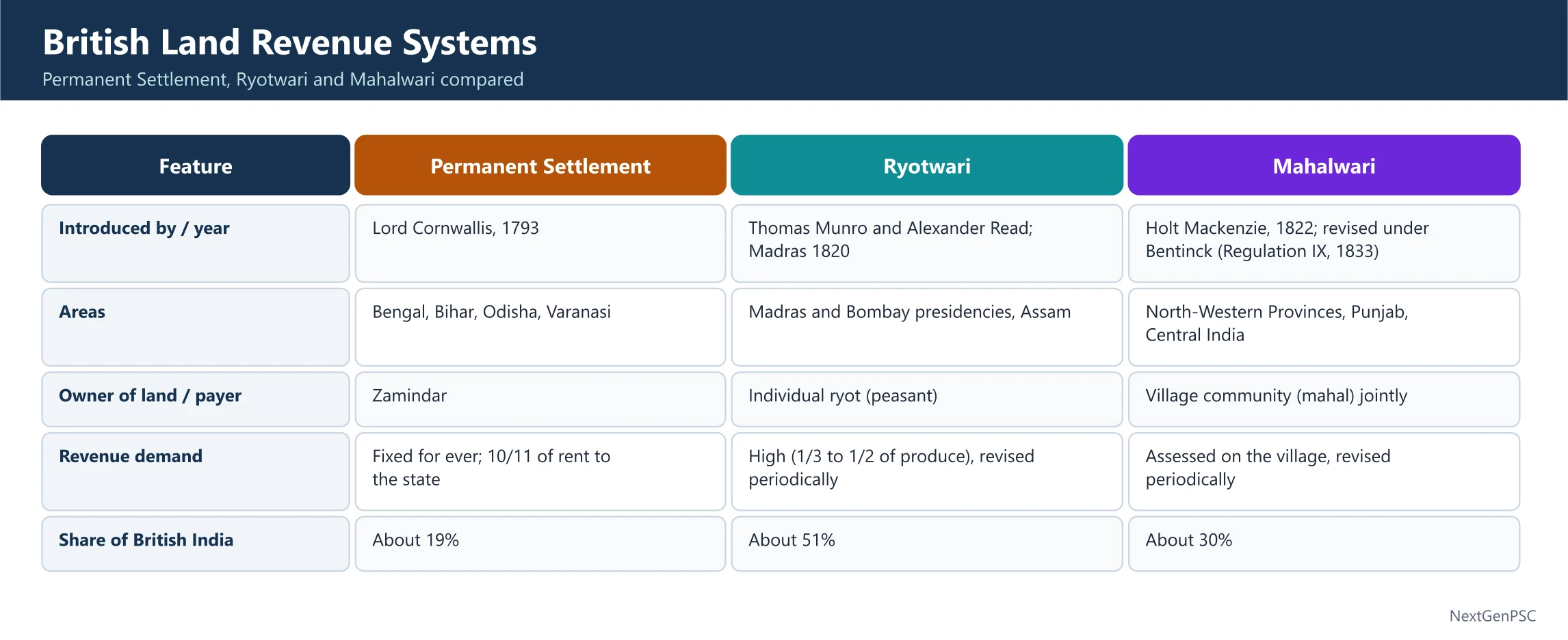
Permanent Settlement (1793) : Introduced by Lord Cornwallis in Bengal, Bihar, Orissa . Zamindars were recognized as hereditary landlords; revenue was fixed permanently. Led to absentee landlordism and peasant oppression.
Ryotwari Settlement (1820s) : Introduced by Thomas Munro in Madras, Bombay. Revenue settlement was made directly with the cultivators (ryots). Revenue was revised periodically (not fixed), often leading to high demands.
Mahalwari Settlement (1833) : Introduced by R.M. Bird in the NW Provinces & Punjab. Settlement was made with the entire village community (mahal), which was jointly responsible for paying revenue.
Taluqdari System (Awadh) : After annexation, taluqdars (landlords) were often dispossessed and then restored as landlords under the British, increasing their power and leading to oppression.
Indigo System (Bengal) : European planters forced peasants to grow indigo (a cash crop) on their best land; sparked the famous Indigo Revolt (1859–60).
Consequences : Creation of absentee landlords, massive indebtedness among peasants, decline in traditional village institutions, and periodic agrarian unrest and famines.
| System | Region | Introduced by | Features |
|---|---|---|---|
| Permanent Settlement | Bengal, Bihar, Orissa | Cornwallis (1793) | Zamindars as hereditary landlords; fixed revenue forever. |
| Ryotwari | Madras, Bombay | Thomas Munro | Direct settlement with cultivators (ryots); periodic revision. |
| Mahalwari | NW Provinces, Punjab | R.M. Bird (1833) | Village (mahal) collectively responsible; revenue demand revised. |
| Taluqdari | Awadh | Dalhousie’s policy | Taluqdars acted as powerful intermediaries; increased exploitation. |
Prelims tips
- Permanent Settlement = Cornwallis , 1793 (Bengal).
- Ryotwari = Thomas Munro (Madras/Bombay).
- Mahalwari = R.M. Bird , 1833 (NW Provinces, Punjab).
- Indigo Revolt = 1859–60 in Bengal.
Mains points
- Revenue policies prioritized Company profits over agrarian welfare, creating an exploitative structure of landlordism .
- These settlements fueled rural poverty and discontent, serving as a major underlying cause of the 1857 revolt .
Did you know?
- Under Permanent Settlement , many zamindars lost estates due to inability to pay fixed high revenue.
- The Indigo Revolt inspired Dinabandhu Mitra’s play *Nil Darpan* ( The Indigo Mirror ).
Economic Policies
British economic policies systematically de-industrialized India and transformed it into a supplier of raw materials and a market for British machine-made goods.
De-industrialisation : Indian handicrafts (especially textiles) collapsed due to the influx of cheap British machine-made goods and discriminatory tariffs that favoured imports over Indian exports.
Trade Pattern Reversal : India exported raw materials (cotton, indigo, silk, opium) and imported manufactured goods, reversing the favorable pre-colonial trade patterns.
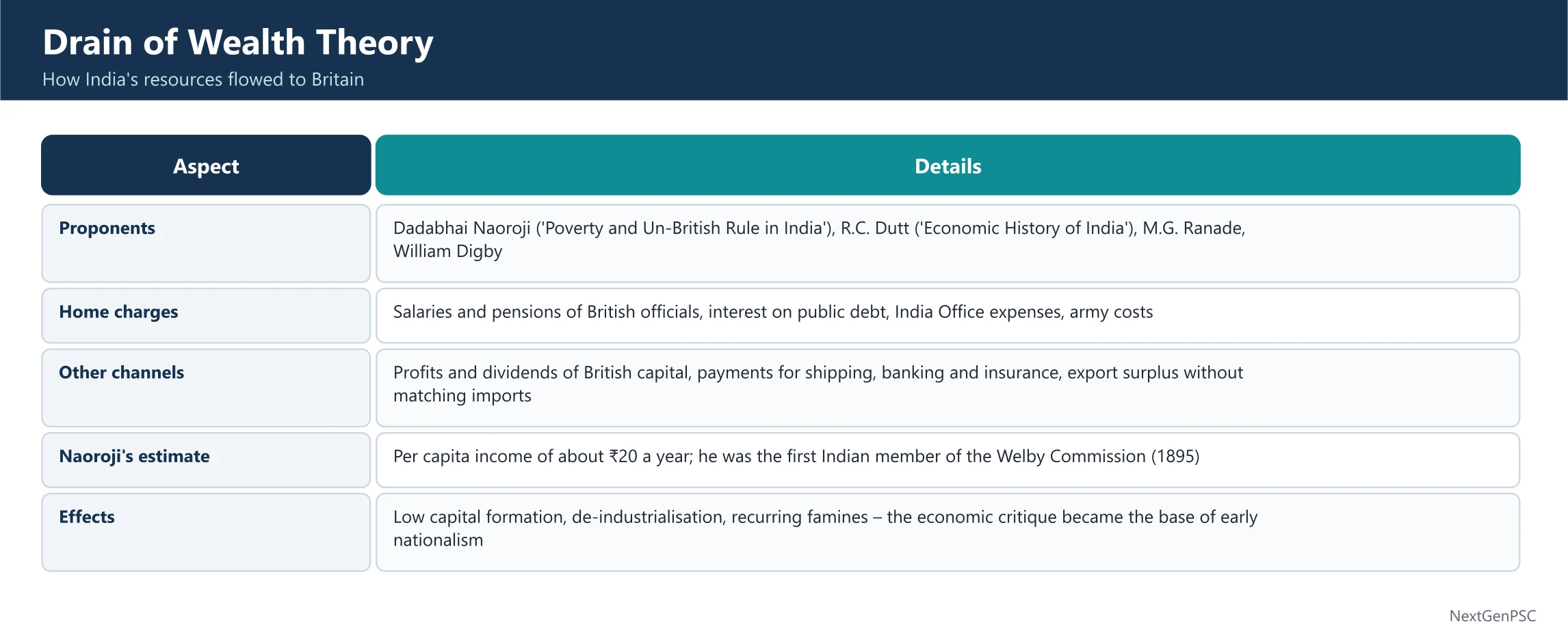
Drain of Wealth Theory : Nationalists like Dadabhai Naoroji argued that India's surplus was systematically transferred to Britain through salaries, pensions, and 'Home Charges' (expenses paid in Britain), causing India's impoverishment.
Opium Trade : The Company encouraged widespread opium cultivation in Bihar and Bengal. The opium was exported to China; these profits financed crucial Company operations and indirectly contributed to the Opium Wars.
Infrastructure Development : Railways (from 1853), telegraph, roads, and ports were developed—primarily to move troops, raw materials from the interior to ports, and integrate markets favorable to Britain, not for Indian industrial growth.
Fiscal policies : High land revenue demands and tariffs were structured to extract surplus; currency and banking changes primarily favoured British merchants.
| Policy/Feature | Impact |
|---|---|
| Import of British textiles | Collapse of Indian handicrafts ; mass unemployment. |
| Export of raw materials | Shift to cash crops (cotton, indigo); food insecurity. |
| Drain of Wealth | Systematic transfer of Indian wealth abroad ( Home Charges ). |
| Opium cultivation | Profits for British; misery for peasants; led to Opium Wars. |
| Railways (1853) | Facilitated exploitation; not industrialisation or public welfare. |
Prelims tips
- First railway line : Bombay to Thane (1853).
- Drain of Wealth theory → Dadabhai Naoroji .
- Opium trade was key to British profits in China.
- Drain theory: Dadabhai Naoroji's 'Poverty and Un-British Rule in India' estimated per capita income at about ₹20 a year; William Digby wrote 'Prosperous British India'; Naoroji was the first Indian member of the Welby Commission (1895) on Indian expenditure.
Mains points
- Economic policies fundamentally transformed India into a colonial economy dedicated to serving British industrial interests.
- Policies triggered rural poverty and economic discontent, providing a fertile ground for the 1857 revolt.
Did you know?
- Dadabhai Naoroji called British rule 'Un-British Rule in India'.
- Railway contracts guaranteed minimum profits for British investors, shifting all risk to the Indian treasury.
Impact on Indian Society
British policies drastically disrupted traditional social and economic structures, while unintentionally creating a new educated middle class.
Rise of New Classes : The revenue systems created powerful new classes of Zamindars and moneylenders, while the peasantry became increasingly impoverished and indebted.
Urban Shift : Traditional inland urban centers declined, while the port cities ( Calcutta, Bombay, Madras ) and administrative towns expanded.
The Educated Elite : A new English-educated middle class emerged from missionary schools and colleges, forming the intellectual and administrative backbone for later nationalist leadership.
Social and Religious Reforms : Efforts by Indian reformers (like Raja Ram Mohan Roy) and missionary activity led to legal reforms against practices like Sati and promoted widow remarriage.
Social Unrest : Economic distress, land alienation, and cultural shocks created deep social unrest, leading to localized revolts (e.g., Santhal, Indigo) and contributing to the Revolt of 1857.
Long-term Institutional Changes : The British left permanent institutional legacies, including modern legal codes, the railways, the postal and telegraph systems, and western-style education.
Prelims tips
- Permanent Settlement created absentee landlordism.
- Port cities (Calcutta, Bombay, Madras) grew at the cost of inland towns.
Mains points
- Colonial exploitation created deep social discontent among the masses, providing the material base for the 1857 revolt.
- British policies simultaneously and unintentionally created new classes (educated Indians, professionals) that later formed the core of the freedom movement.
Did you know?
- Dadabhai Naoroji’s book *Poverty and Un-British Rule in India* (1901) made Drain Theory popular.
Economic Impact (Industrial Capital)
The primary economic impact of British Industrial Revolution capital on India was not development but the exploitation of its resources and market, often facilitated by guaranteed profits.
Capital Investment Pattern : Most British investment in India was channelled into areas serving colonial interests: Railways, plantations (tea, coffee, indigo), coal mining, and shipping, rather than native Indian industry.
The 'Guaranteed Return' System : The British government often guaranteed a minimum profit (e.g., 5% to 6%) to British investors who invested in Indian railways. This ensured risk-free profits for British capital, regardless of the railway's actual earnings, placing the risk entirely on the Indian taxpayer.
Impact on Indigenous Industry : This capital inflow led to a 'drain of skilled capital' away from indigenous sectors like handicrafts and small-scale industries, which couldn't compete with subsidized or protected British capital.
Rise of Modern Industry : While the late 19th century saw the emergence of a few modern Indian-owned industries (like cotton textiles in Bombay, jute in Calcutta), these efforts were often hampered by British government policies (e.g., lack of state support, excise duties on Indian textiles).
Role of Finance : The modern banking structure that emerged was initially geared toward financing external trade (export of raw materials) and British businesses, marginalizing Indian entrepreneurs.
| Sector | Primary Investor (Pre-1914) | Motive |
|---|---|---|
| Railways | British (Guaranteed returns) | Transport raw materials/troops |
| Tea/Coffee Plantations | British | Export of cash crops |
| Cotton Mills (Bombay) | Indian | Rare success story, often without state support |
| Jute Mills (Calcutta) | British/Scottish | Export-oriented processing |
Prelims tips
- The term 'guaranteed profits' is often associated with the early railway development in India.
- Early modern cotton textile mills were primarily established by Indian capital in Western India.
Mains points
- British industrial capital played a deformative role in the Indian economy, creating an enclave economy focused on extraction.
- The structure of investment highlighted the colonial nature of the state, where Indian interests were secondary to the risk-free profits of the metropolis.
Did you know?
- The initial cost of building railways in India under the guaranteed return system was estimated to be nearly twice what it should have been due to extravagant spending by the companies.
British Social Legislation (Abolition of Slavery)
Although traditional practices of slavery and bonded labour existed, the British enacted the Indian Slavery Act of 1843 to abolish the legal status of slavery in British India.
Context : Pressure from humanitarian movements and the abolitionist movement in Britain (which had already abolished slavery in its colonies in 1833) spurred action in India.
Prevalence in India : Various forms of slavery, bonded labour, and the transfer of people as property (especially for domestic or agricultural work) were prevalent in parts of India.
The Act (1843) : The Indian Slavery Act (Act V of 1843), passed during the time of Governor-General Lord Ellenborough, officially prohibited the recognition of slavery by courts.
Key Provisions : The Act did not completely abolish the institution of slavery in practice immediately, but it stripped the master of his legal right to claim the slave. It stated that:
— No person could be subjected to any rights of property as a slave.
— Courts could no longer enforce contracts for slave service or property claims related to slavery.
Limitations : The legislation was a slow social process; debt bondage and various forms of forced labour continued illegally for many years.
| Aspect | Details |
|---|---|
| Year | 1843 |
| Governor-General | Lord Ellenborough |
| Key Impact | Abolished legal status of slavery; courts could not enforce slave ownership. |
| Nature | Social and Humanitarian Legislation. |
Prelims tips
- Indian Slavery Act was passed in 1843.
- It did not physically free all slaves but removed the legal protection for the practice.
Mains points
- The Act represents a shift from a purely exploitative administration to one beginning to introduce moral and social reforms, reflecting British political currents.
- It was part of a broader package of legal modernization that provided a uniform, Westernized legal framework, though often displacing traditional legal customs.
Did you know?
- The abolition of slavery and the legalisation of widow remarriage were two major social reforms driven partly by the influence of English education and indigenous Indian reformers.
Labour Legislation (Early Factory Acts)
Early Factory Acts were passed in India primarily due to pressure from Manchester industrialists in Britain, rather than humanitarian concerns for Indian workers.
The Motive (British Competition) : Indian factory products, especially cotton textiles in Bombay, were competing effectively with British goods. British manufacturers demanded legislation to increase production costs in India to maintain their competitive edge, especially concerning long working hours of Indian labour.
The First Factory Act (1881) : Passed during the time of Lord Ripon, it was the first piece of labour legislation in India. It primarily focused on the protection of children (aged 7–12).
— Key Provisions: Prohibited the employment of children below 7 years, limited working hours for children between 7 and 12 years to 9 hours a day, and mandated four holidays a month.
The Second Factory Act (1891) : Passed during the time of Lord Lansdowne, it extended protection to women and improved regulations for children.
— Key Provisions: Limited working hours for women to 11 hours a day, reduced working hours for children to 7 hours a day, and provided a compulsory one-hour rest period for all employees.
Limitations : These early acts were extremely limited in scope. They did not apply to government factories, plantations (where conditions were harshest), or small workshops, and thus protected only a small fraction of the workforce.
| Act | Year | Governor-General | Focus |
|---|---|---|---|
| First Factory Act | 1881 | Lord Ripon | Children (Age 7–12) |
| Second Factory Act | 1891 | Lord Lansdowne | Women and Children (Revised) |
Prelims tips
- The main pressure for the Factory Acts came from British manufacturers to hurt Indian competition.
- First Factory Act (1881) focused on children.
Mains points
- The legislation revealed that British policy, even when seemingly humanitarian, was often a tool of economic protectionism for the metropolitan economy.
- The limited scope of the acts, particularly their exclusion of plantation labour, showed the colonial state's willingness to prioritize planter interests over worker welfare.
Did you know?
- Indian industrialists and landlords often opposed these acts, viewing them as unnecessary interference that hurt their own profits.
Modern Indian History: All chapters
- Advent of Europeans in India
- Decline of the Mughal Empire
- Emergence of Regional States
- Expansion and Consolidation of British Power
- British Government & Economic Policies (1757–1857)
- Social Reform Movements
- People’s Resistance before 1857
- The Revolt of 1857
- Growth of Nationalism and Moderate Phase of Congress
- British Administration in India
- Era of Militant Nationalism (1905–1909)
- First Phase of Revolutionary Activities (1907–1917)
- India’s Response to First World War and Home Rule Movement
- Emergence of Gandhi
- Non-Cooperation Movement and Khilafat Movement
- Emergence of Swarajists, Socialist Ideas, Revolutionary Activities
- Struggle for Swaraj (1928–1935)
- Period from 1935 to 1942
- Period from 1942 to 1947
- World History (Mains GS I)
- Post-Independence India