
Modern Indian History · UPSC Notes
Emergence of Regional States — UPSC Modern History Notes
Free, exam-focused notes for UPSC Prelims and Mains, with Prelims tips and Mains points for every topic. 11 topics.
Open in the interactive reader: bookmarks, progress tracking and read-aloud.
Background
With Mughal decline after 1707, many provincial governors and warrior groups asserted autonomy, leading to powerful regional states.
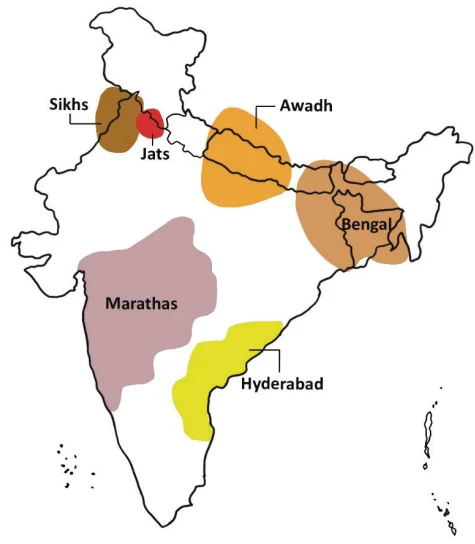
Political Vacuum after Aurangzeb (d.1707) : The death of Aurangzeb and the subsequent infighting among the Later Mughals severely reduced imperial control. Provincial governors (subedars) and military commanders (like the Nizam in Hyderabad) took advantage of this central weakness to consolidate local political power.
Military Professionalisation at Local Level : Regional elites stopped depending entirely on the fragile Mughal army. They developed their own standing forces (cavalry, infantry, artillery) and local fortifications, making them militarily independent of Delhi. Significance: This military strength was the basis of their autonomy.
Strong Economic Bases : Regional rulers secured control over vital economic levers: land revenue collection, lucrative riverine trade routes (especially in Bengal and Awadh), and important artisan centres. This control provided the fiscal capacity (financial resources) needed to sustain semi-independent courts and armies.
Administrative Experiments : New revenue practices (like ijara or revenue farming) were introduced to maximize local income, often deviating from strict Mughal norms. The rise of local munshis (bureaucrats) and revenue experts created administrative systems distinct from the Mughal bureaucracy.
Diplomatic Fluidity and Shifting Alliances : Regional rulers engaged in complex negotiations with each other, the weakened Mughal court, and crucially, the European companies. Their practice of forming shifting alliances was a routine survival strategy in the volatile 18th century.
Cultural Decentralisation and Patronage : Regional courts actively became patrons of local languages, arts, and architectures. This led to the flowering of distinct regional cultures (e.g., the elaborate culture of Lucknow, unique Deccani styles), reinforcing their political independence with a cultural identity.
Prelims tips
- Connect political decentralisation after 1707 to the institutional rise of provincial courts and standing local armies.
- Remember the twin bases of power for regional states: revenue control and military capability.
Mains points
- Explain how the combination of fiscal control, military autonomy and local legitimacy enabled provincial regimes to replace centralized Mughal authority.
- Discuss the long-term implications of decentralisation for later colonial state-building by the British.
Did you know?
- Several regional courts preserved elaborate Mughal ceremonial forms while innovating administratively — a mix of continuity and change.
Awadh
Founded by Saadat Khan Burhan-ul-Mulk ( 1722 ); wealthy province, centre of Shia culture and politics.
Origin and Status : Founded in 1722 by Saadat Khan Burhan-ul-Mulk . Awadh emerged as a key Successor State to the Mughals , initially semi-autonomous but achieving de facto independence by the mid- 18th century .
Economic Strength (Fiscal Base) : Situated in the fertile Gangetic plains , the region generated significant revenue surplus and grain. The Nawabs actively invested in irrigational works and urban markets, providing the fiscal capacity to sustain their semi-independent court and army.
Administrative Structure : Awadh maintained a system of professional bureaucracy , local revenue officers (amil), and standing cavalry units , ensuring efficient tax collection and military readiness, differentiating it from the collapsing central Mughal administration .
Cultural Apex and Patronage : Under Asaf-ud-Daula , the capital Lucknow became a vibrant centre of refined culture. It patronized Urdu poetry , classical music (khayal, thumri), and the classical dance form Kathak (UPSC significance: a major centre of cultural and linguistic revival ).
Foreign Relations and Diplomacy : Awadh engaged in complex realpolitik , navigating volatile relationships with the Marathas , Rohillas , the weakened Mughals , and critically, the British EIC . They often paid subsidies or entered treaties ( e.g., Treaty of Allahabad after Buxar ) to secure temporary autonomy, reflecting the era's instability.
Decline and Final Annexation : Nawabi sovereignty was gradually eroded by increasing Company demands and interference, especially the Subsidiary Alliance of 1801 . In 1856 , Lord Dalhousie annexed Awadh under the formal pretext of 'maladministration' . This was an annexation by alleged misgovernment, not an application of the Doctrine of Lapse; it alienated taluqdars, soldiers and sections of the local elite before the Revolt of 1857 .
| Ruler | Period | Notes |
|---|---|---|
| Saadat Khan | 1722–1739 | Founder |
| Safdar Jang | 1739–1754 | Consolidated power ; military reforms |
| Shuja-ud-Daula | 1754–1775 | Allied at Buxar (1764) ; suffered losses |
| Asaf-ud-Daula | 1775–1797 | Capital moved to Lucknow ; cultural patron |
Prelims tips
- Link Awadh’s prosperity and Lucknow’s cultural flowering to Nawabi patronage under Asaf-ud-Daula .
- Remember British annexation of Awadh (1856) as a cause of growing discontent before 1857 .
- By the Treaty of Faizabad (1775), Nawab Asaf-ud-Daula ceded Benares to the Company.
Mains points
- Analyse how Awadh combined agrarian prosperity with courtly patronage to create a resilient regional polity and how British policies undermined it.
- Discuss Awadh’s role in north Indian politics ( Buxar, Rohilla conflicts ) and cultural contributions to Indo-Muslim synthesis.
Did you know?
- Lucknow’s court etiquette ( nazakat and adab ) influenced North Indian elite culture and persists in idioms and cuisine today.
Bengal
Murshid Quli Khan made Bengal virtually independent; became richest province but fell after Battle of Plassey (1757) .
Founder and Revenue Reforms : Murshid Quli Khan (appointed Diwan 1704 , Nawab 1717 ) established Bengal as a powerful Successor State . He reorganized revenue administration , transferred the capital to Murshidabad , and increased the efficiency of tax collection to maximize state income.
Economic Prosperity (The Golden Goose) : Bengal was the richest province in India, acting as a major international entrepôt (trading hub). Its wealth was based on export-oriented production of high-value goods like silk, muslin , saltpeter (used in gunpowder), and rice, driving vibrant Indian Ocean and Atlantic trade .
Fiscal and Bureaucratic Strength : The autonomous Nawabs developed a strong fiscal base (financial reserves) and an effective local bureaucracy . This capacity, often supported by powerful local bankers ( Jagat Seths ), funded their armies and courtly life, challenging the central Mughal system.
European Rivalry and Intervention : French, Dutch, and English factories intensely competed for Bengal's trade . The powerful English EIC increasingly used its commercial links and local financial allies to intervene politically in succession disputes, blurring the lines between trade and tribute .
Battle of Plassey (1757) - The Turning Point : The defeat of Siraj-ud-Daulah , the last independent Nawab, was primarily due to internal conspiracies involving key officials like Mir Jafar (Commander-in-Chief) and local merchants. This allowed the Company to capture key fiscal controls (effectively the Diwani ) without immediate territorial annexation.
Profound Consequences (Drain of Wealth) : The transfer of revenue control after Plassey led to the systematic transfer of wealth from Bengal to the EIC ( Drain of Wealth ). This severely disrupted local artisanal production (as the EIC gained monopoly) and caused long-term agrarian changes favoring export-oriented cash crops (like Indigo and Opium) over food security.
| Ruler | Period | Notes |
|---|---|---|
| Murshid Quli Khan | 1717–1727 | Founder and revenue reforms |
| Alivardi Khan | 1740–1756 | Military leader; resisted Marathas |
| Siraj-ud-Daulah | 1756–1757 | Defeated at Plassey ; last independent nawab |
Prelims tips
- Associate Murshidabad with Murshid Quli Khan and Plassey (1757) with the start of Company political power .
- Remember key Bengal exports ( muslin, silk, saltpetre ) to explain European interest.
Mains points
- Evaluate how Bengal’s fiscal-administrative reforms made it a prize for European companies and how Plassey (1757) converted commercial advantage into political control .
- Discuss the socio-economic transformations in Bengal after Company takeover , focusing on artisans, land tenure and trade .
Did you know?
- Bengal’s muslin was so fine that contemporary Europeans called it 'woven air' — a symbol of high artisanal skill.
Hyderabad
Founded by Nizam-ul-Mulk Asaf Jah ( 1724 ); Asaf Jahi dynasty lasted till 20th century .
Nizam-ul-Mulk ( Qamar-ud-Din Khan ) declared de facto independence in 1724 and established the Asaf Jahi dynasty centred at Hyderabad .
Deccan politics : Hyderabad’s strategic location controlled trade routes and provided a buffer between Maratha and Carnatic zones .
Administration : Nizams maintained a Persianate court culture , an efficient revenue system and hired European (mainly French ) military advisors and technicians at times.
Relations with Marathas & British : multiple wars and treaties with Marathas ; later subsidiary alliances and treaties with British reduced sovereignty but preserved princely status .
Economy & culture : patronised Deccani painting, architecture and syncretic Urdu- Telugu court culture ; Hyderabad became a major urban-commercial node .
Prelims tips
- Remember 1724 as founding year of Asaf Jahi dynasty ; note Hyderabad’s role as Deccan buffer state .
- Relate Nizam-Maratha conflicts and later subsidiary treaties with the British to explain gradual loss of autonomy.
Mains points
- Analyse how Hyderabad balanced regional pressures ( Marathas, Carnatic ) and European interventions to maintain princely status into the 19th century .
- Discuss the administrative and cultural legacy of the Asaf Jahi dynasty in South India.
Did you know?
- Hyderabad’s unique Deccani cuisine , language blends and architectural styles reflect centuries of syncretic rule .
Marathas
From Shivaji’s Swarajya to Peshwa-led empire ; dominant Indian power in 18th century until Panipat (1761) .
Origins : Shivaji (c.1627–1680) created a resilient polity based on hill forts , guerrilla tactics , and a network of revenue holders (deshmukhs, sanad holders).
Peshwa ascendancy : In the early 18th century , the Peshwas (prime ministers) became de facto leaders expanding influence across central, north and east India .
Revenue & military : Marathas extracted chauth and sardeshmukhi from neighbouring territories, financed cavalry-heavy armies and used rapid mobility to project power.
Confederacy model : Rather than a centralised state, the Maratha polity was a coalition of powerful houses ( Peshwas, Scindias, Holkars, Gaekwads, Bhonsles ) with shifting alliances.
Crisis at Panipat (1761) : Heavy losses against Ahmad Shah Abdali undermined Maratha northern expansion temporarily and led to internal reorganisation.
Recovery & legacy : By late 18th century leaders like Mahadji Scindia restored influence in north India; Marathas remained kingmakers until British consolidation .
| House/Clan | Centre | Notes |
|---|---|---|
| Peshwas | Pune | De facto leaders and political coordinators |
| Scindias | Gwalior | North India power brokers |
| Holkars | Indore | Strong Maratha presence in Central India |
| Gaekwads | Baroda | Western India revenue base |
| Bhonsles | Nagpur | Eastern and central expansion |
Prelims tips
- Remember chauth and sardeshmukhi as Maratha revenue instruments and Baji Rao I’s role in rapid northern expansion.
- Panipat (1761) is a crucial date to link to Maratha setback by Abdali .
- After Peshwa Narayan Rao's murder (1773) the Maratha state was run by the Barabhai council of twelve chiefs led by Nana Fadnavis.
Mains points
- Analyse why the Maratha confederacy , despite military successes, failed to evolve into a stable centralised empire — consider fiscal institutions, leadership structure and regionalism .
- Discuss Maratha interactions with other regional powers ( Nizam, Mysore, Awadh ) and Europeans in shaping 18th-century geopolitics .
Did you know?
- Maratha cavalry tactics emphasised speed , local intelligence networks and seasonal campaigning timed to monsoon cycles.
Sikhs
After Guru Gobind Singh , Sikhs organised into Misls ; Ranjit Singh founded Sikh Empire ( 1799–1839 ).
Khalsa & militarisation : Guru Gobind Singh (1708 death) institutionalised Khalsa (1699) giving Sikhs a distinct collective military-religious identity .
Misl confederacy : Post- 1716 , Sikh groups organised into around a dozen misls each controlling territories and resources in the Punjab .
Ranjit Singh’s consolidation : By 1799 Ranjit Singh unified most misls , captured Lahore (1799) , modernised the army ( European officers , western drills) and established centralised administration .
Economy & diplomacy : Punjab’s agrarian surplus , control of key routes and trade revenues funded the army; Ranjit Singh made treaties with British while resisting Afghan threats .
Legacy : Strong centralized Sikh state until 1849 ( annexation by British ); maintained religious pluralism and employed Hindus, Muslims in administration.
Prelims tips
- Remember Khalsa formation (1699) and Lahore capture by Ranjit Singh (1799) .
- Note the modernisation of the Sikh army with European officers and artillery .
Mains points
- Assess the institutional and military reforms that enabled Ranjit Singh to transform a confederacy of misls into a centralized Sikh Empire .
- Discuss the role of religious identity and pragmatic secular governance in the longevity of the Sikh state .
Did you know?
- Ranjit Singh abolished the jagirdari-like jagirs in favour of state salaries for many officers — a reform that stabilised administration.
Jats
Peasant-warrior community ; Suraj Mal of Bharatpur built a strong Jat kingdom .
Origins & mobilisation : Jats were agrarian communities who organised militarily as Mughal control weakened, seizing territory around Mathura, Bharatpur and surrounding plains.
Leadership : Leaders like Churaman, Badan Singh and Maharaja Suraj Mal (reigned 1755–1763) consolidated Jat chieftaincies into a cohesive polity.
Administration & military : Suraj Mal fortified Bharatpur ( Lal Kot, Deeg ), reformed revenue collection and maintained a disciplined cavalry and infantry for regional defence.
Relations : Jats both resisted and formed tactical alliances with Marathas, Mughals and later negotiated with the British to preserve autonomy.
Limitations : Strong locally but lacked deep bureaucratic institutions and wider revenue base to build a long-lasting territorial state against larger powers.
Prelims tips
- Associate Suraj Mal and the fortress of Bharatpur with Jat power peak in mid- 18th century .
- Remember the Jats’ agrarian-military social base when explaining their political rise.
Mains points
- Discuss how peasant-militant mobilisation enabled creation of regional polities like Bharatpur and the structural limits they faced.
- Analyse the role of local forts, agrarian revenue and alliances in sustaining Jat power for several decades.
Did you know?
- Deeg Palace and Bharatpur forts still stand as architectural reminders of Jat statecraft .
Rajputs
Rajput states like Jaipur and Jodhpur revived autonomy after Aurangzeb .
Varied responses : Some Rajput states allied with Mughals earlier; after 1707 many negotiated autonomy through diplomacy, matrimonial ties and selective military resistance .
Sawai Jai Singh II (1688–1743) exemplified a Rajput ruler who combined scientific patronage ( Jantar Mantar ), urban planning ( Jaipur city ) and diplomatic acumen .
Economy & administration : Rajput courts relied on agrarian revenue, tribute relations with neighbours and maintained local chieftains to collect taxes.
Military posture : Rajput rulers balanced between resisting annexation and collaborating with stronger neighbours ( Mughals, Marathas , later British ) to retain princely status .
Cultural role : Rajput patronage kept courtly Rajput traditions, martial codes and temple-based social structures alive during the period.
Prelims tips
- Link Sawai Jai Singh’s Jantar Mantar and Jaipur city-plan to Rajput contributions to science and urbanism .
- Remember Rajputs used marriages and treaties alongside military resistance to secure autonomy.
Mains points
- Evaluate Rajput strategies of survival : collaboration, resistance and cultural patronage —and their longer-term effects on regional polity.
- Discuss how Rajput courts balanced local autonomy with obligations to more powerful neighbours.
Did you know?
- Jaipur city was planned on grid-iron lines — an early example of modern urban planning in India.
Mysore
Mysore under Hyder Ali and Tipu Sultan became a strong southern power; resisted British through four Anglo-Mysore Wars .
Transition of power : Wodeyar dynasty remained titular, but Hyder Ali (c. 1761 ) rose from military commander to de facto ruler , establishing strong centralized military control .
Military modernization : Hyder and Tipu adopted European techniques , maintained regular artillery, used rocket units and recruited skilled European and Mysorean engineers .
Economic policy : emphasis on state-controlled workshops, sericulture (silk), stimulation of local industries and promotion of external trade (Persian Gulf, Red Sea contacts).
Diplomacy & warfare : engaged in alliances with Marathas, Nizam and attempted French connection ; fought four Anglo-Mysore wars (1767–1799) with mixed outcomes.
Tipu’s death (1799) marked the end of major Mysore resistance — British restored Wodeyar rulers as subsidiary allies under British influence .
| War | Period | Key Outcome |
|---|---|---|
| First (1767–1769) | Treaty of Madras (1769) | Restored territories; Mysore remained resilient |
| Second (1780–1784) | Treaty of Mangalore (1784) | Temporary Indian success; stalemate restored status quo |
| Third (1790–1792) | Treaty of Seringapatam (1792) | Tipu lost territories , paid indemnity & gave hostages |
| Fourth (1799) | Siege of Seringapatam (1799) | Tipu killed ; Mysore fell under British influence |
Prelims tips
- Remember Hyder Ali’s rise from commander to ruler and Tipu’s use of rockets and state-controlled industry .
- Note 1799 as the decisive year when Tipu fell and British influence became dominant in Mysore .
- Tipu Sultan planted a 'Tree of Liberty' at Srirangapatnam and is said to have joined the Jacobin Club; in the Battle of Pollilur (1780) Haidar Ali and Tipu defeated Colonel Baillie.
Mains points
- Analyse Mysore’s institutional transformation under Hyder Ali and Tipu Sultan and why state-led military-industrial policies failed to prevent eventual British dominance .
- Discuss the international dimensions ( French support, Persian Gulf trade ) of Mysore’s resistance politics .
Did you know?
- Tipu Sultan attempted to develop an indigenous arms industry and maintain foreign contacts ( France, Ottoman Empire ) to counter the British .
Impact of Regional States
Regional states revived local cultures and economies but disunity aided colonial expansion .
Cultural revival : courts patronised languages ( Urdu, Deccani, Marathi ), literature, painting schools and regional music/dance traditions , generating diverse cultural landscapes .
Economic localisation : some regions ( Bengal, Awadh, parts of Deccan ) experienced commercial prosperity and artisanal revival while others suffered from warfare-induced disruption .
Military modernisation : several states adopted European drill, artillery and administrative military reforms (e.g., Mysore, Sikh army under Ranjit Singh ).
Political fragmentation : competing sovereignties made coordinated resistance to European powers difficult; companies exploited rivalries via subsidies, bribes and military support .
State experiments : varied land-revenue systems and administrative models emerged—these later influenced British revenue policies in different regions.
| Positive | Negative |
|---|---|
| Cultural renaissance (music, architecture, literature) | Political disunity |
| Economic prosperity in Awadh, Bengal | Failure to unite against British |
| Military innovation (Marathas, Sikhs, Mysore) | Continuous warfare drained resources |
Prelims tips
- Use regional case studies to show variety—contrast Bengal’s fiscal strength with Mysore’s military-industrial push and Maratha confederacy’s revenue model .
- Remember that cultural revival did not always translate into political unity .
Mains points
- Discuss how the political and institutional diversity of regional states complicated any single narrative of ‘ decline ’ and created multiple modern trajectories in late pre-colonial India.
- Evaluate how regional experiments in revenue, military and administration shaped subsequent colonial policies and post-colonial state structures .
Did you know?
- Many regional capitals ( Lucknow, Murshidabad, Hyderabad, Pune, Lahore, Seringapatam ) became centres of learning, craft and urban culture that influenced modern India.
Carnatic Region
The Carnatic Nawabs were nominally subordinate to Hyderabad , but became independent and a focus of Anglo-French rivalry .
Political Status : The Carnatic (Coromandel Coast and its interior) was an important subah under the Mughals. After 1707, the Nawab of Arcot (Carnatic) became practically independent, though technically a vassal of the Nizam of Hyderabad.
European Involvement (Carnatic Wars) : Due to its strategic location and control over major ports like Madras (Chennai) and Pondicherry (Puducherry), the region became the theatre for three Anglo-French Wars (Carnatic Wars, 1746–1763).
Key Rulers : The Nawabs of Arcot, such as Dost Ali Khan, often became mere pawns in the European rivalries, seeking military or financial support from either the French or the British, which allowed external powers to dictate terms.
Economic Exploitation : The later Nawabs accrued immense debts to the English EIC and its private servants, leading to British control over the revenue administration of the Carnatic as collateral (security for the loans).
Final Fate : The British ultimately annexed the Carnatic region in 1801, merging it into the Madras Presidency after decades of political and financial control, establishing a strong base in South India.
Prelims tips
- Identify the Carnatic Wars as the proxy war between the British and French in India, primarily fought for control of the coast.
- Associate the Nawabs of Arcot with the political and financial decline that facilitated British annexation of the region.
Mains points
- Analyze the economic and strategic reasons that made the Carnatic the primary battleground for European powers in the mid-18th century.
- Discuss how the debt trap created by the EIC effectively undermined the sovereignty of the Nawabs of Arcot before the formal annexation.
Did you know?
- The Battle of Wandiwash (1760), a key event of the Third Carnatic War, was a decisive military defeat for the French in India.
Modern Indian History: All chapters
- Advent of Europeans in India
- Decline of the Mughal Empire
- Emergence of Regional States
- Expansion and Consolidation of British Power
- British Government & Economic Policies (1757–1857)
- Social Reform Movements
- People’s Resistance before 1857
- The Revolt of 1857
- Growth of Nationalism and Moderate Phase of Congress
- British Administration in India
- Era of Militant Nationalism (1905–1909)
- First Phase of Revolutionary Activities (1907–1917)
- India’s Response to First World War and Home Rule Movement
- Emergence of Gandhi
- Non-Cooperation Movement and Khilafat Movement
- Emergence of Swarajists, Socialist Ideas, Revolutionary Activities
- Struggle for Swaraj (1928–1935)
- Period from 1935 to 1942
- Period from 1942 to 1947
- World History (Mains GS I)
- Post-Independence India