
Indian Polity & Governance: UPSC Notes, Key Concepts & Practice

    High-yield Polity coverage for UPSC Prelims and Mains. Revise the Constitution’s philosophy, rights framework, separation of powers, legislative-executive-judicial relations, federalism, local bodies, and contemporary governance — with crisp summaries, mains points, prelims tips, and MCQs.

    Chapter index

    Indian Polity & Governance

    Interactive study materials with AI assistance

    Indian polity Playlist

    19 chapters • 0 completed

    1

    Making of the Constitution

    18 topics

    2

    Salient Features of the Indian Constitution

    4 topics

    3

    Preamble

    7 topics

    4

    Evolution of States & Union Territories

    7 topics

    5

    Citizenship

    9 topics

    6

    Fundamental Rights

    34 topics

    7

    Directive Principles of State Policy (DPSP)

    19 topics

    8

    Amendment and Basic Structure

    12 topics

    9

    Parliamentary System of Government

    48 topics

    10

    Union Executive

    36 topics

    Practice
    11

    State Executive

    21 topics

    12

    State Legislature

    11 topics

    13

    Centre-State Relations

    24 topics

    14

    Inter-State Relations

    14 topics

    15

    Emergency Provisions

    13 topics

    16

    Supreme Court

    26 topics

    17

    High Court

    20 topics

    18

    Local Government

    21 topics

    19

    UTs + Scheduled and Tribal Areas

    22 topics

    Progress (0%)
    0 / 19 complete

    Chapter 10: Union Executive

    Chapter Test
    36 topics•Estimated reading: 108 minutes

    President of India

    Key Point

    The President is the Head of the State, a nominal and symbolic authority who exercises powers on the aid and advice of the Council of Ministers. Elected indirectly through an Electoral College, the office represents the unity and integrity of the nation.

    The President is the Head of the State, a nominal and symbolic authority who exercises powers on the aid and advice of the Council of Ministers. Elected indirectly through an Electoral College, the office represents the unity and integrity of the nation.

    Detailed Notes (63 points)
    Tap a card to add note • Use the highlight Listen button to play the full section
    A. The President of India
    Introduction
    The President of India is the Head of the Indian State and represents the unity, integrity, and dignity of the nation.
    The President occupies the highest constitutional office in the country.
    He/She is called the Nominal Executive or Constitutional Head because, in a parliamentary system, real power is exercised by the Council of Ministers headed by the Prime Minister .
    The President performs his duties based on the aid and advice of the Council of Ministers (Article 74 of the Constitution).
    This means the President is a symbol of national unity who ensures that the Constitution is respected and followed in spirit.
    Role and Nature of Office
    1. The President is the symbolic head of the government — representing India in national and international affairs.
    2. Though the position is largely ceremonial , it ensures that the government works according to the Constitutional framework .
    3. The President plays an important role in maintaining the balance between the Legislature, Executive, and Judiciary .
    4. The President acts as the guardian of the Constitution .
    Qualifications (Article 58)
    To be eligible for the office of President, a person must:
    1. Be a citizen of India .
    2. Have completed 35 years of age .
    3. Be qualified to be elected as a member of the Lok Sabha .
    4. Not hold any office of profit under the Government of India, any State Government, or any local or other authority.
    5. For example, a person holding a government job or being a member of a public service commission must first resign before contesting for President.
    Conditions of Office (Article 59)
    1. The President cannot be a member of Parliament or a State Legislature while in office.
    2. If a Member of Parliament (MP) or Member of Legislative Assembly (MLA) is elected as President, their seat automatically becomes vacant from that day.
    3. The President’s emoluments (salary) and allowances cannot be reduced during their term, ensuring independence.
    4. The President is entitled to an official residence called the Rashtrapati Bhavan in New Delhi.
    5. The President’s salary is determined by Parliament (currently ₹5 lakh per month, as per the latest amendment).
    Nomination Process
    1. A candidate must satisfy all the constitutional qualifications mentioned above.
    2. The nomination paper must be signed by at least 50 proposers and 50 seconders , who are members of the Electoral College.
    3. A security deposit of ₹15,000 is required (refundable if the candidate secures a certain number of votes).
    4. The nomination paper is scrutinized by the Returning Officer (usually the Secretary-General of Lok Sabha or Rajya Sabha).
    5. If valid, the candidate’s name is included in the list of contesting candidates.
    Electoral College (Article 54)
    The President is elected indirectly by an Electoral College , not directly by the people.
    The Electoral College consists of:
    1. Elected members of both Houses of Parliament (Lok Sabha and Rajya Sabha).
    2. Elected members of the Legislative Assemblies of all States and Union Territories having legislatures (Delhi, Puducherry, and Jammu & Kashmir).
    Note: Nominated members of Parliament and State Legislatures do not participate in the election.
    Manner of Election (Article 55)
    1. The election is held through the system of Proportional Representation by means of the Single Transferable Vote (STV) . This ensures fairness and balance between the Union and States.
    2. The election is conducted by the Election Commission of India (ECI) .
    3. Voting is by secret ballot to ensure independence of choice.
    4. Each voter (MP or MLA) can mark multiple preferences (1st, 2nd, 3rd, etc.) on the ballot paper.
    Value of Votes
    The value of votes is determined to ensure equality between the States and the Centre:
    - Value of MLA’s vote = (Population of the State ÷ Total number of elected MLAs) ÷ 1000.
    - Value of MP’s vote = (Total value of all MLA votes ÷ Total number of elected MPs).
    The population figures are based on the 1971 Census until the first census after 2026 is published.
    Counting of Votes and Quota System
    1. A candidate must secure a quota of votes to be declared elected.
    Formula: Quota = (Total valid votes ÷ 2) + 1 .
    2. In the first round, only first preference votes are counted.
    3. If no candidate achieves the quota, the candidate with the least votes is eliminated , and his/her ballots are redistributed according to second preferences.
    4. This continues until one candidate reaches the required quota.
    5. This method ensures that the winner has a broad consensus among the electoral college.
    Disputes and Supervision
    1. The Election Commission of India (ECI) conducts the election under its supervision.
    2. Any dispute related to the election of the President is decided by the Supreme Court of India (Article 71).
    3. The Supreme Court’s decision on such disputes is final and binding .
    Reasons for Indirect Election
    1. Practical difficulty: Direct elections would require an enormous amount of money, time, and resources given India’s population size.
    2. Ceremonial role: The President is not the real executive; the actual power lies with the Prime Minister and Council of Ministers. Hence, direct election is unnecessary.
    3. Federal balance: The indirect election gives both the Union and States an equal role in choosing the President, maintaining the federal structure of India.
    4. Continuity and stability: Indirect elections prevent frequent political upheaval and ensure smooth functioning of the parliamentary system.

    Election of the President – Key Aspects

    AspectDetails
    Electoral CollegeElected MPs + Elected MLAs (States + UTs Delhi, Puducherry, J&K)
    MethodProportional Representation by Single Transferable Vote
    AuthorityElection Commission of India
    VotingSecret ballot; multiple preferences allowed
    DisputesDecided by Supreme Court

    Mains Key Points

    The President is the nominal head of state, symbolizing national unity.
    Elected indirectly to balance parliamentary democracy and federalism.
    Election ensures weightage to both Parliament and State Assemblies.
    Office functions on advice of the Council of Ministers, ensuring parliamentary supremacy.
    Indirect election avoids unnecessary expenditure for a figurehead post.

    Prelims Strategy Tips

    President is indirectly elected by an electoral college.
    Election follows proportional representation with single transferable vote.
    Population for vote value calculation: Census 1971.
    Election disputes: Supreme Court jurisdiction.
    70th Amendment (1992): added the elected members of the Legislative Assemblies of Delhi and Puducherry to the electoral college of the President.

    Oath, Term and Impeachment of the President

    Key Point

    The President takes oath before the Chief Justice of India, holds office for 5 years, and can be removed only through impeachment on the ground of violation of the Constitution under Article 61.

    The President takes oath before the Chief Justice of India, holds office for 5 years, and can be removed only through impeachment on the ground of violation of the Constitution under Article 61.

    Detailed Notes (36 points)
    Tap a card to add note • Use the highlight Listen button to play the full section
    A. Oath or Affirmation of the President (Article 60)
    Before entering office, the President must take an Oath or Affirmation to uphold the Constitution and discharge duties faithfully.
    The oath is administered by the Chief Justice of India (CJI) .
    In the absence of the CJI, the senior-most judge of the Supreme Court available administers the oath.
    The oath takes place usually in the Central Hall of Parliament in a formal ceremony.
    The exact wording of the oath is mentioned in Article 60 of the Constitution .
    Text of the Oath
    “I, (name), do swear in the name of God / solemnly affirm that I will faithfully execute the office of President of India and will to the best of my ability preserve, protect and defend the Constitution and the law, and that I will devote myself to the service and well-being of the people of India.”
    B. Term of Office (Article 56)
    1. The tenure of the President is five years from the date of assuming office.
    2. The President continues in office even after the expiry of the term until the successor enters office — ensuring no vacancy in the position.
    3. The President may resign at any time by addressing the resignation letter to the Vice-President of India .
    4. The President can be removed only through the process of impeachment for violating the Constitution (Article 61).
    5. The President is eligible for re-election and may be re-elected for any number of terms. (For example: Dr. Rajendra Prasad was re-elected for a second term in 1957).
    6. If the office of President falls vacant (due to death, resignation, removal, or otherwise), the Vice-President acts as President until a new President is elected within six months.
    C. Impeachment of the President (Article 61)
    The President can be removed from office only by following the impeachment procedure under Article 61 of the Constitution.
    This process is quasi-judicial in nature — meaning it combines both political and judicial features.
    It is used only in case of a ‘violation of the Constitution’ , though the term is not defined in the Constitution itself.
    Procedure for Impeachment
    1. The charges can be initiated in either House of Parliament — Lok Sabha or Rajya Sabha.
    2. The notice of intention to move the resolution must be signed by at least one-fourth (1/4th) of the total members of that House.
    3. A copy of the notice must be given to the President at least 14 days in advance .
    4. The House then considers the resolution and must pass it by a two-thirds (2/3rd) majority of the total membership of that House.
    5. Once one House passes the resolution, the other House investigates the charges.
    During this investigation, the President has the right to appear and defend themselves personally or through an authorized representative.
    6. After investigation, if the second House also passes the resolution by a two-thirds majority of total membership , the President is removed from office immediately.
    7. This ensures that impeachment cannot happen on political grounds alone — both Houses must agree by a special majority.
    Key Features of Impeachment Process
    1. It is a serious and rare process designed to protect the dignity of the highest office.
    2. It ensures checks and balances — Parliament can remove the President, but only with overwhelming consensus.
    3. No President has been impeached in India so far. (Dr. Rajendra Prasad, Dr. Radhakrishnan, and others completed their terms honorably.)
    Members Involved in Impeachment
    1. All Members of Parliament (both elected and nominated) participate in the impeachment process.
    2. State Legislative Assemblies and Union Territories’ members do not participate in this process.
    3. Hence, the impeachment is an exclusive power of Parliament .

    Impeachment of the President – Key Features

    AspectDetails
    ArticleArticle 61
    GroundViolation of the Constitution
    InitiationEither House of Parliament
    Notice1/4th members sign + 14 days' notice
    Majority2/3rd of total membership in both Houses
    NatureQuasi-judicial
    StatusNo President has been impeached so far

    Mains Key Points

    Oath signifies allegiance to the Constitution and service to the people.
    Fixed 5-year tenure ensures stability but allows re-election.
    Impeachment is a serious, quasi-judicial procedure ensuring checks on misuse of office.
    High majority requirement ensures removal cannot be politically motivated.
    So far, the provision has acted as a deterrent, not actually invoked.

    Prelims Strategy Tips

    Oath administered by CJI or senior-most SC judge.
    President’s tenure: 5 years, re-election allowed any number of times.
    Impeachment under Article 61: ground is violation of the Constitution.
    Nominated MPs participate in impeachment, State MLAs do not.

    Impeachment: Indian President vs US President

    Key Point

    While the Indian President can be impeached only for violation of the Constitution under Article 61, the US President, Vice President, and civil officers can be impeached for treason, bribery, or other high crimes and misdemeanours. The processes, grounds, and authorities involved are significantly different.

    While the Indian President can be impeached only for violation of the Constitution under Article 61, the US President, Vice President, and civil officers can be impeached for treason, bribery, or other high crimes and misdemeanours. The processes, grounds, and authorities involved are significantly different.

    Impeachment Process – India vs USA

    ParameterIndian PresidentUS President
    ApplicabilityPresident onlyPresident, Vice President, and all civil officers of the US
    Grounds for RemovalViolation of the ConstitutionTreason, Bribery, or other high crimes and misdemeanours
    Charges of ImpeachmentCan be initiated in either House of ParliamentOnly the House of Representatives can initiate
    Process of Removal1/4th members sign charges + 14 days’ notice; resolution passed by 2/3rd of total membership; referred to the other House for investigationHouse of Representatives votes by simple majority; Senate conducts trial with Chief Justice presiding
    Majority Needed2/3rd majority of total membership in both Houses2/3rd majority in Senate for conviction
    Outcome / StatusNo Indian President has been impeached so far3 Presidents impeached (Andrew Johnson, Bill Clinton, Donald Trump) but none convicted

    Mains Key Points

    Indian impeachment is limited to violation of Constitution, narrower than the US grounds.
    US impeachment covers broader misconduct like treason, bribery, high crimes.
    Indian process is more rigid with higher safeguards, ensuring stability of the post.
    US process is political in nature, often influenced by party majority in House/Senate.
    No Indian President impeached yet, while US has impeached 3 Presidents without removal.

    Prelims Strategy Tips

    Indian President – Impeachment only for ‘violation of Constitution’ (Art. 61).
    US President – Grounds include treason, bribery, and high crimes/misdemeanours.
    Indian process: Both Houses, 2/3rd majority of total membership.
    US process: House impeaches (simple majority), Senate convicts (2/3rd).

    Vacancy in the Office of the President

    Key Point

    A vacancy in the office of the President may occur due to expiry of term, resignation, removal, death, or disqualification. Provisions ensure continuity of the office, with the Vice-President or Chief Justice acting until a new President is elected.

    A vacancy in the office of the President may occur due to expiry of term, resignation, removal, death, or disqualification. Provisions ensure continuity of the office, with the Vice-President or Chief Justice acting until a new President is elected.

    Detailed Notes (28 points)
    Tap a card to add note • Use the highlight Listen button to play the full section
    A. Vacancy in the Office of the President
    Causes of Vacancy (Article 62 & Related Provisions)
    The office of the President may become vacant due to several reasons. These are:
    1. Expiry of the 5-year term of office.
    2. Resignation submitted by the President to the Vice-President of India.
    3. Removal of the President through the process of impeachment under Article 61.
    4. Death of the President while in office.
    5. Disqualification or if the election is declared void by the Supreme Court.
    Constitutional Safeguard
    The Constitution ensures that the Office of the President is never left vacant , even for a single day. Immediate arrangements are made to fill the position temporarily or permanently, as the case may be.
    Case 1: Vacancy due to Expiry of Term
    1. When the President’s 5-year term comes to an end, the Election Commission of India must conduct the election before the expiry of the term.
    2. If, for any reason, the election is delayed, the outgoing President continues to hold office until the newly elected President assumes charge.
    3. This ensures continuity of constitutional authority and avoids any administrative vacuum.
    4. In this situation, the Vice-President does not act as President because the incumbent continues in office until the successor takes oath.
    Case 2: Vacancy due to Death, Resignation, Removal, or Other Reasons
    1. If the office becomes vacant due to death, resignation, removal, disqualification, or any other reason , a new election must be held within 6 months of the vacancy (Article 62).
    2. The newly elected President holds office for a full term of 5 years — not just the remainder of the previous term.
    3. During the interim period (before the election of the new President), the Vice-President of India acts as the Acting President .
    4. The Vice-President exercises all powers and functions of the President during this period.
    5. If the office of the Vice-President is also vacant , then the Chief Justice of India (CJI) acts as the President of India.
    6. If the CJI’s office is also vacant, then the senior-most judge of the Supreme Court available acts as the President.
    7. This chain of succession ensures that there is no constitutional breakdown at any point.
    Important Points to Remember
    1. The Acting President (whether the Vice-President or Chief Justice) exercises all powers of the President but does not hold the office permanently.
    2. The Acting President does not get a separate oath again as President, but acts under the authority of the Constitution.
    3. All decisions and actions taken by the Acting President are legally valid.
    4. So far, this has happened a few times in history — for example, V.V. Giri acted as President in 1969 after Dr. Zakir Husain’s death until a new President was elected.

    Vacancy in the President’s Office – Provisions

    SituationProvision
    Expiry of termElection before expiry; outgoing President continues till new one elected
    Death / Removal / ResignationElection within 6 months; new President serves full 5 years
    Interim arrangementVice President acts as President until election
    If VP also vacantChief Justice of India acts as President
    If CJI vacantSenior-most judge of Supreme Court acts as President

    Mains Key Points

    Ensures continuity of the highest office in the Union Executive.
    No vacuum in authority due to detailed constitutional provisions.
    Distinction made between expiry of term and unexpected vacancies.
    Acting President mechanism maintains balance and stability.
    Highlights importance of Vice President and judiciary in succession.

    Prelims Strategy Tips

    Outgoing President continues if elections delayed after term expiry.
    Vacancy due to resignation, removal or death ➡ election within 6 months.
    New President always gets full 5-year term, not remainder.
    VP acts as President in interim; if VP vacant, CJI or senior-most SC judge.

    Powers of the President of India

    Key Point

    Under Article 53, the executive power of the Union is vested in the President, who exercises powers on the advice of the Council of Ministers. Powers include executive, administrative, and appointments, with limited discretionary authority in rare cases.

    Under Article 53, the executive power of the Union is vested in the President, who exercises powers on the advice of the Council of Ministers. Powers include executive, administrative, and appointments, with limited discretionary authority in rare cases.

    Detailed Notes (36 points)
    Tap a card to add note • Use the highlight Listen button to play the full section
    A. Executive Powers of the President (Article 53–78)
    General Principle
    Under Article 53 of the Constitution, the Executive Power of the Union is vested in the President of India .
    This means all executive actions of the Government of India are taken in the name of the President.
    However, in reality, the President exercises these powers on the aid and advice of the Council of Ministers headed by the Prime Minister (as per Article 74).
    The President is thus the constitutional or nominal head of the executive, while the Prime Minister and Council of Ministers are the real executive authorities.
    In most cases, the President must act according to ministerial advice, but in a few exceptional circumstances, he/she may act at discretion — e.g., when appointing a Prime Minister after a hung Parliament (no clear majority).
    B. Appointment Powers of the President
    The President has wide powers of appointment under various constitutional provisions. Some key appointments made by the President include:
    1. Prime Minister of India — The President appoints the Prime Minister. Generally, the leader of the majority party or coalition in Lok Sabha is invited to form the government.
    2. Other Ministers — Appointed on the advice of the Prime Minister. The President formally appoints them and allocates portfolios.
    3. Attorney General of India — The chief legal advisor to the Government of India.
    4. Judges of the Supreme Court and High Courts — The President appoints the Chief Justice of India (CJI) and other judges of the Supreme Court, as well as Chief Justices and judges of High Courts, based on the recommendations of the collegium system.
    5. Governors of States — The President appoints Governors who act as constitutional heads of the states.
    6. Comptroller and Auditor General of India (CAG) — The head of the Indian Audit Department, responsible for auditing government accounts.
    7. Chief Election Commissioner and Election Commissioners — The President appoints them to ensure free and fair elections.
    8. Chairman and Members of the Union Public Service Commission (UPSC) — Appointed by the President.
    9. Finance Commission Members — Constituted by the President every five years under Article 280.
    10. Administrators of Union Territories — Appointed to govern Union Territories on behalf of the President.
    The President also has the power to remove or dismiss these officials as per the provisions of the Constitution (for example, the CAG and Supreme Court judges can be removed by a special procedure).
    C. Administrative Powers
    Apart from appointments, the President also performs important administrative functions to ensure the smooth running of the government:
    1. Rule-making Power: The President makes rules for the convenient transaction of government business and the allocation of work among ministers (under Article 77).
    2. Information-seeking Power: The President can ask the Prime Minister for information regarding the affairs of the Union or legislative matters.
    3. Supervision over States: The President ensures that the government of every state is carried on in accordance with the provisions of the Constitution (Article 355).
    4. Administration of Union Territories: The President administers Union Territories through Administrators or Lieutenant Governors appointed by him/her.
    5. Inter-State Council: The President can establish an Inter-State Council (under Article 263) to promote coordination between the Centre and the States.
    6. National Commissions: The President constitutes various national commissions, e.g., for Scheduled Castes (Article 338) and Scheduled Tribes (Article 338A).
    7. Emergency Administration: During a national or state emergency, the President assumes a more active executive role to ensure national security and unity.
    D. Discretionary Powers (Exceptional Situations)
    Although the Indian President usually acts on ministerial advice, certain discretionary powers are available in exceptional circumstances:
    1. Appointing a Prime Minister when no party has a clear majority in Lok Sabha.
    2. Dismissing a government that has lost majority support but refuses to resign.
    3. Returning a bill (except a Money Bill) to Parliament for reconsideration.
    4. Deciding on the timing and terms for dissolution of Lok Sabha when no stable government is possible.
    These powers ensure that the President can act as a neutral constitutional guardian in times of political instability.

    Key Powers of the President – Executive & Administrative

    CategoryPowers
    Appointment PowersPM & Council, Judges of SC & HCs, Governors, CAG, CEC & ECs, AGI
    Removal PowersAs per constitutional provisions (e.g., Judges by Parliament, AG at pleasure of President)
    Administrative PowersRule-making, seeking information, UT administration, Inter-State Council formation
    Discretionary PowersAppointment of PM when no majority; limited rare cases

    Mains Key Points

    President is the nominal executive; actual authority rests with Council of Ministers.
    Appointment powers highlight President’s role in functioning of other institutions.
    Administrative powers ensure smooth functioning of Union government.
    Discretionary power limited to ensure parliamentary democracy.
    Shows balance of symbolic headship and functional governance.

    Prelims Strategy Tips

    Art. 53: Executive power vested in President.
    Appointments include PM, Governors, CJI, CAG, CEC, AG etc.
    UTs are administered by President through appointed administrators.
    Inter-State Council formed by President for Centre–State co-operation.

    Legislative Powers of the President

    Key Point

    The President plays a central role in the functioning of the Parliament, including summoning, proroguing, dissolving the Lok Sabha, giving assent to bills, nominating members, and promulgating ordinances when Parliament is not in session.

    The President plays a central role in the functioning of the Parliament, including summoning, proroguing, dissolving the Lok Sabha, giving assent to bills, nominating members, and promulgating ordinances when Parliament is not in session.

    Detailed Notes (54 points)
    Tap a card to add note • Use the highlight Listen button to play the full section
    A. Legislative Powers of the President (Articles 79–123)
    The President of India plays a very important role in the functioning of the Parliament. Although the President is not a member of Parliament, no law can come into force without the President’s assent . These powers show the President’s key position in the legislative process.
    General Legislative Role
    1. The President is an integral part of Parliament along with the Lok Sabha and Rajya Sabha (Article 79).
    2. The President summons, prorogues, and dissolves the Houses of Parliament (Articles 85 & 86).
    3. The President ensures smooth functioning and continuity of the legislative process.
    1. Power to Summon, Prorogue, and Dissolve Parliament
    1. The President can summon (call) a session of Parliament at any time, but there should not be a gap of more than six months between two sessions.
    2. The President can prorogue (end) a session of Parliament.
    3. The President can also dissolve the Lok Sabha before the completion of its five-year term on the advice of the Prime Minister.
    4. These powers ensure that the executive controls the timing of sessions , but within constitutional limits.
    2. Address to Parliament
    1. The President addresses both Houses of Parliament together:
    After every general election to the Lok Sabha.
    At the beginning of the first session of each year (Budget Session).
    2. This address outlines the policies and programmes of the government and sets the tone for parliamentary discussions.
    3. This is a constitutional duty under Article 87 .
    3. Nomination of Members to Parliament
    1. The President nominates 12 members to the Rajya Sabha (Article 80).
    2. These members are chosen from fields of art, literature, science, and social service — to enrich parliamentary debates with expert opinions.
    3. The President also nominates 2 members to the Lok Sabha from the Anglo-Indian community (this provision was abolished by the 104th Constitutional Amendment Act, 2020).
    4. Assent to Bills
    1. Every bill passed by Parliament becomes a law only after the President’s assent (Article 111).
    2. The President may:
    Give assent → The bill becomes an Act.
    Withhold assent → The bill fails to become law.
    Return the bill (except Money Bill or Constitutional Amendment Bill) → for reconsideration by Parliament.
    3. If Parliament passes the bill again (with or without changes), the President must give assent — this is known as a suspensive veto .
    4. In the case of a Money Bill (Article 110) or a Constitutional Amendment Bill (Article 368), the President cannot return the bill for reconsideration.
    5. Joint Sitting of Parliament (Article 108)
    1. If there is a deadlock between the Lok Sabha and Rajya Sabha over an ordinary bill, the President may summon a Joint Sitting of both Houses.
    2. The meeting is presided over by the Speaker of the Lok Sabha .
    3. The bill is passed by a simple majority of members present and voting.
    4. Example: Joint sittings were held for the Dowry Prohibition Bill (1961) , Banking Service Commission (Repeal) Bill (1977) , and Prevention of Terrorism Bill (2002) .
    6. Prior Approval for Certain Bills
    The President’s prior recommendation or previous sanction is required before introducing certain types of bills in Parliament, such as:
    1. Bills involving expenditure from the Consolidated Fund of India .
    2. Bills that seek to alter the boundaries or reorganize States (Article 3).
    3. Bills affecting the powers and functions of the Supreme Court or High Courts .
    7. Power to Lay Reports Before Parliament
    The President causes the following important reports to be laid before Parliament :
    1. Report of the Comptroller and Auditor General of India (CAG) .
    2. Report of the Union Public Service Commission (UPSC) .
    3. Report of the Finance Commission .
    4. These reports ensure financial accountability and administrative transparency.
    8. Power Regarding Disqualification of Members
    1. The President decides on questions regarding the disqualification of Members of Parliament (Article 103).
    2. However, the President acts according to the opinion of the Election Commission of India .
    3. This ensures fairness and neutrality in the decision.
    9. Ordinance-Making Power (Article 123)
    1. The President can issue an Ordinance when Parliament is not in session and immediate action is necessary.
    2. An Ordinance has the same force as an Act of Parliament but must be approved by both Houses within six weeks of reassembly.
    3. The President exercises this power on the advice of the Council of Ministers .
    4. Example: Demonetisation Ordinance (2016) and Triple Talaq Ordinance (2019) were issued under this power.

    Legislative Powers of the President – Key Aspects

    PowerDescription
    Summon & ProrogueCan summon or end sessions of Parliament
    Dissolve Lok SabhaHas power to dissolve Lok Sabha before term completion
    Assent to BillsBill becomes law only after assent; may return (except money/constitutional amendment bills)
    Nominations12 members to Rajya Sabha (science, art, literature, social service)
    Joint SittingCan summon under Article 108
    AddressAfter general elections and at first session each year
    Prior ApprovalNeeded for bills like reorganisation of states
    DisqualificationDecides MPs’ disqualification on ECI recommendation
    ReportsLays reports of CAG, UPSC, Finance Commission
    OrdinancesCan promulgate ordinances when Parliament not in session

    Mains Key Points

    President’s legislative role is central but largely formal, ensuring continuity of Parliament.
    Assent and ordinance powers show a balance between executive and legislative spheres.
    Nominating experts to Rajya Sabha enriches parliamentary debates.
    Address to Parliament highlights government’s agenda and accountability.
    Legislative powers reflect parliamentary sovereignty while maintaining President’s symbolic authority.

    Prelims Strategy Tips

    Ordinance-making power: Art. 123, when Parliament not in session.
    President nominates 12 members to Rajya Sabha (science, art, literature, social service).
    Joint Sitting of Parliament: Art. 108.
    Cannot return Money Bill or Constitutional Amendment Bill.

    Veto Powers of the President

    Key Point

    Under Article 111, the President has veto powers over bills, which act as a safeguard against unconstitutional, hasty, or ill-considered legislations. The veto powers include Absolute Veto, Suspensive Veto, and Pocket Veto.
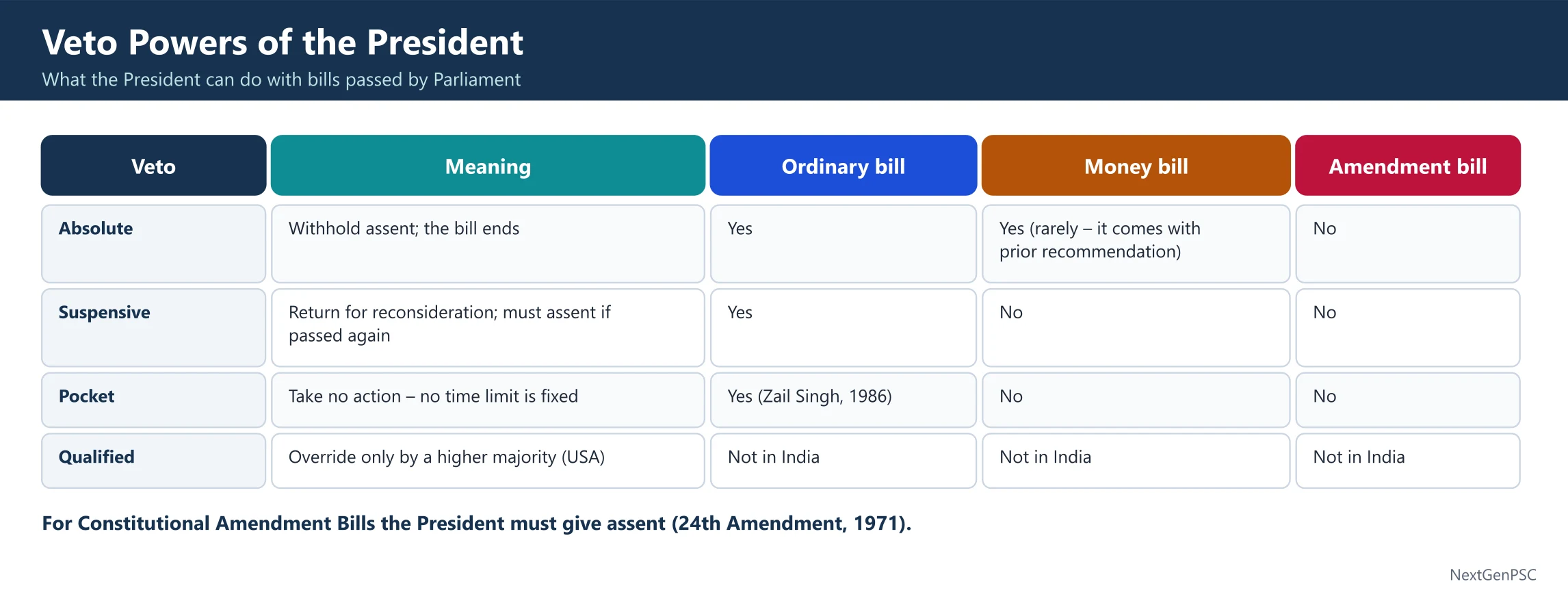
    Under Article 111, the President has veto powers over bills, which act as a safeguard against unconstitutional, hasty, or ill-considered legislations. The veto powers include Absolute Veto, Suspensive Veto, and Pocket Veto.

    Veto Powers of the President
    Detailed Notes (48 points)
    Tap a card to add note • Use the highlight Listen button to play the full section
    A. Veto Powers of the President (Article 111)
    The word ‘Veto’ means the power to withhold or refuse assent to a bill passed by the legislature. It allows the President to prevent a bill from becoming law.
    This power ensures a balance between the Executive and Legislature and prevents the passing of hasty or unconstitutional laws.
    Under Article 111 of the Indian Constitution, the President has three options when a bill is presented for assent.
    Options before the President (Article 111)
    1. Give assent to the bill — the bill becomes an Act (law).
    2. Withhold assent to the bill — the bill fails to become law (this is called Absolute Veto ).
    3. Return the bill for reconsideration (except in case of Money Bills or Constitutional Amendment Bills).
    If the bill is passed again by Parliament (with or without amendments), the President must give assent — this is called Suspensive Veto .
    4. For Constitutional Amendment Bills , the President has no veto power ; assent is mandatory as per the 24th Constitutional Amendment Act, 1971.
    Purpose of Veto Powers
    The veto powers serve two important purposes:
    1. To prevent unconstitutional legislations that may violate the spirit of the Constitution.
    2. To check hasty or ill-considered laws passed without adequate discussion.
    B. Types of Veto Powers of the President
    The Constitution does not explicitly classify veto powers, but they have been recognized in practice as three types:
    1. Absolute Veto
    Meaning: The President withholds assent to the bill, and the bill completely lapses — it does not become law.
    This veto is used very rarely and usually in the following cases:
    (a) When the bill is a Private Member’s Bill (introduced by an MP who is not a Minister).
    (b) When the Cabinet resigns and the new government advises the President not to give assent to a bill passed by the previous government.
    Examples:
    Dr. Rajendra Prasad (1954) withheld assent to the PEPSU Appropriation Bill .
    R. Venkataraman (1991) withheld assent to the Salary, Allowances and Pension of MPs (Amendment) Bill .
    Effect: The bill dies completely and can only be reintroduced afresh in Parliament.
    2. Suspensive Veto
    Meaning: The President returns the bill to Parliament for reconsideration.
    If Parliament passes the bill again (with or without changes), the President must give assent to it.
    This gives the President limited power to ensure that Parliament rethinks a bill.
    Exception: Money Bills (Article 110) cannot be returned for reconsideration.
    Effect: The President can delay but cannot permanently block the bill.
    3. Pocket Veto
    Meaning: The President takes no action on a bill and keeps it pending indefinitely.
    Since Article 111 does not prescribe any time limit for the President to act, he/she can use this as a silent veto.
    This power is rarely used but gives the President an effective tool to avoid confrontation.
    Example:
    President Giani Zail Singh (1986) used the Pocket Veto against the Indian Post Office (Amendment) Bill .
    Effect: The bill remains pending indefinitely — neither approved nor rejected.
    C. Types of Veto in Comparative Perspective
    1. Absolute Veto → Bill dies completely.
    2. Suspensive Veto → Bill delayed, but can still become law.
    3. Pocket Veto → Bill kept pending; no action taken.
    In the USA, the President has a ‘Pocket Veto’ valid only if Congress adjourns, but in India, there is no time limit — so the President can keep a bill pending indefinitely.
    D. Significance of Veto Powers
    1. It provides a constitutional check on the legislative branch.
    2. It ensures quality control over legislation.
    3. It allows the President to uphold constitutional principles during law-making.
    4. However, since India follows a parliamentary system , the President’s veto is limited and mostly formal.

    Types of Veto Powers of the President

    TypeDescriptionExamples
    Absolute VetoBill lapses if assent withheldPEPSU Appropriation Bill (1954), MPs Salary & Allowances Bill (1991)
    Suspensive VetoBill returned for reconsideration; assent must be given if re-passedApplicable to non-money bills
    Pocket VetoNo action; no time limit specified in ConstitutionIndian Post Office (Amendment) Bill (1986)

    Mains Key Points

    Veto powers act as a constitutional check on legislative authority.
    They ensure laws are not unconstitutional or poorly considered.
    Absolute Veto is rarely used but significant for accountability.
    Suspensive Veto highlights Parliament’s supremacy as re-passed bills must be assented.
    Pocket Veto demonstrates flexibility but must be exercised with restraint.

    Prelims Strategy Tips

    Article 111: President’s veto powers.
    No veto for Constitutional Amendment Bills (24th Amendment Act, 1971).
    Absolute Veto used mostly for Private Member Bills.
    Pocket Veto has no time limit (Art. 111).

    Other Powers of the President of India

    Key Point

    Beyond executive and legislative functions, the President holds veto powers over state legislation, acts as Commander-in-Chief, represents India diplomatically, exercises financial oversight, proclaims emergencies, and has judicial powers including pardoning under Article 72.

    Beyond executive and legislative functions, the President holds veto powers over state legislation, acts as Commander-in-Chief, represents India diplomatically, exercises financial oversight, proclaims emergencies, and has judicial powers including pardoning under Article 72.

    Detailed Notes (57 points)
    Tap a card to add note • Use the highlight Listen button to play the full section
    A. Presidential Veto over State Legislation
    The President also has a role in the law-making process of states. When certain bills passed by a state legislature are reserved by the Governor for the consideration of the President , the President may exercise veto powers similar to those in Article 111.
    Options before the President:
    1. Give assent to the bill – the bill becomes law for that state.
    2. Withhold assent – the bill fails to become law.
    3. Direct the Governor to return the bill (except a Money Bill) for reconsideration by the state legislature.
    Even if the bill is passed again by the state legislature, the President is not bound to give assent.
    Significance:
    This ensures that state laws do not violate the Constitution or national interests .
    The President thus acts as a safeguard to preserve the unity and integrity of India .
    B. Military Powers of the President
    1. The President is the Supreme Commander of the Indian Armed Forces (Army, Navy, and Air Force).
    2. Appoints the Chiefs of the Army, Navy, and Air Force .
    3. The President can declare war or make peace with any country, but only on the advice of the Council of Ministers.
    4. All defense-related decisions, agreements, or treaties are carried out in the name of the President.
    5. However, the actual military power lies with the Cabinet and Prime Minister , making the President’s role constitutional and ceremonial.
    C. Diplomatic Powers of the President
    1. All international treaties and agreements are negotiated and signed on behalf of India in the name of the President (usually by the government).
    2. The President appoints Indian Ambassadors and High Commissioners to foreign countries.
    3. The President receives foreign ambassadors and diplomatic representatives in India by accepting their credentials.
    4. The President represents India in all international forums and affairs.
    5. However, such treaties and agreements are valid only after being approved by Parliament.
    Example: Treaties like the Indo-US Nuclear Deal (2008) and Indo-Bangladesh Land Boundary Agreement (2015) were signed in the President’s name.
    D. Financial Powers of the President
    1. Money Bills can be introduced in Parliament only with the President’s prior recommendation.
    2. The President causes the Annual Financial Statement (Union Budget) to be laid before Parliament at the beginning of every financial year (Article 112).
    3. The President has control over the Contingency Fund of India and can authorize advances to meet unexpected expenses (Article 267).
    4. The President constitutes the Finance Commission every five years to recommend financial relations between the Centre and States (Article 280).
    5. No demand for a grant or withdrawal from the Consolidated Fund of India can be made without the President’s approval.
    6. The President also lays before Parliament the reports of the CAG, Finance Commission, and UPSC for transparency and accountability.
    E. Emergency Powers of the President
    The President has extraordinary powers to deal with emergencies to ensure the security, unity, and stability of India.
    1. National Emergency (Article 352)
    1. Proclaimed when there is a threat to the security of India or any part of it due to war, external aggression, or armed rebellion.
    2. The President can assume extensive powers and extend the term of Parliament.
    3. Fundamental Rights under Article 19 are suspended during National Emergency.
    2. President’s Rule (Article 356)
    1. Imposed when there is a failure of constitutional machinery in a state.
    2. The President takes over the functions of the State Government.
    3. The State Legislature may be dissolved or suspended.
    4. Example: President’s Rule has been imposed in states like Jammu & Kashmir (2018) and Maharashtra (2019).
    3. Financial Emergency (Article 360)
    1. Proclaimed when the financial stability or credit of India is threatened.
    2. The President can reduce salaries of government employees and direct States to follow financial discipline.
    3. This type of emergency has never been proclaimed in India so far.
    F. Judicial Powers of the President
    1. The President can seek an advisory opinion from the Supreme Court under Article 143 on questions of law or public importance. The opinion is not binding .
    2. The President exercises pardoning powers under Article 72 to show mercy or correct judicial errors.
    Types of Pardoning Powers:
    1. Pardon: Complete forgiveness of the offence and removal of both sentence and conviction.
    2. Commutation: Substitution of one punishment with a lighter one (e.g., death penalty → life imprisonment).
    3. Remission: Reduction in the duration or amount of punishment without changing its nature.
    4. Respite: Awarding a lesser sentence due to special circumstances (e.g., pregnancy, disability).
    5. Reprieve: Temporary suspension of punishment, especially death sentence, to allow time for appeal or mercy petition.
    Scope:
    1. The President’s pardoning power applies to cases involving Union Law, Military Courts, and Death Sentences.
    2. It is an important tool for justice and humanity in the Indian legal system.

    President’s Powers – Beyond Executive & Legislative

    CategoryKey Powers
    State VetoAssent, withhold, or return state bills; not bound after reconsideration.
    MilitaryCommander-in-Chief; declares war/peace on CoM advice.
    DiplomaticTreaties, appoint ambassadors, receive foreign diplomats.
    FinancialMoney Bill recommendation, Budget, Contingency Fund, Finance Commission.
    EmergencyNational (Art. 352), President’s Rule (Art. 356), Financial (Art. 360).
    JudicialSeek SC advice (Art. 143), Pardoning powers (Art. 72).

    Mains Key Points

    Presidential veto over state laws ensures central check on state legislation.
    Military and diplomatic powers make President the symbolic head of India’s sovereignty.
    Financial powers keep executive control over budget and fiscal discipline.
    Emergency powers allow extraordinary action but with safeguards.
    Judicial powers, esp. pardoning, highlight President’s role as a humanitarian authority.

    Prelims Strategy Tips

    State bills: President not bound even after reconsideration.
    Military: President = Supreme Commander, but acts on advice.
    Diplomatic: Treaties in name of President; ambassadors appointed.
    Financial: Prior recommendation needed for Money Bill.
    Emergencies: 352 (National), 356 (State failure), 360 (Financial).
    Judicial: Pardoning power under Art. 72.

    Pardoning Powers of the President (Article 72)

    Key Point

    Article 72 empowers the President to grant pardon, reprieve, respite, remission, or commutation of punishment. These powers apply to cases of offences against Union law, military court sentences, and death penalties, ensuring both justice and humanitarian relief.

    Article 72 empowers the President to grant pardon, reprieve, respite, remission, or commutation of punishment. These powers apply to cases of offences against Union law, military court sentences, and death penalties, ensuring both justice and humanitarian relief.

    Detailed Notes (44 points)
    Tap a card to add note • Use the highlight Listen button to play the full section
    A. Pardoning Powers of the President (Article 72)
    The President of India has been given the power to grant pardons, reprieves, respites, remissions, and commutations of punishment under Article 72 of the Constitution.
    This power is a part of the President’s judicial functions and is meant to ensure justice, humanity, and mercy in the Indian legal system.
    B. Scope of the Pardoning Power (Application)
    The President can exercise this power in the following three types of cases:
    1. For offences against Union law (laws made by Parliament).
    2. In cases decided by military courts or court-martial (Armed Forces).
    3. In cases involving death sentences — even if the case falls under a State law.
    Thus, the President’s power is wider than that of the Governor (who cannot pardon a death sentence).
    C. Reasons for Granting Pardoning Powers
    The framers of the Constitution included this power for several reasons:
    1. To correct judicial errors — as judges are human and may make mistakes.
    2. To reduce excessive or harsh punishments in special circumstances (e.g., old age, health, repentance).
    3. To show mercy as a matter of justice and humanity.
    4. To maintain public confidence in fairness and compassion in the justice system.
    This power does not belong to the President personally but is exercised on the advice of the Council of Ministers .
    D. Types of Pardoning Powers (Article 72)
    The Constitution recognizes five forms of pardon or clemency powers:
    1. Pardon
    It means complete forgiveness of the crime and removal of all sentences, punishments, and disqualifications.
    The offender is treated as if the crime never occurred.
    Example: If a person is sentenced to death, the President may grant a full pardon and release him completely.
    2. Commutation
    It means changing one form of punishment to a lighter one.
    The nature of punishment changes, but the conviction remains.
    Example: Death sentence → Life imprisonment, or rigorous imprisonment → simple imprisonment.
    3. Remission
    It means reducing the duration or amount of punishment without altering its nature.
    Example: A sentence of 10 years imprisonment reduced to 5 years.
    4. Respite
    It means awarding a lesser sentence in place of the original punishment due to special circumstances.
    Example: If a woman offender is pregnant , she may be given a lesser punishment than what is prescribed by law.
    5. Reprieve
    It means temporary suspension of the execution of a sentence (especially death sentence).
    It is granted to allow time for the convict to appeal or file a mercy petition .
    E. Judicial Review and Limitations
    1. The President must exercise this power on the aid and advice of the Council of Ministers (as per Article 74).
    2. The Supreme Court has held in cases like Kehar Singh v. Union of India (1989) and Epuru Sudhakar (2006) that this power is subject to judicial review if exercised arbitrarily, mala fide, or without evidence.
    3. However, courts cannot question the merits of the President’s decision.
    F. Significance of Pardoning Power
    1. Acts as a safety valve in the justice system.
    2. Brings compassion and humanity into law enforcement.
    3. Prevents miscarriage of justice by correcting judicial mistakes.
    4. Reflects the philosophy of mercy and reform over revenge.

    Types of Pardoning Powers

    TypeExplanationExample
    PardonComplete nullification of sentence, punishment and disqualificationE.g., Full pardon by President
    RespiteAward of lesser sentence than original punishmentPregnant woman offender
    ReprieveTemporary suspension of punishment executionStay on death penalty
    RemissionReduction in sentence length; punishment retains its character10 years RI reduced to 5 years RI
    CommutationSubstitution of one punishment with lighter formDeath penalty → Life imprisonment

    Mains Key Points

    Pardoning power reflects humanitarian values of the Constitution.
    Acts as a safety valve against judicial errors and excessive punishment.
    Vital in death penalty cases to ensure fairness and mercy.
    Balances judicial finality with executive clemency.
    Strengthens the image of the President as the guardian of justice.

    Prelims Strategy Tips

    Article 72: Pardoning power of the President.
    Applicable in Union law, military court cases, and death penalties.
    Types: Pardon, Respite, Reprieve, Remission, Commutation.
    Purpose: Correct judicial errors, provide humanitarian relief.

    Pardoning Powers: President vs Governor

    Key Point

    While both the President (Art. 72) and the Governor (Art. 161) have pardoning powers, their scope differs. The President can pardon court-martial sentences and death sentences, whereas the Governor’s power is limited and excludes these areas. Judicial pronouncements have clarified the nature and limits of this power.

    While both the President (Art. 72) and the Governor (Art. 161) have pardoning powers, their scope differs. The President can pardon court-martial sentences and death sentences, whereas the Governor’s power is limited and excludes these areas. Judicial pronouncements have clarified the nature and limits of this power.

    Detailed Notes (37 points)
    Tap a card to add note • Use the highlight Listen button to play the full section
    A. Supreme Court Judgements on Pardoning Power (Article 72)
    The Supreme Court of India has clarified the scope, limitations, and procedure of the President’s Pardoning Powers under Article 72 through several landmark judgements. These decisions ensure that the power is used constitutionally, fairly, and not arbitrarily.
    1. Maru Ram v. Union of India (1981)
    Key Facts:
    This case involved challenges to the constitutional validity of Section 433A of the Criminal Procedure Code, which restricted premature release of prisoners.
    Supreme Court’s Observations:
    1. The President and Governor cannot exercise pardoning powers independently.
    2. They are constitutionally bound to act on the aid and advice of the Council of Ministers (as per Article 74 for the President and Article 163 for the Governor).
    3. The power is not arbitrary or personal ; it must be guided by public interest and government policy.
    4. Thus, the pardoning power is a constitutional function and not an individual discretion.
    Significance:
    This judgement established that the President acts as a constitutional head in pardoning matters — ensuring the rule of law and accountability.
    2. Kehar Singh v. Union of India (1988)
    Key Facts:
    Kehar Singh was convicted and sentenced to death for involvement in the assassination of Prime Minister Indira Gandhi. His mercy petition was rejected by the President, leading to a legal challenge.
    Supreme Court’s Observations:
    1. The President’s power to grant pardon is an act of grace and mercy under Article 72.
    2. The convict cannot claim pardon as a matter of right — it is not a judicial remedy.
    3. However, the President must consider relevant materials while deciding on the mercy petition.
    4. The Court also held that the President can examine the merits of the case even after judicial proceedings are complete.
    Significance:
    The judgement highlighted that while the President’s decision is final and not open to appeal , it must be fair, informed, and based on due consideration.
    3. Shatrughan Chauhan v. Union of India (2014)
    Key Facts:
    This case dealt with the inordinate delay in deciding mercy petitions of death row convicts and whether such delay violated the fundamental right to life under Article 21.
    Supreme Court’s Observations:
    1. Unreasonable delay in deciding mercy petitions amounts to cruel, inhuman, and degrading treatment.
    2. Such delay violates the Right to Life and Personal Liberty guaranteed under Article 21.
    3. The Court ruled that death sentences can be commuted to life imprisonment in cases of inordinate delay.
    4. The Court also emphasized that the President’s power under Article 72 must be exercised expeditiously and with sensitivity.
    Significance:
    This case ensured that human dignity and constitutional compassion prevail even in cases involving the death penalty.
    B. Summary of Legal Principles
    1. The pardoning power is a constitutional duty , not a personal privilege (Maru Ram).
    2. It is an act of grace , not a legal right (Kehar Singh).
    3. Delay in mercy petitions can lead to violation of fundamental rights (Shatrughan Chauhan).
    4. The power must be exercised with reason, fairness, and humanity.

    Pardoning Powers: President vs Governor

    ParameterPresident (Article 72)Governor (Article 161)
    ScopeFor offences under Union law, military court, and death sentencesFor offences against State law only
    Court-martialCan pardon court-martial sentencesCannot pardon court-martial sentences
    Death SentenceCan pardon death sentenceCannot pardon; can only suspend, remit or commute
    ApplicabilityWider – covers Union, Military, Death penaltyNarrower – limited to State laws only

    Mains Key Points

    President’s pardoning power is broader, covering Union offences, military court sentences, and death penalties.
    Governor’s power is narrower, restricted to offences against state law.
    Judicial pronouncements have clarified that pardon is an executive act but bound by constitutional limits.
    Power balances justice with mercy, ensuring a humanitarian element in governance.

    Prelims Strategy Tips

    Art. 72: President – wider scope; Art. 161: Governor – limited scope.
    President can pardon death sentences and court-martial sentences; Governor cannot.
    Both act on aid and advice of Council of Ministers.
    Maru Ram (1981): not discretionary; Kehar Singh (1988): act of grace; Shatrughan Chauhan (2014): delay violates Art. 21.

    Constitutional Position of the President

    Key Point

    The President is the constitutional head of the Union, bound by the advice of the Council of Ministers under Articles 53 and 74. However, the President is not merely a rubber stamp but acts as the guardian of the Constitution with certain discretionary and crisis powers.

    The President is the constitutional head of the Union, bound by the advice of the Council of Ministers under Articles 53 and 74. However, the President is not merely a rubber stamp but acts as the guardian of the Constitution with certain discretionary and crisis powers.

    Detailed Notes (36 points)
    Tap a card to add note • Use the highlight Listen button to play the full section
    A. Constitutional Position of the President of India
    The President of India occupies a unique position as the nominal executive head of the Union. Although all executive powers are vested in the President, they are actually exercised by the Council of Ministers headed by the Prime Minister .
    B. Estimating the Constitutional Position
    1. Article 53: The executive power of the Union is vested in the President and is exercised either directly or through officers subordinate to him in accordance with the Constitution.
    2. Article 74: The President shall act in accordance with the advice of the Council of Ministers with the Prime Minister as its head.
    Thus, while the Constitution gives power to the President in name, the real authority lies with the elected government.
    C. Erosion and Restoration of the President’s Position
    1. 42nd Constitutional Amendment Act, 1976: Made the President bound to accept the advice of the Council of Ministers. This reduced the President’s discretionary space.
    2. 44th Constitutional Amendment Act, 1978: Restored limited flexibility by allowing the President to return the advice once for reconsideration. However, after reconsideration, the President must act according to the advice.
    This ensures both democratic control and constitutional balance between the President and the Cabinet.
    D. Significance of the President
    1. The President is not merely a symbolic figure but the constitutional guardian of the nation.
    2. The President can question and seek information from the Council of Ministers to ensure transparency and accountability.
    3. The oath under Article 60 requires the President to preserve, protect, and defend the Constitution and the law — hence, they cannot act mechanically.
    4. The President represents the unity and integrity of the nation above political considerations.
    E. Situational Discretion (When President Acts without CoM Advice)
    Although the President generally acts on ministerial advice, in certain special situations the President can act independently (discretionarily) :
    1. Appointment of Prime Minister when no party has a clear majority in Lok Sabha.
    2. Appointment of PM after the sudden death of a sitting PM when no obvious successor exists.
    3. Dismissal of the Council of Ministers when it loses majority in the Lok Sabha but refuses to resign.
    4. Dissolution of the Lok Sabha when the government loses confidence and no alternative government can be formed.
    These discretionary powers ensure continuity of government and stability of the system.
    F. Examples of Presidential Activism
    While the President is usually bound by the Council of Ministers’ advice, there have been instances of Presidential assertiveness in extraordinary circumstances:
    1. Dr. Rajendra Prasad (First President) often questioned the government’s interpretation of constitutional provisions.
    2. R. Venkataraman and K.R. Narayanan used their moral authority to ensure transparency and fairness in governance.
    3. President K.R. Narayanan (1997) famously returned the Cabinet’s advice to impose President’s Rule in Uttar Pradesh — exercising his right to reconsider advice.
    G. Interpretation of the President’s Role
    1. The President is a constitutional head , not a real executive.
    2. The real executive power lies with the Prime Minister and the Council of Ministers (Article 74).
    3. However, the President has an important watchdog role to ensure that the government functions according to the Constitution.
    H. Famous Description by R. Venkataraman
    Former President R. Venkataraman beautifully summarized the role of the President as:
    “The office of the President is like an emergency light. It comes on automatically when there is a crisis and goes off when the crisis passes.”
    I. Conclusion
    Hence, the President of India is not a mere rubber stamp , but a constitutional sentinel — a guardian of the Constitution and protector of democratic values.

    Constitutional Position of the President

    AspectDetails
    Article 53Executive power of the Union vested in President
    Article 74Bound by advice of Council of Ministers
    42nd Amendment (1976)Made Presidential advice binding
    44th Amendment (1978)President can return advice once for reconsideration
    Discretionary PowersAppointment/dismissal of PM, dissolving Lok Sabha in specific cases
    Symbolic RoleProtector of Constitution; emergency light metaphor by R. Venkataraman

    Mains Key Points

    Though bound by advice, the President ensures constitutional governance.
    Discretionary powers during political uncertainty highlight President’s role beyond a rubber stamp.
    The 42nd and 44th Amendments balanced executive supremacy with Presidential check.
    President symbolizes unity of nation and constitutional stability.
    Position described as an ‘emergency light’ – active only during crises.

    Prelims Strategy Tips

    Art. 53: Union executive power vested in President.
    Art. 74: President bound by advice of CoM.
    42nd Amendment made advice binding; 44th allowed reconsideration once.
    President has limited discretion in PM appointment, dismissal of CoM, Lok Sabha dissolution.

    Vice-President of India

    Key Point

    The Vice-President (Article 63) holds the second highest constitutional office in India, modeled after the US system. He is elected by MPs of both Houses of Parliament and serves as the ex-officio Chairman of the Rajya Sabha.

    The Vice-President (Article 63) holds the second highest constitutional office in India, modeled after the US system. He is elected by MPs of both Houses of Parliament and serves as the ex-officio Chairman of the Rajya Sabha.

    Detailed Notes (42 points)
    Tap a card to add note • Use the highlight Listen button to play the full section
    A. Constitutional Status of the Vice-President of India
    1. Article 63: States that there shall be a Vice-President of India.
    2. The Vice-President is the second-highest constitutional office in India, next only to the President.
    3. The post of Vice-President in India is modeled on the Vice-President of the United States.
    4. The Vice-President serves as a vital link between the executive and legislative branches of the government.
    5. He is the ex-officio Chairman of the Rajya Sabha (Upper House of Parliament).
    B. Qualifications (Article 66 & 84)
    To be eligible for election as Vice-President, a person must:
    1. Be a citizen of India.
    2. Have completed the age of 35 years.
    3. Be qualified to be elected as a member of the Rajya Sabha (Council of States).
    4. Not hold any office of profit under the Government of India, State, or any local authority.
    However, offices like the President, Vice-President, Governor, or Minister are not considered offices of profit.
    C. Conditions of Office
    1. The Vice-President cannot be a member of Parliament or a State Legislature.
    If a sitting MP or MLA is elected as Vice-President, their seat automatically becomes vacant on assuming office.
    2. The salary and allowances of the Vice-President are determined by the Salaries and Allowances of Parliament Officers Act, 1953.
    3. As Chairman of the Rajya Sabha , the Vice-President receives the same salary and allowances as the Speaker of the Lok Sabha.
    4. He continues in office for a term of five years but can resign earlier by addressing the resignation to the President of India.
    D. Nomination Process
    1. Every candidate must file a nomination paper with the Election Commission of India.
    2. The nomination must be subscribed by at least 20 proposers and 20 seconders , all of whom must be Members of Parliament.
    3. The nomination paper is scrutinized by the Returning Officer appointed by the Election Commission.
    4. A security deposit of ₹15,000 must be made along with the nomination paper (as per Presidential and Vice-Presidential Elections Act, 1952).
    E. Election of the Vice-President (Article 66)
    1. The election is conducted by the Election Commission of India (ECI).
    2. The Electoral College for the Vice-President’s election consists of members of both Houses of Parliament — elected and nominated.
    3. The method of election is through Proportional Representation by means of the Single Transferable Vote (STV).
    4. The voting is done by secret ballot to ensure free and fair choice.
    5. The candidate who secures more than 50% of the total valid votes (quota) is declared elected.
    F. Comparison with Presidential Electoral College
    1. Nominated Members: Included in Vice-President’s election ✅ but excluded in President’s election ❌.
    2. State Legislatures: Excluded from Vice-President’s election ❌ but included in President’s election ✅.
    3. Hence, the Vice-President is elected by a smaller and purely Parliamentary electorate.
    G. Term and Reappointment
    1. The term of office is 5 years, but the Vice-President continues until his successor assumes office.
    2. He can be re-elected any number of times.
    3. The office can become vacant due to expiry of term, resignation, removal, or death.
    H. Importance of the Office
    1. Ensures continuity in governance as the Vice-President acts as President in case of vacancy in the Presidential office.
    2. Maintains discipline and neutrality in the functioning of the Rajya Sabha as its presiding officer.
    3. Serves as an important symbol of federal unity and Parliamentary democracy.

    Comparison: Electoral College of President vs Vice-President

    AspectPresidentVice-President
    ArticleArt. 54, 55Art. 66
    Conducted byElection Commission of IndiaElection Commission of India
    MethodProportional Representation, STVProportional Representation, STV
    Electoral CollegeElected MPs + Elected MLAs (states/UTs)Members of both Houses of Parliament (elected + nominated)
    Nominated MembersExcludedIncluded
    State LegislaturesIncludedExcluded

    Mains Key Points

    Vice-President is the second highest constitutional office of India, modeled after the US.
    Acts as ex-officio Chairman of the Rajya Sabha.
    Electoral college for VP includes nominated MPs, unlike President’s election.
    VP ensures continuity of parliamentary functioning and balance in Union executive.
    Reappointment allowed any number of times.

    Prelims Strategy Tips

    Art. 63: Vice-President of India.
    Art. 66: Election by MPs of both Houses (including nominated).
    Qualification: eligible for Rajya Sabha, 35 years, citizen of India.
    Difference with President: VP includes nominated MPs, excludes MLAs.

    Vice-President: Oath, Term, Vacancy, Removal & Functions

    Key Point

    The Vice-President takes oath before the President, holds office for 5 years, and can be removed by an effective majority of the Rajya Sabha with Lok Sabha’s agreement. As ex-officio Chairman of the Rajya Sabha, the Vice-President plays a vital role in maintaining parliamentary decorum and ensuring smooth legislative functioning.

    The Vice-President takes oath before the President, holds office for 5 years, and can be removed by an effective majority of the Rajya Sabha with Lok Sabha’s agreement. As ex-officio Chairman of the Rajya Sabha, the Vice-President plays a vital role in maintaining parliamentary decorum and ensuring smooth legislative functioning.

    Detailed Notes (51 points)
    Tap a card to add note • Use the highlight Listen button to play the full section
    A. Oath or Affirmation (Article 69)
    1. The Vice-President of India takes an oath or affirmation before entering office.
    2. The oath is administered by the President of India.
    3. If the President is unavailable, it is administered by a person appointed by the President.
    4. The oath includes two main pledges:
    To bear true faith and allegiance to the Constitution of India.
    To faithfully discharge the duties of the office of Vice-President.
    This symbolizes the Vice-President’s commitment to uphold constitutional values and neutrality.
    B. Term of Office
    1. The Vice-President holds office for a term of five years from the date he enters office.
    2. However, he continues in office even after expiry of the term until his successor assumes charge.
    3. The Vice-President may also resign earlier by writing to the President of India.
    4. There is no limit on the number of terms — he may be re-elected multiple times.
    C. Vacancy in the Office of the Vice-President
    A vacancy in the office of the Vice-President may occur due to:
    1. Expiry of the 5-year term.
    2. Resignation (addressed to the President).
    3. Removal from office by Parliament.
    4. Death.
    In case of vacancy:
    If the vacancy is due to expiry of term → Election is held before the term ends to ensure continuity.
    If it occurs due to death, resignation, or removal → Election must be held as soon as possible.
    The Constitution does not specify who performs duties in the meantime, but by convention, Rajya Sabha’s Deputy Chairman may preside over the House until a new Vice-President is elected.
    D. Removal of the Vice-President (Article 67(b))
    1. The Vice-President can be removed from office by a resolution of the Rajya Sabha.
    2. The resolution must be passed by a majority of all the then members of the Rajya Sabha (known as effective majority ).
    3. This resolution must be agreed to by the Lok Sabha.
    4. A 14-day notice must be given before moving the resolution.
    5. Unlike the President, there is no impeachment procedure for the Vice-President — the process is simpler and purely parliamentary.
    E. Functions and Role of the Vice-President
    The Vice-President has two main sets of functions:
    1. As the Ex-Officio Chairman of the Rajya Sabha (Article 64)
    2. As Acting President of India (when the office of President is vacant or President is temporarily unable to discharge functions).
    F. Role as Chairman of the Rajya Sabha
    1. The Vice-President is the presiding officer of the Rajya Sabha and maintains order and discipline during proceedings.
    2. He ensures that debates are conducted smoothly and in accordance with parliamentary rules.
    3. He interprets the Constitution and rules of procedure in case of disputes within the House — his decision is final inside the House.
    4. He decides on questions of disqualification of members under the Anti-Defection Law (Tenth Schedule).
    5. He ensures decorum and dignity of the House and has the authority to take disciplinary action against unruly members.
    6. The Vice-President acts as the guardian of Parliamentary privileges and protects the rights of members.
    G. Role in Parliamentary Committees and Institutions
    1. As Chairman of the Rajya Sabha, the Vice-President also plays a key role in the committee system:
    Nominates members to various Parliamentary Committees.
    Appoints Chairpersons of committees such as the Select and Joint Committees.
    Nominates members to constitutional and educational bodies like the Institute of Constitutional and Parliamentary Studies (ICPS).
    2. The Vice-President is part of the three-member committee that nominates the Chairman of the Press Council of India.
    3. He also represents India in several Parliamentary forums and conferences.
    H. Importance of the Office
    1. The Vice-President ensures the continuity of governance and stability of Parliament.
    2. Acts as the symbol of unity and impartiality in the Rajya Sabha.
    3. Serves as a constitutional backup to the President and a protector of Parliamentary dignity.

    Vice-President: Term, Vacancy, Removal & Functions

    AspectDetails
    OathAdministered by President (or his appointee in absence)
    Term5 years
    VacancyCaused by expiry, resignation, removal, or death
    RemovalResolution by effective majority of RS, agreed by LS; 14-day notice; no impeachment
    Chairman of RSPresides, interprets Constitution, decides disqualifications, maintains decorum
    Parliamentary RoleNominates members to committees, appoints chairmen, nominates to bodies (e.g., Press Council committee)

    Mains Key Points

    Vice-President ensures smooth functioning of Rajya Sabha as its ex-officio Chairman.
    Holds a unique position with dual role – part of legislature (Chairman of RS) and succession to President in case of vacancy.
    Removal procedure is simpler than impeachment of the President.
    Acts as a guardian of parliamentary privileges and decorum.
    Plays a vital role in nominating members to committees and statutory bodies.

    Prelims Strategy Tips

    Oath administered by President; not by CJI (unlike President’s oath).
    Term: 5 years; no limit on reappointment.
    Removal by effective majority of Rajya Sabha, agreed by Lok Sabha.
    VP is ex-officio Chairman of Rajya Sabha.
    No impeachment process for VP.

    Vice-President as Acting President & Comparison with US Vice-President

    Key Point

    Under Article 65, the Vice-President acts as the President in case of vacancy or inability of the President, exercising all powers and privileges. Unlike the US Vice-President, the Indian VP is not an automatic successor but only acts until a new President is elected.

    Under Article 65, the Vice-President acts as the President in case of vacancy or inability of the President, exercising all powers and privileges. Unlike the US Vice-President, the Indian VP is not an automatic successor but only acts until a new President is elected.

    Detailed Notes (56 points)
    Tap a card to add note • Use the highlight Listen button to play the full section
    A. Vice-President as Acting President (Article 65)
    1. Under Article 65 of the Constitution, the Vice-President acts as the Acting President of India in certain situations.
    2. The Vice-President temporarily performs the duties of the President in the following circumstances:
    When there is a vacancy in the office of the President due to death, resignation, or removal.
    When the President is unable to discharge his functions owing to absence from India, illness, or any other reason.
    3. During this period, the Vice-President exercises all the powers, functions, privileges, and immunities of the President.
    4. However, the Vice-President does not continue as the Chairman of the Rajya Sabha during this time — these duties are performed by the Deputy Chairman of the Rajya Sabha.
    5. As soon as the new President is elected, or the President resumes duties, the Vice-President ceases to act as Acting President.
    B. Historical Context
    1. Several Vice-Presidents in India have acted as the Acting President in the past.
    Example: Dr. S. Radhakrishnan acted as President when Dr. Rajendra Prasad was ill (1959).
    B. D. Jatti acted as President in 1977 after the death of Dr. Fakhruddin Ali Ahmed until the election of Neelam Sanjiva Reddy.
    2. These instances show that the Vice-President ensures continuity and stability in the highest constitutional office.
    C. Powers and Functions as Acting President
    While acting as President, the Vice-President has the authority to:
    1. Appoint the Prime Minister and Council of Ministers.
    2. Summon, prorogue, or dissolve the Lok Sabha.
    3. Give assent to bills passed by Parliament.
    4. Issue ordinances when Parliament is not in session.
    5. Represent India in international matters and agreements.
    6. Exercise judicial powers under Article 72, including the power to grant pardons.
    All these powers are temporary and subject to the same constitutional limits as the President.
    D. Tenure and Limitations as Acting President
    1. The Vice-President holds the office of Acting President until a new President is elected or the existing President resumes duties.
    2. The Vice-President cannot hold the post of President and Vice-President simultaneously — his functions as Rajya Sabha Chairman remain suspended.
    3. The period of Acting Presidency is considered a part of the Vice-President’s tenure; he continues to draw the President’s salary and privileges during this time.
    E. Comparison: Indian and American Vice-President
    The institution of the Vice-President in India has been inspired by that of the United States, but there are significant differences.
    Indian Vice-President
    Primary Role: Chairman of Rajya Sabha (Upper House of Parliament)
    Constitutional Articles: Articles 63–71
    Term: 5 years
    Re-appointment: Eligible for re-election any number of times
    Vacancy: Election must be held as soon as possible
    Successor to President: Acts temporarily as President until new one is elected
    Role in Governance: Primarily legislative, limited executive role
    Member of National Security Council: No
    Example: B. D. Jatti (1977)
    American Vice-President
    Primary Role: President of the U.S. Senate
    Constitutional Articles: Article II, U.S. Constitution
    Term: 4 years
    Re-appointment: Can be re-elected multiple times
    Vacancy: No fresh election during term (25th Amendment applies)
    Successor to President: Automatically becomes President and serves remaining term
    Role in Governance: Both legislative and executive
    Member of National Security Council: Yes
    Example: Lyndon B. Johnson (became President after John F. Kennedy’s assassination, 1963)
    F. Summary – Key Differences
    Feature: Indian Vice-President — U.S. Vice-President
    Primary Role: Chairman of Rajya Sabha — President of Senate
    Term: 5 years — 4 years
    Acts as President: Temporarily — Permanently
    Becomes President Automatically: No — Yes
    Member of National Security Council: No — Yes
    Election Held if Vacancy: Yes — No

    Comparison: Indian vs American Vice-President

    ParameterIndian Vice-PresidentAmerican Vice-President
    Primary RoleChairman of Rajya SabhaPresident of US Senate
    Term5 years4 years
    Re-appointmentUnlimitedUnlimited
    Vacancy during TermElections held as soon as possibleNo election for intra-term vacancy
    Successor to PresidentNot automatic; only acts until new President electedAutomatic successor; serves remaining term
    National Security Council MemberNoYes

    Mains Key Points

    Vice-President ensures continuity of Union executive by acting as President during vacancy.
    Key difference: Indian VP is only Acting President; American VP automatically succeeds.
    Comparison highlights parliamentary vs presidential systems of government.
    VP’s dual role (legislature + acting head of state) reflects India’s unique constitutional design.

    Prelims Strategy Tips

    Art. 65: VP acts as President in case of vacancy or inability.
    During this period, Deputy Chairman performs RS Chairman duties.
    Indian VP not automatic successor; US VP automatically becomes President.
    Indian VP: 5-year term; US VP: 4-year term.

    Prime Minister of India

    Key Point

    The Prime Minister (Article 75) is the head of the government and leader of the Council of Ministers. Appointed by the President, the PM holds office as long as they enjoy majority support in the Lok Sabha, exercising key powers in relation to the Council of Ministers.

    The Prime Minister (Article 75) is the head of the government and leader of the Council of Ministers. Appointed by the President, the PM holds office as long as they enjoy majority support in the Lok Sabha, exercising key powers in relation to the Council of Ministers.

    Detailed Notes (42 points)
    Tap a card to add note • Use the highlight Listen button to play the full section
    A. Constitutional Status of the Prime Minister
    1. The Prime Minister (PM) is the head of the Government and the real executive authority in India.
    2. The office of the PM is created under Article 75(1) of the Constitution — ‘The Prime Minister shall be appointed by the President.’
    3. Although the Constitution mentions the appointment, it does not specify the procedure — this follows convention and parliamentary practice.
    4. The Prime Minister is the leader of the Council of Ministers (CoM) and acts as the link between the President and the Council.
    5. The PM is also called the Keystone of the Cabinet arch , as the government functions effectively only under his leadership.
    B. Appointment of the Prime Minister
    1. After a general election to the Lok Sabha, the President invites the leader of the majority party (or coalition) to form the government.
    2. If no party has a clear majority, the President may appoint the leader of the largest party or alliance and ask them to prove their majority in the Lok Sabha.
    3. The PM need not be an MP at the time of appointment but must become a member of Parliament within 6 months.
    Example: H. D. Deve Gowda was not an MP when appointed Prime Minister in 1996.
    4. The PM can be a member of either House of Parliament — Lok Sabha or Rajya Sabha.
    Example: Dr. Manmohan Singh served as PM while being a Rajya Sabha member.
    5. If the PM fails to get elected to either House within 6 months, he ceases to hold office automatically.
    C. Oath or Affirmation (Article 75(4))
    1. The Prime Minister takes an oath of office and secrecy before the President of India.
    In the oath, the PM swears:
    To bear true faith and allegiance to the Constitution of India.
    To faithfully and conscientiously discharge the duties of his office.
    To uphold the sovereignty and integrity of India.
    D. Term of the Prime Minister
    1. The Constitution does not specify any fixed tenure for the Prime Minister.
    2. The PM holds office ‘during the pleasure of the President’ (Article 75(2)).
    3. However, in practice, this means the PM remains in office as long as he enjoys the confidence of the Lok Sabha.
    4. When the PM loses majority support, he must resign or the President can dismiss him.
    E. Vacancy in the Office of the Prime Minister
    The office of the PM may fall vacant in the following situations:
    1. On completion of the Lok Sabha’s 5-year term.
    2. Resignation submitted to the President.
    3. Death of the incumbent PM.
    4. Loss of confidence in the Lok Sabha — if a no-confidence motion is passed.
    5. Disqualification or if his election is declared void by the Supreme Court.
    In such a case, the PM can continue for 6 months but must be re-elected to Parliament within that period.
    F. Powers and Duties of the Prime Minister (in relation to the Council of Ministers)
    1. Appointment: Recommends to the President the names of ministers for appointment.
    2. Portfolio Allocation: Distributes work among ministers and allocates portfolios (like Defence, Finance, etc.).
    3. Coordination: Acts as the head of the Council of Ministers and ensures coordination among departments.
    4. Leadership: The PM leads the meetings of the Cabinet and decides important policy issues.
    5. Resignation Impact: If the PM resigns or dies, the entire Council of Ministers automatically dissolves — the government falls.
    6. Removal of Ministers: Can ask a minister to resign or advise the President to remove them.
    7. Advisor Role: The President acts according to the advice of the Council of Ministers headed by the PM.
    Thus, the PM is the central figure in the parliamentary executive system.

    Prime Minister: Key Aspects

    AspectDetails
    Constitutional ArticleArticle 75(1)
    AppointmentBy President; generally leader of majority party/coalition in Lok Sabha
    House MembershipCan belong to either House; must be MP within 6 months
    OathAdministered by President
    TermNo fixed term; co-terminus with Lok Sabha confidence
    VacancyCompletion of term, death, resignation, loss of confidence, void election
    Relation with CoMAppoints, allocates portfolios, removes ministers, leader of CoM

    Mains Key Points

    PM is the real executive authority; head of government and leader of CoM.
    Appointment process highlights President’s role but limited discretion.
    Term linked to majority support in Lok Sabha ensures democratic accountability.
    Vacancy provisions prevent leadership vacuum.
    Powers in relation to CoM show PM’s centrality in cabinet government.

    Prelims Strategy Tips

    Art. 75(1): PM appointed by President.
    PM need not be MP at appointment but must become within 6 months.
    Can be from either House of Parliament (e.g., Manmohan Singh from RS).
    No fixed term; holds office till Lok Sabha confidence exists.
    PM resignation → dissolution of entire CoM.

    Prime Minister: Powers and Functions (Part II)

    Key Point

    The Prime Minister is the principal link between the President and the Council of Ministers, guides Parliament’s functioning, and acts as the chief executive leader of the nation. Dr. Ambedkar observed that in the Indian system, the PM parallels the US President in real authority.

    The Prime Minister is the principal link between the President and the Council of Ministers, guides Parliament’s functioning, and acts as the chief executive leader of the nation. Dr. Ambedkar observed that in the Indian system, the PM parallels the US President in real authority.

    Detailed Notes (40 points)
    Tap a card to add note • Use the highlight Listen button to play the full section
    A. In Relation to the President (Article 78)
    1. The Prime Minister acts as the principal channel of communication between the President and the Council of Ministers.
    2. Under Article 78 of the Constitution, the Prime Minister has a constitutional duty to:
    Communicate to the President all decisions of the Council of Ministers related to the administration of Union affairs and legislative proposals.
    Furnish such information relating to the administration of the Union as the President may call for.
    Submit for the consideration of the Council any matter on which a minister has taken a decision but has not been considered by the Council.
    3. The PM advises the President on key matters of policy, administration, and appointments.
    4. Important appointments made by the President are done on the recommendation of the Prime Minister , such as:
    Attorney General of India
    Comptroller and Auditor General (CAG)
    Chairman and members of the Finance Commission
    Election Commissioners and ambassadors
    5. In short, the President acts on the aid and advice of the Council of Ministers headed by the PM, making the PM the real executive head of the Union.
    B. In Relation to the Parliament
    1. The Prime Minister plays a central role in the functioning of the Parliamentary system.
    2. The PM recommends to the President:
    The dates for summoning and proroguing Parliament sessions.
    The dissolution of the Lok Sabha at any time before the completion of its term.
    3. The PM is the leader of the Lok Sabha (if he is a member) and the chief spokesperson of the government.
    4. He makes policy announcements and answers questions raised by the Opposition.
    5. The PM is responsible for ensuring smooth coordination between the executive and the legislature.
    6. All important government statements, decisions, and policies are announced by the PM on the floor of the House.
    C. Other Powers and Functions of the Prime Minister
    1. The PM is the Chairperson of NITI Aayog (replacing the former Planning Commission).
    2. Chairs important bodies like:
    National Integration Council
    National Development Council
    Inter-State Council
    3. Acts as the chief spokesperson of the Union Government both in India and abroad.
    4. Represents the country at international conferences and summits (e.g., G20, UN, BRICS).
    5. Plays a decisive leadership role during national crises — for instance:
    Managing the COVID-19 pandemic response .
    Coordinating national security and disaster management.
    6. Serves as the leader of the ruling party in Parliament and the political head of the nation.
    D. Constitutional Significance of the Prime Minister
    1. The Prime Minister is the real executive head of India — the President being the nominal or constitutional head.
    2. The functioning of the Indian parliamentary democracy depends largely on the leadership and direction of the PM.
    3. Dr. B. R. Ambedkar rightly remarked:
    'If any functionary under our Constitution is to be compared with the U.S. President, it is the Prime Minister and not the President of the Union.'
    4. Thus, the Prime Minister is the pivot of the entire constitutional machinery and the chief architect of national policy and governance.

    Prime Minister’s Functions: Key Relations

    RelationFunctions
    With President (Art. 78)Channel of communication; recommends appointments; policy advice
    With ParliamentSummoning/proroguing sessions; advises dissolution of Lok Sabha; announces policies
    Other RolesChairs NITI Aayog; chief spokesperson; crisis manager; ruling party leader

    Mains Key Points

    PM ensures coordination between President, CoM, and Parliament.
    Advises President on key appointments and constitutional matters.
    Controls legislative agenda by recommending sessions and dissolutions.
    Plays national leadership role in crises, policy-making, and governance.
    Embodies the real executive authority, unlike the largely nominal President.

    Prelims Strategy Tips

    Art. 78: PM is channel of communication between President and CoM.
    PM recommends constitutional appointments (AG, CAG).
    PM advises summoning/proroguing sessions and dissolution of Lok Sabha.
    PM chairs NITI Aayog, is crisis leader and government spokesperson.
    Ambedkar: PM parallels US President in real executive power.

    Difference between Indian and British Prime Ministers

    Key Point

    Though both follow parliamentary systems, the Indian Prime Minister can be from either House and need not be an MP at appointment (must become within 6 months), while the British Prime Minister must be an MP from the House of Commons at the time of appointment.

    Though both follow parliamentary systems, the Indian Prime Minister can be from either House and need not be an MP at appointment (must become within 6 months), while the British Prime Minister must be an MP from the House of Commons at the time of appointment.

    Indian vs British Prime Ministers

    CriteriaBritish Prime MinisterIndian Prime Minister
    Membership of Lower HouseMust be a member of the House of Commons (lower house)Can be a member of either House (Lok Sabha or Rajya Sabha)
    Requirement of Parliament MembershipMust already be an MP to be appointed PMNeed not be an MP at appointment; must become one within 6 months

    Mains Key Points

    Shows difference between UK and Indian parliamentary conventions.
    UK PM is strictly tied to lower house (Commons), ensuring direct accountability to people.
    Indian PM can be from either House, giving flexibility in leadership selection.
    Indian model accommodates coalition and federal diversity better.

    Prelims Strategy Tips

    British PM: must be MP of House of Commons.
    Indian PM: can be from either House; can be non-MP initially (must become MP in 6 months).
    Example: Manmohan Singh (Rajya Sabha) was PM in India.

    Council of Ministers (Union Executive)

    Key Point

    The Council of Ministers, headed by the Prime Minister, is the real executive authority under Articles 74 and 75. Ministers may belong to either House, but non-MPs must become MPs within 6 months. The 91st Amendment Act, 2003 restricts the size of the Council to 15% of Lok Sabha strength.

    The Council of Ministers, headed by the Prime Minister, is the real executive authority under Articles 74 and 75. Ministers may belong to either House, but non-MPs must become MPs within 6 months. The 91st Amendment Act, 2003 restricts the size of the Council to 15% of Lok Sabha strength.

    Detailed Notes (46 points)
    Tap a card to add note • Use the highlight Listen button to play the full section
    A. Constitutional Basis of the Council of Ministers
    1. The Council of Ministers (CoM) is the real executive authority in India and functions under the leadership of the Prime Minister.
    The CoM is mentioned in two key Articles of the Constitution:
    Article 74: 'There shall be a Council of Ministers with the Prime Minister at the head to aid and advise the President.'
    Article 75: Deals with the appointment, tenure, and responsibilities of ministers.
    According to Article 75:
    The President appoints ministers on the advice of the Prime Minister.
    Ministers hold office during the pleasure of the President (which in practice means as long as the PM desires).
    Ministers may belong to either House of Parliament.
    A person who is not a member of Parliament can be appointed a minister, but must become an MP within 6 months or resign.
    Each minister takes an oath of office and secrecy before the President of India.
    4. The CoM is collectively responsible to the Lok Sabha under Article 75(3).
    B. Size of the Council of Ministers
    1. The size of the CoM is limited by the 91st Constitutional Amendment Act, 2003.
    2. It provides that the total number of ministers, including the Prime Minister, shall not exceed 15% of the total strength of the Lok Sabha.
    3. Example: In a Lok Sabha with 543 members, the maximum number of ministers = 81.
    4. This amendment aimed to prevent the creation of excessively large ministries and reduce political corruption through unnecessary appointments.
    C. Categories of Ministers
    In India, the Council of Ministers is organized into three main categories based on rank and responsibility:
    1. Cabinet Ministers
    1. They are in charge of important ministries such as Home, Defence, Finance, and External Affairs.
    2. They form the core decision-making body of the government called the Cabinet.
    3. They attend Cabinet meetings and play a major role in formulating national policies.
    4. The decisions of the Cabinet are binding on all ministers.
    2. Ministers of State
    There are two types of Ministers of State:
    With Independent Charge:
    They head small or less important ministries independently.
    They are directly responsible to the Prime Minister.
    Example: Minister of State (Independent Charge) for Youth Affairs and Sports.
    With Attached Charge:
    They assist Cabinet Ministers in their work.
    They may represent their ministry in Parliament in the absence of the Cabinet Minister.
    3. Deputy Ministers
    1. They do not hold any independent charge of a ministry.
    2. They function as aides or assistants to Cabinet Ministers or Ministers of State.
    3. Their work is mainly administrative or supportive in nature.
    D. Cabinet vs. Council of Ministers – Key Difference
    1. The Cabinet is the inner core of the Council of Ministers and includes only the most senior ministers.
    2. The Council of Ministers includes all ministers — Cabinet, Ministers of State, and Deputy Ministers.
    3. Thus, every Cabinet Minister is a member of the Council of Ministers, but not every Council member is a part of the Cabinet.
    E. Oath and Responsibilities
    1. Each minister takes two oaths before the President:
    Oath of Office: To faithfully discharge duties and uphold the Constitution.
    Oath of Secrecy: To not reveal matters related to the government.
    2. These oaths are administered under the Third Schedule of the Constitution.

    Categories of Ministers in India

    CategoryRole/Functions
    Cabinet MinistersHead important ministries; core decision-making body
    Ministers of State (Independent Charge)Head specific departments independently
    Ministers of State (Attached)Assist Cabinet Ministers in departments
    Deputy MinistersAssist Cabinet and State Ministers; no independent charge

    Mains Key Points

    Council of Ministers is the real executive authority under Indian parliamentary democracy.
    Headed by PM, it collectively aids and advises the President.
    91st Amendment ensured smaller, more efficient CoM by limiting size.
    Categorization ensures division of responsibilities among Cabinet, State, and Deputy Ministers.
    Collective responsibility ensures unity and accountability of CoM to Lok Sabha.

    Prelims Strategy Tips

    Art. 74: CoM headed by PM aids & advises President.
    Art. 75: Ministers appointed by President on PM’s advice; pleasure of President.
    91st Amendment: Max size of CoM = 15% of Lok Sabha strength.
    Non-MP can be minister, but must become MP in 6 months.
    Oath of office and secrecy by President.

    Ministerial Responsibility and Cabinet System

    Key Point

    In India’s parliamentary democracy, ministers are collectively responsible to the Lok Sabha and individually responsible to the President. The Cabinet, a smaller inner body of the Council of Ministers, is the key decision-making authority for policies, finances, and crisis management.

    In India’s parliamentary democracy, ministers are collectively responsible to the Lok Sabha and individually responsible to the President. The Cabinet, a smaller inner body of the Council of Ministers, is the key decision-making authority for policies, finances, and crisis management.

    Detailed Notes (42 points)
    Tap a card to add note • Use the highlight Listen button to play the full section
    A. Ministerial Responsibility – Concept
    1. The principle of ministerial responsibility is the foundation of the parliamentary system of government.
    2. It ensures that the executive remains accountable to the legislature, particularly the Lok Sabha.
    3. There are two forms of ministerial responsibility – Collective Responsibility and Individual Responsibility.
    B. Collective Responsibility (Article 75(3))
    1. The Council of Ministers is collectively responsible to the Lok Sabha.
    2. This means that the government stays in office only so long as it enjoys the confidence of the Lok Sabha.
    3. If the Lok Sabha passes a No-Confidence Motion , the entire Council of Ministers, including the Prime Minister, must resign.
    4. This ensures political accountability and unity within the executive.
    Important examples:
    1989: National Front coalition government of V. P. Singh lost confidence vote.
    1997: United Front government of H. D. Deve Gowda fell after losing support.
    1999: NDA government led by Atal Bihari Vajpayee lost by 1 vote in Lok Sabha.
    6. Ministers must stand or fall together — they cannot publicly oppose government policy once a decision is made.
    C. Individual Responsibility
    1. Every minister is individually responsible to the President for the work of his or her department.
    2. The Prime Minister can recommend to the President the removal of any minister for inefficiency or disagreement.
    Examples:
    Ram Jethmalani resigned as Law Minister in 1999 after differences with PM Atal Bihari Vajpayee.
    Dr. B. R. Ambedkar resigned in 1953 due to disagreement with the government on the Hindu Code Bill.
    4. Ministers who disagree with the government policy are expected to resign rather than oppose publicly.
    D. No Legal Responsibility
    1. In the British parliamentary system, executive orders require ministerial countersignature.
    2. However, in India, there is no provision that requires every order of the President to be countersigned by a minister.
    3. Thus, there is no legal responsibility of ministers in this sense — their responsibility is political and constitutional.
    E. Cabinet System of Government
    1. The Cabinet system is the central decision-making mechanism of the Council of Ministers.
    2. The Council of Ministers is a large body (about 70–80 ministers), which makes decision-making cumbersome.
    3. Hence, a smaller body known as the Cabinet (comprising senior ministers) handles key policy and administrative decisions.
    4. The Cabinet meets regularly to decide on matters of national importance such as defence, economy, and foreign affairs.
    Example – Modi 3.0 (June 2024) Council of Ministers composition:
    30 Cabinet Ministers.
    5 Ministers of State with Independent Charge.
    36 Ministers of State.
    6. This structure ensures efficiency and coordination within the government.
    F. Main Functions of the Cabinet
    1. Policy Formulation: The Cabinet formulates national and international policies of the government.
    2. Legislative Role: Approves legislative proposals before their introduction in Parliament.
    3. Financial Role: Approves the Union Budget and expenditure proposals before they are presented.
    4. Crisis Management: Takes crucial decisions during war, natural disasters, or emergencies.
    5. Advisory Role: Advises the Prime Minister on all significant matters of governance.
    6. The Cabinet, therefore, acts as the nerve centre of the Indian Government.

    Ministerial Responsibility

    TypeDetailsExample
    Collective ResponsibilityTo Lok Sabha; fall of CoM if No-Confidence Motion passes1989 (V. P. Singh), 1997 (H. D. Deve Gowda), 1999 (A. B. Vajpayee)
    Individual ResponsibilityTo President; removal on PM’s advice; must resign if disagree with govt.Ram Jethmalani’s resignation; Ambedkar’s resignation (1953)
    Legal ResponsibilityNo requirement of countersigning President’s orders—

    Council of Ministers vs Cabinet

    AspectCouncil of MinistersCabinet
    SizeLarge body (~70 ministers)Smaller body (~30 ministers)
    Decision-makingLess effective due to sizeCore decision-making authority
    RoleIncludes all ministers: Cabinet, State, DeputyInner body of senior ministers
    Example (2024)81 ministers in Modi 3.030 Cabinet ministers

    Mains Key Points

    Ministerial responsibility ensures democratic accountability in Indian parliamentary system.
    Collective responsibility links survival of government to Lok Sabha majority.
    Individual responsibility ensures Prime Ministerial control over ministers.
    Absence of legal responsibility distinguishes Indian model from some parliamentary systems.
    Cabinet system allows quicker decision-making within a large Council of Ministers.

    Prelims Strategy Tips

    Art. 75: CoM collectively responsible to Lok Sabha.
    No-Confidence Motion → fall of entire CoM.
    Individual responsibility → Ministers answerable to President; PM can recommend removal.
    No legal responsibility → No countersignature needed.
    Cabinet is inner body of CoM; core decision-maker.

    Cabinet Committees

    Key Point

    Cabinet Committees are extra-constitutional bodies under the Government of India Transaction of Business Rules, 1961. They are standing or ad hoc committees, constituted by the Prime Minister for efficient decision-making in specific areas like political, economic, and parliamentary affairs.

    Cabinet Committees are extra-constitutional bodies under the Government of India Transaction of Business Rules, 1961. They are standing or ad hoc committees, constituted by the Prime Minister for efficient decision-making in specific areas like political, economic, and parliamentary affairs.

    Detailed Notes (33 points)
    Tap a card to add note • Use the highlight Listen button to play the full section
    A. Features of Cabinet Committees
    1. Extra-Constitutional Nature: Cabinet Committees are not mentioned in the Constitution . They derive authority from the Government of India (Transaction of Business) Rules, 1961.
    2. Purpose: These committees are created to ensure efficient decision-making on specialized subjects and to reduce the workload of the full Cabinet.
    3. Types of Committees:
    Standing Committees: Permanent in nature, dealing with regular and long-term policy matters (e.g., Cabinet Committee on Security).
    Ad hoc Committees: Temporary committees formed for specific issues or emergencies and dissolved once their task is over.
    4. Constitution: Formed by the Prime Minister as per administrative needs or changing priorities of governance.
    5. Membership: Usually includes 3 to 8 ministers . Mostly Cabinet Ministers, but Ministers of State or other non-Cabinet ministers can be invited when required.
    6. Chairperson: Normally the Prime Minister heads these committees, though in some cases, senior ministers like the Home Minister or Finance Minister preside.
    7. Significance: These committees ensure quick decisions, better coordination, and confidentiality on sensitive issues.
    B. Cabinet Committees at Present (as of June 2024)
    Currently, there are eight main Cabinet Committees under the Modi 3.0 Government. Two key ones are:
    1. Cabinet Committee on Political Affairs (CCPA)
    1. Composition: Prime Minister (Chairman) + Ministers of Finance, Defence, Home Affairs, Agriculture, Rural Development, Commerce & Industry, and others.
    2. Often called the ‘Super Cabinet’ because it handles politically and economically sensitive issues affecting the nation.
    Functions:
    Deals with Centre–State relations and inter-governmental issues.
    Examines and resolves major political and economic disputes between states or ministries.
    Reviews internal political developments and sets the tone for government policy.
    4. Example: Decisions regarding national movements, political reforms, and inter-state coordination are often discussed here.
    2. Cabinet Committee on Parliamentary Affairs (CCPA)
    1. Composition: Defence Minister (Chairman) + Ministers of Parliamentary Affairs, Law & Justice, Information & Broadcasting, and others.
    Functions:
    Prepares the schedule and agenda for Parliament sessions (Budget, Monsoon, Winter Sessions).
    Monitors the progress of government business in both Houses of Parliament.
    Examines and regulates Non-Government Business (Private Members’ Bills, Motions).
    Recommends dates for summoning and proroguing Parliament to the President.
    3. Significance: Acts as the bridge between the executive and legislature, ensuring smooth parliamentary functioning and legislative planning.
    C. Importance of Cabinet Committees
    1. They bring specialization and focus to complex issues like defence, economy, and foreign affairs.
    2. Promote inter-ministerial coordination and ensure that decisions are taken promptly.
    3. Help maintain confidentiality on sensitive policy matters (especially security and defence).
    4. Reflect the collective responsibility of the Council of Ministers while ensuring efficiency.

    Key Cabinet Committees

    CommitteeHeadFunctions
    Political Affairs CommitteePrime MinisterCentre-state relations; major political and economic issues; called 'Super Cabinet'
    Parliamentary Affairs CommitteeDefence MinisterPrepare Parliament session schedule; monitor government business; scrutinise non-government business

    Mains Key Points

    Cabinet Committees ensure efficient and decentralised decision-making within the executive.
    Political Affairs Committee plays a critical role in Centre-State relations and major policy issues.
    Parliamentary Affairs Committee ensures smooth legislative business and coordination with Parliament.
    Their extra-constitutional but practical nature reflects flexibility of Indian governance.

    Prelims Strategy Tips

    Cabinet Committees are extra-constitutional; provided under Transaction of Business Rules, 1961.
    PM usually chairs; some chaired by Home or Finance Minister.
    Standing or Ad hoc in nature.
    Political Affairs Committee = 'Super Cabinet'.

    Other Cabinet Committees

    Key Point

    Besides Political and Parliamentary Affairs Committees, several other Cabinet Committees exist, each chaired mostly by the Prime Minister (except Accommodation). They focus on critical areas like economy, security, appointments, investment, growth, employment, and accommodation.

    Besides Political and Parliamentary Affairs Committees, several other Cabinet Committees exist, each chaired mostly by the Prime Minister (except Accommodation). They focus on critical areas like economy, security, appointments, investment, growth, employment, and accommodation.

    Detailed Notes (57 points)
    Tap a card to add note • Use the highlight Listen button to play the full section
    A. Introduction to Cabinet Committees
    1. The Cabinet Committees are smaller groups of ministers formed within the Cabinet to handle specialized areas of governance more efficiently.
    2. These committees help reduce the burden on the full Cabinet and ensure speedy decision-making in crucial matters.
    3. They are extra-constitutional bodies — not mentioned in the Constitution, but established under the Government of India (Transaction of Business) Rules, 1961.
    4. The Prime Minister constitutes these committees and decides their composition and functions.
    5. As of June 2024 (Modi 3.0 Government) , there are 6 Cabinet Committees.
    B. Cabinet Committee on Economic Affairs (CCEA)
    1. Composition: Prime Minister (Chairman) + Ministers of Finance, Defence, Home, External Affairs, Agriculture, and other key ministries.
    Functions:
    Continuously reviews the country’s economic trends and policy framework.
    Directs and coordinates major economic activities including foreign investment, industrial policy, and public distribution system (PDS).
    Reviews performance and restructuring of Central Public Sector Enterprises (CPSEs).
    Sets priorities for investment, disinvestment, rural development, pricing policies and measures for economic growth.
    3. Significance: It is one of the most powerful committees and often referred to as the ‘Economic Cabinet’ of India.
    C. Appointments Committee of the Cabinet (ACC)
    1. Composition: Prime Minister (Chairman) + Minister of Home Affairs.
    2. Functions:
    Decides appointments to top government posts such as Chiefs of Army, Navy, and Air Force, CBI Director, and heads of Public Sector Undertakings.
    Resolves appointment-related disputes and promotions among senior bureaucrats.
    3. Significance: Ensures transparency and accountability in senior-level appointments across the government.
    D. Cabinet Committee on Security (CCS)
    1. Composition: Prime Minister (Chairman) + Ministers of Finance, Defence, Home, and External Affairs.
    Functions:
    Handles defence and national security issues.
    Deals with law and order, internal security , and counter-terrorism matters.
    Considers economic and political issues impacting national security.
    Supervises matters relating to atomic energy and space research.
    3. Significance: It is India’s highest decision-making body on defence and strategic issues.
    E. Cabinet Committee on Accommodation (CCA)
    1. Composition: Union Home Minister (Chairman) + Ministers of Road Transport, Corporate Affairs, Housing and Urban Affairs, and others.
    Functions:
    Frames guidelines for allotment of government accommodation.
    Decides on housing for non-eligible persons and special cases.
    Determines rent rates for government quarters and guest houses.
    Decides on relocation of government offices and residential areas.
    3. Significance: Ensures optimal management of government housing resources and fair allocation.
    F. Cabinet Committee on Investment and Growth (CCIG)
    1. Composition: Prime Minister (Chairman) + Ministers of Finance, Commerce & Industry, MSMEs, Civil Aviation, Railways, Road Transport, etc.
    Functions:
    Considers measures to promote investment and GDP growth.
    Improves Ease of Doing Business across sectors.
    Fast-tracks project approvals to remove bureaucratic delays.
    Oversees reforms in exports, imports, and capital inflows.
    3. Significance: Plays a key role in driving economic reform and infrastructure development.
    G. Cabinet Committee on Employment and Skill Development (CCESD)
    1. Composition: Prime Minister (Chairman) + Ministers of Agriculture, Skill Development, Consumer Affairs, Commerce & Industry, and others.
    Functions:
    Reviews employment and skill development policies.
    Bridges skill gaps in priority sectors like manufacturing, IT, and agriculture.
    Promotes women’s participation in the workforce.
    Monitors and expedites implementation of job-oriented initiatives like PM Kaushal Vikas Yojana (PMKVY).
    3. Significance: Ensures the creation of a skilled and employable workforce to support India’s economic growth.
    H. Importance of Cabinet Committees
    1. Facilitate decentralization of work and help the Cabinet focus on broader policy issues.
    2. Enable specialized and speedy decision-making in key areas like defence, economy, and employment.
    3. Ensure coordination among ministries and effective policy implementation.
    4. Reflect the collective functioning of the Cabinet in a more manageable form.

    Key Cabinet Committees (Other than Political & Parliamentary Affairs)

    CommitteeHeadFunctions
    Economic AffairsPrime MinisterReviews economic trends, PSUs, PDS, investment priorities
    AppointmentsPrime Minister + Home MinisterDecides major government appointments, resolves disputes
    SecurityPrime MinisterHandles defence, law & order, internal security, atomic energy
    AccommodationHome MinisterAllotment guidelines, rent, relocation of govt offices
    Investment & GrowthPrime MinisterPromotes investment, Ease of Doing Business, sector reforms
    Employment & Skill DevelopmentPrime MinisterEmployment policies, skill gaps, women’s workforce, initiatives

    Mains Key Points

    Cabinet Committees decentralise decision-making and divide workload among smaller groups of ministers.
    Economic Affairs and Security Committees are most crucial for governance.
    Appointments Committee ensures top-level postings are depoliticised and resolved quickly.
    Accommodation Committee deals with administrative efficiency in government offices.
    Employment & Skill Committee highlights focus on jobs, youth and women empowerment in governance.

    Prelims Strategy Tips

    Cabinet Committees are extra-constitutional but vital for governance.
    Economic Affairs Committee = PM + key ministers; called 'super economic body'.
    Appointments Committee: Only PM + Home Minister.
    Security Committee: Deals with defence, atomic energy, internal security.
    Accommodation Committee is headed by Home Minister (not PM).
    Investment & Growth Committee: Promotes investment, Ease of Doing Business.
    Employment & Skill Committee: Focus on jobs, skill development, women workforce.

    Attorney General of India

    Key Point

    The Attorney General of India (Article 76) is the highest law officer of the country, serving as the primary legal advisor to the Government of India. Appointed by the President, the AG appears on behalf of the government in the Supreme Court and enjoys privileges similar to MPs.

    The Attorney General of India (Article 76) is the highest law officer of the country, serving as the primary legal advisor to the Government of India. Appointed by the President, the AG appears on behalf of the government in the Supreme Court and enjoys privileges similar to MPs.

    Detailed Notes (67 points)
    Tap a card to add note • Use the highlight Listen button to play the full section
    A. Introduction – Who is the Attorney General?
    1. The Attorney General of India (AGI) is the chief legal advisor to the Government of India and its top law officer.
    2. The AGI represents the Union Government in legal matters before courts and gives legal opinions whenever the Government seeks advice.
    3. This position is created under Article 76 of the Constitution of India.
    4. The AGI ensures that all government actions, policies, and laws remain within the framework of the Constitution.
    5. The AGI is often referred to as the ‘Law Guardian of the Government.’
    6. Example: When the Government introduces a major law like the GST or Citizenship Act, the AG advises on its legality and constitutionality.
    B. Appointment and Qualifications
    1. Appointing Authority: The President of India appoints the Attorney General on the advice of the Government.
    2. Eligibility (Article 76(1)): The person must be qualified to become a Judge of the Supreme Court.
    Must be a citizen of India .
    Must have 5 years’ experience as a High Court Judge , OR
    Must have 10 years’ experience as a High Court Advocate , OR
    Must be a distinguished jurist in the opinion of the President.
    3. The selection is based on legal expertise, reputation, and experience — not on seniority alone.
    4. First Attorney General: M. C. Setalvad (1950–1963), renowned for shaping India’s early legal framework.
    5. Current Attorney General (2024): R. Venkataramani.
    C. Term, Tenure, and Salary
    1. The Constitution does not fix any specific term or salary for the AGI.
    2. Both are decided by the President of India.
    3. The AGI holds office during the pleasure of the President — meaning he/she can continue as long as the President (on government advice) wishes.
    4. The AGI’s remuneration is decided on a case-by-case basis and includes fees for court appearances and legal advice.
    5. The AGI is not a full-time salaried employee of the Government, unlike civil servants.
    D. Removal and Resignation
    1. The AGI can be removed by the President at any time — there is no impeachment or fixed process.
    2. The AGI can resign voluntarily by writing to the President.
    3. Convention: The AGI generally resigns when the Government changes, since they are appointed on that Government’s advice.
    4. This ensures that the AGI remains politically neutral and aligned with the current administration’s policies.
    E. Powers and Functions
    The AGI performs a wide range of duties — mainly advisory, representational, and constitutional.
    1. Legal Advisor: Advises the Government of India on legal matters, policy implications, and constitutional validity of laws.
    2. Representation in Courts: Represents the Union Government in the Supreme Court and High Courts.
    3. Advisory Jurisdiction: When the President refers a matter to the Supreme Court under Article 143 , the AG assists by presenting legal arguments.
    4. Defends Government Actions: The AG defends government decisions in public interest litigations (PILs) and constitutional cases.
    5. Drafting Role: Helps draft important bills, legal documents, treaties, and agreements.
    6. Representation in International Matters: May represent India in international legal disputes or treaty negotiations.
    7. Guardian of Rule of Law: Ensures that the actions of the executive conform to constitutional principles.
    F. Rights and Privileges
    1. The AGI has the right of audience in all Indian courts — meaning they can appear and be heard in any court of law.
    2. Has the right to speak and participate in the proceedings of both Houses of Parliament (Article 88), but cannot vote.
    3. Enjoys the privileges and immunities of Members of Parliament (Article 105), such as freedom of speech in Parliament.
    4. Can be invited to Parliamentary Committees for legal guidance on proposed laws.
    5. The AGI is often seen sitting beside senior ministers during debates involving complex legal or constitutional issues.
    G. Limitations and Restrictions
    1. The AGI cannot appear or advise against the Government of India in any case.
    2. Cannot defend any accused in criminal cases without prior permission from the Government.
    3. Cannot hold a company directorship or position without Government approval.
    4. Must maintain confidentiality in all legal and policy matters of the Government.
    5. These restrictions prevent conflict of interest and protect national interest.
    H. Nature of the Office
    1. The AGI is not a government employee — they are a constitutional officer and independent legal advisor.
    2. They may take private legal cases if these do not conflict with Government interests.
    3. However, being the top law officer of the nation , the AGI must uphold dignity, integrity, and impartiality.
    I. Difference between Attorney General and Other Law Officers
    1. Attorney General: Constitutional post (Article 76); chief legal advisor of India.
    2. Solicitor General & Additional Solicitor Generals: Statutory posts (under Govt. of India Rules, 1961) — they assist the AG in court cases and advisory work.
    3. The AG is the chief law officer , while the Solicitor General acts as the second-in-command.
    J. Historical and Practical Importance
    1. The AG has played a vital role in landmark constitutional cases such as the Kesavananda Bharati case (1973) and S.R. Bommai case (1994).
    2. The AG helps maintain the balance between executive power and judicial review.
    3. Acts as a bridge between the Government and the Judiciary.
    4. The office symbolizes the rule of law and constitutional morality in Indian democracy.
    K. Summary – Role in Simple Words
    1. The Attorney General is like the Government’s top lawyer.
    2. Advises the Government on what is legal or illegal, constitutional or unconstitutional.
    3. Represents India in courts, especially in big national issues.
    4. Ensures the Government works within the limits of the Constitution.

    Attorney General of India: Key Aspects

    AspectDetails
    ArticleArticle 76
    Appointing AuthorityPresident of India
    QualificationsSame as SC judge (citizen, 5 yrs judge/10 yrs advocate/distinguished jurist)
    Tenure & RemunerationNot fixed by Constitution; decided by President
    RemovalAt pleasure of President
    RightsAudience in all courts, participate in Parliament without vote, MP privileges
    LimitationsCannot advise/appear against GOI; restrictions on criminal defence & directorships
    First AGM. C. Setalvad
    Present AG (2024)R. Venkataramani

    Mains Key Points

    Attorney General plays key role as government’s chief legal advisor.
    Position ensures representation of Union in SC and HC, and in Presidential references under Art. 143.
    Unlike full-time government servants, AG can practice privately subject to restrictions.
    Resignation practice with change of government shows political accountability.
    Office balances independence of legal profession with responsibility to the executive.

    Prelims Strategy Tips

    Art. 76: AG is highest law officer of India.
    Qualifications = SC judge.
    First AG = M. C. Setalvad; Present = R. Venkataramani.
    Rights: audience in all courts; participate in Parliament (no vote); MP privileges.
    Not a full-time counsel; can do private practice with restrictions.

    Doctrine of Pleasure (Articles 310 and 311)

    Key Point

    The Doctrine of Pleasure (Article 310) holds that civil servants serve at the pleasure of the President or Governor. However, Article 311 acts as a constitutional safeguard, providing immunity against arbitrary dismissal, removal, or reduction in rank, ensuring security of tenure and adherence to natural justice.

    The Doctrine of Pleasure (Article 310) holds that civil servants serve at the pleasure of the President or Governor. However, Article 311 acts as a constitutional safeguard, providing immunity against arbitrary dismissal, removal, or reduction in rank, ensuring security of tenure and adherence to natural justice.

    Detailed Notes (17 points)
    Tap a card to add note • Use the highlight Listen button to play the full section
    A. Article 310: Doctrine of Pleasure
    Article 310 of the Constitution enshrines the Doctrine of Pleasure , borrowed from English common law.
    It states that members of the Defence services, the Civil services of the Union, and the All-India Services hold office during the pleasure of the President .
    Similarly, members of the State Civil Services hold office during the pleasure of the Governor .
    This means that legally, the services of a civil servant can be terminated by the appointing authority (President/Governor) at any time, without showing any reason.
    B. Article 311: Constitutional Safeguards
    Article 311 provides three safeguards to civil servants against arbitrary action under the Doctrine of Pleasure. It is intended to ensure that civil servants enjoy security of tenure and are not dismissed or removed for political or personal reasons:
    1. No Removal by Subordinate Authority: No person holding a civil post can be dismissed or removed by an authority subordinate to that by which he was appointed .
    2. Right to Inquiry (Natural Justice): No person shall be dismissed, removed, or reduced in rank until after an inquiry in which he has been informed of the charges and given a reasonable opportunity of being heard in respect of those charges (Rule of audi alteram partem).
    3. Penalty Determination: The penalty of dismissal, removal, or reduction in rank must be imposed only after the disciplinary authority has considered the representations made by the employee on the basis of the evidence in the inquiry.
    C. Exceptions to Article 311(2)
    The safeguard of holding an inquiry is not required in three exceptional circumstances:
    1. Where a person is dismissed/removed/reduced in rank based on conduct leading to a criminal conviction .
    2. Where the authority is satisfied that holding an inquiry is not reasonably practicable (must be recorded in writing).
    3. Where the President or Governor is satisfied that it is not expedient to hold an inquiry in the interest of the security of the State (must be recorded in writing).
    D. Significance
    The combination of Article 310 and Article 311 reflects a crucial constitutional balance: the State retains the ultimate power to dismiss (sovereignty), but the Civil Servant is protected against capricious action (rule of law and fundamental rights).

    Article 310 vs Article 311

    Constitutional AspectArticle 310 (Pleasure)Article 311 (Safeguards)
    PrincipleSovereignty of the State (Power to Dismiss)Rule of Law (Protection against Arbitrary Action)
    NatureLegal basis for termination of serviceLimitation on termination power (mandatory inquiry)
    Target GroupCivil Servants of Union/StateCivil Servants of Union/State
    ExceptionsNo exception to the pleasure doctrine itselfThree exceptions to the inquiry requirement

    Mains Key Points

    The Doctrine of Pleasure (Art. 310) is essential for maintaining control over the executive and ensuring accountability to the government.
    Article 311 is crucial for upholding the rule of law and protecting civil servants from political victimization.
    The constitutional balance between 310 and 311 is vital for an independent and professional bureaucracy.
    The exceptions to the inquiry rule (Art. 311(2)) are necessary for national security but must be applied judiciously to prevent misuse.

    Prelims Strategy Tips

    Article 310: Doctrine of Pleasure (President/Governor).
    Article 311: Provides safeguards to civil servants (protection against dismissal/removal/reduction in rank).
    Safeguard 1: No removal by subordinate authority.
    Safeguard 2: Right to inquiry and opportunity of being heard (except for 3 exceptions).
    Doctrine of Pleasure ensures state sovereignty; Art. 311 ensures security of tenure.

    Union Public Service Commission (UPSC) - Functions

    Key Point

    The Union Public Service Commission (UPSC) is a central recruiting constitutional body (Article 315) that conducts examinations for All-India Services and Central Services. It is also the principal advisory body to the President on matters of recruitment, transfer, and disciplinary action for civil services.

    The Union Public Service Commission (UPSC) is a central recruiting constitutional body (Article 315) that conducts examinations for All-India Services and Central Services. It is also the principal advisory body to the President on matters of recruitment, transfer, and disciplinary action for civil services.

    Detailed Notes (21 points)
    Tap a card to add note • Use the highlight Listen button to play the full section
    A. Constitutional Status and Mandate
    The Union Public Service Commission (UPSC) is an independent constitutional body established under Article 315 (Part XIV) of the Constitution.
    The UPSC serves as the central recruiting agency for All-India Services (IAS, IPS, IFS) and Group 'A' and Group 'B' Central Services.
    It upholds merit, impartiality, and fairness in public service appointments, acting as the 'Watch-dog of Merit System' in India.
    B. Functions of the UPSC
    The UPSC performs both recruitment and advisory functions:
    1. Recruitment: Conducts examinations for appointment to:
    - All-India Services (AIS): (IAS, IPS, IFS) through the Civil Services Examination (CSE).
    - Group 'A' and Group 'B' Central Services: (e.g., Indian Revenue Service, Indian Foreign Service).
    - Military Services: Through the National Defence Academy (NDA) and Combined Defence Services (CDS) examinations.
    2. Advisory Function: Advises the President of India on matters relating to:
    - Recruitment rules for civil posts (UPSC must be consulted on service rules).
    - Disciplinary matters involving civil servants (e.g., dismissal, removal, reduction in rank).
    - Transfers and promotions from one service to another.
    - Claims for reimbursement of legal expenses incurred by a civil servant while defending official actions.
    3. Consultation: The government is legally required to consult the UPSC on these matters, but the advice is not binding on the government (though usually accepted).
    4. Reports: Presents an annual report on its working to the President , who lays it before both Houses of Parliament.
    C. Significance and Independence
    1. Independence: The Constitution ensures UPSC's independence through provisions like the security of tenure and removal only by the President on the grounds of misbehaviour (after a Supreme Court inquiry).
    2. Merit Principle: It ensures that entry into civil services is based purely on merit and competence , free from political patronage.
    3. Guardian of Service Rules: Its advisory role protects civil servants (and their constitutional safeguards under Article 311) from arbitrary action by the executive.

    UPSC: Functions and Mandate

    Function TypeExample
    RecruitmentConducting Civil Services Examination (CSE) for AIS and Central Services.
    Advisory (President)Advising on disciplinary matters, recruitment rules, and promotion claims.
    Quasi-judicialConducting inquiries regarding disciplinary cases (advice is non-binding).
    ReportingSubmitting Annual Report to the President on its work.

    Mains Key Points

    UPSC upholds the merit principle in civil services, essential for good governance and administrative efficiency.
    Its advisory role is crucial for protecting civil servants (Art. 311) from political interference and arbitrary action.
    The independence of UPSC ensures public services are managed by competent and ethical personnel.
    UPSC's role as a recruiting agency for AIS strengthens the unitary feature of the Indian federation.

    Prelims Strategy Tips

    UPSC is a Constitutional Body (Article 315).
    The advice of UPSC on disciplinary matters is advisory (non-binding).
    UPSC is consulted on recruitment rules, transfers, promotions, and disciplinary actions.
    UPSC submits its Annual Report to the President.

    Investigative Agencies and their Mandates

    Key Point

    Central investigative agencies like the CBI, ED, and NIA play a critical role in tackling corruption, financial crimes, and terrorism. They function under Union laws but face challenges regarding autonomy, political interference, and maintaining the rule of law.

    Central investigative agencies like the CBI, ED, and NIA play a critical role in tackling corruption, financial crimes, and terrorism. They function under Union laws but face challenges regarding autonomy, political interference, and maintaining the rule of law.

    Detailed Notes (15 points)
    Tap a card to add note • Use the highlight Listen button to play the full section
    A. Central Bureau of Investigation (CBI)
    Status: Neither a constitutional nor a statutory body. It derives its power from the Delhi Special Police Establishment (DSPE) Act, 1946 .
    Mandate: Investigates cases of corruption, financial scams, economic crimes, and serious organized crime.
    Controversy: Often criticized as a 'caged parrot' (SC observation) due to frequent political interference and dependence on the Central Government for allocation of staff and resources. Requires consent from state governments to investigate cases within their territory.
    B. Enforcement Directorate (ED)
    Status: Statutory body under the Ministry of Finance (Department of Revenue).
    Mandate: Enforces two key laws:
    1. Prevention of Money Laundering Act (PMLA), 2002: Investigates money laundering and properties derived from the proceeds of crime.
    2. Foreign Exchange Management Act (FEMA), 1999: Investigates violations of foreign exchange laws.
    Controversy: The wide definition of 'proceeds of crime' under PMLA and the recent amendments granting ED greater powers (arrest, search, seizure) have raised concerns about potential misuse and violation of fundamental rights (Article 21).
    C. National Investigation Agency (NIA)
    Status: Statutory body established under the National Investigation Agency (NIA) Act, 2008 (enacted after the 26/11 Mumbai attacks).
    Mandate: Investigates and prosecutes offences affecting the sovereignty, security, and integrity of India (e.g., terrorism, cross-border crimes).
    Significance: Has concurrent jurisdiction with state police forces in terrorism-related cases across the country. Amendments in 2019 expanded its jurisdiction to include human trafficking, cyber terrorism, and offences under the Atomic Energy Act.
    CBI: derives its powers from the Delhi Special Police Establishment Act, 1946; set up by a Home Ministry resolution (1963), it now works under the Ministry of Personnel, Public Grievances and Pensions and needs state consent to investigate in a state.

    Major Central Investigative Agencies

    AgencyStatus/Controlling MinistryKey Mandate/Act
    CBINon-statutory (DSPE Act, 1946)Corruption, Economic Crimes, Serious Fraud
    EDStatutory (Ministry of Finance)PMLA (Money Laundering), FEMA (Foreign Exchange)
    NIAStatutory (Ministry of Home Affairs)Terrorism, Cross-border Crimes, National Security (NIA Act, 2008)

    Mains Key Points

    Central agencies are vital for maintaining national security and financial integrity (Art. 51).
    Political interference in CBI and ED weakens their autonomy and independence, impacting the rule of law.
    NIA's wide jurisdiction reflects the changing nature of national security threats (terrorism).
    Reforms are needed to ensure the functional autonomy of these agencies and safeguard civil liberties during investigations.

    Prelims Strategy Tips

    CBI is not a statutory body; derives power from DSPE Act, 1946.
    ED works under the Ministry of Finance; enforces PMLA and FEMA.
    NIA is a statutory body (NIA Act, 2008) and has pan-India jurisdiction in terror cases.
    CBI needs state consent; NIA has concurrent jurisdiction in terror cases.

    Constitutional Bodies – Election Commission of India (ECI)

    Key Point

    The Election Commission of India (Article 324) is an independent constitutional body responsible for conducting free and fair elections for Parliament, State Legislatures, the President, and the Vice-President. It acts as the guardian of democracy, guided by the Model Code of Conduct.

    The Election Commission of India (Article 324) is an independent constitutional body responsible for conducting free and fair elections for Parliament, State Legislatures, the President, and the Vice-President. It acts as the guardian of democracy, guided by the Model Code of Conduct.

    Detailed Notes (20 points)
    Tap a card to add note • Use the highlight Listen button to play the full section
    A. Constitutional Status and Composition
    The Election Commission of India (ECI) is a permanent and independent constitutional body established under Article 324 (Part XV) of the Constitution.
    Article 324 grants the ECI the power of superintendence, direction, and control of elections.
    Composition: Since 1993, the ECI has been a multi-member body consisting of the Chief Election Commissioner (CEC) and two Election Commissioners (ECs) .
    The President of India appoints the CEC and ECs.
    B. Tenure and Removal
    Tenure: The CEC and ECs hold office for a term of six years or until they attain the age of 65 years , whichever is earlier.
    Removal:
    1. CEC: Can be removed by the President only on the basis of a resolution passed by both Houses of Parliament by a special majority (similar to the removal of a Supreme Court Judge).
    2. ECs: Can be removed by the President on the recommendation of the CEC .
    The CEC’s fixed tenure and difficult removal procedure ensure his independence and constitutional dignity.
    C. Powers and Functions
    1. Delimitation: Determines territorial areas of electoral constituencies throughout the country (as per the Delimitation Commission Act).
    2. Electoral Rolls: Prepares and revises electoral rolls and registers all eligible voters.
    3. Recognition and Symbols: Grants recognition to political parties and allots election symbols.
    4. Disqualification: Advises the President (in case of MPs) and the Governor (in case of MLAs) on matters relating to the disqualification of members.
    5. MCC: Enforces the Model Code of Conduct during elections.
    6. Dispute Resolution: Acts as a quasi-judicial body to settle disputes related to the recognition of political parties and allotment of symbols.
    D. Constitutional Dignity
    The Supreme Court has described the ECI as the guardian of free and fair elections and the sentinel of democracy in India. Its powers are comprehensive and are often invoked to ensure ethical and transparent electoral conduct.

    Election Commission of India (ECI) – Key Facts

    AspectDetails
    Constitutional ArticleArticle 324 (Part XV)
    CompositionCEC + Two ECs (Multi-member body)
    Removal of CECSame as SC Judge (Special Majority in Parliament)
    Removal of ECsPresident on recommendation of CEC
    Tenure6 years or 65 years, whichever is earlier
    MandateConduct elections for President, VP, Parliament, and State Legislatures

    Mains Key Points

    ECI's independence (secured by Article 324 and removal procedure) is crucial for a healthy democracy.
    The role of ECI as the guardian of the MCC ensures a level playing field during elections.
    ECI's quasi-judicial powers (symbol resolution, party recognition) maintain order in the multi-party system.
    Reforms are needed regarding the appointment process of CEC and ECs to further secure independence, as suggested by various committees.

    Prelims Strategy Tips

    ECI is a Constitutional Body (Art. 324).
    Multi-member body since 1993 (CEC + 2 ECs).
    CEC removal requires special majority (like SC Judge); EC removal requires CEC recommendation.
    ECI conducts elections for President, VP, Parliament, and State Legislatures (not local bodies).
    ECI advises President/Governor on disqualification of MPs/MLAs.

    Comptroller and Auditor General of India (CAG)

    Key Point

    The CAG (Articles 148–151) is the head of the Indian Audit and Accounts Department and the guardian of the public purse, auditing the receipts and spending of the Union and the states.

    The CAG (Articles 148–151) is the head of the Indian Audit and Accounts Department and the guardian of the public purse, auditing the receipts and spending of the Union and the states.

    Detailed Notes (19 points)
    Tap a card to add note • Use the highlight Listen button to play the full section
    Appointment and Tenure
    Appointment: by the President by warrant under his hand and seal (Article 148(1)); takes oath before the President.
    Term: 6 years or until the age of 65, whichever is earlier; can resign by writing to the President.
    Removal: only in the same manner and on the same grounds as a Supreme Court judge – an address by both Houses with a special majority on proved misbehaviour or incapacity.
    Independence
    Article 148(4): not eligible for any further office under the Government of India or any state after ceasing to hold office.
    Salary and service conditions: determined by Parliament (salary equal to a Supreme Court judge) and cannot be varied to the CAG's disadvantage after appointment.
    Charged expenditure: the CAG's salary and the administrative expenses of the office are charged on the Consolidated Fund of India.
    No ministerial role: the CAG is not a member of Parliament and no minister can represent the CAG there.
    Duties and Powers
    Article 149: duties laid down by the CAG (Duties, Powers and Conditions of Service) Act, 1971.
    Scope: audits the accounts of the Consolidated Fund, Contingency Fund and Public Account of the Union, the states and UTs with legislatures; government companies and bodies substantially financed by government.
    Types of audit: legal and regulatory audit (compulsory) and propriety audit (discretionary – whether spending was wise and economical); also performance audit.
    Article 150: accounts of the Union and states are kept in the form prescribed by the President on the CAG's advice. Accounts were separated from audit at the Centre in 1976.
    Reports (Article 151)
    Union: reports go to the President, who has them laid before Parliament; states: to the Governor, who has them laid before the state legislature.
    Three Union reports: on appropriation accounts, finance accounts and public undertakings.
    Public Accounts Committee: examines the reports; the CAG acts as its 'friend, philosopher and guide'.
    Role in India: the CAG is only an auditor-general – unlike the UK Comptroller, the CAG does not control the issue of money from the Consolidated Fund.

    CAG at a Glance

    AspectProvision
    Articles148 (office), 149 (duties), 150 (form of accounts), 151 (reports)
    Term6 years or 65 years of age
    RemovalLike a Supreme Court judge
    Post-retirementNo further office under Union or states
    Reports go toPresident (Union) / Governor (state)
    Examined byPublic Accounts Committee

    Fun Facts

    Dr. B.R. Ambedkar called the CAG probably the most important officer under the Constitution.

    The first CAG of independent India was V. Narahari Rao.

    The office traces back to 1860, when Sir Edward Drummond became the first Auditor General of India.

    Mains Key Points

    The CAG enforces financial accountability of the executive to the legislature; its reports (e.g. on 2G spectrum and coal block allocation) have shaped public debate and policy.
    Concerns: delays in reports, limited follow-up by PAC, and debates over auditing policy choices versus spending.
    Gaps: audit of PPP projects, panchayats and urban bodies, and bodies outside direct government funding remains weak.
    Reforms suggested: a multi-member audit board, transparent appointment by a collegium, timely tabling, and capacity for IT and environmental audits.

    Prelims Strategy Tips

    CAG: Articles 148–151; term 6 years or 65 years.
    Removed like a Supreme Court judge; not eligible for any further government office (Article 148(4)).
    Duties under the CAG (DPC) Act, 1971; salary charged on the Consolidated Fund of India.
    Union audit reports go to the President and are laid before Parliament (Article 151); PAC examines them.
    Propriety audit is discretionary; legal and regulatory audit is compulsory.

    Central Vigilance Commission, Central Information Commission and Lokpal

    Key Point

    Three statutory accountability bodies: the CVC (anti-corruption watchdog, CVC Act 2003), the CIC (appeals under the RTI Act 2005) and the Lokpal (ombudsman for public servants, Lokpal and Lokayuktas Act 2013).

    Three statutory accountability bodies: the CVC (anti-corruption watchdog, CVC Act 2003), the CIC (appeals under the RTI Act 2005) and the Lokpal (ombudsman for public servants, Lokpal and Lokayuktas Act 2013).

    Detailed Notes (16 points)
    Tap a card to add note • Use the highlight Listen button to play the full section
    Central Vigilance Commission (CVC)
    Origin: set up in 1964 by an executive resolution on the Santhanam Committee's recommendation; given statutory status by the CVC Act, 2003 (after the Vineet Narain judgment, 1997).
    Composition: a Central Vigilance Commissioner and up to two Vigilance Commissioners, appointed by the President on the recommendation of the Prime Minister, the Union Home Minister and the Leader of the Opposition in the Lok Sabha.
    Term: 4 years or 65 years of age; removed by the President on proved misbehaviour or incapacity after a Supreme Court inquiry.
    Role: supervises the CBI's investigations under the Prevention of Corruption Act and advises on vigilance in central ministries and PSUs; reports annually to the President, which is laid before Parliament.
    Central Information Commission (CIC)
    Basis: the Right to Information Act, 2005; hears appeals and complaints about central public authorities.
    Composition: a Chief Information Commissioner and up to ten Information Commissioners, appointed by the President on the recommendation of the Prime Minister, the Leader of the Opposition in the Lok Sabha and a Union Cabinet Minister nominated by the PM.
    RTI (Amendment) Act, 2019: term, salary and service conditions are now set by the Central Government (rules fix a 3-year term); commissioners are not eligible for reappointment.
    Powers: civil-court powers to summon and inspect records; can impose penalties on Public Information Officers.
    Lokpal
    Background: recommended by the First Administrative Reforms Commission (1966); the Lokpal and Lokayuktas Act, 2013 came into force on 16 January 2014. The first Lokpal, Justice Pinaki Chandra Ghose, was appointed in 2019.
    Composition: a Chairperson and up to 8 members – half judicial, and at least half from SC, ST, OBC, minorities and women.
    Selection committee: Prime Minister, Lok Sabha Speaker, Leader of the Opposition, the CJI or a nominated judge, and an eminent jurist.
    Jurisdiction: includes the Prime Minister (except on international relations, security, public order, atomic energy and space; inquiry needs a two-thirds full bench and is in camera), ministers, MPs and Group A–D officers.
    States: each state must set up a Lokayukta within a year; Maharashtra had the first Lokayukta in 1971.

    CVC vs CIC vs Lokpal

    FeatureCVCCICLokpal
    LawCVC Act, 2003RTI Act, 2005Lokpal and Lokayuktas Act, 2013
    MembersCVC + up to 2 VCsCIC + up to 10 ICsChairperson + up to 8
    Selection panelPM, Home Minister, LoPPM, LoP, Union MinisterPM, Speaker, LoP, CJI, jurist
    Term4 years / 65 yearsSet by Centre (3 years)5 years / 70 years

    Fun Facts

    The term 'Lokpal' was coined by L.M. Singhvi in 1963.

    Sweden created the world's first ombudsman in 1809.

    The CVC was set up on 11 February 1964.

    Mains Key Points

    Together these bodies form India's integrity architecture – prevention (CVC), transparency (CIC) and prosecution/inquiry (Lokpal).
    Concerns: vacancies and delays in appointments, large pendency of RTI appeals, and the 2019 amendment's impact on the CIC's autonomy.
    The Lokpal's limited case disposal and dependence on government agencies for investigation have limited its impact.
    Reforms: time-bound appointments, adequate staff, an independent investigation wing for the Lokpal, and stronger whistle-blower protection.

    Prelims Strategy Tips

    CVC: set up 1964 (Santhanam Committee), statutory since the CVC Act, 2003.
    CVC is appointed on the advice of PM, Home Minister and LoP; term 4 years or 65.
    CIC: RTI Act, 2005; after the 2019 amendment, the Centre fixes term and salary.
    Lokpal Act came into force on 16 January 2014; first Lokpal Justice P.C. Ghose (2019).
    Lokpal covers the PM with exceptions (security, foreign relations, public order, atomic energy, space).

    Ordinance-Making Power (Articles 123 and 213) and Judicial Review

    Key Point

    An ordinance is a temporary law made by the executive when the legislature is not in session. The President (Article 123) and the Governor (Article 213) can promulgate one only on the advice of the council of ministers and only when immediate action is necessary. Courts have held that this emergency power cannot become a parallel source of legislation (D.C. Wadhwa, 1987; Krishna Kumar Singh, 2017).

    An ordinance is a temporary law made by the executive when the legislature is not in session. The President (Article 123) and the Governor (Article 213) can promulgate one only on the advice of the council of ministers and only when immediate action is necessary. Courts have held that this emergency power cannot become a parallel source of legislation (D.C. Wadhwa, 1987; Krishna Kumar Singh, 2017).

    Detailed Notes (20 points)
    Tap a card to add note • Use the highlight Listen button to play the full section
    1. Conditions for Promulgation (Article 123)
    When: Only when both Houses of Parliament (or either House) are not in session.
    Satisfaction: The President must be satisfied that circumstances exist which render immediate action necessary; in practice this is the satisfaction of the Union Cabinet.
    Scope: Co-extensive with Parliament's legislative power—only on subjects Parliament can legislate on, and subject to the same constitutional limits (cannot violate Fundamental Rights).
    Cannot: Amend the Constitution.
    2. Life of an Ordinance
    Same force as an Act of Parliament while in operation.
    Must be laid before both Houses when they reassemble; it ceases to operate six weeks after reassembly unless approved earlier, or earlier still if both Houses pass resolutions disapproving it.
    Maximum life: Since the gap between two sessions cannot exceed six months, an ordinance can last about six months and six weeks.
    Withdrawal: The President may withdraw it at any time.
    3. Governor's Ordinance (Article 213)
    Same conditions for the state legislature; but the Governor needs prior instructions of the President if the matter would require presidential sanction or reservation for a Bill.
    4. Judicial Review – Key Cases
    38th Amendment (1975) made the President's satisfaction non-justiciable; the 44th Amendment (1978) removed that clause.
    R.C. Cooper (1970): Satisfaction can be challenged on grounds of mala fides.
    D.C. Wadhwa (1987): Bihar had re-promulgated ordinances repeatedly without placing them before the legislature; the Court called re-promulgation a fraud on the Constitution.
    Krishna Kumar Singh v. State of Bihar (2017): Seven-judge bench: failure to lay an ordinance before the legislature is a constitutional violation; re-promulgation is a fraud on the Constitution; satisfaction is open to judicial review; rights created by an ordinance do not automatically survive after it lapses.
    5. Concerns
    Frequent use bypasses parliamentary debate and committee scrutiny; Bills are sometimes allowed to lapse and reissued as ordinances.
    Ordinances issued just before or after a session suggest convenience rather than urgency.

    Ordinance: President vs Governor

    FeaturePresident (Art. 123)Governor (Art. 213)
    SubjectsMatters Parliament can legislate onMatters the state legislature can legislate on
    AdviceUnion council of ministersState council of ministers
    Laid beforeBoth Houses of ParliamentState legislature
    Special conditionNoneNeeds President's instructions in certain cases

    Fun Facts

    The idea of the ordinance power was inherited from the Government of India Act, 1935, which gave it to the Governor-General.

    D.C. Wadhwa, an economist, researched how Bihar kept ordinances alive for years, which led to the 1987 judgment.

    Very few modern democracies give the executive a general power to legislate by ordinance.

    Mains Key Points

    Ordinance power reflects the framers' realism about emergencies, but its routine use weakens deliberative democracy and the separation of powers.
    Re-promulgation and lapsing Bills into ordinances undermine Parliament's control over the executive.
    Judicial review after Krishna Kumar Singh is an important check, but courts act only after the fact.
    Reforms: limit ordinances to genuine emergencies, require reasons to be published, and schedule special sessions instead of governing by ordinance.

    Prelims Strategy Tips

    An ordinance cannot amend the Constitution.
    It lapses six weeks after Parliament reassembles unless approved.
    Maximum life is about six months and six weeks.
    44th Amendment made the President's satisfaction justiciable again (38th had barred review).
    Krishna Kumar Singh (2017): re-promulgation is a fraud on the Constitution.

    Electoral Reforms and the Representation of the People Acts

    Key Point

    Free and fair elections are part of the basic structure. Elections are run under Article 324 by the Election Commission and two laws: the Representation of the People Act, 1950 (seats, electoral rolls) and the RPA, 1951 (conduct of elections, disqualifications, corrupt practices, disputes). Reform debates centre on money power, criminalisation, transparency in party funding and simultaneous elections.

    Free and fair elections are part of the basic structure. Elections are run under Article 324 by the Election Commission and two laws: the Representation of the People Act, 1950 (seats, electoral rolls) and the RPA, 1951 (conduct of elections, disqualifications, corrupt practices, disputes). Reform debates centre on money power, criminalisation, transparency in party funding and simultaneous elections.

    Detailed Notes (20 points)
    Tap a card to add note • Use the highlight Listen button to play the full section
    1. The Two RPAs
    RPA, 1950: Allocation of seats in Parliament and state legislatures, delimitation-related matters, preparation of electoral rolls, qualifications of voters.
    RPA, 1951: Qualifications and disqualifications of members, conduct of elections, registration of political parties (Section 29A), corrupt practices (Section 123), election petitions to the High Court, and the 48-hour silence period before polls (Section 126).
    Section 8: Disqualification on conviction; a sentence of two years or more disqualifies for the term plus six years.
    Section 33(7): A candidate can contest from at most two constituencies (1996 amendment).
    2. Landmark Judicial Reforms
    Union of India v. ADR (2002): Voters have a right to know candidates' criminal record, assets and education (affidavits).
    Lily Thomas (2013): Struck down Section 8(4), so sitting legislators are disqualified immediately on conviction.
    PUCL (2013): Introduced NOTA.
    Public Interest Foundation (2018): Parties must publicise candidates' criminal antecedents.
    ADR v. Union of India (February 2024): Struck down the Electoral Bond Scheme as violating voters' right to information under Article 19(1)(a).
    Anoop Baranwal (2023): Led to a law on appointing election commissioners; the CEC and Other ECs Act, 2023 created a selection committee of the PM, the Leader of Opposition and a Union Cabinet Minister.
    3. Legislative and Administrative Reforms
    EVMs with VVPAT; voter age lowered to 18 by the 61st Amendment (1988).
    Election Laws (Amendment) Act, 2021: Voluntary linking of Aadhaar with electoral rolls; four qualifying dates a year for new voters.
    4. Committees
    Dinesh Goswami (1990) on electoral reforms; Indrajit Gupta (1998) on state funding of elections; Law Commission 170th (1999) and 255th (2015) reports.
    High-Level Committee on One Nation One Election (Ram Nath Kovind, 2024): Recommended simultaneous Lok Sabha and state elections followed by local body polls; a Constitution amendment Bill was introduced in December 2024 and referred to a Joint Parliamentary Committee.
    5. Pending Issues
    Opaque party funding and spending far beyond limits; criminalisation; lack of inner-party democracy; misuse of social media and deepfakes; the Model Code of Conduct has no statutory backing.

    RPA 1950 vs RPA 1951

    AspectRPA 1950RPA 1951
    Main subjectSeats and electoral rollsConduct of elections
    Voters/membersQualifications of votersQualifications and disqualifications of members
    Disputes—Election petitions, corrupt practices
    Parties—Registration (Sec 29A), contributions (Sec 29C)

    Fun Facts

    India held simultaneous Lok Sabha and state elections in 1952, 1957, 1962 and 1967 before the cycle broke.

    Shyam Saran Negi of Himachal Pradesh, independent India's first voter, cast his ballot in every general election until his death in 2022.

    EVMs were first used on a trial basis in 1982 in the Paravur constituency of Kerala.

    Mains Key Points

    Most electoral reforms came from the judiciary and the ECI rather than Parliament, reflecting legislators' conflict of interest.
    Opaque political funding is the root of money power; options include state funding, a national election fund and real-time disclosure.
    Simultaneous elections may cut costs and policy paralysis but raise concerns about federalism and accountability if assemblies are cut short.
    The independence of the ECI depends on its appointment process, security of tenure for all commissioners and an independent secretariat.
    Inner-party democracy and statutory backing for the Model Code would deepen reforms beyond election day.

    Prelims Strategy Tips

    Electoral rolls are governed by RPA 1950; corrupt practices by Section 123 of RPA 1951.
    Election petitions are filed in the High Court.
    NOTA was introduced after PUCL v. Union of India (2013).
    Electoral Bond Scheme was struck down in February 2024.
    CEC and Other ECs Act, 2023: selection committee of PM, Leader of Opposition and a Union Cabinet Minister.

    Right to Information Act, 2005

    Key Point

    The RTI Act, 2005 turned the right to know—read by the Supreme Court into Article 19(1)(a)—into an enforceable procedure. Any citizen can ask a public authority for information, which must be supplied within 30 days (48 hours where life or liberty is involved), with appeals to the Central and State Information Commissions. It grew out of grassroots campaigns such as the Mazdoor Kisan Shakti Sangathan (MKSS) in Rajasthan.

    The RTI Act, 2005 turned the right to know—read by the Supreme Court into Article 19(1)(a)—into an enforceable procedure. Any citizen can ask a public authority for information, which must be supplied within 30 days (48 hours where life or liberty is involved), with appeals to the Central and State Information Commissions. It grew out of grassroots campaigns such as the Mazdoor Kisan Shakti Sangathan (MKSS) in Rajasthan.

    Detailed Notes (18 points)
    Tap a card to add note • Use the highlight Listen button to play the full section
    1. Background
    Judicial roots: State of U.P. v. Raj Narain (1975) and S.P. Gupta (1981) recognised the right to know as part of free speech.
    Movement: MKSS (Aruna Roy and others) used public hearings (jan sunwai) in the 1990s to expose corruption in local works.
    Freedom of Information Act, 2002 was never notified; it was replaced by the RTI Act, 2005.
    2. Key Provisions
    Section 2(h): 'Public authority' includes bodies set up by the Constitution or law and bodies substantially financed by government, including NGOs.
    Section 4: Proactive disclosure of information about functions, budgets, decision-making.
    Section 6–7: Request without giving reasons; reply within 30 days, 48 hours for life and liberty; BPL applicants pay no fee.
    Section 8: Exemptions—sovereignty and security, cabinet papers (until decision is taken), personal information, trade secrets, etc.; Section 8(2) allows disclosure if public interest outweighs harm.
    Section 24: Listed intelligence and security organisations are exempt, except for information on corruption and human rights violations.
    Penalty: Information Commissions can fine the Public Information Officer up to ₹25,000.
    3. Amendments and Judgments
    RTI (Amendment) Act, 2019: Tenure, salary and conditions of Information Commissioners are now prescribed by the Central Government (earlier fixed at five years and equal to Election Commissioners)—criticised as reducing independence.
    Digital Personal Data Protection Act, 2023: Amended Section 8(1)(j) to exempt personal information without the earlier public-interest test.
    CPIO, Supreme Court v. Subhash Chandra Agarwal (2019): The office of the Chief Justice of India is a public authority under RTI.
    Political parties: The CIC declared national parties public authorities in 2013; parties have not complied and the issue is before the Supreme Court.
    4. Challenges
    Large backlog of appeals, vacancies in Information Commissions, attacks on RTI activists, weak proactive disclosure, and record-keeping that is still largely manual.

    RTI timelines

    SituationTime limit
    Normal request30 days
    Life or liberty involved48 hours
    Request through Assistant PIO30 days + 5 days
    Third-party information40 days

    Fun Facts

    Tamil Nadu (1997) and Goa (1997) passed state right-to-information laws before the national Act.

    Sweden's Freedom of the Press Act of 1766 is regarded as the world's first freedom-of-information law.

    The MKSS slogan was 'Hamara paisa, hamara hisaab' (our money, our accounts).

    Mains Key Points

    RTI shifted the default from secrecy (Official Secrets Act, 1923) to openness and empowered ordinary citizens to demand accountability.
    Its effectiveness depends on independent, adequately staffed Information Commissions; the 2019 amendment and vacancies weaken this.
    The DPDP Act's change to Section 8(1)(j) risks shielding officials' conduct under the label of privacy; a balance between privacy and transparency is needed.
    Protection of RTI users (Whistle Blowers Protection Act, 2014, still not operationalised) is essential.
    Strong proactive disclosure and digitised records would reduce the need for individual applications.

    Prelims Strategy Tips

    RTI Act replaced the Freedom of Information Act, 2002.
    Section 4 = proactive disclosure; Section 8 = exemptions; Section 24 = security organisations.
    Maximum penalty on a PIO is ₹25,000.
    RTI Amendment 2019 lets the Centre fix tenure and salary of Information Commissioners.
    The CJI's office is a public authority (2019 judgment).

    E-Governance in India: From NeGP to Digital Public Infrastructure

    Key Point

    E-governance uses digital technology to make government SMART—Simple, Moral, Accountable, Responsive and Transparent (2nd ARC, 11th Report). India moved from the National e-Governance Plan (2006) to Digital India (2015) and now to Digital Public Infrastructure such as Aadhaar, UPI, DigiLocker and DBT, while facing a persistent digital divide and data-protection concerns.

    E-governance uses digital technology to make government SMART—Simple, Moral, Accountable, Responsive and Transparent (2nd ARC, 11th Report). India moved from the National e-Governance Plan (2006) to Digital India (2015) and now to Digital Public Infrastructure such as Aadhaar, UPI, DigiLocker and DBT, while facing a persistent digital divide and data-protection concerns.

    Detailed Notes (19 points)
    Tap a card to add note • Use the highlight Listen button to play the full section
    1. Models of Interaction
    G2C (government to citizen: certificates, payments), G2B (licences, procurement), G2G (file systems between departments), G2E (services to employees).
    2. Evolution in India
    Early efforts: National Informatics Centre (NIC, 1976); state projects such as Bhoomi (Karnataka land records) and e-Seva (Andhra Pradesh).
    NeGP (2006): Mission Mode Projects, Common Service Centres (CSCs) in villages, State Data Centres and State Wide Area Networks.
    Digital India (2015): Three visions—digital infrastructure as a utility, governance and services on demand, digital empowerment of citizens; e-Kranti (NeGP 2.0).
    3. Major Platforms
    JAM trinity (Jan Dhan, Aadhaar, Mobile) enabling Direct Benefit Transfer, which reduces leakage and ghost beneficiaries.
    DigiLocker (documents), UMANG (single app for services), CPGRAMS (grievances), GeM (public procurement, 2016), e-Courts, PFMS (fund tracking), CoWIN (vaccination).
    India Stack / DPI: Open, interoperable layers (identity, payments, data) that the private sector can build on; promoted globally during India's G20 presidency (2023).
    4. Benefits
    Speed and convenience, transparency (online tracking reduces discretion), lower transaction costs and corruption, better data for policy.
    5. Challenges
    Digital divide: Gaps by gender, region, age and income; poor rural connectivity.
    Exclusion: Authentication failures (fingerprints of manual workers) can deny rations or pensions.
    Privacy and security: Large databases are attractive targets; the DPDP Act, 2023 provides a framework but its implementation is new. K.S. Puttaswamy (2017) recognised privacy as a fundamental right; the Aadhaar judgment (2018) upheld it with limits.
    Process: Digitising a bad process does not reform it; departments remain in silos.
    6. Way Forward
    Assisted digital access (CSCs), offline fallbacks, interoperable standards, cyber-security audits, and citizen feedback built into services.

    Milestones of e-governance

    YearInitiative
    1976National Informatics Centre
    2006National e-Governance Plan
    2009UIDAI (Aadhaar) set up
    2015Digital India
    2016UPI and GeM launched
    2023DPDP Act; DPI promoted at G20

    Fun Facts

    Karnataka's Bhoomi project computerised millions of land records and became a global case study in e-governance.

    UPI processes more real-time payments than any other system in the world.

    Common Service Centres are often run by village-level entrepreneurs (VLEs).

    Mains Key Points

    E-governance is a reform of processes and accountability, not just digitisation; re-engineering must come before technology.
    DBT has improved targeting and saved money, but exclusion errors show that digital systems need grievance redress and offline options.
    India's DPI model (open, interoperable public rails) is a distinctive alternative to both big-tech-led and state-surveillance models.
    Bridging the digital divide—especially for women and rural users—is essential for inclusive governance.
    Strong data-protection enforcement and cyber security build the trust that digital governance depends on.

    Prelims Strategy Tips

    SMART governance comes from the 2nd ARC's 11th Report 'Promoting e-Governance'.
    NeGP was approved in 2006; Digital India launched in 2015.
    CSCs are village-level access points for e-services.
    GeM is the national public procurement portal (2016).
    Puttaswamy (2017) declared privacy a fundamental right.

    Civil Services in India: Role, Constitutional Provisions and Reforms

    Key Point

    Sardar Patel called the All India Services the 'steel frame' that would hold a diverse India together. The civil services implement policy, provide continuity across governments and advise ministers impartially. They are governed by Part XIV (Articles 308–323), but face criticism for rigidity, generalism and politicisation, prompting reforms such as Mission Karmayogi (2020) and lateral entry.

    Sardar Patel called the All India Services the 'steel frame' that would hold a diverse India together. The civil services implement policy, provide continuity across governments and advise ministers impartially. They are governed by Part XIV (Articles 308–323), but face criticism for rigidity, generalism and politicisation, prompting reforms such as Mission Karmayogi (2020) and lateral entry.

    Detailed Notes (21 points)
    Tap a card to add note • Use the highlight Listen button to play the full section
    1. Role of Civil Services
    Policy implementation and delivery of services at the cutting edge (district administration).
    Policy advice based on experience and data; continuity when governments change.
    Regulation and law and order, disaster response, conduct of elections.
    Nation building: Integration after 1947, planning, welfare delivery.
    2. Constitutional Provisions (Part XIV)
    Article 309: Parliament/state legislatures regulate recruitment and conditions of service.
    Article 310: Doctrine of pleasure—civil servants hold office during the pleasure of the President/Governor.
    Article 311: Safeguards—no dismissal by an authority subordinate to the appointing authority, and no dismissal without inquiry and a reasonable opportunity of being heard (with exceptions).
    Article 312: New All India Services can be created if the Rajya Sabha passes a resolution by two-thirds majority; IAS and IPS are deemed created by Parliament.
    Articles 315–323: UPSC and State PSCs.
    3. Problems
    Rule-bound, risk-averse culture; frequent arbitrary transfers; politicisation and loss of neutrality; generalists in technical roles; weak performance appraisal; corruption; colonial-era hierarchy.
    4. Reform Committees and Measures
    Kothari Committee (1976): Recruitment examination structure.
    Surinder Nath (2003) and Hota (2004) committees: Performance appraisal, tenure, accountability.
    2nd ARC, 10th Report 'Refurbishing of Personnel Administration' (2008): Fixed tenure, domain specialisation, intensive review at 14 and 20 years of service, a Civil Services Law.
    T.S.R. Subramanian v. Union of India (2013): Supreme Court directed fixed tenure and Civil Services Boards for transfers; oral instructions to be recorded.
    Mission Karmayogi (2020): National Programme for Civil Services Capacity Building—shift from rule-based to role-based training through the iGOT Karmayogi platform.
    Lateral entry: Experts recruited at Joint Secretary and Director levels from 2018; a 2024 advertisement was withdrawn after debate on reservations.
    Other: Rule 56(j) premature retirement of non-performers; e-HRMS; 360-degree appraisal; Civil Services Day on 21 April.

    Key articles of Part XIV

    ArticleProvision
    309Recruitment and conditions of service
    310Doctrine of pleasure
    311Safeguards against dismissal
    312All India Services
    315Public Service Commissions

    Fun Facts

    Satyendranath Tagore became the first Indian to join the Indian Civil Service, in 1863.

    The Indian Forest Service (1966) was created under Article 312 as the third All India Service.

    The term 'steel frame' was used earlier by British PM Lloyd George for the ICS; Patel gave it a new meaning for free India.

    Mains Key Points

    Neutrality and anonymity are core values, but 'committed bureaucracy' debates show tension between responsiveness to elected governments and impartiality.
    Stable tenure and transparent transfers are the most effective protection against politicisation.
    Specialisation and lateral entry can bring expertise, but must be balanced with reservation, transparency and protection against capture by private interests.
    Capacity building should focus on roles, outcomes and citizen-centricity (Mission Karmayogi) rather than rule compliance alone.
    Performance must be judged on outcomes with protection for honest decisions taken in good faith, so officers are not deterred from acting.

    Prelims Strategy Tips

    Article 312: new AIS need a Rajya Sabha resolution by two-thirds of members present and voting.
    Article 311 safeguards apply to civil servants of the Union and states, not to the armed forces.
    Mission Karmayogi (NPCSCB) was approved in September 2020.
    Civil Services Day: 21 April (Patel's 1947 address to probationers).
    T.S.R. Subramanian (2013) called for fixed tenure and Civil Services Boards.

    Citizen's Charters, Sevottam and Public Grievance Redressal

    Key Point

    A Citizen's Charter is a public declaration by an organisation of the services it provides, their standards and timelines, and how citizens can seek redress. Born in the UK (1991), it was adopted in India in 1997; the Sevottam model and state Right to Services Acts (first in Madhya Pradesh, 2010) tried to make these promises enforceable.

    A Citizen's Charter is a public declaration by an organisation of the services it provides, their standards and timelines, and how citizens can seek redress. Born in the UK (1991), it was adopted in India in 1997; the Sevottam model and state Right to Services Acts (first in Madhya Pradesh, 2010) tried to make these promises enforceable.

    Detailed Notes (18 points)
    Tap a card to add note • Use the highlight Listen button to play the full section
    1. Concept
    Origin: Launched by UK Prime Minister John Major in 1991 to improve public services.
    Six principles (UK model): Quality, choice, standards, value, accountability, transparency.
    India: Conference of Chief Ministers (1997) adopted an action plan for effective and responsive government; DARPG coordinates charters.
    2. Components of a Good Charter
    Vision and mission; list of services; service standards and time limits; grievance redress mechanism; expectations from citizens; regular review.
    3. Sevottam Model
    Recommended by the 2nd ARC (12th Report, 'Citizen Centric Administration', 2009) and developed by DARPG.
    Three modules: Citizen's Charter, Public Grievance Redress, and Service Delivery Capability.
    Organisations are assessed against these for certification.
    4. Why Charters Failed to Deliver
    Drafted without consulting citizens or front-line staff; generic, not service-specific; no penalty for breach; low public awareness; not updated.
    5. Making Them Enforceable
    Right to Services Acts: Madhya Pradesh (2010) first, followed by Bihar, Punjab, Delhi and others—services in fixed time, with fines on officials for delay and appeal mechanisms.
    Citizen's Charter and Grievance Redressal Bill, 2011: Introduced in Lok Sabha but lapsed in 2014.
    CPGRAMS: Centralised Public Grievance Redress and Monitoring System, an online portal linking central and state departments.
    6. Way Forward
    Participatory drafting, measurable standards, compensation for failure, independent grievance officers, social audit, and digital tracking of service requests.

    Charter vs Right to Services Act

    FeatureCitizen's CharterRight to Services Act
    Legal statusVoluntary declarationStatutory right
    Penalty for delayNoneFine on the official
    AppealInternal grievance cellDesignated appellate authorities

    Fun Facts

    Sevottam combines 'seva' (service) and 'uttam' (excellent).

    Some Right to Services Acts let citizens track applications by SMS and online.

    The UK charter scheme rewarded good organisations with a 'Charter Mark'.

    Mains Key Points

    Charters shift the relationship from 'subject' to 'citizen as client with rights', a core idea of citizen-centric administration.
    Without legal backing and penalties, charters remain symbolic; Right to Services Acts are a stronger model.
    Grievance redress must analyse root causes, not just close complaints, to improve systems.
    Charters should be co-created with users and front-line staff and reviewed regularly against measurable standards.

    Prelims Strategy Tips

    Citizen's Charter originated in the UK in 1991 (John Major).
    India adopted charters after the 1997 Conference of Chief Ministers.
    Sevottam has three modules: charter, grievance redress, service delivery capability.
    Madhya Pradesh passed the first Right to Services Act in 2010.
    CPGRAMS is administered by DARPG.

    Regulatory Bodies in India: Independence and Accountability

    Key Point

    Since liberalisation, India has created independent regulators—SEBI, TRAI, IRDAI, CERC, PFRDA, FSSAI, CCI, IBBI and others—to oversee markets once run directly by the state. They combine quasi-legislative, executive and quasi-judicial powers. The key debates concern their independence from government, accountability to Parliament, appointment processes, overlap and the risk of regulatory capture.

    Since liberalisation, India has created independent regulators—SEBI, TRAI, IRDAI, CERC, PFRDA, FSSAI, CCI, IBBI and others—to oversee markets once run directly by the state. They combine quasi-legislative, executive and quasi-judicial powers. The key debates concern their independence from government, accountability to Parliament, appointment processes, overlap and the risk of regulatory capture.

    Detailed Notes (17 points)
    Tap a card to add note • Use the highlight Listen button to play the full section
    1. Why Independent Regulators
    Expertise in technical sectors, insulation from short-term political pressure, credible commitment to investors, fair competition between public and private players, consumer protection.
    2. Major Regulators
    Financial: RBI (banks, 1935), SEBI (securities; statutory since 1992), IRDAI (insurance, 1999), PFRDA (pensions, statutory 2013), IBBI (insolvency, 2016).
    Infrastructure: TRAI (telecom, 1997), CERC and state commissions (electricity, under the Electricity Act, 2003), Airports Economic Regulatory Authority (2008), PNGRB (petroleum and gas, 2006).
    Others: Competition Commission of India (Competition Act, 2002), FSSAI (food safety, 2006 Act), National Medical Commission (2019), Central Drugs Standard Control Organisation.
    Appellate tribunals: SAT (securities), TDSAT (telecom), APTEL (electricity), NCLAT (company and competition matters).
    3. Issues
    Independence: Appointments, tenure and post-retirement jobs controlled by government; budget dependence.
    Accountability: Weak parliamentary oversight; regulators make binding rules without legislative scrutiny.
    Overlap and gaps: Turf conflicts (e.g. between SEBI and IRDAI over ULIPs, 2010); new sectors (crypto, digital platforms) lack clear regulators.
    Capacity: Shortage of technical staff; long delays in decisions.
    Regulatory capture: Risk that regulators serve industry interests rather than the public.
    4. Reform Proposals
    Financial Sector Legislative Reforms Commission (B.N. Srikrishna, 2013): Indian Financial Code, unified financial regulator, focus on consumer protection.
    Draft Regulatory Reform Bill (2013) proposed common principles for regulators; 2nd ARC also recommended reviewing regulators' independence and accountability.
    Good practices: Transparent appointments, fixed tenure, public consultation on regulations, regulatory impact assessment, annual reports to Parliament, cooling-off periods.

    Key regulators and their sectors

    RegulatorSectorAppellate body
    SEBISecurities marketsSecurities Appellate Tribunal
    TRAITelecomTDSAT
    CERCElectricityAPTEL
    CCICompetitionNCLAT
    IRDAIInsuranceSecurities Appellate Tribunal

    Fun Facts

    The 'ULIP war' of 2010 between SEBI and IRDAI was settled by an ordinance clarifying jurisdiction.

    RBI is older than independent India—it was established in 1935.

    Regulatory capture theory is associated with economist George Stigler.

    Mains Key Points

    Independent regulators are essential for a market economy, but independence must be matched by accountability to Parliament and the public.
    Government control over appointments and finances can undermine regulatory credibility.
    Overlaps and gaps call for a coherent regulatory architecture, especially in finance and digital markets.
    Transparency, consultation and impact assessment reduce the risk of regulatory capture.

    Prelims Strategy Tips

    SEBI was set up in 1988 and given statutory powers in 1992.
    TRAI was established in 1997.
    Appeals against CCI orders go to NCLAT.
    FSLRC was chaired by Justice B.N. Srikrishna.
    PFRDA received statutory status through the PFRDA Act, 2013.

    Public Policy: Design, Implementation and Evaluation

    Key Point

    Good intentions do not guarantee good outcomes; the gap between policy design and implementation explains many failures. The GS II syllabus asks about government policies and interventions for development, issues arising from their design and implementation. Evidence-based design, consultation, capacity at the cutting edge, data-driven monitoring (DMEO, PRAGATI, Aspirational Districts) and evaluation are key to closing the gap.

    Good intentions do not guarantee good outcomes; the gap between policy design and implementation explains many failures. The GS II syllabus asks about government policies and interventions for development, issues arising from their design and implementation. Evidence-based design, consultation, capacity at the cutting edge, data-driven monitoring (DMEO, PRAGATI, Aspirational Districts) and evaluation are key to closing the gap.

    Detailed Notes (19 points)
    Tap a card to add note • Use the highlight Listen button to play the full section
    1. The Policy Cycle
    Agenda setting → policy formulation → decision/adoption → implementation → monitoring and evaluation → revision or termination.
    2. Issues in Design
    Weak problem diagnosis and data; one-size-fits-all schemes ignoring regional diversity; poor consultation with stakeholders and states; unrealistic targets; inadequate funding; overlapping schemes; ignoring behavioural factors.
    Pre-Legislative Consultation Policy (2014) requires draft laws to be published for public comment, though compliance is uneven.
    3. Issues in Implementation
    Capacity gaps at district and block levels, vacancies, leakages and corruption, delays in fund flow, poor coordination among departments and between Centre and states, exclusion errors, lack of awareness among beneficiaries.
    Top-down vs bottom-up: Centrally designed schemes may not fit local realities; involving panchayats and communities improves outcomes.
    4. Tools for Better Policy
    Evidence: Pilots and randomised evaluations, Development Monitoring and Evaluation Office (DMEO) of NITI Aayog (2015).
    Monitoring: PRAGATI (PM-led review platform), dashboards, geo-tagging (PMAY, MGNREGA), DBT.
    Data-driven targeting: Aspirational Districts Programme (2018) ranks districts on key indicators and fosters competition; Aspirational Blocks Programme (2023).
    Behavioural insights: Nudges in Swachh Bharat and Give It Up campaign.
    Regulatory impact assessment and sunset clauses.
    5. Examples
    Successes: DBT, Jan Dhan, Swachh Bharat toilets, Ujjwala, COVID-19 vaccination drive.
    Lessons: GST's early compliance problems, demonetisation's disruption, the repeal of farm laws due to inadequate consultation.
    6. Way Forward
    Co-design with states and users, invest in last-mile capacity, outcome budgeting, independent evaluation, and feedback loops from citizens.

    Design vs implementation failures

    StageTypical problemRemedy
    DesignWeak data, no consultationEvidence, pilots, pre-legislative consultation
    FinancingDelayed or inadequate fundsOutcome budgeting, PFMS tracking
    ImplementationCapacity gaps, leakagesTraining, DBT, local bodies
    EvaluationLittle independent assessmentDMEO, third-party evaluation

    Fun Facts

    The 2019 Nobel in Economics went to Banerjee, Duflo and Kremer for experimental approaches to fighting poverty, many tested in India.

    The Aspirational Districts Programme was praised by UNDP as a model of local development.

    Sunset clauses make a law or scheme expire automatically unless renewed.

    Mains Key Points

    The implementation gap, not policy intent, is often the main reason schemes fail to deliver.
    Consultation with states, experts and affected groups improves design and legitimacy.
    Data-driven monitoring and competition among districts (Aspirational Districts) can improve outcomes in lagging areas.
    Independent evaluation should feed back into redesign or closure of schemes.

    Prelims Strategy Tips

    DMEO is an attached office of NITI Aayog.
    Aspirational Districts Programme was launched in January 2018.
    Pre-Legislative Consultation Policy was adopted in 2014.
    PRAGATI stands for Pro-Active Governance and Timely Implementation.
    Aspirational Blocks Programme was launched in 2023.

    Chapter Complete!

    Ready to move to the next chapter?

    Polity in the news

    Recent current affairs linked to the syllabus topic they belong to.

    All current affairs