
Indian polity Playlist
19 chapters • 0 completed
Making of the Constitution
18 topics
Salient Features of the Indian Constitution
4 topics
Preamble
7 topics
Evolution of States & Union Territories
7 topics
Citizenship
9 topics
Fundamental Rights
34 topics
Directive Principles of State Policy (DPSP)
19 topics
Amendment and Basic Structure
12 topics
Parliamentary System of Government
48 topics
Union Executive
36 topics
State Executive
21 topics
State Legislature
11 topics
Centre-State Relations
24 topics
Inter-State Relations
14 topics
Emergency Provisions
13 topics
Supreme Court
26 topics
High Court
20 topics
Local Government
21 topics
UTs + Scheduled and Tribal Areas
22 topics
Chapter 12: State Legislature
Chapter TestState Legislature – Composition & Legislative Assembly
The State Legislature is provided in Part VI of the Constitution (Articles 168–212). It consists of the Governor and one or two houses – the Legislative Assembly (Vidhan Sabha) and, in some states, the Legislative Council (Vidhan Parishad). The Legislative Assembly is the directly elected house and forms the core of state-level law-making.
The State Legislature is provided in Part VI of the Constitution (Articles 168–212). It consists of the Governor and one or two houses – the Legislative Assembly (Vidhan Sabha) and, in some states, the Legislative Council (Vidhan Parishad). The Legislative Assembly is the directly elected house and forms the core of state-level law-making.
Mains Key Points
Prelims Strategy Tips
State Legislative Assembly – Territorial Constituencies, Reservation, and Duration
The Legislative Assembly is constituted on the basis of territorial constituencies, with seats allocated by Delimitation Commissions. Reservations exist for SCs and STs under Article 332. The Assembly normally has a 5-year tenure, extendable during a National Emergency.
The Legislative Assembly is constituted on the basis of territorial constituencies, with seats allocated by Delimitation Commissions. Reservations exist for SCs and STs under Article 332. The Assembly normally has a 5-year tenure, extendable during a National Emergency.
Mains Key Points
Prelims Strategy Tips
State Legislative Council (Vidhan Parishad)
The State Legislative Council (Vidhan Parishad) is the upper house in a bicameral legislature of certain Indian states. It is a continuing body with indirectly elected and nominated members. Its creation or abolition is governed by Article 169, while composition and election are guided by Article 171.
The State Legislative Council (Vidhan Parishad) is the upper house in a bicameral legislature of certain Indian states. It is a continuing body with indirectly elected and nominated members. Its creation or abolition is governed by Article 169, while composition and election are guided by Article 171.
States with Bicameral Legislatures
| State | Legislative Assembly Strength | Legislative Council Strength |
|---|---|---|
| Andhra Pradesh | 175 | 58 |
| Bihar | 243 | 75 |
| Karnataka | 224 | 75 |
| Maharashtra | 288 | 78 |
| Telangana | 119 | 40 |
| Uttar Pradesh | 403 | 100 |
Composition of Legislative Council (Article 171)
| Category | Fraction of Members |
|---|---|
| Local bodies (municipalities, district boards) | 1/3rd |
| Graduates (3+ years standing) | 1/12th |
| Teachers (3+ years, secondary school+) | 1/12th |
| MLAs (non-MLAs only) | 1/3rd |
| Nominated by Governor | Remaining |
Comparison: Legislative Assembly vs Legislative Council
| Parameter | Legislative Assembly (Vidhan Sabha) | Legislative Council (Vidhan Parishad) |
|---|---|---|
| Status | Compulsory | Optional |
| Members | Directly elected | Indirectly elected + nominated |
| Tenure | 5 years | 6 years (1/3rd retire every 2 years) |
| Dissolution | Can be dissolved by Governor | Permanent body (cannot be dissolved) |
| Role | Real power, controls finances & government | Advisory & revisory body |
| Money Bills | Final authority | Can only recommend amendments |
| Creation/Abolition | Cannot be abolished | Created/abolished by Parliament under Art. 169 |
Mains Key Points
Prelims Strategy Tips
Qualifications, Disqualifications & Vacation of Seats – State Legislature
Members of State Legislative Assembly (LA) and Legislative Council (LC) must meet specific constitutional and statutory qualifications. Disqualifications are laid down in Article 191 and the Representation of the People Act, 1951. Seats may be vacated under Article 190 in cases such as resignation, disqualification, or prolonged absence.
Members of State Legislative Assembly (LA) and Legislative Council (LC) must meet specific constitutional and statutory qualifications. Disqualifications are laid down in Article 191 and the Representation of the People Act, 1951. Seats may be vacated under Article 190 in cases such as resignation, disqualification, or prolonged absence.
Qualifications for Membership
| House | Minimum Age | Other Requirements |
|---|---|---|
| Legislative Assembly (LA) | 25 years | Indian citizen + elector in state constituency |
| Legislative Council (LC) | 30 years | Indian citizen + elector in state constituency |
Grounds of Disqualification (Article 191 & RPA 1951)
| Ground | Details |
|---|---|
| Office of profit | Holds office under govt. except exempted offices |
| Unsound mind | Declared by competent court |
| Insolvency | Undischarged insolvent |
| Citizenship | Not a citizen of India or acquired foreign citizenship |
| Conviction | Convicted of certain offences (as per RPA 1951) |
| Corrupt practices | Bribery, undue influence during elections |
| Defection | Switching party under 10th Schedule (decided by Speaker/Chairman) |
Vacation of Seats (Article 190)
| Ground | Explanation |
|---|---|
| Double membership | Cannot be member of both Houses of State Legislature |
| Membership in 2 states | Must resign from one; else both become vacant |
| Resignation | To Speaker/Chairman; must be voluntary |
| Disqualification | If incurred under Art. 191 / RPA 1951 / anti-defection |
| Absence | Absent without permission for 60 days |
| Election void | Declared void by court |
| Expulsion | By House resolution |
| Holding high office | Becomes President, VP, or Governor |
Mains Key Points
Prelims Strategy Tips
Oath of Members & Speaker of Legislative Assembly
Under Article 188, every member of the State Legislature must take an oath/affirmation before taking their seat. The Speaker of the Legislative Assembly (Article 178) is the presiding officer, elected from among members, with key roles in maintaining order, certifying Money Bills, and deciding disqualifications under the Tenth Schedule.
Under Article 188, every member of the State Legislature must take an oath/affirmation before taking their seat. The Speaker of the Legislative Assembly (Article 178) is the presiding officer, elected from among members, with key roles in maintaining order, certifying Money Bills, and deciding disqualifications under the Tenth Schedule.
Oath of Members (Article 188)
| Aspect | Details |
|---|---|
| Administered by | Governor or person appointed by him (Speaker Pro Tem) |
| Text | As per Third Schedule |
| Without oath | Cannot vote, cannot enjoy privileges & immunities |
Vacancy of Speaker’s Office (Article 179)
| Ground | Explanation |
|---|---|
| Ceases membership | If no longer member of LA |
| Resignation | Resigns by writing to Deputy Speaker |
| Removal | Resolution of removal passed by effective majority (14 days' notice) |
| Completion of term | Till first meeting of next Assembly |
Key Powers of the Speaker
| Function | Explanation |
|---|---|
| Maintain decorum | Ensures order & discipline in House |
| Certify Money Bill | Final authority; cannot be challenged in court |
| Disqualification | Decides cases under Tenth Schedule (subject to judicial review) |
| Quorum issues | Adjourn/suspend sitting if quorum not met |
| Committee role | Appoints chairmen, ex-officio chairman of key committees |
| Casting vote | Votes only in case of tie |
| Interpretation | Final authority on Constitution, rules, and precedents in Assembly |
Mains Key Points
Prelims Strategy Tips
Deputy Speaker & Presiding Officers of State Legislature
The Deputy Speaker of the Legislative Assembly (Article 178) is elected from among members, performs the Speaker’s functions in his absence, and holds office till dissolution of the Assembly. The Legislative Council elects a Chairman and Deputy Chairman with similar powers, though the Chairman cannot certify a Money Bill.
The Deputy Speaker of the Legislative Assembly (Article 178) is elected from among members, performs the Speaker’s functions in his absence, and holds office till dissolution of the Assembly. The Legislative Council elects a Chairman and Deputy Chairman with similar powers, though the Chairman cannot certify a Money Bill.
Deputy Speaker of Legislative Assembly
| Aspect | Details |
|---|---|
| Election | Chosen by Assembly members; date decided by Speaker |
| Tenure | Till dissolution of Assembly or earlier removal/resignation |
| Removal | Resolution of effective majority with 14 days’ notice |
| Functions | Acts as Speaker during absence; presides over proceedings |
Panel of Chairpersons
| Aspect | Details |
|---|---|
| Nomination | By Speaker from Assembly members |
| Role | Preside in absence of Speaker/Deputy Speaker |
| If all absent | Governor appoints a member to preside |
Presiding Officers of Legislative Council
| Position | Details |
|---|---|
| Chairman | Elected by Council members; presiding officer of LC |
| Deputy Chairman | Acts in absence of Chairman |
| Removal | Effective majority resolution with 14 days’ notice |
| Special Note | Chairman cannot certify a Bill as Money Bill |
Mains Key Points
Prelims Strategy Tips
Sessions of the State Legislature
Article 174 empowers the Governor to summon, prorogue, and dissolve the State Legislature. The Assembly must meet at least once every six months. Adjournment, prorogation, and dissolution differ in scope. Dissolution applies only to Legislative Assembly, with consequences for pending bills.
Article 174 empowers the Governor to summon, prorogue, and dissolve the State Legislature. The Assembly must meet at least once every six months. Adjournment, prorogation, and dissolution differ in scope. Dissolution applies only to Legislative Assembly, with consequences for pending bills.
Key Terms: Session, Adjournment, Prorogation, Dissolution
| Term | Meaning | By Whom |
|---|---|---|
| Session | Period between first sitting and prorogation/dissolution | Governor summons under Art. 174 |
| Adjournment | Suspension of sitting for a specific time | Presiding Officer |
| Adjournment sine die | Postponement for indefinite time | Presiding Officer |
| Prorogation | Termination of a session | Governor |
| Dissolution | End of Legislative Assembly’s life | Governor (automatic after 5 years or earlier on COM advice) |
Status of Bills after Dissolution
| Bill Type | Status |
|---|---|
| Pending in LA (originated or transferred from LC) | Lapses |
| Passed by LA but pending in LC | Lapses |
| Pending in LC only | Does not lapse |
| Awaiting Governor/President’s assent | Does not lapse |
| Returned by Governor/President for reconsideration | Does not lapse |
Mains Key Points
Prelims Strategy Tips
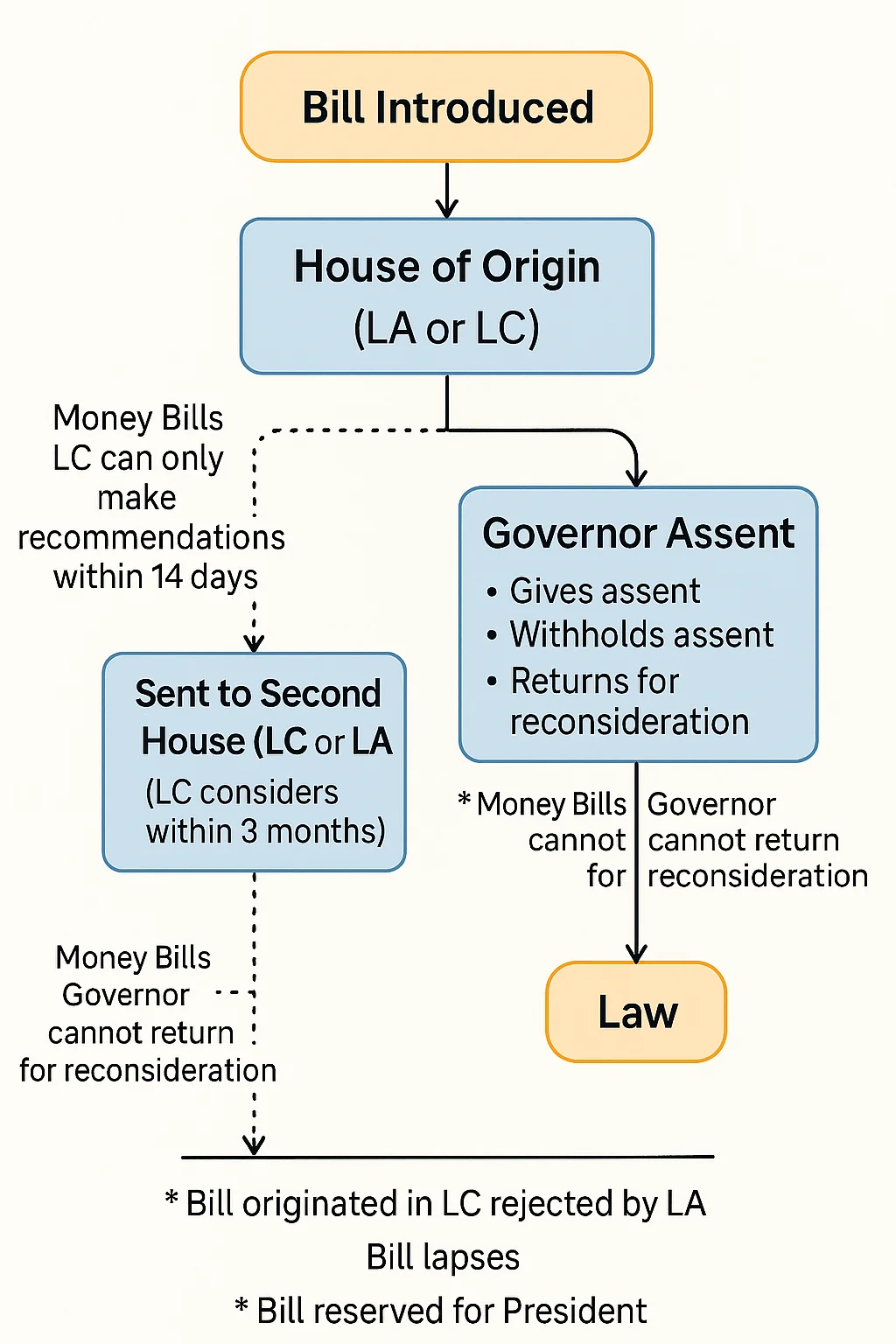
Working of State Legislature – Ordinary Bills
Ordinary bills in the State Legislature can originate in either House (if bicameral). However, the Legislative Assembly has overriding power in their passage. The Legislative Council can delay an ordinary bill for a maximum of 4 months (3 months + 1 month), but cannot permanently block it.
Ordinary bills in the State Legislature can originate in either House (if bicameral). However, the Legislative Assembly has overriding power in their passage. The Legislative Council can delay an ordinary bill for a maximum of 4 months (3 months + 1 month), but cannot permanently block it.
Options for Legislative Council when Bill comes from Assembly
| Option | Consequence |
|---|---|
| Pass without amendments | Bill becomes law immediately |
| Pass with amendments | Returned to LA → if LA accepts, bill passed; if rejects, LA’s version prevails after re-passage |
| Reject bill | If LA re-passes, bill deemed passed in LA’s form after 1 month |
| No action for 3 months | If LA re-passes, bill deemed passed in LA’s form after 1 month |
Time Limits in Passage of Ordinary Bill
| Stage | Maximum Time Delay |
|---|---|
| First instance (LC keeps pending) | 3 months |
| Second instance (LC again rejects/amends/ignores) | 1 month |
| Total maximum delay possible | 4 months |
Comparison: Ordinary Bills – State Legislature vs Union Parliament
| Aspect | State Legislature | Union Parliament |
|---|---|---|
| Final authority | Legislative Assembly | Lok Sabha (in joint sitting) |
| Delay possible | Max 4 months (by LC) | Unlimited if disagreement persists until joint sitting |
| Joint sitting provision | Not available | Available under Article 108 |
Mains Key Points
Prelims Strategy Tips
Money Bill in State Legislature
Under Article 198, a Money Bill can only be introduced in the Legislative Assembly with the Governor’s prior recommendation. The Legislative Council, in bicameral states, has only a recommendatory role. The ultimate power lies with the Legislative Assembly.
Under Article 198, a Money Bill can only be introduced in the Legislative Assembly with the Governor’s prior recommendation. The Legislative Council, in bicameral states, has only a recommendatory role. The ultimate power lies with the Legislative Assembly.
Money Bill – Procedure in State Legislature
| Stage | Role |
|---|---|
| Introduction | Only in LA, with prior recommendation of Governor |
| Passage in LA | Debated and passed by Assembly |
| Sent to LC | LC can only make recommendations |
| Return from LC | Must be returned within 14 days |
| Final decision | LA may accept or reject recommendations; LA’s decision final |
Comparison: Ordinary Bill vs Money Bill in States
| Aspect | Ordinary Bill | Money Bill |
|---|---|---|
| Origin | Either House (in bicameral states) | Only LA |
| Governor’s recommendation | Not required | Mandatory before introduction |
| Role of LC | Can delay up to 4 months | Only recommendatory; must return in 14 days |
| Final Authority | Legislative Assembly (after delays) | Legislative Assembly (absolute supremacy) |
| Joint Sitting | Not provided | Not provided |
Mains Key Points
Prelims Strategy Tips
Comparison of Powers of Legislative Assembly and Legislative Council
The Legislative Assembly (Vidhan Sabha) holds more powers than the Legislative Council (Vidhan Parishad), particularly in financial and executive control. The Council mainly serves as a revisory body with limited powers.
The Legislative Assembly (Vidhan Sabha) holds more powers than the Legislative Council (Vidhan Parishad), particularly in financial and executive control. The Council mainly serves as a revisory body with limited powers.
Comparison of Powers of LA and LC
| Dimension | Provisions |
|---|---|
| Legislative Assembly has more powers | Process of creation/abolition of LC starts with LA resolution. Money Bill cannot be introduced in LC and it cannot reject it. LC cannot vote on demand for grants. LA has overriding powers in case of disagreement over ordinary bills. Members of LC not part of electoral college of President. Only LA members elect Rajya Sabha MPs. No-confidence motion can only be introduced in LA. |
| Legislative Assembly and Legislative Council have equal powers | Introduction and passage of ordinary bills (though LA has final say in disagreements). Approval of Governor’s ordinances. Consideration of reports of State Finance Commission, SPSC, CAG, etc. |
Mains Key Points
Prelims Strategy Tips
Subordinate Judiciary – Family Courts
Family Courts are part of the subordinate judiciary established under the Family Courts Act, 1984, to promote conciliation and secure speedy settlement of disputes related to marriage, family, and associated matters. These courts adopt a less formal and more empathetic approach to resolve disputes, unlike regular civil courts.
Family Courts are part of the subordinate judiciary established under the Family Courts Act, 1984, to promote conciliation and secure speedy settlement of disputes related to marriage, family, and associated matters. These courts adopt a less formal and more empathetic approach to resolve disputes, unlike regular civil courts.
Family Courts Key Facts
| Aspect | Details |
|---|---|
| Founding Act | Family Courts Act, 1984 |
| Jurisdiction | Matrimonial disputes, maintenance, guardianship, property of parties |
| Primary Goal | Conciliation and speedy settlement (mediation) |
| Mandate | Establish in areas with population > 1 million |
| Procedural Rule | Not strictly bound by CPC/Evidence Act |
| Special Feature | Mandatory presence of counsellors/social workers |
Mains Key Points
Prelims Strategy Tips
Chapter Complete!
Ready to move to the next chapter?