
Indian polity Playlist
19 chapters • 0 completed
Making of the Constitution
18 topics
Salient Features of the Indian Constitution
4 topics
Preamble
7 topics
Evolution of States & Union Territories
7 topics
Citizenship
9 topics
Fundamental Rights
34 topics
Directive Principles of State Policy (DPSP)
19 topics
Amendment and Basic Structure
12 topics
Parliamentary System of Government
48 topics
Union Executive
36 topics
State Executive
21 topics
State Legislature
11 topics
Centre-State Relations
24 topics
Inter-State Relations
14 topics
Emergency Provisions
13 topics
Supreme Court
26 topics
High Court
20 topics
Local Government
21 topics
UTs + Scheduled and Tribal Areas
22 topics
Chapter 13: Centre-State Relations
Chapter TestCentre-State Relations: Legislative Relations
Articles 245–255 in Part XI of the Constitution define the legislative powers of the Union and States, including territorial extent, powers to make laws, and areas of exception.
Articles 245–255 in Part XI of the Constitution define the legislative powers of the Union and States, including territorial extent, powers to make laws, and areas of exception.
Territorial Extent & Applicability of Laws
| Type | Territorial Extent | Special Notes |
|---|---|---|
| Parliamentary Law | Whole of India (states, UTs, Indian territories) | Only Parliament can make extraterritorial laws |
| State Law | Within state borders | Can extend outside state if sufficient relation exists |
| UTs | Certain UTs (Andaman & Nicobar, Lakshadweep, Dadra & Nagar Haveli, Daman & Diu, Ladakh) | President makes laws |
| Scheduled Areas | Within states | Governor can exempt applicability of Parliamentary laws |
| Tribal Areas | Certain areas in Assam, Meghalaya, Tripura, Mizoram | Governor/President can modify applicability of laws |
Mains Key Points
Prelims Strategy Tips
Division of Legislative Subjects (Schedule VII)
Schedule VII of the Constitution divides subjects into Union List, State List, Concurrent List, and Residuary Subjects. This defines the legislative competence of Parliament and State Legislatures.
Schedule VII of the Constitution divides subjects into Union List, State List, Concurrent List, and Residuary Subjects. This defines the legislative competence of Parliament and State Legislatures.
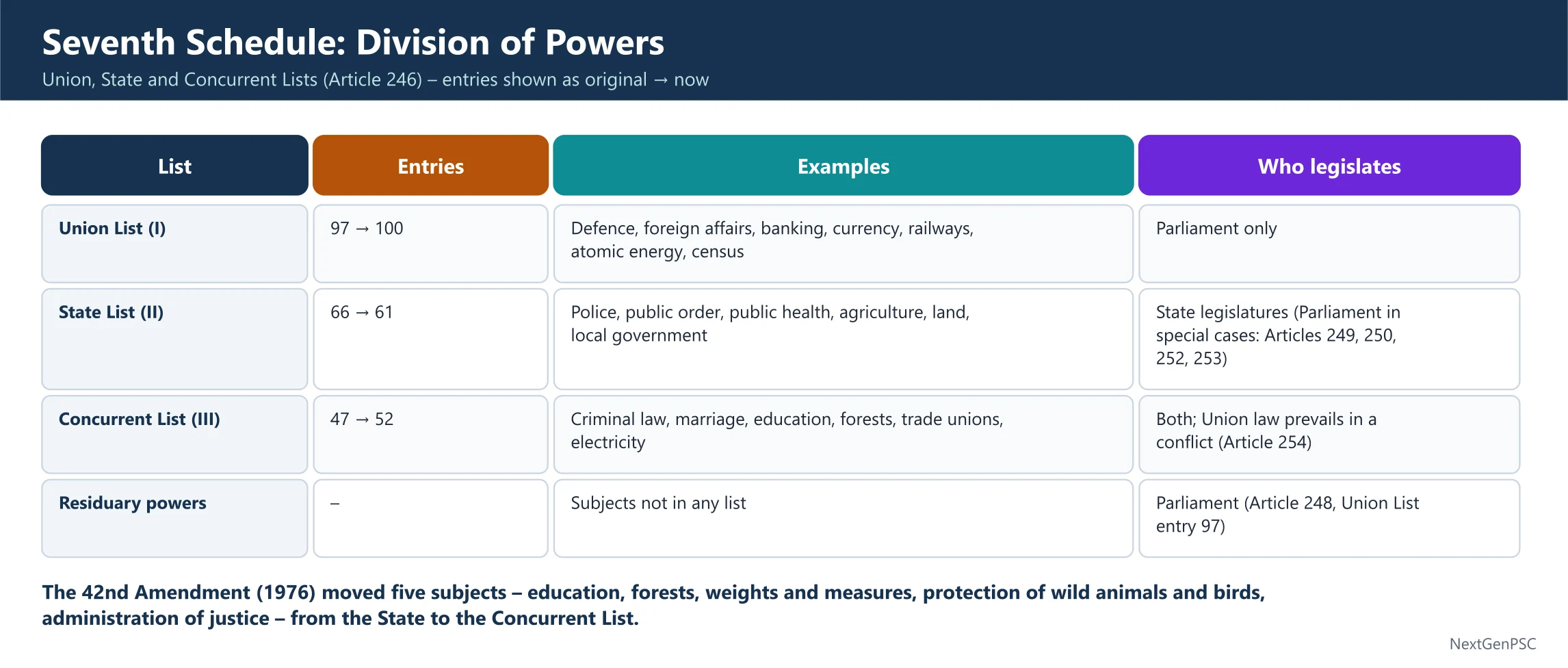
Union, State and Concurrent Lists – Key Details
| List | Number of Subjects | Legislative Authority | Examples |
|---|---|---|---|
| Union List | 98 | Parliament exclusive | Defence, Banking, Currency, Atomic Energy, Foreign Affairs |
| State List | 59 | State Legislature exclusive | Police, Agriculture, Public Health, Land, Water |
| Concurrent List | 52 | Both Parliament and State | Criminal Law, Divorce, Education, Forests, Weights & Measures, Protection of Wild Animals & Birds, Administration of Justice |
| Residuary Subjects | Not enumerated | Parliament exclusive | Cyber Laws, Space Technology, Atomic Energy (if not elsewhere) |
Conflict between Lists – Overriding Rules
| Conflict | List that Prevails |
|---|---|
| Union List vs State List | Union List prevails |
| Union List vs Concurrent List | Union List prevails |
| Concurrent List vs State List | Concurrent List prevails |
Mains Key Points
Prelims Strategy Tips
Conflict Due to Concurrent List and Doctrine of Pith & Substance
In case of conflict between Central and State laws on subjects in the Concurrent List, Central law prevails. Courts apply the 'Doctrine of Pith and Substance' to determine the true nature of the law and its legislative competence.
In case of conflict between Central and State laws on subjects in the Concurrent List, Central law prevails. Courts apply the 'Doctrine of Pith and Substance' to determine the true nature of the law and its legislative competence.
Conflict Resolution in Concurrent List
| Scenario | Outcome |
|---|---|
| Central law conflicts with State law | Central law prevails |
| State law gets President's assent | Valid temporarily; Parliament can still legislate |
| Doctrine of Pith & Substance applied | Law upheld if main purpose relates to competent subject |
Key Judgements Applying Pith and Substance
| Case | Facts | Decision |
|---|---|---|
| State of Bombay vs F.N. Balsara | Bombay Prohibition Act affecting liquor import (Union List) | Law valid: 'pith and substance' under State List |
| Prafulla v. Bank of Commerce (1946) | State money lending law incidentally affected promissory notes (Union List) | Law valid: incidental effect on Union subject does not invalidate law |
Mains Key Points
Prelims Strategy Tips
Parliamentary Legislation on State Subjects
Under certain circumstances, Parliament can legislate on subjects normally in the State List, such as in national interest, during emergencies, by state consent, or for international obligations.
Under certain circumstances, Parliament can legislate on subjects normally in the State List, such as in national interest, during emergencies, by state consent, or for international obligations.
Parliamentary Power to Legislate on State Subjects
| Article | Circumstance | Procedure & Validity | State Legislature Role |
|---|---|---|---|
| Article 249 | National Interest | RS empowers Parliament by 2/3 majority; law passed by simple majority; valid 1 year, renewable | State can still legislate on same subject |
| Article 250 | During National Emergency | Parliament can legislate; laws lapse within 6 months after emergency | State can legislate; if conflict, parliamentary law prevails |
| Article 252 | By agreement between states | State legislatures authorize Parliament; law applies only to consenting states; only Parliament can amend | Only consenting states bound; can legislate normally otherwise |
| Article 253 | International Agreements | Parliament can legislate to implement treaties; no restriction | State legislature may legislate, but parliamentary law supersedes in case of conflict |
| President’s Rule (Article 356) | State under President's Rule | Parliament legislates on State List subjects; laws continue post-Rule | State legislature can amend or repeal after Rule ends |
Mains Key Points
Prelims Strategy Tips
Centre’s Control over State Legislation
The Constitution provides certain powers to the Centre to control or influence state legislation through Presidential assent, prior recommendations, and during emergencies.
The Constitution provides certain powers to the Centre to control or influence state legislation through Presidential assent, prior recommendations, and during emergencies.
Centre’s Control Mechanisms over State Legislation
| Mechanism | Article | Purpose / Notes |
|---|---|---|
| Bill reserved by Governor for President's assent | 200 | Governor sends certain bills to President; President can approve, withhold, or suggest modifications |
| Prior recommendation of President | Varies (e.g., Inter-State Trade) | Certain bills cannot be introduced without President's prior recommendation |
| State Money Bills during Financial Emergency | 360 | Governor can reserve State Money Bills for President during financial emergency; ensures central control over state finances |
Mains Key Points
Prelims Strategy Tips
Administrative Relations between Centre and States
Articles 256–263 define the distribution of executive powers, obligations of states, and mechanisms for coordination between the Union and State governments.
Articles 256–263 define the distribution of executive powers, obligations of states, and mechanisms for coordination between the Union and State governments.
Division of Executive Powers: Centre vs States
| Aspect | Centre | State |
|---|---|---|
| Jurisdiction | Whole of India on Union List subjects and treaty powers | Territory of the state on State List subjects |
| Concurrent List | Power to direct states if Constitution/Parliament requires | Executive power generally rests with state |
| Compliance Obligation | Issue directions to states | Must comply with Union directives; cannot impede Union power |
Mains Key Points
Prelims Strategy Tips
Mutual Delegation of Executive Functions & Centre-State Cooperation
The Constitution allows inter-governmental delegation of executive authority, establishes mechanisms for cooperation, and creates All-India Services to ensure uniformity and high standards across states.
The Constitution allows inter-governmental delegation of executive authority, establishes mechanisms for cooperation, and creates All-India Services to ensure uniformity and high standards across states.
Mutual Delegation of Executive Functions
| Delegating Authority | Delegatee | Consent Required? | Notes |
|---|---|---|---|
| President | State Government | Yes | Delegates executive powers of Union to State |
| Governor | Central Government | Yes | Delegates State executive powers with consent |
| Parliament | State Government | No | Can delegate powers without State consent |
| State Legislature | Centre | No | Cannot delegate powers to Centre |
Centre-State Cooperation Mechanisms
| Article | Purpose | Key Features |
|---|---|---|
| 261 | Full faith & credit to acts, records, judicial proceedings | Across India, ensures legal validity across states |
| 262 | Inter-state river water disputes | Parliament can legislate and resolve disputes; excludes judicial review |
| 263 | Inter-State Council | President can set up council for Centre-State coordination |
| 307 | Regulate inter-state trade & commerce | Parliament appoints authority to manage trade & intercourse between states |
All-India Services
| Service | Established Under | Control | Purpose |
|---|---|---|---|
| IAS | Article 312 | Ultimate: Centre; Immediate: State | High administrative standards, uniformity across states |
| IPS | Article 312 | Ultimate: Centre; Immediate: State | Law & order, police administration, inter-state cooperation |
| IFoS | Article 312 | Ultimate: Centre; Immediate: State | Forest administration and policy uniformity |
| Proposed All-India Judicial Service | Article 312 (conceptual) | Ultimate: Centre; Immediate: State | Increase diversity & representation of marginalized groups in judiciary |
Mains Key Points
Prelims Strategy Tips
Public Service Commissions and Centre-State Relations
The Constitution provides mechanisms for the functioning of State Public Service Commissions, integrated judiciary, and administrative control during emergencies.
The Constitution provides mechanisms for the functioning of State Public Service Commissions, integrated judiciary, and administrative control during emergencies.
State Public Service Commissions (SPSC) and Joint PSCs
| Aspect | Details | Hindi |
|---|---|---|
| Appointment | Chairman and members by Governor; removal by President | अध्यक्ष और सदस्य राज्यपाल द्वारा नियुक्त; पद से हटाना राष्ट्रपति द्वारा |
| Joint PSC | Created by Parliament for multiple states; President appoints members | कई राज्यों के लिए संसद द्वारा संयुक्त PSC बनाई जाती है; सदस्य राष्ट्रपति द्वारा नियुक्त |
| UPSC Role | Assists states on Governor’s request with President approval; joint recruitment schemes | राष्ट्रपति की स्वीकृति से राज्यपाल के अनुरोध पर राज्यों की सहायता करता है; संयुक्त भर्ती योजनाओं में मदद |
Judicial Appointments & High Courts
| Aspect | Details | Hindi |
|---|---|---|
| HC Judges Appointment | By President in consultation with CJI, 2 senior-most HC judges, and Governor | CJI, 2 वरिष्ठ HC न्यायाधीश और राज्यपाल से परामर्श करके राष्ट्रपति द्वारा |
| Removal/Transfer | By President | राष्ट्रपति द्वारा |
| Common High Courts | Parliament can establish HC for multiple states (e.g., Punjab & Haryana) | संसद कई राज्यों के लिए संयुक्त HC स्थापित कर सकती है (जैसे पंजाब और हरियाणा) |
Centre-State Relations During Emergencies
| Emergency Type | Centre Powers | State Implications | Hindi |
|---|---|---|---|
| National Emergency | Issue executive directions on any matter | State must comply | किसी भी मामले पर कार्यकारी निर्देश जारी करना; राज्य को पालन करना होगा |
| President's Rule | President assumes state govt. functions; Governor's powers | State government temporarily replaced | राष्ट्रपति राज्य सरकार के कार्य संभालता है; राज्यपाल की शक्तियाँ; राज्य सरकार अस्थायी रूप से बदल जाती है |
| Financial Emergency (Art. 360) | Direct states on financial propriety; reduce salaries; reserve Money Bills for President | State must implement financial directives | राज्यों को वित्तीय निर्देशों के पालन के लिए; वेतन कम करना; धन विधेयक राष्ट्रपति के लिए सुरक्षित; राज्य को पालन करना होगा |
Mains Key Points
Prelims Strategy Tips
Extra-Constitutional Devices in Centre-State Relations
Apart from constitutional mechanisms, the Union and State governments coordinate through advisory bodies, councils, and conferences to facilitate cooperation, policy-making, and national integration.
Apart from constitutional mechanisms, the Union and State governments coordinate through advisory bodies, councils, and conferences to facilitate cooperation, policy-making, and national integration.
Extra-Constitutional Advisory Bodies & Conferences
| Device / Conference | Presided By | Purpose |
|---|---|---|
| NITI Aayog | Chairperson (PM) | Policy-making, planning, and cooperative federalism advice |
| National Integration Council | President | Measures to maintain national integration |
| National Development Council | Prime Minister | Planning and development policies |
| Governor’s Conference | President | Discuss federal issues and policy coordination |
| Chief Minister’s Conference | Prime Minister | Discuss policy priorities and inter-state cooperation |
| Chief Secretary’s Conference | Cabinet Secretary | Administrative coordination between Centre and States |
| Chief Justices’ Conference | Chief Justice of India | Judicial administration and reforms |
| Home Ministers’ Conference | Union Home Minister | Law, order and internal security matters |
| Central Council of Family and Health Welfare | Union Health Minister / Chairperson | Discuss public health and family welfare programs |
| Conference of Inspectors-General of Police | Union Home Minister / DG Police | Coordination on policing and law enforcement |
Mains Key Points
Prelims Strategy Tips
Financial Relations between Centre and States
The Constitution defines taxation powers, distribution of revenues, and restrictions on states, ensuring fiscal federalism and cooperation.
The Constitution defines taxation powers, distribution of revenues, and restrictions on states, ensuring fiscal federalism and cooperation.
Division and Restrictions of Taxation Powers
| Aspect | Centre | State | Hindi Notes |
|---|---|---|---|
| Exclusive Tax Subjects | Union List: customs, income tax, corporation tax, excise duty, GST (central component) | State List: land revenue, stamp duty, state excise, GST (state component) | विशेष कराधान के विषय केंद्र और राज्य सूची में निर्दिष्ट |
| Concurrent Taxation | GST (101st Amendment) – both can legislate | GST (101st Amendment) – both can legislate | समवर्ती कराधान: केवल GST |
| Residuary Taxation | Parliament only – gift tax, wealth tax, expenditure tax | None | शेष कराधान केवल संसद के पास |
| Professional Tax Limit | N/A | Up to ₹2,500/year | व्यावसायिक कर की सीमा ₹2,500/वर्ष |
| Electricity Tax | Cannot levy for Centre consumption/railways | Can levy on consumption/sale; needs President’s approval for interstate projects | राज्य को राष्ट्रपति की स्वीकृति के बिना अंतरराज्यीय परियोजनाओं पर कर लगाने की अनुमति नहीं |
Mains Key Points
Prelims Strategy Tips
Distribution of Tax Revenues between Centre and States
Articles 268–271 define how tax revenues are levied, collected, appropriated, and distributed between Centre and States, ensuring fiscal balance.
Articles 268–271 define how tax revenues are levied, collected, appropriated, and distributed between Centre and States, ensuring fiscal balance.
Distribution of Tax Revenues
| Article / Tax Type | Levy & Collection | Appropriation / Distribution | Hindi Notes |
|---|---|---|---|
| Article 268 | Levied by Centre | Collected & appropriated by States; goes to Consolidated Fund of State; stamp duties on bills, cheques, insurance, shares | राज्य द्वारा संग्रह और आवंटित; राज्य की समेकित निधि में जाती है; बिल, चेक, बीमा, शेयर पर स्टाम्प शुल्क |
| Article 269 | Levied & collected by Centre | Assigned to States; goes to Consolidated Fund of State; inter-state sales, purchases, consignments | राज्य को आवंटित; राज्य की समेकित निधि में जाती है; अंतरराज्यीय बिक्री, खरीद, माल का प्रेषण |
| Article 270 | Levied & collected by Centre | Distributed between Centre & States; net proceeds distribution by President on Finance Commission advice | केंद्र और राज्यों में वितरित; वित्त आयोग की सिफारिश पर राष्ट्रपति द्वारा वितरण |
| Article 271 | Surcharge on certain taxes | Goes to Centre (Consolidated Fund of India); not shared with States; GST exempt | केंद्र की समेकित निधि में जाती है; राज्यों के साथ साझा नहीं; GST पर लागू नहीं |
| State Levies | Levied & collected by States | Retained by States; goes to Consolidated Fund of State; exclusive domain of states | राज्यों द्वारा संग्रहित और बनाए रखा; राज्य की समेकित निधि में जाती है; केवल राज्यों का अधिकार |
Mains Key Points
Prelims Strategy Tips
Goods and Services Tax (GST)
Introduced via the 101st Constitutional Amendment, GST aims to remove cascading of taxes, create a common national market, and subsume multiple indirect taxes of Centre and States.
Introduced via the 101st Constitutional Amendment, GST aims to remove cascading of taxes, create a common national market, and subsume multiple indirect taxes of Centre and States.
Indirect Taxes Subsumed under GST
| Level | Taxes Included | Hindi Notes |
|---|---|---|
| Centre | Central Excise Duty, Additional Excise Duty, Excise on Medicinal/Toiletry, Services Tax, CVD, Additional Customs Duty, Central Surcharges/Cesses | केंद्र के अप्रत्यक्ष कर जो GST में समाहित |
| State | State VAT/Sales Tax, Entertainment Tax (not local), CST, Octroi & Entry Tax, Purchase Tax, Luxury Tax, Lottery/Betting/Gambling Tax, State Cess/Surcharge | राज्य के अप्रत्यक्ष कर जो GST में समाहित |
Functions of GST Council (Article 279A)
| Function | Description | Hindi Notes |
|---|---|---|
| Tax Subsumption | Recommend taxes, surcharges, cesses to be subsumed under GST | GST में समाहित किए जाने वाले करों, अधिभार और उपकर की सिफारिश करना |
| Goods and Services Coverage | Decide items to include/exempt under GST | GST के अंतर्गत कौनसे वस्त्र/सेवाएँ शामिल या छूट प्राप्त करें |
| Threshold Limit | Decide turnover limit below which GST exempt | GST छूट के लिए कारोबार सीमा तय करना |
| Rate Determination | Set GST rates including floor & ceiling bands | GST दरें तय करना (न्यूनतम और अधिकतम सीमा सहित) |
Mains Key Points
Prelims Strategy Tips
Distribution of Non-Tax Revenues and Grants-in-Aid to States
The Constitution provides for distribution of non-tax revenues and grants-in-aid to ensure fiscal balance and support development of states.
The Constitution provides for distribution of non-tax revenues and grants-in-aid to ensure fiscal balance and support development of states.
Non-Tax Revenue Sources
| Level | Sources | Hindi Notes |
|---|---|---|
| Centre | Posts & Telegraphs, Banking, Railways, Broadcasting, Coinage & Currency, CPSE, Escheat & Lapse | केंद्र के अकर राजस्व स्रोत |
| States | Irrigation, Forest, Fisheries, State PSUs, Escheat & Lapse | राज्यों के अकर राजस्व स्रोत |
Grants-in-Aid to States
| Type | Article | Purpose / Features | Hindi Notes |
|---|---|---|---|
| Discretionary Grants | Article 282 | Grants for public purposes by Centre or States, irrespective of legislative competence; not obligatory | केंद्र या राज्यों द्वारा सार्वजनिक उद्देश्यों के लिए अनुदान, विधायी क्षमता से स्वतंत्र; अनिवार्य नहीं |
| Statutory Grants - General | Article 275 | Aid to needy states; charged on Consolidated Fund of India | जरूरतमंद राज्यों को सहायता; भारत की समेकित निधि पर भार |
| Statutory Grants - Specific | Article 275 | For welfare of Scheduled Tribes; provided on Finance Commission recommendation | अनुसूचित जनजातियों के कल्याण के लिए; वित्त आयोग की सिफारिश पर प्रदान किया जाता है |
Mains Key Points
Prelims Strategy Tips
Finance Commission and Centre-State Financial Relations
The Finance Commission ensures equitable distribution of revenues between Centre and States, while constitutional provisions regulate borrowing, intergovernmental tax immunities, and financial powers during emergencies.
The Finance Commission ensures equitable distribution of revenues between Centre and States, while constitutional provisions regulate borrowing, intergovernmental tax immunities, and financial powers during emergencies.
Key Features of Finance Commission and Financial Relations
| Aspect | Provisions / Details | Hindi Notes |
|---|---|---|
| Finance Commission | Quasi-judicial body, President constitutes every 5 years; recommends tax distribution, grants-in-aid, measures to augment state funds, other matters referred by President | क्वासी-ज्यूडिशियल निकाय; राष्ट्रपति हर 5 साल में नियुक्त; कर वितरण, अनुदान, राज्य निधियों के लिए उपाय, अन्य मामलों की सिफारिश करता है |
| Protection of States’ Interests | Bills affecting state revenues introduced only on President's recommendation | राज्य के वित्तीय हितों को प्रभावित करने वाले विधेयक केवल राष्ट्रपति की सिफारिश पर पेश |
| Borrowing – Centre | Can borrow domestically/abroad within Parliament limits (Art 292); provide loans/guarantees to states | केंद्र संसद की सीमा के भीतर देश/विदेश से उधार ले सकता है; राज्यों को ऋण/गारंटी दे सकता है |
| Borrowing – States | Can borrow within India within legislature limits; abroad with Centre’s consent if previous loans outstanding (Art 293) | राज्य विधानमंडल सीमा के भीतर भारत में उधार ले सकते हैं; पहले का ऋण बकाया होने पर केंद्र की अनुमति से विदेश से उधार |
| Intergovernmental Tax Immunities | Central property exempt from state tax; state property exempt from central tax except commercial operations; local authorities not exempt | केंद्र संपत्ति राज्य कर से मुक्त; राज्य संपत्ति केंद्र कर से मुक्त (वाणिज्यिक कार्य अपवाद); स्थानीय प्राधिकरण मुक्त नहीं |
| Emergency Financial Powers | National Emergency: President can alter revenue sharing; Financial Emergency: Centre directs fiscal propriety, reduces salaries, reserves money bills | राष्ट्रीय आपातकाल: राष्ट्रपति राजस्व वितरण बदल सकता है; वित्तीय आपातकाल: केंद्र वित्तीय अनुशासन निर्देशित, वेतन कम, मनी बिल रिजर्व |
Mains Key Points
Prelims Strategy Tips
Challenges in Centre-State Relations
Fiscal relations are the core challenge in Indian federalism, marked by vertical fiscal imbalance, dependency on Centre, and limitations of state taxation powers.
Fiscal relations are the core challenge in Indian federalism, marked by vertical fiscal imbalance, dependency on Centre, and limitations of state taxation powers.
Fiscal Challenges in Centre-State Relations
| Challenge | Description | Hindi Notes |
|---|---|---|
| Vertical Fiscal Imbalance | States raise 40% revenue, incur 60% expenditure; major responsibilities but limited powers | ऊर्ध्वाधर वित्तीय असंतुलन: राज्य 40% राजस्व जुटाते हैं, 60% व्यय करते हैं; मुख्य जिम्मेदारियां लेकिन सीमित अधिकार |
| Dependency on Centre | States rely heavily on central transfers due to limited fiscal capacity | राज्यों की केंद्रीय स्थानांतरण पर निर्भरता: सीमित वित्तीय क्षमता के कारण |
| Changing Finance Commission Criteria | Each Finance Commission revises allocation formula, causing disputes; e.g., 2011 census controversy | वित्त आयोग के मानदंड बदलते हैं; विवाद उत्पन्न होते हैं; उदाहरण: 2011 जनगणना विवाद |
| Cess and Surcharge Bypassing Formula | Centre collects increasing share of revenue from cess/surcharge, bypassing Finance Commission formula | सेंट्रल सेस और अधिभार के माध्यम से राजस्व में बढ़ोतरी, वित्त आयोग सूत्र को बायपास करते हैं |
| Burden of Centrally Sponsored Schemes | States bear major financial obligations without matching revenue powers | केंद्र-प्रायोजित योजनाओं का बोझ: राजस्व शक्तियों के बिना राज्यों पर वित्तीय भार |
| Impact of GST | Absorbs major state revenue sources; post-GST revenue lower than pre-GST | GST का प्रभाव: मुख्य राज्य राजस्व स्रोतों को समाहित करता है; GST के बाद राजस्व घटा |
Mains Key Points
Prelims Strategy Tips
Encroachment of Centre in State Affairs
Centre’s increasing intervention in administrative, legislative, and policy matters of states poses a challenge to Indian federalism and cooperative governance.
Centre’s increasing intervention in administrative, legislative, and policy matters of states poses a challenge to Indian federalism and cooperative governance.
Examples of Encroachment of Centre
| Domain | Examples | Hindi Notes |
|---|---|---|
| Administrative | One Nation One Ration Card (Tamil Nadu opposed), NEET centralization, Border Security Force powers expanded | प्रशासनिक नीतियों में हस्तक्षेप |
| Legislative / State List | 42nd Amendment moved Education, Forests, Wildlife, Administration of Justice, Weights & Measures to Concurrent List | राज्य सूची में हस्तक्षेप |
| All India Services | IAS, IPS, IFoS under Centre’s control; limits state autonomy | सर्वोच्च भारतीय सेवाओं में हस्तक्षेप |
| Political / Confrontational | Governor misuse: Karnataka SR Bommai, Maharashtra oath; central agencies used in Kerala, Delhi; refusal of schemes by states | राजनीतिक संघर्ष / कांग्रेशनल हस्तक्षेप |
| Other Issues | Weak conflict mediation institutions, growing regionalism, influence in foreign policy (Teesta Treaty, Marine trials) | अन्य समस्याएँ |
Mains Key Points
Prelims Strategy Tips
Recommendations on Centre-State Relations
Various commissions and reforms have suggested measures to strengthen cooperative federalism, safeguard state autonomy, and regulate the role of the Governor and use of Article 356.
Various commissions and reforms have suggested measures to strengthen cooperative federalism, safeguard state autonomy, and regulate the role of the Governor and use of Article 356.
Key Recommendations on Governor and Centre-State Relations
| Issue | Sarkaria Commission | Punchhi Commission | Hindi Notes |
|---|---|---|---|
| Appointment of Governor | Eminent, from outside state, detached from politics; consult CM | Abide by Sarkaria guidelines | राज्यपाल का चयन: योग्य, बाहरी, राजनीतिक रूप से अप्रभावित; CM से परामर्श |
| Removal / Tenure | Enjoy 5-year term; reasons for removal constitutionally laid; consult state govt | Full 5-year tenure; removal not at Centre’s will; procedure like President's impeachment | राज्यपाल का कार्यकाल/अवकाश: 5 साल; केंद्र की इच्छा से नहीं हटाया जाए; संवैधानिक प्रक्रिया |
| President's Rule (Article 356) | Use sparingly; only for failure of constitutional machinery | Amendments to incorporate SC guidelines (S.R. Bommai) | राष्ट्रपति शासन: केवल संवैधानिक विफलता पर, SC दिशानिर्देश शामिल |
| Discretionary Powers / Partisan Role | Cannot dismiss COMs with majority | Exercise with reason, good faith, caution; clear CM appointment guidelines in hung assembly; Floor test within time | अधिकार/पक्षपात: बहुमत वाले COM को नहीं हटाए; विवेक, उचित कारण, समयबद्ध Floor test |
| Dealing with State Bills | President communicates reasons for withholding assent | Governor decides within 6 months; President acts within 6 months | राज्य विधेयक: राष्ट्रपति अस्वीकृति के कारण बताए; राज्यपाल 6 महीने में निर्णय, राष्ट्रपति 6 महीने में कार्यवाही |
Mains Key Points
Prelims Strategy Tips
Centre-State Relations: Legislative, Administrative & Financial Recommendations
Sarkaria and Punchhi Commissions provided detailed guidelines to ensure cooperative federalism, proper management of all-India services, legislative autonomy of states, and equitable fiscal relations.
Sarkaria and Punchhi Commissions provided detailed guidelines to ensure cooperative federalism, proper management of all-India services, legislative autonomy of states, and equitable fiscal relations.
Comparison of Sarkaria & Punchhi Commission Recommendations
| Domain | Sarkaria Commission | Punchhi Commission | Hindi Notes |
|---|---|---|---|
| Legislative Autonomy | Parliament retains residuary taxation; refrain from State List laws; consult states on Concurrent List | Grant more autonomy to states; only necessary subjects in Concurrent List; consult states | विधायी स्वायत्तता: राज्य सूची में हस्तक्षेप न करें; समवर्ती सूची पर परामर्श |
| Deployment of Forces | Centre can deploy forces without consent; consultation desirable | Centre can deploy for short-term communal conflagration (1 week) without consent | केंद्र बल तैनाती: सीमित अवधि के लिए बिना अनुमति |
| All-India Services | Strengthen existing IAS, IPS, IFoS; create more services | Create new services in health, education, engineering, judiciary | अखिल-भारतीय सेवाएं: मौजूदा को मजबूत और नए सेवाएं बनाएँ |
| Surcharge & Cess | Limited purpose & period; annual independent assessment; report to legislature | Review all existing cess/surcharges; reduce Centre's share | सेस और अधिभार: सीमित उद्देश्य; केंद्र का हिस्सा कम करें |
| Finance Commission | States involved in finalizing ToR; permanent secretariat under Finance Ministry | Same | वित्त आयोग: राज्य शामिल; स्थायी सचिवालय बनाना |
Mains Key Points
Prelims Strategy Tips
Institutional Measures for Strengthening Centre-State Relations
Sarkaria and Punchhi Commissions suggested strengthening federal institutions, promoting cooperative federalism, and improving coordination through zonal councils and inter-state mechanisms.
Sarkaria and Punchhi Commissions suggested strengthening federal institutions, promoting cooperative federalism, and improving coordination through zonal councils and inter-state mechanisms.
Comparison of Sarkaria and Punchhi Commission on Institutional Measures
| Institution | Sarkaria Commission | Punchhi Commission | Hindi Notes |
|---|---|---|---|
| National Development Council / Economic Council | Rename & reconstitute as NEDC | Inter-State Council to continue auditing concurrent jurisdiction matters | राष्ट्रीय विकास/आर्थिक परिषद: NEDC पुनर्निर्मित; अंतर-राज्य परिषद की निगरानी जारी |
| Zonal Councils | Constitute afresh; reactivate to promote federalism | Meet at least twice a year with state-proposed agenda | क्षेत्रीय परिषद: पुनर्निर्माण और सक्रिय; राज्य द्वारा प्रस्तावित एजेंडा |
| Inter-State Trade & Commerce Commission | Establish under Article 307 with binding decisions | Not specified | अंतर-राज्य व्यापार आयोग: अनु. 307 के तहत स्थापन, बाध्यकारी निर्णय |
| Cooperative Federalism / Dialogue | Not specified | Use NITI Aayog for cooperative federalism; strengthen dialogue and federal bridging institutions | सहयोगी संघवाद: NITI Aayog का उपयोग, संस्थागत संवाद मजबूत करें |
Mains Key Points
Prelims Strategy Tips
Asymmetric Federalism (Article 371 Series)
The Constitution of India provides for asymmetric federalism, granting special provisions and protection to certain states, primarily in the North-East and historically disadvantaged regions (Article 371 to 371-J). This aims to protect cultural identity, economic interests, and ensure administrative stability in diverse areas.
The Constitution of India provides for asymmetric federalism, granting special provisions and protection to certain states, primarily in the North-East and historically disadvantaged regions (Article 371 to 371-J). This aims to protect cultural identity, economic interests, and ensure administrative stability in diverse areas.
Asymmetric Federalism: Special Provisions (Article 371 Series)
| Article | State | Key Provision/Governor's Role |
|---|---|---|
| 371 | Maharashtra and Gujarat | Establishment of development boards (Vidarbha, Marathwada, Saurashtra, Kutch). |
| 371A | Nagaland | Protection of Naga customary law, social practices, and land ownership. |
| 371C | Manipur | Administration of hill areas (Hilly Areas Committee). |
| 371H | Arunachal Pradesh | Special responsibility of Governor for law and order. |
| 371J | Karnataka | Development Board for Hyderabad-Karnataka region (Kalyana Karnataka) and equitable opportunities. |
Mains Key Points
Prelims Strategy Tips
Inter-State Water Disputes (Article 262) and Mechanisms
Article 262 grants Parliament the power to adjudicate disputes related to inter-state river water sharing, often leading to the formation of ad-hoc river tribunals. Effective resolution is crucial for cooperative federalism and national development, necessitating strong institutional bodies.
Article 262 grants Parliament the power to adjudicate disputes related to inter-state river water sharing, often leading to the formation of ad-hoc river tribunals. Effective resolution is crucial for cooperative federalism and national development, necessitating strong institutional bodies.
Inter-State Water Disputes Mechanism
| Mechanism | Authority/Basis | Notes |
|---|---|---|
| Inter-State River Water Disputes Act | Article 262 (Parliamentary Law) | Sets up ad-hoc tribunals (Proposed to be replaced by a permanent tribunal). |
| Supreme Court Jurisdiction | Excluded by Parliament (Under Article 262) | SC/other courts generally have no jurisdiction on these disputes. |
| Tribunal Decision | Final and Binding | Equivalent to a Supreme Court order; states must implement. |
| CGWA | Statutory Body (EP Act, 1986) | Regulates and controls groundwater use. |
Mains Key Points
Prelims Strategy Tips
Inter-State Council (Article 263)
The Inter-State Council (ISC) is a constitutional body established by the President (Article 263) to inquire into and advise upon disputes between states, discuss subjects of common interest, and recommend measures for better policy coordination, thereby strengthening cooperative federalism.
The Inter-State Council (ISC) is a constitutional body established by the President (Article 263) to inquire into and advise upon disputes between states, discuss subjects of common interest, and recommend measures for better policy coordination, thereby strengthening cooperative federalism.
Inter-State Council (ISC) – Key Facts
| Aspect | Details |
|---|---|
| Constitutional Article | Article 263 (Part XI) |
| Establishment | Presidential Order (1990), based on Sarkaria Commission |
| Chairman | Prime Minister (PM) |
| Nature of Advice | Advisory and Recommendatory |
| Composition | PM + CMs of all states/UTs + Administrators of UTs (no legislature) + 6 Union Cabinet Ministers |
| Mandate | Promote coordination and resolve disputes between Centre and States/States |
Mains Key Points
Prelims Strategy Tips
Zonal Councils (Inter-State Relations)
Zonal Councils are statutory bodies established under the States Reorganisation Act, 1956, to promote inter-state and centre-state cooperation in economic, social, and cultural matters, thereby fostering national integration and minimizing regional disputes.
Zonal Councils are statutory bodies established under the States Reorganisation Act, 1956, to promote inter-state and centre-state cooperation in economic, social, and cultural matters, thereby fostering national integration and minimizing regional disputes.
Zonal Councils Key Facts
| Aspect | Details |
|---|---|
| Status | Statutory Bodies (Established under States Reorganisation Act, 1956) |
| Chairman | Union Home Minister (Common Chairman for all Zonal Councils) |
| Composition | Union Home Minister + CMs of all member states + two other ministers from each state + Administrator of UTs |
| Goal | Promote inter-state and centre-state cooperation; national integration |
| Controversy | Meetings often infrequent, reducing effectiveness. |
Mains Key Points
Prelims Strategy Tips
Regionalism in India: Causes, Forms and Federal Response
Regionalism is a feeling of loyalty to a region based on language, culture, ethnicity or economic interests. It can be healthy—asserting identity and demanding fair development within the Union—or divisive, when it turns into sons-of-the-soil hostility or secessionism. India's federal design (linguistic states, Article 371, Sixth Schedule, new states) has largely accommodated regional aspirations.
Regionalism is a feeling of loyalty to a region based on language, culture, ethnicity or economic interests. It can be healthy—asserting identity and demanding fair development within the Union—or divisive, when it turns into sons-of-the-soil hostility or secessionism. India's federal design (linguistic states, Article 371, Sixth Schedule, new states) has largely accommodated regional aspirations.
Healthy vs divisive regionalism
| Healthy regionalism | Divisive regionalism |
|---|---|
| Demand for development within the Union | Secessionist demands |
| Promotion of regional language and culture | Hostility to other languages and migrants |
| Constitutional methods (new state, autonomy) | Violence and insurgency |
Fun Facts
The DMK's victory in Tamil Nadu in 1967 made it the first regional party to win a state on its own.
Nehru was initially wary of linguistic states, fearing they would weaken national unity.
India's Constitution recognises 22 languages in the Eighth Schedule.
Mains Key Points
Prelims Strategy Tips
Chapter Complete!
Ready to move to the next chapter?