
Indian Polity & Governance: UPSC Notes, Key Concepts & Practice

    High-yield Polity coverage for UPSC Prelims and Mains. Revise the Constitution’s philosophy, rights framework, separation of powers, legislative-executive-judicial relations, federalism, local bodies, and contemporary governance — with crisp summaries, mains points, prelims tips, and MCQs.

    Chapter index

    Indian Polity & Governance

    Interactive study materials with AI assistance

    Indian polity Playlist

    19 chapters • 0 completed

    1

    Making of the Constitution

    18 topics

    2

    Salient Features of the Indian Constitution

    4 topics

    3

    Preamble

    7 topics

    4

    Evolution of States & Union Territories

    7 topics

    5

    Citizenship

    9 topics

    6

    Fundamental Rights

    34 topics

    7

    Directive Principles of State Policy (DPSP)

    19 topics

    8

    Amendment and Basic Structure

    12 topics

    9

    Parliamentary System of Government

    48 topics

    10

    Union Executive

    36 topics

    11

    State Executive

    21 topics

    12

    State Legislature

    11 topics

    13

    Centre-State Relations

    24 topics

    14

    Inter-State Relations

    14 topics

    Practice
    15

    Emergency Provisions

    13 topics

    16

    Supreme Court

    26 topics

    17

    High Court

    20 topics

    18

    Local Government

    21 topics

    19

    UTs + Scheduled and Tribal Areas

    22 topics

    Progress (0%)
    0 / 19 complete

    Chapter 14: Inter-State Relations

    Chapter Test
    14 topics•Estimated reading: 42 minutes

    Inter-State Relations: Water Disputes

    Key Point

    Inter-state water disputes in India have historical origins, institutional complexities, and continuing political relevance due to water scarcity and state reorganisation.

    Inter-state water disputes in India have historical origins, institutional complexities, and continuing political relevance due to water scarcity and state reorganisation.

    Detailed Notes (50 points)
    Tap a card to add note • Use the highlight Listen button to play the full section
    A. Historical Origins of Inter-State Water Disputes
    1. Colonial Legacy
    1. During British rule, India had a highly centralized administrative system in which provinces had very limited autonomy.
    2. The Secretary of State for India in London exercised final authority in matters related to inter-provincial rivers and water sharing.
    3. Provincial governments (like Madras, Bombay, and Bengal) had restricted decision-making powers over irrigation and river management.
    4. This centralized control caused regional dissatisfaction , as local interests and geographical needs were often ignored.
    5. Water-sharing disputes began as early as the late 19th and early 20th centuries — notably between Madras and Mysore (now Tamil Nadu and Karnataka) over the Cauvery River .
    2. Legacy of Colonial Agreements
    1. Several colonial-era water agreements were signed between provinces and princely states — often without proper hydrological data or consultation.
    2. These pre-independence agreements (e.g., 1892 and 1924 Cauvery Agreements) continue to influence post-independence disputes and complicate renegotiations.
    3. After independence, these agreements remained binding under the doctrine of successor state obligations .
    B. Post-Independence Challenges
    1. After independence, India’s State Reorganisation (1956) created new linguistic states, but many river basins were split across multiple states .
    2. This division led to renewed water-sharing conflicts , such as:
    Cauvery River: Karnataka–Tamil Nadu–Kerala–Puducherry
    Krishna River: Maharashtra–Karnataka–Andhra Pradesh–Telangana
    Godavari, Ravi–Beas, Narmada, and Mahanadi disputes.
    3. Many of these conflicts are rooted in historical arrangements and outdated data on rainfall, storage, and crop patterns.
    4. Even after tribunal awards, implementation delays and political resistance remain common.
    5. State governments often use water disputes for political mobilization and regional identity building.
    C. Constitutional and Legislative Framework
    1. Constitutional Provisions
    1. The Seventh Schedule divides legislative powers between the Union and the States.
    Entry 17, State List: Water supply, irrigation, canals, drainage, embankments, water storage — within the State’s territorial limits.
    Entry 56, Union List: Regulation and development of inter-state rivers and river valleys — to the extent declared by Parliament as expedient in public interest.
    2. This overlap creates ambiguity in jurisdiction — leading to disputes between Centre and States over control and regulation.
    2. Article 262 – Adjudication of Inter-State Water Disputes
    1. Article 262(1): Parliament may by law provide for the adjudication of any dispute relating to waters of inter-state rivers or river valleys.
    2. Article 262(2): Parliament may also bar the jurisdiction of the Supreme Court and other courts in such matters.
    3. Based on this, Parliament enacted the Inter-State River Water Disputes Act, 1956 .
    3. Inter-State River Water Disputes Act, 1956
    1. Provides a tribunal mechanism for adjudicating disputes between states over water sharing.
    2. The decision (award) of the tribunal is final and binding on the parties involved — equivalent to a Supreme Court decree.
    3. However, the Act allows judicial appeals under Article 136 (special leave petitions), which often leads to further litigation and delays .
    4. Tribunals like the Cauvery, Krishna, Narmada, and Godavari tribunals have given awards, but their implementation remains inconsistent .
    5. A 2019 Amendment introduced a Dispute Resolution Committee (DRC) to attempt mediation before the formation of a tribunal.
    D. Contemporary Issues and Challenges
    1. Growing Water Scarcity: Rapid urbanization, climate change, and over-extraction of groundwater have increased pressure on inter-state rivers.
    2. Politicization of Water Disputes: Political parties often use river issues to mobilize voters and gain regional support — for example, in Karnataka and Tamil Nadu during elections.
    3. Non-Implementation of Tribunal Awards: Even after judgments, compliance remains weak due to lack of an effective enforcement mechanism.
    4. Centre–State Tensions: States accuse the Centre of bias in water allocation and tribunal formation.
    5. Technological & Data Gaps: Disputes persist due to lack of real-time hydrological data and joint monitoring systems.
    6. Judicial Delays: Supreme Court’s involvement in appeals under Article 136 further slows the process.
    7. Electoral Repercussions: Water disputes now play a crucial role in shaping regional politics and federal relations .
    E. Way Forward
    1. Establish a Permanent Inter-State River Water Disputes Tribunal with continuous jurisdiction and independent technical expertise.
    2. Use data-driven river basin management using satellite and GIS-based monitoring.
    3. Create River Basin Authorities for joint management involving all basin states.
    4. Promote negotiation and mediation through the Inter-State Council and NITI Aayog before litigation.
    5. Ensure binding timelines for tribunals and Supreme Court decisions to prevent indefinite delays.

    Inter-State Water Disputes: Key Aspects

    AspectDetailsHindi Notes
    Historical OriginColonial centralized power; provinces lacked decision-making; Secretary of State final authorityऐतिहासिक उत्पत्ति: औपनिवेशिक केंद्रीकृत सत्ता; प्रांतों की सीमित स्वायत्तता
    Post-Independence IssuesBorder disputes continue (Cauvery), colonial agreements complicate sharing, tribunals orders often ignoredस्वतंत्रता के बाद: सीमा विवाद, औपनिवेशिक समझौते, ट्रिब्यूनल आदेश प्रायः अनदेखे
    Constitutional ProvisionArticle 262; Parliament can legislate on inter-state rivers; states control local water supplyसंवैधानिक प्रावधान: अनु. 262, केंद्र कानून, राज्य स्थानीय जल नियंत्रण
    LegislationInter-State River Disputes Act, 1956: tribunals final authority; awards binding; SC appeals cause delaysकानून: 1956 एक्ट, ट्रिब्यूनल अंतिम, SC अपील में देरी
    Contemporary RelevanceWater scarcity, political focus, election manifestosसमकालीन प्रासंगिकता: जल संकट, राजनीतिक फोकस, चुनावी घोषणापत्र

    Mains Key Points

    Colonial centralization and state reorganization contributed to persistent water disputes.
    Constitutional ambiguity on water jurisdiction and appellate powers undermines tribunal effectiveness.
    Growing water scarcity and political stakes make inter-state water disputes an enduring federal challenge.
    Effective dispute resolution requires timely tribunal awards, limited SC interference, and cooperative federalism mechanisms.

    Prelims Strategy Tips

    Article 262: Parliament empowered to legislate on interstate water disputes; Inter-State River Disputes Act, 1956.
    Tribunals have final authority; awards binding as Supreme Court orders.
    SC can hear appeals under Article 136 → leads to delays.
    Mullaperiyar (Kerala–Tamil Nadu): the Supreme Court allowed Tamil Nadu to raise the water level to 142 ft. SYL canal (Punjab–Haryana): the Punjab Termination of Agreements Act, 2004 was held unconstitutional in the 2016 Presidential reference.

    Inter-State Water Disputes: Constitutional & Legislative Framework

    Key Point

    Inter-state water disputes in India are regulated by Article 262, River Boards Act 1956, and Inter-State Water Disputes Act 1956, providing mechanisms for adjudication and regulation.

    Inter-state water disputes in India are regulated by Article 262, River Boards Act 1956, and Inter-State Water Disputes Act 1956, providing mechanisms for adjudication and regulation.

    Detailed Notes (62 points)
    Tap a card to add note • Use the highlight Listen button to play the full section
    A. Article 262 – Adjudication of Inter-State Water Disputes
    1. Constitutional Provision
    1. Article 262(1): Empowers Parliament to make laws for the adjudication of disputes relating to the waters of inter-state rivers or river valleys.
    2. Article 262(2): Allows Parliament to exclude the jurisdiction of the Supreme Court or any other court in such disputes.
    3. Objective: To ensure specialized, technical, and time-bound resolution of complex water-sharing issues between states without prolonged litigation.
    4. This provision emphasizes that river disputes are national concerns and need expert handling rather than judicial confrontation.
    5. Two major laws were enacted under this Article — the River Boards Act, 1956 and the Inter-State Water Disputes Act, 1956 .
    B. River Boards Act, 1956
    1. Purpose
    1. Enacted to provide a mechanism for the regulation and development of inter-state rivers and river valleys .
    2. Aimed at promoting coordinated and integrated management of water resources shared by two or more states.
    3. Focuses on planning and cooperation , not dispute resolution.
    2. Establishment and Composition
    1. The Central Government can establish a River Board for any inter-state river or river valley.
    2. Boards are created on the request of the concerned state governments .
    3. Composition: A Chairman and members who are experts in fields like:
    Irrigation and water resources management,
    Civil and electrical engineering,
    Agriculture, hydrology, and environmental science.
    4. These experts assist in the planning, regulation, and development of river basins.
    3. Powers and Functions
    1. The River Board advises the Central and State Governments on:
    Regulation of water flow and distribution,
    Construction of dams, reservoirs, and irrigation systems,
    Flood control, hydroelectric projects, and navigation.
    2. The Board cannot adjudicate disputes — it has only an advisory and coordinating role .
    3. Hence, the Act is considered largely ineffective since no River Board has been constituted so far.
    4. States often prefer direct negotiation or tribunal adjudication under the Water Disputes Act.
    C. Inter-State Water Disputes Act, 1956 (ISWD Act)
    1. Objective
    1. Enacted under Article 262 to provide a special mechanism for resolving water-sharing disputes between states.
    2. Ensures that disputes are settled by expert tribunals instead of regular courts to avoid judicial overburdening and political tensions.
    2. Process of Adjudication
    1. A State Government can request the Central Government to refer an inter-state river dispute for adjudication.
    2. The Central Government first attempts negotiation and conciliation between the states.
    3. If such negotiations fail, the Centre must constitute a tribunal within one year to adjudicate the dispute.
    4. The tribunal consists of a Chairman and two other members — all of whom are judges of the Supreme Court or High Courts.
    5. The tribunal follows judicial procedures and bases its decision on hydrological, technical, and legal data.
    3. Nature of Tribunal Awards
    1. The tribunal’s award is final and binding on all the states involved.
    2. The decision is published in the Official Gazette by the Central Government.
    3. Once notified, it has the same effect as a Supreme Court decree under Article 136.
    4. However, states may still approach the Supreme Court through special leave petitions , causing procedural delays.
    5. Examples of such tribunals include:
    Cauvery Water Disputes Tribunal (1990)
    Krishna Tribunal (1969, 2004)
    Narmada Tribunal (1969)
    Godavari Tribunal (1969) .
    4. Limitations
    1. Delay in formation and functioning of tribunals — some took several years after requests.
    2. Prolonged adjudication process — sometimes spanning decades.
    3. Implementation issues due to lack of monitoring and enforcement mechanisms.
    4. Absence of permanent institutional structure leads to inconsistent policy handling.
    5. Politicization of disputes weakens tribunal legitimacy.
    5. Recent Developments
    1. The Inter-State River Water Disputes (Amendment) Bill, 2019 seeks to establish a Permanent Tribunal with multiple benches.
    2. Introduces a Dispute Resolution Committee (DRC) for pre-litigation mediation between states.
    3. Aims to streamline and expedite the resolution process within 5 years from the date of reference.
    4. Also proposes a data bank and information system for all river basins to improve transparency.
    D. Key Difference Between River Boards Act and Water Disputes Act
    1. River Boards Act (1956): Advisory and cooperative in nature — focuses on regulation, planning, and development of river basins.
    2. Inter-State Water Disputes Act (1956): Adjudicatory in nature — provides for binding dispute resolution by tribunals.

    Key Legislative & Constitutional Provisions for Inter-State Water Disputes

    ProvisionKey FeaturesHindi Notes
    Article 262Parliament can legislate; SC or other courts excludedअनु. 262: संसद कानून बना सकती है; SC/अन्य न्यायालयों का क्षेत्राधिकार नहीं
    River Boards Act, 1956Advisory boards for regulation & development; set up on state request; no adjudicatory powersनदी बोर्ड अधिनियम: सलाहकार बोर्ड, राज्य अनुरोध पर; निर्णयाधिकार नहीं
    Inter-State Water Disputes Act, 1956Ad-hoc tribunals; referral only if negotiation fails; decisions final & bindingअंतर-राज्य जल विवाद अधिनियम: अस्थायी ट्रिब्यूनल, वार्ता विफल होने पर; निर्णय अंतिम एवं बाध्यकारी

    Mains Key Points

    Article 262 provides exclusive mechanism for adjudication, avoiding judicial interference.
    River Boards Act promotes cooperative development but lacks binding authority.
    Inter-State Water Disputes Act ensures finality through tribunals, reinforcing inter-state water governance.

    Prelims Strategy Tips

    Article 262 excludes SC jurisdiction in inter-state water disputes.
    River Boards Act 1956: advisory role, no adjudication.
    ISWD Act 1956: tribunals' decision final & binding; referral only if negotiation fails.

    Functional Inter-State Water Disputes Tribunals in India (2022)

    Key Point

    As of 2022, four inter-state water disputes tribunals are functional, addressing river water conflicts between states.

    As of 2022, four inter-state water disputes tribunals are functional, addressing river water conflicts between states.

    List of Functional Inter-State Water Disputes Tribunals

    Tribunal NameYear of FormationStates InvolvedHindi Notes
    Krishna Water Disputes Tribunal-II2004Andhra Pradesh, Telangana, Maharashtra, Karnatakaकृष्णा जल विवाद ट्रिब्यूनल-II, 2004: AP, तेलंगाना, महाराष्ट्र, कर्नाटक
    Mahanadi Water Disputes Tribunal2018Chhattisgarh, Odishaमहानदी जल विवाद ट्रिब्यूनल, 2018: छत्तीसगढ़, ओडिशा
    Mahadayi Water Disputes Tribunal2010Maharashtra, Goa, Karnatakaमहादाई जल विवाद ट्रिब्यूनल, 2010: महाराष्ट्र, गोवा, कर्नाटक
    Ravi and Beas Water Disputes Tribunal1986Punjab, Haryana, Rajasthanरावी और बीयस जल विवाद ट्रिब्यूनल, 1986: पंजाब, हरियाणा, राजस्थान

    Mains Key Points

    These tribunals are constituted under the Inter-State Water Disputes Act, 1956.
    Tribunals have the power to adjudicate disputes; awards are binding on the states involved.
    Tribunals ensure structured, legal resolution of river water disputes to avoid conflicts between states.
    Challenges include delays due to appeals in the Supreme Court and incomplete compliance by states.

    Prelims Strategy Tips

    Krishna Water Tribunal-II: 2004, AP, Telangana, Maharashtra, Karnataka
    Mahanadi Tribunal: 2018, Chhattisgarh & Odisha
    Mahadayi Tribunal: 2010, Maharashtra, Goa, Karnataka
    Ravi & Beas Tribunal: 1986, Punjab, Haryana, Rajasthan

    Challenges and Reforms in Inter-State Water Dispute Resolution

    Key Point

    Inter-state water disputes in India face delays, politicisation, and technical constraints. The 2019 Amendment Act introduced permanent tribunals, Dispute Resolution Committees, and a central data bank to streamline adjudication.
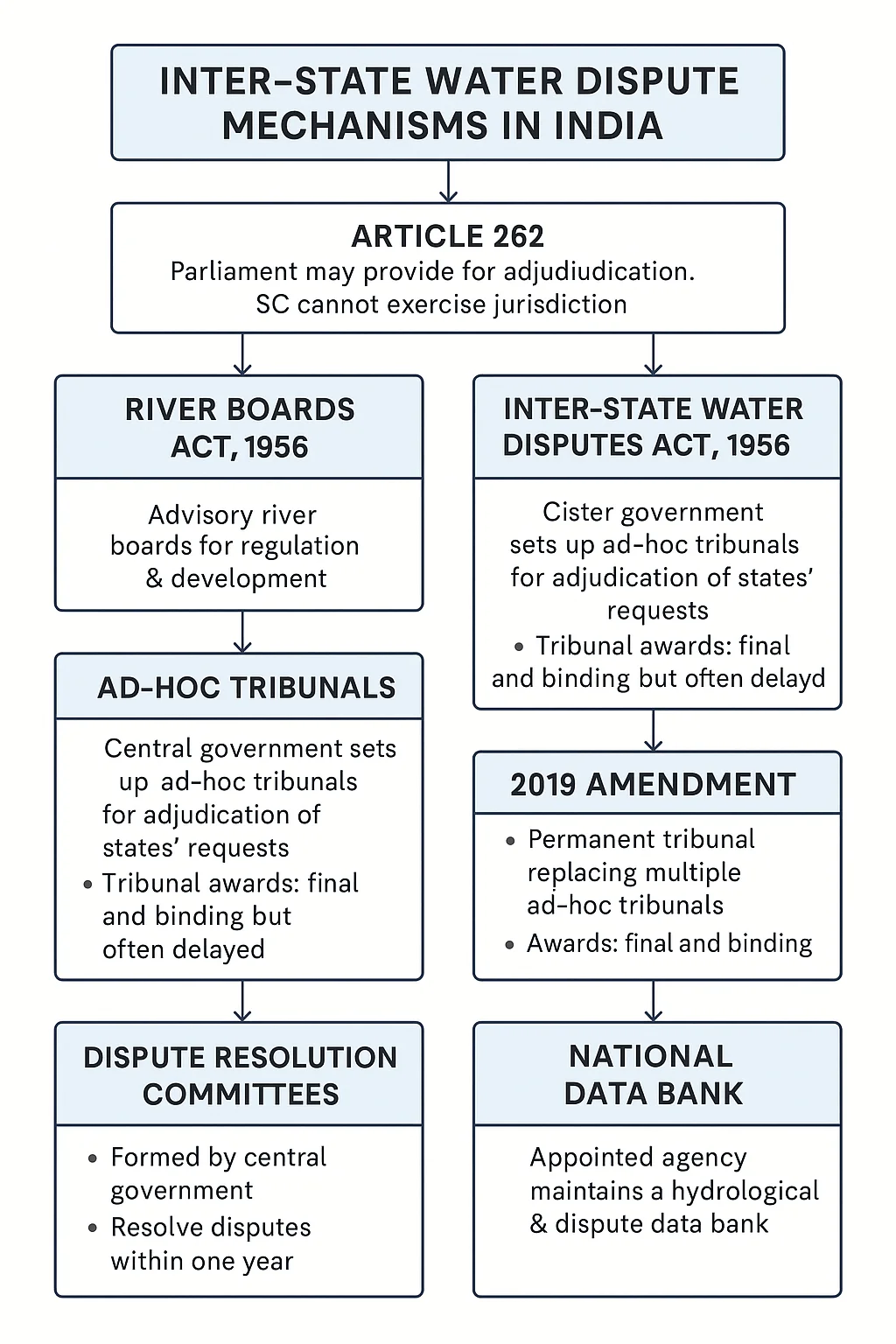
    Inter-state water disputes in India face delays, politicisation, and technical constraints. The 2019 Amendment Act introduced permanent tribunals, Dispute Resolution Committees, and a central data bank to streamline adjudication.

    Challenges and Reforms in Inter-State Water Dispute Resolution
    Detailed Notes (67 points)
    Tap a card to add note • Use the highlight Listen button to play the full section
    A. Challenges in Resolution of Inter-State River Water Disputes
    1. Delay in Tribunal Awards
    1. One of the biggest challenges is the inordinate delay in adjudication.
    2. Example: The Cauvery Water Disputes Tribunal took 17 years (from 1990 to 2007) to deliver its final award.
    3. Such delays defeat the purpose of a specialized mechanism for timely resolution envisaged under Article 262.
    4. Long delays cause loss of public trust and lead to frequent law-and-order issues between affected states.
    2. Judicial Interference
    1. Although Article 262 bars court jurisdiction, states often file Special Leave Petitions (SLPs) under Article 136 in the Supreme Court.
    2. This leads to judicial intervention and prolonged litigation , further delaying final settlement.
    3. Example: The Cauvery dispute continued even after the tribunal award due to appeals in the Supreme Court.
    4. This undermines the finality of tribunal decisions intended by the Constitution.
    3. Composition of Tribunals
    1. Current tribunals consist only of judicial members (judges from the Supreme Court or High Courts).
    2. However, water disputes are multidimensional — involving hydrology, agriculture, engineering, and environmental concerns.
    3. Lack of technical and multidisciplinary experts (e.g., hydrologists, economists, engineers) results in decisions that may not be scientifically sound.
    4. This weakens the credibility and effectiveness of tribunal awards.
    4. Lack of Hydrological Data
    1. States often withhold or manipulate water usage and rainfall data to support their claims.
    2. Absence of a centralized, reliable, and transparent data system leads to conflicting estimates and mistrust.
    3. As a result, tribunals are forced to make decisions without complete or consistent hydrological information .
    5. Politicization of Water Issues
    1. Water disputes are frequently exploited by political parties for electoral gains.
    2. Regional identity and emotional narratives dominate rational discussion on equitable sharing.
    3. Political pressure often leads to non-implementation of tribunal awards or defiance of Supreme Court directives.
    4. Example: Protests and violence during Cauvery water-sharing implementation in Tamil Nadu and Karnataka.
    5. This politicization converts technical disputes into political controversies .
    B. Inter-State River Water Disputes (Amendment) Bill, 2019
    Background
    1. The Inter-State River Water Disputes Act, 1956 was criticized for delays, multiple tribunals, and poor implementation.
    2. To address these issues, the Inter-State River Water Disputes (Amendment) Bill, 2019 was introduced.
    3. The Bill seeks to streamline adjudication , promote data transparency , and establish a permanent institutional mechanism .
    C. Key Provisions of the 2019 Amendment
    1. Disputes Resolution Committee (DRC)
    1. A Disputes Resolution Committee (DRC) is to be constituted by the Central Government before referring a case to the tribunal.
    2. Composition:
    Chairperson (appointed by Centre),
    Experts with at least 15 years of experience in sectors like water management, agriculture, hydrology, and policy,
    One representative from each disputing state.
    3. Function: To encourage negotiation and mediation and prevent escalation of disputes.
    4. Time Limit: Dispute must be resolved within 1 year , extendable by 6 months .
    5. If DRC fails, the dispute is automatically referred to the tribunal.
    2. Permanent Inter-State Water Dispute Tribunal
    1. The Bill replaces the system of multiple ad-hoc tribunals with a single permanent tribunal having multiple benches.
    2. The Permanent Tribunal will function continuously, ensuring institutional continuity and expertise.
    3. Tribunal decisions are final and binding on all parties — maintaining consistency with Article 262.
    4. The previous requirement to publish tribunal awards in the Official Gazette has been removed to avoid procedural delays .
    5. The Central Government must frame a detailed implementation scheme for each award to ensure compliance.
    6. This ensures that tribunal awards do not remain unimplemented for years.
    3. Data Bank and Information System
    1. The Central Government will designate an appropriate agency to maintain a National Hydrological Data Bank .
    2. This data bank will include real-time data on:
    River flow and rainfall,
    Groundwater levels,
    Water usage and storage,
    Historical dispute-related information.
    3. Objective: To ensure scientific, transparent, and evidence-based decision-making by the tribunal and DRC.
    4. Helps reduce manipulation and improve trust among states.
    D. Expected Benefits of the 2019 Amendment
    1. Timely dispute resolution through fixed timelines and mediation mechanisms.
    2. Reduced litigation due to DRC’s pre-adjudication efforts.
    3. Continuous institutional expertise through a permanent tribunal.
    4. Data-driven decisions minimizing political bias and misinformation.
    5. Enhanced Centre–State coordination through structured consultation and transparency.
    E. Conclusion
    1. The 2019 Amendment aims to transform the dispute resolution system from a reactive and legalistic model to a proactive and cooperative one .
    2. Successful implementation depends on political will, data transparency, and institutional efficiency.
    3. Ultimately, effective water dispute management is vital for ensuring federal harmony and sustainable development in India.

    Challenges vs Reforms in Inter-State Water Disputes

    Challenges2019 Amendment ReformsHindi Notes
    Delayed awards (e.g., Cauvery - 17 years)Timeline: Dispute Resolution Committee resolves within 1 year (extendable 6 months)विलंबित पुरस्कार: समिति 1 वर्ष में समाधान करेगी
    Judicial interference (S.L.P. delays)Permanent tribunal; binding decision reduces reliance on SC appealsन्यायिक हस्तक्षेप: स्थायी ट्रिब्यूनल, बाध्यकारी निर्णय
    Lack of technical expertiseExperts with ≥15 years experience in relevant sectors included in committeesतकनीकी विशेषज्ञता की कमी: विशेषज्ञ समिति में शामिल
    Lack of hydrological dataNational-level data bank to maintain comprehensive informationहाइड्रोलॉजिकल डेटा की कमी: राष्ट्रीय डेटा बैंक स्थापित
    Politicisation of water issuesCentral oversight, permanent tribunal ensures structured legal resolutionजल राजनीतिकरण: केंद्रीय निगरानी, स्थायी ट्रिब्यूनल

    Mains Key Points

    Delays in adjudication, politicisation, and lack of technical data have historically undermined inter-state water dispute resolution.
    The 2019 Amendment creates a single permanent tribunal with binding decisions to expedite resolution.
    Dispute Resolution Committees ensure multi-disciplinary expertise and strict timelines.
    National data bank improves availability of hydrological data for fair and informed decisions.
    Overall reforms aim to reduce political conflict, enhance transparency, and improve compliance.

    Prelims Strategy Tips

    2019 Amendment establishes permanent Inter-State Water Dispute Tribunal.
    Dispute Resolution Committee: Chair + sectoral experts + one member from each state; resolve disputes in 1 year.
    National Data Bank maintained by central government.
    Tribunal decisions final and binding; official gazette publication no longer mandatory.

    Inter-State Water Disputes in India

    Key Point

    Inter-State River Water Disputes are one of the major challenges in federal relations of India. Delay in dispute resolution, judicial interference, lack of technical expertise, data gaps, and politicisation have made water-sharing conflicts highly contentious. The Inter-State River Water Disputes (Amendment) Bill, 2019, seeks to streamline and speed up dispute resolution with a permanent tribunal and better institutional mechanisms.

    Inter-State River Water Disputes are one of the major challenges in federal relations of India. Delay in dispute resolution, judicial interference, lack of technical expertise, data gaps, and politicisation have made water-sharing conflicts highly contentious. The Inter-State River Water Disputes (Amendment) Bill, 2019, seeks to streamline and speed up dispute resolution with a permanent tribunal and better institutional mechanisms.

    Detailed Notes (36 points)
    Tap a card to add note • Use the highlight Listen button to play the full section
    A. Challenges in Resolution of Inter-State Water Disputes
    1. Delayed Awards:
    One of the major challenges is the excessive delay in tribunal verdicts.
    Example: The Cauvery Water Disputes Tribunal took nearly 17 years (1990–2007) to deliver its final award.
    Such delays reduce the effectiveness of the dispute resolution mechanism and create prolonged uncertainty.
    2. Judicial Interference:
    Although Article 262 bars the jurisdiction of courts, states often approach the Supreme Court through Special Leave Petitions (SLPs) under Article 136.
    This leads to further delays and undermines the finality of tribunal awards .
    3. Composition of Tribunal:
    The tribunals are composed of only judicial members (judges of the Supreme Court or High Courts).
    Water disputes are complex and require inputs from hydrologists, engineers, environmentalists, and economists .
    The absence of multidisciplinary expertise affects the quality and technical soundness of awards.
    4. Lack of Reliable Hydrological Data:
    Accurate data on rainfall, river flow, and water usage are often unavailable or disputed between states.
    Tribunals frequently make decisions without complete and verified data .
    This increases the chances of disagreement and non-compliance .
    5. Politicisation of Water Issues:
    Water disputes are often used for electoral politics rather than cooperative resolution.
    Parties and state governments exploit emotional sentiments for regional and political gains .
    This leads to aggravated inter-state tensions and hinders implementation of tribunal awards.
    B. Inter-State River Water Disputes (Amendment) Bill, 2019
    1. Disputes Resolution Committee (DRC)
    Formation: Constituted by the Central Government before referring any dispute to a tribunal.
    Composition: Chairperson + experts with 15+ years’ experience in relevant fields (like water resources, hydrology, agriculture, etc.) + one representative from each disputing state.
    Timeline: The DRC must resolve disputes within 1 year , extendable by 6 months .
    Objective: Encourage negotiation and mediation to reduce the need for tribunal intervention.
    2. Permanent Inter-State Water Dispute Tribunal
    All existing ad-hoc tribunals will be dissolved and replaced by a single permanent tribunal with multiple benches.
    This ensures institutional continuity, specialization, and faster adjudication .
    Tribunal’s decision is final and binding on the states involved.
    The earlier requirement to publish awards in the Official Gazette has been removed to speed up implementation.
    The Central Government must frame a scheme for implementing tribunal awards in a time-bound manner.
    3. National Data Bank and Information System
    The Central Government will appoint an agency to maintain a National Hydrological Data Bank .
    The data bank will store real-time data on river water flows, rainfall, groundwater, and usage statistics .
    Objective: To ensure data transparency, accuracy, and scientific decision-making for future dispute resolutions.

    Challenges vs 2019 Bill Provisions

    ChallengeProvision in 2019 Bill
    Delayed AwardsSingle permanent tribunal with time-bound DRC (1 year + 6 months)
    Judicial InterferenceFinal and binding decision of tribunal; reduced court role
    Lack of ExpertiseExperts with 15+ years’ experience included in DRC
    Lack of DataNational-level data bank to be maintained
    PoliticisationCentralised mechanism for faster and credible resolution

    Mains Key Points

    Delays, judicial review, politicisation, and lack of expertise weaken dispute resolution.
    Hydrological data gaps aggravate mistrust between states.
    2019 Bill attempts reform: time-bound mechanism, permanent tribunal, expert involvement, and a national data bank.
    Effective implementation and political will remain crucial for success.
    Water disputes test India’s cooperative federalism.

    Prelims Strategy Tips

    First tribunal: Godavari Water Disputes Tribunal (1969).
    Cauvery Tribunal took 17 years to deliver award.
    2019 Bill: replaces multiple tribunals with one permanent body.
    Awards now binding without need for gazette publication.

    Inter-State Border Disputes in India

    Key Point

    Inter-state border disputes in India arise from colonial boundaries, competition for resources, political opportunism, and regionalism. These disputes often lead to violent clashes, secessionist tendencies, underdevelopment, and mistrust among states. A proactive Union role, time-bound judgements, and local involvement are key to resolving them.

    Inter-state border disputes in India arise from colonial boundaries, competition for resources, political opportunism, and regionalism. These disputes often lead to violent clashes, secessionist tendencies, underdevelopment, and mistrust among states. A proactive Union role, time-bound judgements, and local involvement are key to resolving them.

    Detailed Notes (42 points)
    Tap a card to add note • Use the highlight Listen button to play the full section
    A. Present Inter-State Boundary Disputes in India
    1. Belgaum (Karnataka–Maharashtra)
    Origin: Dispute since reorganisation of states on linguistic basis (1956).
    The Mahajan Commission (1966) recommended the transfer of 264 villages (including Belgaum) to Karnataka.
    Maharashtra rejected the recommendation, maintaining that these areas are Marathi-speaking regions .
    The matter is pending before the Supreme Court since 2004.
    Periodic clashes and protests occur, though committees have been set up for local dialogue.
    2. Assam–Nagaland
    Dispute since 1963 , when Nagaland was carved out of Assam.
    Nagaland claims Naga-majority areas lying inside Assam’s territory.
    Despite several peace talks and mediation efforts , violent incidents continue along the boundary.
    The Union Home Ministry has deployed central forces to maintain peace.
    3. Assam–Arunachal Pradesh
    Boundary dispute covering around 804 km , existing since 1987 .
    Stems from the use of colonial-era maps (1873 Inner Line Regulation) for boundary demarcation.
    In 2022, both states signed the Namsai Declaration to resolve the issue amicably through joint committees.
    4. Himachal Pradesh–Ladakh
    Dispute over Sarchu , located on the Leh–Manali highway — a key tourist and trade route.
    Both claim jurisdiction for tourism, taxation, and land rights.
    5. Haryana–Himachal Pradesh
    Ongoing disagreement over Parwanoo region near the border of the two states.
    Relates to land and revenue jurisdiction after the formation of Himachal Pradesh.
    B. Causes of Inter-State Boundary Disputes
    1. Colonial Legacies: Many state boundaries were drawn during British rule without considering ethnic, linguistic, or cultural realities.
    2. Competition for Resources: Disputes often arise over water, forests, minerals, and fertile land along state borders.
    3. Regionalism: Rising sub-national identities make states more sensitive about territorial control.
    4. Political Opportunism: Parties exploit border issues to mobilize regional sentiments for electoral gain.
    5. Geographical and Demographic Factors: Overlapping linguistic and ethnic populations create ambiguities in border areas .
    6. Lack of Proactive Role by the Union Government: The Centre often acts reactively instead of facilitating early mediation .
    7. Ineffective Mechanisms: Inter-State Council and Zonal Councils are underutilized; tribunal or judicial processes take years.
    C. Impacts of Boundary Disputes
    1. Rise of Secessionist or Regionalist Tendencies: Continuous disputes fuel identity-based politics and alienation.
    2. Violent Clashes: Example – Assam–Mizoram clash (2021) led to the death of 5 policemen and injuries to many civilians.
    3. Developmental Stagnation: Disputed border regions remain underdeveloped due to administrative ambiguity.
    4. Spillover Effect: Unresolved disputes in one region can trigger fresh tensions in neighboring states.
    5. Loss of Public Trust: Frequent conflicts weaken citizens’ faith in law and order machinery and the Union’s conflict-resolution capacity.
    D. Way Forward – Strengthening Cooperative Federalism
    1. Permanent Inter-State Council: As suggested by the Sarkaria Commission , institutionalize a permanent council under Article 263 to deliberate on inter-state issues regularly.
    2. Time-Bound Adjudication: Establish clear deadlines for judicial and administrative resolution of disputes.
    3. Union Government as Facilitator: The Centre should act as a neutral mediator promoting consensus, not as a dominant authority.
    4. Local Participation: Include local communities and stakeholders in negotiation and border demarcation processes to ensure ground-level acceptance.
    5. Post-Settlement Development: Formulate a rehabilitation and regional development policy for disputed areas once boundaries are finalized.

    Key Inter-State Border Disputes

    DisputeStates/UTs InvolvedCurrent Status
    BelgaumKarnataka–MaharashtraPending in SC; committees formed
    Assam–NagalandAssam–NagalandFrequent clashes since 1963
    Assam–Arunachal PradeshAssam–Arunachal PradeshNamsai Declaration 2022
    Himachal–LadakhHimachal Pradesh–LadakhDispute over Sarchu
    Haryana–Himachal PradeshHaryana–Himachal PradeshDispute over Parwanoo

    Mains Key Points

    Border disputes stem from colonial-era demarcations and resource competition.
    Frequent clashes erode trust and hinder development in disputed regions.
    Political opportunism often aggravates disputes instead of resolving them.
    Time-bound judicial resolution and proactive Union role are essential.
    Local community participation and rehabilitation policies can ensure long-term peace.

    Prelims Strategy Tips

    Belgaum border dispute is the oldest inter-state dispute (Karnataka–Maharashtra).
    Namsai Declaration (2022) aimed at resolving Assam–Arunachal Pradesh border issue.
    2021 Assam–Mizoram border clash led to death of 5 policemen.
    Sarkaria Commission recommended a permanent Inter-State Council for dispute resolution.

    Article 263: Inter-State Council

    Key Point

    Article 263 provides for the establishment of an Inter-State Council to serve as an advisory body for coordination between the Union and the States. It plays a key role in discussing disputes, investigating issues of common interest, and fostering cooperative federalism.

    Article 263 provides for the establishment of an Inter-State Council to serve as an advisory body for coordination between the Union and the States. It plays a key role in discussing disputes, investigating issues of common interest, and fostering cooperative federalism.

    Detailed Notes (31 points)
    Tap a card to add note • Use the highlight Listen button to play the full section
    A. Nature and Constitutional Basis
    1. The Inter-State Council (ISC) is an advisory constitutional body established under Article 263 of the Constitution of India.
    2. It is meant to promote cooperative federalism by serving as a forum for discussion, coordination, and conflict resolution between the Centre and the States.
    3. The Council is not a permanent body; it is constituted by the President whenever deemed necessary.
    4. It functions as a consultative and coordinating mechanism rather than a decision-making authority.
    B. Scope and Functions (Article 263)
    As per Article 263, the President may establish an Inter-State Council if it appears necessary for the following purposes:
    1. Inquiry and Advice: To inquire into and advise upon disputes that may arise between two or more states.
    2. Discussion of Common Interests: To investigate and discuss subjects of common interest between the Union and the States or among States themselves.
    3. Policy Coordination: To make recommendations for better coordination between the Union and State governments on policy and administrative matters.
    4. The Council thus acts as a platform for dialogue and harmonization in India’s federal system.
    C. Historical Context
    1. Though Article 263 existed since 1950, it was not invoked immediately after independence.
    2. The first body established under this Article was the Central Council of Health to coordinate health policies between Centre and States.
    3. The idea of a formal Inter-State Council was strongly supported by the Sarkaria Commission (1983) and later accepted by the Government.
    4. The Inter-State Council was formally established in 1990 by a Presidential Order issued under Article 263.
    D. Composition of the Inter-State Council
    1. The Constitution does not specify a fixed structure for the Council; its composition is determined by the President’s notification .
    2. As per the current Presidential Order, the present composition is as follows:
    Prime Minister of India – Chairman of the Council.
    Chief Ministers of all States.
    Chief Ministers of Union Territories having Legislative Assemblies (e.g., Delhi, Puducherry).
    Administrators of Union Territories without Legislative Assemblies.
    Governors of States under President’s Rule.
    Six Union Cabinet Ministers including the Union Home Minister (nominated by the Prime Minister).
    Five Ministers of Cabinet rank or Ministers of State with independent charge (also nominated by the PM).
    E. Significance
    1. The ISC promotes dialogue and cooperation among different levels of government.
    2. It serves as a federal bridge between the Union and States, preventing disputes from escalating.
    3. It also ensures policy coherence in key areas like internal security, education, and economic planning.
    4. The Reactivation of the ISC was recommended by both Sarkaria (1983) and Punchhi (2007) Commissions to strengthen India’s cooperative federalism framework.

    Inter-State Council – Key Aspects

    AspectDetails
    NatureAdvisory body under Article 263
    EstablishmentBy President of India
    ScopeAdvising on disputes, discussing common interests
    First UseFor Central Council of Health
    CompositionPM (Chairman), CMs, Governors under President’s Rule, UT Administrators, 6 Cabinet Ministers (incl. Home), 5 other Ministers

    Mains Key Points

    Inter-State Council under Article 263 strengthens cooperative federalism.
    Provides a platform for dialogue between Union and States on disputes and policies.
    Though advisory, its recommendations can influence Centre-State relations.
    Its effectiveness depends on political will and frequency of meetings.
    Permanent institutionalisation could improve inter-governmental coordination.

    Prelims Strategy Tips

    Article 263 enables creation of Inter-State Council.
    First invoked for Central Council of Health.
    Not a permanent body – established by President as required.
    Headed by Prime Minister with CMs and selected Union Ministers as members.

    Inter-State Council and Standing Committee

    Key Point

    The Inter-State Council (ISC), established under Article 263, is a key platform for cooperative federalism. It has a Standing Committee headed by the Union Home Minister to ensure continuous consultation, monitor decisions, and process matters for the Council. Despite its significance, infrequent meetings, narrow agendas, and non-binding recommendations limit its effectiveness.

    The Inter-State Council (ISC), established under Article 263, is a key platform for cooperative federalism. It has a Standing Committee headed by the Union Home Minister to ensure continuous consultation, monitor decisions, and process matters for the Council. Despite its significance, infrequent meetings, narrow agendas, and non-binding recommendations limit its effectiveness.

    Detailed Notes (27 points)
    Tap a card to add note • Use the highlight Listen button to play the full section
    A. Standing Committee of the Inter-State Council
    1. The Standing Committee of the Inter-State Council (ISC) is a smaller, permanent body created to ensure that the ISC functions continuously even when full meetings are not held frequently.
    2. It is headed by the Union Home Minister and includes a few Chief Ministers and Union Ministers as members.
    3. The committee serves as an executive arm of the ISC, handling ongoing inter-state coordination and policy review.
    Functions of the Standing Committee:
    Continuous Consultation: Ensures regular dialogue and consultation on matters of inter-state relations and cooperative federalism.
    Agenda Preparation: Processes and filters issues for consideration by the full Inter-State Council.
    Monitoring Implementation: Monitors and reviews the implementation of recommendations and decisions taken by the ISC.
    Advisory Function: Examines any matter referred to it by the Chairman (Prime Minister) or the Council itself.
    Facilitating Coordination: Works as a bridge between the Centre and States for improving administrative efficiency and mutual cooperation.
    B. Issues with the Functioning of the Inter-State Council
    Despite being a constitutional mechanism for promoting cooperative federalism, the ISC has several functional shortcomings:
    1. Infrequent Meetings: The Presidential order establishing the ISC requires at least three meetings every year , but this has rarely been followed. Meetings have been held irregularly, sometimes with gaps of several years.
    2. Narrow Scope of Discussions: The agenda of ISC meetings often avoids critical or contentious inter-state disputes and focuses only on general administrative matters.
    3. Advisory and Non-Binding Role: The ISC’s recommendations are not binding on the Union or the States, limiting its practical impact.
    4. Lack of Functional Autonomy: The ISC lacks a dedicated professional Secretariat for research, coordination, and follow-up. It depends entirely on the Union Home Ministry for logistics and policy support.
    5. Political Dominance: The Council is often viewed as a forum dominated by the Centre, used more for promoting the Union government’s agenda than for genuine consensus-building.
    6. Implementation Gap: Many recommendations made by the ISC remain unimplemented due to absence of monitoring mechanisms and accountability structures.
    C. Recommendations to Strengthen the Inter-State Council
    Various commissions and experts have made suggestions to enhance the relevance, autonomy, and effectiveness of the ISC:
    1. Strengthen Legal Position: The Sarkaria Commission (1983) and Punchhi Commission (2007) recommended a constitutional amendment to give the ISC a permanent and stronger legal status.
    2. Institutional Autonomy: The ISC should function independently of the Ministry of Home Affairs, with a dedicated Secretariat and budget.
    3. Technical Expertise: Empower the ISC to constitute ad hoc sub-committees or expert panels for examining specific issues such as water disputes, fiscal devolution, or disaster management.
    4. Permanent Professional Secretariat: Establish a full-time Secretariat on the model of Canada’s Intergovernmental Conference Secretariat to provide research support, coordination, and data analysis.
    5. Regular Meetings: The ISC and its Standing Committee should meet at least thrice a year with a publicly available agenda and post-meeting action reports.
    6. Transparency and Inclusiveness: Include representatives from local governments and regional bodies for wider consultation on national policies impacting states.
    7. Performance Review: An annual review of ISC’s recommendations and follow-up status should be presented before Parliament to ensure accountability.

    Inter-State Council – Issues vs Reforms

    IssuesRecommended Reforms
    Infrequent meetingsMandatory and time-bound meetings (3 per year)
    Narrow agendaBroaden agenda to include contentious disputes
    Non-binding recommendationsStrengthen legal status with constitutional amendment
    No SecretariatEstablish permanent professional Secretariat
    Political dominanceEnsure neutrality and consensus-based functioning

    Mains Key Points

    Standing Committee ensures continuity of ISC’s work between meetings.
    Infrequent meetings and lack of Secretariat weaken ISC’s effectiveness.
    Advisory nature limits enforceability of its recommendations.
    Strengthening ISC requires constitutional backing and technical expertise.
    Permanent Secretariat and proactive Union role can enhance cooperative federalism.

    Prelims Strategy Tips

    Standing Committee of ISC is chaired by the Union Home Minister.
    ISC Order mandates 3 meetings annually (rarely followed).
    Recommendations are advisory and non-binding.
    Sarkaria Commission suggested ad hoc Sub-Committees and permanent Secretariat.

    Public Acts, Records, Judicial Proceedings & Inter-State Trade and Commerce

    Key Point

    The Constitution ensures full faith and credit to public acts, records, and judicial proceedings across India, enabling enforcement of civil judgments nationwide. Articles 301–307 (Part XIII), inspired by the Australian Constitution, guarantee freedom of trade, commerce, and intercourse, subject to reasonable restrictions imposed by Parliament or State Legislatures in the public interest.

    The Constitution ensures full faith and credit to public acts, records, and judicial proceedings across India, enabling enforcement of civil judgments nationwide. Articles 301–307 (Part XIII), inspired by the Australian Constitution, guarantee freedom of trade, commerce, and intercourse, subject to reasonable restrictions imposed by Parliament or State Legislatures in the public interest.

    Detailed Notes (39 points)
    Tap a card to add note • Use the highlight Listen button to play the full section
    A. Public Acts, Records, and Judicial Proceedings
    1. The Constitution provides that full faith and credit shall be given throughout India to:
    Public Acts: Legislative and executive actions of the Union and the States.
    Public Records: Official records and documents maintained by the Union or States.
    Judicial Proceedings: Decisions, orders, and judgments delivered by courts within India.
    2. This principle ensures legal uniformity and mutual recognition of state actions across the country.
    3. Enforceability: Final judgments and orders of civil courts in one State are executable anywhere in India, ensuring consistency in civil justice.
    4. Note: This provision applies only to civil matters , not to criminal proceedings.
    5. Objective: To maintain national integration, unity, and smooth legal coordination among all States and Union Territories.
    B. Inter-State Trade and Commerce (Part XIII: Articles 301–307)
    1. These provisions are inspired by the Australian Constitution and aim to ensure the economic unity and free flow of goods and services throughout India.
    2. They prevent both the Union and States from creating trade barriers that may hamper national integration.
    Article 301 – Freedom of Trade, Commerce, and Intercourse
    1. Declares that trade, commerce, and intercourse throughout the territory of India shall be free and unrestricted .
    2. Objective: To remove economic and border barriers between States and create a single national market .
    3. The term ‘intercourse’ includes movement of goods, people, and services across state boundaries.
    4. However, this freedom is not absolute and can be regulated under certain conditions.
    Articles 302–305 – Permissible Restrictions on Freedom
    1. Article 302 – Parliament’s Power:
    Parliament may impose restrictions on the freedom of trade, commerce, or intercourse in the public interest .
    Such restrictions may include duties, tariffs, or movement controls during national emergencies or scarcity of essential goods.
    2. Article 303 – Non-Discrimination Clause:
    Neither Parliament nor a State Legislature can make any law that gives preference to one State over another.
    Exception: Parliament may relax this rule in case of scarcity of goods (to ensure equitable distribution).
    3. Article 304 – State’s Power to Impose Restrictions:
    State Legislatures may impose reasonable restrictions on trade, commerce, and intercourse within or with other States , but only with prior Presidential assent .
    States may levy taxes on imported goods from other States, provided they are equal to those imposed on similar local goods (no discriminatory taxation).
    4. Article 305 – Protection of Existing Laws:
    Existing laws and State monopoly undertakings (like nationalization acts) are protected from the operation of Article 301.
    Example: Nationalization of industries, transport, or trade sectors can be exempted from the rule of free trade.
    Article 307 – Appointment of an Authority
    1. Empowers Parliament to establish an authority to monitor and enforce the provisions of Articles 301–304.
    2. Such an authority could help in resolving trade disputes between States and ensuring uniformity in trade regulations.
    3. However, as of 2023 , no such authority has been constituted by Parliament.
    4. The Sarkaria Commission and Punchhi Commission both recommended that an Inter-State Trade and Commerce Commission be established under Article 307 to strengthen economic federalism.
    Key Judgments on Article 301
    Atiabari Tea Co. (1961): taxes that directly and immediately hamper the free movement of trade can violate Article 301.
    Automobile Transport (1962): regulatory and compensatory taxes (for facilities such as roads) do not violate freedom of trade.
    Jindal Stainless v. State of Haryana (2016, nine judges): non-discriminatory taxes such as entry tax are not restrictions under Article 301; only discriminatory taxes are hit by Article 304(a).

    Key Provisions: Public Acts & Inter-State Trade

    AspectDetails
    Public Acts & RecordsFull faith and credit across India
    Judicial ProceedingsCivil judgments enforceable nationwide
    Article 301Freedom of trade, commerce, and intercourse
    Articles 302–305Restrictions by Parliament/States under conditions
    Article 307Parliament may appoint authority (not yet created)

    Mains Key Points

    Full faith and credit clause ensures unity in legal and administrative recognition across India.
    Freedom of trade and commerce prevents economic fragmentation between states.
    Restrictions allow balancing public interest with economic liberty.
    Absence of authority under Article 307 limits enforcement mechanisms.
    These provisions reflect India’s federal spirit with economic integration.

    Prelims Strategy Tips

    Inspired by Australian Constitution.
    Article 301 guarantees freedom of trade, commerce, and intercourse.
    Restrictions by Parliament (public interest) and States (with President’s prior consent).
    Civil court judgments are executable throughout India.
    No authority under Article 307 has been set up yet.

    Zonal Councils in India

    Key Point

    Zonal Councils are statutory bodies established under the States Reorganisation Act, 1956. They are deliberative and advisory platforms created to promote cooperation and coordination among states and Union Territories within a region, considering natural divisions, cultural affinity, communication links, and economic development needs.

    Zonal Councils are statutory bodies established under the States Reorganisation Act, 1956. They are deliberative and advisory platforms created to promote cooperation and coordination among states and Union Territories within a region, considering natural divisions, cultural affinity, communication links, and economic development needs.

    Detailed Notes (44 points)
    Tap a card to add note • Use the highlight Listen button to play the full section
    A. Nature and Legal Basis
    1. Zonal Councils are statutory advisory bodies established under the States Reorganisation Act, 1956.
    2. They are deliberative and consultative in nature — functioning as forums for cooperation and coordination between States and Union Territories (UTs) in a particular zone.
    3. Unlike the Inter-State Council (a constitutional body under Article 263), Zonal Councils are statutory in origin .
    4. The Home Ministry acts as the nodal authority for organizing their meetings and implementing their recommendations.
    B. Objectives of Zonal Councils
    The main aim of the Zonal Councils is to promote national integration and cooperative federalism by strengthening inter-state relations.
    Key objectives include:
    1. Promoting cooperation and coordination among States and UTs in each zone.
    2. Discussing matters related to economic and social planning , development, and resource sharing.
    3. Resolving border disputes and issues of law and order.
    4. Discussing linguistic, cultural, or regional identity issues and promoting mutual understanding.
    5. Coordinating inter-state transport, communication, and infrastructure development projects.
    6. Serving as an advisory forum where regional issues can be settled without resorting to litigation or confrontation.
    C. Factors Considered in Formation of Zonal Councils
    In dividing India into zones, the following factors were taken into account:
    1. Natural divisions of the country such as geography and topography.
    2. River systems and communication routes connecting different states.
    3. Cultural and linguistic affinity among the states within a zone.
    4. Economic development, security, and law & order requirements for better coordination and planning.
    5. The objective was to group states with common socio-economic and administrative interests together.
    D. Composition and Structure
    Each Zonal Council consists of:
    1. Chairman: The Union Home Minister (ex-officio).
    2. Vice-Chairman: The Chief Minister of the host state (rotating basis).
    3. Members: Chief Ministers and two other Ministers from each member State in the zone.
    4. Advisory Members: Representatives from Union Territories and senior Central officials (as special invitees).
    E. The Five Zonal Councils of India
    There are five Zonal Councils based on geographical division and administrative convenience:
    1. Northern Zonal Council – Headquarters: New Delhi
    Members: Himachal Pradesh, Haryana, Punjab, Rajasthan, Union Territories of Jammu & Kashmir, Ladakh, Delhi, and Chandigarh.
    2. Central Zonal Council – Headquarters: Allahabad (Prayagraj)
    Members: Uttar Pradesh, Uttarakhand, Chhattisgarh, Madhya Pradesh.
    3. Eastern Zonal Council – Headquarters: Kolkata
    Members: Bihar, Jharkhand, West Bengal, Odisha.
    4. Western Zonal Council – Headquarters: Mumbai
    Members: Gujarat, Maharashtra, Goa, and Union Territory of Dadra & Nagar Haveli and Daman & Diu.
    5. Southern Zonal Council – Headquarters: Chennai
    Members: Andhra Pradesh, Telangana, Karnataka, Tamil Nadu, Kerala, and Union Territory of Puducherry.
    F. Significance
    1. Zonal Councils promote regional cooperation and help reduce inter-state friction.
    2. They act as forums for dialogue on developmental, administrative, and security-related issues.
    3. They strengthen Centre-State relations through discussion rather than confrontation.
    4. Regular meetings of Zonal Councils help build consensus-based governance and address emerging issues like border security, migration, and disaster management.

    Zonal Councils – Membership and Headquarters

    Zonal CouncilStates/UTsHeadquarters
    NorthernHP, Haryana, Punjab, Rajasthan, J&K, Ladakh, Delhi, ChandigarhNew Delhi
    CentralUP, Uttarakhand, Chhattisgarh, MPAllahabad
    EasternBihar, Jharkhand, West Bengal, OdishaKolkata
    WesternGujarat, Maharashtra, Goa, Dadra & Nagar Haveli and Daman & DiuMumbai
    SouthernAP, Telangana, Karnataka, Tamil Nadu, Kerala, PuducherryChennai

    Mains Key Points

    Zonal Councils promote cooperative federalism through dialogue and coordination.
    They provide a platform for resolving inter-state issues outside of courts.
    Though advisory, they help in harmonising policies across states.
    Factors like natural divisions, cultural affinity, and economic planning guided their formation.
    Strengthening their role with greater frequency of meetings could enhance their effectiveness.

    Prelims Strategy Tips

    Zonal Councils established under States Reorganisation Act, 1956.
    Five Zonal Councils: Northern, Central, Eastern, Western, Southern.
    They are deliberative and advisory – not binding.
    Formation considered natural divisions, cultural/linguistic affinity, and economic needs.

    Composition of Zonal Councils & North-Eastern Council

    Key Point

    Zonal Councils, created under the States Reorganisation Act, 1956, are statutory advisory bodies to promote coordination among states. Their composition includes Union ministers, state CMs, other ministers, and administrators of UTs, with officials acting as advisors. The North-Eastern Council (NEC), set up under the 1971 Act, functions as a statutory regional planning body for the North-Eastern region.

    Zonal Councils, created under the States Reorganisation Act, 1956, are statutory advisory bodies to promote coordination among states. Their composition includes Union ministers, state CMs, other ministers, and administrators of UTs, with officials acting as advisors. The North-Eastern Council (NEC), set up under the 1971 Act, functions as a statutory regional planning body for the North-Eastern region.

    Detailed Notes (39 points)
    Tap a card to add note • Use the highlight Listen button to play the full section
    A. Composition of Zonal Councils
    Each Zonal Council consists of both voting and non-voting members, ensuring representation from the Union, States, and Union Territories within each zone.
    1. Members with Voting Rights:
    1. Union Home Minister – Acts as the Chairman of all Zonal Councils.
    2. Chief Ministers of all States in the respective zone – One of them acts as Vice-Chairman by rotation for one year.
    3. Two other Ministers from each member State in the zone.
    4. Administrators of the Union Territories (UTs) within the concerned zone.
    2. Members without Voting Rights (Advisory Members):
    5. Chief Secretaries of all State Governments in the zone.
    6. Development Commissioners (or equivalent senior officers) from each State in the zone.
    → These officials attend meetings to provide administrative and technical input but do not possess voting rights.
    3. Chairmanship and Meetings:
    - The Union Home Minister presides as Chairman of every Zonal Council.
    - The Vice-Chairman (rotating Chief Minister) presides in the absence of the Home Minister.
    - Each Council generally meets once or twice a year to deliberate on inter-state issues such as border disputes, economic planning, and coordination.
    B. North Eastern Council (NEC)
    The North Eastern Council (NEC) is a distinct statutory regional planning body created specifically for India’s northeastern region.
    1. Legal Basis:
    - Established under the North Eastern Council Act, 1971 (amended in 2002 ).
    - Unlike Zonal Councils, the NEC is not a constitutional body , but a statutory organization .
    2. Coverage:
    - Member States: Assam, Arunachal Pradesh, Manipur, Meghalaya, Mizoram, Nagaland, Tripura, and Sikkim .
    - Initially covered seven states; Sikkim was included after the 2002 amendment.
    3. Composition of NEC:
    1. Governors of all eight member States.
    2. Chief Ministers of all eight member States.
    3. Three members nominated by the President of India (including experts or Union Ministers dealing with North Eastern affairs).
    4. Chairperson: The Union Home Minister served as ex-officio Chairman until 2002; after amendment, the Governor of a NE State is nominated as Chairman , and the Minister for DoNER acts as Vice-Chairman .
    4. Nature and Role:
    - Initially created as an advisory body to coordinate policy and planning among the northeastern States.
    - After the 2002 amendment, its role was expanded — now functions as a Regional Planning Body for the North Eastern Region (NER).
    - NEC helps in economic and social development , reviewing progress of projects, and monitoring inter-state coordination in the region.
    - Works under the administrative control of the Ministry of Development of North Eastern Region (DoNER) .
    5. Functions of NEC:
    1. Discuss and coordinate economic and social planning in the North-East.
    2. Formulate and review developmental projects having regional importance.
    3. Promote infrastructure development – transport, power, irrigation, and communication.
    4. Foster cooperation among NE States to reduce regional disparities and promote inclusive growth.
    5. Advise the Central Government on matters affecting NE development and act as a forum for consultation between Centre and States.

    Composition of Zonal Councils

    CategoryMembers
    With Voting RightsUnion Home Minister (Chairman), CMs of states (Vice Chairman by rotation), 2 other ministers from each state, Administrators of UTs in the zone
    Without Voting RightsChief Secretaries of states, Developmental Commissioners of states

    North-Eastern Council (NEC)

    AspectDetails
    EstablishedNorth Eastern Council Act, 1971 (Amended 2002)
    NatureStatutory (Not Constitutional)
    States CoveredAssam, Manipur, Mizoram, Arunachal Pradesh, Nagaland, Meghalaya, Tripura, Sikkim
    Original RoleAdvisory Body
    Current RoleRegional Planning Body
    CompositionGovernors + Chief Ministers + 3 Presidential nominees

    Mains Key Points

    Zonal Councils ensure cooperative federalism by enabling consultation between Union, States, and UTs.
    Composition balances political executives (CMs, ministers) with administrators (UT heads).
    Advisory members like Chief Secretaries provide administrative perspective.
    North-Eastern Council addresses unique developmental challenges of the region.
    Strengthening NEC with more financial and administrative powers could enhance regional planning.

    Prelims Strategy Tips

    Zonal Councils created under States Reorganisation Act, 1956.
    Union Home Minister is Chairman; CMs act as Vice Chairman by rotation.
    North-Eastern Council is a statutory body (1971 Act), not constitutional.
    NEC now functions as a Regional Planning Body, not just advisory.

    Functions, Objectives and Challenges of Zonal Councils

    Key Point

    Zonal Councils were established under the States Reorganisation Act, 1956 to promote cooperation, coordination, and emotional integration among states and between the Centre and states. They address issues such as economic and social planning, linguistic minorities, border disputes, and inter-state transport. However, regionalism, irregular meetings, and limited effectiveness have hindered their role. Commissions like Sarkaria and Punchhi have recommended revitalising them to strengthen cooperative federalism.

    Zonal Councils were established under the States Reorganisation Act, 1956 to promote cooperation, coordination, and emotional integration among states and between the Centre and states. They address issues such as economic and social planning, linguistic minorities, border disputes, and inter-state transport. However, regionalism, irregular meetings, and limited effectiveness have hindered their role. Commissions like Sarkaria and Punchhi have recommended revitalising them to strengthen cooperative federalism.

    Detailed Notes (41 points)
    Tap a card to add note • Use the highlight Listen button to play the full section
    A. Objectives and Functions of Zonal Councils
    The Zonal Councils were established to strengthen the spirit of cooperative federalism and national integration in India. Their role is both advisory and coordinative.
    1. Key Objectives:
    1. Promote emotional integration of the country by reducing regional imbalances and building unity among diverse communities.
    2. Enhance national unity and coordination between States and Union Territories.
    3. Encourage cooperation between the Centre and the States for better governance and policy implementation.
    4. Maintain political balance and ensure harmony among various regions to prevent feelings of neglect or alienation.
    5. Serve as a platform for dialogue to address issues between states in a cooperative and non-confrontational manner.
    2. Functions and Areas of Discussion:
    The Zonal Councils are empowered to discuss and make recommendations on matters of common interest , including:
    - Economic and social planning and development projects affecting multiple states.
    - Welfare of linguistic minorities and promotion of cultural harmony.
    - Settlement of inter-state border disputes through discussion and consensus.
    - Coordination of inter-state transport and communication systems.
    - Public health, education, and environment issues involving multiple states.
    - Law and order concerns in border regions and migration management.
    B. Challenges Faced by Zonal Councils
    Despite their importance, Zonal Councils have faced several challenges that have limited their effectiveness:
    1. Rise of regionalism and parochialism – States often prioritize local political interests over national cooperation.
    2. Irregular meetings – Councils do not meet as frequently as required; follow-up on decisions is weak.
    3. Limited implementation – Recommendations are advisory, not binding on states or the Centre.
    4. Overlapping jurisdictions with other bodies such as the Inter-State Council and NITI Aayog lead to confusion.
    5. Regional issues often overshadow national priorities in discussions.
    C. Recommendations for Strengthening Zonal Councils
    Several expert bodies and commissions have made suggestions to revitalize Zonal Councils and make them more effective:
    1. Punchhi Commission (2010):
    - Recommended that Zonal Councils should meet at least twice a year to ensure regular consultation and coordination.
    - Suggested creation of a permanent secretariat for the Councils to ensure continuity and follow-up of decisions.
    2. Sarkaria Commission (1988):
    - Recommended that Zonal Councils be reconstituted and reactivated to strengthen the federal structure of India.
    - Emphasized promoting consultative decision-making to build trust between the Centre and States.
    3. Setalvad Study Team on Centre-State Relations:
    - Proposed strengthening the Inter-State Council to supplement the functioning of Zonal Councils.
    - Emphasized a structured mechanism for resolving inter-state disputes amicably.
    4. NITI Aayog’s Governing Council:
    - Can act as a complementary body to Zonal Councils by focusing on developmental coordination and policy planning across states.
    - Encourages cooperative and competitive federalism through dialogue-based governance.
    5. Overall Suggestions:
    - Empower Zonal Councils with advisory and coordinating authority backed by administrative support.
    - Encourage regular participation of Chief Ministers and senior officials.
    - Ensure follow-up mechanisms to monitor implementation of recommendations.

    Zonal Councils – Objectives, Challenges and Recommendations

    AspectDetails
    ObjectivesEmotional integration, unity, coordination, Centre-State cooperation, political balance
    FunctionsRecommendations on economic/social planning, linguistic minorities, border disputes, transport
    ChallengesRise of regionalism, infrequent meetings, regional issues dominate
    RecommendationsPunchhi Commission (2 meetings/year), Sarkaria Commission (reactivation), Setalvad (strengthen ISC), NITI Aayog (support role)

    Mains Key Points

    Zonal Councils foster unity and coordination but face challenges due to regionalism and irregular meetings.
    They address vital issues like economic planning, minorities, transport, and border disputes.
    Non-binding nature and limited political will reduce effectiveness.
    Punchhi and Sarkaria Commissions emphasise revival of Zonal Councils.
    Strengthening with regular meetings and integration with NITI Aayog could enhance their role in cooperative federalism.

    Prelims Strategy Tips

    Zonal Councils: statutory, deliberative and advisory (1956).
    Objectives: emotional integration, unity, Centre-State cooperation.
    Punchhi Commission: minimum two meetings annually.
    Sarkaria Commission: reactivation to promote federalism.

    Administrative Relations: Control of Union over States (Article 257)

    Key Point

    Article 257 imposes certain obligations on the states and gives the Union power to issue directions, thereby ensuring that the executive power of the states is exercised in compliance with Union laws and does not impede the executive power of the Union. This is a key provision defining the centralising tendency of Indian federalism.

    Article 257 imposes certain obligations on the states and gives the Union power to issue directions, thereby ensuring that the executive power of the states is exercised in compliance with Union laws and does not impede the executive power of the Union. This is a key provision defining the centralising tendency of Indian federalism.

    Detailed Notes (13 points)
    Tap a card to add note • Use the highlight Listen button to play the full section
    A. Constitutional Mandate (Article 257)
    1. Obligation of States: Article 257(1) mandates that the executive power of every State must be exercised in such a way as to ensure compliance with the laws made by Parliament .
    2. No Impeding Union Executive: The State executive must also ensure that its actions do not impede or prejudice the exercise of the executive power of the Union .
    3. Union's Power to Direct: Article 257(2) empowers the Union Government to issue directions to a State concerning the discharge of its executive functions, where necessary.
    4. Consequence of Non-compliance (Article 365): If a State fails to comply with any direction given by the Union, the President may hold that a situation has arisen in which the government of the State cannot be carried on in accordance with the provisions of the Constitution, thereby leading to President's Rule (Article 356).
    B. Examples of Union Directions to States
    1. Protection of Railways: The Union can direct States regarding the construction and maintenance of means of communication declared to be of national or military importance.
    2. Welfare of Scheduled Tribes: The Union can issue directions regarding the implementation of schemes for the welfare of Scheduled Tribes in the States.
    3. Financial Discipline: During a Financial Emergency (Article 360), the Union can direct States on financial propriety and prudence.
    C. Significance
    1. Article 257 ensures the supremacy of the Union 's executive authority and the uniform application of central laws across all states.
    2. It is considered a unitary feature of the Constitution, providing the Centre with administrative control over the States and acting as a safeguard for national unity.
    3. The power to give directions must, however, be exercised with caution and not arbitrarily, as highlighted by various Centre-State Commissions (Sarkaria, Punchhi).

    Article 257: Union Control Over States

    MandateUnion’s PowerConsequence of Non-compliance
    State must comply with Parliamentary laws (Art. 256).Union can issue administrative directions to States.President's Rule (Art. 356/365) can be imposed.

    Mains Key Points

    Article 257 ensures the smooth execution of Union policies and national integration by placing states under an obligation to comply.
    The power to give directions must be used judiciously, as arbitrary use can lead to misuse of Article 356 and undermine cooperative federalism.
    It highlights the constitutional asymmetry where the Centre holds greater administrative leverage over the State executive.

    Prelims Strategy Tips

    Article 257 empowers the Union to give directions to States.
    Failure to comply with directions is a ground for President's Rule (Art. 365).
    It is a key provision reflecting the unitary bias of the Constitution.
    Directions can be issued for the protection of railways and welfare of SC/STs.

    North-Eastern Council (NEC) and Zonal Councils

    Key Point

    The North-Eastern Council (NEC) is a statutory regional planning body (NEC Act, 1971), distinct from the Zonal Councils (States Reorganisation Act, 1956). While both aim to foster cooperation, the NEC focuses specifically on the economic and social development of the North-Eastern region, whereas Zonal Councils address broader inter-state coordination issues across five geographical zones.

    The North-Eastern Council (NEC) is a statutory regional planning body (NEC Act, 1971), distinct from the Zonal Councils (States Reorganisation Act, 1956). While both aim to foster cooperation, the NEC focuses specifically on the economic and social development of the North-Eastern region, whereas Zonal Councils address broader inter-state coordination issues across five geographical zones.

    Detailed Notes (17 points)
    Tap a card to add note • Use the highlight Listen button to play the full section
    A. North-Eastern Council (NEC)
    1. Status: Statutory body established under the North Eastern Council Act, 1971 (amended in 2002).
    2. Focus: Regional planning and development for the eight North-Eastern States (Assam, Arunachal Pradesh, Manipur, Meghalaya, Mizoram, Nagaland, Tripura, and Sikkim).
    3. Composition (Post-2002): Includes Governors and Chief Ministers of all member States, along with Presidential nominees. The Union Home Minister is the Chairman.
    4. Unique Role: NEC is a Regional Planning Body that monitors regional projects and advises the Centre on developmental issues specific to the North-East.
    B. Zonal Councils
    1. Status: Statutory bodies established under the States Reorganisation Act, 1956 .
    2. Focus: Inter-State coordination across five geographical zones (Northern, Central, Eastern, Western, Southern).
    3. Composition: Includes the Union Home Minister (Chairman), Chief Ministers, and two other Ministers from each member State.
    4. Role: Primarily advisory and deliberative , dealing with border disputes, linguistic minorities, and transport issues.
    C. Key Differences (Zonal Councils vs. NEC)
    | Feature | Zonal Councils | North-Eastern Council (NEC) |
    | Legal Basis | States Reorganisation Act, 1956 | NEC Act, 1971 |
    | Focus | Inter-State coordination, boundary, law & order | Regional planning and economic/social development |
    | Coverage | 5 geographical zones + NEC | Exclusively North-Eastern States (8 states) |
    | Nature | Advisory, deliberative | Regional Planning Body |
    | Sikkim | Member of Eastern Zone | Member of NEC (added 2002) |

    North-Eastern Council vs Zonal Councils

    FeatureZonal CouncilsNorth-Eastern Council (NEC)
    Legal BasisStates Reorganisation Act, 1956NEC Act, 1971
    Number of Bodies5 Zonal Councils1 Council
    ChairmanUnion Home MinisterUnion Home Minister
    Core FunctionAdministrative Coordination/Dispute ResolutionRegional Planning/Economic Development
    States CoveredDivided based on geographyNorth-East (8 states)

    Mains Key Points

    The distinction reflects the special needs of the North-East, requiring a dedicated planning body (NEC) for development and security.
    Zonal Councils provide a broad forum for inter-state administrative coordination in larger regions.
    NEC's role as a planning body ensures targeted development efforts to address regional imbalances and internal security challenges.
    Both mechanisms promote dialogue and cooperation, strengthening India's federal structure.

    Prelims Strategy Tips

    NEC is a statutory body (1971 Act), distinct from Zonal Councils (1956 Act).
    Union Home Minister chairs both Zonal Councils and NEC.
    NEC focuses on planning and development for 8 NE states (Sikkim included since 2002).
    Zonal Councils address border disputes and law & order; NEC addresses economic development.

    Chapter Complete!

    Ready to move to the next chapter?

    Polity in the news

    Recent current affairs linked to the syllabus topic they belong to.

    All current affairs