
Indian Polity & Governance: UPSC Notes, Key Concepts & Practice

    High-yield Polity coverage for UPSC Prelims and Mains. Revise the Constitution’s philosophy, rights framework, separation of powers, legislative-executive-judicial relations, federalism, local bodies, and contemporary governance — with crisp summaries, mains points, prelims tips, and MCQs.

    Chapter index

    Indian Polity & Governance

    Interactive study materials with AI assistance

    Indian polity Playlist

    19 chapters • 0 completed

    1

    Making of the Constitution

    18 topics

    2

    Salient Features of the Indian Constitution

    4 topics

    3

    Preamble

    7 topics

    4

    Evolution of States & Union Territories

    7 topics

    5

    Citizenship

    9 topics

    6

    Fundamental Rights

    34 topics

    7

    Directive Principles of State Policy (DPSP)

    19 topics

    8

    Amendment and Basic Structure

    12 topics

    9

    Parliamentary System of Government

    48 topics

    10

    Union Executive

    36 topics

    11

    State Executive

    21 topics

    12

    State Legislature

    11 topics

    13

    Centre-State Relations

    24 topics

    14

    Inter-State Relations

    14 topics

    15

    Emergency Provisions

    13 topics

    Practice
    16

    Supreme Court

    26 topics

    17

    High Court

    20 topics

    18

    Local Government

    21 topics

    19

    UTs + Scheduled and Tribal Areas

    22 topics

    Progress (0%)
    0 / 19 complete

    Chapter 15: Emergency Provisions

    Chapter Test
    13 topics•Estimated reading: 39 minutes

    Emergency Provisions in the Indian Constitution

    Key Point

    Emergency provisions (Part XVIII, Articles 352–360) empower the President to declare emergencies in India. They were inspired by the Weimar Constitution (Germany) and the Government of India Act, 1935. The 42nd and 44th Constitutional Amendments made significant changes to these provisions. There are three types of emergencies: National, State (President’s Rule), and Financial.
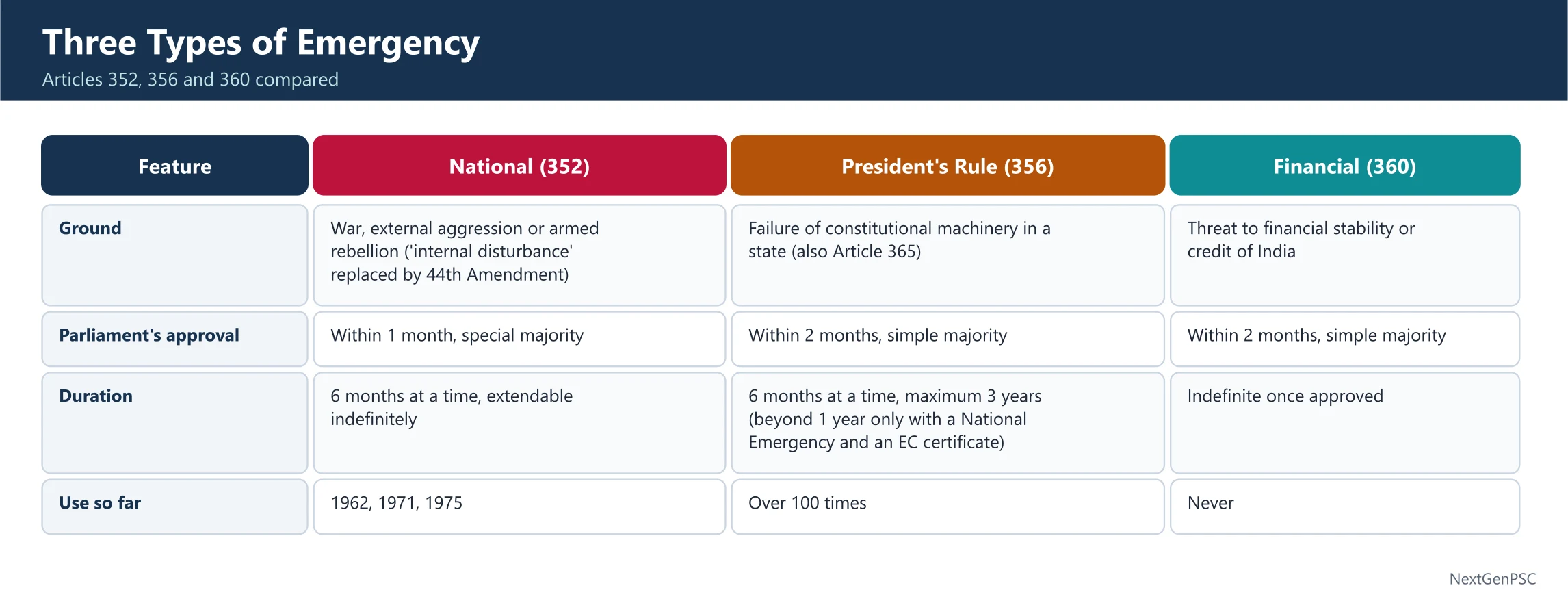
    Emergency provisions (Part XVIII, Articles 352–360) empower the President to declare emergencies in India. They were inspired by the Weimar Constitution (Germany) and the Government of India Act, 1935. The 42nd and 44th Constitutional Amendments made significant changes to these provisions. There are three types of emergencies: National, State (President’s Rule), and Financial.

    Emergency Provisions in the Indian Constitution
    Detailed Notes (38 points)
    Tap a card to add note • Use the highlight Listen button to play the full section
    A. Overview of Emergency Provisions
    1. The Emergency provisions of the Indian Constitution are contained in Part XVIII (Articles 352–360) .
    2. They empower the Central Government to assume greater control over the functioning of states and fundamental rights during extraordinary situations.
    3. These provisions were borrowed from the Weimar Constitution of Germany and the Government of India Act, 1935 .
    4. They have been significantly modified by two major amendments:
    42nd Amendment Act (1976): Strengthened central powers during emergencies.
    44th Amendment Act (1978): Introduced safeguards to prevent misuse, based on lessons from the 1975–77 Emergency.
    5. Purpose: To protect the unity, integrity, and stability of the nation in times of grave crisis while ensuring constitutional governance.
    B. Types of Emergencies in India
    Under the Constitution, there are three types of emergencies that can be declared by the President of India:
    → Although the President formally proclaims an emergency, the decision is taken on the advice of the Prime Minister and the Council of Ministers .
    1. National Emergency – Article 352
    Declared when there is a threat to the security of India or any part thereof due to:
    War
    External aggression
    Armed rebellion (earlier termed 'internal disturbance' before the 44th Amendment).
    During National Emergency, the Centre gains extensive powers over the States, and certain Fundamental Rights (Article 19) are suspended.
    Parliament becomes empowered to legislate on subjects from the State List .
    First declared in 1962 (Indo-China war), then in 1971 (Indo-Pak war), and finally in 1975 (internal emergency declared by Indira Gandhi).
    2. State Emergency – Article 356 (President’s Rule)
    Imposed when the constitutional machinery fails in a State, i.e., the State Government cannot be carried on in accordance with the Constitution.
    The President assumes all or part of the functions of the State Government.
    Parliament exercises the powers of the State Legislature.
    Duration: 6 months at a time (can be extended up to 3 years with Parliament’s approval).
    Judicially reviewed in S.R. Bommai v. Union of India (1994) , which restricted arbitrary imposition of President’s Rule.
    3. Financial Emergency – Article 360
    Declared when the financial stability or credit of India or any part thereof is threatened.
    The President can issue directions to States to observe financial discipline.
    Salaries and allowances of government officials, including judges, can be reduced .
    Never invoked in Indian history till date.
    Purpose: To maintain fiscal stability and prevent economic breakdown.
    C. Common Features of All Emergencies
    1. Proclamation made by the President of India under Article 352, 356, or 360.
    2. Must be based on a written recommendation of the Cabinet (introduced by 44th Amendment).
    3. Must be approved by both Houses of Parliament within a specified time period.
    4. During emergencies, the federal structure becomes unitary — Parliament assumes overriding powers.
    5. Fundamental Rights may be suspended or restricted, depending on the type of emergency.
    6. Judicial review is permitted to prevent arbitrary or mala fide use of emergency powers.

    Emergency Provisions – Key Aspects

    AspectDetails
    Part of ConstitutionPart XVIII (Articles 352–360)
    SourceWeimar Constitution (Germany), Government of India Act 1935
    Amendments42nd (1976) and 44th (1978) Amendments
    TypesNational (Art. 352), State (Art. 356), Financial (Art. 360)
    AuthorityDeclared by President on advice of Council of Ministers

    Mains Key Points

    Emergency provisions ensure unity and security of India during crises.
    They centralize power temporarily to deal with extraordinary situations.
    42nd Amendment made declaration easier; 44th introduced safeguards against misuse.
    National Emergency affects Fundamental Rights; State Emergency leads to President’s Rule; Financial Emergency impacts salaries and financial autonomy.
    Debate continues on balance between security needs and democratic freedoms.

    Prelims Strategy Tips

    Emergency provisions in Part XVIII, Articles 352–360.
    Borrowed from Weimar Constitution (Germany).
    42nd Amendment strengthened Centre’s powers; 44th Amendment restricted misuse.
    Three types: National, State, and Financial Emergency.

    National Emergency (Article 352)

    Key Point

    A National Emergency under Article 352 can be declared in case of war, external aggression, or armed rebellion. It centralises power in the Union and significantly impacts Fundamental Rights and federalism. The 44th Amendment made important safeguards, such as requiring a written Cabinet recommendation. National Emergency has been proclaimed three times in India’s history.

    A National Emergency under Article 352 can be declared in case of war, external aggression, or armed rebellion. It centralises power in the Union and significantly impacts Fundamental Rights and federalism. The 44th Amendment made important safeguards, such as requiring a written Cabinet recommendation. National Emergency has been proclaimed three times in India’s history.

    Detailed Notes (36 points)
    Tap a card to add note • Use the highlight Listen button to play the full section
    A. Grounds for Proclamation of National Emergency
    Under Article 352 , the President of India can declare a National Emergency when the security of India or any part thereof is threatened by:
    1. War – Armed conflict between two or more nations.
    2. External Aggression – Attack or threat from a foreign power without formal declaration of war.
    3. Armed Rebellion – Internal armed uprising against the Government of India.
    Note: The 44th Constitutional Amendment Act (1978) replaced the term ‘ internal disturbance ’ (used earlier) with ‘ armed rebellion ’ to prevent misuse, as seen during the 1975 Emergency.
    B. Proclamation of National Emergency
    1. The President can declare a National Emergency for the whole of India or any part of its territory .
    2. The declaration can be made even before the actual occurrence of war, aggression, or rebellion — if there is an imminent danger of such situations.
    3. Based on the nature of threat:
    If proclaimed due to war or external aggression → it is termed an External Emergency .
    If proclaimed due to armed rebellion → it is termed an Internal Emergency .
    4. The proclamation must be made on the written recommendation of the Union Cabinet (not just the Prime Minister) — a safeguard added by the 44th Amendment Act (1978) .
    5. Once proclaimed, the Emergency must be approved by both Houses of Parliament within one month (earlier two months, reduced by the 44th Amendment).
    6. The proclamation can later be revoked by the President at any time by a subsequent declaration .
    7. The Lok Sabha can also pass a resolution disapproving the Emergency by a simple majority, after which the President must revoke it.
    C. Historical Instances of National Emergency in India
    India has faced three National Emergencies so far:
    1. 26th October 1962 – External Aggression (Indo-China War)
    Declared due to Chinese invasion on India’s northern borders.
    Extended during the Indo-Pak war of 1965.
    Revoked: 10th January 1968 (after more than five years).
    2. 3rd December 1971 – External Aggression (Indo-Pak War / Bangladesh Liberation War)
    Declared during war with Pakistan leading to the creation of Bangladesh.
    Continued even after the war ended and merged with the 1975 internal emergency.
    Revoked: March 1977.
    3. 25th June 1975 – Internal Emergency (Political Crisis)
    Declared by President Fakhruddin Ali Ahmed on the advice of Prime Minister Indira Gandhi.
    Reason: Alleged threat to national security and internal stability following the Allahabad High Court judgment disqualifying Indira Gandhi.
    Resulted in suspension of civil liberties and large-scale political arrests.
    Revoked: March 1977, after the Janata Party’s electoral victory.
    D. Key Takeaways
    1. The 1975 Emergency exposed potential misuse of Article 352, leading to major reforms under the 44th Amendment (1978) .
    2. Now, stricter safeguards and parliamentary accountability ensure the democratic control of emergency powers.
    3. The provision aims to balance national security with protection of citizens’ rights .
    Shah Commission (1977): headed by Justice J.C. Shah, it inquired into the excesses of the 1975–77 Emergency (proclaimed on 25 June 1975 on the ground of 'internal disturbance').

    Instances of National Emergency in India

    YearGroundReasonRevocation
    1962External AggressionIndo-China war; later Indo-Pak war10th January 1968
    1971External AggressionBangladesh Liberation WarMarch 1977
    1975Internal DisturbancePolitical crisis after Indira Gandhi’s election verdictMarch 1977

    Mains Key Points

    National Emergency centralises power and impacts Fundamental Rights.
    Difference between External and Internal Emergencies is crucial.
    44th Amendment introduced safeguards against arbitrary proclamation.
    The 1975 Emergency remains controversial for its misuse.
    Debate continues on balancing national security and democratic freedoms.

    Prelims Strategy Tips

    National Emergency – Article 352.
    44th Amendment replaced ‘Internal Disturbance’ with ‘Armed Rebellion’.
    Cabinet’s written recommendation mandatory since 1978.
    Declared 3 times: 1962, 1971, 1975.

    Approval, Duration and Revocation of National Emergency

    Key Point

    A National Emergency under Article 352 must be approved by both Houses of Parliament within one month and requires renewal every six months by special majority. It can continue indefinitely with repeated approvals. The President may revoke it at any time, but the 44th Amendment introduced safeguards like mandatory Cabinet recommendation, periodic approval, and empowering Lok Sabha to revoke by resolution.

    A National Emergency under Article 352 must be approved by both Houses of Parliament within one month and requires renewal every six months by special majority. It can continue indefinitely with repeated approvals. The President may revoke it at any time, but the 44th Amendment introduced safeguards like mandatory Cabinet recommendation, periodic approval, and empowering Lok Sabha to revoke by resolution.

    Detailed Notes (29 points)
    Tap a card to add note • Use the highlight Listen button to play the full section
    A. Approval of National Emergency
    1. The proclamation of a National Emergency must be approved by both Houses of Parliament within one month from the date of its issue.
    Earlier, the period was two months ; it was reduced to one month by the 44th Constitutional Amendment Act (1978) .
    2. If the Lok Sabha is dissolved at the time of proclamation:
    The Rajya Sabha must approve it first.
    The newly elected Lok Sabha must approve it within 30 days of its first sitting.
    3. The proclamation must be based on the written recommendation of the Union Cabinet — not merely the Prime Minister — to prevent unilateral action by the executive (added by the 44th Amendment).
    4. This ensures collective responsibility of the Union government and prevents arbitrary decision-making.
    5. For continuation, the Emergency requires re-approval every six months by a special majority in both Houses of Parliament.
    6. Special Majority: Majority of total membership of the House + two-thirds of members present and voting.
    7. The periodic approval ensures democratic oversight over the extraordinary powers of the executive.
    B. Duration of National Emergency
    1. In the original Constitution , once approved, a National Emergency could continue indefinitely as long as the Executive desired.
    2. The 44th Amendment Act (1978) introduced a safeguard — now the Emergency must be approved every six months by Parliament.
    3. Thus, though the duration is theoretically unlimited, the requirement for periodic review and approval prevents misuse.
    4. This amendment was made to avoid the indefinite continuation seen during the 1975–1977 Emergency .
    5. It ensures a balance between national security and democratic accountability .
    C. Revocation of National Emergency
    1. The President may revoke a National Emergency at any time by issuing another proclamation — without requiring Parliament’s approval.
    2. Safeguards added by the 44th Amendment Act (1978):
    If the Lok Sabha passes a resolution disapproving (rejecting) the Emergency, the President must revoke it immediately.
    If the Lok Sabha is not in session and at least 1/10th of its members give a written notice, a special session must be convened within 14 days to decide the matter.
    3. This ensures that the Lok Sabha — the House of the People — retains supremacy in decisions related to continuation or revocation of Emergency.
    4. This provision acts as a democratic safeguard against arbitrary or prolonged use of emergency powers.
    D. Difference between Continuation and Cancellation
    1. Continuation: Requires approval every six months by special majority in both Houses of Parliament.
    2. Cancellation (Revocation): Can be initiated by a simple majority in Lok Sabha — the direct representatives of the people.
    3. Continuation → needs approval of both Houses → ensures strict parliamentary check .
    4. Cancellation → can be done solely by Lok Sabha → ensures primacy of elected representatives over emergency powers.

    National Emergency – Approval, Duration and Revocation

    AspectDetails
    ApprovalBoth Houses within 1 month; Cabinet recommendation mandatory
    Duration6 months at a time; indefinite with repeated approvals
    Majority RequiredSpecial majority (total membership + 2/3rd present & voting)
    RevocationBy President anytime; Lok Sabha can compel revocation
    DifferenceContinuation: special majority in both Houses; Cancellation: simple majority in Lok Sabha

    Mains Key Points

    Parliamentary approval is crucial to maintain checks on executive power during emergency.
    44th Amendment reduced initial approval time (2 months → 1 month) and introduced periodic approval every 6 months.
    Special majority requirement prevents easy misuse.
    Revocation powers give supremacy to Lok Sabha, reflecting democratic accountability.
    The safeguards were introduced in response to misuse during 1975–77 Emergency.

    Prelims Strategy Tips

    Approval must be within 1 month (44th Amendment).
    Continuation requires special majority every 6 months.
    Cabinet’s written recommendation mandatory for proclamation.
    Revocation can be by President anytime; Lok Sabha has overriding role.
    Difference: Continuation (special majority both Houses), Revocation (simple majority Lok Sabha).

    Effects of National Emergency

    Key Point

    A National Emergency under Article 352 affects Centre-State relations, the life of legislatures, and Fundamental Rights. Parliament assumes greater powers over State subjects, Lok Sabha and State Assemblies can have their terms extended, and Fundamental Rights, particularly Article 19, can be suspended with restrictions introduced by the 44th Amendment.

    A National Emergency under Article 352 affects Centre-State relations, the life of legislatures, and Fundamental Rights. Parliament assumes greater powers over State subjects, Lok Sabha and State Assemblies can have their terms extended, and Fundamental Rights, particularly Article 19, can be suspended with restrictions introduced by the 44th Amendment.

    Detailed Notes (37 points)
    Tap a card to add note • Use the highlight Listen button to play the full section
    A. Effects on Centre–State Relations
    The declaration of a National Emergency under Article 352 transforms India’s federal system into a more unitary one to deal with national crises.
    1. Legislative Relations:
    1. The Parliament is empowered to make laws on subjects in the State List (Seventh Schedule).
    2. The State legislatures continue to function, but they operate under the overriding authority of Parliament.
    3. Any law made by Parliament on State subjects during the Emergency ceases to have effect after 6 months from the date the Emergency ends.
    4. If Parliament is not in session, the President can issue Ordinances on State subjects.
    5. This ensures legislative uniformity and rapid national response during crises.
    2. Executive Relations:
    1. The Union Government gains power to issue executive directions to any State on any matter.
    2. The State executive authority is not suspended but remains subordinate to the Centre’s directives.
    3. This enhances administrative coordination and ensures unified implementation of policies.
    3. Financial Relations:
    1. The President can modify the distribution of revenues between the Centre and the States.
    2. Any such order must be laid before Parliament for approval.
    3. This enables the Central Government to mobilize national financial resources effectively.
    B. Effects on the Life of Legislatures
    1. The Lok Sabha’s normal 5-year term can be extended by Parliament for one year at a time during the operation of a National Emergency.
    2. Such extension can continue indefinitely, but it ceases to operate 6 months after the Emergency ends .
    3. Similarly, the term of State Legislative Assemblies can also be extended by one year at a time.
    4. Example: The Fifth Lok Sabha (1971–1977) was extended twice — each time by one year during the 1975 Emergency.
    5. This ensures legislative continuity and prevents disruptions in governance during crises.
    C. Effects on Fundamental Rights
    The Fundamental Rights of citizens are most significantly affected during a National Emergency.
    1. Article 358 – Suspension of Article 19:
    1. During an Emergency declared on the grounds of war or external aggression , the rights under Article 19 (freedom of speech, movement, etc.) are automatically suspended throughout the Emergency period.
    2. This provision does not apply to an Emergency declared on the ground of armed rebellion .
    3. Only those laws connected with the Emergency are protected from judicial review .
    4. Once the Emergency ends, Article 19 rights automatically revive.
    2. Article 359 – Suspension of Enforcement of Fundamental Rights:
    1. The President may issue an order declaring that the right to move any court for the enforcement of Fundamental Rights is suspended .
    2. The suspension may be for a specific period or until the Emergency ceases.
    3. Such a Presidential Order must be approved by Parliament .
    4. The 44th Amendment Act (1978) introduced key safeguards:
    Articles 20 and 21 (Protection in respect of conviction and life & liberty) cannot be suspended even during Emergency.
    Only laws and executive actions related to the Emergency are protected from judicial scrutiny.
    5. This balances national security with protection of personal liberty .

    Effects of National Emergency – Key Aspects

    AspectEffect
    Legislative RelationsParliament can legislate on State List; laws lapse 6 months after Emergency ends
    Executive RelationsCentre can direct States on any matter; State powers overridden
    Financial RelationsPresident can alter revenue distribution; subject to parliamentary review
    Life of Lok SabhaTerm extended 1 year at a time; ceases 6 months after Emergency ends
    State AssembliesTerm can also be extended 1 year at a time
    Article 358Suspension of Article 19 (only in case of war/external aggression); limited to Emergency-related laws
    Article 359President can suspend right to move courts for FR enforcement; Articles 20 & 21 protected (44th Amendment)

    Mains Key Points

    National Emergency shifts balance heavily towards the Centre in legislative, executive, and financial matters.
    Parliament assumes overriding legislative powers; State autonomy curtailed.
    Life of legislatures can be extended, impacting democratic cycles.
    Fundamental Rights, especially Article 19, face suspension; Articles 20 and 21 remain safeguarded.
    44th Amendment introduced necessary restrictions to prevent authoritarian misuse.

    Prelims Strategy Tips

    During National Emergency, Parliament can legislate on State List.
    Lok Sabha term can be extended one year at a time; ceases 6 months after revocation.
    Article 19 rights suspended only during Emergency on war/external aggression (not armed rebellion).
    Articles 20 and 21 cannot be suspended even during Emergency (44th Amendment).

    Difference between Article 358 and Article 359

    Key Point

    Article 358 deals specifically with the suspension of Fundamental Rights under Article 19 during a National Emergency declared on grounds of war or external aggression. Article 359 empowers the President to suspend the right to move courts for enforcement of specified Fundamental Rights (except Articles 20 and 21) during any type of National Emergency.

    Article 358 deals specifically with the suspension of Fundamental Rights under Article 19 during a National Emergency declared on grounds of war or external aggression. Article 359 empowers the President to suspend the right to move courts for enforcement of specified Fundamental Rights (except Articles 20 and 21) during any type of National Emergency.

    Detailed Notes (17 points)
    Tap a card to add note • Use the highlight Listen button to play the full section
    A. Article 358 – Suspension of Fundamental Rights under Article 19
    1. Scope: Applies only to Article 19 (freedom of speech, assembly, movement, etc.).
    2. Automatic Suspension: The rights under Article 19 are automatically suspended as soon as a National Emergency is declared on the grounds of war or external aggression .
    3. Not Applicable: Does not apply when the Emergency is declared due to armed rebellion (internal emergency).
    4. Duration: Rights remain suspended for the entire duration of the Emergency.
    5. Extent: Applicable to the whole of India .
    6. Effect: Provides for a complete suspension of Article 19 rights. Any law or executive action violating Article 19 during this period cannot be challenged in court.
    7. Revival: Once the Emergency ends, Article 19 rights are automatically restored and laws inconsistent with them cease to operate.
    B. Article 359 – Suspension of Enforcement of Fundamental Rights
    1. Scope: Applies to all Fundamental Rights (except Articles 20 and 21 ) when their enforcement is suspended by a Presidential Order .
    2. Mode of Operation: Rights are not automatically suspended ; the President must issue an order specifying which rights’ enforcement is suspended.
    3. Applicability: Operates during both External Emergency (war or aggression) and Internal Emergency (armed rebellion).
    4. Duration: Suspension lasts only for the period mentioned in the Presidential Order and not necessarily for the entire Emergency.
    5. Extent: The order may apply to the whole of India or only to a part of it .
    6. Safeguard: The President cannot suspend Articles 20 and 21 — these guarantee protection in criminal cases and the right to life and personal liberty.
    7. Effect: Courts cannot entertain petitions for enforcement of the suspended rights during the specified period, but the rights themselves continue to exist.
    8. Post-Emergency: After the suspension ends, individuals can again approach the courts for enforcement of their Fundamental Rights.

    Difference between Article 358 and Article 359

    AspectArticle 358Article 359
    ScopeLimited to Article 19Applies to all Fundamental Rights (except 20 & 21)
    NatureAutomatic suspension of Article 19Suspension by Presidential Order
    ApplicabilityOnly in war/external aggression emergenciesIn both external and internal emergencies
    DurationEntire duration of the EmergencyAs specified by Presidential Order
    AreaExtends to whole of IndiaMay apply to whole or part of India
    LimitationSuspends Article 19 completelyCannot suspend Articles 20 & 21

    Mains Key Points

    Article 358 provides automatic suspension of Article 19, while Article 359 requires Presidential action.
    Article 358 applies only during war or external aggression, whereas Article 359 applies to both internal and external emergencies.
    Article 358 impacts only Article 19, while Article 359 can cover a broader range of Fundamental Rights except 20 & 21.
    Duration under Article 358 is entire Emergency, but under 359 it is limited to the President’s order.
    This distinction balances executive powers with safeguards against misuse.

    Prelims Strategy Tips

    Article 358: Automatic suspension of Article 19 during war/external aggression emergency.
    Article 359: Suspension of enforcement of FRs (except 20 & 21) by Presidential Order.
    Article 358 applies only to external emergency, not internal.
    Article 359 applies to both internal and external emergencies.

    President’s Rule (State Emergency under Article 356)

    Key Point

    President’s Rule, also called Constitutional Emergency, is imposed under Article 356 when a state government fails to function according to constitutional provisions. It is based on the Union’s duty under Article 355. Proclamation requires parliamentary approval, lasts 6 months at a time, and can continue up to 3 years with safeguards. Revocation can be done by the President anytime without parliamentary approval.

    President’s Rule, also called Constitutional Emergency, is imposed under Article 356 when a state government fails to function according to constitutional provisions. It is based on the Union’s duty under Article 355. Proclamation requires parliamentary approval, lasts 6 months at a time, and can continue up to 3 years with safeguards. Revocation can be done by the President anytime without parliamentary approval.

    Detailed Notes (57 points)
    Tap a card to add note • Use the highlight Listen button to play the full section
    A. What is President’s Rule?
    1. President’s Rule (also called State Emergency ) means that the President of India takes over the administration of a State when its constitutional machinery fails.
    2. In simple terms — the State government is dismissed and the Centre runs the State directly through the Governor.
    3. The aim is not to punish the State but to restore normal constitutional government as soon as possible.
    4. The rule is provided under Article 356 of the Constitution and supported by Articles 355 and 365 .
    B. Constitutional Basis
    1. Article 355: It is the duty of the Union to ensure that every State is governed according to the Constitution. If a State fails to do so, the Centre must step in.
    2. Article 356: If the Governor reports that the State government cannot be carried on in accordance with the Constitution, or if the President is otherwise satisfied, the President may assume the functions of the State government.
    3. Article 365: If a State disobeys the directions of the Union under the Constitution, the President can treat it as a case of constitutional failure.
    4. These articles together form the legal foundation for President’s Rule.
    5. It is sometimes called ‘Breakdown of Constitutional Machinery’ in the State.
    C. When Can President’s Rule Be Imposed?
    It can be imposed in several situations, for example:
    1. When no political party is able to form a majority government in the State after elections.
    2. When a government loses its majority due to defections or withdrawal of support and the Governor finds no alternative government possible.
    3. When the State government deliberately acts against the Constitution or fails to implement Central laws.
    4. During serious breakdowns of law and order, communal violence, or natural disasters where the State administration collapses.
    5. When corruption, misgovernance, or political instability makes it impossible to run the government constitutionally.
    D. Process of Proclamation
    1. The Governor sends a detailed report to the President explaining the constitutional breakdown.
    2. The President examines the report and, if satisfied, issues a Proclamation under Article 356 .
    3. The Proclamation may include:
    Taking over the functions of the State government.
    Declaring that the State legislature’s powers will be exercised by Parliament.
    Authorising the President to delegate powers to the Governor or other authorities.
    4. The objective is to maintain constitutional governance until an elected government returns.
    E. Parliamentary Approval
    1. Every proclamation must be approved by both Houses of Parliament within two months .
    2. If the Lok Sabha is dissolved , then:
    The Rajya Sabha must approve it first.
    The new Lok Sabha must approve it within 30 days of its first sitting .
    3. The approval needs only a simple majority of members present and voting.
    4. If not approved within the time limit, President’s Rule automatically ends .
    5. This procedure ensures democratic control over emergency powers.
    F. Duration of President’s Rule
    1. Once approved, it remains in force for six months .
    2. It can be extended every six months, but the maximum duration is three years .
    3. The 44th Amendment Act (1978) introduced safeguards for extension beyond one year:
    There must be a National Emergency (Article 352) in operation in the State or the whole country.
    The Election Commission must certify that elections to the State Legislative Assembly cannot be held.
    4. These conditions prevent arbitrary or indefinite use of President’s Rule.
    5. After the crisis is resolved, elections are held and democratic rule is restored.
    G. Effects of President’s Rule
    1. Governor becomes the real head of the State and works on behalf of the President.
    2. State Council of Ministers is dismissed.
    3. State Legislative Assembly may be either:
    Dissolved , or
    Kept under suspension until further decision.
    4. The Parliament assumes the power to make laws for the State (can delegate to the President or Governor).
    5. The Union Government controls the finances and administration of the State during this period.
    6. Civil services continue to function but under central supervision.
    H. Revocation of President’s Rule
    1. The President can revoke the rule at any time by issuing another proclamation.
    2. No parliamentary approval is required for revocation.
    3. Once revoked, normal democratic government resumes with the Chief Minister and Council of Ministers taking charge.
    4. Elections are held (if the Assembly was dissolved) to restore an elected government.
    5. Example: President’s Rule in Jammu & Kashmir (2018–2019) was revoked after formation of the new Union Territory governments.

    Key Aspects of President’s Rule

    AspectDetails
    Constitutional ProvisionsArticles 355, 356, and 365
    GroundsFailure of constitutional machinery in state
    ApprovalParliamentary approval within 2 months
    Majority RequiredSimple majority (present and voting)
    Duration6 months; maximum 3 years with safeguards
    44th Amendment SafeguardsNational Emergency in force + EC certifies elections not possible
    RevocationBy President anytime; no parliamentary approval required

    Mains Key Points

    President’s Rule ensures Union’s responsibility to maintain constitutional governance in states.
    Often criticized for political misuse (e.g., frequent imposition in early decades).
    44th Amendment introduced safeguards to restrict its arbitrary extension beyond one year.
    Maintains parliamentary control but still allows central dominance over states.
    Revocation flexibility ensures restoration of democracy when normalcy returns.

    Prelims Strategy Tips

    President’s Rule is under Article 356.
    Ground: Failure of constitutional machinery or non-compliance under Article 365.
    Maximum duration: 3 years (with safeguards from 44th Amendment).
    Approval: Simple majority in both Houses within 2 months.
    Revocation does not need parliamentary approval.

    Effects of the President’s Rule

    Key Point

    When President’s Rule is imposed under Article 356, the Union assumes direct control of the state. The President acquires extraordinary powers, the Governor acts on behalf of the President, and the Parliament exercises legislative functions of the state. Laws made during this period remain valid even after revocation but can be repealed or altered by the State Legislature.

    When President’s Rule is imposed under Article 356, the Union assumes direct control of the state. The President acquires extraordinary powers, the Governor acts on behalf of the President, and the Parliament exercises legislative functions of the state. Laws made during this period remain valid even after revocation but can be repealed or altered by the State Legislature.

    Detailed Notes (47 points)
    Tap a card to add note • Use the highlight Listen button to play the full section
    A. Overview
    When President’s Rule is proclaimed under Article 356, the democratic government of a State is temporarily suspended , and the entire administration is taken over by the Union Government.
    The President (acting through the Governor) exercises executive, legislative, and financial powers of the State.
    However, it is important to note that India continues to remain a federal polity ; the measure is temporary and meant to restore normal governance.
    B. Extraordinary Powers of the President
    During President’s Rule, the President acquires extensive powers to ensure stability and governance:
    1. Assume all functions of the State Government and powers vested in the Governor or any other authority in the State.
    2. Declare that powers of the State Legislature shall be exercised by Parliament .
    3. Dismiss the Council of Ministers headed by the Chief Minister.
    4. Appoint Advisors to assist the Governor in running the administration effectively.
    5. Suspend or dissolve the State Legislative Assembly.
    6. Suspend certain constitutional provisions relating to State bodies or authorities (e.g., Public Service Commission, local bodies) if necessary.
    7. The objective is not to abolish the State government permanently but to restore constitutional governance after temporary central control.
    8. Example: During President’s Rule in Maharashtra (2019) , the Assembly was kept in suspended animation until a new coalition government was formed.
    C. Status of the Governor
    1. The Governor acts as the agent of the President and carries on the administration of the State on the Union’s behalf.
    2. The Governor is assisted by the Chief Secretary and Advisors appointed by the President.
    3. The Governor reports directly to the Union Home Ministry on administrative, financial, and law-and-order matters.
    4. Although the Governor formally holds office, real control rests with the Union Government .
    5. Example: During President’s Rule in Jammu & Kashmir (2018–2019) , the Governor ruled with the help of advisors until the State was reorganized.
    D. Powers of the Parliament
    When the State Legislature is dissolved or suspended, its law-making powers are exercised by Parliament .
    1. Law-Making Power: Parliament can pass laws on any subject in the State List for that particular State.
    2. Budgetary Powers: The State budget and other financial bills are passed by Parliament on behalf of the State.
    3. Delegation of Powers: Parliament can delegate law-making powers to the President or any specified authority (such as the Governor).
    4. Financial Authorisation: Parliament can authorise the Union Government to use the State’s Consolidated Fund if required.
    5. Ordinance Power: If Parliament is not in session, the President may promulgate ordinances on State subjects.
    6. This ensures that administration and financial management continue smoothly even when the elected government is suspended.
    7. Example: In Punjab (1987–1992) , Parliament exercised legislative powers for five years due to prolonged President’s Rule.
    E. Executive and Administrative Impact
    1. The State Secretariat (bureaucracy) continues to function, but now works under the direct supervision of the Governor and Union Government.
    2. Law and order, revenue collection, welfare schemes, and public services are handled by bureaucrats and advisors instead of elected representatives.
    3. Central agencies may be deployed to ensure peace and stability.
    4. The administrative machinery is expected to function neutrally and efficiently , avoiding political bias.
    5. The focus shifts from politics to restoring normal conditions for elections and democratic governance.
    F. Continuity of Laws and Governance
    1. Laws made by Parliament , the President , or other authorities during President’s Rule continue to operate even after its revocation.
    2. Such laws are not limited to the duration of President’s Rule; they remain in force until changed by the State Legislature .
    3. After the elected government returns, the State Legislature can amend or repeal these laws as needed.
    4. This ensures continuity and stability in governance and prevents administrative disruption.
    5. Example: Several laws enacted during President’s Rule in Bihar (1999–2000) continued to operate even after elections were held.
    G. Democratic and Federal Implications
    1. President’s Rule is a temporary central intervention and does not destroy the federal character of India.
    2. The Supreme Court (S.R. Bommai Case, 1994) ruled that Article 356 must be used sparingly and only in genuine cases of constitutional failure.
    3. The objective is to protect democracy, not to undermine it.
    4. Parliament and Judiciary both act as checks on executive misuse of Article 356.
    5. The ultimate goal of President’s Rule is to restore normal, democratic government in the State as soon as possible.

    Effects of President’s Rule

    AspectEffect
    President’s PowersAssumes state functions, dismisses CM & council, dissolves/suspends assembly, appoints advisors.
    Governor’s RoleActs as agent of President; aided by Chief Secretary and advisors.
    Parliament’s RoleExercises state legislature powers, passes bills & budget, can delegate law-making to President/others.
    Financial PowersPresident can authorise use of State Consolidated Fund when Parliament not in session.
    Ordinance PowerPresident can issue ordinances on state matters when Parliament not in session.
    Continuity of LawsLaws made continue even after President’s Rule ends, unless repealed by State Legislature.

    Mains Key Points

    President’s Rule centralises power, weakening state autonomy.
    Governor becomes administrator on behalf of Union, raising federalism concerns.
    Parliament assumes legislative and budgetary functions of the state.
    Extraordinary powers of the President ensure governance continuity but open scope for political misuse.
    Continuation of laws beyond the emergency ensures stability, while legislative repeal safeguards state sovereignty.

    Prelims Strategy Tips

    During President’s Rule, President assumes functions of state government.
    Governor acts as agent of President with advisors.
    Parliament passes state bills and budget during this period.
    Laws made under President’s Rule continue after revocation unless repealed.

    Difference between National Emergency and President’s Rule

    Key Point

    National Emergency under Article 352 is declared in situations of war, external aggression, or armed rebellion and impacts the entire nation’s federal structure, including fundamental rights. President’s Rule under Articles 356 and 365 is imposed when constitutional machinery in a state fails, suspending the state government and legislative assembly. While National Emergency affects Centre-State relations across India, President’s Rule applies only to a particular state.

    National Emergency under Article 352 is declared in situations of war, external aggression, or armed rebellion and impacts the entire nation’s federal structure, including fundamental rights. President’s Rule under Articles 356 and 365 is imposed when constitutional machinery in a state fails, suspending the state government and legislative assembly. While National Emergency affects Centre-State relations across India, President’s Rule applies only to a particular state.

    Detailed Notes (31 points)
    Tap a card to add note • Use the highlight Listen button to play the full section
    Comparison between National Emergency and President’s Rule
    This section explains the difference between National Emergency (Article 352) and President’s Rule (Articles 356 & 365) — two of the three types of emergencies in the Indian Constitution.
    National Emergency – Article 352
    1. Grounds: Declared in case of war, external aggression, or armed rebellion.
    2. Purpose: To safeguard the sovereignty, unity, and security of India.
    3. Effect on State Governments: State governments continue to function but come under the control of the Centre.
    4. Effect on Fundamental Rights: Rights under Article 19 are automatically suspended (in war/external aggression), and others can be restricted under Article 359 — except Articles 20 and 21 (Right to life & personal liberty).
    5. Effect on Centre-State Relations: Federal system becomes unitary in nature for the duration of emergency; Parliament can make laws even on State subjects.
    6. Area of Operation: Can be declared for the whole country or a part of it.
    7. Parliamentary Approval: Must be approved by both Houses within 1 month (reduced from 2 months by the 44th Amendment).
    8. Duration: Valid for 6 months at a time; can continue indefinitely with repeated parliamentary approvals.
    9. Impact on Democracy: Centralisation of power; may limit individual freedoms but meant to protect national integrity.
    10. Examples: 1962 (Indo-China War), 1971 (Indo-Pak War), 1975 (Internal Emergency during Indira Gandhi’s tenure).
    President’s Rule – Articles 356 & 365
    1. Grounds: Declared when a State government fails to function according to the Constitution — i.e., breakdown of constitutional machinery.
    2. Purpose: To restore constitutional governance in the concerned State.
    3. Effect on State Government: State Council of Ministers is dissolved ; the Governor administers the State on behalf of the President.
    4. Effect on Fundamental Rights: No suspension of Fundamental Rights; normal rights of citizens remain intact.
    5. Effect on Centre-State Relations: Central control applies only to that State , not to the entire Union.
    6. Parliamentary Approval: Must be approved by both Houses within 2 months of proclamation.
    7. Duration: Initially 6 months; can be extended every 6 months up to maximum 3 years (with 44th Amendment safeguards).
    8. Majority Required: Simple majority of members present and voting.
    9. Effect on Federalism: Temporary suspension of the State’s autonomy; Centre assumes direct control.
    10. Examples: Kerala (1959), Punjab (1987–1992), Maharashtra (2019), Jammu & Kashmir (2018–2019).
    Key Differences (Summary)
    1. Area of Impact: National Emergency affects the entire country; President’s Rule affects only one State.
    2. Grounds: National Emergency is due to external/internal threats ; President’s Rule is due to state-level governance failure.
    3. Rights: Fundamental Rights can be suspended in National Emergency; they remain unaffected in President’s Rule.
    4. Approval & Majority: National Emergency – 1 month, special majority ; President’s Rule – 2 months, simple majority .
    5. Duration: National Emergency – indefinite (with renewals); President’s Rule – maximum 3 years.
    6. Objective: National Emergency protects the nation; President’s Rule restores governance in a State.

    Difference between National Emergency and President’s Rule

    AspectNational EmergencyPresident’s Rule
    ArticleArticle 352Articles 356 & 365
    ApplicationWar, external aggression, or armed rebellionFailure of constitutional machinery in a state
    Effect on State GovtCentre cannot suspend state govt directlyCouncil of Ministers dissolved; Assembly suspended/dissolved
    Effect on Fundamental RightsSuspension under Arts. 358 & 359 (except 20 & 21)No effect on Fundamental Rights
    Centre-State RelationsAlters relationship of all states with CentreOnly concerned state’s relation with Centre changes
    Approval & DurationApproval within 1 month, renewed every 6 months, indefinite duration, special majority requiredApproval within 2 months, renewed every 6 months, max 3 years, simple majority required

    Mains Key Points

    National Emergency and President’s Rule represent two different mechanisms to address crises: one national, one state-specific.
    National Emergency centralises power and affects rights, while President’s Rule suspends state autonomy but not rights.
    Frequent misuse of Article 356 has been criticized; safeguards like the 44th Amendment are crucial.
    Both provisions demonstrate tensions between federalism and unity in extraordinary circumstances.

    Prelims Strategy Tips

    National Emergency under Article 352 can continue indefinitely with periodic approval.
    President’s Rule under Article 356 has a maximum limit of 3 years.
    National Emergency requires special majority, President’s Rule requires simple majority.
    Fundamental Rights affected only under National Emergency, not under President’s Rule.

    Misuse of President’s Rule and Judicial Safeguards

    Key Point

    Although Dr. B. R. Ambedkar envisioned Article 356 as a ‘dead letter’ to be used only in exceptional cases, President’s Rule has been frequently misused in Indian politics for partisan gains. The judiciary, especially after the S. R. Bommai case (1994), established safeguards by making Presidential satisfaction subject to judicial review and setting conditions for dissolution of assemblies.

    Although Dr. B. R. Ambedkar envisioned Article 356 as a ‘dead letter’ to be used only in exceptional cases, President’s Rule has been frequently misused in Indian politics for partisan gains. The judiciary, especially after the S. R. Bommai case (1994), established safeguards by making Presidential satisfaction subject to judicial review and setting conditions for dissolution of assemblies.

    Detailed Notes (40 points)
    Tap a card to add note • Use the highlight Listen button to play the full section
    A. Historical Misuse of Article 356
    1. Dr. B. R. Ambedkar had described Article 356 as a 'dead letter' — to be used only as a last resort in exceptional circumstances.
    2. However, in practice, it became one of the most politically abused provisions of the Constitution.
    3. First Use: Punjab, 1951 — when the Congress government was dismissed by the Centre.
    4. Since then, almost every State has faced President’s Rule at least once, except Telangana and Chhattisgarh.
    5. Frequent Cases:
    Uttar Pradesh – 9 times.
    Manipur – 10 times.
    Kerala – 7 times.
    Bihar – 8 times.
    6. Recent Examples:
    Puducherry (2021): Imposed after the ruling coalition lost majority; continued until elections.
    Maharashtra (2019): Briefly imposed (12–23 November) due to a hung assembly after elections.
    7. In many cases, Article 356 was invoked not for real constitutional breakdowns, but for political or partisan reasons such as dismissing opposition-led state governments.
    8. Between 1950 and 1990, Article 356 was invoked more than 90 times.
    9. This led to criticism that the Centre was behaving like a unitary authority rather than a federal partner.
    B. Constitutional Changes Affecting Article 356
    1. 38th Constitutional Amendment Act, 1975: Declared that the President’s satisfaction in invoking Article 356 was final and beyond judicial review . This effectively placed the President’s decision outside the courts’ scrutiny.
    2. 44th Constitutional Amendment Act, 1978: Reversed this change — it restored the right of judicial review over the President’s satisfaction. Courts can now examine whether the proclamation was made on relevant and legitimate grounds.
    3. Thus, post-1978, checks and balances were re-established to prevent misuse of emergency powers.
    C. S. R. Bommai vs Union of India (1994) — A Landmark Judgment
    1. Background: The case arose after several opposition-ruled state governments were dismissed under Article 356 in 1989-90 by the Central Government (Janata Dal and later Congress).
    2. The dismissed governments challenged the proclamations before the Supreme Court, leading to a historic constitutional ruling.
    3. The Supreme Court delivered a landmark judgment (1994) that transformed Centre-State relations and limited arbitrary central power.
    Key Principles Laid Down by the Supreme Court:
    1. Limited Presidential Power: The President’s decision under Article 356 is not absolute . It is subject to judicial review.
    2. Judicial Review: The Court can examine whether there was relevant material to justify the imposition of President’s Rule.
    3. Burden of Proof: The Union Government must prove that a genuine constitutional breakdown had occurred.
    4. Assembly Dissolution: The State Legislative Assembly should be kept in suspended animation until Parliament approves the proclamation.
    This prevents hasty dissolution and preserves the possibility of restoring the elected government.
    5. Parliamentary Approval: If the proclamation is not approved within 2 months , it automatically lapses — and the dismissed government is revived along with the Legislative Assembly.
    6. Floor Test Principle: The majority of a government must be tested on the floor of the assembly , not decided by the Governor or President.
    7. Secularism as a Criterion: If a State government acts against secular principles (a basic feature of the Constitution), Article 356 can be validly invoked.
    8. Judicial Remedy: If Article 356 is imposed unjustly, the Court can restore the dismissed government to power.
    Significance of the Bommai Judgment:
    1. It is considered a milestone in strengthening Indian federalism.
    2. It curtailed the misuse of Article 356 for political purposes.
    3. It established that Governor’s reports are subject to judicial scrutiny and cannot be taken as final.
    4. It promoted the spirit of cooperative federalism and respect for the mandate of elected state governments.
    5. Since this judgment, the number of President’s Rule proclamations has significantly declined.

    Key Aspects of Misuse and Judicial Control

    AspectDetails
    Ambedkar’s ViewArticle 356 to remain a 'dead letter', used rarely
    First UsePunjab, 1951
    Frequent MisuseUP (9 times), Manipur (10 times), almost all states affected
    Recent CasesPuducherry 2021, Maharashtra 2019 (brief period)
    38th Amendment (1975)Made Presidential satisfaction final, beyond court review
    44th Amendment (1978)Restored judicial review of Presidential satisfaction
    S. R. Bommai Case (1994)Judicial review allowed; dissolution only after Parliament’s approval; revival of govt if not approved

    Mains Key Points

    Article 356 has been frequently misused for political purposes, undermining state autonomy.
    Ambedkar’s expectation of it being a ‘dead letter’ has not materialized.
    Judicial intervention, particularly S. R. Bommai case, placed restrictions on arbitrary use.
    Proclamation must be justified by relevant material and is open to judicial review.
    Parliamentary approval and revival provisions ensure democratic safeguards.

    Prelims Strategy Tips

    First use of Article 356: Punjab, 1951.
    UP (9 times) and Manipur (10 times) have seen most frequent imposition.
    38th Amendment (1975): made Presidential satisfaction final.
    44th Amendment (1978): restored judicial review.
    S. R. Bommai Case (1994): landmark judgment restricting misuse.

    Financial Emergency

    Key Point

    Financial Emergency is provided under Article 360 of the Indian Constitution. It has never been imposed in India so far. It can be proclaimed by the President if the financial stability or credit of India is threatened. Once approved by Parliament, it continues indefinitely until revoked.

    Financial Emergency is provided under Article 360 of the Indian Constitution. It has never been imposed in India so far. It can be proclaimed by the President if the financial stability or credit of India is threatened. Once approved by Parliament, it continues indefinitely until revoked.

    Detailed Notes (50 points)
    Tap a card to add note • Use the highlight Listen button to play the full section
    A. Constitutional Basis
    1. The provision for Financial Emergency is given under Article 360 of the Indian Constitution (Part XVIII).
    2. It empowers the President of India to declare a Financial Emergency if the financial stability or credit of India or any part of its territory is threatened.
    3. The term ‘credit of India’ means the trust or confidence of investors and international markets in the country’s economic health.
    4. Till date, no Financial Emergency has ever been imposed in India.
    5. However, there were instances where such a step was considered — for example, during:
    The Balance of Payments crisis (1991) when India had only two weeks’ worth of foreign exchange reserves.
    The COVID-19 pandemic (2020) — although severe economic disruption occurred, no such proclamation was made.
    B. Procedure for Declaration
    1. The President can issue a proclamation of Financial Emergency if satisfied that a situation threatening India’s financial stability exists.
    2. Such a proclamation must be approved by both Houses of Parliament within two months from the date of its issue.
    3. If the Lok Sabha is dissolved during this period, the Rajya Sabha must approve it first , and the newly elected Lok Sabha must approve it within 30 days of its first sitting.
    4. The approval requires a simple majority (majority of members present and voting).
    C. Duration and Revocation
    1. Once approved, a Financial Emergency continues to operate indefinitely until revoked by the President.
    2. There is no maximum time limit prescribed in the Constitution.
    3. Unlike the National Emergency, it does not require periodic re-approval by Parliament.
    4. The President can revoke the proclamation at any time by issuing a fresh notification.
    5. Hence, it is the most stable yet least used form of emergency power.
    D. Effects of Financial Emergency
    Once proclaimed, Article 360 empowers the President to exercise broad control over the financial affairs of both the Union and the States.
    (1) Directions to States
    1. The President may issue directions to any State to observe financial propriety and implement Central policies related to expenditure and revenue collection.
    2. The Union Government can reduce or restrict the financial independence of States to ensure national stability.
    3. States must comply with the Centre’s instructions in all financial matters.
    (2) Reduction of Salaries and Allowances
    1. The President may direct a reduction in salaries and allowances of all persons serving the Union or the States, including civil servants and constitutional authorities.
    2. Even the salaries of judges of the Supreme Court and High Courts can be reduced — a rare power, showing the seriousness of this emergency.
    3. This ensures that the burden of financial restraint is shared across the entire administrative system.
    (3) Parliamentary Control over State Finances
    1. The President can require that all Money Bills or Financial Bills passed by a State Legislature be reserved for Presidential consideration.
    2. This means no State can enact a budget or financial law without Central approval.
    3. Effectively, the financial sovereignty of States is suspended temporarily.
    (4) Centralisation of Financial Powers
    1. The Centre assumes complete control over the nation’s fiscal policy, taxation, expenditure, and debt management.
    2. State autonomy is curtailed to ensure uniform national recovery.
    3. The focus shifts from political autonomy to economic survival.
    E. Impact on the Federal System
    1. The Financial Emergency is the strongest form of central financial control envisaged in the Constitution.
    2. During its operation, India’s federal structure becomes unitary in financial matters — all States must follow Central directions.
    3. However, other political and administrative functions of the State continue normally.
    4. Since it affects the independence of constitutional authorities (like judges), the framers viewed it as an extreme and last-resort measure.
    F. Why It Has Never Been Used
    1. The Indian Constitution provides strong financial mechanisms such as the Finance Commission, GST Council, and RBI to manage crises.
    2. India has faced economic distress several times (1991, 2008, 2020), but has managed through reforms, fiscal adjustments, and international support rather than constitutional emergency.
    3. The political cost and international perception of a Financial Emergency are also deterrents — it could harm India’s global credit rating and investor confidence.
    G. Key Takeaways
    1. Financial Emergency under Article 360 remains a preventive constitutional safeguard — designed for use only in extraordinary fiscal crises.
    2. It demonstrates the principle that economic stability is vital for constitutional governance.
    3. Though never used, its existence acts as a psychological and legal deterrent against reckless financial behavior by any government.

    Key Features of Financial Emergency

    AspectDetails
    ArticleArticle 360
    ReasonThreat to financial stability or credit of India/part thereof
    ApprovalBoth Houses of Parliament within 2 months (simple majority)
    DurationIndefinite until revoked; no periodic approval needed
    EffectsReduction of salaries, financial control over states, money bills reserved for President

    Mains Key Points

    Financial Emergency centralises fiscal control in Union hands.
    Ensures national financial stability but undermines state autonomy.
    Potentially affects judicial independence by reducing judges’ salaries.
    Though never used, it remains a constitutional safeguard against fiscal crises.
    Critics argue it grants excessive power to the Centre with no time limit.

    Prelims Strategy Tips

    Financial Emergency: Article 360.
    Never imposed in India till date.
    Approved by simple majority of both Houses within 2 months.
    Duration indefinite, no renewal required.

    Criticism of Emergency Provisions

    Key Point

    Several members of the Constituent Assembly, including H. V. Kamath and H. N. Kunzru, criticized the inclusion of emergency provisions in the Indian Constitution. They argued that such provisions could destroy the federal balance, undermine state autonomy, nullify fundamental rights, and give dictatorial powers to the President.

    Several members of the Constituent Assembly, including H. V. Kamath and H. N. Kunzru, criticized the inclusion of emergency provisions in the Indian Constitution. They argued that such provisions could destroy the federal balance, undermine state autonomy, nullify fundamental rights, and give dictatorial powers to the President.

    Detailed Notes (31 points)
    Tap a card to add note • Use the highlight Listen button to play the full section
    A. Criticism During Constituent Assembly Debates
    1. The emergency provisions (Articles 352–360) faced strong opposition from several members of the Constituent Assembly .
    2. H. V. Kamath and H. N. Kunzru were among the most vocal critics.
    3. They argued that these provisions would give the Union Government and the President excessive powers to interfere in the affairs of States.
    4. They feared that the future rulers could misuse these powers to destroy the federal balance and impose authoritarian control.
    5. Kamath remarked that such provisions could turn India into a ‘constitutional dictatorship’ if used arbitrarily.
    6. H. N. Kunzru warned that “the remedy may be worse than the disease” — implying that in trying to deal with crises, India might lose democracy itself.
    7. Dr. B. R. Ambedkar , while defending the provisions, assured the Assembly that these powers were only for extraordinary situations and not for day-to-day governance.
    8. Ambedkar famously said: “I hope that such articles will remain a dead letter in our Constitution.”
    B. Major Criticisms of Emergency Provisions
    1. Centralisation of Power: The provisions give the Centre sweeping authority, undermining the federal structure envisioned in the Constitution.
    2. Potential for Misuse: The vague terms like ‘internal disturbance’ (before the 44th Amendment) could be used for political motives rather than genuine crises.
    3. President’s Dictatorship: Since the President acts on the advice of the Council of Ministers, in practice, the ruling party can gain near-dictatorial control.
    4. Suspension of Fundamental Rights: During National Emergency, Fundamental Rights (especially under Article 19) can be suspended , making citizens vulnerable to state excesses.
    5. Breakdown of Federalism: During emergencies, the Indian system becomes unitary — Parliament legislates for States, and Governors act under Presidential direction.
    6. Financial Dependence: States lose control over finances during emergencies, weakening their economic autonomy and decision-making power.
    7. Judicial Concerns: During the 1975 Emergency, the judiciary initially failed to check misuse of power (ADM Jabalpur case), eroding public trust.
    8. Suppression of Dissent: Emergency powers can curb press freedom, opposition voices, and civil liberties — as seen during the 1975–77 Emergency.
    C. Post-Emergency Reforms & Safeguards
    1. The 44th Amendment Act (1978) was enacted to prevent future misuse after the excesses of 1975–77.
    2. Key safeguards introduced:
    Cabinet’s written recommendation is mandatory before declaring a National Emergency.
    Parliament’s special majority approval every 6 months is required for continuation.
    Articles 20 and 21 (protection in criminal cases and right to life) cannot be suspended.
    Judicial review restored — courts can examine the validity of an Emergency proclamation.
    3. These changes ensured a balance between the need for strong central action in crises and the protection of citizens’ rights and federal values.
    D. Balanced View
    1. Emergency powers are necessary to protect the nation in extreme situations such as war, rebellion, or economic collapse.
    2. However, their misuse can endanger democracy itself.
    3. Hence, the Constitution seeks to strike a balance between security and liberty — between strong governance and federal autonomy.
    4. As Dr. Ambedkar noted, “The success of the Constitution depends not on its provisions but on the men who work it.”

    Criticism of Emergency Provisions

    Grounds of CriticismExplanation
    Federalism DestroyedEmergency powers give overriding authority to Centre, undermining states.
    Dictatorship of PresidentSweeping powers can make President virtually authoritarian.
    Loss of Financial AutonomyStates lose fiscal independence under Emergency directions.
    Fundamental Rights NullifiedRights can be suspended, making them ineffective during crisis.

    Mains Key Points

    Emergency provisions were criticized as being prone to misuse and undermining federalism.
    They give overriding authority to Centre, weakening the states’ role in governance.
    Suspension of Fundamental Rights negates constitutional guarantees of liberty.
    The President’s sweeping powers resemble authoritarian rule.
    Historical misuse (e.g., 1975–77) validated these concerns.

    Prelims Strategy Tips

    Critics like H. V. Kamath and H. N. Kunzru opposed emergency provisions in Constituent Assembly.
    Main concerns: destruction of federalism, loss of state autonomy, suspension of rights.
    Emergency seen as making President dictatorial.

    Landmark Cases on Suspension of Fundamental Rights

    Key Point

    The Supreme Court's verdict in ADM Jabalpur v. Shivkant Shukla (1976), infamously known as the Habeas Corpus case, held that during the 1975 Emergency, a person could not move the court for enforcement of Articles 14, 21, and 22. This judgment was heavily criticized for sacrificing civil liberties, eventually leading to the 44th Amendment Act, 1978, which protected Articles 20 and 21 from suspension.

    The Supreme Court's verdict in ADM Jabalpur v. Shivkant Shukla (1976), infamously known as the Habeas Corpus case, held that during the 1975 Emergency, a person could not move the court for enforcement of Articles 14, 21, and 22. This judgment was heavily criticized for sacrificing civil liberties, eventually leading to the 44th Amendment Act, 1978, which protected Articles 20 and 21 from suspension.

    Detailed Notes (11 points)
    Tap a card to add note • Use the highlight Listen button to play the full section
    A. The Habeas Corpus Case (ADM Jabalpur vs Shivkant Shukla, 1976)
    1. Background: During the 1975 Internal Emergency, several people were detained under the Maintenance of Internal Security Act (MISA). Habeas Corpus petitions were filed across High Courts challenging the detentions.
    2. The Question: The key question before the Supreme Court was whether, during a Presidential Order suspending the right to move courts for enforcement of Articles 14, 21, and 22 (under Article 359), a citizen could challenge the legality of detention.
    3. Majority Judgment (4:1): The Supreme Court held that the High Courts could not entertain Habeas Corpus petitions during the emergency, essentially affirming that the Right to Life (Article 21) itself stood suspended.
    4. Significance: This judgment is considered a dark chapter in India's judicial history for prioritizing state security over fundamental personal liberty. The solitary dissenting voice was Justice H.R. Khanna .
    5. Overruling: This judgment was later effectively overruled by the subsequent 44th Amendment Act, 1978 , and recognized as erroneous by later Supreme Court benches.
    B. Effect of 44th Amendment (1978)
    1. Protection of Articles 20 & 21: The 44th Amendment mandated that the right to move courts for the enforcement of Articles 20 and 21 cannot be suspended by any Presidential Order, even during a National Emergency.
    2. Article 20: Protects against ex-post-facto laws, double jeopardy, and self-incrimination.
    3. Article 21: Guarantees the Right to Life and Personal Liberty.
    4. Impact: These constitutional safeguards ensure that even in the gravest crisis, the dignity of the individual and the core protections against arbitrary arrest and conviction remain intact.

    Impact of ADM Jabalpur Case on Fundamental Rights

    Constitutional ArticleStatus Before 44th Amendment (1975-77)Status After 44th Amendment (1978)
    Article 19Suspended automatically (Art. 358).Suspended only for war/external aggression; not for armed rebellion.
    Article 21 (Right to Life)Suspended (ADM Jabalpur ruling).Cannot be suspended.
    Right to approach courts for FRs enforcementSuspended for all rights mentioned in Presidential Order.Cannot be suspended for Articles 20 and 21.

    Mains Key Points

    The ADM Jabalpur case highlighted the fragility of fundamental rights during an emergency and the risk of judicial abdication.
    The 44th Amendment (1978) acted as a constitutional repair mechanism, safeguarding the core principle of life and liberty.
    The protection of Articles 20 and 21 ensures constitutional morality and prevents the executive from assuming dictatorial powers over a citizen's basic right to existence and fair legal protection.
    This judgment and the subsequent amendment define the balance between national security and democratic values.

    Prelims Strategy Tips

    ADM Jabalpur v Shivkant Shukla (1976) is known as the Habeas Corpus case.
    The SC ruling essentially suspended Article 21 during the 1975 Emergency.
    The 44th Amendment protected Articles 20 and 21 from suspension.
    Justice H.R. Khanna was the lone dissenter in the ADM Jabalpur case.

    Financial Emergency (Article 360) and Constitutional Effects

    Key Point

    Financial Emergency (Article 360) has never been imposed in India. It is declared when the financial stability or credit of India is threatened. It centralizes fiscal powers, mandates financial directions to states, and allows the reduction of salaries of all government employees, including Supreme Court and High Court judges.

    Financial Emergency (Article 360) has never been imposed in India. It is declared when the financial stability or credit of India is threatened. It centralizes fiscal powers, mandates financial directions to states, and allows the reduction of salaries of all government employees, including Supreme Court and High Court judges.

    Detailed Notes (16 points)
    Tap a card to add note • Use the highlight Listen button to play the full section
    A. Constitutional Basis and Proclamation
    1. Article 360: The President can declare a Financial Emergency if he is satisfied that a situation has arisen whereby the financial stability or credit of India, or of any part of its territory, is threatened.
    2. Proclamation Procedure: The proclamation must be approved by both Houses of Parliament by a simple majority within two months from the date of issue.
    3. Duration: Once approved by both Houses, the Financial Emergency continues indefinitely until revoked by the President.
    4. Revocation: The President can revoke the proclamation at any time by a subsequent proclamation.
    5. Historical Status: The provision has never been invoked in India, even during the severe 1991 economic crisis.
    B. Effects on Centre-State Financial Relations
    The Financial Emergency converts the fiscal federal structure into a unitary one:
    1. Executive Directions: The Union can issue directions to any State to observe canons of financial propriety (financial discipline).
    2. Reduction of Salaries: The Union can direct the reduction of salaries and allowances of all persons serving the State, including the Chief Minister, Ministers, and staff of the Legislative Assembly.
    3. Judicial Salaries: The President can direct the reduction of salaries and allowances of judges of the Supreme Court and High Courts (showing the extreme nature of the power).
    4. State Financial Bills: The President can require that all Money Bills or Financial Bills passed by the State Legislature be reserved for his consideration (Article 201), giving the Centre absolute control over State budgets and taxation.
    5. Suspension of Transfers: The Union Government may temporarily modify the statutory transfer of revenues to States (though the Constitution does not explicitly mandate this, the power is implied).
    C. Significance and Safeguard
    1. Final Safeguard: Article 360 is the ultimate constitutional safeguard against national financial collapse.
    2. Judicial Review: The 44th Amendment (1978) ensured that the President's satisfaction in proclaiming a Financial Emergency is subject to Judicial Review (preventing arbitrary use).

    Financial Emergency: Key Features

    AspectDetails
    Constitutional ArticleArticle 360
    ApprovalParliamentary approval within 2 months (simple majority)
    DurationIndefinite until revoked; no periodic renewal required
    Impact on SalariesReduction of salaries of all government employees, including SC/HC judges
    Impact on StatesState Financial Bills reserved for President's consideration

    Mains Key Points

    Financial Emergency provides the ultimate constitutional tool to enforce fiscal discipline and stability at the national level.
    The power to reduce judicial salaries underscores the extreme nature of this emergency power.
    It severely curtails the fiscal autonomy of states, centralizing budget and taxation authority in the Union.
    The existence of the provision acts as a deterrent against financial mismanagement by any government.

    Prelims Strategy Tips

    Financial Emergency is under Article 360; never used in India.
    Approval: Simple majority, 2 months.
    Duration: Indefinite, no periodic renewal.
    Salaries of SC/HC judges can be reduced.
    President's satisfaction is subject to Judicial Review (44th Amendment).

    Chapter Complete!

    Ready to move to the next chapter?

    Polity in the news

    Recent current affairs linked to the syllabus topic they belong to.

    All current affairs