
Indian Polity & Governance: UPSC Notes, Key Concepts & Practice

    High-yield Polity coverage for UPSC Prelims and Mains. Revise the Constitution’s philosophy, rights framework, separation of powers, legislative-executive-judicial relations, federalism, local bodies, and contemporary governance — with crisp summaries, mains points, prelims tips, and MCQs.

    Chapter index

    Indian Polity & Governance

    Interactive study materials with AI assistance

    Indian polity Playlist

    19 chapters • 0 completed

    1

    Making of the Constitution

    18 topics

    2

    Salient Features of the Indian Constitution

    4 topics

    3

    Preamble

    7 topics

    4

    Evolution of States & Union Territories

    7 topics

    5

    Citizenship

    9 topics

    6

    Fundamental Rights

    34 topics

    7

    Directive Principles of State Policy (DPSP)

    19 topics

    8

    Amendment and Basic Structure

    12 topics

    9

    Parliamentary System of Government

    48 topics

    10

    Union Executive

    36 topics

    11

    State Executive

    21 topics

    12

    State Legislature

    11 topics

    13

    Centre-State Relations

    24 topics

    14

    Inter-State Relations

    14 topics

    15

    Emergency Provisions

    13 topics

    16

    Supreme Court

    26 topics

    17

    High Court

    20 topics

    18

    Local Government

    21 topics

    Practice
    19

    UTs + Scheduled and Tribal Areas

    22 topics

    Progress (0%)
    0 / 19 complete

    Chapter 18: Local Government

    Chapter Test
    21 topics•Estimated reading: 63 minutes

    Panchayati Raj Institutions – Evolution

    Key Point

    The history of local self-government in India is a journey from the 'Sabhas' of ancient kingdoms to the constitutional bodies of today. While the Chola Dynasty (Uttaramerur Inscriptions) provided the finest example of ancient village democracy, the modern foundation was laid by the British, specifically by Lord Ripon in 1882, who is known as the 'Father of Local Self-Government' in India.

    The history of local self-government in India is a journey from the 'Sabhas' of ancient kingdoms to the constitutional bodies of today. While the Chola Dynasty (Uttaramerur Inscriptions) provided the finest example of ancient village democracy, the modern foundation was laid by the British, specifically by Lord Ripon in 1882, who is known as the 'Father of Local Self-Government' in India.

    Detailed Notes (20 points)
    Tap a card to add note • Use the highlight Listen button to play the full section
    1. Ancient Roots (The Golden Era)
    Chola Administration: The most detailed evidence comes from the Uttaramerur Inscriptions (Tamil Nadu) of the Chola period (around 10th Century AD).
    The System: It mentioned village assemblies called 'Sabha' or 'Mahasabha'. Members were selected through the 'Kudavolai' system (a type of pot-ticket/lottery system), ensuring rotation of power.
    2. Decline under Early British Rule
    With the arrival of the British, the village autonomy crumbled. The British introduced the Zamindari system and centralized administration (police and courts), which took away the traditional powers of village panchayats.
    3. Revival during British Era (Timeline)
    1870 – Mayo’s Resolution: Lord Mayo introduced the concept of financial decentralization. This was the first step towards giving local bodies some powers to manage local finances.
    1882 – Lord Ripon’s Resolution (Crucial):
    Called the 'Magna Carta' of Local Self-Government.
    He proposed that local bodies should have a majority of non-official members (elected by people, not appointed officers).
    Objective: To train Indians in self-rule.
    1907 – Royal Commission on Decentralisation:
    Chaired by C.E.H. Hobhouse.
    It emphasized that local government should start from the village level rather than the district level.
    1919 – Montagu-Chelmsford Reforms (Government of India Act, 1919):
    Introduced 'Dyarchy' (Dual Rule) in provinces.
    Local Self-Government became a 'Transferred Subject'. This meant it was now under the control of Indian Ministers in the province, not the British Governor.
    1935 – Government of India Act, 1935:
    It introduced Provincial Autonomy.
    Local self-government was further strengthened and placed entirely under the Provincial List.

    Milestones: Pre-Independence Evolution

    Year / ActKey FeatureImpact
    Chola Period (10th C)Uttaramerur InscriptionsEvidence of democratic Kudavolai system (Lottery).
    1870Mayo's ResolutionIntroduced Financial Decentralization.
    1882Ripon's Resolution'Magna Carta'; Focus on elected representatives.
    1907Royal Commission (Hobhouse)Focus on Village as the basic unit.
    1919GoI Act, 1919Made it a Transferred Subject (Indian control).

    Mains Key Points

    Democratic Tradition: India has a long history of local governance (Cholas), disproving the colonial claim that Indians were unfit for self-rule.
    British Intent: British reforms (Mayo/Ripon) were primarily driven by administrative convenience and lack of funds, rather than a genuine desire for Indian empowerment.
    Structural Flaw: Even after 1919, local bodies suffered because they had limited financial powers and were heavily controlled by the District Collector (Bureaucracy).
    Foundation: These colonial experiments, though flawed, provided the training ground for Indian leaders to manage administration, paving the way for Article 40 (DPSP) in the Constitution.

    Prelims Strategy Tips

    Kudavolai System: Remember this term. It relates to the Chola village administration (not Maurya or Gupta).
    Father of Local Self Govt: It is Lord Ripon, NOT Lord Mayo (Mayo only started financial decentralization).
    Dyarchy (1919): Local government became a Transferred Subject. This is a very common Prelims question.
    Hobhouse Commission (1907): It emphasized that decentralization should begin at the Village level.

    Committees on Local Self-Government

    Key Point

    To understand Panchayati Raj, you must remember the sequence of committees using the mnemonic 'B-A-G-L-T' (Balwant, Ashok, GVK, LM Singhvi, Thungan). The journey started with the Balwant Rai Mehta Committee (1957) recommending a 3-tier structure, and culminated with the L.M. Singhvi and Thungan Committees demanding Constitutional Status, leading to the 73rd Amendment.

    To understand Panchayati Raj, you must remember the sequence of committees using the mnemonic 'B-A-G-L-T' (Balwant, Ashok, GVK, LM Singhvi, Thungan). The journey started with the Balwant Rai Mehta Committee (1957) recommending a 3-tier structure, and culminated with the L.M. Singhvi and Thungan Committees demanding Constitutional Status, leading to the 73rd Amendment.

    Detailed Notes (26 points)
    Tap a card to add note • Use the highlight Listen button to play the full section
    1. Balwant Rai Mehta Committee (1957)
    Background: Formed to examine the failure of the Community Development Programme (1952).
    Core Concept: It coined the term 'Democratic Decentralisation' (which later became known as Panchayati Raj).
    Key Recommendation (The 3-Tiers):
    Gram Panchayat at Village level (Directly Elected).
    Panchayat Samiti at Block level (Executive body).
    Zila Parishad at District level (Advisory/Coordinating body).
    First Adopters: Rajasthan (Nagaur district) was the first to adopt it on Oct 2, 1959, followed by Andhra Pradesh.
    2. Ashok Mehta Committee (1977)
    Context: Appointed by the Janata Party government when the PRI system was declining.
    Major Shift (2-Tier System): It rejected the 3-tier system and proposed:
    Zila Parishad (District Level).
    Mandal Panchayat (A group of villages with a population of 15,000-20,000).
    Political Role: It was the first to recommend that Political Parties should officially participate in Panchayat elections.
    Powers: Compulsory powers of taxation to mobilize their own finances.
    3. G.V.K. Rao Committee (1985)
    Famous Critique: It called the PRIs 'Grass without Roots' because of excessive bureaucratization.
    Focus: It wanted the District (Zila Parishad) to be the pivot for planning and development.
    New Post: Recommended creating a post of District Development Commissioner to act as the CEO of the Zila Parishad.
    4. L.M. Singhvi Committee (1986)
    The Game Changer: It was the primary committee to forcefully demand Constitutional Status for Panchayati Raj Institutions (PRIs).
    Gram Sabha: Emphasized the importance of the Gram Sabha as the foundation of democracy.
    Justice: Recommended setting up Nyaya Panchayats for a cluster of villages to resolve petty disputes.
    5. P.K. Thungan Committee (1988)
    Reiteration: It again stressed Constitutional Status.
    Drafting: Its recommendations (5-year tenure, reservation for women/SC/ST, State Finance Commission) formed the direct basis for the Constitutional Amendment Bill.

    Evolution of Committees (Quick Revision)

    YearCommitteeUnique Feature (Keyword)
    1957Balwant Rai Mehta3-Tier System, Democratic Decentralisation
    1977Ashok Mehta2-Tier System, Mandal Panchayat, Political Parties
    1985G.V.K. Rao'Grass without Roots', District Development Commissioner
    1986L.M. SinghviConstitutional Status, Nyaya Panchayats
    1988P.K. ThunganDrafting of Amendment, Women Reservation

    Mains Key Points

    From Development to Rights: The shift in committees shows a change in mindset—from viewing Panchayats merely as agencies for development (Balwant Rai) to viewing them as institutions of political self-governance (Singhvi).
    Decentralization vs Bureaucracy: The G.V.K. Rao committee's critique ('Grass without roots') is excellent fodder for Mains answers regarding the bureaucratic control over local bodies.
    Evolution of Reservation: Note that early committees didn't focus much on women's reservation. It was the later committees (Thungan/Gadgil) that made it a core component of the 73rd Amendment.

    Prelims Strategy Tips

    Chronology Trick: Remember B-A-G-L-T (Balwant -> Ashok -> GVK -> LM Singhvi -> Thungan).
    The 'Mandal' Trap: If a question mentions 'Mandal Panchayat' or 'Two-Tier System', the answer is always Ashok Mehta.
    Political Parties: Ashok Mehta Committee was the only major one to explicitly recommend Political Party participation in elections.
    Constitutional Status: While L.M. Singhvi proposed it first, P.K. Thungan and Gadgil committees reinforced it.

    Constitutionalisation of Panchayati Raj

    Key Point

    The journey to give constitutional status to Panchayati Raj Institutions (PRIs) involved multiple failed attempts before success. It started with the 64th Amendment Bill (1989) under Rajiv Gandhi, which failed in the Rajya Sabha due to federalism concerns. Finally, under the P.V. Narasimha Rao government, the 73rd Constitutional Amendment Act, 1992 was passed, making PRIs a permanent part of the Indian Constitution.
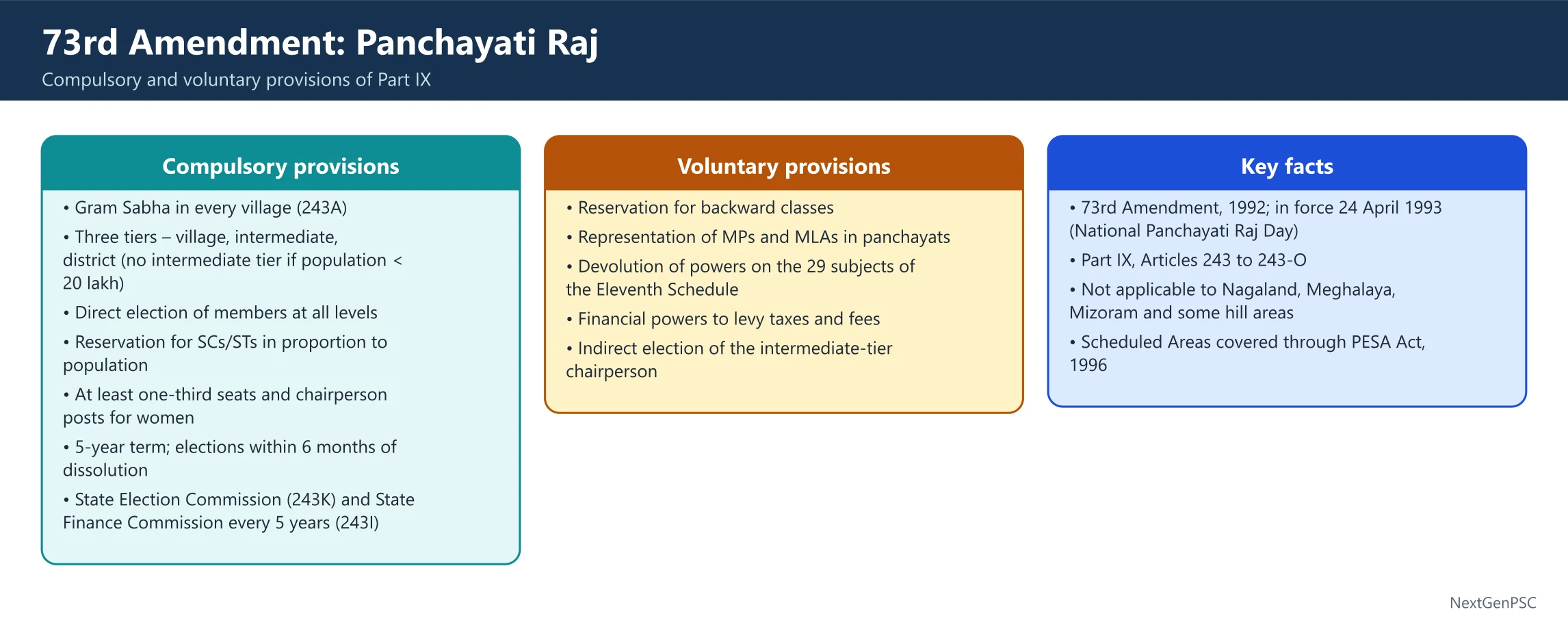
    The journey to give constitutional status to Panchayati Raj Institutions (PRIs) involved multiple failed attempts before success. It started with the 64th Amendment Bill (1989) under Rajiv Gandhi, which failed in the Rajya Sabha due to federalism concerns. Finally, under the P.V. Narasimha Rao government, the 73rd Constitutional Amendment Act, 1992 was passed, making PRIs a permanent part of the Indian Constitution.

    Constitutionalisation of Panchayati Raj
    Detailed Notes (16 points)
    Tap a card to add note • Use the highlight Listen button to play the full section
    1. The First Attempt: Rajiv Gandhi (1989)
    Bill: The 64th Constitutional Amendment Bill was introduced in July 1989.
    Objective: To strengthen PRIs based on the L.M. Singhvi Committee's recommendations.
    Outcome: Although passed by the Lok Sabha, it was defeated in the Rajya Sabha.
    Reason for Failure: Opposition parties criticized it for seeking to strengthen centralization by bypassing state governments, thus violating the federal structure.
    2. The Second Attempt: V.P. Singh (1990)
    Bill: The National Front Government introduced a revised bill in June 1990.
    Outcome: The bill lapsed due to the fall of the government and the subsequent dissolution of the Lok Sabha.
    3. The Final Success: P.V. Narasimha Rao (1991-92)
    Bill: A modified bill (removing controversial centralizing aspects) was introduced in September 1991.
    Process: It was referred to a Joint Parliamentary Committee (JPC) for detailed examination.
    Passage:
    Lok Sabha: Passed on December 22, 1992.
    Rajya Sabha: Passed on December 23, 1992.
    Assent: President Shankar Dayal Sharma gave his assent on April 20, 1993.
    Implementation: The Act came into force on 24th April, 1993 (now celebrated as National Panchayati Raj Day).

    Timeline of Constitutionalisation

    Prime MinisterBill / ActionReason for Outcome
    Rajiv Gandhi (1989)64th Amendment BillFailed in Rajya Sabha (Federalism concerns)
    V.P. Singh (1990)Revised Bill IntroducedBill Lapsed (Dissolution of Lok Sabha)
    P.V. Narasimha Rao (1992)73rd Amendment ActPassed (Consensus built via JPC)

    Mains Key Points

    Significance: Constitutionalisation transformed PRIs from being mere 'creatures of the state government' (whimsical existence) to 'institutions of self-government' with guaranteed tenure and regular elections.
    Federal Tension: The failure of the 64th Amendment Bill highlights the sensitive nature of federalism in India—any attempt by the Centre to directly empower local bodies is often seen by States as bypassing their authority.
    Uniformity: The 73rd Amendment brought uniformity in structure (3-tier), tenure (5 years), and reservation across India, which was previously fragmented.

    Prelims Strategy Tips

    Amendment Confusion: Do not confuse the 64th Amendment Bill (Rajiv Gandhi) with the final 73rd Amendment Act (Narasimha Rao).
    Presidential Assent: The President who signed the 73rd Amendment was Shankar Dayal Sharma, not R. Venkataraman.
    Panchayati Raj Day: April 24th is celebrated because the act came into force on this day, not because it was passed on this day (it was passed in Dec 1992).
    Changes: The Narasimha Rao government succeeded because they modified the bill to address the opposition's fears about reducing the power of States.

    Zila Parishad & Key Provisions (Tenure, Reservation, Disqualification)

    Key Point

    The Zila Parishad is the top tier of the Panchayati Raj system. While its members are elected directly by the people, its Chairperson is elected indirectly. The Constitution ensures a 5-year tenure (Article 243E), mandatory reservation for SCs/STs/Women (Article 243D), and sets the minimum age for contesting elections at 21 years (Article 243F).

    The Zila Parishad is the top tier of the Panchayati Raj system. While its members are elected directly by the people, its Chairperson is elected indirectly. The Constitution ensures a 5-year tenure (Article 243E), mandatory reservation for SCs/STs/Women (Article 243D), and sets the minimum age for contesting elections at 21 years (Article 243F).

    Detailed Notes (24 points)
    Tap a card to add note • Use the highlight Listen button to play the full section
    1. Structure of Zila Parishad (District Level)
    The Zila Parishad is the apex body at the district level. Its composition is defined by the State Legislature.
    Members (Who sits in the Zila Parishad?):
    Elected Members: Members directly elected from territorial constituencies in the district.
    Chairpersons: Of the Panchayat Samitis (Block level) within the district.
    MPs & MLAs: Members of Lok Sabha, Rajya Sabha, and State Assemblies representing that district.
    Election of Chairperson:
    The Chairperson is elected indirectly by and from amongst the elected members.
    Function: Unlike the Gram Panchayat (which implements), the Zila Parishad is primarily a supervisory and advisory body. It coordinates the plans of Panchayat Samitis.
    2. Tenure and Dissolution (Article 243E)
    Normal Term: Every Panchayat has a fixed tenure of 5 years from the date of its first meeting.
    Dissolution: It can be dissolved before the term ends (as per State law).
    Re-election Rules (Important):
    Elections must be held within 6 months of dissolution.
    The 'Remainder' Rule: If a Panchayat is dissolved early, the newly elected Panchayat continues ONLY for the remainder of the period (not a fresh 5 years).
    Exception: If the remainder period is less than 6 months, no election is necessary.
    3. Reservation of Seats (Article 243D)
    SC & ST: Reservation is mandatory and is based on their proportion to the total population of the area.
    Women: Minimum 1/3rd (33%) of total seats and chairperson offices must be reserved for women. (Note: Many states like Bihar, MP, Uttarakhand have raised this to 50%).
    OBCs: This is Voluntary. The State Legislature may make provisions for reservation for Backward Classes (it is not constitutionally mandatory).
    4. Disqualification (Article 243F)
    Grounds: A person is disqualified if they are disqualified under any law for elections to the State Legislature.
    The Age Exception: However, the minimum age for Panchayats is 21 years (unlike 25 years for State Assembly).
    Dispute Authority: Disqualification disputes are decided by an authority determined by the State Legislature.

    Comparison: MP/MLA vs Panchayat Member

    FeatureMP (Lok Sabha) / MLAPanchayat Member
    Minimum Age25 Years21 Years
    Election MethodDirect ElectionDirect Election (Members) / Indirect (Chairperson at District/Block)
    Reservation (Women)Pending Implementation (Nari Shakti Vandan)Mandatory 1/3rd (Constitutional)
    By-Election TenureRemains for remainder of termRemains for remainder of term (If >6 months left)

    Mains Key Points

    Sarpanch-Pati Culture: Despite 1/3rd reservation for women, effective power is often wielded by husbands (Sarpanch-Pati), undermining the goal of political empowerment (Article 243D).
    Lack of Continuity: Frequent dissolutions or the 'remainder term' clause can sometimes hinder long-term developmental planning at the district level.
    Supervisory Role: Zila Parishad acts as the essential link between the State Government and the Gram Panchayats, ensuring that state schemes filter down correctly.
    Inclusivity: The rotational reservation policy ensures that over a period of time, every seat gets an opportunity to be represented by SC, ST, or Women candidates.

    Prelims Strategy Tips

    The Remainder Trap: If a Panchayat is dissolved after 3 years, the new Panchayat works for only 2 years, NOT 5 years. This is a favorite UPSC statement.
    OBC Reservation: Remember that reservation for Backward Classes is Not Mandatory constitutionally; it depends on the State Legislature.
    Chairperson Election: For Village level (Gram Panchayat), the election mode of Chairperson is decided by State Legislature. For Block and District levels, it is Mandatorily Indirect.
    Age Limit: Do not get confused. You can become a Pradhan at 21, but a PM at 25.

    73rd Amendment: Elections, Finances & Exemptions

    Key Point

    The 73rd Amendment ensures that Panchayats are not just 'paper tigers' but independent institutions. It created the State Election Commission (Article 243K) for free elections and the State Finance Commission (Article 243I) for financial stability. However, it also respects India's diversity by providing exemptions to certain tribal areas (Article 243M).

    The 73rd Amendment ensures that Panchayats are not just 'paper tigers' but independent institutions. It created the State Election Commission (Article 243K) for free elections and the State Finance Commission (Article 243I) for financial stability. However, it also respects India's diversity by providing exemptions to certain tribal areas (Article 243M).

    Detailed Notes (21 points)
    Tap a card to add note • Use the highlight Listen button to play the full section
    1. State Election Commission (Article 243K)
    Purpose: Superintendence, direction, and control of the preparation of electoral rolls and conducting elections to the Panchayats.
    Appointment: The State Election Commissioner is appointed by the Governor.
    Independence (Removal): Although appointed by the Governor, they can be removed ONLY in the manner and on the grounds as a Judge of a High Court (i.e., by the President after an inquiry, not by the Governor). This ensures they are not under the pressure of the State Government.
    2. Powers and Functions (Article 243G & 11th Schedule)
    The 3Fs: The goal is to devolve Functions, Funds, and Functionaries to Panchayats.
    Eleventh Schedule: It contains 29 functional items (Agriculture, Library, Health, Sanitation, etc.).
    Voluntary Provision: Transferring these powers is not mandatory but left to the discretion of the State Legislature. This is often criticized as the 'lack of political will' by states.
    3. Finances (Article 243H & 243I)
    Taxation (243H): The State Legislature may authorize a Panchayat to levy, collect, and appropriate taxes, duties, tolls, and fees.
    State Finance Commission (243I): constituted every 5 years by the Governor to review the financial position of Panchayats and suggest the ratio of tax distribution between State and Panchayats.
    4. Exempted Areas (Article 243M)
    The Act does NOT apply to:
    States: Nagaland, Meghalaya, and Mizoram (The 'NaMeMi' states).
    Scheduled Areas: Areas under the Fifth Schedule.
    Tribal Areas: Areas under the Sixth Schedule (in Assam, Meghalaya, Tripura, Mizoram).
    Hill Areas: Of Manipur (where District Councils exist) and Darjeeling (West Bengal).
    Extension: Parliament enacted PESA Act, 1996 to extend these provisions to the Fifth Schedule areas with modifications.
    5. Bar on Court Interference (Article 243-O)
    Delimitation: Courts cannot question the validity of any law relating to the delimitation of constituencies or allotment of seats.
    Election Disputes: Can only be challenged through an Election Petition presented to an authority decided by the State Legislature (not directly to High Court via writ).

    ECI vs SEC (Crucial Distinction)

    FeatureElection Commission of India (ECI)State Election Commission (SEC)
    JurisdictionParliament & State AssembliesPanchayats & Municipalities
    Appointing AuthorityPresidentGovernor
    Removal AuthorityPresidentPresident (Process same as HC Judge)
    Constitutional ArticleArticle 324Article 243K (Panchayats) / 243ZA (Municipalities)

    Mains Key Points

    Lack of Financial Autonomy: Despite Article 243H, Panchayats are reluctant to levy taxes due to local proximity (fear of unpopularity) and depend heavily on State/Central grants, reducing their independence.
    State Control: The State Government retains significant control over the SEC (via funding/staffing) and over the devolution of 29 powers, often treating Panchayats as subordinate departments rather than self-governing bodies.
    PESA Significance: The extension of provisions to scheduled areas (Article 243M) through PESA acknowledges that tribal customs of self-governance should be integrated with modern democracy.

    Prelims Strategy Tips

    The ECI Trap: The Election Commission of India (ECI) has NO role in Panchayat elections. It is entirely handled by the SEC.
    Removal Nuance: Even though the SEC is appointed by the Governor, the Governor CANNOT remove them. Only the President can (impeachment-like process).
    Exceptions: Remember the states Nagaland, Meghalaya, Mizoram. (Use code: 'No Panchayats in NaMeMi').
    Article 243G: It does NOT automatically give powers. It enables the State Legislature to give powers. Hence, the extent of power varies from state to state.

    State Finance Commission & Panchayat Provisions

    Key Point

    The success of Panchayati Raj depends on Financial Autonomy. To ensure this, the 73rd Amendment created the State Finance Commission (SFC) under Article 243I. Additionally, the Act divides provisions into Compulsory (Mandatory) and Voluntary to balance uniformity with federal flexibility.

    The success of Panchayati Raj depends on Financial Autonomy. To ensure this, the 73rd Amendment created the State Finance Commission (SFC) under Article 243I. Additionally, the Act divides provisions into Compulsory (Mandatory) and Voluntary to balance uniformity with federal flexibility.

    Detailed Notes (25 points)
    Tap a card to add note • Use the highlight Listen button to play the full section
    1. State Finance Commission (Article 243I)
    Constitution: The Governor of a state constitutes a Finance Commission every 5 years.
    Role: It acts like the Central Finance Commission but for the state. It reviews the financial position of Panchayats and makes recommendations to the Governor regarding:
    Distribution of Taxes: Sharing of net proceeds of taxes, duties, tolls, and fees between the State and the Panchayats.
    Grant-in-Aid: Principles for giving grants to Panchayats from the Consolidated Fund of the State.
    Improvement: Measures to improve the financial position of Panchayats.
    Action Taken: The Governor places the recommendations (along with the action taken report) before the State Legislature.
    Central Link: The Central Finance Commission also suggests measures to augment the Consolidated Fund of a State to supplement the resources of the Panchayats.
    2. Compulsory (Mandatory) Provisions
    These are provisions that every State MUST include in their Panchayati Raj Act. They ensure a uniform basic structure across India.
    Gram Sabha: Establishment in villages.
    3-Tier System: Village, Intermediate, and District levels (2-tier for states with pop < 20 lakh).
    Direct Elections: To all seats at all levels.
    Indirect Election: For the post of Chairperson at Intermediate and District levels.
    Voting Age: Minimum age to contest is 21 years.
    Reservation: For SCs/STs (Population based) and Women (Min 1/3rd).
    Tenure: Fixed 5 years and fresh elections within 6 months.
    Institutions: Establishment of State Election Commission and State Finance Commission.
    3. Voluntary Provisions
    These are left to the discretion of the State Legislature. States can choose whether to implement them or not.
    Backward Classes: Providing reservation for OBCs.
    MPs/MLAs: Giving representation to MPs and MLAs in Panchayats.
    Devolution: Giving powers and authority (29 functions) to Panchayats.
    Financial Powers: Authorizing Panchayats to levy, collect, and appropriate taxes.
    Chairperson Election: Deciding the mode of election of the Chairperson of the Village Panchayat (Direct or Indirect).

    Quick Revision: Mandatory vs Voluntary

    FeatureNatureProvision
    Reservation for WomenMandatoryMin 1/3rd seats
    Reservation for OBCsVoluntaryDepends on State
    SFC & SECMandatoryMust be formed
    Giving Tax PowersVoluntaryState decides
    MPs/MLAs Voting RightsVoluntaryState decides

    Mains Key Points

    Financial Dependency: Since 'Giving Tax Powers' is a voluntary provision, most states have NOT devolved financial powers. This makes Panchayats dependent on state/central grants, undermining their autonomy.
    MP/MLA Interference: The voluntary provision allowing MPs/MLAs to sit in Panchayats often leads to their dominance, overshadowing local leaders and defeating the purpose of grassroots leadership.
    Inequality: Since many progressive provisions (like 50% women reservation) are state-dependent, there is significant inequality in the empowerment of Panchayats across different states (e.g., Kerala vs. Uttar Pradesh).

    Prelims Strategy Tips

    The 20 Lakh Exception: States with a population less than 20 Lakhs are NOT required to constitute the intermediate level (Block Panchayat). They can have a 2-tier system.
    Chairperson Election Trap: Election of Chairperson at Village level is Voluntary (State decides). Election of Chairperson at Block/District level is Mandatory Indirect.
    Finance Commission: SFC is constituted by the Governor, not the President. But the Central Finance Commission (President appointed) also suggests measures for Panchayats.
    OBC Reservation: It is purely Voluntary. Constitutional reservation is only for SCs, STs, and Women.

    PESA Act, 1996 (Extension to Scheduled Areas)

    Key Point

    The PESA Act (Panchayats Extension to Scheduled Areas Act), 1996 acts as a 'Constitution within the Constitution' for tribal areas. It was enacted on the recommendation of the Dilip Singh Bhuria Committee to extend the provisions of Part IX (Panchayats) to Fifth Schedule areas with certain modifications, empowering the Gram Sabha as the supreme decision-making body.

    The PESA Act (Panchayats Extension to Scheduled Areas Act), 1996 acts as a 'Constitution within the Constitution' for tribal areas. It was enacted on the recommendation of the Dilip Singh Bhuria Committee to extend the provisions of Part IX (Panchayats) to Fifth Schedule areas with certain modifications, empowering the Gram Sabha as the supreme decision-making body.

    Detailed Notes (24 points)
    Tap a card to add note • Use the highlight Listen button to play the full section
    1. Background and Purpose
    The Gap: The 73rd Amendment did not automatically apply to Scheduled Areas (Article 243M).
    The Solution: Parliament enacted PESA in 1996 to extend these provisions.
    Coverage (10 States): It applies to 10 states having Fifth Schedule Areas: Andhra Pradesh, Chhattisgarh, Gujarat, Himachal Pradesh, Jharkhand, Madhya Pradesh, Maharashtra, Odisha, Rajasthan, and Telangana.
    Objective: To provide Self-Rule for the tribal population and to preserve their traditions and customs.
    2. Key Features (Super Powers of Gram Sabha)
    Unlike normal Panchayats where the Gram Panchayat (elected body) is powerful, in PESA areas, the Gram Sabha (People's Assembly) is the most powerful.
    1. Mandatory Consultation:
    Land Acquisition: The Gram Sabha must be consulted before land acquisition for development projects.
    Resettlement: It must be consulted before resettling or rehabilitating persons affected by such projects.
    2. Ownership of Resources:
    Minor Forest Produce (MFP): The Gram Sabha has ownership rights over MFP (like honey, wax, tendu leaves).
    Minor Minerals: Its recommendation is mandatory for granting prospecting licenses or mining leases for minor minerals.
    3. Regulatory Powers:
    Intoxicants: Power to enforce prohibition or regulate the sale/consumption of intoxicants (alcohol).
    Money Lending: Power to control money lending to Scheduled Tribes to prevent exploitation.
    Markets: Power to manage village markets.
    3. Reservation Rules
    Minimum 50%: Reservation for Scheduled Tribes (STs) in every Panchayat shall not be less than one-half (50%) of the total seats.
    Chairpersons: ALL seats of Chairpersons of Panchayats at all levels shall be reserved for Scheduled Tribes.
    Nomination: If there are no ST members elected at the intermediate/district level, the State Government can nominate them (but not exceeding one-tenth of total members).
    4. Challenges
    Implementation Gap: Many states have not framed the necessary rules to implement PESA on the ground.
    Bypassing Gram Sabha: In practice, 'consultation' is often reduced to a formality, or fraudulent Gram Sabha resolutions are manufactured for land acquisition.

    Normal Panchayat vs PESA Panchayat

    FeatureNormal Panchayat (73rd Amd)PESA Panchayat (1996)
    Applies toGeneral AreasFifth Schedule Areas
    Most Powerful BodyGram Panchayat (Elected)Gram Sabha (People)
    Land AcquisitionNo mandatory consultation roleMandatory Consultation
    Minor Forest ProduceDepends on State LawOwnership with Gram Sabha
    Chairperson ReservationProportionate to Pop + 1/3 Women100% Reserved for STs

    Mains Key Points

    Conflict with Laws: Discuss how PESA often conflicts with other laws like the Land Acquisition Act or the Mines and Minerals Act, leading to legal battles.
    Pathalgadi Movement: Mention this movement in Jharkhand as an example of tribal assertion of self-rule rights under PESA, although it turned controversial.
    Democratic Decentralization: PESA is the highest form of direct democracy in India where the community (Gram Sabha) directly manages resources like water, forest, and land ('Jal, Jungle, Jameen').

    Prelims Strategy Tips

    The Committee: Remember Dilip Singh Bhuria Committee. It is the foundation of PESA.
    Chairperson Trap: In PESA areas, ALL chairperson posts (Village, Block, District) are reserved for STs. It is not 50%, it is 100%.
    Mineral Rights: Gram Sabha's power applies to Minor Minerals (sand, clay, etc.), NOT Major Minerals (Coal, Iron Ore).
    Land Acquisition: The Gram Sabha is 'Consulted', it does not have 'Veto' power for land acquisition (unlike what is often confused with FRA Act).

    Evaluation of Working of Panchayati Raj Institutions (PRIs)

    Key Point

    While the 73rd Amendment Act formally established PRIs to ensure Democratic Decentralization, their actual performance is often criticized due to the '3Fs' crisis (Funds, Functions, Functionaries). Despite successfully deepening democracy and increasing women's representation, issues like bureaucratic control, proxy representation (Sarpanch-Pati), and fiscal dependence hinder true local self-governance.

    While the 73rd Amendment Act formally established PRIs to ensure Democratic Decentralization, their actual performance is often criticized due to the '3Fs' crisis (Funds, Functions, Functionaries). Despite successfully deepening democracy and increasing women's representation, issues like bureaucratic control, proxy representation (Sarpanch-Pati), and fiscal dependence hinder true local self-governance.

    Detailed Notes (33 points)
    Tap a card to add note • Use the highlight Listen button to play the full section
    Constitutional Context (Basics for Beginners)
    73rd Constitutional Amendment Act (1992): This Act gave constitutional status to PRIs, adding Part IX ('The Panchayats') and Schedule 11 (containing 29 functional items like agriculture, health, sanitation).
    Article 243G: This is the 'heart' of the amendment. It mandates giving powers and authority to Panchayats to function as Institutions of Self-Government.
    Gram Sabha (Article 243A): It is the foundation of the PRI system, consisting of all registered voters in the village. It acts as a direct assembly of people.
    1. Significance & Achievements of PRIs
    Democratic Decentralization: It shifted power from the center/state down to the grassroots, promoting 'Planning from Below'.
    Political Empowerment of Women: 33% Reservation (Article 243D) has led to over 1.4 million elected women representatives, breaking patriarchal barriers.
    Inclusive Growth: Mandatory reservation for SCs/STs ensures that historically marginalized communities participate in decision-making.
    Better Implementation: Schemes like MGNREGA and Swachh Bharat Mission have higher success rates when monitored locally by PRIs.
    2. Critical Challenges (The '3Fs' Analysis)
    A. Lack of Funds (Financial Issues)
    Fiscal Dependency: PRIs are not financially independent. They depend on State and Central grants (approx. 95% of funds) rather than generating Own Source Revenue (OSR).
    Reluctance to Tax: Elected representatives (Sarpanchs) often avoid collecting property tax or market fees to avoid displeasing voters (proximity to voters).
    Tied vs. Untied Funds: Most funds come as 'Tied Grants' (earmarked for specific schemes), leaving little flexibility for local needs.
    State Finance Commissions (SFC): States are often reluctant to set up SFCs or implement their recommendations to share revenue.
    B. Lack of Functions (Devolution Issues)
    Incomplete Transfer: The constitution lists 29 subjects (Schedule 11), but many States have not fully transferred control over these (e.g., Primary Health Centers often remain under State control).
    Parallel Bodies: Governments create Parastatal bodies (like District Development Authorities or Water Boards) that bypass the authority of elected Panchayats.
    Principle of Subsidiarity Violated: This principle states that whatever can be done at the local level should be done there. However, higher levels of government continue to interfere.
    C. Lack of Functionaries (Staffing Issues)
    Staff Shortage: There is a severe lack of support staff like Secretaries, Junior Engineers, and Data Operators to help the Sarpanch.
    Dual Accountability: The staff (like the Panchayat Secretary) is appointed by the State Government and often reports to state bureaucrats rather than the elected Sarpanch.
    Bureaucratic Control: The local bureaucracy often dominates elected representatives due to the latter's lack of administrative knowledge.
    3. Structural & Social Issues
    Gram Sabha Ineffectiveness: It often acts as a 'rubber stamp'. Meetings are irregular, and attendance is low due to a lack of awareness.
    Sarpanch-Pati Culture (Proxy Representation): Actual power is often wielded by the husbands of elected women representatives, undermining the goal of women empowerment.
    Elite Capture: In many villages, the upper-caste or wealthy elites hijack the decision-making process, ignoring the poor.
    4. Solutions & Way Forward
    Activity Mapping: A clear unbundling of functions is needed to define exactly what the Panchayat is supposed to do versus the State.
    Fiscal Federalism: States must ensure timely release of funds. PRIs must be incentivized to collect property taxes and user fees to build financial independence.
    Capacity Building: Continuous training (via schemes like Rashtriya Gram Swaraj Abhiyan) is needed for Sarpanchs to understand laws and accounting.
    Digitalization: Using portals like e-Gram Swaraj for transparent accounting and planning (GPDP - Gram Panchayat Development Plan).
    Social Audit: Institutionalizing social audits (where the community checks the works) to ensure accountability and reduce corruption.

    Deep Dive: The 3Fs Crisis in PRIs

    ComponentConcept (Beginner)Advanced Issue (UPSC)
    Funds (Finance)Money required to build roads, schools, etc.High dependence on Grants limits autonomy. Lack of 'Fiscal Federalism' at the third tier.
    Functions (Responsibilities)Authority over water, sanitation, health.Violation of 'Principle of Subsidiarity'. Creation of Parallel Bodies reduces PRI relevance.
    Functionaries (Staff)People employed to execute the work.Lack of a separate 'Panchayat Cadre'. Staff reports to State Govt, not the Sarpanch.

    Mains Key Points

    Conclusion/Way Forward: The success of PRIs depends on the effective transfer of Funds, Functions, and Functionaries (3Fs). Without Financial Autonomy, 'Gram Swaraj' remains a dream.
    Governance vs. Government: PRIs must evolve from being mere 'implementing agencies' of the State to genuine 'Institutions of Self-Government' as mandated by Article 243G.
    Women Empowerment: The phenomenon of 'Sarpanch-Pati' must be curbed through capacity building to ensure the 33% reservation leads to real power shift.
    Technology: Digitalization (e-Gram Swaraj) and Social Audits are critical to combat corruption and improve service delivery.
    2nd ARC Recommendation: The Administrative Reforms Commission recommended clear 'Activity Mapping' to stop bureaucratic interference.

    Prelims Strategy Tips

    Article 243A: Powers of Gram Sabha are NOT defined in the Constitution; they are defined by the State Legislature.
    Article 243I: Constitution of State Finance Commission (Constituted by Governor every 5 years).
    Article 243K: State Election Commission conducts Panchayat elections (Not the Election Commission of India).
    Committees: Remember chronological order: Balwant Rai Mehta (1957) -> Ashok Mehta (1977) -> G.V.K. Rao (1985) -> L.M. Singhvi (1986).
    PESA Act 1996: Extends Panchayats to Scheduled Areas (Tribal areas) with extra powers to Gram Sabhas.

    Urban Local Bodies (ULBs)

    Key Point

    Urban Local Bodies (ULBs) act as the third tier of government in urban areas. While the British established the first Municipal Corporation in Madras (1687), it was the 74th Constitutional Amendment Act, 1992 that gave them constitutional protection, ensuring regular elections and devolution of powers. It added Part IX-A and the 12th Schedule (18 functional items) to the Constitution.

    Urban Local Bodies (ULBs) act as the third tier of government in urban areas. While the British established the first Municipal Corporation in Madras (1687), it was the 74th Constitutional Amendment Act, 1992 that gave them constitutional protection, ensuring regular elections and devolution of powers. It added Part IX-A and the 12th Schedule (18 functional items) to the Constitution.

    Detailed Notes (28 points)
    Tap a card to add note • Use the highlight Listen button to play the full section
    1. Evolution of Urban Bodies (Historical Background)
    Pre-Independence: The first Municipal Corporation was set up in Madras in 1687, followed by Bombay and Calcutta in 1726.
    Lord Mayo’s Resolution (1870): Initiated financial decentralization for local bodies.
    Lord Ripon’s Resolution (1882): Known as the 'Magna Carta' of local self-government. He is called the 'Father of Local Self-Government' in India because he introduced the elective element.
    Government of India Act, 1919: Under the Dyarchy system, Local Self-Government became a 'Transferred Subject' (under Indian ministers).
    Constitution: 'Local Government' is a subject under the State List (7th Schedule).
    2. 74th Constitutional Amendment Act, 1992
    Came into force: 1 June 1993.
    New Part: Added Part IX-A (Articles 243P to 243ZG).
    New Schedule: Added 12th Schedule containing 18 functional items (e.g., Urban Planning, Fire Services, Slum improvement).
    3. Three Types of Municipalities (Article 243Q)
    Nagar Panchayat: For a 'transitional area' (an area shifting from rural to urban).
    Municipal Council: For a 'smaller urban area'.
    Municipal Corporation: For a 'larger urban area' (usually population > 10 lakhs).
    Note: The Governor notifies these areas based on population, density, and revenue.
    4. Composition & Elections
    Direct Elections: All members (Councillors) are elected directly by people from territorial constituencies called Wards.
    Chairperson Election: The manner of election (Direct or Indirect) is decided by the State Legislature.
    Nominated Members: Persons with special knowledge (Aldermen) can be nominated but do not have the right to vote in meetings.
    Conduct of Elections: The State Election Commission (Article 243ZA) is responsible for superintendence and control of elections (Not the Election Commission of India).
    5. Committees & Planning
    Ward Committees (Article 243S): Mandatory for municipalities with a population of 3 lakhs or more.
    District Planning Committee (DPC - Article 243ZD): Consolidates plans prepared by both Panchayats and Municipalities in the district. 4/5th of its members are elected from the elected members of the district panchayat and municipalities.
    Metropolitan Planning Committee (MPC - Article 243ZE): Mandatory for Metropolitan areas (population > 10 lakhs). 2/3rd members are elected from elected members of municipalities and chairpersons of panchayats.
    6. Reservation (Article 243T) & Duration
    SC/ST: Reservation of seats in proportion to their population.
    Women: Not less than 1/3rd of total seats (including SC/ST women quotas) are reserved for women. This also applies to the office of Chairpersons.
    Duration: 5-year term. If dissolved earlier, fresh elections must be held within 6 months.

    Categorization of Urban Local Bodies

    TypeCriteria (General)Head of Institution
    Nagar PanchayatTransition from Rural to UrbanChairman / President
    Municipal CouncilSmall Urban AreaPresident / Chairman
    Municipal CorporationLarge Urban AreaMayor

    Mains Key Points

    Financial Fragility: ULBs lack financial autonomy as they are reluctant to levy property taxes and depend on state grants. The GST regime has further reduced their independent revenue sources.
    Functional Overlap: Existence of 'Parastatal Bodies' (like Development Authorities) undermines the authority of elected Municipalities.
    Mayor's Status: In most states, the Mayor is a ceremonial head with executive powers vested in the state-appointed Municipal Commissioner.
    Unplanned Urbanization: Lack of effective District (DPC) and Metropolitan (MPC) planning committees leads to chaotic urban growth (slums, traffic, drainage issues).
    Way Forward: Need for a directly elected Mayor with executive powers and implementation of the 12th Schedule in letter and spirit.

    Prelims Strategy Tips

    State Election Commission conducts ULB elections, NOT the Election Commission of India.
    Lord Ripon is known as the 'Father of Local Self-Government' in India.
    Article 243ZD (District Planning Committee) mandates that 4/5th members must be elected, not nominated.
    Cantonment Boards are NOT governed by the 74th Amendment; they are under the Union Ministry of Defence.
    Minimum age to contest ULB elections is 21 years.

    Urban Local Bodies: Duration, Elections & Finances

    Key Point

    To ensure stability and independence, the Constitution fixes a 5-year term for Municipalities (Article 243U). Elections are conducted by an independent State Election Commission (Article 243ZA), distinct from the Election Commission of India. Financial health is secured through the State Finance Commission (Article 243Y), which recommends tax devolution.

    To ensure stability and independence, the Constitution fixes a 5-year term for Municipalities (Article 243U). Elections are conducted by an independent State Election Commission (Article 243ZA), distinct from the Election Commission of India. Financial health is secured through the State Finance Commission (Article 243Y), which recommends tax devolution.

    Detailed Notes (25 points)
    Tap a card to add note • Use the highlight Listen button to play the full section
    1. Duration of Municipalities (Article 243U)
    Fixed Tenure: Every municipality has a fixed term of 5 years from the date appointed for its first meeting.
    Dissolution: It can be dissolved before the expiry of 5 years (procedure decided by State Law). However, the municipality must be given a reasonable opportunity of being heard before dissolution.
    Re-election Timeline: If dissolved, fresh elections must be completed within 6 months.
    The 'Remainder Period' Rule: A municipality constituted after premature dissolution continues only for the remainder of the original 5-year term. (It does not get a full fresh 5-year term).
    Exception: If the remainder of the period is less than 6 months, no election is required.
    2. Disqualifications (Article 243V)
    A person is disqualified if they are disqualified for elections to the State Legislature.
    Age Exception: The minimum age to contest for Municipality is 21 years. (Note: For MP/MLA it is 25 years). So, a person cannot be disqualified on the ground of age if they have attained 21 years.
    3. State Election Commission (SEC) - Article 243ZA
    Role: Superintendence, direction, and control of the preparation of electoral rolls and the conduct of all elections to municipalities.
    Independence: The State Election Commissioner is appointed by the Governor. To ensure independence, they can only be removed in the same manner as a Judge of a High Court.
    Powers: The State Legislature makes laws regarding election matters, but the actual conduct is done by the SEC.
    4. Powers and Functions (Article 243W)
    The State Legislature endows municipalities with powers to function as institutions of self-government.
    They prepare plans for economic development and social justice.
    They perform functions listed in the 12th Schedule (18 items like roads, water supply, public health).
    5. Finances & State Finance Commission (Article 243Y)
    Article 243X (Power to Tax): The State Legislature may authorize a municipality to levy, collect, and appropriate taxes, duties, tolls, and fees.
    Article 243Y (Finance Commission): The Finance Commission constituted under Article 243I (for Panchayats) also reviews the financial position of Municipalities.
    Functions of SFC: It makes recommendations to the Governor regarding:
    – Distribution: Sharing of net tax proceeds between the State and Municipalities.
    – Determination: Which taxes/tolls may be assigned to municipalities.
    – Grants-in-aid: Grants from the Consolidated Fund of the State.
    Action Taken: The Governor places these recommendations (along with an action taken report) before the State Legislature.

    Comparison: Election Commission of India vs. State Election Commission

    FeatureElection Commission of India (ECI)State Election Commission (SEC)
    MandateParliament (LS/RS), President, VP, State AssembliesPanchayats and Municipalities only
    AppointmentBy PresidentBy Governor
    RemovalLike Supreme Court JudgeLike High Court Judge

    Mains Key Points

    Fiscal Federalism: The State Finance Commission is crucial for fiscal federalism, but in practice, States often delay its constitution or ignore its recommendations, starving ULBs of funds.
    Independence of SEC: The constitutional protection given to the State Election Commissioner (removal like HC Judge) is vital to prevent political interference in local elections.
    Lack of Financial Autonomy: Despite constitutional provisions (Art 243X), states are reluctant to devolve taxation powers, making Municipalities dependent on 'Grants-in-aid' which affects their efficiency.

    Prelims Strategy Tips

    Confusing Point: A Municipality reconstituted after premature dissolution serves only for the remainder of the period, NOT for a full 5 years.
    Article 243I vs 243Y: While 243I establishes the State Finance Commission for Panchayats, Article 243Y mandates the SAME commission to review Municipal finances.
    Judicial Intervention: Article 243ZG bars the interference of courts in electoral matters (like delimitation of constituencies).
    Audit: The Constitution does NOT specify the audit method; it leaves it to the State Legislature to decide (Article 243Z).

    Urban Local Bodies: Exempted Areas, Planning Committees & 12th Schedule

    Key Point

    The 74th Amendment Act applies to most urban areas but specifically exempts Scheduled Areas and Tribal Areas (Article 243ZC). To ensure integrated development between rural and urban areas, the Constitution mandates the formation of the District Planning Committee (DPC) and Metropolitan Planning Committee (MPC). The 12th Schedule lists 18 functional items that States may devolve to municipalities.

    The 74th Amendment Act applies to most urban areas but specifically exempts Scheduled Areas and Tribal Areas (Article 243ZC). To ensure integrated development between rural and urban areas, the Constitution mandates the formation of the District Planning Committee (DPC) and Metropolitan Planning Committee (MPC). The 12th Schedule lists 18 functional items that States may devolve to municipalities.

    Detailed Notes (28 points)
    Tap a card to add note • Use the highlight Listen button to play the full section
    1. Exempted Areas (Article 243ZC)
    The provisions of Part IX-A do NOT apply to:
    Scheduled Areas: Areas under the 5th Schedule (mostly tribal areas in central India).
    Tribal Areas: Areas under the 6th Schedule (Assam, Meghalaya, Tripura, Mizoram).
    Specific Exemption: The Darjeeling Gorkha Hill Council in West Bengal is exempted to protect its unique administrative structure.
    Parliament's Power: The Parliament acts can extend these provisions to Scheduled/Tribal areas with exceptions and modifications (similar to PESA Act for rural areas).
    2. District Planning Committee (DPC) - Article 243ZD
    Purpose: To consolidate plans prepared by Panchayats and Municipalities in the district and prepare a Draft Development Plan for the district as a whole.
    Composition: Decided by State Legislature.
    Election of Members: 4/5th (80%) of members must be elected by and from amongst the elected members of the District Panchayat and Municipalities in the district.
    Basis of Representation: The ratio of members from Panchayats and Municipalities corresponds to the ratio of rural and urban populations in the district.
    Chairperson: Chosen as per State Law. He/She forwards the development plan to the State Government.
    3. Metropolitan Planning Committee (MPC) - Article 243ZE
    Metropolitan Area Definition: An area having a population of 10 Lakhs or more, comprised in one or more districts, and consisting of two or more Municipalities or Panchayats.
    Purpose: To prepare a Draft Development Plan for the Metropolitan area, considering issues like shared water resources, infrastructure, and environmental conservation.
    Election of Members: 2/3rd (66%) of members should be elected by and from amongst the elected members of the Municipalities and Chairpersons of the Panchayats in the Metropolitan area.
    Nominated Members: The remaining 1/3rd can represent the Central Govt, State Govt, and other organizations.
    Chairperson: Forwards the plan to the State Government.
    4. Bar to Interference by Courts (Article 243ZG)
    The validity of any law relating to the delimitation of constituencies or the allotment of seats cannot be questioned in any court.
    No election to any Municipality can be called in question except by an election petition presented to such authority as provided by the State Legislature.
    5. Twelfth Schedule (Article 243W) - 18 Functions
    (Note: These are voluntary provisions; States decide how many to devolve)
    Planning & Regulation: Urban planning (Town planning), Regulation of land use, Building construction.
    Infrastructure: Roads, bridges, Water supply (domestic/industrial), Street lighting, Parking lots, Bus stops.
    Health & Sanitation: Public health, Sanitation, Solid waste management, Slaughterhouses regulation.
    Social Welfare: Urban poverty alleviation, Slum improvement, Safeguarding interests of weaker sections (handicapped/mentally retarded).
    Environment & Amenities: Urban forestry, Parks, Gardens, Playgrounds, Burials & Cremation grounds, Vital statistics (Births/Deaths registration).

    Comparison: DPC vs. MPC

    FeatureDistrict Planning Committee (DPC)Metropolitan Planning Committee (MPC)
    Article243ZD243ZE
    AreaEntire District (Rural + Urban)Metro Area (Pop > 10 Lakh)
    Elected Members4/5th (elected by District Panchayat & Municipalities)2/3rd (elected by Municipalities & Panchayat Chairpersons)
    Plan Forwarded ToState GovernmentState Government

    Mains Key Points

    Implementation Failure: While DPCs and MPCs are constitutionally mandatory, many states have either not constituted them or they remain non-functional. This hinders integrated regional planning.
    Encroachment: State governments often create 'Urban Development Authorities' (like DDA in Delhi) which take over the planning functions of elected bodies (DPC/MPC), violating the spirit of the 74th Amendment.
    Significance of 12th Schedule: It provides a blueprint for what a 'Smart City' management should look like, integrating physical infrastructure with social justice.

    Prelims Strategy Tips

    Ratios are crucial: Remember 4/5th for DPC and 2/3rd for MPC. UPSC often swaps these.
    Who elects whom in DPC? Elected members of Zila Parishad and Municipalities elect from amongst themselves.
    Functions: 'Fire Services' is a municipal function under 12th Schedule, but 'Police' is NOT (State List).
    Metropolitan Area: Defined as an area with a population of 10 Lakh or more.
    Darjeeling: Specifically exempted from 74th Amendment.

    Types of Urban Governments: Municipal Corporations & Elected Mayors

    Key Point

    Municipal Corporations are created for the administration of big cities (like Delhi, Mumbai, Bengaluru). They are characterized by a clear separation of powers between the Deliberative Wing (Council headed by Mayor) and the Executive Wing (headed by the Commissioner). The debate on Directly Elected Mayors focuses on replacing the 'weak mayor' system with a strong political executive to ensure better accountability.

    Municipal Corporations are created for the administration of big cities (like Delhi, Mumbai, Bengaluru). They are characterized by a clear separation of powers between the Deliberative Wing (Council headed by Mayor) and the Executive Wing (headed by the Commissioner). The debate on Directly Elected Mayors focuses on replacing the 'weak mayor' system with a strong political executive to ensure better accountability.

    Detailed Notes (32 points)
    Tap a card to add note • Use the highlight Listen button to play the full section
    1. Municipal Corporation (The Big Cities)
    Jurisdiction: Established in large urban areas (usually population > 10 lakhs).
    Establishment: Established by Acts of the State Legislature. In Union Territories, they are established by Acts of the Parliament.
    Three Authorities: The Corporation typically works through three distinct authorities:
    1. The Council: The legislative body.
    2. The Standing Committees: To facilitate working.
    3. The Commissioner: The executive authority.
    2. Composition & Structure
    A. The Council (Deliberative Wing)
    It consists of Councillors directly elected by the people from wards.
    It also includes some nominated persons with special knowledge called Aldermen.
    Function: It acts as the 'City Parliament', making bye-laws and discussing issues.
    B. The Mayor (Political Head)
    The Council is headed by a Mayor, assisted by a Deputy Mayor.
    Election: In most states, the Mayor is elected indirectly by the councillors from among themselves. In some states (like Uttarakhand, Jharkhand), the Mayor is elected directly by the people.
    Role: Usually ceremonial (presiding over meetings). He/she lacks real executive power in the current setup.
    C. The Municipal Commissioner (Executive Head)
    He/she is appointed by the State Government (usually an IAS officer).
    Role: Responsible for the implementation of the Council's decisions. He wields the real executive power (controlling staff, budget execution).
    3. The Mayor vs. Commissioner Conflict
    The core issue in Indian municipal governance is the separation of power:
    Democratic Deficit: The elected Mayor has no power, while the unelected Commissioner (bureaucrat) has all the power.
    Accountability Issue: Citizens vote for the Mayor/Council, but if work isn't done, the Mayor blames the Commissioner, and the Commissioner blames State rules.
    4. Directly Elected Mayor: The Debate
    Why is it needed? To create a single face of the city (like a Chief Minister for a state) who is directly accountable to the people and has a fixed tenure.
    Current Problem: In many cities (e.g., Bengaluru), the Mayor has a 1-year term. By the time they understand the city, their term ends.
    5. 2nd ARC Recommendations (6th Report)
    The Administrative Reforms Commission recommended the 'Mayor-in-Council' system (similar to the Cabinet system in Parliament):
    Direct Election: The Mayor should be directly elected by the people.
    Executive Power: The Mayor should be the Chief Executive of the Corporation.
    Cabinet: The Mayor should appoint a 'Cabinet' (Steering Committee) from the elected councillors to run different departments.
    Commissioner's Role: The Commissioner should act as a Secretary to the Mayor/Council, not as an independent power center.

    Comparison: Mayor vs. Municipal Commissioner

    FeatureMayorMunicipal Commissioner
    Type of ExecutivePolitical Executive (Ceremonial Head)Administrative Executive (Real Head)
    AppointmentElected (Directly or Indirectly)Appointed by State Govt (IAS)
    AccountabilityAccountable to People/CouncilAccountable to State Government
    RolePresides over Council meetingsImplements decisions & controls staff

    Mains Key Points

    Weak Mayor System: The colonial legacy of a 'Strong Commissioner, Weak Mayor' continues to plague Indian cities. This leads to a lack of ownership and urban leadership.
    Fragmentation: The Mayor runs the corporation, but other critical agencies (Police, Water Board, Development Authority) report to the State Govt, making holistic planning impossible.
    2nd ARC Solution: Adopting the Mayor-in-Council system would merge the deliberation and execution, making the Mayor truly responsible for the city's performance.

    Prelims Strategy Tips

    Standing Committees: These are statutorily created to deal with specific fields (Education, Health). They are powerful because they take practical decisions that the full Council cannot.
    Mayor's Term: It is NOT fixed by the Constitution. It varies by State Act (e.g., 1 year in Bangalore, 2.5 years in Mumbai, 5 years in UP).
    Aldermen: Nominated members in the Municipal Corporation are often called 'Aldermen'. They usually do not have voting rights in motions of no confidence.
    Oldest Corporation: Madras (Chennai) Municipal Corporation, established in 1687, is the oldest in India.

    Types of Urban Governments: Municipality, Notified Area Committee, Town Area Committee & Cantonment Boards

    Key Point

    Urban governance in India is not uniform. Apart from constitutional bodies (Corporations, Councils, Nagar Panchayats), there are statutory and non-statutory bodies like Notified Area Committees (nominated), Town Area Committees (small towns), and Cantonment Boards (under Defence Ministry). The 74th Amendment does not apply to most of these non-constitutional bodies automatically.

    Urban governance in India is not uniform. Apart from constitutional bodies (Corporations, Councils, Nagar Panchayats), there are statutory and non-statutory bodies like Notified Area Committees (nominated), Town Area Committees (small towns), and Cantonment Boards (under Defence Ministry). The 74th Amendment does not apply to most of these non-constitutional bodies automatically.

    Detailed Notes (29 points)
    Tap a card to add note • Use the highlight Listen button to play the full section
    1. Municipality (Municipal Council)
    Jurisdiction: Administers 'smaller urban areas'.
    Structure: Like Corporations, they have a Council (legislative) and an Executive Officer.
    Key Difference: The Executive Officer is appointed by the State Government but has fewer powers compared to a Municipal Commissioner.
    2. Notified Area Committee (NAC)
    Purpose: Created for two types of areas:
    1. Fast-developing towns due to industrialization.
    2. Towns that do not yet meet all conditions to be a Municipality.
    Status: It is established by a Gazette Notification (hence the name). It is NOT a statutory body elected by people.
    Composition: It is an entirely nominated body. All members, including the Chairman, are nominated by the State Government. (This is considered undemocratic).
    3. Town Area Committee
    Purpose: Administers small towns.
    Authority: It is a semi-municipal authority entrusted with limited civic functions (like street lighting, drainage).
    Composition: Can be wholly elected, wholly nominated, or mixed (decided by State Act).
    4. Cantonment Board
    Purpose: Municipal administration for the civilian population residing in cantonment (military) areas.
    Authority: Set up under the Cantonments Act, 2006 (Central legislation). It works under the administrative control of the Union Ministry of Defence.
    Composition: Partly elected and partly nominated. The Military Officer Commanding the Station is the ex-officio President.
    5. Township
    Purpose: Established by large Public Sector Undertakings (PSUs) to provide civic amenities to its staff/workers living in colonies near the plant (e.g., Bhilai Steel Plant township).
    Structure: It has no elected members. A 'Town Administrator' acts as the head.
    6. Port Trust
    Purpose: Established in port areas (like Mumbai, Kolkata, Chennai) to manage the port and provide civic amenities.
    Authority: Created by an Act of Parliament.
    Composition: Consists of both elected and nominated members.
    7. Special Purpose Agency
    Also called Single Purpose Agencies. States set these up for specific functions, bypassing local bodies.
    Examples: Housing Boards, Water Supply & Sewerage Boards, Pollution Control Boards, Urban Development Authorities (like DDA).
    Status: They are statutory bodies but function as subordinate agencies of the State Government, not as local self-government institutions.

    Comparison: Cantonment Board vs. Municipality

    FeatureCantonment BoardMunicipality
    ControlCentral Govt (MoD)State Govt
    DemocracyPartly Elected, Partly NominatedFully Elected
    HeadMilitary Officer (Non-elected)Chairman/Mayor (Elected)

    Mains Key Points

    Multiplicity of Agencies: The existence of multiple bodies (Special Purpose Agencies, Cantonment Boards, PSUs) in the same city leads to fragmented governance and lack of coordination.
    Undemocratic Nature: Bodies like Notified Area Committees and Special Agencies lack democratic accountability as they are dominated by bureaucrats/nominees.
    Smart City Mission: It often creates Special Purpose Vehicles (SPVs) which operate as private companies, raising concerns about bypassing elected municipal councils.

    Prelims Strategy Tips

    Which Ministry? Urban Local Bodies generally come under the Ministry of Housing and Urban Affairs. BUT, Cantonment Boards come under the Ministry of Defence.
    Elected vs Nominated: Notified Area Committees are entirely nominated. This is a favorite trick question.
    Township: It is not an elected body; it is basically a company town managed by a bureaucrat.
    74th Amendment: Does NOT apply to Cantonment Boards directly.

    Other Types of Urban Local Governments: Township, Port Trusts & Special Purpose Agencies

    Key Point

    Besides the standard elected bodies (Corporations/Councils), India has specific urban bodies for specific needs. Townships are 'company towns' with no elected members. Port Trusts manage port cities under Parliament's Act. Special Purpose Agencies (SPAs) are function-specific bodies (like Water Boards) that operate independently of the local municipality.

    Besides the standard elected bodies (Corporations/Councils), India has specific urban bodies for specific needs. Townships are 'company towns' with no elected members. Port Trusts manage port cities under Parliament's Act. Special Purpose Agencies (SPAs) are function-specific bodies (like Water Boards) that operate independently of the local municipality.

    Detailed Notes (21 points)
    Tap a card to add note • Use the highlight Listen button to play the full section
    1. Township (Industrial Colonies)
    Purpose: Established by large Public Sector Undertakings (PSUs) (like Steel Plants, Coal Mines) to provide civic amenities (housing, drainage, roads) to their employees living near the plant.
    Structure: It is NOT an elected body. It is essentially an extension of the company's bureaucracy.
    Administration: It is managed by a Town Administrator, who is appointed by the enterprise/ministry. There are no elected members/councillors here.
    Example: Bhilai Steel Plant Township, Rourkela Township.
    2. Port Trust
    Purpose: Established in port areas (like Mumbai, Kolkata, Chennai) to manage the commercial affairs of the port and provide civic amenities to the people living in the port estate.
    Authority: Created by an Act of Parliament (formerly Major Port Trusts Act, 1963; now transitioned to Major Port Authorities Act, 2021).
    Composition: It consists of both elected and nominated members. The Chairman is an official.
    Functions: It acts like a semi-government body combining commercial port management with municipal duties (roads, lighting, sewage).
    3. Special Purpose Agencies (SPAs)
    Also known as: Single Purpose Agencies or Function-based Agencies.
    Concept: Unlike a Municipality which is 'Area-based' and 'Multi-purpose', SPAs are created to handle one specific function efficiently using technical experts.
    Establishment: Created by State Legislature Acts or by executive order.
    Examples:
    – Housing Boards: (e.g., UP Housing & Development Board)
    – Pollution Control Boards: (State Pollution Control Board)
    – Urban Development Authorities: (e.g., Delhi Development Authority - DDA)
    – Water Supply & Sewerage Boards: (e.g., Delhi Jal Board)
    Nature: They work independent of the local Municipal Corporation, often leading to coordination issues.

    Area-based vs. Function-based Urban Bodies

    FeatureMunicipal Corporation (Area-based)Special Purpose Agency (Function-based)
    ScopeComprehensive (All civic amenities in the city)Specific (Only Water, or Housing, or Pollution)
    DemocracyElected by People (Democratic)Nominated by Govt (Bureaucratic/Expert)
    StatusConstitutional (74th Amendment)Statutory (State Acts) or Executive

    Mains Key Points

    Problem of 'Parastatals': Special Purpose Agencies (like DDA) act as 'Parastatal Bodies'. They often take away powers (like planning) from elected Municipalities, violating the spirit of the 74th Amendment.
    Lack of Accountability: Since SPAs are run by bureaucrats/technocrats appointed by the State Govt, they are not directly accountable to the local citizens, unlike Ward Councillors.
    Coordination Crisis: A city often suffers because the Municipality digs a road to lay wires, and the Water Board digs it again to lay pipes. This happens due to the separation of these agencies.

    Prelims Strategy Tips

    Township Trap: If UPSC asks "Which urban body has NO elected members?", the answer is usually Township (or Notified Area Committee).
    Port Trusts: They manage major ports. Minor ports are usually managed by State Maritime Boards.
    Legislative Source: Port Trusts = Parliament Act. Housing Boards = State Legislature Act. Townships = No specific Act (Internal arrangement of PSU).
    74th Amendment: None of these three (Township, Port Trust, SPA) are covered under the mandatory provisions of the 74th Amendment.

    Municipal Personnel and Revenue

    Key Point

    The efficiency of Urban Local Bodies (ULBs) depends on their Personnel (Staffing) and Finance. While personnel systems vary across states (Separate, Unified, Integrated), the financial health is often critical, relying on a mix of Tax Revenue (Article 243X) and Devolution recommended by the State Finance Commission (Article 243Y).

    The efficiency of Urban Local Bodies (ULBs) depends on their Personnel (Staffing) and Finance. While personnel systems vary across states (Separate, Unified, Integrated), the financial health is often critical, relying on a mix of Tax Revenue (Article 243X) and Devolution recommended by the State Finance Commission (Article 243Y).

    Detailed Notes (24 points)
    Tap a card to add note • Use the highlight Listen button to play the full section
    1. Municipal Personnel Systems
    There is no uniform personnel system for ULBs in India. Different states follow different patterns:
    Separate Personnel System: Each local body appoints and administers its own staff. They are not transferable to other local bodies. (Ensures autonomy but lacks specialized talent).
    Unified Personnel System: The State Government appoints and administers the staff. They are transferable between different local bodies within the state. (Prevalent in Andhra Pradesh, Tamil Nadu, UP).
    Integrated Personnel System: Municipal staff are members of the State Civil Services. They can be transferred not only between local bodies but also to state government departments. (Prevalent in Odisha, Bihar, Karnataka).
    2. Municipal Revenue – Five Broad Sources
    The financial resources of ULBs can be classified into five categories:
    A. Tax Revenue (Article 243X)
    Property Tax: The most important source of revenue. Levied on land and buildings.
    Other Taxes: Entertainment tax, Advertisement tax, Professional tax, Water tax, Animal tax, Lighting tax, Pilgrim tax, Market tax.
    Toll: Levied on new bridges or roads constructed by the municipality.
    B. Non-Tax Revenue
    User Charges: Fees collected for services provided (e.g., Water charges, Sanitation fees, Sewerage charges).
    Regulatory Fees: Building plan approval fees, birth/death certificate fees, trade licenses.
    Assets: Rent from municipal properties, royalty, profits, and dividends.
    C. Grants-in-Aid
    Central Finance Commission (CFC): Grants recommended by the CFC to supplement the resources of local bodies.
    Centrally Sponsored Schemes (CSS): Funds for specific schemes like Swachh Bharat Mission or AMRUT.
    State Grants: To cover revenue deficits or for specific development projects.
    D. Devolution (State Finance Commission)
    Based on the recommendations of the State Finance Commission (Article 243Y), the state government shares a part of its net tax proceeds with municipalities.
    E. Loans
    ULBs can borrow from the State Government or Financial Institutions only with the prior approval of the State Government.
    Recently, some Municipal Corporations (like Pune, Indore) have issued 'Municipal Bonds' to raise funds from the market.

    Municipal Bonds: A New Revenue Source

    FeatureDetails
    DefinitionDebt securities issued by ULBs to fund infrastructure projects.
    First in IndiaBangalore Municipal Corporation (1997).
    Recent TrendPune (2017) and Indore have successfully listed bonds on BSE.
    BenefitReduces dependence on state grants; enforces financial discipline.

    Mains Key Points

    Low OSR (Own Source Revenue): According to the RBI, OSR of Indian municipalities is less than 1% of GDP (compared to 6-7% in Brazil/South Africa). This fiscal weakness hampers service delivery.
    GST Impact: The introduction of GST subsumed taxes like Octroi and Entry Tax, which were major revenue sources for ULBs, increasing their dependence on State compensation.
    Way Forward: To make cities 'Atmanirbhar', ULBs must improve Property Tax collection (using GIS mapping) and monetize assets (land value capture).

    Prelims Strategy Tips

    Central Council of Local Government: It was set up in 1954 under Article 263 (Inter-State Council). It is an advisory body chaired by the Union Minister for Housing & Urban Affairs.
    Taxation Power: The Constitution does NOT give ULBs the direct power to tax. It says the State Legislature 'MAY' authorize them (Article 243X). This is why ULBs are financially weak.
    Municipal Bonds: SEBI regulates the issuance of municipal bonds in India.

    Central Council of Local Government

    Key Point

    Established under Article 263 of the Constitution by a Presidential Order in 1954, the Central Council of Local Government constitutes a high-level advisory body. While it originally oversaw both rural and urban local governments, since 1958, it deals exclusively with Urban Local Governments.

    Established under Article 263 of the Constitution by a Presidential Order in 1954, the Central Council of Local Government constitutes a high-level advisory body. While it originally oversaw both rural and urban local governments, since 1958, it deals exclusively with Urban Local Governments.

    Detailed Notes (14 points)
    Tap a card to add note • Use the highlight Listen button to play the full section
    1. Constitutional Basis & Establishment
    Authority: It was constituted under Article 263 of the Constitution, which empowers the President to establish an Inter-State Council or other bodies to facilitate coordination between the Centre and States.
    Evolution: Originally formed in 1954 to handle both Panchayats (Rural) and Municipalities (Urban).
    The Shift (1958): In 1958, its mandate was restricted to Urban Local Government only. (Rural bodies are now handled by the Ministry of Panchayati Raj).
    2. Composition
    Chairman: The Union Minister for Housing and Urban Affairs acts as the Chairman.
    Members: The State Ministers for Local Self-Government (Urban) from all states are members.
    Nature: It is purely an advisory body. Its decisions are not binding on the Union or State governments.
    3. Key Functions
    Policy Formulation: Considering and recommending broad policy matters regarding urban governance.
    Legislation: Making proposals for legislation on matters related to local government.
    Financial Assistance: Recommending the allocation of Central financial assistance to local bodies.
    Coordination: Examining the possibility of cooperation between the Centre and States.
    Review: Reviewing the work of the commercial and economic type of local bodies.

    Central Council of Local Government: Key Facts

    FeatureDescription
    Established ByOrder of the President of India
    ArticleArticle 263 (Inter-State Coordination)
    JurisdictionUrban Local Government ONLY (since 1958)
    ChairmanUnion Minister (Urban Affairs)

    Mains Key Points

    Cooperative Federalism: The Council is a classic example of cooperative federalism where the Centre and States come together to discuss urban issues, despite 'Local Government' being a State List subject.
    Urbanization Challenges: With rapid urbanization, this Council plays a crucial role in harmonizing laws across states regarding Smart Cities, Amrut Mission, and municipal finance.
    Limitations: Being advisory, its recommendations are often delayed or ignored by State governments, leading to uneven urban development across India.

    Prelims Strategy Tips

    The Rural Trap: Do not get confused by the name 'Local Government'. It DOES NOT deal with Panchayati Raj (Rural). It deals only with Urban bodies.
    Advisory Nature: It is NOT a statutory body with binding powers. It is a constitutional body (in the sense that it is formed under Art 263) but its function is advisory.
    Chairman: It is chaired by a Union Cabinet Minister, not the Prime Minister.

    Urban Governance: Issues, Challenges and Solutions

    Key Point

    Urban governance is the software that manages the hardware of urban infrastructure. According to the World Bank, cities are the 'Engines of Economic Growth', contributing over 60% to India's GDP. However, Indian cities face a 'Low Equilibrium Trap'—poor service delivery leads to low tax compliance, which further reduces funds. Resolving the 3Fs crisis (Funds, Functions, Functionaries) is essential for sustainable urbanization.

    Urban governance is the software that manages the hardware of urban infrastructure. According to the World Bank, cities are the 'Engines of Economic Growth', contributing over 60% to India's GDP. However, Indian cities face a 'Low Equilibrium Trap'—poor service delivery leads to low tax compliance, which further reduces funds. Resolving the 3Fs crisis (Funds, Functions, Functionaries) is essential for sustainable urbanization.

    Detailed Notes (31 points)
    Tap a card to add note • Use the highlight Listen button to play the full section
    1. Importance of Urban Governance
    Economic Powerhouse: Cities occupy only 3% of the land but contribute approx 63% to the GDP (expected to rise to 75% by 2030).
    Demographic Shift: India's urban population is projected to double by 2050 (UN World Urbanization Prospects). Effective governance is needed to manage this Migration.
    Service Delivery: It determines the quality of basic rights—clean water (Article 21), sanitation, and primary health.
    SDG Goals: Crucial for achieving SDG 11 (Sustainable Cities and Communities).
    2. Issues in Urban Governance (The Structural Flaws)
    A. Financial Crisis (Lack of Funds)
    Low Own Source Revenue (OSR): Municipal revenue is less than 1% of GDP in India (vs 6% in South Africa). Abolition of Octroi and subsuming local taxes into GST has dried up funds.
    Dependence: High dependency on State/Central grants erodes autonomy.
    B. Functional Issues (Lack of Functions)
    Parastatal Agencies: State governments create unelected bodies like Development Authorities (DDA, BDA) or Water Boards. These encroach upon the 18 functions meant for elected municipalities under the 12th Schedule.
    Fragmentation: Multiple agencies (Traffic Police, PWD, Municipality) work in silos without coordination.
    C. Personnel Issues (Lack of Functionaries)
    No Specialized Cadre: Unlike the IAS/IPS, there is no dedicated 'Municipal Cadre' in most states. Generalist officers often lack technical expertise in urban planning.
    Short Tenure: Municipal Commissioners (IAS) have short tenures, preventing long-term vision execution.
    3. Emerging Challenges
    Unplanned Urbanization: Rise of Census Towns (areas that are urban in character but governed by rural Panchayats) leads to chaotic growth.
    Climate Change: Indian cities are vulnerable to Urban Flooding (e.g., Chennai, Bengaluru) and Heat Islands due to poor drainage and loss of green cover.
    Corruption & Transparency: Real estate-municipality nexus and lack of digitization in record-keeping.
    4. Solutions and Way Forward
    A. Financial Reforms
    Municipal Bonds: Encouraging cities with good credit ratings (like Indore, Pune) to raise funds from the market. (Regulated by SEBI).
    Value Capture Financing (VCF): Taxing the increase in land value resulting from public infrastructure investments (e.g., Metro rail).
    Property Tax Reforms: Using GIS Mapping to bring unassessed properties under the tax net.
    B. Administrative Reforms
    Directly Elected Mayor: Implementing the Mayor-in-Council system (2nd ARC recommendation) to ensure a single point of accountability.
    Convergence: Merging parastatal bodies into the Municipal Corporation or making them accountable to the Mayor.
    Citizen Participation: Strengthening Ward Committees and Area Sabhas (Community Policing, Waste Management).
    C. Technology & Innovation
    Smart Cities Mission: Using Integrated Command and Control Centres (ICCC) for traffic and disaster management.
    AMRUT Mission: Focusing on universal water supply and sewerage coverage.

    Smart Solutions for Urban Issues

    IssueTraditional ApproachSmart/Reform Approach
    FundingDependence on Govt GrantsMunicipal Bonds, Value Capture Financing, PPP Models
    LeadershipWeak Mayor, Strong CommissionerDirectly Elected Mayor with 5-year tenure
    PlanningTop-down by State AuthoritiesBottom-up via District Planning Committees (DPC)
    Service DeliveryManual files, delays, briberye-Governance, Online Certificates, Grievance Portals

    Mains Key Points

    Conclusion: India cannot grow without its cities growing. The need of the hour is 'Cooperative Federalism' where the Centre and State empower the third tier.
    Quote: "Cities are the closest government to the people, yet the furthest from having the power to solve their problems.
    Climate Aspect: Urban governance must integrate Climate Action Plans (e.g., Mumbai Climate Action Plan) to make cities resilient.
    Performance Linked Grants: The 15th Finance Commission has recommended tying grants to reforms like online accounts auditing and notification of property tax floor rates.

    Prelims Strategy Tips

    RBI Report on Municipal Finances (2022): Stated that property tax collection in India is extremely low compared to OECD countries.
    Article 243W: Mentions the schemes for economic development and social justice.
    Committees: Isher Judge Ahluwalia Committee (2011) on urban infrastructure is a key reference.
    Indore: Consistently ranked cleanest city under Swachh Survekshan; first to list Green Bonds on NSE.

    Environmental Governance: Environmental Impact Assessment (EIA/SEIAA)

    Key Point

    Environmental Impact Assessment (EIA) is a policy tool used to identify the environmental, social, and economic impacts of a project prior to decision-making. Mandated under the Environment (Protection) Act, 1986, it aims to predict environmental impacts at an early stage in project planning and design, find ways and means to reduce adverse impacts, and shape projects to suit the local environment.

    Environmental Impact Assessment (EIA) is a policy tool used to identify the environmental, social, and economic impacts of a project prior to decision-making. Mandated under the Environment (Protection) Act, 1986, it aims to predict environmental impacts at an early stage in project planning and design, find ways and means to reduce adverse impacts, and shape projects to suit the local environment.

    Detailed Notes (20 points)
    Tap a card to add note • Use the highlight Listen button to play the full section
    Constitutional Backing & Legal Framework
    While the EIA Notification 2006 is statutory, the concept draws strength from Article 21 (Right to a Clean Environment) and Article 48A (State's duty to protect the environment) of the Constitution.
    EIA Notification, 2006: The Categorization
    Projects are classified based on potential impact and spatial extent:
    Category A: Large projects (e.g., Nuclear Power, Major Ports). These require Central Government clearance via the Expert Appraisal Committee (EAC).
    Category B: Smaller projects. These require State Government clearance via the State Environmental Impact Assessment Authority (SEIAA).
    Category B1: Requires mandatory EIA Report + Public Hearing.
    Category B2: Exempted from full EIA and Public Hearing (e.g., small mining leases, certain building projects).
    The Four Key Stages of EIA Process
    1. Screening: Only for Category B projects. The SEAC decides if the project requires a full EIA (becomes B1) or not (becomes B2).
    2. Scoping: The committee determines the Terms of Reference (ToR). This defines the boundaries of the study—what needs to be analyzed (e.g., impact on a specific river, air quality radius).
    3. Public Hearing (Jan Sunwai): A mandatory step where local affected people voice concerns. It creates a democratic feedback loop.
    4. Appraisal: The EAC or SEAC scrutinizes the final documents and Public Hearing reports to recommend Approval or Rejection.
    Draft EIA Notification 2020 (The Controversy)
    The government proposed a new notification to replace the 2006 rules. It faced criticism for:
    Post-Facto Clearance: Allowing projects that started without permission to pay a fine and get legalized later. Critics argue this defeats the 'Precautionary Principle'.
    Reduced Public Participation: Reducing the notice period for public hearings from 30 days to 20 days.
    Exemptions: Strategic projects (highways, inland waterways) were proposed to be exempt from public oversight.
    PARIVESH Portal
    It is a web-based, role-based workflow application for online submission and monitoring of the proposals submitted by the proponents for seeking Environment, Forest, Wildlife and CRZ Clearances from Central, State and district level authorities.

    Comparison: EIA 2006 vs Draft EIA 2020

    FeatureEIA Notification 2006Draft EIA 2020 Proposal
    Clearance TimelinePost-activity clearance is NOT allowed.Proposes Post-facto clearance (legalizing violations).
    Public Hearing Notice30 Days notice period.Reduced to 20 Days.
    Reporting ComplianceReport every 6 months.Report once a year.

    Mains Key Points

    Sustainable Development: EIA acts as a bridge between development and environmental protection, enforcing the 'Precautionary Principle'.
    Decentralization: The creation of SEIAA/SEAC ensures that state-level issues are handled locally, adhering to the principle of federalism.
    Critique of Implementation: Reports are often copy-pasted by consultants; public hearings are treated as formalities; and the lack of independent regulators makes monitoring weak.
    Way Forward: Need for an independent National Environment Management Authority (NEMA) to conduct EIAs, removing the conflict of interest where the developer pays the consultant.

    Prelims Strategy Tips

    Strategic Projects: Projects concerning national defence and security are exempt from the public hearing process.
    Validity: Environmental Clearance is usually valid for 10 years for River Valley projects and 7 years for others (subject to amendments).
    Agency: EIA is a statutory requirement under the Environment Protection Act, 1986, NOT the Air or Water Acts.
    Category B2: Remember that 'B2' projects generally do NOT require public hearing.

    Government Initiatives: National Health Mission (NHM)

    Key Point

    The National Health Mission (NHM) is the flagship program of the Government of India to address the health needs of the under-served and vulnerable sections. Launched in 2013 by the Ministry of Health and Family Welfare (MoHFW), it subsumed the National Rural Health Mission (NRHM) and the National Urban Health Mission (NUHM). It serves as the primary vehicle for achieving the goals of the National Health Policy, 2017.

    The National Health Mission (NHM) is the flagship program of the Government of India to address the health needs of the under-served and vulnerable sections. Launched in 2013 by the Ministry of Health and Family Welfare (MoHFW), it subsumed the National Rural Health Mission (NRHM) and the National Urban Health Mission (NUHM). It serves as the primary vehicle for achieving the goals of the National Health Policy, 2017.

    Detailed Notes (24 points)
    Tap a card to add note • Use the highlight Listen button to play the full section
    1. Evolution and Components
    NRHM (launched 2005): Focuses on rural areas with a special focus on 18 'Empowered Action Group' (EAG) states. It introduced the concept of community health workers.
    NUHM (launched 2013): Focuses on the health needs of the urban poor, particularly slum dwellers and migrants.
    RMNCH+A Strategy: The core of NHM is Reproductive, Maternal, Newborn, Child, and Adolescent Health.
    2. Institutional Framework (The Healthcare Pyramid)
    NHM strengthens the public health delivery system in a tiered manner:
    1. Sub-Centres (SC) / Health & Wellness Centres (HWC): The most peripheral contact point. Staffed by ANMs (Auxiliary Nurse Midwife). Now upgraded to HWCs under Ayushman Bharat to provide Comprehensive Primary Health Care.
    2. Primary Health Centre (PHC): The first contact point with a qualified doctor (MBBS). It acts as a referral unit for 6 Sub-Centres.
    3. Community Health Centre (CHC): The first referral unit acting as a secondary level of health care. It has specialists (Surgeon, Pediatrician, Gynecologist, Physician).
    4. District Hospital (DH): The tertiary level of care within the district.
    3. The Backbone: ASHA Workers
    ASHA (Accredited Social Health Activist): A trained female community health activist selected from the village itself.
    Role: She acts as an interface between the community and the public health system. She creates awareness on immunization, institutional delivery, and sanitation.
    Incentives: She is an honorary volunteer receiving performance-based incentives (e.g., for ensuring hospital delivery under JSY).
    4. Key Initiatives under NHM
    Janani Suraksha Yojana (JSY): Cash assistance to pregnant women to promote institutional delivery.
    Janani Shishu Suraksha Karyakram (JSSK): Free drugs, diet, and transport for pregnant women and sick infants.
    RBSK (Rashtriya Bal Swasthya Karyakram): Screening children for '4Ds' - Defects at birth, Diseases, Deficiencies, and Development delays.
    National Quality Assurance Standards (NQAS): To improve the quality of care in public health facilities.
    5. Financing Pattern
    It is a Centrally Sponsored Scheme.
    General Category States: 60 (Centre) : 40 (State).
    North-Eastern & Hilly States: 90 (Centre) : 10 (State).
    Union Territories (without legislature): 100% Central funding.

    Comparison: NRHM vs. NUHM

    FeatureNRHM (Rural)NUHM (Urban)
    Primary UnitSub-Centre / PHCUrban PHC (U-PHC)
    Frontline WorkerASHAUSHA / ASHA (Urban)
    Community GroupVillage Health Sanitation & Nutrition Committee (VHSNC)Mahila Arogya Samiti (MAS)
    Target GroupRural Population (Focus on High Priority Districts)Urban Poor, Slum Dwellers, Rag pickers

    Mains Key Points

    Communitisation: NHM shifted health from a purely bureaucratic 'service delivery' model to a community-led model via ASHA workers and Rogi Kalyan Samitis.
    Flexibility: It allows states to plan their own health strategies through 'State Programme Implementation Plans' (PIPs), promoting cooperative federalism.
    Infrastructure Gaps: Despite successes, the Rural Health Statistics show a shortfall of specialists (Surgeons, Pediatricians) in CHCs, leading to high out-of-pocket expenditure for the poor.
    Digital Health: The integration of NHM with the Ayushman Bharat Digital Mission (ABDM) is crucial for creating portable health records.

    Prelims Strategy Tips

    Rogi Kalyan Samiti (RKS): It is a registered society that manages the affairs of hospitals to ensure accountability and community participation.
    Funding: NHM is a 'Centrally Sponsored Scheme' (Core Scheme). It is NOT 100% funded by the Centre for all states.
    Targets: NHM aims to reduce MMR (Maternal Mortality Ratio) to 1/1000 live births and IMR (Infant Mortality Rate) to 25/1000 live births.
    Mainstreaming AYUSH: Integration of AYUSH systems (Ayurveda, Yoga, etc.) into mainstream healthcare is a key goal of NHM.

    Statutory Bodies: National Legal Services Authority (NALSA)

    Key Point

    NALSA was constituted under the Legal Services Authorities Act, 1987, to operationalize Article 39A of the Constitution (Directive Principles of State Policy), which mandates Free Legal Aid to the poor and weaker sections of society. It acts as the apex body to lay down policies and principles for making legal services available under the provisions of the Act.

    NALSA was constituted under the Legal Services Authorities Act, 1987, to operationalize Article 39A of the Constitution (Directive Principles of State Policy), which mandates Free Legal Aid to the poor and weaker sections of society. It acts as the apex body to lay down policies and principles for making legal services available under the provisions of the Act.

    Detailed Notes (26 points)
    Tap a card to add note • Use the highlight Listen button to play the full section
    Constitutional Basis (Why it exists?)
    Article 39A: Added by the 42nd Amendment Act (1976). It directs the State to ensure that the operation of the legal system promotes justice on a basis of equal opportunity and provides free legal aid.
    Article 14 & 21: Ensuring equality before law and the right to a fair trial/life requires that no one is denied justice due to economic disability.
    Organizational Hierarchy
    The Act creates a nationwide network to reach the grassroots level:
    National Level (NALSA): Patron-in-Chief is the CJI. Executive Chairman is the second senior-most Supreme Court Judge.
    State Level (SLSA): Patron-in-Chief is the Chief Justice of High Court. Executive Chairman is a senior HC Judge.
    District Level (DLSA): Ex-officio Chairman is the District Judge.
    Taluk Level (TLSC): Headed by a senior Civil Judge.
    Who is Eligible for Free Legal Aid? (Section 12)
    Women and Children.
    Members of SC/ST.
    Industrial Workmen.
    Victims of mass disaster, violence, flood, drought, earthquake, or industrial disaster.
    Disabled persons.
    Persons in custody.
    Persons with annual income less than the amount prescribed by the Central/State Govt (e.g., usually Rs. 1 Lakh to 3 Lakhs depending on the state).
    Lok Adalats (People's Courts)
    Concept: An Alternative Dispute Resolution (ADR) mechanism where pending cases or pre-litigation disputes are settled amicably.
    Statutory Status: Given under the Legal Services Authorities Act, 1987.
    Finality: The award (decision) made by the Lok Adalat is deemed to be a decree of a civil court and is final and binding on all parties.
    No Appeal: No appeal lies against the award before any court of law. (If parties are not satisfied, they must initiate fresh litigation in a regular court; they cannot appeal the Lok Adalat decision itself).
    No Fee: There is no court fee payable when a matter is filed in a Lok Adalat.
    Recent Initiatives
    Tele-Law: Mainstreaming legal aid through Common Service Centres (CSCs) at the Panchayat level using video conferencing.
    Nyaya Bandhu: A pro-bono legal service mobile application connecting lawyers with registered beneficiaries.

    Lok Adalat vs. Regular Court

    FeatureLok AdalatRegular Court
    Basis of DecisionCompromise / Settlement between partiesMerits of the case / Evidence / Law
    AppealNO Appeal allowedAppeal allowed to higher courts
    FocusSpeedy justice, reducing burdenStrict procedural justice

    Mains Key Points

    Access to Justice: NALSA acts as a crucial bridge to reduce the gap between the legality of law and the reality of the poor.
    Reducing Pendency: National Lok Adalats dispose of millions of cases in a single day, significantly reducing the burden on the judiciary.
    Challenges: Lack of awareness, poor quality of legal aid lawyers (due to low honorarium), and the perception that free legal aid is 'poor quality' aid needs to be addressed.

    Prelims Strategy Tips

    Permanent Lok Adalats: Can decide cases on merit if parties fail to reach a compromise (unlike regular Lok Adalats which can ONLY compromise). They deal with Public Utility Services.
    Funding: NALSA receives funds from the Consolidated Fund of India via the Ministry of Law and Justice.
    Eligible Income: The income ceiling is NOT uniform across India; different states have different limits.

    State-Specific General Knowledge: Maharashtra

    Key Point

    Maharashtra, the land of Marathas, is the second most populous state and the third largest state by area in India. Formed on 1st May 1960 by splitting the Bombay State based on language, it is the economic powerhouse of India, contributing the highest share to the national GDP.

    Maharashtra, the land of Marathas, is the second most populous state and the third largest state by area in India. Formed on 1st May 1960 by splitting the Bombay State based on language, it is the economic powerhouse of India, contributing the highest share to the national GDP.

    Detailed Notes (37 points)
    Tap a card to add note • Use the highlight Listen button to play the full section
    1. Geography & Location
    Location: Western peninsular region of India, occupying a substantial portion of the Deccan Plateau.
    Coastline: It has a 720 km long coastline along the Arabian Sea, known as the Konkan Coast.
    Borders: Gujarat & Madhya Pradesh (North), Chhattisgarh (East), Telangana (Southeast), Karnataka & Goa (South).
    Physical Divisions:
    1. Konkan: The coastal strip.
    2. Sahyadri (Western Ghats): The mountain range separating Konkan from the plateau.
    3. Desh (Deccan Plateau): The vast plateau region to the east.
    2. River Systems
    Godavari: Known as 'Dakshin Ganga', originates from Trimbakeshwar (Nashik). It is the longest river in Peninsular India.
    Krishna: Originates from Mahabaleshwar (Satara).
    Bhima: A major tributary of Krishna, originates in Bhimashankar (Pune).
    Tapi: A major west-flowing river (rift valley) passing through the northern border.
    3. Economy & Industry
    GSDP: It has the highest GSDP among all Indian states.
    Capital: Mumbai is the financial capital of India, home to RBI, SEBI, BSE, and NSE.
    Hubs:
    – Pune: IT and Auto hub ('Detroit of India').
    – Nashik: Wine capital of India.
    – Nagpur: Logistics hub (Zero Mile) and Orange city.
    Sugar Industry: Maharashtra is one of the top producers of sugar in India, driven by the Cooperative Movement.
    4. Culture & Heritage
    UNESCO World Heritage Sites:
    – Ajanta Caves: Buddhist rock-cut caves (Aurangabad).
    – Ellora Caves: Hindu, Buddhist, and Jain caves (Aurangabad).
    – Elephanta Caves: Dedicated to Shiva (Mumbai Harbour).
    – Chhatrapati Shivaji Maharaj Terminus (CSMT): Victorian Gothic architecture.
    – Victorian Gothic and Art Deco Ensembles of Mumbai.
    Festivals: Ganesh Chaturthi is the most iconic festival, popularized as a public event by Bal Gangadhar Tilak.
    Folk Art: Warli Painting (tribal art) and Lavani (folk dance).
    5. Biodiversity
    Tiger Reserves: Tadoba-Andhari (Oldest in state), Pench, Melghat, Sahyadri, Navegaon-Nagzira, Bor.
    State Symbols:
    – Animal: Indian Giant Squirrel (Shekru).
    – Bird: Yellow-footed Green Pigeon (Hariyal).
    – Flower: Jarul (Pride of India).
    – Tree: Mango.

    Administrative Divisions of Maharashtra

    RegionKey CitiesCharacteristic
    VidarbhaNagpur, AmravatiMineral rich (Coal), Forest cover, Cotton belt.
    MarathwadaChhatrapati Sambhajinagar (Aurangabad)Drought-prone, Historical significance (Ellora/Ajanta).
    Western MaharashtraPune, Satara, KolhapurProsperous, Sugarcane belt, Political power center.
    KonkanMumbai, Thane, RatnagiriCoastal, High rainfall, Hilly terrain.

    Mains Key Points

    Regional Disparity: While Mumbai-Pune-Nashik (Golden Triangle) is highly developed, regions like Marathwada and Vidarbha suffer from agrarian distress and farmer suicides.
    Urbanization Challenges: With over 45% urbanization, cities like Mumbai face severe issues of slums (Dharavi), flooding, and infrastructure crunch.
    Cooperative Federalism: Maharashtra's cooperative sector (Sugar, Dairy, Banks) is a model for rural economic empowerment, though it faces politicization issues.

    Prelims Strategy Tips

    Highest Peak: Kalsubai (1646 m) in the Sahyadris.
    Lonar Lake: A hyper-velocity impact crater lake in Buldhana district, created by a meteorite hit (Geo-heritage site).
    Bhakti Movement: Saints like Dnyaneshwar, Tukaram, Namdev, and Eknath are from this region (Varkari sect).
    Jyotirlingas: 5 out of 12 Jyotirlingas are in Maharashtra (Trimbakeshwar, Bhimashankar, Grishneshwar, Aundha Nagnath, Parli Vaijnath).

    Chapter Complete!

    Ready to move to the next chapter?

    Polity in the news

    Recent current affairs linked to the syllabus topic they belong to.

    All current affairs