
Indian polity Playlist
19 chapters • 0 completed
Making of the Constitution
18 topics
Salient Features of the Indian Constitution
4 topics
Preamble
7 topics
Evolution of States & Union Territories
7 topics
Citizenship
9 topics
Fundamental Rights
34 topics
Directive Principles of State Policy (DPSP)
19 topics
Amendment and Basic Structure
12 topics
Parliamentary System of Government
48 topics
Union Executive
36 topics
State Executive
21 topics
State Legislature
11 topics
Centre-State Relations
24 topics
Inter-State Relations
14 topics
Emergency Provisions
13 topics
Supreme Court
26 topics
High Court
20 topics
Local Government
21 topics
UTs + Scheduled and Tribal Areas
22 topics
Chapter 19: UTs + Scheduled and Tribal Areas
Chapter TestUnion Territories: Introduction & Evolution
Union Territories (UTs) are defined under Part VIII (Articles 239-241) of the Constitution. Created by the 7th Constitutional Amendment Act, 1956 based on the Fazl Ali Commission recommendations, they are directly administered by the President through an Administrator. Unlike states which share federal power, UTs represent a unitary relationship with the Centre.
Union Territories (UTs) are defined under Part VIII (Articles 239-241) of the Constitution. Created by the 7th Constitutional Amendment Act, 1956 based on the Fazl Ali Commission recommendations, they are directly administered by the President through an Administrator. Unlike states which share federal power, UTs represent a unitary relationship with the Centre.
Administrative Structure of Current UTs (2024)
| Union Territory | Administrator Title | Legislature Status |
|---|---|---|
| Andaman & Nicobar | Lieutenant Governor | No Legislature |
| Chandigarh | Administrator (Punjab Governor) | No Legislature |
| Dadra & Nagar Haveli, Daman & Diu | Administrator | No Legislature |
| Delhi (NCT) | Lieutenant Governor | Legislative Assembly (Art 239AA) |
| Jammu & Kashmir | Lieutenant Governor | Legislative Assembly (Currently suspended) |
| Lakshadweep | Administrator | No Legislature |
| Puducherry | Lieutenant Governor | Legislative Assembly (Art 239A) |
| Ladakh | Lieutenant Governor | No Legislature |
Comparison: State vs Union Territory
| Feature | State | Union Territory |
|---|---|---|
| Relationship with Centre | Federal (Power Sharing) | Unitary (Direct Control) |
| Executive Head | Governor (Constitutional Head) | Administrator/LG (Agent of President) |
| Administration | Autonomous regarding State List | Administered by Centre (Even if Assembly exists) |
Mains Key Points
Prelims Strategy Tips
Union Territories: Need & Comparison with States
The creation of Union Territories (UTs) supports India's unity by managing areas with special needs—be it strategic location, cultural uniqueness, or political disputes. While States share power with the Centre (Federal Structure), UTs are under the direct control of the Centre (Unitary Structure).
The creation of Union Territories (UTs) supports India's unity by managing areas with special needs—be it strategic location, cultural uniqueness, or political disputes. While States share power with the Centre (Federal Structure), UTs are under the direct control of the Centre (Unitary Structure).
Key Differences: States vs Union Territories
| Feature | States | Union Territories |
|---|---|---|
| Constitutional Part | Part VI | Part VIII |
| Status | Autonomous units | Agents of the Centre |
| Executive Head | Governor (Constitutional Head) | Lt. Governor/Administrator (Agent of President) |
| Legislature | All states have Legislative Assemblies | Only Delhi, Puducherry, J&K have Assemblies |
| Parliament's Power | Cannot make laws on State List (normally) | Can make laws on ANY subject (even State List) |
Mains Key Points
Prelims Strategy Tips
Constitutional Provisions for Union Territories
Articles 239–241 of the Constitution lay down the framework for administration, legislatures, ordinances, presidential powers, and High Courts in Union Territories.
Articles 239–241 of the Constitution lay down the framework for administration, legislatures, ordinances, presidential powers, and High Courts in Union Territories.
Articles Related to Union Territories
| Article | Subject Matter |
|---|---|
| 239 | Administration of Union Territories |
| 239A | Creation of legislatures or council of ministers for UTs |
| 239AA | Special provisions for Delhi (NCT) |
| 239AB | Provision for failure of constitutional machinery in UTs |
| 239B | Administrator’s power to promulgate ordinances during recess |
| 240 | President’s power to make regulations for certain UTs |
| 241 | High Courts for Union Territories |
Mains Key Points
Prelims Strategy Tips
Administration of Union Territories
Union Territories (UTs) are directly administered by the President through an appointed Administrator (Article 239). While most UTs are centrally run, Delhi, Puducherry, and J&K have special provisions for Legislative Assemblies. However, Parliament retains the ultimate power to make laws on any subject for all UTs.
Union Territories (UTs) are directly administered by the President through an appointed Administrator (Article 239). While most UTs are centrally run, Delhi, Puducherry, and J&K have special provisions for Legislative Assemblies. However, Parliament retains the ultimate power to make laws on any subject for all UTs.
High Court Jurisdiction over Union Territories
| Union Territory | High Court (Jurisdiction) |
|---|---|
| Delhi | Delhi High Court (Separate) |
| Jammu & Kashmir | J&K and Ladakh High Court (Separate) |
| Ladakh | J&K and Ladakh High Court |
| Chandigarh | Punjab & Haryana High Court (Shared) |
| Puducherry | Madras High Court (Shared) |
| Andaman & Nicobar Islands | Calcutta High Court (Shared) |
| Lakshadweep | Kerala High Court (Shared) |
| Dadra & Nagar Haveli, Daman & Diu | Bombay High Court (Shared) |
Mains Key Points
Prelims Strategy Tips
Constitutional Provisions for Delhi and J&K
Delhi, under Article 239AA (added by the 69th Amendment), functions as the National Capital Territory (NCT) with its own legislature. However, it has limited powers, specifically excluding Police, Public Order, and Land. Jammu & Kashmir, following the 2019 Reorganisation, was split into two UTs: J&K (with a legislature similar to Puducherry) and Ladakh (without a legislature).
Delhi, under Article 239AA (added by the 69th Amendment), functions as the National Capital Territory (NCT) with its own legislature. However, it has limited powers, specifically excluding Police, Public Order, and Land. Jammu & Kashmir, following the 2019 Reorganisation, was split into two UTs: J&K (with a legislature similar to Puducherry) and Ladakh (without a legislature).
Comparison: Delhi vs Puducherry vs J&K
| Feature | Delhi (NCT) | Puducherry | Jammu & Kashmir |
|---|---|---|---|
| Origin of Legislature | Constitution (Art 239AA) | Parliamentary Act (1963) | Parliamentary Act (2019) |
| Excluded Subjects | Police, Public Order, Land | None (But Parliament is supreme) | Police, Public Order |
| Council of Ministers Limit | 10% of Assembly | Usually 10-15% | 10% of Assembly |
| Chief Minister Appointment | By President | By President | By Lt. Governor (Under 2019 Act) |
Mains Key Points
Prelims Strategy Tips
Issues and Reforms in Union Territories
Union Territories face unique challenges such as the demand for full statehood (Delhi, J&K), delayed elections, and conflicts between the appointed Lieutenant Governor and the elected government. To resolve these, reforms focusing on cooperative federalism, clear power-sharing rules, and financial independence are essential.
Union Territories face unique challenges such as the demand for full statehood (Delhi, J&K), delayed elections, and conflicts between the appointed Lieutenant Governor and the elected government. To resolve these, reforms focusing on cooperative federalism, clear power-sharing rules, and financial independence are essential.
Key Issues and Proposed Reforms
| Issue Area | Problem | Suggested Reform |
|---|---|---|
| Elections | Often delayed (e.g., in Municipal Corporations) | Empower State Election Commissions to ensure timely polls. |
| Nomination | Centre nominates members without consulting State Govt | Set clear qualification norms and consult the CM. |
| Administration | LG vs CM power tussle slows development | Define 'Aid and Advice' clearly to limit LG's interference. |
| Funding | High dependency on Central Grants | Grant greater financial power to generate own revenue. |
Mains Key Points
Prelims Strategy Tips
Debate on Conferring Full Statehood to Delhi
The debate on Full Statehood for Delhi arises from the unique 'Hybrid' status of the capital, leading to frequent power tussles between the elected Chief Minister (CM) and the Centre-appointed Lieutenant Governor (LG). While the Supreme Court (2018) clarified that the LG must act on the aid and advice of ministers, it also ruled that Delhi cannot be granted full statehood under the current Constitution.
The debate on Full Statehood for Delhi arises from the unique 'Hybrid' status of the capital, leading to frequent power tussles between the elected Chief Minister (CM) and the Centre-appointed Lieutenant Governor (LG). While the Supreme Court (2018) clarified that the LG must act on the aid and advice of ministers, it also ruled that Delhi cannot be granted full statehood under the current Constitution.
Statehood Debate: Pros vs Cons
| Argument Type | In Favour (Proponents) | Against (Opponents) |
|---|---|---|
| Efficiency | Single command center; no need for LG's repeated approvals. | Dual authority (Centre vs State) in the same city leads to chaos. |
| Security | Local police accountable to elected CM ensures better safety. | Security of Parliament & Embassies requires Central control. |
| Land | Faster land allotment for state projects (Clinics/Schools). | Land in the Capital is a strategic asset for National Infrastructure. |
| Democracy | Respects the mandate of the elected government. | Delhi belongs to the entire nation, not just local residents. |
Mains Key Points
Prelims Strategy Tips
Scheduled Areas and Tribal Areas
Scheduled Areas and Tribal Areas are designated regions under Article 244 (Part X) of the Constitution that require special administration to protect the interests of indigenous people. The Fifth Schedule applies to 10 states (like Jharkhand, Odisha), while the Sixth Schedule is specific to the North-Eastern states of Assam, Meghalaya, Tripura, and Mizoram.
Scheduled Areas and Tribal Areas are designated regions under Article 244 (Part X) of the Constitution that require special administration to protect the interests of indigenous people. The Fifth Schedule applies to 10 states (like Jharkhand, Odisha), while the Sixth Schedule is specific to the North-Eastern states of Assam, Meghalaya, Tripura, and Mizoram.
Key Articles: Administration of Tribal Areas
| Article | Provision |
|---|---|
| Article 244(1) | Fifth Schedule (10 States) |
| Article 244(2) | Sixth Schedule (Assam, Meghalaya, Tripura, Mizoram) |
| Article 244A | Formation of an Autonomous State within Assam |
| Article 339 | Union Control over Scheduled Areas administration |
Mains Key Points
Prelims Strategy Tips
Special Provisions for Fifth Schedule Areas
The Fifth Schedule acts as a 'Constitution within a Constitution' for 10 States. It provides special powers to the President and Governor to suspend or modify ordinary laws to protect the land and culture of tribals. The Tribes Advisory Council (TAC) serves as the voice of the tribal people in the state government.
The Fifth Schedule acts as a 'Constitution within a Constitution' for 10 States. It provides special powers to the President and Governor to suspend or modify ordinary laws to protect the land and culture of tribals. The Tribes Advisory Council (TAC) serves as the voice of the tribal people in the state government.
Powers under Fifth Schedule
| Authority | Key Function/Power |
|---|---|
| President | Declares areas; Appoints Commission (every 10 yrs) |
| Governor | Modifies Laws (State/Central); Submits Annual Report |
| Tribes Advisory Council | Advisory Body (20 members, 3/4th ST MLAs) |
| Union Government | Can give Executive Directions to State for administration |
Mains Key Points
Prelims Strategy Tips
Special Provisions for Sixth Schedule Areas
The Sixth Schedule (Article 244(2)) acts like a 'Constitution within a Constitution' specifically for the North-Eastern states of Assam, Meghalaya, Tripura, and Mizoram. It grants these tribal areas high autonomy by creating Autonomous District Councils (ADCs), which function like 'mini-parliaments' with powers to make laws, collect taxes, and administer justice.
The Sixth Schedule (Article 244(2)) acts like a 'Constitution within a Constitution' specifically for the North-Eastern states of Assam, Meghalaya, Tripura, and Mizoram. It grants these tribal areas high autonomy by creating Autonomous District Councils (ADCs), which function like 'mini-parliaments' with powers to make laws, collect taxes, and administer justice.
List of Autonomous Districts (The 10 ADCs)
| State | Autonomous District Councils |
|---|---|
| Assam (3) | 1. Bodoland Territorial Council 2. Karbi Anglong District Council 3. Dima Hasao District Council |
| Meghalaya (3) | 1. Khasi Hills District Council 2. Jaintia Hills District Council 3. Garo Hills District Council |
| Tripura (1) | 1. Tripura Tribal Areas Autonomous District Council |
| Mizoram (3) | 1. Chakma District Council 2. Mara District Council 3. Lai District Council |
Comparison: Fifth Schedule vs Sixth Schedule
| Feature | Fifth Schedule | Sixth Schedule |
|---|---|---|
| Applicability | 10 Mainland States | 4 North-Eastern States (AMTM) |
| Mechanism | Tribes Advisory Council (Advisory body) | Autonomous District Council (Legislative/Executive body) |
| Autonomy | Low (Protective nature) | High (Self-governance nature) |
Mains Key Points
Prelims Strategy Tips
Differences between Fifth and Sixth Schedule
The Fifth Schedule applies to Scheduled Areas in most states and provides for Tribal Advisory Councils with limited powers, while the Sixth Schedule applies to certain northeastern states and establishes Autonomous District and Regional Councils with legislative, executive, and judicial powers.
The Fifth Schedule applies to Scheduled Areas in most states and provides for Tribal Advisory Councils with limited powers, while the Sixth Schedule applies to certain northeastern states and establishes Autonomous District and Regional Councils with legislative, executive, and judicial powers.
Comparison of Fifth and Sixth Schedule
| Parameter | Fifth Schedule | Sixth Schedule |
|---|---|---|
| Nature of Governing Body | Tribal Advisory Councils created by respective State Legislature. | District/Regional Councils created by the Constitution itself. |
| Powers | Tribal Advisory Councils have limited executive powers; State’s executive power extends to Scheduled Areas. | Councils have extensive legislative, executive, and judicial powers. |
| Financial Autonomy | No financial powers, cannot prepare budgets. | Councils can prepare budgets and manage finances. |
| Establishment | President declares/renounces Scheduled Areas in consultation with Governor. | Governor can create new Autonomous Districts/Regions or alter boundaries/names. |
| Range of Powers | Minimal, mostly decided by State Cabinet. | Long list of subjects with independent authority. |
| States Covered | Scheduled Areas and STs in all states except Assam, Meghalaya, Tripura, Mizoram. | Only Assam, Meghalaya, Tripura, Mizoram. |
Mains Key Points
Prelims Strategy Tips
Issues and Reforms: Fifth & Sixth Schedule Areas
While the Constitution provides special protections, there are gaps. The Fifth Schedule suffers from 'Toothless Councils' (TACs have no real power). The Sixth Schedule faces the problem of 'Elite Capture' (power concentrated in a few rich tribal families) and funding clashes with State Governments. New demands, like Ladakh's protest for Sixth Schedule status, highlight the need for urgent reforms.
While the Constitution provides special protections, there are gaps. The Fifth Schedule suffers from 'Toothless Councils' (TACs have no real power). The Sixth Schedule faces the problem of 'Elite Capture' (power concentrated in a few rich tribal families) and funding clashes with State Governments. New demands, like Ladakh's protest for Sixth Schedule status, highlight the need for urgent reforms.
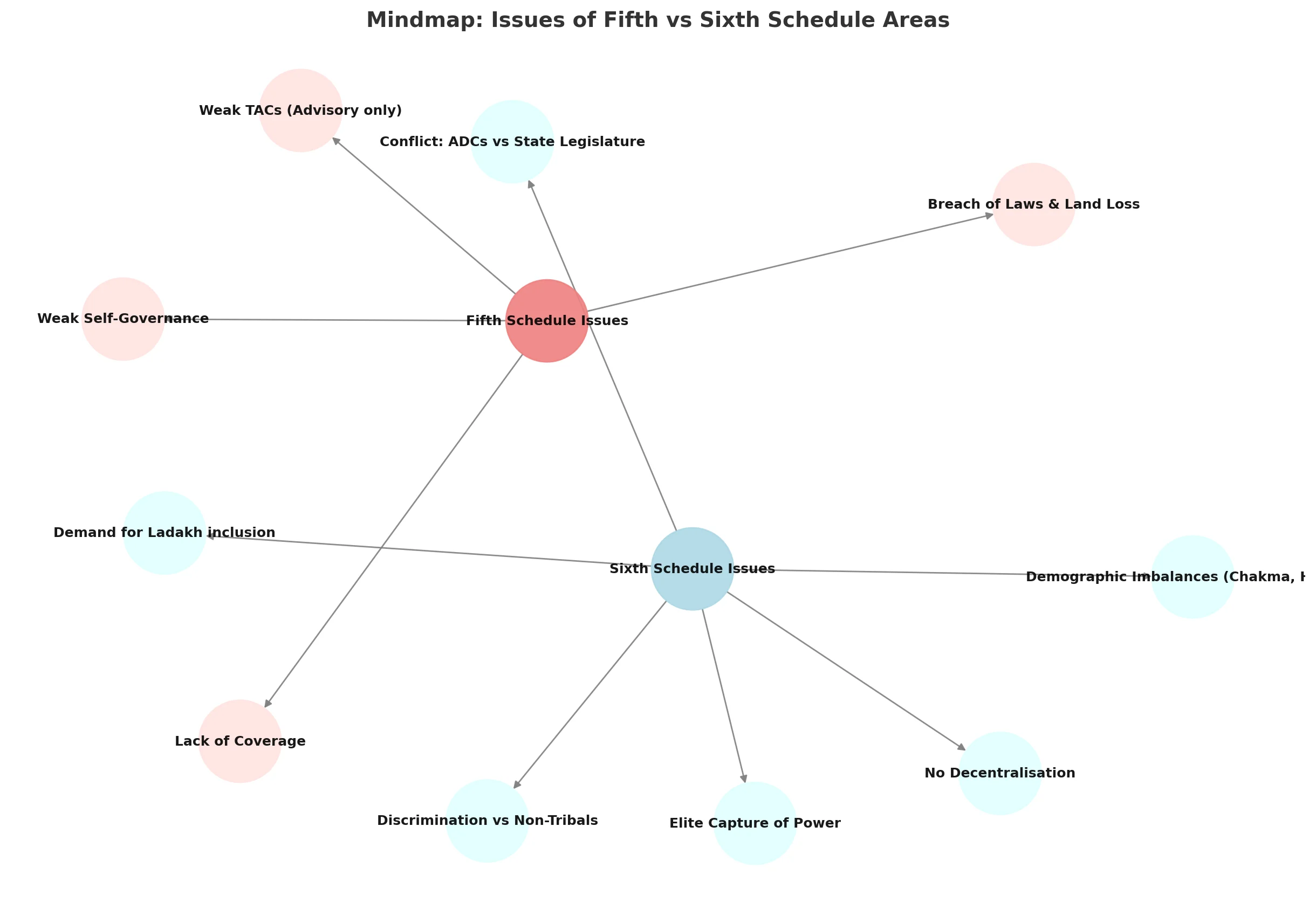
Comparison of Challenges: 5th vs 6th Schedule
| Issue Area | Fifth Schedule Problem | Sixth Schedule Problem |
|---|---|---|
| Governance Power | Too Weak: Advisory only (TACs). | Conflict: Clashes with State Govt over jurisdiction. |
| Financial Autonomy | None: Dependent on State Budget. | Blocked: State Govts delay releasing funds to ADCs. |
| Democracy | State Bureaucracy dominates. | Elite Capture: Rich tribals dominate poor tribals. |
| Reform Needed | Implement PESA in letter and spirit. | Pass 125th Amendment for direct funding. |
Mains Key Points
Prelims Strategy Tips
Constitutional Amendments Related to UTs
Union Territories did not originally have a full democratic structure like states. Key constitutional amendments shaped how UTs were governed, how they could later become states, and when they gained legislatures or councils.
Union Territories did not originally have a full democratic structure like states. Key constitutional amendments shaped how UTs were governed, how they could later become states, and when they gained legislatures or councils.
Mains Key Points
Prelims Strategy Tips
Evolution of States from Union Territories
Some Union Territories (UTs) later became full States. This happened when the regions grew in population, built stable institutions, and consistently demanded more autonomy. Converting a UT to a State gives it a full-fledged legislature, its own elected government with wider powers, and greater control over finances and policing (subject to the Constitution).
Some Union Territories (UTs) later became full States. This happened when the regions grew in population, built stable institutions, and consistently demanded more autonomy. Converting a UT to a State gives it a full-fledged legislature, its own elected government with wider powers, and greater control over finances and policing (subject to the Constitution).
Major UT → State Transitions (Quick View)
| Region | From | To | Year | Why (Short) |
|---|---|---|---|---|
| Himachal Pradesh | UT | State | 1971 | Representation & admin needs |
| Manipur | UT | State | 1972 | Political demand & identity |
| Tripura | UT | State | 1972 | Population & governance |
| Meghalaya | Autonomous (within Assam) | State | 1972 | Tribal identity & self-rule |
| Goa | UT | State | 1987 | Growth & popular demand |
| Mizoram | UT | State | 1987 | Peace accord & stability |
| Arunachal Pradesh | UT | State | 1987 | Strategic admin & development |
Mains Key Points
Prelims Strategy Tips
Forest Rights Act (FRA), 2006 and Community Rights
The Forest Rights Act, 2006 (FRA) gives legal rights to tribal and forest-dwelling communities over the land and forest resources they have lived on for generations. Before this Act, these communities were treated as encroachers on their own land due to colonial forest policies. FRA restores their historical rights and empowers them to manage forest resources.
The Forest Rights Act, 2006 (FRA) gives legal rights to tribal and forest-dwelling communities over the land and forest resources they have lived on for generations. Before this Act, these communities were treated as encroachers on their own land due to colonial forest policies. FRA restores their historical rights and empowers them to manage forest resources.
Mains Key Points
Prelims Strategy Tips
National Commission for Scheduled Tribes (NCST)
NCST is a constitutional watchdog for the rights of Scheduled Tribes. It ensures that ST welfare schemes, reservation benefits, land rights, and cultural protections are properly implemented. It was created in 2003 after separating ST matters from NCSC to provide dedicated focus on tribal issues.
NCST is a constitutional watchdog for the rights of Scheduled Tribes. It ensures that ST welfare schemes, reservation benefits, land rights, and cultural protections are properly implemented. It was created in 2003 after separating ST matters from NCSC to provide dedicated focus on tribal issues.
Mains Key Points
Prelims Strategy Tips
National Commission for Scheduled Castes (NCSC)
The National Commission for Scheduled Castes (NCSC) is a constitutional body under Article 338 that safeguards the rights of SCs. It monitors implementation of protections, investigates complaints of discrimination, and advises governments on SC welfare and development.
The National Commission for Scheduled Castes (NCSC) is a constitutional body under Article 338 that safeguards the rights of SCs. It monitors implementation of protections, investigates complaints of discrimination, and advises governments on SC welfare and development.
Mains Key Points
Prelims Strategy Tips
Scheduled Castes and Scheduled Tribes (Lists)
SC/ST lists define exactly which communities get constitutional benefits like reservation. The President notifies the lists for each State/UT (Articles 341 & 342). Only Parliament can later add or remove communities by law—States cannot change these lists.
SC/ST lists define exactly which communities get constitutional benefits like reservation. The President notifies the lists for each State/UT (Articles 341 & 342). Only Parliament can later add or remove communities by law—States cannot change these lists.
Mains Key Points
Prelims Strategy Tips
Particularly Vulnerable Tribal Groups (PVTGs)
PVTGs are the most vulnerable among STs—small populations, fragile livelihoods, and low literacy. Identified using criteria like pre-agricultural technology, stagnant/declining population, economic backwardness, and low literacy. They need focused, flexible, community-led welfare.
PVTGs are the most vulnerable among STs—small populations, fragile livelihoods, and low literacy. Identified using criteria like pre-agricultural technology, stagnant/declining population, economic backwardness, and low literacy. They need focused, flexible, community-led welfare.
Mains Key Points
Prelims Strategy Tips
Inner Line Permit (ILP) and Protected Area Permit (PAP)
ILP regulates entry of Indian citizens into certain tribal-dominated areas (mainly some NE States) to protect indigenous culture and land. PAP regulates entry of foreigners into sensitive/protected areas for security and conservation.
ILP regulates entry of Indian citizens into certain tribal-dominated areas (mainly some NE States) to protect indigenous culture and land. PAP regulates entry of foreigners into sensitive/protected areas for security and conservation.
Mains Key Points
Prelims Strategy Tips
Armed Forces Special Powers Act (AFSPA)
AFSPA, 1958 grants special powers to the armed forces in areas declared ‘disturbed’ to aid civil power—like search without warrant, arrest, and controlled use of force. It is controversial due to immunity provisions and human rights concerns.
AFSPA, 1958 grants special powers to the armed forces in areas declared ‘disturbed’ to aid civil power—like search without warrant, arrest, and controlled use of force. It is controversial due to immunity provisions and human rights concerns.
Mains Key Points
Prelims Strategy Tips
Denotified, Nomadic and Semi-nomadic Tribes (DNTs)
DNTs include communities once labeled as ‘Criminal Tribes’ by a colonial law (1871). Even after denotification (1952), many face stigma, lack of IDs/address, and exclusion from welfare due to mobility. They need tailored, mobile, identity-friendly delivery systems.
DNTs include communities once labeled as ‘Criminal Tribes’ by a colonial law (1871). Even after denotification (1952), many face stigma, lack of IDs/address, and exclusion from welfare due to mobility. They need tailored, mobile, identity-friendly delivery systems.
Mains Key Points
Prelims Strategy Tips
Chapter Complete!
Congratulations! You've completed all chapters.