
Indian polity Playlist
19 chapters • 0 completed
Making of the Constitution
18 topics
Salient Features of the Indian Constitution
4 topics
Preamble
7 topics
Evolution of States & Union Territories
7 topics
Citizenship
9 topics
Fundamental Rights
34 topics
Directive Principles of State Policy (DPSP)
19 topics
Amendment and Basic Structure
12 topics
Parliamentary System of Government
48 topics
Union Executive
36 topics
State Executive
21 topics
State Legislature
11 topics
Centre-State Relations
24 topics
Inter-State Relations
14 topics
Emergency Provisions
13 topics
Supreme Court
26 topics
High Court
20 topics
Local Government
21 topics
UTs + Scheduled and Tribal Areas
22 topics
Chapter 6: Fundamental Rights
Chapter TestFundamental Rights – Part I
Fundamental Rights (Part III, Articles 12–35) are the cornerstone of the Indian Constitution, guaranteeing essential freedoms and equality to citizens. They act as limitations on the authority of the State and secure justice, liberty, and dignity of individuals.
Fundamental Rights (Part III, Articles 12–35) are the cornerstone of the Indian Constitution, guaranteeing essential freedoms and equality to citizens. They act as limitations on the authority of the State and secure justice, liberty, and dignity of individuals.
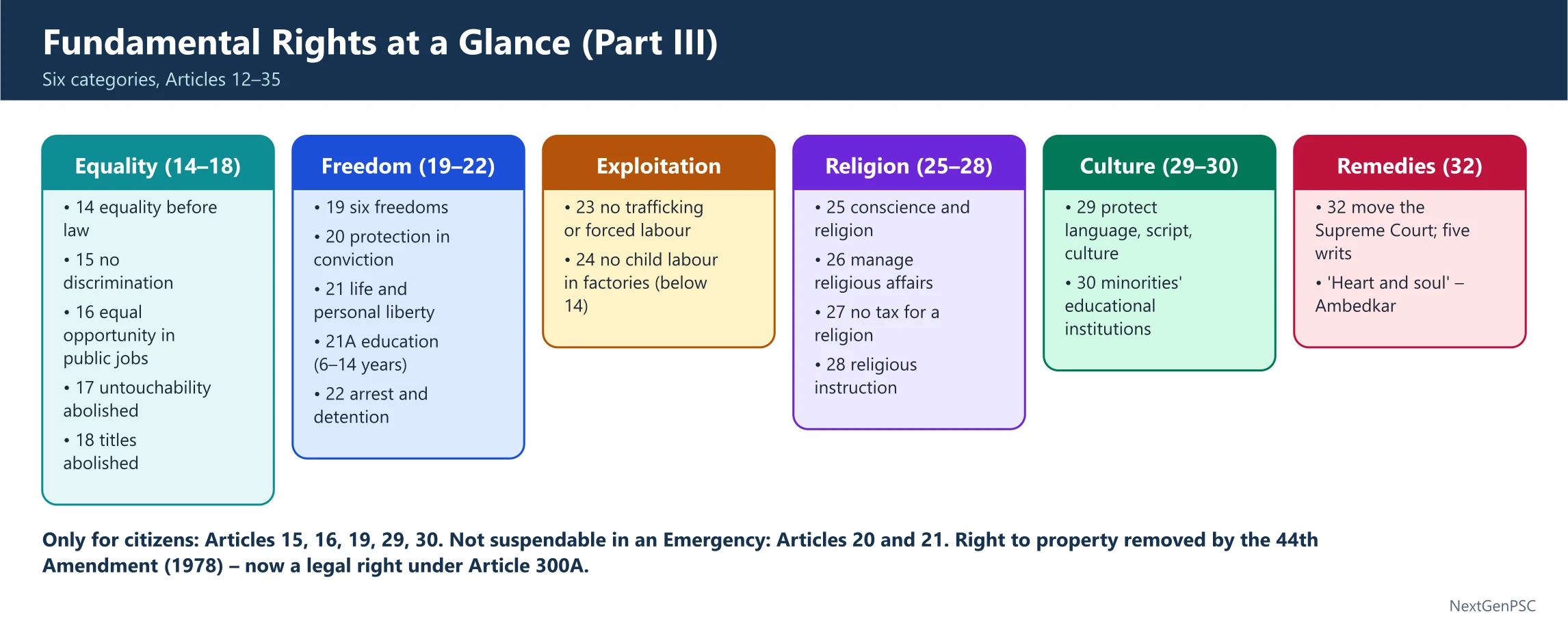
Difference between Fundamental Rights and Legal Rights
| Parameter | Fundamental Rights | Legal Rights |
|---|---|---|
| Protection | Guaranteed by Constitution (Part III) | Granted by ordinary law (e.g., RTI Act) |
| Amendment | Change requires constitutional amendment | Changeable by simple majority law |
| Justiciability | Directly enforceable in SC (Art. 32) & HCs (Art. 226) | Enforced in ordinary courts only |
| Scope | Civil & political freedoms (some social aspects) | Depends on subject matter of statute |
| Basic Structure | Some rights are part of Basic Structure Doctrine | Not part of Basic Structure |
Mains Key Points
Prelims Strategy Tips
Features of Fundamental Rights & Article 12 – Definition of State
Fundamental Rights are justiciable, enforceable limitations on State power, ensuring protection of liberty and equality. Article 12 defines 'the State' to include government bodies and authorities, making them accountable for violation of Fundamental Rights.
Fundamental Rights are justiciable, enforceable limitations on State power, ensuring protection of liberty and equality. Article 12 defines 'the State' to include government bodies and authorities, making them accountable for violation of Fundamental Rights.
Tests to Determine 'Other Authorities' under Article 12 (Ajay Hasia Case)
| Test Factor | Explanation |
|---|---|
| Government Shareholding | If govt. holds full/major share capital of the body. |
| Financial Assistance | Whether govt. funds cover almost entire expenditure. |
| Monopoly Status | Whether corporation enjoys state-conferred monopoly. |
| Deep & Pervasive Control | Extent of govt. control over policies/management. |
| Public Function | Functions closely related to govt. responsibilities. |
| Transfer of Govt. Department | If a govt. department is transferred to the corporation. |
Mains Key Points
Prelims Strategy Tips
Article 13 – Laws Inconsistent with Fundamental Rights & Judicial Review
Article 13 makes laws inconsistent with Fundamental Rights void. It empowers the judiciary through Judicial Review to strike down unconstitutional legislative and executive actions. Several judicial doctrines like Severability, Eclipse, and Colourable Legislation evolved to interpret and apply Article 13.
Article 13 makes laws inconsistent with Fundamental Rights void. It empowers the judiciary through Judicial Review to strike down unconstitutional legislative and executive actions. Several judicial doctrines like Severability, Eclipse, and Colourable Legislation evolved to interpret and apply Article 13.
Judicial Doctrines under Article 13
| Doctrine | Essence | Case Example |
|---|---|---|
| Pith & Substance | True purpose of law prevails despite incidental encroachment | State of Bombay v. F.N. Balsara |
| Colourable Legislation | What cannot be done directly cannot be done indirectly | State of Bihar v. Kameshwar Singh |
| Delegated Legislation | Parliament delegates rule-making power to Executive | D.S. Grewal v. Punjab |
| Doctrine of Necessity | Exceptional situations justify extraordinary measures | Gullapalli Nageshwar Rao v. AP |
| Doctrine of Pleasure | Civil servants hold office at President/Governor’s pleasure | Union of India v. Balbir Singh |
| Doctrine of Eclipse | Pre-constitutional law not void, but dormant | Bhikaji v. State of MP |
| Doctrine of Severability | Unconstitutional part struck down, rest survives | NHAI v. Trichy Expressway |
| Doctrine of Territorial Nexus | Law valid if territorial connection exists | Tata Iron & Steel v. State of Bihar |
| Doctrine of Implied Powers | Necessary implied powers allowed | Bidi Leaves Case |
| Doctrine of Incidental Powers | Legislature can legislate on related matters | State of Rajasthan v. G. Chawla |
| Doctrine of Precedent | SC judgments binding under Art. 141 | Shah Bano Case |
| Doctrine of Harmonious Construction | Conflicts resolved by harmonisation | Shankari Prasad Case |
Mains Key Points
Prelims Strategy Tips
Article 14 – Equality before Law & Equal Protection of Laws
Article 14 guarantees that no person shall be denied equality before the law or equal protection of laws within India. It applies to citizens, foreigners, and legal persons, forming the foundation of Rule of Law and natural justice. While equality is a basic feature, reasonable classification and affirmative action are permitted.
Article 14 guarantees that no person shall be denied equality before the law or equal protection of laws within India. It applies to citizens, foreigners, and legal persons, forming the foundation of Rule of Law and natural justice. While equality is a basic feature, reasonable classification and affirmative action are permitted.
Comparison – Equality Before Law vs Equal Protection of Laws
| Aspect | Equality Before Law | Equal Protection of Laws |
|---|---|---|
| Meaning | No special privileges, equal subjection to ordinary law | Equal treatment in similar circumstances – rights & liabilities alike |
| Origin | British concept, Rule of Law (Dicey) | American Constitution (14th Amendment) |
| Nature | Negative – absence of special privilege | Positive – State must ensure equality in practice |
Mains Key Points
Prelims Strategy Tips
Article 15 – Prohibition of Discrimination on Certain Grounds
Article 15 prohibits the State and private individuals (in certain cases) from discriminating against citizens on grounds of religion, race, caste, sex, or place of birth. It also allows special provisions for women, children, socially and educationally backward classes, SCs, STs, and Economically Weaker Sections (EWS).
Article 15 prohibits the State and private individuals (in certain cases) from discriminating against citizens on grounds of religion, race, caste, sex, or place of birth. It also allows special provisions for women, children, socially and educationally backward classes, SCs, STs, and Economically Weaker Sections (EWS).
Evolution of Article 15 Provisions
| Clause | Provision | Added/Amended by |
|---|---|---|
| 15(1) | State cannot discriminate on religion, race, caste, sex, place of birth | Original Constitution (1950) |
| 15(2) | No citizen denied access to public spaces | Original Constitution (1950) |
| 15(3) | Special provisions for women and children | Original Constitution (1950) |
| 15(4) | Special provisions for SEBCs, SCs, STs | 1st Amendment, 1951 |
| 15(5) | Reservation in educational institutions (excl. minority) | 93rd Amendment, 2005 |
| 15(6) | Reservation for EWS (up to 10%) | 103rd Amendment, 2019 |
Mains Key Points
Prelims Strategy Tips
Article 16 – Equality of Opportunity in Public Employment
Article 16 guarantees equality of opportunity in public employment for all citizens, prohibiting discrimination on the basis of religion, race, caste, sex, descent, place of birth, or residence. However, it permits certain exceptions such as residence requirements, reservations for backward classes, SCs, STs, and Economically Weaker Sections (EWS), and religious institutions’ needs.
Article 16 guarantees equality of opportunity in public employment for all citizens, prohibiting discrimination on the basis of religion, race, caste, sex, descent, place of birth, or residence. However, it permits certain exceptions such as residence requirements, reservations for backward classes, SCs, STs, and Economically Weaker Sections (EWS), and religious institutions’ needs.
Key Provisions & Amendments under Article 16
| Clause | Provision | Amendment/Year |
|---|---|---|
| 16(1)-(2) | No discrimination in public employment on listed grounds | Original Constitution (1950) |
| 16(3) | Residence requirement for certain jobs | Public Employment Act, 1957 |
| 16(4) | Reservation for backward classes | Original Constitution |
| 16(4A) | Reservation in promotion for SC/ST | 77th Amendment, 1995 |
| 16(4B) | Carry forward of unfilled SC/ST vacancies | 81st Amendment, 2000 |
| 16(5) | Religious institutions can mandate religious qualifications | Original Constitution |
| 16(6) | 10% EWS quota in jobs/education | 103rd Amendment, 2019 |
Mains Key Points
Prelims Strategy Tips
Article 17 & Article 18 – Abolition of Untouchability and Titles
Article 17 abolishes 'untouchability' and makes its practice a punishable offence. It is absolute in nature and applicable against both State and private individuals. Article 18 abolishes titles of nobility, preventing misuse of honorary distinctions and ensuring equality.
Article 17 abolishes 'untouchability' and makes its practice a punishable offence. It is absolute in nature and applicable against both State and private individuals. Article 18 abolishes titles of nobility, preventing misuse of honorary distinctions and ensuring equality.
Comparison: Article 17 vs Article 18
| Aspect | Article 17 – Abolition of Untouchability | Article 18 – Abolition of Titles |
|---|---|---|
| Scope | Forbids untouchability practice in any form | Forbids titles of nobility (except military/academic) |
| Beneficiaries | All citizens (absolute protection) | All citizens + foreigners in State service |
| Nature | Absolute, no exceptions | Qualified – allows academic & military distinctions |
| Law | Untouchability Offences Act, 1955 / PCR Act, 1976 | No separate law, but awards clarified by SC |
| Judgments | People’s Union for Democratic Rights (1982) | Balaji Raghavan v. Union of India (1995) |
Mains Key Points
Prelims Strategy Tips
Right to Freedom (Articles 19–22)
The Right to Freedom (Articles 19–22) forms the backbone of Part III of the Constitution, guaranteeing essential freedoms such as speech, association, life and liberty, education, and safeguards against arbitrary arrest. These rights ensure the dignity of individuals and protect democratic values.
The Right to Freedom (Articles 19–22) forms the backbone of Part III of the Constitution, guaranteeing essential freedoms such as speech, association, life and liberty, education, and safeguards against arbitrary arrest. These rights ensure the dignity of individuals and protect democratic values.
Overview of Right to Freedom (Articles 19–22)
| Article | Subject Matter | Key Features |
|---|---|---|
| Article 19 | Protection of freedoms | 6 freedoms with reasonable restrictions |
| Article 20 | Protection in respect of conviction | No ex-post facto law, no double jeopardy, no self-incrimination |
| Article 21 | Life & personal liberty | Expanded to include privacy, livelihood, health, etc. |
| Article 21A | Right to Education | Free & compulsory education for 6–14 years |
| Article 22 | Protection against arrest & detention | Safeguards + preventive detention provisions |
Mains Key Points
Prelims Strategy Tips
Article 19 – Protection of Certain Rights Regarding Freedom of Speech, etc.
Article 19 grants six freedoms to Indian citizens – speech, assembly, association, movement, residence, and profession – forming the foundation of democratic rights. These freedoms are not absolute and can be reasonably restricted on grounds such as sovereignty, security, public order, morality, and defamation.
Article 19 grants six freedoms to Indian citizens – speech, assembly, association, movement, residence, and profession – forming the foundation of democratic rights. These freedoms are not absolute and can be reasonably restricted on grounds such as sovereignty, security, public order, morality, and defamation.
Freedoms under Article 19(1) and Grounds of Restriction
| Freedom | Clause | Restrictions Allowed Under |
|---|---|---|
| Speech & Expression | 19(1)(a) | Art. 19(2): security, sovereignty, morality, contempt, defamation, etc. |
| Assemble Peaceably | 19(1)(b) | Art. 19(3): sovereignty, public order |
| Form Associations | 19(1)(c) | Art. 19(4): sovereignty, public order, morality |
| Move Freely | 19(1)(d) | Art. 19(5): interest of general public, protection of STs |
| Reside & Settle | 19(1)(e) | Art. 19(5): interest of general public, protection of STs |
| Practice Profession/Trade | 19(1)(g) | Art. 19(6): interest of general public, professional qualifications, monopolies |
Mains Key Points
Prelims Strategy Tips
Article 19 – Freedom-wise Breakdown & Landmark Judgments
Each freedom under Article 19(1) has been judicially interpreted to expand democratic rights, while maintaining reasonable restrictions under clauses (2)–(6). Landmark Supreme Court cases shaped the scope of speech, assembly, association, movement, residence, and profession rights.
Each freedom under Article 19(1) has been judicially interpreted to expand democratic rights, while maintaining reasonable restrictions under clauses (2)–(6). Landmark Supreme Court cases shaped the scope of speech, assembly, association, movement, residence, and profession rights.
Mains Key Points
Prelims Strategy Tips
Freedoms under Article 19(1)(b)–(g)
Article 19(1)(b)–(g) guarantees freedoms of assembly, association, movement, residence, and profession. These rights promote national unity and democratic participation but are subject to reasonable restrictions under clauses (3)–(6).
Article 19(1)(b)–(g) guarantees freedoms of assembly, association, movement, residence, and profession. These rights promote national unity and democratic participation but are subject to reasonable restrictions under clauses (3)–(6).
Freedoms (19(1)(b)–(g)) and Restrictions
| Freedom | Scope | Restrictions |
|---|---|---|
| Assembly (19(1)(b)) | Meetings, processions, protests | Art. 19(3): sovereignty, public order; CrPC 144; IPC 141 |
| Association (19(1)(c)) | Unions, societies, chambers | Art. 19(4): sovereignty, order, morality |
| Movement (19(1)(d)) | Free movement across India | Art. 19(5): public interest, ST protection |
| Residence (19(1)(e)) | Reside/settle anywhere | Art. 19(5): public interest, ST protection |
| Profession (19(1)(g)) | Trade, occupation, livelihood | Art. 19(6): public interest, qualifications, state monopoly |
Mains Key Points
Prelims Strategy Tips
Article 20 – Protection in Respect of Conviction for Offences
Article 20 provides safeguards against arbitrary punishment through three key protections: prohibition of ex-post-facto laws, protection against double jeopardy, and prohibition of self-incrimination. These rights apply to both citizens and foreigners and cannot be suspended even during an emergency.
Article 20 provides safeguards against arbitrary punishment through three key protections: prohibition of ex-post-facto laws, protection against double jeopardy, and prohibition of self-incrimination. These rights apply to both citizens and foreigners and cannot be suspended even during an emergency.
Protections under Article 20
| Clause | Protection | Scope | Exceptions |
|---|---|---|---|
| 20(1) | No ex-post-facto law | Only criminal offences; no retrospective conviction/punishment | Civil liability, taxation |
| 20(2) | No double jeopardy | Same offence; same facts; prior acquittal/conviction by court | Departmental/administrative proceedings |
| 20(3) | No self-incrimination | Accused in criminal cases; oral/written testimony | Civil cases; voluntary confessions |
Mains Key Points
Prelims Strategy Tips
Article 21 – Protection of Life and Personal Liberty
Article 21 ensures that no person shall be deprived of life or personal liberty except according to procedure established by law. It applies to both citizens and non-citizens and has been widely interpreted by the Supreme Court to include a range of rights such as livelihood, clean environment, privacy, and dignity.
Article 21 ensures that no person shall be deprived of life or personal liberty except according to procedure established by law. It applies to both citizens and non-citizens and has been widely interpreted by the Supreme Court to include a range of rights such as livelihood, clean environment, privacy, and dignity.
Procedure Established by Law vs Due Process of Law
| Aspect | Procedure Established by Law | Due Process of Law |
|---|---|---|
| Origin | British Constitution | U.S. Constitution |
| Scope | Checks only if law is enacted properly | Checks fairness, justice, and reasonableness of law itself |
| Judicial Role | Limited – only reviews procedure | Broad – reviews substance + procedure |
| Mention in Indian Constitution | Yes – Article 21 | Not explicitly, but adopted by SC in Maneka Gandhi case |
Mains Key Points
Prelims Strategy Tips
Article 21 – Expanded Scope of Right to Life and Personal Liberty
Article 21 has evolved from a narrow safeguard to the foundation of a wide range of fundamental rights through judicial interpretation. It now encompasses rights such as livelihood, privacy, environment, health, education, dignity, speedy trial, and even sustainable development.
Article 21 has evolved from a narrow safeguard to the foundation of a wide range of fundamental rights through judicial interpretation. It now encompasses rights such as livelihood, privacy, environment, health, education, dignity, speedy trial, and even sustainable development.
Derived Rights under Article 21
| Category | Examples |
|---|---|
| Dignity & Decency | Right to live with dignity, women’s decency, reputation, no public hanging |
| Livelihood & Social Security | Right to livelihood, shelter, family pension, insurance policy |
| Health & Environment | Right to health, emergency medical aid, clean environment, freedom from noise pollution |
| Justice & Liberty | Right to free legal aid, speedy trial, appeal, protection against solitary confinement, torture, handcuffing |
| Education & Information | Right to education up to 14 years, right to information |
| Personal Freedom | Right to privacy, right to marry person of choice, right to sleep, right to travel abroad |
Mains Key Points
Prelims Strategy Tips
Right to Education (Article 21A) & Protection Against Arrest and Detention (Article 22)
Article 21A makes free and compulsory education for children aged 6–14 a Fundamental Right, while Article 22 provides protection in cases of arrest and detention, including safeguards against misuse of preventive detention.
Article 21A makes free and compulsory education for children aged 6–14 a Fundamental Right, while Article 22 provides protection in cases of arrest and detention, including safeguards against misuse of preventive detention.
Evolution of Right to Education
| Year/Case | Development |
|---|---|
| 1990 – Ramamurti Committee | Recommended compulsory education. |
| 1992 – Mohini Jain Case | Education part of Right to Life (Article 21). |
| 1993 – Unnikrishnan Case | Right to free education up to 14 years. |
| 1999 – Tapas Majumdar Committee | Quality education for all, even poorest. |
| 2002 – 86th Amendment | Inserted Article 21A, modified Article 45, added FD in 51A(k). |
| 2009 – RTE Act | Operationalised Right to Education. |
Types of Detention under Article 22
| Type | Meaning |
|---|---|
| Punitive Detention | Detention after conviction by court (punishment). |
| Preventive Detention | Detention without trial to prevent a possible offence. |
Mains Key Points
Prelims Strategy Tips
Article 22 – Protection Against Punitive & Preventive Detention
Article 22 provides rights in cases of arrest and detention: safeguards against arbitrary punitive detention (right to be produced before magistrate, legal counsel, release after 24 hours) and conditional protections under preventive detention (grounds of detention, representation, maximum periods with Advisory Board review).
Article 22 provides rights in cases of arrest and detention: safeguards against arbitrary punitive detention (right to be produced before magistrate, legal counsel, release after 24 hours) and conditional protections under preventive detention (grounds of detention, representation, maximum periods with Advisory Board review).
Safeguards under Punitive vs Preventive Detention
| Aspect | Punitive Detention | Preventive Detention |
|---|---|---|
| Applicability | After conviction by court | Before trial, to prevent offence |
| Rights | Grounds of arrest, legal aid, produced in 24 hrs | Grounds of detention, representation |
| Duration | As per criminal law procedure | Max 3 months, extendable by Parliament/Advisory Board |
| Scope | Only after offence committed | Anticipatory, based on suspicion |
| Beneficiaries | Only accused | Both citizens & aliens |
Mains Key Points
Prelims Strategy Tips
Preventive Detention – Relevant Supreme Court Judgements & Value Addition
Preventive detention has been upheld but strictly scrutinised by the Supreme Court. It must be used sparingly and never as a substitute for ordinary legal processes.
Preventive detention has been upheld but strictly scrutinised by the Supreme Court. It must be used sparingly and never as a substitute for ordinary legal processes.
Fundamental Rights – Citizens vs Foreigners
| Category | Rights Included |
|---|---|
| Only Citizens | Articles 15, 16, 19, 29, 30 |
| Citizens + Foreigners (except enemy aliens) | Articles 14, 20, 21, 21A, 22, 23, 24, 25, 26, 27, 28 |
Prelims Strategy Tips
Article 23 – Prohibition of Traffic in Human Beings and Forced Labour
Article 23 prohibits trafficking in human beings, begar (forced labour), and other similar practices. It applies to both citizens and foreigners, and protects against actions of both the State and private individuals.
Article 23 prohibits trafficking in human beings, begar (forced labour), and other similar practices. It applies to both citizens and foreigners, and protects against actions of both the State and private individuals.
Article 23 – Key Aspects
| Aspect | Details |
|---|---|
| Coverage | Applies to citizens + non-citizens; against State & private individuals |
| Prohibited Practices | Human trafficking, begar, bonded labour, forced labour |
| Exception | Compulsory service for public purposes without discrimination |
| Legislation | Immoral Traffic (Prevention) Act, 1956 |
| Judgements | Vishal Jeet (1990), Gaurav Jain (1997), PUDR v. Union of India (1982) |
Mains Key Points
Prelims Strategy Tips
Article 24 – Prohibition of Employment of Children in Factories, etc.
Article 24 prohibits the employment of children below 14 years in factories, mines, or hazardous occupations. Later amendments strengthened this to a total ban on child labour in all occupations (below 14 years), and restricted adolescent labour (14–18 years) in hazardous work.
Article 24 prohibits the employment of children below 14 years in factories, mines, or hazardous occupations. Later amendments strengthened this to a total ban on child labour in all occupations (below 14 years), and restricted adolescent labour (14–18 years) in hazardous work.
Article 24 – Key Provisions and Laws
| Aspect | Details |
|---|---|
| Scope | No child below 14 in factories, mines, hazardous work |
| Main Law | Child Labour (Prohibition and Regulation) Act, 1986; amended in 2016 |
| Amendment 2016 | Ban on all work for <14 yrs; ban on hazardous work for 14–18 yrs |
| Exceptions | Family enterprises, entertainment industry (non-hazardous) |
| Punishments | 6 months–2 years jail + ₹20k–₹50k fine; repeat offences 1–3 years jail |
| Judgements | PUDR (1982), M.C. Mehta (1996), Bandhua Mukti Morcha (1997), Bachpan Bachao Andolan (2011) |
Mains Key Points
Prelims Strategy Tips
Article 25 – Freedom of Conscience and Religion
Article 25 guarantees freedom of conscience and the right to profess, practice, and propagate religion to all persons (citizens and non-citizens). This embodies Indian secularism, where the State maintains a principled distance but can intervene to ensure public order, morality, health, and social reform.
Article 25 guarantees freedom of conscience and the right to profess, practice, and propagate religion to all persons (citizens and non-citizens). This embodies Indian secularism, where the State maintains a principled distance but can intervene to ensure public order, morality, health, and social reform.
Freedom of Religion under Article 25
| Aspect | Provision |
|---|---|
| Who is covered? | All persons – citizens and foreigners |
| Rights included | Conscience, profess, practice, propagate |
| Restrictions | Public order, morality, health, other FRs |
| State intervention (25(2)) | Regulate secular activities, social reform, Hindu temple entry |
| Secularism model | Indian model – principled distance, not absolute separation |
Mains Key Points
Prelims Strategy Tips
Article 26 – Freedom to Manage Religious Affairs
Article 26 guarantees every religious denomination or any of its sections the right to establish institutions, manage religious affairs, own property, and administer such property, subject to public order, morality, and health.
Article 26 guarantees every religious denomination or any of its sections the right to establish institutions, manage religious affairs, own property, and administer such property, subject to public order, morality, and health.
Rights under Article 26
| Right | Explanation |
|---|---|
| Establish institutions | For religious & charitable purposes |
| Manage religious affairs | Independently in matters of religion |
| Own property | Acquire movable and immovable property |
| Administer property | Manage property under legal framework |
Mains Key Points
Prelims Strategy Tips
Articles 27 & 28 – Freedom from Religious Taxes and Religious Instruction
Article 27 prohibits using taxes for promoting a particular religion, ensuring secular use of public funds. Article 28 governs religious instruction in educational institutions, prohibiting it in state-run institutions but allowing voluntary practice in aided or recognised ones.
Article 27 prohibits using taxes for promoting a particular religion, ensuring secular use of public funds. Article 28 governs religious instruction in educational institutions, prohibiting it in state-run institutions but allowing voluntary practice in aided or recognised ones.
Types of Institutions under Article 28
| Type of Institution | Status of Religious Instruction |
|---|---|
| Wholly maintained by State | Prohibited (Art. 28(1)) |
| Administered by State but established under trust/endowment | Permitted (Art. 28(2)) |
| Recognised by State | Voluntary (Art. 28(3)) |
| State-aided institutions | Voluntary (Art. 28(3)) |
Mains Key Points
Prelims Strategy Tips
Cultural and Educational Rights – Articles 29 & 30
Articles 29 & 30 protect the cultural and educational rights of minorities in India. Article 29 safeguards distinct language, script, or culture of citizens, while Article 30 gives minorities the right to establish and administer educational institutions. These provisions ensure inclusivity, equality, and protection against discrimination in education.
Articles 29 & 30 protect the cultural and educational rights of minorities in India. Article 29 safeguards distinct language, script, or culture of citizens, while Article 30 gives minorities the right to establish and administer educational institutions. These provisions ensure inclusivity, equality, and protection against discrimination in education.
Comparison of Articles 29 & 30
| Aspect | Article 29 | Article 30 |
|---|---|---|
| Scope | Protects cultural & educational rights of citizens | Protects only minorities’ rights |
| Who is protected? | Citizens (minority + majority) | Only religious & linguistic minorities |
| Nature of right | Group right (29(1)) + individual right (29(2)) | Collective right to establish/manage institutions |
| Restrictions | Absolute in 29(1); 29(2) prevents denial of admission | Subject to reasonable regulation for academic standards |
| Aid & Recognition | Admission cannot be denied in state institutions | Aid must not discriminate against minority institutions |
Mains Key Points
Prelims Strategy Tips
Landmark Supreme Court Judgments on Writs
Article 32 is described by Dr. B.R. Ambedkar as the ‘heart and soul’ of the Constitution. It empowers citizens to directly approach the Supreme Court for enforcement of Fundamental Rights through constitutional writs. Judicial interpretation of writ jurisdiction has played a vital role in strengthening personal liberty, rule of law, and constitutional governance in India.
Article 32 is described by Dr. B.R. Ambedkar as the ‘heart and soul’ of the Constitution. It empowers citizens to directly approach the Supreme Court for enforcement of Fundamental Rights through constitutional writs. Judicial interpretation of writ jurisdiction has played a vital role in strengthening personal liberty, rule of law, and constitutional governance in India.
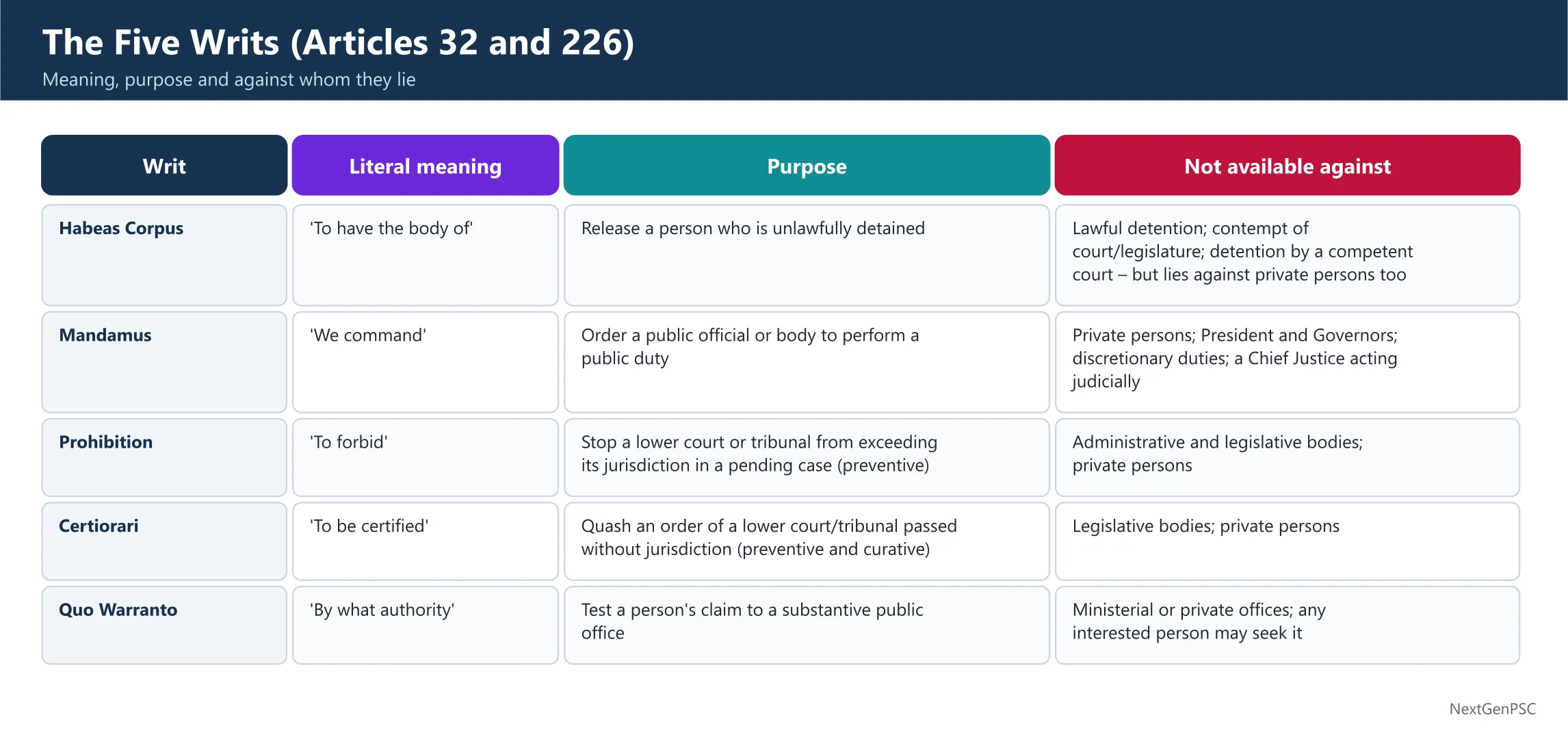
Summary of Constitutional Writs and Key Judgments
| Writ | Purpose | Landmark Judgments |
|---|---|---|
| Habeas Corpus | Protection of personal liberty | ADM Jabalpur (1976), K.S. Puttaswamy (2017) |
| Mandamus | Enforce public duty | Praga Tools (1969), Vineet Narain (1997) |
| Prohibition | Prevent excess of jurisdiction | East India Commercial Co. (1962) |
| Certiorari | Quash illegal orders | A.K. Gopalan (1950), Syed Yakoob (1964) |
| Quo Warranto | Challenge illegal public office | University of Mysore (1964), B.R. Kapur (2001) |
Prelims Strategy Tips
Articles 33 & 34 – Modification and Restriction of Fundamental Rights
Article 33 empowers Parliament to restrict/abrogate Fundamental Rights of armed, paramilitary, police, and intelligence forces to maintain discipline. Article 34 empowers Parliament to impose restrictions during Martial Law and indemnify officials. Martial Law affects rights in a specific area, whereas National Emergency (Art. 352) impacts rights, Centre–State relations, and governance nationwide.
Article 33 empowers Parliament to restrict/abrogate Fundamental Rights of armed, paramilitary, police, and intelligence forces to maintain discipline. Article 34 empowers Parliament to impose restrictions during Martial Law and indemnify officials. Martial Law affects rights in a specific area, whereas National Emergency (Art. 352) impacts rights, Centre–State relations, and governance nationwide.
Article 33 – Key Aspects
| Aspect | Details |
|---|---|
| Authority | Only Parliament can restrict FRs (not states) |
| Applicability | Armed forces, paramilitary, police, intelligence, analogous forces incl. non-combatant staff |
| Objective | Ensure discipline and proper discharge of duties |
| Judicial Review | Outside scope of judicial review |
| Nature | Security > Individual freedom |
Article 34 – Key Aspects (Martial Law)
| Aspect | Details |
|---|---|
| Authority | Parliament may indemnify officials and validate punishments |
| Source | English common law |
| Grounds | War, invasion, insurrection, rebellion, riot, violent resistance to law |
| Powers | Military restricts civilian rights, punishments incl. death penalty |
| Provision | Implicit under Article 34 (no explicit definition) |
| Supreme Court Verdict | Habeas Corpus not suspended under Martial Law |
Difference: Martial Law vs National Emergency
| Parameters | Martial Law | National Emergency (Article 352) |
|---|---|---|
| Impact | Suspension of Fundamental Rights only | FRs + Centre-State relations + revenue distribution + legislative powers + Parliament tenure |
| Govt. & Courts | Suspended | Function as usual |
| Grounds | Law & order breakdown (rebellion, riot, insurrection) | War, external aggression, armed rebellion |
| Region | Specific area(s) only | Whole country or part of it |
| Provision in Constitution | Implicit (Article 34) | Explicit, detailed (Article 352) |
Mains Key Points
Prelims Strategy Tips
Article 35 – Legislation to Give Effect to Fundamental Rights & Exceptions
Article 35 empowers Parliament (not state legislatures) to make laws for enforcing certain Fundamental Rights, even on matters in the State List. It also includes provisions for untouchability, trafficking, armed forces' rights, and indemnity under Martial Law. Articles 31A, 31B, and 31C serve as exceptions to Fundamental Rights.
Article 35 empowers Parliament (not state legislatures) to make laws for enforcing certain Fundamental Rights, even on matters in the State List. It also includes provisions for untouchability, trafficking, armed forces' rights, and indemnity under Martial Law. Articles 31A, 31B, and 31C serve as exceptions to Fundamental Rights.
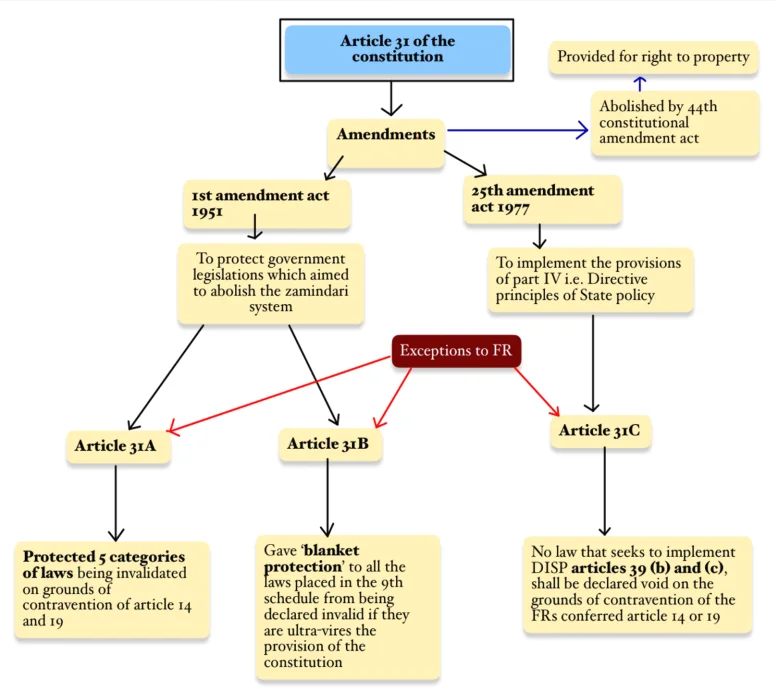
Powers of Parliament under Article 35
| Subject | Details |
|---|---|
| Employment residence condition | Parliament can prescribe residence as condition under Article 16. |
| Empowering courts | Parliament can authorize lower courts to issue writs for FRs (not just SC/HC). |
| Forces’ rights | Parliament may restrict/abrogate FRs for armed, paramilitary, police & intelligence forces. |
| Martial Law | Parliament can indemnify government servants for acts during Martial Law. |
| Punishment laws | For offences under Article 17 (untouchability) & Article 23 (trafficking/forced labour). |
Exceptions to Fundamental Rights
| Article | Provision |
|---|---|
| Article 31A | Protects land reform & agrarian reform laws from being challenged as violating FRs. |
| Article 31B | Validates laws in the 9th Schedule – immune from judicial review (subject to basic structure test). |
| Article 31C | Protects laws implementing DPSPs under Article 39(b) & 39(c) – cannot be challenged for violating FRs. |
Prelims Strategy Tips
Articles 31A, 31B & 31C – Exceptions to Fundamental Rights
Articles 31A, 31B, and 31C were introduced through constitutional amendments to protect agrarian reforms, land acquisition, and certain socio-economic legislations from being struck down as violating Fundamental Rights. However, judicial review remains available through the Basic Structure doctrine.
Articles 31A, 31B, and 31C were introduced through constitutional amendments to protect agrarian reforms, land acquisition, and certain socio-economic legislations from being struck down as violating Fundamental Rights. However, judicial review remains available through the Basic Structure doctrine.
Comparison of Articles 31A, 31B, 31C
| Article | Provision | Purpose | Judicial Review |
|---|---|---|---|
| 31A | Protects 5 categories of socio-economic laws from Art. 14 & 19 challenges | Facilitates agrarian reforms, land acquisition, corporate restructuring | Judicial review limited, subject to Basic Structure |
| 31B | Protects laws placed in 9th Schedule from Art. 13 scrutiny | Secure land reform & related laws from being struck down | I.R. Coelho (2007): Open to review if Basic Structure violated |
| 31C | DPSPs under Art. 39(b) & (c) override Art. 14 & 19 | Prioritises socialism, equitable distribution of resources | Kesavananda Bharati (1973): Limited protection; wider immunity struck down |
Prelims Strategy Tips
Significance and Criticism of Fundamental Rights
Fundamental Rights protect individuals from arbitrary state action, ensure dignity and equality, and form the backbone of democracy. However, they face criticism for excessive limitations, lack of socio-economic rights, and vulnerability during emergencies.
Fundamental Rights protect individuals from arbitrary state action, ensure dignity and equality, and form the backbone of democracy. However, they face criticism for excessive limitations, lack of socio-economic rights, and vulnerability during emergencies.
Significance vs Criticism of Fundamental Rights
| Aspect | Significance | Criticism |
|---|---|---|
| Protection | Shield against arbitrary state action | Preventive detention undermines liberty |
| Equality & Justice | Promotes social justice and minority protection | Fails to address socio-economic inequalities |
| Accountability | Article 32 ensures enforcement | Expensive, benefits mostly rich litigants |
| Democracy | Cornerstone of democratic governance | Can be suspended during emergencies |
| Clarity | Provide structured guarantees | Ambiguity in terms like 'public order' |
Mains Key Points
Prelims Strategy Tips
Fundamental Duties (Part IV-A, Article 51-A)
Fundamental Duties are moral obligations of all citizens to help promote a spirit of patriotism and uphold the unity of India. These duties were added to the Constitution by the 42nd Amendment Act, 1976 on the recommendation of the Swaran Singh Committee. They are non-justiciable but serve as a constant reminder to citizens.
Fundamental Duties are moral obligations of all citizens to help promote a spirit of patriotism and uphold the unity of India. These duties were added to the Constitution by the 42nd Amendment Act, 1976 on the recommendation of the Swaran Singh Committee. They are non-justiciable but serve as a constant reminder to citizens.
Fundamental Duties – Key Facts
| Aspect | Details |
|---|---|
| Part & Article | Part IV-A, Article 51-A |
| Added by | 42nd Amendment Act, 1976 |
| Recommendation | Swaran Singh Committee |
| Source | USSR Constitution (Inspiration) |
| Nature | Non-justiciable (cannot be directly enforced by courts) |
| Current Number | 11 (11th added by 86th Amendment, 2002) |
Mains Key Points
Prelims Strategy Tips
Eighth Schedule – Official Languages
The Eighth Schedule of the Constitution lists the Official Languages of the Republic of India. The original Schedule had 14 languages, but the number has increased over time through constitutional amendments. These languages are recognized by the government for administrative, literary, and educational purposes.
The Eighth Schedule of the Constitution lists the Official Languages of the Republic of India. The original Schedule had 14 languages, but the number has increased over time through constitutional amendments. These languages are recognized by the government for administrative, literary, and educational purposes.
Amendments to the Eighth Schedule
| Amendment Act | Year | Languages Added | Total Languages |
|---|---|---|---|
| Original Schedule | 1950 | 14 Languages | 14 |
| 21st Amendment | 1967 | Sindhi | 15 |
| 71st Amendment | 1992 | Konkani, Manipuri, Nepali | 18 |
| 92nd Amendment | 2003 | Bodo, Dogri, Maithili, Santhali | 22 |
Mains Key Points
Prelims Strategy Tips
Constitutional Bodies – National Commission for SCs (Article 338)
The National Commission for Scheduled Castes (NCSC) is a constitutional body established under Article 338 to monitor, investigate, and safeguard the rights and interests of the Scheduled Castes in India. It also participates in the planning process of the socio-economic development of the SCs.
The National Commission for Scheduled Castes (NCSC) is a constitutional body established under Article 338 to monitor, investigate, and safeguard the rights and interests of the Scheduled Castes in India. It also participates in the planning process of the socio-economic development of the SCs.
Evolution of NCSC
| Phase | Article/Amendment | Provision |
|---|---|---|
| Initial | Article 338 (Original) | Special Officer for SCs & STs |
| 1st Commission | 65th Amendment (1990) | Multi-member Commission for SCs & STs |
| Bifurcation | 89th Amendment (2003) | Separate Commissions: NCSC (Art. 338) & NCST (Art. 338-A) |
Mains Key Points
Prelims Strategy Tips
Constitutional Bodies – Special Officer for Linguistic Minorities (Article 350-B)
The Special Officer for Linguistic Minorities is a constitutional authority responsible for investigating all matters relating to the safeguards provided for linguistic minorities under the Constitution and reporting directly to the President. This office was created by the States Reorganisation Act, 1956, giving effect to Article 350-B.
The Special Officer for Linguistic Minorities is a constitutional authority responsible for investigating all matters relating to the safeguards provided for linguistic minorities under the Constitution and reporting directly to the President. This office was created by the States Reorganisation Act, 1956, giving effect to Article 350-B.
Special Officer for Linguistic Minorities – Key Facts
| Aspect | Detail |
|---|---|
| Constitutional Article | Article 350-B |
| Amendment | 7th Amendment Act, 1956 |
| Designation | Commissioner for Linguistic Minorities (CLM) |
| Headquarters | Prayagraj (Allahabad) |
| Reporting Authority | President of India |
| Key Safeguard Article | Article 350-A (mother tongue instruction at primary stage) |
Mains Key Points
Prelims Strategy Tips
Statutory Bodies – National Human Rights Commission (NHRC)
The National Human Rights Commission (NHRC) is a statutory, non-constitutional body established under the Protection of Human Rights Act, 1993, to protect and promote human rights in India. It investigates violations of rights, recommends measures for effective implementation, and focuses on civil and political rights.
The National Human Rights Commission (NHRC) is a statutory, non-constitutional body established under the Protection of Human Rights Act, 1993, to protect and promote human rights in India. It investigates violations of rights, recommends measures for effective implementation, and focuses on civil and political rights.
NHRC – Key Facts
| Aspect | Details |
|---|---|
| Status | Statutory Body (Non-Constitutional) |
| Founding Act | Protection of Human Rights Act, 1993 |
| Chairperson | Retired CJI or SC Judge |
| Recommendations | Non-binding on the government |
| Powers | Civil Court powers for inquiries |
Mains Key Points
Prelims Strategy Tips
Statutory Bodies – National Commission for Women (NCW)
The National Commission for Women (NCW) is a statutory body established under the National Commission for Women Act, 1990, to review constitutional and legal safeguards for women, recommend remedial measures, and facilitate redressal of grievances. It acts as an advisory and quasi-judicial body for women's rights.
The National Commission for Women (NCW) is a statutory body established under the National Commission for Women Act, 1990, to review constitutional and legal safeguards for women, recommend remedial measures, and facilitate redressal of grievances. It acts as an advisory and quasi-judicial body for women's rights.
NCW – Key Facts
| Aspect | Details |
|---|---|
| Status | Statutory Body (Non-Constitutional) |
| Founding Act | National Commission for Women Act, 1990 |
| Members | Chairperson + 5 Members |
| Reporting Authority | Central Government |
| Powers | Civil Court powers for inquiries |
Mains Key Points
Prelims Strategy Tips
Chapter Complete!
Ready to move to the next chapter?