
Indian polity Playlist
19 chapters • 0 completed
Making of the Constitution
18 topics
Salient Features of the Indian Constitution
4 topics
Preamble
7 topics
Evolution of States & Union Territories
7 topics
Citizenship
9 topics
Fundamental Rights
34 topics
Directive Principles of State Policy (DPSP)
19 topics
Amendment and Basic Structure
12 topics
Parliamentary System of Government
48 topics
Union Executive
36 topics
State Executive
21 topics
State Legislature
11 topics
Centre-State Relations
24 topics
Inter-State Relations
14 topics
Emergency Provisions
13 topics
Supreme Court
26 topics
High Court
20 topics
Local Government
21 topics
UTs + Scheduled and Tribal Areas
22 topics
Chapter 7: Directive Principles of State Policy (DPSP)
Chapter TestDirective Principles of State Policy (DPSP)
Directive Principles (Part IV, Articles 36–51) are constitutional instructions to guide the State in governance, aiming to establish a welfare state and secure social and economic democracy. They are non-justiciable but fundamental to governance.
Directive Principles (Part IV, Articles 36–51) are constitutional instructions to guide the State in governance, aiming to establish a welfare state and secure social and economic democracy. They are non-justiciable but fundamental to governance.
Directive Principles of State Policy – Key Aspects
| Aspect | Details |
|---|---|
| Part of Constitution | Part IV (Articles 36–51) |
| Source | Irish Constitution |
| Nature | Non-justiciable, but fundamental in governance |
| Objective | Establish welfare state; ensure socio-economic democracy |
| Relation with FR | FR + DPSP = Conscience of the Constitution |
Mains Key Points
Prelims Strategy Tips
Directive Principles of State Policy (DPSP)
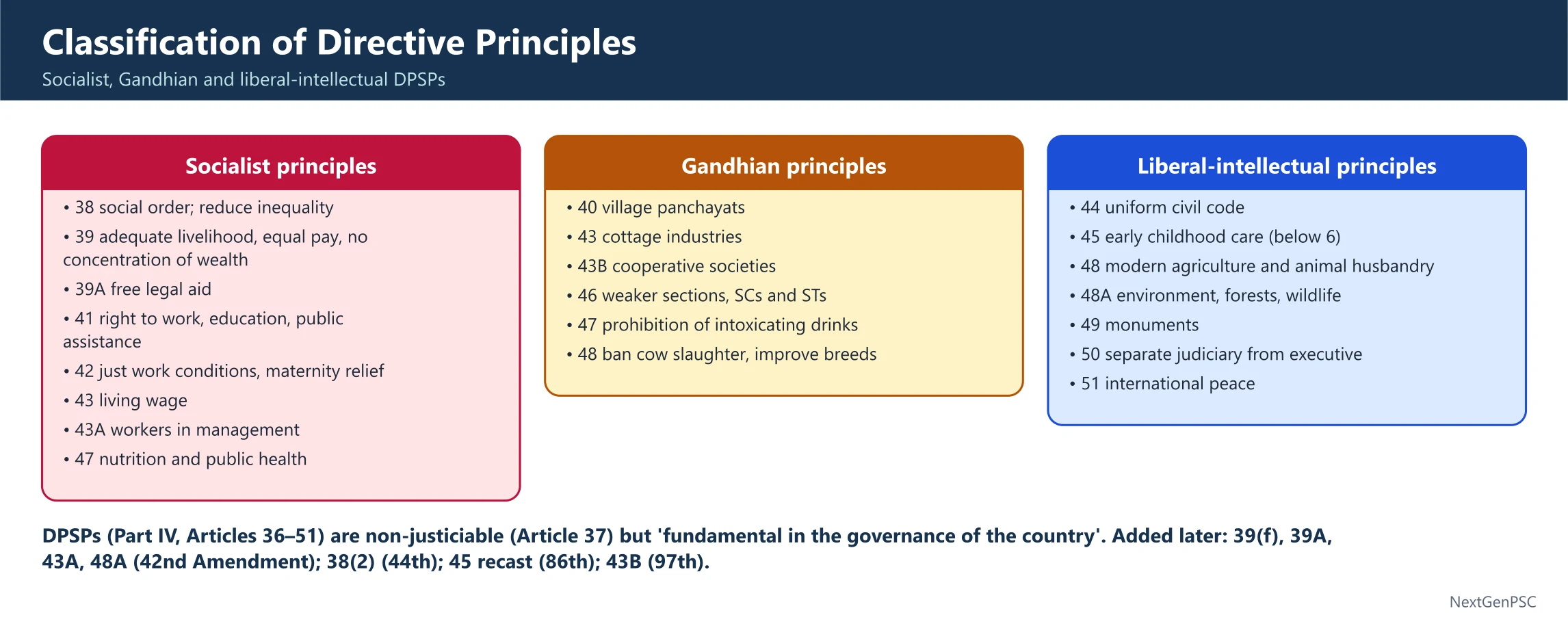
Directive Principles (Part IV, Articles 36–51) guide the State in governance. They are non-justiciable but fundamental in establishing a welfare state and ensuring social, economic, and political justice. DPSPs are classified into Socialist, Gandhian, and Liberal-Intellectual principles.
Directive Principles (Part IV, Articles 36–51) guide the State in governance. They are non-justiciable but fundamental in establishing a welfare state and ensuring social, economic, and political justice. DPSPs are classified into Socialist, Gandhian, and Liberal-Intellectual principles.
Categories of Directive Principles of State Policy
| Category | Articles | Focus |
|---|---|---|
| Socialist Principles | 38, 39, 39A, 41, 42, 43A, 47 | Justice, equality, welfare state, workers' rights. |
| Gandhian Principles | 40, 43, 46, 47, 48 | Village panchayats, cottage industries, SC/ST welfare, prohibition, agriculture. |
| Liberal-Intellectual Principles | 44, 45, 48A, 49, 50, 51 | UCC, education, environment, heritage, separation of powers, international peace. |
Mains Key Points
Prelims Strategy Tips
Directive Principles of State Policy – Constitutional Provisions
Articles 36 to 51 in Part IV of the Constitution lay down the Directive Principles of State Policy (DPSPs). These principles guide the State in ensuring social, economic, and political justice and in establishing a welfare state.
Articles 36 to 51 in Part IV of the Constitution lay down the Directive Principles of State Policy (DPSPs). These principles guide the State in ensuring social, economic, and political justice and in establishing a welfare state.
Constitutional Provisions under DPSPs
| Article | Subject Matter |
|---|---|
| 36 | Definition of the State |
| 37 | Application of the principles contained in this Part |
| 38 | State to secure a social order for the promotion of welfare of the people |
| 39 | Certain principles of policy to be followed by the State |
| 39A | Equal justice and free legal aid |
| 40 | Organisation of village panchayats |
| 41 | Right to work, to education and to public assistance in certain cases |
| 42 | Provision for just and humane conditions of work and maternity relief |
| 43 | Living wage, etc., for workers |
| 43A | Participation of workers in management of industries |
| 43B | Promotion of co-operative societies |
| 44 | Uniform civil code for the citizens |
| 45 | Provision for early childhood care and education to children below the age of six years |
| 46 | Promotion of educational and economic interests of SCs, STs and other weaker sections |
| 47 | Duty of the State to raise the level of nutrition, standard of living and improve public health |
| 48 | Organisation of agriculture and animal husbandry |
| 48A | Protection and improvement of environment, forests and wildlife |
| 49 | Protection of monuments, places and objects of national importance |
| 50 | Separation of judiciary from executive |
| 51 | Promotion of international peace and security |
Mains Key Points
Prelims Strategy Tips
Articles 36 & 37 – Definition of State and Nature of DPSPs
Article 36 adopts the same definition of 'State' as in Fundamental Rights, including Union, States, and all authorities under government control. Article 37 clarifies that Directive Principles are non-justiciable, but they impose a duty on the State to apply them in governance.
Article 36 adopts the same definition of 'State' as in Fundamental Rights, including Union, States, and all authorities under government control. Article 37 clarifies that Directive Principles are non-justiciable, but they impose a duty on the State to apply them in governance.
Mains Key Points
Prelims Strategy Tips
Socialist Principles under DPSPs
Socialist DPSPs emphasize social and economic justice, reduction of inequalities, and establishment of a welfare state. Key provisions include Articles 38, 39, 39A, 41, 42, 43, 43A, and 47.
Socialist DPSPs emphasize social and economic justice, reduction of inequalities, and establishment of a welfare state. Key provisions include Articles 38, 39, 39A, 41, 42, 43, 43A, and 47.
Mains Key Points
Prelims Strategy Tips
Articles 39A, 41, 42 & 43 – Socialist DPSPs on Justice, Work and Labour
These DPSPs aim to ensure equal justice, right to work, humane work conditions, maternity relief, and living wages. They form the backbone of India's welfare and labour protection framework.
These DPSPs aim to ensure equal justice, right to work, humane work conditions, maternity relief, and living wages. They form the backbone of India's welfare and labour protection framework.
Mains Key Points
Prelims Strategy Tips
Articles 40, 43, 43A & 47 – Gandhian and Socialist DPSPs
These DPSPs reflect Gandhian ideals of grassroots democracy, rural industries, and worker participation, alongside socialist objectives of nutrition, health, and labour rights. They aim to balance community welfare with economic justice.
These DPSPs reflect Gandhian ideals of grassroots democracy, rural industries, and worker participation, alongside socialist objectives of nutrition, health, and labour rights. They aim to balance community welfare with economic justice.
Mains Key Points
Prelims Strategy Tips
Articles 43B, 46, 47 & 48 – Cooperative Societies, Weaker Sections, Public Health and Cattle Protection
These DPSPs guide the State to promote cooperative societies, uplift SCs/STs and weaker sections, improve nutrition and public health, and protect cattle by prohibiting slaughter. They reflect a mix of socialist, Gandhian, and welfare-state ideals.
These DPSPs guide the State to promote cooperative societies, uplift SCs/STs and weaker sections, improve nutrition and public health, and protect cattle by prohibiting slaughter. They reflect a mix of socialist, Gandhian, and welfare-state ideals.
Mains Key Points
Prelims Strategy Tips
Article 44 – Uniform Civil Code for the Citizens
Article 44 directs the State to secure a Uniform Civil Code (UCC) across India to ensure equality in matters like marriage, divorce, inheritance, and adoption. Goa already follows it under Portuguese Civil Code, and in 2024, Uttarakhand became the first Indian state to enact a UCC Act.
Article 44 directs the State to secure a Uniform Civil Code (UCC) across India to ensure equality in matters like marriage, divorce, inheritance, and adoption. Goa already follows it under Portuguese Civil Code, and in 2024, Uttarakhand became the first Indian state to enact a UCC Act.
Mains Key Points
Prelims Strategy Tips
Articles 45, 48, 48A, 49 & 50 – Directive Principles of State Policy
These Articles focus on welfare measures such as early childhood education, scientific agriculture and animal husbandry, environmental protection, safeguarding monuments, and ensuring separation of judiciary from executive.
These Articles focus on welfare measures such as early childhood education, scientific agriculture and animal husbandry, environmental protection, safeguarding monuments, and ensuring separation of judiciary from executive.
Mains Key Points
Prelims Strategy Tips
Article 51 – Promotion of International Peace and Security & Amendments in DPSP
Article 51 directs the State to promote peace, maintain friendly relations, respect international law, and encourage arbitration. DPSPs have been strengthened through amendments, notably the 42nd, 44th, and 86th Constitutional Amendments.
Article 51 directs the State to promote peace, maintain friendly relations, respect international law, and encourage arbitration. DPSPs have been strengthened through amendments, notably the 42nd, 44th, and 86th Constitutional Amendments.
Amendments in DPSP
| Amendment | Article | Subject Matter |
|---|---|---|
| 42nd Amendment (1976) | 39A | Free legal aid to the poor |
| 42nd Amendment (1976) | 39(f) | Expanded children's rights |
| 42nd Amendment (1976) | 43A | Workers' participation in management |
| 42nd Amendment (1976) | 48A | Protection of environment |
| 44th Amendment (1978) | 38(2) | Reduce inequalities among individuals & groups |
| 86th Amendment (2002) | 45 | Early childhood care (linked with Article 21A) |
Mains Key Points
Prelims Strategy Tips
Directives Outside Part IV & Utility of DPSPs
Some directives exist outside Part IV (Articles 335, 350A, 351). DPSPs guide governance, supplement Fundamental Rights, promote welfare, and ensure accountability, though they face criticism for lacking legal sanction and philosophical consistency.
Some directives exist outside Part IV (Articles 335, 350A, 351). DPSPs guide governance, supplement Fundamental Rights, promote welfare, and ensure accountability, though they face criticism for lacking legal sanction and philosophical consistency.
Directives Outside Part IV
| Article | Part | Subject Matter |
|---|---|---|
| 335 | Part XVI | Claims of SCs and STs to services |
| 350A | Part XVII | Instruction in mother tongue at primary stage |
| 351 | Part XVII | Promotion of Hindi language |
Mains Key Points
Prelims Strategy Tips
Comparison between Fundamental Rights and Directive Principles of State Policy
Fundamental Rights (FRs) guarantee civil-political freedoms and limit state power, while Directive Principles of State Policy (DPSPs) guide the state to establish social and economic democracy. FRs are justiciable and legally enforceable, while DPSPs are non-justiciable but hold moral and political value.
Fundamental Rights (FRs) guarantee civil-political freedoms and limit state power, while Directive Principles of State Policy (DPSPs) guide the state to establish social and economic democracy. FRs are justiciable and legally enforceable, while DPSPs are non-justiciable but hold moral and political value.
Fundamental Rights vs Directive Principles
| Parameters | Fundamental Rights | Directive Principles of State Policy |
|---|---|---|
| Characteristics | Limit state’s control over individuals | Impose duties on state; obligations to fulfill |
| Legal Status | Legally enforceable | Non-enforceable |
| Objective | Establish political democracy | Establish socio-economic democracy |
| Force | Legal sanctions | Moral and political sanctions |
| Need | Individual development | Welfare of the community |
| Enforcement | Many rights directly enforceable without legislation | Require legislation for enforcement |
| Justiciability | Violation → can be declared unconstitutional | Violation not ground for declaring law unconstitutional |
Mains Key Points
Prelims Strategy Tips
Conflict between Fundamental Rights and Directive Principles of State Policy
The conflict between Fundamental Rights (FRs) and Directive Principles (DPSPs) has shaped Indian constitutional law. Initially, FRs were held superior, but over time, the judiciary evolved doctrines like Basic Structure to balance both. Key cases – Champakam Dorairajan, Golaknath, Kesavananda Bharati, and Minerva Mills – define this trajectory.
The conflict between Fundamental Rights (FRs) and Directive Principles (DPSPs) has shaped Indian constitutional law. Initially, FRs were held superior, but over time, the judiciary evolved doctrines like Basic Structure to balance both. Key cases – Champakam Dorairajan, Golaknath, Kesavananda Bharati, and Minerva Mills – define this trajectory.
Judicial Approach towards FRs vs DPSPs Conflict
| Case | Year | Judgment & Significance |
|---|---|---|
| Champakam Dorairajan v State of Madras | 1951 | Reservation violated Articles 15(1), 16(2), 29(2). FRs are superior over DPSPs. DPSPs subordinate to FRs. |
| Golaknath v State of Punjab | 1967 | Parliament cannot amend/cut down FRs for implementing DPSPs. FRs sacrosanct. Article 368 amendment treated as 'law' under Article 13(3). |
| Kesavananda Bharati v State of Kerala | 1973 | Overruled Golaknath. Parliament can amend FRs but cannot alter Basic Structure. Introduced Basic Structure Doctrine. FRs & DPSPs must be harmonized. |
| Minerva Mills v Union of India | 1980 | Unlimited amending power unconstitutional. Balance between FRs and DPSPs is part of Basic Structure. Reinforced Golden Triangle: Articles 14, 19, 21. |
Mains Key Points
Prelims Strategy Tips
Fundamental Duties (Article 51-A)
Fundamental Duties, added by the 42nd Amendment on the recommendation of the Swaran Singh Committee, outline the moral and civic obligations of citizens. They are non-justiciable but serve as a reminder that rights and duties go hand in hand. The 86th Amendment added the duty of parents/guardians to provide education.
Fundamental Duties, added by the 42nd Amendment on the recommendation of the Swaran Singh Committee, outline the moral and civic obligations of citizens. They are non-justiciable but serve as a reminder that rights and duties go hand in hand. The 86th Amendment added the duty of parents/guardians to provide education.
Mains Key Points
Prelims Strategy Tips
Fundamental Duties (Article 51A)
Fundamental Duties, inspired by the USSR and added by the 42nd Constitutional Amendment Act, 1976, outline the moral and civic responsibilities of Indian citizens. Initially 10, later expanded to 11 through the 86th Amendment (2002), they aim to balance rights with responsibilities and promote national unity, discipline, and respect for the Constitution.
Fundamental Duties, inspired by the USSR and added by the 42nd Constitutional Amendment Act, 1976, outline the moral and civic responsibilities of Indian citizens. Initially 10, later expanded to 11 through the 86th Amendment (2002), they aim to balance rights with responsibilities and promote national unity, discipline, and respect for the Constitution.
List of Fundamental Duties
| Clause | Duty | Duty (Hindi) |
|---|---|---|
| 51A(a) | To abide by the Constitution and respect its ideals and institutions, the National Flag and the National Anthem. | संविधान का पालन करना और उसके आदर्शों एवं संस्थाओं, राष्ट्रीय ध्वज और राष्ट्रीय गान का सम्मान करना। |
| 51A(b) | To cherish and follow the noble ideals that inspired the national struggle for freedom. | स्वतंत्रता संग्राम को प्रेरित करने वाले महान आदर्शों को संजोना और उनका अनुसरण करना। |
| 51A(c) | To uphold and protect the sovereignty, unity and integrity of India. | भारत की संप्रभुता, एकता और अखंडता की रक्षा और उसे बनाए रखना। |
| 51A(d) | To defend the country and render national service when called upon to do so. | देश की रक्षा करना और जब बुलाया जाए तो राष्ट्रीय सेवा करना। |
| 51A(e) | To promote harmony and the spirit of common brotherhood transcending diversities and to renounce practices derogatory to the dignity of women. | धार्मिक, भाषाई, क्षेत्रीय या साम्प्रदायिक भेदभाव से ऊपर उठकर सद्भाव और भ्रातृत्व की भावना को बढ़ावा देना तथा महिलाओं की गरिमा के विरुद्ध प्रथाओं का त्याग करना। |
| 51A(f) | To value and preserve the rich heritage of the country’s composite culture. | देश की समग्र संस्कृति की समृद्ध विरासत को महत्व देना और उसे सुरक्षित रखना। |
| 51A(g) | To protect and improve the natural environment including forests, lakes, rivers and wildlife and to have compassion for living creatures. | प्राकृतिक पर्यावरण की रक्षा और सुधार करना तथा जीवित प्राणियों के प्रति करुणा रखना। |
| 51A(h) | To develop the scientific temper, humanism and the spirit of inquiry and reform. | वैज्ञानिक दृष्टिकोण, मानवतावाद तथा अनुसंधान और सुधार की भावना का विकास करना। |
| 51A(i) | To safeguard public property and to abjure violence. | सार्वजनिक संपत्ति की रक्षा करना और हिंसा का त्याग करना। |
| 51A(j) | To strive towards excellence in all spheres of individual and collective activity. | व्यक्तिगत और सामूहिक गतिविधियों के सभी क्षेत्रों में उत्कृष्टता की ओर प्रयास करना। |
| 51A(k) | To provide opportunities for education to children between the age of six and fourteen years (added by 86th Amendment, 2002). | छह से चौदह वर्ष तक के बच्चों को शिक्षा प्रदान करने के अवसर उपलब्ध कराना (86वें संशोधन, 2002 द्वारा जोड़ा गया)। |
Mains Key Points
Prelims Strategy Tips
Important Judgments and Committees on Fundamental Duties
The judiciary has reinforced the significance of Fundamental Duties by linking them with Fundamental Rights and DPSPs. National awards, environmental protection, secular education, and public order have been interpreted through the lens of Article 51A. Committees like Verma Committee emphasized dissemination and enforcement of duties through education and law.
The judiciary has reinforced the significance of Fundamental Duties by linking them with Fundamental Rights and DPSPs. National awards, environmental protection, secular education, and public order have been interpreted through the lens of Article 51A. Committees like Verma Committee emphasized dissemination and enforcement of duties through education and law.
Landmark Supreme Court Judgments on Fundamental Duties
| Case | Year | Judgment & Significance |
|---|---|---|
| Balaji Raghavan v Union of India | 1995 | Upheld validity of Bharat Ratna & Padma awards. Recognizing merit is not violative of equality; linked to Article 51A(j) – striving for excellence. |
| M.C. Mehta v Kamal Nath | 2000 | Developers fined for environmental damage. Court cited Article 51A(g), Article 48A, and Article 21 together to protect environment. |
| Aruna Roy v Union of India | 2002 | Upheld National Curriculum Framework for School Education (NCFSE). No violation of Article 28; aligned with Article 51A(e) promoting secularism and harmony. |
| Re: Ramlila Maidan Incident v Home Secretary | 2012 | Citizens have duty to obey lawful orders. Organisers must protect public property and ensure peaceful assembly (Article 51A(i)). |
Verma Committee on Fundamental Duties (1999)
| Recommendations / Observations | Supporting Legal Provisions |
|---|---|
| Dissemination of Fundamental Duties through schools, curriculum, and awareness. | NCFSE upheld by SC in Aruna Roy case (2002). |
| Proposed duty to vote as a Fundamental Duty. | Not yet adopted as constitutional duty. |
| Identified legal provisions already enforcing duties. | UAPA (1967), Wildlife Protection Act (1972), Prevention of Insults to National Honour Act (1971), Forest Conservation Act (1980). |
| SC in Shri Ranganath Mishra v UOI (2000) directed Centre to implement recommendations. | Strengthened legal backing to enforce duties. |
Mains Key Points
Prelims Strategy Tips
Government Indices and Reporting (National MPI)
The National Multidimensional Poverty Index (MPI) serves as a key tool for tracking India's progress in achieving Directive Principles, particularly Articles 38, 39, and 47, by measuring deprivation across health, education, and standard of living. It aids in targeted policy implementation.
The National Multidimensional Poverty Index (MPI) serves as a key tool for tracking India's progress in achieving Directive Principles, particularly Articles 38, 39, and 47, by measuring deprivation across health, education, and standard of living. It aids in targeted policy implementation.
National MPI Progress (2015-16 to 2019-21)
| Metric | 2015–16 Baseline | 2019–21 Latest | Change (Absolute) |
|---|---|---|---|
| MPI Headcount Ratio | 24.85% | 14.96% | ↓ 9.89 percentage points |
| Number of people out of poverty | N/A | 135 Million (13.5 Crore) | 135 Million |
Mains Key Points
Prelims Strategy Tips
Legal Aid and DPSP Implementation (Tele-Law)
The Tele-Law initiative, launched under the Digital India campaign, operationalizes Article 39A (Free Legal Aid) by connecting marginalized citizens in rural areas with panel lawyers through video conferencing and telephone facilities, ensuring equitable access to justice.
The Tele-Law initiative, launched under the Digital India campaign, operationalizes Article 39A (Free Legal Aid) by connecting marginalized citizens in rural areas with panel lawyers through video conferencing and telephone facilities, ensuring equitable access to justice.
Tele-Law Initiative Key Statistics (Mid-2024)
| Metric | Statistics |
|---|---|
| Total Beneficiaries | Over 6.5 Million (65 Lakh) |
| Women Beneficiaries | Over 50% of total |
| Common Service Centres (CSCs) | 75,000+ |
| Constitutional Article Supported | Article 39A (Free Legal Aid) |
Mains Key Points
Prelims Strategy Tips
Chapter Complete!
Ready to move to the next chapter?