
Indian polity Playlist
19 chapters • 0 completed
Making of the Constitution
18 topics
Salient Features of the Indian Constitution
4 topics
Preamble
7 topics
Evolution of States & Union Territories
7 topics
Citizenship
9 topics
Fundamental Rights
34 topics
Directive Principles of State Policy (DPSP)
19 topics
Amendment and Basic Structure
12 topics
Parliamentary System of Government
48 topics
Union Executive
36 topics
State Executive
21 topics
State Legislature
11 topics
Centre-State Relations
24 topics
Inter-State Relations
14 topics
Emergency Provisions
13 topics
Supreme Court
26 topics
High Court
20 topics
Local Government
21 topics
UTs + Scheduled and Tribal Areas
22 topics
Chapter 8: Amendment and Basic Structure
Chapter TestAmendment and Basic Structure (Article 368)
The Indian Constitution balances rigidity and flexibility. While Parliament has wide powers to amend the Constitution under Article 368, the Supreme Court in Kesavananda Bharati (1973) ruled that the 'Basic Structure' cannot be altered. This ensures adaptability without compromising core constitutional principles.
The Indian Constitution balances rigidity and flexibility. While Parliament has wide powers to amend the Constitution under Article 368, the Supreme Court in Kesavananda Bharati (1973) ruled that the 'Basic Structure' cannot be altered. This ensures adaptability without compromising core constitutional principles.
Procedure of Constitutional Amendment
| Stage | Details |
|---|---|
| Introduction of Bill | Only Parliament has power; can be introduced by any MP; no prior Presidential approval needed. |
| Legislative Procedure | Must be passed by special majority (total majority + 2/3rd present and voting) in each House; no joint sitting allowed. |
| Ratification by States | Required for federal provisions; must be ratified by at least half of state legislatures by simple majority. |
| Presidential Assent | Mandatory assent after passage (24th Amendment makes it obligatory). Becomes law after assent. |
Mains Key Points
Prelims Strategy Tips
Types of Amendments in the Indian Constitution
The Indian Constitution provides three types of amendments: (i) by simple majority (like ordinary law, not under Article 368), (ii) by special majority of Parliament under Article 368, and (iii) by special majority of Parliament plus ratification by half of the state legislatures. This balance ensures flexibility as well as rigidity.
The Indian Constitution provides three types of amendments: (i) by simple majority (like ordinary law, not under Article 368), (ii) by special majority of Parliament under Article 368, and (iii) by special majority of Parliament plus ratification by half of the state legislatures. This balance ensures flexibility as well as rigidity.

Types of Constitutional Amendments
| Type | Article | Procedure | Scope |
|---|---|---|---|
| Amendment by Simple Majority | Not under Article 368 | Passed like ordinary law of Parliament; simple majority only. | Creation/abolition of state legislative councils, quorum, MPs’ salaries, rules of procedure, privileges, English language use in Parliament, SC judges’ number, SC jurisdiction, citizenship laws, elections, etc. |
| Amendment by Special Majority of Parliament | Article 368 | Special majority: majority of total membership + 2/3rd of members present & voting. | Fundamental Rights, DPSPs, and other provisions not requiring state ratification. |
| Amendment by Special Majority + State Ratification | Article 368 | Special majority in Parliament + ratification by at least half of state legislatures (simple majority). No time limit for ratification. | Provisions related to federal structure: President’s election, Union–State powers, distribution of legislative functions, SC/HC powers, 7th Schedule, state representation in Parliament, Article 368 itself, GST Council. |
Mains Key Points
Prelims Strategy Tips
Types of Majorities in Indian Constitution
Different types of majorities are used in the Indian Parliament depending on the subject matter. These include Simple Majority, Absolute Majority, Effective Majority, and Special Majority. Each has different numerical requirements and applications.
Different types of majorities are used in the Indian Parliament depending on the subject matter. These include Simple Majority, Absolute Majority, Effective Majority, and Special Majority. Each has different numerical requirements and applications.
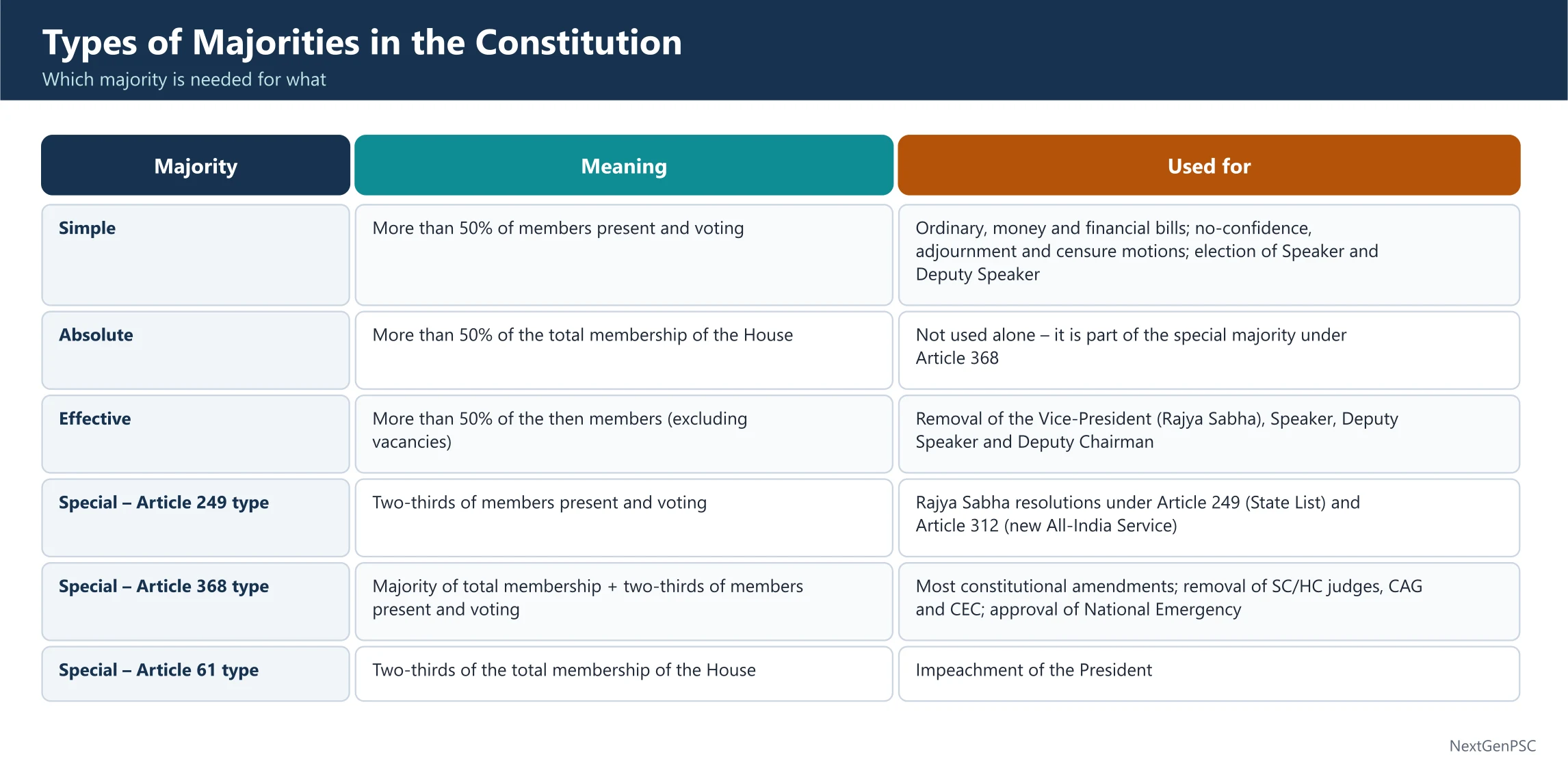
Types of Majorities
| Type | Definition | Example Calculation | Usage |
|---|---|---|---|
| Simple Majority | More than 50% of members present and voting. | Lok Sabha: Strength 545; Vacant 5; Present 500; Voting 450; Simple Majority = 226. | Most motions & bills (e.g., No-confidence motion, Money Bills). |
| Absolute Majority | More than 50% of the total strength of the House. | Lok Sabha: Strength 545; Absolute Majority = 273. | Formation of government (rarely used alone in Parliament). |
| Effective Majority | More than 50% of the effective strength (total strength minus vacancies). | Lok Sabha: Strength 545; Vacant 5 → Effective strength 540; Majority = 271. | Removal of Vice-President, Deputy Chairman of Rajya Sabha, Speaker & Deputy Speaker of Lok Sabha. |
| Special Majority | Any majority other than simple, absolute or effective; includes two-thirds present & voting, or combination with absolute majority. | Two-thirds present & voting OR Absolute Majority + 2/3rd present & voting depending on Article. | Impeachment of President (Art. 61), Removal of SC Judge/CAG, some Constitutional Amendments, legislation on State List (Art. 249). |
Prelims Strategy Tips
Amendment Procedure – Criticism and Key Amendments
The Indian Constitution provides flexibility and rigidity through Article 368. While it allows amendments to adapt to changing times, the procedure faces criticism for Parliament’s dominance, limited state role, and similarity to ordinary law-making. Key amendments have addressed retirement age, reservations, defections, Panchayati Raj, and women’s representation.
The Indian Constitution provides flexibility and rigidity through Article 368. While it allows amendments to adapt to changing times, the procedure faces criticism for Parliament’s dominance, limited state role, and similarity to ordinary law-making. Key amendments have addressed retirement age, reservations, defections, Panchayati Raj, and women’s representation.
Content of Amendments Made So Far
| Category | Examples |
|---|---|
| Minor modifications | 15th Amendment Act, 1963 → Raised retirement age of High Court judges (60 → 62). 104th Amendment Act, 2020 → Extended SC/ST seat reservations in Lok Sabha and State Assemblies. |
| Due to judicial interpretations | Golaknath Case (1967) → Held constitutional amendment = 'law' under Article 13. 24th Amendment Act, 1971 → Clarified Article 13 doesn’t apply to amendments under Article 368. |
| Political consensus | 52nd Amendment Act, 1985 → Anti-defection law. 73rd Amendment Act, 1992 → Panchayati Raj Institutions. 106th Amendment Act, 2023 → 1/3rd reservation for women in Lok Sabha & State Assemblies (including SC/ST seats). |
Prelims Strategy Tips
Types of Constitutional Amendments
The Indian Constitution provides three modes of amendment – (1) By Simple Majority (outside Article 368), (2) By Special Majority of Parliament, and (3) By Special Majority of Parliament + Ratification by half of state legislatures. This reflects its flexible-rigid blend.
The Indian Constitution provides three modes of amendment – (1) By Simple Majority (outside Article 368), (2) By Special Majority of Parliament, and (3) By Special Majority of Parliament + Ratification by half of state legislatures. This reflects its flexible-rigid blend.
Types of Amendments under Indian Constitution
| Type | Scope / Examples |
|---|---|
| By Simple Majority of Parliament (Outside Article 368) | 1. Admission or establishment of new states. 2. Formation of new states or alteration of areas, boundaries, or names of existing states. 3. Abolition/creation of legislative councils in states. 4. Second Schedule – emoluments, allowances, privileges of President, Governors, Speakers, Judges. 5. Quorum in Parliament. 6. Salaries/allowances of MPs. 7. Rules of procedure in Parliament. 8. Privileges of Parliament, its members and committees. 9. Use of English in Parliament. 10. Number of puisne judges in SC. 11. Conferment of more jurisdiction on SC. 12. Use of official language. 13. Citizenship – acquisition/termination. 14. Elections to Parliament & State legislatures. 15. Delimitation of constituencies. 16. Union Territories. 17. Fifth Schedule – Scheduled Areas & Tribes. 18. Sixth Schedule – Tribal Areas. |
| By Special Majority of Parliament (Article 368) | 1. Fundamental Rights. 2. Directive Principles of State Policy. 3. Any provision not covered under the other two categories. |
| By Special Majority + Ratification by Half of States (Article 368) | 1. Election of the President and manner of election. 2. Extent of executive powers of Union and States. 3. Supreme Court and High Courts. 4. Distribution of legislative powers between Union and States. 5. Any of the lists in 7th Schedule. 6. Representation of States in Parliament. 7. Parliament's power to amend the Constitution & its procedure (Article 368 itself). |
Prelims Strategy Tips
Doctrine of Basic Structure
The Basic Structure Doctrine, evolved in Kesavananda Bharati (1973), holds that while Parliament has wide powers to amend the Constitution under Article 368, it cannot alter or destroy its ‘basic structure’. This ensures continuity of core constitutional values.
The Basic Structure Doctrine, evolved in Kesavananda Bharati (1973), holds that while Parliament has wide powers to amend the Constitution under Article 368, it cannot alter or destroy its ‘basic structure’. This ensures continuity of core constitutional values.
Evolution of Basic Structure Doctrine
| Case | Year | Judgment & Significance |
|---|---|---|
| Shankari Prasad v Union of India | 1951 | Parliament has absolute power to amend the Constitution, including FRs. Article 13 applies only to ordinary laws, not amendments. |
| Sajjan Singh v State of Rajasthan | 1964 | No limitation on Parliament’s amending power. CA Acts not covered under Article 13. |
| Golaknath v State of Punjab | 1967 | CA Acts are ‘law’ under Article 13. Parliament cannot amend FRs. FRs sacrosanct. |
| Kesavananda Bharati v State of Kerala | 1973 | CA Acts not ‘law’ under Article 13. Parliament can amend any part of the Constitution, including FRs, but cannot alter the Basic Structure. |
Mains Key Points
Prelims Strategy Tips
Elements of the Basic Structure of the Constitution
The Supreme Court has not given an exhaustive list of what constitutes the Basic Structure, but through various cases it has identified certain principles such as supremacy of the Constitution, rule of law, judicial review, democracy, secularism, federalism, and protection of Fundamental Rights.
The Supreme Court has not given an exhaustive list of what constitutes the Basic Structure, but through various cases it has identified certain principles such as supremacy of the Constitution, rule of law, judicial review, democracy, secularism, federalism, and protection of Fundamental Rights.
Key Elements of Basic Structure (Indicative List)
| Element | Source Case / Recognition |
|---|---|
| Supremacy of the Constitution | Kesavananda Bharati (1973) |
| Rule of Law | Indira Nehru Gandhi v Raj Narain (1975) |
| Judicial Review | Kesavananda Bharati (1973), Minerva Mills (1980) |
| Democracy (Parliamentary System) | Indira Gandhi v Raj Narain (1975) |
| Secularism | S.R. Bommai v Union of India (1994) |
| Federalism | SR Bommai (1994), Kesavananda Bharati (1973) |
| Separation of Powers | Indira Gandhi v Raj Narain (1975) |
| Independence of Judiciary | S.P. Gupta v Union of India (1981) |
| Free and Fair Elections | Indira Gandhi v Raj Narain (1975) |
| Balance between FRs & DPSPs | Minerva Mills v Union of India (1980) |
| Unity and Integrity of India | Kesavananda Bharati (1973) |
| Preamble Values (equality, liberty, justice) | Kesavananda Bharati (1973) |
Mains Key Points
Prelims Strategy Tips
Provisions Included in the Basic Structure
The Basic Structure doctrine, first evolved in Kesavananda Bharati (1973), ensures that Parliament’s amending power under Article 368 does not alter the Constitution’s essential features. The list of provisions is not exhaustive and continues to evolve through Supreme Court judgments.
The Basic Structure doctrine, first evolved in Kesavananda Bharati (1973), ensures that Parliament’s amending power under Article 368 does not alter the Constitution’s essential features. The list of provisions is not exhaustive and continues to evolve through Supreme Court judgments.
Core Provisions Recognized as Part of Basic Structure
| Provision | Significance |
|---|---|
| Supremacy of the Constitution | Ensures Constitution is the highest law of the land. |
| Rule of Law | Guarantees equality before law and accountability of power. |
| Separation of Powers | Legislature, Executive, and Judiciary maintain balance. |
| Republic and Democratic Form of Government | People’s sovereignty through elections. |
| Secular Character of the Constitution | Equal respect for all religions. |
| Federal Character of the Constitution | Division of power between Union and States. |
| Sovereignty and Unity of India | Safeguards independence and territorial integrity. |
| Freedom and Dignity of the Individual | Protects liberty and human rights. |
| Mandate to Build a Welfare State | Guides state policies towards social justice. |
| Parliamentary System | Ensures collective responsibility and accountability. |
| Independence of Judiciary | Free from political interference. |
| Judicial Review | Courts can review laws to check constitutionality. |
| Limited Power of Parliament to Amend | Parliament cannot destroy core constitutional values. |
Mains Key Points
Prelims Strategy Tips
Landmark Amendments – 1st, 24th, 42nd, 44th, 61st, and 93rd
Major Constitutional Amendments reflect periods of significant political shifts and judicial interactions. Amendments like the 42nd (Mini Constitution) and 44th (Emergency aftermath) addressed the fundamental structure and rights, while the 61st Amendment reduced the voting age, enhancing democratic participation.
Major Constitutional Amendments reflect periods of significant political shifts and judicial interactions. Amendments like the 42nd (Mini Constitution) and 44th (Emergency aftermath) addressed the fundamental structure and rights, while the 61st Amendment reduced the voting age, enhancing democratic participation.
Major Constitutional Amendments
| Amendment | Year | Key Provision |
|---|---|---|
| 1st | 1951 | Added Ninth Schedule (Land Reforms), amended Art. 15, 19. |
| 24th | 1971 | Parliament can amend FRs (Mandatory Presidential Assent). |
| 42nd | 1976 | Added 'Socialist, Secular, Integrity' to Preamble; added FRs; made President bound by advice. |
| 44th | 1978 | Removed Right to Property from FRs; inserted 'armed rebellion' for Emergency. |
| 61st | 1989 | Reduced voting age from 21 to 18 years. |
| 93rd | 2005 | Reservation for OBCs/SEBCs in private unaided educational institutions (Art. 15(5)). |
Mains Key Points
Prelims Strategy Tips
Ninth Schedule and Judicial Review
The Ninth Schedule (Article 31B) was added by the 1st Amendment (1951) to provide constitutional immunity to certain laws, particularly land reform acts, from judicial review. However, the Supreme Court, in I.R. Coelho (2007), ruled that laws placed in the Ninth Schedule after April 24, 1973 (Kesavananda Bharati judgment date) are subject to judicial review if they violate the Basic Structure.
The Ninth Schedule (Article 31B) was added by the 1st Amendment (1951) to provide constitutional immunity to certain laws, particularly land reform acts, from judicial review. However, the Supreme Court, in I.R. Coelho (2007), ruled that laws placed in the Ninth Schedule after April 24, 1973 (Kesavananda Bharati judgment date) are subject to judicial review if they violate the Basic Structure.
Ninth Schedule and Judicial Review Timeline
| Year/Case | Principle Established |
|---|---|
| 1951 (1st Amendment) | Ninth Schedule introduced (Art. 31B); immunity from FRs challenges. |
| 1973 (Kesavananda Bharati) | Basic Structure Doctrine established. |
| 1981 (Waman Rao) | Laws before 24/04/1973 remain immune (The 'Waman Rao Rule'). |
| 2007 (I.R. Coelho) | Laws added after 24/04/1973 are subject to judicial review if they violate Basic Structure. |
Mains Key Points
Prelims Strategy Tips
The Preamble and Basic Structure
The Preamble embodies the fundamental values and philosophy of the Constitution. The Supreme Court has affirmed that the Preamble is an integral part of the Constitution and its core values—Sovereignty, Socialism, Secularism, Democracy, and Republic—form part of the Basic Structure and are thus unamendable.
The Preamble embodies the fundamental values and philosophy of the Constitution. The Supreme Court has affirmed that the Preamble is an integral part of the Constitution and its core values—Sovereignty, Socialism, Secularism, Democracy, and Republic—form part of the Basic Structure and are thus unamendable.
Preamble Amendability Status
| Case/Act | Status of Preamble | Significance |
|---|---|---|
| Berubari Union Case (1960) | Not part of the Constitution. | Initial restrictive view. |
| Kesavananda Bharati (1973) | Is a part of the Constitution; can be amended. | Established amendability but introduced Basic Structure limit. |
| 42nd Amendment (1976) | Amended Preamble once. | Added Socialist, Secular, Integrity. |
Mains Key Points
Prelims Strategy Tips
Constitutional Amendments Related to Territory and Federalism
The Indian Constitution has been amended multiple times to redefine territorial boundaries and strengthen the federal structure. Amendments related to the Seventh Schedule, creation of new states, and the Goods and Services Tax (GST) Council require ratification by half of the state legislatures, underscoring the federal commitment.
The Indian Constitution has been amended multiple times to redefine territorial boundaries and strengthen the federal structure. Amendments related to the Seventh Schedule, creation of new states, and the Goods and Services Tax (GST) Council require ratification by half of the state legislatures, underscoring the federal commitment.
Mains Key Points
Prelims Strategy Tips
Chapter Complete!
Ready to move to the next chapter?