
Indian Polity & Governance: UPSC Notes, Key Concepts & Practice

    High-yield Polity coverage for UPSC Prelims and Mains. Revise the Constitution’s philosophy, rights framework, separation of powers, legislative-executive-judicial relations, federalism, local bodies, and contemporary governance — with crisp summaries, mains points, prelims tips, and MCQs.

    Chapter index

    Indian Polity & Governance

    Interactive study materials with AI assistance

    Indian polity Playlist

    19 chapters • 0 completed

    1

    Making of the Constitution

    18 topics

    2

    Salient Features of the Indian Constitution

    4 topics

    3

    Preamble

    7 topics

    4

    Evolution of States & Union Territories

    7 topics

    5

    Citizenship

    9 topics

    6

    Fundamental Rights

    34 topics

    7

    Directive Principles of State Policy (DPSP)

    19 topics

    8

    Amendment and Basic Structure

    12 topics

    9

    Parliamentary System of Government

    48 topics

    Practice
    10

    Union Executive

    36 topics

    11

    State Executive

    21 topics

    12

    State Legislature

    11 topics

    13

    Centre-State Relations

    24 topics

    14

    Inter-State Relations

    14 topics

    15

    Emergency Provisions

    13 topics

    16

    Supreme Court

    26 topics

    17

    High Court

    20 topics

    18

    Local Government

    21 topics

    19

    UTs + Scheduled and Tribal Areas

    22 topics

    Progress (0%)
    0 / 19 complete

    Chapter 9: Parliamentary System of Government

    Chapter Test
    48 topics•Estimated reading: 144 minutes

    Parliamentary System of Government

    Key Point

    India adopted the British Parliamentary system to ensure accountability of the executive to the legislature. While it provides representation and responsibility, challenges like instability, coalition politics, and cabinet dictatorship persist. The debate continues whether India should move towards a Presidential system for stability or retain Parliamentary democracy for accountability.

    India adopted the British Parliamentary system to ensure accountability of the executive to the legislature. While it provides representation and responsibility, challenges like instability, coalition politics, and cabinet dictatorship persist. The debate continues whether India should move towards a Presidential system for stability or retain Parliamentary democracy for accountability.

    Key Features of the Parliamentary System

    AspectDetails
    Collective ResponsibilityCouncil of Ministers collectively responsible to Lok Sabha under Article 75(3).
    Dual ExecutiveNominal head: President; Real head: Prime Minister.
    Majority Party RuleLeader of majority party/coalition in Lok Sabha becomes PM.
    Fusion of PowersExecutive is part of the legislature, unlike in Presidential system.
    Political HomogeneityMinisters generally belong to the same party/coalition ensuring unity.
    Secrecy of ProcedureMinisters bound by oath of secrecy (Third Schedule).
    Double MembershipMinisters must be members of Parliament (or get elected within 6 months).

    Merits and Demerits of Parliamentary System

    CategoryDetails
    MeritsEnsures responsible govt.; Cooperation between legislature & executive; Broad representation; Alternative govt. without elections; Flexible and adaptable system.
    DemeritsUnstable governments (coalitions, defections); Cabinet dictatorship (PM dominance); Lack of policy continuity; Ministers may lack expertise; Against strict separation of powers.

    Parliamentary vs Presidential System

    ParameterParliamentary SystemPresidential System
    ExecutiveDual: President (nominal), PM (real).Single: President is both Head of State & Govt.
    ResponsibilityCouncil of Ministers responsible to legislature.President not responsible to legislature.
    StabilityGovt may fall anytime (no-confidence).Stable govt – fixed term.
    Separation of PowersFusion of legislature & executive.Strict separation of powers.
    LeadershipCollective leadership – PM is first among equals.Centralised – President is sole executive.
    ExamplesIndia, UK, Canada, Japan.USA, Brazil, Russia.

    Important Constitutional Provisions

    ArticleProvision
    Article 74Council of Ministers headed by PM to aid and advise President.
    Article 75PM appointed by President; Ministers responsible to Lok Sabha; Collective responsibility.
    Article 77Conduct of business of Union government.
    Article 78Duties of PM to inform President.
    Article 164Similar provisions for states – CM & Council of Ministers responsible to legislative assembly.

    Landmark Cases Shaping Parliamentary System

    CaseJudgment
    Indira Gandhi v Raj Narain (1975)SC held rule of law & free elections are part of basic structure; curtailed PM’s arbitrary powers.
    S.R. Bommai v Union of India (1994)Laid down limits on Article 356 misuse; Secularism part of basic structure; Strengthened federalism.
    Rameshwar Prasad v Union of India (2006)Governors’ powers limited in dissolving assemblies; Parliamentary responsibility reaffirmed.

    Mains Key Points

    Parliamentary system ensures executive accountability to legislature (collective responsibility).
    Familiarity with British model + plural Indian society justified its adoption.
    Landmark cases reinforced democratic accountability (Indira Gandhi case, S.R. Bommai).
    Criticism: instability, coalition politics, PM dominance, lack of expertise in ministers.
    Debate continues on shifting towards Presidential model for stability vs retaining Parliamentary for accountability.
    Reforms suggested: Anti-defection strengthening, greater transparency in PMO, internal democracy in parties.

    Prelims Strategy Tips

    India adopted Parliamentary system inspired by UK, not US Presidential model.
    Article 75(3): Collective responsibility of Council of Ministers to Lok Sabha.
    Dual executive: President (nominal), Prime Minister (real).
    Ambedkar: Parliamentary system = responsibility; Presidential = stability.
    Cases: Indira Gandhi v Raj Narain (1975), S.R. Bommai (1994) – strengthened Parliamentary democracy.

    Systems of Government: Parliamentary, Presidential & Semi-Presidential

    Key Point

    India adopted the Parliamentary system for ensuring accountability, though it is less stable compared to the Presidential model. The Presidential system ensures stability with strict separation of powers, while the Semi-Presidential system balances both. Comparison with the British model highlights India’s republican and constitutional supremacy.

    India adopted the Parliamentary system for ensuring accountability, though it is less stable compared to the Presidential model. The Presidential system ensures stability with strict separation of powers, while the Semi-Presidential system balances both. Comparison with the British model highlights India’s republican and constitutional supremacy.

    Detailed Notes (22 points)
    Tap a card to add note • Use the highlight Listen button to play the full section
    Parliamentary System
    Features a dual executive — the President as the nominal head and the Prime Minister as the real head of government.
    Ensures collective responsibility of the Council of Ministers to the legislature.
    Guarantees accountability of the executive to the elected representatives.
    Chosen in India due to its British legacy and suitability for a diverse, democratic, and multi-party society.
    Presidential System
    Characterized by a single executive — the President as both Head of State and Head of Government.
    The President has a fixed tenure and is independent of the legislature for survival.
    Ensures strict separation of powers among the three organs of government.
    Example: United States of America (USA) .
    Semi-Presidential System
    Combines features of both parliamentary and presidential systems.
    Has a dual executive — a President directly elected by the people and a Prime Minister responsible to the legislature.
    Example: France .
    Why India Chose the Parliamentary System
    To ensure executive accountability to the legislature.
    To prevent deadlocks and conflicts between the executive and legislature.
    To reflect the spirit of responsibility and responsiveness in a diverse society.
    Comparison with Britain
    Both follow the parliamentary model but differ fundamentally:
    – India is a Republic with constitutional supremacy .
    – Britain is a Monarchy with parliamentary sovereignty .

    Presidential System

    FeatureDetails
    ExecutiveSingle executive – President as both Head of State & Government.
    TenureFixed tenure; stable unless impeached.
    AccountabilityNot accountable to legislature.
    PowersStrict separation of powers between executive, legislature, judiciary.
    ExamplesUSA, Brazil, Mexico.

    Semi-Presidential System

    FeatureDetails
    ExecutiveDual – Popularly elected President + PM from legislature.
    Power SharingPresident handles foreign/security; PM handles domestic/governance.
    AccountabilityPM accountable to legislature; President to voters.
    ExamplesFrance, Portugal, Sri Lanka.

    Comparison: Indian vs British Parliamentary System

    ParameterIndian SystemBritish System
    TypeRepublic with elected President.Monarchy with hereditary King/Queen.
    SovereigntyConstitution is supreme.Parliament is supreme.
    Prime MinisterCan be from either house.Must be from lower house (Commons).
    MinistersNon-MPs can be ministers for 6 months.Only MPs can be ministers.
    Legal ResponsibilityNot applicable.Exists; ministers legally responsible.
    Shadow CabinetNot present.Present; opposition forms it.
    HousesLok Sabha & Rajya Sabha.House of Commons & House of Lords.

    Mains Key Points

    India preferred accountability (Parliamentary) over stability (Presidential).
    Presidential ensures stability but risks authoritarianism.
    Semi-presidential balances stability with responsibility.
    Indian vs British shows adaptation – India chose Republic & Constitution supremacy.
    Debate continues on reforms: Presidential for stability vs Parliamentary for accountability.

    Prelims Strategy Tips

    Presidential: Single executive, fixed tenure, strict separation of powers.
    Semi-Presidential: Dual executive – President + PM (France model).
    Indian Parliamentary: Republic, constitutional supremacy; British: Monarchy, parliamentary supremacy.
    Shadow Cabinet exists in UK but not in India.

    Union Parliament

    Key Point

    The Union Parliament is the supreme legislative body of India. It represents citizens, ensures government accountability, regulates public expenditure, and builds national leadership. It consists of the President, Rajya Sabha, and Lok Sabha under Part V (Articles 79–122).

    The Union Parliament is the supreme legislative body of India. It represents citizens, ensures government accountability, regulates public expenditure, and builds national leadership. It consists of the President, Rajya Sabha, and Lok Sabha under Part V (Articles 79–122).

    Detailed Notes (9 points)
    Tap a card to add note • Use the highlight Listen button to play the full section
    Role and Importance of Parliament
    The Parliament is one of the three vital pillars of Indian democracy, alongside the Executive and the Judiciary.
    It serves as the highest law-making authority in the country, ensuring that governance is carried out according to the will of the people.
    Parliament upholds the principles of representation, responsibility, and accountability in a democratic framework.
    It acts as a forum for debate and discussion on national and public issues, reflecting the diverse voices of India.
    One of its crucial functions is to scrutinize government expenditure and ensure financial discipline through various committees.
    It provides leadership and direction to the government while safeguarding citizens’ rights and maintaining democratic balance.
    The Indian Parliament consists of three components : the President , the Rajya Sabha (Council of States) , and the Lok Sabha (House of the People) .
    Although the President is not a member of either House, they are an integral part of Parliament and play a vital role in the legislative process.

    Need of Parliament

    PurposeExplanation
    RepresentationVoice of citizens in the law-making process.
    AccountabilityGovernment held accountable through debates, questions, motions.
    Financial ControlEnsures public expenditure follows constitutional norms.
    LeadershipDevelops and promotes national leadership.
    DemocracyStrengthens democratic values and institutions.

    Composition of Parliament

    ComponentDetails
    PresidentNot a member of either house, but an integral part. Assent required for bills, issues ordinances, addresses both houses.
    Rajya SabhaCouncil of States, upper house of Parliament.
    Lok SabhaHouse of the People, directly elected by citizens.

    Mains Key Points

    Parliament symbolizes the will of the people and ensures representation in governance.
    Acts as a check on executive actions through debates, questions, and motions.
    Controls finances by approving budget and regulating expenditure.
    Develops national leadership and provides a platform for political debate.
    Strengthens democracy by upholding accountability and transparency.

    Prelims Strategy Tips

    Articles 79–122 cover Union Parliament.
    Parliament = President + Rajya Sabha + Lok Sabha.
    President is not a member but an integral part of Parliament.
    Parliament ensures accountability, financial control, and representation.

    Rajya Sabha

    Key Point

    The Rajya Sabha, also known as the Council of States, is the Upper House of Parliament. Its maximum strength is 250, with members representing states, Union Territories, and 12 nominated members. It ensures representation of states at the national level and plays a key role in law-making and checks on the executive.

    The Rajya Sabha, also known as the Council of States, is the Upper House of Parliament. Its maximum strength is 250, with members representing states, Union Territories, and 12 nominated members. It ensures representation of states at the national level and plays a key role in law-making and checks on the executive.

    Detailed Notes (8 points)
    Tap a card to add note • Use the highlight Listen button to play the full section
    Composition of the Rajya Sabha
    The Rajya Sabha (Council of States) represents the interests of the states and serves as the upper house of Parliament .
    Its composition and powers are defined under Article 80 of the Constitution.
    The maximum strength of the Rajya Sabha is 250 members :
    – 238 members represent the States and Union Territories, elected by the method of proportional representation through the Single Transferable Vote (STV).
    – 12 members are nominated by the President from distinguished fields such as literature, science, art, and social service.
    The current strength of the Rajya Sabha is 245 members : 225 from States, 8 from Union Territories, and 12 nominated members.
    The Rajya Sabha acts as a revising chamber —it reviews, debates, and refines the laws passed by the Lok Sabha, ensuring thorough scrutiny and balanced legislation.

    Composition of Rajya Sabha

    CategoryNumber of Members
    Representatives of States225 (elected by State Legislative Assemblies)
    Representatives of UTs8 (elected in prescribed manner)
    Nominated Members12 (President nominates from Literature, Science, Art, Social Service)
    Maximum Strength250 (Article 80)
    Present Strength245

    Qualifications (Article 84)

    RequirementDetails
    CitizenshipMust be an Indian citizen
    AgeMinimum 30 years
    Electoral RollName in electoral roll of any Parliamentary constituency

    Disqualifications (Article 102 & RPA, 1951)

    GroundDetails
    Office of ProfitHolds office under central/state government
    Unsound MindDeclared by a competent court
    InsolvencyUndischarged insolvent
    CitizenshipNot an Indian citizen
    Election OffencesConvicted for corrupt/election offences
    Criminal ConvictionImprisonment of 2+ years (except preventive detention)
    Failure in AccountsNot lodging election expenses in time
    Conflict of InterestInterest in government contracts, works or services
    Corporation RoleDirector/agent in govt-controlled corporation (25% shareholding)
    Dismissal from ServiceRemoved for corruption or disloyalty
    Promoting EnmityConviction for communal hatred or bribery
    Social CrimesPunished for practising untouchability or other social crimes

    Mains Key Points

    Rajya Sabha ensures representation of states in Parliament and protects federal balance.
    It acts as a revising chamber, preventing hasty legislation.
    Nominated members enrich debates with expertise in literature, science, art, and social service.
    Disqualification process ensures ethical and accountable membership.
    President decides disqualification in consultation with Election Commission (binding advice).

    Prelims Strategy Tips

    Maximum strength: 250 (238 elected + 12 nominated).
    Current strength: 245 members.
    Minimum age for Rajya Sabha: 30 years.
    Nominated members represent literature, science, art, social service.
    Disqualification grounds: Article 102 + RPA, 1951.

    Election and Role of Rajya Sabha Members

    Key Point

    Rajya Sabha members are elected indirectly by State and UT legislatures using proportional representation through a single transferable vote. Members serve staggered six-year terms, making Rajya Sabha a permanent house. It represents states, revises legislation, prevents hasty laws, and ensures federal balance.

    Rajya Sabha members are elected indirectly by State and UT legislatures using proportional representation through a single transferable vote. Members serve staggered six-year terms, making Rajya Sabha a permanent house. It represents states, revises legislation, prevents hasty laws, and ensures federal balance.

    Detailed Notes (11 points)
    Tap a card to add note • Use the highlight Listen button to play the full section
    Election of Rajya Sabha Members
    Mode of Election: Members of the Rajya Sabha are elected indirectly by the elected members of the State Legislative Assemblies (for States) and by special electoral colleges (for Union Territories).
    Election System: The election is held through proportional representation by means of the single transferable vote (STV) system, ensuring representation of various political groups in proportion to their strength in the assemblies.
    Seat Allocation: Seats are allocated to each State based on its population, as per the 1971 Census . Representation is thus unequal — e.g., Uttar Pradesh has 31 members, while Tripura has only 1.
    Union Territory Representation: Currently, three Union Territories — Delhi, Puducherry, and Jammu & Kashmir — elect members to the Rajya Sabha.
    Qualifications (as per the Representation of the People Act, 1951):
    – Must be an elector in a parliamentary constituency of the concerned State or UT.
    – Must belong to the Scheduled Castes/Tribes (for reserved seats, if applicable).
    – Must have attained a minimum age of 30 years .
    Tenure: Each member serves for a term of 6 years , with no restriction on re-election.
    Every two years , one-third of the members retire, making the Rajya Sabha a continuing chamber that is never fully dissolved.

    Representation in Rajya Sabha

    CategoryMode of ElectionSystemElectoral College
    StatesIndirectProportional Representation by Single Transferable VoteElected MLAs of State Legislatures
    Union TerritoriesIndirectProportional Representation by Single Transferable VoteSpecial Electoral College (Delhi, Puducherry, J&K)
    Nominated MembersNominated by PresidentNot electedNot applicable

    Tenure of Rajya Sabha Members

    ProvisionDetails
    Tenure6 years (RPA, 1951)
    Re-electionAllowed (no bar)
    RetirementOne-third retire every 2 years
    ContinuityRajya Sabha is a permanent chamber; not subject to dissolution

    Role of Rajya Sabha

    FunctionDescription
    RepresentationRepresents states and UTs in Union Legislature
    Revising HouseProvides valuable inputs and reviews bills
    Check on Hasty LawsPrevents rushed or populist legislation
    ExpertisePlatform for experts to influence policy
    Federal BalanceActs as a balance between Centre and states

    Mains Key Points

    Rajya Sabha election system ensures proportionality and prevents domination of larger parties.
    Unequal seat allocation highlights demographic diversity and federal compromise.
    Staggered tenure ensures stability and continuity, unlike Lok Sabha.
    Acts as a balancing institution between people’s representation (Lok Sabha) and state representation.
    Provides space for experienced statesmen, experts, and nominated members to enrich debates.

    Prelims Strategy Tips

    Rajya Sabha election: Indirect, proportional representation with single transferable vote.
    Electoral college: State MLAs (for states), special electoral college (for UTs).
    Seat allocation: Based on 1971 census, leading to unequal representation.
    Tenure: 6 years; one-third retire every 2 years; continuing house.
    Minimum age: 30 years (qualification), 25 years (RPA, 1951 provision for elections).

    Lok Sabha – Composition and Features

    Key Point

    The Lok Sabha, or House of the People, is the lower house of Parliament and the main representative body of citizens. It was constituted on 17th April 1952 after the first general elections. With a maximum strength of 550 (Article 81), it currently has 543 elected members, representing states and Union Territories.

    The Lok Sabha, or House of the People, is the lower house of Parliament and the main representative body of citizens. It was constituted on 17th April 1952 after the first general elections. With a maximum strength of 550 (Article 81), it currently has 543 elected members, representing states and Union Territories.

    Detailed Notes (8 points)
    Tap a card to add note • Use the highlight Listen button to play the full section
    Composition of the Lok Sabha
    The Lok Sabha (House of the People) was constituted on 17th April 1952 after the first general elections, marking the beginning of parliamentary democracy in India.
    Maximum Strength: As per Article 81 of the Constitution, the Lok Sabha can have a maximum of 550 members — 530 representing the States and 20 representing the Union Territories.
    Present Strength: The current strength of the Lok Sabha is 543 members — 524 from States and 19 from Union Territories .
    Delimitation: The 84th Constitutional Amendment Act (2001) froze the delimitation of constituencies until the first census after 2026 (likely to be held in 2031 ). This was done to maintain a balance between population growth and representation.
    Future Proposals: There are proposals to increase the total seats to 848 in the future to ensure more equitable and proportional representation across the growing population.
    Qualifications: A person must be an Indian citizen , at least 25 years of age , and have their name in the electoral roll of any parliamentary constituency.
    Disqualifications: Same as those applicable for the Rajya Sabha — holding an office of profit under the government, being insolvent or of unsound mind , loss of citizenship , or conviction for certain criminal offences.

    Lok Sabha Composition

    CategoryMaximum SeatsPresent Strength
    States530524
    Union Territories2019
    Total550543

    Qualification & Disqualification

    CriteriaLok Sabha Rule
    Minimum Age25 years (Lok Sabha) vs 30 years (Rajya Sabha)
    CitizenshipMust be an Indian citizen
    Electoral RollName must be in electoral roll of a parliamentary constituency
    Disqualification (Constitution)Office of profit, insolvency, unsound mind, loss of citizenship
    Disqualification (RPA, 1951)Conviction, corrupt practices, failure to report election expenses, bribery, promoting enmity

    Mains Key Points

    Lok Sabha reflects true democratic representation as members are directly elected by citizens.
    Freeze on delimitation (till 2026/2031) prevents large states from gaining excessive dominance but raises concerns of unequal representation.
    Ensures political accountability as the government is responsible to Lok Sabha under Article 75.
    Lok Sabha plays a central role in money bills, budget approval, and no-confidence motions.
    Strengthening Lok Sabha through increased seats is debated to balance population-based representation with federal fairness.

    Prelims Strategy Tips

    Lok Sabha = House of People, directly elected, maximum strength 550 (Article 81).
    Present strength 543 (524 from states + 19 from UTs).
    Minimum age: 25 years (vs 30 for Rajya Sabha).
    Delimitation frozen until first census after 2026 (likely 2031).
    Elections based on Universal Adult Franchise – Article 326.

    Election of Members of Lok Sabha & Term

    Key Point

    Lok Sabha members are directly elected by the people through universal adult franchise using the First Past the Post (FPTP) system. Each state is divided into territorial constituencies based on population. Special provisions exist for SC/ST reservations. The term is 5 years but can be dissolved earlier or extended during a National Emergency.

    Lok Sabha members are directly elected by the people through universal adult franchise using the First Past the Post (FPTP) system. Each state is divided into territorial constituencies based on population. Special provisions exist for SC/ST reservations. The term is 5 years but can be dissolved earlier or extended during a National Emergency.

    Detailed Notes (40 points)
    Tap a card to add note • Use the highlight Listen button to play the full section
    Election to the Lok Sabha – Overview
    The Lok Sabha (House of the People) is the directly elected lower house of Parliament and represents the will of the people of India. It forms the cornerstone of India’s representative democracy.
    Mode of Election
    Members are elected through direct elections held every five years across all States and Union Territories. Elections are conducted by the Election Commission of India under Article 324.
    Each member represents a single parliamentary constituency .
    Lok Sabha elections are conducted in multiple phases due to India’s vast geography and large electorate.
    Election System
    The system used is the First Past the Post (FPTP) system, where the candidate who gets the highest number of votes in a constituency is declared elected, even if they do not secure an absolute majority (50%+).
    This system ensures simplicity and quick results but is often criticized for being unfair to smaller political parties since even a minority vote share can lead to victory.
    Universal Adult Franchise
    Every Indian citizen aged 18 years or above has the right to vote, regardless of caste, creed, gender, or religion.
    The 61st Constitutional Amendment Act (1988) lowered the voting age from 21 to 18 years , significantly expanding voter participation.
    Currently, India has over 95 crore registered voters , making it the largest democracy in the world .
    Representation from Union Territories
    Elections in Union Territories are conducted under the Union Territories (Direct Election to the House of the People) Act, 1965 .
    The election process is identical to that in the States, and UTs like Delhi, Puducherry, and Jammu & Kashmir send representatives to the Lok Sabha.
    Territorial Constituencies and Delimitation
    Each State is divided into territorial constituencies as per Article 82 and the Delimitation Act .
    Delimitation is carried out by the Delimitation Commission to ensure equitable representation based on population.
    Four Delimitation Acts have been enacted: 1952, 1962, 1972, and 2002 .
    The 84th Constitutional Amendment Act (2001) froze the delimitation process until the first census after 2026 (likely in 2031).
    This was done to prevent States with higher population control measures from losing representation.
    Seat Allocation
    Currently, the Lok Sabha has 543 seats — 524 from States and 19 from Union Territories .
    Seat allocation among States is based on the 1971 Census , and constituency boundaries are based on the 2001 Census .
    For Jammu & Kashmir , the 2011 Census is followed after the abrogation of Article 370.
    Reservation of Seats
    Seats are reserved for Scheduled Castes (SCs) and Scheduled Tribes (STs) as per Article 330 .
    The number of reserved seats is based on the proportion of SC/ST population in each State.
    The 104th Constitutional Amendment Act (2019) extended this reservation till 2030 .
    There is no reservation for women in Lok Sabha, although the Women's Reservation Bill, 2023 (Nari Shakti Vandan Adhiniyam) provides for 33% reservation after delimitation.
    Term and Dissolution
    The normal term of the Lok Sabha is five years from the date of its first meeting.
    It can be dissolved earlier by the President on the advice of the Prime Minister.
    During a National Emergency (Article 352), the term can be extended by one year at a time , but not beyond six months after the Emergency ceases.
    Unlike Rajya Sabha, the Lok Sabha is not a continuing chamber and gets dissolved completely.
    Significance of Lok Sabha Elections
    The Lok Sabha election is the largest democratic exercise in the world.
    It determines the political leadership of India for five years and reflects the popular mandate of the people.
    The Prime Minister and Council of Ministers are collectively responsible to the Lok Sabha, making it the real centre of power in India’s parliamentary democracy.

    Lok Sabha Elections – Key Features

    AspectDetails
    Mode of ElectionDirect election by people
    Election SystemFirst Past the Post (FPTP) – most votes win
    Voting Age18 years (reduced from 21 by 61st CAA)
    ConstituenciesStates divided into territorial constituencies
    Delimitation Acts1952, 1962, 1972, 2002
    Seat AllocationBased on 1971 census (Lok Sabha); 2001 census (state constituencies); J&K – 2011 census
    ReservationSC/ST reservation in Lok Sabha (Article 330, extended to 2030)
    Term5 years; extendable during National Emergency

    Mains Key Points

    Direct elections to Lok Sabha make it the truest representative body of Indian citizens.
    FPTP ensures stability and simplicity but often criticized for not reflecting proportional vote share.
    Reservation of seats for SCs/STs ensures political representation for marginalized communities.
    Delimitation freeze prevents large states from dominating but raises representation fairness issues.
    Lok Sabha’s fixed 5-year term ensures stability, while dissolution power of the President keeps executive accountable.

    Prelims Strategy Tips

    Lok Sabha elections use FPTP system, not proportional representation.
    Voting age reduced from 21 → 18 years by 61st Constitutional Amendment (1989).
    Delimitation frozen till 2026 (next likely after 2031 census).
    SC/ST reservations extended till 2030 by 104th Amendment (2019).
    Lok Sabha term = 5 years, extendable only during National Emergency.

    Comparison between Rajya Sabha and Lok Sabha

    Key Point

    Rajya Sabha (Upper House) represents the states while Lok Sabha (Lower House) represents the people directly. Lok Sabha holds greater powers in money matters and can dissolve, while Rajya Sabha is a permanent body providing checks, expertise, and continuity.
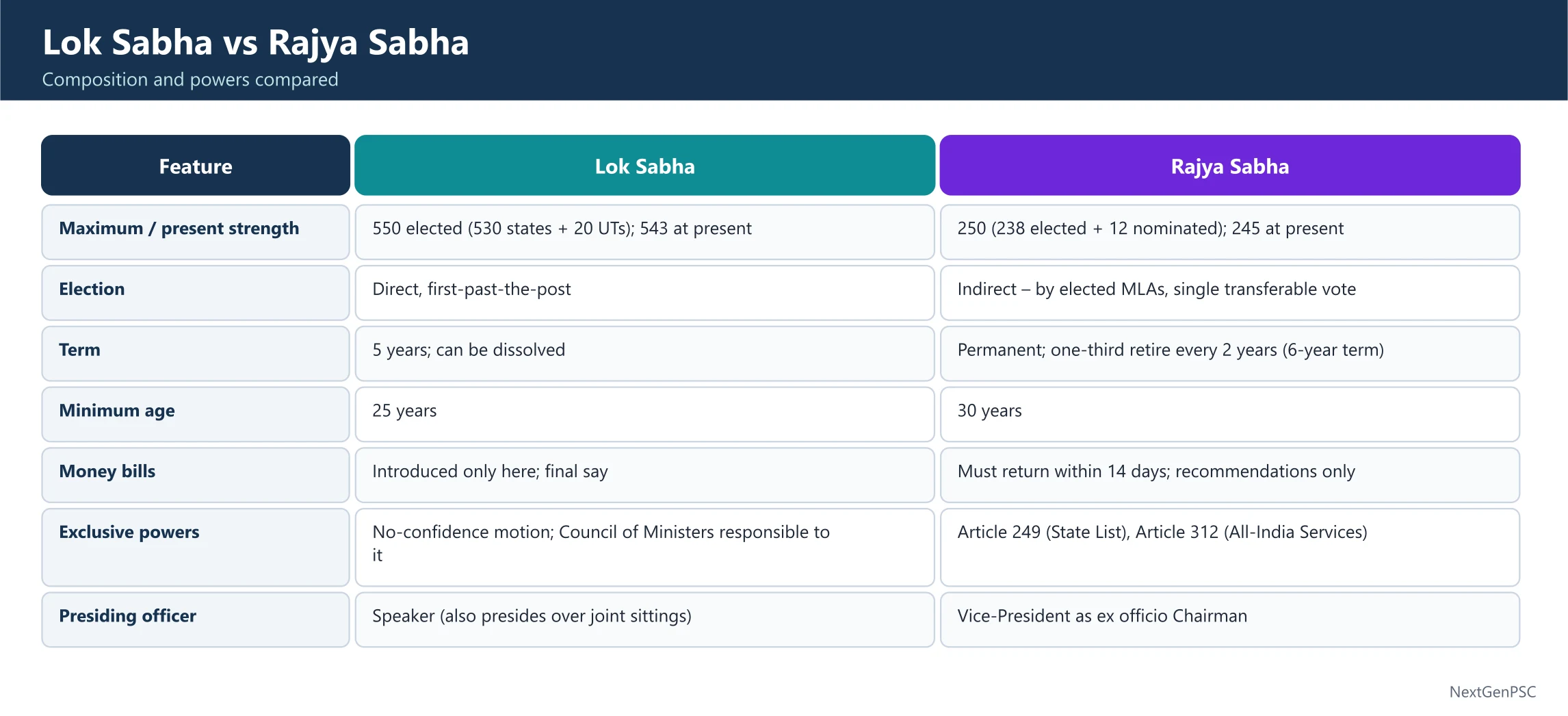
    Rajya Sabha (Upper House) represents the states while Lok Sabha (Lower House) represents the people directly. Lok Sabha holds greater powers in money matters and can dissolve, while Rajya Sabha is a permanent body providing checks, expertise, and continuity.

    Comparison between Rajya Sabha and Lok Sabha

    Rajya Sabha vs Lok Sabha – Key Comparison

    AspectRajya SabhaLok Sabha
    CompositionMaximum 250 members (238 elected, 12 nominated)Maximum 550 members (543 elected currently)
    RepresentationRepresents States & UTs (indirect election)Represents People (direct election)
    Election SystemProportional Representation by Single Transferable Vote (MLAs elect)First Past the Post System (citizens elect directly)
    Tenure6 years, 1/3rd retire every 2 years; Permanent House5 years; can be dissolved earlier by President
    Presiding OfficerVice-President of India (Chairman)Speaker of Lok Sabha
    Minimum Age30 years25 years
    Money BillsCan only recommend amendments; Lok Sabha may accept or rejectExclusive power to introduce & decide Money Bills
    Ordinary BillsEqual powers; bill needs approval of both HousesEqual powers; joint sitting possible if deadlock (Lok Sabha prevails)
    Control over ExecutiveLimited – Council of Ministers responsible only to Lok SabhaFull – Government survives only on Lok Sabha majority
    DissolutionCannot be dissolvedCan be dissolved by President before 5 years
    Special PowersCan authorize Parliament to legislate on State List (Article 249); can initiate removal of VPControls finances, can bring no-confidence motion to dismiss govt

    Mains Key Points

    Rajya Sabha ensures representation of States, continuity, and expertise; Lok Sabha reflects the will of the people directly.
    Lok Sabha dominates in financial matters and controls the executive, making it the stronger chamber.
    Rajya Sabha plays a revising and reviewing role, preventing hasty legislation.
    Bicameralism balances democratic representation with federal representation.
    The combination of Lok Sabha’s supremacy and Rajya Sabha’s stability ensures both accountability and continuity in governance.

    Prelims Strategy Tips

    Rajya Sabha = Permanent House; Lok Sabha = dissolvable.
    Minimum age: Lok Sabha 25 years, Rajya Sabha 30 years.
    Money Bills can only be introduced in Lok Sabha.
    Council of Ministers is collectively responsible only to Lok Sabha.
    Joint sitting provision exists only for ordinary bills (Lok Sabha prevails).

    Special Powers of Rajya Sabha

    Key Point

    Rajya Sabha, though the Upper House with limited control over the executive and finances, enjoys unique constitutional powers that strengthen federalism and ensure balance in the Indian parliamentary system.

    Rajya Sabha, though the Upper House with limited control over the executive and finances, enjoys unique constitutional powers that strengthen federalism and ensure balance in the Indian parliamentary system.

    Unique Powers of Rajya Sabha

    PowerConstitutional ProvisionDetails
    Legislation on State ListArticle 249If Rajya Sabha passes a resolution by 2/3rd majority, Parliament can legislate on matters in the State List (for national interest).
    Creation of All India ServicesArticle 312Rajya Sabha can authorize Parliament (by 2/3rd majority) to create new All-India Services common to Union and States.
    Removal of Vice-PresidentArticle 67(b)Rajya Sabha initiates the removal of Vice-President; resolution must be passed by majority and agreed to by Lok Sabha.
    Continuation of EmergencyArticle 352, 356, 360If Lok Sabha is dissolved, Rajya Sabha approves continuation of National, State, or Financial Emergency.
    Exclusive RepresentationArticle 8012 nominated members (literature, art, science, social service) enrich debates with expertise.
    Check on Hasty LegislationOrdinary BillsActs as a revising chamber; provides second thought to laws passed by Lok Sabha.

    Mains Key Points

    Rajya Sabha’s unique powers balance Lok Sabha’s supremacy and ensure federal cooperation.
    Acts as a safeguard for states in legislative matters through Article 249.
    Plays critical role in emergency situations when Lok Sabha is dissolved.
    Expertise through nominated members enhances policy debates.
    Ensures federalism, continuity, and wisdom in law-making.

    Prelims Strategy Tips

    Article 249 & 312 give Rajya Sabha special federal powers.
    Rajya Sabha initiates removal of Vice-President.
    During Lok Sabha’s dissolution, Rajya Sabha approves continuation of Emergency.
    12 nominated members = expertise infusion in debates.
    Rajya Sabha = continuing chamber (cannot be dissolved).

    Vacation of Seats (Article 101)

    Key Point

    Article 101 of the Indian Constitution provides the conditions under which a seat in Parliament becomes vacant. It ensures accountability, prevents dual membership, and upholds discipline in legislative functioning.

    Article 101 of the Indian Constitution provides the conditions under which a seat in Parliament becomes vacant. It ensures accountability, prevents dual membership, and upholds discipline in legislative functioning.

    Detailed Notes (27 points)
    Tap a card to add note • Use the highlight Listen button to play the full section
    Vacation of Seats in Parliament
    Under the Constitution and the Representation of the People Act, 1951, a Member of Parliament (MP) may lose their seat under various circumstances.
    1. Double Membership
    A person cannot simultaneously be a member of both the Lok Sabha and Rajya Sabha . If elected to both Houses, the individual must resign from one within 10 days ; otherwise, the Rajya Sabha seat automatically becomes vacant .
    If a person is elected to both Houses on different dates, the first seat won is automatically vacated.
    2. Dual Seat Holders (Parliament and State Legislature)
    If a person is elected both to Parliament and a State Legislature , they must resign from the State Legislature within 14 days of the later election result. If not, the Parliamentary seat is deemed vacant .
    This ensures the separation of powers between State and Union legislatures.
    3. Resignation
    A Member of Parliament may resign by submitting a written resignation to the Speaker (Lok Sabha) or Chairman (Rajya Sabha) .
    Only voluntary and genuine resignations are accepted; the presiding officer can reject resignations made under pressure or coercion.
    Once accepted, the resignation is final and irrevocable .
    4. Disqualification
    A member’s seat becomes vacant if they are disqualified under:
    – Article 102 of the Constitution.
    – Representation of the People Act, 1951 (for corrupt practices, conviction, etc.).
    – Anti-Defection Law (10th Schedule) – for voluntarily giving up party membership or defying party whip.
    The decision on disqualification lies with the President , who acts on the advice of the Election Commission .
    5. Absence from Parliament
    If a member is absent without permission for 60 consecutive sitting days , their seat can be declared vacant by the House.
    However, absence due to illness or official duties may be condoned by the presiding officer.
    6. Other Situations
    A seat may also become vacant if:
    – The member’s election is declared void by a competent court.
    – The member is expelled from the House for misconduct.
    – The member is elected as President, Vice-President, or Governor of a State.
    These provisions ensure that a member cannot hold conflicting positions and that parliamentary integrity is maintained.

    Prelims Strategy Tips

    Article 101 deals with vacation of seats in Parliament.
    Maximum absence without permission: 60 days → seat vacated.
    Dual membership of both Houses or Parliament & State Legislature not allowed.
    Resignation valid only if voluntary (Speaker/Chairman decides).
    Disqualification grounds under Article 102, RPA 1951, Anti-defection law.

    Speaker of the Lok Sabha

    Key Point

    The Speaker is the presiding officer of the Lok Sabha, responsible for maintaining order, regulating proceedings, and safeguarding parliamentary democracy. The office continues even after the dissolution of the Lok Sabha until the first sitting of the new House.

    The Speaker is the presiding officer of the Lok Sabha, responsible for maintaining order, regulating proceedings, and safeguarding parliamentary democracy. The office continues even after the dissolution of the Lok Sabha until the first sitting of the new House.

    Detailed Notes (36 points)
    Tap a card to add note • Use the highlight Listen button to play the full section
    Speaker of the Lok Sabha – Overview
    The Speaker is the presiding officer and the principal spokesperson of the Lok Sabha. The office ensures the smooth functioning of parliamentary proceedings and maintains decorum in the House.
    Origin
    The post of the Speaker originated in 1921 under the Montague-Chelmsford Reforms with the establishment of the Central Legislative Assembly .
    The first Speaker of independent India was G. V. Mavalankar (1952–1956).
    Election
    The Speaker is elected by the members of the Lok Sabha from among themselves.
    The date of election is fixed by the President of India under Article 93.
    The Speaker’s election usually takes place soon after the formation of a new Lok Sabha.
    A candidate requires a simple majority of votes of members present and voting to be elected.
    Tenure and Continuation
    The Speaker holds office from the date of election till just before the first sitting of the next Lok Sabha .
    Even after the Lok Sabha is dissolved, the Speaker continues in office until the new House elects a successor, ensuring continuity.
    There is no fixed term , and the Speaker remains in office as long as they are a member of the Lok Sabha.
    Resignation
    The Speaker can resign at any time by submitting a written resignation to the Deputy Speaker .
    The resignation becomes effective once it is accepted by the Deputy Speaker.
    Removal
    The Speaker can be removed from office by a resolution passed by an effective majority of the members of the Lok Sabha.
    A 14-day prior notice must be given before moving such a resolution, supported by at least 50 members .
    While a resolution for removal is under consideration, the Speaker may preside but cannot vote except on procedural matters.
    Role in Voting
    The Speaker does not vote in the first instance.
    However, in case of a tie , the Speaker exercises a casting vote to break the deadlock.
    This ensures neutrality and impartiality in decision-making.
    Significance of the Office
    The Speaker represents the authority of the Lok Sabha and the dignity of the House.
    Acts as the guardian of the rights and privileges of Members of Parliament.
    Interprets the Constitution and rules related to parliamentary procedures.
    Decides on questions of disqualification under the Anti-Defection Law (Tenth Schedule).
    Represents the Lok Sabha in all external and inter-parliamentary functions.
    Key Articles on the Speaker
    Article 94: the Speaker vacates office on ceasing to be a member, resigns by writing to the Deputy Speaker, or is removed by a resolution passed by a majority of all the then members of the Lok Sabha after 14 days' notice. On dissolution, the Speaker continues until the new House first meets.
    Article 95: when the office is vacant, the Deputy Speaker (or a member appointed by the President) performs the Speaker's duties.
    Article 96: while a resolution for the Speaker's removal is under consideration, the Speaker does not preside but can speak and vote in the first instance (no casting vote).
    Article 100: the presiding officer does not vote in the first instance but has a casting vote in a tie; quorum is one-tenth of the total membership.

    Powers and Functions of the Speaker

    FunctionDetails
    Maintaining OrderRegulates proceedings of Lok Sabha, ensures decorum, can suspend unruly members.
    Interpreter of ConstitutionFinal interpreter of Constitution within Lok Sabha; decisions subject to judicial review (e.g., anti-defection cases).
    Quorum & AdjournmentCan adjourn/suspend sitting in absence of quorum.
    Money Bill CertificationFinal authority to decide whether a bill is a Money Bill.
    Anti-Defection LawDecides disqualification of members under Tenth Schedule (Kihoto Hollohan case, 1992).
    Resignation of MPsAccepts resignation of Lok Sabha members and checks genuineness.
    CommitteesEx-officio Chairman of Indian Parliamentary Group; heads Business Advisory, Rules, and General Purpose Committees.
    Joint SittingPresiding officer of joint sittings of Parliament.
    Secret SittingCan allow secret sittings at the request of the Leader of the House.

    Prelims Strategy Tips

    Speaker elected by Lok Sabha members; removal requires effective majority + 14-day notice.
    Speaker continues after dissolution until new House meets.
    Final authority on certification of Money Bill (not subject to judicial review).
    Decides disqualification under Anti-defection law (subject to judicial review – Kihoto Hollohan, 1992).
    Casting vote in case of tie; no vote otherwise.

    Comparison of Office of Speaker

    Key Point

    The role of the Speaker varies across democracies. While the British model ensures neutrality in practice, the Indian Speaker is expected to be neutral but often criticized for partisanship. The American model openly allows party affiliation. Impartiality of the Speaker is crucial for sustaining parliamentary democracy.

    The role of the Speaker varies across democracies. While the British model ensures neutrality in practice, the Indian Speaker is expected to be neutral but often criticized for partisanship. The American model openly allows party affiliation. Impartiality of the Speaker is crucial for sustaining parliamentary democracy.

    Detailed Notes (21 points)
    Tap a card to add note • Use the highlight Listen button to play the full section
    Comparison of Speaker’s Role – India, UK, and USA
    British Speaker
    In the United Kingdom, the Speaker of the House of Commons is known for their strict neutrality .
    Upon election, the Speaker resigns from their political party and completely disassociates from political activities.
    They do not participate in debates or express political opinions.
    During elections, the Speaker stands as an independent candidate and is usually not opposed by major political parties.
    This practice has made the British Speaker one of the most respected figures in parliamentary democracy.
    Indian Speaker
    In India, the Speaker of the Lok Sabha is expected to be impartial while conducting proceedings and giving rulings.
    However, unlike the British model, the Indian Speaker continues to be a member of their political party even after election.
    This has often led to accusations of bias , especially in matters relating to disqualification under the Anti-Defection Law (Tenth Schedule) .
    Despite this, several Indian Speakers (e.g., G.V. Mavalankar, Balram Jakhar ) have upheld the dignity and independence of the office.
    American Speaker
    In the United States, the Speaker of the House of Representatives is a highly political position .
    The Speaker is elected by the majority party and serves as its chief spokesperson and legislative leader .
    They openly support and advance their party’s agenda, often influencing legislative priorities.
    Thus, the American model reflects a partisan approach , unlike the neutral traditions of the UK Speaker.
    Summary
    – UK: Speaker resigns from party → complete neutrality.
    – India: Speaker remains in party → expected neutrality but often criticized.
    – USA: Speaker is a political leader → overtly partisan role.

    Comparison of Speaker’s Office

    ParametersBritish ModelIndian ModelAmerican Model
    Nature of OfficeNeutral in practiceNeutral in theoryOpenly supports party
    Resignation from PartyYesNot necessaryNo
    Voting PowerOnly tie-breaking vote; supreme authority over conduct of business and disqualificationsOnly casting vote; final decision in disqualification matters under defection lawFinal decision rests with the House in disqualification disputes

    Speaker’s Role and Anti-Defection Cases

    Key Point

    The Speaker plays a crucial role in upholding parliamentary democracy but faces controversies over impartiality in disqualification proceedings under the anti-defection law. Important Supreme Court rulings highlight the need for reforms, including proposals for independent tribunals.

    The Speaker plays a crucial role in upholding parliamentary democracy but faces controversies over impartiality in disqualification proceedings under the anti-defection law. Important Supreme Court rulings highlight the need for reforms, including proposals for independent tribunals.

    Detailed Notes (24 points)
    Tap a card to add note • Use the highlight Listen button to play the full section
    Security of Tenure
    The Speaker of the Lok Sabha enjoys security of tenure to ensure independence and impartiality in functioning.
    They can be removed only by a resolution passed by an effective majority in the Lok Sabha.
    Such a motion requires a 14-day prior notice supported by at least 50 members .
    This safeguard prevents arbitrary removal and ensures stability of the office.
    Salary and Privileges
    The Speaker’s salary and allowances are charged on the Consolidated Fund of India (CFI).
    This means they are not subject to the annual vote of Parliament , ensuring financial independence.
    The Speaker is also entitled to official residence and rank equivalent to a Cabinet Minister .
    Casting Vote
    The Speaker maintains neutrality by not voting in the first instance .
    In the event of a tie, they exercise a casting vote to decide the outcome.
    This upholds the principle of impartiality in decision-making.
    Judicial Immunity
    The Speaker’s conduct in Parliament is protected from judicial scrutiny .
    Under Article 122 , courts cannot question parliamentary proceedings or decisions taken within the House.
    This constitutional protection preserves the autonomy and dignity of the legislature.
    Way Forward
    To strengthen the neutrality and credibility of the Speaker’s office:
    1. Independent Tribunal: Establish an impartial tribunal for deciding anti-defection cases instead of the Speaker alone.
    2. Dinesh Goswami Committee (1990): Transfer disqualification powers to the President acting on the Election Commission’s advice .
    3. British Model: The Speaker should resign from party membership after election, ensuring neutrality (as set by Dr. Neelam Sanjeeva Reddy ).
    4. Legislative Integrity: Core law-making powers must remain within the legislature ( Re Delhi Laws Act, 1951 ).
    5. Jawaharlal Nehru’s View: The Speaker is the symbol of dignity and freedom ; the position must always be held by an impartial and eminent leader .

    Important Judicial Rulings on Speaker’s Powers

    CaseYearJudgment & Significance
    Kihoto Hollohan vs Zachillhu1992Judicial review cannot be applied before Speaker/Chairman makes a decision.
    Nabam Rebia v Bemang Felix2016Speaker cannot proceed with disqualification if a no-confidence motion against him is pending.
    Subhash Desai v Principal Secretary, Governor of Maharashtra & Ors.2023 (pending)Challenge to 2016 ruling; issue whether MLAs can stall disqualification by moving no-confidence against Speaker.
    Keisham Meghachandra Singh vs Hon’ble Speaker, Manipur2020Suggested amending Constitution to establish independent tribunal led by judges for anti-defection cases.

    Deputy Speaker of the Lok Sabha

    Key Point

    The Deputy Speaker is elected by Lok Sabha members from among themselves and presides in the absence of the Speaker. While enjoying similar powers, the Deputy Speaker is directly responsible to the House and not subordinate to the Speaker. As of the 17th Lok Sabha, the post remains vacant.

    The Deputy Speaker is elected by Lok Sabha members from among themselves and presides in the absence of the Speaker. While enjoying similar powers, the Deputy Speaker is directly responsible to the House and not subordinate to the Speaker. As of the 17th Lok Sabha, the post remains vacant.

    Detailed Notes (27 points)
    Tap a card to add note • Use the highlight Listen button to play the full section
    Deputy Speaker of the Lok Sabha – Overview
    The Deputy Speaker is the second-highest presiding officer of the Lok Sabha. The office ensures smooth functioning of the House in the absence of the Speaker and upholds parliamentary continuity.
    Election
    The Deputy Speaker is elected by the members of the Lok Sabha from among themselves under Article 93 of the Constitution.
    The date of election is fixed by the Speaker .
    By convention, the Deputy Speaker belongs to the Opposition party to ensure balance and fairness in proceedings.
    Powers and Functions
    1. Exercises all powers and functions of the Speaker when the Speaker is absent or the office is vacant.
    2. Presides over sittings of the House in the absence of the Speaker and maintains order and decorum.
    3. When appointed as a member of a Parliamentary Committee , automatically becomes its Chairperson .
    4. Can interpret parliamentary rules and give rulings during proceedings when presiding.
    5. Represents the Speaker in inter-parliamentary conferences when required.
    Removal and Resignation
    – The procedure for removal is the same as that of the Speaker — by a resolution passed by an effective majority of Lok Sabha members with 14 days’ prior notice .
    – The resignation must be submitted to the Speaker of the Lok Sabha.
    – The Deputy Speaker, like the Speaker, remains in office until the first sitting of the next Lok Sabha . Even after dissolution, they continue to hold office temporarily.
    Position and Independence
    The Deputy Speaker is not subordinate to the Speaker ; both are directly responsible to the Lok Sabha .
    When presiding, the Deputy Speaker enjoys the same authority and dignity as the Speaker.
    This ensures institutional independence within the presiding offices of the House.
    Voting Powers
    – When presiding over the House , the Deputy Speaker has no vote in the first instance but exercises a casting vote in the event of a tie.
    – When not presiding , they can cast an ordinary vote as a member.
    Important Note
    As of the 17th Lok Sabha (2019–present) , the position of Deputy Speaker remains vacant .
    Although Article 93 mandates the election of a Deputy Speaker, it does not specify a time limit for such an election.
    This has raised constitutional and procedural concerns regarding the functioning and balance of parliamentary offices.

    Mains Key Points

    Deputy Speaker strengthens continuity of Lok Sabha proceedings in absence of the Speaker.
    Ensures independence of presiding office since not subordinate to Speaker.
    Role in Parliamentary Committees enhances accountability and scrutiny of executive.
    Vacancy of Deputy Speaker raises constitutional and democratic concerns, highlighting need for reforms on election timeline.

    Prelims Strategy Tips

    Deputy Speaker elected under Article 93 by Lok Sabha members.
    Same removal process as Speaker: effective majority + 14 days' notice.
    Deputy Speaker not subordinate to the Speaker; directly responsible to House.
    As of 17th Lok Sabha, post remains vacant.
    Casting vote when presiding, ordinary vote otherwise.

    Presiding Officers of Parliament – Special Positions

    Key Point

    Apart from the Speaker and Deputy Speaker of Lok Sabha, other important presiding positions include the Speaker Pro tem, Panel of Chairpersons, Chairman of Rajya Sabha, Deputy Chairman of Rajya Sabha, and Panel of Vice-Chairpersons. These ensure smooth functioning of both Houses in absence of permanent presiding officers.

    Apart from the Speaker and Deputy Speaker of Lok Sabha, other important presiding positions include the Speaker Pro tem, Panel of Chairpersons, Chairman of Rajya Sabha, Deputy Chairman of Rajya Sabha, and Panel of Vice-Chairpersons. These ensure smooth functioning of both Houses in absence of permanent presiding officers.

    Detailed Notes (30 points)
    Tap a card to add note • Use the highlight Listen button to play the full section
    Speaker Pro tem
    The Speaker Pro tem is appointed by the President of India under Article 93 (by convention, not explicitly mentioned in the Constitution).
    Usually, the senior-most member of the Lok Sabha is appointed to this position.
    Functions include:
    – Presiding over the first sitting of the newly elected Lok Sabha.
    – Administering oath to new members under Article 99.
    – Holding charge temporarily until a regular Speaker is elected.
    Once the new Speaker assumes office, the Pro tem Speaker ceases to function automatically.
    Notable examples: G. V. Mavalankar (1952), Balram Jakhar (1980), K. Suresh (2019) .
    Panel of Chairpersons (Lok Sabha)
    The Speaker of the Lok Sabha nominates a Panel of up to 10 members under Rule 9 of the Rules of Procedure.
    These members preside over the House in the absence of both the Speaker and Deputy Speaker .
    However, they cannot preside when both positions are vacant — in such a case, the President appoints a member to preside.
    They are chosen for their parliamentary experience and are expected to maintain neutrality and decorum during proceedings.
    Chairman of the Rajya Sabha
    The Vice President of India is the ex-officio Chairman of the Rajya Sabha under Article 64.
    Functions are similar to the Speaker of Lok Sabha , such as presiding over debates, maintaining order, and ensuring procedural discipline.
    However, the Chairman cannot certify a Money Bill (Article 110) or preside over a joint sitting (Article 118).
    Removal process: Effective majority in Rajya Sabha + Simple majority in Lok Sabha.
    The Chairman plays a vital role in protecting the rights of states and maintaining the federal balance in Parliament.
    Deputy Chairman of the Rajya Sabha
    Elected by the members of the Rajya Sabha from among themselves (Article 89).
    Acts as the presiding officer in the absence of the Chairman.
    Has the same powers, functions, and removal process as the Deputy Speaker of Lok Sabha.
    In case both the Chairman and Deputy Chairman are absent, the Panel of Vice-Chairpersons presides.
    Panel of Vice-Chairpersons (Rajya Sabha)
    The Chairman nominates a panel of Vice-Chairpersons (usually senior MPs).
    They preside over the House in the absence of the Chairman and Deputy Chairman.
    Their functions and authority are similar to their Lok Sabha counterparts .
    This ensures the continuity of parliamentary proceedings even in the absence of key presiding officers.

    Key Differences: Speaker vs Chairman of Rajya Sabha

    ParameterSpeaker of Lok SabhaChairman of Rajya Sabha
    PositionElected by Lok Sabha membersEx-officio (Vice President of India)
    Certification of Money BillYes (final authority)No power
    Presiding over Joint SittingYesNo
    RemovalEffective Majority of Lok SabhaEffective Majority in Rajya Sabha + Simple Majority in Lok Sabha

    Mains Key Points

    Speaker Pro tem ensures smooth start of new Lok Sabha.
    Chairman of Rajya Sabha represents federal character (Vice President as link between Union and States).
    Deputy Chairman strengthens Rajya Sabha functioning in absence of Chairman.
    Panels ensure business continuity without interruptions.
    Differences between Speaker and Chairman highlight asymmetric roles of Lok Sabha and Rajya Sabha.

    Prelims Strategy Tips

    Speaker Pro tem: Appointed by President, temporary post, not in Constitution.
    Chairman of Rajya Sabha = Vice President (ex-officio).
    Speaker certifies Money Bill, not Chairman.
    Deputy Speaker/Deputy Chairman: Removal by Effective Majority.
    Panels act only in absence, but not during vacancy.

    Speaker Pro tem

    Key Point

    The Speaker Pro tem is a temporary presiding officer of the Lok Sabha, appointed by the President, to conduct the first sitting until the new Speaker is elected. Usually, the senior-most member is chosen for this role.

    The Speaker Pro tem is a temporary presiding officer of the Lok Sabha, appointed by the President, to conduct the first sitting until the new Speaker is elected. Usually, the senior-most member is chosen for this role.

    Detailed Notes (26 points)
    Tap a card to add note • Use the highlight Listen button to play the full section
    Speaker Pro tem – Meaning and Importance
    The Speaker Pro tem is a temporary presiding officer of the Lok Sabha appointed by the President of India .
    This position exists to ensure that the newly elected Lok Sabha can start functioning smoothly even before the election of a permanent Speaker.
    The word ‘Pro tem’ is a Latin term meaning ‘for the time being’ .
    Appointment
    Appointed by the President of India under Article 93 (by convention).
    Usually, the senior-most and experienced member of the Lok Sabha is chosen for this temporary position.
    The appointment is made after general elections and before the first session of the new Lok Sabha begins.
    Functions include:
    – Presides over the first sitting of the newly elected Lok Sabha until a permanent Speaker is chosen.
    – Administers the oath or affirmation to all new members of the Lok Sabha under Article 99.
    – Facilitates the election of the new Speaker by conducting the voting process inside the House.
    – Maintains order and discipline in the House during this temporary phase.
    – Ensures the smooth transition from the old House to the new one.
    – Has the same powers as the Speaker (for example, deciding who may speak and ensuring decorum).
    Tenure
    The Speaker Pro tem remains in office only until the regular Speaker is elected by the members of the Lok Sabha.
    Once the new Speaker is elected, the role of Speaker Pro tem automatically ends .
    Constitutional Status
    The term ‘Speaker Pro tem’ is not mentioned in the Constitution but is recognized as a constitutional convention .
    It is a well-established parliamentary practice followed in every Lok Sabha since independence.
    Examples of Speaker Pro tem in India
    – G. V. Mavalankar (First Speaker Pro tem in 1952)
    – Balram Jakhar (1980)
    – K. Suresh (2019, for the 17th Lok Sabha)
    The Speaker Pro tem plays an important role in upholding democratic traditions by ensuring that the new House begins its duties with dignity and order.

    Key Features of Speaker Pro tem

    FeatureDescription
    AppointmentBy the President of India
    TenureUntil a new Speaker is elected
    EligibilityUsually the senior-most Lok Sabha member
    FunctionsPresides over first sitting, administers oath to members
    Mention in ConstitutionNot explicitly mentioned

    Mains Key Points

    Ensures smooth transition from old Lok Sabha to new Lok Sabha.
    Provides continuity in functioning before Speaker election.
    Highlights flexibility of parliamentary conventions beyond Constitution.
    Upholds democratic traditions during changeover.

    Prelims Strategy Tips

    Appointed by President, not by Parliament.
    Not mentioned in Constitution – a parliamentary convention.
    Presides only until new Speaker is elected.
    Administers oath to newly elected members.

    Union Legislature-II: Leaders in the Parliament

    Key Point

    Leaders in Parliament ensure smooth coordination between government, opposition, and parties. While the Leader of the House represents the ruling side, the Leader of Opposition provides checks and balances. Whips, appointed by parties, maintain discipline and ensure voting strength.

    Leaders in Parliament ensure smooth coordination between government, opposition, and parties. While the Leader of the House represents the ruling side, the Leader of Opposition provides checks and balances. Whips, appointed by parties, maintain discipline and ensure voting strength.

    Detailed Notes (30 points)
    Tap a card to add note • Use the highlight Listen button to play the full section
    Leader of the House
    Mentioned in the Rules of Procedure of both Lok Sabha and Rajya Sabha (not in the Constitution).
    In Lok Sabha, the Prime Minister acts as the Leader of the House when he/she is a member of that chamber.
    If the Prime Minister is a member of Rajya Sabha, he/she nominates a member of Lok Sabha to act as the Leader of the House there.
    Functions include:
    Organizing government business in the House by deciding which bills or matters to take up.
    Coordinating between the government and opposition for smooth functioning of the legislature.
    Ensuring order and discipline in the House during sessions.
    Representing the government in all official discussions inside the House.
    Examples: Jawaharlal Nehru (first Leader of the House, Lok Sabha), Piyush Goyal (Rajya Sabha, 2024).
    Leader of the Opposition (LoP)
    Recognized officially under the Salary and Allowances of Leaders of Opposition in Parliament Act, 1977 .
    To qualify, the party must have at least 10% of total strength of the respective House (Lok Sabha or Rajya Sabha).
    The Leader of Opposition enjoys status, salary, and facilities equivalent to a Cabinet Minister .
    Functions include:
    Acting as the main spokesperson of the opposition inside and outside Parliament.
    Holding the government accountable through debates, questions, and motions.
    Participating in selection committees for key constitutional posts like CBI Director, Lokpal, and CVC.
    Presenting alternative policies and representing opposition viewpoints in the legislature.
    Notable LoPs: Ram Subhag Singh (first LoP, 1969), Atal Bihari Vajpayee , Sushma Swaraj , Mallikarjun Kharge .
    Whips in Parliament
    The post of Whip is a parliamentary convention and not mentioned in the Constitution or Rules of Procedure.
    Each political party appoints its own Whip to maintain discipline among its members in the House.
    The Chief Whip of the ruling party is usually the Minister of Parliamentary Affairs .
    Whips ensure that members attend important sessions and vote according to party directions.
    Violation of a Whip’s order may lead to expulsion from the party under the anti-defection law (Tenth Schedule).
    Types of Whips:
    One-line Whip : Informal direction; attendance optional.
    Two-line Whip : Members must attend and participate in discussion.
    Three-line Whip : Members must be present and vote as directed; violation may invite disciplinary action.

    Key Leaders in Parliament

    PositionDetails
    Leader of the HouseFrom ruling party; PM or nominee; coordinates govt work.
    Leader of OppositionPrincipal opposition party (≥10% seats); statutory recognition; Cabinet rank.
    WhipAppointed by parties; enforces discipline; types: one-line, two-line, three-line.

    Mains Key Points

    Leader of House ensures coordination of government business and effective communication with Parliament.
    Leader of Opposition strengthens checks & balances, ensures accountability of ruling government.
    Whips maintain party discipline, reduce instability in multiparty system.
    Vacancy in LoP weakens Parliament's oversight function.
    Parliamentary conventions (like whips) highlight flexibility and adaptability of Indian polity.

    Prelims Strategy Tips

    Leader of Opposition needs at least 10% of total strength of the House.
    LoP enjoys Cabinet rank under the 1977 Act.
    Whips are not in Constitution, but by convention.
    Three-line Whip violation can lead to expulsion.
    Leader of House: PM in respective chamber; nominee in other house.

    Sessions of Parliament

    Key Point

    Parliament functions through sessions (Budget, Monsoon, Winter). The President summons each session, and the maximum gap cannot exceed 6 months (Article 85). Key terms like adjournment, prorogation, and dissolution regulate continuity of Parliament. Lok Sabha dissolution impacts pending bills, but Rajya Sabha as a permanent body ensures legislative continuity.

    Parliament functions through sessions (Budget, Monsoon, Winter). The President summons each session, and the maximum gap cannot exceed 6 months (Article 85). Key terms like adjournment, prorogation, and dissolution regulate continuity of Parliament. Lok Sabha dissolution impacts pending bills, but Rajya Sabha as a permanent body ensures legislative continuity.

    Detailed Notes (30 points)
    Tap a card to add note • Use the highlight Listen button to play the full section
    Meaning of a Session
    A session is the period between the first sitting of Parliament and its prorogation (formal end) by the President.
    Each session consists of multiple sittings (daily meetings) where members debate, discuss, and pass bills.
    Types of Parliamentary Sessions
    There are three main sessions held every year in India:
    1. Budget Session (February–May): The longest and most important session. The Union Budget is presented, discussed, and passed during this session.
    2. Monsoon Session (July–September): Focuses on legislative business, policy debates, and pending bills.
    3. Winter Session (November–December): A short session dealing with important legislation and government discussions.
    Constitutional Provision – Article 85
    Article 85 mandates that no more than six months shall elapse between two sessions of Parliament.
    Therefore, Parliament must meet at least twice a year , though in practice, it meets three times.
    The President summons each House on the advice of the Council of Ministers , and the Prime Minister plays a crucial role in scheduling sessions.
    Key Terms Related to Sessions
    Adjournment: Suspension of a sitting for a specified time (hours, days, or until next meeting).
    Adjournment Sine Die: Ending a sitting without specifying the date for the next one.
    Prorogation: Formal termination of a session by the President; all pending notices lapse, but bills remain pending.
    Dissolution: Applies only to the Lok Sabha . It brings the House’s life to an end, and all pending bills (except money bills passed by both Houses) lapse.
    The Rajya Sabha is a continuing chamber ; it cannot be dissolved, only prorogued.
    Effect on Pending Business
    When Parliament is adjourned , business continues from where it left off.
    When it is prorogued , pending bills do not lapse but pending motions, notices, and resolutions lapse.
    When it is dissolved , all bills pending in the Lok Sabha lapse , but those pending in the Rajya Sabha can be reintroduced later.
    Importance of Parliamentary Sessions
    Sessions ensure legislative accountability and enable Parliament to scrutinize government policies .
    They maintain democratic checks and balances between the executive and legislature.
    Regular sessions promote transparency, debate, and responsiveness in governance.
    Lapsing of Bills on Dissolution (Article 107)
    Lapse: a bill pending in the Lok Sabha; a bill passed by the Lok Sabha but pending in the Rajya Sabha.
    Do not lapse: a bill pending in the Rajya Sabha that the Lok Sabha has not passed; a bill for which the President has notified a joint sitting before dissolution; a bill passed by both Houses awaiting the President's assent; a bill returned by the President for reconsideration.
    Prorogation does not affect pending bills.

    Key Parliamentary Terms

    KeywordMeaningExample
    SummoningFormal call by President to start a session.Budget Session summoned in Jan/Feb every year.
    AdjournmentSuspension of sitting by presiding officer for hours/days.Lok Sabha adjourned for a day due to obituary references.
    Adjournment Sine DieSuspension of sitting for indefinite period by presiding officer.When no further business is left.
    ProrogationFormal termination of a session by the President.After Monsoon Session ends, President issues prorogation order.
    DissolutionOnly for Lok Sabha; ordered by President on advice of PM; ends its life.2019 Lok Sabha dissolved before general elections.

    Bills and Dissolution

    Type of BillStatus after Lok Sabha Dissolution
    Originated in Lok Sabha but not passedLapses
    Passed in Lok Sabha but pending in Rajya SabhaLapses
    Pending in Rajya Sabha but not passed in Lok SabhaDoes not lapse
    Passed by both Houses, pending President's assentDoes not lapse
    Returned by President for reconsiderationDoes not lapse
    Referred for a joint sitting by the PresidentDoes not lapse

    Mains Key Points

    Sessions of Parliament ensure periodic accountability of the executive.
    Summoning by President underlines the balance between executive and legislature.
    Rajya Sabha continuity provides stability, preventing complete legislative standstill.
    Adjournment and prorogation show flexibility, while dissolution resets Lok Sabha.
    Frequent disruptions reduce productivity; reforms needed for better session management.

    Prelims Strategy Tips

    Article 85: President summons Parliament; maximum 6 months gap between sessions.
    Budget Session is the longest and most important; Winter Session is the shortest.
    Only Lok Sabha can be dissolved; Rajya Sabha is a permanent body.
    Bills lapse only on dissolution of Lok Sabha, not adjournment or prorogation.
    Joint sitting can be notified by the President under Article 108.

    Devices of Parliamentary Proceedings – Question Hour

    Key Point

    Question Hour is the first hour of every parliamentary sitting. It is a crucial device to ensure accountability of the executive to Parliament. Members can ask starred, unstarred, or short-notice questions, keeping ministers answerable on governance and policy matters.

    Question Hour is the first hour of every parliamentary sitting. It is a crucial device to ensure accountability of the executive to Parliament. Members can ask starred, unstarred, or short-notice questions, keeping ministers answerable on governance and policy matters.

    Detailed Notes (21 points)
    Tap a card to add note • Use the highlight Listen button to play the full section
    Meaning and Purpose
    The Question Hour is the first hour of every parliamentary sitting in both Lok Sabha and Rajya Sabha.
    It is one of the most important mechanisms through which Members of Parliament (MPs) hold the executive accountable by asking questions about government policies, decisions, and actions.
    Its main purpose is to ensure transparency, accountability, and efficiency in governance.
    Procedure
    MPs must submit their questions in advance (at least 10 days before) to the Secretary-General of the House.
    The questions are examined for admissibility based on the Rules of Procedure and the Speaker’s discretion.
    Only questions that are relevant, factual, and within the domain of government responsibility are admitted.
    Private members can also ask questions if they have introduced a bill, motion, or resolution related to the subject.
    Types of Questions
    1. Starred Questions: Require an oral answer in the House by the concerned Minister. Supplementary questions are allowed. Marked with an asterisk ( ).
    2. Unstarred Questions: Require a written reply. No supplementary questions are permitted.
    3. Short Notice Questions: Asked on matters of urgent public importance, with shorter notice (less than 10 days).
    4. Questions to Private Members: Can be asked regarding bills, resolutions, or motions introduced by private members.
    Significance of Question Hour
    It strengthens parliamentary oversight and allows MPs to raise issues of public concern .
    It helps in identifying policy gaps, administrative lapses, and corruption within ministries.
    Through Question Hour, Parliament acts as a check on executive power and ensures democratic accountability.
    Famous example: Many government irregularities have been exposed during Question Hour (e.g., Bofors, 2G, etc.).
    Note
    Question Hour was suspended during the Monsoon Session of 2020 due to COVID-19 restrictions, which drew criticism as it limited legislative scrutiny.

    Types of Parliamentary Questions

    TypeDescriptionFollow-up Allowed
    Starred QuestionMarked with an asterisk (), answered orally by the minister; up to 2 supplementary questions allowed.Yes
    Unstarred QuestionAnswered in writing by the concerned minister; no supplementary questions permitted.No
    Short Notice QuestionAsked on urgent matters of public importance; can be answered orally without 10-day notice.Yes

    Mains Key Points

    Ensures transparency and accountability in governance.
    Allows MPs to highlight public grievances and hold ministers responsible.
    Instrument of legislative control over executive decisions.
    Provides insights into government functioning, expenditure, and policies.
    Strengthens democracy by enabling informed debate and scrutiny.

    Prelims Strategy Tips

    Question Hour is the first hour of a sitting in Parliament.
    Starred Question → oral answer + supplementary questions allowed.
    Unstarred Question → written answer, no supplementary allowed.
    Short Notice Question → urgent public importance, no 10-day prior notice needed.
    Maximum starred questions admitted per day = 20.

    Zero Hour and Motions in Parliament

    Key Point

    Zero Hour, unique to India since 1962, allows MPs to raise urgent issues without prior notice, right after Question Hour. Motions, on the other hand, are formal devices used to initiate discussions on matters of public interest, with different types such as substantive, substitute, and subsidiary.

    Zero Hour, unique to India since 1962, allows MPs to raise urgent issues without prior notice, right after Question Hour. Motions, on the other hand, are formal devices used to initiate discussions on matters of public interest, with different types such as substantive, substitute, and subsidiary.

    Detailed Notes (20 points)
    Tap a card to add note • Use the highlight Listen button to play the full section
    Meaning and Origin
    The Zero Hour is a unique Indian parliamentary innovation, not mentioned in the Constitution or in the Rules of Procedure of either House.
    It began in 1962 when members started raising urgent matters immediately after Question Hour . Over time, this practice became a convention.
    The name 'Zero Hour' comes from the fact that it starts at 12:00 noon (zero hour on the clock).
    Timing and Duration
    Zero Hour starts immediately after the Question Hour and generally lasts for one hour .
    The duration and conduct of Zero Hour are decided by the Speaker (Lok Sabha) or Chairman (Rajya Sabha) .
    Though not formally listed in the day’s business, it has become a regular and recognized part of parliamentary proceedings.
    Purpose and Procedure
    Members use Zero Hour to raise issues of urgent public importance such as local grievances, administrative negligence, or public welfare matters.
    Unlike Question Hour, members do not need to give prior notice to raise a matter during Zero Hour.
    However, the Speaker may allow a member to speak only with prior permission and depending on time constraints.
    Issues raised during Zero Hour are not for voting or immediate decision but to draw the government’s attention for prompt action.
    Significance
    Zero Hour serves as an informal yet effective tool for ensuring executive accountability and responsiveness.
    It allows MPs to highlight regional issues, corruption cases, policy failures, and public grievances directly before ministers.
    Through Zero Hour, the legislature performs its role as a watchdog of democracy .
    Relation to Motions
    Motions are formal procedural devices to initiate structured discussions on matters of public importance.
    Zero Hour, on the other hand, is spontaneous and flexible , used to raise matters urgently without procedural restrictions.

    Types of Motions

    TypeDescriptionExamples
    Substantive MotionIndependent and self-contained motion dealing with important matters.Impeachment of President, Removal of CEC.
    Substitute MotionProposed as an alternative to an original motion; replaces it if adopted.Revised motion replacing original draft resolution.
    Subsidiary MotionDepends on the original motion; cannot stand alone.Adjournment motion, Closure motion, Amendment motion.

    Mains Key Points

    Zero Hour provides flexibility to MPs to raise urgent matters beyond formal procedures.
    Though informal, it enhances parliamentary oversight on governance.
    Motions provide structured mechanisms for legislative debate and decision-making.
    Substantive motions are powerful tools (e.g., impeachment).
    Subsidiary motions like adjournment enhance accountability by spotlighting urgent public issues.

    Prelims Strategy Tips

    Zero Hour is not mentioned in Constitution or Rules of Procedure; started in 1962.
    Zero Hour = immediately after Question Hour, urgent issues raised without notice.
    Motions are formal tools to initiate discussion; resolutions are also substantive motions.
    Three types of motions: substantive, substitute, subsidiary.

    Types of Motions and Resolutions in Parliament

    Key Point

    Apart from Question Hour and Zero Hour, Parliament has devices like Point of Order, Short Duration Discussions, Half-an-hour Discussions, Special Mentions, and Resolutions to ensure accountability, transparency, and deliberation.

    Apart from Question Hour and Zero Hour, Parliament has devices like Point of Order, Short Duration Discussions, Half-an-hour Discussions, Special Mentions, and Resolutions to ensure accountability, transparency, and deliberation.

    Detailed Notes (25 points)
    Tap a card to add note • Use the highlight Listen button to play the full section
    Point of Order
    A Point of Order is an extraordinary parliamentary device used when a member believes that the rules of procedure or conduct of business have been violated.
    It immediately suspends the ongoing debate or proceedings until the issue is clarified by the presiding officer (Speaker or Chairman).
    Only points related to the Rules of Procedure, constitutional provisions, or established parliamentary practices are admissible.
    Usually raised by opposition members to highlight procedural lapses or to check government actions.
    No debate is allowed on a Point of Order, and the decision of the presiding officer is final.
    Short Duration Discussion (Rule 193)
    A two-hour discussion allowed on matters of urgent public importance (e.g., natural disasters, price rise, law and order).
    Members give prior notice to the Speaker, and if admitted, the discussion takes place without any formal motion or voting.
    At the end of the discussion, the concerned minister replies to the issues raised, but no resolution is passed.
    This device enhances executive accountability and gives MPs a platform to raise pressing issues.
    Half-an-hour Discussion
    This discussion allows MPs to seek further clarifications on answers given during Question Hour or Short Notice Questions .
    It is permitted only with the approval of the Speaker or Chairman .
    Up to three members can participate, and the concerned minister provides additional explanations.
    It helps clarify government positions on complex or incomplete replies.
    Special Mention
    Introduced in 1983 (Rajya Sabha) and later adopted in Lok Sabha, it allows members to raise issues of public importance not covered under other parliamentary devices.
    Members submit a short written notice (usually one day in advance) and can make a brief statement in the House.
    No debate or voting is allowed, but it serves as a means for public grievances and awareness .
    Resolutions
    A Resolution is a formal expression of the will, opinion, or decision of the House.
    It can be moved by either a Minister (Government Resolution) or a Private Member (Private Member’s Resolution) .
    Resolutions may deal with policy matters, legislative recommendations, or approval/disapproval of executive actions .
    All resolutions are motions , but not all motions qualify as resolutions.

    Types of Resolutions

    TypeDescriptionDiscussion Days
    Private Member ResolutionMoved by non-minister MP; raises alternative policies or concerns.Alternate Fridays
    Government ResolutionMoved by a minister; on matters of policy, administration, or approval of treaties.Any day (Mon-Thu)
    Statutory ResolutionBased on provisions of Constitution or Act of Parliament; can be moved by minister or private member.Depends on agenda

    Mains Key Points

    Devices like Point of Order and Short Duration Discussion enhance accountability of government.
    Half-an-hour discussions help in clarifying vague or incomplete ministerial answers.
    Special Mention strengthens MPs’ role by allowing issues outside agenda.
    Resolutions are powerful expressions of parliamentary opinion; statutory resolutions carry binding authority.
    These instruments strengthen deliberative democracy within parliamentary practice.

    Prelims Strategy Tips

    Point of Order: Extraordinary device, suspends business, no debate.
    Short Duration Discussion = 2 hours; Half-an-hour Discussion = detailed clarifications.
    Special Mention: Introduced to raise issues outside regular business.
    All resolutions are motions, but not all motions are resolutions.
    Private Member Resolutions discussed only on alternate Fridays.

    Legislative Proposals in Parliament

    Key Point

    Legislative proposals in India are introduced in the form of Bills. They may be government bills or private bills and are classified into ordinary bills, money bills, financial bills, etc. Article 110 defines Money Bills. Bills are the backbone of the legislative process as they transform into laws after parliamentary approval and presidential assent.

    Legislative proposals in India are introduced in the form of Bills. They may be government bills or private bills and are classified into ordinary bills, money bills, financial bills, etc. Article 110 defines Money Bills. Bills are the backbone of the legislative process as they transform into laws after parliamentary approval and presidential assent.

    Detailed Notes (49 points)
    Tap a card to add note • Use the highlight Listen button to play the full section
    Meaning of a Bill
    A Bill is a draft of a proposed law that is introduced in Parliament. When both Houses of Parliament pass it and the President gives assent , it becomes an Act (law) .
    In simple terms, every law starts as a Bill. Parliament discusses, debates, and sometimes changes the Bill before passing it.
    Bills can be introduced by either a minister (Government Bill) or any other MP (Private Member’s Bill).
    Types of Bills by Who Introduces Them
    1. Government Bill (Public Bill): Introduced by a minister on behalf of the Government. These bills represent government policy and have a high chance of becoming law because the ruling party has majority support.
    Example: Goods and Services Tax (GST) Bill, 2016.
    Notice period before introduction: 7 days .
    2. Private Member’s Bill: Introduced by an MP who is not a minister. It allows ordinary MPs to suggest laws or reforms. Such Bills are usually debated on Fridays .
    Example: Transgender Persons (Protection of Rights) Bill, 2014.
    Notice period before introduction: 1 month .
    Private Member’s Bills rarely become laws, but they are important to raise awareness about key public issues.
    Classification of Bills by Subject Matter
    1. Ordinary Bills: Deal with subjects in the Union List or Concurrent List (like education, defense, health, etc.), except financial matters. They can be introduced in either House and must be passed by both Houses to become law.
    If there is a disagreement between the two Houses, the President can call a Joint Sitting (Article 108).
    Example: Citizenship (Amendment) Bill, 2019.
    2. Money Bills (Article 110): Deal exclusively with financial matters like taxation, government borrowing, or spending from the Consolidated Fund of India .
    Money Bills can be introduced only in Lok Sabha with the President’s recommendation .
    Rajya Sabha cannot reject or amend a Money Bill — it can only suggest changes within 14 days , which Lok Sabha may accept or ignore.
    The Speaker of Lok Sabha certifies whether a Bill is a Money Bill, and this decision is final .
    Example: Finance Bill (part of Union Budget) .
    3. Financial Bills: These are broader than Money Bills — they deal with taxation and expenditure but also include non-financial provisions .
    They require approval from both Houses and can be introduced only in Lok Sabha with the President’s recommendation .
    Example: Finance Bill, 2020 (includes tax proposals).
    Article 110: What Makes a Bill a Money Bill
    A Bill is a Money Bill only if it deals with one or more of the following topics:
    (a) Imposition, abolition, remission, alteration or regulation of any tax.
    (b) Borrowing or guarantee by the Government of India.
    (c) Custody and withdrawal of money from the Consolidated or Contingency Fund of India .
    (d) Appropriation of money from the Consolidated Fund .
    (e) Declaring expenditure charged on the Consolidated Fund or increasing such expenditure.
    (f) Receipt, custody, issue or audit of money in the Consolidated Fund or Public Account .
    (g) Any incidental matter related to the above.
    How a Bill Becomes a Law (Simplified Steps)
    1. First Reading: Introduction and publication of the Bill; no detailed discussion yet.
    2. Second Reading: Detailed examination and debate; Bill may be sent to a Standing Committee for expert review.
    3. Third Reading: Final discussion and voting on the Bill in the House where it was introduced.
    4. Other House: The Bill goes to the other House (if applicable) for approval.
    5. President’s Assent: After both Houses pass it, the President signs it . Once signed, it becomes an Act of Parliament .
    Key Differences Between Money Bill and Financial Bill
    Feature: Money Bill | Financial Bill
    Constitutional Article: 110 | 117
    Introduced in: Only Lok Sabha | Only Lok Sabha
    President’s Recommendation: Mandatory | Mandatory
    Rajya Sabha’s Role: Advisory (14 days) | Equal power with Lok Sabha
    Certification: By Speaker | Not required
    Fun Fact for Beginners
    The first Private Member’s Bill to become a law in India was the Hindu Marriage (Amendment) Act, 1963 .
    Money Bills are so crucial that even if Lok Sabha is dissolved, they can still be passed with Presidential approval if needed for national finances.

    Classification of Bills in Indian Parliament

    Type of BillIntroduced ByNotice PeriodKey Features
    Private BillPrivate Member (non-minister)1 MonthLess chance of passing; reflects opposition/public view.
    Public BillMinister7 DaysRepresents government policy; higher chance of passing.
    Ordinary BillMinister or Private MemberVariesDeals with general matters in Union/Concurrent List.
    Money BillMinister (Finance)VariesDefined under Article 110; Lok Sabha exclusive; Speaker certifies.
    Financial BillMinisterVariesCovers taxation + expenditure; broader than Money Bill; needs both Houses’ approval.

    Mains Key Points

    Bills are the foundation of legislative functioning in Parliament.
    Distinction between Money Bills and Financial Bills often leads to constitutional debates (e.g., Aadhaar Bill controversy).
    Private Members’ Bills highlight alternative policies though rarely passed.
    Role of Speaker in certifying Money Bills makes the office crucial.
    Classification of Bills reflects balance between government dominance and parliamentary scrutiny.

    Prelims Strategy Tips

    Private Bill: 1 month notice; Public Bill: 7 days notice.
    Money Bill defined in Article 110; certified by Speaker; only introduced in Lok Sabha.
    Financial Bills are broader than Money Bills.
    Ordinary Bills can be introduced in either House.
    Money Bill deals ONLY with matters under Article 110(a)-(g).

    Difference between an Ordinary Bill and a Money Bill

    Key Point

    Ordinary Bills and Money Bills differ in scope, introduction, procedure, and the role of Rajya Sabha. Money Bills deal only with financial matters under Article 110 and have a restricted procedure, while Ordinary Bills cover general matters and require approval of both Houses.
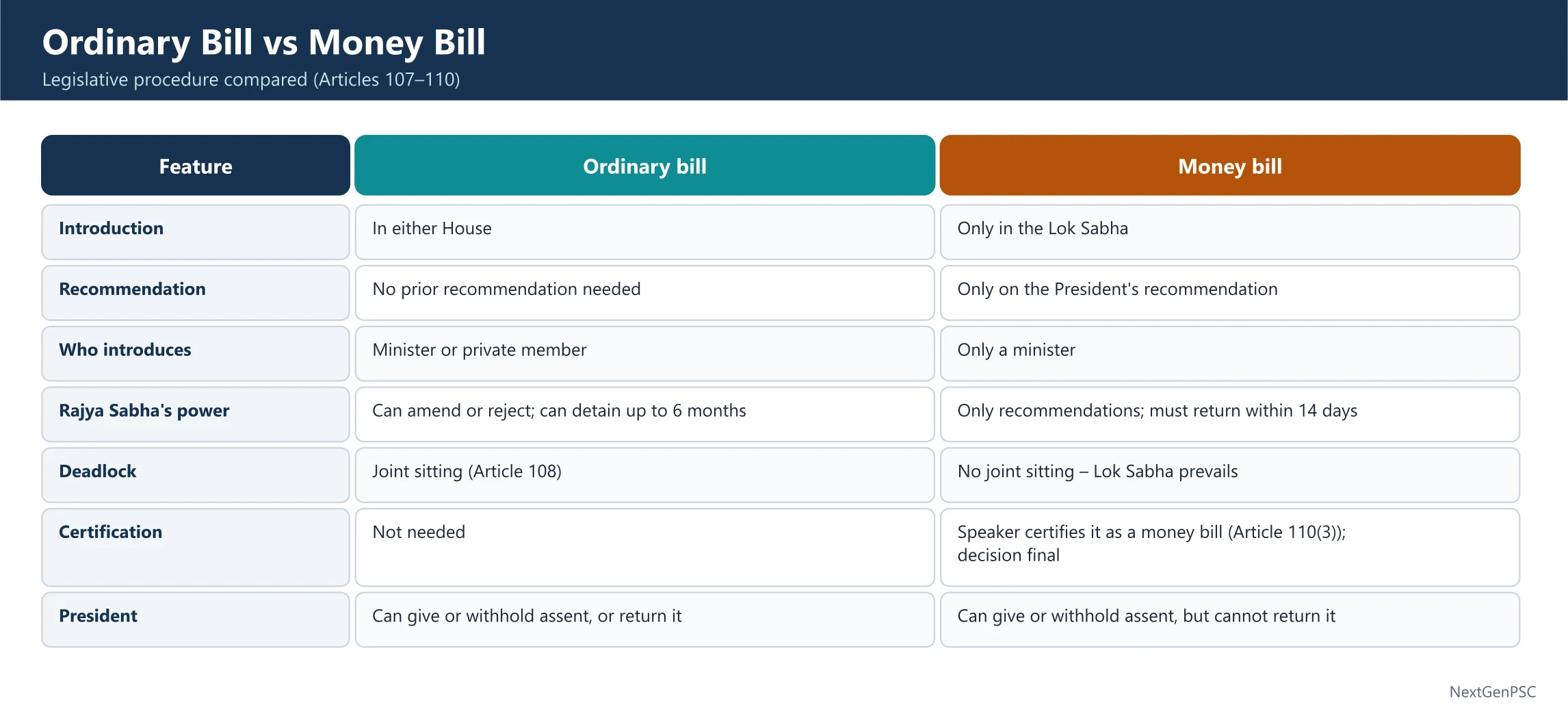
    Ordinary Bills and Money Bills differ in scope, introduction, procedure, and the role of Rajya Sabha. Money Bills deal only with financial matters under Article 110 and have a restricted procedure, while Ordinary Bills cover general matters and require approval of both Houses.

    Difference between an Ordinary Bill and a Money Bill

    Comparison: Money Bill vs Ordinary Bill

    AspectMoney BillOrdinary Bill
    IntroductionOnly in Lok SabhaEither in Lok Sabha or Rajya Sabha
    Introduced byMinister onlyAny MP (Minister or Private Member)
    President’s RecommendationMandatory before introductionNot required
    Rajya Sabha PowerCannot amend/reject; only recommend; Lok Sabha may accept/rejectCan amend or reject the bill
    Time Rajya Sabha can holdMaximum 14 daysMaximum 6 months
    CertificationCertified as Money Bill by SpeakerNo certification required
    Role of Rajya Sabha in PassageOptional; Bill passes if Lok Sabha accepts after 14 daysMandatory; must pass in both Houses before President’s assent
    Joint SessionNo provision of Joint SessionJoint Session allowed in case of deadlock
    Effect of Defeat in Lok SabhaLeads to resignation of governmentIf introduced by Minister and defeated, government must resign
    President’s RoleCan approve or reject but cannot return for reconsiderationCan approve, reject, or return for reconsideration

    Mains Key Points

    The distinction ensures financial supremacy of Lok Sabha as representatives of the people control finances.
    Speaker’s certification is final and often controversial (e.g., Aadhaar Act as Money Bill).
    Rajya Sabha’s limited role in Money Bills reduces federal balance but strengthens executive accountability.
    Ordinary Bills reflect broader legislative consensus involving both Houses.

    Prelims Strategy Tips

    Money Bill: Only in Lok Sabha, certified by Speaker, Rajya Sabha has limited role.
    Ordinary Bill: Can be introduced in either House; requires approval of both Houses.
    Joint Session possible for Ordinary Bills, not for Money Bills.
    President cannot return Money Bill but can return an Ordinary Bill.
    Article 109: a Money Bill can be introduced only in the Lok Sabha on the President's recommendation; the Rajya Sabha must return it within 14 days with or without recommendations, which the Lok Sabha may accept or reject. The Speaker's certificate (Article 110(3)) is final.

    Difference between Money Bill, Financial Bill and Constitution Amendment Bill

    Key Point

    Money Bills (Art. 110), Financial Bills (Art. 117) and Constitution Amendment Bills differ in scope, procedure, and role of President and Rajya Sabha. Money Bills are most restrictive, Financial Bills (A & B) allow greater Rajya Sabha role, while Constitution Amendment Bills require special procedure under Article 368.

    Money Bills (Art. 110), Financial Bills (Art. 117) and Constitution Amendment Bills differ in scope, procedure, and role of President and Rajya Sabha. Money Bills are most restrictive, Financial Bills (A & B) allow greater Rajya Sabha role, while Constitution Amendment Bills require special procedure under Article 368.

    Comparison of Bills

    AspectMoney Bill (Art. 110)Financial Bill – A (Art. 117(1))Financial Bill – B (Art. 117(3))Constitution Amendment Bill (Art. 368)
    President’s RecommendationRequiredRequiredNot requiredNot required
    IntroductionOnly in Lok SabhaOnly in Lok SabhaBoth HousesEither House
    Rajya Sabha RoleCannot amend/reject, only recommendCan amend or rejectCan amend or rejectMust pass by special majority in both Houses
    CertificationSpeaker certifies as Money BillNo certification requiredNo certification requiredNo certification required
    Joint SittingNot allowedAllowedAllowedNot allowed
    ProvisionsOnly matters in Article 110 (e.g., taxes, borrowing, Consolidated Fund, expenditure)Matters of Art. 110 + general legislationExpenditure from Consolidated Fund of IndiaProvisions of Constitution (e.g., GST Act, 101st Amendment)
    President’s AssentCan approve or reject; cannot returnCan approve, reject or returnCan approve, reject or returnCannot withhold assent
    Effect on GovernmentDefeat → Government resignationDefeat → Possible government resignation (if finance proposal)Defeat → No automatic fall of governmentNo effect on government stability

    Mains Key Points

    Distinction ensures control of finances by Lok Sabha while allowing Rajya Sabha role in wider financial matters.
    Speaker’s certification of Money Bill often controversial (Aadhaar Act case).
    Financial Bills show Parliament’s balance of financial and general legislative powers.
    Constitution Amendment Bills reflect rigidity + flexibility; protect Basic Structure.

    Prelims Strategy Tips

    Money Bill: Article 110, certified by Speaker, Rajya Sabha limited role.
    Financial Bill-A: Art. 117(1), deals with Art. 110 + general legislation, RS has full powers.
    Financial Bill-B: Art. 117(3), deals with expenditure from Consolidated Fund, RS has full powers.
    Constitution Amendment Bills: Special majority in both Houses; no joint sitting; President cannot withhold assent.

    Legislative Procedure in the Parliament

    Key Point

    The legislative procedure ensures detailed scrutiny of bills through three readings in each House, followed by the President’s assent. In case of deadlock between the Houses, a Joint Sitting under Article 108 can be summoned.

    The legislative procedure ensures detailed scrutiny of bills through three readings in each House, followed by the President’s assent. In case of deadlock between the Houses, a Joint Sitting under Article 108 can be summoned.

    Detailed Notes (28 points)
    Tap a card to add note • Use the highlight Listen button to play the full section
    Step 1: First Reading
    At this stage, the member (Minister or Private MP) asks for the permission of the House to introduce the Bill.
    There is no discussion on the principles or details of the Bill at this point.
    Once introduced, the Bill is published in the Gazette of India , making it available for public and parliamentary scrutiny.
    This stage is mainly about formally introducing the Bill into Parliament.
    Step 2: Second Reading
    This is the most important and detailed stage in the legislative process.
    The Bill is taken up for clause-by-clause discussion or may be referred to a Parliamentary Committee (such as a Departmental Standing Committee) for detailed examination.
    After receiving the Committee’s report, the House discusses the Bill in detail and may propose amendments .
    Only those amendments which are accepted by the House are included in the final draft of the Bill.
    This stage ensures parliamentary scrutiny, transparency, and accountability .
    Step 3: Third Reading
    This is the final discussion stage in the House where the Bill was introduced.
    Here, members debate only on whether the Bill should be passed or rejected — no further amendments are allowed.
    After the debate, the Bill is put to vote . If passed by a simple majority , it is sent to the other House for consideration.
    This stage gives the Bill its final approval in one House.
    Consideration in the Other House
    The Bill goes through the same three stages — first reading, second reading, and third reading — in the other House (Lok Sabha or Rajya Sabha, as the case may be).
    If the other House passes the Bill without changes , it is sent to the President for assent .
    If there are disagreements between the two Houses, the President may call a Joint Sitting under Article 108 to resolve the issue.
    President’s Assent
    Once both Houses have passed the Bill, it is sent to the President of India for approval.
    The President may:
    (a) Give assent – The Bill becomes a law.
    (b) Withhold assent – The Bill fails.
    (c) Return the Bill (if not a Money Bill) for reconsideration.
    If the Bill is passed again by Parliament, the President is bound to give assent .
    After the President’s approval, the Bill becomes an Act of Parliament and is enforceable as law throughout India.

    Joint Sitting of Parliament (Article 108)

    AspectDetails
    ConditionsDisagreement between Houses; Rejection by one House; Inaction for 6 months.
    Summoning AuthorityPresident of India under Article 108.
    Presiding OfficerSpeaker → Deputy Speaker → Deputy Chairman of Rajya Sabha → Member elected by Joint Sitting.
    RulesRules of procedure of Lok Sabha generally followed.
    Majority NeededSimple majority of members present and voting.
    Bills ConsideredDowry Prohibition Bill (1961), Banking Service Commission (Repeal) Bill (1978), Prevention of Terrorism Bill (2002).
    ExceptionsMoney Bills and Constitution Amendment Bills cannot be referred to Joint Sitting.

    Mains Key Points

    Three-reading procedure ensures thorough scrutiny of bills.
    Parliamentary Committees play crucial role in detailed examination.
    Joint Sitting prevents legislative deadlocks between Houses.
    Exceptions for Money Bills reflect financial primacy of Lok Sabha.
    Process balances democratic debate with efficiency in law-making.

    Prelims Strategy Tips

    Legislative procedure involves 3 readings in both Houses.
    President’s assent makes the bill a law (mandatory).
    Joint Sitting: Article 108; simple majority required; Speaker presides.
    Exceptions: Money Bills & Constitution Amendment Bills.

    Budget in the Parliament

    Key Point

    Article 112 of the Constitution defines the Union Budget as the 'Annual Financial Statement'. It involves multiple stages—from presentation by the Finance Minister to the passage of Appropriation and Finance Bills. The process ensures accountability, transparency, and parliamentary control over public finances.

    Article 112 of the Constitution defines the Union Budget as the 'Annual Financial Statement'. It involves multiple stages—from presentation by the Finance Minister to the passage of Appropriation and Finance Bills. The process ensures accountability, transparency, and parliamentary control over public finances.

    Detailed Notes (35 points)
    Tap a card to add note • Use the highlight Listen button to play the full section
    Presentation of Budget
    The Union Finance Minister presents the annual budget in Parliament, usually on February 1 every year.
    This presentation marks the beginning of the new financial year (April 1 to March 31).
    The budget is divided into two parts — Railway Budget (now merged) and General Budget .
    It contains the government’s estimated receipts and expenditure for the upcoming financial year.
    The budget speech is delivered in Lok Sabha and simultaneously laid in Rajya Sabha .
    The first part of the speech deals with economic survey and policy overview , while the second part discusses tax proposals and fiscal measures .
    General Discussion
    The discussion starts a few days after the presentation of the budget.
    Members debate the general principles and policies of the budget, not specific figures or items.
    This stage provides an opportunity for Parliament to criticize, suggest improvements , and discuss the government’s overall economic strategy.
    The discussion typically lasts for 3 to 4 days and ends with a reply from the Finance Minister .
    No voting or formal motion takes place at this stage — it is only a policy-level debate .
    Scrutiny by Departmental Committees
    After the general discussion, Parliament is adjourned for about 3 weeks .
    During this period, 24 Departmentally Related Standing Committees examine the Demands for Grants of various ministries.
    Each committee studies the financial performance, expenditure, and utilization of funds of a specific ministry.
    They submit detailed reports and recommendations to both Houses of Parliament.
    This stage ensures parliamentary oversight and transparency in government spending.
    Voting on Demands for Grants
    After the committees submit their reports, Parliament resumes to discuss and vote on each ministry’s Demands for Grants .
    This voting happens only in Lok Sabha because the Constitution gives it the ‘power of the purse’ .
    Rajya Sabha can discuss the demands but cannot vote on them.
    Members can also move Cut Motions (Policy Cut, Economy Cut, or Token Cut) to reduce or criticize specific demands.
    However, since the government usually has a majority, most cut motions are not passed.
    Appropriation Bill
    After the voting on Demands for Grants, an Appropriation Bill is introduced in Lok Sabha.
    It provides legal authority for the government to withdraw money from the Consolidated Fund of India to meet approved expenditures.
    Without this Bill, the government cannot legally spend any money from the Consolidated Fund.
    Once the Bill is passed by both Houses and receives the President’s assent , it becomes law.
    Finance Bill
    The Finance Bill contains all the government’s taxation and financial proposals for the year.
    It is usually introduced immediately after the budget presentation and must be passed by both Houses within 75 days (as per the Provisional Collection of Taxes Act, 1964 ).
    It is treated as a Money Bill under Article 110 .
    Once it receives the President’s assent , the budget process is complete, and the government can officially implement its financial proposals.

    Stages of the Union Budget

    StageDetails
    PresentationUnion Finance Minister presents the Annual Financial Statement (Article 112).
    General DiscussionHouse deliberates on budget policies, no voting.
    Scrutiny by CommitteesStanding Committees review Demands for Grants and submit reports.
    Voting on DemandsLok Sabha votes ministry-wise on Demands for Grants.
    Appropriation BillLegalises voted demands; authorises withdrawal from Consolidated Fund.
    Finance BillIncludes all tax and financial proposals; must be passed within 75 days.

    Mains Key Points

    Union Budget ensures accountability and financial discipline of government.
    Committee scrutiny strengthens transparency in financial governance.
    Lok Sabha holds exclusive power over grants, reflecting democratic control of finances.
    Appropriation and Finance Bills transform budgetary proposals into legal authority.
    Budget process balances executive’s initiative with legislative oversight.

    Prelims Strategy Tips

    Budget = Annual Financial Statement (Article 112).
    Demands for Grants voted only in Lok Sabha.
    Appropriation Bill enables withdrawal from Consolidated Fund.
    Finance Bill must be passed within 75 days.
    Departmental Committees scrutinise demands during budget recess.

    Cut Motions in Parliament

    Key Point

    Cut Motions are tools available only in the Lok Sabha during the budget process. They allow members to question or reduce specific demands for grants, thereby ensuring financial accountability of the executive. Though rarely passed (due to majority support for government), they hold significant importance as instruments of opposition scrutiny.

    Cut Motions are tools available only in the Lok Sabha during the budget process. They allow members to question or reduce specific demands for grants, thereby ensuring financial accountability of the executive. Though rarely passed (due to majority support for government), they hold significant importance as instruments of opposition scrutiny.

    Detailed Notes (17 points)
    Tap a card to add note • Use the highlight Listen button to play the full section
    Key Features
    Cut Motions are part of the budgetary control mechanism used by Parliament to examine and restrict government expenditure.
    They can only be introduced in Lok Sabha since it has the ‘power of the purse’ under the Constitution.
    A Cut Motion requires prior approval from the Speaker before being admitted for discussion.
    If a Cut Motion is passed , it signifies that the Lok Sabha has lost confidence in the government , which may lead to its resignation.
    Although rarely passed due to the ruling party’s majority, they provide the Opposition a vital opportunity to criticize government policies and raise public issues.
    Thus, Cut Motions act as a symbolic weapon in the hands of the Opposition to ensure accountability.
    Types of Cut Motions
    1. Policy Cut Motion: Seeks to reduce a demand to Re. 1 to show disapproval of the policy of a particular ministry or department. It is used to initiate discussions on the policy aspect of government functioning.
    2. Economy Cut Motion: Proposes to reduce the amount of demand by a specific sum to point out that the proposed expenditure can be economized or reduced . It targets wasteful or non-essential spending.
    3. Token Cut Motion: Seeks to reduce the amount of a demand by ₹100 to draw attention to a specific grievance within the ministry or its operations. It is the most common type of cut motion.
    Significance
    Cut Motions play a crucial role in promoting executive accountability to the legislature.
    They provide a platform for the Opposition to highlight government shortcomings, financial mismanagement, or public grievances.
    Through debates on Cut Motions, MPs can question and analyze the efficiency, necessity, and justification of government expenditure.
    Even though they are rarely successful , their discussion alone ensures transparency and legislative oversight .
    In summary, Cut Motions act as a parliamentary safety valve for democratic control over public finances.

    Types of Cut Motions

    Type of Cut MotionMotion TextPurpose
    Policy Cut MotionThe amount of demand be reduced to Re. 1Expresses disapproval of the policy underlying the demand for grant.
    Economy Cut MotionThe amount of the demand be reduced to a specified amountSeeks reduction to show concern for economy or to highlight inefficiency.
    Token Cut MotionThe amount of the demand be reduced by ₹100Raises a specific grievance for which the Government of India is responsible.

    Mains Key Points

    Cut motions are symbolic instruments of parliamentary control over executive spending.
    They provide opposition an avenue to raise grievances and critique policies.
    Their discussion enhances transparency and accountability in financial matters.
    Though rarely passed, they remain an effective check on the ruling party.
    Reflects parliamentary democracy’s strength in ensuring financial discipline.

    Prelims Strategy Tips

    Cut motions can only be introduced in Lok Sabha.
    Passing of a cut motion = loss of confidence in government.
    Types: Policy Cut, Economy Cut, Token Cut.
    Rarely passed due to government majority but important for debates.

    Important Budgetary Concepts: Demand for Grants, Charged Expenditure & Other Grants

    Key Point

    Budgetary control in India operates through Demand for Grants (voted expenditure), Charged Expenditure (non-votable but discussable), and additional mechanisms like Vote on Account, Supplementary and Excess Grants, and Guillotine. These ensure both legislative oversight and institutional independence.

    Budgetary control in India operates through Demand for Grants (voted expenditure), Charged Expenditure (non-votable but discussable), and additional mechanisms like Vote on Account, Supplementary and Excess Grants, and Guillotine. These ensure both legislative oversight and institutional independence.

    Detailed Notes (25 points)
    Tap a card to add note • Use the highlight Listen button to play the full section
    Demand for Grants
    Every ministry or department prepares a Demand for Grant for the upcoming financial year, outlining the money it requires for its functioning and programs.
    These demands must receive the President’s prior recommendation before being introduced in the Lok Sabha.
    They are voted upon only in Lok Sabha because it represents the people and controls public finances.
    Rajya Sabha can only discuss but not vote on these demands.
    Each Demand for Grant corresponds to a specific ministry or department — for example, the Ministry of Defence or Ministry of Education.
    These demands collectively form the expenditure side of the Union Budget.
    Charged Expenditure
    Charged Expenditure is the spending that is directly charged to the Consolidated Fund of India and is not subject to voting in Parliament.
    Members can discuss but not vote on it — ensuring protection from political influence.
    Its main purpose is to maintain the independence and dignity of key constitutional offices and institutions.
    Parliament can declare any expenditure as ‘charged’ through legislation.
    Examples include salaries, allowances, and pensions of the President, Judges of Supreme and High Courts, CAG, UPSC members, Speakers/Chairpersons, debt charges, and tribunal awards .
    This ensures that crucial offices function free from legislative pressure .
    Other Grant Mechanisms
    Vote on Account: Temporary authorization allowing the government to withdraw funds from the Consolidated Fund of India until the full Budget is passed. Usually valid for two months but can be extended during elections or emergencies . It helps avoid interruption in essential government services.
    Supplementary Grants: Additional funds sought during the financial year when the existing budgetary allocation proves insufficient. Requires President’s recommendation .
    Excess Grants: When actual spending exceeds the amount sanctioned by Parliament. Examined by the Public Accounts Committee (PAC) before Parliament approves it retrospectively.
    Guillotine: On the last day fixed for discussing Demands for Grants, all remaining demands are put to vote together without discussion . This ensures the budget is passed on time .
    Interim Budget
    An Interim Budget is presented by the outgoing government during an election year to manage expenses for around 4 months until the new government presents a full Budget.
    It is not mentioned in the Constitution but has evolved as a parliamentary convention.
    It includes both revenue and expenditure estimates for a short duration and authorizes necessary withdrawals from the Consolidated Fund.
    After the elections, the new government introduces a comprehensive Union Budget .
    The Interim Budget 2024–25 focused on the vision of ‘Viksit Bharat 2047’ , emphasizing inclusive, sustainable, and all-round development.

    Voted vs Charged Expenditure

    AspectVoted Expenditure (Demand for Grants)Charged Expenditure
    ApprovalRequires Lok Sabha votingNot subject to voting, only discussion
    Prepared byIndividual ministriesConstitutional provisions or Parliament law
    ExamplesMinistry-wise demands (like Defence, Health, Education)Salaries of President, SC/HC Judges, CAG, UPSC, debt charges

    Full Budget vs Interim Budget

    AspectFull BudgetInterim Budget
    TimingPresented annually for the entire financial yearPresented in election years for ~4 months
    AuthorityNewly formed governmentOutgoing government
    ScopeComprehensive – policies, schemes, taxation proposalsCovers essential expenditure; no major policy changes
    Constitutional MentionMandated under Article 112 (Annual Financial Statement)Not mentioned in Constitution; parliamentary convention

    Mains Key Points

    Budgetary system balances executive accountability with institutional autonomy.
    Charged expenditure ensures independence of constitutional offices like Judiciary, CAG, UPSC.
    Cut motions and Guillotine show legislative control over executive spending.
    Vote on Account and Interim Budget ensure financial continuity during political transitions.
    Key challenge: balancing fiscal discipline with developmental needs.

    Prelims Strategy Tips

    Demand for Grants: voted only in Lok Sabha, requires President’s recommendation.
    Charged expenditure: not voted, only discussed (e.g., salaries of President, SC/HC judges, CAG).
    Vote on Account: temporary approval for 2 months; essential during elections.
    Guillotine: last-day automatic approval of remaining demands for grants.
    Interim Budget: presented in election year; not in Constitution; 2024-25 theme ‘Viksit Bharat 2047’.

    Funds under the Constitution

    Key Point

    The Indian Constitution provides for three types of funds – Consolidated Fund of India (CFI), Public Account of India, and Contingency Fund of India. These ensure financial management, accountability, and provision for unforeseen expenditures.

    The Indian Constitution provides for three types of funds – Consolidated Fund of India (CFI), Public Account of India, and Contingency Fund of India. These ensure financial management, accountability, and provision for unforeseen expenditures.

    Detailed Notes (25 points)
    Tap a card to add note • Use the highlight Listen button to play the full section
    Consolidated Fund of India (CFI)
    The Consolidated Fund of India is the most important national account created under Article 266(1) of the Constitution.
    It includes:
    • All revenues received by the Government of India such as taxes, duties, fees, and penalties .
    • All loans raised by the Government of India (both domestic and external).
    • All money received in repayment of loans given by the Government.
    Every rupee earned or borrowed by the government goes into this fund.
    No money can be withdrawn from this fund without Parliament’s approval through a law (usually via the Appropriation Act).
    This ensures financial accountability and legislative control over public spending.
    Both the Union and each State maintain their own Consolidated Funds.
    Public Account of India
    The Public Account of India is established under Article 266(2) of the Constitution.
    It includes all other funds received by or on behalf of the government that do not belong to the Consolidated Fund.
    Examples include: Provident Fund deposits, judicial deposits, departmental deposits, remittances, postal savings, and other small savings.
    This money does not belong to the government but is held by it in trust for the public or other entities.
    Unlike the Consolidated Fund, no parliamentary approval is needed for withdrawals.
    However, the transactions are subject to audit by the CAG (Comptroller and Auditor General of India).
    The Public Account represents the fiduciary responsibility of the government.
    Contingency Fund of India
    The Contingency Fund of India is established under Article 267 to meet urgent or unforeseen expenditure that cannot wait for parliamentary approval.
    It is placed at the disposal of the President and is operated by the Finance Secretary on behalf of the President.
    Expenditures from this fund are later replenished by Parliament through the Appropriation Act.
    The fund acts as an emergency financial buffer for the Union Government.
    The corpus (fund amount) is decided by Parliament through legislation — currently ₹500 crore (can be revised by law).
    Each State also maintains its own State Contingency Fund for similar purposes.

    Comparison of Constitutional Funds

    FundArticleKey Features
    Consolidated Fund of IndiaArticle 266(1)Includes all revenues, loans, recoveries; withdrawal only by Parliamentary law.
    Public Account of IndiaArticle 266(2)Includes deposits like PF, judicial, departmental, remittances; no parliamentary approval needed for withdrawal.
    Contingency Fund of IndiaArticle 267Used for unforeseen expenditure; held by Finance Secretary on behalf of President; amount decided by Parliament.

    Mains Key Points

    CFI ensures parliamentary control over government spending.
    Public Account represents trust-based deposits managed by government without voting.
    Contingency Fund ensures financial flexibility in emergencies.
    Together, these funds reflect balance between accountability and efficiency.
    Key challenge: avoiding misuse of Public Account and ensuring parliamentary oversight.

    Prelims Strategy Tips

    CFI (Article 266(1)): Withdrawal only with Parliamentary approval.
    Public Account (Article 266(2)): No voting required; includes PF, deposits, remittances.
    Contingency Fund (Article 267): At President’s disposal; urgent expenditure.
    Finance Secretary holds Contingency Fund on behalf of the President.
    CFI = Voted + Charged expenditure; Public Account = Non-votable.

    Various Types of Grants in Indian Budget

    Key Point

    Apart from Demand for Grants, the Indian Constitution and budgetary process recognize several other types of grants like Supplementary, Additional, Excess, Exceptional, Token Grants, and Vote of Credit. These provide flexibility to meet unforeseen or new expenditure requirements.

    Apart from Demand for Grants, the Indian Constitution and budgetary process recognize several other types of grants like Supplementary, Additional, Excess, Exceptional, Token Grants, and Vote of Credit. These provide flexibility to meet unforeseen or new expenditure requirements.

    Detailed Notes (33 points)
    Tap a card to add note • Use the highlight Listen button to play the full section
    Supplementary Grant
    A Supplementary Grant is given when the money approved by Parliament for a ministry or department under the Appropriation Act turns out to be insufficient during the financial year.
    For example, if the Health Ministry runs out of its budget allocation due to an outbreak of a new disease, it can request additional funds through a supplementary grant.
    The government must present the reason for the shortfall and the amount required to Parliament for approval .
    Once approved, the funds are withdrawn from the Consolidated Fund of India .
    Thus, a supplementary grant ensures that essential services and programs continue smoothly without interruption due to a lack of funds.
    Additional Grant
    An Additional Grant is sought when a completely new service, program, or project arises that was not included in the original annual budget.
    This type of grant is not for shortages but for new initiatives that the government decides to implement mid-year.
    Example: Launching a new women’s empowerment scheme or a vaccination drive after the annual budget has already been passed.
    It helps the government respond to changing priorities or emergencies without waiting for the next financial year.
    Excess Grant
    An Excess Grant is needed when a department or ministry spends more money than Parliament originally approved for a particular purpose.
    These cases are carefully reviewed by the Public Accounts Committee (PAC) to find out why the overspending happened and whether it was justified.
    Only after the PAC’s recommendation does Parliament approve the excess amount.
    Example: If the Defence Ministry exceeds its budget due to sudden national security needs.
    It ensures that no extra spending goes unchecked and that the government is accountable for every rupee spent.
    Exceptional Grant
    An Exceptional Grant is given for a special, one-time purpose that does not belong to any ongoing program or service of that financial year.
    It is not meant to cover regular or recurring expenses but rather extraordinary situations .
    Example: Providing financial assistance to earthquake or flood victims, or hosting an international event like the G20 summit.
    This allows the government to act swiftly in response to national needs without amending the regular budget.
    Token Grant
    A Token Grant is a very small amount (sometimes ₹1 or ₹100) sanctioned to permit reallocation of funds from savings in other heads of expenditure.
    It is used when a ministry needs money for a new activity but doesn’t want to create a fresh budgetary provision.
    For instance, if the Education Ministry saves funds in one area, it can reallocate a small portion to start a new digital learning program using a token grant.
    Thus, it promotes budget flexibility and efficiency by allowing adjustments within the existing financial framework.
    Vote of Credit
    A Vote of Credit is a special emergency grant that allows the government to meet sudden and unforeseen demands for large sums of money.
    It functions like a ‘blank cheque’ , giving temporary financial freedom to the executive in times of crisis.
    This type of grant is used during wars, natural disasters, or national emergencies when quick spending is necessary and prior approval is not practical.
    After the immediate need is met, Parliament reviews and formally approves the expenditure later through an Appropriation Act .
    It ensures that the government can act fast in emergencies while maintaining constitutional oversight later.

    Types of Grants and Their Purpose

    Type of GrantPurposeExample
    Supplementary GrantWhen original funds are insufficientExtra allocation to a ministry for ongoing scheme
    Additional GrantFor new service/scheme not in original budgetMid-year launch of new welfare scheme
    Excess GrantFor overspending beyond approved budgetExcess expenditure on defence procurement
    Exceptional GrantFor special, one-time purposeNatural disaster relief
    Token GrantEnable re-appropriation of fundsNew minor service introduced mid-year
    Vote of CreditMeet unexpected demand of money (blank cheque)War-time emergency expenditure

    Mains Key Points

    Grants provide flexibility in managing public finances beyond the annual budget.
    Supplementary and Excess Grants ensure transparency and accountability in overspending.
    Token and Additional Grants help address new and unforeseen services.
    Vote of Credit ensures financial preparedness in emergencies.
    Parliamentary approval keeps executive accountable even in extraordinary circumstances.

    Prelims Strategy Tips

    Supplementary Grant: Insufficient authorized funds.
    Additional Grant: For new services not in original budget.
    Excess Grant: Overspending; checked by PAC.
    Exceptional Grant: For special purpose, not part of regular services.
    Token Grant: Allows re-appropriation of funds.
    Vote of Credit: Like a blank cheque; used in national emergencies.

    Parliamentary Privileges

    Key Point

    Parliamentary privileges are special rights, immunities, and exemptions enjoyed by Members of Parliament (MPs), committees, and the Houses collectively. They ensure independence, dignity, and effectiveness of legislative functioning. Provided under Article 105, these privileges are uncodified, enforced through conventions and rulings.

    Parliamentary privileges are special rights, immunities, and exemptions enjoyed by Members of Parliament (MPs), committees, and the Houses collectively. They ensure independence, dignity, and effectiveness of legislative functioning. Provided under Article 105, these privileges are uncodified, enforced through conventions and rulings.

    Detailed Notes (29 points)
    Tap a card to add note • Use the highlight Listen button to play the full section
    Sources of Parliamentary Privileges
    1. Constitution: Articles 105 (for Parliament) and 194 (for State Legislatures) grant privileges and immunities to members.
    2. Rules of Procedure: Both Houses of Parliament have their own rule books which specify certain privileges and powers.
    3. Judicial Decisions: Important Supreme Court and High Court judgments have clarified how privileges should be used.
    4. Parliamentary Conventions: Long-established practices followed for smooth functioning, even if not written in law.
    Together, these sources help members perform their duties freely and fearlessly without external pressure.
    Nature of Privileges
    These privileges are not codified in any single law — they are based on constitutional provisions, customs, and conventions.
    They are meant to protect the dignity and independence of the Parliament and its members.
    They apply to all Members of Parliament (MPs) and the Attorney General of India , but not to the President.
    Parliament has the power to define its privileges by law, but no such law has been enacted yet .
    Presiding officers (Speaker and Chairman) enforce these privileges and decide on violations.
    The main goal is to ensure that members can speak, question, and criticize freely without fear of legal action.
    Types of Parliamentary Privileges
    1. Collective Privileges (for the House as a whole)
    The Parliament or a State Legislature as a body enjoys certain rights collectively.
    Right to regulate internal proceedings: Courts cannot interfere in how Parliament conducts its business.
    Freedom from external interference: No outside authority can control or question the internal functioning of the House.
    Right to receive information about MPs’ arrest: If an MP is arrested, the House must be informed immediately.
    Publication Protection: True and fair reports of parliamentary proceedings are protected — no one can sue for defamation unless published with malice.
    Right to decide privileges breach: The House has the power to punish anyone who violates its privileges (like contempt of Parliament).
    These privileges ensure that the House maintains its authority and works independently of the judiciary or executive.
    2. Individual Privileges (for Members)
    Freedom of Speech: Members can speak freely in Parliament without fear of being sued or prosecuted. This is absolute and different from the limited freedom under Article 19(1)(a).
    Freedom from Arrest: Members cannot be arrested in civil cases during the session of Parliament or 40 days before and after the session. However, this protection does not apply to criminal cases or preventive detention .
    Exemption from Court Attendance: MPs cannot be compelled to appear as witnesses in court without permission from the House.
    Immunity from Legal Action: No MP can be sued or punished for anything said or voted inside Parliament.
    Example: If an MP criticizes government policy in Parliament, they cannot be charged with defamation.
    These individual privileges help MPs express opinions freely and carry out their constitutional duties effectively.

    Types of Parliamentary Privileges

    TypeKey Features
    Collective PrivilegesSalary decided by Parliament, regulate internal proceedings, immunity from court interference, right to information on arrest of MPs, protection for true reports.
    Individual PrivilegesFreedom of speech in Parliament, exemption from civil arrest (not criminal), no compulsion to testify in court without House permission, protection from liability for votes/speech.

    Mains Key Points

    Parliamentary privileges uphold legislative independence and dignity.
    Uncodified nature has led to controversies over scope and misuse.
    Privileges balance accountability of MPs with autonomy of legislature.
    Judiciary has clarified limits (e.g., no privilege against criminal liability).
    Codification debate: whether to clearly define privileges to avoid misuse.

    Prelims Strategy Tips

    Article 105: Parliamentary privileges (similar to Article 194 for States).
    Privileges uncodified; Parliament may define by law, but no law enacted yet.
    Freedom of speech in Parliament is distinct from Article 19(1)(a).
    Civil arrest exemption: during session + 40 days before/after.
    Privileges apply to MPs + Attorney General, not President.

    Powers of Lok Sabha and Rajya Sabha: Comparative Analysis

    Key Point

    Lok Sabha, being the directly elected house, enjoys greater powers in financial and executive control, while Rajya Sabha has special authority in federal matters. In most legislative and constitutional matters, both Houses exercise equal powers, ensuring balance in parliamentary democracy.

    Lok Sabha, being the directly elected house, enjoys greater powers in financial and executive control, while Rajya Sabha has special authority in federal matters. In most legislative and constitutional matters, both Houses exercise equal powers, ensuring balance in parliamentary democracy.

    Detailed Notes (22 points)
    Tap a card to add note • Use the highlight Listen button to play the full section
    Instances when Lok Sabha has More Powers
    The Lok Sabha , being the directly elected House of the people, has certain powers that make it more influential in India's parliamentary system.
    1. Money Bill: A Money Bill can be introduced only in the Lok Sabha (Article 110). Once passed by Lok Sabha, the Rajya Sabha can only make recommendations, which Lok Sabha may accept or reject. The Speaker’s decision on whether a bill is a Money Bill is final and binding .
    2. Joint Sitting: In case of disagreement between the two Houses over an ordinary bill, a Joint Sitting is held. It is presided over by the Speaker of the Lok Sabha , not by the Vice-President (who is Chairman of Rajya Sabha). Hence, Lok Sabha holds greater influence due to its larger numbers.
    3. Voting on Demands for Grants: The power of the purse lies only with the Lok Sabha. It alone votes on Demands for Grants —the detailed expenditure of various ministries. Rajya Sabha can discuss them but not vote.
    4. No-confidence Motion: Only Lok Sabha can move and pass a No-confidence Motion against the Council of Ministers (Article 75). If passed, the entire government must resign. This ensures executive accountability to the people .
    5. National Emergency: During a National Emergency (Article 352) , only Lok Sabha can pass a resolution to discontinue it, even if Rajya Sabha wants it to continue. This reinforces Lok Sabha’s supremacy as the House of the people.
    Instances when Rajya Sabha has More Powers
    The Rajya Sabha , representing the states, enjoys special powers to safeguard federal interests and ensure continuity in governance.
    1. Creation of All-India Services (Article 312): Rajya Sabha can authorize Parliament to create new All-India Services (like the IAS or IPS) if it passes a resolution supported by two-thirds majority of members present and voting.
    2. Legislation on State List (Article 249): In the national interest, Rajya Sabha can empower Parliament to make laws on subjects in the State List by passing a resolution with a two-thirds majority .
    3. Removal of Vice-President: A resolution for the removal of the Vice-President can only be initiated in the Rajya Sabha and then approved by Lok Sabha. This gives Rajya Sabha a unique constitutional role.
    Instances when Both Houses have Equal Powers
    In most legislative and constitutional matters, both Houses enjoy equal status to maintain balance between federal and democratic principles.
    1. Ordinary and Constitutional Bills: Both Houses must approve Ordinary Bills (except Money Bills) and Constitutional Amendment Bills for them to become law.
    2. Financial Bills: Involving expenditure from the Consolidated Fund of India (other than Money Bills) must be passed by both Houses.
    3. Election and Impeachment of the President: Both Houses participate in the election of the President and in the process of his impeachment for violation of the Constitution.
    4. Election of the Vice-President: Members of both Houses form the Electoral College to elect the Vice-President.
    5. Approval of Ordinances: Presidential Ordinances (temporary laws under Article 123) must be approved by both Houses within six weeks of reassembly.
    6. Emergency Proclamations: All three emergencies — National, State, and Financial — require approval of both Houses.
    7. Removal of Judges: Both Houses play equal roles in the removal (impeachment) of Supreme Court and High Court judges.
    8. Discussion of Reports: Reports from Finance Commission, UPSC, CAG , and other constitutional bodies are presented in both Houses for discussion and recommendations.

    Comparative Powers of Lok Sabha and Rajya Sabha

    AspectLok SabhaRajya SabhaEqual Powers
    Financial ControlMoney Bill, Demands for Grants, No-confidence MotionLimited role, only recommendations on Money BillFinancial Bills involving expenditure from CFI
    Executive AccountabilityCouncil of Ministers accountable to Lok SabhaNo direct accountabilityApproval of ordinances
    Federal RoleResolution for discontinuance of National EmergencyAuthorize Parliament to legislate on State List (Art. 249), Create All-India Services (Art. 312)Approval of emergency proclamations
    Removal PowersResolution for discontinuance of emergencyInitiates removal of Vice-PresidentImpeachment of President, removal of judges
    LegislationInitiates & passes bills; final authority on Money BillsRevising chamber; cannot reject Money BillsOrdinary Bills, Constitutional Amendments

    Mains Key Points

    Lok Sabha represents direct will of the people, hence enjoys supremacy in financial and executive matters.
    Rajya Sabha safeguards federal interests by representing states, with exclusive powers under Articles 249 and 312.
    Equal powers in legislative and constitutional matters ensure bicameral balance.
    This distribution reflects India’s quasi-federal structure and parliamentary democracy.
    Controversies often arise over Speaker’s certification of Money Bills (e.g., Aadhaar Bill).

    Prelims Strategy Tips

    Money Bills can be introduced only in Lok Sabha, with Speaker’s certification being final.
    Rajya Sabha has special powers under Articles 249 and 312.
    No-confidence motion can only be introduced in Lok Sabha.
    In impeachment of President, removal of judges, and constitutional amendments, both Houses have equal powers.

    Parliamentary Committees – Public Accounts Committee (PAC)

    Key Point

    Parliamentary Committees ensure legislative oversight beyond regular sessions. Among them, the Public Accounts Committee (PAC) is the most important financial committee, tasked with examining CAG audit reports and ensuring accountability in government spending.

    Parliamentary Committees ensure legislative oversight beyond regular sessions. Among them, the Public Accounts Committee (PAC) is the most important financial committee, tasked with examining CAG audit reports and ensuring accountability in government spending.

    Detailed Notes (38 points)
    Tap a card to add note • Use the highlight Listen button to play the full section
    Overview of Parliamentary Committees
    Parliamentary Committees are small groups of Members of Parliament (MPs) formed to handle specific work more efficiently than the entire House.
    They are either appointed or elected by the House or nominated by the Speaker (Lok Sabha) or Chairman (Rajya Sabha).
    They work under the supervision of these presiding officers and submit reports to them.
    Each House has a dedicated Secretariat that helps the committees with research, record-keeping, and report drafting.
    These committees play a vital role in ensuring effective law-making, financial control, and government accountability .
    Classification of Committees
    1. Standing Committees: These are permanent committees that work continuously. They are reconstituted every year or as required. Examples include Financial Committees (Public Accounts Committee, Estimates Committee, Committee on Public Undertakings) and Department-related Standing Committees .
    2. Ad hoc Committees: These are temporary committees set up for a specific purpose and dissolve after completing their task. Examples include Select Committees or Joint Parliamentary Committees (JPCs) that examine specific bills or issues like scams or policy reviews.
    Standing Committees ensure continuous oversight, while Ad hoc Committees deal with specific or urgent issues .
    Public Accounts Committee (PAC)
    The PAC is one of the most important Financial Committees of Parliament. It ensures that public money is spent efficiently and as approved by Parliament.
    Origin: Established in 1921 under the Government of India Act, 1919 — making it one of the oldest oversight bodies.
    Composition: 22 members — 15 from Lok Sabha and 7 from Rajya Sabha.
    Eligibility: Ministers cannot be members, ensuring impartiality.
    Election Method: Members are elected by the system of proportional representation through the single transferable vote method.
    Chairman: Appointed by the Speaker of Lok Sabha. Since 1967, the chairman is traditionally from the opposition to promote non-partisan scrutiny.
    Tenure: 1 year.
    Role of CAG: The Comptroller and Auditor General (CAG) acts as the committee’s ‘friend, philosopher, and guide’ , assisting with technical expertise on audit matters.
    Functions of PAC
    Examines the audit reports submitted by the CAG on Union government accounts.
    Ensures that public funds are spent as approved by Parliament and not misused.
    Detects irregularities, inefficiencies, and corruption in government expenditure.
    Reviews how far policy decisions and budgetary allocations have been implemented.
    Helps in maintaining financial accountability and transparency within the government.
    In short, PAC acts as the ‘watchdog of public finance’ in India.
    Limitations of PAC
    It cannot interfere in policy matters or ongoing administrative decisions.
    Its work is post-facto — it reviews expenditure after it has been made (a post-mortem analysis).
    Its role is advisory — it can recommend actions but cannot enforce them.
    It cannot disallow or reverse expenditure already approved by Parliament.
    Despite these limits, its reports are influential and often lead to reforms in financial administration .
    Way Forward (Reforms Suggested)
    Consult PAC during the appointment of the CAG to ensure transparency and independence.
    Empower the PAC to examine Public-Private Partnership (PPP) projects and government contracts.
    Allow PAC to use expert assistance (like auditors, economists, or technical experts) for complex reviews.
    Implement follow-up mechanisms to ensure that ministries act on PAC recommendations.
    Strengthening the PAC will make India’s parliamentary oversight more robust, transparent, and accountable .

    Key Features of Public Accounts Committee (PAC)

    AspectDetails
    Establishment1921 under Government of India Act, 1919
    Composition22 members (15 LS + 7 RS)
    ChairmanAppointed by Speaker; from Opposition (convention since 1967)
    Tenure1 year
    Main RoleExamines CAG audit reports; ensures accountability
    LimitationsNo policy intervention, advisory role only

    Mains Key Points

    PAC ensures post-expenditure accountability, unlike pre-approval control exercised during budget.
    It strengthens legislative oversight over executive’s financial management.
    Chairman from opposition enhances neutrality and credibility.
    Limitations include lack of enforcement power; role is advisory.
    Strengthening PAC by including PPP scrutiny and expert support can improve accountability.

    Prelims Strategy Tips

    PAC established in 1921 under Government of India Act, 1919.
    Composition: 22 members (15 LS + 7 RS); Ministers cannot be members.
    Chairman appointed by Speaker; by convention from opposition since 1967.
    CAG acts as friend, philosopher, and guide of PAC.
    PAC role is advisory; cannot enforce or disallow expenditure.

    Parliamentary Financial Committees – Estimates Committee & Committee on Public Undertakings

    Key Point

    Along with the Public Accounts Committee, the Estimates Committee and the Committee on Public Undertakings (COPU) play a vital role in ensuring financial accountability, efficiency in administration, and oversight of public sector enterprises.

    Along with the Public Accounts Committee, the Estimates Committee and the Committee on Public Undertakings (COPU) play a vital role in ensuring financial accountability, efficiency in administration, and oversight of public sector enterprises.

    Detailed Notes (47 points)
    Tap a card to add note • Use the highlight Listen button to play the full section
    A. Estimates Committee
    Background
    The Estimates Committee was established in 1950 based on the recommendation of John Mathai , who was the Finance Minister of India at that time.
    After India’s independence, Parliament needed a mechanism to examine how the government was spending money and whether it was being used effectively and economically.
    Hence, this committee was formed to evaluate the efficiency, effectiveness, and financial discipline of various government departments.
    Composition
    1. The Committee consists of 30 members , all of whom are from the Lok Sabha (the lower house of Parliament).
    2. Ministers cannot be members of this committee, to ensure impartial and independent review of government functioning.
    3. The members are elected every year by the members of Lok Sabha using the proportional representation system through a single transferable vote — ensuring fair representation of all political parties.
    4. The Chairman of the Committee is appointed by the Speaker of Lok Sabha and is usually from the ruling party .
    5. The tenure of the Committee is one year .
    Functions
    1. The Committee examines the budget estimates of different ministries and departments to identify possible ways to reduce unnecessary expenditure .
    2. It suggests economies and improvements in the organization and administration of government departments.
    3. It recommends alternative policies that could improve efficiency and economy in administration.
    4. It examines whether the money sanctioned by Parliament has been spent properly and within the policy limits .
    5. It also suggests reforms in the format of estimates presented to Parliament to make them more understandable and useful.
    Significance
    1. The Estimates Committee plays a crucial role in maintaining financial discipline in government spending.
    2. It acts as a financial watchdog of Parliament by identifying wasteful expenditures.
    3. It enhances the accountability and efficiency of the executive branch.
    4. It helps Parliament in exercising effective control over the national budget .
    B. Committee on Public Undertakings (COPU)
    Background
    The Committee on Public Undertakings (COPU) was established in 1964 based on the recommendation of the Krishna Menon Committee .
    After independence, India established several Public Sector Undertakings (PSUs) in industries such as steel, energy, and transport to promote industrial growth.
    Parliament required a specialized committee to ensure that these government-owned enterprises were being managed efficiently, honestly, and in the public interest.
    Hence, the COPU was formed to oversee the functioning, finances, and performance of these enterprises.
    Composition
    1. The Committee consists of 22 members : 15 from the Lok Sabha and 7 from the Rajya Sabha .
    2. Ministers cannot be members of this committee to maintain impartiality.
    3. Members are elected by proportional representation through a single transferable vote system, ensuring balanced political representation.
    4. The Chairman is appointed by the Speaker of Lok Sabha .
    5. The tenure of the Committee is one year .
    Functions
    1. The COPU examines the reports and accounts of various Public Sector Undertakings (PSUs) .
    2. It reviews the reports of the Comptroller and Auditor General of India (CAG) relating to PSUs.
    3. It ensures that PSUs are managed following sound business and commercial principles .
    4. It identifies and reports cases of inefficiency, mismanagement, corruption, and policy failures in public undertakings.
    5. It makes suggestions for improving productivity, profitability, and accountability in PSUs.
    6. It ensures that PSUs contribute effectively to the economic and social development of the country.
    Significance
    1. The COPU serves as a parliamentary watchdog over the working of public enterprises.
    2. It promotes transparency, accountability, and good governance in the management of PSUs.
    3. It helps prevent financial irregularities, losses, and corruption in public undertakings.
    4. It provides Parliament with an independent evaluation of how effectively PSUs are functioning.
    5. It ensures that the nation’s resources are used efficiently and for public benefit .

    Comparison: Estimates Committee vs Committee on Public Undertakings

    AspectEstimates CommitteeCOPU
    Year of Establishment1950 (John Mathai recommendation)1964 (Krishna Menon recommendation)
    Composition30 members (only Lok Sabha)22 members (15 LS + 7 RS)
    ChairmanAppointed by Speaker, usually from ruling partyAppointed by Speaker
    Membership RestrictionMinisters not eligibleMinisters not eligible
    Tenure1 year1 year
    Main FunctionReview estimates, suggest savings and reformsReview PSUs, examine CAG reports on PSUs

    Mains Key Points

    Estimates Committee focuses on economy, efficiency, and reforms before money is spent.
    COPU ensures accountability of PSUs, preventing mismanagement and inefficiency.
    Together with PAC, these committees form a three-pillar financial oversight structure.
    Estimates Committee has proactive role (suggesting reforms), COPU has evaluative role (reviewing PSUs).
    Challenges: Advisory nature, lack of enforcement powers; strengthening through expert inputs is needed.

    Prelims Strategy Tips

    Estimates Committee is largest financial committee with 30 members, all from Lok Sabha.
    PAC scrutinizes accounts post-expenditure, Estimates Committee works pre-expenditure.
    COPU was set up in 1964 after Krishna Menon Committee recommendation.
    COPU ensures PSUs follow sound commercial practices.
    Chairman of Estimates Committee usually from ruling party; PAC chairman usually from opposition.

    Department Related Standing Committees (DRSCs)

    Key Point

    DRSCs, introduced in 1993, strengthen parliamentary control over ministries by examining Demands for Grants, bills, reports, and long-term policy documents. They ensure detailed scrutiny outside the house and promote accountability of the executive.

    DRSCs, introduced in 1993, strengthen parliamentary control over ministries by examining Demands for Grants, bills, reports, and long-term policy documents. They ensure detailed scrutiny outside the house and promote accountability of the executive.

    Detailed Notes (23 points)
    Tap a card to add note • Use the highlight Listen button to play the full section
    A. Departmentally Related Standing Committees (DRSCs)
    Establishment & Structure
    The Departmentally Related Standing Committees (DRSCs) were established in 1993 to strengthen accountability, efficiency, and detailed scrutiny in the functioning of Parliament.
    Before 1993, Parliament lacked a specialized mechanism to examine the detailed working of ministries. The DRSC system was therefore introduced to enable in-depth discussion on government policies and performance .
    At present, there are 24 DRSCs — out of which 16 work under the Lok Sabha and 8 under the Rajya Sabha .
    Composition
    1. Each Committee can have a maximum of 31 members .
    2. Of these, 21 members are nominated by the Speaker of Lok Sabha and 10 members are nominated by the Chairman of Rajya Sabha .
    3. The Chairman of each committee is appointed by the respective presiding officer (the Speaker or the Chairman).
    4. The tenure of every committee is one year .
    5. Ministers cannot be members of these committees, ensuring neutrality and unbiased examination of government performance.
    Functions
    1. The DRSCs examine the Demands for Grants of various ministries before these are discussed in Parliament. However, they cannot suggest cut motions (i.e., they cannot reduce the amount of grants).
    2. They scrutinize bills referred to them by the presiding officers and submit detailed reports to Parliament.
    3. They examine the Annual Reports of ministries and departments to assess their performance and achievements.
    4. They consider national long-term policy documents and offer valuable feedback or recommendations.
    5. By discussing issues in detail outside the main house, they help reduce the legislative workload and make debates in Parliament more focused and efficient.
    Significance
    1. The DRSC system has brought a culture of specialized, informed, and detailed examination of government functioning.
    2. It ensures parliamentary control and oversight over the executive in a more continuous and effective manner.
    3. It improves transparency, accountability, and efficiency in governance.
    4. It allows members to discuss issues in a non-political and cooperative environment , encouraging consensus building.
    5. It strengthens the role of Parliament as a deliberative and supervisory institution rather than a mere law-making body.

    Key Features of DRSCs

    AspectDetails
    Year of Establishment1993
    Current Number24 (16 Lok Sabha + 8 Rajya Sabha)
    Composition31 members (21 LS + 10 RS)
    ChairmanAppointed by Speaker/Chairman
    Tenure1 year
    Major FunctionsReview Demands for Grants, Bills, Reports, and Policy Documents

    Mains Key Points

    DRSCs enhance legislative scrutiny by allowing detailed deliberations outside the house.
    They act as mini-Parliaments, ensuring ministries are accountable year-round.
    Strengthen participatory democracy by involving MPs across parties.
    Reduce disruptions in Parliament by shifting technical discussions to committees.
    Challenges: Lack of expert support, recommendations often advisory and ignored by ministries.

    Prelims Strategy Tips

    DRSCs introduced in 1993 for better accountability.
    24 DRSCs: 16 under Lok Sabha, 8 under Rajya Sabha.
    Maximum strength: 31 (21 LS + 10 RS).
    Review Demands for Grants but cannot move cut motions.
    Present detailed reports to Parliament, reducing house workload.

    Other Important Parliamentary Committees

    Key Point

    Apart from Financial Committees and DRSCs, several other committees such as the Petitions Committee, Privileges Committee, Business Advisory Committee, Rules Committee, and Ethics Committee play a crucial role in maintaining parliamentary discipline, scheduling business, and upholding ethical standards.

    Apart from Financial Committees and DRSCs, several other committees such as the Petitions Committee, Privileges Committee, Business Advisory Committee, Rules Committee, and Ethics Committee play a crucial role in maintaining parliamentary discipline, scheduling business, and upholding ethical standards.

    Key Parliamentary Committees and Their Functions

    CommitteeCompositionFunctions
    Committee on PetitionsLS: 15 (Speaker nominated); RS: 10 (Chairman nominated)Examines petitions for compliance with rules; reviews specific complaints on public matters
    Committee on PrivilegesLS: 15 (Speaker nominated); RS: 10 (Chairman nominated)Examines breaches of privilege and recommends actions
    Business Advisory CommitteeLS: 15 (Speaker ex-officio chairperson); RS: 11 (Chairman ex-officio chairperson)Regulates house timetable; allocates time for bills and business discussions
    Rules CommitteeLS: 15 (Speaker ex-officio chairperson); RS: 16 (Chairman ex-officio chairperson)Reviews procedures and conduct; proposes amendments to rules
    Committee on Private Member’s Bills and ResolutionsLS: 15 (Speaker nominated, Deputy as chairperson); No such committee in RSAllocates time for discussion of private member’s bills and resolutions
    General Purpose CommitteeLS: Speaker (chairperson) + Deputy Speaker + Chairpersons of DRSCs + Leaders of recognised parties/groups + nominated members; RS: Chairman (chairperson) + Deputy Chairman + Chairpersons of DRSCs + Leaders of recognised parties/groups + nominated membersAdvises on house matters referred by Speaker/Chairman
    Ethics CommitteeNot more than 15 members (nominated by Speaker)Oversees moral and ethical conduct of members

    Mains Key Points

    These committees ensure smooth functioning of Parliament beyond the house floor.
    Business Advisory and Rules Committees reduce disruptions and increase efficiency.
    Privileges and Ethics Committees safeguard dignity, discipline, and accountability of members.
    Petitions and Private Member’s Bills Committees provide direct citizen engagement and participatory democracy.
    Challenges: Lack of codified privileges, limited enforcement power of committees, frequent allegations of partisan bias.

    Prelims Strategy Tips

    Committee on Petitions, Privileges exist in both LS & RS; Private Member’s Bills Committee exists only in LS.
    Business Advisory & Rules Committees are chaired ex-officio by Speaker (LS) and Chairman (RS).
    Ethics Committee established to oversee moral conduct of MPs.

    Critical Evaluation of Functioning of the Parliament

    Key Point

    The Indian Parliament plays a central role in law-making, ensuring accountability, financial control, and political leadership. However, increasing disruptions, weak opposition, criminalization of politics, declining debates, and bypassing committees challenge its effectiveness and public trust.

    The Indian Parliament plays a central role in law-making, ensuring accountability, financial control, and political leadership. However, increasing disruptions, weak opposition, criminalization of politics, declining debates, and bypassing committees challenge its effectiveness and public trust.

    Detailed Notes (44 points)
    Tap a card to add note • Use the highlight Listen button to play the full section
    A. Powers and Functions of Parliament
    Legislative Powers
    The Parliament has the power to make laws on subjects included in the Union List and the Concurrent List of the Constitution.
    In addition, it has authority over residuary subjects — matters not covered by the State or Concurrent Lists.
    This makes Parliament the supreme law-making body in India.
    Executive Control
    The Parliament exercises control over the executive (the Council of Ministers) through various tools such as questions, motions, resolutions, debates, and parliamentary committees .
    This ensures that the government remains accountable to the people within constitutional limits.
    Financial Powers
    Parliament has complete control over the country’s finances — no tax can be levied and no money can be spent from the Consolidated Fund of India without its approval.
    It passes the Annual Budget and the Demands for Grants of various ministries, ensuring that public money is spent wisely.
    Judicial Powers
    Parliament performs certain quasi-judicial functions such as the removal of the President, Judges of the Supreme Court and High Courts, and other constitutional authorities through impeachment or removal procedures.
    Constituent Powers
    Under Article 368 of the Constitution, Parliament has the power to amend the Constitution — although such amendments are subject to judicial review by the Supreme Court.
    Grievance Redressal
    Members of Parliament raise the grievances of the people through questions, calling attention motions, and discussions in the House.
    Conflict Resolution
    Parliament provides a platform for national debate on sensitive issues such as secularism, regionalism, and communalism , promoting unity and understanding.
    Dissemination of Information
    Through ministerial answers, parliamentary debates, and committee reports , Parliament ensures that information about governance reaches the public.
    Leadership Role
    Parliament acts as a nursery of national political leadership — where political leaders gain experience, skills, and exposure in democratic functioning.
    B. Challenges to Parliamentary Functioning
    Frequent Disruptions
    Frequent disruptions in the Houses reduce productivity and delay law-making. According to PRS India , 8 out of 10 sessions of the 17th Lok Sabha were adjourned early due to disorder.
    Weak Opposition
    The lack of a strong and united opposition , coupled with internal divisions and unfocused criticism, weakens parliamentary debate and accountability.
    Criminalization of Politics
    According to the Association for Democratic Reforms (ADR) Report, 2019 , 43% of MPs have criminal cases pending against them — undermining the image of Parliament.
    Defection and Misuse of Anti-Defection Law
    Despite the Anti-Defection Law , defections continue, and sometimes the law is misused to silence internal dissent within parties.
    Decline in Debates
    Parliamentary discussions have become shorter and less meaningful. For instance, in the Winter Session 2022 , only 7.7 hours were spent in Lok Sabha and 10.8 hours in Rajya Sabha on Question Hour .
    Decline in Committee Scrutiny
    Only about 16% of Bills are now being referred to committees for detailed study, reducing the quality of legislative scrutiny.
    Partisanship of Presiding Officers
    Presiding officers (like Speaker or Chairman) are sometimes accused of partisan conduct , which affects the neutrality and credibility of parliamentary proceedings.
    Increasing Use of Ordinances
    The frequent use of ordinances by the Executive (e.g., Jammu & Kashmir Reorganisation Ordinance, 2019 ) weakens Parliament’s authority and bypasses democratic deliberation.
    Lack of Training and Absenteeism
    Many MPs lack adequate legislative training . Frequent absenteeism, coupled with socio-economic barriers , affects their effectiveness in debates and committee work.
    Vacancy of Deputy Speaker Post
    The long-standing vacancy of the Deputy Speaker’s post in Lok Sabha raises concerns about the functioning and balance of parliamentary procedures.

    Mains Key Points

    Sustaining parliamentary democracy requires effective debate, scrutiny, and accountability mechanisms.
    Weakening of parliamentary committees reduces quality of legislation.
    Frequent disruptions dilute Parliament’s deliberative function.
    Strengthening MPs’ training and capacity-building is crucial for effective functioning.
    Reforms needed: codification of privileges, independent presiding officers, compulsory referral of bills to committees.

    Prelims Strategy Tips

    Article 105: Parliamentary privileges protect freedom of speech in Parliament.
    ADR report (2019): 43% MPs had criminal cases.
    PRS India: Only 16% bills referred to committees in recent Lok Sabha.
    Deputy Speaker post of Lok Sabha vacant in 17th Lok Sabha.
    Ordinances like J&K Reorganisation (2019) show executive bypass of Parliament.

    Implications and Reforms for Better Parliamentary Functioning

    Key Point

    Reduced parliamentary functioning leads to hasty lawmaking, weakened democracy, and rising public distrust. To strengthen Parliament, reforms such as codifying privileges, minimum sitting days, constructive opposition, greater committee involvement, and citizen engagement are necessary.

    Reduced parliamentary functioning leads to hasty lawmaking, weakened democracy, and rising public distrust. To strengthen Parliament, reforms such as codifying privileges, minimum sitting days, constructive opposition, greater committee involvement, and citizen engagement are necessary.

    Detailed Notes (34 points)
    Tap a card to add note • Use the highlight Listen button to play the full section
    A. Implications of Reduced Functioning of Parliament
    Poor Law-Making and Judicial Burden
    When bills are passed hastily without proper discussion , it often results in poorly drafted and ambiguous laws .
    Such laws increase the burden on the judiciary due to frequent court challenges and interpretations — a concern even raised by the Chief Justice of India (CJI) .
    Erosion of Public Trust
    When Parliament fails to deliberate meaningfully or address public concerns, it leads to a trust deficit among citizens .
    People lose confidence in the legislative process, which may lead to protests, agitations, and growing public cynicism toward politics.
    Hindrance to Deliberation
    Frequent disruptions and walkouts prevent serious and meaningful discussions on important national issues like economy, defense, or social justice.
    This weakens Parliament’s role as a forum for national debate and reduces the quality of decision-making.
    Criminalization of Politics
    The increasing criminalization of politics discourages honest and capable individuals from entering public life.
    It undermines the democratic spirit and the credibility of elections, weakening the very foundation of representative democracy.
    B. Suggestions for Reform
    NCRWC (National Commission to Review the Working of the Constitution) Recommendations
    1. Codification of Parliamentary Privileges: Clearly define the privileges and immunities of MPs to prevent misuse and ambiguity.
    2. Establishment of a Parliamentary Ombudsman: An independent body to investigate complaints against MPs and ensure ethical conduct.
    3. Fixing a Minimum Number of Sitting Days: Ensure that both Houses of Parliament meet for a specified minimum number of days annually (e.g., 100 days for Lok Sabha, 90 days for Rajya Sabha).
    4. Strengthening the Opposition: Encourage constructive criticism and coordinated opposition stances; consider forming a Shadow Cabinet system similar to the UK model .
    Empowering Committees
    Adopt practices from countries like Sweden and Finland , where it is mandatory for all bills to be referred to committees for detailed scrutiny before passage.
    Create a Legislation Committee dedicated to examining all bills, amendments, and delegated legislation to improve quality and consistency.
    Support from Law Commission
    Seek the Law Commission’s expertise to improve the quality of drafting and ensure that laws are clear, consistent, and enforceable .
    Enhancing Citizen Engagement
    Encourage public participation in law-making by inviting suggestions and feedback before bills are passed.
    Example: TRAI’s net neutrality regulations were shaped significantly by public consultation — a model that can be replicated in other sectors for greater transparency.
    Implementation Reforms
    1. Election Commission and Supreme Court: Limit the use of party whips only to crucial votes such as confidence motions and constitutional amendments to allow MPs to vote more freely on policy matters.
    2. Strict enforcement of the Representation of the People’s Act to ensure transparency and integrity in elections .
    Ethical Standards and Capacity Building
    1. Introduce a Code of Ethics for MPs to promote discipline, decorum, and integrity in parliamentary behavior.
    2. Organize capacity-building workshops for MPs to strengthen their legislative, research, and debating skills.
    3. Recent positive initiative: The Lok Sabha Secretariat published a booklet on ‘Unparliamentary Words’ to encourage dignified speech and debate in Parliament.

    Implications vs Suggestions for Better Parliamentary Functioning

    ImplicationsSuggestions
    Hasty passage of bills → poorly drafted laws & litigation burdenRefer bills to committees (Sweden/Finland model), Law Commission review
    Trust deficit among people → protests, agitationsCitizen engagement in law-making (e.g., TRAI net neutrality consultations)
    Frequent disruptions → block serious deliberationsFix minimum sitting days; enforce code of ethics for MPs
    Criminalisation of politics weakens democracyStrict enforcement of RPA, capacity building, and ethics code
    Weak opposition, misuse of anti-defection lawStrengthen opposition, limit whip use to key votes, shadow cabinet system

    Mains Key Points

    Declining functioning undermines Parliament’s role as a deliberative body of democracy.
    Reforms must focus on codification of privileges, minimum sittings, stronger committees, and constructive opposition.
    Citizen engagement and transparent processes can rebuild public trust in Parliament.
    Criminalisation and misuse of anti-defection law must be addressed to strengthen legislative independence.
    Capacity building and ethical standards are vital for improving Parliament’s effectiveness.

    Prelims Strategy Tips

    Article 118: Parliament regulates its own procedure and conduct of business.
    NCRWC suggested codification of parliamentary privileges and fixing minimum sitting days.
    Sweden/Finland practice: mandatory referral of bills to committees.
    TRAI example: Public consultation on net neutrality rules.
    Vote on Account and Guillotine ensure budget passage despite disruptions.

    President and Council of Ministers (Article 74 & 75)

    Key Point

    In the Indian Parliamentary system, the President is the nominal executive, while the Council of Ministers, headed by the Prime Minister, is the real executive. Article 74 mandates that the Council of Ministers must aid and advise the President, and Article 75 establishes the principle of collective responsibility to the Lok Sabha.

    In the Indian Parliamentary system, the President is the nominal executive, while the Council of Ministers, headed by the Prime Minister, is the real executive. Article 74 mandates that the Council of Ministers must aid and advise the President, and Article 75 establishes the principle of collective responsibility to the Lok Sabha.

    Detailed Notes (15 points)
    Tap a card to add note • Use the highlight Listen button to play the full section
    A. The Role of the President (Nominal Executive)
    Article 53: The executive power of the Union is vested in the President and shall be exercised by him either directly or through officers subordinate to him.
    The President is the Head of the State and performs ceremonial and formal duties. All executive actions are formally taken in the President's name (Article 77).
    The President acts on the aid and advice of the Council of Ministers (Article 74). The 42nd Amendment (1976) made this advice binding, though the 44th Amendment (1978) allowed the President to send the advice back for reconsideration once.
    B. The Council of Ministers (Real Executive)
    The Council of Ministers, led by the Prime Minister (PM), is the real decision-making authority.
    Article 75: The Prime Minister is appointed by the President, and other Ministers are appointed by the President on the advice of the PM.
    The PM is the Head of Government and the leader of the majority party in the Lok Sabha.
    C. Collective Responsibility
    Article 75(3) establishes the core principle of the parliamentary system: The Council of Ministers shall be collectively responsible to the Lok Sabha.
    This means the Council of Ministers acts as a team, and the entire Council sinks or swims together. If a No-Confidence Motion is passed against the Council, the entire Ministry must resign.
    The President dismisses the Council of Ministers on the PM's advice or after a lost confidence motion.
    D. Individual Responsibility
    Ministers hold office during the pleasure of the President (Article 75(2)).
    This implies that the President can remove a minister on the advice of the Prime Minister at any time. This principle ensures that the PM can enforce unity and discipline among ministers.

    Nominal vs Real Executive

    ExecutiveHeadConstitutional Position
    NominalPresidentHead of State (Article 52)
    RealPrime MinisterHead of Government (Article 75)

    Mains Key Points

    The relationship between the President and the CoM is central to the Indian parliamentary system and ensures democratic accountability.
    Collective responsibility enforces unity and ministerial accountability to the elected Lok Sabha.
    The dual executive system balances formal constitutional authority (President) with real political power (PM/CoM).
    Judicial pronouncements on the binding nature of advice (Article 74) reinforce the PM’s dominance.

    Prelims Strategy Tips

    President is the nominal head (Article 52), PM is the real head (Article 75).
    Article 74: CoM to aid and advise President.
    Article 75(3): CoM is collectively responsible to Lok Sabha (core of Parliamentary system).
    President must give assent after CoM advice is reconsidered (44th Amendment).

    Anti-Defection Law (Tenth Schedule)

    Key Point

    The Anti-Defection Law (Tenth Schedule) was added by the 52nd Amendment Act, 1985, to prevent political defections and ensure stability in government. It empowers the Presiding Officer (Speaker/Chairman) to disqualify members on grounds of voluntarily giving up party membership or defying the party whip.

    The Anti-Defection Law (Tenth Schedule) was added by the 52nd Amendment Act, 1985, to prevent political defections and ensure stability in government. It empowers the Presiding Officer (Speaker/Chairman) to disqualify members on grounds of voluntarily giving up party membership or defying the party whip.

    Detailed Notes (18 points)
    Tap a card to add note • Use the highlight Listen button to play the full section
    A. Origin and Purpose
    The law was introduced to curb the practice of 'Aaya Ram Gaya Ram' (frequent floor-crossing) that caused political instability, particularly in state assemblies.
    It was added as the Tenth Schedule to the Constitution by the 52nd Constitutional Amendment Act, 1985 .
    B. Grounds for Disqualification
    A member can be disqualified under the following grounds:
    1. Voluntarily giving up party membership: If an elected member formally resigns or publicly states an intent to leave the party.
    2. Defying the party whip: If an elected member votes or abstains from voting contrary to the direction (whip) issued by the political party.
    3. Nominated members: If a nominated member joins any political party after the expiry of six months from the date of his nomination.
    4. Independent members: If an independently elected member joins any political party.
    C. Key Exceptions (Merger)
    The law permits a 'merger' without disqualification if the original party merges with another party and two-thirds of the members of the legislature party agree to the merger.
    D. Deciding Authority and Judicial Review
    The question of disqualification is decided by the Presiding Officer of the House (Speaker in Lok Sabha, Chairman in Rajya Sabha).
    Kihoto Hollohan v. Zachillhu (1992): The Supreme Court upheld the validity of the law but ruled that the Presiding Officer's decision is subject to Judicial Review .
    E. Criticism
    1. Partisanship of Speaker: The Speaker often faces accusations of bias, especially in delaying decisions to favor the ruling party.
    2. Suppression of Dissent: The law curtails the freedom of speech (Article 19) of members by forcing them to follow the party whip, even against their conscience.
    3. Promotes Collective Silence: It discourages healthy debate and intra-party democracy.

    Anti-Defection Law Key Facts

    AspectDetails
    Constitutional ProvisionTenth Schedule, Article 102(2) and 191(2)
    Amendment52nd Amendment Act, 1985
    Deciding AuthorityPresiding Officer (Speaker/Chairman)
    ExceptionMerger of 2/3rd members of the legislative party
    Judicial Review StatusSubject to Judicial Review (Kihoto Hollohan case)

    Mains Key Points

    The law enhances government stability but is criticized for suppressing dissent and curtailing free speech under Article 19.
    Judicial intervention ensures accountability of the Speaker's role in anti-defection cases.
    The merger clause is a necessary exception, but its misuse is a matter of concern.
    Reforms are suggested to assign the decision-making power to an independent tribunal to ensure greater impartiality.

    Prelims Strategy Tips

    Anti-Defection Law is in the Tenth Schedule (52nd Amendment, 1985).
    Decided by the Presiding Officer (Speaker/Chairman).
    Allows merger if 2/3rd members agree.
    The Presiding Officer's decision is subject to judicial review (Kihoto Hollohan case).
    Law applies to Lok Sabha and State Legislative Assemblies.

    No-Confidence Motion and Collective Responsibility

    Key Point

    The No-Confidence Motion is a critical tool of accountability in the Lok Sabha, reflecting the principle of collective responsibility. If passed, it signifies that the Council of Ministers has lost the confidence of the House, and the entire government must resign.

    The No-Confidence Motion is a critical tool of accountability in the Lok Sabha, reflecting the principle of collective responsibility. If passed, it signifies that the Council of Ministers has lost the confidence of the House, and the entire government must resign.

    Detailed Notes (15 points)
    Tap a card to add note • Use the highlight Listen button to play the full section
    A. Constitutional Basis
    The No-Confidence Motion is derived from Article 75(3) , which establishes the principle of collective responsibility of the Council of Ministers to the Lok Sabha.
    It is governed by Rule 198 of the Rules of Procedure and Conduct of Business in Lok Sabha.
    The Constitution does not explicitly mention the No-Confidence Motion but is based on the underlying principle of parliamentary democracy.
    B. Procedure and Requirements
    The motion can only be introduced in the Lok Sabha (House of the People).
    It can be moved against the entire Council of Ministers (not against an individual minister).
    It requires the support of at least 50 members of the Lok Sabha to be admitted by the Speaker.
    If admitted, the motion is debated, and the Prime Minister and the Council of Ministers reply.
    C. Effect of Passing the Motion
    If the motion is passed by a simple majority (more than 50% of members present and voting), the entire Council of Ministers must resign .
    The President then appoints a new Prime Minister or dissolves the Lok Sabha and calls for fresh elections.
    D. Comparison with Censure Motion
    No-Confidence Motion: Moved only against the entire CoM; if passed, mandatory resignation; tests the government's majority.
    Censure Motion: Moved against an individual minister or a group of ministers; if passed, no mandatory resignation (though the government may choose to resign); used to express strong disapproval of a policy or action.

    No-Confidence Motion vs Censure Motion

    AspectNo-Confidence MotionCensure Motion
    TargetEntire Council of MinistersIndividual Minister or Group of Ministers
    PurposeTests confidence/majority of governmentExpresses strong disapproval of a specific policy/action
    Effect if PassedMandatory resignation of the entire governmentNo mandatory resignation
    RequirementRequires 50 members' support to be admittedRequires statement of grounds for motion

    Mains Key Points

    The motion is the ultimate tool of accountability of the executive to the legislature.
    It strengthens democratic checks and balances by ensuring the government retains the support of the people's representatives.
    The debate on the motion provides the opposition a platform for comprehensive scrutiny of the government's performance.
    However, its political misuse can lead to unnecessary instability and disruption of parliamentary proceedings.

    Prelims Strategy Tips

    No-Confidence Motion derived from Article 75(3); only in Lok Sabha.
    Requires 50 members' support for admission.
    If passed by simple majority, mandatory resignation.
    Censure Motion is used to disapprove a policy, not test majority.
    The Prime Minister has faced multiple No-Confidence Motions (e.g., Indira Gandhi, Atal Bihari Vajpayee, Narendra Modi).

    Delimitation Commission of India

    Key Point

    The Delimitation Commission is a quasi-judicial body appointed by the President to redraw the boundaries of Lok Sabha and State Legislative Assembly constituencies to ensure that each constituency has roughly the same number of voters. Its orders have the force of law and cannot be challenged in any court.

    The Delimitation Commission is a quasi-judicial body appointed by the President to redraw the boundaries of Lok Sabha and State Legislative Assembly constituencies to ensure that each constituency has roughly the same number of voters. Its orders have the force of law and cannot be challenged in any court.

    Detailed Notes (14 points)
    Tap a card to add note • Use the highlight Listen button to play the full section
    A. Constitutional Mandate
    The process of Delimitation (redrawing boundaries) is mandated under Article 82 (for Lok Sabha) and Article 170 (for State Legislative Assemblies) after every census.
    The goal is to provide 'one vote, one value' by ensuring fair representation and equitable distribution of seats based on population.
    B. Composition
    The Commission is appointed by the President of India and works in collaboration with the Election Commission of India (ECI) .
    It consists of a Chairman (a retired Supreme Court Judge), the Chief Election Commissioner (CEC) (ex-officio member), and the State Election Commissioners (ex-officio members).
    C. Key Provisions and Freeze
    84th Amendment Act, 2001: Froze the allocation of seats in Lok Sabha and the division of States into territorial constituencies until the first census after 2026 .
    The number of seats is based on the 1971 Census for inter-state allocation, and the 2001 Census for drawing boundaries within states.
    The freeze was implemented to encourage States to adopt population control measures without fearing a loss of political representation.
    D. Powers and Status of Orders
    The Commission is a quasi-judicial body , and its orders have the force of law .
    Its orders cannot be challenged in any court of law .
    The orders are laid before the Lok Sabha and the concerned State Legislative Assemblies, but no modifications are allowed by them.

    Delimitation Commission Key Facts

    AspectDetails
    Constitutional ArticlesArticle 82 (Lok Sabha) and 170 (State Assemblies)
    Nature of BodyQuasi-judicial body; orders have force of law
    ChairmanRetired Supreme Court Judge
    Delimitation FreezeUntil the first census after 2026 (84th Amendment, 2001)
    Basis of Seat Allocation1971 Census (for inter-state allocation)

    Mains Key Points

    Delimitation ensures fair representation, but the freeze (till 2026) has led to unequal representation based on current population.
    The Commission's quasi-judicial status and non-challengeability ensure its political independence in drawing boundaries.
    The next delimitation process after 2026 will be highly sensitive, potentially altering the political landscape significantly.
    It balances the principle of democracy (one value, one vote) with federal concerns (states' political representation).

    Prelims Strategy Tips

    Delimitation mandated by Articles 82 and 170 after every census.
    The Commission's orders cannot be challenged in any court.
    Seat allocation is based on the 1971 Census.
    The freeze on delimitation lasts until after the 2026 Census (84th Amendment).
    Chairman is a retired Supreme Court Judge.

    Motion of Thanks (President’s Address)

    Key Point

    The Motion of Thanks is a parliamentary procedure following the President's address to both Houses (Article 87). The address outlines the government's policy achievements and future agenda. The subsequent debate and vote on the Motion of Thanks are critical for testing the government's majority and providing a platform for opposition scrutiny.

    The Motion of Thanks is a parliamentary procedure following the President's address to both Houses (Article 87). The address outlines the government's policy achievements and future agenda. The subsequent debate and vote on the Motion of Thanks are critical for testing the government's majority and providing a platform for opposition scrutiny.

    Detailed Notes (14 points)
    Tap a card to add note • Use the highlight Listen button to play the full section
    A. Constitutional Provision
    Article 87 mandates that the President addresses both Houses of Parliament at two occasions:
    1. The commencement of the first session after each General Election to the Lok Sabha.
    2. The commencement of the first session of each year (Budget Session).
    The Address is prepared by the Cabinet and outlines the government's policies, programs, and legislative agenda for the coming year.
    B. Motion of Thanks Procedure
    Immediately following the President's Address, a Motion of Thanks is moved in both Houses of Parliament (Lok Sabha and Rajya Sabha).
    The Motion is debated over several days, giving members, especially the opposition, a chance to discuss the government's policies and criticize its shortcomings.
    Members can move amendments to the Motion of Thanks to express grievances or suggest alternative policies.
    C. Significance and Effect of Voting
    The Motion of Thanks is a formal mechanism to test the majority of the government .
    If the Motion of Thanks is defeated in the Lok Sabha , it is a grave event and amounts to the defeat of the government , forcing the Council of Ministers to resign.
    The defeat of an amendment (including a Cut Motion) during the Motion of Thanks is also considered a loss of confidence and can lead to the fall of the government.
    However, in the Rajya Sabha , the defeat of the Motion of Thanks does not lead to the fall of the government , as the Council of Ministers is collectively responsible only to the Lok Sabha.

    Motion of Thanks – Key Facts

    AspectDetails
    Constitutional ArticleArticle 87 (President's Address)
    PurposeFormal debate on government policy; test government's majority
    InitiationBoth Houses (Lok Sabha and Rajya Sabha)
    Effect of Defeat (Lok Sabha)Amounts to defeat of government; mandatory resignation
    Effect of Defeat (Rajya Sabha)No effect on the government (CoM not responsible to RS)

    Mains Key Points

    The Motion of Thanks ensures that the government is held accountable for its policy proposals and past performance before the legislature.
    It serves as a critical democratic tool, allowing the opposition a comprehensive platform to criticize the government and propose alternatives.
    The mandatory voting process reinforces the core principle of collective responsibility (Article 75).
    The Address and the Motion set the tone and legislative agenda for the entire financial year.

    Prelims Strategy Tips

    President's Address mandated by Article 87 (first session of the year and after every general election).
    Motion of Thanks is debatable and votable.
    Defeat of Motion of Thanks in Lok Sabha forces the government to resign.
    The Motion is moved in both Houses of Parliament.

    EVMs and Election Procedures (Technology and Reform)

    Key Point

    Electronic Voting Machines (EVMs), introduced for faster and more accurate vote counting, and Voter Verifiable Paper Audit Trail (VVPAT) machines, introduced for greater transparency, are central to modern Indian elections. Continuous reforms, including the NOTA option and election expenditure limits, aim to strengthen the democratic process.

    Electronic Voting Machines (EVMs), introduced for faster and more accurate vote counting, and Voter Verifiable Paper Audit Trail (VVPAT) machines, introduced for greater transparency, are central to modern Indian elections. Continuous reforms, including the NOTA option and election expenditure limits, aim to strengthen the democratic process.

    Detailed Notes (13 points)
    Tap a card to add note • Use the highlight Listen button to play the full section
    A. Electronic Voting Machines (EVMs)
    EVMs were first introduced in 1982 (Kerala by-election) and became widely used in the 2004 general elections.
    They ensure faster counting, eliminate invalid votes (paper ballots), and are seen as more environmentally friendly.
    Controversy and Security: Debates persist regarding EVM tampering. However, the Election Commission asserts that EVMs are stand-alone machines, not connected to the internet, making them secure against external hacking.
    B. Voter Verifiable Paper Audit Trail (VVPAT)
    VVPAT was introduced in 2013 and is fully implemented since 2019 general elections, ensuring greater transparency.
    The VVPAT allows the voter to physically verify that their vote has been cast correctly to the candidate they chose. A slip is generated for verification and then dropped into a sealed box.
    VVPAT Counting: Currently, VVPAT slips of five randomly selected polling booths in each assembly constituency are physically counted and matched with the EVM count, as mandated by the Supreme Court.
    C. Election Reforms and Procedures
    NOTA (None of the Above): Introduced in 2013, NOTA allows voters who do not wish to vote for any of the candidates to exercise their right. It forces political parties to nominate better candidates.
    Model Code of Conduct (MCC): A set of guidelines issued by the ECI for political parties and candidates to be followed during an election. Though not statutory , it is essential for conducting free and fair elections.
    Election Expenditure Limits: Statutory limits are set on the amount of money a candidate can spend during campaigning to ensure a level playing field (governed by the Representation of the People Act, 1951).
    Postal Ballot: Facility provided to service voters (armed forces, government servants outside the state) and absent voters (elderly, physically challenged, essential services) to vote through postal ballot (ETPBS - Electronically Transmitted Postal Ballot System for service voters).

    EVM and VVPAT Key Facts

    AspectEVMVVPAT
    First Use1982 (Kerala by-election)2013 (Nagaland by-election)
    PurposeAccurate and quick counting; eliminates invalid votesVoter verification; ensures vote has been cast correctly
    Audit CheckEVM count is checked against VVPAT slips (5 booths per constituency)VVPAT slips serve as paper record for audit
    StatusUsed since 2004 General ElectionsFully implemented since 2019 General Elections

    Mains Key Points

    EVMs and VVPATs enhance the technical integrity and transparency of the democratic process, addressing concerns about electoral fraud.
    The Supreme Court's ruling on VVPAT counting (5 randomly selected booths) ensures judicial oversight and auditability of the electronic process.
    NOTA acts as a pressure release valve, forcing political parties to nominate better candidates.
    MCC, despite being non-statutory, is a potent tool for the ECI to enforce free and fair conduct during elections, relying on its constitutional power (Article 324).

    Prelims Strategy Tips

    EVMs first used in 1982; fully implemented since 2004.
    VVPAT fully implemented since 2019 general elections.
    NOTA introduced in 2013; governed by ECI guidelines.
    MCC is ECI guidelines, not a statutory law.
    Voting age reduced from 21 to 18 by the 61st Amendment (1989).

    Administrative Reforms Commission (ARC)

    Key Point

    The Administrative Reforms Commission (ARC) is a high-powered committee set up by the Government of India to provide recommendations for improving the public administration system. The First ARC (1966) and the Second ARC (2005) suggested wide-ranging reforms on ethics, governance, decentralization, and disaster management.

    The Administrative Reforms Commission (ARC) is a high-powered committee set up by the Government of India to provide recommendations for improving the public administration system. The First ARC (1966) and the Second ARC (2005) suggested wide-ranging reforms on ethics, governance, decentralization, and disaster management.

    Detailed Notes (20 points)
    Tap a card to add note • Use the highlight Listen button to play the full section
    A. First Administrative Reforms Commission (ARC-I)
    Year: 1966-1970
    Chairman: Morarji Desai (initially), later K. Hanumanthaiah.
    Key Recommendations:
    1. Strengthening Federalism: Recommended more financial autonomy for states and delegation of powers.
    2. Specialized Personnel: Advocated for specialized training and performance evaluation of civil servants.
    3. Decentralization: Emphasized the need for a stronger Panchayati Raj system (later realized by 73rd/74th Amendments).
    4. Financial Administration: Recommended reforms in the financial, accounting, and auditing system.
    B. Second Administrative Reforms Commission (ARC-II)
    Year: 2005-2009
    Chairman: Veerappa Moily (initially), later V. Ramachandran.
    Key Recommendations (15 Reports):
    1. Ethics in Governance: Stressed the need for a Code of Ethics for ministers and civil servants (related to Parliamentary ethics).
    2. Citizen-Centric Administration: Focus on Right to Information (RTI) and a Citizen's Charter to ensure transparency.
    3. Disaster Management: Suggested a legal and institutional framework for disaster response (led to the Disaster Management Act, 2005).
    4. Strengthening Local Governance: Recommended greater devolution of powers and resources to local bodies.
    5. E-Governance: Advocated for the integration of technology in all aspects of government functioning.
    C. Significance for Parliamentary Functioning
    ARC reports provide the intellectual and policy framework for legislative reforms and executive accountability .
    Recommendations regarding ethics, transparency (RTI), and financial control directly influence the efficiency of parliamentary oversight and debate.

    Administrative Reforms Commissions (ARC)

    ARCChairmanKey Focus/Report
    First ARCMorarji Desai / K. HanumanthaiahDecentralization, Financial Administration, Personnel
    Second ARCVeerappa Moily / V. RamachandranEthics in Governance, Citizen-Centric Admin, Disaster Management

    Mains Key Points

    ARC reports serve as a vital policy framework for continuous administrative reform, linking governance to constitutional values (DPSPs).
    Recommendations on ethics and transparency directly influence the quality of parliamentary democracy and accountability.
    The focus on e-governance and citizen-centric administration reflects the modern challenges faced by the public sector.
    Implementation of ARC suggestions strengthens the legislature's capacity to oversee an efficient and ethical executive.

    Prelims Strategy Tips

    ARC-I (1966) recommended Panchayat Raj reforms.
    ARC-II (2005) recommended a Code of Ethics and emphasized RTI and e-governance.
    ARC-II's report led to the enactment of the Disaster Management Act, 2005.
    ARC recommendations are advisory, not binding on the government.

    Pressure Groups in Indian Politics

    Key Point

    A pressure group is an organised group that tries to influence public policy in its own interest without seeking to capture power through elections. From business chambers like FICCI and trade unions like AITUC to farmers' unions and environmental movements, pressure groups are the 'anonymous empire' that connects citizens to government between elections.

    A pressure group is an organised group that tries to influence public policy in its own interest without seeking to capture power through elections. From business chambers like FICCI and trade unions like AITUC to farmers' unions and environmental movements, pressure groups are the 'anonymous empire' that connects citizens to government between elections.

    Detailed Notes (23 points)
    Tap a card to add note • Use the highlight Listen button to play the full section
    1. Pressure Groups vs Political Parties
    Goal: Parties seek to form government; pressure groups seek to influence it.
    Scope: Parties have broad programmes; pressure groups focus on specific interests.
    Accountability: Parties face voters; pressure groups are accountable only to members.
    2. Classification (Gabriel Almond)
    Institutional groups: Within the state—bureaucracy, military, judiciary associations.
    Associational groups: Formally organised for specific interests—chambers of commerce, unions.
    Non-associational groups: Based on caste, religion, region or kinship, often informal.
    Anomic groups: Spontaneous—riots, demonstrations, sudden agitations.
    3. Major Pressure Groups in India
    Business: FICCI (1927), ASSOCHAM (1920), CII.
    Trade unions: AITUC (1920), INTUC (1947), BMS (1955), CITU (1970)—most are linked to political parties.
    Farmers: All India Kisan Sabha (1936), Bharatiya Kisan Union (Mahendra Singh Tikait), Shetkari Sanghatana (Sharad Joshi).
    Professional: Indian Medical Association, Bar Council of India.
    Students: ABVP, NSUI, SFI.
    Movements: Chipko, Narmada Bachao Andolan, RTI campaign (MKSS), India Against Corruption.
    4. Methods
    Lobbying ministers and officials, representations to parliamentary committees, election support, media campaigns, litigation (PILs), strikes and protests.
    5. Assessment
    Positive: Articulate interests, supply expertise to policymakers, act as a check on government, give voice to minorities (functional representation).
    Negative: Well-funded groups have disproportionate influence; caste and religious groups can deepen divisions; violent agitations disrupt public life.
    Indian features: Strong links with parties, dominance of caste/community groups, use of agitation more than lobbying, and no law regulating lobbying (unlike the US Lobbying Disclosure Act, 1995).
    Example: The 2020–21 farmers' protest led Parliament to repeal the three farm laws in November 2021.

    Pressure group vs political party

    BasisPressure groupPolitical party
    AimInfluence policyCapture power
    InterestsNarrow, specificBroad, aggregated
    ElectionsDo not contestContest elections
    ResponsibilityTo membersTo the electorate

    Fun Facts

    The phrase 'anonymous empire' for pressure groups comes from British political scientist S.E. Finer.

    Chipko activists hugged trees in the 1970s in the Garhwal Himalaya to stop felling.

    The All India Kisan Sabha was founded in Lucknow in 1936 with Swami Sahajanand Saraswati as president.

    Mains Key Points

    Pressure groups deepen democracy by providing continuous participation and specialised input between elections.
    Unequal resources mean business lobbies often have more access than unorganised workers; transparency rules for lobbying would level the field.
    In India, identity-based groups and agitational politics dominate, which can pressure governments but also polarise society.
    Consultative mechanisms (pre-legislative consultation, committee hearings) can channel group demands into institutional forms rather than street protest.

    Prelims Strategy Tips

    AITUC (1920) is India's oldest central trade union.
    FICCI was founded in 1927.
    Almond's four types: institutional, associational, non-associational, anomic.
    India has no statutory regulation of lobbying.
    The three farm laws were repealed in November 2021.

    NGOs, Civil Society and the Development Industry

    Key Point

    Civil society is the space between the family, the market and the state where citizens organise voluntarily. NGOs are its formal organisations, delivering services, running advocacy and holding government accountable. Critics speak of a 'development industry' driven by donor funds, while the state regulates foreign funding through the FCRA, 2010 (tightened in 2020).

    Civil society is the space between the family, the market and the state where citizens organise voluntarily. NGOs are its formal organisations, delivering services, running advocacy and holding government accountable. Critics speak of a 'development industry' driven by donor funds, while the state regulates foreign funding through the FCRA, 2010 (tightened in 2020).

    Detailed Notes (21 points)
    Tap a card to add note • Use the highlight Listen button to play the full section
    1. Legal Forms of NGOs
    Society under the Societies Registration Act, 1860; Trust under the Indian Trusts Act, 1882 or state laws; Section 8 company under the Companies Act, 2013.
    Tax: Exemptions under the Income-tax Act; donors get deductions for eligible donations.
    NGO Darpan: NITI Aayog portal for registration and unique IDs.
    2. Roles
    Service delivery: Health, education, disaster relief, especially in remote areas (e.g. SEWA, Pratham).
    Advocacy and rights: RTI, MGNREGA and the Right to Food campaigns grew out of civil society.
    Watchdog: Social audits, election watch (ADR), environmental monitoring.
    Innovation: Pilots later scaled by government.
    Constitutional link: Article 19(1)(c) right to form associations; Article 43 promotes cooperatives; 97th Amendment (2011) added cooperatives (Article 43B).
    3. Regulation of Foreign Funding – FCRA
    FCRA, 2010 requires registration or prior permission to receive foreign contributions.
    FCRA Amendment, 2020: Ban on transferring foreign funds to other organisations; administrative expenses capped at 20% (earlier 50%); foreign funds must first be received in a designated account at SBI, New Delhi Main Branch; Aadhaar required for office-bearers.
    Upheld by the Supreme Court in Noel Harper v. Union of India (2022).
    4. The 'Development Industry' Critique
    Donor agendas may override local priorities; projects follow funding cycles rather than needs.
    Professionalisation creates a class of consultants; accountability flows upward to donors, not to beneficiaries.
    Opacity and misuse of funds by some NGOs harm the credibility of the sector.
    5. Concerns and Way Forward
    State–NGO tension: Cancellation of FCRA licences raises concerns about shrinking civic space; government cites security and diversion of funds.
    Reforms: National accreditation, simple compliance for small NGOs, transparency of accounts, and implementation of the National Policy on the Voluntary Sector (2007) to build partnership.

    Key FCRA 2020 changes

    ProvisionBefore 2020After 2020
    Administrative expense cap50%20%
    Transfer to other NGOsAllowed to registered bodiesProhibited
    Receiving accountAny designated bankSBI, New Delhi Main Branch first
    Identification—Aadhaar of office-bearers

    Fun Facts

    SEWA (Self Employed Women's Association) was founded by Ela Bhatt in Ahmedabad in 1972.

    Pratham's ASER survey on children's learning levels is conducted largely by volunteers.

    The word 'NGO' gained currency after the UN Charter (1945) gave consultative status to non-governmental organisations.

    Mains Key Points

    Civil society complements the state and market by reaching the excluded and holding power accountable.
    Many landmark rights-based laws (RTI, MGNREGA, Food Security) were shaped by civil-society campaigns.
    Regulation is legitimate to prevent misuse and protect security, but it should not choke dissent or small grassroots groups.
    The development-industry critique calls for downward accountability to communities through social audits and participatory planning.
    Government–NGO partnership works best with clear roles, transparent funding and independent evaluation.

    Prelims Strategy Tips

    Section 8 companies are non-profit companies under the Companies Act, 2013.
    FCRA 2020 capped administrative expenses at 20% of foreign contributions.
    Article 43B (97th Amendment) relates to cooperative societies.
    NGO Darpan is managed by NITI Aayog.
    National Policy on the Voluntary Sector was adopted in 2007.

    Women's Reservation: The 106th Amendment (Nari Shakti Vandan Adhiniyam, 2023)

    Key Point

    After nearly three decades of failed attempts, the Constitution (106th Amendment) Act, 2023 reserves one-third of seats for women in the Lok Sabha, state Legislative Assemblies and the Delhi Assembly. It will take effect only after the first Census after the Act and the delimitation that follows, and lasts for 15 years, extendable by Parliament.

    After nearly three decades of failed attempts, the Constitution (106th Amendment) Act, 2023 reserves one-third of seats for women in the Lok Sabha, state Legislative Assemblies and the Delhi Assembly. It will take effect only after the first Census after the Act and the delimitation that follows, and lasts for 15 years, extendable by Parliament.

    Detailed Notes (21 points)
    Tap a card to add note • Use the highlight Listen button to play the full section
    1. Background
    73rd and 74th Amendments (1992): One-third reservation for women in panchayats and municipalities; many states have raised it to 50%.
    Earlier Bills: 81st Amendment Bill (1996), and the 2008 Bill passed by the Rajya Sabha in 2010 but lapsed in 2014.
    Under-representation: Women's share in the Lok Sabha has remained low—about 14% in the 18th Lok Sabha (2024).
    2. Key Provisions
    New Articles 330A and 332A: One-third of seats reserved for women in the Lok Sabha and state Assemblies, including one-third of the seats reserved for SCs and STs.
    Article 239AA amended: Same for the Delhi Legislative Assembly.
    Article 334A: Comes into force after delimitation based on the first Census conducted after the Act; valid for 15 years, extendable by Parliament.
    Rotation: Reserved seats rotate after each delimitation.
    Not covered: Rajya Sabha and state Legislative Councils; no separate OBC quota.
    Passage: Passed in a special session in September 2023, received Presidential assent on 28 September 2023.
    3. Arguments in Favour
    Substantive equality (Article 15(3)); better policy focus on health, nutrition, safety; role models; evidence from panchayats (studies showing more investment in drinking water where women led).
    4. Concerns
    Delay: Link to Census and delimitation postpones implementation by years.
    Proxy representation: 'Sarpanch-pati' phenomenon seen in panchayats.
    OBC women: Demand for a sub-quota.
    Rotation may discourage nurturing of constituencies.
    Reservation alone does not fix party nomination practices, campaign finance and safety issues.
    5. Way Forward
    Time-bound Census and delimitation, capacity building, internal party quotas, and women's representation in the Rajya Sabha and Councils.

    106th Amendment at a glance

    ArticleProvision
    330AReservation for women in the Lok Sabha
    332AReservation for women in state Legislative Assemblies
    239AAReservation for women in the Delhi Assembly
    334ACommencement after delimitation; 15-year term

    Fun Facts

    The 106th Amendment Bill was the first Bill introduced in the new Parliament building in September 2023.

    Rwanda has the world's highest share of women in its lower house of parliament, over 60%.

    Bihar was the first state to provide 50% reservation for women in panchayats (2006).

    Mains Key Points

    Political representation is a structural route to gender justice; panchayat experience shows women leaders change spending priorities.
    Linking implementation to Census and delimitation makes a historic reform contingent on uncertain timelines.
    Descriptive representation must translate into substantive representation through party support, training and protection from proxy rule.
    Intersectionality matters: debates on OBC and minority women's representation will continue.

    Prelims Strategy Tips

    106th Amendment = Nari Shakti Vandan Adhiniyam, 2023.
    It does not apply to the Rajya Sabha or Legislative Councils.
    One-third of SC/ST reserved seats are also reserved for women.
    Implementation follows the first Census after the Act and delimitation.
    Reservation lasts 15 years, extendable by Parliament.

    Chapter Complete!

    Ready to move to the next chapter?

    Polity in the news

    Recent current affairs linked to the syllabus topic they belong to.

    All current affairs