
Indian & Physical Geography · UPSC Notes
Mineral and Energy Resources, Industries in India — UPSC Geography Notes
Free, exam-focused notes for UPSC Prelims and Mains, with Prelims tips and Mains points for every topic. 30 topics.
Open in the interactive reader: bookmarks, progress tracking and read-aloud.
Mineral Resources in India
Minerals are naturally occurring substances with definite chemical composition, while ores are mineral-rich rocks extracted for commercial use. India is richly endowed with a wide variety of mineral resources distributed across different geological regions, including metallic, non-metallic, and energy minerals.
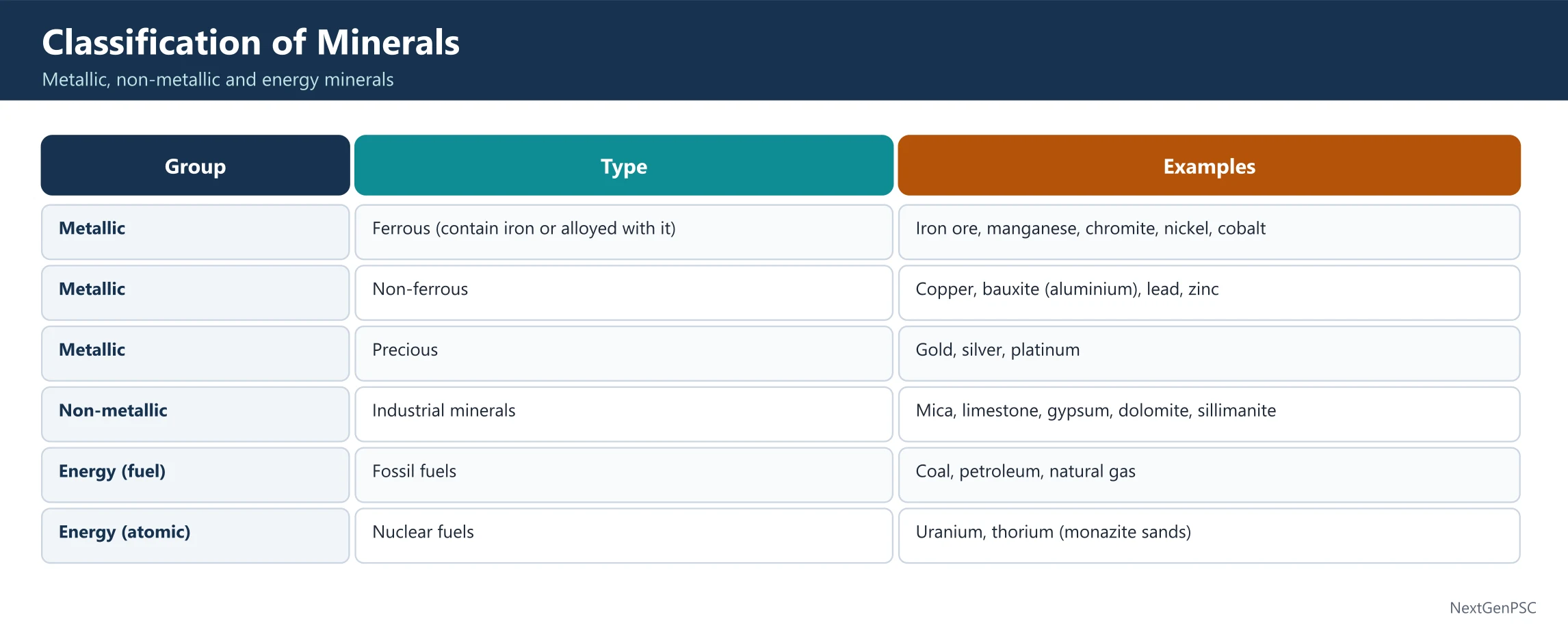
Types of Minerals
Metallic Minerals: Iron ore, copper, bauxite, manganese, zinc, lead, etc.
Non-Metallic Minerals: Mica, limestone, gypsum, salt, phosphorite, etc.
Energy Minerals: Coal, petroleum, natural gas, uranium, thorium, lignite.
Distribution of Mineral Resources in India
1. Northwestern Plateau Region
Associated with Dharwar system of rocks; stretches from Aravallis (Rajasthan) to parts of Gujarat.
Major Minerals: Copper, zinc.
Rajasthan: Sandstone, granite, marble, gypsum, salt.
Gujarat: Oil, natural gas, salt reserves.
2. South-Western Plateau Region
Covers Karnataka, Goa, parts of Tamil Nadu & Kerala.
Minerals: Bauxite, high-grade iron ore, manganese, limestone.
Neyveli (Tamil Nadu): Lignite deposits.
Kerala: Monazite, thorium (radioactive minerals).
Goa: Rich in iron ore deposits.
3. North-Eastern Plateau Region
Includes Odisha Plateau, West Bengal, Jharkhand (Chhotanagpur), parts of Chhattisgarh.
Minerals: Coal, iron ore, bauxite, manganese, mica.
Other Areas/Regions
Himalayan Belt (Eastern & Western): Copper, lead, zinc, cobalt, tungsten.
Assam Valley: Oil deposits.
Mumbai High (offshore): Major oil resources.
| Region | Minerals Found |
|---|---|
| Northwestern Plateau (Rajasthan, Gujarat) | Copper, Zinc, Sandstone, Granite, Marble, Gypsum, Oil, Gas, Salt |
| South-Western Plateau (Karnataka, Goa, TN, Kerala) | Bauxite, Iron ore, Manganese, Limestone, Lignite (Neyveli), Monazite, Thorium |
| North-Eastern Plateau (Odisha, Jharkhand, WB, Chhattisgarh) | Coal, Iron ore, Bauxite, Manganese, Mica |
| Himalayan Belt | Copper, Lead, Zinc, Cobalt, Tungsten |
| Assam Valley | Oil |
| Mumbai High (Offshore) | Oil and Natural Gas |
Prelims tips
- Dharwar system → Copper & Zinc in Rajasthan & Gujarat.
- Neyveli (Tamil Nadu) → Lignite.
- Kerala → Monazite & Thorium deposits.
- Chhotanagpur plateau → Coal, Iron ore, Bauxite, Manganese, Mica.
- Mumbai High → Offshore oil & gas.
Mains points
- India’s mineral resources are unevenly distributed, concentrated in peninsular plateaus and Himalayan belts.
- Chhotanagpur Plateau is the richest mineral belt of India (coal, iron ore, bauxite, mica).
- Rajasthan & Gujarat dominate in building materials and petroleum resources.
- Strategic minerals like thorium in Kerala and oil in Mumbai High are critical for energy security.
- Sustainable mining and environmental safeguards are crucial to balance resource extraction with ecological protection.
Ferrous Metallic Minerals – Iron Ore in India
Iron ore is the most important ferrous mineral, primarily used for steel production (98%). India is rich in iron ore deposits, with Odisha being the largest producer, followed by Jharkhand, Chhattisgarh, Karnataka, Maharashtra, Telangana, and Andhra Pradesh.
Types of Iron Ore
Magnetite: >70% metallic iron; black; magnetic properties; most valuable type.
Hematite: 65–70% metallic iron; red-brown in color; major commercial ore.
Siderite: 40–50% metallic iron; brown; contains iron & carbon; more impurities.
Limonite: <50% metallic iron; yellow; impure; low-grade ore.
Characteristics
Colors vary: rusty red, deep purple, yellow, dark grey.
Generally rich in iron oxides.
Major industrial importance for steelmaking.
Uses of Iron Ore
Steel Production: ~98% of iron ore is used for making steel.
Other Uses:
- Powdered iron in auto parts, catalysts, certain steels.
- Radioactive iron for medicine.
- Iron compounds used in paints, inks, cosmetics, and plastics.
Distribution of Iron Ore in India
Odisha: Largest producer; Sundergarh, Mayurbhanj, Kendujhar. Major mines: Gurumahisani, Sulaipet, Badampahar, Kiruburu, Bonai.
Jharkhand: Noamundi, Gua in Singhbhum districts.
Chhattisgarh: Durg, Dantewada, Bailadila, Dalli-Rajhara mines.
Karnataka: Ballari, Baba Budan Hills, Kudremukh (Chikmagalur), Shivamogga, Chitradurga, Tumakuru.
Maharashtra: Chandrapur, Bhandara, Ratnagiri.
Telangana: Karimnagar, Warangal.
Andhra Pradesh: Kurnool, Cuddapah, Anantapur.
| Type | Iron Content | Color | Properties |
|---|---|---|---|
| Magnetite | >70% | Black | Magnetic, most valuable |
| Hematite | 65–70% | Red-brown | Major commercial ore |
| Siderite | 40–50% | Brown | Contains carbon; impure |
| Limonite | <50% | Yellow | Low-grade; impure |
Prelims tips
- Magnetite has >70% iron; most valuable, magnetic properties.
- Hematite is India’s most important iron ore (65–70% Fe).
- Odisha is the largest producer of iron ore in India.
- Major mines: Bailadila (Chhattisgarh), Kudremukh (Karnataka), Noamundi (Jharkhand).
Mains points
- Iron ore is the backbone of the steel industry, contributing to industrial growth and infrastructure.
- Odisha and Chhattisgarh form the core of India’s iron ore belt.
- Export of iron ore is a significant contributor to India’s trade, though restricted at times for domestic demand.
- Illegal mining, environmental damage, and displacement of tribal communities are key challenges.
- Policy focus is on sustainable mining, beneficiation, and value addition to reduce dependence on imports of finished steel.
Manganese and Copper – Distribution and Uses in India
Manganese is a vital ferroalloy metal used in steelmaking, batteries, and chemicals, while Copper is a key non-ferrous metal widely used in electrical works, alloys, and industry. India is a major producer of both, with Madhya Pradesh leading in manganese and copper production.
Manganese
Characteristics: Hard, heavy, silvery metal; exploited from ores like Pyrolusite and Psilomelane, and also from nodules on the deep seafloor.
Uses:
- Steel contains ~1% manganese, improving strength, workability, and resistance (railway tracks, safes, rifle barrels, prison bars).
- Used as an oxidizer in chemical industries for disinfectants and chemicals.
- Used in making electric batteries, paints, and plastics.
Largest Producer (World): China.
Distribution in India:
- Madhya Pradesh (Largest): Balaghat, Chhindwara, Nimar, Mandla, Jhabua.
- Maharashtra: Nagpur, Bhandara, Ratnagiri.
- Odisha: Bonai, Kendujhar, Sundergarh, Gangpur, Koraput, Kalahandi, Bolangir.
- Karnataka: Dharwar, Ballari, Belagavi, North Canara, Chikkmagaluru, Shivamogga, Chitradurga, Tumakuru.
- Others: Telangana, Goa, Jharkhand (minor producers).
Copper
Characteristics: Soft, brown non-ferrous metal; found in igneous and metamorphic rocks.
Primary Ores: Chalcopyrite, copper sulfide, basic carbonates.
Extraction: Gold, silver, lead, zinc are also extracted as by-products.
Uses:
- Good conductor of heat & electricity → wires, transformers, generators, electronics.
- High malleability → metallurgical industry (cables, fittings, auto parts).
- Alloy making:
- With Tin → Bronze.
- With Zinc → Brass.
- With Nickel → Monel metal.
- With Gold → Guinea gold.
- With Aluminium → Duralumin.
Largest Producer (World): Chile.
Distribution in India:
- Madhya Pradesh (Largest): Balaghat.
- Rajasthan: Jhunjhunu, Alwar.
- Jharkhand: Singhbhum.
| Mineral | Characteristics | Uses | Largest Producer (India) | Major States |
|---|---|---|---|---|
| Manganese | Hard, silvery; ores: Pyrolusite, Psilomelane | Steel, chemicals, batteries, paints, plastics | Madhya Pradesh | MP, Maharashtra, Odisha, Karnataka, Telangana, Goa, Jharkhand |
| Copper | Soft, brown, non-ferrous | Electrical works, alloys, auto parts | Madhya Pradesh | MP, Rajasthan, Jharkhand |
Prelims tips
- Manganese: Essential ferroalloy metal; improves steel strength.
- India’s largest manganese producer: Madhya Pradesh (Balaghat).
- Copper: Key non-ferrous metal; used in electrical industry.
- India’s copper production: MP (Balaghat), Rajasthan (Jhunjhunu, Alwar), Jharkhand (Singhbhum).
Mains points
- Manganese is indispensable in steelmaking and allied industries; India ranks among top global producers.
- Copper is vital for electrical and electronic industries; alloy production adds industrial value.
- Mining belts: MP-Odisha belt is central for both manganese and copper production.
- Challenges: Over-extraction, environmental impact, depletion of high-grade ores.
- Policy focus: Sustainable mining, technological upgradation, and reducing import dependence on refined copper.
Bauxite and Gold – Distribution and Uses in India
Bauxite is the principal ore of aluminium, used in industries from aircraft to packaging, while Gold is a precious metal valued for jewelry, reserves, and industrial uses. Odisha leads in bauxite production and Karnataka is the largest gold producer in India.
Bauxite
Characteristics: Principal ore of aluminium; alumina is extracted from bauxite, then aluminium is produced from alumina. Aluminium is malleable, light, corrosion-resistant, and a good conductor of electricity.
Uses:
- Aircraft, automobiles, ships, rail wagons, and machinery manufacturing.
- Domestic appliances, utensils, doors, windows, screens.
- Aluminium foils for packaging food.
Largest Producer (World): Australia.
Distribution in India:
- Odisha (Largest): Kalahandi, Koraput, Sundargarh, Bolangir, Sambalpur.
- Gujarat: Bhavnagar, Jamnagar.
- Jharkhand: Ranchi, Lohardaga, Palamu, Gumla.
- Maharashtra: Kolhapur.
- Chhattisgarh: Maikala range (Bilaspur, Durg), Amarkantak plateau (Surguja, Raigarh, Bilaspur).
- Tamil Nadu: Nilgiri, Salem.
- Madhya Pradesh: Katni, Jabalpur, Balaghat.
Gold
Characteristics: Lustrous yellow metal; highly malleable and ductile; good conductor of heat and electricity; found in relatively pure form.
Uses:
- International reserve asset (monetary value).
- Jewelry and ornaments.
- Dental fillings.
- Industrial applications: electronics, computers, communications equipment, jet engines, spacecraft.
Largest Producer (World): China.
Distribution in India:
- Karnataka (Largest): Hutti Gold Mine, Raichur district; Kolar Gold Fields (now defunct).
- Andhra Pradesh: Anantapur district (Ramgiri field).
- Jharkhand: Subarnarekha, Sonanadi rivers.
- Kerala: Punnapuzha, Chaliyar Puzha placers.
| Mineral | Characteristics | Uses | Largest Producer (India) | Major States |
|---|---|---|---|---|
| Bauxite | Principal ore of aluminium; light, malleable | Aircraft, utensils, foils, construction | Odisha | Odisha, Gujarat, Jharkhand, Maharashtra, Chhattisgarh, TN, MP |
| Gold | Lustrous yellow, ductile, pure form | Jewelry, reserves, electronics, dentistry | Karnataka | Karnataka, AP, Jharkhand, Kerala |
Prelims tips
- Bauxite → principal ore of aluminium; Odisha largest producer in India.
- Aluminium foils and aircraft industry are major uses.
- Gold → Karnataka (Hutti mines) is India’s top producer.
- Kolar Gold Fields are historic but now defunct.
Mains points
- Bauxite is critical for aluminium industry, a lightweight metal with vast industrial uses.
- India’s deposits concentrated in Odisha, Gujarat, Jharkhand, MP, Maharashtra.
- Gold has cultural and economic importance, with applications in jewelry and electronics.
- India’s gold reserves are limited, causing import dependence.
- Policy challenge: Boost exploration, reduce import bill, and encourage recycling of aluminium and gold.
Diamond and Silver – Precious Resources in India
Diamonds, the hardest naturally occurring substances, serve both ornamental and industrial purposes, while Silver is a versatile precious metal crucial for ornaments, mirrors, electronics, batteries, and cloud seeding. India’s key diamond deposits are in Panna (Madhya Pradesh), while Rajasthan leads in silver production.
Diamond
Characteristics:
- Hardest natural substance (10 on Mohs hardness scale).
- Made of carbon crystals (~99.95% carbon).
- Transparent to translucent with high refractive index (brilliance).
- Formed at high pressure and temperature, usually deep within Earth’s mantle.
Types:
- Gem-quality diamonds (clear, transparent, for jewelry).
- Industrial diamonds (used in tools, abrasives).
- Synthetic diamonds (man-made, used in industries like semiconductors).
Uses:
- Jewelry and ornaments (gem trade accounts for ~30% of mined diamonds).
- Industrial applications: cutting, drilling, polishing, as abrasives.
- Automobiles and aerospace: ~1.5 carats of industrial diamonds per high-tech vehicle.
- Electronics: Heat sinks, semiconductor devices.
Largest Producer (World): Russia (Aikhal, Udachny mines). Botswana and Canada are also major producers.
Distribution in India:
- Madhya Pradesh: Panna belt (famous diamond mines).
- Chhattisgarh: Raipur district.
- Andhra Pradesh: Kurnool and Anantapur districts.
- Exploration: Geological Survey of India (GSI) is exploring newer kimberlite pipes in MP and Karnataka.
Silver
Characteristics:
- Almost white, glossy, soft, highly ductile, and malleable.
- Excellent conductor of heat and electricity (better than copper).
- Found as native silver or in ores like argentite and chlorargyrite.
Uses:
- Ornaments, silverware, jewelry.
- Mirrors (best reflector of visible light).
- Electronics: printed circuit boards, conductors, switches.
- Medicine: Silver compounds used as disinfectants and in wound healing.
- Photography: Once a major use (silver nitrate films).
- Silver iodide used in weather modification (cloud seeding).
- Energy sector: Solar panels use silver paste in photovoltaic cells.
Largest Producer (World): Mexico (others: Peru, China, Russia).
Distribution in India:
- Rajasthan (Largest): Zawar mines in Udaipur.
- Jharkhand: Dhanbad district.
- Andhra Pradesh: Vizag region.
- By-product: Silver is often obtained as a by-product in lead, zinc, copper, and gold mining.
- India imports a large share of silver for electronics and solar industries.
| Mineral | Characteristics | Uses | Largest Producer (India) | Major States |
|---|---|---|---|---|
| Diamond | Hardest natural substance; 99.95% carbon; high brilliance | Jewelry, tools, abrasives, automobiles, semiconductors | Madhya Pradesh | MP (Panna), Chhattisgarh (Raipur), AP (Kurnool, Anantapur) |
| Silver | White, soft, ductile; excellent conductor; argentite ore | Jewelry, mirrors, electronics, batteries, solar panels | Rajasthan | Rajasthan (Udaipur), Jharkhand (Dhanbad), Andhra Pradesh (Vizag) |
Prelims tips
- Diamond hardness = 10 on Mohs scale.
- India’s only significant diamond mines are in Panna (MP).
- Silver is often obtained as a by-product of lead, zinc, and copper mining.
- Rajasthan (Zawar mines) leads silver production in India.
- Silver is vital for solar panel manufacturing.
Mains points
- Diamonds are both a luxury commodity (jewelry) and an industrial necessity (cutting, drilling, semiconductors).
- India’s diamond trade is heavily reliant on imports, but domestic Panna mines hold cultural and economic value.
- Silver plays dual roles: traditional (jewelry, utensils) and modern (electronics, solar panels, cloud seeding).
- India is a major consumer of silver due to its cultural traditions (festivals, ornaments) and industrial demand.
- Challenges: depletion of reserves, environmental concerns, need for new exploration and sustainable extraction.
Non-Metallic Minerals of India
Non-metallic minerals are essential for construction, fertilizer, ceramic, chemical, electrical, and refractory industries. India is rich in mica, limestone, gypsum, dolomite, graphite, kaolin, and other minerals spread across peninsular and Himalayan states.
Overview
Non-metallic minerals do not yield metals but are vital for industrial use.
Used in industries such as fertilizers, cement, refractories, ceramics, and electronics.
India has a wide distribution of non-metallic minerals across peninsular India, Himalayas, and desert regions.
Key Minerals
Mica: Transparent, heat and electricity non-conductor. Used in electrical/electronic industry. Major states: Andhra Pradesh (largest), Rajasthan, Karnataka.
Limestone: CaCO3 rock, used in cement, steel, construction. Found in MP, Rajasthan, AP, Gujarat, Chhattisgarh.
Dolomite: CaMg(CO3)2, used in cement, steel, fertilizers. Found in Odisha, Chhattisgarh, AP, Jharkhand, Rajasthan.
Asbestos: Fibrous, resistant to heat/acid. Used in fire-proofing, insulation. Found in AP, Rajasthan, TN, Karnataka.
Magnesite: MgCO3, used in refractories, fertilizers, chemicals. Found in TN (Salem), Rajasthan, Uttarakhand.
Kyanite: High-pressure mineral, used in refractories/ceramics. Found in Jharkhand, MP, WB, Maharashtra, Rajasthan.
Sillimanite: Al2SiO5 mineral, used in refractories and ceramics. Found in Odisha, Kerala, Assam, TN.
Graphite: Black, good conductor, used in electrodes, lubricants, nuclear industry. Found in Odisha, TN, AP, J&K.
Apatite & Rock Phosphate: Phosphate minerals, used in fertilizers. Found in MP, Jharkhand, Rajasthan, UP.
Gypsum: CaSO4·2H2O, used in plaster, cement, fertilizers. Found in Rajasthan (99%), J&K, Gujarat.
Potash: K-salts, essential for fertilizers. Found in MP (Sidhi), UP (Sonbhadra), Bihar (Kaimur), Rajasthan.
Kaolin: White clay (Al2Si2O5(OH)4), used in paper, ceramics, cosmetics. Found in Kerala, Rajasthan.
Perlite: Volcanic glass, used in construction/insulation. Found only in Gujarat (Patanav).
Wollastonite: CaSiO3, used in ceramics, paints, plastics. Found in Rajasthan (Pali, Udaipur), Tamil Nadu.
| Mineral | Chemical/Property | Uses | Major States |
|---|---|---|---|
| Mica | Silicate, elastic sheets | Electronics, insulation | AP, Rajasthan, Karnataka |
| Limestone | CaCO3 | Cement, steel, construction | MP, Rajasthan, Gujarat |
| Dolomite | CaMg(CO3)2 | Cement, flux, fertilizers | Odisha, Chhattisgarh |
| Asbestos | Fibrous silicate | Insulation, fire-proofing | AP, Rajasthan, TN |
| Magnesite | MgCO3 | Refractories, fertilizers | TN, Rajasthan, Uttarakhand |
| Kyanite | Al2SiO5 | Refractories, ceramics | Jharkhand, MP, WB |
| Sillimanite | Al2SiO5 | Refractories, cement | Odisha, Kerala |
| Graphite | Carbon (hexagonal) | Electrodes, lubricants, nuclear | Odisha, TN |
| Apatite/Phosphate | Ca5(PO4)3F/Cl | Fertilizers | MP, Jharkhand, Rajasthan |
| Gypsum | CaSO4·2H2O | Fertilizers, cement, plaster | Rajasthan, J&K |
| Potash | K-salts | Fertilizers | MP, UP, Bihar, Rajasthan |
| Kaolin | Al2Si2O5(OH)4 | Paper, ceramics, cosmetics | Kerala, Rajasthan |
| Perlite | Volcanic glass | Construction, insulation | Gujarat |
| Wollastonite | CaSiO3 | Ceramics, paints, plastics | Rajasthan, TN |
Prelims tips
- Andhra Pradesh is the largest mica producer in India.
- Rajasthan contributes 99% of gypsum production.
- Tamil Nadu (Salem) is famous for magnesite.
- Gujarat is the only state with perlite reserves.
- Odisha is a major graphite producer.
Mains points
- Non-metallic minerals form the backbone of construction, fertilizers, and electronics industries.
- India’s limestone and gypsum support a large cement industry.
- Mica exports have been historically significant for India.
- Challenges: environmental issues, health hazards (asbestos), and resource mismanagement.
- Future potential in sustainable mining and value addition through processing.
Atomic Minerals in India
Atomic minerals like Uranium, Thorium, Beryllium, and Lithium are vital for nuclear energy, defense, and high-tech industries. India possesses rich reserves of thorium along coastal sands and significant uranium deposits in Jharkhand, Chhattisgarh, and Andhra Pradesh.
Overview
Atomic minerals are used in nuclear power generation, defense applications, and advanced technologies.
India has abundant thorium reserves but limited uranium reserves, shaping its nuclear policy and energy mix.
Key Atomic Minerals
Uranium: First discovered in Jaduguda (Jharkhand, 1951). Other deposits in Chhattisgarh, Madhya Pradesh, and copper mines of Udaipur (Rajasthan). Key fuel for nuclear reactors.
Thorium: Derived from monazite sands containing ~10% thoria. Found in Kerala, Tamil Nadu, Odisha, Andhra Pradesh, Jharkhand, and Bihar. India has one of the world’s largest thorium reserves.
Beryllium: Extracted from beryl ore; used as a moderator in nuclear reactors. Deposits in Andhra Pradesh, Rajasthan, and Bihar.
Lithium: Found in minerals like lepidolite and spodumene. Lepidolite occurs in mica belts of Jharkhand, MP, Rajasthan, and Chhattisgarh. Critical for batteries and electric vehicles.
| Mineral | Key Uses | Major Deposits in India |
|---|---|---|
| Uranium | Fuel for nuclear reactors | Jharkhand (Jaduguda), Chhattisgarh, MP, Rajasthan (Udaipur) |
| Thorium | Thorium-based nuclear reactors (future fuel) | Kerala, Tamil Nadu, Odisha, AP, Jharkhand, Bihar |
| Beryllium | Moderator in nuclear reactors | Andhra Pradesh, Rajasthan, Bihar |
| Lithium | Batteries, EVs, electronics | Jharkhand, MP, Rajasthan, Chhattisgarh |
Prelims tips
- Jaduguda (Jharkhand) – first uranium deposit discovered in India (1951).
- India has one of the world’s largest thorium reserves, mainly in monazite sands of Kerala.
- Beryllium is used as a moderator in nuclear reactors.
- Lithium is found in lepidolite and spodumene, critical for EV batteries.
- Atomic minerals such as monazite (Kerala beach sands) are 'prescribed substances' under the Atomic Energy Act, 1962; their mining is reserved for government entities such as IREL.
Mains points
- India’s nuclear policy emphasizes thorium due to limited uranium reserves and abundant thorium sands.
- Uranium mining at Jaduguda is crucial for India’s atomic energy program.
- Thorium is expected to be the backbone of India’s future nuclear reactors (Stage-III of nuclear program).
- Lithium exploration is gaining momentum due to rising EV demand.
- Strategic importance of atomic minerals in defense and high-tech industries.
Rare Earth Elements (REEs)
Rare Earth Elements (REEs) are a group of 17 elements critical for electronics, defense, renewable energy, and advanced technologies. While China dominates global supply, India has rich reserves in beach sand minerals such as monazite and ilmenite.
Overview
Defined by IUPAC as 17 elements in the periodic table with similar chemical properties.
These include the lanthanides plus scandium and yttrium.
Thulium and lutetium are the least abundant REEs, while cerium, yttrium, lanthanum, and neodymium are the most abundant.
Critical for clean energy, defense, aerospace, electronics, and medical applications.
Key REEs and Applications
Yttrium: Phosphors, ceramics, alloys.
Lanthanum: Batteries, petroleum refining catalysts.
Cerium: Autocatalysts, glass polishing, chemical catalysts.
Praseodymium: High-power magnets, pigments.
Neodymium: Permanent magnets used in EVs and wind turbines.
Promethium: Beta radiation source.
Samarium: High-temperature magnets.
Europium: Fluorescent lighting, phosphors.
Gadolinium: MRI contrast agent, nuclear reactor rods.
Terbium: Lighting phosphors, magnets.
Dysprosium: High-power magnets, lasers.
Holmium: Strongest known magnets.
Erbium: Lasers, glass coloring.
Thulium: Magnetic ceramics under development.
Ytterbium: Fibre optics, solar panels.
Lutetium: PET scanners.
Trade and Production
China controls ~90% of global REE production and holds one-third of reserves.
India: Major rare earths found in beach sand minerals (BSM) – ilmenite, sillimanite, garnet, zircon, monazite, rutile.
Indian Rare Earths Ltd. (IREL, Dept. of Atomic Energy) and Kerala Minerals and Metals Ltd. (KMML) are key producers.
| Element | Applications |
|---|---|
| Yttrium | Phosphors, ceramics, alloys |
| Lanthanum | Batteries, catalysts |
| Cerium | Autocatalysts, glass polishing |
| Praseodymium | Magnets, pigments |
| Neodymium | Magnets (EVs, wind turbines) |
| Promethium | Radiation source |
| Samarium | High-temp magnets |
| Europium | Fluorescent lighting |
| Gadolinium | MRI, nuclear rods |
| Terbium | Lighting, magnets |
| Dysprosium | Magnets, lasers |
| Holmium | Strongest magnets |
| Erbium | Lasers, glass colorant |
| Thulium | Magnetic ceramics |
| Ytterbium | Fibre optics, solar panels |
| Lutetium | PET scanners |
Prelims tips
- REEs include 17 elements (lanthanides + Scandium + Yttrium).
- India’s REEs are mainly found in beach sand minerals (monazite, ilmenite).
- China dominates global REE trade (~90% supply).
- Neodymium and Dysprosium are vital for EV and wind turbine magnets.
Mains points
- REEs are strategic minerals for clean energy (wind, solar), EV batteries, and defense applications.
- India’s beach sand minerals provide significant potential for self-reliance in REEs.
- China’s dominance in REE market poses supply chain vulnerabilities.
- Indian Rare Earths Ltd. (IREL) and KMML play a key role in REE extraction and processing.
- REEs are central to Atmanirbhar Bharat’s vision in renewable energy and defense sectors.
Energy Resources in India
India’s energy resources are divided into conventional (coal, petroleum, natural gas, hydropower) and non-conventional (solar, wind, tidal, geothermal, biogas). Coal continues to dominate India’s energy mix, contributing around 44% of total energy consumption (2020).
Classification of Energy
Based on Source & Utilisation
Traditional / Non-commercial: Firewood, charcoal, cow-dung, agricultural waste.
Commercial: Oil, natural gas, hydroelectricity, nuclear, wind, solar.
Based on Nature
Conventional: Coal, petroleum, natural gas, hydropower.
Non-Conventional: Solar, wind, tidal, geothermal, biogas.
India’s Energy Mix (2020)
Coal: 44% of total energy consumption.
Petroleum & other liquids: 24%.
Biomass & waste: 21%.
Renewables: 1% (but growing).
Coal
An inflammable organic substance found in sedimentary rocks.
Composition: Hydrocarbons, volatile matter, moisture, ash.
Types of Coal
Anthracite: 80-95% carbon, best quality, hard, compact, deep black, semi-metallic luster.
Bituminous: 60-80% carbon, most widely used, dense, black, produces coke.
Lignite: 40-55% carbon, brownish-black, high moisture (>35%), burns with smoke.
Peat: <40% carbon, low heat, emits a lot of smoke, leaves much ash.
Distribution of Coal in India
Anthracite: Small quantity in Jammu & Kashmir.
Bituminous: Jharkhand, Odisha, West Bengal, Madhya Pradesh, Chhattisgarh.
Lignite: Neyveli (Tamil Nadu), Rajasthan, Lakhimpur (Assam), Karewas of J&K.
Peat: Found in Tamil Nadu and parts of North-East.
| Type | Carbon Content | Features | Distribution in India |
|---|---|---|---|
| Anthracite | 80-95% | Hard, compact, black, semi-metallic luster | Small deposits in J&K |
| Bituminous | 60-80% | Dense, black, most used, produces coke | Jharkhand, Odisha, West Bengal, MP, Chhattisgarh |
| Lignite | 40-55% | Brown-black, high moisture, smoky burning | Neyveli (TN), Rajasthan, Assam, J&K Karewas |
| Peat | <40% | Low heat, high smoke & ash | Tamil Nadu, North-East India |
Prelims tips
- Anthracite is the best quality coal with 80-95% carbon; found in small quantities in J&K.
- Bituminous coal is the most widely used coal in India.
- Lignite reserves are significant in Neyveli, Tamil Nadu.
- Coal contributes ~44% to India’s total energy consumption (2020).
Mains points
- Coal remains the backbone of India’s energy mix, though renewables are rising.
- Anthracite has highest calorific value but is rare in India.
- Bituminous coal drives thermal power generation and steel industries.
- Lignite supports industries like power generation in Tamil Nadu (Neyveli).
- India faces challenges of balancing coal dependence with climate goals.
Distribution of Coal in India
India is the second-largest coal producer after China. Around 75% of the country’s coal production comes from Chhattisgarh, Odisha, Jharkhand, and Madhya Pradesh. Coal reserves are mainly divided into Gondwana coal (older deposits) and Tertiary coal (younger deposits), along with significant lignite deposits in southern and western India.
Overview
India is the 2nd largest coal producer globally after China.
75% of total production is concentrated in four states: Chhattisgarh, Odisha, Jharkhand, Madhya Pradesh.
Coal deposits in India are classified as Gondwana coal (~98% of reserves), Tertiary coal (~2%), and Lignite.
Gondwana Coal
Chhattisgarh: Korba, Birampur, Hasdo Arand, Lakhanpur, Taptapani-Ramkota.
Jharkhand: Jharia (best metallurgical coal), Bokaro, Ramgarh, Rajmahal.
Odisha: Talcher (thermal power), Rampur-Himgir.
Madhya Pradesh: Singrauli, Umaria, Pench-Kanha-Tawa.
West Bengal: Raniganj (India’s first coal mine), Dalingkot.
Telangana & Andhra Pradesh: Singareni coalfield.
Tertiary Coal
Assam: Makum, Nazira.
Meghalaya: Garo-Khasi-Jaintia Hills.
Arunachal Pradesh: Namchik-Namrup.
Lignite
Tamil Nadu: Neyveli (90% of India’s lignite reserves).
Gujarat: Kutch district.
Rajasthan: Bikaner district.
| Type | States | Major Coalfields |
|---|---|---|
| Gondwana | Chhattisgarh | Korba, Birampur, Hasdo Arand, Lakhanpur, Taptapani-Ramkota |
| Gondwana | Jharkhand | Jharia, Bokaro, Ramgarh, Rajmahal |
| Gondwana | Odisha | Talcher, Rampur-Himgir |
| Gondwana | Madhya Pradesh | Singrauli, Umaria, Pench-Kanha-Tawa |
| Gondwana | West Bengal | Raniganj, Dalingkot |
| Gondwana | Telangana & Andhra Pradesh | Singareni |
| Tertiary | Assam | Makum, Nazira |
| Tertiary | Meghalaya | Garo-Khasi-Jaintia Hills |
| Tertiary | Arunachal Pradesh | Namchik-Namrup |
| Lignite | Tamil Nadu | Neyveli |
| Lignite | Gujarat | Kutch district |
| Lignite | Rajasthan | Bikaner district |
Prelims tips
- Jharia (Jharkhand) – best metallurgical coal field of India.
- Raniganj (West Bengal) – site of India’s first coal mine.
- Talcher (Odisha) – important for thermal power generation.
- Neyveli (Tamil Nadu) – holds 90% of India’s lignite reserves.
Mains points
- India’s coal production is concentrated in a few states, leading to regional dominance in energy supply.
- Gondwana coal accounts for about 98% of India’s total reserves.
- Jharia coalfield is crucial for India’s steel industry due to its metallurgical coal.
- Lignite reserves in Neyveli support Tamil Nadu’s thermal power plants.
- Tertiary coal is of lower quality but important in North-Eastern India.
Petroleum in India
Petroleum is an inflammable liquid composed of 90-95% hydrocarbons and 5% organic compounds. In India, petroleum occurs naturally as crude oil in onshore and offshore oilfields. Assam hosts the oldest oil field (Digboi), while Mumbai High remains the largest offshore field.
Overview
Petroleum is a flammable liquid composed mainly of hydrocarbons.
Occurs naturally as crude oil – a mix of solid, liquid, and gaseous hydrocarbons.
Widely used for fuel, petrochemicals, lubricants, fertilizers, plastics, and pharmaceuticals.
Composition
90-95% Hydrocarbons (alkanes, cycloalkanes, aromatics).
~5% organic compounds (oxygen, nitrogen, sulfur, organometallic compounds).
Distribution of Petroleum in India
Onshore Oilfields:
Assam: Digboi (oldest in India), Naharkatiya, Moran-Hugrijan.
Arunachal Pradesh: Manabhum field.
Rajasthan: Barmer district, Mangala field, Saraswati & Rajeshwari fields.
Gujarat: Ankleshwar, Lunej, Ahmedabad fields.
Offshore Oilfields:
Mumbai High (largest).
Bassein.
Aliabet.
Krishna-Godavari Basin.
Kaveri Delta.
| Region | Oilfields |
|---|---|
| Assam | Digboi, Naharkatiya, Moran-Hugrijan |
| Arunachal Pradesh | Manabhum |
| Rajasthan | Barmer, Mangala, Saraswati, Rajeshwari |
| Gujarat | Ankleshwar, Lunej, Ahmedabad |
| Offshore | Mumbai High, Bassein, Aliabet, Krishna-Godavari Basin, Kaveri Delta |
Prelims tips
- Digboi (Assam) – India’s oldest oilfield (discovered in 19th century).
- Mumbai High – largest offshore oilfield of India.
- Barmer (Rajasthan) – major onshore oil producer in western India.
- Krishna-Godavari basin – important offshore petroleum region on east coast.
Mains points
- India’s petroleum distribution includes both onshore and offshore reserves.
- Assam’s Digboi is historically significant as Asia’s first oilfield.
- Mumbai High continues to be the backbone of India’s offshore production.
- Barmer and Mangala in Rajasthan have boosted western India’s oil output.
- Krishna-Godavari Basin shows potential for natural gas and petroleum exploration.
Natural Gas in India
Natural gas is a fossil fuel mainly composed of methane, found both offshore and onshore in India. Offshore production accounts for more than two-thirds of India’s total gas output, while coal bed methane (CBM) is emerging as an alternative source.
Overview
Natural gas is a clean-burning fossil fuel primarily composed of methane (CH4).
It is used for electricity generation, as industrial fuel, in fertilizers, and as CNG for vehicles.
In 2018-19, India’s production was ~90.1 MMSCMD (Million Metric Standard Cubic Meters per Day).
Offshore accounts for more than 67% of production.
Distribution of Natural Gas in India
Offshore Production:
Cauvery Offshore
Khambhat Basin
South Bassein Gas field
Mumbai Offshore
Krishna-Godavari Offshore
Onshore Production:
Assam (largest onshore producer)
Rajasthan
Tripura
Tamil Nadu
Gujarat
Coal Bed Methane (CBM):
West Bengal – Raniganj coalfields
Jharkhand
Madhya Pradesh
| Type | Regions/Fields |
|---|---|
| Offshore | Cauvery Offshore, Khambhat Basin, South Bassein, Mumbai Offshore, Krishna-Godavari |
| Onshore | Assam, Rajasthan, Tripura, Tamil Nadu, Gujarat |
| Coal Bed Methane (CBM) | West Bengal (Raniganj), Jharkhand, Madhya Pradesh |
Prelims tips
- Assam is the largest onshore producer of natural gas in India.
- Mumbai High and South Bassein are major offshore natural gas producers.
- Krishna-Godavari basin is an important offshore hub for both petroleum and natural gas.
- Coal Bed Methane is primarily found in Raniganj (West Bengal), Jharkhand, and Madhya Pradesh.
Mains points
- Natural gas is a cleaner alternative to coal and petroleum for reducing carbon emissions.
- Offshore regions account for over two-thirds of India’s gas production, showing dependency on marine resources.
- Onshore regions like Assam and Tripura are crucial for local industrial growth.
- Coal Bed Methane (CBM) extraction provides an additional domestic gas resource, reducing import dependency.
- Krishna-Godavari basin is strategically important for India’s energy security.
Hydroelectricity in India
Hydroelectricity is a renewable energy source that generates electricity using the kinetic energy of flowing water. India’s hydropower potential is estimated at 145 GW, but as of March 2022, only 46.2 GW has been harnessed (~11.7% of total electricity generation).
Overview
Hydroelectricity relies on dams and water barriers to generate electricity from river flow.
It is renewable, clean, and reduces dependency on fossil fuels.
India has a total potential of 145 GW, but less than one-third has been developed.
Hydropower contributes about 11.7% of India’s total electricity generation.
Major Hydroelectric Projects in India
Nagarjunasagar Project (Andhra Pradesh & Telangana) – Krishna River – World’s largest masonry dam.
Srisailam Project (Andhra Pradesh & Telangana) – Krishna River.
Tehri Dam (Uttarakhand) – Bhagirathi River – highest dam in India.
Bhakra Nangal Project (Himachal Pradesh) – Satluj River.
Idukki Project (Kerala) – Periyar River.
Sardar Sarovar Project (Gujarat) – Narmada River.
ShivaSamudra Project (Karnataka) – Kaveri River.
Teesta Project (Sikkim) – Teesta River.
Koyna Project (Maharashtra) – Koyna River – largest hydel power project in India.
Salal Project (Jammu & Kashmir) – Chenab River.
Ranjit Singh Sagar Project (Punjab) – Ravi River.
Hirakud Dam (Odisha) – Mahanadi River – world’s longest earthen dam.
Indira Sagar Project (Madhya Pradesh) – Narmada River.
Rihand Project (Uttar Pradesh) – Rihand River.
Rana Pratap Sagar Project (Rajasthan) – Chambal River.
Mettur Dam (Tamil Nadu) – Kaveri River.
| State | Project | River |
|---|---|---|
| Andhra Pradesh & Telangana | Nagarjunasagar | Krishna |
| Andhra Pradesh & Telangana | Srisailam | Krishna |
| Uttarakhand | Tehri Dam | Bhagirathi |
| Himachal Pradesh | Bhakra Nangal | Satluj |
| Kerala | Idukki | Periyar |
| Gujarat | Sardar Sarovar | Narmada |
| Karnataka | ShivaSamudra | Kaveri |
| Sikkim | Teesta Project | Teesta |
| Maharashtra | Koyna Project | Koyna |
| Jammu & Kashmir | Salal Project | Chenab |
| Punjab | Ranjit Singh Sagar | Ravi |
| Odisha | Hirakud Dam | Mahanadi |
| Madhya Pradesh | Indira Sagar | Narmada |
| Uttar Pradesh | Rihand Project | Rihand |
| Rajasthan | Rana Pratap Sagar | Chambal |
| Tamil Nadu | Mettur Dam | Kaveri |
Prelims tips
- Tehri Dam in Uttarakhand is the highest dam in India.
- Nagarjunasagar is the world’s largest masonry dam.
- Hirakud Dam in Odisha is the longest earthen dam in the world.
- Koyna Hydroelectric Project in Maharashtra is the largest hydropower project in India.
Mains points
- Hydropower is renewable, clean, and reduces dependence on fossil fuels.
- India has large untapped potential (~145 GW), but current utilization is less than one-third.
- Large dams contribute to irrigation, flood control, and drinking water in addition to power generation.
- Social and environmental concerns include displacement, ecological disruption, and siltation of dams.
- Hydropower can play a crucial role in India’s energy transition towards net zero targets.
Non-Conventional Sources of Energy in India
India is investing in non-conventional energy sources like shale gas and nuclear power to diversify its energy mix. Shale gas reserves are identified in multiple sedimentary basins, while nuclear power contributes to clean electricity production with ongoing expansion projects.
Shale Gas
Definition: Natural gas trapped within shale formations.
India has 96 trillion cubic feet of technically recoverable shale gas.
Major shale gas basins in India: Cambay, Krishna–Godavari, Cauvery, Damodar Valley, Upper Assam, Pranahita–Godavari, Rajasthan, Vindhya.
Nuclear Energy
Energy released from atomic nucleus through fission (splitting) or fusion (joining).
Provides reliable, large-scale electricity with low greenhouse gas emissions.
India has several operating, planned, and under-construction nuclear power plants.
| Status | Plants |
|---|---|
| Operating | Kaiga (Karnataka), Narora (Uttar Pradesh), Kudankulam (Tamil Nadu), Kalpakkam (Tamil Nadu), Kakrapar (Gujarat), Rawatbhata (Rajasthan), Tarapur (Maharashtra) |
| Planned | Jaitapur (Maharashtra), Kovvada (Andhra Pradesh), Haripur (West Bengal), Gorakhpur (Haryana), Bhimpur (Madhya Pradesh), Mithi Virdi (Gujarat), Mahi Banswara (Rajasthan) |
| Under Construction | Kaiga (Karnataka), Chutka (Madhya Pradesh), Tarapur (Maharashtra), Kudankulam 3 & 4 (Tamil Nadu), Kalpakkam PFBR (Tamil Nadu), Kakrapar 3 & 4 (Gujarat), Rawatbhata (Rajasthan) |
Prelims tips
- Shale gas reserves in India are estimated at 96 trillion cubic feet.
- First uranium deposit in India was discovered at Jaduguda, Jharkhand (important for nuclear fuel).
- Jaitapur in Maharashtra will be the largest nuclear power plant in India once completed.
- Kudankulam Nuclear Plant (Tamil Nadu) is India’s largest operational nuclear power station.
Mains points
- Shale gas can reduce dependency on imported natural gas and strengthen India’s energy security.
- Nuclear energy is a low-carbon source and is crucial for India’s net zero goals by 2070.
- Challenges include safety concerns, waste disposal, and local opposition to nuclear plants.
- India’s nuclear expansion depends on domestic uranium availability and international collaborations.
- Non-conventional sources like shale gas and nuclear energy complement solar, wind, and hydropower in India’s energy mix.
Solar, Wind and Tidal Energy in India
India is rapidly scaling up non-conventional energy sources like solar, wind, and tidal energy to meet its renewable targets. Solar power leads the growth, followed by significant wind energy installations, while tidal energy remains in the R&D stage.
Solar Energy
Solar power converts sunlight into thermal or electrical energy.
Installed solar capacity: 53.997 GW (as of March 2022).
India targets 100 GW of solar capacity by March 2023 (40 GW rooftop + 60 GW ground-mounted).
Key States: Rajasthan (7737.95 MW), Karnataka (7469.01 MW), Gujarat (5708 MW), Tamil Nadu (4675 MW), Andhra Pradesh (4380 MW).
Part of India’s 450 GW renewable energy target for 2030.
Wind Energy
Wind energy is generated when naturally flowing air is harnessed for electricity.
Key States: Maharashtra, Gujarat, Tamil Nadu, Karnataka, Rajasthan, Andhra Pradesh, Madhya Pradesh.
India is one of the world’s top wind energy producers.
Tidal Energy
Tidal energy harnesses power from the rise and fall of tides.
Still under Research & Development stage in India, no large-scale commercial plants yet.
Potential areas: Gulf of Khambat, Gulf of Kutch, Palk Bay–Mannar Channel (Tamil Nadu), Hooghly River, South Haldia & Sunderbans (West Bengal).
| State | Installed Capacity (MW) |
|---|---|
| Rajasthan | 7737.95 MW |
| Karnataka | 7469.01 MW |
| Gujarat | 5708 MW |
| Tamil Nadu | 4675 MW |
| Andhra Pradesh | 4380 MW |
Prelims tips
- India’s solar capacity target: 100 GW by 2023 (40 GW rooftop + 60 GW ground-mounted).
- Rajasthan has the highest installed solar capacity in India.
- Seven states lead in wind power generation: Maharashtra, Gujarat, Tamil Nadu, Karnataka, Rajasthan, Andhra Pradesh, Madhya Pradesh.
- Tidal energy potential exists in Gulf of Khambat, Gulf of Kutch, and Sundarbans.
Mains points
- Solar power is India’s fastest growing renewable energy sector, crucial for reducing fossil fuel dependency.
- Wind energy complements solar by generating power during different seasonal cycles.
- Tidal energy, though not commercially operational, has potential in coastal areas for future diversification.
- Challenges include land acquisition, intermittency of renewables, and integration into the national grid.
- Government schemes like National Solar Mission and state-level incentives are boosting renewable adoption.
Biogas and Geothermal Energy in India
Biogas and geothermal energy are important non-conventional renewable energy sources in India. Biogas plants help manage organic waste while producing clean fuel, whereas geothermal energy harnesses Earth’s internal heat, with potential capacity estimated at 10 GW.
Biogas
Definition: Biogas is a mixture of methane, CO₂, and trace gases produced by anaerobic digestion of organic matter in oxygen-free environments.
Uses: Used as cooking fuel, for electricity generation, and as organic manure (slurry).
Distribution: India has over 5 million biogas plants.
Maharashtra leads with ~931,000 plants, followed by Karnataka (~513,000 plants).
Geothermal Energy
Definition: Geothermal energy is heat derived from reservoirs of hot water beneath the Earth’s surface.
Potential: Estimated 10 GW of geothermal power (MNRE, 2021).
Major Geothermal Provinces:
- Himalayas: Puga & Chhumathang (J&K), Manikaran & Beas Valley (HP), Satluj & Spiti Valley, Sikkim.
- Sohana: Haryana, Rajasthan.
- SONATA Belt: Madhya Pradesh, Chhattisgarh, Jharkhand (Tattapani).
- Cambay: Gujarat (Lasundra, Tuwa, Chhabsar) and parts of Rajasthan.
- Godavari Valley (Andhra Pradesh).
- Mahanadi Valley (Odisha, Taptapani Spring).
- Andaman-Nicobar Islands.
- Maharashtra: Salbardi, Unkeshwar, Konkan.
- Uttarakhand: Tapoban (Chamoli), Alaknanda Valley.
| Energy Type | Distribution/Key Areas |
|---|---|
| Biogas | Maharashtra (~931,000 plants), Karnataka (~513,000), Total ~5 million plants in India |
| Geothermal (Himalayas) | Puga, Chhumathang (J&K); Manikaran, Beas Valley (HP); Satluj, Spiti Valley, Sikkim |
| Geothermal (Sohana) | Haryana, Rajasthan |
| Geothermal (SONATA Belt) | MP, Chhattisgarh (Tattapani), Jharkhand |
| Geothermal (Cambay) | Gujarat (Lasundra, Tuwa, Chhabsar), Rajasthan |
| Geothermal (Others) | Andhra Pradesh (Godavari), Odisha (Mahanadi, Taptapani), Andaman-Nicobar, Maharashtra (Salbardi, Unkeshwar, Konkan), Uttarakhand (Tapoban, Alaknanda Valley) |
Prelims tips
- Maharashtra has the highest number of biogas plants (~931k).
- India has more than 5 million biogas plants overall.
- Geothermal potential in India is estimated at 10 GW.
- Puga Valley (J&K) and Manikaran (HP) are key geothermal sites.
Mains points
- Biogas reduces dependency on firewood and chemical fertilizers by providing renewable fuel and organic manure.
- India’s large agricultural base makes it highly suitable for biogas expansion.
- Geothermal energy is underdeveloped in India despite vast potential due to high initial costs and technological barriers.
- Key geothermal sites like Puga, Manikaran, and Tattapani highlight India’s diverse geothermal provinces.
- Both biogas and geothermal can complement solar and wind energy in India’s renewable energy strategy.
Industries in India – Manufacturing Sector
The manufacturing sector is the backbone of India’s industrial growth, contributing around 16–17% to GDP and generating large-scale employment. It boosts agriculture, trade, commerce, and innovation while absorbing surplus labor in labour-intensive industries.
Significance of Manufacturing Sector
1. Growth of the Economy: Contributes 16–17% to India’s GDP, has a multiplier effect, drives capital accumulation.
2. Agricultural Development: Supplies fertilizers, pesticides, irrigation equipment, ploughs, and modern tools to enhance productivity.
3. Employment Generation: Backbone of employment for ~12% of the labour force, especially through SMEs (Small and Medium Enterprises). The National Manufacturing Policy (2011) aimed at creating 100 million jobs by 2022.
4. Expansion of Trade & Commerce: Strong manufacturing sector ensures quality products for exports, attracts investment, fosters innovation, strengthens intellectual property rights, and builds robust infrastructure.
5. Growth in Labour-Intensive Industries: Textiles, wood, paper, and other industries absorb semi-skilled and unskilled workforce, reducing disguised unemployment.
6. Regional Development: Establishment of industries in backward areas helps reduce regional imbalances and promotes inclusive development.
7. Foreign Exchange Earnings: Export of manufactured goods like textiles, pharmaceuticals, IT hardware, and automobiles brings in foreign currency.
8. Innovation and Skill Development: Boosts R&D, enhances technological advancement, and promotes vocational skill training.
| Aspect | Details |
|---|---|
| GDP Contribution | 16–17% of GDP, multiplier effect on economy |
| Agriculture Support | Provides fertilizers, pesticides, modern farm tools |
| Employment | 12% labour force, SMEs backbone, target 100 million jobs |
| Trade & Commerce | Improves exports, attracts FDI, strengthens IPR |
| Labour Absorption | Textiles, paper, wood industries absorb surplus workforce |
| Regional Growth | Industries in backward areas reduce regional imbalance |
| Foreign Exchange | Exports of textiles, pharma, automobiles earn forex |
| Innovation & Skills | Boosts R&D, vocational training, and technology adoption |
Prelims tips
- Manufacturing contributes around 16–17% to India’s GDP.
- National Manufacturing Policy (2011) aimed to create 100 million jobs by 2022.
- SMEs (Small and Medium Enterprises) employ ~12% of India’s labour force.
- Labour-intensive industries: textiles, paper, wood industries.
Mains points
- Discuss how the manufacturing sector supports agricultural development and provides employment opportunities.
- Explain the role of SMEs and the National Manufacturing Policy in strengthening India’s industrial base.
- Evaluate the contribution of labour-intensive industries in reducing unemployment and fostering inclusive growth.
- Analyze challenges like infrastructure gaps, low R&D spending, and need for skill upgradation in manufacturing.
- Suggest measures to enhance manufacturing competitiveness under 'Make in India' and 'Atmanirbhar Bharat' initiatives.
Factors Affecting the Location of Industries
The location of industries is influenced by raw materials, power, climate, labour, market, transport, and finance. Special categories of industries like Footloose, Sunrise, and Weighloose industries depend on unique locational dynamics. Agro-based industries, like the cotton industry, rely heavily on raw material and climatic conditions.
Factors Affecting Industrial Location
1. Availability of Raw Materials: Proximity to raw materials reduces transportation costs; scale of deposits decides scale of production.
2. Power Resources & Water: Steady supply of electricity and water ensures smooth manufacturing processes.
3. Favourable Climate: Extremely hot, cold, or humid regions hinder industrial growth.
4. Labour: Availability of cheap, skilled, and semi-skilled labour fosters growth.
5. Market: Proximity to markets avoids high transportation costs and ensures quick sale of goods.
6. Transport Facilities: Efficient road, rail, and water transport improves raw material supply and finished goods distribution.
7. Finance: Capital availability at low-interest rates boosts industrial expansion.
Special Industry Types
- Footloose Industry: Not tied to location; can be set up anywhere (e.g., IT, electronics, software).
- Sunrise Industry: Newly emerging industries with high growth potential (e.g., food processing, petrochemicals, renewable energy).
- Weighloose Industry: Raw materials are heavy, but finished goods are light; located near raw material sources (e.g., sugar industry).
Agro-based Industry: Cotton Industry
- Cotton is spun into yarn or thread and woven into textiles.
- Locational Factors: Availability of raw cotton, market facilities, transport access, ports, cheap labour, skilled workers, and moist climate.
- Example regions: Maharashtra, Gujarat, Tamil Nadu, Punjab.
| Factor | Impact |
|---|---|
| Raw Materials | Proximity reduces transport costs, determines industry size |
| Power & Water | Ensures continuous production |
| Climate | Favourable climate encourages growth |
| Labour | Cheap, skilled workforce promotes expansion |
| Market | Nearby markets reduce costs and increase efficiency |
| Transport | Efficient transport improves connectivity |
| Finance | Cheap capital accelerates industrialization |
Prelims tips
- Footloose industries are location-independent (e.g., IT, software).
- Sunrise industries: new fast-growing industries (e.g., food processing, petrochemicals).
- Weighloose industries (e.g., sugar) are near raw materials because finished goods are lighter.
- Cotton textile industry needs raw cotton, moist climate, cheap labour, and markets.
Mains points
- Examine the factors influencing industrial location in India with examples.
- Discuss the importance of raw materials and power supply in industrial clustering.
- Analyze the role of climate and labour availability in agro-based industries like cotton textiles.
- Evaluate the significance of Footloose, Sunrise, and Weighloose industries in modern economy.
- Suggest measures for balanced regional industrial growth in India.
Cotton and Jute Industries in India
Cotton and jute are the two most important agro-based textile industries in India. Cotton textiles dominate with Maharashtra, Gujarat, and Tamil Nadu as leading centers, while jute is concentrated in West Bengal along the Hugli River basin, earning the name 'Golden Fibre Industry'.
Cotton Industry
Cotton is spun into yarn and textiles, forming the backbone of India's textile industry.
Locational Factors: Raw cotton availability, moist climate, cheap and skilled labour, transport, port access, and large markets.
Major Cotton Industry Regions:
- Maharashtra: Jalgaon, Kolhapur, Pune, Sangli, Sholapur, Nagpur (Mumbai is called 'Cottonpolis of India').
- Gujarat: Ahmedabad, Surat, Vadodara, Bharuch, Rajkot, Porbandar, Bhavnagar, Nadiad. (2nd largest producer of cotton yarn).
- Tamil Nadu: Coimbatore, Tirupur, Salem, Madurai, Pollachi, Chennai, Tuticorin, Tirunelveli (largest number of mills in India).
- Other states: Andhra Pradesh (Guntur, Vijayawada, Warangal), Karnataka (Bengaluru, Mysore, Belgaum), Uttar Pradesh (Kanpur, Agra, Meerut), Madhya Pradesh (Indore, Gwalior, Jabalpur), Rajasthan (Jaipur, Kota, Udaipur, Bhilwara), West Bengal (Kolkata, Howrah, Murshidabad).
Jute Industry
Jute is a long, shiny natural fibre, affordable next to cotton. Known as 'Golden Fibre'.
Locational Factors: Alluvial soil, standing water for retting, warm and wet monsoon climate, 20–40°C temperature, 70–80% humidity.
Distribution of Jute Industry:
- West Bengal: Hugli River Basin (dominant region).
- Andhra Pradesh: Guntur, Visakhapatnam, Ongle, Eburu.
- Bihar: Darbhanga, Samastipur, Gaya.
- Chhattisgarh: Raigarh.
- Odisha: Cuttack.
Case Study: Why West Bengal Leads in Jute
90% of India’s jute produced in Ganga-Brahmaputra delta.
Hugli River provides abundant water for retting, dyeing, washing, and cheap water transport.
Cheap labour from West Bengal, Bihar, Odisha, and Uttar Pradesh.
Raniganj coalfields supply energy.
Kolkata port aids imports of machinery and exports of finished jute goods.
Kolkata and hinterland provide a ready market.
| Industry | States | Key Centers |
|---|---|---|
| Cotton | Maharashtra | Mumbai, Pune, Nagpur, Kolhapur |
| Cotton | Gujarat | Ahmedabad, Surat, Vadodara, Rajkot |
| Cotton | Tamil Nadu | Coimbatore, Tirupur, Salem, Madurai |
| Cotton | Others | Kanpur (UP), Indore (MP), Jaipur (Rajasthan), Kolkata (WB) |
| Jute | West Bengal | Hugli Basin (Kolkata, Howrah, Serampore) |
| Jute | Andhra Pradesh | Guntur, Visakhapatnam |
| Jute | Bihar | Darbhanga, Samastipur |
| Jute | Chhattisgarh | Raigarh |
| Jute | Odisha | Cuttack |
Prelims tips
- Mumbai is known as 'Cottonpolis of India'.
- Tamil Nadu has the largest number of cotton mills.
- West Bengal dominates jute industry due to Hugli basin.
- Jute is called 'Golden Fibre'.
Mains points
- Discuss factors influencing the location of cotton textile industry in India.
- Examine why Mumbai is called the 'Cottonpolis of India'.
- Analyze reasons behind West Bengal’s dominance in the jute industry.
- Evaluate challenges faced by the jute industry due to competition from synthetic fibres.
- Suggest measures for modernization and global competitiveness of Indian textile industries.
Sugar Industry in India
The sugar industry is the second-largest agro-based industry in India after textiles. India is the world’s second-largest producer of sugar after Brazil. The industry is concentrated in Uttar Pradesh, Bihar, Maharashtra, Karnataka, and Tamil Nadu. Major by-products include bagasse, molasses, and press mud.
Locational Factors of Sugar Industry
Raw material: Sugarcane is highly perishable; hence mills are located near cane farms. It is a weight-losing industry.
Climate: Warm climate is suitable for sugarcane cultivation; southern and western India have an advantage of longer crushing season.
Soil: Black lava soil with good water retention supports sugarcane cultivation in western India.
Energy: Bagasse, a by-product, is used as fuel in sugar mills.
Distribution of Sugar Industry in India
Uttar Pradesh: Saharanpur, Bijnor, Meerut, Muzaffarnagar, Moradabad, Gorakhpur, Deoria, Gonda.
Bihar: Saran, Darbhanga, Muzaffarpur, Champaran.
Maharashtra: Pune, Satara, Sholapur, Kolhapur.
Punjab: Dhuri, Phagwara.
Karnataka: Shimoga, Mandya, Munirabad.
Tamil Nadu: Coimbatore, Pugulur, Nalikipuram, Pandyarajpur.
Andhra Pradesh: West & East Godavari, Visakhapatnam, Chittoor.
Telangana: Medak, Nizamabad.
Odisha: Rayagada, Bargarh.
Madhya Pradesh: Sihor.
Case Study: Uttar Pradesh & Bihar
Fertile alluvial soil rich in potash and lime supports sugarcane cultivation.
Level topography and irrigation facilities are favorable.
Abundant water for processing and washing.
Availability of cheap labour.
Densely populated nearby markets and better transport facilities ensure demand and distribution.
| State | Major Centers |
|---|---|
| Uttar Pradesh | Saharanpur, Meerut, Muzaffarnagar, Gorakhpur |
| Bihar | Saran, Darbhanga, Muzaffarpur, Champaran |
| Maharashtra | Pune, Satara, Sholapur, Kolhapur |
| Karnataka | Shimoga, Mandya, Munirabad |
| Tamil Nadu | Coimbatore, Pugulur, Nalikipuram |
| Andhra Pradesh | West & East Godavari, Visakhapatnam |
| Telangana | Medak, Nizamabad |
| Punjab | Dhuri, Phagwara |
| Odisha | Rayagada, Bargarh |
| Madhya Pradesh | Sihor |
Prelims tips
- India is the world’s second-largest producer of sugar after Brazil.
- Bagasse is used as fuel in sugar mills.
- Uttar Pradesh leads in sugar production due to fertile alluvial soil.
- Sugar industry is a weight-losing industry, located near raw material.
Mains points
- Examine factors influencing the location of sugar industry in India.
- Discuss the regional distribution of sugar industry and its shift from North India to South India.
- Analyze challenges faced by the Indian sugar industry like low productivity, water usage, and price fluctuations.
- Evaluate the significance of by-products of sugar industry in India’s economy.
Tea and Coffee Industry in India
India is the largest consumer of tea and one of the largest producers of both tea and coffee. Assam, West Bengal, Tamil Nadu, and Kerala account for about 95% of tea production, while Karnataka, Kerala, and Tamil Nadu together contribute nearly all of India’s coffee output.
Tea Industry in India
India is the largest consumer of tea, with nearly 75% of domestic production consumed locally.
Rainfall requirement: ~1500 mm annually.
Temperature: less than 15°C, tropical and subtropical climate is preferred.
Soil: Rich in humus, well-drained, deep, and fertile.
Warm, moist, and frost-free climate is ideal.
Distribution of Tea Industry
Assam: Darrang, Goalpara, Kamrup, Lakhimpur, Dibrugarh, Nowgong, Sibsagar, Cachar, Karbi Anglong, North Cachar.
West Bengal: Darjeeling, Terai (West Dinajpur), Dooars (Cooch Behar).
Tamil Nadu: Nilgiris, Kanyakumari, Madurai, Coimbatore, Tirunelveli.
Kerala: Idukki, Wayanad, Palghat, Kozhikode, Kottayam, Trivandrum, Quilon, Ernakulam.
Karnataka: Chikmagalur, Coorg, Hassan.
Largest tea area: Assam.
Coffee Industry in India
Coffee is the second most consumed beverage crop in India after tea.
India is the 6th largest coffee producer and 5th largest exporter globally, with ~80% exported.
Climatic requirements: Hot and humid climate, 15°C–25°C temperature, rainfall 150–250 cm.
Sensitive to frost, snowfall, strong sunlight, and dry winds.
Soil: Rich in humus, iron, and calcium.
Distribution of Coffee Industry
Karnataka: Kodagu, Chikmagalur, Shimoga, Hassan, Mysore (70% of total production, 60% area under coffee).
Kerala: Wayanad, Kozhikode, Malappuram, Kannur, Kollam, Palakkad (second largest producer).
Tamil Nadu: Nilgiris, Salem, Madurai, Tirunelveli, Coimbatore (third largest producer).
| State | Major Areas |
|---|---|
| Assam | Darrang, Lakhimpur, Dibrugarh, Cachar |
| West Bengal | Darjeeling, Terai, Dooars |
| Tamil Nadu | Nilgiris, Coimbatore, Madurai |
| Kerala | Idukki, Wayanad, Kozhikode |
| Karnataka | Chikmagalur, Coorg, Hassan |
| State | Major Areas |
|---|---|
| Karnataka | Kodagu, Chikmagalur, Hassan, Mysore |
| Kerala | Wayanad, Kozhikode, Malappuram, Palakkad |
| Tamil Nadu | Nilgiris, Salem, Madurai, Coimbatore |
Prelims tips
- India is the largest consumer and second largest producer of tea in the world.
- Assam has the largest area under tea cultivation in India.
- India is the 6th largest coffee producer and 5th largest exporter globally.
- Karnataka contributes ~70% of India’s coffee production.
Mains points
- Examine the locational factors of tea and coffee cultivation in India.
- Discuss the regional distribution of tea and coffee industries in India.
- Analyze the role of tea and coffee in India’s export economy.
- Evaluate the challenges faced by tea and coffee industries like climate sensitivity, labour issues, and global competition.
Food Processing Industry in India
Food processing refers to converting raw edible ingredients into consumable food items or adding value to existing foods. Its objectives are to enhance shelf-life, ensure food safety, and add economic value. Maharashtra is the leading state, while coastal states like Andhra Pradesh, Karnataka, Kerala, Gujarat, and West Bengal dominate the sector.
Overview
Food processing is one of the largest industries in India and contributes significantly to GDP and employment.
It involves direct food manufacturing or value addition such as packaging, preservation, flavoring, and fortification.
Enhances storage, shelf-life, and reduces wastage of agricultural produce.
Distribution
Concentrated in coastal states: Andhra Pradesh, Maharashtra, Karnataka, Kerala, Gujarat, and West Bengal.
Punjab and Uttar Pradesh are major inland hubs due to strong agricultural base.
Maharashtra is the leading state in food processing industries.
Significance
Reduces post-harvest losses and improves farmers’ income.
Generates large-scale employment, especially in rural areas.
Promotes exports of processed food items like marine products, fruits, vegetables, spices, and packaged foods.
Supports allied sectors such as cold storage, logistics, and packaging industries.
| State | Key Areas |
|---|---|
| Maharashtra | Mumbai, Pune, Nagpur, Nashik |
| Andhra Pradesh | Visakhapatnam, Guntur, Vijayawada |
| Karnataka | Bengaluru, Mangalore, Mysore |
| Kerala | Kochi, Kozhikode, Thrissur |
| Gujarat | Ahmedabad, Surat, Rajkot |
| West Bengal | Kolkata, Haldia, Malda |
| Punjab | Ludhiana, Amritsar, Jalandhar |
| Uttar Pradesh | Kanpur, Lucknow, Varanasi |
Prelims tips
- Maharashtra is the leading state in food processing industries.
- Punjab and Uttar Pradesh are the inland states with major food processing industries.
- Food processing helps reduce post-harvest losses and increases farmers’ income.
- Marine products and packaged foods are major export categories.
Mains points
- Examine the locational distribution of food processing industries in India.
- Discuss the role of food processing in doubling farmers’ income.
- Evaluate the challenges faced by food processing industries: infrastructure gaps, cold chain issues, and supply chain inefficiencies.
- Suggest measures to strengthen India’s food processing sector under ‘Make in India’ and ‘Atmanirbhar Bharat’ initiatives.
Forest-Based Industries: Paper Industry in India
The paper industry in India is a forest-based, weight-losing industry located near raw material sources like bamboo, wood pulp, and bagasse. West Bengal, Maharashtra, Andhra Pradesh, Madhya Pradesh, Karnataka, and Odisha are the major hubs.
Locational Factors
Paper industry is a weight-losing industry: raw material (bamboo, wood, bagasse) is heavier compared to the finished product.
To save transportation costs, industries locate close to raw material sources.
Availability of cheap labour and water are crucial factors.
Distribution
West Bengal: Titanagar, Kolkata, Kakinara, Naihatti.
Maharashtra: Mumbai, Pune, Ballarpur.
Andhra Pradesh: Rajahmundry.
Madhya Pradesh: Indore, Bhopal, Sehore.
Karnataka: Belagola, Shimoga.
Odisha: Several paper units.
West Bengal Case
Remains a major paper-producing state due to easy labour availability and bamboo supplies from Assam, Bihar, and Odisha.
Strong transport network and proximity to Kolkata port support exports.
Alternative Raw Material
Some industries, especially in Karnataka (Belagola, Shimoga), use bagasse (sugarcane residue) as raw material.
| State | Key Locations | Raw Material Source |
|---|---|---|
| West Bengal | Titanagar, Kolkata, Kakinara, Naihatti | Bamboo (Assam, Bihar, Odisha) |
| Maharashtra | Mumbai, Pune, Ballarpur | Wood pulp, Bamboo |
| Andhra Pradesh | Rajahmundry | Bamboo |
| Madhya Pradesh | Indore, Bhopal, Sehore | Wood, Bamboo |
| Karnataka | Belagola, Shimoga | Bagasse (sugarcane residue) |
| Odisha | Various small units | Bamboo, wood |
Prelims tips
- Paper industry is a weight-losing industry located near raw material sources.
- West Bengal is a leading paper producer due to bamboo supply and cheap labour.
- Belagola and Shimoga (Karnataka) paper mills use bagasse instead of bamboo.
Mains points
- Analyse the locational factors behind the distribution of paper industry in India.
- Discuss the importance of bamboo, wood pulp, and bagasse as raw materials in paper industry.
- Evaluate the role of West Bengal as a leading paper-producing state.
- Suggest sustainable alternatives to reduce deforestation in paper production.
Heavy Engineering Industries: Automobile Industry in India
The automobile industry in India is one of the largest in the world, driven by cheap skilled labour, low steel cost, and strong R&D. It is closely linked with the iron and steel industry for raw materials, and is concentrated in states like Maharashtra, Tamil Nadu, Haryana, Gujarat, and Karnataka.
Importance
Automobile sector contributes significantly to GDP and employment in India.
India is a leading producer of two-wheelers, cars, commercial vehicles, and tractors.
Major global automobile companies have manufacturing bases in India.
Locational Factors
Cheap and skilled labour availability.
Low cost of steel and aluminium inputs.
Strong R&D ecosystem and industrial clusters.
Proximity to ports and markets for exports.
Distribution in India
1. Andhra Pradesh: Penukonda, Sri City, Krishna district.
2. Gujarat: Sanand, Rajkot, Ahmedabad.
3. Haryana: Manesar, Bawal, Gurugram, Faridabad.
4. Himachal Pradesh: Amb, Nalagarh.
5. Jharkhand: Jamshedpur (Tata Motors hub).
6. Karnataka: Bengaluru, Bidadi, Mysuru, Dharwad.
7. Madhya Pradesh: Pithampur, Jabalpur, Mandideep, Dewas.
8. Maharashtra: Pune, Aurangabad, Nashik (auto capital of India).
9. Tamil Nadu (not listed above but important): Chennai, Hosur – called 'Detroit of India'.
| State | Key Locations | Special Notes |
|---|---|---|
| Andhra Pradesh | Penukonda, Sri City, Krishna | Emerging auto hub with global investments |
| Gujarat | Sanand, Rajkot, Ahmedabad | Major hub for Tata Nano, Maruti Suzuki, Ford |
| Haryana | Manesar, Bawal, Gurugram, Faridabad | Maruti Suzuki and Hero MotoCorp base |
| Jharkhand | Jamshedpur | Home to Tata Motors (trucks, commercial vehicles) |
| Karnataka | Bengaluru, Bidadi, Dharwad | Toyota, Bosch, and auto components hub |
| Madhya Pradesh | Pithampur, Jabalpur, Dewas | Commercial vehicle and tractor hub |
| Maharashtra | Pune, Aurangabad, Nashik | Known as India's automobile capital |
| Tamil Nadu | Chennai, Hosur | Detroit of India – Hyundai, Ford, Ashok Leyland |
| Himachal Pradesh | Nalagarh, Amb | Small automobile and component units |
Prelims tips
- Tamil Nadu (Chennai, Hosur) is known as 'Detroit of India'.
- Maharashtra (Pune, Nashik, Aurangabad) is India's automobile capital.
- Jamshedpur (Jharkhand) is famous for Tata Motors commercial vehicles.
- Haryana (Gurugram, Manesar) is Maruti Suzuki hub.
Mains points
- Discuss the locational factors behind the growth of automobile industry in India.
- Examine the role of Tamil Nadu and Maharashtra as major automobile hubs.
- Highlight the challenges faced by the Indian automobile sector (e.g., global competition, EV transition).
- Analyse the importance of automobile industry in India's industrialisation and exports.
Mineral Based Industries: Iron and Steel Industry
The iron and steel industry is the backbone of India's industrialisation. The first pig iron plant was set up in 1874 at Kulti, and TISCO was established in 1907 at Jamshedpur. Major steel plants include TISCO, IISCO, VISL, Rourkela, Bhilai, Durgapur, Bokaro, and Salem, each located strategically near raw material sources, power, water, labour, and transport.
Historical Background
First pig iron plant: Kulti, 1874.
TISCO (Tata Iron and Steel Company) set up in 1907 at Jamshedpur – India's oldest steel company.
IISCO (Indian Iron and Steel Company) was established in 1919 at Burnpur.
Importance
Provides basic raw material for industries and infrastructure.
Contributes significantly to GDP, exports, and employment.
India is the 2nd largest producer of crude steel globally (after China).
Major Plants and Locational Factors
TISCO (Jamshedpur, Jharkhand)
- Iron ore: Gurumahisani (Odisha), Noamundi (Singhbhum).
- Coal: Jharia (Jharkhand), Raniganj (West Bengal).
- Manganese: Joda mines (Odisha).
- Limestone: Sundergarh (Odisha).
- Water: Subernarekha River.
- Transport: NH-6 and Paradip port.
IISCO (Kulti-Burnpur, West Bengal)
- Iron ore: Pansiraburu, Gua (Jharkhand).
- Coal: Raniganj and Jharia.
- Limestone & Manganese: Gangapur (Odisha).
- Water: Damodar River, power from DVC.
- Transport: Kolkata port, Delhi-Kolkata highway.
VISL (Bhadravati, Karnataka)
- Iron ore: Kemangundi (Bababudan hills).
- Power: Sharavati and Mahatma Gandhi hydro projects.
- Limestone: Vandigudda.
- Manganese: Shimoga & Chitradurga.
- Water: Bhadra River.
Rourkela Steel Plant (Odisha)
- Iron ore: Mayurbhanj, Keonjhar, Barsuna, Bonai.
- Coal: Bokaro, Jharia, Talcher, Korba.
- Manganese: Biramitrapur (Sundergarh).
- Power: Hirakud Project.
- Water: Brahmani, Sankha & Koel Rivers.
- Transport: Kolkata–Mumbai railway line, Visakhapatnam port.
Bhilai Steel Plant (Chhattisgarh)
- Iron ore: Dalli-Rajhara.
- Coal: Jharia, Raniganj, Korba.
- Manganese: Balaghat (MP), Bhandara (Maharashtra).
- Limestone: Nandini mines.
- Power: Korba Thermal Plant.
- Water: Tandula canal.
Durgapur Steel Plant (West Bengal)
- Iron ore: Keonjhar (Odisha), Singhbhum (Jharkhand).
- Coal: Jharia, Raniganj.
- Manganese: Barbil & Bonai (Odisha).
- Water: Damodar River.
- Transport: Kolkata port, Kolkata-Mumbai railway line.
Bokaro Steel Plant (Jharkhand)
- Iron ore: Kiriburu, Noamundi, Gua.
- Coal: Jharia & Bokaro mines.
- Manganese: Hirri mines (Chhattisgarh).
- Limestone: Daltonganj, Latehar (Jharkhand).
- Water: Damodar & Bokaro rivers, Tenughat Dam.
Salem Steel Plant (Tamil Nadu)
- Iron ore: Salem mines.
- Coal: Neyveli lignite.
- Manganese: Tumkur (Karnataka).
- Power: Mettur Hydel Project (Cauvery).
- Water: Cauvery River.
- Transport: Road, rail, and Chennai port.
| Plant | State | Key Raw Material Sources | Special Notes |
|---|---|---|---|
| TISCO | Jharkhand | Iron ore (Odisha), Coal (Jharia), Limestone (Odisha) | Oldest private steel plant |
| IISCO | West Bengal | Iron ore (Jharkhand), Coal (Raniganj, Jharia) | Located near Damodar River |
| VISL | Karnataka | Iron ore (Kemangundi), Hydel power (Sharavati) | Hydro-based steel plant |
| Rourkela | Odisha | Iron ore (Keonjhar), Coal (Bokaro, Jharia) | First integrated public sector plant |
| Bhilai | Chhattisgarh | Iron ore (Dalli-Rajhara), Coal (Korba) | Soviet collaboration |
| Durgapur | West Bengal | Iron ore (Keonjhar, Singhbhum), Coal (Raniganj) | Located near DVC |
| Bokaro | Jharkhand | Iron ore (Kiriburu), Coal (Bokaro) | Public sector plant |
| Salem | Tamil Nadu | Iron ore (Salem), Coal (Neyveli) | Specialises in stainless steel |
Prelims tips
- First pig iron plant: Kulti (1874).
- TISCO Jamshedpur (1907) – oldest steel company in India.
- Rourkela – first public sector integrated steel plant (with German collaboration).
- Bhilai – Soviet collaboration, specialises in rails.
- Salem Steel Plant – known for stainless steel production.
Mains points
- Discuss the locational factors of major iron and steel plants in India.
- Examine the role of public and private sector in India's steel industry.
- Analyse the challenges faced by Indian steel industry (raw material supply, global competition, energy needs).
- Evaluate the contribution of steel sector in India's industrialisation and infrastructure development.
Mineral Based Industries: Cement Industry
India is the 2nd largest cement producer in the world, contributing over 7% of global installed capacity. Cement production capacity reached about 545 million tonnes in FY22. The industry is raw-material oriented and largely depends on limestone deposits.
Characteristics
Raw-material oriented industry: limestone is the chief raw material (60-65%).
About 1.5 tonnes of limestone is needed for 1 tonne of cement production.
Other raw materials: clay, gypsum, coal, and fly ash.
It is a weight-losing industry, hence plants are located near limestone deposits.
Importance
Vital for infrastructure development (roads, housing, dams, bridges).
India’s cement industry provides significant employment and contributes to GDP.
Plays a key role in the growth of construction and real estate sectors.
Distribution of Cement Industry
Tamil Nadu
- Durg, Shankar, Pulpur, Aaila, Dalmiapuram, Madurai, Alugang.
Madhya Pradesh
- Jamul, Satna, Ankle Tara, Banyor, Neemuch, Maihar, Kaisun, Gopal Nagar, Gwalior, Katni, Damoh.
Andhra Pradesh (including Telangana)
- Machraila, Mangalgiri, Panyam, Krishna, Vijayanagar, Tandur, Mancherial, Yerragutla, Bugnipali, Kistrina, Perampalli, Nalgonda, Hyderabad, Adilabad.
Rajasthan
- Lakheri, Udaipur, Nimbahera, Chittorgarh, Beawar.
Gujarat
- Sikka, Okhla Mandal, Ahmedabad, Porbandar, Dwarka, Ranavab.
Karnataka
- Bagalkot, Bari, Bhadravati, Bengaluru, Kurkanta, Shahbad, Aamsandra, Bijapur, Gulbarga, Tulkur.
Jharkhand
- Sindri, Khelari, Japla, Dalmia Nagar, Chaibasa, Banjari, Kalyanpur.
Uttar Pradesh
- Churk, Chopan, Chunar (major new producing districts).
| State | Major Centres |
|---|---|
| Tamil Nadu | Durg, Dalmiapuram, Madurai |
| Madhya Pradesh | Satna, Neemuch, Maihar, Katni |
| Andhra Pradesh & Telangana | Vijayanagar, Tandur, Mancherial, Nalgonda |
| Rajasthan | Chittorgarh, Beawar, Nimbahera, Lakheri |
| Gujarat | Ahmedabad, Sikka, Porbandar, Dwarka |
| Karnataka | Bagalkot, Gulbarga, Bhadravati, Bijapur |
| Jharkhand | Sindri, Japla, Chaibasa |
| Uttar Pradesh | Churk, Chopan, Chunar |
Prelims tips
- India is the 2nd largest cement producer globally after China.
- Limestone is the chief raw material (60-65%).
- Satna in Madhya Pradesh is known as the cement hub of India.
- Churk, Chopan, Chunar are new major producing centres in UP.
Mains points
- Examine the locational factors influencing the cement industry in India.
- Discuss the role of limestone deposits in the growth of cement plants.
- Analyse the regional distribution of cement plants and its relation with infrastructure development.
- Evaluate the importance of cement industry for housing and construction sector in India.
Chemical-Based Industries
India ranks 2nd in the world in production of nitrogenous fertilizers and 3rd in phosphatic fertilizers. The petrochemical industry, derived from petroleum, forms a major part of the organic chemical industry, producing plastics, synthetic fibers, rubber, and pharmaceuticals.
Fertilizer Industry
India is among the largest producers and consumers of fertilizers in the world.
Contributes to agricultural productivity and food security.
Types: Nitrogenous (urea, ammonium sulfate), Phosphatic (DAP, SSP), and Potassic fertilizers (import-dependent).
Distribution:
1. Gujarat & Maharashtra: Vadodara, Kalol, Ahmedabad, Kandla, Trombay.
2. Chotanagpur Plateau Region: Jamshedpur, Rourkela, Durgapur, Burnpur, Sindri, Bhilai, Vizag.
3. Tamil Nadu & Kerala: Coimbatore, Neyveli, Alwaye, Kochi, Tuticorin, Ennore.
4. Uttar Pradesh: Jagdishpur, Gorakhpur, Aonla, Shahjahanpur, Babrala.
5. North-West Region: Bhatinda, Nangal (Punjab), Panipat (Haryana), Delhi.
Petrochemical Industry
Petrochemicals are derived from petroleum during refining.
Products include synthetic rubber, plastics, synthetic fibers, detergents, pharmaceuticals, fertilizers, and insecticides.
Sub-groups: Polymers, Synthetic fibers, Elastomers, Surfactants, Olefins, and Aromatics.
Major Locations:
Uttar Pradesh: Auraiya.
Gujarat: Jamnagar, Gandhar, Hazira.
Maharashtra: Ratnagiri.
West Bengal: Haldia.
Andhra Pradesh: Visakhapatnam.
Most petrochemical plants are located near oil refineries for easy feedstock supply.
| Region | Major Centres |
|---|---|
| Gujarat & Maharashtra | Vadodara, Kalol, Ahmedabad, Kandla, Trombay |
| Chotanagpur Plateau | Jamshedpur, Rourkela, Durgapur, Sindri, Bhilai, Vizag |
| Tamil Nadu & Kerala | Coimbatore, Neyveli, Alwaye, Kochi, Tuticorin, Ennore |
| Uttar Pradesh | Jagdishpur, Gorakhpur, Aonla, Shahjahanpur, Babrala |
| North-West Region | Bhatinda, Nangal, Panipat, Delhi |
| State | Major Centres |
|---|---|
| Uttar Pradesh | Auraiya |
| Gujarat | Jamnagar, Gandhar, Hazira |
| Maharashtra | Ratnagiri |
| West Bengal | Haldia |
| Andhra Pradesh | Visakhapatnam |
Prelims tips
- India is 2nd largest producer of nitrogenous fertilizers and 3rd in phosphatic fertilizers.
- Most fertilizer plants are located near raw material sources like natural gas and coal.
- Petrochemicals are mostly clustered near oil refineries for feedstock.
- Jamnagar (Gujarat) has the world’s largest oil refinery and a major petrochemical hub.
Mains points
- Discuss the locational factors influencing fertilizer industries in India.
- Explain the role of fertilizers in India's food security.
- Analyse the importance of petrochemical industries in modern industrial growth.
- Evaluate how proximity to refineries has shaped the petrochemical industry in India.
Cottage Industries & Industrial Regions of India
Cottage industries are small, mostly family-run units that provide livelihoods and fulfill household needs. Major industrial regions of India are clustered based on raw material, power, labor, and market availability.
Cottage Industries
Small, family-run enterprises; profits used for daily needs.
Also known as small-scale industries.
Major sectors: cotton weaving, carpet making, silk weaving, leather works, handicrafts, food processing.
Distribution:
Cotton Weaving: Maharashtra, Tamil Nadu, Gujarat.
Silk Weaving: Karnataka (70% share), varieties: Mulberry, Tussar, Muga, Eri.
Carpet Making: Kashmir, Rajasthan, Punjab, Uttar Pradesh, Andhra Pradesh.
Leather Works: Tamil Nadu, West Bengal, Uttar Pradesh.
Major Industrial Regions
Gurgaon-Delhi-Meerut Region
Products: Textiles, sugar, glass, engineering, paper, electronics, agro-based goods.
Growth factors: Raw material base, proximity to Delhi markets, IGI Airport, Bhakra-Nangal hydro power, thermal plants, oil refinery in Mathura.
Gujarat Region
Location: Ahmedabad–Vadodara to Surat, Valsad, Jamnagar.
Products: Cotton, silk, synthetics, petrochemicals, dairy, engineering, diamonds (Surat).
Growth factors: Ports, petrochemical hubs (Jamnagar, Ankleshwar), Kakrapara nuclear power, Ukai hydel project.
Chotanagpur Region
Location: Jharkhand, northern Odisha, western West Bengal.
Products: Iron & steel, engineering, machine tools, heavy electricals.
Growth factors: Coal (Damodar Valley), iron ore (Jharkhand-Odisha), DVC power, cheap labor, Kolkata port.
Known as 'Ruhr of India'.
Hugli Region
Location: Along Hugli River, West Bengal.
Products: Textiles, engineering, chemicals, petrochemicals, pharmaceuticals.
Growth factors: Navigable rivers, Kolkata port, proximity to coal, iron, tea plantations, Haldia refinery.
Mumbai-Pune Region
Location: Thane–Pune, Nashik, Solapur, Satara, Sangli, Jalgaon.
Products: Cotton textiles, chemicals, petrochemicals, engineering, ship-building, electronics.
Growth factors: Cotton fields (Narmada-Tapi basin), Mumbai port, cheap labor, Mumbai High oil, nuclear power.
Known as 'Cottonopolis of India'.
Vishakhapatnam-Guntur Region
Location: Coastal Andhra Pradesh.
Products: Fertilizers, cement, aluminium, textiles, shipyard, petrochemicals.
Growth factors: Visakhapatnam & Machilipatnam ports, Godavari coal, Bailadila iron, energy from KG basin.
Kollam-Thiruvananthapuram Region
Location: South Kerala (Kollam, Kochi, Trivandrum, Alwaye).
Products: Coir, rubber, cashew, food & fish processing, fertilizers, light industries.
Growth factors: Plantation crops, hydropower, Kochi oil refinery.
Bangalore-Tamil Nadu Region
Location: Karnataka (Bangalore, Mysore) & Tamil Nadu (Coimbatore, Salem, Madurai).
Products: Textiles (cotton, silk), sugar, leather, cement, engineering, IT, electronics.
Growth factors: Skilled labor, good climate, Pykara hydropower, PSU industries (HAL, HMT, BEL, ITI).
Coimbatore known as 'Manchester of Tamil Nadu'.
| Region | Location | Major Industries | Reasons for Growth |
|---|---|---|---|
| Gurgaon–Delhi–Meerut Region | Delhi, Haryana (Faridabad, Gurgaon, Ambala), Western UP (Meerut, Agra, Mathura) | Textiles, Sugar, Glass, Chemicals, Paper, Electronics, Engineering, Agro-based | Fertile agro-base, proximity to Delhi, Indira Gandhi Airport, Bhakra–Nangal hydropower, Mathura refinery, cheap labor |
| Gujarat Region | Ahmedabad–Vadodara, Surat, Valsad, Jamnagar | Cotton textiles, Silk, Synthetic fibres, Petrochemicals, Dairy products, Engineering, Diamond cutting | Cotton-growing base, ports (Kandla, Surat), petrochemical hubs, hydel & nuclear power, skilled labor |
| Chotanagpur Region | Jharkhand, N. Odisha, W. West Bengal | Iron & Steel, Heavy engineering, Machine tools, Electricals | Coal from Damodar Valley, iron ore from Singhbhum–Keonjhar, DVC power, cheap labor, Kolkata port |
| Hugli Region | Hugli river belt (100 km, Bansberia–Birlanagar), West Bengal | Jute textiles, Engineering, Chemicals, Pharmaceuticals, Fertilizers, Paper, Petrochemicals | Navigable Hugli river, Kolkata port, cheap labor (Bengal–Bihar), Raniganj coal, Chotanagpur iron ore, Haldia refinery |
| Mumbai–Pune Region | Maharashtra (Thane, Pune, Nashik, Solapur, Satara, Sangli, Jalgaon) | Cotton textiles, Petrochemicals, Engineering, Ship-building, Pharma, Electronics, IT/Software | Cotton base (Tapi–Narmada basin), Mumbai port, cheap labor, Mumbai High oil, hydel & nuclear power |
| Vishakhapatnam–Guntur Region | Coastal Andhra Pradesh (Visakhapatnam, Guntur, Krishna–Godavari basin) | Fertilizers, Cement, Aluminium, Textiles, Petrochemicals, Ship-building, Paper | Ports (Visakhapatnam, Machilipatnam), Bailadila iron ore, Krishna–Godavari gas, Godavari coal, cheap transport |
| Kollam–Thiruvananthapuram Region | South Kerala (Kollam, Kochi, Thiruvananthapuram, Alwaye, Ernakulam, Allapuzha) | Coir, Rubber, Cashew, Food & fish processing, Fertilizers, Light industries, Aluminium, Cement | Plantation crops (rubber, coconut, cashew), hydropower (Western Ghats), Kochi refinery, port facilities |
| Bangalore–Tamil Nadu Region | Karnataka (Bangalore, Mysore), Tamil Nadu (Coimbatore, Salem, Madurai) | Cotton textiles, Silk, Sugar, Leather, Cement, Engineering, Electronics/IT | Cheap skilled labor, large markets, favorable climate, hydropower (Pykara, Sharavati), PSUs (HAL, HMT, BEL), strong textile base |
Prelims tips
- Cottage industries are small-scale, family-run and labor-intensive.
- Assam is largest producer of tea; Karnataka is largest silk producer.
- Chotanagpur region is called 'Ruhr of India' due to steel industry concentration.
- Mumbai is known as 'Cottonopolis of India'.
- Coimbatore is called 'Manchester of Tamil Nadu'.
Mains points
- Explain the role of cottage industries in India's rural economy.
- Discuss the locational factors responsible for the growth of major industrial regions of India.
- Compare Mumbai-Pune industrial region with Gujarat industrial region.
- Analyse the importance of Chotanagpur region in India’s industrial development.
Critical Minerals: India's Strategy for Supply Security
Critical minerals—lithium, cobalt, nickel, graphite, rare earth elements and others—are essential for EV batteries, solar panels, wind turbines, electronics and defence, but their supply is concentrated in a few countries and processing is dominated by China. India identified 30 critical minerals (2023), amended the mining law to let the Centre auction them, and launched the National Critical Mineral Mission (2025).
1. What Makes a Mineral 'Critical'
High economic importance combined with high supply risk—few producing countries, geopolitical concentration, lack of substitutes, low recycling.
Ministry of Mines list (June 2023): 30 minerals including lithium, cobalt, nickel, graphite, rare earth elements, tungsten, vanadium, silicon, tin, titanium and phosphorus and potash (fertilisers).
2. Why They Matter for India
Clean-energy targets (500 GW non-fossil capacity, EV adoption) and electronics and semiconductor manufacturing depend on them.
India is heavily import-dependent for lithium, cobalt and nickel; global refining of many minerals is concentrated in China, which has used export controls (e.g. on gallium, germanium, graphite and rare earths).
3. Domestic Measures
MMDR Amendment Act, 2023: Centre can auction 24 critical and strategic minerals (Part D, First Schedule); six minerals including lithium were removed from the atomic minerals list to allow private exploration; exploration licences introduced for deep-seated minerals.
Discoveries: Lithium resources reported in Reasi (Jammu and Kashmir, 2023) and elsewhere; auctions of critical mineral blocks since 2023; offshore mineral blocks also offered.
National Critical Mineral Mission (January 2025): Exploration, mining, processing, recycling, stockpiling and overseas acquisitions.
Recycling: Battery waste management rules (2022) with EPR; incentives for recovering minerals from e-waste.
4. International Partnerships
KABIL (Khanij Bidesh India Ltd, 2019; joint venture of NALCO, HCL and MECL) acquiring lithium assets abroad, including in Argentina.
Minerals Security Partnership (US-led; India joined in 2023), partnerships with Australia, Quad critical minerals cooperation, deals with African and Latin American countries.
5. Challenges
Low exploration spending and data; long gestation of mines; lack of processing and refining technology; environmental and social impacts (forests, tribal lands); price volatility.
6. Way Forward
Invest in geoscience data and exploration, build refining capacity with technology partners, create strategic reserves, develop recycling and substitutes (e.g. sodium-ion batteries), and ensure responsible mining with community consent.
| Mineral | Main uses |
|---|---|
| Lithium | EV and storage batteries |
| Cobalt, nickel | Battery cathodes |
| Graphite | Battery anodes |
| Rare earth elements | Permanent magnets for EV motors and wind turbines, defence |
| Gallium, germanium | Semiconductors, solar cells |
Prelims tips
- India's critical minerals list (2023) has 30 minerals.
- KABIL is a joint venture of NALCO, HCL and MECL.
- MMDR Amendment 2023 removed lithium from the atomic minerals list.
- National Critical Mineral Mission was approved in January 2025.
- India joined the Minerals Security Partnership in 2023.
Mains points
- Critical minerals are the 'new oil': energy transition shifts dependence from fuel imports to mineral and processing supply chains.
- Processing capacity, not just reserves, is the real bottleneck; India needs refining technology and partners.
- Diversified partnerships (Australia, Africa, Latin America, Quad) reduce exposure to any single supplier.
- Mining must balance strategic needs with environmental protection and tribal rights under PESA and FRA.
- A circular economy—recycling batteries and e-waste—can supply a growing share of demand.
Did you know?
- The 'Lithium Triangle' of Argentina, Bolivia and Chile holds a large share of the world's lithium resources.
- Rare earth elements are not actually rare in the Earth's crust, but are hard to find in concentrated, economically mineable deposits.
- India's monazite sands along the Kerala and Odisha coasts contain rare earths and thorium.
Distribution of Key Natural Resources across the World
The GS I syllabus asks about the distribution of key natural resources across the world, including South Asia and the Indian subcontinent. Resources are unevenly spread because of geology, climate and history, but whether they bring prosperity depends on technology, capital and institutions—the 'resource curse' shows that abundance can also bring conflict and stagnation.
1. Energy Resources
Petroleum: Large proven reserves in Venezuela, Saudi Arabia, Iran, Canada (oil sands) and Iraq; West Asia (Persian Gulf) is the core exporting region.
Natural gas: Russia, Iran and Qatar hold the largest reserves; shale gas transformed US output.
Coal: Large reserves in the USA, Russia, Australia, China and India; China is the largest producer and consumer.
Uranium: Australia has the largest reserves; Kazakhstan is the leading producer.
2. Metallic Minerals
Iron ore: Australia and Brazil are leading producers and exporters; India, China and Russia are also major.
Bauxite: Guinea has very large reserves; Australia is a top producer; India has significant deposits in Odisha.
Copper: Chile is the largest producer, followed by Peru and the DR Congo.
3. Critical Minerals
Lithium: 'Lithium Triangle' (Chile, Argentina, Bolivia) and Australia (largest producer).
Cobalt: The Democratic Republic of the Congo produces about three-quarters of world supply.
Rare earths: China dominates mining and especially processing.
4. Water and Land Resources
Freshwater is concentrated in a few river basins and countries (Brazil, Russia, Canada); arid regions (West Asia, North Africa) face scarcity; fertile alluvial plains (Indo-Gangetic, Nile, Mississippi) support dense populations.
5. South Asia and India
India: coal (Jharkhand, Odisha, Chhattisgarh), iron ore (Odisha, Jharkhand, Chhattisgarh, Karnataka), bauxite (Odisha), mica, rare-earth-bearing monazite sands; dependent on imports for oil, gas, lithium and cobalt.
Nepal and Bhutan: hydropower potential; Bangladesh: natural gas; Pakistan: coal (Thar), gas; Afghanistan: untapped minerals.
6. Factors and Consequences
Factors: Geological history, climate, accessibility, technology, capital, political stability.
Resource curse / Dutch disease: Over-dependence on resource exports can weaken other sectors, fuel corruption and conflict (e.g. 'conflict minerals' in Central Africa); good governance (Norway's sovereign fund) can avoid it.
Geopolitics: Control of energy and critical minerals shapes alliances and trade wars.
| Resource | Leading countries |
|---|---|
| Crude oil (reserves) | Venezuela, Saudi Arabia, Iran, Canada |
| Natural gas (reserves) | Russia, Iran, Qatar |
| Iron ore (production) | Australia, Brazil, China, India |
| Copper (production) | Chile, Peru, DR Congo |
| Cobalt (production) | DR Congo |
| Lithium | Australia (production); Chile, Argentina, Bolivia (reserves) |
| Rare earths | China |
Prelims tips
- Venezuela has the world's largest proven oil reserves.
- The DR Congo is the largest producer of cobalt.
- Chile is the largest producer of copper.
- Australia is the largest producer of lithium.
- Guinea has some of the world's largest bauxite reserves.
Mains points
- Resource endowment is a geological accident, but development outcomes depend on institutions and technology.
- Concentration of critical minerals in a few countries creates supply-chain and geopolitical risks for importers like India.
- South Asia's resource complementarities (hydropower in the Himalaya, gas in Bangladesh) offer scope for regional energy trade.
- Sustainable and equitable resource use requires managing environmental costs and the rights of local and tribal communities.
Did you know?
- 'Dutch disease' is named after the Netherlands' experience after discovering natural gas in the 1950s–60s.
- Norway's sovereign wealth fund, built from oil revenues, is among the largest in the world.
- Much of Canada's oil reserves are in the Athabasca oil sands of Alberta.
Indian & Physical Geography: All chapters
- The Universe and the Earth
- Atmosphere and Its Composition
- Atmospheric Temperature
- Atmospheric Moisture
- Air Mass, Fronts & Cyclones
- Evolution of Earth's Crust, Earthquakes and Volcanoes
- Interior of the Earth
- Landforms
- Geomorphic Processes
- Movement of Ocean Water
- Oceans and Their Properties
- Climate of a Region
- Indian Geography: Introduction and Geology
- Physiography of India
- Indian Climate
- Indian Drainage
- Soil and Natural Vegetation
- Mineral and Energy Resources, Industries in India
- Indian Agriculture
- Population, Migration and Urbanisation