
Indian & Physical Geography · UPSC Notes
Indian Agriculture — UPSC Geography Notes
Free, exam-focused notes for UPSC Prelims and Mains, with Prelims tips and Mains points for every topic. 24 topics.
Open in the interactive reader: bookmarks, progress tracking and read-aloud.
Land Use Categories in India
The Agricultural Statistics (1949) classified land in India into 9 categories. These categories are recorded in Land Revenue Records and reflect how land is used in agriculture, forestry, settlements, and other purposes.
Overview
9-fold classification of land in India was first introduced in 1949.
Maintained in Land Revenue Records by the Ministry of Agriculture.
Reflects share of forests, agriculture, fallows, wasteland, and settlements.
Net sown area is the largest category, covering about 42.4% of land.
Forest cover (24.62%) is crucial for ecology, biodiversity, and livelihoods.
| Category | Share (%) | Details |
|---|---|---|
| Forests | 24.62% | Forest cover indicates presence of trees; Forest area means legal status in government records. |
| Net Sown Area | 42.4% | Land used for sowing and harvesting crops; 3–4 crops grown annually. |
| Misc. Tree Crops | 1% | Privately owned cultivable land with orchards, bamboo, bushes, etc. |
| Non-Agricultural Uses | 8.7% | Settlements, industries, roads, canals, ponds, shops, railways. |
| Permanent Pastures & Grazing Land | 3.92% | Owned by Panchayat/Government; used for grazing; part of CPR. |
| Barren & Uncultivable Land | 5.5% | Unfit for cultivation; includes deserts, ravines, hilly terrain. |
| Current Fallows | 4.9% | Left uncultivated for less than 1 year; soil fertility restored naturally. |
| Other Fallow Land | 3.6% | Left uncultivated for more than 1 year but less than 5 years. |
| Culturable Waste Land | 4.41% | Not cultivated for 5+ years; can be reclaimed through improvements. |
| Parameter | Common Property Resources (CPR) | Public/State Resource |
|---|---|---|
| Ownership | Owned by state; communities get ‘use rights’, may/may not have collective ownership. | Exclusively owned by state; people not excluded from enjoying. |
| Examples | Panchayat village lands, community-owned canal irrigation. | Marine fisheries in EEZ, national highways. |
Prelims tips
- Land use classification in India introduced in 1949.
- Net sown area is the largest share (42.4%).
- Forests cover 24.62% of total land.
- Culturable waste land = land not used for 5+ years but reclaimable.
- Permanent pastures & grazing land = Common Property Resources (CPR).
Mains points
- Land use pattern highlights the dominance of agriculture in India’s economy.
- Forests play dual role: ecological balance + livelihood security.
- Fallow and wastelands show scope for increasing agricultural productivity via reclamation.
- Non-agricultural land use reflects rapid urbanization and industrialization.
- CPR and public resources distinction is vital for governance and equitable access.
Indian Agriculture – Agricultural Land Use
India has a geographical area of 328.7 million hectares (2016–17). Out of this, 139.4 million hectares is the net sown area (42.4%), and 200.2 million hectares is the gross cropped area, with a cropping intensity of 143.6%. Agriculture contributes ~17.8% of India's GVA (2019–20).
Agricultural Land Use
Total geographical area: 328.7 million hectares.
Net sown area: 139.4 million hectares (42.4% of total).
Gross cropped area: 200.2 million hectares.
Cropping intensity: 143.6%.
Agriculture & allied sectors: ~17.8% of GVA (2019–20).
Significance
Provides livelihood to more than 55% of Indian population.
Contributes significantly to food security and rural employment.
Backbone of Indian economy with strong forward and backward linkages.
| Parameter | Details |
|---|---|
| Topography & Soil | Different soils and landforms support diverse crops; tea in hilly, drained soils; cotton in black soils (Deccan, Malwa). |
| Climate (Rainfall & Temperature) | Agriculture is monsoon-dependent; rice needs hot-humid climate (100+ cm rainfall); wheat needs cool climate. |
| Parameter | Details |
|---|---|
| Land Related | Size of holdings affects investment capacity; smaller farms mean higher input costs per unit. Land tenancy reforms provide tenure security. |
| Dependent Population | About 55% population still depends on agriculture and allied activities (Economic Survey). |
| Backward Linkages | Quality of seeds, irrigation, mechanization, fertilisers, and credit availability affect agriculture. |
| Forward Linkages | Market access, storage, transport, research hubs, and extension services enhance productivity. |
Prelims tips
- Net sown area: 42.4% of total geographical area (2016–17).
- Cropping intensity: 143.6%.
- Agriculture’s share in GVA (2019–20): 17.8%.
- 55% of Indian population dependent on agriculture (Economic Survey).
Mains points
- Agriculture remains the backbone of Indian economy, providing livelihood to majority population.
- Natural factors like soils, topography, and monsoon critically affect crop distribution.
- Socio-economic factors like land size, tenancy reforms, and rural labour shape productivity.
- Forward and backward linkages highlight agriculture’s interconnection with industry and markets.
- Need for diversification and modernization to reduce monsoon dependency.
Types of Agriculture Practiced in India
India practices diverse types of agriculture due to varied topography, climate, and socio-economic conditions. These include dry farming, wet farming, irrigated farming, subsistence farming, shifting cultivation, terrace farming, plantation agriculture, commercial farming, contract farming, organic farming, and mixed farming.
| Type | Description | Regions |
|---|---|---|
| Dry Farming | Practised in <80 cm rainfall areas; only one crop per year; millets & pulses grown. | Rajasthan (dry areas), Vidarbha (Maharashtra), MP, Haryana (south), Gujarat, Karnataka |
| Wet Farming | Practised in >200 cm rainfall areas; multiple crops grown; rice & jute are main. | West Bengal, NE states, Malabar coast |
| Irrigated Farming | Practised in 80–200 cm rainfall zones with irrigation support; wheat, rice, sugarcane. | Punjab, Haryana, UP, NW Tamil Nadu, river deltas, Deccan Plateau |
| Subsistence Farming | Farming for self-consumption; small holdings, manual labour, low productivity. | Chhattisgarh, Uttarakhand, Jharkhand, hill areas |
| Shifting Cultivation | Forest land cleared by cutting & burning; crops grown for 2–3 years; then shifted. | NE India (Jhuming), Orissa, Chhattisgarh, Andhra Pradesh (tribal belts) |
| Terrace Cultivation | Terraces carved on hills to conserve soil & water; used for crops. | Himalayas, NE states, Nilgiris, peninsular hills |
| Plantation Agriculture | Organised, large-scale cultivation of single crop; needs high investment. | Tea (Assam, WB, Nilgiris), Coffee (Karnataka, Kerala, TN), Rubber (Kerala) |
| Commercial Farming | Crops grown mainly for market & industries. | Sugarcane (UP, Maharashtra), Cotton (Gujarat, Maharashtra, Punjab), Jute (WB) |
| Contract Farming | Companies contract farmers, provide inputs & buy produce at pre-fixed price. | Emerging trend in many states; vegetables, dairy, poultry, food processing hubs |
| Organic Farming | Avoids chemicals; relies on manure, compost, crop rotation & bio-control. | Sikkim, Uttarakhand, MP, Maharashtra, Rajasthan, Kerala, NE states |
| Mixed Farming | Combination of crop cultivation & livestock rearing. | Practiced in many states across India |
Prelims tips
- Shifting cultivation in NE India is called Jhuming.
- Sikkim is India’s first fully organic state.
- Dry farming: practiced in <80 cm rainfall; Wet farming: >200 cm rainfall.
- Plantation agriculture: Tea (Assam, WB), Coffee (Karnataka, Kerala, TN), Rubber (Kerala).
- Shifting cultivation – regional names: Jhum (North-East), Podu/Penda (Andhra/Odisha), Bewar/Dahiya (Madhya Pradesh), Kumari (Western Ghats), Valre (Rajasthan); abroad – Milpa (Mexico, Central America), Ladang (Malaysia, Indonesia), Roca (Brazil), Conuco (Venezuela), Ray (Vietnam), Chena (Sri Lanka), Masole (Congo).
Mains points
- India’s agricultural diversity reflects its varied climate and soils.
- Traditional farming methods (subsistence, shifting, terrace) coexist with modern farming (commercial, contract, organic).
- Dryland agriculture remains vulnerable to monsoon failures.
- Plantation and commercial farming show integration with global markets.
- Organic and contract farming are emerging trends in sustainable agriculture.
Cropping Seasons and Patterns in India
India has three major cropping seasons – Kharif (June–Sept), Rabi (Oct–Mar), and Zaid (Apr–Jun). Cropping patterns vary across regions due to climate, soil, irrigation, farm size, input costs, and government policies. Cropping intensity in India is around 136%.
| Season | Major Crops | Northern States | Southern States |
|---|---|---|---|
| Kharif (June–Sept) | Rice, Cotton, Bajra, Maize, Jowar, Tur | Rice, Cotton, Bajra, Maize, Jowar, Tur | Rice, Maize, Ragi, Jowar, Groundnut |
| Rabi (Oct–Mar) | Wheat, Gram, Rapeseeds, Mustard, Barley | Wheat, Gram, Rapeseeds, Mustard, Barley | Rice, Maize, Ragi, Jowar, Groundnut |
| Zaid (Apr–Jun) | Vegetables, Fruits, Fodder | Vegetables, Fruits, Fodder | Rice, Vegetables, Fodder |
| Factor | Impact |
|---|---|
| Climate | Determines crop suitability; Punjab (rice, wheat) vs Tamil Nadu (groundnut, sunflower). |
| Soil | Black soil → Cotton; Sandy soil → Bajra, Jowar; Alluvial → Rice, Wheat. |
| Irrigation | Enables crop diversification, e.g., canal & drip irrigation for vegetables, orchards. |
| Farm Size | Large holdings allow diversification; small → focus on sustenance crops. |
| Input Prices & MSP | High MSP for rice & wheat distorts cropping pattern, neglecting pulses & oilseeds. |
| Government Policies | Policies influence farmer choice – subsidies, procurement, export-import rules. |
| Concept | Details |
|---|---|
| Cropping Intensity | Gross Cropped Area / Net Sown Area × 100; India ~136%. |
| Crop Rotation | Sequential cropping (e.g., wheat → maize → pulses) improves soil fertility. |
| Mixed Cropping | Two or more crops grown simultaneously (e.g., wheat + gram). Reduces risk. |
| Relay Cropping | Sowing next crop before harvesting standing crop. Efficient resource use. |
Prelims tips
- India has three cropping seasons – Kharif, Rabi, Zaid.
- Cropping Intensity of India ~136%.
- MSP focus on wheat, rice & sugarcane has distorted cropping patterns.
- Shifting cultivation in NE called Jhuming.
Mains points
- Cropping patterns vary regionally due to climate, soil, and irrigation availability.
- Government policies (MSP, subsidies) significantly influence farmer choices.
- High cropping intensity (136%) reflects labour-abundant but land-scarce India.
- Sustainable practices like crop rotation, mixed cropping, and relay cropping enhance soil fertility and reduce risks.
Major Crops in India
Indian agriculture is divided into two broad categories – Food Crops (for consumption) and Cash Crops (for commercial purposes). Food crops occupy about 72% of gross cropped area, while cash crops cover around 27.8%. Rice is the most important cereal crop, making India the 2nd largest producer globally and the largest exporter.
| Type | Description | Share in Gross Cropped Area | Examples |
|---|---|---|---|
| Food Crops | Grown mainly for consumption to feed population and livestock | 72% | Rice, Wheat, Maize, Pulses, Millets |
| Cash Crops | Grown mainly for commercial purposes to earn profit | 27.8% | Sugarcane, Oilseeds, Spices, Cotton, Tobacco, Tea, Coffee |
| Parameter | Details |
|---|---|
| Rainfall | 100–200 cm, well-distributed; grown with irrigation even in <100 cm rainfall areas |
| Temperature | 23–30°C (Sowing: 20–22°C; Growing: 23–25°C; Harvesting: 25–30°C) |
| Soil | Fertile loamy/clayey soil; lower & middle Ganga plains, coastal plains, Brahmaputra valley, Deccan plateau |
| Major States | West Bengal, Uttar Pradesh, Andhra Pradesh, Odisha, Punjab |
| Production Facts | India – 2nd largest producer after China; largest exporter of rice globally |
| Area & Yield | UP has largest area under cultivation; Punjab has highest yield (4035 kg/ha) |
| Leading Producer | West Bengal – contributes 13.15% of national production |
| Special Note | In states like West Bengal, 3 crops of rice grown annually – Aman, Boro, Aos |
Prelims tips
- Food crops occupy ~72% gross cropped area; cash crops ~28%.
- India is 2nd largest rice producer after China; largest exporter globally.
- Punjab has highest rice yield; West Bengal is largest producer.
- Rice requires 100–200 cm rainfall and 23–30°C temperature.
Mains points
- Food crops dominate Indian agriculture due to population pressure (72% area).
- Rice is the staple crop with highest area coverage and multiple cropping in eastern states.
- Cash crops like sugarcane, cotton, tea, and coffee drive exports and agro-based industries.
- Regional variations in cropping depend on rainfall, soil type, irrigation, and government policies.
Major Cereal Crops in India – Rice, Wheat and Maize
Rice, wheat, and maize are the three most important cereal crops in India. India is the 2nd largest producer of both rice and wheat globally, and maize is the third most important cereal crop after these two. India is also the largest exporter of rice worldwide.
Perennial Rice Varieties
Farmers in China developed the first perennial rice variety, PR23, in 2018.
Perennial rice does not need replanting every year; one planting yields up to 8 harvests in 4 years.
India’s IARI developed first-ever non-GM herbicide-tolerant rice varieties – ‘Pusa Basmati 1979’ and ‘Pusa Basmati 1985’.
Developed by crossing Pusa 1121 and Pusa 1509 with drought-tolerant ‘Robin’ (derived from Nagina 22).
Nagina 22 is drought and heat-tolerant, with deep root systems.
Wheat
India is the 2nd largest wheat producer globally after China.
Wheat is a Rabi crop, sown in October–November and harvested in March–April.
Uttar Pradesh is the largest wheat producer; Punjab has the highest yield (~5008 kg/ha).
Wheat requires cool winters (10–15°C) and moderate summers (21–26°C) with ~75 cm rainfall.
Cultivation is concentrated in north-western states due to alluvial soil, irrigation, and Green Revolution impact.
Maize
Maize is the 3rd most important cereal after rice and wheat, called the 'Queen of Cereals' for its high yield potential.
Andhra Pradesh is the leading maize producer (20.9% of India’s output).
Maize is grown as a Kharif crop, sown in June–July and harvested in September–October.
Requires 50–100 cm rainfall, 21–27°C temperature, and old alluvial (Bangar) soils.
| Variety | Details |
|---|---|
| PR23 (China) | First commercial perennial rice (2018); 8 harvests from 1 planting (4 years) |
| Pusa Basmati 1979 & 1985 (India) | Non-GM, herbicide-tolerant varieties developed by IARI |
| Parentage | Pusa 1121 + Pusa 1509 × Robin (drought-tolerant, derived from Nagina 22) |
| Parameter | Details |
|---|---|
| Rainfall | 75 cm ideal; not feasible <50 cm or >100 cm |
| Temperature | Winter: 10–15°C; Summer: 21–26°C |
| Soil | Well-drained loamy & clayey soils (alluvial plains of north India; black soil in Deccan) |
| Major States | UP, MP, Punjab, Haryana (75% of production) |
| Production Facts | 2nd largest producer globally; Rabi crop (Oct–Nov sowing, Mar–Apr harvest) |
| Highest Area | Uttar Pradesh – largest cultivation area |
| Highest Yield | Punjab – 5008 kg/ha due to irrigation, Green Revolution, Western Disturbance |
| Parameter | Details |
|---|---|
| Rainfall | 50–100 cm |
| Temperature | 21–27°C |
| Soil | Old alluvial (Bangar) soil |
| Major States | Andhra Pradesh (20.9%), Karnataka, Rajasthan |
| Production Facts | 3rd most important cereal; grown mainly in semi-arid regions |
| Season | Kharif crop – Sown: June–July, Harvested: Sep–Oct |
| Special Note | Called 'Queen of Cereals' for high yield potential |
Prelims tips
- PR23 (China, 2018) is first perennial rice; India’s IARI released Pusa Basmati 1979 & 1985 (non-GM).
- India – 2nd largest wheat producer; Punjab highest yield, UP largest area.
- Maize is called 'Queen of Cereals'; AP is top producer (20.9%).
- Wheat – Rabi crop; Rice – Kharif; Maize – mainly Kharif crop.
Mains points
- Perennial rice reduces cost and improves sustainability as it avoids annual replanting.
- Wheat is critical for India’s food security, concentrated in north-western plains with irrigation support.
- Maize, though coarse, has high yield potential and is vital for fodder, food, and industry.
- New crop varieties (e.g., Pusa Basmati, Robin-derived strains) show India’s focus on resilience and innovation in agriculture.
Food Crops – Millets in India
Millets, often called 'food for the poor', are actually nutrient-rich crops full of proteins, fibers, vitamins, and minerals. They grow well in poor soils, require little irrigation, and are climate-resilient, making them critical for dryland farming in India.
Overview of Millets
Millets are short-duration crops, requiring low inputs and minimal irrigation.
They can grow in poor-quality soils and withstand arid, semi-arid, and harsh climatic conditions.
Major types: Jowar, Bajra, Ragi, and minor millets (Kodon, Kutki, Sanwa, Varagu, Rajgira).
Used for both human consumption and cattle fodder.
Importance
High nutritional value: rich in proteins, calcium, iron, and fiber.
Climate-resilient and suitable for dryland farming.
Contribute to food and nutritional security, especially in rural and tribal areas.
| Parameter | Details |
|---|---|
| Rainfall | More than 30 cm (not suitable for heavy rainfall areas) |
| Temperature | 26°C – 33°C |
| Soil | Loamy, sandy, and varied soils |
| Major States | Maharashtra (38.23%), Karnataka, Tamil Nadu |
| Crop Type | Both Kharif and Rabi |
| Uses | Food grain, fodder, industrial raw material, dryland farming |
| Parameter | Details |
|---|---|
| Rainfall | 40–50 cm (requires little irrigation) |
| Temperature | 25°C – 30°C (hot and dry climate) |
| Soil | Light sandy, black, red soils |
| Major States | Rajasthan (40%), Uttar Pradesh, Gujarat, Haryana |
| Crop Type | Kharif crop |
| Uses | Staple food in arid regions, major cattle fodder, hardy crop for drylands |
| Parameter | Details |
|---|---|
| Rainfall | 50–100 cm |
| Temperature | 20°C – 30°C |
| Soil | Red, light black, sandy loams |
| Major States | Karnataka (70%), Uttarakhand, Tamil Nadu, Andhra Pradesh, Odisha, Maharashtra |
| Crop Type | Rabi in South India, Kharif in North India |
| Uses | Staple food in South India, highly nutritious (rich in calcium and iron) |
Prelims tips
- Karnataka produces >70% of India’s Ragi.
- Maharashtra leads in Jowar (38.23%).
- Rajasthan leads in Bajra (40%).
- Millets are climate-resilient and used in dryland farming.
Mains points
- Millets are vital for food security in arid and semi-arid regions.
- They are climate-resilient crops suitable for dryland farming.
- Nutritionally rich, millets help fight malnutrition in rural areas.
- Millets diversify India’s cropping pattern, reducing over-dependence on rice and wheat.
International Year of Millets (IYM) 2023
The UN General Assembly, on India’s proposal, declared 2023 as the International Year of Millets to promote their production, consumption, and global acceptance. Millets are climate-resilient, nutrition-rich crops crucial for food security.
Context
UN Food and Agriculture Organization (FAO) organized the opening ceremony for IYM 2023 in Rome, Italy.
UNGA declared 2023 as International Year of Millets on 5th March 2021 based on India’s proposal.
Opportunities of IYM 2023
Create awareness and increase millet production & consumption.
Promote Indian millets, recipes, and value-added products globally.
Increase contribution of millets to food security and nutrition.
Ensure efficient processing, storage, transport, and consumption systems.
Encourage sustainable production involving all stakeholders.
About Millets
Millets are small-seeded grasses, often called Nutri-cereals.
Grown in 131 countries, especially on marginal lands of dry regions (temperate, subtropical, tropical).
Known for resilience in low rainfall and poor soils.
India’s Millet Production
India is the largest producer of millets globally (41% share in 2020).
Major millet-producing states: Rajasthan, Uttar Pradesh, Haryana, Gujarat, Madhya Pradesh, Maharashtra, Karnataka, Tamil Nadu, Andhra Pradesh, Telangana.
Rajasthan: Contributes 50% of India’s millet production; largest pearl millet (bajra) producer.
Karnataka: Leading producer of finger millet (ragi).
Maharashtra: Top producer of jowar (sorghum).
Government Steps
National Year of Millets – 2018.
Sub-Mission on Millets under National Food Security Mission since 2018.
Inclusion of millets under POSHAN Abhiyaan by Ministry of Women & Child Development.
State-Level Initiatives
Odisha: Odisha Millet Mission (2018), tagline ‘Farm to Plate’, ragi included in PDS (7 districts).
Karnataka: Incentives to millet farmers (₹10,000/ha), organic promotion under ‘Savayava Bhagya Yojana’, national/international trade fairs.
Maharashtra: Millets promoted under Project on Climate Resilient Agriculture.
Telangana: Raithu Bandhu Samithi, exclusive FPOs for millet promotion.
| Millet Type | Leading State |
|---|---|
| Pearl Millet (Bajra) | Rajasthan |
| Finger Millet (Ragi) | Karnataka |
| Sorghum (Jowar) | Maharashtra |
Prelims tips
- UNGA declared 2023 as IYM on India’s proposal (March 2021).
- India contributes ~41% of global millet production.
- Rajasthan – Bajra, Karnataka – Ragi, Maharashtra – Jowar.
- Millets included under POSHAN Abhiyaan and NFSM (2018).
Mains points
- IYM 2023 provides global platform to highlight millets’ role in food security and climate resilience.
- Helps diversify agriculture away from rice-wheat dominance towards nutrition-rich crops.
- State-led missions (Odisha, Karnataka, Maharashtra, Telangana) provide models for millet promotion.
- Millets align with SDGs: zero hunger, climate action, and good health.
- Promotes India’s soft power by branding traditional crops globally.
Pulses in India
India is the largest producer, consumer, and importer of pulses globally. Pulses are grown both as Kharif and Rabi crops, with Rabi pulses contributing more than 60% of the total production.
Overview
Pulses are rich in protein and are crucial supplements to cereal-based diets.
Grown across diverse climatic conditions in India.
Major Rabi pulses: Bengal Gram (Chana), Lentils, Peas.
Major Kharif pulses: Arhar (Pigeon Pea), Moong (Green Gram), Urad (Black Gram).
Pulses improve soil fertility by fixing atmospheric nitrogen.
India accounts for nearly 25% of global pulse production but also imports to meet domestic demand.
| Pulse | Characteristics | Conditions for Growth | Major States |
|---|---|---|---|
| Bengal Gram (Chana) | Accounts for ~40% of pulse production; protein-rich supplement. | Cold climate; ideal temperature 24–30°C; sandy loam to clay loam soils; Rabi crop sown in Sep–Nov. | Madhya Pradesh, Uttar Pradesh, Rajasthan, Andhra Pradesh |
| Pigeon Pea (Arhar/Tur) | Consumed as dal; rich in iron & iodine; grown as Kharif & Rabi crop. | Tropical crop; 24–30°C; requires sunny weather during flowering; black cotton soils. | Maharashtra, Karnataka, Madhya Pradesh, Uttar Pradesh, Gujarat, Jharkhand |
| Cowpea | Drought hardy; maintains soil moisture; protein content 22–24%. | Sensitive to cold; best at 27°C (day), 22°C (night); grown in sandy/semi-arid soils rich in organic matter. | Punjab, Haryana, Western Uttar Pradesh |
| Red Kidney Bean (Rajma) | Popular in North Indian cuisine; rich in protein & molybdenum. | Ideal temp 15–25°C; loose, well-drained, organic-rich soil; sensitive to salinity. | Maharashtra, Jammu & Kashmir, Himachal Pradesh, Uttarakhand |
| Green Gram (Moong) | Highly digestible protein; also used as green manure; contributes ~10% of total pulses. | 15–27°C; slightly acidic to neutral soils; grown in Kharif & Rabi in North, Rabi in South. | Odisha, Maharashtra, Andhra Pradesh, Madhya Pradesh |
Prelims tips
- India is the largest producer, consumer, and importer of pulses.
- Bengal Gram (Chana) – largest share (~40% of pulse production).
- Arhar/Tur is mainly produced in Maharashtra, Karnataka, MP, UP, Gujarat, Jharkhand.
- Moong contributes ~10% of India’s pulse output.
Mains points
- Pulses are vital for nutritional security in India’s cereal-based diet.
- They contribute to soil fertility via nitrogen fixation.
- Despite being the largest producer, India imports pulses to meet demand.
- Regional specialization: MP dominates Chana; Maharashtra dominates Arhar; Karnataka leads in Urad & Moong.
- Need for improved storage, MSP coverage, and research for higher productivity.
Oilseeds in India
India is one of the largest growers of oilseeds and a major importer of edible oils. Seven edible oilseeds and two non-edible oilseeds are grown, mostly in rainfed regions. Rajasthan, Gujarat, Maharashtra, and Madhya Pradesh together account for 70% of production.
Overview
India grows 9 annual oilseed crops – 7 edible (groundnut, sesame, rapeseed-mustard, sunflower, safflower, soybean, niger seed) and 2 non-edible (castor, linseed).
Oilseed farming is primarily confined to rainfed areas.
Rajasthan is the top producer, while Madhya Pradesh has the largest area under oilseed cultivation.
Uses: Cooking oils, animal feed, biofuels, industrial products like varnishes, inks, soaps, and cosmetics.
| Oilseed | Conditions of Growth | Major States | Features |
|---|---|---|---|
| Groundnut | Tropical; 20–30°C; 50–75 cm rainfall; sandy loam soils; grown as Rabi & Kharif. | Gujarat, Rajasthan, Tamil Nadu | Half of India’s oilseed output; rich in vitamins & proteins; edible oil, soaps, medicines, cattle feed; improves crop rotation. |
| Sesamum | 21–23°C; 45–50 cm rainfall; loamy soils; Kharif in north, Rabi in south. | Gujarat, West Bengal, Tamil Nadu, Madhya Pradesh | 45–50% oil; used in cooking, perfumery, medicines; also for cattle feed. |
| Rapeseed & Mustard | Cool NW climate; mainly Rabi crop; similar to wheat conditions. | Rajasthan, Haryana, Madhya Pradesh | 25–45% oil; cooking, preservatives, lubricants, toiletries, cattle feed. |
| Linseed | 20°C; 75 cm rainfall; clay loam & alluvial soils; Rabi crop. | Madhya Pradesh, Uttar Pradesh, Chhattisgarh | 35–47% oil; used in paints, varnishes, inks, waterproof fabrics. |
| Castor | Dry warm areas; 20–25°C; 50–75 cm rainfall; red sandy loam & light alluvial soils; Kharif in north, Rabi in south. | Gujarat, Rajasthan, Telangana, Karnataka | 35–58% oil; lubricants, soaps, inks, varnishes, medicines. |
| Sunflower | 20–26°C; 50–75 cm rainfall; deep loamy soils; grown in Kharif, Rabi & spring. | Karnataka, Maharashtra, Andhra Pradesh | Cooking oil, margarine, butter, snacks; also cosmetics, paints, lubricants, biodiesel. |
| Safflower | 22–35°C; 60–90 cm rainfall; wide soils; Rabi crop in dry areas. | Maharashtra, Karnataka, Andhra Pradesh | Cooking oil, cattle fodder; India is the largest producer of safflower seeds. |
| Soybean | 15–32°C; 60–65 cm rainfall; sandy loam soils; Kharif crop harvested Sep–Oct. | Madhya Pradesh, Maharashtra, Rajasthan | Second most important oilseed after groundnut; cooking oil, biofuel, animal feed. |
Prelims tips
- India grows 9 annual oilseeds – 7 edible & 2 non-edible.
- Rajasthan, Gujarat, Maharashtra & MP produce 70% of total oilseeds.
- Groundnut – largest share; Gujarat top producer.
- Soybean – MP is the leading state.
- Safflower – India is world’s largest producer.
Mains points
- India is both a major producer and importer of oilseeds due to rising edible oil demand.
- Groundnut, soybean, and rapeseed-mustard are dominant in production.
- Oilseeds are vital for edible oils, fodder, biofuels, and industrial uses.
- Rainfed dependence makes oilseeds vulnerable to climate variability.
- Need for research, irrigation expansion, and MSP coverage to reduce import dependence.
Plantation Crops in India
India is a major producer of plantation crops such as tea and coffee. India is the second-largest tea producer after China and contributes around 3.5% of world coffee production. These crops are export-oriented, labour-intensive, and thrive in specific climatic and soil conditions.
Tea
India produced 13.4 lakh tonnes of tea in 2018, second only to China.
Requires heavy rainfall (150–300 cm), 20–30°C temperature, and well-drained, humus-rich soils.
Sensitive to extreme cold (below 10°C) and heat (above 35°C).
Soil needs high potash and iron; hill slopes are preferred.
Concentrated in North East (Assam, West Bengal), South India (Nilgiri, Cardamom, Palni, Anaimalai hills in TN, Kerala, Karnataka), and North West India (HP, Uttarakhand).
Coffee
India produces 3.5% of world coffee. Brazil is the global leader (25%).
Requires 150–250 cm rainfall, 15–28°C temperature, and loamy soil rich in iron & calcium.
Cannot tolerate stagnant water, snow, or very high temperatures (>30°C).
3 southern states dominate: Karnataka (71%), Kerala, and Tamil Nadu.
| Crop | Conditions for Growth | Major Areas | Key Facts |
|---|---|---|---|
| Tea | Rainfall 150–300 cm; Temp. 20–30°C; well-drained humus & iron-rich soil; hill slopes. | Assam, West Bengal (NE India – 75% production); Nilgiri, Cardamom, Palni, Anaimalai hills (TN, Kerala, Karnataka); Himachal Pradesh, Uttarakhand. | India: 13.4 lakh tonnes in 2018, 2nd largest producer after China. |
| Coffee | Rainfall 150–250 cm; Temp. 15–28°C; loamy, iron-rich soil; sensitive to stagnant water. | Karnataka (71%), Kerala, Tamil Nadu. | India: 3.5% of world coffee production; Brazil is global leader (25%). |
Prelims tips
- Tea: India 2nd largest producer; Assam & West Bengal = 75% of output.
- Coffee: Karnataka contributes ~71%.
- Tea requires 150–300 cm rainfall; Coffee 150–250 cm.
- Coffee cannot tolerate stagnant water; Tea sensitive to prolonged dry spells.
Mains points
- Tea and coffee are plantation crops contributing significantly to India’s export earnings.
- Labour-intensive crops providing large-scale rural employment.
- Tea dominates in North East; Coffee is confined to southern hill slopes.
- Both require specific climate-soil combinations; vulnerable to climate change.
- Need for modernization, branding, and global market expansion.
Cash Crops in India
Cash crops like cotton and sugarcane are vital for India’s agro-economy. Cotton supports the textile and oil industries, while sugarcane is a tropical crop that provides raw material for sugar, jaggery, and ethanol industries, also generating large-scale rural employment.
Cotton
India produces ~8% of world cotton; 4th largest producer after USA, China, Russia.
Fibre used in textile industries; oil from seeds used in vanaspati industry; seeds also serve as cattle feed.
Quality is poor, hence long staple cotton is imported.
Requires ~75 cm rainfall and 150 days of clear weather at flowering and boll opening.
Grows best on black cotton soil of Deccan Plateau and alluvial soil of northern plains.
Leading producers: Maharashtra, Gujarat, Andhra Pradesh, Haryana, Rajasthan, Punjab, Karnataka, Madhya Pradesh.
High-quality cotton: Punjab & Haryana.
Sugarcane
Indigenous to India, belongs to the bamboo family.
Provides livelihood to over a million people, important for sugar, jaggery, ethanol.
Temperature: 21–27°C; Rainfall: 75–150 cm; requires soils with good water retention.
Major producing states: Uttar Pradesh (50% share, largest area), Maharashtra, Karnataka.
| Crop | Conditions for Growth | Major Areas | Key Facts |
|---|---|---|---|
| Cotton | Rainfall ~75 cm; 150 days cloud-free weather; black cotton soil (Deccan) and alluvial soil (north). | Maharashtra, Gujarat, Andhra Pradesh, Punjab, Haryana, Rajasthan, Karnataka, Madhya Pradesh. | India: 8% of world cotton; 4th largest producer; high-quality cotton in Punjab & Haryana. |
| Sugarcane | Temp. 21–27°C; Rainfall 75–150 cm; soils with high water retention. | Uttar Pradesh (50% share, largest area), Maharashtra, Karnataka. | Indigenous crop; raw material for sugar, jaggery, ethanol; employs >1 million people. |
Prelims tips
- India: 4th largest cotton producer (~8% of world).
- UP: ~50% of India’s sugarcane output; largest area under cultivation.
- Cotton best in black cotton soils; Sugarcane requires water-retentive soils.
- Sugarcane – tropical & subtropical crop between 35°N–35°S latitudes.
Mains points
- Cotton is crucial for India’s textile industry, employing millions in ginning, spinning, and weaving.
- Sugarcane supports sugar, jaggery, and ethanol industries, making it a vital multipurpose crop.
- Both are labour-intensive and linked with rural employment and livelihoods.
- Cotton quality issues force India to import long-staple varieties despite being a large producer.
- Sugarcane is criticized for its high water requirement, straining water resources in UP and Maharashtra.
Jute and Horticulture Crops in India
After cotton, jute is the second most important natural fibre crop in India, mainly concentrated in West Bengal. Horticulture has also become a significant sector, making India a world leader in the production of mango, banana, cashew nuts, spices, and coconuts.
Jute
India is the largest producer of jute globally.
Provides raw material not only for packaging but also for textiles, paper, building materials, automotive use, and decorative purposes.
Requires temperature of 24–35°C, rainfall 120–150 cm, and flood-replenished soils.
Major areas: West Bengal (80%), Bihar, Assam.
Horticulture
Produces ~320.48 million tonnes annually; productivity higher than food grains.
India is 2nd largest producer of fruits and vegetables globally.
Largest producer of spices, coconut, and cashew nuts.
Fruits such as mango, banana, apple, pomegranate, and guava dominate production.
Cashew
Requires temperature 16–25°C, rainfall 50–350 cm, rocky/laterite/sandy soils.
Major producers: Maharashtra, Andhra Pradesh, Odisha, Karnataka.
India is the largest producer and exporter of cashew in the world.
Mango
Temperature 20–30°C, rainfall 75–250 cm, adaptable to most soils.
India produces >50% of world’s mangoes; largest exporter.
Major states: Uttar Pradesh, Bihar, Andhra Pradesh, West Bengal, Odisha.
Apple
Temperate crop; requires 21–24°C, rainfall 100–125 cm.
Prefers loamy, well-drained soils; grown in orchards on hill slopes.
Major states: Himachal Pradesh (Kullu, Shimla), Jammu & Kashmir, Uttarakhand.
Banana
Tropical/sub-tropical crop; requires 20–30°C, rainfall ~150 cm.
Needs moisture-rich, well-drained soils with organic matter.
Major states: Tamil Nadu, Maharashtra, Gujarat, Karnataka, Kerala.
India is the largest producer globally.
Orange
Requires sandy loam soils, grown mainly in hilly regions.
Major states: Uttarakhand, Himachal Pradesh (Kangra), West Bengal (Darjeeling), Meghalaya (Khasi & Jaintia hills).
| Crop | Conditions | Major Areas | Key Facts |
|---|---|---|---|
| Jute | Temp 24–35°C; Rainfall 120–150 cm; flood-replenished soils | West Bengal (80%), Bihar, Assam | India largest producer globally |
| Cashew | Temp 16–25°C; Rainfall 50–350 cm; rocky/laterite/sandy soils | Maharashtra, Andhra Pradesh, Odisha, Karnataka | India largest producer & exporter |
| Mango | Temp 20–30°C; Rainfall 75–250 cm; adaptable soils | UP, Bihar, Andhra Pradesh, West Bengal, Odisha | India >50% of world production |
| Apple | Temp 21–24°C; Rainfall 100–125 cm; loamy soils | Himachal Pradesh, J&K, Uttarakhand | Confined to temperate hilly regions |
| Banana | Temp 20–30°C; Rainfall ~150 cm; moist soils | Tamil Nadu, Maharashtra, Gujarat, Karnataka, Kerala | India largest producer globally |
| Orange | Well-drained sandy loam soils; hilly areas | Uttarakhand, Himachal (Kangra), Darjeeling, Meghalaya | Climate less important than soil |
Prelims tips
- India largest producer of jute, cashew, mango, banana, spices.
- West Bengal: ~80% of India’s jute.
- UP: top state in mango production.
- Karnataka: leading producer of coffee and also banana-rich.
- Horticulture productivity higher than cereals.
Mains points
- Jute remains crucial for rural employment in eastern India and export revenue.
- Horticulture diversifies agriculture beyond cereals, increasing farmers’ incomes.
- India’s dominance in mango and banana production provides export potential.
- Cashew and spices are globally competitive, linking India to international markets.
- Challenges: post-harvest losses, inadequate cold storage, and fragmented supply chains.
Irrigation in India
Irrigation in India is classified into Major, Medium, and Minor projects based on Cultivable Command Area (CCA). Different irrigation systems like tanks, wells, tubewells, and canals dominate in different regions due to geology, soil, and water availability.
Classification of Irrigation Projects
Major Projects: CCA > 10,000 hectares.
Medium Projects: CCA between 2,000–10,000 hectares.
Minor Projects: CCA < 2,000 hectares.
Factors Influencing Irrigation
Northern India: Soft rocks, fertile plains, perennial rivers → canals & wells feasible.
Southern India: Hard rocks, uneven relief → tanks more prevalent.
Sources of Irrigation
1. Tank Irrigation (South India)
Constructed reservoirs of mud/stone across streams.
States: Andhra Pradesh, Telangana, Tamil Nadu, Karnataka, Maharashtra.
Merits: Low cost, farmer-owned, supports fishing.
Demerits: Dry in summers, lifting water is hard, silting issues.
2. Well & Tube Well Irrigation (North India)
Wells dug for groundwater; Persian wheel/mot used.
Tube wells (deep >15m) use electric/diesel pumps.
Areas: North India plains, Tapi & Narmada valley, deltas of Mahanadi, Godavari, Krishna, Cauvery.
Absent: Rocky peninsular region, dry tracts of Rajasthan, Gujarat (brackish water).
Merits: Cheap, independent source, no ‘Reh’ problem.
Demerits: Small area (1–8 ha), brackish water problem, lowers groundwater table.
3. Canal Irrigation
Artificial channels constructed with brick/stone/concrete.
Types:
- Inundation Canals: Only during floods/rainy season, no dams.
- Perennial Canals: Year-round, constructed with barrages.
Distribution: Uttar Pradesh, Punjab, Haryana; also coastal deltas of South India.
Absent in peninsular rocky terrain.
Merits: Perennial water, fertile silt deposition, cheap long-term.
Demerits: Limited to plains, waterlogging, mosquito breeding, malaria risk.
| Type | CCA Range |
|---|---|
| Major | >10,000 hectares |
| Medium | 2,000–10,000 hectares |
| Minor | <2,000 hectares |
| Parameter | Northern India | Southern India |
|---|---|---|
| Rock & Soil | Soft rocks & fertile plains | Hard rocks & uneven relief |
| Irrigation Method | Canals, wells, tanks (perennial rivers) | Tank system (dependence on rainfall) |
Prelims tips
- Major irrigation projects: CCA > 10,000 ha.
- Tank irrigation concentrated in South India.
- Tube wells dominate in North India plains.
- Canal irrigation: best developed in UP, Punjab, Haryana.
Mains points
- Irrigation in India depends on regional geology, climate, and water availability.
- Tank irrigation sustainable but prone to siltation and seasonal drying.
- Well and tube well irrigation is farmer-driven but causes groundwater depletion.
- Canal irrigation enhances fertility but causes waterlogging and health hazards.
- Balanced irrigation strategy is essential for food security and sustainability.
Other Sources of Irrigation & Multipurpose River Valley Projects
Apart from tanks, wells, and canals, India also practices modern irrigation methods like surface, sprinkler, and drip irrigation. Multipurpose river valley projects (like Bhakra-Nangal, Damodar Valley, Hirakud) provide irrigation, electricity, drinking water, flood control, and navigation but also have social and environmental costs.
Other Sources of Irrigation
Surface Irrigation
Oldest form; water moves by gravity (furrows, basins, terraces).
Common in terraced rice fields.
Merits: Low cost, no technology needed.
Demerits: Over-watering, no drainage outlet, unsuitable for high infiltration soils.
Sprinkler Irrigation
Artificial rainfall; efficient in arid/semi-arid regions.
Merits: Works on all soils except heavy clay.
Demerits: Poor performance in high winds/high temperatures.
Drip Irrigation
Also called trickle irrigation; water delivered drop by drop to roots.
Highly efficient, prevents soil erosion, suited to poor soils and water-scarce areas.
Merits: Saves water, controls weeds, no erosion.
Demerits: High initial cost, technical limitations.
Multipurpose River Valley Projects
Multi-objective projects (irrigation, power, drinking water, flood control, navigation).
Different from hydropower-only projects.
Advantages: Drought-free irrigation, flood management, inland navigation, cheap power.
Disadvantages: Submerges farmland, displaces people, environmental issues, seismic risks.
| Type | Description | Merits | Demerits |
|---|---|---|---|
| Surface | Gravity flow (furrows, basins, terraces). Oldest system. | No tech required, low cost. | Over-watering, poor drainage, not for high infiltration soils. |
| Sprinkler | Artificial rainfall; efficient in arid/semi-arid areas. | Works on all soils except heavy clay. | Poor under high wind & heat. |
| Drip | Drop-by-drop water delivery to roots (trickle). | Water saving, no erosion, weed control. | High initial cost, technical issues. |
| Aspect | Details |
|---|---|
| Advantages | Irrigation, flood control, navigation, cheap hydro-power, drinking water. |
| Disadvantages | Land submergence, displacement, environmental degradation, seismic risk. |
Prelims tips
- Surface irrigation oldest; seen in terraced rice fields.
- Sprinkler irrigation best in arid/semi-arid; not for heavy clay.
- Drip irrigation most efficient; promoted in water-scarce areas.
- Multipurpose projects like Bhakra-Nangal, Damodar Valley serve irrigation + power.
Mains points
- Modern irrigation methods (sprinkler, drip) improve water-use efficiency in arid regions.
- Surface irrigation is traditional but causes wastage and waterlogging.
- Multipurpose river valley projects integrate irrigation, power, transport, and flood management.
- However, they create ecological challenges and displacement issues.
- Balanced approach needed: modern irrigation + sustainable dam planning.
Major Multipurpose River Valley Projects in India
Multipurpose river valley projects in India aim at irrigation, hydroelectric power, flood control, navigation, and drinking water supply. Inspired by the Tennessee Valley Project (USA), they have been crucial for agricultural and industrial growth, though they also cause displacement and environmental challenges.
Overview
First major project: Damodar Valley Project (post-Independence).
Serve multiple purposes – irrigation, power, flood management, navigation, drinking water.
Joint ventures often between states, sometimes India-Nepal cooperation.
Issues: displacement, submergence, ecological imbalance.
| Project | River/State | Key Features |
|---|---|---|
| Damodar Valley Project | Damodar (Jharkhand, WB) | First post-independence project; 7 dams; also thermal plants; modeled on Tennessee Valley Project. |
| Bhakra Nangal Project | Sutlej (Himachal, Punjab, Haryana, Rajasthan) | Biggest multipurpose project; Bhakra & Nangal dams; Gobind Sagar reservoir. |
| Hirakud Project | Mahanadi (Odisha) | World’s longest dam; includes Tikrapara and Naraj barrages. |
| Beas Project | Beas-Sutlej (Punjab, Haryana, Rajasthan) | Includes Pong Dam; Beas-Sutlej link; earthquake resistant. |
| Indira Gandhi Canal | NW Rajasthan | World’s largest irrigation canal; turns Thar Desert cultivable. |
| Ranjit Sagar Dam | Ravi (Punjab, J&K) | Also called Thein Dam; major hydro + irrigation project. |
| Ramganga Project | Ramganga (Uttarakhand) | Provides irrigation, flood control, electricity. |
| Chambal Project | Chambal (MP & Rajasthan) | Three dams: Gandhi Sagar, Rana Pratap Sagar, Jawahar Sagar. |
| Kosi Project | Kosi (Bihar & Nepal) | Flood control; joint Indo-Nepal project; barrage at Hanuman Nagar. |
| Farakka Barrage | Ganga (West Bengal) | Maintains Kolkata Port; improves Hooghly navigation. |
| Tungabhadra Project | Tungabhadra (Karnataka, Andhra Pradesh) | Known as Pampa Sagar; irrigation + hydropower. |
| Gandak Project | Gandak (Bihar, UP, Nepal) | Joint Indo-Nepal venture; irrigation + power. |
| Nagarjunasagar Project | Krishna (Telangana) | Largest masonry dam in India; canals named after Nehru & Shastri. |
| Rihand Project | Rihand (UP) | Gobind Ballabh Pant Sagar reservoir; supplies power to UP, Bihar, MP. |
| Narmada Valley Project | Narmada (MP, Gujarat) | World’s largest planned river project; includes Sardar Sarovar, Narmada Sagar. |
| Koyna Project | Koyna (Maharashtra) | Largest dam in Maharashtra; flood control + hydroelectricity. |
Prelims tips
- First project post-independence: Damodar Valley Project.
- World’s longest dam: Hirakud (Mahanadi, Odisha).
- Largest masonry dam: Nagarjunasagar (Krishna, Telangana).
- Indira Gandhi Canal turned Thar Desert cultivable.
- Sardar Sarovar (Narmada) one of world’s biggest projects.
Mains points
- Multipurpose river valley projects are vital for irrigation, power, flood control and navigation.
- They contributed massively to India’s Green Revolution and industrial growth.
- However, they cause displacement of people and submergence of agricultural land.
- Ecological impacts include deforestation, biodiversity loss, and seismic risk.
- Balancing development with sustainability is crucial.
Dam Safety Act, 2021
The Dam Safety Act, 2021 aims to ensure surveillance, inspection, operation and maintenance of specified dams in India to prevent dam failure-related disasters. It also establishes national and state-level institutions for uniform dam safety policies and monitoring.
Context
The Supreme Court in 2021 cited the Act as a solution to end the perennial dispute between Tamil Nadu and Kerala over the Mullaperiyar Dam.
Objectives
Ensure safety and proper functioning of dams across India.
Prevent dam-related disasters and protect lives and property.
Establish uniform dam safety surveillance and inspection procedures.
Institutions under the Act
National Committee on Dam Safety (NCDS): Headed by Chairman of the Central Water Commission (CWC); formulates policies, protocols, and guidelines.
National Dam Safety Authority (NDSA): Headed by its Chairman; functions as a regulatory body for nationwide dam safety standards.
State-level bodies are also constituted for local implementation.
Government Initiatives Linked
DHARMA (Dam Health and Rehabilitation Monitoring Application): A digital tool for dam-related data management.
SHAISYS (Seismic Hazard Assessment Information System): A web-based tool to estimate seismic hazards at dam sites.
DRIP (Dam Rehabilitation and Improvement Project): Launched in 2012 with World Bank support; covers 7 states (Jharkhand, Karnataka, Kerala, MP, Odisha, Tamil Nadu, Uttarakhand); aims to rehabilitate old/dilapidated dams.
| Institution | Head | Role |
|---|---|---|
| National Committee on Dam Safety (NCDS) | Chairman, CWC | Formulates uniform dam safety policies and procedures |
| National Dam Safety Authority (NDSA) | Chairman | Regulates and ensures nationwide dam safety standards |
| State Dam Safety Bodies | State Appointees | Implement dam safety measures at local level |
Prelims tips
- Dam Safety Act, 2021 establishes NCDS and NDSA.
- First pan-India law for dam safety.
- Supreme Court referenced it in Mullaperiyar case.
- DRIP is World Bank-assisted project for dam rehabilitation.
Mains points
- The Act provides a legal framework for dam safety management in India.
- It centralizes policy-making while ensuring state-level implementation.
- Strengthens digital monitoring through DHARMA and SHAISYS.
- DRIP addresses old dam rehabilitation with international support.
- Important for disaster risk reduction and water resource management.
Interlinking of Rivers in India
Interlinking of rivers is a large-scale water management project aimed at transferring surplus water from flood-prone regions to drought-prone areas, ensuring water and food security. The National River Linking Project (NRLP) plans to connect 30 canals with 14 Himalayan and 16 Peninsular rivers.
Background
First suggested by Sir Arthur Cotton in 1919.
In 1960, K.L. Rao (then Minister of State for Energy & Irrigation) proposed linking Ganga and Cauvery.
In 1980, Ministry of Irrigation prepared the National Perspective Plan (NNP) for inter-basin water transfer.
National River Linking Project (NRLP)
Connects 14 Himalayan and 16 Peninsular rivers with 30 canals.
Aim: Transfer water from surplus (Himalayan) to deficit (Peninsular) basins.
Himalayan Component
Storage reservoirs on Ganga & Brahmaputra rivers and their tributaries in India and Nepal.
Link Ganga & Brahmaputra basins to Mahanadi basin.
Link Eastern tributaries of Ganga with Sabarmati & Chambal systems.
Peninsular Component
16 links connecting rivers of South India.
Linking Mahanadi & Godavari to Krishna, Pennar, Cauvery & Vaigai.
Linking Ken to Betwa, Parbati, Kalisindh & Chambal.
Linking west-flowing rivers (south of Tapi) to east-flowing rivers.
Ken-Betwa Link Project (KBLP)
Approved by Union Cabinet.
Involves Daudhan Dam and canal to transfer water from Ken to Betwa.
Aim: Address water scarcity in Bundelkhand region (MP & UP).
| Advantages | Disadvantages |
|---|---|
| Redistribution of water to drought-prone areas, boosting agriculture & water security | Can disturb natural ecology of rivers |
| Energy security due to new dams & hydroelectricity | Displacement of people due to dam construction |
| Formation of new waterways improving transport | High financial burden on government |
| Flood management and drought relief | Inter-state disputes and international tensions (transboundary rivers like Ganga & Brahmaputra) |
Prelims tips
- First suggested by Sir Arthur Cotton (1919).
- National Perspective Plan (1980) formed the base of NRLP.
- NRLP: 14 Himalayan + 16 Peninsular rivers with 30 canals.
- Ken-Betwa is the first approved link under NRLP.
Mains points
- River linking ensures redistribution of water resources for balanced development.
- It supports agriculture, drinking water supply, navigation, and power generation.
- However, ecological impact, displacement issues, and fiscal burden remain concerns.
- Ken-Betwa is crucial for Bundelkhand’s water security but faces environmental challenges.
- Balancing development with ecology and inter-state cooperation is the key.
Allied Activities – Livestock Resources in India
India has one of the largest livestock sectors in the world, engaging over 16.44 million workers. As per 2019 census, India has 535.78 million livestock, with cattle, buffaloes, goats, and sheep forming the bulk. The country ranks 1st globally in milk production and several other livestock parameters.
Overview
Livestock sector employs 16.44 million workers (farming, mixed farming, fishing & aquaculture).
India has 43 indigenous cattle, 16 buffalo, 34 goat and 43 sheep breeds (DARE, 2020).
Total livestock population (2019): 535.78 million (+4.6% over 2012 Census).
Cattle: 192.49 million (+0.8% over previous Census).
Exotic/Crossbred cattle: 50.42 million; Indigenous/Non-descript cattle: 142.11 million.
Indigenous cattle population declined by 6%.
Importance
Livestock provides employment, nutrition (milk, meat, eggs), draft power, manure, and raw material.
Key role in rural economy and food security.
| Category | Number of Breeds |
|---|---|
| Cattle | 43 breeds |
| Buffalo | 16 breeds |
| Goat | 34 breeds |
| Sheep | 43 breeds |
| Rank | Parameters |
|---|---|
| 1st | Total Livestock Population, Milk Production, Cattle Population, Buffalo Population, Carabeef, Goat Milk Production, Total Bovine Population |
| 2nd | Goat Population, Bristle Production, Fish Production |
| 3rd | Sheep Production, Egg Production |
| 4th | Chicken Production |
| 5th | Poultry Meat, Poultry Production, Meat Production |
| 8th | Duck Production |
| 9th | Camel Population, Wool Production |
Prelims tips
- India has 535.78 million livestock (2019).
- Ranks 1st in milk production, cattle, buffalo & total livestock population.
- Indigenous cattle population declined by 6%.
- India has 43 indigenous cattle & 16 buffalo breeds.
Mains points
- Livestock sector is a critical component of Indian agriculture, providing employment and nutrition.
- India ranks globally high in milk, meat, and livestock population but faces declining indigenous breeds.
- Need for scientific breeding, veterinary infrastructure, and policy support.
- Livestock contributes significantly to food security and rural economy.
- Sustainability challenges: fodder scarcity, overgrazing, climate stress.
Poultry and Apiculture in India
India is among the largest poultry producers globally, ranking 3rd in egg production and 18th in broiler production. Poultry is concentrated in southern and western India. Apiculture, the scientific practice of beekeeping, provides honey and pollination benefits, with India being a significant honey exporter.
Poultry in India
India is the world's 3rd largest egg producer (after US and China) and 18th largest broiler producer.
Egg and broiler production is rising at 8–10% per annum.
Major production areas: Tamil Nadu (eggs), Andhra Pradesh (poultry & hatcheries), Visakhapatnam, Chittoor, Karnataka, Maharashtra, Gujarat, Madhya Pradesh, Orissa and North-East states.
Important Chicken Breeds and Distribution
Ankleshwar – Gujarat
Aseel – Chhattisgarh, Orissa, Andhra Pradesh
Busra – Maharashtra, Gujarat
Danki – Andhra Pradesh
Kadaknath – Madhya Pradesh
Kalahasti – Andhra Pradesh
Kashmir Favorolla – Jammu & Kashmir
Miri – Assam
Nicobari – Andaman & Nicobar Islands
Punjab Brown – Punjab, Haryana
Mewari – Rajasthan
Apiculture (Beekeeping)
Apiculture is the science and culture of honeybees.
Four common bee varieties in India: Apis cerana (Indigenous), Apis florea, Apis dorsata, Apis mellifera (Italian).
India exported 61,333.88 MT honey worth Rs. 732.16 crore (2018-19).
Major export destinations: USA, UAE, Saudi Arabia, Morocco, Qatar.
| Breed | Distribution |
|---|---|
| Ankleshwar | Gujarat |
| Aseel | Chhattisgarh, Orissa, Andhra Pradesh |
| Busra | Maharashtra, Gujarat |
| Danki | Andhra Pradesh |
| Kadaknath | Madhya Pradesh |
| Kalahasti | Andhra Pradesh |
| Kashmir Favorolla | Jammu & Kashmir |
| Miri | Assam |
| Nicobari | Andaman & Nicobar Islands |
| Punjab Brown | Punjab, Haryana |
| Mewari | Rajasthan |
Prelims tips
- India ranks 3rd in egg production, 18th in broiler production.
- Tamil Nadu is top egg producer; Andhra Pradesh leads in poultry & hatcheries.
- Kadaknath (Madhya Pradesh) is a GI-tagged chicken breed.
- India exported over 61,000 MT honey in 2018-19; USA is top importer.
Mains points
- Poultry sector is growing rapidly, crucial for protein supply and rural income.
- India’s poultry industry has regional concentration in South and West India.
- Kadaknath and other native breeds have cultural and commercial value.
- Apiculture contributes to honey production, pollination, and rural livelihood.
- Export potential is high, but challenges include disease outbreaks, feed costs, and climate stress.
Sericulture, Fisheries and Blue Revolution in India
India is the only country producing all five varieties of commercial silk and the 2nd largest silk producer in the world. It is also the 2nd largest fish producer globally, contributing over 5.43% to global fish output. The Blue Revolution has strengthened India’s inland and marine fisheries through aquaculture expansion, technology adoption, and government support.
Sericulture in India
Agro-based industry involving rearing of silkworms for raw silk production.
India produces all 5 types of silk: Mulberry, Tasar, Oak Tasar, Eri, and Muga (unique golden silk of Assam).
2nd largest silk producer globally, contributing ~20% of global silk.
Mulberry silk dominates (71.8%), while Tasar, Eri, Muga together form ~28.2%.
Major production states: Karnataka (leading), Andhra Pradesh, West Bengal, Tamil Nadu, Jharkhand, Assam & NE states.
Importance: Provides rural employment, especially women; supports handloom and export industries.
Fisheries in India
India is 2nd largest fish producer globally after China; contributes 5.43% of global production.
Total production: 13.42 million tonnes (2018-19) vs 0.75 million tonnes in 1950-51.
Fisheries GDP contribution: 1.07% of national GDP & 5.3% of Agriculture GDP.
Export: India exported ~1.37 million tonnes of seafood worth $7.76 billion (2020-21). Major export item: Frozen shrimp.
Major marine fish: mackerel, sardines, tuna, prawns, hilsa.
Major inland fish: rohu, catla, mrigal, pangasius, tilapia.
Leading states: Andhra Pradesh (22% of total fish), West Bengal, Gujarat, Kerala, Tamil Nadu, Maharashtra, Odisha, Karnataka.
Blue Revolution in India
Launched: 1973-74 (first phase under 5th Five Year Plan); major boost in 1985-90 (7th Plan).
Aim: Rapid increase in fish production & productivity via aquaculture, inland fisheries, and marine resources.
Objective: Enhance protein-rich food supply, employment, exports, and socio-economic development of fishing communities.
Components: Inland aquaculture, brackish water farming, marine capture fisheries, shrimp farming, ornamental fisheries.
Key schemes:
- Pradhan Mantri Matsya Sampada Yojana (PMMSY, 2020): target to double fish production to 22 million MT by 2024-25.
- National Fisheries Development Board (2006).
- Integrated Development of Inland Fisheries and Aquaculture (1985).
- National Aquaculture Mission.
Success: India has become the largest exporter of shrimp in the world.
Challenges: Overfishing, marine pollution, climate change impact on marine ecosystems, lack of cold-chain infrastructure.
| Type | Characteristics | Major States |
|---|---|---|
| Mulberry | 71.8% share, reared on mulberry leaves | Karnataka, Andhra Pradesh, Tamil Nadu |
| Tasar | Wild silk from forest areas | Jharkhand, Odisha, Chhattisgarh |
| Oak Tasar | Produced on oak trees | North-East states |
| Eri | Also called 'Ahimsa Silk', warm texture | Assam, Meghalaya, Nagaland |
| Muga | Golden yellow, unique to Assam | Assam |
| State/UT | Inland Area | Coastline (km) | Key Features |
|---|---|---|---|
| Andhra Pradesh | 11,514 km rivers, 553,055 ha | 974 | 22% fish & 70% shrimp production |
| Kerala | 3,220 km rivers, 126,584 ha | 590 | Traditional marine hub, Hilsa & Sardines |
| Gujarat | 3,865 km rivers, 556,659 ha | 1600 | Longest coastline, diverse marine fish |
| West Bengal | 2,525 km rivers, 570,429 ha | 158 | Hilsa hub, inland aquaculture |
| Tamil Nadu | 7,420 km rivers, 764,208 ha | 1076 | 2nd in marine fish, major harbors |
| Maharashtra | 29,530 km rivers, 8,224,569 ha | 720 | 7th in fish, strong inland fisheries |
| Odisha | 24,879 km rivers, 899,115 ha | 480 | Brackish water, marine & inland |
| Karnataka | 5,853 km rivers, 571,885 ha | 300 | 'Mackerel Coast' |
| Goa | 250 km rivers, 3,644 ha | 104 | Small-scale coastal fisheries |
| Puducherry | 7 km rivers, 1,718 ha | 45 | Small fishing economy |
Prelims tips
- India produces all 5 types of silk; Muga silk is unique to Assam.
- India is 2nd in global fish production and 1st in shrimp exports.
- Andhra Pradesh leads in total fish & shrimp production.
- Blue Revolution: started in 1970s, major boost in 1985-90.
Mains points
- Sericulture provides rural employment, boosts handloom & textile exports.
- Fisheries sector contributes to GDP, nutrition security, and foreign exchange.
- Blue Revolution transformed aquaculture into a major growth driver.
- Challenges: overfishing, climate change, marine pollution, lack of infrastructure.
- Policy thrust: PMMSY, cold chain infra, sustainable aquaculture, export promotion.
Agricultural Revolutions in India
India has witnessed multiple agricultural revolutions, each focusing on different crops or products such as food grains, milk, oilseeds, fish, and poultry. These revolutions transformed Indian agriculture, making it self-sufficient in food and boosting exports.
| Revolution | Product/Focus | Features | Father/Leader | Period |
|---|---|---|---|---|
| Round Revolution | Potato | Boost potato production | — | 1965–2005 |
| Green Revolution | Food grains (Rice & Wheat) | HYV seeds, fertilizers, mechanisation, irrigation | Norman Borlaug, M.S. Swaminathan | 1966–1967 |
| Grey Revolution | Fertilizers & Wool | Linked with fertilizer use supporting Green Revolution | — | 1960s–1970s |
| Pink Revolution | Prawn, Onion, Meat | Technological revolution in meat & poultry sector | Durgesh Patel | 1970s |
| White Revolution (Operation Flood) | Milk | Increase milk production, dairy farmer empowerment | Verghese Kurien | 1970–1996 |
| Blue Revolution | Fish | Rapid increase in fish production, aquaculture expansion | Dr. Arun Krishnan | 1973–2002 |
| Red Revolution | Meat & Tomato | Boost productivity of meat and tomato | Vishal Tiwari | 1980s |
| Yellow Revolution | Oilseeds | Increase production of edible oils | Sam Pitroda | 1986–1990 |
| Brown Revolution | Leather, Coffee, Cocoa | Organic farming, leather, coffee, soil improvement | Hiralal Chaudhari | — |
| Golden Fibre Revolution | Jute | Increase jute production & productivity | — | 1990s |
| Golden Revolution | Fruits, Honey, Horticulture | Boost in fruits, honey, animal husbandry | Nirpakh Tutaj | 1991–2003 |
| Silver Revolution | Eggs & Poultry | Boost in egg & poultry production | Indira Gandhi | 2000s |
| Silver Fibre Revolution | Cotton | Increase in cotton productivity | — | 2000s |
| Protein Revolution | Agriculture | Technology-driven 2nd Green Revolution, Price Stabilization Fund | Coined by Narendra Modi & Arun Jaitley | 2014–2020 |
| Evergreen Revolution | Overall Agriculture | Sustainable agriculture, 11th Five-Year Plan | M.S. Swaminathan | 2017–2022 |
| Black Revolution | Petroleum | Boost petroleum, ethanol blending & biodiesel production | — | — |
Prelims tips
- Green Revolution father: Norman Borlaug (global), M.S. Swaminathan (India).
- White Revolution (Operation Flood) father: Verghese Kurien.
- Blue Revolution father: Dr. Arun Krishnan.
- Yellow Revolution relates to oilseeds, Pink to meat/prawn, Silver to poultry/eggs.
- Protein Revolution: Coined by Narendra Modi & Arun Jaitley in 2014 Budget speech.
- GM crops: approved by the Genetic Engineering Appraisal Committee (GEAC, MoEFCC) under rules framed under the Environment Protection Act, 1986; Bt cotton (2002) is the only GM crop approved for commercial cultivation, while GM mustard DMH-11 got environmental release approval in 2022 (matter before the Supreme Court).
Agricultural Marketing, MSP, Food Security and Key Farm Schemes
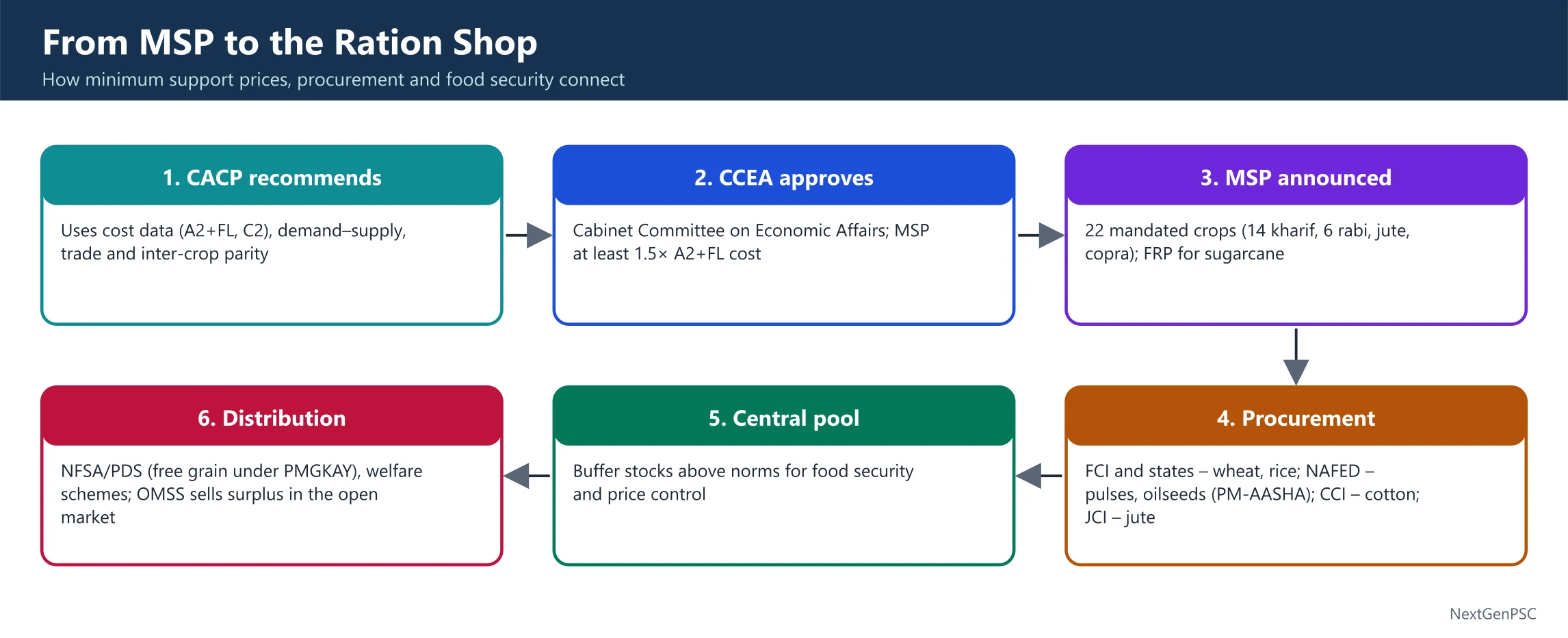
Farm incomes depend on fair prices (MSP, procurement, e-NAM), risk cover (PMFBY), credit (KCC), inputs (fertiliser subsidy, Soil Health Cards) and a food security system (FCI buffer stocks, NFSA and the PDS).
Prices and Procurement
MSP: announced by the Centre for 22 mandated crops (14 kharif, 6 rabi, 2 commercial – jute and copra) on the recommendation of the CACP, approved by the Cabinet Committee on Economic Affairs; since 2018-19 set at least 1.5 times the A2+FL cost.
FRP: Fair and Remunerative Price for sugarcane, fixed under the Sugarcane (Control) Order, 1966.
PM-AASHA (2018): Price Support Scheme (pulses, oilseeds, copra – procured by NAFED), Price Deficiency Payment Scheme and a private procurement pilot.
Price Stabilisation Fund (2015): builds buffers of pulses and onions to control price spikes.
Marketing
APMC Acts: state laws regulating mandis; the Model APLM Act, 2017 and Model Contract Farming Act, 2018 encourage reforms.
e-NAM (2016): online trading platform linking APMC mandis across India, run by SFAC.
Institutions: NAFED (cooperative procurement agency, 1958); PACS (primary agricultural credit societies – being computerised); APEDA (export promotion of agricultural products); WDRA (negotiable warehouse receipts); agricultural commodity futures trade on NCDEX under SEBI.
Risk, Credit and Income Support
PMFBY (2016): farmer premium 2% (kharif), 1.5% (rabi), 5% (commercial/horticultural crops); voluntary for all farmers since 2020.
Kisan Credit Card (1998): short-term crop loans, extended to animal husbandry and fisheries; interest subvention brings the effective rate to 4% on prompt repayment.
PM-KISAN: ₹6,000 a year in three instalments; PM-KMY (2019): voluntary contributory pension of ₹3,000 a month at 60 for small and marginal farmers aged 18–40.
Agriculture Infrastructure Fund (2020): ₹1 lakh crore financing for post-harvest infrastructure with 3% interest subvention.
Inputs
Fertilisers: urea at a fixed MRP (100% neem-coated since 2015); Nutrient Based Subsidy for P and K fertilisers (2010); 'Bharat' single brand (2022); nano urea.
PM-PRANAM (2023): rewards states that cut chemical fertiliser use with 50% of the subsidy saved.
Soil Health Card (2015): soil testing with crop-wise fertiliser advice.
Operation Greens (2018): began with tomato, onion and potato (TOP); later extended to more perishables.
Food Security
FCI and buffer stocks: the Food Corporation of India (1965) procures, stores and moves grain; OMSS sells surplus wheat and rice in the open market to cool prices.
NFSA, 2013: covers up to 75% of the rural and 50% of the urban population – 5 kg grain per person per month (35 kg per household under Antyodaya), free since 2023 under PMGKAY; the eldest woman is head of household for the ration card.
PDS reforms: One Nation One Ration Card (portability), Aadhaar seeding, ePoS machines.
WTO: the Bali 'Peace Clause' (2013) protects India's public stockholding from challenge; NAMA talks concern industrial goods, not agriculture.
| Scheme | Year | Purpose |
|---|---|---|
| Kisan Credit Card | 1998 | Cheap short-term farm credit |
| Soil Health Card | 2015 | Soil testing and nutrient advice |
| e-NAM | 2016 | National online market for farm produce |
| PMFBY | 2016 | Low-premium crop insurance |
| PM-AASHA | 2018 | Price support for pulses and oilseeds |
| Agriculture Infrastructure Fund | 2020 | Credit for post-harvest infrastructure |
| PM-PRANAM | 2023 | Reduce chemical fertiliser use |
Prelims tips
- MSP covers 22 mandated crops on CACP advice; sugarcane gets FRP instead.
- PMFBY premium: 2% kharif, 1.5% rabi, 5% commercial/horticulture.
- e-NAM (2016) is implemented by SFAC; NAFED procures pulses/oilseeds under PM-AASHA.
- NFSA 2013: 75% rural, 50% urban; 5 kg per person per month; AAY 35 kg per household.
- OMSS releases FCI stock in the open market; the Peace Clause (Bali 2013) protects public stockholding.
Mains points
- MSP-led procurement is concentrated in a few crops and states (wheat and rice in Punjab, Haryana, MP), skewing cropping patterns and groundwater use.
- Fragmented APMC markets, high commissions and poor storage keep farmers' share of the consumer price low; e-NAM and FPOs aim to fix this.
- Fertiliser subsidy distorts nutrient use (excess urea, poor N:P:K ratio); balanced fertilisation and soil testing improve soil health.
- Food security has shifted from calories to nutrition – fortified rice, millets in PDS and portability under One Nation One Ration Card.
Did you know?
- The CACP was set up in 1965 as the Agricultural Prices Commission.
- India runs one of the world's largest food distribution programmes, reaching about 80 crore people.
- Neem coating slows the release of nitrogen from urea and curbs its diversion for industrial use.
Crop Diversification in India
Crop diversification means shifting from a few dominant crops—especially the paddy–wheat cycle of the north-west—to a wider mix of pulses, oilseeds, millets, horticulture and allied activities. It can restore groundwater and soil health, improve nutrition and raise farm incomes, but farmers shift only when markets, procurement and risk support make alternatives viable.
1. Why Diversify
Water: Paddy in Punjab and Haryana depends on groundwater; water tables are falling rapidly in many blocks.
Soil: Monocropping and heavy fertiliser use degrade soil health.
Climate resilience: Millets and pulses tolerate heat and drought better.
Nutrition: More pulses, oilseeds, fruits and vegetables address protein and micronutrient gaps.
Income and imports: High-value crops raise income; more pulses and oilseeds cut India's large edible-oil imports.
Environment: Less paddy means less stubble burning and methane emissions.
2. Types of Diversification
Horizontal: Adding more crops or shifting area to different crops (intercropping, crop rotation).
Vertical: Adding value through processing, dairy, poultry, fisheries, agro-forestry.
3. Policy Initiatives
Crop Diversification Programme under RKVY in Green Revolution states (Punjab, Haryana, western Uttar Pradesh).
Haryana's Mera Pani Meri Virasat (2020): Incentive per acre for farmers who shift from paddy.
International Year of Millets (2023), proposed by India and declared by the UN; millets branded as 'Shree Anna'.
National Mission on Edible Oils – Oil Palm (2021) and pulse self-reliance efforts.
MIDH (Mission for Integrated Development of Horticulture); horticulture output now exceeds foodgrain output in volume.
4. Barriers
Assured MSP procurement for rice and wheat but weak procurement for alternatives; lack of storage, processing and markets; price risk; free power and water favouring paddy; limited seed and technology for new crops; small holdings.
5. Way Forward
Procurement and price support for pulses, oilseeds and millets; payment for ecosystem services or per-acre incentives; FPO-led market linkages; crop planning based on agro-climatic zones and water budgets; inclusion of millets in PDS and mid-day meals.
| Aspect | Paddy–wheat system | Diversified system |
|---|---|---|
| Water use | Very high | Lower (millets, pulses) |
| Market support | Assured MSP procurement | Uncertain markets |
| Soil health | Declining | Improves with rotation and legumes |
| Risk | Low price risk, high ecological risk | Higher price risk, lower ecological risk |
Prelims tips
- 2023 was the International Year of Millets, proposed by India.
- Millets are branded as 'Shree Anna' in India.
- Mera Pani Meri Virasat is a Haryana scheme for shifting away from paddy.
- National Mission on Edible Oils – Oil Palm was launched in 2021.
- Vertical diversification means adding value or allied activities, not just changing crops.
Mains points
- The paddy–wheat cycle is locked in by MSP procurement, free power and assured markets; diversification requires changing these incentives.
- Diversification links agriculture to water security, nutrition and climate goals.
- Farmers respond to prices and risk, not advice; assured procurement or price deficiency payments for alternatives are needed.
- Regional planning matters: what suits rain-fed central India differs from irrigated Punjab.
- Vertical diversification into dairy, fisheries and processing raises income without increasing water use.
Did you know?
- Producing one kilogram of rice can require several thousand litres of water.
- Odisha's Millet Mission (2017) revived millet cultivation among tribal farmers.
- India is the world's largest producer of millets.
Indian & Physical Geography: All chapters
- The Universe and the Earth
- Atmosphere and Its Composition
- Atmospheric Temperature
- Atmospheric Moisture
- Air Mass, Fronts & Cyclones
- Evolution of Earth's Crust, Earthquakes and Volcanoes
- Interior of the Earth
- Landforms
- Geomorphic Processes
- Movement of Ocean Water
- Oceans and Their Properties
- Climate of a Region
- Indian Geography: Introduction and Geology
- Physiography of India
- Indian Climate
- Indian Drainage
- Soil and Natural Vegetation
- Mineral and Energy Resources, Industries in India
- Indian Agriculture
- Population, Migration and Urbanisation