
Ancient Indian History · UPSC Notes
Buddhism and Jainism — UPSC Ancient History Notes
Free, exam-focused notes for UPSC Prelims and Mains, with Prelims tips and Mains points for every topic. 17 topics.
Open in the interactive reader: bookmarks, progress tracking and read-aloud.
Buddhism and Jainism: The Shramana Movement (6th Century BCE)
The 6th century BCE witnessed the rise of Buddhism and Jainism in eastern India as part of the Shramana movement . They rejected Brahmanical ritualism, emphasized Ahimsa (non-violence), ethical conduct, and liberation (Moksha/Nirvana) , providing an egalitarian alternative that reshaped Indian society and culture.
I. Core Founders and Teachings
Gautama Buddha is conventionally dated in many Indian exam sources to 563–483 BCE, though modern scholarship debates the exact chronology. Core teachings include the Four Noble Truths, the Eightfold Path, and the Middle Way (rejecting extremes).
Vardhamana Mahavira, the 24th Tirthankara, is traditionally dated to 599–527 BCE in Jain tradition; the chronology is debated. Core Jain principles include the Five Vows, Anekantavada, and the goal of Kevalajnana (omniscience).
Both rejected the authority of the Vedas , opposed priestly dominance, animal sacrifice, and costly Yajnas .
Merchants, artisans, rulers, and other lay supporters patronised these traditions in different regions. Their appeal cannot be reduced to a single social group or motive.
II. Reasons for Rise of New Religions (Causative Factors)
Social: The rigid Varna system and marginalization of Shudras and women created a demand for more inclusive spiritual paths.
Economic: The Second Urbanization led to the rise of wealthy mercantile classes . They adopted non-violence (Ahimsa) as it protected the cattle vital for trade and agriculture, thus supporting Buddhism and Jainism.
Religious: Vedic sacrifices had become excessively elaborate, costly, and mechanical , alienating the common public.
Philosophical/Intellectual: The Upanishadic philosophy encouraged personal knowledge (Jnana) and inquiry over rituals, creating fertile ground for the Shramana traditions .
Political/Geographical: Eastern India (Magadha, Bihar) had a weaker Vedic hold compared to the West, and rulers like Bimbisara and Ajatashatru provided crucial initial patronage.
III. Impact of Buddhism and Jainism
Moral and Religious: Led to the decline of ritualism ; emphasized ethics, morality, and meditation as the path to salvation. Both promoted non-violence, influencing later Indian thought.
Social: Buddhist and Jain monastic traditions offered new religious roles to people from varied backgrounds, including women in particular orders. They did not eliminate social hierarchy in wider society.
Political: Gained immense state patronage, especially under Ashoka (Buddhism) and Chandragupta Maurya (Jainism), leading to vast expansion.
Economic: Monasteries became centers of economic activity, education, and trade, supported by large donations and merchant guilds.
Cultural: Inspired monumental architecture ( Stupas like Sanchi, Viharas , Chaityas ) and rich sculpture and cave art (Ajanta, Ellora, Udayagiri), contributing significantly to Indian heritage.
International: Buddhism became a world religion, spreading globally (Sri Lanka, Myanmar, Tibet, China, Japan, SE Asia); Jainism remained mostly confined to India but deeply influenced regional ethics and philosophy.
| Factor | Explanation |
|---|---|
| Caste Rigidity | Shudras & Vaishyas oppressed by Brahmanical elites sought more egalitarian alternatives. |
| Decline of Women's Status | Exclusion from rituals and Vedic education made them turn to new faiths for spiritual inclusion. |
| Costly Ritualism | Elaborate Yajnas and animal sacrifices (Bali) alienated commoners and the trading class. |
| Urbanization & Trade | Vaishya merchants, needing Ahimsa for trade and resource protection, funded and supported these sects. |
| Upanishadic Thought | Encouraged self-knowledge and meditation over rituals, paving the way for non-Vedic paths. |
| Shramana Traditions | Existing ascetic practices and wandering monks influenced Buddhism & Jainism's format. |
| Aspect | Impact |
|---|---|
| Religion | Rejected ritualism; emphasized ethics, meditation, and non-violence ( Ahimsa ). |
| Society | Weakened caste hierarchy; gave space to women and marginalized groups in Sanghas . |
| Politics | Gained patronage from Magadhan rulers; Ashoka spread Buddhism globally. |
| Economy | Monasteries became centers of donations, education, and helped consolidate trade links. |
| Culture | Stupas, Viharas, Chaityas , and unique cave art (Ajanta, Ellora) enriched architecture and art. |
| Language | Promoted vernacular languages like Pali and Ardhamagadhi over Sanskrit. |
Prelims tips
- Buddha and Mahavira are conventionally dated in many exam sources to 563–483 BCE and 599–527 BCE respectively; their exact chronology is debated.
- Both rejected Vedic authority, Yajnas, and animal sacrifices .
- Buddhism was more flexible and pragmatic; Jainism emphasized extreme asceticism and Ahimsa .
- Ashoka’s patronage was key to the spread of Buddhism beyond India.
Mains points
- Answer opening: Buddhism and Jainism were major Sramana traditions that questioned Vedic ritual authority and offered alternative ethical and monastic paths in an age of urbanisation and state formation.
- Social impact: Their use of accessible languages, monastic institutions and lay patronage widened religious participation, but they did not by themselves abolish social hierarchy or create a uniformly egalitarian society.
- Political economy: Expansion of towns, trade networks, merchant donations and patronage from rulers—including, at different times, Magadhan and later dynasties—helped institutional growth.
- Evidence: Link doctrine to material culture: stupas, chaityas, viharas, inscriptions, Buddhist councils and canonical traditions. Use an inscription or monument rather than relying only on later biographies.
- Conclusion: Buddhism's broad trans-Asian spread and Jainism's enduring regional influence show how Indian religious movements combined ethical ideas with institutions, patronage and networks.
Did you know?
- Buddha’s first sermon at Sarnath is called Dhammachakra Pravartana (Turning the Wheel of Law).
- Mahavira practiced extreme asceticism and attained Kevalajnana (omniscience) at age 42.
- Both religions used Prakrit languages (Pali for Buddhism, Ardhamagadhi for Jainism) instead of Sanskrit to reach common people.
- Jain monks are divided into Digambaras (sky-clad/nude) and Shvetambaras (white-clad).
- The Sri Lankan Buddhist chronicles associate Mahinda and Sanghamitta with the transmission of Buddhism to Sri Lanka under Ashoka; this detail is not stated in Ashoka’s own edicts.
- Jain tradition associates Chandragupta Maurya with Bhadrabahu, Shravanabelagola, and Sallekhana. This account should be identified as a later Jain tradition rather than treated as contemporary evidence.
Buddhism: Gautama Buddha and the Twelve Deeds (Key Events)
The life of Gautama Buddha (Siddhartha) is defined by key events marking his journey from a prince to an enlightened being. The Twelve Deeds (Dvādaśākara) summarize his mission, from the resolution to be born until his final liberation, and form the basis of Buddhist art and literature.
About Gautama Buddha (Historical Context)
Born in 563 BCE at Lumbini (Nepal) in the Kshatriya Shakya clan; father Suddhodana was the head of the Shakya republic.
He was married to Yasodhara and had a son, Rahula, reflecting his life in the Gṛhastha (householder) stage.
The vision of the Four Sights (old man, sick man, dead body, ascetic) while leaving the palace inspired his path to renunciation.
At age 29, he performed the Great Renunciation (Mahabhinishkramana) , leaving the palace to become an ascetic.
He realized that extreme self-mortification was useless and adopted the balanced ‘Middle Path’ .
He attained Enlightenment (Nirvana) under the Bodhi tree at Bodh Gaya at age 35.
He delivered his first sermon at Sarnath , known as ‘Dhammachakra Pravartana’ .
He traveled and taught for 45 years across Magadha, Kosala, and other Mahajanapadas.
He attained Mahaparinirvana (final Nirvana) at Kushinagar at age 80 (483 BCE).
The Twelve Deeds of Buddha (Dvādaśākara)
The Twelve Deeds are symbolic milestones used in art and philosophy, representing the stages of a Bodhisattva’s path:
1. Descent from Tushita Heaven – The divine resolve to be born as Buddha.
2. Entry into the Womb – Entered Queen Maya’s womb as a white elephant (the auspicious dream).
3. Birth at Lumbini – Born in Lumbini grove, took seven steps, declared his destiny.
4. Mastery in Arts – Excelled in knowledge, martial arts, and princely skills.
5. Life in Palace – Enjoyed royal luxury, sheltered from suffering.
6. Renunciation (Mahabhinishkramana) – Left palace at age 29 after seeing the Four Sights.
7. Practice of Austerities – Six years of severe penance and study.
8. Triumph over Mara – Resisted the temptations of Mara (desire, fear) just before enlightenment.
9. Enlightenment (Nirvana) – Attained complete awakening under the Bodhi tree at Bodh Gaya.
10. First Sermon (Dhammachakra Pravartana) – Preached at Sarnath, setting the Wheel of Dharma in motion.
11. Teaching Life – Traveled across India for 45 years, spreading the Dharma.
12. Mahaparinirvana – Attained final Nirvana at Kushinagar at age 80.
| Deed | Description |
|---|---|
| Descent from Tushita Heaven | Bodhisattva resolved to be reborn for humanity’s liberation. |
| Entry into Womb | Entered Queen Maya’s womb as a white elephant in a dream. |
| Birth at Lumbini | Born in Lumbini grove, took seven steps, declared destiny. |
| Mastery of Arts | Excelled in education and princely skills. |
| Life in Palace | Enjoyed royal luxuries, sheltered from suffering. |
| Renunciation (Mahabhinishkramana) | At 29, left palace after witnessing Four Sights. |
| Practice of Austerities | Six years of severe penance and meditation, followed by the Middle Path. |
| Victory over Mara | Defeated temptations of desire, fear, and ego before awakening. |
| Enlightenment (Nirvana) | Attained complete spiritual awakening under the Bodhi tree at Bodh Gaya. |
| First Sermon (Dhammachakra Pravartana) | Sarnath: set the Wheel of Dharma in motion, preaching the Four Noble Truths. |
| Teaching Life | Spread Dharma across northern India for 45 years. |
| Mahaparinirvana | Final Nirvana at Kushinagar at age 80. |
Prelims tips
- Buddha’s birth: Lumbini ; Enlightenment: Bodh Gaya ; First Sermon: Sarnath ; Death: Kushinagar (The Four Great Sites).
- Mahabhinishkramana = Great Renunciation at age 29.
- The Four Sights inspired his renunciation.
- Buddha preached for 45 years across Magadha and Kosala.
- Mahaparinirvana occurred at age 80.
Mains points
- The Life of Buddha symbolizes the rejection of luxury and the search for ultimate truth , setting the example for the entire monastic order.
- The Twelve Deeds represent stages from divine resolve to teaching humanity, forming the iconographic and narrative basis of Buddhist tradition.
- Buddha’s message emphasized ethics (Sila), meditation (Samadhi), and wisdom (Prajna) over rituals.
- The spread of Buddhism owes much to the simplicity, universality, and pragmatic nature of his teachings, making the Sangha highly accessible.
Did you know?
- Buddha was born under a Sal tree in Lumbini grove.
- Queen Maya Devi died seven days after his birth; Buddha was raised by his maternal aunt Mahaprajapati Gautami (who later became the first Buddhist nun).
- He meditated under the Bodhi tree at Bodh Gaya for 49 days before enlightenment.
- The symbol of the wheel (Dharmachakra) represents his first sermon at Sarnath.
- Buddha never claimed divinity; he called himself the ‘Tathagata’ (one who has thus gone or attained the truth) and emphasized the human potential for enlightenment.
Buddhism: Panchamahakalyan & Asta Mahasthanas
Buddhist tradition reveres five major events in Buddha’s life as Panchamahakalyan (birth, renunciation, enlightenment, first sermon, Mahaparinirvana). The Asta Mahasthanas are the eight sacred sites associated with these and other events, forming the Buddha Path for pilgrimage.
Panchamahakalyan (Five Great Events) and Symbolic Icons
These five events define the core narrative and symbolic life of the Buddha, often depicted in early Buddhist art (e.g., Sanchi Stupa) through aniconic (non-human) representation.
1. Jati Kalyan (Birth) – Born as Siddhartha at Lumbini (Nepal) in the Shakya clan. Symbolic Icon: Lotus and Bull.
2. Maha Abhinishkramana (Renunciation) – The Great Departure from Kapilavastu at age 29 after witnessing the Four Sights. Symbolic Icon: Horse (Kanthaka).
3. Bodhi Kalyan (Enlightenment) – Attained Nirvana at Bodh Gaya under the Bodhi tree at age 35, following the Middle Path. Symbolic Icon: Bodhi Tree or Vajrasana (Diamond Throne).
4. Dharmachakra Pravartana (First Sermon) – Delivered the first sermon to five disciples at Sarnath , setting the Wheel of Dharma in motion. Symbolic Icon: Dharmachakra (Wheel of Law).
5. Mahaparinirvana (Final Nirvana) – Passed away at Kushinagar at age 80, attaining final liberation. Symbolic Icon: Stupa (Relic Mound).
Asta Mahasthanas (Eight Great Places – Buddha Path)
The eight sacred sites that form the major Buddhist pilgrimage circuit, each linked to a major event or miracle.
1. Lumbini – Birthplace of Buddha (Jati Kalyan). Site confirmed by the Ashoka Pillar inscription.
2. Bodh Gaya – Site of enlightenment (Bodhi Kalyan). Home to the Mahabodhi Temple and the Vajrasana .
3. Sarnath – Place of first sermon (Dharmachakra Pravartana). Site of the Dhamek Stupa and the original Ashoka Pillar .
4. Kushinagar – Site of Mahaparinirvana. Location of the Reclining Buddha statue and final relic division.
5. Rajagriha (Rajgir) – Where Buddha tamed the mad elephant Nalagiri; site of the First Buddhist Council (Saptaparni Cave) soon after his death.
6. Vaishali – Established the first order of nuns ( Bhikshuni Sangha ); important preaching site; location of the Second Buddhist Council .
7. Shravasti – Performed the ‘Twin Miracle’ (Yamaka Pāṭihāriya); Buddha spent the maximum number of rainy retreats (Varshavasa) here at Jetavana Vihara.
8. Samkashya (Sankisa, UP) – Believed to be the site where Buddha descended from Tushita heaven after teaching the Abhidhamma to his mother.
| Event | Place | Description |
|---|---|---|
| Jati Kalyan (Birth) | Lumbini | Birth of Siddhartha; walked seven steps. |
| Mahabhinishkramana (Renunciation) | Kapilavastu → Ganga region | Left palace at 29 after seeing Four Sights. |
| Bodhi Kalyan (Enlightenment) | Bodh Gaya | Attained Nirvana under Bodhi tree. |
| Dharmachakra Pravartana (First Sermon) | Sarnath | Delivered first sermon to five disciples. |
| Mahaparinirvana (Final Nirvana) | Kushinagar | Death at age 80; attained Parinirvana. |
| Place | Event | Significance |
|---|---|---|
| Lumbini | Birth | Birthplace of Buddha; UNESCO heritage site. |
| Bodh Gaya | Enlightenment | Site of Nirvana; Mahabodhi Temple complex. |
| Sarnath | First Sermon | Dhammachakra Pravartana; deer park. |
| Kushinagar | Mahaparinirvana | Death and final Nirvana. |
| Rajagriha | Miracles & Council | Tamed Nalagiri elephant; First Buddhist Council. |
| Vaishali | Bhikshuni Sangha | Established order of nuns; important preaching. |
| Shravasti | Miracles & Retreats | Performed ‘twin miracle’; stayed many monsoons. |
| Samkashya | Descent from Tushita | Descended from heaven after teaching Abhidhamma to mother. |
Prelims tips
- Panchamahakalyan = Birth (Lumbini), Renunciation (Kapilavastu), Enlightenment (Bodh Gaya), First Sermon (Sarnath), Mahaparinirvana (Kushinagar).
- Asta Mahasthanas = 8 great pilgrimage sites; Ashoka built stupas here.
- Four Great Pilgrimages = Lumbini, Bodh Gaya, Sarnath, Kushinagar.
- Samkashya = descent from heaven; Shravasti = twin miracle.
- Rajagriha = site of First Buddhist Council after Buddha’s death.
Mains points
- Panchamahakalyan events define the symbolic life cycle of the Buddha and are central to Buddhist art and ritual.
- Asta Mahasthanas form the Buddhist pilgrimage circuit, showing how geography and religion intertwined.
- These sites became centers of stupas, monasteries, and later international pilgrimage.
- Ashoka’s patronage linked these sacred sites to state power and spread of Buddhism.
- They represent not just history but the living memory and spiritual geography of Buddhism.
Did you know?
- The Panchamahakalyan events are depicted on Buddhist stupas like Sanchi and Bharhut.
- Lumbini, Bodh Gaya, Sarnath, and Kushinagar are called the ‘Four Great Pilgrimage Sites’.
- Samkashya (Sankisa) is less known but equally sacred for the descent miracle.
- Shravasti is where Buddha is said to have performed the ‘Twin Miracle’ showing fire and water simultaneously.
- Emperor Ashoka visited all the Asta Mahasthanas and built stupas at these sites.
Buddhism: Reasons for Rise and Spread
Buddhism emerged in the 6th century BCE as a reformist religion. It rose due to dissatisfaction with Brahmanism, social inequalities, and support from rulers and merchants. It spread across India and Asia through missionary work, royal patronage, trade routes, and adaptability.
Reasons for the Rise of Buddhism
Reaction against Brahmanical orthodoxy: costly yajnas, dominance of priests, animal sacrifices.
Social equality: Buddhism rejected caste system; admitted women and Shudras into Sangha.
Simple teachings: Four Noble Truths, Eightfold Path — easy for common people to understand.
Language: Used Pali/Prakrit instead of Sanskrit, making teachings accessible.
Support of merchants and urban classes: Buddhist monasteries became trade hubs.
Political patronage: Magadhan rulers (Bimbisara, Ashoka) supported Buddhism.
Religious tolerance: Buddhism emphasized compassion (karuna) and non-violence (ahimsa).
Spread of Buddhism in India
Monasteries (Viharas) became centres of education, debate, and cultural exchange.
Ashoka sent missionaries after the Kalinga war: spread to all corners of India.
Organized councils (Rajgir, Vaishali, Pataliputra) codified teachings and created unity.
Adaptability: absorbed local traditions and appealed to both rural and urban populations.
Spread of Buddhism Outside India
Sri Lanka: Ashoka’s son Mahinda and daughter Sanghamitta spread Buddhism.
Central Asia: Buddhist monks carried it along Silk Route.
China: Entered during Han dynasty via trade and monks (Faxian, Xuanzang later studied in India).
SE Asia: Spread to Myanmar, Thailand, Cambodia, Vietnam via trade and missions.
Tibet: Tantric Buddhism (Vajrayana) developed; Dalai Lama tradition.
Japan & Korea: Spread through China via Mahayana Buddhism.
| Factor | Explanation |
|---|---|
| Religious | Reaction against yajnas, priestly dominance, sacrifices. |
| Social | Egalitarian; admitted all castes and women. |
| Philosophical | Simple teachings (Four Noble Truths, Eightfold Path). |
| Linguistic | Use of Pali/Prakrit made it accessible. |
| Economic | Merchants and urban elites supported monasteries. |
| Political | Magadhan rulers and Ashoka gave patronage. |
| Region | Method of Spread | Key Notes |
|---|---|---|
| India | Monasteries, councils, Ashoka’s missions | Centres: Bihar, UP, Maharashtra, Andhra |
| Sri Lanka | Ashoka’s son Mahinda, daughter Sanghamitta | Established Theravada Buddhism |
| Central Asia | Silk Route trade & monks | Became hub for Mahayana transmission |
| China | Missionaries & traders | Han dynasty; later Xuanzang visited India |
| SE Asia | Merchants & missions | Myanmar, Thailand, Cambodia – Theravada dominant |
| Tibet | Missionaries from India | Vajrayana Buddhism; Dalai Lama lineage |
| Japan & Korea | Via China | Mahayana Buddhism established |
Prelims tips
- Buddha preached in Pali/Prakrit, not Sanskrit.
- Ashoka’s patronage was the biggest factor in spread.
- Theravada = Sri Lanka, Myanmar, Thailand; Mahayana = China, Japan, Korea, Tibet.
- Buddhist Councils helped in codification and spread.
- Silk Route was crucial for spread to Central Asia & China.
Mains points
- Buddhism rose as a protest against Vedic ritualism and rigid caste system.
- Its simplicity, egalitarianism, and ethical message appealed to masses.
- State support and trade networks helped institutionalize Buddhism.
- Buddhist monasteries became centres of learning, economy, and culture.
- Its adaptability ensured global spread, shaping Asian civilizations.
Did you know?
- Buddhism was the first Indian religion to spread internationally.
- Ashoka sent missionaries not only to Asia but also to Greece and Egypt.
- Nalanda and Vikramshila universities became global centres of Buddhist learning.
- Chinese pilgrims Faxian and Xuanzang preserved much of Indian Buddhist history.
- Theravada Buddhism dominates in Sri Lanka & SE Asia, while Mahayana spread to China, Korea, Japan, Tibet.
Buddhism: Doctrines and Councils
Buddha’s teachings focus on suffering, impermanence, selflessness, and the path to liberation. Buddhist Councils preserved and codified these teachings, leading to different schools like Theravada and Mahayana.
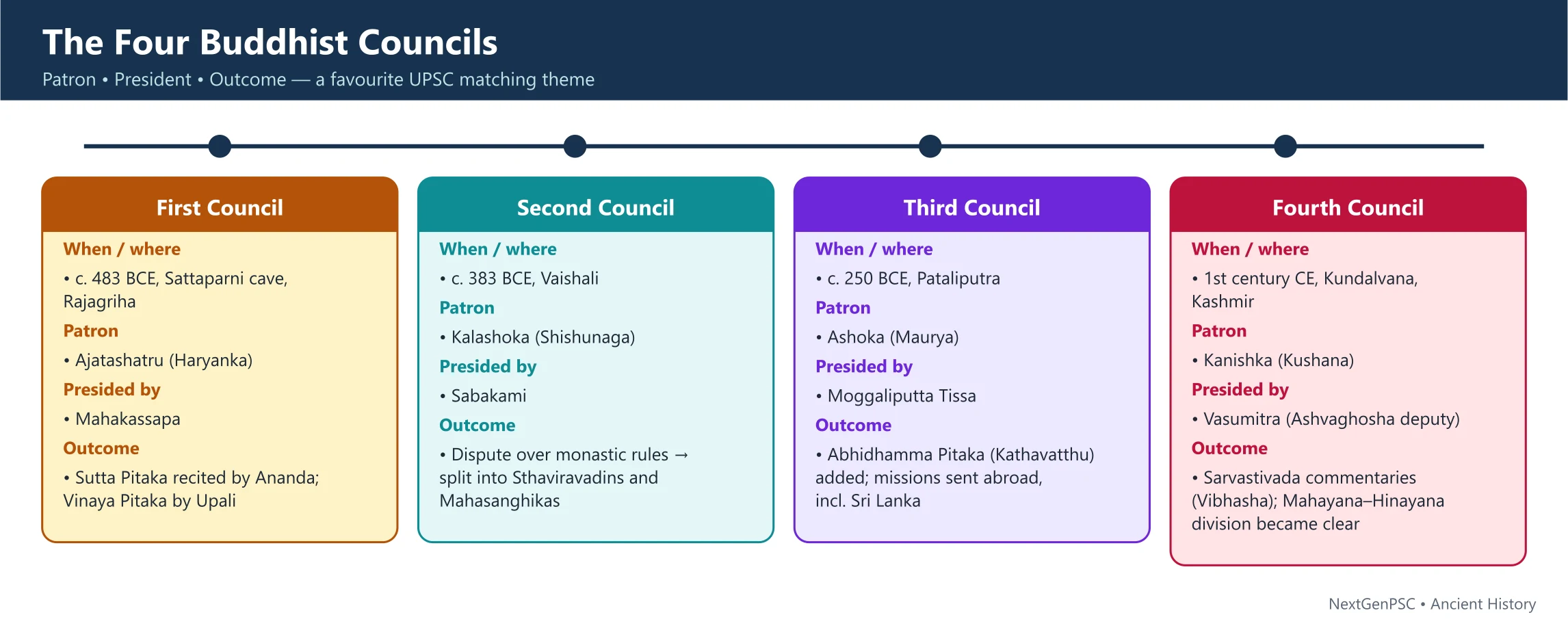
Core Doctrines / Teachings: The Essence of Buddhism
Three Jewels (Tri-Ratna): Buddha (The enlightened one), Dhamma (The teachings), and Sangha (The monastic order). Taking refuge in these three is central to practice.
Four Noble Truths (Arya Satya): The fundamental foundation of Buddha’s philosophy, providing a complete framework for dealing with suffering:
1. Life is suffering ( Dukkha ).
2. Cause of suffering is desire/craving ( Tanha ).
3. Cessation of suffering ( Nirodha ) is possible by ending desire (Nibbana/Nirvana).
4. Path to cessation is the Eightfold Path (Magga).
Eightfold Path (Ashtangika Marga): The practical guide to achieve Nirvana, known as the Middle Path . It is divided into three categories:
- Prajna (Wisdom): Right view, right resolve.
- Sila (Ethical Conduct): Right speech, right conduct, right livelihood.
- Samadhi (Mental Discipline): Right effort, right mindfulness, right meditation.
Three Universal Truths (Ti-Lakkhana): Core concepts of reality:
- Anitya (Impermanence): Everything is constantly changing.
- Anatta (Non-self/Non-soul): There is no permanent, unchanging self or soul.
- Dukkha (Suffering): All existence is marked by suffering.
Dependent Origination (Pratityasamutpada): The law that states all phenomena arise in dependence upon other causes and conditions. It explains the cycle of birth and death (Samsara) through a chain of 12 causes (nidanas).
Karma & Rebirth: Actions (Karma) driven by intention determine the conditions of future lives. Nirvana is the state achieved when this cycle of Karma and Rebirth (Samsara) is completely ended.
Ethical Emphasis: Focused on Ahimsa (Non-violence), Karuna (Compassion), and Maitri (Loving-kindness).
Buddhist Councils: Codification and Schisms
These councils were crucial for codifying Buddhist scriptures (Tripitakas) and resolving doctrinal disputes, leading to major schisms.
1. First Council (Rajagriha, c. 483 BCE) – Held immediately after Buddha’s Mahaparinirvana at Saptaparni Cave . Patron: Ajatashatru . Presided by Mahakasyapa . Purpose: To preserve Buddha’s teachings. Result: Collection and compilation of the Vinaya Pitaka (monastic discipline) and Sutta Pitaka (Buddha's sermons/discourses).
2. Second Council (Vaishali, c. 383 BCE) – Held roughly 100 years after the First Council. Patron: Kalasoka . Issue: Disputes over monastic discipline (ten points) practiced by the Vajjian monks. Result: First major schism, leading to two groups: the conservative Sthaviravada (Elders) and the liberal Mahasanghika (Great Community).
3. Third Council (Pataliputra, c. 250 BCE) – Held during the Mauryan period. Patron: Ashoka . Presided by Moggaliputta Tissa . Purpose: To purify the Sangha from heretical views and strengthen the true faith. Result: The Abhidhamma Pitaka (philosophical analysis) was compiled. Missionaries ( Dharmamahamatras ) were sent abroad, consolidating Theravada Buddhism (a continuation of Sthaviravada).
4. Fourth Council (Kundalavana, Kashmir, 1st c. CE) – Held under the Kushan ruler. Patron: Kanishka . Presided by Vasumitra and Ashvaghosha . Result: The final major split, formalizing the division between Mahayana (Great Vehicle) and Hinayana (Lesser Vehicle). Texts were written in Sanskrit (instead of Pali/Prakrit).
| Doctrine | Meaning |
|---|---|
| Four Noble Truths | Life is suffering, desire causes it, cessation is possible, Eightfold Path is the solution. |
| Eightfold Path | Eight steps of moral and mental discipline leading to Nirvana. |
| Middle Path | Avoid extremes of luxury and asceticism. |
| Anitya | Everything is impermanent. |
| Anatta | There is no permanent soul or self. |
| Dukkha | All existence involves suffering. |
| Pratityasamutpada | Everything arises from causes and conditions. |
| Karma & Rebirth | Actions decide rebirth; Nirvana ends cycle. |
| Council | Place & Patron | Presided by | Outcome |
|---|---|---|---|
| First (c. 483 BCE) | Rajagriha; Patron: Ajatashatru | Mahakasyapa | Compilation of Vinaya & Sutta Pitaka |
| Second (c. 383 BCE) | Vaishali; Patron: Kalasoka | Yasas | Dispute on monastic rules; split into Sthaviravada & Mahasanghika |
| Third (c. 250 BCE) | Pataliputra; Patron: Ashoka | Moggaliputta Tissa | Missionaries sent abroad; Abhidhamma Pitaka compiled |
| Fourth (c. 1st CE) | Kashmir; Patron: Kanishka | Vasumitra & Ashvaghosha | Division into Mahayana & Hinayana; Sanskrit texts composed |
Prelims tips
- Three Pitakas: Vinaya, Sutta, Abhidhamma.
- First Council: Rajagriha; Fourth Council: Kashmir.
- Second Council → first schism (Sthaviravada vs Mahasanghika).
- Third Council → Ashoka sent missionaries abroad.
- Mahayana vs Hinayana division = 4th Council under Kanishka.
- The First Buddhist Council at Rajagriha (under Ajatashatru) was presided over by Mahakassapa; Ananda recited the Sutta Pitaka and Upali the Vinaya Pitaka.
Mains points
- Buddhist doctrines emphasized ethics, impermanence, and self-realization instead of rituals.
- The Four Councils institutionalized Buddhism and ensured continuity of teachings.
- The Second Council led to the first schism, highlighting doctrinal diversity.
- Ashoka’s Third Council and missionary work gave Buddhism an international dimension.
- Kanishka’s Fourth Council shaped Mahayana, which spread across Asia.
Did you know?
- Buddha avoided metaphysical questions (like existence of God) and focused on practical ethics.
- The word ‘Nirvana’ literally means ‘blowing out’ of desire and ignorance.
- First Council preserved teachings orally; writing of scriptures happened much later in Sri Lanka.
- Kanishka’s Fourth Council gave rise to Mahayana Buddhism.
- Ashoka’s missionaries spread Buddhism as far as Sri Lanka, Central Asia, and Greece.
Buddhism: Sects and Philosophical Schools
Buddhism gradually split into sects — Hinayana (Theravada), Mahayana, and Vajrayana — due to doctrinal differences, linguistic shifts, and geographical spread. Philosophical schools like Madhyamaka and Yogachara deepened Buddhist thought and influenced Asian civilizations.
| Sect | Key Features | Language | Regions | Texts |
|---|---|---|---|---|
| Hinayana (Theravada) | Oldest sect; emphasis on Arhat ideal; Nirvana only for monks; focus on discipline and original teachings. | Pali | Sri Lanka, Myanmar, Thailand, Cambodia, Laos | Tipitaka (Pali Canon) |
| Mahayana | Compassion (Karuna) and Bodhisattva ideal; salvation for all; belief in Bodhisattvas and multiple Buddhas; use of Sanskrit sutras. | Sanskrit | China, Korea, Japan, Vietnam | Lotus Sutra, Prajnaparamita texts |
| Vajrayana (Tantrayana) | Esoteric practices, mantras, mudras, mandalas, tantra; Guru-disciple lineage; faster path to Nirvana. | Sanskrit, Tibetan | Tibet, Mongolia, Bhutan, Nepal | Guhyasamaja Tantra, Tibetan Kangyur & Tengyur |
| School | Founder/Thinker | Philosophy | Impact |
|---|---|---|---|
| Abhidhamma (Theravada) | Early Theravada scholars | Analysis of dharmas (elements of reality); detailed psychology & metaphysics. | Basis of Theravada scholastic tradition in Sri Lanka & SE Asia. |
| Madhyamaka | Nagarjuna (2nd CE) | Doctrine of Shunyata (emptiness); avoids extremes of existence & non-existence. | Shaped Mahayana thought; influenced Chinese Chan & Tibetan Buddhism. |
| Yogachara (Vijnanavada) | Asanga & Vasubandhu (4th CE) | Mind-only philosophy; external world is projection of consciousness. | Greatly influenced meditation, psychology, Tibetan schools. |
| Sautrantika | Kumaralata, Vasubandhu | Emphasis on momentariness (kshanika vada); direct perception + inference. | Laid base for Buddhist logic traditions in India. |
| Vaibhashika | Scholars in Kashmir | Realist view: dharmas are ultimately real; relied on Abhidharma Pitaka. | Important in Kashmir; debated with Sautrantikas. |
| Aspect | Hinayana (Theravada) | Mahayana | Vajrayana |
|---|---|---|---|
| Ideal | Arhat (individual salvation) | Bodhisattva (salvation for all) | Siddha through tantra (quick salvation) |
| Goal | Nirvana (cessation of suffering) | Universal Buddhahood | Rapid Nirvana via rituals & tantra |
| Language | Pali | Sanskrit | Sanskrit & Tibetan |
| Texts | Tipitaka (Pali Canon) | Mahayana Sutras (Lotus, Prajnaparamita) | Tantras (Guhyasamaja, Hevajra) |
| Deities | Buddha as teacher | Multiple Buddhas & Bodhisattvas | Buddhas, Bodhisattvas + deities in tantric pantheon |
| Regions | Sri Lanka, SE Asia | China, Japan, Korea, Vietnam | Tibet, Mongolia, Bhutan, Nepal |
| Practice | Monastic discipline, meditation | Compassion, faith, devotion | Mantras, mudras, mandalas, rituals |
Prelims tips
- Hinayana = Arhat ideal; Mahayana = Bodhisattva ideal; Vajrayana = Tantric practices.
- Languages: Pali → Hinayana; Sanskrit → Mahayana; Tibetan → Vajrayana.
- Madhyamaka (Shunyata) → Nagarjuna; Yogachara (Mind-only) → Asanga & Vasubandhu.
- Sautrantika & Vaibhashika = Abhidharma debates in Kashmir.
- Theravada = SE Asia; Mahayana = East Asia; Vajrayana = Tibet & Himalayas.
Mains points
- Buddhism diversified into three main sects adapting to regional and cultural contexts.
- Hinayana emphasized strict adherence to early teachings, Mahayana universalized salvation, Vajrayana embraced esoteric rituals.
- Philosophical schools like Madhyamaka and Yogachara added depth to Buddhist metaphysics.
- Buddhist sects shaped the religious and cultural landscapes of South Asia, East Asia, and Central Asia.
- The flexibility of Buddhism allowed it to integrate local traditions while retaining its ethical and philosophical core.
Did you know?
- Theravada (Hinayana) is the only surviving Hinayana sect today, dominant in Sri Lanka & SE Asia.
- Mahayana introduced celestial Buddhas like Amitabha and Bodhisattvas like Avalokiteshvara.
- Vajrayana Buddhism incorporates Hindu Tantric elements like mantras and mandalas.
- Nagarjuna’s Madhyamaka is considered the philosophical backbone of Mahayana.
- Yogachara’s ‘mind-only’ theory inspired deep meditation practices in Tibet and Zen in Japan.
Buddhism: Bodhisattvas and Buddhist Missionaries
Bodhisattvas are enlightened beings in Mahayana who postpone Nirvana to help others. Buddhist missionaries, especially under Ashoka, spread Buddhism across India and Asia, shaping world history.
Bodhisattvas: The Mahayana Ideal of Compassion
The Bodhisattva is the central, ethical ideal of Mahayana Buddhism (The Great Vehicle). A Bodhisattva is an enlightened being (like the Buddha was before his enlightenment) who is qualified to enter Nirvana but deliberately delays their final liberation out of profound compassion (Karuna) to help all sentient beings achieve salvation.
This concept shifts the focus of religious practice from individual salvation (as in Hinayana/Theravada) to universal salvation (Mahayana).
Key Bodhisattvas are often worshipped as deities and are widely depicted in Gandhara, Mathura, and Ajanta art:
- Avalokiteshvara (Padmapani): The most popular Bodhisattva, embodying pure compassion (Karuna) . He is symbolized by the Lotus (Padma) . Known as Guanyin in China and Kannon in Japan.
- Manjushri: The Bodhisattva of wisdom (Prajna) . He is typically symbolized with a flaming sword (cutting through ignorance) and a text (Prajnaparamita Sutra).
- Maitreya: The Future Buddha (Bodhisattva) who is currently residing in the Tushita heaven and is expected to appear on Earth in the future to re-teach the Dharma.
- Vajrapani: The Protector Bodhisattva , symbolizing power and force . He carries a Vajra (thunderbolt) and is strongly associated with Vajrayana Buddhism .
- Kshitigarbha: The Bodhisattva and savior of beings trapped in hell realms . Highly popular in East Asian traditions (China, Japan, Korea).
In Mahayana, the worship of Bodhisattvas and the Buddha image became the central ritual practice, dramatically influencing the art and architecture of South, Central, and East Asia.
Buddhist Missions: The Global Spread of Dhamma
The global expansion of Buddhism commenced significantly after the Third Buddhist Council (c. 250 BCE) , organized under Emperor Ashoka , where the decision was made to actively spread the Dhamma beyond India’s borders.
Important Missionary Efforts (Ashoka's Dharmavijaya):
- To Sri Lanka : Ashoka’s son, the monk Mahinda , and his daughter, the nun Sanghamitta , established the core Theravada Buddhism (which survives there to this day). Sanghamitta famously carried a branch of the Bodhi Tree.
- To Southeast Asia : Monks and maritime traders spread the Theravada traditions to Myanmar (Suvarnabhumi), Thailand, and Cambodia via sea routes.
- To Central Asia : Buddhism spread rapidly along the Silk Route during the reign of Kanishka (Kushan). Monasteries flourished in centers like Bamiyan, Khotan, and Kashgar, acting as cultural and trade hubs.
- To China : Buddhism was introduced during the Han dynasty (1st century CE). Its spread was facilitated by monks like Kumarajiva (translator) and later pilgrims/scholars like Faxian and Xuanzang , who traveled to India for texts.
- To Tibet & Nepal : Vajrayana Buddhism (Tantric Buddhism) developed from the 7th century CE onwards, often blended with local Bon traditions, under figures like Padmasambhava.
- To Greece & West Asia : Ashoka’s Rock Edicts (Edict XIII) explicitly mention sending Dharma-dutas (messengers of Dhamma) to Hellenic kingdoms (Antiochus II, Ptolemy II, etc.).
Role of Monasteries: Monasteries (Viharas) were strategically located near trade routes, serving as cultural centres, banks, hospitals, and transit hubs for traders and scholars, aiding the smooth flow of Buddhist ideas and art.
Artistic Spread: The distinctive Gandhara (Indo-Greek) and Mathura schools of art produced the first iconic Buddha and Bodhisattva images , which became the visual language that carried the faith across Asia.
| Bodhisattva | Domain | Region of Popularity |
|---|---|---|
| Avalokiteshvara (Padmapani) | Compassion | Tibet, China (Guanyin), Japan (Kannon) |
| Manjushri | Wisdom | India, Nepal, Tibet, China |
| Maitreya | Future Buddha | Across Buddhist world |
| Vajrapani | Power & protection | Tibet, Vajrayana schools |
| Kshitigarbha | Savior of hell beings | China, Japan, Korea |
| Region | Missionaries/Medium | Result |
|---|---|---|
| Sri Lanka | Mahinda & Sanghamitta | Theravada Buddhism established |
| Myanmar, Thailand, Cambodia | Monks & traders | Theravada dominant |
| Central Asia | Silk Route monks | Monasteries like Bamiyan, Khotan flourished |
| China | Monks like Kumarajiva, Faxian, Xuanzang | Mahayana Buddhism spread |
| Tibet & Nepal | Tantric teachers | Vajrayana Buddhism developed |
| West Asia & Greece | Ashoka’s Dharma-dutas | Limited spread recorded in inscriptions |
Prelims tips
- Avalokiteshvara = Compassion; Manjushri = Wisdom; Maitreya = Future Buddha.
- Ashoka’s son Mahinda took Buddhism to Sri Lanka.
- Silk Route was vital for spread to Central Asia & China.
- Vajrayana spread mainly to Tibet, Mongolia, Bhutan.
- Faxian (5th CE) & Xuanzang (7th CE) visited India to study Buddhism.
Mains points
- Bodhisattvas symbolized Mahayana’s universalist approach, blending philosophy with devotion.
- Missionaries, supported by Ashoka, ensured Buddhism’s transformation into a world religion.
- Bodhisattvas like Avalokiteshvara and Maitreya shaped Buddhist art and worship across Asia.
- Trade routes, especially the Silk Route, were as important as royal patronage in spreading Buddhism.
- The interaction of missionaries with local traditions led to unique forms of Buddhism in Sri Lanka, China, Tibet, and Japan.
Did you know?
- Avalokiteshvara transformed into female form (Guanyin) in China.
- Maitreya is still awaited as the 'future Buddha'.
- Ashoka’s missions are recorded in his rock edicts.
- Bamiyan Buddhas (destroyed in 2001) were key symbols of Buddhism in Central Asia.
- Xuanzang’s records from India are major historical sources for Buddhism.
Buddhism: Literature and Decline
Buddhist literature is vast, ranging from the Pali Canon (Tipitaka) to Mahayana Sutras and Vajrayana Tantras. Despite flourishing for centuries, Buddhism declined in India due to revival of Hinduism, internal divisions, loss of royal patronage, and invasions.
Buddhist Literature: Tripitakas and Philosophical Texts 📚
Buddhist literature is vast, spanning centuries and multiple languages (Pali, Sanskrit, and various local languages).
Pali Canon (Tipitaka/Tripitaka): The oldest and most authentic collection of Buddhist scriptures, primarily associated with the Theravada school. It comprises three baskets (Pitakas):
- Vinaya Pitaka: Deals exclusively with the rules of discipline for monks and nuns (the Sangha ). It reflects the early democratic organization of the Sangha.
- Sutta Pitaka: The collection of Buddha’s discourses and main teachings on Dhamma (doctrine). It is the source for the Four Noble Truths and the Eightfold Path.
- Abhidhamma Pitaka: Contains the philosophical and psychological analysis and systematic treatment of the teachings found in the Sutta Pitaka. This was compiled later, generally accepted after the Third Buddhist Council .
Non-Canonical Pali Texts: These are important historical and narrative sources:
- Milinda Panha: A famous dialogue between the Indo-Greek king Menander (Milinda) and the Buddhist monk Nagasena , explaining complex doctrines.
- Jataka Tales: A popular collection of over 500 stories describing the previous births of the Buddha (Bodhisattva), reflecting the moral and ethical values of the time.
Mahayana Texts (in Sanskrit): Texts of the Mahayana school, focusing on the Bodhisattva ideal and universal salvation:
- Prajnaparamita Sutras: Texts dealing with the Perfection of Wisdom (Prajna), highly revered and attributed to Nagarjuna.
- Lotus Sutra (Saddharma Pundarika): Emphasizes the possibility of universal salvation and the eternal nature of the Buddha.
Key Philosophical Texts: Major works that established distinct Buddhist philosophical schools:
- Works of Nagarjuna (founder of the Madhyamaka or Middle Path School): His main text is the Madhyamaka Karika (doctrine of Shunya or emptiness).
- Works of Asanga & Vasubandhu (founders of the Yogachara or Vijnanavada School): Texts focus on the doctrine that only consciousness (Vijnana) is real.
Vajrayana Literature: Later texts associated with Tantric/Esoteric Buddhism (e.g., in Tibet): Tantras, mantras, mandalas , and specific ritual texts (e.g., Guhyasamaja Tantra).
Buddhist Chronicles: Important historical sources like the Dipavamsa and Mahavamsa (Chronicles of Sri Lanka) which detail Ashoka’s missionary activities.
Universities as Literary Centres: Major monastic universities like Nalanda, Vikramashila, and Odantapuri were huge repositories and centers that produced vast commentaries and new Buddhist texts, especially Mahayana and Vajrayana literature.
Decline of Buddhism in India: The Multi-Factorial Causes 📉
Buddhism, despite its initial success and widespread influence, gradually declined in India, primarily due to internal issues, successful external competition, and destruction.
Revival of Hinduism (Brahmanical Counter-Reform): The rise of Bhakti movements (emphasizing personal devotion and simple worship) and the philosophical reform efforts of thinkers like Adi Shankaracharya successfully challenged Buddhist intellectual dominance. Furthermore, the practice of incorporating Buddhist elements into Hinduism (syncretism), most notably declaring Buddha as the 9th avatar of Vishnu , effectively absorbed the faith's appeal and distinct identity.
Internal Decay and Divisions: The major sectarian splits ( Hinayana vs Mahayana vs Vajrayana ) led to fragmentation of the community and weakened the centralized authority of the Sangha. The later Vajrayana school introduced complex, esoteric rituals and magical practices that were costly and morally questionable, distancing the common people from the original simple teachings.
Loss of Royal Patronage: Buddhism thrived primarily under strong state support (Mauryas, Kushanas, parts of the Gupta period). The gradual decline of these strong, Buddhist-supporting dynasties meant a crucial loss of funding and protection for the large monastic establishments, leading to their dependency on local rulers who often favored Hindu temples.
Linguistic Alienation: The shift of major philosophical texts from the accessible Pali/Prakrit language to scholarly Sanskrit (especially in the Mahayana school) created a language barrier , making the doctrines inaccessible and less relatable for the masses.
Competition with Other Faiths: Jainism , with its stronger focus on the local community and lack of reliance on state funding, remained more active and deeply rooted in the trading communities. The rise of Vaishnavism and Shaivism offered emotional and accessible paths to salvation that competed directly with Buddhism.
Muslim Invasions and Destruction: The devastating Turkish Muslim invasions in the 12th century CE delivered the final blow. The destruction of major educational centers and monastic universities like Nalanda, Vikramshila, and Odantapuri by forces like Bakhtiyar Khilji (c. 1200 CE) removed the intellectual and physical base of Buddhism in its homeland, leading to the dispersal or conversion of monks.
Absorption into Hinduism (Final Step): By the 12th century CE, Buddhism had largely disappeared from India , surviving mainly in the Himalayan regions and globally in Sri Lanka, Tibet, and East Asia, having been successfully marginalized and absorbed by the strong resurgence of the Brahmanical tradition.
| Category | Examples | Language |
|---|---|---|
| Canonical (Pali Canon) | Vinaya Pitaka, Sutta Pitaka, Abhidhamma Pitaka | Pali |
| Non-Canonical Pali | Jatakas, Milinda Panha | Pali |
| Mahayana Sutras | Lotus Sutra, Prajnaparamita, Lankavatara Sutra | Sanskrit |
| Philosophical | Nagarjuna’s Madhyamaka Karika, Yogachara texts | Sanskrit |
| Vajrayana Tantras | Guhyasamaja Tantra, Hevajra Tantra | Sanskrit, Tibetan |
| Chronicles | Dipavamsa, Mahavamsa | Pali |
| Factor | Explanation |
|---|---|
| Revival of Hinduism | Bhakti, absorption of Buddha as Vishnu’s avatar. |
| Internal Divisions | Hinayana, Mahayana, Vajrayana split. |
| Over-Ritualism | Complex Tantric practices alienated people. |
| Loss of Patronage | Decline after Mauryas, Kushanas, Guptas. |
| Competition with Jainism | Jain monks remained active at grassroots. |
| Language Barrier | Shift to Sanskrit excluded masses. |
| Invasions | Muslim invasions destroyed monasteries. |
| Assimilation | Buddhism merged with Hindu traditions. |
Prelims tips
- Tipitaka = Vinaya, Sutta, Abhidhamma.
- Milinda Panha = dialogue with Greek King Menander.
- Lotus Sutra & Prajnaparamita = Mahayana texts.
- Guhyasamaja Tantra = Vajrayana text.
- Main reasons of decline: Hindu revival, invasions, loss of patronage.
Mains points
- Buddhist literature preserved Buddha’s teachings and inspired Asian civilizations.
- Tipitaka remains the canonical base of Theravada; Mahayana added Sutras, Vajrayana added Tantras.
- Buddhism declined in India but thrived abroad due to adaptability and missionary zeal.
- Decline was due to internal schisms, over-ritualism, and external pressures like invasions.
- Absorption into Hinduism shows cultural synthesis but also marked Buddhism’s end in India.
Did you know?
- Milinda Panha records a dialogue between Greek King Menander and monk Nagasena.
- Jataka tales later influenced Panchatantra and Indian folklore.
- Nalanda University once housed 10,000 monks and vast Buddhist manuscripts.
- Buddhism declined in India but flourished in Sri Lanka, Tibet, East Asia.
- Buddha declared as the 9th avatar of Vishnu helped absorb Buddhism into Hinduism.
Jainism: 24 Tirthankaras & Pancha Kalyanakas
Jainism recognizes 24 Tirthankaras (ford-makers) who attained Kevalajnana (omniscience) and guided others on the path of liberation. The five great events in a Tirthankara’s life, called Pancha Kalyanakas, are celebrated with rituals.
The 24 Tirthankaras: Founders of the Jain Path 🕉️
Jainism is centered around the teachings of Tirthankaras (ford-makers), 24 perfected souls who achieved omniscience (Kevalajnana) and taught the path to liberation (Moksha).
Rishabhanatha (Adinatha) – First Tirthankara ; considered the founder of Jainism in the present era; associated with the Ikshvaku dynasty. Symbol: Bull.
Ajitanatha – 2nd Tirthankara. Symbol: Elephant.
Sambhavanatha – 3rd Tirthankara. Symbol: Horse.
Abhinandananatha – 4th Tirthankara. Symbol: Monkey.
Sumatinatha – 5th Tirthankara. Symbol: Curlew (bird).
Padmaprabha – 6th Tirthankara. Symbol: Lotus.
Suparshvanatha – 7th Tirthankara. Symbol: Swastika.
Chandraprabha – 8th Tirthankara. Symbol: Moon.
Suvidhinatha (Pushpadanta) – 9th Tirthankara. Symbol: Crocodile.
Shitalanatha – 10th Tirthankara. Symbol: Kalpavriksha (wish-fulfilling tree).
Shreyansanatha – 11th Tirthankara. Symbol: Rhinoceros.
Vasupujya – 12th Tirthankara. Symbol: Buffalo.
Vimalanatha – 13th Tirthankara. Symbol: Boar.
Anantanatha – 14th Tirthankara. Symbol: Falcon.
Dharmanatha – 15th Tirthankara. Symbol: Vajra (Thunderbolt).
Shantinatha – 16th Tirthankara. Symbol: Deer.
Kunthunatha – 17th Tirthankara. Symbol: Goat.
Aranatha – 18th Tirthankara. Symbol: Nandavarta (an auspicious mark).
Mallinatha – 19th Tirthankara. Highly significant due to doctrinal split: Digambaras reject her gender, asserting no female can achieve Moksha; Shvetambaras accept her as female. Symbol: Waterpot.
Munisuvrata – 20th Tirthankara. Symbol: Tortoise.
Naminatha – 21st Tirthankara. Symbol: Blue Lotus.
Neminatha – 22nd Tirthankara. Said to be the cousin of Lord Krishna . Symbol: Conch.
Parshvanatha – 23rd Tirthankara ; considered a historical figure who preceded Mahavira by about 250 years. He prescribed four great vows (Mahavratas). Symbol: Snake.
Mahavira (Vardhamana) – 24th and last Tirthankara ; a contemporary of Buddha and the final organizer of Jainism. He added the fifth vow (Brahmacharya). Symbol: Lion.
Pancha Kalyanakas (Five Auspicious Events)
These five events mark the major milestones in the life of every Tirthankara, celebrated with great pomp and devotion by the Jain community. They are pivotal in Jain iconography and temple architecture.
1. Garbh Kalyanaka (Conception): The auspicious descent of the Tirthankara’s soul into the mother’s womb (e.g., Mahavira's mother, Trishala, had 16 auspicious dreams).
2. Janma Kalyanaka (Birth): The auspicious birth celebrations of the Tirthankara.
3. Diksha Kalyanaka (Renunciation): The voluntary renunciation of worldly life, wealth, and power; the initiation into asceticism (becoming a Muni or Sadhu ).
4. Kevalajnana Kalyanaka (Omniscience): The attainment of Kevalajnana (supreme, perfect, and all-encompassing knowledge) under a specific tree, which marks the Tirthankara as a true Jina (Conqueror).
5. Moksha Kalyanaka (Liberation): The final liberation of the soul from the cycle of birth and death ( Samsara ); the soul attains an eternal state in the Siddhashila (Abode of the Liberated).
| Tirthankara | Position | Symbol | Notes |
|---|---|---|---|
| Rishabhanatha (Adinatha) | 1st | Bull | Founder; Ikshvaku dynasty |
| Neminatha | 22nd | Conch | Cousin of Krishna; renounced at marriage |
| Parshvanatha | 23rd | Snake | Historical; lived ~8th century BCE |
| Mahavira (Vardhamana) | 24th | Lion | Last Tirthankara; contemporary of Buddha |
| Event | Description |
|---|---|
| Garbh Kalyanaka | Conception of Tirthankara in mother’s womb |
| Janma Kalyanaka | Auspicious birth celebration |
| Diksha Kalyanaka | Renunciation and initiation into ascetic life |
| Kevalajnana Kalyanaka | Attainment of omniscience (Kevalajnana) |
| Moksha Kalyanaka | Final liberation from samsara |
Prelims tips
- Symbols of important Tirthankaras: Rishabhanatha (Bull), Neminatha (Conch), Parshvanatha (Snake), Mahavira (Lion).
- Parshvanatha preached 4 vows; Mahavira added 5th vow (celibacy).
- Pancha Kalyanakas = Conception, Birth, Renunciation, Omniscience, Liberation.
Mains points
- The 24 Tirthankaras symbolize Jainism’s continuity and emphasis on asceticism.
- Pancha Kalyanakas mark the spiritual milestones in a Tirthankara’s journey.
- Parshvanatha and Mahavira were historical, showing Jainism’s deep antiquity.
- Jain rituals still reenact the Pancha Kalyanakas during temple consecrations.
- The Tirthankara concept reflects Jainism’s stress on self-realization without divine intervention.
Did you know?
- Rishabhanatha (Adinatha) is considered the first Tirthankara and is mentioned in Rigveda traditions.
- Parshvanatha (23rd) preached 4 vows; Mahavira (24th) added the 5th (Brahmacharya).
- Mallinatha (19th) is believed to be female by Shvetambaras, male by Digambaras.
- The life of a Tirthankara is ritually reenacted during consecration ceremonies (Pancha Kalyanaka Pratishtha).
Jainism: Vardhamana Mahavira & Teachings
Mahavira, the 24th and last Tirthankara, reformed Jainism by emphasizing asceticism, non-violence, and strict discipline. His teachings centered on the Five Great Vows, Anekantavada (non-absolutism), and Syadvada (conditional logic).
Vardhamana Mahavira (540–468 BCE): The 24th Tirthankara 🦁
Mahavira, the last Tirthankara, is regarded as the final systematizer and popularizer of the Jain faith, providing the comprehensive philosophical and ascetic framework.
Birth and Lineage: Born in Kundagrama (near Vaishali, Bihar) in 540 BCE. His parents were Siddhartha (father, chief of the Jnatrika clan ) and Trishala (mother, sister of a Licchavi chief). This royal Kshatriya lineage provided Jainism with initial political and social standing.
The Great Renunciation (Diksha Kalyanaka): Following the death of his parents, Mahavira renounced his princely life, wealth, and family (wife Yashoda, daughter Priyadarshana) at the age of 30 and became a wandering ascetic ( Muni ).
Asceticism and Omniscience: He practiced rigorous penance and intense meditation for 12 years . At the age of 42 , he attained Kevalajnana (omniscience or supreme knowledge) under a Sal tree near Jrimbhikagrama (on the bank of the Rijupalika river). He was henceforth known as Jina (Conqueror).
Teaching Life and Nirvana: He spent the next 30 years spreading his teachings across Magadha, Kosala, and Mithila. He attained Moksha Kalyanaka (final liberation, or Nirvana) at Pava (Pawapuri, Bihar) in 468 BCE.
Core Teachings of Jainism: The Path to Kevalajnana
Jainism is fundamentally a doctrine of self-effort, extreme ethical rigor , and the path of the Three Jewels to burn off accumulated Karma.
Five Mahavratas (Great Vows): These form the ethical cornerstone of Jain conduct, essential for monks and practiced less strictly (Anuvratas or Lesser Vows) by laypersons:
1. Ahimsa (Non-violence): The most important vow , requiring non-injury to all living beings (plants, insects, animals, humans) through thought, word, and deed.
2. Satya (Truth): Speaking the truth, but prioritizing Ahimsa over Satya.
3. Asteya (Non-stealing): Not taking anything that has not been freely given.
4. Brahmacharya (Celibacy/Continence): Added by Mahavira for monks to ensure maximum asceticism.
5. Aparigraha (Non-possession): Renunciation of all possessions and attachments to wealth or property.
Triratna (Three Jewels): The three-pronged path that guides the soul to liberation:
- Right Faith (Samyak Darshana): Faith in the Tirthankaras and the path taught by them.
- Right Knowledge (Samyak Jnana): Correct and adequate knowledge of Jain principles (Anekantavada, Syadvada).
- Right Conduct (Samyak Charitra): Observing the Five Mahavratas to destroy Karmic bonds.
Anekantavada (Doctrine of Non-Absolutism): The metaphysical principle that reality has infinite aspects ; no single perspective or statement can express the absolute truth. This promotes intellectual tolerance .
Syadvada (Doctrine of Conditional Judgment): The logical expression of Anekantavada. It states that truth can only be expressed through seven conditional statements (Saptabhangi) , affirming that 'Maybe it is' (Syad-asti) or 'Maybe it is not' (Syad-nasti), highlighting the relativity of human knowledge.
Doctrine of Karma: Karma is viewed as a physical substance (Karmic matter) that attaches to the soul (Jiva) and binds it to the cycle of rebirth. Liberation ( Moksha ) is possible only by destroying accumulated Karma through ethical conduct and extreme asceticism (Tapas) .
Creator God Denied: Jainism denies the existence of a supreme Creator God . The universe is seen as eternal, and liberation is achieved through self-effort and perfect conduct, not divine grace.
Strict Equality and Austerity: Stressed the equality of all living beings (Jiva) , leading to strict vegetarianism and prohibition of harming even insects. Heavy emphasis on Tapas (austerity), meditation, and renunciation for salvation.
| Event | Details |
|---|---|
| Birth | 540 BCE, Kundagrama near Vaishali (Bihar) |
| Clan | Jnatrika (linked to Licchavis) |
| Marriage | Married Yashoda; daughter Priyadarshana |
| Renunciation | At age 30, left home to become ascetic |
| Kevalajnana | At age 42, Jrimbhikagrama under Sal tree |
| Teachings | 30 years in Magadha, Kosala, Mithila |
| Death/Nirvana | 468 BCE at Pava (Pawapuri, Bihar) |
| Teaching | Description |
|---|---|
| Five Mahavratas | Ahimsa, Satya, Asteya, Brahmacharya, Aparigraha |
| Triratna | Right Faith, Right Knowledge, Right Conduct |
| Anekantavada | Non-absolutism; truth has multiple aspects |
| Syadvada | Conditional judgments (seven-fold logic) |
| Karma Doctrine | Soul bound by karma; liberation through asceticism |
| No Creator God | Liberation through self-effort, not divine grace |
| Asceticism | Strict renunciation, meditation, tapas |
Prelims tips
- Mahavira’s birthplace = Kundagrama (Vaishali, Bihar).
- Language of preaching = Ardhamagadhi Prakrit.
- At age 42 → attained Kevalajnana; at age 72 → attained Nirvana at Pava (Pawapuri).
- Five vows = Ahimsa, Satya, Asteya, Brahmacharya, Aparigraha.
- Triratna = Right Faith, Right Knowledge, Right Conduct.
Mains points
- Mahavira systematized Jain teachings, making asceticism central.
- His emphasis on Ahimsa influenced Indian traditions deeply, including Gandhi.
- Jain doctrines like Anekantavada and Syadvada enriched Indian philosophy.
- Jainism rejected caste dominance and emphasized equality of beings.
- Mahavira’s teachings spread widely due to use of Prakrit and missionary monks.
Did you know?
- Mahavira was called 'Nirgrantha' (without bonds).
- He preached in Ardhamagadhi Prakrit, accessible to common people.
- Mahavira’s Nirvana at Pawapuri is commemorated as 'Diwali' in Jain tradition.
- Parshvanatha (23rd Tirthankara) taught 4 vows; Mahavira added 5th vow (celibacy).
- Jainism does not believe in a creator god but stresses on eternal souls (jiva).
Jainism: Principles & Sects
The principles of Jainism emphasize non-violence, truth, non-possession, and self-effort for liberation. Over time, Jainism split into two major sects: Digambara and Shvetambara, differing on monastic practices, scriptures, and the status of women.
Core Principles of Jainism: The Path of Rigorous Ethics 🧘
Jain philosophy is defined by its extreme emphasis on ethical conduct (Samyak Charitra) and non-attachment to achieve liberation (Moksha).
Pancha Mahavratas (Five Great Vows): The cornerstone of Jain ethics, necessary for destroying Karmic matter:
1. Ahimsa (Non-violence): The supreme principle. It requires complete non-injury to all living beings (Jiva) , including plants and insects, through thought, word, and deed. This is the foundation of Jain vegetarianism.
2. Satya (Truth): Always speaking the truth, but prioritizing the principle of Ahimsa —truth that harms others must be avoided.
3. Asteya (Non-stealing): Do not take anything that is not freely given, including property or ideas.
4. Brahmacharya (Celibacy/Chastity): Complete celibacy for monks ( Muni ); strict restraint and fidelity for householders. This fifth vow was added by Mahavira .
5. Aparigraha (Non-possession): Complete detachment from external possessions (wealth, property) and internal attachments (love, hate, jealousy).
Triratna (Three Jewels): The path to liberation ( Moksha ) which must be practiced simultaneously:
- Right Faith (Samyak Darshana): Correct conviction/belief in the Tirthankaras and the truth of the Jain doctrine.
- Right Knowledge (Samyak Jnana): Correct, comprehensive, and adequate knowledge of reality (as defined by Anekantavada).
- Right Conduct (Samyak Charitra): Strict observance of the Five Mahavratas to burn off accumulated Karma.
Anekantavada (Doctrine of Non-Absolutism): The metaphysical doctrine that states reality is complex and multi-faceted ; absolute truth cannot be known from a single perspective. This promotes intellectual pluralism .
Syadvada (Doctrine of Conditional Judgment): The logical manifestation of Anekantavada. It uses the seven-fold conditional logic (Saptabhangi Naya) (e.g., 'Syaad Asti' - maybe it is) to affirm that all knowledge is relative and conditional.
Doctrine of Karma: Karma is believed to be a subtle, physical substance (Karmic matter) that adheres to the soul (Jiva), binding it to the cycle of rebirth (Samsara). Liberation requires purification through tapas (austerity) and severe conduct to destroy the Karmic bond.
No Creator God: Jainism denies the existence of a supreme creator or controller god . The universe is eternal, and Tirthankaras are revered as perfect guides who achieved self-liberation, not as divine beings who grant grace.
Sects of Jainism: The Doctrinal Schism
The major schism occurred around the 3rd century BCE following a severe famine in Magadha, when monks led by Bhadrabahu moved South (Karnataka) while those led by Sthulabhadra remained North.
Digambara (Sky-clad):
- Monastic Practice: Monks practice complete nudity (Sky-clad, Dig-ambara), symbolizing total renunciation of worldly possessions, including clothing. They carry only a peacock feather broom and a water gourd.
- Women's Status: They hold that women ( Mallinatha ) cannot achieve Moksha in their current birth, as they cannot practice complete nudity and asceticism. They must be reborn as men.
- Scriptures: They believe the original Agamas (canonical texts) were lost . They rely on later commentaries and texts like Kasayapahuda .
- Idolatry: Worship idols of Tirthankaras that are unclothed and undecorated .
Shvetambara (White-clad):
- Monastic Practice: Monks wear simple white robes (Shveta-ambara), believing clothes do not impede the path to liberation.
- Women's Status: They believe women ( Mallinatha ) can achieve liberation (Moksha).
- Scriptures: They believe the core Agamas (45) were recovered/preserved and compiled at the Vallabhi Council (Gujarat).
- Idolatry: Worship idols that are typically clothed and decorated with ornaments.
Sub-sects (The Non-Idolaters): Both major sects later saw reform movements that rejected idol worship:
- Sthanakavasi (16th century): A Shvetambara sub-sect that rejects idol worship . They emphasize meditation, fasting, and prayer halls ( Sthanaka ) instead of temples.
- Terapanthi (18th century): A reformist sub-sect of Sthanakavasi founded by Acharya Bhikshu. Known for its highly centralized hierarchy under one Acharya (leader) and strict discipline; also non-idolatry .
| Principle | Description |
|---|---|
| Ahimsa | Non-violence towards all beings |
| Satya | Speaking truth without harm |
| Asteya | Not stealing |
| Brahmacharya | Celibacy/restraint |
| Aparigraha | Detachment from possessions |
| Triratna | Right Faith, Right Knowledge, Right Conduct |
| Anekantavada | Doctrine of non-absolutism |
| Syadvada | Seven-fold conditional logic |
| Karma | Bondage of soul through karma; liberation by austerity |
| Aspect | Digambara | Shvetambara |
|---|---|---|
| Monk Attire | Nudity (sky-clad) | White robes |
| Women’s Liberation | Not possible | Possible |
| Scriptures | Original Agamas lost; rely on commentaries | Preserved 45 Agamas |
| Idols | Nude, without ornaments | Clothed, decorated idols |
| Language | Prakrit + later Sanskrit texts | Ardhamagadhi Prakrit texts |
| View on Mallinatha | Male Tirthankara | Female Tirthankara |
Prelims tips
- Five vows (Ahimsa, Satya, Asteya, Brahmacharya, Aparigraha) are core principles.
- Triratna = Right Faith, Right Knowledge, Right Conduct.
- Anekantavada = doctrine of multiple viewpoints.
- Digambara = nudity, women cannot achieve liberation.
- Shvetambara = white robes, women can attain liberation.
Mains points
- Jainism’s principles emphasize self-discipline, non-violence, and renunciation.
- Anekantavada and Syadvada reflect Jainism’s philosophical depth.
- The split into Digambara and Shvetambara arose due to differences in monastic discipline and scriptures.
- Women’s status is a major point of divergence between the sects.
- Reformist sects like Sthanakavasi and Terapanthi show Jainism’s adaptability.
Did you know?
- Jains are among the strictest practitioners of Ahimsa; many cover their mouths to avoid harming insects.
- Syadvada’s seven-fold logic is unique to Jain philosophy.
- Mallinatha (19th Tirthankara) is a point of debate between Digambaras and Shvetambaras.
- Sthanakavasi and Terapanthi sects reject idol worship, unlike mainstream Digambara & Shvetambara.
Jainism: Later Developments & Councils
After Mahavira, Jainism evolved through councils, schisms, and regional spread. The Jain Councils played a crucial role in preserving scriptures and shaping sectarian divisions, especially between Digambara and Shvetambara.
Later Developments in Jainism: Spread, Schisms, and Councils 🏛️
Jainism saw significant geographical and intellectual expansion despite internal schisms, mainly thriving in Western and Southern India due to strong patronage from mercantile communities and regional dynasties.
Sectarian Split: The major division into Digambara (sky-clad) and Shvetambara (white-clad) occurred around 1st century BCE–1st century CE following the famine in Magadha . This led to differences regarding monastic nudity, women's ability to attain liberation (Moksha), and the authenticity of scriptures.
Language of Scriptures: The Shvetambaras compiled and preserved their canonical texts (Agamas) primarily in Ardhamagadhi Prakrit . The Digambaras maintained that the original Agamas were lost , relying instead on later commentaries and treatises (like the Shatkhandagama).
Geographical Spread: Unlike Buddhism, Jainism remained primarily an Indian religion, spreading effectively to Western India ( Rajasthan, Gujarat ) and Southern India ( Karnataka, Maharashtra, Tamil Nadu ). Its connection to the merchant class aided this localized spread along trade routes.
Royal Patronage: Jainism received continuous support from various regional dynasties, ensuring its survival and influence:
- Kharavela (Kalinga, 1st century BCE): Mentioned in the Hathigumpha inscription as a patron.
- Gangas, Rashtrakutas, Hoysalas (Karnataka): Major patrons who encouraged the building of monumental sites like Shravanabelagola.
- Chalukyas and Solankis (Gujarat/Rajasthan): Patrons of magnificent temple complexes like Dilwara.
Temples & Architecture: The faith inspired magnificent temple architecture, including the intricate marble carvings of Dilwara Temple (Mount Abu), the massive monolithic statue of Bahubali (Gomateshwara) at Shravanabelagola, and the elaborate Ranakpur Jain Temple .
Literary and Philosophical Developments: Jain scholars enriched Indian philosophy using Sanskrit and Prakrit:
- Umasvati: Authored the seminal text Tattvarthasutra , often called the 'Jain Bible,' summarizing key doctrines (Triratnas, Anekantavada).
- Haribhadra and Hemachandra: Great scholars who wrote vast commentaries and philosophical treatises, systematizing Jain logic and ethics.
Reformist Movements: Later sects arose, moving away from ritual and idol worship:
- Sthanakavasi (16th CE): A Shvetambara sub-sect that rejected idol worship , emphasizing meditation and the use of prayer halls ( Sthanaka ) over temples.
- Terapanthi (18th CE): A reformist sect known for strict discipline and a centralized leadership under a single Acharya; also non-idolatrous .
Jain Councils (Sangitis): Codification and Schism Formalization
The Jain Councils played a critical role in preserving the canon, which subsequently formalized the split between the Digambara and Shvetambara sects.
First Council (Patliputra, Magadha, 4th century BCE):
- Held during the reign of Chandragupta Maurya (who patronized Jainism).
- Presided by Sthulabhadra (leader of the monks who stayed in the North during the famine).
- Aim: Compilation of the scattered Jain scriptures (Agamas) into a single canon.
- Result: 12 Angas (the core of the canon) were successfully compiled and memorized. However, the Digambaras (who had moved South under Bhadrabahu) did not recognize this compilation.
Second Council (Vallabhi, Gujarat, 512 CE):
- Presided by Devardhi Kshamasramana (a Shvetambara scholar).
- Aim: Final compilation and written codification of the canonical texts, as the oral tradition was deemed unreliable.
- Result: The Shvetambaras compiled and preserved 45 Agamas (including 12 Angas) in written form. The Digambaras formally rejected the authenticity of these written Agamas, affirming their belief that the original texts were lost forever.
Impact: These councils were primarily driven by the need to manage the canon but effectively formalized the doctrinal and geographical divide between the two major sects. The preservation of the Agamas became the defining feature of the Shvetambara tradition.
| Council | Year/Period | Place | Leader | Key Outcomes |
|---|---|---|---|---|
| First Council | 4th century BCE | Patliputra | Sthulabhadra | Compilation of 12 Angas |
| Second Council | 512 CE | Vallabhi (Gujarat) | Devardhi Kshamasramana | 45 Agamas compiled in written form (Shvetambara canon) |
Prelims tips
- First Jain Council → Patliputra, 4th BCE, Sthulabhadra → 12 Angas.
- Second Jain Council → Vallabhi, 512 CE, Devardhi Kshamasramana → 45 Agamas.
- Sectarian split (Digambara vs Shvetambara) formalized after Vallabhi council.
- Bahubali statue (Shravanabelagola) = Ganga dynasty, 10th CE.
Mains points
- Jainism evolved after Mahavira through councils and schisms.
- The First Council at Patliputra attempted to preserve oral traditions in 12 Angas.
- The Second Council at Vallabhi codified texts, leading to Digambara-Shvetambara divide.
- Royal patronage in western and southern India ensured survival and temple building.
- Later Jain thinkers (Umasvati, Haribhadra, Hemachandra) enriched literature and philosophy.
Did you know?
- Umasvati’s Tattvarthasutra is the only Jain text accepted by both Digambaras and Shvetambaras.
- The colossal statue of Bahubali at Shravanabelagola (built in 10th century CE) is the tallest monolithic statue in India.
- Jains were influential in trade and banking in medieval Gujarat and Rajasthan.
- Hemachandra, a Jain scholar, was an advisor to King Kumarapala of Gujarat (12th CE).
Jainism: Literature & Patrons
Jaina literature includes canonical Agamas, commentaries, and philosophical works in Prakrit, Sanskrit, and regional languages. Jainism received strong royal patronage from dynasties like Mauryas, Kharavelas, Chalukyas, Rashtrakutas, Hoysalas, and Solankis.
Jaina Literature: Canonical and Regional Contributions 📜
Jaina literature is vast and multi-lingual, having significantly enriched ancient and medieval Indian languages, including Prakrit, Sanskrit, and regional languages (Apabhramsha, Tamil, Kannada).
Canonical Texts (Agamas): The primary scriptures of Jainism. They were compiled orally before being committed to writing. They are mainly preserved by the Shvetambara sect in Ardhamagadhi Prakrit . The final written compilation of the 45 Agamas took place at the Second Jain Council at Vallabhi (Gujarat) in 512 CE .
Non-Canonical Literature: This vast body includes authoritative philosophical commentaries (Niryuktis, Bhāṣyas), ethical treatises, cosmology texts, and popular narratives.
Prakrit and Apabhramsha Works:
- Ardhamagadhi Prakrit: The language of the early Jain scriptures (Agamas), making them accessible to the masses in the Magadha region.
- Pali and Apabhramsha: Later texts, especially folk narratives and popular literature, utilized Apabhramsha and other regional Prakrits.
Sanskrit Works (The Philosophical Tradition): Jaina scholars mastered Sanskrit to debate with Brahmanical schools:
- Umasvati: Authored the seminal Tattvarthasutra (The Book of Reality), which is unique as it is accepted by both the Digambara and Shvetambara sects. It systematically summarizes Jain doctrines (Triratna, Karma, Moksha).
- Haribhadra (8th CE) and Hemachandra (12th CE): Wrote extensive philosophical treatises, commentaries, and works on Jain logic ( Nyaya ).
Narrative and Historical Literature:
- Jataka-like stories: Narrative works, such as Parishishtaparvan by Hemachandra (detailing early Jain and Mauryan history), often resemble Buddhist Jataka tales in style but focus on Jain figures.
- Jain Purana-style works: Vast collections narrating the lives and deeds of the 24 Tirthankaras and notable Jain kings.
Regional Literary Contributions (Key for Cultural UPSC): Jain poets often pioneered literary works in regional languages:
- Tamil: Jain poets contributed significantly to early Tamil literature, including the famous epics Silappadikaram and Civaka Cintamani (the latter is considered one of the 'Five Great Epics of Tamil Literature').
- Kannada: Jain poets Pampa, Ranna, and Janna (known collectively as the 'Three Jewels' of early Kannada literature) enriched classical Kannada literature through works based on Jain Tirthankaras and epics.
- Gujarati: Jain scholars like Hemachandra received strong patronage from the Solankis , contributing to early Gujarati language and literature.
Patrons of Jainism: Royal Support and Merchant Endowments 👑
Jainism sustained its influence across centuries, not through military might, but through the continuous political patronage and financial support from the powerful mercantile class.
Mauryan Period (The Political Foundation):
- Chandragupta Maurya (Founder of the Mauryan Empire) became the most famous early royal patron, renouncing his throne to become a Jain monk and migrating South to Shravanabelagola (Karnataka) where he performed Sallekhana (fasting unto death).
- Later Mauryan rulers like Bindusara and Ashoka also displayed tolerance toward the faith, allowing its continued spread.
Kharavela of Kalinga (1st BCE): The Hathigumpha inscription confirms that King Kharavela was a devout patron of Jainism, undertaking building works for Jain ascetics.
Western Indian Dynasties (The Mercantile Base):
- Solankis of Gujarat: Major patrons who sponsored Jain scholars and provided resources for constructing magnificent temples, such as the Dilwara complex and the Ranakpur Jain Temple .
- Parmaras of Malwa: Also encouraged Jain learning and construction.
Southern Dynasties (The Monumental Sites): Jainism was powerful in the South until the rise of the Bhakti movement:
- Gangas of Karnataka: The most famous contribution is the construction of the colossal Bahubali statue (Gomateshwara) at Shravanabelagola (10th CE) under their general and minister, Chavundaraya.
- Rashtrakutas and Hoysalas: Constructed many Jain temples (Basadis) in Karnataka, notably in places like Belur and Halebid.
Later Medieval Period (Bankers and Merchants): Jain merchants and bankers (like Vimala Shah who funded the Dilwara Vimala Vasahi temple in the 11th CE) became the primary source of financial support, ensuring the faith's survival long after major political dynasties declined. Local chieftains also continued to support Jain monks and scholars.
| Category | Examples | Language |
|---|---|---|
| Canonical (Agamas) | 12 Angas, 45 Agamas compiled at Vallabhi | Ardhamagadhi Prakrit |
| Philosophy | Umasvati’s Tattvarthasutra, Haribhadra’s works, Hemachandra’s Yoga Shastra | Sanskrit |
| Narratives | Parishishtaparvan, Jain Puranas | Prakrit, Sanskrit |
| Chronicles | Mahavamsa (Sri Lanka), Prabandhakosa | Prakrit, Sanskrit |
| Regional | Silappadikaram, Civaka Cintamani (Tamil); Pampa Bharata (Kannada) | Tamil, Kannada, Gujarati |
| Ruler/Dynasty | Region | Contribution |
|---|---|---|
| Chandragupta Maurya | Magadha → Karnataka | Adopted Jainism; ended life at Shravanabelagola |
| Kharavela (Kalinga) | Odisha | Mentioned in Hathigumpha inscription as Jain patron |
| Gangas of Karnataka | South India | Built Bahubali statue (10th CE) |
| Solankis of Gujarat | Western India | Built Dilwara, Ranakpur temples; patronized Hemachandra |
| Hoysalas & Rashtrakutas | Karnataka | Supported Jain temples & scholars |
| Parmaras of Malwa | Central India | Encouraged Jain learning |
Prelims tips
- First Jain Council (Patliputra, 4th BCE) → Compilation of Angas.
- Second Jain Council (Vallabhi, 512 CE) → 45 Agamas written.
- Tattvarthasutra by Umasvati = accepted by all sects.
- Hemachandra = Solanki Gujarat, 12th CE.
- Bahubali statue = built by Ganga dynasty, 10th CE.
Mains points
- Jain literature reflects diversity: Prakrit Agamas, Sanskrit philosophy, and regional epics.
- The Vallabhi council codified Shvetambara canon but deepened sectarian divisions.
- Patronage from Mauryas, Kharavela, Solankis, Gangas, Hoysalas, and merchants ensured Jain survival.
- Jain merchants’ wealth contributed to the construction of monumental temples.
- Jain scholars like Umasvati and Hemachandra enriched Indian philosophy and regional languages.
Did you know?
- Jains produced some of the earliest Tamil epics like Silappadikaram.
- The Gommateshwara Bahubali statue at Shravanabelagola (57 ft) is an iconic Jain monument.
- Hemachandra, a Jain scholar, was instrumental in shaping the Gujarati language and grammar.
- Jain merchants were among the biggest temple-builders in medieval India.
Similarities between Buddhism and Jainism
Buddhism and Jainism emerged in the 6th century BCE in eastern India. Both were Shramana traditions that rejected Vedic rituals, emphasized ethical conduct, and sought liberation through self-effort.
Philosophical Similarities: The Shramana Tradition 💡
Buddhism and Jainism share a common philosophical root stemming from the Shramana tradition, fundamentally distinguishing them from the Vedic tradition.
Rejection of Vedic Authority: Both outright reject the authority of the Vedas , the supremacy of Brahmanas, and the efficacy of the Brahmanical sacrificial system ( Yajnas ).
Focus on Self-Effort: Neither believes in a supreme, creator God ( Ishvara ). Salvation/liberation is achieved solely through the individual's self-effort, ethical conduct, and rigorous asceticism/meditation .
Ultimate Goal: The highest spiritual goal is liberation ( Moksha in Jainism / Nirvana in Buddhism)—final release from Samsara (the perpetual cycle of birth, death, and rebirth).
Doctrine of Karma: Both share the belief that the present state of existence and future rebirths are determined entirely by one's actions ( Karma ).
Path of Discipline: Both advocate a path centered on asceticism, meditation, and strict ethical discipline as the primary means to transcend the world and annihilate Karma.
Ethical & Social Similarities: Egalitarianism and Morality 🤝
Their social appeal lay in their inclusive and ethical structure, challenging the prevailing social hierarchy.
Cardinal Virtue of Ahimsa: Both emphasize Ahimsa (non-violence) as the cardinal ethical principle, though Jainism is far stricter in its application (extending to insects and plants).
Shared Ethical Vows: Both stress the importance of fundamental ethical qualities, notably truthfulness (Satya) , non-stealing (Asteya) , celibacy (Brahmacharya) , and non-possession (Aparigraha) .
Opposition to Caste: Both opposed the rigid caste hierarchy (Varna system) prevalent at the time, offering the path to salvation to all individuals irrespective of their birth or social status.
Inclusion of Women: Women were allowed to join the monastic orders ( Bhikshuni Sangha in Buddhism, although the Jain Digambara sect later rejected this).
Non-Materialism: Both promoted simple living, non-attachment, and detachment from materialism as essential for spiritual progress, appealing strongly to the non-Brahmana classes.
Practices and Historical Impact 👑
Their institutional forms and historical spread also bear strong resemblances.
Monastic Orders: Both founded highly organized and disciplined monastic orders (Sangha/Monk Sangha) , living by strict rules (Vinaya Pitaka/Five Mahavratas) and relying on the lay community for support.
Economic Model: Both encouraged an alms-based economy (Bhiksha/Vrata), where monks relied on donations from the laity, reducing the direct economic burden on the state and promoting ethical interdependence.
Language of Discourse: Both actively preached in the vernacular Prakrit languages (Pali for Buddhists, Ardhamagadhi for Jains) instead of scholarly Sanskrit, ensuring their teachings reached the common people effectively.
Royal Patronage: Both gained vital royal patronage during the Magadhan/Mauryan period: Ashoka was the greatest patron of Buddhism; Chandragupta Maurya was a notable patron of Jainism.
Cultural Contribution: Both profoundly influenced Indian culture, contributing immensely to art, architecture (Stupas, Chaityas, Viharas, Cave Temples, Jain Bastis), and the development of regional literature (Pali, Ardhamagadhi, Kannada, Tamil).
| Aspect | Similarity |
|---|---|
| Scriptures | Rejected Vedic authority |
| God | No creator god; focus on karma and liberation |
| Goal | Moksha/Nirvana = liberation from rebirth |
| Doctrine | Karma & rebirth accepted |
| Ethics | Ahimsa, truth, non-stealing, celibacy, non-possession |
| Society | Against caste dominance; open to all |
| Language | Preached in Prakrit (common languages) |
| Monasticism | Established Sanghas with rules for monks/nuns |
Prelims tips
- Both Buddhism & Jainism → reject Vedas, yajnas, and creator god.
- Core ethics = Ahimsa, Satya, Aparigraha.
- Both established monastic orders (Sangha).
- Both gained Mauryan patronage (Ashoka → Buddhism, Chandragupta → Jainism).
- Preached in Prakrit languages for masses.
Mains points
- Buddhism and Jainism represent the Shramana tradition, challenging Vedic orthodoxy.
- Both emphasized ethics, non-violence, and equality, appealing to common people.
- Their rejection of caste and ritual yajnas helped spread across diverse social groups.
- Both shaped Indian art, architecture, and literature significantly.
- Despite similarities, they diverged in metaphysics (soul doctrine, austerities), showing independent development.
Did you know?
- Both Jainism and Buddhism are part of the Shramana tradition, parallel to but distinct from Vedic Hinduism.
- Both traditions use the lotus as a symbol of purity and detachment.
- Jain Diwali commemorates Mahavira’s Nirvana, while for Hindus it marks Rama’s return to Ayodhya.
- Buddha and Mahavira were contemporaries in the 6th century BCE, both from Kshatriya clans of eastern India.
Differences between Buddhism and Jainism
While both Buddhism and Jainism arose as Shramana traditions in the 6th century BCE, they differ in their doctrines, practices, and approach to liberation.
| Aspect | Buddhism | Jainism |
|---|---|---|
| Founder | Gautama Buddha (6th BCE) | Mahavira, 24th Tirthankara (6th BCE) |
| Philosophy of Soul | Denied permanent soul (Anatman) | Believes in eternal soul (Jiva) |
| Supreme Being | No creator god; Nirvana is cessation of desires | No creator god; liberation is separation of soul from karma |
| Path to Liberation | Middle Path (avoid extremes) | Extreme asceticism, strict austerities |
| Doctrine | Anatman, Four Noble Truths, Eightfold Path | Anekantavada, Syadvada, Triratna |
| Ahimsa | Important, but not as extreme (monks could eat meat if not killed for them) | Absolute non-violence, even towards plants and microorganisms |
| Attitude to Women | Women can join Sangha and attain Nirvana | Digambaras deny liberation for women; Shvetambaras allow it |
| Language of Preaching | Pali (Tripitaka) | Ardhamagadhi Prakrit (Agamas) |
| Spread | Spread widely across Asia (Sri Lanka, China, SE Asia) | Confined mainly to India (West & South India) |
| Royal Patronage | Ashoka, Kaniska, Harsha | Chandragupta Maurya, Kharavela, Solankis, Gangas |
| Monastic Life | Moderate asceticism; monks wear robes | Severe asceticism; Digambaras practice nudity |
| Goal | Nirvana (cessation of suffering and rebirth) | Moksha (liberation of soul from karma) |
Prelims tips
- Buddhism → Anatman, Four Noble Truths, Eightfold Path.
- Jainism → Anekantavada, Syadvada, Five vows.
- Buddhism spread widely abroad; Jainism remained mostly in India.
- Buddhist monks wore robes; Digambar Jain monks practiced nudity.
- Women → Buddhism allowed Nirvana, Jainism divided (Digambara vs Shvetambara).
Mains points
- Buddhism and Jainism shared common ground in rejecting Vedic rituals and caste dominance.
- Buddhism advocated a Middle Path, while Jainism stressed extreme asceticism.
- Jainism believed in eternal soul; Buddhism denied permanence of self.
- Jainism remained India-centric, while Buddhism became a world religion.
- These differences shaped their historical trajectories and survival.
Did you know?
- Buddha and Mahavira were contemporaries (6th BCE) from Kshatriya clans in eastern India.
- Buddhism spread outside India rapidly; Jainism remained more localized.
- Jains strictly avoid root vegetables to prevent killing microorganisms, while Buddhists allow limited meat.
- Both influenced Indian art, architecture, and ethics deeply.
Decline of Jainism
Despite its early popularity, Jainism gradually declined in most parts of India after the early medieval period due to internal rigidity and external competition from other religions.
Causes of Decline and Factors for Survival of Jainism 📉
Despite being one of the oldest Shramana traditions, Jainism failed to achieve the pan-Indian spread of Buddhism, leading to its limited presence today. This was due to a combination of internal rigidity and external pressures.
A. Internal Causes (Structural Rigidities):
Extreme Asceticism: Jainism's excessive emphasis on renunciation , including strict fasts ( Sallekhana ), nudity (practiced by the Digambaras ), and extremely rigid rules (e.g., Ahimsa preventing agricultural/military professions), severely limited its mass appeal and recruitment beyond the merchant class.
Complex Doctrines: Its philosophical concepts, particularly Anekantavada (multiplicity of viewpoints) and Syadvada (conditional judgment), were too abstract, nuanced, and intellectually demanding for the common, illiterate masses to embrace fully.
Language Barrier: While initially using Ardhamagadhi Prakrit , the language gradually lost popularity. The absence of a centralized, continuous effort to translate and preach widely in newer regional languages meant its accessibility declined over time.
Sectarian Split: The early and deep division into Digambara and Shvetambara sects weakened the religious authority and unity of the faith, diverting energy into internal doctrinal disputes rather than outward spread.
Lack of Flexibility: Jainism's core principles were too rigid to adapt its rituals and practices to the changing social and religious landscape, reducing its relevance compared to evolving Hinduism.
B. External Causes (Competition and Pressure):
Rise of Buddhism: Buddhism offered a simpler path (The Middle Way) that avoided Jainism's extremes of austerity. It was more socially accessible and gained significant, early imperial patronage from Ashoka , ensuring its dominance in North India.
Revival of Hinduism: The resurgence of Puranic Hinduism, the emotional appeal of the Bhakti movements (Vaishnavism/Shaivism), and the successful incorporation of popular rituals and deities overshadowed the highly ascetic and non-theistic nature of Jainism.
Decline of Patronage: Jainism suffered significantly from the loss of consistent royal support after the collapse of the Mauryan Empire and the decline of regional patrons like the Solankis and Gangas, leading to reduced funding for monasteries and temple building.
Regional Limitation: Jainism failed to become a pan-Indian religion like Buddhism, remaining largely confined to Western and Southern India, which limited its demographic and political base.
Spread of Islam: Medieval invasions, particularly in North India, led to the destruction of many Jain temples and monastic centers , further weakening the faith's institutional structure.
Factors for Survival and Resilience 💪
Jainism, unlike Buddhism, did not completely disappear from India, surviving as a resilient faith due to specific factors:
Merchant Community Support: Its core strength lay in the wealthy and dedicated merchant/banking community in Rajasthan, Gujarat, and Karnataka, who continuously funded temples and monasteries without relying on royal patronage.
Deep Local Roots: The faith became deeply entrenched in local traditions and communities in these regions, making it resilient against external shocks.
Intellectual and Cultural Contribution: Continued influence in trade, banking, and significant contributions to regional literature (especially Kannada and Gujarati) ensured the survival of small but highly dedicated and influential communities.
| Type | Causes |
|---|---|
| Internal | Extreme asceticism, complex doctrines, language barrier, sectarian split, rigidity |
| External | Rise of Buddhism, Hindu revival, loss of patronage, Islamic invasions, regional limitation |
Prelims tips
- Sectarian split (Digambara vs Shvetambara) → weakened Jainism.
- Ashoka → Buddhism; Chandragupta Maurya → Jainism.
- Jainism remained confined to western & southern India.
- Declined after rise of Bhakti and Islamic invasions.
- Still survives due to strong mercantile support in Gujarat & Rajasthan.
Mains points
- The decline of Jainism was due to both internal rigidity (asceticism, sectarianism) and external competition (Buddhism, Hinduism, Islam).
- Loss of royal patronage weakened its influence.
- Unlike Buddhism, Jainism survived in small pockets due to strong community support.
- Its survival in Gujarat, Rajasthan, and Karnataka shows its deep mercantile roots.
- The decline also highlights the importance of adaptability in religious traditions.
Did you know?
- Unlike Buddhism, Jainism never spread widely outside India, except small communities in Sri Lanka and Southeast Asia.
- Jain Diwali celebrates Mahavira’s Nirvana — a tradition that continues despite overall decline.
- Merchant guilds played a key role in Jainism’s survival during medieval India.
- Some of the world’s most beautiful temples (Dilwara, Ranakpur, Shravanabelagola) belong to Jainism, even after its decline.
Jainism: Geography and Pilgrimage Centres
Jainism spread initially in Magadha but later thrived mainly in Western India (Gujarat/Rajasthan) and South India (Karnataka) . Its geography is marked by major pilgrimage centres and colossal monuments, often reflecting the support of mercantile communities and regional dynasties.
Geographical Spread and Core Regions
Eastern India (Origin): Kundagrama (Mahavira's birthplace), Pawapuri (Mahavira's Nirvana), and Patliputra (First Jain Council) were initial centers in Magadha.
Western India (Fortress): Gujarat and Rajasthan became the fortress of Shvetambara Jainism, heavily supported by the mercantile class. This region is home to most of the iconic Jain temple complexes.
Southern India (Digambara Center): Karnataka became the major center for Digambara Jainism, especially after the migration led by Bhadrabahu (accompanied by Chandragupta Maurya) during the 4th century BCE famine.
Central India: Significant Jain sites also developed in Central India (e.g., Khajuraho Jain temples).
Major Pilgrimage Centres (Tirthas)
Shravanabelagola (Karnataka): A prominent Digambara pilgrimage site, home to the colossal monolithic statue of Bahubali (Gomateshwara) . This site is central to Jain history as the place where Chandragupta Maurya and Bhadrabahu resided.
Dilwara Temples (Mount Abu, Rajasthan): A complex of magnificent Shvetambara temples famous for their intricate marble carvings, built by the Solankis and merchants.
Palitana (Gujarat): Home to the Shatrunjaya Hills temple complex, the most sacred pilgrimage site for Shvetambara Jains.
Sammed Shikharji (Jharkhand): Believed to be the place where 20 of the 24 Tirthankaras attained Moksha. It is the most sacred pilgrimage site for Digambara Jains.
Ranakpur (Rajasthan): Famous for the majestic Chaumukha Temple (Four-faced Temple), one of the largest and most intricately designed Jain temples.
Pawapuri (Bihar): Site of Mahavira’s Moksha Kalyanaka (liberation), marked by the beautiful Jal Mandir (Water Temple).
Kundagrama near Vaishali (Bihar): Traditionally identified as Mahavira’s birthplace; Vaishali was also a major centre in Buddhist history.
Jainism's Survival Factors
The concentration of Jainism in merchant-dominated regions provided financial stability and political resilience, ensuring the faith survived various invasions and political changes.
| Centre | Region/State | Significance/Monuments |
|---|---|---|
| Sammeta Shikharji | Jharkhand | Site of Moksha for 20 Tirthankaras; most sacred Digambara site. |
| Palitana | Gujarat | Shatrunjaya Hills; most sacred Shvetambara site. |
| Shravanabelagola | Karnataka | Gomateshwara (Bahubali) colossal statue; site of Chandragupta Maurya's Sallekhana. |
| Dilwara Temples | Mount Abu (Rajasthan) | Magnificent marble temples; sponsored by Solankis/merchants. |
| Pawapuri | Bihar | Site of Mahavira’s Moksha (Jal Mandir). |
| Ranakpur | Rajasthan | Famous Chaumukha Temple (Four-faced). |
Prelims tips
- Pawapuri = Mahavira’s Nirvana.
- Shravanabelagola = Chandragupta Maurya + Bahubali statue.
- Dilwara/Ranakpur = Rajasthan/Gujarat (Western India).
- Sammed Shikharji = Moksha of 20 Tirthankaras (Jharkhand).
- Jainism spread mainly to Western and Southern India.
Mains points
- The geographical spread of Jainism highlights the importance of the merchant class (Vaishyas) as patrons.
- Pilgrimage centers like Shravanabelagola and Dilwara are evidence of Jainism's profound impact on Indian art and architecture.
- The concentration of Tirthas in Gujarat/Rajasthan and Karnataka reflects regional patronage that helped the faith survive in the medieval period.
- The association of monumental art (Bahubali) with the faith shows its method of popularizing its core tenets.
Did you know?
- The Gomateshwara statue at Shravanabelagola is the focus of the Mahamastakabhisheka, traditionally held every 12 years.
- The Dilwara Temples were originally built between the 11th and 16th centuries.
- Jain architecture often features small, tightly clustered temples on hilltops (like Palitana) to symbolize the path to liberation.