
Ancient Indian History · UPSC Notes
Chalcolithic Age (Copper Age) — UPSC Ancient History Notes
Free, exam-focused notes for UPSC Prelims and Mains, with Prelims tips and Mains points for every topic. 4 topics.
Open in the interactive reader: bookmarks, progress tracking and read-aloud.
Chalcolithic Age (Copper Age)
The Chalcolithic Age, also called the Copper Age, was the transitional phase between the Neolithic and Bronze Age. It is marked by the first use of copper along with stone tools, growth of agriculture, pottery, and village settlements.
Beginner’s Quick Map
Timeline: ~3000–1000 BCE (varies by region). Think: Neo → Chalco → Bronze .
Core idea: Stone tools continue, but copper joins in. Villages get bigger, storage improves, and pottery styles become the key cultural signatures.
Memory hook: ‘COP’ = C opper tools + O rnamented pottery + P ermanent villages.
General Features
Materials & Tools: Copper blades, chisels, pins, bangles alongside stone celts and microliths.
Agriculture: Wheat, barley, rice (by region), pulses, millets; granaries and storage bins common.
Animals: Cattle, sheep, goat, buffalo; evidence of dairying and pastoral movement around villages.
Pottery: Distinct regional styles— Black-and-Red Ware (BRW) , black-painted red wares, red-slipped wares.
Houses: Mud-brick and wattle-and-daub; some sites show fortified or planned layouts.
Burials: Extended/urn burials, grave goods (pots, beads, tools) → belief in afterlife and emerging status differences.
Textiles: Cotton cultivation and weaving evident (spindle whorls, impressions).
Social life: Village-level chiefs/elite households; craft specialization grows (potters, metal workers).
Major Chalcolithic Cultures in India
Ahar–Banas (Rajasthan): Black-and-Red Ware with white designs; copper tools; stone blades; evidence of copper smelting (Ahar, Gilund).
Malwa (MP & adjoining Maharashtra): Fortified/large settlements; wheel-made pottery with black designs on orange/red (Navdatoli, Eran, Kayatha).
Jorwe (Maharashtra Deccan): Red ware with black geometric motifs; granaries ; hierarchical village planning (Jorwe, Inamgaon, Daimabad).
Kayatha (MP): Transitional—late Neolithic traits + early copper; neat red-slipped pottery with paint (Kayatha near Ujjain).
Other Deccan groups: Savalda (rectangular houses, coarse handmade pottery). Key sites: Daimabad (copper hoard), Inamgaon (planned settlement, burials).
Why it matters (UPSC lens)
Bridges Neolithic subsistence and later urban complexity (Bronze/Iron).
Regional cultures = excellent site–pottery–feature mapping for prelims and mains.
Clear evidence of surplus , crafts , and social layering in rural India.
| Aspect | Details |
|---|---|
| Tools | Copper blades and ornaments with continued stone tools |
| Agriculture | Wheat, barley, rice (regional), pulses, millets; granaries |
| Pottery | Painted red ware, Black-and-Red Ware (BRW), red-slipped wares |
| Settlements | Mud-brick/wattle-and-daub houses; some fortified/planned villages |
| Burials | Extended and urn burials with grave goods → afterlife belief |
| Economy | Agriculture, animal husbandry, copper working, cotton weaving |
| Site/Culture | State/Region | Signature |
|---|---|---|
| Ahar, Gilund (Ahar–Banas) | Rajasthan | Black-and-Red Ware, copper smelting |
| Navdatoli, Eran (Malwa) | Madhya Pradesh | Fortified/large village, painted pottery |
| Kayatha | Madhya Pradesh | Transitional, red-slipped ware |
| Jorwe, Inamgaon, Daimabad | Maharashtra (Deccan) | Red ware with black designs, granaries, copper hoard at Daimabad |
| Savalda | Maharashtra | Rectangular houses, coarse handmade pottery |
Prelims tips
- Chalcolithic = Copper + Stone together.
- Ahar–Banas → Black-and-Red Ware with white paint.
- Jorwe → red pottery with black geometric designs; Deccan granaries.
- Malwa → large/fortified villages; wheel-made painted ware.
- Daimabad → famous copper hoard (includes a chariot).
- Cotton cultivation attested in this period (spindle whorls/impressions).
Mains points
- Chalcolithic villages demonstrate surplus agriculture , craft specialisation and incipient hierarchy without full urbanism.
- Regional diversity (Ahar, Malwa, Jorwe, Kayatha) illustrates local adaptations in pottery, planning and economy.
- Copper use remained selective ; stone technology continued—showing gradual techno-economic change.
- Burial goods reflect belief systems and stratification—useful for social reconstruction.
Did you know?
- The Daimabad hoard includes a copper chariot, animals, and figurines—showcasing remarkable metal casting skill.
- Inamgaon shows planned lanes and storage—rural planning before big cities.
- Different regions developed easily recognisable pottery identities —handy for exam mapping.
Chalcolithic Cultures in India
The Chalcolithic Age in India (3000–1000 BCE) saw the emergence of several regional cultures. These cultures were marked by the use of copper along with stone tools, agriculture, painted pottery, and permanent settlements.
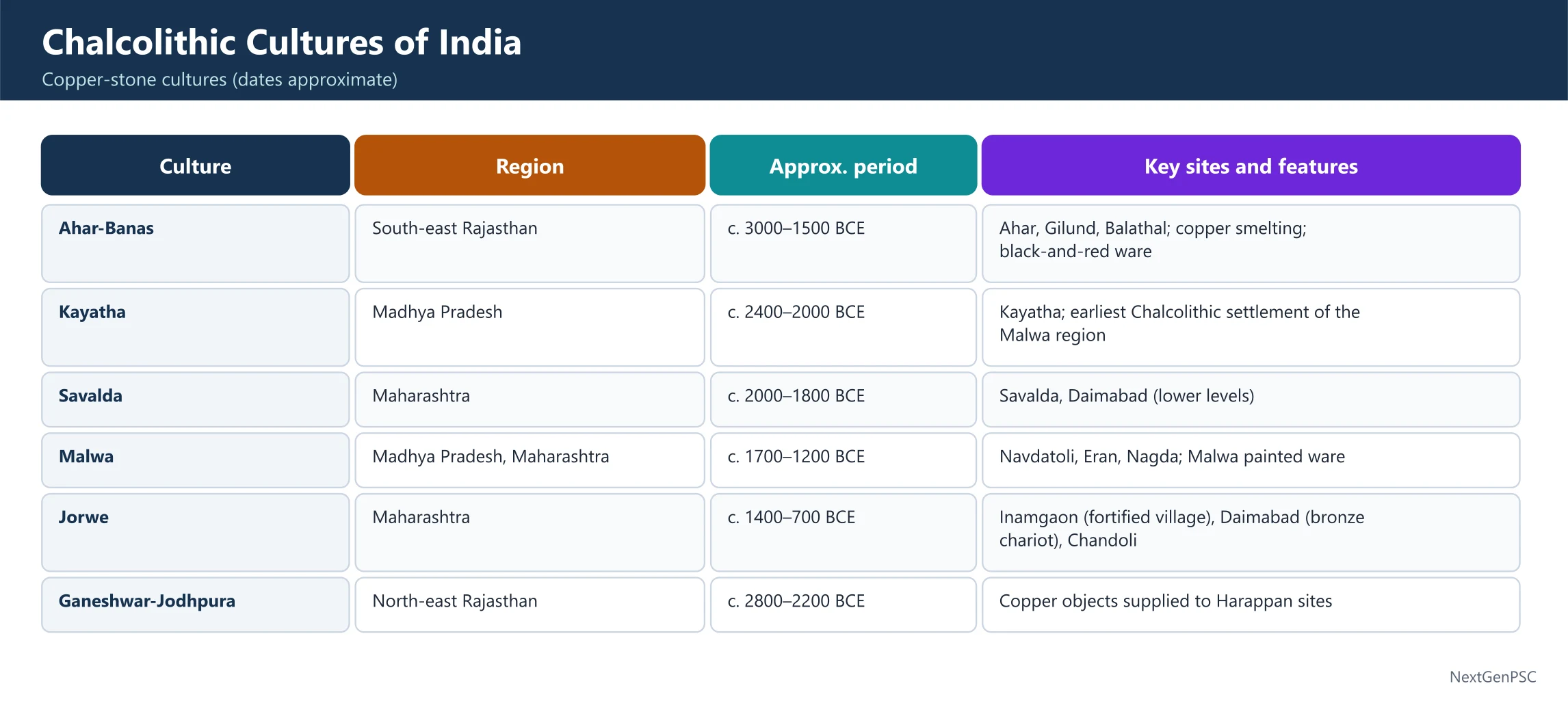
Major Chalcolithic Cultures (Easy IDs)
Ahar–Banas Culture (Rajasthan)
Location: Ahar (Udaipur), Gilund, Banas valley.
Pottery: Black-and-Red Ware with white painted designs.
Economy: Agriculture (wheat, barley, rice), animal domestication; copper working.
Distinctive: Stone structures; smelting evidence.
Malwa Culture (MP & Maharashtra)
Location: Navdatoli, Eran, Kayatha.
Pottery: Black-painted designs on orange/red background; wheel-made.
Economy: Agriculture; fortified settlements; craft specialisation.
Distinctive: Large houses; planned village layouts.
Jorwe Culture (Maharashtra, Deccan)
Location: Jorwe (Ahmednagar), Daimabad, Inamgaon.
Pottery: Red ware with black geometric patterns.
Economy: Millets, pulses; granaries ; pastoral support.
Distinctive: Stratified settlements; ritual areas; copper hoard nearby at Daimabad.
Kayatha Culture (Madhya Pradesh)
Location: Kayatha (near Ujjain).
Pottery: Red-slipped ware with painted designs.
Economy: Early copper use; agriculture; domestication.
Distinctive: Transitional traits (Neolithic + Chalcolithic).
Other Deccan Groups
Savalda: Rectangular houses; coarse handmade pottery.
Daimabad: Copper hoard (chariot, animals).
Inamgaon: Planned lanes; storage bins; varied burials.
OCP and Copper Hoards (Upper Ganga–Yamuna region)
Ochre Coloured Pottery (OCP): A broadly second-millennium BCE archaeological horizon in parts of the upper Ganga–Yamuna doab and adjoining Rajasthan. It is a useful material-culture label, not a synonym for any Vedic text or one political people.
Copper hoards: Assemblages of copper objects—such as celts, antennae swords, harpoons and anthropomorphic figures—are found mainly in north and central India. Their makers, use and exact relation to OCP remain debated; do not treat every copper hoard as an OCP find.
Beginner mnemonic
‘AMJK’ → A har–Banas (BRW), M alwa (fortified), J orwe (red-black motifs, granary), K ayatha (transitional).
| Culture | Region | Timeline | Pottery | Economy | Distinctive Features |
|---|---|---|---|---|---|
| Ahar-Banas | Rajasthan (Ahar, Gilund, Banas valley) | 3000–1500 BCE | Black-and-Red Ware with white designs | Agriculture (wheat, barley, rice), domestication | Stone structures, copper smelting evidence |
| Malwa | Madhya Pradesh, Maharashtra | 1900–1400 BCE | Black designs on orange/red wheel-made pottery | Agriculture, fortified settlements | Large houses, planned layouts |
| Jorwe | Maharashtra (Jorwe, Daimabad, Inamgaon) | 1400–700 BCE | Red ware with black geometric patterns | Millets, pulses, granaries | Social hierarchy, ritual spaces |
| Kayatha | Madhya Pradesh (near Ujjain) | 2000–1800 BCE | Red-slipped ware with decorations | Early copper use, agriculture | Transitional (Neolithic + Chalcolithic) |
| Savalda | Maharashtra | 2300–2000 BCE | Coarse handmade pottery | Agriculture, domestication | Rectangular houses |
| Daimabad | Maharashtra | 2200–1000 BCE | Associated with Jorwe repertoire | Agriculture, copper working | Copper hoard (chariot, animals) |
| Inamgaon | Maharashtra | 1600–700 BCE | Jorwe pottery | Agriculture, storage | Planned settlement, varied burials |
Prelims tips
- Ahar–Banas (Rajasthan) → white-painted black-and-red ware; Ahar = ancient Tambavati.
- Malwa ware → finest Chalcolithic pottery; Navdatoli on the Narmada.
- Jorwe (Maharashtra) → Daimabad (largest site), Inamgaon; c. 1400–700 BCE.
- Kayatha (near Ujjain) → early Chalcolithic culture with links to pre-Harappan traditions.
- Daimabad → famous bronze hoard (chariot with rider, elephant, rhinoceros, buffalo).
- Cultures: Ahar-Banas (Ahar, Balathal, Gilund – Rajasthan); Ganeshwar-Jodhpura (Rajasthan, copper supplier to the Harappans); Malwa (Navdatoli, Eran, Kayatha); Jorwe (Inamgaon, Daimabad – bronze chariot); Pandu Rajar Dhibi (West Bengal).
Mains points
- Regional Chalcolithic cultures show that farming societies developed independently across Rajasthan, central India and the Deccan.
- Their distinct pottery traditions help archaeologists trace cultural zones and movement of people.
- Sites like Inamgaon and Daimabad reveal planning, storage and social ranking in non-urban societies.
- They bridged the gap between the Neolithic and the Iron Age in regions outside the Harappan zone.
Chalcolithic Life: Economy, Society, Religion and Decline
Chalcolithic communities were village-based farmers who used copper alongside stone. They spread settled agriculture across central India, the Deccan and eastern India, showed early social inequality, worshipped a mother goddess and the bull, and declined largely because of increasing aridity after c. 1200 BCE.
Economy
Agriculture: Wheat, barley, rice, lentils, millets and other pulses. Navdatoli (on the Narmada) has yielded almost all the food grains known in ancient India.
Animal husbandry: Cattle, sheep, goats, pigs and buffaloes were kept; hunting and fishing continued.
Crafts: Copper smelting (Ahar–Banas region near the Aravalli copper sources), bead-making in carnelian and steatite, spinning and weaving; threads of cotton and silk have been found at Nevasa and Chandoli.
Pottery: Wheel-made painted pottery, especially black-and-red ware; Malwa ware is regarded as the finest Chalcolithic pottery.
Settlements and Society
Mostly rural villages; houses of mud, wattle-and-daub or stone (Ahar), both round and rectangular.
Social differentiation: At Inamgaon, a large five-roomed house next to a granary is taken as the residence of a chief; settlements show a hierarchy from large centres (Daimabad) to small villages.
Burials: In Maharashtra the dead were buried in the floor of houses, often in a north–south position, with pots and copper objects; many children were buried in urns.
Religion
Terracotta female figurines point to mother goddess worship; stylised bulls on pottery and terracotta bull figurines suggest a bull cult.
No temples have been found; worship appears to have been domestic.
Limitations
Copper was scarce and tin largely absent, so bronze tools were rare; stone tools (microliths) remained essential.
They did not know writing, did not build cities, and rarely used burnt bricks.
The large number of child burials suggests high infant mortality.
Decline
From about 1200 BCE many settlements, especially of the Jorwe culture, were abandoned, probably because of declining rainfall; people turned to a more mobile life.
The late Jorwe phase survived at sites like Inamgaon till about 700 BCE, with smaller round huts and poorer material culture.
Significance
They were the first large farming village communities of peninsular and central India and laid the base for the Iron Age and early historic cultures of these regions.
| Feature | Chalcolithic cultures | Harappan civilization |
|---|---|---|
| Settlement | Rural villages | Planned cities and towns |
| Metal | Mainly copper; bronze rare | Copper and bronze in common use |
| Writing | No script | Indus script (undeciphered) |
| Building material | Mud, wattle-and-daub, stone; burnt bricks rare | Standardised burnt bricks |
| Trade | Local and regional | Long-distance, including Mesopotamia |
| Region | Central India, Deccan, Rajasthan, eastern India | North-west, Punjab, Haryana, Gujarat |
Prelims tips
- Navdatoli → largest variety of food grains among Chalcolithic sites.
- Inamgaon → five-roomed 'chief's house' near a granary; late Jorwe phase till c. 700 BCE.
- Maharashtra burials → under house floors, north–south orientation; many child urn burials.
- Mother goddess and bull → main religious symbols; no temples found.
- Silk and cotton threads → Nevasa and Chandoli (Maharashtra).
Mains points
- Chalcolithic cultures carried settled farming into central India and the Deccan, regions the Harappans never reached.
- Evidence from Inamgaon and Daimabad shows emerging social ranking and settlement hierarchies before the rise of states.
- Their technological limits — scarce copper, no tin, no writing — help explain why they did not develop into cities.
- Their decline around 1200 BCE illustrates how climatic change (aridity) shaped early agrarian societies.
- They provide continuity between the Neolithic and the Iron Age, linking prehistory with early historic India.
Did you know?
- At Inamgaon, the feet of many buried adults were cut off — possibly so that the dead could not 'walk' back as ghosts.
- Navdatoli lies opposite Maheshwar on the Narmada and was excavated by H. D. Sankalia.
- A chief at Inamgaon appears to have been buried in a four-legged jar with his feet intact.
Copper Hoard and Ochre Coloured Pottery (OCP) Cultures
In the Ganga–Yamuna doab and adjoining regions, the 2nd millennium BCE saw hoards of copper tools and weapons and a pottery tradition with an ochre wash (OCP). The stratified find at Saipai links the two, and the Ganeshwar–Jodhpura complex shows copper production near the Khetri mines.
Copper Hoard Culture
What: Groups (hoards) of copper objects found buried together, mostly by chance, without clear settlement context.
Distribution: Mainly the Ganga–Yamuna doab; also Chota Nagpur (Jharkhand), Odisha, Madhya Pradesh, Haryana and Rajasthan.
Typical objects: Flat and shouldered celts, bar celts, antennae-hilted swords, barbed harpoons, rings and anthropomorphic figures (human-shaped copper objects).
Largest hoard: Gungeria (Balaghat, MP), found in 1870 — 424 copper objects and 102 thin silver plates.
Purpose: Debated — weapons, tools, trade items or ritual objects (especially the anthropomorphs).
Ochre Coloured Pottery (OCP)
Pottery: Medium-fabric red ware with an ochre wash that tends to rub off; some pieces are painted.
Region: Upper Ganga–Yamuna doab, Haryana and north-eastern Rajasthan.
Sites: Atranjikhera, Lal Qila, Hastinapur, Ahichchhatra, Saipai, Jodhpura, Sinauli.
Date: Broadly the 2nd millennium BCE (often placed around 2000–1500 BCE).
Link with Copper Hoards: At Saipai (Etawah) a copper harpoon was found in an OCP layer — the only clear stratified association.
Sequence: At Atranjikhera, OCP is followed by Black-and-Red Ware and then Painted Grey Ware (PGW).
Ganeshwar–Jodhpura Cultural Complex
Located in north-eastern Rajasthan near the Khetri copper mines; produced large numbers of copper arrowheads, fish-hooks and axes.
Believed to have supplied copper to the Harappans; its pottery resembles OCP.
Recent find: Sinauli (Baghpat, UP)
Excavations (2018) revealed burials with copper-covered objects, swords and remains interpreted by excavators as carts or chariots (early 2nd millennium BCE); the interpretation is still debated.
| Feature | Copper Hoard Culture | OCP Culture |
|---|---|---|
| Nature of evidence | Hoards of copper objects | Settlement sites with pottery |
| Main region | Ganga–Yamuna doab, Chota Nagpur, Odisha, MP | Upper doab, Haryana, NE Rajasthan |
| Key sites | Gungeria (largest), Saipai | Atranjikhera, Hastinapur, Lal Qila, Saipai |
| Diagnostic feature | Celts, harpoons, antennae-hilted swords, anthropomorphs | Red ware with ochre wash |
| Date (broad) | 2nd millennium BCE | c. 2000–1500 BCE |
Prelims tips
- Gungeria (Balaghat, MP) → largest copper hoard (424 copper objects, 102 silver plates).
- Saipai (Etawah) → copper harpoon in an OCP layer; links the two cultures.
- Ganeshwar–Jodhpura → near Khetri copper mines; copper supplier to the Harappans.
- Atranjikhera → sequence OCP → Black-and-Red Ware → PGW.
- Anthropomorphic copper figures and antennae-hilted swords → typical Copper Hoard objects.
Mains points
- These cultures show metal-using communities in the Ganga plain contemporary with the late Harappan phase, filling the gap before the Vedic Iron Age.
- The debate over who made the Copper Hoards (Harappan refugees, local tribes or early Vedic people) shows the limits of evidence without settlements.
- Ganeshwar–Jodhpura highlights the role of regional resource zones in sustaining Harappan trade.
- Recent finds like Sinauli reopen questions about warfare, burial customs and transport in the 2nd millennium BCE.
Did you know?
- OCP gets its name because the ochre colour comes off on the fingers when the sherds are handled.
- Some copper anthropomorphs are so heavy and blunt that scholars think they were ritual objects rather than weapons.
- Gungeria's silver plates were cut in the shape of bull heads and discs.