
Ancient Indian History · UPSC Notes
Mauryan Empire — UPSC Ancient History Notes
Free, exam-focused notes for UPSC Prelims and Mains, with Prelims tips and Mains points for every topic. 13 topics.
Open in the interactive reader: bookmarks, progress tracking and read-aloud.
Mauryan Empire (321–184 BCE): Introduction & Sources
The Mauryan Empire was the first large empire to rule much of the Indian subcontinent, founded by Chandragupta Maurya. It marked a turning point in Indian polity, economy, and administration, reaching its greatest documented extent under Ashoka. ‘Pan-Indian’ should not be read as control over every part of present-day India.
I. Introduction: The Foundation of India's First Empire 👑
The Mauryan Empire ( 321 BCE – 184 BCE ) marked the political and economic unification of ancient India, transitioning from small kingdoms (Mahajanapadas) to a vast, centrally administered imperial state.
Founder and Architect: The empire was founded by Chandragupta Maurya , who successfully overthrew the unpopular Nanda dynasty with the strategic guidance of his chief advisor, Chanakya (Kautilya) .
Capital: The political and administrative heart of the empire was Pataliputra (modern Patna, Bihar), strategically located at the confluence of the Ganga and Son rivers.
Territorial Extent: It expanded dramatically from its Magadhan base (Eastern India) to encompass nearly the entire Indian subcontinent , stretching from present-day Afghanistan (in the Northwest) to Karnataka (in the South), and Bengal (in the East).
Imperial Climax: The empire reached its greatest territorial and moral peak under Emperor Ashoka (Bindusara's son), especially after the Kalinga War (c. 261 BCE), which spurred him to adopt Dhamma (Buddhist ethics).
Key Features: The Mauryan period is celebrated for its highly centralized administration , detailed bureaucracy , economic prosperity fueled by agrarian surplus, and the unique experiment of spreading socio-ethical ideals (Dhamma) through state power.
Decline: The empire declined rapidly after Ashoka's death, eventually ending in 184 BCE when the last Mauryan ruler, Brihadratha , was assassinated by his Commander-in-Chief, Pushyamitra Shunga , leading to the foundation of the Shunga dynasty.
II. Sources of Mauryan History: Evidential Base 📜
The Mauryan Empire is the first period in Indian history for which a large number of diverse and concrete sources are available, enabling historical reconstruction.
A. Archaeological Sources (Direct Evidence):
Ashokan Edicts: These are the most authentic and primary source for Mauryan history, providing direct insight into Ashoka’s administration, religious policies, and territories. They are categorized as:
- Major/Minor Rock Edicts (on rocks or boulders).
- Major/Minor Pillar Edicts (on polished stone pillars).
- Cave Inscriptions (Barabar hills).
Scripts and Language: They were written predominantly in Prakrit language, using the Brahmi script (in most of India) and Kharoshthi (in the Northwest). Greek and Aramaic scripts were used in Afghanistan/Pakistan.
Monuments: The highly polished, monolithic Ashokan Pillars (e.g., the Sarnath Lion Capital , now the National Emblem of India ) and structural remains of Stupas (Sanchi, Bharhut) and Barabar caves (Bihar) demonstrate superior Mauryan craftsmanship and art.
B. Literary Sources (Narrative and Administrative):
Arthashastra (by Kautilya/Chanakya): A detailed Sanskrit treatise covering every aspect of statecraft, including administration, diplomacy, economics, warfare (sixfold policy), espionage, and the King's duties ( Dharmasastra and Arthasastra combined). It provides the theoretical blueprint for Mauryan administration.
Mudrarakshasa (by Vishakhadatta): A later Sanskrit drama (Gupta period) that vividly describes the political intrigue, the role of Chanakya, and Chandragupta's successful overthrow of the Nanda dynasty.
Jain Texts: The Parishishtaparvan by Hemachandra is crucial as it details Chandragupta Maurya's later life, including his decision to renounce the throne and become a Jain monk .
Buddhist Texts: Chronicles like Mahavamsa and Dipavamsa (from Sri Lanka) and narratives like Divyavadana and Asokavadana are the primary source for Ashoka's conversion to Buddhism and his efforts to propagate Dhamma.
C. Foreign Accounts (Eyewitness Testimony):
Indica (by Megasthenes): Megasthenes was the Greek ambassador sent by Seleucus Nikator (Alexander's successor) to the court of Chandragupta Maurya in Pataliputra. Although the original work is lost, fragments survive in later Classical accounts, providing eyewitness descriptions of the Mauryan capital, society (seven-fold division), and administration.
Other Classical Accounts: Writers like Pliny, Arrian, and Strabo supplemented Megasthenes’ work, mentioning details about Mauryan India's military strength and trade routes.
| Type | Examples | Importance |
|---|---|---|
| Archaeological | Ashokan edicts, pillars, stupas, caves | Direct evidence of administration, religion, language |
| Literary (Indian) | Arthashastra, Mudrarakshasa, Jain & Buddhist texts | Insights on polity, society, Ashoka’s policies |
| Foreign Accounts | Megasthenes’ Indica, Strabo, Pliny | Eyewitness and outsider perspective on Mauryan society |
Prelims tips
- Foundation → Chandragupta Maurya (321 BCE), guided by Chanakya.
- Capital → Pataliputra.
- Sources → Arthashastra (Kautilya), Indica (Megasthenes), Ashokan edicts.
- Sarnath Lion Capital = National Emblem.
- Barabar caves = oldest rock-cut caves in India.
Mains points
- Answer opening: The Mauryas created the first large empire to rule much of the subcontinent, while recognising that 'pan-Indian' does not mean control of every part of present-day India.
- State formation: A large army, provincial centres, revenue extraction, roads and officials enabled imperial integration; the actual balance between central command and local variation must not be reduced to a single rigid model.
- Source method: Ashokan edicts are the strongest contemporary evidence for Ashoka's public policy. Arthashastra, Buddhist-Jain traditions and Megasthenes illuminate other aspects, but differ in date, genre and purpose.
- Dhamma: Present it as an ethical-political policy of welfare, restraint and respect among sects, not simply as Buddhism imposed through the state.
- Conclusion: Mauryan statecraft, inscriptions and polished art made a lasting political and cultural vocabulary, even though the empire's administrative reach was uneven and its unity was not permanent.
Did you know?
- The Sarnath Lion Capital of Ashoka is India’s national emblem.
- Megasthenes described Chandragupta’s court and society in detail in ‘Indica’.
- Barabar caves (Bihar) given by Ashoka are the oldest surviving rock-cut caves in India.
- Chandragupta Maurya abdicated throne and became a Jain monk at Shravanabelagola.
Mauryan Empire: Political History & Expanse
The Mauryan Empire (321–184 BCE) was the first large-scale empire of India. From Chandragupta’s foundation with Chanakya’s guidance to Ashoka’s imperial zenith and later decline, it marked a turning point in Indian polity.
Political History: The Builders of the Mauryan Empire 👑
The Mauryan dynasty was defined by three successive strong rulers who achieved territorial expansion, diplomatic recognition, and moral leadership.
Chandragupta Maurya (321–297 BCE): The Unifier
Foundation: Founded the Mauryan Empire around 321 BCE, overthrowing the centralized but tyrannical Nanda dynasty , guided by his mentor, Chanakya (Kautilya) .
Western Consolidation: He defeated the Hellenistic general Seleucus Nikator (successor of Alexander) in 305 BCE. The resulting treaty was highly favorable to the Mauryans: Seleucus ceded vast territories ( Aria/Herat, Arachosia/Kandahar, Gedrosia/Baluchistan, and Paropamisadae/Kabul ), establishing the Mauryan frontier up to modern Afghanistan/Iran.
Diplomacy and Administration: The treaty was sealed with a marriage alliance and Chandragupta gifted Seleucus 500 war elephants . He established the highly centralized administrative structure detailed in the Arthashastra , with the capital at Pataliputra .
End of Reign: According to Jain tradition ( Parishishtaparvan ), he abdicated the throne late in life, became a Jain monk , and performed Sallekhana (fasting unto death) at Shravanabelagola (Karnataka), marking the influence of Jainism in the South.
Bindusara (297–273 BCE): The Expander
Succession: Son of Chandragupta Maurya. He successfully continued the policy of southern expansion into the Deccan Plateau.
Titles: Greek sources refer to him as 'Amitrochates' (Sanskrit: Amitraghata ), meaning the 'Slayer of Enemies' , indicating his continued military conquests.
Territorial Control: Controlled almost the entire subcontinent, consolidating territories from the Himalayas to Karnataka, with only the extreme South ( Cholas, Pandyas, Cheras ) and Kalinga remaining independent.
Foreign Relations: Maintained friendly diplomatic relations with Hellenistic kings, receiving ambassadors like Deimachus (from Antiochus I of Syria) at his court.
Ashoka the Great (273–232 BCE): The Moral Emperor
Initial Conquest: Initially expanded the empire aggressively. The brutal Kalinga War (261 BCE) , where over 1,00,000 people were killed and many more deported, was his last major military conquest.
Transformation (Dharmavijaya): Shocked by the immense bloodshed, Ashoka underwent a profound moral transformation. He embraced Buddhism (though remained tolerant of all faiths) and abandoned the policy of military conquest ( Bherighosa ) in favor of Dhamma (Dhamma-ghosa) .
Dhamma Policy: His unique policy emphasized social welfare, Ahimsa (non-violence), respect for elders, tolerance, and public service. He established Dharmamahamatras (officials) to spread and enforce Dhamma.
Monuments and Missions: Constructed numerous roads, rest houses, hospitals, and monumental Stupas (Sanchi) and Rock & Pillar Edicts across the empire. He sent organized Buddhist missions (including his son Mahendra and daughter Sanghamitra ) to Sri Lanka, Central Asia, and Southeast Asia .
Legacy: Ashokan pillars (especially the Sarnath Lion Capital ) are enduring symbols of Indian culture and state authority. He is considered the greatest ruler in ancient Indian history for his unique synthesis of imperial power and ethical governance.
Later Mauryas (232–184 BCE): Decline and Fragmentation
Weak Succession: Following Ashoka's long reign, a series of weak successors (e.g., Dasharatha, Samprati—a Jain patron) ruled fragmented regions. The empire split into eastern and western halves.
Causes of Decline: The empire fragmented due to internal factors (centralized administration became unwieldy, possible economic strain from maintaining the large Sangha, and large grants to Brahmins/Jains) and external pressures (invasions from Greeks/Bactrians in the Northwest).
End of Dynasty: The last Mauryan ruler, Brihadratha , was assassinated by his own Commander-in-Chief, Pushyamitra Shunga , in 184 BCE during a military parade, marking the end of the Mauryan Empire and the beginning of the Shunga dynasty in Magadha.
Expanse of the Mauryan Empire (The Largest Ancient Empire) 🗺️
At its height under Ashoka, the Mauryan Empire was the largest in ancient Indian history, comparable in scope only to the later Mughal Empire.
North-West Frontier: Extended to present-day Afghanistan, Baluchistan , and parts of Iran (territories acquired from Seleucus Nikator), controlling the crucial trade route (Silk Route access).
Eastern Regions: Included the core region of Magadha (Bihar) and was expanded to encompass Bengal and the newly conquered Odisha (Kalinga) .
Western Regions: Stretched to modern Gujarat (evidenced by the Junagadh/Girnar inscription which mentions Mauryan officials administering the Sudarshana Lake) and the Arabian Sea coast.
Southern Limit: Extended into the Deccan Plateau up to modern Karnataka (evidenced by Minor Rock Edicts in Karnataka).
Independent South: The Tamil regions (Cholas, Pandyas, Cheras, Satiyaputras) remained outside direct Mauryan provincial control but acknowledged Mauryan hegemony and maintained diplomatic relations.
| Ruler | Reign | Key Achievements |
|---|---|---|
| Chandragupta Maurya | 321–297 BCE | Founded empire, defeated Seleucus, centralized administration |
| Bindusara | 297–273 BCE | Expanded south, maintained foreign relations |
| Ashoka | 273–232 BCE | Kalinga War, adopted Buddhism, spread Dhamma, built stupas & edicts |
| Later Mauryas | 232–184 BCE | Weak rulers, decline, Brihadratha killed by Pushyamitra Shunga |
| Direction | Regions Covered |
|---|---|
| North-West | Afghanistan, Baluchistan, NW India |
| East | Bengal, Odisha (Kalinga) |
| West | Gujarat, parts of Iran |
| South | Deccan Plateau till Karnataka; Tamil states semi-independent |
| Center | Magadha (Bihar), capital Pataliputra |
Prelims tips
- Chandragupta Maurya defeated Seleucus (305 BCE).
- Bindusara = Amitrochates in Greek sources.
- Kalinga War (261 BCE) → turning point for Ashoka.
- Ashokan edicts = earliest extensive, securely dated corpus of inscriptions in India.
- Last Mauryan ruler → Brihadratha (killed by Pushyamitra Shunga).
Mains points
- Chandragupta laid the foundation of a centralized state with Chanakya’s guidance.
- Bindusara consolidated and expanded to the Deccan.
- Ashoka transformed from conqueror to propagator of Buddhism after Kalinga.
- The Mauryan Empire’s vast expanse shows the first attempt at pan-Indian political unity.
- Its decline reveals the challenge of sustaining such a vast centralized empire.
Did you know?
- Seleucus Nikator exchanged territories with Chandragupta and received 500 war elephants, which later helped in his battles in West Asia.
- Ashoka’s inscriptions are the earliest extensive, securely dated corpus of deciphered inscriptions in India; James Prinsep deciphered Brahmi in 1837.
- Sri Lankan Buddhist chronicles associate Mahinda and Sanghamitta with the transmission of Buddhism to Sri Lanka under Ashoka; this detail is not stated in Ashoka’s edicts.
- The Mauryan Empire was larger than Alexander’s empire in India.
Mauryan Empire: Edicts of Ashoka & Dhamma Policy
Ashoka’s edicts are the earliest extensive, securely dated corpus of deciphered inscriptions in India. They articulate Dhamma as an ethical and administrative policy; Major Rock Edict XIII records remorse after the Kalinga war, but avoid reducing the policy to one event or to Buddhism alone.
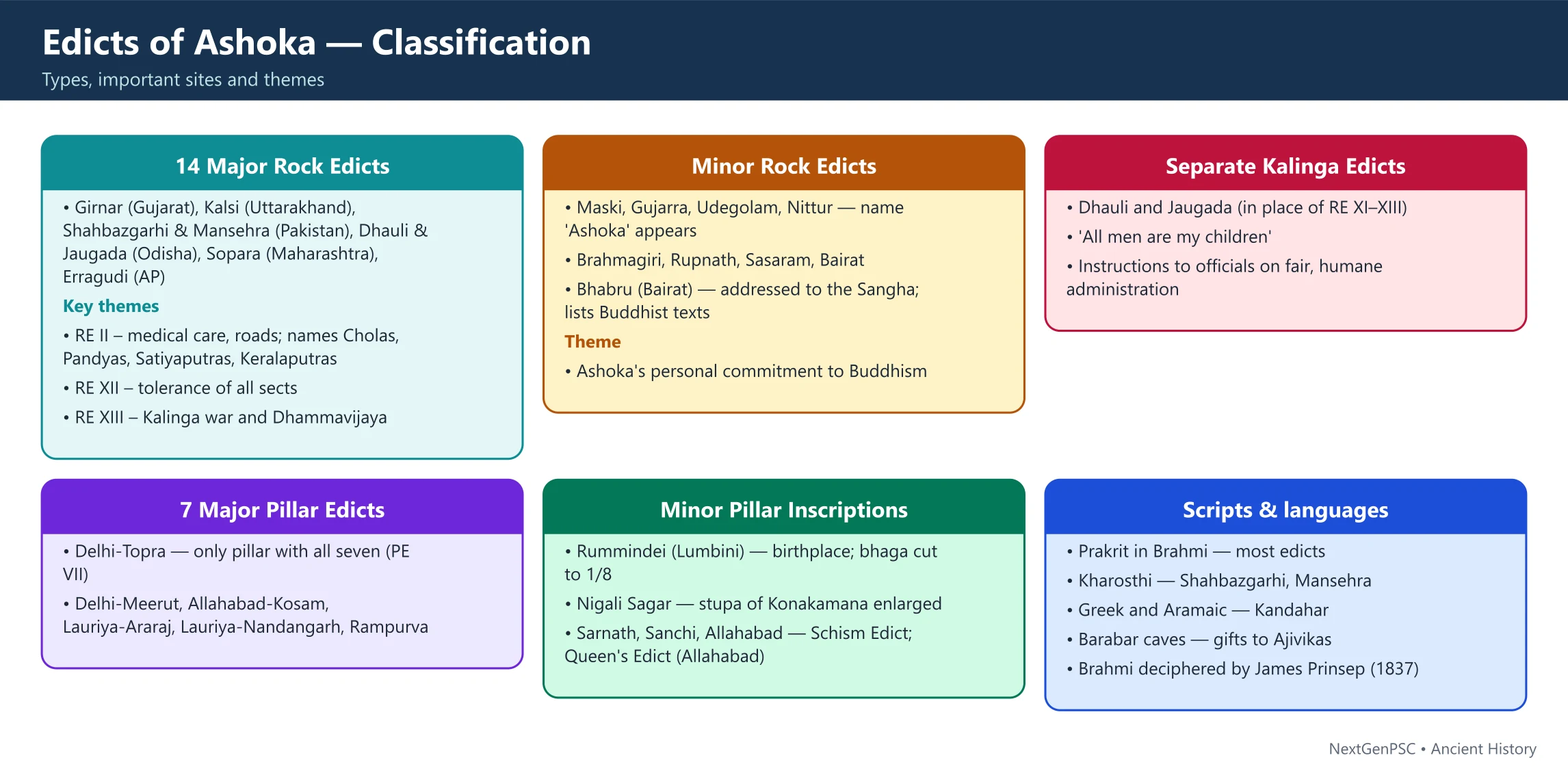
Edicts of Ashoka: The Primary Historical Source 📜
Ashoka’s inscriptions are the first in Indian history issued by a monarch and are crucial for understanding his reign and the spread of his ethical policy (Dhamma).
Location and Medium: Ashoka issued over 40 inscriptions across his empire, engraved on carefully polished rocks, free-standing pillars (monoliths) , and caves (e.g., Barabar caves).
Scripts and Languages: The vast majority of edicts in India were written in Prakrit language using the Brahmi script . However, in the Northwestern regions (Afghanistan/Pakistan), he used Greek, Aramaic, and Kharoshthi scripts (e.g., Kandahar bilingual inscription) to ensure local comprehension.
Classification: The edicts are systematically categorized:
- 14 Major Rock Edicts (MRE): Deal mainly with the principles of Dhamma and ethical conduct.
- 7 Pillar Edicts (PE): Often summarize the Dhamma and Ashoka's public works.
- Minor Rock Edicts (MRE): Describe Ashoka's personal conversion to Buddhism and his initial efforts.
- Minor Pillar Edicts: Address specific instructions to the Sangha.
Key Sites: Found across the subcontinent: Girnar (Gujarat), Dhauli & Jaugada (Odisha), Sarnath & Sanchi (MP), Kalsi (Uttarakhand), Kandahar (Afghanistan).
National Significance: The Sarnath Lion Capital , originally crowning an Ashokan pillar, is the National Emblem of India , symbolizing the enduring legacy of Mauryan art and ethical statecraft.
Ashoka’s Dhamma: A Code of Ethical Governance 🕊️
Dhamma was not a religious doctrine but a universal code of conduct and socio-ethical policy aimed at promoting peace and harmony in his diverse empire.
A. Contents and Core Principles of Dhamma:
Non-violence and Compassion: Strict prohibition on animal sacrifice (mentioned in MRE I); emphasis on Ahimsa (non-violence) and Karuna (compassion) towards all living beings (MRE III).
Social Ethics: Stressed respect for elders , obedience to parents, generosity ( Dana ) to Brahmanas and Shramanas, and humane treatment of servants and slaves (MRE XI).
Religious Tolerance: The policy of Toleration was central (MRE XII), advocating for respect between all sects (Buddhists, Jains, Brahmanas, Ajivikas) and advising against criticizing other faiths.
Moral Behaviour: Emphasis on virtues like truthfulness, charity, purity of thought, and self-control (MRE XIII).
Welfare Measures: Establishment of infrastructure for public welfare, including planting medicinal herbs, digging wells, building roads and rest houses, and providing medical care for both humans and animals (PE II).
Rejection of Ritualism: Avoidance of meaningless and superstitious rituals (MRE IX), emphasizing instead the ethical fruit of Dhamma.
B. Steps Taken to Propagate Dhamma:
Dhamma Mahamatras: Appointment of special officers called Dhamma Mahamatras to propagate the Dhamma, supervise welfare works, and redress wrongs within the empire (MRE V).
Dhamma Yatras: Ashoka replaced traditional royal hunting trips ( Vihara Yatras ) with Dhamma Yatras (personal tours) to preach morality directly to his subjects.
Missions Abroad: Sent organized missions ( Dharma-dutas ) to spread the ethical teachings to Sri Lanka (led by Mahendra & Sanghamitra ), Southeast Asia, and Hellenistic kingdoms (as confirmed by MRE XIII).
Public Inscriptions: Engraving the edicts on prominent public places (pillars and rocks) for easy access and longevity.
C. Interpretations and Significance:
Nature of Dhamma: Dhamma was definitively not a new religion , but an ethical policy blending Buddhist values (like Ahimsa) with universal moral principles.
Historical Debate: Some historians view it as Ashoka’s personal religious preference, while others see it as a pragmatic policy of state integration —a common moral language to unify a vast, multi-religious empire under central rule.
Uniqueness: Ashoka’s Dhamma remains a unique, unparalleled experiment in utilizing state power for ethical and social reform in ancient world history.
| Type | Description | Examples |
|---|---|---|
| Major Rock Edicts | 14 edicts; policies, welfare, tolerance | Girnar, Dhauli, Jaugada, Kalsi |
| Pillar Edicts | 7 pillars; Dhamma principles, Ashoka’s moral vision | Sarnath, Sanchi, Allahabad, Lauriya Nandangarh |
| Minor Rock Edicts | Personal beliefs, Buddhist influence | Maski, Brahmagiri, Gujarra |
| Minor Pillar Edicts | Buddhist missions, Dhamma Mahamatras | Sanchi, Sarnath |
| Principle | Meaning |
|---|---|
| Ahimsa | Non-violence towards humans and animals |
| Tolerance | Respect for all religions and sects |
| Family Ethics | Obedience to parents, care for children and servants |
| Charity | Dana (donation) and helping the needy |
| Public Welfare | Roads, wells, medical care for people & animals |
| Moral Purity | Truthfulness, avoidance of meaningless rituals |
Prelims tips
- Edicts → written in Prakrit (Brahmi), also Greek, Aramaic, Kharoshthi.
- Sarnath Lion Capital = National Emblem.
- Devanampiya Piyadassi = Ashoka.
- Kalinga War (261 BCE) → turning point in Ashoka’s life.
- Maski edict → first inscription mentioning Ashoka by name.
- Edicts on Buddhism: Bhabru (Bairat) edict – Ashoka declares faith in the Buddha, Dhamma and Sangha; Rummindei (Lumbini) pillar – tax cut to one-eighth and bali waived; Nigali Sagar pillar – enlarged stupa of Buddha Konakamana; Schism edicts (Sarnath, Sanchi, Allahabad); separate Kalinga edicts at Dhauli and Jaugada – 'all men are my children'.
Mains points
- Ashoka’s edicts are a unique source to understand ancient Indian polity, religion, and ethics.
- His Dhamma was not sectarian Buddhism but a moral policy for social harmony.
- Ashoka balanced conquest with compassion after the Kalinga war.
- His efforts show the use of communication and moral persuasion as instruments of governance.
- Historians interpret Dhamma as both a religious policy and a political tool for empire integration.
Did you know?
- Ashoka’s inscriptions are the first official written records in Indian history.
- The word ‘Ashoka’ does not appear in his edicts; he calls himself ‘Devanampiya Piyadassi’ (Beloved of the Gods, of Gracious Looks).
- The Maski inscription is famous because it identifies Devanampiya Piyadassi with Ashoka; similar identification is also found at Gujarra.
- His Dhamma was not Buddhism alone, but a universal code of conduct.
Major Rock Edicts of Ashoka
The 14 Major Rock Edicts of Ashoka, engraved across his empire, provide direct insights into his policies on Dhamma, governance, tolerance, and Kalinga war.
| Edict No. | Content/Message |
|---|---|
| Edict I | Prohibits animal sacrifice and festive slaughter. |
| Edict II | Medical care for humans and animals; wells and trees along roads. |
| Edict III | Urges obedience to parents, respect for elders, and proper behavior towards Brahmanas and Shramanas. |
| Edict IV | Decline of rituals and growth of Dhamma. |
| Edict V | Appointment of Dhamma Mahamatras for welfare of people and spreading Dhamma. |
| Edict VI | Ashoka’s concern for welfare of all; transparency in administration; reports to be sent to him anytime. |
| Edict VII | Promotes religious tolerance among different sects. |
| Edict VIII | Mentions Ashoka’s Dhamma Yatras (tours of compassion). |
| Edict IX | Condemns meaningless rituals; emphasizes Dhamma (moral life). |
| Edict X | Denounces fame and glory; true glory lies in Dhamma. |
| Edict XI | Dhamma is the best gift; promotes morality as the highest duty. |
| Edict XII | Religious tolerance and harmony; respect for all sects. |
| Edict XIII | Detailed description of the Kalinga War (261 BCE), remorse for bloodshed, decision to adopt Dhamma and non-violence; mentions missions sent to Greek kings. |
| Edict XIV | States that inscriptions are made in different places, in different forms, but essence is the same. |
Prelims tips
- Edict XIII → Kalinga war & remorse.
- Edict V → Dhamma Mahamatras.
- Edict VII & XII → Religious tolerance.
- Edict VIII → Dhamma yatras.
- Edict X → Rejects glory, emphasizes Dhamma.
Mains points
- The Major Rock Edicts provide a chronological record of Ashoka’s transformation from a conqueror to a moral ruler.
- They reflect his concern for welfare, morality, and religious tolerance.
- Edict XIII is crucial for understanding Ashoka’s remorse after Kalinga and the turning point in his policy.
- Edicts show the use of inscriptions as a medium of mass communication in ancient India.
- They provide the earliest insight into state policy based on ethics rather than religion alone.
Did you know?
- Major Rock Edict XIII is the most famous: it records the Kalinga war and Ashoka’s remorse.
- Edict XII advocates restraint in praising one’s own sect and condemning others; avoid unprovable ‘first in world history’ claims.
- Ashoka’s edicts occur across present-day India, Pakistan, Nepal, Bangladesh, and Afghanistan; they are not found in Sri Lanka.
- James Prinsep deciphered the Brahmi script in 1837, unlocking Ashokan edicts.
Pillar Edicts of Ashoka
Ashoka’s seven Pillar Edicts, inscribed mainly on sandstone pillars, elaborate on his Dhamma, personal beliefs, moral conduct, and administrative instructions.
| Edict No. | Content/Message |
|---|---|
| Pillar Edict I | Prohibition of animal sacrifice; festivals should avoid cruelty. |
| Pillar Edict II | Promotion of medical treatment for humans and animals; planting of trees and wells. |
| Pillar Edict III | Urges officials to be impartial, fair, and just; focus on morality over rituals. |
| Pillar Edict IV | Dhamma more important than rituals; glory lies in moral behavior, not ceremonies. |
| Pillar Edict V | Mentions appointment of Dhamma Mahamatras to spread morality and ensure welfare. |
| Pillar Edict VI | Ashoka’s personal commitment to Dhamma; confesses past mistakes and emphasizes truth, compassion, and tolerance. |
| Pillar Edict VII | Comprehensive summary of Dhamma principles: non-violence, respect, tolerance, welfare, truthfulness — considered the most important edict. |
Prelims tips
- Pillar Edict V → Dhamma Mahamatras.
- Pillar Edict VI → Ashoka’s personal confession and truthfulness.
- Pillar Edict VII → Summary of Dhamma (most important).
- Sarnath Lion Capital → National Emblem.
- Pillar Edicts carved on sandstone pillars (up to 40 feet tall).
- The Sarnath Lion Capital is carved from polished Chunar sandstone; it was adopted as India's National Emblem on 26 January 1950.
Mains points
- Pillar Edicts complement Rock Edicts in explaining Ashoka’s Dhamma policy.
- They reflect his personal transformation after the Kalinga war.
- They emphasize morality, welfare, tolerance, and ethical governance.
- Pillar Edict VII is the most comprehensive and regarded as Ashoka’s moral testament.
- The polished sandstone pillars are masterpieces of Mauryan art and engineering.
Did you know?
- The Pillar Edicts are carved on polished sandstone pillars, some over 40 feet tall.
- The Sarnath Lion Capital (National Emblem of India) comes from one such pillar.
- Pillar Edict VII is the longest and most comprehensive, summarizing Ashoka’s entire Dhamma policy.
- Unlike Major Rock Edicts, which were more public, Pillar Edicts reflect Ashoka’s personal and ethical concerns.
Mauryan Administration: Central Administration
Mauryan administration is reconstructed from inscriptions, Megasthenes’ account, archaeological evidence, and texts such as the Arthashastra. These sources differ in date, purpose, and scope, so a single uniform bureaucratic model should not be assumed.
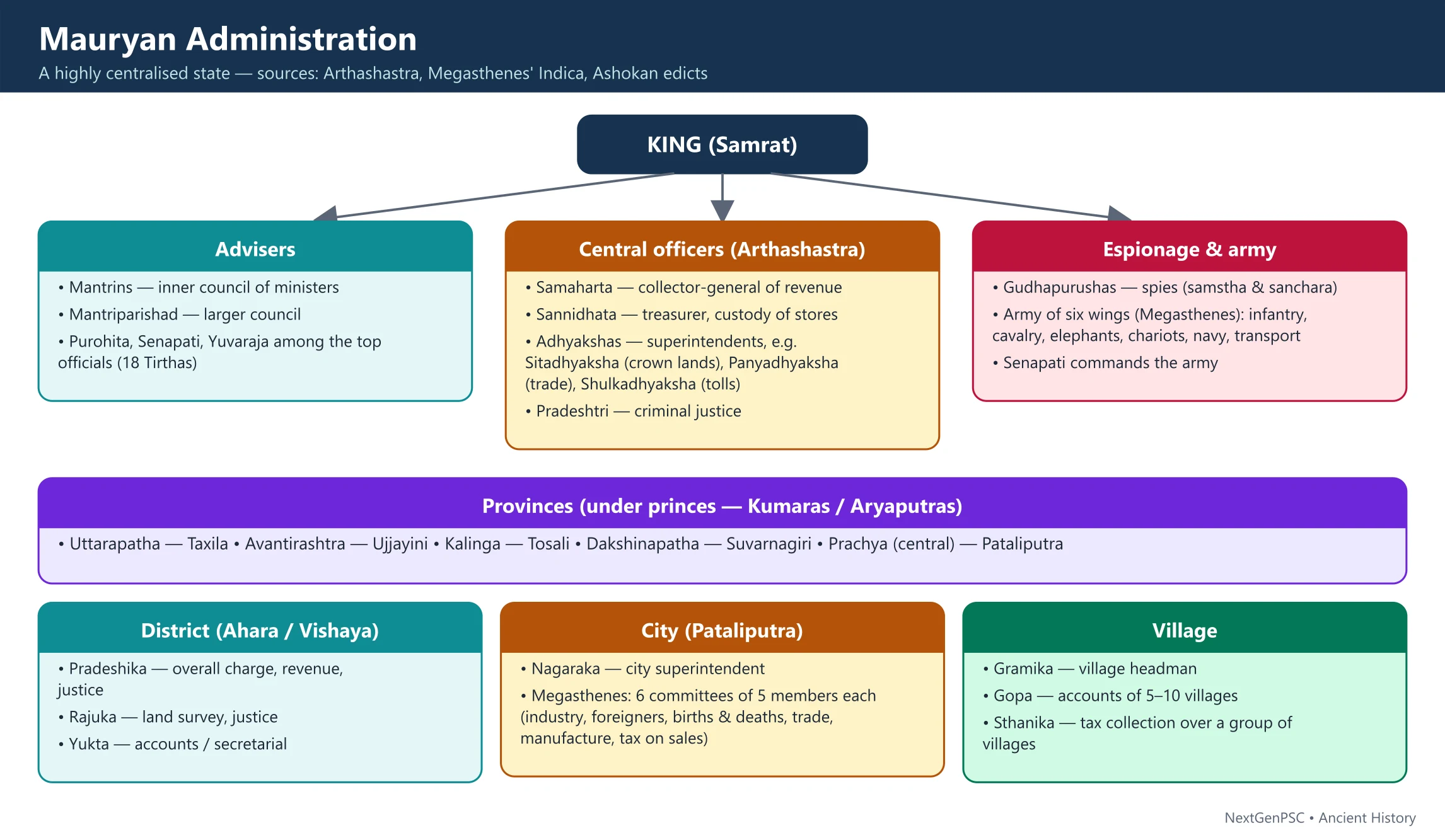
Mauryan Administration: Centralized Bureaucracy 🏛️
The Mauryan Empire combined imperial centres, provincial authorities, and local institutions. The Arthashastra provides a normative model of statecraft, not a direct administrative manual that can be assigned wholesale to the Mauryas.
I. Central Authority and Key Council
The King (Rajan or Swami) was the supreme head, possessing centralized authority over legislative, executive, judicial, and military functions.
The King was assisted by a Council of Ministers (Mantri Parishad) , which offered advice, but the final decision-making power always rested with the monarch.
The highest functionaries were called Tirthas (or Mahamatras ), forming the core of the central bureaucracy.
II. Important Officials in Central Administration
These officials managed the most critical departments of the vast empire:
Mahamantri (Chief Minister): Headed the Mantri Parishad and was the principal advisor to the King.
Senapati (Commander-in-Chief): Supreme head of the armed forces.
Purohita (High Priest): Performed rituals and advised the King on matters of Dharma and state ethics.
Amatya (Minister/Civil Servant): General administrative officers responsible for crucial tasks like revenue collection, maintaining records, and policy implementation. They were the executive backbone.
Yuvaraja (Crown Prince): The heir apparent, often assigned the responsibility of serving as the provincial governor (usually in the more critical provinces).
Mahamatras: High-ranking, special officers responsible for various critical state functions, including justice, revenue, and welfare.
Kautilya's Saptanga Theory of State
The Arthashastra defines the state not as territory, but as an organic entity composed of seven interdependent elements ( Saptanga ), crucial for UPSC understanding of Mauryan polity:
1. Swami (King): The head, symbolizing sovereignty and leadership.
2. Amatya (Ministers/Bureaucracy): The administrative and advisory body.
3. Janapada (Territory & People): The physical land and the population/subjects.
4. Durga (Fort/Capital): Strong capital and fortifications for defense.
5. Kosha (Treasury): The accumulated revenue, wealth, and resources—the financial backbone.
6. Danda (Army/Force): Military power to enforce rule and protect the state.
7. Mitra (Ally): Foreign policy and friendly states, essential for external security.
III. Departmental Heads and Provincial Governance
Adhyakshas (Superintendents) as per Arthashastra
The Arthashastra lists 27 Adhyakshas, showing the level of economic specialization and state control over production and trade. These are key for Prelims:
Sita Adhyaksha: Superintendent of Agriculture (Sita = furrow/land).
Panya Adhyaksha: Superintendent of Commerce and Trade (Panya = goods).
Sulka Adhyaksha: In charge of Customs and Tolls (revenue generation).
Navadhyaksha: Superintendent of Shipping and Ports .
Akaradhyaksha: Superintendent of Mines .
Pautavadhyaksha: Superintendent of Weights and Measures (ensuring fair trade).
Suradhyaksha: Superintendent of Liquor (state monopoly).
Lavanadhyaksha: Superintendent of Salt (state monopoly).
Officers Mentioned in Ashokan Edicts (Practical Administration)
Ashoka introduced unique officials to manage justice and Dhamma:
Dhamma Mahamatras: Special officers appointed by Ashoka to spread Dhamma, supervise welfare works , and ensure justice, acting as liaisons between the state and the people (MRE V).
Pradeshikas: Governors of the provinces (head of territorial administration); they toured the area and reported directly to the king every 5 years.
Rajukas: Officers at the district level ; responsible for both justice and revenue collection . Ashoka granted them increasing autonomy and judicial powers (PE IV).
Yuktas: Subordinate officers often assisting the Pradeshikas and Rajukas in record-keeping and revenue collection .
Amatyas: General administrators who were the highest-ranking civil servants, serving as counselors and executive heads at various levels.
| Limb | Function |
|---|---|
| Swami (King) | Head of the state |
| Amatya (Ministers) | Bureaucracy and advisors |
| Janapada | Territory and population |
| Durga | Fortifications and defense |
| Kosha | Treasury and resources |
| Danda | Army and coercive authority |
| Mitra | Allies and foreign policy |
| Adhyaksha | Department |
|---|---|
| Sita Adhyaksha | Agriculture |
| Panya Adhyaksha | Commerce & Trade |
| Sulka Adhyaksha | Customs & Toll |
| Nava Adhyaksha | Shipping & Ports |
| Akara Adhyaksha | Mines |
| Pautava Adhyaksha | Weights & Measures |
| Sura Adhyaksha | Liquor |
| Lavana Adhyaksha | Salt |
| Kosha Adhyaksha | Treasury |
| Samastha Adhyaksha | Markets |
Prelims tips
- Saptanga theory → 7 limbs of state from Arthashastra.
- Adhyakshas supervised every department (agriculture, trade, mines, liquor, salt, etc.).
- Dhamma Mahamatras → introduced by Ashoka.
- Rajukas → rural justice officers (mentioned in edicts).
- Pradeshikas → provincial governors.
- Adhyakshas (Arthashastra): Lohadhyaksha (iron), Sitadhyaksha (crown lands), Panyadhyaksha (commerce), Samsthadhyaksha (markets), Pautavadhyaksha (weights and measures), Sulkadhyaksha (tolls), Navadhyaksha (ships); Vyavaharika Mahamatras were judicial officers in towns.
Mains points
- The Mauryan central administration was highly centralized and bureaucratic.
- The king was supreme but assisted by ministers, priests, military, and provincial officers.
- The Arthashastra provides a detailed account of Adhyakshas (superintendents) and state organization.
- Ashoka introduced Dhamma Mahamatras, reflecting moral and welfare dimensions in administration.
- The Saptanga theory shows the holistic view of statecraft in ancient India.
Did you know?
- Megasthenes compared the Mauryan capital Pataliputra to cities like Susa and Persepolis due to its grandeur.
- The Mauryan administration had one of the earliest known departments for animal welfare.
- Ashoka appointed special officers (Dhamma Mahamatras) dedicated to moral and ethical governance.
- The Mauryan postal system (via runners) ensured communication across the vast empire.
Mauryan Administration: Provincial, Local & Municipal
The Mauryan Empire had a well-structured administrative system at provincial, district, village, and municipal levels. This ensured control over the vast empire from Pataliputra to farthest provinces.
Provincial Administration: The Pillars of Central Rule 🏛️
The Mauryan Empire, too vast for direct rule, was efficiently managed through a division into provinces, ensuring the writ of Pataliputra reached distant territories.
Four Main Provinces: The empire was divided into four main provincial administrative centres, with Pataliputra serving as the central Imperial capital:
- Eastern Province: Centered at Tosali (modern Dhauli/Jaugada in Odisha, controlling the resource-rich Kalinga region).
- Western Province: Centered at Ujjain (controlling the important Western trade route).
- Southern Province: Centered at Suvarnagiri (Karnataka, controlling the gold mines and Deccan access).
- Northern/North-Western Province: Centered at Taxila (controlling the Silk Route and the gateway to Central Asia).
Provincial Head: Each province was governed by a Kumara (Royal Prince) or an Aryaputra (a relative of the royal family), acting as the King's viceroy. This ensured loyalty and strong implementation of royal orders.
Function: The provincial governor was responsible for implementing the Emperor's Dhamma policy , collecting the bulk of the taxes, maintaining the large provincial army, and ensuring strict law and order.
Oversight: Central officers, notably the Pradeshikas and Rajukas , conducted regular inspection tours to check corruption and oversee the provincial administration, maintaining the highly centralized nature of the empire.
Local Administration: District and Village Structure 🏘️
Below the provinces, Kautilya's system mandated a clear hierarchy for local governance, crucial for revenue collection and justice.
Divisions: Provinces were divided into districts (known as Ahara or Aharas ), and these were further subdivided into groups of villages ( Grama ).
District Officers (The Trio): These officers were responsible for detailed administration, bridging the gap between the province and the village:
- Pradeshika: The head of the district administration; responsible for supervising law and order and touring the province every five years to oversee tax collection and justice.
- Rajuka: The core rural administrator (elevated under Ashoka, granting them judicial powers); responsible for land measurement , survey, revenue assessment, and dispensing justice at the district level.
- Yukta: Subordinate officers who functioned primarily as clerks and record keepers , managing the revenue accounts.
Village Administration: The village ( Grama ) was the smallest unit of administration, largely autonomous in day-to-day matters.
- Headed by the Gramika (village headman), who was generally an elected or traditional local official.
- The Gramika was responsible for coordinating tax collection and maintaining local law and order, acting as the primary link to the Mauryan state.
Municipal Administration: Urban Planning and Regulation 🏙️
The Mauryan Empire, being the first great urban state, required a sophisticated system for managing its capital and major cities.
Source: The most detailed account of urban governance comes from Megasthenes' Indica , describing the administration of the capital, Pataliputra .
Structure: City administration was meticulously managed by a Municipal Council of 30 members . This council was divided into six committees (boards) , each consisting of five members and responsible for a specific function.
Six Committees (Key Functions):
1. Industrial Regulation: Oversight of artisans and workshops, ensuring quality and checking adulteration.
2. Foreigners: Registration, management, and welfare of visitors and foreigners.
3. Demographic Records: Mandatory registration of births and deaths (indicating advanced statistical and administrative control).
4. Trade and Commerce: Regulation of markets, weights, and measures.
5. Manufactured Goods: Supervision of the public sale of manufactured products.
6. Taxation: Collection of customs and excise duties.
Key Urban Officials:
- Nagar Adhyaksha: The overall City Superintendent responsible for the general order and safety of the capital (as per Arthashastra).
- Samastha Adhyaksha: Superintendent of markets (ensuring price and supply control).
- Pautavadhyaksha: In charge of standardizing weights and measures .
| Province | Capital |
|---|---|
| East | Tosali (Odisha) |
| West | Ujjain (Madhya Pradesh) |
| South | Suvarnagiri (Karnataka) |
| North-West | Taxila (Pakistan) |
| Central | Pataliputra (Bihar) |
| Committee | Functions |
|---|---|
| Industry & Artisans | Regulated crafts, guilds, production |
| Foreigners | Registration, welfare, regulation |
| Births & Deaths | Maintained vital statistics |
| Trade & Commerce | Regulated trade activities |
| Manufactured Goods | Regulated quality & sale of products |
| Taxes & Duties | Collected taxes, tolls, customs |
Prelims tips
- Mauryan provinces → Tosali, Ujjain, Suvarnagiri, Taxila.
- Kumara (Aryaputra) = Viceroy of provinces.
- Pradeshika, Rajuka, Yukta = district officers.
- Municipal council of 30 members at Pataliputra (Megasthenes).
- 6 committees → Industry, Foreigners, Birth-Death, Trade, Manufactured goods, Taxes.
Mains points
- The Mauryan Empire balanced centralization with provincial and local administration.
- Provincial capitals ensured control over distant regions through royal princes.
- Village autonomy allowed integration of local traditions with imperial authority.
- Municipal administration of Pataliputra was highly advanced with specialized committees.
- This multi-tiered structure ensured efficiency in governance of a vast empire.
Did you know?
- Pataliputra’s municipal council of 30 members is one of the earliest recorded urban local governance systems in the world.
- Each Mauryan province was governed by a prince (Kumara), ensuring loyalty to the throne.
- Village assemblies had autonomy in day-to-day matters, showing a balance of centralization and local self-rule.
- Megasthenes described Pataliputra as a large, fortified city with wooden palisades and 64 gates.
Mauryan Administration: Military & Espionage System
The Mauryan Empire had one of the largest and most organized armies of the ancient world. Alongside, its espionage system described in the Arthashastra made it a highly centralized and secure state.
Military Administration: The Largest Standing Army 🐘
The Mauryan Empire relied on its formidable and highly organized military to unify and hold the vast subcontinent, a force largely documented by the foreign account of Megasthenes.
Strength and Components: The army was the largest standing professional force of its time. Megasthenes in his Indica reports its immense strength, vital for controlling such a large territory and for diplomacy (e.g., Chandragupta gifted 500 elephants to Seleucus Nikator).
Key Components (Chaturanga Bala + Navy):
- Infantry: 6,00,000 soldiers (The main component, emphasizing mass warfare).
- Cavalry: 30,000 horses.
- Elephants: 9,000 war elephants (A unique and decisive feature of Indian military might, used for shock and siege tactics).
- Chariots: 8,000 chariots.
- Navy: Essential for riverine and coastal control (mentioned in Kautilya's Arthashastra and Megasthenes).
Funding: The huge cost of maintaining this professional standing army was borne by the state through efficient land revenue and other taxes (Kosha).
Supreme Command: The overall command rested with the King , assisted by the Senapati (Commander-in-Chief) .
Military Board (Megasthenes’ Account): According to Megasthenes, military administration was executed by a dedicated War Office of 30 members , organized into 6 Committees (each with 5 members), providing specialization in logistics and command:
1. Cavalry (Ashva)
2. Elephants (Gaja)
3. Chariots (Ratha)
4. Infantry (Padati)
5. Navy (Nava)
6. Transport & Commissariat (managing supplies, provisions, and equipment).
Defense Strategy: Forts (Durga) , the fourth element of the Saptanga Theory , were crucial for territorial defense and guarding strategic trade routes.
Espionage System: The Eyes and Ears of the King 🕵️
The Mauryan espionage system was highly developed and sophisticated, crucial for maintaining internal security and centralized control, as detailed in the Arthashastra .
Purpose: Spies ( Gudhapurushas ) served as the 'eyes and ears of the king', monitoring loyalty, gathering foreign intelligence, and checking public opinion to prevent unrest or rebellion.
Categories of Spies (Sansthana and Sanchari): Kautilya categorized spies based on their method of operation:
- Sansthana (Stationary Spies): Operated from fixed locations, posing as householders, ascetics (Munda), merchants (Vaidenak) , beggars, or poisonous doctors to gather localized intelligence.
- Sanchari (Mobile/Wandering Spies): Moved across regions, disguised as wandering monks, traders, artists, or courtesans (Ganikas), providing broader intelligence and foreign monitoring.
Central Control: Gudhapurushas (Secret Agents) reported directly to the King or a high-ranking Amatya, ensuring that the information remained confidential and quickly actionable.
Function: Spies were used to monitor the loyalty of high officials, generals, and even royal princes (to prevent usurpation), suppress potential rebellions, and engage in counter-espionage against foreign agents.
Link to Dhamma: Ashoka’s edicts, while promoting ethical rule, still reflect a strong surveillance culture, as officers like Rajukas and Pradeshikas were tasked with regular tours to check local officials and ensure justice, acting as a benign form of state monitoring.
| Force | Strength |
|---|---|
| Infantry | 6,00,000 |
| Cavalry | 30,000 |
| Elephants | 9,000 |
| Chariots | 8,000 |
| Navy | Not quantified but significant for trade & defense |
| Committee | Function |
|---|---|
| Cavalry | Training, maintenance of horses |
| Elephants | Care, training, use in war |
| Chariots | Maintenance, deployment in battles |
| Infantry | Recruitment, arms, discipline |
| Navy | Riverine & coastal defense |
| Transport & Commissariat | Food, arms supply, logistics |
| Type | Role |
|---|---|
| Sansthana (Stationary) | Settled spies posing as householders, ascetics, merchants |
| Sanchari (Mobile) | Moving spies like wandering monks, entertainers, prostitutes |
| Gudhapurushas | Secret agents directly reporting to the king |
| Dutas | Messengers & diplomatic envoys |
| Vishakanyas | Poison maidens used for secret assassinations (mentioned in Arthashastra) |
Prelims tips
- Mauryan army → Infantry 6 lakh, Cavalry 30k, Elephants 9k, Chariots 8k.
- Military Board → 30 members, 6 committees (Megasthenes).
- Spies = Sansthana (stationary), Sanchari (mobile).
- Dhamma Mahamatras ≠ spies, but Ashoka’s moral officers.
- Vishakanyas mentioned in Arthashastra, not in edicts.
Mains points
- The Mauryan army was the largest standing army in ancient India and a pillar of imperial power.
- Military board ensured specialization in different branches of the army.
- Espionage was institutionalized, ensuring control over officials, provinces, and enemies.
- Kautilya emphasized spies as essential for stability of the state.
- Together, military and espionage made the Mauryan Empire highly centralized and secure.
Did you know?
- The Mauryan army was larger than Alexander’s invasion force and even contemporary Hellenistic armies.
- War elephants gave Mauryans a unique military advantage — used effectively in battles.
- Kautilya’s Arthashastra described espionage as more important than military power itself.
- The concept of Vishakanyas (poison-maidens) shows use of unconventional tactics in espionage.
Mauryan Administration: Revenue & Judicial System
The Mauryan Empire had a highly organized revenue system to maintain its vast army and administration, along with a judicial system influenced by both Arthashastra and Ashokan Dhamma.
Revenue Administration: The Financial Backbone 💰
The Mauryan state derived its massive wealth from a highly organized and extensive revenue system, primarily based on the land, as detailed in the Arthashastra .
Primary Source of Income (Bhaga): Land revenue ( Bhaga ) was the most important source, typically levied at the rate of 1/4th to 1/6th of the total produce, showcasing the agrarian nature of the economy.
Collection Method: Revenue was collected both in kind (grain) or in cash (Karshapanas). Officials like the Rajukas were responsible for land measurement, survey, and revenue assessment, ensuring efficiency.
Other Major Sources of Revenue (State Monopoly and Duties):
- Customs Duties (Sulka): Taxes on imports and exports, collected at borders and city gates.
- Monopolies: Crown control over key resources, including mines, forests, salt, and liquor , which generated significant non-tax revenue.
- Excise/Sales Tax: Taxes on trade and professions, including gambling.
- Pastoral Tax (Bali): Taxes levied on cattle and pasture lands.
Superintendents (Adhyakshas): Kautilya’s detailed bureaucracy was run by Adhyakshas (Superintendents) overseeing crucial economic departments like agriculture (Sitadhyaksha), commerce (Panyadhyaksha), mines (Akaradhyaksha), and weights & measures (Pautavadhyaksha) .
Utilization of Revenue (Kosha): The revenue ( Kosha ) maintained the large standing army , paid the vast bureaucracy , and funded extensive welfare projects (roads, hospitals, stupas), with Ashoka’s edicts specifically emphasizing reducing the burden on peasants and increasing public welfare.
Judicial Administration: Dual Philosophy of Justice ⚖️
Mauryan judiciary, centralized under the King, followed a dual approach: strict law enforcement (as per Kautilya) tempered by compassionate reform (as per Ashoka).
Supreme Authority: The King was the supreme judge and the ultimate court of appeal, holding final authority over all judicial matters.
Court Hierarchy (Based on Arthashastra and Edicts): Justice was delivered through a hierarchy of courts:
- Royal Court: Situated at Pataliputra , dealing with appeals and major cases.
- Provincial Courts: Headed by the Kumara (Viceroy).
- District Courts: Primarily under the Pradeshika and Rajuka .
- Village Courts: Village-level justice, often informal, handled by the Gramika .
Types of Courts (as per Arthashastra):
- Dharmasthiya Courts: Dealt with civil matters (disputes, contract violations).
- Kanthakashodhana Courts: Dealt with criminal matters (crimes against the state, often involving severe punishments).
Key Judicial Officials:
- Rajukas: Ashoka granted the Rajukas vast authority, including the power to administer justice and award punishment, even the death sentence , in rural areas (PE IV).
- Dhamma Mahamatras: Introduced by Ashoka to ensure that judicial decisions were delivered with compassion (Karuna) , promoted moral principles, and supervised the welfare of prisoners.
Punishments: The legal system under Kautilya emphasized harsh and deterrent punishments ( Danda-niti ), including heavy fines, imprisonment, mutilation, and the death penalty.
Ashokan Reforms (Humane Justice): Ashoka’s policy significantly shifted the emphasis, advocating for humane treatment , stressing reform, pardons , and granting a three-day respite to those sentenced to death (PE IV), symbolizing the softening of Mauryan jurisprudence.
| Source | Details |
|---|---|
| Land Revenue | 1/4th–1/6th of produce (main source) |
| Customs (Sulka) | Taxes on imports, exports, tolls |
| Mines & Forests | State monopoly on resources |
| Salt & Liquor Tax | Controlled by Adhyakshas |
| Pastoral Tax (Bali) | From cattle and herders |
| Trade & Professions | Guild taxes, artisans, shopkeepers |
| Level | Authority |
|---|---|
| Capital (Pataliputra) | King & Royal Court |
| Provincial | Kumara (Prince as Viceroy) |
| District | Pradeshika, Rajuka |
| Village | Gramika (Village Headman) |
Prelims tips
- Main revenue → Land tax (1/4th–1/6th of produce).
- Rajukas → revenue + judicial authority.
- Pradeshikas → district officers (justice + tax).
- Ashoka reduced burden on peasants (edicts).
- Dual nature → Arthashastra = harsh law; Ashoka = humane justice.
Mains points
- The Mauryan revenue system was centralized and diversified, ensuring resources for army and administration.
- Land revenue formed the backbone of the economy, but trade and monopoly taxes were also significant.
- Judiciary combined strict Arthashastra principles with Ashoka’s humane reforms.
- Rajukas highlight fusion of fiscal and judicial authority at district level.
- This dual approach of coercion and compassion ensured stability of the empire.
Did you know?
- Revenue officials (Rajukas) combined both judicial and fiscal powers.
- The Mauryan empire possibly had one of the world’s first recorded systems of birth-death registration (as per municipal boards).
- Ashoka introduced humanitarian reforms like release of prisoners during festivals.
- Kautilya advocated harsh punishments including use of spies in trials.
Mauryan Empire: Trade, Currency & Society
The Mauryan Empire controlled an extensive network of trade routes — both inland and overseas. A regulated currency system and a hierarchical social order ensured integration of the vast empire.
Trade and Commerce: Economic Prosperity 💰
The Mauryan period was characterized by significant economic prosperity, fueled by state control, extensive trade networks, and a standardized currency system.
Internal Trade Routes: The Mauryans maintained and protected extensive road networks, the most famous being the Royal Highway connecting the capital Pataliputra to Taxila (the gateway to the Northwest). Trade also relied on major riverine routes (Ganga, Indus, Godavari, Krishna), which were vital arteries for bulk transport.
External Trade: Flourished with Sri Lanka, Southeast Asia , and Western powers, including the Hellenistic kingdoms (Greece, West Asia) via land and sea.
Key Economic Exchanges:
- Exports: Fine textiles ( cotton and silk ), spices, pearls, semi-precious stones, ivory, and high-quality steel (wootz) .
- Imports: Primarily luxury goods, horses (essential for the army), wine, glass, and high-breed cattle.
State Control: Trade was highly regulated and taxed by the state. The Adhyakshas (Superintendents) ensured state monopoly and revenue generation, notably the Panya Adhyaksha (Superintendent of Commerce).
Guilds (Shrenis): Organized associations of merchants and artisans ( Shrenis ) played a crucial role in regulating production, ensuring quality, and acting as proto-banks, reflecting a complex commercial organization.
Major Ports: Key coastal centres facilitated overseas trade: Tamralipti (Bengal, for Eastern and Southeast Asian trade), and Bhrigukachcha (Broach, Gujarat) and Sopara (Maharashtra, for Western and Hellenistic trade).
Coins and Currency: Monetized Economy 🪙
The Mauryan state promoted a monetary economy through the use of standardized coinage, replacing the earlier barter-dominated system.
Primary Currency: The primary currency unit was the Punch-marked silver coins (Karshapanas) , bearing symbols of the state (sun, tree, animals). This standardized coinage is a key indicator of the centralized economy.
State Regulation: The coinage system, along with weights and measures, was strictly regulated by the state, with the Pautavadhyaksha (Superintendent of Weights and Measures) ensuring standardization and preventing fraud.
Usage: While money ( Karshapanas ) was vital for urban trade, taxation, and large transactions, Barter continued to exist, especially for local exchanges in rural areas.
Older Units: Older, non-punch-marked metallic units like Nishka (gold) and Satamana (silver) were still used for high-value transactions and ceremonial purposes.
Mauryan Society: Hierarchy and Dhamma 🕊️
Mauryan society was a complex blend of traditional varna hierarchy, emerging urban classes, and Ashoka's unique attempt at moral unification.
Varna System and Stratification: Society remained highly stratified, following the traditional varna system (Brahmanas, Kshatriyas, Vaishyas, Shudras). However, the presence of Shramana sects (Buddhism, Jainism) and the economic importance of Vaishyas and Shudras (artisans) meant the hierarchy was not as brutally extreme or solely ritual-based as in later periods.
Megasthenes' Seven-Fold Division: The Greek ambassador Megasthenes described Mauryan society as divided into seven classes (Philosophers, Farmers, Soldiers, Herdsmen, Artisans, Magistrates, and Councillors), reflecting an occupational grouping rather than the formal Varna system.
Status of Women: Women held a somewhat ambiguous position. While women in the aristocracy enjoyed high status and were active in religious life and even as spies, their overall educational and political status showed a decline compared to the early Vedic age. Ashoka’s Dhamma Mahamatras were specifically tasked with welfare work for women ( Ithijhakka Mahamatras ).
Labour System: Slavery was recognized by the Arthashastra, though Megasthenes claimed it was rare. Forced labour (Vishti) was prevalent, particularly for large state projects (like stupas, roads, and irrigation works).
Social Mobility and Diversity: Social mobility existed, primarily through the successful guilds and the urban professions . The society was marked by religious pluralism, encompassing Brahmanism, Buddhism, Jainism, Ajivikas, and Materialists (Lokayatas).
Ashoka’s Role: Ashoka’s Dhamma policy was fundamentally aimed at mitigating caste conflicts , promoting religious tolerance , and ensuring social harmony across the vast, diverse empire, recognizing the need for moral unity over ritual uniformity.
| Type | Details |
|---|---|
| Internal Trade | Royal highways, village markets, guild-based production |
| River Trade | Ganga, Indus, Godavari, Krishna |
| Maritime Trade | Ports: Tamralipti, Bhrigukachcha, Sopara |
| Exports | Textiles, spices, ivory, pearls, steel |
| Imports | Horses, wine, luxury goods, glass, cattle |
| Type of Coin | Material | Remarks |
|---|---|---|
| Karshapana | Silver | Punch-marked coins; main currency |
| Copper Coins | Copper | Local circulation |
| Nishka | Gold | Traditional high-value unit |
| Satamana | Silver | Older silver weight-based currency |
| Barter | Grain & goods | Prevalent in villages |
| Aspect | Details |
|---|---|
| Varna System | Rigid but flexible in guild-based urban life |
| Position of Women | Declining status; welfare mentioned in edicts |
| Slavery | Slavery & forced labor (Vishti) existed |
| Family | Joint family, patriarchal system |
| Religion | Diverse sects: Brahmanism, Buddhism, Jainism, Ajivikas |
Prelims tips
- Main Mauryan coin = Silver punch-marked Karshapana.
- Ports = Tamralipti, Bhrigukachcha, Sopara.
- Main source of revenue = Land tax.
- Guilds (Shrenis) = organized artisans & merchants.
- Vishti = forced labor (common in Mauryan society).
Mains points
- Mauryan trade was both inland and overseas, with state-controlled taxation and guild system.
- Punch-marked coins reflect standardization and growing monetization of the economy.
- Society was hierarchical but accommodated multiple religions and occupational groups.
- Women’s position declined, though Ashoka’s Dhamma attempted welfare measures.
- Integration of economy and society under centralized state control ensured stability.
Did you know?
- Punch-marked coins are the earliest coins in India, issued even before Mauryas but standardized under them.
- The Mauryan highway system allowed officials to send reports to Pataliputra quickly.
- Tamralipti was the busiest port of the Mauryan period, linking India with Sri Lanka and Southeast Asia.
- Megasthenes noted that Mauryan society was highly organized into occupational groups (like guilds).
Mauryan Empire: Art & Decline
The Mauryan Empire (321–184 BCE) is remembered not only for its vast political power but also for its artistic achievements in stone architecture, sculpture, and stupas. However, after Ashoka’s death, the empire gradually disintegrated due to internal weaknesses and external pressures.
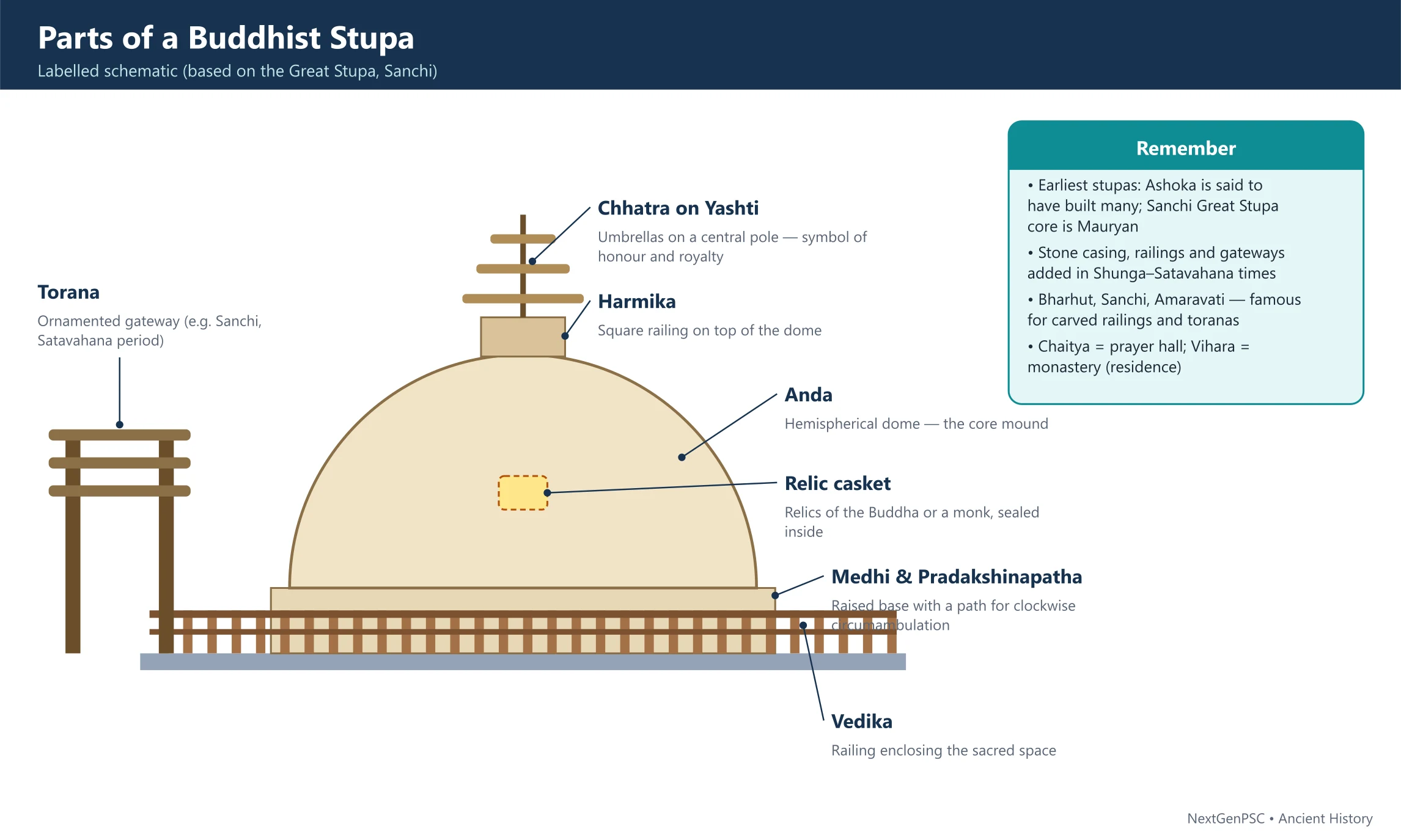
Mauryan Art and Architecture: Transition to Stone 🗿
The Mauryan period marks a revolutionary transition in Indian art and architecture, moving from the use of wood (a perishable material) to the extensive use of stone on a monumental scale. It fused indigenous traditions with foreign (Achaemenid-Persian and Hellenistic) influences.
A. Court Art: Monolithic Stone Pillars
• Ashokan Pillars: These were majestic, monolithic (made of a single block of stone) sandstone columns, often over 50 feet tall, erected across the empire to propagate Dhamma.
• Characteristic Features: The pillars exhibit an exceptional Mauryan polish , giving the surface a distinct mirror-like shine . They typically feature a base, a shaft, and a crowning animal capital (e.g., bull, lion, elephant).
• Sarnath Lion Capital: The most famous pillar capital, featuring four addorsed lions resting on a drum carved with a Dharmachakra (Wheel of Law) and four animals (lion, elephant, bull, horse). It serves as the National Emblem of India .
B. Rock-cut Architecture (Cave Temples)
• Purpose: These structures, carved out of living rock, were primarily Viharas (residence/retreats) for monks and ascetics.
• Barabar and Nagarjuni Hills (Bihar): The earliest surviving examples are the Lomas Rishi Cave (famous for its decorated entrance mimicking wooden architecture) and Sudama Cave . These were graciously dedicated by Emperor Ashoka to the Ajivika sect .
• Interior Finish: They display the same high Mauryan polish on their interiors as seen on the pillars, indicating advanced craftsmanship.
C. Stupas (Relic Mounds)
• Ashoka's Role: Buddhist tradition credits Ashoka with building an astonishing 84,000 stupas across his empire, serving as monumental reliquaries for the Buddha's remains.
• Major Sites: Important early stupas are located at Sanchi and Bharhut (though their elaborate stone railings/ toranas were later additions in the Shunga period).
• Structure: A Stupa typically consists of a hemispherical dome (anda), a railing (vedika), and later, elaborately carved gateways (toranas).
D. Sculpture (Folk Art)
• Yaksha-Yakshi Figures: These large, free-standing sculptures of local male ( Yaksha ) and female ( Yakshi ) deities represent the vigorous indigenous folk tradition blended with the polish of Mauryan court art.
• Example: The famous Didarganj Yakshi (Patna, Bihar) exemplifies the Mauryan treatment of polished sandstone, featuring life-like vitality and massive scale.
Disintegration of the Mauryan Empire: Causes of Collapse 💥
The Mauryan Empire, despite its strong initial foundation, collapsed rapidly within fifty years of Ashoka's death due to multiple interconnected factors:
1. Weak and Incompetent Successors: After the long reign of Ashoka (273–232 BCE), the central authority was weakened by a series of incompetent and weak rulers (e.g., Dasharatha, Samprati), who lacked the personality or administrative capacity to manage the vast empire.
2. Over-centralization and Administrative Rigidity: The Mauryan system was overly dependent on the monarch's personal leadership . Without a strong leader like Ashoka or Chandragupta, the highly centralized administrative machinery became rigid and collapsed under its own weight.
3. Financial Strain: Maintaining the largest standing army in ancient India, funding a vast bureaucracy , and undertaking Ashoka's extensive welfare measures and stupa building projects heavily drained the Imperial treasury (Kosha).
4. Brahmana Reaction: Ashoka’s strong advocacy of Dhamma , which included a ban on animal sacrifice and generosity toward Shramana sects (Buddhism/Jainism), is believed by some historians to have alienated the orthodox Brahmanas , who resented the loss of their influence and income from Vedic rituals.
5. Military Weakness: Ashoka's subsequent pacifist policy (Dhamma-ghosa) , though morally commendable, may have indirectly led to a perceived or real weakening of the offensive capacity of the army, making it vulnerable to external threats.
6. Rise of Regional Powers & Internal Revolts: Provincial governors and local chieftains seized the opportunity presented by the weak central leadership to assert independence . This led to internal revolts in peripheral regions like Kalinga, Andhra, and Punjab.
7. Foreign Invasions: The Bactrian-Greek invasions (led by figures like Demetrius and Menander) from the North-West Frontier exploited the military weakness and fragmentation, slicing off the westernmost parts of the empire.
The Final Blow: The last Mauryan ruler, Brihadratha , was assassinated in 184 BCE by his own Commander-in-Chief, Pushyamitra Shunga , during a military parade, marking a Brahmanical counter-reaction and the end of the Mauryan dynasty, which was immediately succeeded by the Shunga dynasty .
| Form | Examples | Features |
|---|---|---|
| Pillars | Sarnath, Sanchi, Lauria Nandangarh | Monolithic, polished, animal capitals |
| Stupas | Sanchi, Bharhut, Piprahwa | Hemispherical dome, railings, symbolism |
| Rock-cut Caves | Barabar Hills (Lomas Rishi, Sudama) | Highly polished, Ajivika donation |
| Sculpture | Didarganj Yakshi, Yaksha figures | Folk + Mauryan polish, realism |
| Reason | Explanation |
|---|---|
| Weak Successors | Ineffective rulers after Ashoka |
| Over-centralization | Vast empire hard to control |
| Financial Crisis | Treasury exhausted by army & welfare |
| Pacifist Policy | Ashoka reduced military aggressiveness |
| Rise of Provinces | Governors declared independence |
| Brahmana Opposition | Ashoka’s Buddhism alienated Brahmanas |
| Foreign Invasions | Bactrian-Greek attacks |
| Internal Revolts | Regional uprisings (Kalinga, Andhra, Punjab) |
| Rigid Administration | Collapse of centralized system without strong king |
Prelims tips
- Didarganj Yakshi = example of Mauryan sculpture + polish.
- Barabar Caves = Ajivikas, Ashoka & Dasaratha’s donation.
- Sarnath Lion Capital = National Emblem.
- Last Mauryan ruler = Brihadratha (killed by Pushyamitra Shunga).
- Main cause of decline = Weak successors + financial crisis.
Mains points
- Mauryan art marks the beginning of stone architecture in India.
- Stupas, pillars, and caves reflect state patronage of religion and art.
- Decline due to combination of weak rulers, financial strain, and external invasions.
- Ashoka’s Dhamma weakened military aggressiveness, making empire vulnerable.
- Fragmentation after Ashoka shows dependence of empire on strong central leadership.
Did you know?
- The Sarnath Lion Capital is now India’s National Emblem.
- Mauryan polish gave a mirror-like shine to stone surfaces — unmatched in later centuries.
- Ashoka is said to have built 84,000 stupas to enshrine relics of Buddha.
- Brihadratha, the last Mauryan ruler, was killed during a military parade by Pushyamitra Shunga.
Mauryan Period: Heterodox Sects (Ajivikas)
The Mauryan period, known for its religious pluralism, saw the patronage of the Ajivika sect alongside Buddhism and Jainism. The Ajivikas, founded by Makkhali Gosala , believed in Niyati (fatalism/determinism)—the belief that everything is strictly predetermined and human effort is futile. Emperor Ashoka and his successor Dasharatha donated the Barabar and Nagarjuni caves to this sect.
Ajivika Philosophy: Determinism (Niyati)
The Ajivika sect emerged as a major contemporary rival to Buddhism and Jainism in the 6th century BCE.
Founder: Makkhali Gosala was initially a companion of Mahavira before breaking away to found his own sect.
Core Doctrine: Niyati (Fatalism/Determinism) . They taught that human effort has no bearing on destiny; the soul's suffering is pre-ordained over a fixed cycle of 8,400,000 Mahakalpas, after which liberation occurs automatically.
Ethical Stance: Given their fatalistic view, they believed ethical conduct or extreme asceticism was ultimately pointless, contrasting sharply with the emphasis on Karma and free will in Buddhism and Jainism.
Mauryan Patronage and Legacy
Imperial Patronage: Ashoka's policy of Dhamma stressed tolerance towards all sects. He demonstrated this by building and dedicating the Barabar Caves (Bihar) near Rajagriha to Ajivika ascetics (MRE XII).
Successor's Support: Ashoka's grandson, Dasharatha , continued this tradition by dedicating the Nagarjuni Caves to the Ajivikas, providing them with Viharas (retreats).
Archaeological Significance: The Barabar and Nagarjuni caves are the oldest surviving rock-cut caves in India, showing the importance of the Ajivika sect during the Mauryan period.
Decline: The sect flourished during the Mauryan and post-Mauryan periods but gradually declined in the medieval era, likely due to the highly deterministic nature of their doctrine and the lack of popular appeal compared to the pragmatic ethics of Buddhism.
Prelims tips
- Ajivika founder: Makkhali Gosala .
- Core doctrine: Niyati (fatalism).
- Barabar and Nagarjuni caves were donated by Ashoka and Dasharatha to the Ajivikas.
- Ajivikas were contemporary rivals of Buddha and Mahavira.
Mains points
- The patronage of the Ajivikas highlights religious pluralism and toleration under the Mauryan Empire.
- The doctrine of Niyati provided a philosophical alternative to the prevailing Karma-based beliefs.
- The existence of the Barabar caves provides archaeological evidence of Mauryan art and the state's welfare measures for ascetic sects.
- The eventual decline of Ajivika shows the importance of ethical pragmatism over rigid determinism for mass appeal.
Mauryan Economy: Sources and Revenue Collection
The Mauryan economy was largely agrarian, centered on the fertile plains of the Ganga. Our understanding of its economic structure, especially the rigorous taxation and revenue system, is primarily derived from Kautilya's Arthashastra , which details state control over trade, mines, and monopolies.
Sources of Economic Information (The Evidence)
Arthashastra: The primary and most systematic source. It details economic policy (Varta) , including agriculture, trade, taxation, and state monopolies. It prescribes the duties of various Superintendents ( Adhyakshas ).
Ashokan Edicts: Provide practical evidence of economic life, such as the Rummindei Pillar Edict , which mentions the reduction of land tax (Bhaga) in the birthplace of the Buddha (Lumbini) to 1/8th, showing the state's tax control.
Foreign Accounts (Indica): Megasthenes describes the abundance of resources, the occupational division of society (farmers being the most numerous), and the detailed municipal oversight of trade and industry.
Archaeological Finds: Punch-marked coins (Karshapanas) confirm the monetary economy; NBPW pottery (Northern Black Polished Ware) reflects the prosperity and extent of urban trade routes.
Revenue Collection System (Arthashastra Mandate)
The central revenue authority was the Samaharta (Chief Collector General) , and the head of the treasury was the Sannidhata .
Land Tax (Bhaga): The principal source, usually 1/6th of the produce , collected by Rajukas and Yuktas .
Other Agrarian Taxes: Sita (tax from crown land, cultivated by the state), Bali (a religious tax or tribute), and Kara (a general tax).
Monopolies & State Control: The state held monopolies over crucial sectors ( Akara - mines, Lavana - salt, Sura - liquor, Nava - shipping), maximizing revenue. Superintendents ( Adhyakshas ) managed these monopolies.
Trade & Urban Taxes: Sulka (customs duty on imports/exports, fixed at 1/5th or 1/10th), sales tax, and octroi were levied by municipal committees (as described by Megasthenes).
Forced Labour (Vishti): Used for public works, although Megasthenes claimed slavery was unknown in India.
| Official (Arthashastra) | Function |
|---|---|
| Samaharta | Chief Collector General (central revenue head) |
| Sannidhata | Chief Custodian of the Treasury |
| Sita Adhyaksha | Superintendent of Agriculture (Crown Land) |
| Rajuka | Assessor of land revenue & judicial officer |
| Yukta | Subordinate revenue and accounts officer |
Prelims tips
- Primary source for revenue: Arthashastra .
- Most important tax: Bhaga (Land Tax, 1/6th of produce).
- Sita = revenue from Crown lands.
- Rummindei Edict confirms Ashoka reduced the tax on Lumbini's land (to 1/8th).
- Samaharta = Chief Collector; Sannidhata = Chief Treasurer.
Mains points
- The Mauryan revenue system was centralized and highly efficient, necessary for sustaining the massive army and bureaucracy.
- Arthashastra reveals state control over crucial economic sectors (mines, salt, trade) through monopolies.
- The system shows an early attempt at formal, standardized taxation (Bhaga, Sulka) replacing the earlier voluntary offerings (Bali).
- Ashoka’s edicts (like Rummindei) illustrate the political and ethical control over the tax structure.