
Ancient Indian History · UPSC Notes
Vedic Age — UPSC Ancient History Notes
Free, exam-focused notes for UPSC Prelims and Mains, with Prelims tips and Mains points for every topic. 17 topics.
Open in the interactive reader: bookmarks, progress tracking and read-aloud.
Vedic Age: Background (The Arrival of the Aryans)
The Vedic Age (conventionally c. 1500–600 BCE) is reconstructed chiefly from Vedic texts, which were composed and transmitted orally over a long period. The linguistic relationship of Vedic Sanskrit to other Indo-European languages is well established; the routes, chronology, and social processes of Indo-Aryan migration and settlement should not be reduced to a single certainty.
Chronology (Two Phases)
Early Vedic Period (Rigvedic Age): c. 1500–1000 BCE. Defined by the composition of the Rigveda .
Later Vedic Period: c. 1000–600 BCE. Defined by the composition of the other three Vedas and eastward expansion.
Sources of Information (Literary Focus)
Vedas: The primary source ( Rigveda, Samaveda, Yajurveda, Atharvaveda ).
Supportive texts: Brahmanas (ritual manuals), Aranyakas (forest treatises), Upanishads (philosophy—soul, reality, liberation).
Later epics: Ramayana , Mahabharata were compiled later but preserve memories of later Vedic culture and geography.
Background of Aryans (Theories of Origin)
Indo-Aryans spoke languages of the Indo-European family , linking them linguistically to Iran and parts of Europe.
Many scholars relate the spread of Indo-Aryan languages into northwestern South Asia to movements from the Eurasian steppe during the second millennium BCE. Exact dates, routes, and social processes remain subjects of research; named passes cannot be treated as established routes.
UPSC caution: Do not attribute a settled ‘Central Asian theory’ to Max Müller. Present the Indo-Aryan question through linguistic, archaeological, and genetic evidence, while distinguishing evidence from political claims.
First settled in PUNJAB , the Sapta-Sindhu (Land of Seven Rivers).
Why the Vedic Age matters (Beginner view)
Shows a shift from semi-nomadic pastoralism to settled agriculture and territorial kingdoms.
Seeds of Indian thought: Dharma (duty/ethics), Karma (action and result), early social division ( Varna ), and evolving political ideas.
Simple Timeline Memory Aid
1500–1000 BCE: Songs to nature, cattle wealth, tribes in Punjab.
1000–600 BCE: Farming spreads east, iron tools begin, bigger kingdoms rise.
| Phase | Timeline | Key Features |
|---|---|---|
| Early Vedic (Rigvedic) | 1500–1000 BCE | Rigveda composed , pastoral society, centered in Punjab (Sapta-Sindhu) |
| Later Vedic | 1000–600 BCE | Other Vedas composed, agriculture expanded , eastward spread to Ganga valley, iron begins |
Prelims tips
- Rigveda is the oldest Veda (c. 1500–1000 BCE).
- Two clear phases: Early (Rigvedic) and Later .
- Indo-Aryan migration is discussed using linguistic, archaeological, and genetic evidence; avoid presenting a single dated route or a ‘Max Müller theory’ as settled fact.
- Sapta-Sindhu = cradle of early Vedic culture.
- Veda literally means knowledge .
Mains points
- The origin of the Indo-Aryans remains debated; linguistic links with Iranian and European languages point to migration, while others argue for indigenous development.
- The Boghazkoi inscription (c. 1400 BCE) naming Vedic gods shows wider Indo-Iranian connections.
- Recent ancient DNA studies add a new line of evidence to the migration debate, which should be presented with balance.
- The Vedic period marks a shift from urban Harappan culture to a pastoral, rural society in the north-west.
Early Vedic Age (Rigvedic Period) - Life in Sapta-Sindhu
The Early Vedic Age (conventionally 1500–1000 BCE) is portrayed in the Rigveda as a predominantly pastoral, kin-based society in which cattle were important. The precise workings of political assemblies and social institutions are inferred from texts and should not be labelled a modern ‘democracy’.
Geographical Location
Core area: Punjab and northwestern India , the Sapta-Sindhu (Land of Seven Rivers).
Important Rivers: Sindhu (Indus), Vitasta (Jhelum), Parushni (Ravi), Sutudri (Sutlej), and especially the praised Saraswati .
Aryans gradually moved toward the Ganga-Yamuna doab but PUNJAB remained central in this phase.
Society (Flexible and Egalitarian)
Basic units: Griha (family) → Vish (clan) → Jana (tribe). Society was tribal and patriarchal .
Women and texts: The Rigveda preserves hymns associated with women such as Ghosha and Lopamudra. It does not justify a blanket claim that women attended particular assemblies or that later practices were wholly absent; social access varied by context.
Varna: Early, flexible stage; divisions by work more than birth. Shudra reference appears once (Purusha Sukta, Mandala 10).
Wealth: Cattle (Gau) —chief measure of wealth and compensation (fines/gifts in cows).
Polity (Limited Monarchy)
Rajan: Tribe’s chief— not absolute or always hereditary.
Assemblies: Sabha, Samiti, and Vidatha are mentioned in the Rigveda. Their membership and exact functions are debated; they indicate consultation and collective activity, not a modern constitutional check on the rajan.
Key officials: Purohita (priest-adviser), Senani (war leader).
Administration: The evidence points to a comparatively less bureaucratic polity than later states. Avoid treating the absence of a standing army or a tax system as conclusively established. Gavishti is commonly glossed as a search for cows and reflects the importance of cattle conflicts.
Economy (Pastoral First)
Main occupation: Pastoralism (cattle rearing).
Agriculture: Practised (barley, wheat) but secondary to herding.
Technology: Iron unknown ; tools of copper and stone .
Trade: Barter common; cows often used as value units.
Religion (Naturalistic and Simple)
Polytheism: Deities personify natural forces.
Key deities: Indra (thunder/war; most invoked), Agni (sacrificial fire—messenger between men and gods), Varuna (cosmic order— Rita ).
Worship: Yajnas (sacrifices), hymns, prayers for worldly goods (rain, cattle, sons, victory).
Absent: No temples or idol worship in this period.
Beginner Memory Aids
Society: Jana (tribe) and kinship groups are important Rigvedic categories. Do not project the later jati system or a uniform joint-family model back onto the entire early Vedic period.
Polity = 3S: Sabha Samiti Senani (with Purohita ).
Economy = 3C: Cattle Copper Cashless (barter) .
| Aspect | Features |
|---|---|
| Geography | Punjab & Sapta-Sindhu region (Indus–Saraswati zone) |
| Society | Tribal , patriarchal, women respected , flexible varna , cattle wealth |
| Polity | Rajan with limited power; Sabha , Samiti , Vidhata active |
| Economy | Pastoralism primary; farming secondary; barter ; no iron |
| Religion | Naturalistic , polytheistic; Indra, Agni, Varuna ; yajnas ; no temples/idols |
| Literature | Rigveda (1028 hymns, 10 mandalas); oral tradition |
Prelims tips
- Rigveda mentions Sapta-Sindhu (‘land of seven rivers’).
- Women like Lopamudra composed hymns.
- Rajan was checked by Sabha , Samiti , Vidhata .
- Key deities: Indra , Agni , Varuna ( Rita ).
- Cattle were the main wealth; economy = pastoral first.
Mains points
- Rigvedic society was tribal, pastoral, and relatively egalitarian , unlike the more stratified later Vedic phase.
- Use a change-over-time frame: Explain the movement from jana-based pastoral communities to larger territorial polities, settled agriculture, iron use and sharper social hierarchy in the Later Vedic phase.
- Political power was decentralised through Sabha and Samiti , limiting the Rajan .
- Evidence: The Rigveda is a source for early Vedic society, while later Vedic texts, Painted Grey Ware contexts and archaeology must be used carefully for subsequent developments; no single source should be made to speak for the whole period.
- Women’s position was noteworthy in education, religion, and assemblies.
- Qualification: References to women such as Gargi and Maitreyi show possibilities within elite textual traditions; they do not establish equal status for all women across regions and social groups.
- Naturalistic religion rooted in yajnas formed the ritual base for later Hindu practice.
- Answer conclusion: The Vedic age should be presented as a long, internally changing phase—not as a static cultural block or a direct equivalent of modern social institutions.
Did you know?
- Rigveda is the oldest surviving Indo-European text.
- Indra is invoked around 250 times—most frequent deity.
- Gavishti literally means ‘search for cows’, showing cattle-centric wars.
- The term Bharata appears, hinting at early identity.
Rigvedic Rivers and Regions (The Sapta-Sindhu)
Rigvedic culture was centered in the ' Sapta-Sindhu ' (Land of Seven Rivers) region in northwestern India and Pakistan. The rivers were central to their life, providing water for pastures and early agriculture, and are frequently praised in the Rigveda .
Sapta-Sindhu (Land of Seven Rivers) — Easy Map Mental Image
Think of a fan-shaped plain west to east: from Afghanistan (Kabul) into Punjab and down to Sindh.
Called the ' cradle of Rigvedic culture ' because most hymns praise its rivers and pastures.
The commonly listed Seven Rivers : Sindhu (Indus), Vitasta (Jhelum), Asikni (Chenab), Parushni (Ravi), Vipasha (Beas), Sutudri (Sutlej), and Saraswati (Ghaggar-Hakra).
Some lists include Drishadvati (Chautang) or Kubha (Kabul) and Krumu (Kurram) as associated western rivers.
River Significance in Rigveda (Beginner Notes)
Saraswati: The most praised—described as mighty, pure, life-giving; titled 'Ambitame, Naditame, Devitame' (best mother, best river, best goddess). Today identified with the Ghaggar-Hakra system (mostly dry/seasonal).
Sindhu (Indus): Revered as the greatest river , the 'mother of rivers'; many tributaries join it in Punjab.
Ganga & Yamuna: Briefly mentioned in Rigveda (Ganga ~1 time, Yamuna ~3 times) → shows Aryans were not yet settled in the Gangetic plains ; these become central only in Later Vedic times.
Western Rivers: Mentions of Kubha (Kabul) , Krumu (Kurram) show connections with the northwest/Afghanistan region and the direction of early movements.
Why Rivers Mattered (Super Simple)
Pastures: Watered grasslands for cattle (core of Rigvedic economy).
Farming: Early barley/wheat cultivation along riverbanks.
Travel/Trade: Rivers were natural routes and boundaries .
Religion: Many hymns personify rivers as goddesses —purity, prosperity, protection.
Quick Memory Aids
Five rivers of Punjab (to pair with Sanskrit names): Jhelum– Vitasta , Chenab– Asikni , Ravi– Parushni , Beas– Vipasha , Sutlej– Sutudri .
Battle of Ten Kings (Dasharajna) was fought on the banks of Parushni (Ravi) .
| Rigvedic Name | Modern Name | Significance |
|---|---|---|
| Sindhu | Indus | Most revered, 'Mother of Rivers' |
| Saraswati | Ghaggar–Hakra (largely dry) | Most praised; 'Ambitame, Naditame, Devitame' |
| Vitasta | Jhelum | One of the Five Rivers of Punjab |
| Parushni | Ravi | Site of the 'Battle of Ten Kings' |
| Asikni | Chenab | Seven Rivers list; western Punjab |
| Vipasha | Beas | Seven Rivers list; flows from Himachal |
| Sutudri | Sutlej | Seven Rivers list; easternmost of the five |
| Kubha | Kabul | Shows northwest/Afghan link |
| Krumu | Kurram | Western tributary; migration hint |
| Drishadvati | Chautang | Often paired with Saraswati in later texts |
Prelims tips
- Sapta-Sindhu = core Rigvedic zone in the northwest.
- Saraswati is the most praised river in Rigveda.
- Mentions of Kubha & Krumu show northwest/Afghan links.
- Ganga & Yamuna are minor in Rigveda; major in Later Vedic.
Mains points
- Rigvedic river names help locate the early Vedic people in the Sapta-Sindhu region of Afghanistan, Punjab and Haryana.
- The importance of the Sindhu and the Saraswati reflects a river-based pastoral and early farming economy.
- The eastward shift of geography in later texts (from Punjab to the Ganga plain) traces the expansion of Vedic culture.
- The identification of the Saraswati with the Ghaggar–Hakra links Vedic geography with Harappan archaeology, though it remains debated.
Rigvedic Terms and Their Meanings (Key Vocabulary)
Understanding Rigvedic terms is essential for UPSC, as they reflect the simple tribal polity, pastoral economy, and social structure of the Early Vedic people, which later transformed dramatically.
| Term | Meaning (UPSC Focus) |
|---|---|
| Rajan | Tribal chief or king (power was limited by assemblies ) |
| Sabha | Council of elders and nobles ( Aristocratic Assembly ) |
| Samiti | General tribal assembly ( Popular Assembly ; involved common people) |
| Vidhata | Earliest and most diverse assembly ( men and women participated ; social, religious functions) |
| Purohita | Priest (advisor to the Rajan; performed yajnas ) |
| Senani | Military commander of the tribal militia |
| Jana | Tribe ( basic unit of Rigvedic society) |
| Vis (Vish) | Clans/common people of the tribe |
| Grama | Cluster of families/villages |
| Gotra | Lineage/clan (early social marker; exogamy idea develops later) |
| Gavishti | Cattle raid/war ( search for cows ) |
| Gau | Cow ( symbol of wealth ; unit of value/gifts) |
| Rita | Cosmic law/natural order ( Varuna as guardian) |
| Pur | Fort (often wooden; Indra as 'Purandara'—destroyer of forts) |
| Bali | Voluntary offering/tribute to the chief (not a regular tax) |
| Nishka | Gold ornament (also used as a unit of value/gift) |
| Gramani | Head of the Grama (village leader) |
Prelims tips
- Sabha = aristocratic; Samiti = popular assembly.
- Vidhata is earliest; women participated .
- Rajan 's power was limited by assemblies.
- Gavishti = war for cattle; Rita = cosmic order.
Mains points
- Rigvedic vocabulary — gavishti (war), duhitri (daughter), gopa (king) — shows how central cattle were to society.
- Terms such as sabha, samiti and vidatha reveal a tribal polity with popular assemblies.
- Changes in the meaning of words like vish and varna over time trace the transformation of Vedic society.
- Knowing these terms is essential for interpreting the social and economic life of the early Vedic period.
Tribal Assemblies and Functionaries of Early Vedic Period
Rigvedic polity was semi-democratic and participatory . The Rajan (chief) was mainly a war leader, and his authority was checked by Sabha , Samiti , and Vidhata , preventing absolute monarchy.
Assemblies (Checks on the Rajan) — Simple View
Sabha (Council of Elders)
Nature: Elders/nobles—more aristocratic .
Functions: Advised Rajan, judicial functions, discussed disputes/customs.
Samiti (People’s Assembly)
Nature: Wider body—more democratic .
Functions: Major decisions on war/peace , selection/approval of Rajan.
Vidhata (Earliest Assembly)
Nature: Oldest mentioned; men and women participated .
Functions: Social–religious–military; distribution of war booty.
Gana (Clan Assembly)
Nature: Smaller clan/group council— consultative .
Functionaries (Who did what?)
Rajan (Chief)
Role: Led in battle/rituals; called Gopati (protector of cows). No regular taxation system.
Purohita (Priest)
Role: Most important official ; chief adviser; performed yajnas for divine favour.
Senani (Commander)
Role: Led the tribal militia ( Vis ) in wars and raids.
Gramani (Village Head)
Role: Head of Grama ; collected bali (voluntary offering), maintained order.
Beginner Memory Aids
3S to check Rajan: Sabha , Samiti , Senani (with Purohita guiding rituals).
Rajan ≠ absolute king : power shared with assemblies; economy pastoral , not a tax-state.
| Assembly | Nature | Functions |
|---|---|---|
| Sabha | Council of elders/nobles | Advised Rajan; court of justice; customs/debates |
| Samiti | General people’s assembly | Elected/approved Rajan; decided war/peace |
| Vidhata | Earliest, broad-based | Religious, social, military; men & women participated |
| Gana | Clan-level council | Consultative support to higher bodies |
| Functionary | Role |
|---|---|
| Rajan | Tribal chief; limited authority; led wars/rituals |
| Purohita | Most important official ; priest-adviser; conducted yajnas |
| Senani | Commander of militia ( Vis ) |
| Gramani | Village head; collected bali ; local order |
Prelims tips
- Sabha (elite) vs Samiti (popular): both limited the Rajan .
- Vidhata is earliest; explicit women’s participation .
- No regular taxes; bali was voluntary .
- Purohita and Senani were key officials.
- Panchajana – the five Rigvedic tribes: Anu, Druhyu, Yadu, Turvasha and Puru; in the Later Vedic period the Akshavapa (accounts officer / keeper of dice) was one of the ratnins.
Mains points
- Assemblies created a decentralized check on power, unlike many contemporary absolute kingships.
- Participation of commoners ( Samiti ) and women ( Vidhata ) indicates inclusive early institutions .
- Limited taxation and reliance on bali match a pastoral economy rather than a bureaucratic state.
Did you know?
- Vidhata uniquely notes women’s presence—rare in ancient polities.
- Sabha / Samiti survive in modern names: Lok Sabha , Vidhan Sabha .
- Title Gopati (protector of cows) shows the pastoral heart of Rigvedic life.
Rigvedic Tribal Conflicts and Gods (Society and Belief)
Rigvedic society was constantly engaged in tribal conflicts , primarily over cattle wealth (Gavishti) and pastures, reflecting their pastoral economy. Their religion was naturalistic , praising several gods who were personifications of natural forces like Indra, Agni, and Varuna .
Tribal Conflicts (The Importance of Cattle) — Simple View
Why fights? Cattle = wealth . More cows meant more milk, traction, and prestige. So raids for cows ( Gavishti , literally ‘search for cows’) and for pastures were common.
The 'Battle of Ten Kings' (Dasarajna): Famous multi-tribe battle on Parushni (Ravi) . The Bharata tribe under King Sudas defeated a confederacy of ten tribes—a turning point for Bharata prestige.
Scale & aim: These wars were resource fights (cattle, land, water), not for empire building. Think clan vs clan , not big kingdoms (yet).
Forts (Puras): Mostly wooden stockades . Indra’s epithet Purandara (‘destroyer of forts’) reflects success in such raids.
Aftermath: War booty (cattle, metals) was shared; assemblies (like Vidhata ) often handled distribution and rituals.
Gods of Rigveda (Naturalistic Deities) — Who did what?
Indra: Chief war god , linked to thunder, rain, victory ; invoked for success in battle and prosperity. Mentioned ~250 times—shows society’s warlike, pastoral priorities.
Agni: Fire god ; the messenger carrying offerings to gods. Every home and sacrifice needed Agni—so he appears in almost every ritual.
Varuna: Guardian of Rita (cosmic moral order)—ensures truth, oath-keeping, and justice. Associated with the sky/waters.
Soma: Deified sacred plant/drink used in sacrifices; praised for inspiration and vigor (Rigveda’s Mandala 9 is devoted to Soma).
Rudra: Fierce, healing, storm-linked deity—often seen as a forerunner of Shiva (protective yet fearsome).
Surya, Savitri, Ushas: Solar/deity triad —Surya (sun), Savitri (stimulating life; source of the Gayatri idea), and Ushas (dawn goddess, celebrated for beauty and new beginnings).
Aditi: Mother goddess symbolizing limitlessness and freedom (mother of Adityas).
Easy Memory Aids
Three big names: Indra (war/rain), Agni (ritual messenger), Varuna (moral order).
War term: Gavishti = war/raid for cows.
Indra’s title: Purandara = fort breaker → tribal raids on wooden forts.
| Conflict | Details |
|---|---|
| Gavishti | War for cows , main reason for conflicts (cattle raid) |
| Dasarajna (Battle of Ten Kings) | Bharatas vs. confederacy of 10 tribes on Parushni (Ravi) |
| Pur Wars | Indra praised as Purandara (destroyer of forts) in Rigveda |
| God | Domain/Role |
|---|---|
| Indra | Thunder, rain, war ; most prominent deity |
| Agni | Fire; mediator between humans and gods |
| Varuna | Rita (cosmic order), morality, justice |
| Soma | Deified ritual drink/plant |
| Rudra | Storm, healing; precursor of Shiva |
Prelims tips
- The Battle of Ten Kings was fought on Parushni (Ravi) .
- Gavishti = war/raid for cows (key cause of conflict).
- Indra as Purandara reflects tribal fort-raids .
- Indra, Agni, Varuna are the most frequently invoked deities.
- Rita (cosmic order) is guarded by Varuna .
Mains points
- Rigvedic conflicts were tribal and centered on pastoral wealth , showing politics driven by survival/resource control, not imperial expansion.
- The prominence of Indra underscores the warlike, fluid nature of early Rigvedic society and contact with non-Aryan groups.
- Religion reflected a naturalistic worldview —approachable gods via yajnas —different from later Upanishadic abstraction.
Did you know?
- Indra is mentioned about 250 times in the Rigveda—more than any other god.
- The Battle of Ten Kings shows the rise of the Bharata clan (name linked to 'Bharata').
- Rigveda’s Mandala 9 is devoted to Soma hymns.
- Ushas , the dawn goddess, is praised in some of the most poetic hymns.
Comparison between Harappan Culture and Vedic Culture
The comparison between the Harappan (IVC) Civilization (urban and Bronze Age) and the Vedic Culture (rural and Iron Age starting in the Later Vedic phase) is crucial. It shows a major shift in geography, economy, technology, and polity in ancient India.
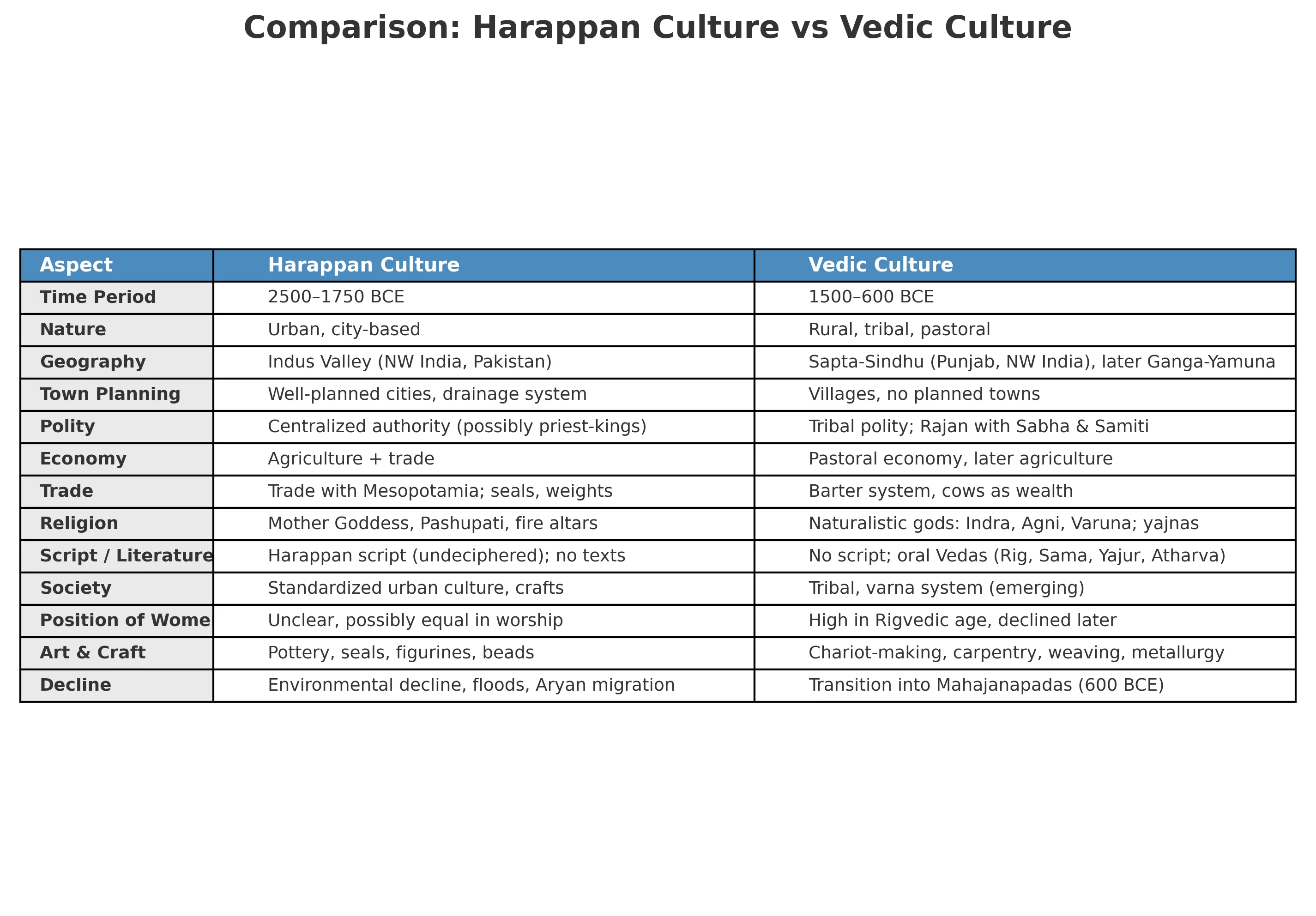
| Aspect | Harappan Culture (IVC) | Vedic Culture (1500–600 BCE) |
|---|---|---|
| Nature | Urban, city-based ; material life; planned towns | Rural, tribal, pastoral (Early Vedic); village life |
| Economy | Agriculture + extensive trade ; craft specialization; granaries | Pastoralism primary (Early); agriculture dominant (Later) |
| Technology | Bronze (copper+tin); standardized bricks | Copper (Early), Iron (Later Vedic; Krishna-ayas ) |
| Polity | Standardization hints at central coordination ; no clear monarchy | Tribal monarchy limited by Sabha/Samiti (Early); more hereditary/absolute later |
| Town Planning | Grid pattern , citadel/lower town, covered drainage | No planned cities; villages/settlements |
| Religion | Mother Goddess, Pashupati (proto-Shiva) , fire altars | Naturalistic deities (Indra, Agni, Varuna); yajnas central; no temples/idols |
| Script | Undeciphered pictographic script | No script (oral Shruti tradition) |
| Women’s Status | Unclear; Mother Goddess hints respect | High in Early Vedic; declines in Later Vedic |
Prelims tips
- Harappan = urban planning & drainage; Vedic = village life, rituals.
- Harappan script undeciphered ; Vedic literature is oral (Shruti) .
- Key marker: Bronze (IVC) → Iron (Later Vedic) .
- Varna is flexible/early in Rigvedic; becomes rigid later.
Mains points
- Shift from urban-standardized IVC to rural-tribal Early Vedic marks a deep civilizational transition.
- Iron technology in Later Vedic enabled Ganga valley agriculture and set up the Second Urbanization (Mahajanapadas).
- Polity moves from possible central coordination (IVC) to participatory tribal (Early Vedic), then to hereditary monarchies (Later Vedic).
Did you know?
- The Great Bath (IVC) shows civic ritual spaces, while Vedic society emphasized public yajnas instead of monumental baths.
- Indra as Purandara may echo conflicts with fortified settlements ( puras ).
- IVC had long-distance trade ; Vedic era valued cattle and used barter mostly.
Later Vedic Age: Background and Expansion (1000–600 BCE)
The Later Vedic Age (1000–600 BCE) marks the shift from Punjab to the Ganga–Yamuna doab and the spread of iron ( Krishna-ayas ). Result: agriculture-dominant economy , hereditary monarchy , and a rigid Varna system .
Geographical Expansion and Iron Age — What changed?
Expansion: Movement eastward into fertile plains (UP–Bihar). New, bigger units arise: Kuru, Panchala, Kosala, Videha .
Iron tech: Krishna-ayas tools helped clear forests (often with fire) and make stronger ploughshares → deeper tilling, more food.
Economy (From herds to harvests)
Dominance: Clear shift to agriculture as main livelihood.
Crops: Rice (Vrihi) grows in importance alongside wheat/barley; irrigation/monsoon management matter more.
Crafts & exchange: Rise of specialized crafts (weaving, pottery, metallurgy). Proto-units like Nishka (gold ornament) and Satamana (silver measure) used; coins not yet minted.
Polity (Tribe → Territory)
Monarchy: Rajan becomes hereditary and more absolute . Tribal chiefs turn into territorial kings ; early Janapadas form.
Revenue: Bali (once voluntary) becomes compulsory —a step toward taxation.
Assemblies: Sabha/Samiti lose influence; a small noble/priestly elite centralizes power.
Royal rites: Ashvamedha (territorial control), Rajasuya (consecration), Vajapeya (prestige rite) assert supremacy.
Society (Tightening hierarchy)
Varna: Becomes rigid/hereditary . Brahmana–Kshatriya distinction sharpens; Shudra status declines .
Women: Decline in status—limited education/assembly roles; signs of child marriage and ritual exclusion appear.
Religion (Ritualism and a new philosophy)
Shift: Indra/Agni lose primacy; Prajapati (Brahma), Vishnu, Rudra gain ground.
Ritualism: Large, complex, expensive sacrifices elevate Brahmanas .
Reaction: Upanishads emphasize Atman–Brahman , inner knowledge, and question ritual excess .
| Aspect | Shift from Early Vedic (Change) |
|---|---|
| Geography | From Sapta-Sindhu (Punjab) to Ganga–Yamuna doab (UP/Bihar) |
| Technology | Advent/spread of Iron ( Krishna-ayas ) |
| Economy | Pastoral → Agriculture dominant ; rice gains importance |
| Polity | Tribal chief → Hereditary, stronger monarchy ; assemblies decline |
| Society | Flexible → Rigid varna (birth-based); women’s status declines |
| Religion | Naturalistic gods → Prajapati, Vishnu, Rudra ; ritualism dominates |
| Kingdom / Janapada | Region (approx.) | UPSC Significance |
|---|---|---|
| Kuru | Delhi–Haryana | Early dominant Vedic kingdom; cultural centre |
| Panchala | Western UP | Powerful neighbour of Kuru; key in epics |
| Kosala | Eastern UP (Awadh) | Prominent; later a Mahajanapada |
| Videha | North Bihar (Mithila) | Kings called Janaka ; seat of learning |
| Magadha | South Bihar | Begins ascent; later becomes dominant empire |
Prelims tips
- Use of iron ( Krishna-ayas ) begins ~ 1000 BCE .
- Eastward expansion into the Ganga–Yamuna doab .
- Rice (Vrihi) gains importance.
- Rajan becomes hereditary ; Sabha/Samiti decline.
- Prajapati, Vishnu, Rudra rise; Upanishads end the period.
Mains points
- Later Vedic sees state formation : tribal chiefdoms → territorial kingdoms (Janapadas).
- Iron on fertile plains supplies the material base for surplus, hierarchy, and monarchy.
- Declining assemblies + rigid varna = reduced egalitarianism despite growth.
- Upanishadic thought challenges ritual dominance—setting ground for Buddhism/Jainism .
Did you know?
- Ashvamedha : a consecrated horse roamed freely; stopping it meant war with the king.
- Janapada (people’s ‘footprint’) marks the shift from Jana (tribe) to territory .
- Kurus–Panchalas helped consolidate clans into larger polities—precursor to Mahajanapadas .
- Brahmana texts detail complex rites—showing ritual specialization and social hierarchy.
Later Vedic Period: Iron, Crafts, Trade and Commerce (The Economic Revolution)
The Later Vedic Age (1000–600 BCE) saw the widespread use of Iron (known as Krishna-ayas or Shyama-ayas), which fundamentally revolutionized agriculture and enabled massive settlement expansion into the Ganga plains. This led to an agricultural surplus , boosting specialized crafts, trade, and the use of proto-currency units like Nishka and Satamana . Beginner tip: Think of iron tools as better “hardware” that makes farms faster and towns bigger.
Use of Iron (The Technological Leap)
Iron (Krishna-ayas) was the hallmark of this period, arriving around 1000 BCE.
Iron axes and controlled use of fire enabled efficient forest clearance in the dense Ganga-Yamuna doab.
Iron ploughshares, sickles, and other tools transformed farming, allowing for intensive agriculture and significant productivity increase .
This technology directly led to the establishment of permanent and larger settlements in the fertile Gangetic plains.
Beginner tip: Bronze could cut, but iron could cut faster and deeper ; that’s why fields expanded quickly.
Crafts and Specialization
Agricultural surplus fueled specialized crafts, indicating growing occupational differentiation.
Flourishing crafts included weaving, carpentry , metalwork (copper, iron), ornaments and simple stone/wood carving.
Pottery: The characteristic pottery of this era is Painted Grey Ware (PGW) , known for fine grey fabric with black painted designs; typically bowls and dishes used in daily life/rituals.
Artisans often formed distinct occupational groups or early guild-like associations to protect skills and standards.
Beginner tip: Surplus grain = free time for some people to become full-time artisans .
Trade and Commerce (Proto-Currency)
Trade Catalyst: The shift to agriculture and production of surplus encouraged both local and long-distance trade.
Barter System: Exchange of goods remained common, but weighted gold ornaments ( Nishka ) and silver pieces ( Satamana ) started acting as proto-currency or units of value, signalling the transition away from using cattle as the sole measure of wealth.
Trade Routes: Trade networks expanded along the major river systems (Ganga, Yamuna) and overland forest clearings; boats and bullock carts were typical carriers.
Markets: Emergence of early market centres ( nigama ) hinted at the coming urbanization; periodic fairs likely helped inter-village exchange.
Beginner tip: Nishka / Satamana were weighed metal pieces , not stamped coins—like paying by weight instead of a printed note.
| Aspect | Key Features |
|---|---|
| Iron Use | Iron ploughshares, axes, sickles; enabled Ganga plain settlement |
| Crafts | Specialization, Weaving, Painted Grey Ware (PGW) pottery, metalwork |
| Trade | Agricultural surplus, Barter , riverine and overland routes |
| Commerce | Proto-currency (Nishka, Satamana), early markets ( nigama ) |
| Transport | Boats on rivers; bullock carts on land; forest clearings improved connectivity |
Prelims tips
- Iron (Krishna-ayas) is the hallmark technology of the Later Vedic period (c. 1000 BCE).
- Painted Grey Ware (PGW) pottery is archaeologically linked with this age and early settlements in the Ganga valley.
- Nishka (gold) and Satamana (silver) were used as proto-currency (weighted metal pieces, not minted coins).
- Nigama = the term for early market centers mentioned in texts.
- Easy recall: Iron → farms grow → crafts rise → markets spread.
Mains points
- Iron technology transformed agriculture , settlement, and politics, shifting power eastward into the Ganga valley.
- Craft specialization and proto-currency show deepening division of labour and monetization beyond simple barter.
- Agricultural surplus laid the economic foundation for urbanization and the rise of Mahajanapadas in the 6th century BCE.
Did you know?
- The term ‘ Krishna-ayas ’ literally means ‘black metal’, distinguishing it from copper ( ayas ).
- Painted Grey Ware pottery often aligns with sites remembered in the Mahabharata tradition (e.g., Hastinapura).
- The iron plough’s surplus was the economic base that later supported the rise of Mahajanapadas .
Later Vedic Period: Varna System and Marriage (Social Rigidity)
In the Later Vedic Age, the Varna system became rigid and primarily hereditary , sharply defining the four classes (Brahmana, Kshatriya, Vaishya, Shudra). Social mobility declined drastically, and the status of women deteriorated , evidenced by exclusion from assemblies and restrictive marriage practices. Beginner tip: Jobs started passing by birth , not by skill.
Varna System (Hereditary Hierarchy)
Rigid Definition: The four varnas were clearly defined, with positions and occupations increasingly becoming hereditary (determined by birth).
Supremacy: Brahmanas consolidated religious authority via complex, costly rituals; Kshatriyas held political-military power.
Lower Status: Vaishyas farmed and traded but faced exploitation; Shudras did service/manual work and were largely denied religious-social privileges .
Jati System: Craft specialization and inter-varna unions produced many Jatis (sub-castes) within the Varna framework.
Beginner tip: Varna = broad category ; Jati = specific community within it.
Decline of Women's Status and Marriage
Decline: Women were excluded from Sabha/Samiti ; access to education reduced; child marriage and polygamy spread in elites.
Marriage as Sacrament: Marriage remained a compulsory samskara (sacrament).
Eight Forms: Texts codified eight types of marriage (four approved, four disapproved) to regulate society under Varna rules.
Beginner tip: Approved = family/ritual consent; Disapproved = love by choice or coercive/transactional forms.
| Varna | Role / Power |
|---|---|
| Brahmana | Priests, teachers, religious authority (Highest) |
| Kshatriya | Rulers, warriors, political and military power |
| Vaishya | Agriculture, trade, economic base (Paid taxes, often exploited) |
| Shudra | Servants, manual labour, excluded from Vedic rituals (Lowest) |
| Marriage Type | Category | UPSC Significance |
|---|---|---|
| Brahma, Daiva, Arsha, Prajapatya | Approved (Dharma-based) | Ideal sacramental, family-approved alliances |
| Gandharva, Asura, Rakshasa, Paishacha | Disapproved (Non-Dharma) | From consensual love ( Gandharva ) to coercive/transactional forms |
Prelims tips
- Purusha Sukta (Rigveda, Mandala X) → earliest reference to the four varnas.
- Later Vedic period → varna becomes more hereditary; Shudras denied upanayana.
- Gotra → originally 'cow-pen'; later rule of gotra exogamy in marriage.
- Ashramas → four stages first fully listed in the Jabala Upanishad.
- Anuloma (man of higher varna) vs pratiloma (woman of higher varna) marriages.
Mains points
- Society shifted from flexible tribe-based roles to a rigid, hereditary Varna-Jati order , sharply reducing social mobility .
- Women’s public role decreased with exclusion from assemblies and growing ritual control by Brahmanas .
- The eight marriage forms show how texts tried to regulate society within a strict hierarchy.
Did you know?
- ‘ Anuloma ’ (higher-varna groom, lower-varna bride) found partial acceptance; ‘ Pratiloma ’ was condemned—showing one-way hierarchy.
- Gandharva (love marriage) appears in epics (e.g., Shakuntala–Dushyanta) despite textual disapproval.
- Rise of dowry (stri-dhan) and bride-price suggests growing control of marriage by wealth and patriarchy.
Later Vedic Period: Polity and Bureaucracy (The Rise of the State)
In the Later Vedic Age, the Polity transformed completely : tribal units evolved into hereditary territorial kingdoms (Rajya) . The Rajan emerged as a powerful, absolute monarch , legitimized by grand sacrifices . A rudimentary bureaucracy with specialized officials expanded, laying the foundation for organized Mahajanapadas . Beginner tip: Think ‘tribe → district → kingdom’ as agriculture and revenue grow.
Polity (Hereditary Monarchy)
Monarchy: The Rajan became the supreme authority ; kingship turned clearly hereditary .
Legitimacy: Power asserted via Rajasuya (consecration), Vajapeya (prestige/supremacy), Ashvamedha (territorial sovereignty).
Decline of Democracy: Sabha and Samiti lost real power, becoming ceremonial—checks on the king weakened.
Warfare: From cattle-raids to territorial conquest ; larger units known as Janapadas formed.
Beginner tip: Rituals worked like a public ‘ certificate ’ of the king’s authority.
Bureaucracy and Officials (Early Administration)
Expanding administration relied on specialized posts:
– Purohita: Chief Priest & Advisor (top counselor; oversaw rituals and legitimacy).
– Senani: Military commander; led forces and planned campaigns.
– Gramani: Village head; kept order, organized labour, collected dues.
– Sangrahitri: Treasurer ; managed revenue accounts and storage.
– Bhagadugha: Collected the king’s Bhaga (share of produce).
– Suta: Royal charioteer and chronicler ; preserved genealogies.
Taxation: Bali (once voluntary) became compulsory ; Bhaga (produce share) and Shulka (customs duty) were institutionalized.
Law and Order: Justice by king with Brahmana advice; emphasis on Dharma (customary norms).
Beginner tip: More fields → more grain → need officials to count, store, guard and tax.
| Aspect | Details |
|---|---|
| Nature of Polity | Hereditary monarchy replacing tribal set-ups; Janapadas emerged |
| King’s Legitimacy | Grand sacrifices ( Rajasuya, Ashvamedha ) as political-religious validation |
| Assemblies | Sabha/Samiti declined ; Vidatha disappeared |
| Warfare | From raids to territorial conquest ; revenue and labour extraction grew |
| Official | Role |
|---|---|
| Purohita | Chief Priest and Advisor (Legitimacy/rituals) |
| Senani | Commander-in-chief; campaigns/defence |
| Sangrahitri | Treasurer ; revenue/accounts |
| Bhagadugha | Collected Bhaga (king’s share) |
| Gramani | Village head; order/revenue at local level |
| Suta | Charioteer and chronicler (genealogies) |
Prelims tips
- Ratnins → royal officials such as Senani, Purohita, Bhagadugha (tax collector), Sangrihitri (treasurer).
- Rajasuya, Vajapeya and Ashvamedha → sacrifices that strengthened royal authority.
- Sabha and Samiti declined; Vidatha disappeared in the Later Vedic period.
- Rashtra (territory) appears; titles like Ekarat and Samrat show growing royal power.
- Gramani → village headman; Kurus and Panchalas → leading Later Vedic peoples.
Mains points
- Tribal polity evolved into a territorial state (Janapada) powered by agricultural surplus and organized revenue.
- The king’s authority and Brahmana ritual power formed a mutual legitimation loop.
- Basic bureaucracy + taxation set the template for later Mahajanapadas and second urbanization.
Did you know?
- A king performing Ashvamedha could be styled Samrat —signalling overlordship.
- Royal Sutas preserved history orally, acting like court historians.
- The rise of Sangrahitri / Bhagadugha shows the move from gifts to systematic taxation .
- Bali shifted from voluntary gift to compulsory tax as the state solidified.
Later Vedic Period: Religion and Public Sacrifices (Ritual Dominance)
Religion in the Later Vedic period (1000–600 BCE) became dominated by elaborate, expensive sacrifices (yajnas) . Kings used massive public rituals like Rajasuya, Vajapeya, and Ashvamedha to demonstrate political power, legitimize their hereditary rule , and expand territories. Priests ( Brahmanas ) gained supremacy, while philosophical thought in the Upanishads questioned excessive ritualism. Beginner tip: Big public yajnas worked like political PR + divine certificate for kings.
Religious Developments (The Shift)
Deity Shift: Rigvedic deities like Indra and Agni declined ; new gods like Prajapati (the creator, later Brahma), Vishnu (the preserver), and Rudra (the fierce god, precursor of Shiva) rose in importance.
Priestly Power: Brahmanas consolidated their power as ritual specialists and custodians of yajnas, making their role indispensable.
Focus Shift: Religion moved from simple hymns and prayers (Rigvedic) to complex ritualism ; yajnas became the heart of religious, social, and political life.
Rituals as Statecraft: Sacrifices symbolized not just piety but political legitimacy and reinforced the rigid social hierarchy (Varna system).
Philosophical Counter-Movement: Upanishadic thought (late Vedic) began criticizing this ritualism, emphasizing knowledge (jnana) , meditation ( dhyana ), and concepts like Karma, Moksha, and Atman/Brahman .
Beginner tip: Shift = from prayer to process (hymns → complicated rites run by priests).
Public Sacrifices and Political Meaning (The King's Tools)
Yajnas were massive public events performed by kings to show divine sanction of power and loyalty from subordinate chiefs.
Rajasuya: Affirmed a king’s sovereignty ; marked his official consecration and elevated him above his peers.
Vajapeya: Symbolized victory and prosperity ; included a ceremonial royal chariot race .
Ashvamedha: Demonstrated territorial supremacy and expansion; the horse’s free movement defined the limits of the king's political control. The king who performed this was often called Samrat .
Household rituals (like Agnihotra , daily fire ritual) remained common, but large public yajnas were essential tools of statecraft and control.
Beginner tip: If the horse roams free and no one stops it, the king claims control of that zone.
| Ritual | Process / Description | Purpose & Political Meaning |
|---|---|---|
| Rajasuya | Royal consecration; king performed rituals, received homage from chiefs, drank soma, and was anointed. | Legitimized kingship; affirmed sovereignty among other rulers; symbol of divine kingship. |
| Vajapeya | Involved chariot race, soma sacrifice, and distribution of gifts to Brahmanas. | Showcased victory, prosperity, and strength; reinforced alliance with Brahmanas. |
| Ashvamedha | A horse was released to wander freely for a year, guarded by warriors; territories it roamed had to submit or fight. | Demonstrated territorial supremacy; king declared Samrat (universal ruler). |
| Agnihotra | Daily fire ritual by householders, offering milk and ghee into fire. | Maintained sacred domestic fire; symbolized continuity of dharma in families. |
| Soma Yajna | Preparation and offering of soma juice to gods in fire sacrifice. | Believed to grant divine favor, prosperity, and vitality to ruler and people. |
| Gomedha / Naramedha (symbolic) | Mentioned as cow or symbolic human sacrifices, not common in practice. | Emphasized extreme devotion; reflected myths of power and fear. |
| Samskara / Ritual | Description | Social & Religious Significance |
|---|---|---|
| Garbhadhan | Conception rite performed before cohabitation with mantras. | Sanctified conception; linked child to dharma. |
| Pumsavana | Rite performed in 2nd or 3rd month of pregnancy for healthy male child. | Reflected preference for sons in patriarchal society. |
| Simantonnayana | Hair-parting ritual of pregnant woman in later months. | Ensured protection of mother & child; honored motherhood. |
| Jatakarma | Performed at birth; father whispers mantras into newborn’s ear. | Welcomed child into family; paternal authority emphasized. |
| Namakarana | Naming ceremony on 10th–12th day. | Gave identity; linked child to lineage. |
| Nishkramana | First outing of child into the open world (usually 4th month). | Introduced child to environment & community. |
| Annaprasana | First solid food feeding (6th month, often rice). | Highlighted rice as staple crop; tied child to agrarian society. |
| Chudakarana | First tonsure/shaving of child’s head. | Purification & renewal; symbol of discipline. |
| Karnavedha | Ear-piercing ceremony. | Considered protective & aesthetic; linked to health & tradition. |
| Upanayana | Initiation into Brahmacharya (student life); sacred thread ceremony for upper varnas. | Access to Vedic study; excluded Shudras, reinforcing hierarchy. |
| Samavartana | Convocation after completion of study; end of Brahmacharya. | Prepared youth for Grihastha (householder) life. |
| Vivaha | Marriage ceremony; sacred fire rituals & seven steps (saptapadi). | Most important samskara; ensured family lineage & dharma. |
| Vanaprastha | Retirement into forest for meditation and detachment. | Part of ashrama system; ideal for elderly householders. |
| Antyeshti | Funeral rites (cremation, Shraddha offerings). | Linked dead with ancestors (Pitris); reinforced ancestor worship. |
Prelims tips
- Prajapati → supreme god of the Later Vedic period; Rudra and Vishnu gain importance.
- Indra and Agni lose their earlier prominence.
- Pushan → protector of cattle, regarded as god of the Shudras.
- Elaborate sacrifices increased the power of the Brahmana priests.
- Upanishads → reaction against ritualism; stress on knowledge of Brahman and Atman.
Mains points
- Ritualism served a political function by legitimizing hereditary monarchies and asserting authority over emerging Janapadas .
- Large public sacrifices created a co-dependent loop between Kshatriya rulers (patronage/protection) and Brahmana priests (divine sanction).
- The Upanishadic critique (Atman/Brahman) opposed costly complexity of state rituals, paving the way for Buddhism and Jainism.
Did you know?
- Ashvamedha could last over a year, involving hundreds of priests and vast resources, demonstrating the king's immense wealth .
- The Rajasuya required the king to symbolically conquer dice (akshapatra), showing his supposed mastery over fate/chance .
- The Vajapeya yajna’s chariot race winner (often the king himself) was ceremonially crowned, symbolizing his ritual and physical supremacy .
- The terms Gomedha (cow sacrifice) and Naramedha (human sacrifice) appear in texts, but scholars think they were often symbolic or rare , not common practice.
Vedic Literature (The Written Heritage)
Vedic literature forms the earliest literary record of Indian civilization, primarily preserved through oral tradition (Shruti) . It is systematically divided into four main sections: the four Vedas (hymns), the Brahmanas (ritual explanations), the Aranyakas (forest texts), and the Upanishads (philosophical conclusion). Beginner tip: Think: Prayer → How-to → Reflection → Philosophy .
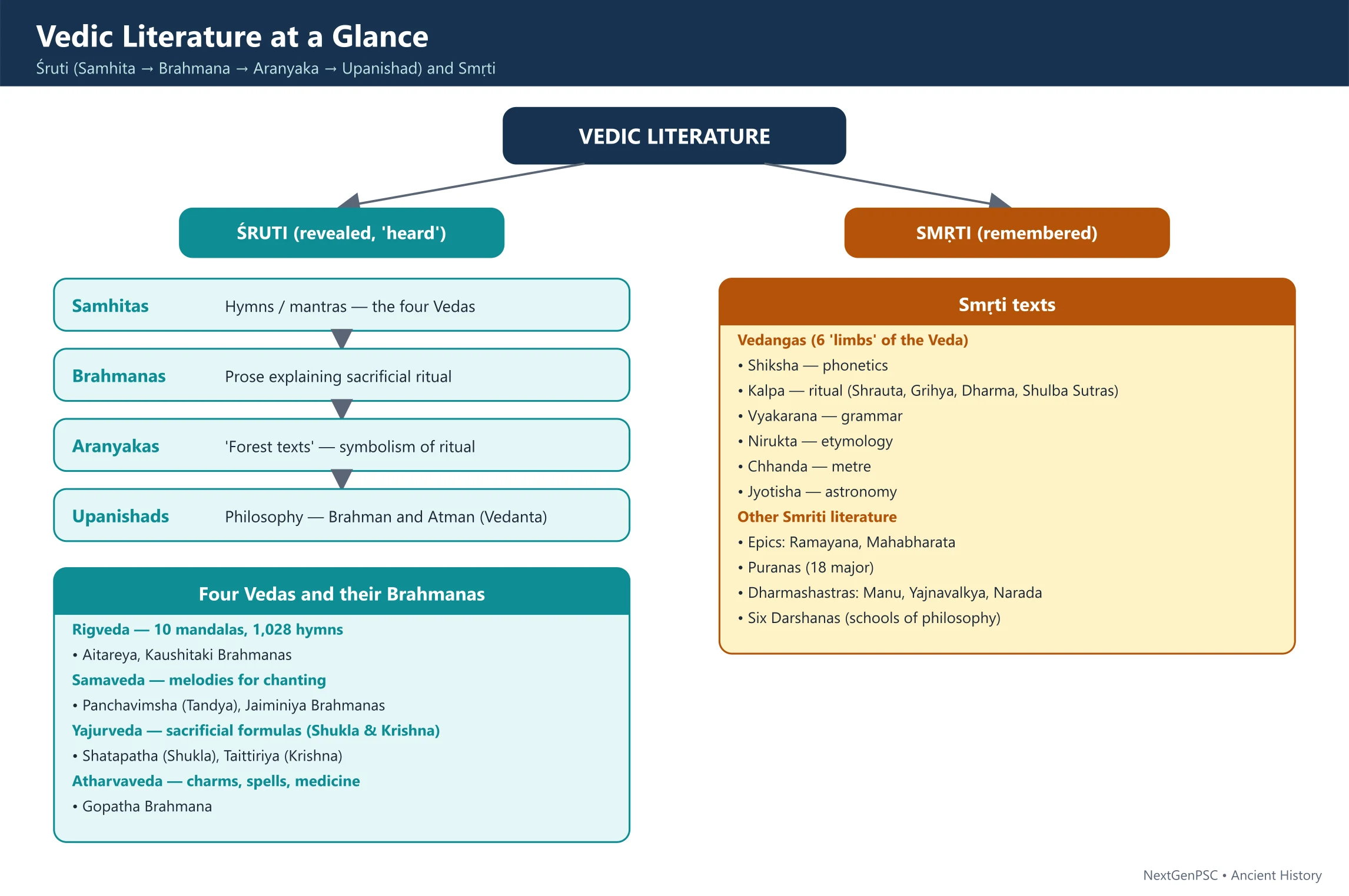
🌿 The Four Vedas (Samhitas)
The Vedas are the oldest sacred texts of India, like a library of hymns, songs, and rituals that guided early Indian religious and social life.
1. Rigveda
The oldest Veda (c. 1500–1000 BCE) with 1,028 hymns (Suktas) in 10 sections called Mandalas.
The hymns praise natural forces like Agni (fire), Indra (rain/war), Vayu (wind), and Surya (sun).
It reflects an early society that worshipped nature and valued courage, truth, and family.
2. Samaveda
A collection of Rigvedic verses set to music.
It is the basis of Indian classical music and was used by priests during rituals.
Focuses more on melody and chanting than meaning.
3. Yajurveda
Contains prose and verses (yajus) used by priests while performing rituals and sacrifices (yajnas).
It is like a ritual handbook — giving instructions on how to perform each ceremony properly.
4. Atharvaveda
The youngest Veda, dealing with everyday life, healing, and magic.
Contains spells, charms, prayers, and hymns for health, success, and protection.
Shows the beliefs of common people, not just priests.
📘 The Explanatory Texts
Brahmanas
Prose texts explaining the meaning and methods of rituals and sacrifices.
Example: Satapatha Brahmana explains the rules for fire sacrifices.
Aranyakas
Means ‘Forest Books’; written for hermits who lived in forests and meditated.
These texts connect ritual (Brahmanas) with philosophy (Upanishads) — showing the transition from outer worship to inner reflection.
Upanishads
Called Vedanta (‘end or goal of the Vedas’).
They discuss spiritual ideas like:
Atman – the soul or true self
Brahman – the universal spirit or ultimate reality
Karma – the law of cause and effect
Moksha – freedom or liberation from the cycle of rebirth
Marked a shift from rituals to philosophy, teaching that God and the soul are one.
🪔 Later Auxiliary Texts (Smriti Literature)
Vedangas (‘Limbs of the Vedas’)
These are six disciplines that help preserve and understand the Vedas:
Shiksha – pronunciation and phonetics
Chhanda – meter (poetic rhythm)
Vyakarana – grammar
Nirukta – meanings of difficult words
Kalpa – ritual rules and guidelines
Jyotisha – astronomy and astrology
Sutras
Short, concise statements summarizing complex ideas for easy learning.
The Sulba Sutras discuss geometry and measurements used for building Vedic fire altars — showing early Indian mathematical knowledge.
🧠 Beginner Tip
Shruti → means 'that which is heard' — directly revealed knowledge (includes the Vedas and Upanishads).
Smriti → means 'that which is remembered' — written or compiled later (Vedangas, Sutras, Epics, etc.).
| Category | Content Focus | Significance |
|---|---|---|
| Shruti (Revealed) | Vedas, Brahmanas, Aranyakas, Upanishads | Considered divinely revealed; foundation of Hindu theology |
| Vedas | Hymns, prayers, and basic knowledge | Rigveda is the oldest text , foundation of the entire literature |
| Brahmanas | Ritual explanations | Consolidated priestly supremacy and ritual dominance |
| Upanishads | Philosophy/Metaphysics , Atman/Brahman | Marked the shift away from ritualism to philosophy (Vedanta) |
| Smriti (Remembered) | Vedangas, Sutras (Law, Grammar, Geometry) | Auxiliary literature for practice and preservation |
Prelims tips
- Order → Samhita → Brahmana → Aranyaka → Upanishad.
- Rigveda → 10 mandalas, 1,028 hymns; Mandalas II–VII are the 'family books'.
- Samaveda → melodies (origin of Indian music); Atharvaveda → charms and spells.
- Shatapatha Brahmana → Shukla Yajurveda; Aitareya Brahmana → Rigveda.
- Six Vedangas → Shiksha, Kalpa, Vyakarana, Nirukta, Chhanda, Jyotisha.
- Brahmanas by Veda: Rigveda – Aitareya, Kaushitaki; Yajurveda – Taittiriya, Shatapatha; Samaveda – Panchavimsha (Tandya); Atharvaveda – Gopatha.
Mains points
- Vedic literature divides into Shruti (revealed) and Smriti (remembered), underscoring the sanctity of Shruti.
- There is a clear arc from ritual focus (Brahmanas) to philosophical inquiry (Upanishads).
- The Vedangas/Sutras standardized language, law and early sciences—showing a complete intellectual ecosystem.
Did you know?
- The Rigveda is the oldest Indo-European text (c. 1500–1000 BCE).
- The Samaveda has about 75 original hymns; most verses are from the Rigveda but arranged for singing .
- The Sulba Sutras include clever geometry (e.g., methods to approximate √2) for altar construction.
- The Upanishads gave enduring ideas like ‘Aham Brahmasmi’ and doctrines of Karma and rebirth.
Smriti Literature
Smriti (‘remembered’) literature developed after Shruti . While Shruti (Vedas, Brahmanas, Upanishads) was considered divine revelation , Smriti represented human interpretation , tradition, and law. Smriti texts include the Epics (Itihasas) , Puranas , Dharma Shastras , Smritis (legal codes), Sutras , and later Nibandhas . They shaped Hindu law, social order, and popular religion. Beginner tip: Shruti = core scripture; Smriti = how society applied it over time.
Epics (Itihasas)
Ramayana (Valmiki): 24,000 verses; story of Rama , Sita , Lakshmana , Ravana . Upholds ideal kingship (Rama as Maryada Purushottama ).
Mahabharata (Vyasa): ~100,000 verses; world’s longest epic. Kuru dynasty, Kurukshetra war; contains the Bhagavad Gita —a philosophical discourse on dharma , karma , bhakti .
Both epics shaped moral ideals, dharma , and collective identity. Beginner tip: Epics teach values through stories.
Puranas
18 Mahapuranas and 18 Upapuranas ; mix of mythology, genealogy, cosmology, legends of gods and saints.
Key Puranas: Vishnu Purana, Shiva Purana, Bhagavata Purana, Markandeya Purana, Matsya Purana, Vayu Purana.
Made religion accessible to masses; spread bhakti traditions; often linked to specific deities ( Shaiva , Vaishnava , Shakta ).
Beginner tip: Puranas = people’s handbook of myths, devotion and local cults.
Dharma Shastras
Legal & social texts prescribing duties (dharma) , punishments, and caste rules.
Manusmriti : Oldest & influential; codified Varna-ashrama dharma .
Yajnavalkya Smriti : More systematic; includes civil & criminal law .
Narada Smriti : Focuses on judicial procedures .
Mitakshara and Dayabhaga (later commentaries) became the basis of Hindu law of inheritance.
Beginner tip: Remember triad: Manu (foundational), Yajnavalkya (systematic), Narada (judicial).
Sutra Literature
Kalpa Sutras : Shrauta (public sacrifices), Grihya (domestic rituals), Dharma Sutras (rules of conduct).
Sulba Sutras : early geometry ; construction of altars.
These texts show the transition from ritual manuals to codified law. Beginner tip: Sutra = compact rulebook.
Later Smriti Texts
Nibandhas : commentaries and digests on law and dharma.
Examples: Medhatithi on Manusmriti, Apararka , Mitakshara , Dayabhaga .
Helped adapt Hindu law to changing times. Beginner tip: Think of Nibandhas as legal updates/FAQs.
| Category | Content | Examples |
|---|---|---|
| Epics (Itihasas) | Heroic narratives, moral & dharma teaching | Ramayana, Mahabharata ( Bhagavad Gita ) |
| Puranas | Myths, cosmology, genealogies, devotion | Vishnu Purana, Shiva Purana, Bhagavata Purana |
| Dharma Shastras & Smritis | Law codes, caste rules, duties, punishments | Manusmriti, Yajnavalkya Smriti, Narada Smriti |
| Sutras | Concise manuals on rituals, society, law | Shrauta, Grihya, Dharma Sutras; Sulba Sutras |
| Later Digests | Commentaries adapting law | Mitakshara, Dayabhaga, Apararka, Medhatithi |
| Aspect | Shruti | Smriti |
|---|---|---|
| Meaning | ‘Heard’ ( divine revelation ) | ‘Remembered’ ( human tradition ) |
| Authority | Supreme, eternal, infallible | Secondary, adaptable, can change |
| Examples | Vedas, Brahmanas, Aranyakas, Upanishads | Epics, Puranas, Dharma Shastras, Sutras |
| Function | Spiritual/ritual/philosophical knowledge | Practical laws, customs, ethics, stories |
| Flexibility | Fixed & immutable | Flexible, modified by time & context |
Prelims tips
- Smriti = 'remembered' texts, as opposed to Shruti ('heard').
- Major Smritis → Manu, Yajnavalkya, Narada, Brihaspati, Parashara.
- Manusmriti → c. 200 BCE–200 CE; Narada Smriti → judicial procedure (Gupta age).
- Other Smriti literature → epics, Puranas, Dharmashastras and the Vedangas.
- Commentaries like Mitakshara (Vijnaneshvara) on Yajnavalkya Smriti shaped later Hindu law.
Mains points
- Smriti literature spans Epics , Puranas , Dharma Shastras , Sutras , and later commentaries .
- It provided a practical framework for society—law, duties, customs, stories.
- Epics taught ideals via narrative; Puranas spread religion through myths & bhakti .
- Dharma Shastras codified caste/social rules, deeply influencing Indian law.
- Unlike Shruti, Smriti remained flexible and adapted to historical change.
Did you know?
- Mahabharata is ~8× the length of the Iliad and Odyssey combined.
- Puranas were recited in temples and village gatherings to spread bhakti .
- Manusmriti influenced Hindu personal law for centuries, including under colonial rule.
- Sulba Sutras contain early geometry and approximations of √2.
- Smriti texts evolved with society, showing law and religion as living traditions .
Comparison: Early Vedic vs Later Vedic Age
The Early Vedic Age (Rigvedic, 1500–1000 BCE) was a pastoral, tribal society with simple rituals and nature gods. The Later Vedic Age (1000–600 BCE) saw expansion into the Ganga plains, use of iron, rise of hereditary monarchies, rigid varna system, elaborate sacrifices, and beginnings of philosophy.
| Aspect | Early Vedic (Rigvedic) | Later Vedic |
|---|---|---|
| Time Period | 1500–1000 BCE (Rigveda) | 1000–600 BCE (Yajur, Sama, Atharva, Brahmanas, Upanishads) |
| Geography | Northwest India (Punjab, Saraswati, Sindh region) | Expansion to Ganga-Yamuna Doab, Kosala, Videha, Magadha |
| Economy | Pastoral; cattle = wealth; limited agriculture (barley, wheat) | Agriculture dominant; rice (vrihi) important; iron ploughs, surplus trade |
| Polity | Tribal polity; Rajan as tribal chief; assemblies (Sabha, Samiti) important | Hereditary monarchy; Rajan became powerful; taxation (bali, bhaga); assemblies declined |
| Society | Varna system flexible; women had higher status, education, and participation | Varna system rigid; women’s position declined (child marriage, no assemblies) |
| Religion | Nature gods (Indra, Agni, Varuna, Surya, Ushas); simple hymns & prayers | Ritualism and sacrifices (Rajasuya, Vajapeya, Ashvamedha); rise of Prajapati, Vishnu, Rudra; Upanishadic philosophy begins |
| Literature | Rigveda (hymns) | Samaveda, Yajurveda, Atharvaveda, Brahmanas, Aranyakas, Upanishads |
| Military | Wars for cattle (gavishti); simple weapons (bronze, stone) | Use of iron weapons; larger kingdoms; wars for territory |
| Settlement | Semi-nomadic, tribal clans; no large towns | Permanent villages and towns in fertile plains; proto-urban growth |
Prelims tips
- Economy → pastoral (Early) vs agricultural with iron (Later).
- Chief god → Indra and Agni (Early) vs Prajapati (Later).
- Assemblies → Sabha, Samiti, Vidatha strong (Early) vs declining (Later).
- Women → attended assemblies (Early) vs lower status, excluded from sabha (Later).
- Region → Sapta-Sindhu (Early) vs Ganga–Yamuna doab (Later); PGW linked with Later Vedic sites.
Mains points
- Early Vedic period = tribal, pastoral, nature-worshipping; Later Vedic period = agrarian, hereditary monarchy, ritualism.
- Use of iron in Later Vedic transformed agriculture and settlement.
- Varna system hardened, reducing women’s role in society.
- Religion shifted from simple hymns to elaborate yajnas and philosophy.
- This transition laid foundation for Mahajanapadas around 600 BCE.
Did you know?
- Rigveda mentions rivers like Saraswati and Sindhu, showing early geography.
- Later Vedic period texts mention rice (vrihi) for the first time.
- Ashvamedha yajna was central to Later Vedic kingship.
- Women like Gargi and Maitreyi are mentioned in Later Vedic Upanishads, though generally status declined.
- Assemblies Sabha & Samiti were more democratic in Rigvedic age but declined in Later Vedic.
Ancient Indian Education System (Gurukula and Philosophical Schools)
The ancient Indian education system was primarily centered on the Gurukula model, where students lived with the Guru, fostering an intimate, personalized learning environment. The focus was holistic—on Dharma, philosophy, literature, and practical skills —and was mostly exclusive to the upper three Varnas during the Later Vedic Period. The Upanayana ritual marked the beginning of formal education.
The Gurukula System (Teacher-Centric)
Mode: Oral transmission ( Shruti ) was the primary method, with emphasis on memorization, recitation, and close interaction between the student ( Shishya ) and teacher ( Guru ).
Location: Gurukulas were typically located outside the village or town in a tranquil setting, emphasizing detachment from material life.
Curriculum: Included the Vedas and Vedangas (grammar, phonetics, astronomy), Dharma Shastras (law and ethics), Tarka (logic), and practical skills like Archery, Ayurveda (medicine), and statecraft .
Fees: Fees were often paid at the end of the education as a voluntary gift ( Guru Dakshina ), reflecting the spiritual nature of the relationship, not a commercial transaction.
Access and Exclusion
Upanayana: The initiation ceremony (sacred thread) for upper Varnas (Brahmana, Kshatriya, Vaishya), marking their entry into the student phase ( Brahmacharya Ashrama ).
Exclusion: The Shudras were systematically denied access to Vedic education and the Upanayana ritual; women's access, which was higher in the Early Vedic Period (e.g., Gargi, Maitreyi), declined significantly in the Later Vedic Age.
Centers of Learning
Texts such as the Upanishads locate important debates in places including Kashi and Mithila. Taxila became a major centre of learning in the later early-historic period and should not be simply labelled a Later Vedic institution.
Philosophical Schools
The six orthodox schools of philosophy (Shad Darshanas)—Nyaya, Vaisheshika, Sankhya, Yoga, Mimamsa, and Vedanta—developed over later centuries; do not treat them as a completed Later Vedic curriculum.
| Ashrama (Stage) | Age / Phase | Primary Goal |
|---|---|---|
| Brahmacharya | Student life (Celibacy) | Learning, discipline, serving the Guru |
| Grihastha | Householder (Marriage) | Family, profession, social duty (Dharma) |
| Vanaprastha | Retirement (Forest dweller) | Contemplation, detachment, moving towards spiritual life |
| Sanyasa | Ascetic (Renunciation) | Complete spiritual devotion and attainment of Moksha |
Prelims tips
- Gurukula system emphasized oral learning and a personal student-teacher bond.
- Upanayana was the initiation ritual for Brahmacharya (student life).
- Shudras and often women were excluded from Vedic education.
- Guru Dakshina was a voluntary gift at the end of education.
- The Ashrama System formalized stages of life (Brahmacharya, Grihastha, Vanaprastha, Sanyasa).
Mains points
- The Gurukula system promoted a holistic and personalized form of education, fostering strong moral and ethical values.
- However, the system was intrinsically hierarchical and exclusionary , reinforcing the Varna-based social order by denying education to Shudras and limiting women's access.
- Later centers like Taxila and Mithila laid the intellectual foundation for the rise of philosophical schools and heterodox traditions (Buddhism/Jainism) that challenged orthodox ritualism.
Six Schools of Indian Philosophy (Astika and Nastika)
Indian philosophy is divided into Astika schools, which accept the authority of the Vedas — Sankhya, Yoga, Nyaya, Vaisheshika, Mimamsa and Vedanta — and Nastika schools, which reject it — Charvaka, Buddhism, Jainism and the Ajivikas. The six Astika schools are usually studied in three pairs.
Astika vs Nastika
Astika (orthodox): accept the authority of the Vedas. Nastika (heterodox): reject the Vedas as a final authority.
Astika does not simply mean 'believing in God' — early Sankhya and Mimamsa did not centre on a creator God.
The Six Astika Darshanas (in pairs)
Sankhya — founder Kapila. Dualism of Purusha (consciousness) and Prakriti (matter); Prakriti has three gunas (sattva, rajas, tamas). Liberation comes through right knowledge.
Yoga — Patanjali (Yoga Sutras). Accepts Sankhya metaphysics and adds the eight-limbed path (ashtanga: yama, niyama, asana, pranayama, pratyahara, dharana, dhyana, samadhi) and Ishvara.
Nyaya — Gautama (Akshapada). School of logic; accepts four means of valid knowledge (pramanas): perception, inference, comparison and testimony.
Vaisheshika — Kanada. Atomism: the world is made of eternal atoms (paramanu); analysis of reality into categories (padarthas).
Mimamsa (Purva Mimamsa) — Jaimini. Interprets Vedic ritual; stresses karma (ritual action) and the eternal authority of the Vedas.
Vedanta (Uttara Mimamsa) — Badarayana (Brahma Sutras). Based on the Upanishads; later schools: Advaita (Shankara, non-dualism), Vishishtadvaita (Ramanuja, qualified non-dualism) and Dvaita (Madhva, dualism).
Nastika Schools
Charvaka (Lokayata) — traditionally linked to Brihaspati. Materialism: only perception is valid; no soul, no afterlife, no karma — enjoy life here.
Buddhism and Jainism — reject Vedic authority and sacrifice; stress ethics and liberation through one's own effort.
Ajivika — Makkhali Gosala; niyati (strict fatalism/determinism). Ashoka and Dasharatha donated Barabar and Nagarjuni caves to them.
Significance
These schools reflect a long Indian tradition of debate, logic and rational enquiry, with lasting influence on science (logic, atomism), ethics and religion.
| School | Type | Founder / text | Core idea |
|---|---|---|---|
| Sankhya | Astika | Kapila | Dualism of Purusha and Prakriti |
| Yoga | Astika | Patanjali — Yoga Sutras | Eight-limbed path to liberation |
| Nyaya | Astika | Gautama (Akshapada) | Logic; four pramanas |
| Vaisheshika | Astika | Kanada | Atomism; categories of reality |
| Mimamsa | Astika | Jaimini | Vedic ritual and karma |
| Vedanta | Astika | Badarayana — Brahma Sutras | Brahman; Advaita, Vishishtadvaita, Dvaita |
| Charvaka | Nastika | Brihaspati (traditional) | Materialism; only perception valid |
| Ajivika | Nastika | Makkhali Gosala | Niyati (fatalism) |
Prelims tips
- Pairs → Sankhya–Yoga, Nyaya–Vaisheshika, Mimamsa–Vedanta.
- Vaisheshika (Kanada) → atomism; Nyaya (Gautama) → logic.
- Mimamsa → Jaimini (not Vaisheshika) — a common trap.
- Advaita → Shankara; Vishishtadvaita → Ramanuja; Dvaita → Madhva.
- Charvaka → materialism; accepts only perception (pratyaksha).
Mains points
- The coexistence of orthodox and heterodox schools shows the pluralism and tolerance of debate in ancient Indian thought.
- Nyaya logic and Vaisheshika atomism represent early rational and scientific enquiry.
- Charvaka's materialism challenged ritualism and priestly authority, showing that scepticism had a place in Indian tradition.
- Vedanta, especially Advaita, deeply influenced later Indian religion, the Bhakti movement and modern thinkers like Vivekananda.
Did you know?
- No original Charvaka text survives — we know their views mainly from opponents who tried to refute them.
- Kanada's name is often explained as 'atom-eater', from kana (particle).
- The Yoga Sutras of Patanjali contain only about 196 short aphorisms.