
Ancient Indian History · UPSC Notes
Gupta Period — UPSC Ancient History Notes
Free, exam-focused notes for UPSC Prelims and Mains, with Prelims tips and Mains points for every topic. 18 topics.
Open in the interactive reader: bookmarks, progress tracking and read-aloud.
Gupta Period (c. 320 CE – 550 CE): Introduction and Sources
The Gupta period saw major developments in Sanskrit literature, mathematics, astronomy, art, and political culture. It is often called a ‘Golden Age’ in older textbooks, but UPSC answers should qualify the label: prosperity and cultural achievement were uneven across regions and social groups, and political control varied over time.
Introduction: The Golden Age of Ancient India 🌟
Time Period: c. 320 CE – 550 CE. The Gupta Empire succeeded the fragmented kingdoms of the Post-Mauryan era, bringing significant political unification to North India.
Founder and Key Rulers: The dynasty was founded by Chandragupta I (c. 320 CE), who assumed the imperial title Maharajadhiraja . The most powerful emperors included Samudragupta, Chandragupta II (Vikramaditya), Kumaragupta, and Skandagupta .
Legacy (The Golden Age): The Gupta age is celebrated as the 'Golden Age of Ancient India' due to its unprecedented achievements in arts, sciences, and classical Sanskrit literature .
Achievements: This period saw major contributions to mathematics and astronomy (notably Aryabhata's place-value notation, trigonometry and astronomy), literature (Kalidasa's works), and the flourishing of art forms like the Ajanta Cave paintings and stone temple architecture . The formal arithmetic rules for zero are associated with Brahmagupta's later seventh-century work.
Decline: The decline began after the reign of the last great ruler, Skandagupta , primarily due to the severe pressures from the Hun invasions (Hephthalites) and increasing internal political weaknesses.
Sources of Gupta History: The Evidence Base 📜
The history of the Gupta Empire is highly reliable, documented through extensive and diverse sources, reflecting their administrative and cultural focus.
A. Epigraphical Sources (Inscriptions):
Allahabad Pillar Inscription (Prayaga Prashasti): This crucial inscription, composed by Harisena (the court poet), is a detailed eulogy (Prashasti) of Samudragupta’s extensive military campaigns and political achievements (conquests of Aryavarta and Dakshinapatha). The pillar itself was originally erected by Ashoka.
Bhitari Pillar Inscription: Provides key details regarding the achievements and military prowess of Skandagupta , particularly his successful defense against the early Huna invasions .
Junagarh Rock Inscription: Documents the efforts of Skandagupta in repairing the Sudarshana Lake (a reservoir originally built during the Mauryan period), highlighting his commitment to public works and administration.
B. Literary Sources (The Sanskrit Revival):
Puranas: Ancient Hindu texts that contain valuable genealogical lists and chronological information about the Gupta rulers and their territories.
Works of Kalidasa: The peak of classical Sanskrit literature, including plays like Abhijnanasakuntalam (The Recognition of Shakuntala), Meghadutam , and the epic Raghuvamsha . These texts vividly portray the culture and courtly life of the Gupta period (especially Chandragupta II's reign).
Scientific Works: Aryabhatiya by Aryabhata is a landmark work of mathematics and astronomy: it uses place-value notation, develops trigonometry, discusses Earth's rotation and explains eclipses scientifically. It should not be cited as the text that set out formal arithmetic rules for zero.
Amarakosha: A well-known Sanskrit lexicon (dictionary) written by Amarasimha (one of the Navaratnas), providing immense cultural and linguistic insight.
C. Numismatic Sources (Coins):
• Gupta Gold Coins (Dinars): The Guptas issued the largest number of gold coins in ancient Indian history. These coins are invaluable, depicting kings in various symbolic poses: performing Vedic rituals (Ashvamedha), hunting , or playing musical instruments (Samudragupta playing the veena ), thus providing insights into the economy, religion, art, and the ideals of kingship .
D. Foreign Accounts:
Fa-Hien (Faxian): This Chinese Buddhist traveler visited India during the reign of Chandragupta II (early 5th century CE). His records describe the empire's internal condition, noting the peaceful conditions, economic prosperity , the lack of capital punishment, and the flourishing of Buddhism and Vaishnavism in the Gangetic valley.
| Source Type | Examples | Importance |
|---|---|---|
| Epigraphical | Allahabad Pillar (Samudragupta), Bhitari Pillar (Skandagupta), Junagarh Rock | Political history, conquests, administration |
| Literary | Puranas, Kalidasa’s works, Aryabhatiya, Amarakosha | Genealogy, literature, science, culture |
| Numismatic | Gold coins (dinars) | Economy, kingship, religion, art |
| Foreign Accounts | Fa-Hien (Faxian) | Society, religion, prosperity under Chandragupta II |
Prelims tips
- Allahabad Pillar Inscription (Prayaga Prashasti) → Harisena, Samudragupta.
- Junagarh Inscription → Skandagupta, repairs Sudarshana Lake.
- First major Sanskrit prose inscription → Rudradaman I (Junagarh, before Gupta).
- Fa-Hien visited during Chandragupta II’s reign.
Mains points
- Answer opening: The Gupta period saw important political consolidation in north India and major achievements in Sanskrit culture, art and science; the label 'Golden Age' must be qualified rather than applied to all regions and groups.
- State and economy: Land grants, local intermediaries and regional powers indicate changing state-society relations alongside impressive coinage and elite cultural patronage.
- Evidence: Use the Allahabad pillar inscription for Samudragupta, Damodarpur copper plates for administration, coins for royal imagery and Fa-Hien as a selective outsider account.
- Culture: Link classical Sanskrit literature, temple architecture, sculpture and scientific texts to patronage networks; avoid assigning every later development concerning zero or Nalanda to one Gupta ruler.
- Conclusion: The Gupta age is best assessed through both cultural creativity and its uneven social-economic outcomes, including the growing importance of land grants and regionalisation.
Did you know?
- The Gupta gold coins are among the finest in ancient India, depicting kings performing sacrifices, hunting, and music.
- Fa-Hien’s account shows that while Hinduism was dominant, Buddhism was still flourishing.
- Gupta inscriptions often used Sanskrit in ornate kavya style — showing the rise of classical Sanskrit.
- The Allahabad pillar was originally erected by Ashoka but reused by Samudragupta for his inscription.
Political History of the Gupta Empire
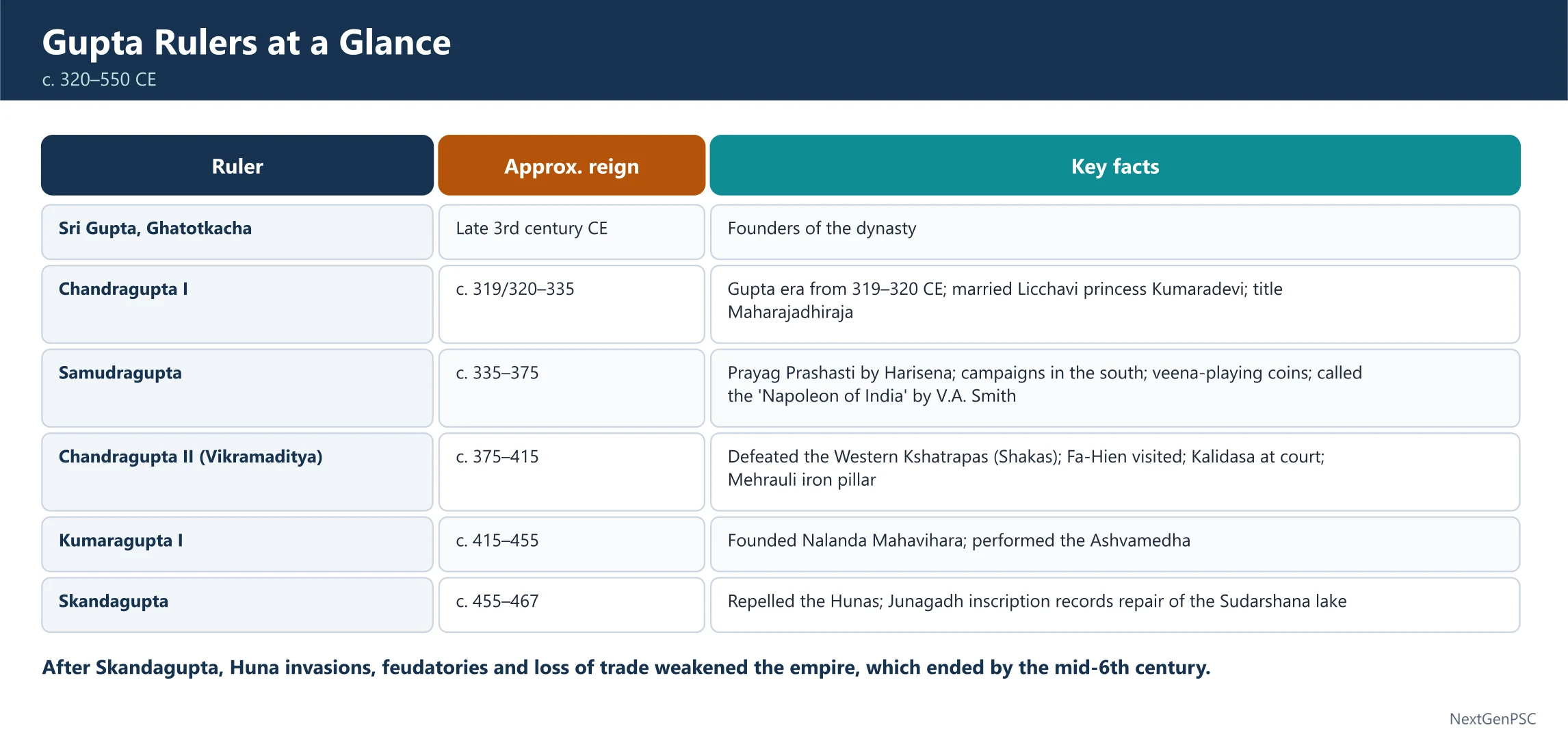
The Gupta Empire (320–550 CE) was established by Chandragupta I. The dynasty reached its peak under Samudragupta and Chandragupta II, saw consolidation under Kumaragupta, and faced decline during Skandagupta’s reign due to Hun invasions.
Political History: The Imperial Zenith of the Guptas 👑
The Gupta dynasty was built by a succession of competent rulers who achieved territorial dominance through strategic alliances and military might, leading to an age of unparalleled cultural flourishing.
Chandragupta I (c. 320–335 CE): The Founder
Political Foundation: He is considered the first important ruler and effective founder of the dynasty (following less prominent rulers like Sri Gupta). His reign began a formal epoch.
Strategic Alliance: He significantly raised the Gupta dynasty's prestige and power by marrying a Lichchhavi princess (Kumāradevī) . This political alliance secured the fertile and powerful Magadha region.
Imperial Title: Assumed the grand imperial title of Maharajadhiraja (King of Great Kings), formally asserting sovereignty over the smaller states in the Gangetic plains, with the capital at Pataliputra .
Samudragupta (c. 335–375 CE): The Great Conqueror
Conquests and Titles: Son of Chandragupta I and the greatest military ruler of the dynasty . Historian V.A. Smith famously called him the ‘Indian Napoleon’ due to his extensive conquests.
Primary Source: His campaigns, conquests, and virtues are meticulously recorded in the Allahabad Pillar Inscription (Prayaga Prashasti) , composed by his court poet, Harisena .
Imperial Expansion: His campaigns covered the entire subcontinent:
- Defeated and annexed nine kings of Aryavarta (North India).
- Subjugated 12 rulers of Dakshinapatha (South India) but adopted a policy of releasing and reinstating them as feudatories (Dharmavijaya) — a statesmanlike policy that earned loyalty without stretching administration.
Culture and Religion: Promoted Brahmanism (Vaishnavism) and performed the Ashvamedha sacrifice , yet remained highly tolerant towards other faiths. His coins depicting him playing the veena highlight his patronage of the arts and his personal accomplishment as a musician ( Kaviraja ).
Chandragupta II (Vikramaditya) (c. 375–415 CE): The Peak
Conquest and Titles: Son of Samudragupta and one of the greatest rulers. He achieved a major victory by defeating the Western Kshatrapas (Shakas) of Gujarat and Malwa, marking the end of foreign Shaka rule in Western India and gaining access to lucrative Western ports.
Imperial Zenith: His reign is considered the peak of the Gupta Empire's territorial, economic, and cultural power .
Cultural Patronage: Later literary tradition links his court with scholars such as Kalidasa and Amarasimha, but the exact membership and chronology of a 'Navaratna' court should not be treated as securely established. Aryabhata's work is dated to 499 CE, after Chandragupta II's reign.
Foreign Account: The Chinese Buddhist traveler Fa-Hien (Faxian) visited India during his reign (early 5th century CE), describing the empire's prosperity, peace , and efficient administration.
Titles: Assumed the title Vikramaditya (Sun of Prowess) after his victory over the Shakas.
Kumaragupta I (c. 415–455 CE): Consolidation and Learning
Stability: Maintained the vast empire inherited from his father (Chandragupta II). He also performed the Ashvamedha sacrifice to assert his supremacy.
Learning: Nalanda's early foundation is often attributed to Kumaragupta I through the identification of the donor 'Sakraditya' in later tradition and seals; the precise foundation date and identification remain uncertain. Nalanda developed over centuries into a major monastic centre of learning.
Defense: Successfully defended the empire against the initial incursions of the Pushyamitras and the Hunas (though major attacks came later).
Skandagupta (c. 455–467 CE): The Last Great Defender
The Defender: He is the last great Gupta ruler . He is celebrated for successfully repelling the large-scale invasions of the Hunas (Hephthalites) , an existential threat to the empire.
Source: His achievements and the Huna war are detailed in the Bhitari pillar inscription .
Public Works: His commitment to welfare is noted in the Junagarh inscription , which records his repair of the important Sudarshana Lake (which had previously been repaired by the Shaka ruler Rudradaman I).
Decline: Although victorious, the constant warfare severely exhausted the empire financially , marking the beginning of the irreversible decline of the mighty Gupta Empire.
| Ruler | Period | Key Achievements |
|---|---|---|
| Chandragupta I | 320–335 CE | Founder; marriage alliance with Lichchhavis; Maharajadhiraja title |
| Samudragupta | 335–375 CE | Great conqueror; Allahabad pillar inscription; Indian Napoleon; patron of arts |
| Chandragupta II (Vikramaditya) | 375–415 CE | Defeated Western Kshatrapas; peak of empire; patron of Kalidasa; Fa-Hien’s visit |
| Kumaragupta I | 415–455 CE | Performed Ashvamedha; Nalanda's early foundation is often attributed to his reign; defended empire |
| Skandagupta | 455–467 CE | Defeated Hunas; repaired Sudarshana Lake; decline of empire began |
Prelims tips
- Allahabad Pillar Inscription → Samudragupta, written by Harisena.
- Chandragupta II defeated Western Kshatrapas → end of foreign rule in western India.
- Nalanda's early foundation is often attributed to Kumaragupta I, but the exact evidence and date need caution.
- Skandagupta defeated Hunas but empire declined after him.
Mains points
- Gupta political history shows rise from regional power to imperial dominance.
- Samudragupta’s conquests made Guptas paramount in northern India.
- Chandragupta II’s reign was the cultural and political peak of the Guptas.
- Kumaragupta’s reign shows consolidation with cultural patronage (Nalanda).
- Skandagupta successfully repelled Hunas but financial strain began Gupta decline.
Did you know?
- Samudragupta issued coins showing him playing the veena — rare depiction of a king as a musician.
- Chandragupta II took the title Vikramaditya, later associated with legends and ‘Navaratnas’.
- Fa-Hien’s account praised the Gupta administration and prosperity but also noted caste restrictions.
- Skandagupta’s reign marks the first large-scale Hun invasions into India.
Administration of the Gupta Empire
The Gupta administration was a blend of strong central monarchy and decentralized feudalism. While the emperor was the supreme authority, various officials managed the empire at central, provincial, and local levels. The period saw the rise of feudatories (Samantas) and land grants, which influenced later Indian polity.
I. Central Administration and the Royal Authority 👑
The Gupta system was characterized by a powerful monarchical tradition but saw the early stages of decentralized control through land grants.
The King (Rajan): The supreme, sovereign authority, holding executive, legislative, and judicial powers. Kings adopted grand, elaborate titles like Maharajadhiraja (King of Great Kings), Parameshvara , and Paramabhattaraka .
Council of Ministers (Mantri Parishad): A high-ranking council that advised the king, but ultimate, concentrated power resided with the monarch, particularly under emperors like Samudragupta.
Rise of Feudalism: The practice of granting large tracts of tax-free land ( Brahmadeya/Agrahara ) to Brahmanas, officials, and temples (often recorded on copper plates) reduced the central government’s cash revenue and led to the rise of the Samanta (feudal) system .
II. Administrative Hierarchy: From Centre to Village 🏘️
The administration maintained a clear hierarchy, structured primarily for efficient revenue collection and imperial control over provinces.
A. Provincial (Bhukti) Administration:
The empire was divided into Bhuktis (provinces), which were administered by an imperial governor called the Uparika (often recruited from the royal family or a trusted high-ranking official).
Provinces were subdivided into Vishayas (districts), managed by the Vishayapati .
Further divisions included the Vithi (sub-districts) and the Gram (Village, the basic unit).
B. Local and Urban Administration:
Village (Gram): The basic unit, managed by the Gramadhyaksha (village headman), who was often assisted by a council of village elders ( Gramika ). These villages enjoyed a high degree of autonomy in internal matters.
Urban (Nagara) Administration: Administration in major cities (Pataliputra, Ujjain, Mathura) was organized, often involving guilds (Shrenis) and local officials, ensuring public order, managing markets, and collecting duties.
III. Key Officials and Titles in the Gupta Era 💂
Gupta titles reflect the complexity and, often, the combination of civil and military duties in high-ranking positions (e.g., Mahadandanayaka).
Kumaramatya: Highly privileged and influential high officials, often recruited from the royal family (hence 'Kumara'). They supervised general administration across the central and provincial levels.
Sandhivigrahika / Mahasandhivigrahaka: The Minister of Peace and War (Foreign Affairs). This title signifies a complex diplomatic bureaucracy necessary for managing numerous feudatories and external threats.
Mahadandanayaka: A high-ranking official who served a dual role —as a Chief of Justice and a Military Commander .
Mahapratihara: The Chief of Palace Guards , responsible for royal household security and ceremonial protocol.
Revenue Officials: The Bhogika served as a revenue officer at the local level. Ayuktas were general officials assisting in revenue collection and administration.
Military Officials: Titles included Mahasenapati (Commander-in-chief), Baladhikaranas (officers commanding military units), and Mahabaladhikrita (Officer-in-charge of army organization).
IV. Judicial System: Dharma and Punishment ⚖️
The Gupta period saw the legal system becoming more defined, guided by religious texts, with clear differentiation between civil and criminal law.
Basis of Justice: Justice was guided by Dharma-shastras (religious law codes). The King remained the supreme judicial authority.
Civil and Criminal Law: A key feature was the clear distinction between Civil Law (disputes, property) and Criminal Law (crime, offense).
Judicial Hierarchy: Royal courts at the capital served as the apex, followed by courts under the Mahadandanayaka and local bodies ( Dandapasadhikarana - judicial officer) and village headmen.
Punishments: Punishments, while severe (based on smritis), were generally less harsh than the Mauryan period , particularly in terms of capital punishment. However, the severity of the penalty often varied based on the caste and social status of the offender, reflecting the caste rigidity of the age (as noted in the accounts of Fa-Hien).
| Official | Role |
|---|---|
| Kumaramatya | High-ranking officials supervising administration |
| Sandhivigrahika | Minister of peace and war (foreign affairs, treaties) |
| Mahadandanayaka | Chief justice and military commander |
| Mahapratihara | Head of palace guards |
| Bhogika | Revenue officer at local level |
| Ayuktas | Assistants in revenue collection and administration |
| Mahasenapati | Commander-in-chief of army |
| Mahasandhivigrahaka | Chief minister for foreign affairs |
| Mahabaladhikrita | Army organization officer |
Prelims tips
- Kumaramatya → high officials in Gupta administration.
- Sandhivigrahika → minister of peace and war (foreign affairs).
- Mahadandanayaka → chief justice + military commander.
- Gupta local administration was village-based (Gramadhyaksha).
Mains points
- Gupta administration combined monarchy with feudal decentralization.
- Officials were well-defined: Kumaramatyas, Sandhivigrahika, Mahadandanayaka, Mahapratihara, etc.
- Village remained the basic unit of administration, with Gramadhyaksha and guilds playing key roles.
- Land grants to officials show the rise of feudalism in India.
- Gupta bureaucracy became the model for later Indian dynasties.
Did you know?
- Gupta inscriptions often mention the names of officials, showing a highly organized bureaucracy.
- The post of ‘Sandhivigrahika’ (minister of peace and war) is considered the origin of modern foreign ministry in India.
- Many Gupta officials were recruited from powerful families and often given land grants instead of salaries.
- Decentralization through Samantas (feudatories) began in Gupta times and became a major feature in medieval India.
Revenue Administration of the Gupta Empire
The Gupta economy was primarily agrarian, with land revenue as the chief source of income. Taxes were collected on agriculture, trade, and professions. Land grants to officials, Brahmanas, and temples led to the growth of feudalism.
Sources of Revenue
• Land Revenue (Bhaga): Main source; usually 1/4th to 1/6th of produce.
• Bali: Voluntary/compulsory tax from subjects.
• Bhoga: Taxes in kind (produce, gifts, services).
• Hiranya: Tax paid in cash (gold or silver).
• Uparikara: Additional cesses on land revenue.
• Visti: Forced labour (corvée), often resented by peasants.
• Customs Duties: Collected on trade (internal and external).
• Professional & Guild Taxes: Taxes imposed on artisans, craftsmen, and guilds (shrenis).
• Tributes from Feudatories (Samantas): Provided income along with military assistance.
Land Grants
Gupta rulers issued land grants to Brahmanas, officials, and temples.
These grants were recorded on copper plates (e.g., Damodarpur copper plates).
Land grants were often tax-free and hereditary.
Officials sometimes received land instead of salaries.
Led to the rise of feudalism and decline of centralized economy.
Agrarian Economy
Agriculture was the backbone of Gupta economy.
Important crops: rice, wheat, sugarcane, cotton, pulses.
Irrigation was practiced; wells, tanks, and canals maintained by villagers and sometimes the state.
Villages were largely self-sufficient economic units.
| Tax/Term | Description |
|---|---|
| Bhaga | Land revenue (1/4th–1/6th of produce) |
| Bali | Compulsory/voluntary tax from subjects |
| Bhoga | Tax in kind (produce, services, gifts) |
| Hiranya | Cash tax (gold/silver) |
| Uparikara | Additional tax on land |
| Visti | Forced labour (corvée duty) |
| Customs Duties | Tax on internal and foreign trade |
| Tributes | Collected from feudatories (Samantas) |
Prelims tips
- Bhaga → main land revenue tax.
- Visti → forced labour (important prelims term).
- Damodarpur copper plates → source of Gupta land grants.
- Gupta villages were largely self-sufficient economic units.
Mains points
- Revenue was the backbone of Gupta administration, with agriculture as the mainstay.
- Land grants led to decentralization and rise of feudalism.
- Different forms of taxes (Bhaga, Bali, Bhoga, Hiranya, Visti) reflect a complex system.
- Damodarpur copper plates highlight bureaucratic recording of land transfers.
- The revenue system shows the beginning of transition from centralized Mauryan economy to feudal medieval economy.
Did you know?
- Gupta rulers issued many copper-plate grants recording land transfers.
- Villages often managed their own irrigation and tax collection systems.
- The practice of granting tax-free land to Brahmanas (Brahmadeya) expanded in Gupta times.
- Visti (forced labour) was so unpopular that some inscriptions mention its remission as a royal favour.
Military Organization of the Gupta Empire
The Guptas maintained a strong army consisting of infantry, cavalry, elephants, and a smaller navy. Though not as centralized as Mauryan military, it was effective against regional powers and foreign invasions, particularly the Hunas.
Composition of the Gupta Army
• Infantry (Padatikas): Largest segment of the army; carried bows, swords, and shields.
• Cavalry (Ashvarohi): Increased importance during Gupta period; horsemen with lances and bows.
• War Elephants (Gajashakti): Used for shock power and battlefield dominance.
• Chariots: Declined in importance compared to earlier times.
• Navy: Small, mainly for riverine and coastal defense.
Key Features
The Guptas emphasized cavalry and archery more than Mauryas.
Horses were imported from Central Asia, indicating foreign trade ties.
Kings like Samudragupta and Skandagupta personally led military campaigns.
Military organization less centralized; reliance on feudatories (Samantas) for troops.
Use of iron weapons (swords, spears, axes) became widespread.
Important Military Titles and Officials
• Mahasenapati: Commander-in-chief.
• Baladhikaranas: Military officers commanding units.
• Mahabaladhikrita: Officer in charge of army organization.
• Dandanayaka: Judicial-cum-military officer.
Role in Defense and Expansion
Samudragupta expanded empire through aggressive conquests (recorded in Allahabad pillar).
Chandragupta II defeated Western Kshatrapas with military might.
Skandagupta repelled the Hunas but empire weakened financially due to wars.
| Unit | Description |
|---|---|
| Infantry (Padatikas) | Largest force; swords, bows, shields |
| Cavalry (Ashvarohi) | Fast, powerful; lances, archery; horses from Central Asia |
| War Elephants (Gajashakti) | Shock force; battlefield dominance |
| Chariots | Declining importance in warfare |
| Navy | Limited; river and coastal defense only |
Prelims tips
- Gupta army → emphasized cavalry and elephants.
- Horses imported from Central Asia.
- Skandagupta defeated Hunas.
- Samudragupta called ‘Indian Napoleon’ for conquests.
Mains points
- Gupta army composition included infantry, cavalry, elephants, and a limited navy.
- Emphasis on cavalry reflects Central Asian influence on warfare.
- Samudragupta and Chandragupta II expanded empire through conquests.
- Skandagupta defended empire against Hunas but financial strain began.
- Reliance on Samantas for troops sowed seeds of feudalism and decentralization.
Did you know?
- Samudragupta’s coins show him as a warrior and also playing the veena, highlighting both martial and cultural skills.
- Skandagupta’s success against the Hunas temporarily saved north India from foreign domination.
- The Guptas emphasized cavalry more than earlier Indian dynasties, showing Central Asian influence.
- Gupta military relied heavily on Samantas, a feature that later contributed to feudalism.
Provincial, District, and Village Administration in Gupta Empire
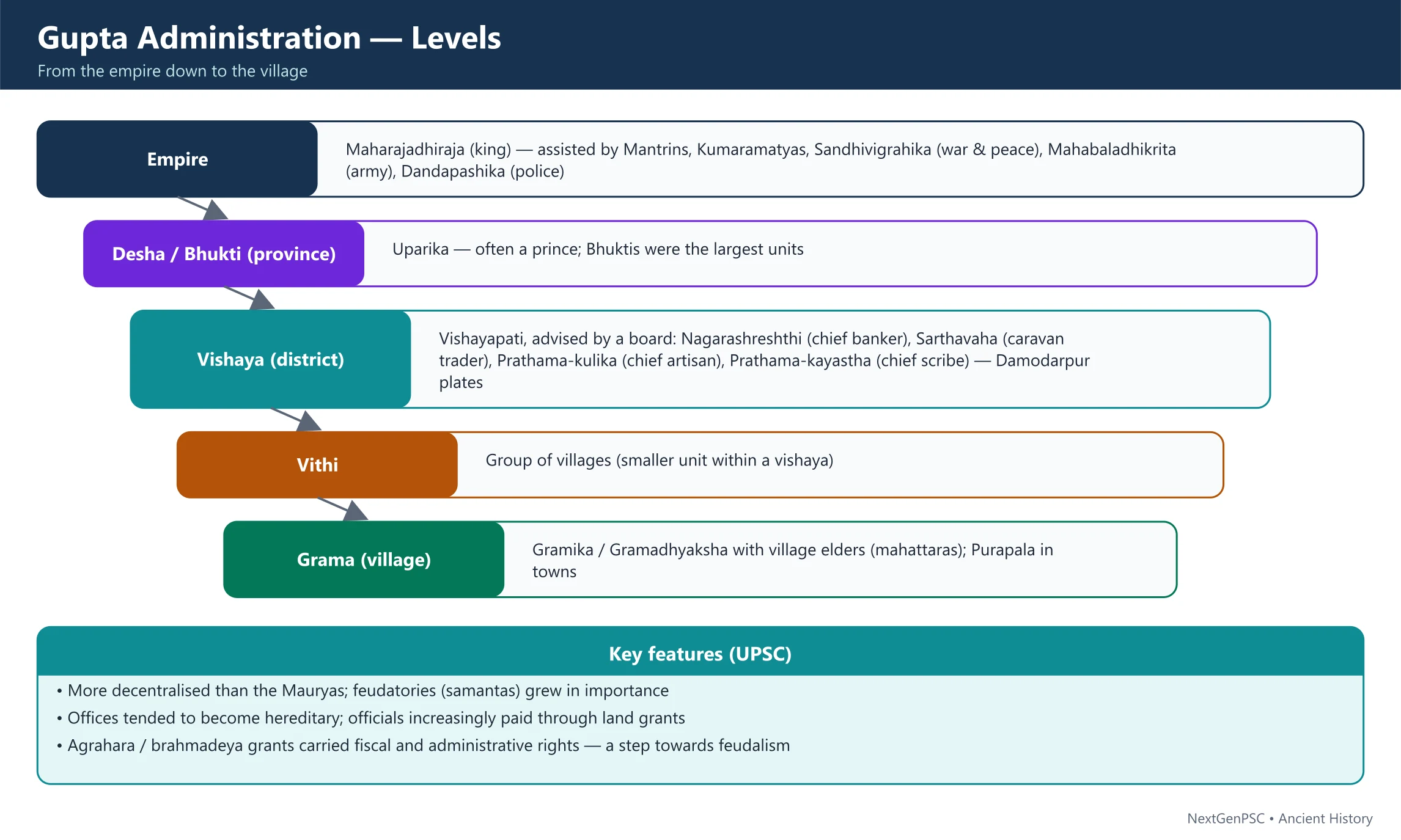
The Gupta Empire had a well-structured hierarchy: Provinces (Bhuktis) → Districts (Vishayas) → Sub-districts (Vithis) → Villages (Gramas). While the king was supreme, real power at local levels often lay with officials, feudatories, guilds, and village assemblies.
Provincial Administration (Bhuktis): The Uparika's Role 🏛️
The Gupta imperial structure relied on a tiered administration, where the centralized monarchy delegated authority to regional heads, leading to an emerging semi-feudal structure.
Provincial Division: The vast empire was divided into large provinces known as Bhuktis .
Provincial Head: Each Bhukti was governed by an Uparika (provincial governor), typically appointed directly by the emperor (King). The Uparika often held the title Maharaja , indicating their high status.
Uparika's Responsibilities: The Uparika was responsible for the strategic administration: maintaining law and order , supervising revenue collection from the subordinate units, and overseeing the military contingents within the province.
Semi-Feudal Character: The provincial administration increasingly acquired a semi-feudal character , relying on Samantas (feudal lords) for military support and local governance, showcasing the decentralization of state power.
District Administration (Vishayas): Local Participation 🏘️
The Vishaya (district) level was crucial, as it was the point where imperial authority met the local populace. Administration here was characterized by non-official participation .
District Division: Bhuktis (provinces) were subdivided into Vishayas (districts) .
District Head: Each district was headed by a royal official called the Vishayapati .
Council of Non-Officials: The Vishayapati was mandatorily assisted by a District Advisory Council . This council included local influential representatives, demonstrating local self-governance:
- Nagarasreshtin (Chief Merchant/Banker).
- Sarthavaha (Head of the Caravan Traders).
- Prathamakulika (Chief Artisan or Head of the Craftsmen).
Function: Inscriptions (e.g., Damodarpur copper plates ) prove that these district assemblies actively participated in administrative decisions, especially those concerning managing land grants, sale of wastelands, and local taxation .
Village Administration (Gramas): Autonomous Units 🏡
The village remained the most resilient and most autonomous unit of the entire imperial structure.
Basic Unit: The village (Grama) was the fundamental unit of administration.
Village Head: Headed by the Gramadhyaksha (village headman) or Gramikas , assisted by a council of village elders (Mahattaras) .
Responsibilities: The Gramadhyaksha was responsible for ensuring maintenance of irrigation systems, local revenue collection (which was then passed up the hierarchy), and the resolution of local disputes .
Self-Sufficiency: Villages were largely self-sufficient economic units , with the agricultural economy being supported by local artisans and craftsmen ( Shrenis ).
Community Participation: Guilds (Shrenis) and broader community assemblies actively participated in local governance, signifying the limited direct interference of the central state in day-to-day village life.
| Unit | Head | Functions |
|---|---|---|
| Province (Bhukti) | Uparika | Governor; maintained law, revenue, and order |
| District (Vishaya) | Vishayapati | District head; managed land grants, revenue, justice |
| Sub-district (Vithi) | Local officers | Assisted in administration at regional level |
| Village (Grama) | Gramadhyaksha / Gramikas | Tax collection, irrigation, disputes, village welfare |
Prelims tips
- Province = Bhukti → headed by Uparika.
- District = Vishaya → headed by Vishayapati.
- Village = Grama → headed by Gramadhyaksha/Gramikas.
- Damodarpur copper plates → key source for Gupta administration.
Mains points
- Gupta administration was hierarchical: Bhuktis → Vishayas → Vithis → Gramas.
- Uparika (provincial governor) and Vishayapati (district head) were key officials.
- Village administration was strong and self-sufficient under Gramadhyaksha.
- Damodarpur inscriptions reveal active role of assemblies and guilds in administration.
- This system shows both central control and local autonomy, laying foundation for later feudalism.
Did you know?
- Damodarpur copper plate inscriptions (Bengal) provide detailed evidence of district administration in Gupta times.
- Local guilds (Shrenis) often acted like municipal corporations, funding temples and infrastructure.
- Villages were largely autonomous and rarely interfered with by the central government.
- Urban centers like Ujjain and Pataliputra had their own councils and officials for city governance.
Economy of the Gupta Empire (with focus on Taxes)
The Gupta economy was primarily agrarian but supported by flourishing trade and crafts. Taxes were collected on land, produce, trade, and professions. Land grants and tax exemptions to Brahmanas and officials led to the rise of feudalism.
I. Agrarian Economy and Trade: The Engine of the Golden Age 🌾
The Gupta economy was highly productive, based on a sturdy agricultural foundation and propelled by flourishing regional and international trade networks.
A. Agrarian Backbone:
• Mainstay: Agriculture was the undisputed backbone of the Gupta economy, directly sustaining the imperial court and financing military campaigns.
• Crops and Irrigation: Major crops included rice, wheat, barley, pulses, sugarcane, and cotton . Productivity was significantly supported by improved irrigation systems, including the maintenance of wells, tanks, and canals (with state interest noted, e.g., Sudarshana Lake repair).
• Self-Sufficiency: Villages continued to function as largely self-sufficient economic units , producing their own food and basic necessities, which reduced the administrative complexity of local management.
B. Trade and Commerce:
• Internal Networks: Extensive internal trade connected the northern routes ( Utarapatha ) with the southern trade routes ( Dakshinapatha ), facilitating the exchange of regional specialty goods.
• External Links: Foreign trade flourished, linking India with the Roman Empire (via Red Sea ports), Southeast Asia (via eastern ports like Tamralipti), and Central Asia (via the Silk Route ).
• Trade Indicators: The discovery of Roman gold coins (Denarii) in large numbers across India provides strong evidence of the huge volume and favorable balance of Indo-Roman trade for India.
• Key Exports: Principal exports included silk, cotton textiles, spices, ivory, and precious stones .
• Guilds' Role: Merchant and artisan Guilds (Shrenis) were major financiers of trade and played a crucial role in regulating production, prices, and quality.
II. Taxation and Land Grants: The Seeds of Feudalism 💰
The Gupta tax system was comprehensive, covering land, production, and commerce, but the widespread use of land grants introduced profound structural changes.
A. Complex Taxation System:
Bhaga: The primary Land Tax , collected at a rate of 1/4th to 1/6th of the produce (usually in kind, but sometimes in cash).
Bali: A tax that shifted from being a voluntary tribute to a compulsory/compulsory tax collected from subjects for general state expenditure.
Bhoga: A tax paid in kind , representing the royal share of produce, services, or gifts (e.g., fruits, vegetables, small services) given daily to the king.
Hiranya: Taxes specifically collected in cash ( gold or silver coins ), usually imposed on specific goods or professions.
Uparikara: An additional tax or temporary cess levied over and above the regular land revenue.
Visti: Forced labour (corvée duty) , where peasants were obliged to work for the state without wages. This was an unpopular measure and indicates increasing pressure on the peasantry.
Duties and Tributes: The state collected Customs duties on internal and foreign trade and levied Professional/occupational taxes on artisans and merchants. Tributes (including taxes and military assistance) were collected from feudatories (Samantas) .
B. Land Grants and Decentralization:
Land Grants: Gupta rulers frequently granted tax-free land (Brahmadeya/Agrahara) to Brahmanas, temples, and officials (recorded in copper plates , e.g., the Damodarpur copper plates from Bengal).
Impact of Grants: These grants fundamentally reduced the central state’s direct revenue and simultaneously empowered the grantees (Brahmins/Samantas) with administrative and judicial authority over the bestowed land. This system significantly strengthened feudal tendencies in the Gupta period, marking a major transition in Indian polity.
| Tax | Description |
|---|---|
| Bhaga | Land revenue (1/4 – 1/6 of produce) |
| Bali | Compulsory/voluntary tax from people |
| Bhoga | Produce, gifts, or services in kind |
| Hiranya | Cash tax in gold/silver |
| Uparikara | Additional cess on land |
| Visti | Forced labour (corvée duty) |
| Customs Duties | Taxes on trade |
| Professional Taxes | Artisans, guilds, merchants |
| Tributes | Taxes + military help from feudatories |
Prelims tips
- Bhaga → land revenue (main tax).
- Visti → forced labour tax (important for prelims).
- Damodarpur copper plates → evidence of land grants and taxes.
- Hiranya = cash tax in gold/silver.
Mains points
- Gupta economy was agrarian, supplemented by trade and crafts.
- Land revenue (Bhaga) was the chief tax, alongside Bali, Bhoga, Hiranya, and Uparikara.
- Visti (forced labour) reveals social burdens on peasants.
- Copper plate grants highlight growing feudalism and tax exemptions.
- Trade prosperity is evident from Roman coins and Silk Route commerce.
Did you know?
- Roman coins found in Gupta territories indicate large-scale Indo-Roman trade.
- Visti (forced labour) was often mentioned in inscriptions — remission of Visti was considered royal generosity.
- Copper plate grants from Gupta period are a major source of tax and land policies.
- Guilds sometimes collected taxes and funded religious and public works.
Agriculture in the Gupta Empire
Agriculture was the mainstay of the Gupta economy. Land was classified into different types for revenue purposes, and land grants became common, reflecting the rise of feudalism.
I. Agrarian Economy: The Foundation of Prosperity 🌾
Agriculture remained the bedrock of the Gupta economy, supporting the imperial structure and the 'Golden Age' cultural boom. The vast majority of the population was engaged in farming.
Crops: Major crops included staple grains like rice, wheat, and barley , alongside cash crops such as sugarcane, pulses, cotton, and mustard , indicating agricultural diversity and specialization.
Irrigation: Productivity was maintained and supported through wells, tanks, and canals . The management of these irrigation facilities was primarily handled by the villagers themselves, with supplementary support from the state (as evidenced by the Sudarshana Lake repair).
Village Structure: Villages were largely self-sufficient economic units , producing their own food and basic needs, which limited the direct administrative burden on the central government.
II. Specialized Land Classification 🗺️
Gupta period legal and administrative texts, unlike earlier periods, detailed specific classifications for different types of land based on usage and productivity (important for Prelims):
Kshetra: Cultivated land actively fit for agriculture (the main tax base).
Khila: Waste or barren land which was not cultivated (often due to poor soil quality).
Aprahata: Forest land or uncultivated wilderness.
Vasti: Habitable land designated for settlements and houses (residential areas).
Prahata: Land recently cleared of forest and brought under cultivation.
Udranga: High land, often less fertile or subject to specific taxes.
Sita-bhumi: Crown land directly managed and controlled by the king (generating revenue for the royal treasury).
III. Land Grants and Feudalization (Institutional Change) 📉
The institutional practice of granting land was the single most significant factor in changing the Gupta political economy, leading directly to feudalism and decentralization.
Brahmadeya: Land grants to Brahmanas (priests). These were typically tax-free and often hereditary, intended to increase the prestige of the grantor and the spread of Brahmanical influence.
Devadana: Land grants given to temples or other religious institutions for their maintenance and worship ( Puja ).
Agrahara: Grants involving entire villages (not just parcels) gifted to Brahmanas or educational institutions, giving the grantees significant administrative control.
Vrittis (Official Assignments): Assignments of land given to officials (Amātyas) often in lieu of a fixed salary . This marks a transition from a centralized cash economy (Mauryan model) to a land-based feudal model.
Impact: These grants were typically hereditary and granted the recipients exemption from state interference (tax collection, law enforcement). This reduced the state's direct revenue and simultaneously empowered the grantees as local landlords/feudatories , significantly strengthening feudal tendencies (the Samanta system).
| Type | Description |
|---|---|
| Kshetra | Cultivated land |
| Khila | Waste/barren land |
| Aprahata | Forest/uncultivated land |
| Vasti | Habitable/settlement land |
| Prahata | Cleared land brought under cultivation |
| Udranga | High land, less fertile |
| Sita-bhumi | Crown land under king |
| Grant Type | Beneficiaries | Features |
|---|---|---|
| Brahmadeya | Brahmanas | Tax-free, hereditary land |
| Devadana | Temples | For religious upkeep |
| Agrahara | Brahmanas/educational institutions | Whole villages donated |
| Vritti | Officials | Land given in lieu of salary |
Prelims tips
- Kshetra = cultivated land; Khila = barren land.
- Brahmadeya → tax-free land grants to Brahmanas.
- Agrahara → whole villages donated.
- Damodarpur copper plates → evidence for Gupta land grants.
Mains points
- Gupta economy was agrarian, with classification of land for revenue assessment.
- Types of lands like Kshetra, Khila, Sita-bhumi show agricultural diversity.
- Land grants (Brahmadeya, Devadana, Agrahara, Vritti) reflected religious patronage and administrative practice.
- Copper plate inscriptions serve as primary sources for land policies.
- Land grants led to decentralization, decline in royal revenue, and rise of feudalism.
Did you know?
- Many land grants were inscribed on copper plates and buried in the donated land for legal authenticity.
- Damodarpur copper plates from Bengal are key sources on Gupta land revenue and grants.
- Agrahara grants led to entire villages being controlled by Brahmanas or monasteries.
- Exemptions in land grants reduced royal control and revenue, fueling feudalism.
Mining, Trade, and Coinage in Gupta Empire
The Gupta period witnessed thriving mining, inland and overseas trade, and the issue of beautiful gold, silver, and copper coins. Trade prosperity was one of the reasons why this era is called the Golden Age of India.
I. Mining: Resource Exploitation and State Wealth ⛏️
The Gupta economy benefited greatly from India's rich mineral resources, which provided the raw materials necessary for the military, coinage, and extensive trade.
Strategic Metals:
- Iron: Crucially exploited for superior agricultural tools, weapons , and large-scale construction (e.g., the Delhi Iron Pillar).
- Copper: Widely used in the minting of coins (for local transactions) and the manufacture of common household utensils and statues.
Precious Metals:
- Gold: Sourced internally (from regions like Kolar in Karnataka and the Satpura region) and externally through the massive favorable balance of trade with the Roman Empire.
- Silver: Sourced from local Western Indian mines and acquired through trade with Central Asia (often used for regional silver coinage).
Gemstones: Precious stones like lapis lazuli, carnelian, and pearls were extensively mined, cut, and polished, forming a significant component of India's high-value exports .
II. Trade and Commerce: The Global Network 🌍
Trade reached its peak, connecting the Gupta heartland to international markets and enabling the economic stability required for the Golden Age.
Internal Trade: Flourished along well-protected routes, notably the Utarapatha (connecting the Gangetic plains to the Northwest, essential for Central Asian trade) and the Dakshinapatha (connecting North India to the Deccan and the South).
Trade Centers: Important urban trade hubs included Pataliputra, Ujjain (a major commercial city and secondary capital), Mathura, Tamralipti (major Eastern port), and Broach (Bhrigukachcha, Western port) .
Role of Guilds: Guilds (Shrenis) of merchants and artisans were powerful autonomous bodies that regulated industry, trade standards, and banking activities, often financing large-scale trade operations.
Overseas Trade: Maintained vital contact with the Roman Empire (for luxury goods and gold), Southeast Asia (Java, Sumatra), and China (via the Silk Route ), primarily for luxury goods and spices.
Exports/Imports: India exported high-value goods like silk, cotton textiles, spices, ivory, pearls, and precious stones . Imports mainly included horses (critical for the Gupta cavalry), Chinese silk , wine, glass, and gold/silver bullions (from Rome).
Ports: Tamralipti (on the eastern coast for SE Asia/China trade) and Broach (Bhrigukachcha) and Cambay (on the western coast for Roman trade) were the key maritime hubs.
III. Coins of the Gupta Period: Art, Economics, and Kingship 🪙
Gupta coinage is famed for its artistic beauty, purity, and iconographic diversity, reflecting the empire's wealth and cultural self-awareness.
Material and Volume: Guptas issued coins of gold, silver, and copper . They are most famous for issuing the largest volume of highly artistic gold coins (Dinars) in ancient Indian history, symbolizing the height of prosperity.
Gold Coin Iconography: Gold coins provide crucial cultural and political insights, depicting the kings:
- Performing Vedic rituals (e.g., Ashvamedha sacrifice type).
- Demonstrating military skill (e.g., Lion-slayer/Tiger-slayer types, showing Chandragupta II and Samudragupta).
- Showcasing cultural skills (e.g., Samudragupta playing the veena ).
Silver and Copper Coins: Chandragupta II was the first Gupta king to issue silver coins after defeating the Western Kshatrapas (Shakas), primarily for regional trade. Copper coins facilitated local and small-scale transactions.
Religious Syncretism: Coins depicted diverse deities ( Lakshmi, Ganga, Garuda, Kartikeya, Shiva, Buddha ) alongside the rulers, highlighting the empire’s religious tolerance and the syncretic nature of its official iconography.
| Metal | Features |
|---|---|
| Gold (Dinar) | Most famous; kings shown in rituals, hunting, music; deities depicted |
| Silver | Issued after conquest of Western Kshatrapas by Chandragupta II |
| Copper | Used for local, small-scale transactions |
Prelims tips
- Guptas most famous for gold coins (Dinars).
- Chandragupta II → silver coins after defeating Western Kshatrapas.
- Guilds (Shrenis) important for trade regulation.
- Ports: Tamralipti, Broach, Cambay were major trade centers.
Mains points
- Gupta economy flourished with mining, agriculture, and trade.
- Ports like Tamralipti and Broach facilitated overseas trade.
- Guilds played a central role in urban economy, banking, and production.
- Gupta coinage reflects prosperity, victories, and cultural achievements.
- Gold coins highlight the Gupta period as a Golden Age of Indian history.
Did you know?
- Samudragupta is one of the rare kings in history whose coins depict him playing a musical instrument (veena).
- Roman coins found in India during Gupta times suggest massive Indo-Roman trade.
- Gupta gold coins are considered the most artistic in ancient India.
- Gupta silver coins imitated designs of defeated Western Kshatrapa rulers.
Society During the Gupta Period
Gupta society was highly stratified with a rigid Varna system. The period saw the rise of Brahmanical dominance, decline in women’s status, strengthening of joint families, and the flourishing of arts, education, and culture.
I. Social Structure: Stratification and Decline of Mobility 📉
The Gupta age saw the Varna system become more complex and rigid than the Mauryan period, accompanied by a notable decline in the overall position of women.
Varna Hierarchy: The Brahmanas solidified their highest prestige and power, benefiting greatly from extensive land grants ( Brahmadeya ). Kshatriyas remained the ruling and warrior class. Vaishyas continued their key role in trade and agriculture , and Shudras primarily served as laborers and artisans .
Caste and Jatis: The rigidity of the Varna system led to the proliferation of sub-castes (jatis) , often based on specialized crafts or professions. Inter-caste mobility was significantly reduced compared to earlier times, reinforcing hereditary status.
Untouchability: The practice of untouchability (Chandalas) became more prominent and institutionalized during this period, as attested by the accounts of the Chinese traveler, Fa-Hien .
Guilds (Shrenis): Economic guilds ( Shrenis ) of artisans and merchants continued to function as influential social groups , providing a secondary source of identity and self-governance outside the Varna structure.
II. Status of Women, Family, and Marriage 💍
The period marked a distinct decline in the legal and social status of women , despite some notable exceptions in the aristocracy.
Decline in Status: Women were increasingly excluded from Vedic education and participation in assemblies . The legal age for marriage was lowered, making child marriage more common.
Sati and Idealization: The custom of Sati (widow immolation) began to appear, primarily confined to the upper classes and royal families , indicating a growing social suppression. Literature heavily emphasized the ideal of ‘Pativrata’ (the devoted wife).
Power Holders: Despite the general decline, some aristocratic women, notably Prabhavati Gupta (daughter of Chandragupta II, who was a Vakataka Queen), held significant political and administrative power .
Family Structure: The Joint Family system was strengthened and became the social norm, with patriarchal authority (male head of the family) becoming more dominant and unchallenged.
III. Religion, Education, and Cultural Life 🎓
The Gupta era is defined by the revival of Brahmanism (Hinduism) and an explosion of scientific and literary output.
Religious Dominance and Synthesis: Brahmanism (Hinduism) regained its political and social dominance. The major sects of Vaishnavism (worship of Vishnu) and Shaivism (worship of Shiva), along with Shaktism , flourished. The composition of the Puranas (mythological narratives) formalized these religious traditions.
Tolerance and Monasticism: Despite the Hindu revival, the Gupta rulers practiced religious tolerance , allowing Buddhism and Jainism to continue flourishing (evidenced by the Ajanta caves and royal patronage).
Architecture and Rituals: Temple building (stone temples with Shikharas) became prominent. Traditional rituals and pilgrimages (as opposed to Vedic sacrifices) grew popular among the masses.
Education Centres: Major institutions such as Nalanda and Vallabhi became important centres of learning. Nalanda's early foundation is often associated with Kumaragupta I, though the precise date and identification are debated; its international prominence grew over subsequent centuries.
Intellectual Curriculum: Education encompassed a vast curriculum, including the Vedas, grammar, logic, medicine, astronomy, and philosophy .
Sanskrit Zenith: Sanskrit literature reached its classical zenith . This golden era included literary giants like Kalidasa (playwright), Amarasimha (lexicographer), Aryabhata (astronomer/mathematician), and Varahamihira (astronomer/polymath).
| Aspect | Features |
|---|---|
| Varna System | Rigid; Brahmanas dominant; rise of sub-castes; untouchability appeared |
| Women’s Position | Declined; child marriage, sati, limited education; some exceptions like Prabhavati Gupta |
| Family | Joint families; patriarchal authority |
| Religion | Brahmanism dominant; Vaishnavism, Shaivism, Shaktism; temples flourished |
| Education | Nalanda, Vallabhi universities; Sanskrit literature; scholars like Kalidasa, Aryabhata |
Prelims tips
- Prabhavati Gupta → female regent (Vakataka kingdom).
- Nalanda and Vallabhi → famous universities of Gupta era.
- Varna system became rigid; untouchability gained ground.
- Child marriage and sati appear in Gupta period.
Mains points
- Gupta society was hierarchical with a rigid Varna system.
- Women’s position declined, though exceptions like Prabhavati Gupta existed.
- Joint family system strengthened; patriarchy dominated.
- Brahmanism revived but Buddhism and Jainism continued.
- Nalanda and Vallabhi universities made India a global center of learning.
Did you know?
- Prabhavati Gupta, daughter of Chandragupta II, ruled as regent of the Vakataka kingdom — a rare example of female power.
- The Gupta period saw the composition of many Puranas, which helped spread Hinduism among the masses.
- Gupta coins often depicted goddesses like Lakshmi and Ganga, showing religious and cultural symbolism.
- Nalanda attracted students from several parts of Asia, especially in its later centuries.
Religion During the Gupta Period
The Gupta period witnessed a revival of Hinduism with the rise of temple architecture, Bhakti cults, and Puranic traditions. Vaishnavism, Shaivism, and Shaktism flourished, while Buddhism and Jainism continued with royal patronage.
Hinduism: Revival and Synthesis (The Puranic Age) 🕉️
The Gupta period marked the classical revival of Brahmanism (Hinduism), transforming it from a ritualistic Vedic faith into a devotional, accessible popular religion.
Royal Patronage: Gupta rulers were primarily Vaishnavas (devotees of Vishnu) and often adopted titles like Parama-bhāgavata (Devotee of Vishnu). They used the Garuda (vehicle of Vishnu) as their official emblem.
Sectarian Expansion: The three main sects of modern Hinduism expanded and formalized:
- Vaishnavism: Worship of Vishnu and his avatars (especially Krishna, Rama).
- Shaivism: Worship of Shiva (often depicted as the Lingam).
- Shaktism: Worship of the Goddess (Shakti/Devi) in various forms (Durga, Lakshmi).
Bhakti and Puranas: The concept of Bhakti (personal, emotional devotion to a deity) gained immense popularity, making religion accessible to the masses. The great Puranas (e.g., Vishnu Purana, Bhagavata Purana ) were composed and compiled, codifying mythology, genealogies, and rituals for the common people.
Temple Architecture: The Gupta era pioneered the construction of permanent stone temples for Hindu deities, marking a shift from earlier temporary wooden/rock structures. Key examples include the Dashavatara Temple at Deogarh (famous for its panel depicting Vishnu reclining on Sheshnaga) and the Bhitargaon Temple (brick).
Numismatic Evidence: Gupta gold coins vividly depict Hindu deities like Vishnu, Lakshmi, Kartikeya (Skanda), and Ganga , highlighting the official integration of these cults with imperial authority.
Buddhism and Jainism: Continued Flourishing ☸️
Despite the Hindu revival, the Gupta period was characterized by religious tolerance , allowing non-Vedic faiths to flourish, often under the patronage of the royal family or the mercantile class.
Buddhism (Mahayana Apex):
- Intellectual Center: Nalanda developed into a major centre of Buddhist learning. Its early foundation is often associated with Kumaragupta I, but that attribution and the exact chronology are not certain; its fame expanded markedly in later centuries.
- Art and Cult: The Bodhisattva cult (the Mahayana ideal of compassionate saviors) gained popularity. Buddhist art developed into the classical Sarnath and Mathura styles (Gupta phase), and the Ajanta cave frescoes (depicting elaborate Jataka tales and Buddhist life) were created.
- Foreign Visitors: The continued vitality of Buddhism is confirmed by the visit of the Chinese Buddhist pilgrim Fa-Hien (during Chandragupta II's reign), who meticulously described the thriving monasteries and general peace.
Jainism (Local Stronghold):
- Jainism maintained its stronghold, particularly in Western India (Gujarat, Malwa) and the Deccan (Karnataka) , supported by the dedicated merchant and local ruler communities.
- Some Gupta rulers issued land grants to Jain temples and monasteries, and Jain councils continued to flourish under local political patronage.
Religious Tolerance (Samudra-Sangam)
The Gupta Empire’s administration maintained a policy of Sarva-dharma-sama-bhava (equality toward all religions).
• Evidence: Inscriptions show that while the emperors adopted Vaishnava titles , they simultaneously patronized and endowed non-Vaishnava sites, including Buddhist monasteries and Jain temples (e.g., Samudragupta performed Vedic sacrifices but was notably tolerant towards Buddhism and appointed Buddhists to high posts).
| Religion | Developments |
|---|---|
| Hinduism | Rise of Puranas, Bhakti movement, temple construction, deity worship (Vishnu, Shiva, Devi) |
| Buddhism | Mahayana flourished; Nalanda University; Ajanta paintings; Bodhisattva cult |
| Jainism | Continued in western India; land grants to Jain temples; councils and monasteries |
| Religious Tolerance | Guptas supported multiple religions despite being Vaishnavas |
Prelims tips
- Dashavatara Temple, Deogarh → Gupta period Hindu temple.
- Nalanda → major Buddhist centre; its early foundation is often attributed to Kumaragupta I, but the evidence needs caution.
- Fa-Hien → visited during Chandragupta II; described Buddhism in India.
- Guptas → Vaishnavas but tolerant towards Buddhism and Jainism.
Mains points
- Gupta period marked revival of Hinduism with temples, Bhakti cults, and Puranas.
- Vaishnavism, Shaivism, and Shaktism flourished alongside Buddhism and Jainism.
- Mahayana Buddhism thrived, with Nalanda University as a key center.
- Gupta rulers practiced religious tolerance, supporting multiple faiths.
- Religious developments shaped Indian culture, art, and society for centuries.
Did you know?
- Dashavatara Temple at Deogarh is one of the earliest surviving stone temples of Hinduism.
- Fa-Hien’s accounts describe the prosperity of Buddhist monasteries and Hindu rituals.
- Puranas composed during Gupta period made complex Vedic ideas accessible to common people.
- Gupta coins with goddess Lakshmi reflect the prosperity of the empire.
Gupta Art and Culture
The Gupta period is regarded as the Classical Age of Indian art and culture. Gupta art was marked by grace, balance, spirituality, and refinement, seen in sculpture, temple architecture, and paintings.
Features of Gupta Art: The Classical Indian Style 🎨
Gupta art marks a decisive shift towards a truly indigenous and refined Indian style, moving away from foreign influences while retaining the technical skill of earlier periods.
Synthesis and Refinement: Gupta art represents a synthesis of earlier traditions (like the physical vitality of the Mathura School and the foreign drapery of the Gandhara School ) into a distinct, unified classical Indian style .
Spiritual Expression: The emphasis shifted from portraying realistic physical detail to expressing spiritual serenity, inner calmness, and refined beauty . This idealism is the hallmark of the Gupta period.
Iconography: This era was crucial for the standardization of the iconography (visual representation) of the main deities across Hinduism (Vishnu, Shiva), Buddhism (Buddha, Bodhisattvas), and Jainism (Tirthankaras).
Sculpture Style: Sculptures are characterized by their realistic yet idealized forms , delicate carving, a pervasive sense of calm and detachment in facial expressions, and the use of the wet drapery style (clothing that appears thin and clinging to the body).
Architecture: Saw the pioneering development of permanent stone temple architecture (known as the Nagara style in its nascent form), featuring a small square sanctum ( Garbhagriha ) and the construction of the Shikhara (tower) over the sanctum.
Painting: The Ajanta murals (frescoes) represent the peak of Gupta artistic expression , known for their emotive power, naturalistic coloring, and fluid lines.
Examples of Gupta Art and Architecture
A. Stone Temple Architecture (The Birth of the Hindu Temple)
Dashavatara Temple, Deogarh (Uttar Pradesh): Considered the finest surviving example of Gupta temple architecture . It is dedicated to Vishnu and features the iconic panel of Vishnu reclining on Sheshnaga (Anantashayana). This temple has a distinct Shikhara (tower), marking its innovative nature.
Bhitargaon Temple (Uttar Pradesh): Represents the earliest known surviving brick temple in India, famed for its elaborate terracotta panels and unique architectural plan.
Tigawa Temple and Sanchi Temple No. 17 (Madhya Pradesh): Early surviving examples of simple, square, flat-roofed stone temples with a single entrance and Garbhagriha .
B. Sculpture (The Iconic Image)
Sarnath Buddha Images: The seated Buddha from Sarnath is the most iconic representation of the Gupta style —serene, highly spiritual, with the eyes downcast in meditation, and a distinct halo ( Prabhamandala ) around the head.
Standing Vishnu (Mathura): Showcases the idealized, refined form of the Hindu deity, crafted in local red sandstone, embodying divine perfection.
Seated Bodhisattvas: Frequently depicted in the caves and at sites like Sarnath, reflecting the Mahayana ideal of compassion.
C. Paintings
Ajanta Caves (Maharashtra): The Buddhist murals here (Caves 1, 2, 16, 17) depict the Jataka tales (stories of Buddha's past lives) and detailed images of Bodhisattvas (like Padmapani and Vajrapani). The style is narrative, using the fresco method (painting on wet plaster).
Bagh Caves (Madhya Pradesh): Features murals similar to the Ajanta style, but dealing more with secular themes (court life and daily scenes).
D. Coins as Art (Numismatic Evidence)
Gupta Gold Coins: These coins are masterpieces of metal art, depicting kings in dynamic yet stylized poses, showing the blending of royal power and cultural refinement (kings performing rituals, hunting, or playing the veena ).
| Category | Examples |
|---|---|
| Temples | Dashavatara Temple (Deogarh), Bhitargaon Temple (UP), Tigawa Temple (MP) |
| Sculptures | Sarnath Buddha images, Standing Vishnu (Mathura), Bodhisattva statues |
| Paintings | Ajanta Caves murals, Bagh Caves paintings |
| Coins | Gold coins showing kings and deities like Lakshmi, Ganga, Garuda |
Prelims tips
- Dashavatara Temple, Deogarh → Gupta architecture.
- Bhitargaon Temple → earliest brick temple.
- Sarnath Buddha images → iconic Gupta sculpture.
- Ajanta murals → peak of Gupta painting.
Mains points
- Gupta art synthesized Gandhara and Mathura traditions into a distinct Indian style.
- Stone temple architecture began with shikhara designs.
- Sculptures emphasized spiritual calmness and ideal beauty.
- Ajanta paintings are masterpieces of classical Indian art.
- Gupta coins reflect both artistic excellence and political authority.
Did you know?
- The Sarnath school of sculpture produced some of the most serene Buddha images in Indian art history.
- Bhitargaon Temple (UP) is one of the earliest surviving brick temples in India.
- Ajanta murals used natural pigments and lime plaster, which survived for over 1500 years.
- Gupta gold coins are regarded as miniature works of art.
Gupta Literature
The Gupta Age is considered the Golden Age of Sanskrit Literature. Scholars like Kalidasa, Amarasimha, Aryabhata, and others enriched literature in drama, poetry, lexicons, science, and religious texts.
I. General Features of Gupta Literature 📖
The Gupta period is known as the Classical Age of Sanskrit Literature and saw an unprecedented patronage for intellectual pursuits, establishing the foundations of classical Hindu and scientific thought.
Sanskrit Dominance: Sanskrit became the primary language of literature, administration, royal courts, and high culture , replacing Prakrit in official and intellectual circles.
Literary Zenith: Both Classical Sanskrit poetry (Kavya) and drama (Nataka) reached their highest forms, emphasizing ornate style, sophisticated themes, and emotional depth.
Religious Systematization: Religious texts like the Puranas were systematically compiled and expanded, making complex Hindu mythology and philosophy accessible to the common populace.
Scientific Advancement: The period produced seminal works in mathematics, astronomy, and medicine , establishing India as a global leader in scientific thought.
II. Famous Scholars and Works (The Navaratnas) 🧠
The flourishing of literature and science is best highlighted by the influential scholars of the time, often associated with the court of Chandragupta II (Vikramaditya).
Kalidasa: The Poet Laureate
- The Greatest Sanskrit poet and dramatist of all time, embodying the cultural brilliance of the Gupta age. Works include:
- Abhijnanasakuntalam (play): An internationally famous masterpiece considered the best Sanskrit drama, detailing the romance of King Dushyanta and Shakuntala.
- Meghaduta (lyric poem): The Cloud Messenger , a beautiful poem of separation and love.
- Raghuvamsha, Kumarasambhava (epic poems): Literary epics on the solar dynasty of Rama and the birth of Kartikeya, respectively.
Amarasimha: The Lexicographer
- Authored the famous lexicon ( dictionary ) known as Amarakosha , one of the earliest and most systematic Sanskrit dictionaries, providing immense insight into vocabulary and culture.
Aryabhata: The Mathematician-Astronomer
- Authored Aryabhatiya , a landmark text on place-value notation, trigonometry, the rotation of the Earth on its axis, and an approximation of Pi (π) . Formal arithmetic rules for zero are associated with Brahmagupta's seventh-century work, not Aryabhatiya.
Varahamihira: The Polymath
- Authored Brihat Samhita , a vast encyclopedia covering astronomy, meteorology, astrology , architecture, and natural sciences, demonstrating the breadth of Gupta scientific knowledge.
Visakhadatta: The Political Dramatist
- Wrote Mudrarakshasa (The Signet Ring of the Rakshasa): A famous political drama that describes the intrigue and espionage that led to the overthrow of the Nandas by Chandragupta Maurya and Chanakya (though written during the Gupta period).
Sudraka: The Social Dramatist
- Wrote Mricchakatika (The Little Clay Cart): A famous social drama depicting love, court life, social issues, and the daily lives of the common people, showcasing Gupta society's complexity.
Religious Texts: The Puranas (e.g., Vishnu Purana, Bhagavata Purana, Markandeya Purana ) were finalized and compiled, providing the definitive narrative and theological basis for modern Hinduism.
Other Sciences: Dhanvantri was a famous physician and pioneer of Ayurveda. The classic texts Sushruta-Samhita and Charaka-Samhita were widely studied in medical institutions, reflecting high medical standards.
| Scholar | Works |
|---|---|
| Kalidasa | Abhijnanasakuntalam, Meghaduta, Raghuvamsha, Kumarasambhava |
| Amarasimha | Amarakosha (lexicon) |
| Aryabhata | Aryabhatiya (mathematics, astronomy) |
| Varahamihira | Brihat Samhita, Pancha-Siddhantika |
| Visakhadatta | Mudrarakshasa (political drama) |
| Sudraka | Mricchakatika (play) |
| Puranas | Vishnu Purana, Bhagavata Purana, Markandeya Purana |
Prelims tips
- Kalidasa → Abhijnanasakuntalam, Meghaduta.
- Amarasimha → Amarakosha (lexicon).
- Aryabhata → Aryabhatiya.
- Visakhadatta → Mudrarakshasa.
- Sudraka → Mricchakatika.
Mains points
- The Gupta period is rightly called the Golden Age of Sanskrit Literature.
- Kalidasa emerged as one of the greatest poets and dramatists of India.
- Amarasimha’s Amarakosha remains a classical lexicon in Sanskrit.
- Scientific literature like Aryabhatiya and Brihat Samhita show the link between literature and science.
- Religious texts like the Puranas were systematized and popularized.
Did you know?
- Abhijnanasakuntalam by Kalidasa was translated into several languages, including English and German, influencing Western literature.
- Amarakosha by Amarasimha is still referred to by Sanskrit scholars as an important lexicon.
- Aryabhata’s Aryabhatiya is important for place-value notation, trigonometry and astronomy; do not equate it with Brahmagupta's later formal rules for zero.
- Gupta age is often called the 'Golden Age of Sanskrit Literature'.
Fa-Hien’s Visit and Inscriptions of Gupta Rulers
The Chinese pilgrim Fa-Hien visited India during Chandragupta II’s reign and described social, religious, and cultural conditions. Inscriptions like Allahabad Pillar Inscription, Mehrauli Iron Pillar, and copper plates are key sources of Gupta history.
I. Visit of Fa-Hien (Faxian): An Eyewitness Account 🚶♂️
Fa-Hien was a renowned Chinese Buddhist pilgrim who provided a crucial eyewitness account of the heartland of the Gupta Empire during its golden age.
Period and Patronage: He visited India around 405–411 CE , primarily during the successful reign of Chandragupta II (Vikramaditya) .
Purpose and Route: His main purpose was to collect authentic Buddhist texts (Vinaya Pitaka) and study Buddhist practices. He entered via Central Asia and visited major centers like Peshawar, Mathura, and the capital, Pataliputra , before exiting via the Tamralipti port .
Key Observations (Social & Political Insights): His records, compiled in ‘Fo-Kuo-Ki’ (Record of Buddhist Kingdoms), are vital for understanding the social fabric:
- Governance: Praised the prosperity and peace of the Gupta rule. Noted the mild penal laws and the absence of harsh punishments (like the death penalty), reflecting a humanitarian administration.
- Economy: Observed that people were generally wealthy and that the administration mainly relied on tributes from royal lands , with minimal interference in people's daily lives.
- Religion: Noted the existence of numerous Buddhist monasteries (though Buddhism was declining in the Gangetic valley heartland), but affirmed the dominance of Hinduism and the Brahmanical way of life.
- Society: Recorded the rigidity of the Caste system and made one of the earliest foreign references to the practice of untouchability (where Chandalas had to live outside the city and strike a piece of wood to announce their presence).
- Welfare: Noted the existence of hospitals and charitable institutions, showcasing state concern for public welfare.
II. Important Inscriptions of Gupta Rulers: Epigraphic Evidence 📜
Gupta inscriptions, mostly written in highly ornate Sanskrit Kavya style , are the primary source for constructing the political chronology and detailing imperial achievements.
Allahabad Pillar Inscription (Prayaga Prashasti):
- Significance: The most detailed and valuable source for the political history of the early Guptas.
- Author and King: Composed in both Sanskrit prose and verse by Harisena , the court poet and official of Samudragupta .
- Content: Describes Samudragupta’s vast conquests (Aryavarta and Dakshinapatha campaigns), political genius, and personal virtues.
Mehrauli Iron Pillar Inscription:
- Location/Context: Near Qutub Minar, Delhi; the inscription celebrates the military victories of a king named Chandra (widely identified as Chandragupta II ).
- Technology: Famous globally for its exceptional rust-resistant iron technology (a pure iron structure that has not rusted for over 1600 years), symbolizing Gupta scientific advancement.
Bhitari Stone Pillar Inscription:
- King/Event: Records the strenuous efforts and decisive victory of Skandagupta over the Hunas (Hephthalites), cementing his legacy as the last great Gupta defender.
Junagadh Rock Inscription:
- King/Event: Records the crucial work of Skandagupta in repairing the Sudarshana Lake after it burst due to heavy rains, highlighting his administrative responsibility.
Damodarpur Copper Plate Inscriptions:
- Content: Found in Bengal; they are key sources for understanding Gupta administrative hierarchy, taxation system, and land policies , as they meticulously record land grants made during the Gupta rule.
Eran Inscription (Madhya Pradesh):
- Social Significance: Records land grants and contains the first epigraphical reference (written evidence) to the practice of Sati (widow immolation) in India (c. 510 CE).
These inscriptions collectively form the foundation for reconstructing the political, social, and economic history of the Gupta Empire.
| Inscription | Ruler | Details |
|---|---|---|
| Allahabad Pillar Inscription | Samudragupta | Prayag Prashasti by Harisena; conquests & achievements |
| Mehrauli Iron Pillar | Chandragupta II (or Samudragupta) | Rust-free iron; inscription of king’s glory |
| Bhitari Stone Pillar | Skandagupta | Victory over Hunas |
| Damodarpur Copper Plates | Multiple rulers | Land grants; taxation policies |
| Junagadh Rock Inscription | Skandagupta | Repair of Sudarshana lake |
| Eran Inscription | Gupta rulers | Land grants; earliest mention of Sati practice |
Prelims tips
- Fa-Hien → visited during Chandragupta II, wrote Fo-Kuo-Ki.
- Allahabad Pillar Inscription (Prayag Prashasti) → Samudragupta.
- Mehrauli Iron Pillar → Chandragupta II / Samudragupta.
- Eran Inscription → earliest epigraphic mention of Sati.
Mains points
- Fa-Hien’s account provides valuable information on society, religion, and administration of Gupta India.
- Gupta inscriptions like Allahabad Pillar and Damodarpur plates are authentic sources for political and economic history.
- Mehrauli Iron Pillar shows Gupta metallurgical skills.
- Eran inscription reflects social customs like Sati.
- Together, these sources give a composite picture of Gupta rule.
Did you know?
- Fa-Hien was impressed by the mild penal laws of the Guptas — he found no capital punishment in use.
- Fa-Hien’s travelogue 'Fo-Kuo-Ki' is one of the earliest foreign accounts of Gupta India.
- The Mehrauli Iron Pillar has not rusted for over 1600 years, amazing modern scientists.
- Eran inscription provides the first epigraphical evidence of Sati practice in India.
Decline of the Gupta Empire
The Gupta Empire, which marked the Golden Age of India, gradually declined in the late 5th and 6th centuries CE due to internal weaknesses, economic strain, feudal tendencies, and foreign invasions, especially of the Hunas.
Causes for the Decline of the Gupta Empire 💔
The decline of the Gupta Empire (beginning c. 467 CE) was a classic example of imperial breakdown, resulting from a simultaneous failure of centralized finance, military resilience, and political unity.
I. Structural and Political Weaknesses
Weak Successors and Centralization: The central authority failed immediately after the death of Skandagupta . A series of weak successors were unable to maintain the unity of the vast territory, and constant succession disputes further fragmented the center.
Feudal Decentralization: The core administrative flaw was the growing power of feudatories (Samantas) . Extensive Land Grants to Brahmanas and officials (in lieu of salary) reduced the state’s direct revenue base and gave local lords administrative and military autonomy, fundamentally weakening the Gupta monarchs.
Administrative Decay: The highly centralized administration became unwieldy and ineffective as the empire expanded and the central leadership weakened. Local self-governing bodies like assemblies and guilds lost their strength, leading to the decay of governance at the grassroots level.
Rise of Regional Powers: Powerful provincial governors (Uparikas) and local Samantas asserted their independence, setting up breakaway kingdoms in peripheral regions (e.g., Maitrakas in Valabhi).
II. Economic and Military Strain
Huna Wars (The Fatal Blow): Continuous, severe wars with the Hunas (Central Asian nomadic tribes) under Skandagupta and his successors (like Purugupta) severely drained the Imperial treasury and military manpower. Although Skandagupta initially defeated the Hunas, later Huna leaders like Toramana and Mihirakula penetrated deep into India, causing widespread destruction to trade centers, agriculture, and urban life .
Decline in Trade Income: The loss of the lucrative Western trade routes was critical, coinciding with the decline of the Western Roman Empire. This significantly reduced the inflow of Roman gold (Dinarii) , which had been the backbone of the Gupta monetary economy.
Revenue Erosion: The policy of issuing tax-free land grants accelerated, severely reducing the income of the central government, even while expenditure on defense and administration remained high.
III. Social and Religious Factors
Social Rigidity: The strengthening of the rigid caste system and the increasing practice of untouchability reduced social mobility and cohesion, creating internal stratification and reducing the sense of loyalty to the central imperial culture.
Religious Orthodoxy: The heightened dominance of Brahmanism and Vedic orthodoxy, coupled with the relative decline of Buddhism in the heartland, may have weakened the unifying cultural synthesis of the empire, contributing to regional isolation.
The Final End
By the mid-6th century CE , the empire had effectively collapsed, shrinking back to the original Magadha region .
The last remnants of the Gupta authority were replaced by numerous small successor states (like the Later Guptas and the Pushyabhutis), culminating in the rise of Harsha in the 7th century CE, who attempted a final, brief unification of North India.
| Cause | Explanation |
|---|---|
| Weak Successors | Failed to control vast empire after Skandagupta |
| Economic Crisis | Wars, loss of trade, land grants reduced revenue |
| Feudalism | Rise of Samantas and provincial governors weakened central power |
| Huna Invasions | Toramana and Mihirakula destroyed northwest and central India |
| Social-Religious Factors | Caste rigidity, decline of Buddhism, orthodoxy |
| Loss of Trade Routes | Decline of Roman trade reduced prosperity |
Prelims tips
- Skandagupta → last strong Gupta ruler, fought Hunas.
- Toramana & Mihirakula → Huna rulers during Gupta decline.
- Eran Inscription → first evidence of Sati practice.
- Decline of Roman trade = decline of Gupta prosperity.
Mains points
- The decline of the Gupta Empire was due to a combination of internal weaknesses, economic strain, feudalism, and foreign invasions.
- Huna invasions were the immediate cause of disintegration.
- Loss of Indo-Roman trade reduced prosperity and weakened economy.
- Rigid caste system and religious orthodoxy reduced social cohesion.
- By 6th century CE, Guptas had shrunk to Magadha, paving way for regional kingdoms.
Did you know?
- Skandagupta is remembered as the last strong Gupta ruler who successfully repelled Huna invasions temporarily.
- The Eran inscription of Gupta period gives the first epigraphic evidence of the practice of Sati.
- Decline of Roman Empire (476 CE) badly affected Indo-Roman trade, impacting Gupta economy.
- Huna ruler Mihirakula was known for his cruelty and is described in Buddhist texts as a tyrant.
The Vakataka Dynasty
The Vakatakas were a powerful dynasty in the Deccan (250–500 CE), contemporary to the Guptas. They ruled large parts of Maharashtra, Madhya Pradesh, and Vidarbha. They were great patrons of art, literature, and religion, closely associated with Ajanta caves.
Vakataka Dynasty (c. 250 CE – 550 CE): The Deccan Ally of the Guptas alliances
The Vakatakas were a significant indigenous dynasty that succeeded the Satavahanas in the Deccan, maintaining political stability and cultural continuity parallel to the imperial Guptas in the north. They are crucial for understanding the history of Maharashtra and Central India .
I. Origin, Political History, and Key Rulers
Origin and Territory: They emerged as a local power after the decline of the Satavahanas. Their kingdom was primarily centered around the Vidarbha region (present-day Maharashtra), controlling major trade routes from the north to the Deccan.
Founder: The dynasty was founded by Vindhyashakti (c. 250 CE).
Imperial Assertion: Pravarasena I was the first to significantly expand the kingdom, assume the imperial title of Samrat (Emperor), and perform Ashvamedha sacrifices , establishing their orthodox Brahmanical credentials.
Dynastic Split: After Pravarasena I, the dynasty split into two major branches:
- The Nandivardhana branch (ruling from Vidarbha, near Nagpur).
- The Vatsagulma branch (ruling from Washim in southern Maharashtra, known for strong cultural patronage).
The Gupta Alliance: The most crucial political event was the marriage alliance established by Prithvisena II and the Guptas, where his daughter Prabhavatigupta married the mighty Chandragupta II . This alliance secured the Gupta's southern flank and influenced Vakataka administration.
Cultural Apex: Harishena (Vatsagulma branch) was the last great ruler . He successfully extended the kingdom and is widely known as a generous patron of art and architecture, especially at Ajanta .
II. Administration, Religion, and Cultural Contributions
Administration: Kings followed a monarchical system assisted by high-ranking ministers and relied increasingly on feudal lords (Samantas) for military and administrative functions, reflecting the growing decentralization of the era.
Land Grants: Copper plate inscriptions frequently record tax-free land grants (Brahmadeya) given to Brahmanas and religious institutions, a characteristic feature of the post-Mauryan and Gupta periods.
Religion: The Vakatakas were fervent Brahmanical Hindus , performing Vedic sacrifices (Ashvamedha, Vajapeya) and patronizing the major sects of Shaivism, Vaishnavism, and Shaktism . They were, however, notably tolerant toward Buddhism, allowing it to flourish under their patronage.
Artistic Legacy (Ajanta): The Ajanta Caves (specifically the Viharas, Caves 16, 17, and 19 ), renowned for containing the finest surviving frescoes of ancient India, were developed, expanded, and painted under the generous patronage of the Vakataka court and their ministers (especially during Harishena's reign).
Literature: The court encouraged classical literature. King Pravarasena II himself is credited with the composition of a well-known Prakrit kavya titled 'Setubandha' . It is also believed that the great Sanskrit poet Kalidasa may have spent time in the Vakataka court during the Gupta alliance.
III. Decline
The Vakataka kingdom, already divided, fragmented rapidly after the death of the powerful Harishena (late 5th century CE).
Weak successors could not maintain centralized control, and their feudatories became independent , leading to the dynasty’s absorption into later regional powers.
| Ruler | Contributions |
|---|---|
| Vindhyashakti | Founder of the dynasty |
| Pravarasena I | Performed Ashvamedha; expanded empire; assumed Samrat title |
| Prithvisena II | Alliance with Guptas (marriage with Chandragupta II) |
| Pravarasena II | Wrote Setubandha (Prakrit kavya) |
| Harishena | Last great ruler; patronized Ajanta caves (Caves 16, 17) |
Prelims tips
- Vindhyashakti → founder of Vakatakas.
- Pravarasena I → performed Ashvamedha.
- Prabhavatigupta → daughter of Chandragupta II, Vakataka queen.
- Harishena → patron of Ajanta caves.
Mains points
- The Vakatakas succeeded the Satavahanas and became powerful in the Deccan.
- They had close matrimonial ties with the Guptas, ensuring political alliances.
- They patronized Hinduism and Ajanta cave paintings, enriching Indian art.
- Their land grants promoted feudal tendencies in the Deccan.
- The dynasty declined after Harishena’s death, paving way for Chalukyas.
Did you know?
- Ajanta Cave 16’s murals (like ‘Dying Princess’) were painted under Vakataka patronage.
- Prabhavatigupta, daughter of Chandragupta II, ruled as regent for her sons after her husband’s death.
- The Vakatakas combined Gupta cultural influence with Deccan traditions.
- Their inscriptions are valuable sources for Deccan history.
Gupta Administration and Sanskrit as Official Language
The Gupta period marked the formal elevation of Sanskrit as the official language of the administration, royal court, and high literature, replacing the earlier use of Prakrit in official inscriptions. This linguistic shift reflected the Brahmanical revival and the classical nature of the Gupta Age, influencing legal and administrative documents.
Sanskrit Dominance in Administration
Official Language: Unlike the Mauryans (who used Prakrit and Brahmi/Kharoshthi), the Guptas formally adopted Sanskrit for their royal inscriptions (Prashastis) and administrative records. This is evident in the ornate poetry of the Allahabad Pillar Inscription (Samudragupta's eulogy).
Legal Texts: Legal texts like the Dharma Shastras and later commentaries on Smritis (law codes) were primarily composed in Sanskrit, standardizing legal discourse.
Administrative Terminology: High-ranking official titles like Maharajadhiraja, Mahadandanayaka, and Sandhivigrahika were used in Sanskrit, reinforcing the classical, imperial identity of the Gupta state.
Provincial Records: While Prakrit continued to be used by the common people, administrative documents at the provincial level (e.g., land grants recorded on Damodarpur copper plates ) were often written in Sanskrit or regional languages heavily influenced by Sanskrit, using the Gupta script (a variant of Brahmi).
Intellectual Shift: The emphasis on Sanskrit in education and governance solidified the position of the Brahmanas as the intellectual elite and interpreters of law.
Prelims tips
- Sanskrit was the official language of the Gupta court/administration.
- Gupta inscriptions (Prashastis) used the Kavya style of Sanskrit.
- The Gupta script (a variant of Brahmi) was used for most inscriptions.
- Prakrit continued to be the language of the common people.
Mains points
- The adoption of Sanskrit as the official language solidified the Brahmanical revival and standardized administrative and legal terminology across the empire.
- This shift contrasts sharply with the Mauryan reliance on Prakrit and demonstrates the cultural ideology of the Golden Age.
- The use of Sanskrit in royal inscriptions (like the Allahabad Pillar) gave the Guptas a classical, imperial identity .
Gupta Science and Technology: Astronomy and Mathematics
The Gupta period is especially important in the history of Indian astronomy and mathematics. Scholars such as Aryabhata and Varahamihira produced influential works on place-value notation, trigonometry, astronomy and Earth's rotation. Avoid attributing every later development concerning zero to this period or to a single scholar.
I. Aryabhata (The Scientific Pioneer) 🔭
Key Work: Aryabhatiya (written c. 499 CE).
Mathematics: Used a place-value notation and made major advances in trigonometry, including sine tables. Aryabhatiya does not set out the formal arithmetic rules for zero; these are classically associated with Brahmagupta (628 CE).
Astronomy: Stated that the Earth is round and rotates on its own axis (a concept centuries ahead of the West). Explained the cause of solar and lunar eclipses as the shadow of the Earth/Moon, rejecting mythological explanations. Calculated the length of the solar year with remarkable accuracy.
II. Varahamihira (The Great Polymath) 🌌
Key Work: Brihat Samhita (Great Compendium).
Content: A vast encyclopedia covering astronomy, geography, meteorology, architecture, and botany . He demonstrated advanced knowledge of various sciences.
Astronomy: Authored the Pancha-Siddhantika (Five Astronomical Canons), a treatise summarizing five earlier astronomical systems (including Greek/Hellenistic ones), showcasing intellectual exchange.
III. Other Scientific and Technological Feats
Metallurgy: The Mehrauli Iron Pillar (near Qutub Minar, Delhi) is a technological marvel. It is made of pure wrought iron and has not rusted for over 1600 years , demonstrating superior Gupta metallurgical skill (likely due to low sulfur content and phosphorus infusion).
Medicine: Scholars like Vagbhata compiled the Ashtanga Hridaya (a systematic text on medical practice). The Sushruta Samhita and Charaka Samhita continued to be authoritative texts, reflecting high medical standards in institutions like Nalanda .
Engineering: Continued construction of large irrigation works (e.g., Sudarshana Lake repair by Skandagupta) and the pioneering development of stone temple architecture (Deogarh, Bhitargaon).
| Scholar | Contribution |
|---|---|
| Aryabhata | Concept of Zero, Decimal System, Earth’s rotation, accurate value of Pi (π) |
| Varahamihira | Pancha-Siddhantika (astronomy), Brihat Samhita (polymathy) |
| Metallurgy | Rust-resistant Mehrauli Iron Pillar (wrought iron) |
| Medicine | Compilation of Ashtanga Hridaya (Vagbhata); continuation of Charaka and Sushruta |
Prelims tips
- Aryabhata → Aryabhatiya (499 CE), place-value notation, trigonometry and astronomy; formal rules for zero → Brahmagupta (628 CE).
- Aryabhata stated that the Earth rotates on its axis .
- Mehrauli Iron Pillar shows superior Gupta metallurgy (rust-free iron).
- Varahamihira wrote Pancha-Siddhantika (astronomy treatise).
Mains points
- The scientific achievements of the Gupta Age, particularly by Aryabhata, were foundational, preceding many similar discoveries in the West by centuries.
- The focus shifted from mythological explanations to empirical observation (e.g., in explaining eclipses).
- The Mehrauli Iron Pillar and advanced coinage demonstrate the technological excellence that underpinned the empire's economic and military strength.
- The work of Varahamihira shows the integration of various scientific traditions (Indian, Greek, Roman) through intellectual syncretism.