
Ancient Indian History · UPSC Notes
The Mahajanapadas — UPSC Ancient History Notes
Free, exam-focused notes for UPSC Prelims and Mains, with Prelims tips and Mains points for every topic. 8 topics.
Open in the interactive reader: bookmarks, progress tracking and read-aloud.
Mahajanapadas: Background and Evolution (UPSC Focus)
By c. 600 BCE, larger territorial polities known as Mahajanapadas had emerged in parts of northern India. This phase is often called the Second Urbanization. Iron technology, agricultural change, trade, monetisation, and political competition were important factors, but their relative role varied by region; monarchies coexisted with oligarchic gana-sanghas.
🧭 Historical Background: From Tribe to Territory
— Early Vedic tribes (known as Jana ) were primarily pastoral (cattle-herding) and nomadic. Over time, they moved eastwards and settled permanently in the highly fertile Ganga-Yamuna doab (the land between two rivers).
— The critical invention was the widespread use of iron (referred to in texts as krishna-ayas or shyama-ayas). Iron tools, especially the iron ploughshare , were effective in cutting through the dense forests and tilling the heavy, clay soil of the Ganga valley, which was nearly impossible with earlier bronze or wooden tools. This revolutionary technology provided the basis for the entire era.
— This new technology allowed for large-scale, sedentary agriculture , particularly wet-rice cultivation , which yields a large food surplus (more food than the farmers needed to eat).
— This surplus was the economic fuel: it supported a growing population, allowed people to specialize in non-agricultural jobs (like making crafts or trading), and ultimately led to the transformation of pastoral-tribal polities (Jana) into fixed territorial states ( Janapadas ). Allegiance shifted from the tribe/clan to the land, meaning the territory became more important than the people.
Transition to Mahajanapadas: The Dawn of Kingdoms
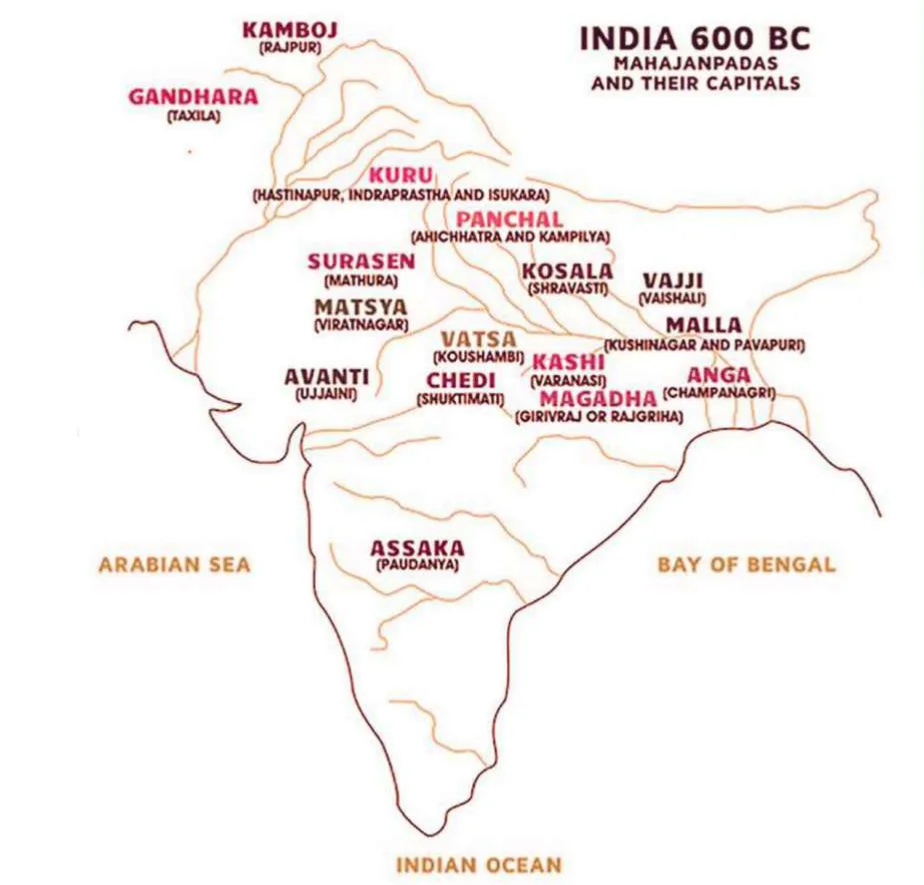
— By the 6th century BCE , the competition and conflicts among the Janapadas led to the smaller ones being absorbed or conquered by the stronger ones, resulting in the formation of only 16 Mahajanapadas (‘great janapadas’). This was a process of political consolidation.
— We learn about these 16 states from reliable contemporary religious texts, specifically the Buddhist text Anguttara Nikaya and the Jain text Bhagavati Sutra .
— The political landscape was diverse, featuring powerful, centralized Monarchies (kingdoms ruled by a single, hereditary king, like Magadha ) alongside unique forms of governance called Republics or Oligarchies ( gana-sanghas , where power was held by an assembly of clan chiefs, like Vajji and Malla ).
— This entire period (600–300 BCE) is known as the Second Urbanization of India (the first being the Harappan Civilization). Towns like Rajagriha, Vaishali, Kaushambi, and Ujjain became fortified administrative and economic hubs, indicating a shift from a purely rural life to a mixed rural-urban one.
— The fierce competition among the Mahajanapadas culminated in the ultimate rise of Magadha , due to its strategic advantages, which then provided the geographical and political core for the future Mauryan Empire .
| Factor | Explanation (Beginner Friendly) |
|---|---|
| Iron Technology | New, strong iron ploughs allowed farmers to till the tough soil of the Ganga plain and clear forests easily, enabling large-scale, productive agriculture. This created the economic base for the cities. |
| Agriculture | Surplus food production (especially rice ) meant that not everyone had to farm. This extra food supported the new classes: professional soldiers, administrators, craftsmen, and traders, who lived in the cities. |
| Urbanization | The rise of fortified cities like Rajagriha and Vaishali as political, administrative, and trading capitals. This growth of towns marks the Second Urbanization of India. |
| Polity | The government evolved from tribal assemblies to powerful hereditary monarchies (where the king's son inherited the throne). This meant greater centralized authority, allowing rulers to effectively manage large territories and armies. |
| Trade & Economy | The introduction of the first uniform currency— Punch-marked coins (pieces of silver/copper with symbols)—made large-scale trade, collecting taxes, and paying soldiers much easier and faster. Guilds (Shrenis) organized and regulated craft production. |
| Religion & Society | The emergence of new faiths like Buddhism and Jainism offered simpler alternatives to the complex, expensive Vedic rituals. These new religions were often patronized by the wealthy merchant class (Vaishyas) who lived in the new urban centers. |
Prelims tips
- Anguttara Nikaya (Buddhist) → lists 16 Mahajanapadas; Jain Bhagavati Sutra gives a different list.
- Janapada → Mahajanapada: tribal territories grew into large states by the 6th century BCE.
- Two types → monarchies (rajya) and republics (gana-sangha).
- Assaka (on the Godavari) → only Mahajanapada south of the Vindhyas.
- Iron, surplus agriculture and the second urbanisation underpinned their rise.
Mains points
- Answer opening: The Mahajanapada period marks a major phase of state formation, in which territorial polities, towns, agricultural expansion and new social groups became more visible in the Ganga plains and beyond.
- Second urbanisation: Iron technology, agricultural surplus, fortified settlements, craft production, punch-marked coinage and exchange networks combined to support urban growth; the pace and form of change varied regionally.
- Political diversity: Monarchies coexisted with gana-sanghas. These oligarchic corporate polities should not be equated with modern democracies, since participation was limited to particular lineages or elites.
- Religious and social context: Towns, merchants and competing rulers created favourable conditions for Buddhist, Jain and other Sramana communities, while older Brahmanical traditions continued and adapted.
- Magadhan expansion: Fertile land, river routes, access to resources and political strategy together explain Magadha's rise; avoid explaining its success through one factor or treating the Mauryan Empire as an inevitable outcome.
- Answer conclusion: The period is best understood as a transition in economy, polity and ideas that made larger states possible while preserving considerable regional diversity.
Did you know?
- — The Buddhist Anguttara Nikaya and Jain Bhagavati Sutra are the primary sources that provide the complete list of the 16 Mahajanapadas.
- — Vaishali (the capital of the Vajji Mahajanapada) is historically regarded as one of the world’s earliest republics (or gana-sanghas), functioning as an oligarchy ruled by an assembly of chiefs, not a king.
- — The introduction of Punch-marked coins was critical. Before this, barter (exchanging goods) was common, but the use of coins simplified transactions and revolutionized the economy, allowing for easier taxation and payments.
- — The rivalry between Kosala and Magadha was the most intense power struggle in North India during this period, ultimately won by Magadha.
- — Asmaka was the only Mahajanapada located entirely south of the Vindhya mountains (in the Deccan region, on the Godavari river).
Reasons for the Growth of Mahajanapadas and Urban Centres (Second Urbanization)
The rise of the 16 Mahajanapadas and their associated cities between 600–300 BCE was the result of a powerful combination of factors. Iron technology boosted agriculture, creating a massive surplus that fueled specialized trade and the use of coins . This wealth allowed rulers to build stronger fortified capitals and establish centralized political systems to manage their larger territories, marking India's Second Urbanization .
1. Geographical and Agricultural Factors (The Economic Base)
— The Ganga-Yamuna river plains were incredibly fertile, allowing for high agricultural output, which was now fully exploited using new iron tools. This abundance of food (surplus) formed the essential economic base for the entire civilization, as it freed up labor for other activities.
— The use of iron ploughs was crucial for effectively cultivating the wet, heavy soil needed for rice cultivation , which is a highly productive crop and could efficiently feed the rapidly growing, non-agricultural population in the new cities.
2. Political Factors (The Centralizing Force)
— The need to manage the massive agricultural resources and the newly expanded territories led to the development of powerful Mahajanapadas with highly organized administrative and military systems.
— Kings started maintaining professional, standing armies (soldiers who were paid and served all year, unlike tribal armies) and large bureaucracies. This required a systematic way of collecting revenue, which was done through a formal system of taxation (bali, bhaga, kara).
— Fortified capital cities (like Ujjain or Rajagriha) were essential. They served as administrative headquarters, protected the royal treasury, and provided a safe haven for the ruler and the administrative elite, enabling long-term stability.
3. Economic and Trade Factors (Monetization)
— Cities became centers for advanced craft specialization . Artisans excelled in weaving, metallurgy, and making high-quality pottery, like the famous Northern Black Polished Ware (NBPW) , which is an archaeological marker of urban prosperity and elite living.
— Guilds (Shrenis) were powerful organizations of craftsmen and merchants. They regulated the quality of goods, fixed prices, and controlled trade practices, fostering economic stability and growth by ensuring quality and protecting members.
— The widespread use of Punch-marked silver and copper coins ( karshapanas ) was a revolutionary change. It replaced the slow system of barter, speeding up trade, simplifying the collection of taxes, and enabling the growth of a complex, monetized economy .
4. Social and Religious Factors (New Dynamics)
— The rigid structure of society (the varna-jati system ) paradoxically led to greater occupational specialization , as different groups focused on specific crafts and trades, leading to more efficient production.
— The new religious movements of Buddhism and Jainism often flourished in these urban centers. They were generally more appealing to the merchant (Vaishya) class , who disliked the expensive and complex Vedic rituals and found new patronage in the developing towns like Vaishali, which became hubs for philosophical debates and monastic life.
| Factor | Details (How it Caused Urban Growth) |
|---|---|
| Agriculture | Iron tools led to massive food surplus, directly feeding the specialized, non-farming population in towns. |
| Geography | Fertile Ganga plains and navigable rivers supported trade and easy transportation of goods and troops. |
| Political | Centralized Mahajanapadas built fortified capitals for administration, treasury, and security, attracting people. |
| Economic | Coins (punch-marked) sped up trade; Guilds organized skilled craft production, making towns specialization hubs. |
| Social | Occupational specialization created communities of specialized craftsmen in cities, supporting complex services. |
| Religious | Buddhism & Jainism attracted merchants, making towns major religious and cultural hubs for debate and monastic life. |
| Cultural | New luxury pottery (NBPW) and planned urban layouts indicated prosperity, sophistication, and efficient administration. |
Prelims tips
- — The Second Urbanization is dated to the 6th century BCE and was mainly centered in the Ganga valley .
- — The NBPW (Northern Black Polished Ware) is the archaeological signature of this period, indicating high-status, urban living and trade networks.
- — Punch-marked coins (Karshapanas) are crucial: they represent the very first indigenous coinage of India and signal a shift to a monetized economy.
- — Focus on the four most significant Mahajanapadas: Magadha, Kosala, Vatsa, and Avanti , as they dominated the political landscape.
- — The key source texts are the Buddhist Anguttara Nikaya and the Jain Bhagavati Sutra , both listing the 16 states.
Mains points
- — The Mahajanapadas marked the definitive transition from fluid tribal societies to fixed, well-administered territorial states with professional armies and systematic taxation, establishing a new form of political organization.
- — They represent the Second Urbanization in Indian history, characterized by fortified cities, widespread monetization, and the effective use of iron technology in agriculture, creating a strong rural-urban link.
- — The political structure was highly diverse, demonstrating the coexistence and competition between centralized Monarchies and decentralized Republics , showcasing political experimentation.
- — The cities of the Mahajanapadas became the fertile ground for the growth and spread of Buddhism and Jainism as popular reform movements, often supported by the wealthy merchant class who were crucial to the urban economy.
- — The competition among these 16 states paved the way for the ultimate unification of North India under the victorious power of Magadha , which created the base for the first pan-Indian empire (Mauryan Empire).
The 16 Mahajanapadas: Geographical Distribution and Types
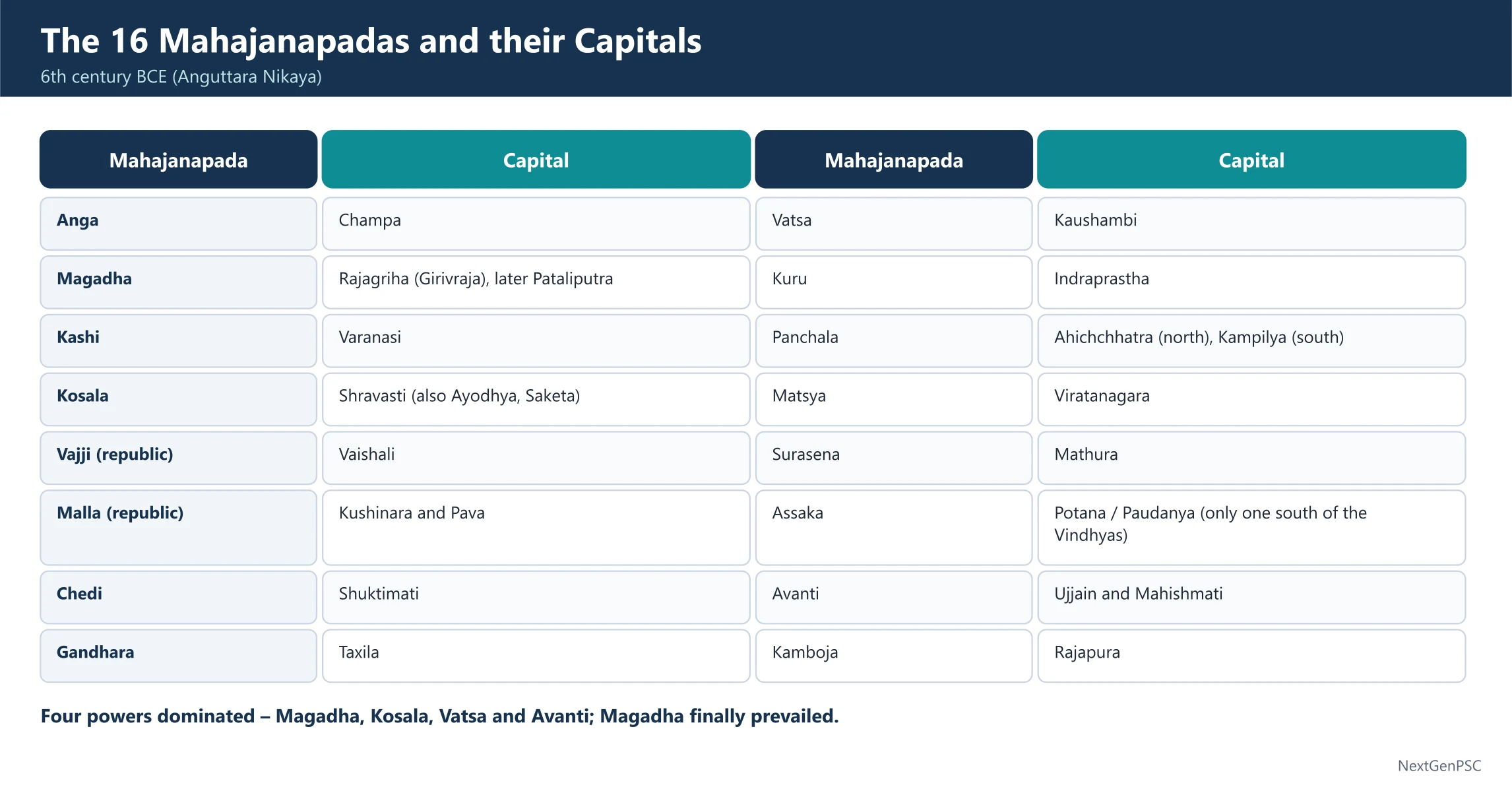
The Mahajanapadas (600–300 BCE) were the 16 largest territorial states that existed during India's Second Urbanization . They were highly diverse, governed by either a single, powerful King (Monarchies) or an Assembly of Chiefs (Republics) . The competition among these states eventually led to the dominance of Magadha , which created the base for the Mauryan Empire.
Historical Context and Political Diversity
— The list of the 16 Mahajanapadas is compiled from the Buddhist text Anguttara Nikaya and the Jain text Bhagavati Sutra . They emerged as Janapadas expanded and consolidated power, marking the end of the tribal phase.
— Monarchies (Raja-centred): These were the most common type, ruled by a single, hereditary king who commanded a standing army and collected taxes systematically. They tended to be more powerful and expansionist. Examples include Magadha, Kosala, Kashi, and Avanti .
— Republics or Oligarchies (Gana-sanghas): These states were ruled by an assembly of clan chiefs or heads of families, rather than a single king. They were generally located in the Himalayan foothills and the eastern Gangetic plains. The Vajji (with the powerful Lichchhavi clan) and Malla were the key examples, known for their collective decision-making.
— This period is significant because it shows the simultaneous existence and rivalry between these two distinct political systems (Kingships and Republics) in ancient India.
Importance for UPSC
— The Second Urbanization was centered in these Mahajanapadas, with cities acting as administrative seats, trade hubs, and cultural centers for the entire region.
— They provided the crucial political and economic backdrop against which Buddhism and Jainism developed and spread rapidly, often receiving support from the urban population and trading communities.
— The continuous process of annexation (conquering) of the weaker states by the stronger ones was a key political dynamic, culminating in the rise of Magadha as the supreme power in North India.
| Mahajanapada | Capital | Modern Location (For Mapping) | Key Features |
|---|---|---|---|
| Anga | Champa | Bhagalpur & Munger (Bihar) | Important for sea trade; was the first state annexed by Magadha under King Bimbisara. |
| Magadha | Rajagriha (later Pataliputra) | South Bihar | The most powerful kingdom ; had crucial access to iron ore and highly fertile land; formed the base for the Mauryan Empire. |
| Vajji (Vriji) | Vaishali | North Bihar | A confederacy of republics (like the Lichchhavis); historically significant as the site of early republican governance. |
| Malla | Kusinara & Pava | Eastern Uttar Pradesh | A Republic; famous as the site where Buddha attained Mahaparinirvana (death) and Mahavira attained Nirvana (Jainism). |
| Kashi | Varanasi | Eastern Uttar Pradesh | A major religious and trade center; initially powerful, but later fell to the rivalry between Kosala and Magadha. |
| Kosala | Shravasti | Awadh region (UP) | A powerful monarchy; its ruler King Prasenajit was a contemporary and strong political rival of Magadha's Bimbisara and Ajatashatru. |
| Vatsa | Kaushambi | Allahabad/Prayagraj region (UP) | Strategically located on major land and river trade routes linking the northern plains with the Deccan region. |
| Kuru | Indraprastha (Delhi) | Delhi–Haryana | Famous from the Vedic period (Kauravas), but was politically weaker and less dominant by the 6th century BCE. |
| Panchala | Ahichhatra (North), Kampilya (South) | Western Uttar Pradesh | A significant center of Later Vedic culture; later absorbed into the larger Gangetic kingdoms. |
| Matsya | Viratnagar | Alwar (Rajasthan) | Mentioned in the Mahabharata; played a relatively minor political role in the 6th century BCE. |
| Chedi | Suktimati | Bundelkhand (Madhya Pradesh) | A smaller kingdom mentioned in the epics; politically overshadowed by Magadha and Avanti. |
| Avanti | Ujjain & Mahishmati | Western Madhya Pradesh | A major trade kingdom that controlled the lucrative Malwa plateau; a powerful rival to Magadha until its eventual annexation. |
| Gandhara | Taxila | Northwest (Punjab, Afghanistan) | Famous for its university at Taxila ; a crucial hub for foreign trade and cultural exchange with Persia and Central Asia. |
| Kamboja | Rajapura | Afghanistan & Kashmir region | Known for its superior breeds of horses and military prowess; located near the borders of the Persian Achaemenid empire. |
| Asmaka (Assaka) | Pratishthana (Paithan) | Maharashtra (Godavari valley) | The only Mahajanapada located entirely south of the Vindhyas (in the Deccan region), important for southern trade routes. |
| Surasena | Mathura | Western Uttar Pradesh | A religious center traditionally associated with the Krishna tradition ; also an important trade city due to its location. |
| Region | Mahajanapadas |
|---|---|
| Eastern India | Magadha, Anga, Vajji, Malla, Kashi, Kosala (The Core of the Ganga Valley, where power consolidated) |
| Central India | Vatsa, Chedi |
| Western India | Avanti, Surasena, Matsya |
| Northern India | Kuru, Panchala |
| North-Western India | Gandhara, Kamboja (States beyond the Indus, facing Persian influence) |
| Southern India | Asmaka (Assaka) (The only trans-Vindhyan state) |
Prelims tips
- Anga → Champa; Magadha → Rajagriha (Girivraja); Vatsa → Kaushambi; Kosala → Shravasti.
- Avanti → Ujjayini (north) and Mahishmati (south); Gandhara → Taxila.
- Vajji → Vaishali (republican confederacy of eight clans); Malla → Kusinara and Pava.
- Panchala → Ahichchhatra (north) and Kampilya (south); Matsya → Viratnagar.
- Assaka → Potana/Potali on the Godavari.
Mains points
- The 16 Mahajanapadas marked the final transition from tribal societies to territorial states with organised armies and taxation — an advanced form of political organisation.
- The political structure was highly diverse, showing coexistence and competition between centralised monarchies and decentralised republics.
- Geographical advantages (such as iron ore and fertile soil) made eastern states like Magadha powerful, preparing the ground for empire.
- The urban centres of these states became important bases for the spread of Buddhism and Jainism, which were supported by trading communities.
- Political rivalry finally ended in the dominance of Magadha, which became the core of the first great empire of Indian history (the Mauryan Empire).
Did you know?
- Vaishali (capital of the Vajjis) is regarded as one of the earliest republics in the world, governed by an assembly instead of a king.
- Gautama Buddha attained mahaparinirvana at Kushinagar and Mahavira attained nirvana at Pava — both Malla centres, making the Mallas religiously important.
- Magadha succeeded partly because it gradually absorbed major rivals such as Anga, Kashi, Kosala and the Vajjis, becoming the largest state in India.
- Taxila (Gandhara) was a renowned centre of learning that drew students from distant regions.
Economy and Society during Mahajanapadas (600–300 BCE) for UPSC
The Mahajanapada period (600–300 BCE) marked a Second Urbanization fueled by iron-based agriculture and monetized trade . Society became highly stratified with a rigid Varna-Jati hierarchy , while new intellectual currents, especially Buddhism and Jainism , challenged the Brahmanical orthodoxy and favored urban, trading classes.
Agriculture & Land System: The Foundation of Surplus
Expansion into fertile middle Ganga plains was made possible by iron ploughs (ploughshares), significantly increasing agricultural yield.
Wet-rice cultivation (paddy) became the dominant crop, producing a crucial surplus necessary for sustaining the urban population and the state.
Irrigation developed using wells, tanks, and canals , as mentioned in contemporary texts like the Jatakas.
Land became systematically taxable . Peasants had to pay various taxes: bali (earlier tribute, now a mandatory tax), bhaga (king’s share, typically one-sixth of the produce), and kara (miscellaneous taxes).
Regular recorded land grants to Brahmanas are better documented from later centuries; do not treat Brahmadeya as a characteristic institution of the Mahajanapada period.
Urbanization: The Second Wave
The period is known as the Second Urbanization . Major cities ( nagaras ) like Rajagriha, Pataliputra, Vaishali, Kaushambi, and Ujjain flourished as political and commercial hubs.
Cities were typically fortified with moats and ramparts (e.g., Kaushambi) for security, indicating organized state power.
Northern Black Polished Ware (NBPW) pottery, a distinctive glossy ceramic, was a luxury item signifying the wealth and prosperity of the urban elite.
Trade, Commerce & Coinage: The Monetary Economy
Internal trade connected villages (supplying grain) to towns (supplying finished goods). External trade expanded with regions like Persia, Central Asia, and Sri Lanka.
Major trade items included rice, cotton textiles , ivory, beads, salt, and spices.
Trade moved along well-defined Caravan routes (e.g., Uttarapath and Dakshinapath) and via riverine (Ganga-Yamuna) and coastal transport .
The crucial innovation was the use of First Coinage : irregular pieces of silver and copper known as Punch-marked coins (Karshapanas) , marking the shift to a monetary economy .
Guilds (Shrenis): The Pillars of Craft and Trade
Artisan and merchant groups (Shrenis) are attested in early historic sources and became increasingly important over time. Their organisation and functions differed across places and periods.
Later inscriptions provide clearer evidence of guilds receiving endowments and financing activities; avoid projecting a uniform system of price-fixing or public banking onto the 6th–4th centuries BCE.
Social Structure: Rigid Hierarchy
The Varna system solidified into a rigid social hierarchy: Brahmana (Priests), Kshatriya (Rulers/Warriors), Vaishya (Farmers/Traders), and Shudra (Servants/Labourers).
The rise of specialized crafts and guilds led to the proliferation of Jati (sub-castes) , based largely on occupation .
Patriarchal joint families were the predominant family unit.
Terms such as dasa, dasi, and karmakara occur in early texts, but they cover varied forms of dependence and labour. They should not automatically be equated with one modern category of slavery or bonded labour.
Women's status generally declined , losing political and educational rights, though they could join the new religious orders as nuns (bhikkhunis).
Religion & Society: The Challenge to Orthodoxy
Brahmanical orthodoxy continued to emphasize costly yajnas (sacrifices like Ashvamedha, Rajasuya) and ritual supremacy.
This system was challenged by the Heterodox Movements : Buddhism, Jainism, and Ajivikas . They rejected ritualism, promoted Ahimsa (non-violence) and ethical conduct, and appealed significantly to the Vaishyas and other trading communities who were marginalized by the Brahmanical caste structure.
The cities became centers for philosophical debates , encouraging intellectual pluralism.
| Sector | Key Features |
|---|---|
| Agriculture | Iron ploughs , wet-rice cultivation , bali/bhaga/kara taxes |
| Crafts | Specialized guilds, NBPW pottery , metalwork |
| Trade | Long-distance routes (Uttarapath/Dakshinapath), internal and external |
| Coinage | Earliest punch-marked silver coins (Karshapanas) |
| Urbanization | Second Urbanization ; fortified cities (Rajagriha, Pataliputra) |
| Guilds | Shrenis organized traders/artisans, functioned as proto-banks |
| Aspect | Details |
|---|---|
| Varna | Rigid hierarchy of Brahmana, Kshatriya, Vaishya, Shudra |
| Jati | Sub-castes formed based on occupation and guild membership |
| Family | Patriarchal , joint families dominant |
| Women | Declining status , limited education; some became Buddhist/Jain nuns |
| Slavery | Existence of slaves (dasa, dasi) and bonded labour (karmakara) |
| Religion | Brahmanical ritualism vs heterodox religions (Buddhism, Jainism) |
| Aspect | Vedic (1500–600 BCE) | Mahajanapadas (600–300 BCE) |
|---|---|---|
| Economy | Pastoral + limited farming; Barter | Agrarian-based ; Monetary economy (coins), strong trade |
| Technology | Bronze, limited iron (later Vedic) | Widespread iron use , advanced irrigation |
| Urbanization | No cities; tribal villages (Jana/Vish dominant) | Second urbanization ; Fortified cities (Nagaras) |
| Trade | Barter economy; cattle wealth | Monetary economy ; punch-marked coins |
| Society | Flexible Varna system; Women had higher status | Rigid Varna-Jati system ; Women’s status declined |
| Religion | Nature gods, simple hymns, less emphasis on ritual | Ritualism, Yajnas ; rise of Buddhism & Jainism challenging the status quo |
Prelims tips
- Punch-marked coins (mostly silver) → earliest Indian coins, from this period.
- NBPW (Northern Black Polished Ware) → deluxe pottery of the period.
- Shrenis → guilds of merchants and artisans; Setthi → merchant-banker; Gahapati → wealthy householder.
- Taxes → Bali, Bhaga (often 1/6 of produce) and Shulka (tolls).
- Paddy transplantation and iron ploughshares → agricultural surplus in the middle Ganga valley.
Mains points
- The Mahajanapada economy was a major structural shift towards agrarian production supported by specialized crafts, coinage, and long-distance trade.
- The Second Urbanization provided the essential economic and administrative base for the subsequent emergence of centralized empires .
- The society saw a deepening of Varna-Jati stratification and the institutionalization of unfree labour, which was simultaneously challenged by new religions.
- Contrast with the Vedic period (in economy, technology, and social structure) is vital to understand the magnitude of socio-economic transformation.
Did you know?
- Guilds (Shrenis) acted like early banks — lending money and financing large trade caravans, showing financial organization.
- The distribution of NBPW indicates broad interaction networks, but pottery distribution alone does not prove the exact form or scale of trade.
- The earliest silver punch-marked coins show distinctive symbols like the sun, tree, fish, and animals .
- Texts mention both dasa (slave) and karmakara (bonded labourer) , distinguishing between inherited and debt-based servitude.
- The Ganasanghas (republics like the Vajjis) were important alternatives to the monarchies, where rule was exercised by an assembly of tribal elders.
Rise and Growth of the Magadhan Empire (6th–4th Century BCE)
Magadha emerged as the most powerful Mahajanapada primarily due to its unrivalled geographical and resource advantages (fertile land, iron), its strategically located capitals (Rajagriha, Pataliputra), and a succession of ambitious, strong rulers (Haryanka, Shishunaga, Nanda Dynasties) who utilized superior military technology and a standing army to create the first large territorial empire.
Geographical Advantages: The Natural Base
Fertile Alluvial Soil: Magadha was located in the middle Ganga plains , guaranteeing a consistent and large agricultural surplus for revenue and sustenance.
Iron Ore Resources: Control over the iron deposits in the nearby Chotanagpur plateau (South Bihar/Jharkhand) provided Magadha with an endless supply of superior weapons and tools for both war and clearing forest land.
Riverine Transport: The Ganga, Son, and Champa rivers provided a cheap and efficient network for transport, trade, and military movement, linking the capital to distant regions.
Natural Fortifications: The first capital, Rajagriha , was naturally secured by five hills. The later capital, Pataliputra , was built at the confluence of the Ganga and Son, providing an unassailable 'Water Fort' .
Political and Military Factors: The Human Element
Strong Rulers: A succession of powerful and ruthless rulers, including Bimbisara and Ajatashatru (Haryanka), Shishunaga , and the Nandas , relentlessly pursued expansion through annexation and diplomacy.
Expansion Policy: Magadha systematically annexed its neighbors (e.g., Anga) and defeated rivals (like Kosala and Vajji).
Military Innovations: Magadhan armies pioneered the use of war-elephants (which were crucial for siege warfare and shock tactics) and innovative siege engines (like Ajatashatru’s mahashilakantaka - a large stone-throwing machine).
Standing Army: The Nanda Dynasty maintained a huge, well-equipped standing army using the state's massive revenue, eliminating reliance on tribal levies.
Economic and Cultural Strength
Control over Trade: Magadha controlled key trade routes, benefiting from the taxes and duties collected, which further financed its military expansion.
Urban Hubs: Cities like Rajagriha and Pataliputra were major economic and administrative centers , streamlining state control.
Cultural Pluralism: Magadha was the epicenter of Buddhism and Jainism (Buddha and Mahavira spent significant time here). This cultural open-ness attracted scholars, traders, and monks, making it a dynamic melting pot, possibly mitigating rigid Varna opposition.
Patronage: Kings like Ajatashatru patronized the emerging religious movements, giving them social acceptance and strengthening Magadha’s influence.
| Ruler/Dynasty | Period (Approximate) | UPSC Relevance (Key Contribution) |
|---|---|---|
| Bimbisara (Haryanka) | 545–493 BCE | Annexed Anga (key resource area); used matrimonial alliances to consolidate power and expand territory. |
| Ajatashatru (Haryanka) | 493–462 BCE | Defeated Kosala & Vajji (republics); used mahashilakantaka (siege engine); patronized the First Buddhist Council . |
| Udayin (Haryanka) | 462–440 BCE | Established Pataliputra at the Ganga-Son confluence as the new, strategically superior capital. |
| Shishunaga | c. 412 BCE | Defeated Avanti (Ujjain), permanently settling the major rivalry with Western India. |
| Kalasoka (Shishunaga) | c. 394 BCE | Organized the Second Buddhist Council at Vaishali. |
| Mahapadma Nanda (Nanda) | c. 345–321 BCE | The first great empire-builder ; annexed Kalinga ; called 'Ekarat' (sole ruler); maintained an enormous standing army . |
Prelims tips
- Dynasties in order → Haryanka → Shishunaga → Nanda → Maurya.
- Bimbisara → annexed Anga; used marriage alliances (Kosala, Licchavi, Madra).
- Ajatashatru → defeated the Vajjis; built a fort at Pataligrama; First Buddhist Council.
- Udayin → shifted the capital to Pataliputra.
- Mahapadma Nanda → 'Sarvakshatrantaka' and 'Ekarat'.
Mains points
- Magadha's rise was a classic example of resource mobilization (iron, agriculture) driving political centralization and military expansion .
- The success of Magadha paved the way for the Mauryan Empire , demonstrating the necessity of a strong economic base and an efficient military for pan-Indian unity.
- The shift from Rajagriha to Pataliputra highlights the changing strategic and economic focus from fortified hills to riverine trade hubs.
- The Nanda Dynasty's maintenance of a large standing army and a robust tax system was the culmination of state-building efforts of the Mahajanapada era.
Did you know?
- The first capital, Rajagriha , means 'House of the King'. It was later replaced by Pataliputra , which became the capital of the Mauryan Empire.
- The term 'Magadhi' refers to the Prakrit language spoken in Magadha, which was later adopted by the Buddha for his teachings.
- The Nanda army was rumored to be so formidable that the armies of Alexander the Great hesitated to advance into the Ganges valley.
- The shifting of the capital to Pataliputra by Udayin was a decision of immense strategic foresight, centralizing control over the entire Ganga basin.
Rise and Growth of Magadha: Dynasties & Rulers
The rise of Magadha unfolded under successive dynasties—Haryanka, Shishunaga, Nanda—each contributing to territorial expansion, military strength, and urban growth, culminating in the Mauryan Empire.
🏰 Rise of Magadha Empire (c. 6th–4th Century BCE)
Magadha was the most powerful Mahajanapada, emerging as the center of political and cultural development in ancient India.
Its rise was due to fertile soil, iron mines (especially in south Bihar), strong rulers, strategic rivers (Ganga, Son), and powerful armies.
👑 Haryanka Dynasty
Bimbisara (c. 545–493 BCE)
Founder of the Haryanka dynasty and one of the earliest empire-builders of India.
Capital: Rajagriha (modern Rajgir, Bihar).
Expansion: Conquered the kingdom of Anga and made it part of Magadha.
Matrimonial Alliances: Used marriages as political tools —
Married a princess of Kosala (bringing Kashi as dowry).
Married a princess of Madra (Punjab region).
Married a Lichchhavi princess, Chellana (strengthened relations with Vaishali).
Administration: Efficient governance; appointed officials to different regions.
Religion: Contemporary of both Buddha and Mahavira; patronized Buddhism and Jainism.
Medical Diplomacy: King Bimbisara sent his personal physician Jivaka to Avanti to treat King Pradyota, who was suffering from jaundice. (Some sources mention Kashi/Varanasi, but records indicate Jivaka was dispatched to Avanti to attend Pradyota.)
Important Fact: Considered one of the first rulers to maintain a regular army and a standing diplomatic policy.
Ajatashatru (c. 493–462 BCE)
Son of Bimbisara; ascended the throne after imprisoning and killing his father.
Wars and Expansion:
Defeated Kosala and annexed Kashi.
Defeated the Vajji Confederacy (Lichchhavis of Vaishali) after a long war.
Military Innovations:
Introduced war-elephants (Rathamukta Gaja).
Used siege engines called ‘Mahashilakantaka’ (stone-throwing machine) and ‘Rathamusala’ (chariot with blades).
Capital: Strengthened Rajagriha with massive fortifications.
Religion: Contemporary of Buddha; organized the First Buddhist Council after Buddha’s death (at Rajagriha).
Important Fact: Considered one of the first rulers to use advanced war machines in Indian warfare.
Udayin (c. 462–440 BCE)
Son and successor of Ajatashatru.
Founded Pataliputra (modern Patna) at the confluence of the Ganga and Son rivers.
Significance: Made Pataliputra the new capital of Magadha, replacing Rajagriha.
Importance: The location enhanced Magadha’s strategic control over river routes and trade.
Important Fact: Pataliputra remained the imperial capital of India for centuries under later dynasties.
🏛️ Magadha under the Shishunaga Dynasty
Shishunaga (c. 412 BCE)
Founder of the Shishunaga dynasty.
Capital: Initially Rajagriha, later shifted temporarily to Vaishali.
Military Achievements: Defeated the kingdom of Avanti, ending the long rivalry between Magadha and Avanti.
Administrative Significance: Extended Magadha’s control over central India.
Important Fact: Known for integrating northern and central India politically for the first time.
Kalasoka (c. 394 BCE)
Son of Shishunaga.
Capital: Shifted back to Pataliputra.
Religious Contribution: Presided over the Second Buddhist Council at Vaishali (around 383 BCE).
Important Fact: The Buddhist Sangha split into two sects — Sthaviravadins and Mahasanghikas — during his reign.
👑 Magadha under the Nanda Dynasty
Mahapadma Nanda (c. 345–321 BCE)
Founder of the Nanda dynasty and regarded as the first empire-builder of India.
Titles: Known as ‘Ekarat’ (sole sovereign).
Expansion: Defeated Kalinga and Kosala, expanding Magadha across almost all of northern India.
Administration: Maintained a highly centralized administration.
Military Strength: Maintained the largest army of ancient India:
200,000 infantry
20,000 cavalry
3,000 elephants
2,000 chariots
Economy: Imposed heavy taxation to support the large army and bureaucracy.
Important Fact: Referred to in the Puranas as the “destroyer of all Kshatriyas.”
Nanda Successors (Until c. 321 BCE)
Continued the policies of centralization, strong military, and heavy taxation.
Downfall: Their oppressive rule made them unpopular and paved the way for Chandragupta Maurya’s rise with the guidance of Chanakya (Kautilya).
Important Fact: The last Nanda ruler, Dhana Nanda, was defeated by Chandragupta Maurya, marking the beginning of the Mauryan Empire.
| Ruler | Period | Contributions |
|---|---|---|
| Bimbisara | c. 545–493 BCE | Annexed Anga; matrimonial alliances with Kosala (Kashi), Madra, Lichchhavis; capital at Rajagriha; contemporary of Buddha & Mahavira. |
| Ajatashatru | c. 493–462 BCE | Defeated Kosala, absorbed Kashi; conquered Vajji Confederacy; used war-elephants, siege machines (‘Mahashilakantaka’, ‘Rathamusala’); strengthened Rajagriha. |
| Udayin | c. 462–440 BCE | Founded Pataliputra at Ganga-Son junction; made it new capital; improved Magadha’s strategic supremacy. |
| Ruler | Period | Contributions |
|---|---|---|
| Shishunaga | c. 412 BCE | Defeated Avanti; ended Magadha–Avanti rivalry; shifted capital temporarily to Vaishali. |
| Kalasoka | c. 394 BCE | Shifted capital back to Pataliputra; presided over Second Buddhist Council at Vaishali. |
| Ruler | Period | Contributions |
|---|---|---|
| Mahapadma Nanda | c. 345–321 BCE | Known as ‘Ekarat’ (sole sovereign); defeated Kalinga, Kosala; expanded empire across north India; maintained largest army (200,000 infantry, 20,000 cavalry, 3,000 elephants, 2,000 chariots); heavy taxation. |
| Nanda Successors | Until c. 321 BCE | Continued strong taxation and military; unpopular due to oppression, which facilitated Mauryan rise. |
| Ruler | Period | Contributions |
|---|---|---|
| Chandragupta Maurya (Maurya Dynasty) | c. 321 BCE | With Chanakya’s guidance, overthrew Nandas; founded Mauryan Empire; Pataliputra became imperial capital of first pan-Indian empire. |
Prelims tips
- Haryanka → Bimbisara, Ajatashatru, Udayin.
- Shishunaga → destroyed Avanti's power; Kalashoka → Second Buddhist Council at Vaishali.
- Nanda → Mahapadma Nanda (founder), Dhana Nanda (last; 'Agrammes' of Greek writers).
- Hathigumpha inscription → a 'Nandaraja' took a Jina image from Kalinga.
- Chandragupta Maurya with Chanakya overthrew Dhana Nanda (c. 321 BCE).
Mains points
- Magadha's rise rested on geography (iron, elephants, fertile land, rivers) and on ambitious rulers.
- The Nandas built a large army and treasury, laying the administrative foundation for the Mauryan empire.
- Shifting capitals from Rajagriha to Pataliputra reflects the importance of river communication and trade.
- Non-Kshatriya dynasties like the Nandas show that political power was not limited by varna.
Did you know?
- Bimbisara and Ajatashatru were contemporaries of Buddha and Mahavira.
- Ajatashatru used India’s earliest known war-machines in sieges.
- Udayin’s capital Pataliputra remained India’s political heart for nearly 1,000 years.
- Mahapadma Nanda is called the first historical emperor of India.
- Alexander’s invasion coincided with Nanda rule, but he never attacked Magadha due to its massive army.
Rise and Expansion of Magadha
Magadha rose as the strongest Mahajanapada due to fertile land, iron resources, strategic capitals, powerful rulers, military innovations, and efficient taxation. It expanded in all directions before transforming into the Mauryan Empire.
| Direction | Regions Annexed | By Ruler/Dynasty |
|---|---|---|
| East | Anga (Champa), later Kalinga | Bimbisara annexed Anga; Nandas conquered Kalinga |
| West | Kosala, Kashi, Avanti | Ajatashatru absorbed Kosala & Kashi; Shishunaga defeated Avanti |
| North | Vajji Confederacy (Vaishali, Lichchhavis) | Ajatashatru defeated Vajji after long war |
| South | Deccan (Andhra trade routes) | Nandas extended Magadha into Deccan region |
Prelims tips
- Bimbisara annexed Anga; Ajatashatru conquered Kosala, Kashi, Vajji.
- Udayin founded Pataliputra as Magadha’s capital.
- Shishunaga defeated Avanti, ending westward rivalry.
- Mahapadma Nanda called ‘Ekarat’ in Puranas; maintained largest ancient Indian army.
- Alexander did not invade Magadha due to Nanda army strength.
Mains points
- Magadha’s geography (fertile soil, rivers, iron) gave natural advantages over other Mahajanapadas.
- Strong rulers (Bimbisara, Ajatashatru, Nandas) expanded territory through conquest and diplomacy.
- Military strength: war elephants, siege engines, and massive standing army under Nandas.
- Economic base: surplus agriculture, trade routes, taxation, and punch-marked coins.
- Religious importance: Buddhism and Jainism flourished with royal patronage.
- Strategic capitals (Rajagriha → Pataliputra) ensured defense and control of trade routes.
- Magadha’s rise explains why it became the nucleus of the Mauryan Empire, unlike rivals Kashi, Kosala, or Avanti.
Persian and Greek Invasions in the Mahajanapada Period (External Factors)
North-western India faced invasions from the Achaemenid Persians (6th–4th century BCE) and later the Greeks under Alexander (327–325 BCE). These invasions shattered the small fragmented kingdoms, exposed India to new administrative ideas, coinage, and international trade , and ironically paved the way for Mauryan unification.
Persian Invasions (Achaemenids)
Cyrus (c. 550 BCE) first attempted to enter India but failed to go beyond Gandhara.
Darius I (522–486 BCE) succeeded, annexing Gandhara and the Indus region (Punjab, Sindh). This marked the first foreign rule in India, forming the 20th Satrapy (province) of the Achaemenid Empire.
The Indian Satrapy was economically significant, paying a tribute of 360 talents of gold dust (20% of the Empire's total revenue).
Impact: Introduced the Aramaic script (which influenced the later Kharosthi script, written right to left) and established stronger trade links . Persian influence is seen in Mauryan administration (e.g., satrap system) and palace architecture (e.g., bell-shaped capitals).
Greek Invasions (Alexander of Macedonia)
Alexander invaded India in 327 BCE after conquering the Persian Empire, intending to conquer the entire former Achaemenid territory.
He defeated local rulers of the northwest: Ambhi (Taxila) surrendered without a fight, but Porus (Puru) fought bravely at the Battle of Hydaspes (326 BCE) on the Jhelum River. Alexander honored Porus and reinstated him as a subordinate king.
The army reached up to the Beas River but mutinied and refused to advance further due to exhaustion, homesickness, and overwhelming fear of the colossal Nanda army waiting in Magadha.
Alexander left behind Greek garrisons (Satraps) and established several cities (e.g., Bucephala) before his return and death in Babylon in 323 BCE.
Immediate Impact: Paving the way for Mauryas
Alexander’s campaign exposed the political fragmentation and military weakness of the small, disunited kingdoms in the northwest, which Chandragupta Maurya later easily annexed.
Alexander’s general, Seleucus Nicator , later ceded the North-Western territories (including parts of Afghanistan) to Chandragupta Maurya around 303 BCE via a peace treaty, fully integrating the northwest into the Mauryan Empire.
The invasions stimulated direct trade and cultural contact (e.g., Indo-Greek art, astronomical ideas) between India and the Hellenistic world.
| Ruler | Period | Indian Territories | Impact |
|---|---|---|---|
| Cyrus | c. 550 BCE | Attempted Gandhara | First contact, failed expansion |
| Darius I | 522–486 BCE | Gandhara, Indus region (Punjab, Sindh) | First foreign rule, Satrapies, taxation, Aramaic script influence |
| Xerxes | 486–465 BCE | Maintained control | Indian soldiers served in Persian wars against Greece |
| Event | Details |
|---|---|
| Entry into India | 327 BCE via Khyber Pass, intending to follow up Persian conquest |
| Battle of Hydaspes | 326 BCE, Alexander vs Porus on Jhelum; Porus defeated but reinstated due to his bravery |
| Advance stopped | Army mutiny at the Beas River due to fear of Nanda’s army and exhaustion |
| Return & Aftermath | Alexander left Greek Satraps; Seleucus Nicator ceded NW India to Chandragupta Maurya (303 BCE) |
Prelims tips
- Darius I annexed Gandhara and Indus region — the first foreign rule in India.
- Aramaic script introduced by Persians influenced the direction and structure of the Kharosthi script.
- Alexander defeated Porus in 326 BCE at Hydaspes (Jhelum) .
- Alexander stopped at Beas River due to the Nanda army’s size and reputation.
- Seleucus Nicator ceded NW India to Chandragupta Maurya by treaty (303 BCE), marking the full liberation of the region.
Mains points
- Persian rule integrated northwest India into the Achaemenid Empire, bringing new ideas on taxation, coinage, and administration (satrap system) .
- Alexander’s invasion exposed the weakness of fragmented polities, creating a political vacuum and providing the strategic foundation for Mauryan unification .
- Both invasions significantly enhanced Indo-West Asian trade and cultural contact , leading to later developments like the Gandhara art and Indo-Greek scientific exchange.
- Persian influence is clearly visible in Mauryan administration, particularly the pillar capitals , and imperial architecture at Pataliputra.