
Ancient Indian History · UPSC Notes
Sangam Age — UPSC Ancient History Notes
Free, exam-focused notes for UPSC Prelims and Mains, with Prelims tips and Mains points for every topic. 13 topics.
Open in the interactive reader: bookmarks, progress tracking and read-aloud.
Sangam Age: Introduction
The Sangam Age (broadly c. 300 BCE – 300 CE) refers to early historic Tamilakam as represented by early Tamil anthologies and related texts. These sources, read with archaeology, inscriptions and foreign notices, illuminate society, economy, polity and culture in South India. The tradition of three literary Sangams at Madurai is a later literary account, not an independently verified institutional history.
I. Political Geography and Chronology 📜
The Sangam Age refers to the period in the history of Tamilakam (the ancient Tamil region) defined by the composition of the Sangam Literature . It represents the earliest well-documented phase of South Indian history.
Meaning of Sangam: The term 'Sangam' literally means an assembly or gathering (of poets). Tradition holds that three such literary academies ( Muchchangam ) were held under the royal patronage of the Pandya rulers in Madurai and Kapadapuram, but only the literature from the Third Sangam survives today.
Chronology: The most accepted period for the bulk of the existing literature is c. 300 BCE – 300 CE . This period immediately precedes the politically disruptive Kalabhra Interregnum and the rise of the Pallavas .
Geography (Tamilakam): The region covered by the Sangam kingdoms included modern Tamil Nadu, Kerala , and contiguous parts of Karnataka and Andhra Pradesh .
Major Kingdoms: The political landscape was dominated by the three powerful crowned kings ( Muvendar ): the Cholas, the Cheras, and the Pandyas , along with numerous smaller chieftains ( Velir chiefs ).
II. Sources: Reconstructing Ancient South India 🔎
The history of this era is constructed using indigenous literary works and corroborating external evidence.
Sangam Literature (The Primary Source): The literature is classified into two main groups (Anthologies):
- Ettutogai (Eight Anthologies of short poems).
- Pattuppattu (Ten Idylls or long poems).
- Tolkappiyam (the earliest extant work, primarily a treatise on Tamil grammar and poetics , providing insight into early society and culture).
Archaeological Evidence: Excavations confirm the existence of vibrant trade and urban centers, particularly at Arikamedu (near Pondicherry), Uraiyur , and Kaveripattinam (Puhar, a major Chola port). Finds include Roman coins, amphorae, and Arretine ware (fine pottery).
Foreign Accounts: The writings of Greek and Roman authors corroborate the extensive maritime trade: Periplus of the Erythraean Sea , Pliny the Elder , and Ptolemy mention major South Indian ports (Muziris, Korkai, Kaveripattinam) and the high-value exports (spices, pearls, ivory) demanded by the Roman Empire.
Inscriptions: The Ashokan Edicts (Mauryan period) provide the earliest epigraphical confirmation from the North, mentioning the Cholas, Cheras, and Pandyas as independent kingdoms existing just outside the direct Mauryan boundary.
III. Culture, Polity, and Society
Political Structure (Muvendar): The three crowned kings were hereditary monarchs. Kings used titles like Kone or Vendan . Administration was aided by a council of five assemblies (ministers, priests, envoys, spies, army chiefs), though warfare (puram) and cattle raids were common.
Economy: Driven by flourishing overseas sea trade (spices, pearls, textiles) with Rome and Southeast Asia. The local economy was agrarian, characterized by barter in rural areas and punch-marked and issued coins in port cities.
Societal Division: Society was broadly divided into: Arasar (ruling class), Vellalar (wealthy landowners/agriculturalists), Vanigar (traders), and Kadaisiyar (labourers). The Varna system was present but less rigid than in North India, with local occupational groups being more prominent.
Religion: Local deities, notably Murugan (worshipped as Skanda/Kartikeya in the North), were prominent. Worship focused on ancestors, nature spirits, and the heroic ideal (Nadukal) . Buddhism and Jainism had a significant presence, especially among the influential merchant class.
Literature Legacy: Sangam literature is unique: divided into Akam (inner life, dealing with love and family) and Puram (outer life, dealing with warfare, governance, and heroism). This literature forms the foundation of the Tamil cultural and linguistic identity and provides the most comprehensive picture of ancient South India.
Importance: It is notable for being largely secular and realistic , providing deep, nuanced insights into the society, economy, and politics of the period, demonstrating the independent literary development of the South.
| Source | Details |
|---|---|
| Literary | Sangam texts: Ettutogai, Pattuppattu, Tolkappiyam |
| Archaeological | Arikamedu, Kaveripattinam, Uraiyur excavations |
| Epigraphic | Ashokan inscriptions mentioning southern kingdoms |
| Foreign Accounts | Pliny, Ptolemy, Periplus of the Erythraean Sea |
Prelims tips
- Sangam literature → early Tamil anthologies; use them with archaeological and epigraphic evidence.
- Three Sangams at Madurai → later literary tradition, not a settled historical fact.
- Major kingdoms: Cholas, Cheras, Pandyas.
- Sources: Sangam literature + archaeology + Ashokan edicts + foreign accounts.
- Period: c. 300 BCE – 300 CE.
Mains points
- Answer opening: Sangam texts, read with Tamil-Brahmi inscriptions, archaeology and Mediterranean notices, are central evidence for early historic Tamilakam; they should not be read as literal chronicles.
- Polity: Chera, Chola and Pandya rulers coexisted with local chiefs and varied settlements. Avoid projecting the fully documented medieval Chola sabha–nattar system or modern democratic language onto Sangam polity.
- Economy: Ecological regions (tinai), agriculture, pastoralism, crafts, pearl fishing and maritime exchange shaped society. Roman finds indicate contact, but not a one-way or uniformly prosperous trade system.
- Culture and sources: Poems illuminate patronage, warfare, gender and social life, while inscriptions and excavated sites test literary claims. The tradition of three Sangams at Madurai is a later literary memory, not a settled institutional fact.
- Conclusion: Sangam material demonstrates the regional diversity and long-distance connections of early South India before the later temple-centred states.
Did you know?
- The word 'Tamil Sangam' literally means 'academy of Tamil poets'.
- Tolkappiyam, the oldest Tamil text, is both a grammar book and a guide to Sangam society.
- The Periplus describes Tamil ports like Kaveripattinam as major centers of Indo-Roman trade.
- Roman coins found at Arikamedu and Karur confirm overseas trade links.
Sources of the Sangam Age
The reconstruction of the Sangam Age (c. 300 BCE – 300 CE) is based on multiple sources — Sangam literature, foreign accounts, archaeological findings, inscriptions, and coins. Together, they provide insights into polity, economy, trade, society, and culture of early Tamilakam.
I. Sangam Literature: The Primary Indigenous Source 📜
Sangam Literature is the most fundamental source for reconstructing the history, culture, and society of ancient Tamilakam, noted for its secular and realistic tone.
Major Works: The literature is generally classified into three major collections (though primarily based on the surviving Third Sangam works):
- Ettutogai (Eight Anthologies): A collection of eight long and short poems.
- Pattuppattu (Ten Idylls): A group of ten longer poems.
- Pathinenkilkanakku (Eighteen Minor Works): Later didactic (moralizing) texts, with the most famous being the Tirukkural by Tiruvalluvar.
Tolkappiyam: The earliest extant Tamil work, primarily a treatise on Tamil grammar and poetics , but also provides invaluable information on the social, economic, and political life of the early Sangam Age.
Themes: The poems are classified by theme: Akam (inner life, dealing with love and family) and Puram (outer life, dealing with warfare, heroism, and governance). This dual focus lends realism to the texts.
II. Foreign Accounts: Corroborating the Trade Boom 🌍
Greek and Roman writings provide an external, economic lens through which to verify the vibrancy of the Tamil kingdoms.
Key Texts: Important accounts come from the Periplus of the Erythraean Sea (an anonymous Greek text, 1st century CE), which provides a sailor’s guide to coastal trade; Pliny the Elder (Roman natural historian); and Ptolemy (geographer).
Trade Description: These accounts vividly describe the extensive Indo-Roman trade , detailing the high volume of goods exported from the Tamil region (especially pepper, pearls, spices, and fine cotton ) in exchange for Roman gold.
Ports: They precisely name the major Tamil ports controlled by the Muvendar, including Kaveripattinam (Chola), Muziris (Chera), Uraiyur , and Korkai (Pandya).
III. Archaeological Materials: Physical Evidence 🏺
Archaeology provides the concrete evidence of the sophisticated urban life and international contacts described in the literature.
Key Excavation Sites: Major urban and port sites include Arikamedu (near Pondicherry, confirmed as a Roman trading post), Kaveripattinam (Puhar), Uraiyur , and Kodumanal .
Trade Artifacts: Finds at Arikamedu decisively prove Indo-Roman contact: large quantities of Roman amphorae (wine jars), Rouletted Ware (fine Roman-style pottery), and Roman gold coins .
Indigenous Pottery: Widespread presence of local pottery styles like Black-and-Red Ware (BRW) , indicating the daily life and local trade of the Tamil people.
Urban Planning: Excavations reveal the existence of planned urban centers with evidence of advanced weaving and drainage systems (e.g., Uraiyur), confirming the prosperity mentioned in the Sangam poems.
IV. Inscriptions and Coins: Direct Political Links 👑
Epigraphy and numismatics confirm the chronology and existence of the three crowned kings and their economic power.
Ashokan Edicts: Ashoka’s inscriptions (Mauryan period, 3rd BCE) provide the earliest external epigraphical mention, naming the Cholas, Cheras, and Pandyas as independent southern neighbours, thus establishing the terminal date (terminus a quo) for the Sangam Age.
Tamil-Brahmi Inscriptions: Numerous inscriptions in the Tamil-Brahmi script (c. 2nd BCE – 3rd CE) are found in natural caves and on pottery/coins. They often record donations to Jain monks (e.g., Mangulam, Jambai caves) and mention local chiefs and trade guilds .
Roman Gold Coins: Large numbers of Roman gold coins (issued by Emperors like Augustus, Tiberius, Nero) found in hoards across Tamil Nadu, serving as a powerful testament to the massive scale of the spice and pearl trade.
Indigenous Coins: The Cheras, Cholas, and Pandyas issued their own Punch-marked and copper coins . The animal emblems on these coins were symbolic of their dynastic identity:
- Pandya Symbol: Fish .
- Chera Symbol: Bow and Arrow .
- Chola Symbol: Tiger .
| Category | Examples / Evidence |
|---|---|
| Literature | Ettutogai, Pattuppattu, Tolkappiyam |
| Foreign Accounts | Pliny, Ptolemy, Periplus of the Erythraean Sea |
| Archaeology | Arikamedu (Roman artifacts), Kodumanal, Uraiyur |
| Inscriptions | Ashokan edicts, Tamil-Brahmi cave inscriptions |
| Coins | Roman gold coins, Chera (bow), Pandya (fish), Chola (tiger) |
Prelims tips
- Symbols on coins: Tiger (Chola), Fish (Pandya), Bow (Chera).
- Arikamedu = Roman trade center.
- Periplus mentions Tamil ports like Muziris & Kaveripattinam.
- Tamil-Brahmi = earliest inscriptions of Tamil.
- Sangam literature is secular, unlike Vedic texts.
- Sangam literature: the 18 major works (Melkanakku) = Ettuthogai (8 anthologies) + Pattuppattu (10 idylls); the 18 minor works (Pathinenkilkanakku) include the Tirukkural.
Mains points
- Sangam Age history is reconstructed from multiple sources: literature, archaeology, coins, inscriptions, and foreign accounts.
- Sangam literature is secular and provides direct insight into polity, society, and economy.
- Foreign accounts (Periplus, Ptolemy) highlight Indo-Roman trade through Tamil ports.
- Arikamedu and Roman coins prove India’s role in Mediterranean trade.
- Tamil-Brahmi inscriptions show early literacy and organized political systems.
Did you know?
- Over 10,000 Roman coins have been found in Tamil Nadu, showing India’s role in Roman luxury trade.
- The Pandya emblem (fish) is still part of Tamil Nadu’s cultural symbolism.
- Tamil-Brahmi script inscriptions represent one of the earliest written forms of Tamil language.
- Arikamedu was a major Indo-Roman trading hub for textiles, beads, and spices.
Kingdoms of the Sangam Period
The Sangam period was dominated by three major Tamil kingdoms — the Cholas, Cheras, and Pandyas — along with smaller chieftains (Velirs). These dynasties engaged in warfare, patronized Sangam poets, and promoted overseas trade with Rome and Southeast Asia.
The Muvendar (Three Crowned Kings) of the Sangam Age 👑
The political history of the Sangam period (c. 300 BCE – 300 CE) is dominated by the rivalry and alliances between the three major dynastic houses of Tamilakam, collectively known as the Muvendar .
A. Cholas (Coromandel Coast) 🐅
Political Base: The Cholas controlled the central and northern parts of Tamilakam, along the Coromandel Coast and the Kaveri delta region (the most fertile area).
Capital and Ports: Their inland capital was Uraiyur (Tiruchirappalli), and their crucial port city, known for foreign trade, was Kaveripattinam (also called Puhar ), situated at the mouth of the Kaveri river.
Emblem: Their dynastic symbol was the Tiger emblem .
Famous King: Karikala Chola is the most renowned king in the literary tradition. He is traditionally credited with Kaveri embankments and the ancient Grand Anicut (Kallanai); the monument has been repaired and modified over time, so this attribution should be stated with caution.
Economic Focus: Highly engaged in maritime trade with the Romans, Southeast Asia, and Sri Lanka, utilizing the wealth generated from the fertile delta and sea trade.
B. Cheras (Kerala Coast) 🏹
Political Base: The Cheras controlled the Western Coast (Malabar/Kerala) and parts of western Tamil Nadu, strategically dominating the lucrative spice trade route to Rome.
Capitals: Their capitals were Vanji and Karur .
Emblem: Their dynastic symbol was the Bow and Arrow emblem .
Famous Ruler: Senguttuvan (The Red Chera) is the celebrated hero of the Sangam epic Silappadikaram . He is noted for introducing the Pattini cult (worship of the idealized wife, Kannagi) into the Tamil region.
Economic Focus: Controlled the Western Ghats spice trade , exporting massive quantities of pepper and other spices via ports like Muziris (on the Kerala coast) directly to the Roman Empire.
C. Pandyas (Southern Tip) 🐟
Political Base: The Pandyas controlled the southernmost part of Tamilakam, with their political and cultural heart located at Madurai .
Capital and Ports: Their capital was Madurai , which was the primary center for the literary academies. Their main port was Korkai , famous for its pearl fisheries .
Emblem: Their dynastic symbol was the Fish emblem .
Cultural Contribution: They were the chief patrons of the Sangam assemblies at Madurai, legitimizing the literary tradition.
Historical Mentions: They are important for being mentioned in the Ashokan inscriptions as powerful, independent southern neighbors who maintained diplomatic relations with the Mauryan court.
Economic Focus: Their economy was heavily based on the pearl trade (at Korkai) and the internal agricultural economy.
Velirs (Minor Chieftains)
The Velirs were minor chieftains and feudatories who ruled smaller, localized territories, primarily in forest and hill tracts.
They frequently allied or fought with the Muvendar, acting as important regional powers.
Their primary legacy is their role as generous patrons of Sangam poets (e.g., Pari, Adiyaman), whose works provide detailed descriptions of local life and warfare.
| Dynasty | Capital/Region | Symbol | Famous Ruler | Contributions |
|---|---|---|---|---|
| Chola | Uraiyur, Kaveripattinam | Tiger | Karikala Chola | Grand Anicut; maritime trade |
| Chera | Karur (Vanji), Kerala region | Bow | Senguttuvan Chera | Patron of Silappadikaram; spice trade |
| Pandya | Madurai, Korkai | Fish | Neduncheliyan | Sangam patronage; pearl fisheries |
| Velir | Smaller chieftains | - | - | Allies or rivals; Sangam patrons |
Prelims tips
- Chola emblem = Tiger; Pandya = Fish; Chera = Bow.
- Karikala Chola → traditionally credited with the Grand Anicut (Kallanai).
- Senguttuvan Chera → linked with Silappadikaram, Pattini cult.
- Pandya capital = Madurai, pearl fisheries at Korkai.
- Velirs = minor chieftains in Sangam literature.
Mains points
- Three crowned kings (Muvendar) — Cholas, Cheras, Pandyas — dominated Sangam politics.
- They controlled ports, overseas trade, and patronized Sangam poets.
- Symbols on coins (Tiger, Fish, Bow) confirm their political identity.
- Velir chieftains acted as feudatories and local patrons of literature.
- These kingdoms laid the foundation for later medieval Tamil states.
Did you know?
- Karikala is traditionally credited with the Grand Anicut (Kallanai) on the Kaveri; the structure has been repeatedly repaired and modified.
- Roman writers mention Pandya envoys visiting Emperor Augustus.
- The Cheras were so famous for pepper that it was called ‘Yavana Priya’ (beloved of Greeks/Romans).
- Sangam poems sometimes exaggerate rulers as heroes who never lost battles.
Polity and Administration in the Sangam Age
The Sangam Age was characterized by hereditary monarchies — mainly the Cholas, Cheras, and Pandyas — with kings as supreme rulers. Kingship was supported by councils, assemblies, a strong army, and simple revenue administration. Local chieftains (Velirs) and assemblies also played a role in governance.
I. Kingship and Central Authority (Muvendar) 👑
Kingship in the Sangam Age (Tamilakam) was hereditary and charismatic, though its power was constrained by tradition and local councils.
Monarchy: Hereditary monarchy was the norm, with the three crowned kings ( Cholas, Cheras, Pandyas ) using titles like 'Ko', 'Vendan' , or 'Irayan' .
Symbolism: The sceptre (sengol) is a symbol of royal authority; vel is primarily the spear associated with Murugan. Sangam poetry often depicted kings as generous patrons of poets and artists, reinforcing their legitimacy and fame.
Accountability: Kingship was generally not absolute . Rulers were expected to respect ancient customs and traditions and governed with the aid of high-ranking advisory councils.
Royal Court (Avai) and Official Ranks
The King’s Court (Avai) served as the central hub of administration, justice, and culture.
High-ranking officials included: Amaichar (ministers/counselors), Anthanar (priests, who played a non-political advisory role), Dutar (envoys/ambassadors), and Vaidiya (physicians).
• Intelligence: The existence of a dedicated system of spies (arrar) for intelligence work is explicitly mentioned, indicating the importance of internal security.
II. Army, Revenue, and Justice ⚔️
The power of the Sangam kings relied on their standing armies and the wealth generated through land and flourishing sea trade.
A. Military Organization:
• Standing Army: Kings maintained organized standing armies , whose primary function was defense and conducting cattle raids (Vetchi/Karandai) and territorial wars (puram).
• Fourfold Division (Chaturanga): The army traditionally comprised four divisions: infantry, cavalry, elephants, and chariots .
• Emblems: The distinct dynastic symbols were carried into battle as standards on flags: Tiger (Chola), Bow (Chera), and Fish (Pandya).
B. Revenue and Taxation:
Land Tax (Irai): The main source of royal income was land tax (Irai) , collected from the agricultural base.
Customs and Duties: Significant income was derived from customs duties collected at busy ports (like Kaveripattinam, Muziris ) and taxes collected from markets.
Supplement: Tributes from subordinate chieftains (Velirs) and loot/war booty were major supplements to the royal treasury.
C. Justice System:
The King was the supreme judge . Justice was administered swiftly, and crimes were often punished severely, sometimes including capital punishment .
The justice system was guided by customs and traditions and the king's respect for the laws of the land.
III. Assemblies and Local Governance 🏘️
Administration involved kings, courts, officials and local chiefs, but the evidence does not justify projecting the fully documented later Chola local-government system back onto the Sangam period.
Royal Court (Avai): The term is used for a royal court or assembly in literary contexts; it should not be equated with a modern judicial institution.
Locality and chieftains: Settlements, clans and Velir chiefs had local importance. Terms such as nadu can denote a territorial area, but their exact administrative meaning varied over time.
Later Chola distinction: Detailed bodies such as sabha, ur, nagaram and nattar, especially their committees and procedures, are best evidenced for the medieval Chola period, not for Sangam Tamilakam.
UPSC caution: Do not call Sangam governance 'democratic' or attribute later Chola village institutions to it without qualification.
| Aspect | Details |
|---|---|
| Kingship | Hereditary monarchy; kings called Ko, Vendan |
| Court | Advisers, priests, envoys, spies; Avai as center |
| Local institutions | Royal court (Avai), settlements and local chiefs; do not project later Chola sabha/nattar institutions back to this period |
| Army | Infantry, cavalry, elephants, chariots; dynastic symbols on flags |
| Revenue | Land tax (Irai), trade taxes, tributes, war booty |
| Justice | King as supreme judge; severe punishments |
Prelims tips
- Main tax = Irai (land tax).
- Karikala Chola → traditionally associated with the Grand Anicut.
- Symbols: Chola = Tiger; Pandya = Fish; Chera = Bow.
- Army = 4 divisions (infantry, cavalry, elephants, chariots).
- Avai → royal court/assembly in literary usage; detailed sabha and nattar institutions are securely documented for later Chola times.
Mains points
- The Sangam polity was monarchical with Cholas, Cheras, and Pandyas as the main powers.
- Kingship was hereditary but constrained by councils and assemblies.
- The army was organized and symbols of dynasties were used in battle standards.
- Revenue was mainly land-based; ports contributed customs duties.
- Assemblies and local chieftains played a role in governance alongside kings.
Did you know?
- Karikala Chola is remembered in tradition as both a warrior and a builder associated with the Grand Anicut.
- Sangam kings often compared themselves to rainclouds — givers of prosperity.
- Pandya kings invited poets to their courts and rewarded them with gold and land.
- Elephants were considered prestige symbols in Sangam armies.
Sangam Society
Sangam society was secular, open, and less rigid compared to later Vedic society. It was organized into various social groups, with kings and warriors at the top. Women enjoyed relatively better status, though patriarchy was present. The religious life was diverse, with worship of nature, deities, and hero-stones. The economy was agrarian but supported by flourishing trade and crafts.
I. Political and Revenue Administration 🏛️
Kingship in the Sangam Age (Tamilakam) was hereditary and charismatic, though its power was constrained by tradition and local councils.
Kingship: Hereditary monarchy was the norm, with the three crowned kings ( Cholas, Cheras, Pandyas ) using titles like 'Ko', 'Vendan' , or 'Irayan' . The sengol is the sceptre associated with royal authority; vel is Murugan's spear.
Royal Court (Avai): Served as the central hub of administration and justice. Officials included Amaichar (ministers), Anthanar (priests/advisors), Dutar (envoys), and Arrar (spies/intelligence workers), indicating a rudimentary but structured bureaucracy.
Army: Kings maintained organized standing armies composed of the traditional four divisions (infantry, cavalry, elephants, and chariots). Dynastic symbols— Tiger (Chola), Bow (Chera), and Fish (Pandya)—were carried into battle as standards.
Main Revenue: The primary source of royal income was land tax (Irai) , supplemented by customs duties collected at ports and tributes from subordinate chiefs. War booty (loot) was also a major supplement.
Local Institutions: Local chiefs, settlements and royal courts mattered in administration. The formal sabha, ur, nagaram and nattar arrangements famous from inscriptions are chiefly medieval Chola evidence and should not be presented as a Sangam-period system.
II. Society, Gender, and Family Life 💍
Sangam society was organized along occupational lines, with a strong warrior ethic and a relatively high status for women compared to later eras.
Social Class: Status was based more on occupation and heroism than on the North Indian Varna system , which was present but less rigidly enforced . Key productive groups included the Farmers (Vellalar) , Artisans (Kammalar) , and Merchants (Vanigar) .
Brahmanas' Role: Brahmanas (Anthanar) enjoyed prestige as priests and advisors, performing Vedic rituals, but did not dominate the political or social landscape to the extent they did in North India.
Status of Women: Women enjoyed considerable freedom: Women poets like Avvaiyar contributed significantly to the Sangam literature. Both arranged marriages and love marriages were accepted (documented in the Akam poetry). Widow remarriage was accepted , and Sati was rare , confined to the aristocracy.
Family: Society was based on the Joint Family system , characterized by strong patriarchal norms (male head of the family).
III. Economy, Trade, and Religion ⚓
The Sangam economy was vibrant, fueled by the rich Kaveri delta and direct trade with the Mediterranean world. Religion was eclectic, blending local cults with external traditions.
Agrarian Foundation: Agriculture was the backbone, focused on intensive paddy cultivation in the fertile river deltas. Productivity was supported by advanced civil engineering, such as the embankments and dams (e.g., Grand Anicut ) constructed by Karikala Chola .
Maritime Trade (Indo-Roman): The trade network was extensive. Key ports were Muziris (Chera), Kaveripattinam (Chola), and Korkai (Pandya). The primary export was pepper (often called 'black gold'), along with pearls, ivory, and fine cotton textiles .
Trade Evidence: The discovery of hoards of Roman gold coins (Denarii) and artifacts (amphorae, Arretine ware) at sites like Arikamedu confirms this massive commercial link.
Currency: Kings issued their own Punch-marked and copper coins , but Roman gold was the preferred medium for high-value international trade. Local barter dominated rural exchange.
Religion: Dominant cults included local deities like Murugan (god of the hills) and Kotravai (goddess of war). Hero-worship was central ( Nadukal or Hero Stones). Buddhism and Jainism had a significant presence, especially among the influential merchant class in urban centers.
| Aspect | Features |
|---|---|
| Social Classes | Kings, warriors, farmers, artisans, merchants; varna not rigid |
| Women | Avvaiyar poetess; property rights; widow remarriage; patriarchy |
| Religion | Nature worship; Murugan, Kotravai; hero stones; ancestor worship; Buddhism, Jainism |
| Economy | Agriculture (paddy); trade (pepper, pearls, cotton); crafts; Roman trade |
Prelims tips
- Tinai = eco-cultural landscapes in Sangam poetry.
- Karikala Chola is traditionally associated with the Grand Anicut (irrigation).
- Hero stones (Nadukal) = memorials of warriors.
- Roman coins → proof of Indo-Roman trade.
- Avvaiyar = famous woman poet of Sangam age.
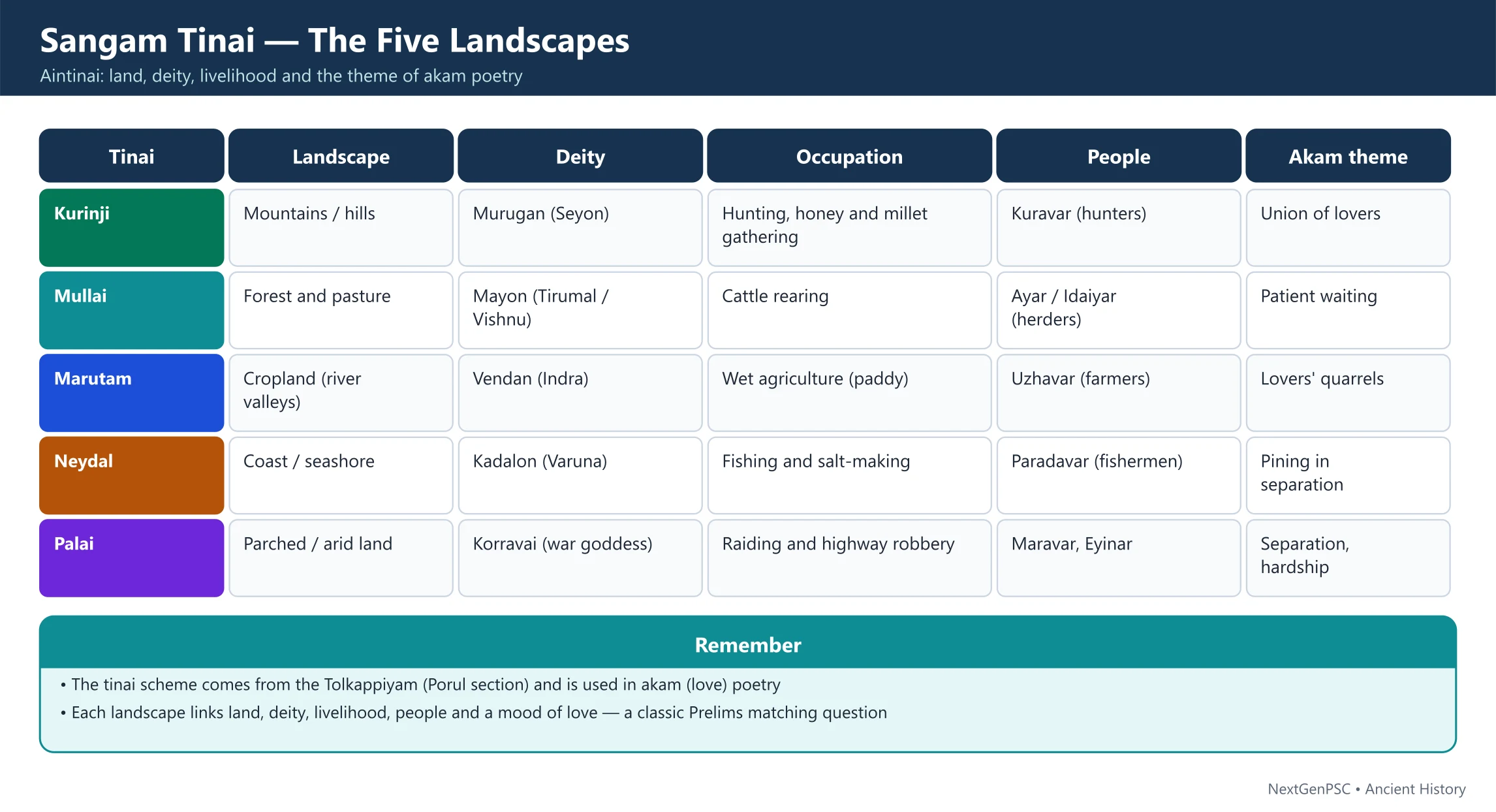
- Five tinai (landscapes): Kurinji – hills (Murugan); Mullai – forests and pasture (Mayon); Marudam – farmland (Indra); Neydal – coast (Varuna); Palai – arid land (Korravai).
Mains points
- Sangam society was less rigid compared to northern varna system.
- Women had better status and contributed to literature but patriarchy persisted.
- Religion was pluralistic: nature worship, hero worship, Brahmanical, Buddhist, and Jain practices co-existed.
- Agriculture was the backbone of economy, but external trade with Rome made Tamilakam prosperous.
- Sangam texts show an advanced, urbanizing society with vibrant trade and cultural life.
Did you know?
- The Sangam poems describe 5 eco-cultural regions (Tinai): Kurinji (mountain), Mullai (forest), Marutam (agricultural land), Neital (coastal), Palai (desert).
- Women poets like Avvaiyar, Nachchellaiyar, and Kakkaipadiniyar composed secular poems.
- Hero-stones (Nadukal) were worshipped like deities — a practice continuing in parts of Tamil Nadu.
- Roman coins discovered in Arikamedu prove that South India was a hub of Indo-Roman trade.
Comparison: Sangam Society vs. Later Vedic Society
The Sangam society (300 BCE – 300 CE) was more secular, occupation-based, and relatively open, while the Later Vedic society (1000–600 BCE) was dominated by rigid varna, Brahmanical rituals, and patriarchal norms. Both were agrarian but Sangam society was more urban and trade-oriented.
| Aspect | Sangam Society | Later Vedic Society |
|---|---|---|
| Social Structure | Not rigid; based on occupation & heroism; Velirs as chieftains | Rigid Varna system (Brahmana, Kshatriya, Vaishya, Shudra) |
| Women | Better status; women poets (Avvaiyar); widow remarriage allowed | Low status; excluded from assemblies; child marriage, sati appear |
| Religion | Nature worship (Murugan, Kotravai); hero stones; ancestor worship; Buddhism & Jainism present | Vedic deities (Indra, Agni, later Vishnu, Rudra); yajnas & rituals central |
| Polity | Monarchical (Cholas, Cheras, Pandyas); royal courts and local chiefs; later Chola assemblies should not be projected backward | Hereditary monarchy; kings supported by purohita, senani; Sabha & Samiti weakened |
| Economy | Agriculture + flourishing trade (Roman, SE Asia); pepper, pearls, cotton exports | Agriculture-based; iron ploughs; proto-currency (nishka, satamana) |
| Literature | Sangam poems (secular, realistic); Tolkappiyam | Vedas, Brahmanas, Aranyakas, Upanishads (religious-philosophical) |
| Society Type | Secular, realistic, urbanized in coastal areas | Ritualistic, agrarian, hierarchical |
Prelims tips
- Chola = Tiger; Pandya = Fish; Chera = Bow.
- Sangam literature = secular, Tolkappiyam = grammar + society.
- Later Vedic = rigid varna, decline of women’s status.
- Hero stones (Sangam) vs Yajnas (Later Vedic).
Mains points
- Sangam society was secular, realistic, and occupation-based, while Later Vedic society was ritualistic and varna-based.
- Women had a relatively better position in Sangam society compared to Later Vedic society.
- Religious practices differed: Sangam emphasized nature and hero worship, while Later Vedic focused on yajnas.
- Economically, Sangam society was more connected to international trade, whereas Later Vedic society remained agrarian.
- The comparison shows regional variations in early Indian societies.
Did you know?
- Sangam literature is secular and realistic, while Vedic texts are mostly religious.
- Women in Sangam society could compose poetry, unlike in Later Vedic society.
- Sangam economy was linked with Rome, while Later Vedic economy was largely internal and agrarian.
- Symbols of dynasties (Tiger, Fish, Bow) in Sangam society contrast with Vedic ritual symbols (yajna, soma).
Sangam Economy
The Sangam economy was based on agriculture, crafts, and flourishing internal and external trade. Ports like Kaveripattinam and Muziris linked Tamilakam with Rome, Southeast Asia, and Sri Lanka. Pepper, pearls, and textiles were major exports, while Roman gold coins and wine came as imports.
I. Agrarian Economy and Water Management 🌾
Agriculture formed the economic base of the Sangam kingdoms, relying heavily on advanced water management and riverine resources.
Staple Crop: Paddy (rice) was the staple crop, cultivated intensively in the fertile delta regions, particularly the Kaveri delta .
Irrigation: Productivity was strongly supported by systematic irrigation practices using tanks, wells, and extensive river embankments (an important state function).
Key Infrastructure: Karikala Chola is traditionally credited with the ancient Grand Anicut (Kallanai) on the Kaveri. The structure was repaired and modified over time, so its original date and attribution should be stated with caution.
Other Produce: Other important crops included millets (in dry areas), sugarcane, cotton (a major export), and spices like pepper and turmeric .
Supplementary Activities: Cattle rearing, fishing, and toddy-tapping were common supplementary economic activities, particularly in specific regional landscapes ( Tinai ).
II. Crafts, Industries, and Maritime Skill ⚓
The Sangam age was characterized by sophisticated manufacturing, catering to both local consumption and high-value foreign trade.
Textile Industry: Weaving was a major occupation, with cotton and silk textiles being produced. Uraiyur (the Chola capital) was renowned for its fine cotton textiles (often sought after by Roman traders).
Metal and Luxury Crafts: Metalwork (iron, gold, copper) for tools and ornaments, bead-making (using semi-precious stones), and ivory carving were flourishing industries.
Shipbuilding: Shipbuilding was a highly specialized and vital industry, supporting the extensive overseas trade.
Pottery as Trade Evidence: The discovery of local Black-and-Red Ware (BRW) alongside foreign Rouletted Ware and amphorae at sites like Arikamedu provides archaeological evidence of local industry co-existing with Indo-Roman trade .
III. Trade and Revenue: The Roman Connection 🪙
Trade was the engine of wealth, making the Tamil kingdoms prosperous and politically significant.
Internal Trade: Conducted through well-known local markets called Angadi in both villages and towns, connecting the productive heartlands with the port cities.
External Trade (The Boom): The most prominent feature was the brisk Indo-Roman trade . This exchange occurred primarily through major ports controlled by the Muvendar:
- Muziris (Chera, known for pepper).
- Arikamedu (Chola/Pandya, a Roman trading post).
- Kaveripattinam (Chola).
- Korkai (Pandya, known for pearls).
Exports/Imports: Exports included high-value, highly demanded goods: pepper (the key commodity), pearls, ivory, fine textiles, and spices . Imports mainly consisted of Roman gold coins (Denarii) , wine (in amphorae), glassware, and horses.
Numismatic Evidence: The discovery of Roman gold coins (from Emperors like Augustus, Nero, and Tiberius ) in hoards at sites like Karur and Arikamedu confirms the massive scale of trade and the favorable balance of trade for Tamilakam.
Other Links: Tamil merchants also maintained strong maritime links with Sri Lanka, Southeast Asia, and Egypt .
Revenue and Taxes
Main Revenue: Land Tax (Irai) was the primary source of royal income.
Secondary Revenue: Taxes were also collected through Customs duties (at ports, reflecting trade's importance), Trade taxes (on markets and guilds), Tributes from subordinate chiefs ( Velirs ), and War booty (plunder, which supplemented royal income and motivated the army).
Utilization: Revenue was used to maintain the standing armies , support the royal court , and fund public works (like embankments).
| Aspect | Features |
|---|---|
| Agriculture | Paddy cultivation; irrigation works; Grand Anicut by Karikala |
| Crafts | Weaving (cotton, silk); metalwork; bead-making; pottery |
| Trade (Internal) | Markets called Angadi; guild-based exchange |
| Trade (External) | Ports: Muziris, Arikamedu, Korkai; Indo-Roman trade |
| Exports | Pepper, pearls, ivory, textiles, spices |
| Imports | Gold coins, wine, glassware, horses from Rome |
| Revenue | Land tax (Irai), customs duties, tributes, trade taxes, war booty |
Prelims tips
- Karikala Chola → traditionally associated with the Grand Anicut (Kallanai) on the Kaveri.
- Main tax = Irai (land tax).
- Roman coins = proof of Indo-Roman trade.
- Pepper = 'Yavana Priya' (beloved of Greeks/Romans).
- Ports: Muziris, Arikamedu, Kaveripattinam, Korkai.
- Roman trade: the Muziris Papyrus (2nd century CE) records a loan for a cargo shipped from Muziris to Alexandria; Arikamedu near Puducherry was an Indo-Roman trading station.
Mains points
- Agriculture formed the backbone of the Sangam economy with paddy as the staple.
- Crafts like weaving, bead-making, and metallurgy supported trade.
- Indo-Roman trade flourished, making Tamilakam a hub of international commerce.
- Roman coins and foreign goods confirm maritime links with the Mediterranean.
- Revenue came mainly from land tax, customs, and tributes from local chiefs.
Did you know?
- The Periplus called pepper from Tamilakam 'black gold' and the most desired Roman import.
- Roman demand for Tamil pepper was so high that Pliny complained about Roman gold flowing into India.
- Uraiyur and Kaveripattinam were buzzing textile centers, exporting cotton to Rome.
- Nadukal (hero stones) sometimes mentioned merchants who died protecting caravans.
Sangam Literature: The Epics
The period immediately following the Sangam age saw the composition of the major Tamil Epics and didactic works (Pathinenkilkanakku). These epics—notably Silappadikaram and Manimekalai —are crucial for understanding the transition from the Sangam period to the Kalabhra interregnum, and for documenting social, religious, and commercial life.
I. The Five Great Tamil Epics (Aimperumkappiyam) 📖
While Sangam literature is primarily secular and realistic (Ettutogai, Pattuppattu), the later epics, written mostly in the post-Sangam period, are more devotional and often promote Buddhist or Jain ideals.
1. Silappadikaram (The Story of the Anklet):
- Author: Ilango Adigal (a Chera prince and Jain monk).
- Content: The story of Kannagi , who seeks justice for her husband Kovalan after he is wrongfully executed in Madurai (Pandya kingdom).
- Significance: Known for its vivid description of Sangam trade, urban life , and its Jain influence . Kannagi later became the subject of the Pattini cult (worship of the idealized wife, introduced by Senguttuvan Chera).
2. Manimekalai (The Story of the Bowl):
- Author: Sittalai Sattanar (a Buddhist poet).
- Content: It is the sequel to Silappadikaram, narrating the life of Manimekalai (Kovalan and Madhavi's daughter), who becomes a Buddhist nun.
- Significance: A powerful source for Buddhist doctrines and philosophy in South India and provides insight into the rivalry between Buddhism and Hinduism .
3. Civaka Cintamani: A Jain epic detailing the life of the prince Jivaka (Civaka), who ultimately renounces the world to become an ascetic. Jain philosophy is central.
4. Valayapathi and 5. Kundalakesi: Other major epics (less extant). Kundalakesi is a Buddhist epic that debates Jainism.
II. Didactic Literature (Pathinenkilkanakku)
This collection of 18 minor works, composed later (c. 300–600 CE), focuses primarily on ethics, morality, and code of conduct , indicating a society shifting from the heroic ideal to moral philosophy.
Tirukkural: The most famous work in this category, authored by Tiruvalluvar . It consists of 1330 couplets (Kural), covering three sections: Aram (Virtue/Dharma), Porul (Wealth/Polity), and Inbam (Love/Pleasure) . It is considered the 'Bible of Tamil Land' for its secular ethical content.
| Epic | Author | Religion | Content Focus |
|---|---|---|---|
| Silappadikaram | Ilango Adigal | Jainism | Justice, urban life, trade (Kannagi, Kovalan) |
| Manimekalai | Sittalai Sattanar | Buddhism | Buddhist philosophy, sequel to Silappadikaram |
| Civaka Cintamani | Tiruttakkathevar | Jainism | Jain ideal of renunciation (Life of Jivaka) |
| Tirukkural | Tiruvalluvar | Secular Ethics | Dharma, Artha, Kama (Virtue, Wealth, Love) |
Prelims tips
- Silappadikaram = Ilango Adigal, Jain, Kannagi.
- Manimekalai = Sittalai Sattanar, Buddhist.
- Tirukkural = Tiruvalluvar, Secular Ethics.
- Epics primarily belong to the Post-Sangam period (c. 300–600 CE).
- Kannagi worship (Pattini cult) linked to Silappadikaram.
Mains points
- Tamil epics and didactic literature mark the transition from Sangam heroism to a society focused on ethics and devotion.
- They are valuable sources for studying the influence and rivalry of Buddhism and Jainism in South India.
- The Tirukkural represents the pinnacle of Tamil ethical philosophy and is a unique secular guide to life.
- The epics showcase the continued prosperity of urban centers and maritime trade routes.
Did you know?
- The Silappadikaram and Manimekalai are known as the ‘Twin Epics’.
- The Manimekalai provides a powerful critique of the Hindu caste system from a Buddhist perspective.
- The Tirukkural is considered one of the greatest ethical works ever written.
- Ilango Adigal was the brother of the famous Chera King Senguttuvan.
Chola Society (9th–13th Century CE)
Chola society was heavily stratified, primarily characterized by a rigid Varna-Jati hierarchy and a dominant Brahmanical religious and social order . However, the period also saw a strong, organized merchant class (Nanadesis) and craft guilds , which played a major economic role and provided a degree of social mobility.
I. Varna, Caste, and Social Stratification 🔪
Brahmanical Dominance: Brahmanas held the highest social status and enjoyed immense political and economic power through Brahmadeya (tax-free land grants) from the Chola kings. They were primarily involved in temple administration, education, and ritual performance.
Kshatriya/Vellalar: The Vellalar (wealthy agricultural landholders) emerged as the dominant secular elite, often intermarrying with the ruling Kshatriya families. They controlled local administration and military affairs.
Social Cleavage: Chola society was notoriously divided into two major hostile groups, reflecting competition for status: the Valangai (Right-hand faction, mainly agriculturalists and some lower castes) and Idangai (Left-hand faction, mainly artisans, merchants, and landless laborers).
Temple Workers: The vast, imperial Chola temples (like Brihadeshwara) became huge economic and social centers, employing thousands of people (devadasis, musicians, craftsmen, cooks), reinforcing the temple-centered social structure.
Untouchability: Caste rigidity became more pronounced than in the Sangam era, and untouchability was clearly institutionalized, restricting movement and occupation for marginalized groups.
II. Women, Family, and Religion 💍
Women's Status: The status of women in the Chola period declined significantly compared to the Sangam era. Women were generally excluded from property ownership and education. The system of Devadasi (temple servants) was institutionalized, highlighting both the patronage of art and the subordination of women in a highly religious context.
Sati: The practice of Sati (self-immolation by widows) was practiced, mainly by the royal and aristocratic families, as recorded in inscriptions.
Joint Family: The Joint Family system and patriarchal authority remained the dominant social norm.
Religion: The Chola period was the zenith of the Bhakti movement (Alvars and Nayanars). Chola kings were staunch Shaivites (e.g., Rajaraja I, Rajendra I), patronizing the construction of massive Shiva temples, but were largely tolerant of Vaishnavism and other faiths.
III. Economic and Urban Life 💰
Trade and Guilds: The powerful merchant guilds ( Nanadesis and Manigramam ) were crucial. They facilitated international trade across the Bay of Bengal, financing temples, and maintaining a high status in urban centers ( Nagaram ).
Agrarian Economy: The agrarian base was very strong, supported by advanced irrigation systems (e.g., the Chola water tank/lake at Gangaikonda Cholapuram ).
Urban Centers: Cities like Kanchipuram, Thanjavur, and Gangaikonda Cholapuram flourished as administrative, religious, and trading capitals, supported by the wealth generated from land revenue and overseas trade.
| Aspect | Features |
|---|---|
| Social Order | Rigid Varna-Jati system; Brahmanical dominance; Valangai/Idangai split |
| Women’s Status | Declining; institutionalization of Devadasi and Sati (in royal families) |
| Religion | Shaivism dominant (Rajaraja I); Bhakti movement apex; religious tolerance |
| Economy | Strong agrarian base (irrigation); maritime trade (Bay of Bengal); powerful guilds (Nanadesis) |
Prelims tips
- Brahmanas received Brahmadeya (land grants).
- Vellalars were dominant landholders/administrators.
- Valangai/Idangai = Right-hand/Left-hand caste divisions.
- Devadasi system and Sati (royal) existed.
- Rajaraja I was a staunch Shaivite .
Mains points
- Chola society was marked by social hierarchy and a rigid caste system, often leading to factional conflicts (Valangai/Idangai).
- The period saw the zenith of Bhakti movement and strong religious patronage, making the temple the center of social and economic life.
- Despite the economic prosperity brought by guilds and maritime trade, the status of women declined significantly.
- The Chola state actively promoted Brahmanical orthodoxy while managing social conflicts.
Did you know?
- The split between Valangai and Idangai factions often led to localized conflicts in Chola society.
- The Chola tax system was highly advanced, collecting taxes not just on land, but on professions, houses, and even fishing nets.
- The Nataraja bronze sculpture is the most famous example of Chola art, often associated with Shiva worship.
Chola Administration and Local Governance
Chola administration was monarchical with a highly organized central government, but its unique feature was the robust system of local self-government through autonomous village assemblies ( Urar, Sabha ). The Uttaramerur inscription provides detailed rules for their democratic functioning.
I. Central Administration and Officials 👑
Monarchy: Chola kingship was hereditary, with the king as the supreme authority, often taking grand titles like Rajadhiraja (King of Kings).
Council and Bureaucracy: The king was assisted by a Council of Ministers and a well-organized, large bureaucracy of officials. Officials were generally paid in land assignments rather than cash (a feudal trait).
Revenue: Land revenue (Kadamai) was the chief source of income. Land was meticulously surveyed and classified for tax purposes. Other taxes included professional taxes, customs, and duties.
Military: The Cholas maintained a large standing army and the strongest Navy in Asia, crucial for overseas expansion and trade control (especially the Bay of Bengal).
II. Provincial and Local Administration 🏘️
Provincial Division: The empire was divided into Mandalams (provinces), usually headed by a viceroy (often a royal prince). Mandalams were subdivided into Valanadus , which were further divided into Nadus (districts) and Kurram (groups of villages).
Nadu (District): Managed by an assembly called Nattar , who were responsible for local administration and revenue collection.
Urban Centers (Nagaram): Trading centers and towns were managed by assemblies called Nagaram , comprised mainly of merchants and traders .
III. Local Self-Government: The Chola Legacy 🗳️
The Chola period is famous for its autonomous local governance, documented by the Uttaramerur inscription of Parantaka I (10th century CE).
Urar (Ur): The assembly of all common tax-paying residents in ordinary villages . They managed local affairs, irrigation, and local temples.
Sabha (or Mahasabha): The assembly of adult Brahmanas in Brahmadeya (land granted to Brahmanas) villages. It was highly sophisticated and ran through an intricate system of committees (Variyam) , which handled specialized functions like:
- Samvatsara Variyam: Annual committee for general affairs.
- Eri Variyam: Tank/irrigation committee.
- Totta Variyam: Garden committee.
- Pon Variyam: Gold committee (finance).
Election Process (Kudavolai): The inscription details a highly democratic and sophisticated election system. Members were selected by lottery from among the qualified residents of 30 wards (villages), a system called Kudavolai (meaning 'pot-leaf-ticket').
Qualifications (Uttaramerur): Strict qualifications applied: minimum age (35–70) , land ownership, and minimum educational requirements. Misconduct or failure to submit accounts led to immediate disqualification for life (preventing corruption).
IV. Judicial System
The King was the supreme judicial authority. The Rajendra Chola II inscription mentions the Dharmasana (King's court). Village assemblies and caste assemblies also adjudicated local, minor disputes. Punishments ranged from fines to mutilation or execution (for serious crimes).
| Assembly | Area/Membership | Key Function |
|---|---|---|
| Urar (Ur) | General villages (All resident taxpayers) | Basic village administration, irrigation, temples |
| Sabha (Mahasabha) | Brahmadeya villages (Brahmanas only) | Advanced democratic functions, specialized committees (Variyams) |
| Nagaram | Trading towns (Merchants, traders) | Managed commercial affairs |
| Nadu (Nattar) | District assembly | Managed district-level affairs and revenue |
Prelims tips
- Kudavolai system = Chola election by lottery (Uttaramerur).
- Urar = common village assembly; Sabha = Brahmana assembly.
- Variyam = specialized committees of the Sabha (Eri Variyam for irrigation).
- Rajendra I → defeated Srivijaya (maritime power).
- Nadu was a district managed by the Nattar assembly.
Mains points
- Chola administration was characterized by strong centralization balanced with robust local self-government .
- The Sabha and Kudavolai system represented a highly sophisticated and functional form of village-level democracy in ancient India.
- The division of the realm into Mandalams, Nadus, and Kurrams ensured efficient revenue collection and military mobilization.
- The Chola Navy's strength was the key to their economic dominance and projection of power across the Bay of Bengal.
- The local assemblies' control over land and justice reduced the burden on the central government.
Did you know?
- The Kudavolai (lottery) system ensured fairness and prevented dynastic control over local elections.
- The Uttaramerur inscription of Parantaka I (10th CE) is famously studied by political scientists for its detailed rules of democracy.
- The Chola Navy was the strongest in Asia, enabling Rajendra Chola's conquest of the Srivijaya kingdom (Southeast Asia).
- The Chola tax system was complex, collecting taxes not just on land, but on professions, houses, and even fishing nets.
Chola Society and Economy
Chola society was stratified by caste, with Brahmanas at the top and social mobility restricted. The economy was heavily reliant on agrarian prosperity (Kavery delta), supported by maritime trade with Southeast Asia and China, leading to the rise of powerful merchant guilds ( Nanadesis ).
I. Social Structure: Stratification and Hierarchy 📉
Brahmanical Apex: Brahmanas held the highest social status due to royal patronage (Brahmadeya grants) and their role as ministers and priests . They were crucial in legitimizing Chola rule through Vedic rituals.
Vellalar Dominance: The Vellalar (agricultural landholders) were the dominant secular elite, controlling local governance and forming the backbone of the bureaucracy.
Social Division (Valangai/Idangai): A unique and often tense social cleavage existed between the Valangai (Right-hand, mainly agricultural and lower castes) and Idangai (Left-hand, mainly artisan and merchant castes). Conflicts over social privileges were frequent.
Women's Status: The status of women declined . They were excluded from property rights and public life. The institutionalization of the Devadasi system and the documented practice of Sati (in royal families) highlight this decline.
Religion: Chola kings were devout Shaivites (e.g., Rajaraja I), promoting the Nayanar tradition, but they maintained religious tolerance toward Vaishnavism (Alvar tradition) and Buddhism.
II. Economic Pillars: Land and Sea 🚢
Agrarian Foundation: The Kaveri delta was the economic heartland, characterized by intensive paddy cultivation and supported by sophisticated irrigation systems (dams, tanks, canals). Land revenue was the primary tax source.
Trade and Guilds: Trade flourished both internally and internationally:
- Internal Trade: Well-established markets (Angadi) and local merchant assemblies ( Nagaram ).
- International Trade (The Key): Cholas monopolized the Bay of Bengal trade routes, connecting India to China (Song Dynasty) and Southeast Asia (Srivijaya) . This generated immense wealth.
- Merchant Guilds (Shrenis): Powerful guilds like Nanadesis (operating across kingdoms) and Manigramam (local/regional) controlled foreign trade, financed temples, and acted as proto-banks (accepting deposits and issuing loans).
Currency: Cholas issued numerous gold, silver, and copper coins with imperial emblems (Tiger), stabilizing the monetary economy for long-distance commerce.
Temple Economy: The massive temples (Brihadeshwara) were not just religious centers but huge economic institutions —employing labor, managing vast land grants, financing local businesses, and acting as centers for record-keeping.
| Aspect | Features |
|---|---|
| Social Order | Rigid Varna-Jati system; Valangai/Idangai (factional split) |
| Women’s Status | Declining; Devadasi system; Sati (royal) practiced |
| Religion | Shaivism dominant (Nayanar tradition); immense temple construction |
| Economy | Agrarian base (Kaveri Delta); Maritime Monopolies (Bay of Bengal) |
| Trade Agents | Powerful Nanadesis and Manigramam merchant guilds |
| Coins | Gold, silver, copper (imperial Tiger emblem) |
Prelims tips
- Brahmadeya (land grants to Brahmanas) was common.
- Vellalar = powerful landholders.
- Nanadesis/Manigramam = major merchant guilds (trade/banking).
- Valangai/Idangai = caste-based factional split.
- Devadasi system was institutionalized.
Mains points
- Chola society was hierarchically stratified, promoting Brahmanical orthodoxy, yet it contained significant internal social friction (Valangai/Idangai).
- The economy was a synergistic blend of a strong agrarian base and lucrative maritime trade, generating surplus.
- Merchant guilds were autonomous economic centers, crucial for trade, finance, and cultural patronage.
- The decline in women's status (Sati, Devadasi) contrasts sharply with the state's political and military zenith.
Did you know?
- The Brihadeshwara Temple at Thanjavur alone controlled vast agricultural land, making it one of the largest landholders in South India.
- Rajendra Chola’s naval conquest of Srivijaya (Indonesia/Malaysia) was aimed primarily at protecting Chola maritime trade routes from piracy.
- Chola society was so caste-ridden that conflicts between the Valangai (right-hand) and Idangai (left-hand) factions were frequent and violent.
Chola Art and Architecture
The Chola period marked the zenith of Dravida temple architecture . Chola temples, notably the Brihadeshwara Temple in Thanjavur, were monumental, featuring towering Vimanas , elaborate Gopurams , and massive courtyards. The Cholas are also world-famous for their elegant bronze Nataraja sculptures .
I. Dravida Style Temple Architecture: Zenith of the Vimana 🏛️
The Cholas inherited and perfected the temple-building tradition initiated by the Pallavas, moving towards large-scale, monumental imperial structures.
Vimana Dominance: Chola architecture is defined by the Vimana (the central tower over the main shrine). The Vimana became pyramidal and massively tall , dominating the temple complex (e.g., the Brihadeshwara Temple Vimana is 66 meters high).
Brihadeshwara Temple (Thanjavur): Built by Rajaraja I (c. 1010 CE). It is a UNESCO World Heritage site and the largest temple of its time. It is known for its massive scale, intricate carvings, and the single-stone cap (Shikhara), which weighs approximately 80 tons.
Later Temples: Rajendra I built the Gangaikonda Cholapuram Temple , which was stylistically similar to the Thanjavur temple but slightly shorter, symbolizing his conquest of the North.
Gopurams: While the Vimana was the focus, the Gopurams (entrance gateways) also became increasingly larger, detailed, and adorned with multiple sculptures (this trend was further magnified by the later Pandyas).
Sculpture Integration: Temple walls and towers were covered with intricate narrative sculptures , detailing Puranic episodes and the life of the King.
II. Chola Bronze Sculpture: The Nataraja Ideal 🥉
Chola bronze casting is considered the finest in the world , unparalleled in its technical skill and artistic elegance in the medieval period.
Nataraja Sculpture: The iconic Nataraja (Dancing Shiva) figure, depicting Shiva performing the Ananda Tandava (dance of bliss, symbolizing cosmic creation and destruction), is the most famous Chola contribution. These sculptures were designed to be carried in temple processions.
Technique: The sculptures were made using the lost-wax technique (Cire Perdue) , an ancient and complex method that allowed for the casting of highly detailed, hollow figures.
Idealism: Chola bronzes are characterized by their idealized form, graceful movement, and emotional expressiveness , representing the zenith of metal art in ancient India.
III. Paintings
Chola temples featured frescoes and murals on inner walls and ceilings. Paintings depicting royal portraits and mythological scenes (e.g., inside the Brihadeshwara Temple) are important art historical sources.
| Monument | Ruler | Style/Significance |
|---|---|---|
| Brihadeshwara Temple (Thanjavur) | Rajaraja I | Largest Dravida Vimana (66m); UNESCO World Heritage site |
| Gangaikonda Cholapuram Temple | Rajendra I | Built after Ganga campaign; stylized Dravida Vimana |
| Nataraja Bronze | Multiple rulers | Iconic symbol of cosmic dance (Ananda Tandava); Lost-wax technique |
Prelims tips
- Dravida Style zenith = Cholas.
- Brihadeshwara Temple = Rajaraja I, Thanjavur.
- Gangaikonda Cholapuram = Rajendra I.
- Nataraja = Chola bronze, Lost-wax technique.
- Focus: Vimana (tower) taller than Gopuram (entrance).
Mains points
- Chola architecture perfected the Dravida style, emphasizing the monumental scale of the Vimana as a symbol of imperial power.
- Bronze sculptures, especially the Nataraja , showcase the technical and artistic sophistication of the Chola era.
- Chola temples functioned as socio-economic institutions , controlling vast resources and employing large populations.
- The architecture and art reflect the dominance of Shaivism and the cultural integration of the empire.
Did you know?
- The Brihadeshwara Temple (Thanjavur) has a Vimana that casts no shadow at noon.
- The massive single-stone cap (Shikhara) of the Thanjavur Vimana was rolled up an inclined plane built from over 6 km away.
- The Lost-wax technique used for Nataraja bronzes was known to the Harappans (Dancing Girl).
- The Chola temples are not just religious sites but were centers of administration, education, and economy.
Megalithic Culture of South India (Iron Age Background to the Sangam Age)
From about 1000 BCE, people of South India buried their dead in megaliths — monuments of large stones such as dolmens, cists, cairn circles and menhirs — along with iron tools and black-and-red ware. This Iron Age culture formed the material base of the Sangam age.
What Are Megaliths?
'Megalith' means 'big stone'. In South India they are mainly burial or memorial monuments of the Iron Age (broadly c. 1000 BCE to the early centuries CE).
Types of Megaliths
Dolmen — a large flat capstone resting on upright stones.
Cist — a stone box-chamber, often buried, sometimes with a 'port-hole' opening.
Cairn circle — a heap of stones over a burial, ringed by a circle of boulders.
Menhir — a single tall standing stone, often a memorial.
Urn burials — remains placed in large pottery urns (common in Tamil Nadu).
Kerala forms — rock-cut chambers, topikal (hood stones) and kudakkal (umbrella stones).
Important Sites
Brahmagiri and Maski (Karnataka) — Brahmagiri was excavated by Mortimer Wheeler (1947).
Adichanallur (Thoothukudi, Tamil Nadu) — large urn-burial site on the Tamraparni.
Hallur (Karnataka) — early evidence of iron in South India; Junapani (Vidarbha) — stone circles.
Kodumanal (Erode) — megalithic burials with iron, beads and Tamil-Brahmi graffiti.
Porkalam (Kerala) — rock-cut chambers and umbrella stones.
Material Culture
Iron tools and weapons (axes, sickles, swords, arrowheads), black-and-red ware, beads of carnelian and other stones, and occasionally horse equipment.
Settlements were usually small; people practised agriculture, herding and crafts.
Link with the Sangam Age
Sangam poems describe urn burial and hero stones (nadukal), showing continuity with megalithic customs.
Ashoka's edicts at Brahmagiri and Maski lie within the megalithic zone, linking it with the early historic period.
Megaliths are also found in central India and the north-east, where the Khasis continued erecting memorial stones in recent times.
| Type | Description | Example region / site |
|---|---|---|
| Dolmen | Capstone on upright stones | Karnataka, Tamil Nadu |
| Cist | Stone box-chamber, sometimes with port-hole | Brahmagiri |
| Cairn circle | Stone heap ringed by boulders | Junapani (Vidarbha), Deccan |
| Menhir | Single standing stone | Karnataka, Andhra Pradesh |
| Urn burial | Remains in large pottery urns | Adichanallur (Tamil Nadu) |
| Topikal / Kudakkal | Hood stone / umbrella stone | Kerala (Porkalam) |
Prelims tips
- Megalithic culture → Iron Age burials with iron tools and black-and-red ware.
- Adichanallur → urn burials (Tamil Nadu); Brahmagiri → excavated by Wheeler in 1947.
- Topikal and Kudakkal → hood and umbrella stones of Kerala.
- Menhir → single standing stone; dolmen → capstone on uprights; cist → stone box.
- Brahmagiri and Maski → megalithic sites that also have Ashokan edicts.
Mains points
- Megalithic culture represents the spread of iron technology and settled agriculture in South India before the early historic period.
- Elaborate burials with grave goods reflect beliefs in an afterlife and growing social differentiation.
- Continuity between megalithic customs and Sangam texts (urn burial, hero stones) links archaeology with literature.
- Recent excavations at Adichanallur, Kodumanal and Keezhadi are pushing back dates and enriching the picture of early Tamil society.
Did you know?
- Some South Indian cist burials have a 'port-hole' in one slab, possibly so that later remains could be added.
- The Khasi people of Meghalaya continued to erect memorial monoliths into the 20th century — a living megalithic tradition.
- Adichanallur was first explored in the 1870s, and finds from it are in museums in Chennai and Berlin.